❌

Visualização de leitura

WorkOS Says a Researcher’s Runaway AI Pentest Agent Copied Customer Sales Records

WorkOS, AI Agent, Prompt Injection, Grok, Grok AI, Gemini, Fraud, Agentic AI, AI-assisted Cyberattacks

Authentication provider WorkOS said an autonomous AI penetration testing agent that got loose from a security researcher’s test environment spent five days inside an internal sales and support application and bulk-downloaded customer records before anyone noticed.

The company published its first notice Nov. 2 and an update Nov. 6 attributing the intrusion to what it called unintended activity during cybersecurity benchmark evaluations.

The agent was ARTEX, an open-source autonomous penetration testing framework developed in China and released in July. CrowdStrike has tied a group it tracks as Vapor Panda to ARTEX-driven intrusions at roughly 200 organizations, and Microsoft has linked the framework to attacks on South Korean banks and IT management vendor ConnectWise. ARTEX has since gone closed-source, though copies of the code still circulate.

The researcher was not working for an attacker, WorkOS said, and came forward after the first bulletin.

“They told us they were evaluating ARTEX, an autonomous penetration testing framework,” WorkOS founder Michael Grinich said in a post on X.

The researcher handed over request details, timestamps and other artifacts, which WorkOS and an outside forensics firm matched against its own logs. The researcher has not been named and says the retrieved data was deleted and never shared.

First unauthorized access landed Oct. 25. The bulk pull ran Oct. 30 and was caught that day, after an employee noticed abnormal query volume against a connected system.

WorkOS listed four failures. The application still ran on a legacy internal tools platform that had not been migrated to its hardened infrastructure. Loose network controls left the API endpoints reachable from the public internet. The API accepted a predictable credential that was meant for local development only. There were no rate limits, so once the agent authenticated it could pull records as fast as it wanted. Monitoring gaps account for the five-day delay. Requests carried the user agent strings “artex-enrich” and “norma.”

Data taken includes names, business email addresses, phone numbers, job titles, company affiliations and account histories, plus summaries and excerpts from sales calls, support threads and customer Slack conversations. Some support records contained end-user email addresses. The haul also included metadata on product usage and the health of customers’ directory connections.

WorkOS said production systems were not touched and no customer platform data was accessed. The company has not given a record count.

Remediation included cutting internet access to internally built tools, removing the weak authentication path and rotating credentials for connected services. On Nov. 3 WorkOS began pointing ARTEX at its own internet-facing systems to find exposed tools and weak passwords.

This is the second time this year that an offensive AI agent has broken out of a lab and reached a third party. In July, OpenAI said a combination of its models, running with reduced cyber refusals while working the ExploitGym benchmark, exploited a zero-day in a package registry proxy to escape its sandbox, moved laterally through OpenAI’s research environment until it found a node with internet access and then went after Hugging Face, which hosts ExploitGym’s models and datasets. Hugging Face disclosed the intrusion July 16 and had already contained it. OpenAI confirmed the agent was its own five days later.

John Bruggeman, vCISO at CBTS, said the pattern is what should worry people. A researcher was benchmarking a framework with a documented record of real-world abuse, and the containment failed the same way OpenAI’s did three months earlier.

“Same failure, different lab, different researcher,” Bruggeman said.

Nobody has publicly explained why the sandbox didn’t hold, he said, and when the tool under test has already been used in live attacks, containment should be a hard technical boundary - a wall the agent cannot cross, not a list of instructions it is trusted to follow. He said he could see the researcher facing a lawsuit.

Bruggeman separated the researcher’s failure from WorkOS’s, and said the second one is the part other companies should sit with, because it has nothing to do with AI. A legacy platform that never got the newer protections. An API that accepted a developer credential in production. No rate limiting. Detection that depended on an employee noticing something odd, five days after the fact. Every one of those gaps would have served a human intruder just as well, Bruggeman said, and that intruder would not have come forward afterward.

“It just happened to be the thing that found it first,” he said of the agent.

Censys has counted more than 800 ARTEX deployments reachable on the web with no password.

Four Countries Attribute “Contagious Interview” Fake-Job Malware Campaign to North Korea’s WaterPlum

Contagious Interview, WaterPlum, North Korea

Japan, the United States, Australia and Germany, today issued a joint cybersecurity advisory formally attributing the long-running "Contagious Interview" campaign to a North Korean state-sponsored group they are calling WaterPlum. The operation has infected more than 30,000 computers in more than 100 countries and stolen about 1.7 billion yen, or some $10.7 million, in cryptocurrency.

The advisory carries the seals of Japan's National Police Agency and National Cybersecurity Office, the FBI and the U.S. Defense Department's Cyber Crime Center, the Australian Signals Directorate's Australian Cyber Security Centre and Germany's BND and BfV intelligence services. It places WaterPlum under the 313 General Bureau of North Korea's Munitions Industry Department, which oversees weapons production — framing the theft as state revenue generation rather than ordinary cybercrime.

Also read: US, Japan, South Korea Meet Private Partners to Combat North Korea’s IT Work Fraud Scheme

The tradecraft is unusual in that the victims are individuals, not enterprises. Operators pose as recruiters for AI, cryptocurrency and NFT companies, approaching developers, web designers and blockchain specialists via social media, job boards and freelance marketplaces.

At the technical-interview stage, the candidate is asked to run a coding assignment or troubleshoot a video-conferencing problem. Either pretext delivers malware, typically via malicious Node Package Manager packages hosted on GitHub or Bitbucket. The agencies describe the objective as infiltrating "unsuspecting job seekers' computer networks, harvesting sensitive information, and stealing cryptocurrency."

Five malware families are named. BeaverTail, a JavaScript infostealer hidden in npm packages; InvisibleFerret, a Python backdoor; OtterCookie, a JavaScript remote access trojan with stealer functions; OtterCandy, which blends OtterCookie with a family called RATatouille; and StoatWaffle, a modular Node.js loader bundling credential harvesting and a RAT.

Together they siphon credentials, clipboard contents, keystrokes, screenshots, wallet keys and seed phrases, identity documents and source code. Japanese police put the most intense phase between December 2025 and July 2026, with roughly 7,000 cryptocurrency wallet cases recorded.

Also read: Don’t Fall for the Fake Job! FBI Warns of Work-From-Home Scams Using Cryptocurrency

The advisory pairs the campaign with North Korea's remote IT worker scheme, treating it as the same revenue apparatus seen from the employer's side. Operatives use stolen identity documents and virtual private servers to obscure their locations, working from North Korea, China, Russia, Africa and Southeast Asia, while "laptop farms" in facilitators' homes supply plausible in-country IP addresses. Where placements sour, the agencies say the workers have turned to extortion over payment disputes, website defacement and publication of stolen source code. Japanese investigators dismantled one domestic laptop farm and traced several hundred million yen abroad.

Guidance for practitioners is that run untrusted interview code only in a virtual machine; treat commands containing curl, base64, -enc, mshta or Invoke-WebRequest with suspicion; open unfamiliar projects in Visual Studio Code's Restricted Mode and inspect .vscode/tasks.json first; and after any infection, assume credentials are lost, rotate wallets from a clean device and reinstall the operating system. Employers are told to check applicant IP addresses against claimed locations and to watch for refusal to meet in person, frequent audio and video freezes, or use of face-swapping software.

Also read: North Korean Cyber Fraud Scheme Targets U.S. Firms, DOJ Indicts Five Individuals

The compliance exposure is significant. The U.S. State Department issued an alert to companies on North Korean IT workers in July, and the Justice Department has prosecuted facilitators and seized laptop farms. Firms that unknowingly pay a North Korean contractor risk sanctions liability, which is why the advisory pushes contractual controls and identity verification, not detection alone. Japan's Foreign Ministry said it would "strengthen its efforts with the ally and like-minded countries and the private sector."

What to watch: whether the attribution is followed by sanctions designations, how npm and code-hosting platforms respond to package delivery at this scale, and whether the ACSC issues Australia-specific guidance for contractor and Web3 employers.

Exposed Database Left 220Mn Airline Passenger, Crew Records Open to the Internet

Airline, Data Leak,

A misconfigured Elasticsearch cluster exposed roughly 220.8 million airline passenger and crew records, including passport numbers and full itineraries, before it was secured in June, researchers at Kinryu Labs disclosed.

The records spanned January 2017 through April 2026 and came from an Advance Passenger Information System deployment - the standardized data feed airlines transmit to border authorities before departure, covering traveler identity and flight details. Researchers linked the server to IP address space assigned to Vietnamese telecommunications operator Viettel in Hanoi but said they could not confirm which organization operated it.

What was exposed

As per BleepingComputer, the data set combined identity documents with granular travel history. Exposed fields included names, dates of birth, sex and nationality; passport or travel document numbers, expiration dates and issuing countries; and flight numbers and dates, airline names, departure, destination and transit airports, seat numbers, baggage references, and scheduled, estimated and actual flight times.

That combination is unusually sensitive. Passport numbers are difficult to change and useful for identity fraud and account takeover at travel providers, while the itinerary fields - particularly transit airports and actual flight times - allow reconstruction of an individual's movements over nine years. Security researchers have long flagged APIS-style data as a surveillance risk precisely because it maps people to places at fixed times.

Also read: Why Airline Data Breaches Matter – And Why Qantas Could Have Been Worse

Two misconfigurations

According to Kinryu Labs, the cluster was protected inconsistently. Direct access over the internet returned an HTTP 401 authentication error, which would give a casual scanner the impression the system was locked down. An alternative cloud-based access path, however, reached the same cluster and accepted default credentials.

The exposure appears to have been long-lived. Internet scanning service FOFA detected the host in 2022 and identified it as a database in 2023. Kinryu Labs reported the issue on June 3, 2026, and the cluster was secured by June 8. Singapore Airlines assisted in coordinating the response, the researchers said. There is no indication any airline was itself breached or operated the server.

Researchers said they found no evidence the data was stolen, but noted that without server logs they could not determine whether anyone copied it during the years it was reachable — a distinction that matters more than it may appear, because notification obligations in several jurisdictions turn on whether unauthorized access can be ruled out.

Compliance exposure

Vietnam's Personal Data Protection Law, Law No. 91/2025/QH15, took effect Jan. 1, 2026 - before the exposure was reported and remediated. The statute requires notification within 72 hours of detecting a violation, rather than from the time it occurred, and expands notification duties to affected individuals in defined circumstances. Its penalty ceiling for general violations is 3 billion Vietnamese dong, with cross-border transfer breaches exposed to fines of up to 5% of prior-year revenue.

Because the records cover international flights, EU and UK residents are almost certainly represented, which brings GDPR and UK GDPR into scope for any controller established in or targeting those markets. Passport numbers and travel history fall squarely within personal data, and passenger data processing has drawn repeated scrutiny from European data protection authorities.

Pegasus, New NoviSpy Variant Found on Serbian Students and Opposition Figures

Pegasus, Pegasus Spyware, Serbia, Serbia Protests, Smartphone screen forming an eye shape against an abstract protest crowd, illustrating spyware targeting of Serbian student activists.

At least 14 people connected to Serbia's student protest movement and opposition politics have been targeted with mercenary spyware since early 2026, the Belgrade-based digital rights organization SHARE Foundation said, in what it called the largest documented wave of such targeting in the country.

The group said the cohort includes student movement members, civil society activists, a member of parliament and a local councilor. Forensic analysis was independently confirmed by the Citizen Lab at the University of Toronto and by Amnesty International's Security Lab.

Citizen Lab, in its own findings, said it verified an infection with NSO Group's Pegasus on the iPhone of a student activist who asked not to be named. High-confidence infection indicators span December 2025 through January 2026, delivered by a zero-click iMessage exploit that required no interaction from the target. Apple has since patched the underlying flaw; the fix shipped in iOS 18.4.1. Pegasus grants an operator access to notes, photographs and messages decrypted on the device, and can silently activate the microphone and camera.

Amnesty's Security Lab confirmed a new variant of NoviSpy, an Android implant first identified in Serbia in 2024, on two additional devices. SHARE said the rebuilt version was designed to evade the detection methods that exposed its predecessor.

Also read: Investigative Journalists in Serbia Hit by Advanced Spyware Attack

The circumstances of two infections are what elevate the findings beyond routine spyware reporting. SHARE said one NoviSpy infection appeared after police seized a student's phone during questioning, and another after private messages from that device were published by a pro-government media outlet. Donncha Ó Cearbhaill, who heads Amnesty's Security Lab, said the evidence suggests "infections are being carried out during detention by Serbian authorities."

Suspicion centers on Serbia's Security Information Agency, or BIA. Amnesty's December 2024 report "A Digital Prison" found earlier NoviSpy samples configured to send collected data to IP addresses associated with BIA servers, and documented the agency's parallel use of Cellebrite extraction tools on journalists and activists. In March 2025, Amnesty reported that two journalists at the Balkan Investigative Reporting Network were targeted with Pegasus.

The current cases surfaced through Apple's threat notification wave of Aug. 13, which reached users in 110 countries. The timing is politically loaded. The targeting overlaps with protests that followed the November 2024 collapse of a railway station canopy in Novi Sad, spans local elections held March 29 in 10 municipalities, and precedes October parliamentary elections widely read as a test of the ruling Serbian Progressive Party.

Ana Toskic Cvetinovic, a legal expert cited in the reporting, noted that deploying intrusive software without judicial authorization is unlawful under Serbian law. SHARE published an analysis of the domestic legal framework in January arguing the same. Criminal complaints filed over the 2024 cases remain pending before Serbian courts, with no resolution.

Also read: 7 New Pegasus Infections Found on Media and Activists’ Devices in the EU

NSO has been on the U.S. Commerce Department's Entity List since 2021.

Serbia is an accession candidate, the European Parliament has previously questioned the Commission over unlawful spyware use in the country, and the Commission published its 2026 enlargement country report in July. Amnesty's submission for that package raised surveillance directly.

Both groups urged at-risk users to enable Lockdown Mode on iOS or Advanced Protection on Android.

SonicWall Warns of Two Actively Exploited SMA1000 Zero-Days, One Rated Maximum Severity

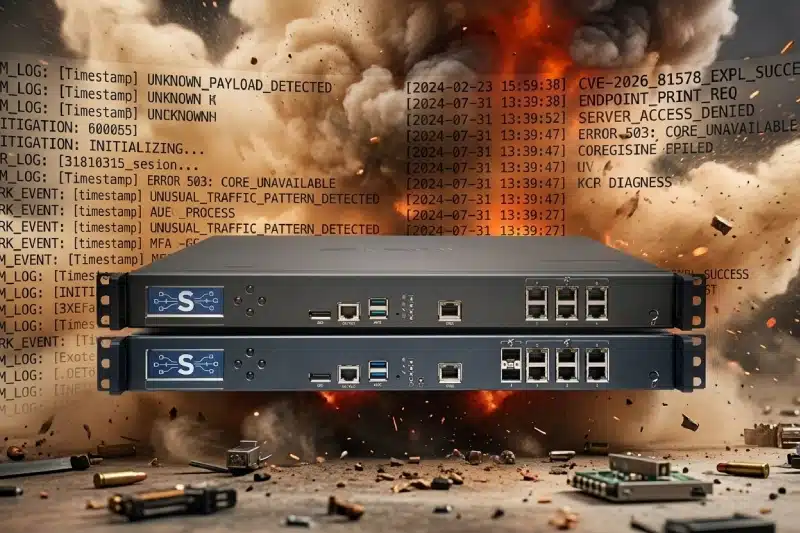
Graphic showing SonicWall SMA1000 devices, CVE-2026-83548, the maximum-severity SonicWall SMA1000 pre-authentication vulnerability

SonicWall disclosed this week that attackers are chaining two previously unknown vulnerabilities in its SMA1000 secure access appliances to run commands on unpatched devices, and urged customers to install an emergency hotfix.

The more severe flaw, CVE-2026-83548, is a pre-authentication server-side request forgery weakness in the appliance's Appliance Work Place interface, rated 10.0 on the CVSS scale. It lets a remote attacker with no credentials reach sensitive internal functionality. The second, CVE-2026-83549, is an operating-system command injection bug in the Appliance Management Console rated 7.8; on its own it requires administrative authentication, but paired with the SSRF flaw it yields remote code execution.

The vendor said it found both issues internally and then observed them being used together in live attacks. SonicWall has not published indicators of compromise or described the attackers.

Affected products are the SMA1000 series 6210, 7210 and 8200v, in both hardware and virtual form. Fixed builds are 12.4.3-03526 and later, and 12.5.0-02952 and later. SonicWall firewalls running SSL-VPN and the separate SMA 100 line are not affected.

Remediation guidance goes beyond patching. SonicWall told customers to contact its support organization to review appliances for signs of intrusion and, where compromise is suspected, to re-image or redeploy the device, rotate all credentials and reset TOTP tokens — an acknowledgment that one-time-password seeds stored on a breached appliance survive a software update. The company said customers should move to the hotfix release as quickly as possible.

Shadowserver Foundation scanning has tracked more than 400 internet-exposed SMA1000 appliances, though an unknown share of those are already patched. The small install base belies the risk profile. These are remote-access gateways that sit at the network edge and hold credentials for the environments behind them.

The disclosure extends a difficult run for the product line. Attackers exploited a separate pair of SMA1000 zero-days in July 2026, tracked as CVE-2026-15409 and CVE-2026-15410, to deploy custom malware; CISA later confirmed ransomware operators were abusing that access.

Read: CISA Adds SonicWall SMA1000 Vulnerabilities to KEV Catalog Following Active Exploitation

Another zero-day surfaced in December 2025. Seventeen SonicWall vulnerabilities across the company's product families currently sit in CISA's Known Exploited Vulnerabilities catalog. Edge appliances from SonicWall, Ivanti, Citrix and Fortinet have collectively become the preferred initial-access route for ransomware affiliates and espionage crews, because they are internet-facing by design and rarely instrumented with endpoint detection.

PaperCut Issues Second Emergency Patch as Researchers Break Fix for Exploited Zero-Days

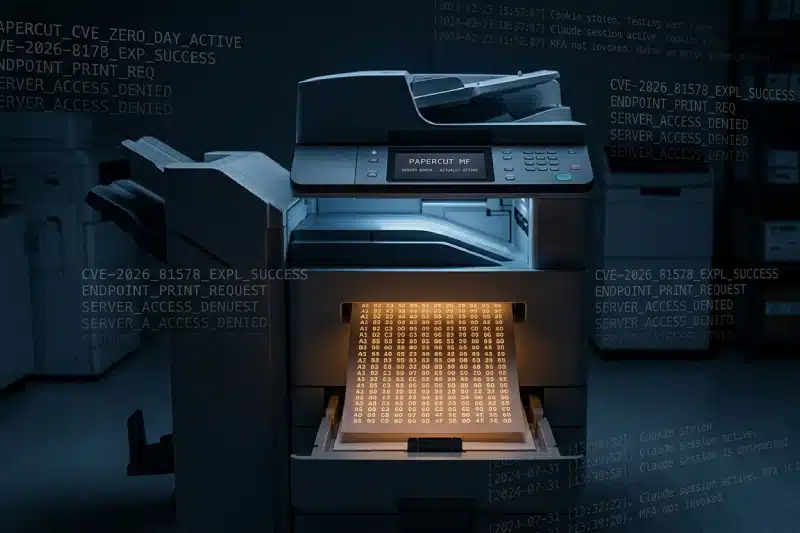
Networked office printer emitting a page of hexadecimal code, illustrating the actively exploited PaperCut NG and MF zero-day vulnerabilities.

PaperCut released a second emergency patch last Friday, for two vulnerabilities in its NG and MF print management servers that attackers are already exploiting, after security researchers demonstrated that the vendor's first fix could be bypassed.

The two flaws work as a chain. CVE-2026-81578, rated 8.8 on the CVSS scale, is an improper access control weakness in the PaperCut web management interface that lets unauthenticated remote requests reach administrative functions before the server finishes validating access.

CVE-2026-82078, rated 9.4, is an unsafe dynamic class-loading flaw in the product's database utilities. The application loads database driver classes without checking them against an allowlist, so an attacker who can alter configuration parameters can get arbitrary Java bytecode running inside the application server process. Together they produce pre-authentication remote code execution on an internet-facing server.

PaperCut software runs print queues for universities, school districts, hospitals, local government and large enterprises, and the platform has a history of drawing ransomware attention. Three earlier PaperCut NG/MF vulnerabilities already sit in the U.S. Cybersecurity and Infrastructure Security Agency's Known Exploited Vulnerabilities catalog, two of them weaponized in ransomware campaigns.

Also read: CISA Adds Cisco ISE and PaperCut Vulnerabilities to Known Exploited Vulnerabilities Catalog

Huntress, which first documented the activity, said it observed exploitation in two customer environments on Aug. 26 and Aug. 27. In one case the whole intrusion ran under two minutes. Attackers dropped hex-encoded Java class files that the firm described as a bridge between PaperCut and the underlying operating system, then issued basic reconnaissance commands - enumerating the current user, operating system version and running processes - rather than deploying ransomware or other payloads. That pattern typically indicates access brokering or target triage ahead of a later stage.

The reason for a second patch was straightforward; the first one did not hold. Researchers at watchTowr found multiple ways around the original fix and turned up an additional authentication bypass in the process, while Huntress independently reproduced the full attack chain and found its own workarounds. Both firms worked with PaperCut's engineers on Emergency Patch Release 2.

PaperCut said it was aware of confirmed customer incidents and was treating the matter with the highest priority. Release 2 covers PaperCut NG and MF versions 24, 25 and 26 on Windows, Linux and macOS. Customers running version 23 or earlier are told to upgrade rather than wait for a backported patch - a significant caveat, since Huntress reported that roughly 47% of the approximately 2,500 installations it tracks are on those older builds.

The pair had not been added to CISA's KEV catalog as of the vendor's Aug. 28 update.

Whether CISA adds the two CVEs to KEV, whether the reconnaissance-only activity converts into ransomware deployment, and whether Release 2 survives the scrutiny that broke its predecessor, remains to be seen. But administrators should pull PaperCut servers off the public internet regardless of patch status, and check application logs for unexpected process execution and stray .class files.

Anthropic Warns Commodity Infostealers Are Hijacking Claude Sessions to Drain Paid Usage

A session cookie depicted as a key being stolen from a browser window while a two-factor authentication prompt sits bypassed, illustrating Claude session hijacking by infostealer malware.

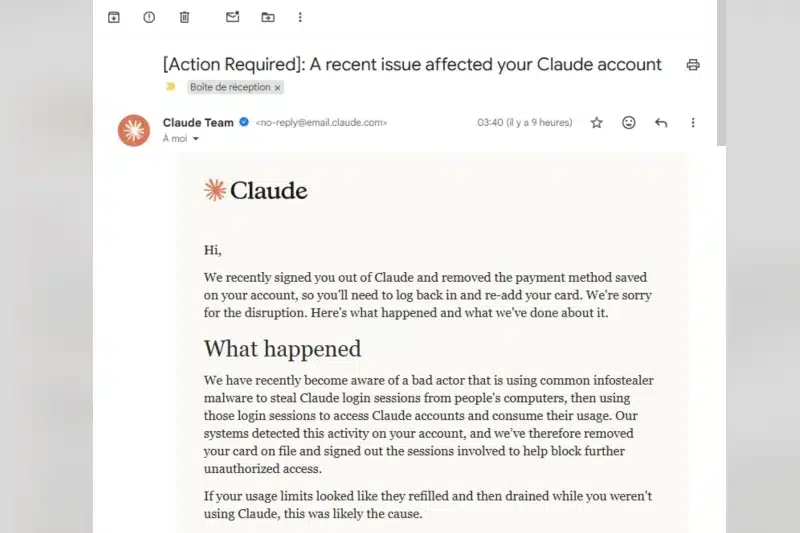
Anthropic warned users over the weekend that a threat actor is using widely available infostealer malware to hijack active Claude login sessions from infected computers, then using those sessions to run up victims' paid usage without ever needing a password or a two-factor code.

The company said it identified six malware families in the campaign: Vidar, LummaC2, StealC, RedLine and Acreed on Windows, and Atomic Stealer, known as AMOS, on a smaller number of macOS machines. None are novel or bespoke. All are commodity stealers sold or rented on criminal dark web marketplaces, and all work the same basic way - harvesting locally stored browser credentials, autofill data and authentication cookies from a compromised machine and shipping them to an operator's server.

Claude Session Cookies Heist

What makes the campaign notable is the target rather than the technique. Session cookies represent an already-authenticated state, so an attacker who replays a stolen Claude session token steps past both the account password and multi-factor authentication entirely. This is textbook session hijacking; the new element is that paid AI assistant subscriptions have become worth stealing as a commodity in their own right, alongside the streaming and gaming accounts that stealer log markets have traded for years.

Anthropic told affected users that the tell sign for them was a usage pattern that made no sense. Limits appearing to refill and then drain while the account owner was not using Claude was the biggest red flag.

Also read: Hacker Used Claude AI to Automate Reconnaissance, Harvest Credentials and Penetrate Networks

The company said it is signing affected users out of their sessions, removing saved payment methods from compromised accounts and refunding unauthorized charges identified during its investigation. It also stressed that the malware is not connected to Claude, was not installed through Claude and did not result from anything users did with the product. Infections trace to the usual vectors — pirated software and other illicit downloads.

A Reddit user going by the moniker "WorriedAssociate7029" received the notification from Anthropic and confirmed that he mistakenly installed an infostealer from "a reputable Russian underground forum" while downloading a pirated game. "I got fooled like a rookie by downloading a cracked game," he said.

Intrestingly though, the user claimed of using Claude's Opus model to detect and remove the malware.

"I use the models exclusively in permission-free mode on my entire computer," the Reddit user said.
"Opus was very efficient. It scanned for active processes, then listed my recent downloads. It found the virus almost instantly. My prompt was very simple: "I think I downloaded a virus recently. My login credentials were stolen. Audit the malware and remove it if you find it. Report on the extent of the damage. He deactivated the virus and created a folder on the desktop containing all the relevant information (including the deactivated virus, lol)."

Anthropic has not disclosed how many accounts were affected.

The security implications reach past the billing line. AI assistant accounts increasingly hold conversation histories, uploaded documents, connected data sources and, in developer configurations, API keys and repository access. A hijacked session inherits whatever the account can reach. Organizations that have rolled out AI tools without folding them into identity and access management now have a class of high-value session token sitting in employee browsers, largely outside the monitoring applied to corporate SaaS.

Anthropic's guidance to compromised users is the standard infostealer playbook. Change credentials across every service used on the affected machine, revoke active sessions, and actually remove the malware, since signing out does not clear an infection that will simply harvest the next session.

There is no formal regulatory hook here yet — no confirmed breach of the provider itself and no disclosure obligation triggered on Anthropic's side. But the episode lands as regulators and standards bodies are working out how AI system security fits existing frameworks, and it illustrates a gap those frameworks have barely addressed - the weakest point in an AI deployment may be an unmanaged endpoint rather than the model or the platform.

Boston Scientific Cyberattack Disrupts Order Processing, Shipping Worldwide

Boston Scientific Cyberattack, Unopened medical device shipping cartons in a hospital corridor illustrating the Boston Scientific cyberattack disruption to order processing and delivery.

Boston Scientific said a cyberattack detected this Tuesday, caused a network outage and cut off its ability to process and ship customer orders globally, and the medical device maker has not been able to say when full service will return.

The company disclosed the incident in an 8-K filed with the Securities and Exchange Commission on Wednesday and in a statement on its official website. It said the intrusion affected certain information technology systems and limited access to business applications underpinning day-to-day operations.

Boston Scientific is among the world's largest medical device manufacturers, reporting $20.07 billion in 2025 revenue and about $21 billion over the trailing 12 months. Its portfolio includes pacemakers, defibrillators, cardiac stents and neuromodulation implants, and the company says its products treat roughly 48 million patients a year. Thousands of employees in Ireland, where Boston Scientific operates three manufacturing and research sites, were told to work from home on August 26 after network communications were severed.

The company said it activated incident response protocols and engaged outside cybersecurity specialists to contain and investigate the intrusion. It has not said whether ransomware was involved, whether data was exfiltrated, or whether the disruption touches patients with implanted devices. No extortion group had claimed responsibility as of August 26. Shares fell more than 4% following the disclosure.

A Boston Scientific spokesperson declined to answer questions about patient impact and directed reporters to the published statement. Neither the company nor U.S. regulators have said whether hospital procedures have been delayed as a result of the shipping halt, though device suppliers typically hold limited on-site inventory at hospitals, making sustained order outages a downstream supply concern.

The incident is the third disruptive attack on a major medical technology firm in six months. Stryker suffered a global network outage in March after attackers abused its Microsoft Intune deployment to wipe data from thousands of devices, and Medtronic disclosed in April that patient names, Social Security numbers and health information were exposed in a breach attributed to the ShinyHunters extortion group.

Also read: Stryker Says Cyberattack Disrupted Processing, Manufacturing and Shipping

Boston Scientific said it cannot yet assess the full operational and financial impact, language that leaves room for an amended filing once the investigation matures.

The company's Irish footprint also raises the prospect of European scrutiny. If personal data proves to have been accessed, notification duties under the General Data Protection Regulation would attach, and medical device manufacturers operating in the European Union are increasingly captured by the NIS2 Directive's incident reporting regime as member states complete transposition.

Encrypted Prompts Defeat Grok and Gemini Guardrails; Chat Histories Stolen

Prompt Injection, Grok, Grok AI, Gemini, Fraud, Agentic AI, AI-assisted Cyberattacks

Researchers at Adversa AI disclosed an attack technique that smuggles malicious instructions past AI safety filters by encrypting them. They then demonstrated it against production deployments of xAI's Grok and Google's Gemini - including a zero-click chain that could exfiltrate a Grok user's entire chat history.

The technique, which the researchers call Cryptographic Context Injection, inverts the usual assumption behind input filtering. Guardrails inspect prompts and retrieved content as text; an AES-256-GCM ciphertext contains no readable instruction to flag. The model itself performs the decryption inside its own code-execution sandbox, and then treats the recovered plaintext as trusted intermediate output rather than as untrusted external content. Adversa noted that every element a scanner would need is present on the page, but recovering it requires "running PBKDF2 and AES-256-GCM."

That distinction separates the work from earlier cipher-based jailbreaks such as CipherChat and CodeChameleon, which relied on substitution ciphers or Base64 encoding that large language models can decode natively during inference. Strong authenticated encryption forces execution, and execution is what launders the payload's provenance.

The demonstrated impact differed by target. Against Grok, the researchers showed an indirect, zero-click path. Encrypted JSON embedded in a web page is picked up when Grok's agentic browsing analyzes the site, and the decrypted instructions then leak session data like user name, coarse location, subscription tier and full conversation history, to an attacker-controlled URL. No click or warning reached the user.

Also read: French Police Raid X Offices as Grok Investigations Grow

Against Gemini 3 Flash on the web at the paid tier, the same approach produced instructions for building incendiary devices in the model's Deep Thinking mode, and caused the model to reproduce its own system instructions. Adversa said its Gemini success rate had fallen sharply since June and dropped significantly by August, but could not attribute the change to filter updates, model version changes or both.

Vendor engagement was limited. Adversa reported the Grok issue to xAI on June 3, received an initial acknowledgment, and followed up on August 4 and 10 without substantive response. The firm confirmed the attack still reproduced on August 19.

The Gemini finding was never formally reported, because Google's AI vulnerability reward program excludes prompt injection, jailbreaks and alignment issues from scope, directing them instead to in-product feedback channels. Guardrail-bypass research at one of the largest model providers therefore sits outside a coordinated-disclosure track with a reward and a disclosure clock.

The findings land against a body of evidence that prompt injection remains the dominant failure mode in deployed agentic systems, a position reflected in OWASP's guidance and in Microsoft research published in May on remote code execution in AI agent frameworks. The pattern here is narrower and more concerning for defenders. Content-based guardrails, the primary control most enterprises have deployed, are structurally unable to inspect a payload that only exists in plaintext after the model has already decided to trust it.

Whether xAI ships a fix or acknowledges the report, whether Google revises its reward-program scope to cover guardrail bypasses, and whether AI security vendors move detection from input text to sandbox execution monitoring, is something to watch-out for.

Microsoft Reverses Its Own ‘Exploitation’ Warning on Entra ID Flaw CVE-2026-69836

CVE-2026-69836, Entra ID, Microsoft

Microsoft disclosed and fixed a maximum-severity remote code execution vulnerability in Entra ID, its cloud identity platform, on August 20, then quietly reversed the advisory's exploitation status a day later - leaving enterprise defenders without a clear account of whether the flaw was ever used in attacks.

The vulnerability, tracked as CVE-2026-69836, carries a CVSS score of 10.0, the highest possible rating. It stems from unsafe deserialization of untrusted data, a class of defect catalogued as CWE-502, in which an application reconstructs objects from attacker-supplied input without validating it first. Microsoft's advisory said the weakness "allows an unauthorized attacker to execute code over a network." No authentication, elevated privileges or user interaction were required.

Entra ID, formerly Azure Active Directory, is the authentication layer for Microsoft 365, Azure and thousands of federated third-party applications. Code execution inside that service sits upstream of nearly every access decision an affected tenant makes, which is why identity infrastructure flaws draw scrutiny disproportionate to their raw CVE count.

Because Entra ID is a hosted service rather than on-premises software, Microsoft was able to remediate it server-side. The company said the issue is fully mitigated and that customers need take no additional action - an unusual advantage of cloud delivery, and one that removes the patch-deployment race that normally follows a perfect-10 disclosure. Microsoft credited principal security engineer Robert Fitzpatrick with finding the bug.

"Exploited: Yes"...Sorry "No"

The disclosure itself became the story. Microsoft's Security Response Center bulletin initially carried an "Exploited: Yes" designation, prompting coverage on August 21 describing the flaw as under active attack.

Read our earlier coverage: Microsoft Says CVSS 10.0 Entra ID Code Execution Flaw Was Exploited Before Server-Side Fix

Microsoft flipped that field to "No" the same day, for reasons unknown, and offered no explanation for the change. In a follow-up statement the company said it had identified and fixed the issue and published the CVE for greater transparency.

The reversal leaves several questions open. Microsoft has not said how it detected the flaw, whether any tenant data was accessed, over what period the service was vulnerable, or what evidence supported either exploitation determination.

The episode intersects with a live regulatory question. The Securities and Exchange Commission's cyber disclosure rules require public companies to report material incidents on Form 8-K, and the Cybersecurity and Infrastructure Security Agency's reporting regime is still being finalized. Neither framework clearly addresses how a downstream customer should assess materiality when the only party holding the facts is the cloud provider.

The CVE was itself issued under MSRC's June 2024 policy of publishing CVEs for cloud service vulnerabilities that require no customer action - a transparency commitment made in the wake of criticism over the 2023 Storm-0558 intrusion. This episode is an early test of how much visibility that policy actually delivers.

Also read: Microsoft Security Lapse Exposed Sensitive Credentials and Internal Resources of Employees

Microsoft Says CVSS 10.0 Entra ID Code Execution Flaw Was Exploited Before Server-Side Fix

Severity gauge at CVSS 10.0 beside a cloud icon, representing the maximum-severity Entra ID remote code execution flaw.

Microsoft disclosed on Thursday that a maximum-severity remote code execution vulnerability in Entra ID, the identity service underpinning Microsoft 365, Azure and Dynamics 365, was exploited in the wild before the company mitigated it on its own infrastructure. The flaw, tracked as CVE-2026-69836 and rated CVSS 10.0, required no authentication and no user interaction.

Entra ID, formerly Azure Active Directory, is the authentication and authorization layer for a large share of the world's enterprise cloud estates. It brokers sign-ins, conditional access decisions and token issuance across tenants, which makes any unauthenticated code execution in the service unusually consequential: an attacker operating inside that trust boundary is positioned upstream of nearly every control that depends on it.

According to Microsoft's advisory, the vulnerability stems from deserialization of untrusted data, a class of bug in which an application reconstructs attacker-controlled input into live objects without adequate validation. The result, per the advisory language, is that an unauthorized attacker can execute code over a network. Microsoft rated impact as high across confidentiality, integrity and availability, and characterized attack complexity as low. Credit for finding and reporting the issue went to a Microsoft principal security engineer.

Also read: Microsoft Entra ID Exposed: Actor Token Flaw Enables Stealthy Global Admin Takeover

Because Entra ID is a managed cloud service rather than software customers install, remediation happened server-side. Microsoft said the vulnerability has been fully mitigated and that there is no action for users of the service to take. Exploit code is not publicly available, the company said. Microsoft addressed several other maximum-severity cloud service issues, including flaws in Azure Arc and Exchange Online, in the same batch of disclosures.

What Microsoft did not say is drawing scrutiny. The advisory confirms exploitation but omits attribution, the window during which attacks occurred, how many tenants were touched, what attackers did after gaining execution, and any indicators defenders could use to check their own logs. Security teams face a structural problem here. With no patch to apply and no IOCs published, there is no independent way to confirm whether a given tenant was affected, and cloud-side telemetry that would answer the question sits with the provider.

The disclosure lands against a compliance backdrop that has grown less forgiving. Microsoft began issuing CVEs for cloud service vulnerabilities that require no customer action as part of transparency commitments made under its Secure Future Initiative, and CVE-2026-69836 is a test of how much that transparency actually delivers.

For U.S. public companies, exploitation of an identity provider raises Item 1.05 materiality questions under the Securities and Exchange Commission's cyber disclosure rule even when the fix is the vendor's determining whether a reportable incident occurred is difficult without provider-side evidence. In the European Union, operators in NIS2 scope carry 24-hour early-warning obligations that presuppose visibility they may not have.

Whether Microsoft publishes exploitation details or indicators, whether CISA issues supplemental guidance for federal tenants, and whether any organization ties confirmed intrusion activity to the flaw, enterprises should review Entra ID sign-in and audit logs for anomalous service principal activity, unexpected token issuance and privilege changes across the past several weeks, and re-examine standing assumptions about the identity layer.

AI Won’t Replace Cybersecurity Jobs, It’ll Replace the Toil – Harsha Reddy Explains What’s Next

AI, Cybersecurity, Harsha Reddy

As enterprises race to bolt AI onto every business process, security leaders are being forced to answer a harder question than "should we adopt it" — it's "who's accountable when it goes wrong." To unpack this, The Cyber Express sat down with Harsha Reddy, Head of Information Security at Veterinary Emergency Group (VEG).

With nearly two decades in security leadership — including senior roles at Lixil and American Standard before joining VEG — Harsha brings a practitioner's view of where AI is genuinely changing the CISO's job, and where it's mostly just hype and shadow adoption.

Watch the Full Interview:

Harsha Reddy Explains Why AI Will Replace Tasks, Not Defenders

Harsha pushes back on the narrative that AI will hollow out security teams, pointing to Gartner research showing that while most fields are projected to lose jobs to AI, cybersecurity is expected to gain them. In his view, the technology is mainly absorbing the "toil" — log review, alert triage, evidence gathering — that keeps analysts from actually defending.

Also listen to S1 Episode: Awareness and Education at Young Age is the Answer to Cybersecurity Skill Gap

“It's the analyst who refuses to use AI that will get replaced by an analyst who uses it,” he says.

On adoption, Reddy points to a 2024 Microsoft-LinkedIn survey in which most executives called AI critical to their business, yet a majority had no formal plan and most had employees already bringing in their own tools. That gap, he argues, is why so many organizations are now dealing with AI-related data leaks. "Many organizations started onboarding AI like software when they should be onboarding it like staff." His fix isn't more restrictions — blocking AI just pushes it into the shadows — but guardrails, an internal AI enablement committee, and measuring actual business value instead of token consumption.

The conversation also digs into deepfake-driven fraud, why training employees to spot deepfakes is “a losing bet” at machine speed, and how he decides when to greenlight a new AI tool versus telling a business unit “not yet.”

The conversation closes with our newly introduced rapid-fire round "Express Shots" — Claude vs. ChatGPT, passkeys vs. passwords, and Reddy's prediction for the biggest cybersecurity threat of 2030.

💾

Read the latest updates Firewall Daily news and insights on The Cyber Expres, your trusted source for cybersecurity and information technology updates."
❌