Visualização de leitura

With developer verification, Google's Apple envy threatens to dismantle Android's open legacy

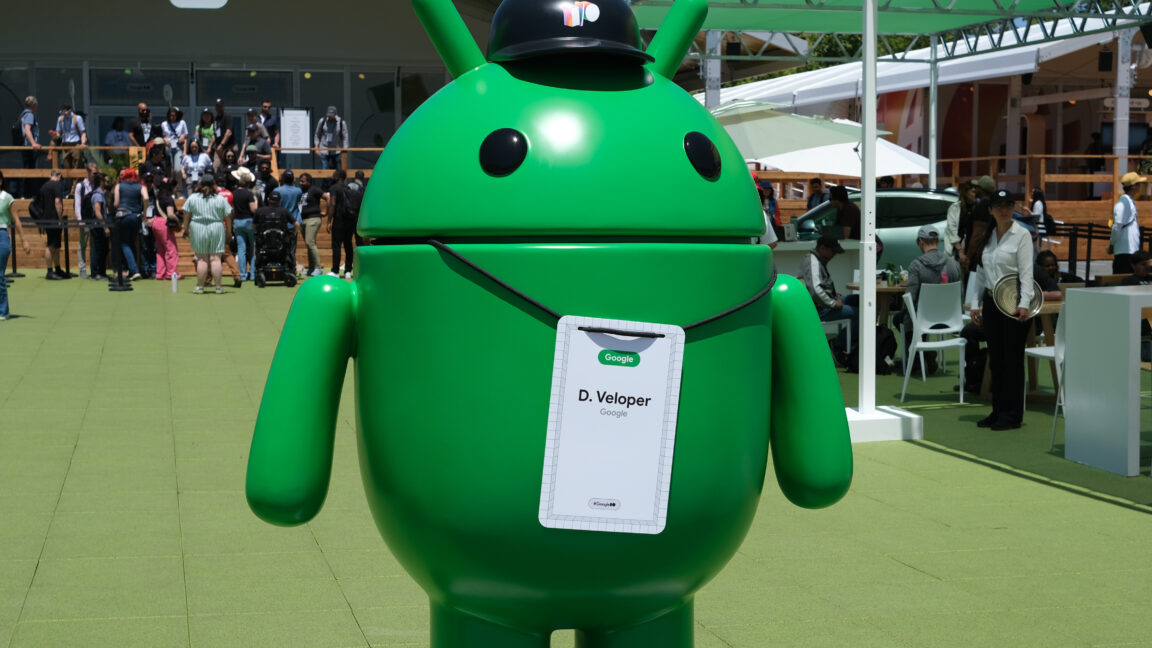
It's been nearly 20 years since Google revealed Android, which the company described as the first "truly open" mobile operating system, setting Google-powered phones apart from the iPhone's aggressively managed experience. Over time, though, Android has become more aligned with Apple's approach. For the moment, users still have the final say in what software runs on their increasingly locked-down smartphones. Later this year, though, Google plans to seriously curtail that freedom in the name of security.

In the coming weeks, Google will officially debut Android developer verification, which will require app makers outside the Play Store to register with their real names and pay a fee to Google. Failure to do so will block their apps from installation (sometimes called sideloading) on virtually all Android devices. Google says this is a necessary evolution of the platform's security model, but upending the status quo could push developers away from Android and risk the privacy of those that remain.

This might make your phone a little safer, sure, but it won't stop people from getting scammed. At the same time, it could rob the Android ecosystem of what made it special in the first place.

Read full article

Comments

© Aurich Lawson | Getty Images

Millions of people imperiled through sign-in links sent by SMS

Websites that authenticate users through links and codes sent in text messages are imperiling the privacy of millions of people, leaving them vulnerable to scams, identity theft, and other crimes, recently published research has found.

The links are sent to people seeking a range of services, including those offering insurance quotes, job listings, and referrals for pet sitters and tutors. To eliminate the hassle of collecting usernames and passwords—and for users to create and enter them—many such services instead require users to provide a cell phone number when signing up for an account. The services then send authentication links or passcodes by SMS when the users want to log in.

Easy to execute at scale

A paper published last week has found more than 700 endpoints delivering such texts on behalf of more than 175 services that put user security and privacy at risk. One practice that jeopardizes users is the use of links that are easily enumerated, meaning scammers can guess them by simply modifying the security token, which usually appears at the right of a URL. By incrementing or randomly guessing the token—for instance, by first changing 123 to 124 or ABC to ABD and so on—the researchers were able to access accounts belonging to other users. From there, the researchers could view personal details, such as partially completed insurance applications.

Read full article

Comments

Google will end dark web reports that alerted users to leaked data

Google began offering "dark web reports" a while back, but the company has just announced the feature will be going away very soon. In an email to users of the service, Google says it will stop telling you about dark web data leaks in February. This probably won't negatively impact your security or privacy because, as Google points out in its latest email, there's really nothing you can do about the dark web.

The dark web reports launched in March 2023 as a perk for Google One subscribers. The reports were expanded to general access in 2024. Now, barely a year later, Google has decided it doesn't see the value in this type of alert for users. Dark web reports provide a list of partially redacted user data retrieved from shadowy forums and sites where such information is bought and sold. However, that's all it is—a list.

The dark web consists of so-called hidden services hosted inside the Tor network. You need a special browser or connection tools in order to access Tor hidden services, and its largely anonymous nature has made it a favorite hangout for online criminals. If a company with your personal data has been hacked, that data probably lives somewhere on the dark web.

Read full article

Comments

© Getty Images | 400tmax

Google confirms Android dev verification will have free and paid tiers, no public list of devs

As we careen toward a future in which Google has final say over what apps you can run, the company has sought to assuage the community's fears with a blog post and a casual "backstage" video. Google has said again and again since announcing the change that sideloading isn't going anywhere, but it's definitely not going to be as easy. The new information confirms app installs will be more reliant on the cloud, and devs can expect new fees, but there will be an escape hatch for hobbyists.

Confirming app verification status will be the job of a new system component called the Android Developer Verifier, which will be rolled out to devices in the next major release of Android 16. Google explains that phones must ensure each app has a package name and signing keys that have been registered with Google at the time of installation. This process may break the popular FOSS storefront F-Droid.

It would be impossible for your phone to carry a database of all verified apps, so this process may require Internet access. Google plans to have a local cache of the most common sideloaded apps on devices, but for anything else, an Internet connection is required. Google suggests alternative app stores will be able to use a pre-auth token to bypass network calls, but it's still deciding how that will work.

Read full article

Comments

© Ryan Whitwam

Former WhatsApp security boss in lawsuit likens Meta’s culture to a “cult”

Over the past year, Meta has blanketed TV screens around the world with commercials touting the privacy of Whatsapp, its encrypted messenger with a monthly user base of 3 billion people.

“It’s private,” one ad campaign featuring the former cast of the Modern Family TV show says. “On Whatsapp, no one can see or hear your personal messages … not even us,” a different series of ads declares.

“Serious risks to user data”

On Monday, the former head of security for the Meta-owed messaging app filed a federal whistleblower lawsuit that tells a far different narrative. The suit, filed in US District Court for the District of Northern California, recites a litany of purported security and privacy flaws that Meta not only didn’t fix after becoming aware of them, but also kept secret, allegedly in violation of a $5 billion settlement then-Whatsapp parent company Facebook reached with the Federal Trade Commission. The complaint was filed by Attaullah Baig, who became head of WhatsApp security in 2021.

Read full article

Comments

© Getty Images | NurPhoto

Browser extensions turn nearly 1 million browsers into website-scraping bots

Extensions installed on almost 1 million devices have been overriding key security protections to turn browsers into engines that scrape websites on behalf of a paid service, a researcher said.

The 245 extensions, available for Chrome, Firefox, and Edge, have racked up nearly 909,000 downloads, John Tuckner of SecurityAnnex reported. The extensions serve a wide range of purposes, including managing bookmarks and clipboards, boosting speaker volumes, and generating random numbers. The common thread among all of them: They incorporate MellowTel-js, an open source JavaScript library that allows developers to monetize their extensions.

Intentional weakening of browsing protections

Tuckner and critics say the monetization works by using the browser extensions to scrape websites on behalf of paying customers, which include AI startups, according to MellowTel founder Arsian Ali. Tuckner reached this conclusion after uncovering close ties between MellowTel and Olostep, a company that bills itself as "the world's most reliable and cost-effective Web scraping API." Olostep says its service “avoids all bot detection and can parallelize up to 100K requests in minutes.” Paying customers submit the locations of browsers they want to access specific webpages. Olostep then uses its installed base of extension users to fulfill the request.

Read full article

Comments

Nintendo warns Switch 2 GameChat users: “Your chat is recorded”

Last month, ahead of the launch of the Switch 2 and its GameChat communication features, Nintendo updated its privacy policy to note that the company "may also monitor and record your video and audio interactions with other users." Now that the Switch 2 has officially launched, we have a clearer understanding of how the console handles audio and video recorded during GameChat sessions, as well as when that footage may be sent to Nintendo or shared with partners, including law enforcement.

Before using GameChat on Switch 2 for the first time, you must consent to a set of GameChat Terms displayed on the system itself. These terms warn that chat content is "recorded and stored temporarily" both on your system and the system of those you chat with. But those stored recordings are only shared with Nintendo if a user reports a violation of Nintendo's Community Guidelines, the company writes.

That reporting feature lets a user "review a recording of the last three minutes of the latest three GameChat sessions" to highlight a particular section for review, suggesting that chat sessions are not being captured and stored in full. The terms also lay out that "these recordings are available only if the report is submitted within 24 hours," suggesting that recordings are deleted from local storage after a full day.

Read full article

Comments

© Aurich Lawson | Nintendo

“Microsoft has simply given us no other option,” Signal says as it blocks Windows Recall

Signal Messenger is warning the users of its Windows Desktop version that the privacy of their messages is under threat by Recall, the AI tool rolling out in Windows 11 that will screenshot, index, and store almost everything a user does every three seconds.

Effective immediately, Signal for Windows will by default block the ability of Windows to screenshot the app. Signal users who want to disable the block—for instance to preserve a conversation for their records or make use of accessibility features for sight-impaired users—will have to change settings inside their desktop version to enable screenshots.

My kingdom for an API

“Although Microsoft made several adjustments over the past twelve months in response to critical feedback, the revamped version of Recall still places any content that’s displayed within privacy-preserving apps like Signal at risk,” Signal officials wrote Wednesday. “As a result, we are enabling an extra layer of protection by default on Windows 11 in order to help maintain the security of Signal Desktop on that platform even though it introduces some usability trade-offs. Microsoft has simply given us no other option.”

Read full article

Comments

© Getty Images

DeepSeek iOS app sends data unencrypted to ByteDance-controlled servers

A little over two weeks ago, a largely unknown China-based company named DeepSeek stunned the AI world with the release of an open source AI chatbot that had simulated reasoning capabilities that were largely on par with those from market leader OpenAI. Within days, the DeepSeek AI assistant app climbed to the top of the iPhone App Store's "Free Apps" category, overtaking ChatGPT.

On Thursday, mobile security company NowSecure reported that the app sends sensitive data over unencrypted channels, making the data readable to anyone who can monitor the traffic. More sophisticated attackers could also tamper with the data while it's in transit. Apple strongly encourages iPhone and iPad developers to enforce encryption of data sent over the wire using ATS (App Transport Security). For unknown reasons, that protection is globally disabled in the app, NowSecure said.

Basic security protections MIA

What’s more, the data is sent to servers that are controlled by ByteDance, the Chinese company that owns TikTok. While some of that data is properly encrypted using transport layer security, once it's decrypted on the ByteDance-controlled servers, it can be cross-referenced with user data collected elsewhere to identify specific users and potentially track queries and other usage.

Read full article

Comments

© Getty Images

Time to check if you ran any of these 33 malicious Chrome extensions

As many of us celebrated the year-end holidays, a small group of researchers worked overtime tracking a startling discovery: At least 33 browser extensions hosted in Google’s Chrome Web Store, some for as long as 18 months, were surreptitiously siphoning sensitive data from roughly 2.6 million devices.

The compromises came to light with the discovery by data loss prevention service Cyberhaven that a Chrome extension used by 400,000 of its customers had been updated with code that stole their sensitive data.

’Twas the night before Christmas

The malicious extension, available as version 24.10.4, was available for 31 hours, from December 25 at 1:32 AM UTC to Dec 26 at 2:50 AM UTC. Chrome browsers actively running Cyberhaven during that window would automatically download and install the malicious code. Cyberhaven responded by issuing version 24.10.5, and 24.10.6 a few days later.

Read full article

Comments

© Getty Images

❌