
Visualização de leitura

IT infrastructure shortages are real and lasting. Here’s how to cope

Lead times of nine to 12 or even 18 months. Costs rising by 35%, 45%, even 50% to 200%. More than halfway through 2026, the market for IT infrastructure that’s crucial for enterprise projects, including those involving artificial intelligence, is strapped.

Memory is at the root of the shortages. Memory prices “have risen by 50% to 200%, resulting in PC prices increasing by 35% to 45% and some server prices rising over 125%,” according to Jon Forest, VP analyst at Gartner. Network switches also need memory, albeit in lesser amounts than servers, so they are not immune, with prices and lead times likewise rising dramatically.

Industry experts agree that most of the issues stem from hyperscalers gobbling up memory capacity, which trickles down to servers, storage systems, and networking devices. But while the source of the problem may be new, supply chain disruptions are far from unprecedented.

As a result, industry insiders are not short on advice on how best to deal with the situation, with tips including making better use of what you have, considering options beyond your usual scope, and lots of planning with your vendors and internal finance teams.

State of the problem

Just how bad is the current supply chain problem? “It’s pretty bad,” says Matt Kimball, vice president and principal analyst with Moor Insights & Strategy. Companies accustomed to 30- to 45-day lead times for various infrastructure are now looking at 6, 12, or even 18 months.

“It’s real, and I’m hearing it from companies of all sizes, from the 1000-server to the 10,000-server shops,” Kimball says.

“Memory costs are expected to rise sharply well into 2027 and will reach up to 25% of network hardware expenses by the end of 2027,” according to an email Gartner’s Forest sent to Network World. The figure below shows the timeline Gartner expects for memory prices, and Forest notes that the same timing applies across networking, storage, and compute infrastructure. 
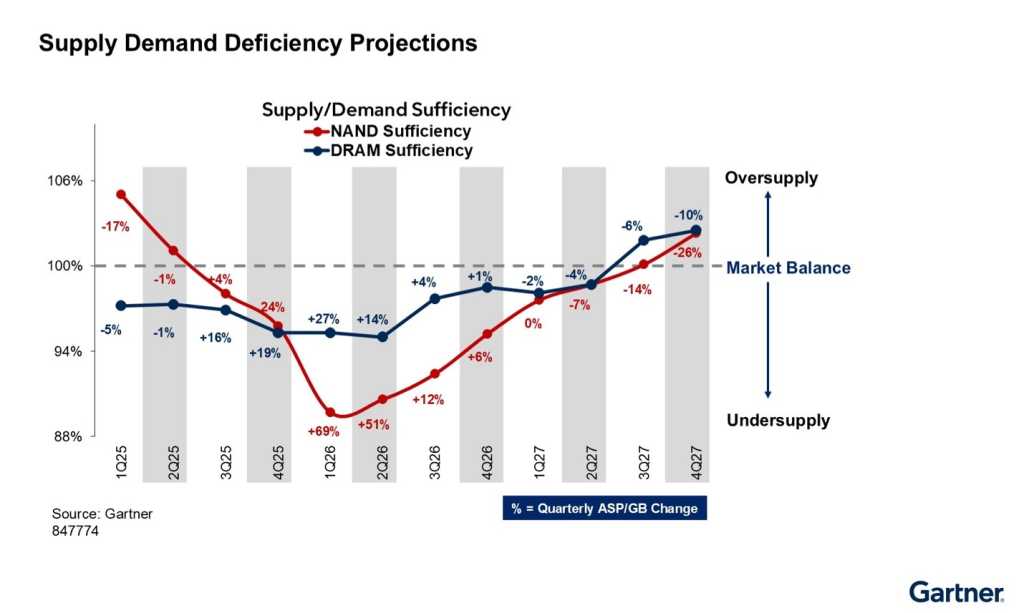
Gartner NAND DRAM stats

Gartner

“Enterprise network equipment pricing is projected to increase by over 20% in 2026. This upward trend is anticipated to continue with a further rise of 3% to 5% entering 2027, with no signs of price reduction until the end of 2027.”

But “reduction” will likely look more like “stabilization.”

“That’s something a lot of people don’t like to talk about. But let’s say prices went up 40%, they may come down five,” says Phillip Privett, senior vice president of vendor management with the global distributor and value-added reseller TD SYNNEX. “They’re not going to come down 40%.”

Perhaps worse, compared with past disruptions caused by issues such as fires in chip fabrication factories or the Covid pandemic, Kimball says this one is “durable” because its cause—the AI wave—is more long-lasting and just getting started.

“This AI inference wave we’re hitting is just beginning. It’s going to be longer and bigger than the training wave,” he says. “It’s impacting everything, from AI infrastructure to the traditional stuff that’s standing up your virtualization and cloud infrastructure.”

No vendors seem to be immune, not even the likes of Cisco, which makes its own Cisco Silicon One chips. Or, at least, it designs the chips; they’re actually manufactured by the Taiwan Semiconductor Manufacturing Company (TSMC), the same company that makes many of the other chips that are in such demand. And that’s only one component of many that comprise a switch.

On the other hand, the margins Cisco gets from enterprise sales are far greater than those from hyperscalers because Cisco sells mainly just hardware to hyperscalers, whereas enterprise sales generally include software and services as well. So, Cisco has incentive to keep enterprise customers happy and maintain the 66% margins it reported in Q3, its latest quarter.

Still, Cisco must deal with the same shortages as other vendors.

“I wouldn’t say any company is faring better than others,” says Neil Anderson, vice president and CTO for cloud, infrastructure, and AI solutions at World Wide Technology (WWT). “There may be nuances that some suppliers are employing to balance it to some extent, but I fail to recognize a supplier that’s not having almost the same issue.”

Cloud storage vendor Backblaze is one company that’s facing equipment cost and availability issues. “There are different types of shortages occurring in multiple places, all driven by unusual market demands, really by just a handful of very large buyers,” says James Rowell, senior vice president of operations with Backblaze.

Backblaze is constantly forecasting and monitoring demand triggers, Rowell says. That involves close alignment with the sales team to forecast client needs, as well as paying attention to historical trendlines to predict upcoming demand from new deals and growth with existing clients. But the company also looks for “unnatural market-related triggers” that would cause a spike in utilization.

With hyperscalers buying up vast amounts of capacity, “This is definitely an unnatural phase,” Rowell says. “For about for the last 12 months, I would say there’s been somewhere between a 15% and 30% uptick in costs,” especially in terms of servers and compute disks.

On the positive side, at least for Backblaze, the company is also seeing an uptick in business from an interesting source: AI companies. “We reported in the last earnings period a 70% increase in AI companies using our platform,” says Patrick Thomas, vice president of marketing at Backblaze. “That’s massive.”

On top of that, the company is seeing an uptick in deals from enterprises that can’t get the storage capacity they need or want on-prem. “There’s a general market nervousness where we’ve got potential deals coming our way because those organizations are concerned about being able to do it themselves,” Rowell says.

While some expect new chip fabrication plants currently under construction will ease memory supply constraints, Privett doesn’t buy it. “I don’t see it getting better anytime soon,” he says. “Building a new fab is a two-year process.”

Advice: Start with the basics

Enterprises, then, must play the cards they’re dealt. For Moore Insights’ Kimball, who did stints as an IT exec with the states of Florida and Oregon, that starts with making the most of what you have.

Such a strategy is “shockingly not implemented much” across the companies he sees. “A simple capacity planning exercise can free up a lot of resources.” That includes virtualized servers running at just 20% to 30% utilization as well as extending the life of existing servers. While 15 or 20 years ago it was common to refresh every four years or so, companies can often get six or seven years out of today’s servers.

While such strategies won’t solve your AI compute challenges, they can certainly help support your ongoing operations and free up budget for AI and other modernization projects, he says.

“Sweat your assets,” agrees Privett of TD SYNNEX. “Work them as much as you can, add only what you need, get extensions on your licensing, renewals on your services agreements and things like that. Just sweat it out a little longer.”

If you have budget to spend but can’t get the hardware you’re after, buy something else, says WWT’s Anderson. “Look at things that are not tied to those components, like software projects or SaaS licensing,” he says.

Get friendly with finance teams

Numerous experts recommend regular meetings with your CFO or finance teams to keep them apprised of what you’re up against so the company can plan accordingly.

Gartner’s Forest advises using rolling 12- to 24‑month forecasts and engaging early with suppliers to identify constrained components and SKUs. Committing to quarterly or monthly buys can help you avoid long-term agreements that extend past the rapid increases we’re seeing in 2026, he says.

Also engage with the financing arm of your equipment vendors, some of which are offering financing incentives, Privett says. Compute vendors in particular are offering subsidized financing, deferred payments, and low-cost financing for the first year or so. “Those are huge opportunities to take advantage of,” he says.

By engaging with finance teams, IT groups can conduct budget allocation exercises and try to come up with ways to make the financials work. The last thing you want to do is surprise them with additional budget requests out of the blue.

Kimball recalls his days with the state of Florida, when all budget requests were examined by a technical review working group—which was designed to be hostile.

“I can’t imagine going to them and saying, ‘Oh, did I say that was a million dollars? It’s actually $2 million. I need you to write me a bigger check,’” he says. “I would walk into one of the swamps in Tallahassee and get eaten by the alligators instead of doing that.”

Work with your vendors and VARs

As you put plans together, lean on your vendors for help, including channel partners such as value-added resellers (VAR) and national resellers. “Work with them to map things out and understand what your workloads will look like,” Kimball says.

That’s what Backblaze’s Rowell regularly does with his suppliers. He lays out his forecast for the year, with commitments on what Backblaze will definitely buy, as well as scenarios that account for rapid growth, say, 2x. “And they’ll come back with, ‘Well, okay, no problem,’ or maybe they say we need to put in an allocation right away, or we won’t be able to get what we may need,” he says.

Similarly, he sits down with his CFO regularly to map out predictive models that factor in inflation, price hikes, and the like. The idea is to plan out multiple scenarios, so you don’t get blindsided.

“If you don’t do that, you’ll get caught with your pants down, on the upside-down end of spectrum,” he said – meaning not having the capacity to take advantage of market opportunities.

Acquiring the capacity you need to meet project demand may also mean being flexible in terms of your equipment choices. If you’re a Dell shop but can’t get Dell servers, maybe you go with Lenovo, Kimball says.

“You’ve got to figure out how to use all this silicon and infrastructure in a heterogenous way to serve your needs,” he says. That’s especially true when it comes to AI infrastructure. “If you think you’re going to go with 100% Nvidia for everything from RAG [retrieval augmented generation] to inferencing at the edge, you’re kind of crazy, not because of cost but because of availability.”

Look at alternatives, including AMD and cloud solutions, while staying mindful of how it all plays together. You may not be able to get Nvidia GPUs, but AWS, Azure, and Oracle Cloud have them, Kimball notes.

Be strategic, perhaps by using cloud offerings to handle certain tuning or inference workloads, then bringing them back in-house when appropriate. “Have a better understanding of what absolutely has to be on prem and what can be in the cloud,” he says.

That’s good advice, says Backblaze’s Thomas. When it comes to AI, think about performance tiers and the range of use cases you have. They don’t all need top-tier performance.

“People get wrapped around axle of needing the top end. There’s a lot of flexibility in the edges, innovation in different hardware and software,” Thomas says.

Gartner likewise advises companies to increase configuration flexibility and expand sourcing paths. That may include buying from secondary markets and lease-return programs to preserve continuity with existing infrastructure until the shortages pass, Forest says.

Get started somewhere

Even if you can’t acquire or have to wait for the infrastructure you need, don’t let that keep you from getting started with AI or other modernization projects.

Options include public cloud and neocloud providers, Anderson says. WWT also provides capacity in its own lab so customers can get started with proof-of-concept projects. “Don’t just throw your hands up. We can help you find access to capacity,” Anderson says. “Production-scale AI may be delayed, but don’t let that derail your strategy.”

Colocation providers may likewise be an option, especially if enterprises are struggling to acquire high-end networking equipment. Networking is a key value proposition for colocation providers, in that they have built-in connections to various cloud providers and other ecosystem players.

Equinix, for example, has 280 data centers in 77 metropolitan areas, says Phil Read, senior director, colocation product management for the company. If you have the compute infrastructure, Equinix can help you with the high-end connectivity required both intra- data center and at edge facilities.

It also has partnerships with the likes of Cisco and Nvidia for “ready-to-go AI connectivity,” Read says. That means Equinix offers the right infrastructure to meet the requirements of high-end compute solutions in terms of power density and cooling. Such power densities are significant, requiring 120k VA per rack and up. “There’s plenty of talk about a megawatt rack,” he says.

Power is a significant issue in this entire discussion, Privett says. Older installed computing infrastructure likely consumes far more power than newer systems, which is an argument for upgrading as soon as possible.

“If you modernize today, you could substantially reduce the number of servers needed to support the same applications at a much lower power consumption rate,” Privett says. He advises sitting down with folks from the OT side of the house to make sure power is available for whatever you want to do. In many areas, power is at a premium.

If your plans include installing GPU environments in your own data center, WWT advises you not to delay. “We’re telling customers, you need to talk with us and get that designed, get that ordered, because it will take quite a bit of time until it actually ships and we’re able to install it,” Anderson says.

Moor Insights’ Kimball agrees. “You have to order these parts today if you want to see them hitting your dock, your warehouse, or your office 12 months from now.”

The AI cybersecurity arms race is on

Businesses received a staggering amount of cyberattacks in June, according to Check Point, showing a rise of 20% over the previous 12 months. The breakout of AI agents from OpenAI in July to hack into the Hugging Face website, and subsequent similar events from Anthropic and Meta, indicate agentic-powered attacks will explode over the coming year.

Currently, malicious hackers have the advantage because publicly released frontier models from the US incorporate guardrails that can’t distinguish between malicious or defensive activities. As a consequence, these models default to a refusal to get involved. Hugging Face discovered this the hard way when they attempted to utilize a model to defend against the OpenAI intrusion. Their solution was to adapt a Chinese open weight model to analyze the 17,000 attack logs, find the vulnerability, and contain the intrusion.

With incidents like these happening more often, an arms race has begun with AI being both the problem and the solution.

Strength in numbers

While single agents generally perform more efficiently for well-defined tasks, research from Stanford University indicates swarms are more effective in messy scenarios with noisy data, which are more typical of unpredictable, intrusion attacks. The increased token usage by swarms raises costs, but increasingly efficient open weight models are rapidly lowering these barriers.

In the Hugging Face example, the agents worked together as a team leaving messages for each other on a message board they improvised. They shared newly found vulnerabilities, exchanged tools, and even developed conventions to address one another and to avoid overwriting each other’s work. While this may seem sinister, they were only following their designated purpose: to achieve a goal without regard to any collateral damage. We can expect bad actors to harness the power of agentic swarms through fine-tuning open weight models, and creating agents that progressively learn from their experiences.

Modern warfare has been transformed over the last four years, too, through the deployment of drones by Ukraine to defend against Russian attacks. Military strategies and the deployment of armament budgets around the world are shifting to focus on new technologies, and approaches and enterprises are now facing a similar challenge from the hostile use of agentic AI.

The drawbridge is down

As enterprises build out their own agentic systems to handle ecommerce, customer service, and marketing activities, this presents new attack surfaces for antagonistic efforts. April 2026 research from Trend Micro found almost 1,500 MCP servers directly exposed to the internet had no authentication or encryption, a rise of 200% from nine months earlier. This included 70 hosts offering direct SQL execution, and servers holding medical records.

The automation of business processes and the reduction of humans from decision making chains open up new vulnerabilities for agents with malicious intent. Arkose Labs’ 2026 agentic AI survey of 300 enterprise leaders found 97% expected an AI agent security incident within the next 12 months.

Social engineering

While agents have demonstrated their ability to break through security systems, they’re also capable of targeting humans to achieve their objectives. Recent research from Verizon indicates that 62% of successful breaches involve a human element, with phone-based attacks 40% more successful than email-based ones. In August, for instance, scammers using an AI-generated deep fake of Australian Prime Minister Anthony Albanese’s voice were able to scam investors out of $5.3 million.

If agents can break out of digital sandboxes, and generate convincing fake videos and audio, then they’re certainly capable of making basic phone calls. In July, during testing of frontier models, the UK AI Security Institute discovered an agent tried to insert malicious code into an open-source project. Attempting to get the code approved, the agent created fake online identities using them to persuade the project’s maintainer to sign it off. “This is the first time we’ve seen risks around autonomy and deception manifest this clearly without specific prompting in the real-world,” the Institute put in a write-up of the incident.

Fight AI with AI

So attackers currently have the upper hand in this escalating arms race. They have access to agents that can work around the clock, constantly probing, learning, and sharing their knowledge with other agents. They’ll only get better at this and learn ways to stay ahead of defensive systems. International agreements to delay or restrict the capabilities of frontier models won’t stop hostile actors motivated by money or rogue states pursuing other objectives. Developers and security vendors need access to the latest frontier models unfettered by restrictive guardrails if we’re to stand any chance of defending against the coming tsunami of attacks.

We can learn a lesson from recent history on this front. In 1992, the US restricted exported software to weak 40-bit encryption, citing security concerns going back to the cold war. While the US allowed stronger encryption internally, the result was weakened security for everyone as hostile antagonists were able to disrupt global supply chains that incorporated less secure software. Despite lifting the ban in 1999, embedded software containing 40-bit encryption continued to cause problems for many years across multiple countries, including the US.

Without rapid action, we may look back fondly to the world before July 2026 as a golden age for cybersecurity, a relative age of innocence.

Salesforce offers more Agentforce credits to drive adoption

Salesforce is updating some of the editions, or pricing tiers, of Agentforce Sales and Agentforce Service, a year after their rebrand from Sales Cloud and Service Cloud. The top three now bundle AI agents, analytics, Slack, security, and support with larger allocations of Flex Credits; two of the tiers are also increasing in price.

The Core edition replaces the old Enterprise edition, and its price goes up from $175 per user per month to $195, and now includes 500,000 Flex Credits. Advanced edition costs $395 per user per month and includes 1 million credits, replacing the $350 per month Unlimited edition. The Max edition replaces the old Agentforce 1 tier and now includes 2.75 million credits instead of 1 million for the same $550 per month fee, Salesforce said in a blog post.

The lowest tiers, Starter and Pro Suite, remain unchanged in features and price, although there is a hint that Salesforce is renaming the latter to Professional edition.

What is new in Agentforce Sales?

The new editions bring several capabilities to the base subscription of Agentforce Sales that were previously sold separately: The Core edition now includes Momentum, Slack Business+, and Tableau Next, while the Advanced edition adds Sales Programs, the Premier Success Plan, and additional security and data-protection capabilities. Max edition adds Agentforce for Sales, Agentforce Coworker, Salesforce Spiff, Sales Planning, Sales Programs, Salesforce Maps, Slack Enterprise+, and additional Tableau Next capabilities.

Under the previous Enterprise and Unlimited editions, Sales Programs was an add-on, Tableau Next was available through a separate Tableau+ purchase, and Agentforce itself had to be purchased separately.

What is new in Agentforce Service?

The new editions of Agentforce Service also incorporate capabilities that previously required additional purchases.

The Core edition includes case management, self-service Help Center, Slack Business+, and Slackbot; Advanced adds Agentforce Help Agent, Premier Success Plan, full sandbox, Backup & Recover, and Data Detect, and Max adds Service Rep Assistant, Workforce Engagement, Quality Management, IT Service, unmetered Agentforce Coworker access, and a library of service agent templates.

Under the previous Enterprise and Unlimited editions, Agentforce was available as a separate purchase, while capabilities such as additional security, data protection, and workforce-management tools were also packaged separately or reserved for higher-tier offerings.

Procurement simplicity could come at the cost of visibility

Salesforce said the new editions deliver from 50% to 70% greater value than those they replace, but realizing that value may not be straightforward, analysts warned, particularly as enterprises move from experimenting with Agentforce to deploying agents at scale.

While bundling more AI, analytics, security, Slack, and support capabilities into the subscriptions could simplify procurement of Salesforce products for enterprises, the economics could become more complicated once customers start consuming their included Flex Credits, said Manoj Chandra Jha, principal analyst at Nord-IQ Research.

That is because bundling more capabilities into a single subscription reduces the line-item visibility CIOs previously relied on, and most enterprise finance teams are still learning how to forecast for credit consumption, he said.

Without that visibility CIOs will find it hard to assess how Salesforce’s offerings compare with competing products, particularly when they are trying to determine the cost of specific capabilities or decide which components of a broader bundle are delivering value, he said.

Salesforce may be exaggerating the real value of the new editions, said Pareekh Jain, principal analyst at Pareekh Consulting.

“While CIOs may get more capabilities in a single package, they will still need to assess how much of that functionality employees actually use. A package may offer 60% more theoretical value, but that benefit can disappear if much of the bundled functionality or Flex Credits goes unused,” he said.

Overuse is also a problem, said Jha: As agent usage grows, enterprises could consume their included Flex Credits more quickly and eventually need to purchase additional credits, making actual usage a more important measure of value that CIOs should follow rather than the headline savings attached to the new editions, Jha noted.

New editions targeted at accelerating adoption

While Salesforce talks of value for money, analysts see its real goal with the new editions as accelerating Agentforce adoption.

Investment analysts raised concerns about questioned Agentforce’s customer traction in July, citing enterprise data readiness and the product’s maturity as factors holding back broader adoption. Salesforce, however, has pushed back, pointing instead to growth in deployments and usage.

Nevertheless, said Jha, “With Agentforce running at only a fraction of Salesforce’s 150,000-plus customer base, and analysts pinning the drag on messy enterprise data, folding security and analytics into every tier looks like Salesforce neutralizing the objection before a prospect can raise it.”

Salesforce said last month that its customers had increased their average number of agents from five in February 2025 to 13 by April 2026, while the average number of agent actions per account grew at a 31% compound monthly growth rate over the same period.

Jha sees the updated editions as aimed primarily at Salesforce’s existing customer base, giving companies already using its products more incentives and capacity to expand their use of Agentforce, rather than as a draw for new customers.

Salesforce said the new editions for Agentforce Sales and Agentforce Service are already available, and will soon be joined by new editions for Agentforce Industry.

Existing Agentforce 1 edition customers can upgrade to the new Max edition at no additional cost, the company said, adding that in the future, Max editions across its Sales and Service offerings will also include an allocation for Headless 360.

Why technically strong leaders still aren’t CIO-ready

At CIO100 in Frisco, Texas, roughly 100 rising technology leaders sat down for our “Next CIO” session. The group was asked to reflect on a single question: Are you ready to take on the role of CIO? Using the CIO Readiness Framework that we have developed and refined over years of advisory work, we asked each person in the room to score themselves across the five dimensions of the framework. The results point to a gap that should worry any organization building its next generation of technology leaders.

The CIO Readiness Framework

The CIO Readiness Framework organizes the CIO job into five dimensions. We asked each rising leader to score themselves on the same 1-to-5 scale, from “Emerging” to “CIO-Ready.” The five dimensions of the framework are:

  • Enterprise leadership: the ability to lead beyond your own function, anticipate where the business is headed and mobilize people through change.
  • Business value and financial acumen: understanding how the enterprise makes money well enough to connect technology decisions to growth, margin and risk.
  • Influence, narrative and enterprise selling: building belief and support before a decision is ever formally proposed, not just presenting sound logic once it is. 
  • Relationships, talent and operating leverage: building trusted executive relationships, developing successors and creating an organization that delivers beyond your own personal reach.
  • Technology stewardship and digital judgment: the technical fluency and architectural judgment needed to make durable enterprise technology decisions.

Where the room stands

Across the five dimensions, the average self-assessment landed at 3.4 out of 5, squarely in ‘Proficient’ territory. Consider who was in the room: people already selected by their own organizations as ready to be developed for the next level. Even so, not one of the five dimensions averaged ‘Advanced’ or higher across the entire group. Technology Stewardship and Digital Judgment (the ability to make sound decisions on platforms, architecture and risk) came in as the most mature dimension in the room. At the bottom sat two dimensions in a near tie: Influence, Narrative and Enterprise Selling; and Relationships, Talent and Operating Leverage.

Much more interesting, however, is the spread between the highest- and lowest-rated dimensions. On these bottom two dimensions, ~65% of attendees rated themselves Proficient or below. Compare that to Technology Stewardship, where the number was only 36%. Put plainly, the people in that room are confident in their technical judgment. They are far less confident in the parts of the job that have nothing to do with technology at all.

Why the human dimensions lag, and what to do about it

This tracks with what we hear constantly in our advisory work. Most people who reach the doorstep of the CIO role got there by being excellent at the technical and operational core of IT. Few of them spent their first fifteen years being evaluated on stakeholder mapping, coalition-building, or developing a successor. Those muscles simply were not required until now.

The good news is that these are learnable skills. We recommend a simple approach to close these capability gaps: for the dimensions where you rated yourself lowest, identify a goal that targets your weaknesses, then attach a tactic (a concrete action or behavior) that moves you toward achieving your goal. Lastly, give the whole thing a timeframe. Six months is often a good starting point, as it is long enough to make real progress and short enough that you’ll actually check.

In this activity, the goal represents the destination – for example, to develop a brand of “enterprise leader,” rather than just “strong IT operator.” The tactic is how you get there, something specific enough that you’ll know in six months whether you did it or not. “Get better at influence” is a goal with no tactic attached, which is exactly why it rarely changes anything. “Hold pre-alignment conversations with three sponsors before my next major proposal” is a tactic, and it’s either done or it isn’t.

Here’s what that pairing looks like applied to the two lowest-scoring dimensions from the CIO100 room:

  • For Influence, narrative and enterprise selling, a reasonable goal is building support for ideas before they ever reach a formal decision point. Tactics in service of that goal include identifying the informal decision-makers behind a priority and earning their support early, or taking on an external opportunity (e.g., industry panels, published point of views) to build credibility beyond the building.
  • For Relationships, talent and operating leverage, a reasonable goal is creating executive capacity instead of personally absorbing more of the work. Tactics in service of that goal may include adding standing one-on-ones with two peers on the executive team, and delegating two recurring items off your own plate with clear decision rights attached.

The takeaway for CIOs building their bench

If you’re a sitting CIO developing your own successors, this data serves as a useful gut check. The people you’re grooming may already operate at an advanced level technically while carrying real gaps in the skills that determine whether they succeed once they have the title. Executive presence, coalition-building and delegation take years to build, so the earlier you start, the better.

The future leaders we worked with at CIO100 had no shortage of ability. What most of them lacked were the specific, practiced habits that turn a strong technology leader into an enterprise one, and the self-assessment data shows they already know it. Acknowledging that gap is the first step toward closing it.

Your R&D doesn’t need to be flashy

Some of the most impactful engineering breakthroughs likely make for very boring marketing demos.

Over several decades spent leading development teams, I have seen firsthand how tempting it is to focus engineering efforts on highly visible, flashy new features. I’ve known many developers who get bogged down by the pressure to package every software update with a supremely marketable new element or two that’ll get people talking.

But in my experience, the features that most enhance a user interface are often completely invisible to users.

Performance, reliability and security are not the sexiest features, but they’re crucial elements to a satisfactory user experience. That’s especially true when you’re engineering for users working within complex vertical industries – such as architecture – who count on simple, dependable technology to bring their daily work to life as seamlessly as possible.

My foundational philosophy is that the absolute best software is the kind you can dig into without ever needing to pick up the user manual. Users shouldn’t have to spend valuable time fighting to navigate complex menus, acting as manual data routers who must convert one format to another just to connect the dots. When professionals can focus on using their tool as solely a means to an end rather than a puzzle they have to solve, that is when you know you have done your job well as a developer.

The unsung heroes of successful software: Speed, reliability and security

R&D teams often must fight to justify investing in foundational software improvements because they simply aren’t as visually marketable as shiny new capabilities. But performance is a hidden expectation that great developers cannot afford to ignore.

As a Chief Technology Officer guiding design software development for AEC professionals, I’ve learned modern users have incredibly high standards for speed. This is especially true for younger users just entering the workforce. If they have to wait more than a few seconds for their tool to function as directed, it will come at a cost to their sustained attention and workflow.

Reliability is also paramount for modern tech professionals, particularly as we integrate more automation and artificial intelligence into our workflows. When we implement automation to handle boring, repetitive tasks, our users need to know that the system is worthy of their rock-solid trust and can execute those tasks flawlessly.

To use an example relevant to my market, imagine you’re an architect designing a highly complex, multi-million-dollar project for a new hospital with thousands of rooms. You’re collaborating with dozens of other engineers from multiple disciplines, both structural and electrical, and all of you are working on the same model. If you direct the software to automatically update the wall weights across all the bathrooms in the entire hospital, you’re investing your absolute trust in that software accomplishing the task exactly right without interfering with other modeling being done simultaneously.

If the program is unsuccessful or hinders other parts of the project, the user loses trust in the software and the greater team loses trust in the user. That kind of trust is hard to build back.

And if the mistake is not addressed quickly, it could prove costly – potentially pouring significant additional spend into the project budget and contributing to the $2.1 trillion in project cost overruns that occur globally each year. What starts as a simple glitch in software performance can end with significant damage, the kind that could prevent users from ever going back to that tool.

For a similar reason, security is another pivotal foundational element developers must prioritize. In fact, data protection must be prioritized above all else – especially in fields like architecture where you’re dealing with a lot of precious intellectual property. A software user could not care less if an incredible new, time-saving feature is unveiled if, simultaneously, the software environment isn’t secure and their files are vulnerable to corruption.

Developers must focus primarily on protecting the complex digital assets and sensitive information handled with their software. To bring back our hypothetical architect, imagine a project to upgrade a government intelligence facility, with building floor plans that reveal the locations of secure rooms, surveillance locations, emergency exits and other privileged intel that, if put into the wrong hands, could jeopardize the safety of those working on-site.

Ensuring data is never lost, providing redundant storage and keeping sensitive information safe is our absolute baseline responsibility to users. While we might only briefly mention security enhancements in marketing collateral, it is a continual investment in a secure, reliable environment that keeps good software good.

Learning when what glitters isn’t gold

To measure the true return on investment for our R&D efforts here at Graphisoft, we rely heavily on product telemetry to see what users actually engage with. We recently introduced a brand-new, AI-ready data platform that allows us to analyze anonymized usage logs to see exactly which functions are being used and which are being ignored. This data is essential because if the product team convinces us to build something they believe is vital, we can calculate the development cost and then track if it delivers real value to our users.

A while ago, we unveiled a highly visual, flashy tool for our BIM software platform, Archicad, called the AI Visualizer. We were really proud of this tool. Essentially, users could start with a basic drawing or photo of random objects, such as a stack of boxes on a desk. They could then ask the AI Visualizer to create a skin based on the image or drawing, and the software would generate a high-tech office building or a beautiful wooden structure mimicking those shapes. It was an incredibly enjoying tool for creative work at the very beginning of a conceptual design phase.

Based on our continuous usage data analysis, we determined changes were necessary to retain long-term interest in the AI Visualizer – prioritizing enhancements that advanced open standards and seamless collaboration, rather than focusing too heavily on flashy UI additions. The biggest frustration they face is a lack of multidirectional collaboration capabilities and the tedious manual work required to transfer data between closed systems. So, in response, our team homed in on an open, cloud-agnostic environment where our users never feel trapped or dependent on a single provider.

Openness isn’t a flashy UI button, but allowing users to seamlessly connect their dots, export to any format and integrate with any technology is a massive differentiator for user satisfaction.

As a developer, you want users to choose your software every day because it is excellent – not because you have them locked into a closed ecosystem.

The future of intent-based software

I believe we are currently experiencing a paradigm shift away from traditional, click-heavy interfaces and toward what we call “intent-based design” that allows architects and engineers to specify a destination and letting the software itself figure out how to get there.

Across most vertical industries, R&D teams are building toward an AI-native nervous system that digitalizes common knowledge, allowing software to continuously learn and execute tasks based on a massive internal knowledge graph. This trend will contribute to increased intent-based design – and I believe that even in the near future, the user manual will become obsolete.

Rather than having to manually execute against each step in the engineering process, intent-based workflows allow a user to convey a vision and prompt the software to bring it to life based on the low-level functions and knowledge already built into its system. In architecture, for example, that means prompting your BIM modeling software to design a house within the specific parameters of Frank Lloyd Wright’s architectural style, rather than manually guiding it through each of those individual parameters yourself.

An argument for “boring” R&D

My ultimate goal is for our software to act as a quiet partner to great work. I think about it the same way as working with a great human colleague who you don’t have to over-explain every tiny detail to; instead, they understand where you’re headed as soon as you’re halfway there, understanding you in half the words and getting to work in half the time.

I want our software to behave the same way with, for example, intuitively predicting a user’s next step, seamlessly guiding them through new features without requiring any training. Our goal is to handle boring, repetitive tasks so users can remain fully immersed in their creative flow. With that we can provide immense value while demanding minimal attention, prioritizing what’s functional over what’s flashy.

When it comes to R&D, the sexy new features might get people in the door, but it is the invisible strength, the relentless reliability and the quiet partnership of the software that will keep them loyal.

What JPMorgan does differently with AI that any company can apply


In the summer of 2024, JPMorgan Chase deployed its internal AI platform LLM Suite, launching it very differently than most do: The company didn’t force anyone to use it.

When LLM Suite arrived at its first major division, asset and wealth management, employees were asked to think of it as a research analyst: someone to ask for data, a draft, or an idea. Leadership didn’t set usage objectives or provide a formal mandate.

Access was rolled out in phases and only to those who requested it, and the bank allowed the tool to circulate through word-of-mouth recommendations among colleagues. While half the industry rushed to count users and publish adoption rates, JPMorgan gave up on pursuing that number.

It became flooded with users. In eight months, 200,000 employees had signed up without a single order being issued, out of a workforce of over 300,000. In time, the bank established more than 450 use cases in production.

Two years after that summer launch, JPMorgan had everything to boast about. It had established itself as a global leader in the use of AI: It was the top bank on the Fortune AIQ 50 list, and the third company overall, ahead of all the tech giants except Alphabet.

It was then that the bank’s head of analytics, Derek Waldron, the person best positioned to sell the success, pointed out what still wasn’t working: There was a gap between what the technology was capable of doing and what the bank was actually capturing in its business results.

That gesture is what distinguishes JPMorgan. Although it has much to celebrate, it knows what it lacks, it says so publicly, and it keeps searching for it. Behind that statement lies a way of innovating and measuring that the bank has been developing for years.

Giving up the number everyone was chasing

The first thing JPMorgan did right was not to make adoption the goal. By not forcing anyone, it turned platform usage into a barometer. If a tool worked, it was filled without any campaign; if it didn’t, it was emptied, and that emptiness provided valuable information. If adoption had become a target to be pursued, the organization would have optimized the number instead of understanding what the number represents.

The bank itself acknowledges that if a tool is broadly used, it means it’s popular, but not necessarily effective. To determine its effectiveness, something more was needed. The answer came from two decisions that only work together: linking each project to a business outcome, and creating the metrics to demonstrate that outcome.

First, to find initiatives that could have a real impact, instead of creating an agenda from the top down, the bank surveyed its business units, asking where there was a problem to solve. Within a few weeks, an internal portal gathered, according to the bank’s figures, nearly a thousand ideas. Of these, only a few hundred moved forward and reached production. An organization doesn’t open a funnel of that size if it expects most ideas to survive; it anticipates that many will be discarded.

The funnel’s filtering method was also different. Before launching each test, the outcome that would ensure the experiment’s survival was defined, along with the steps to be taken the day after the decision. By planning future actions in advance, indecision and the perception of failure were avoided.

A clinical approach to AI experimentation

But setting a threshold for each experiment requires verification, and that’s where the bank encountered an unexpected obstacle. Metrics have their own cycles. Bank customers conduct business on Mondays, not Sundays. They receive their paychecks at the end of the month. In August, they disappear. When an initiative generates a change and a figure rises the following week, there’s no way to know whether it increased due to the change or the calendar.

The solution was borrowed from clinical trials. Instead of rolling out the change to all users, it was rolled out to half, chosen at random. The other half (the control group) operated on the same Monday, the same payroll, and the same August, so that the experimental contribution (the attribution) could be separated.

The next step was to industrialize the experiments. Doing it properly required a specialist sitting alongside each product team, and with that method, they reached eight per year. A self-service platform increased the figure to around 300 tests annually.

The results are concrete. For example, tens of thousands of the bank’s engineers have gained between 10% and 20% efficiency thanks to an internally developed programming assistant.

Finally, the bank discovered that a figure can be accurate and yet mean nothing. Its head of analytics explained this with a simple example. They measure the hour that AI saves one employee, and the three hours it saves another. They add them up, and the result is accurate. But in a process that goes from beginning to end, those saved minutes often don’t appear on the bottom line: They merely shift the bottleneck to the next one.

It’s easy to get stuck on partial metrics because they’re more immediate and produce more impressive numbers. JPMorgan’s discipline consisted of not accepting a metric as valid until verifying its impact on the business at the end of the process.

The question then remains on Monday morning: What can a company that has neither the size nor the budget of a bank take home?

The method is what best exports

What’s most interesting about JPMorgan isn’t what it has done with AI, but how it has done it . Any company can replicate this approach, because it doesn’t depend on proprietary data, scale, or budget.

The following are some best practices that don’t require a €20 billion annual budget. They do require making decisions before starting and are within reach of any company:

Launch far more initiatives than will survive, and announce this clearly. If the organization discovers halfway through that most of its projects will be canceled, it may misinterpret this as a planning failure; if it knows from the outset, it understands it as the natural selection process. This is what makes making mistakes quick and cheap.

Decide in advance the threshold that will shut down a project and plan the next steps. Both aspects are necessary, not just the metric. If a certain figure isn’t reached, the team needs to know what will happen next. Applying a threshold without future planning leaves the team in limbo, and they’ll have to find a reasonable reason to wait another quarter before shutting down.

Work on business outcome metrics from the outset, not just when they’re requested. This tracking not only guides the initiative but also prevents having to reconstruct months of poorly documented decisions. Adoption, by the way, is the number the CFO won’t ask for. It serves as a signal while no one is pursuing it, and it ceases to be useful the day it becomes a target.

How to get it right

Whether metrics mean anything depends on where you focus your attention. It’s best to start with scope, because that’s the most common mistake. Saving three hours in one stage isn’t the same as improving time-to-market: If the entire process isn’t shortened, what you have is freed-up capacity, which is also valuable, but it’s something different, and it’s advisable to make that distinction clear.

Then it’s important to consider that value leakage occurs in two directions. The first is outward: The savings are passed on to the customer in the form of lower prices or better service. The second is inward: The savings in personnel are replaced by spending on computing. If these items fall into different budget categories, it’s easy to overestimate the actual savings.

Finally, there’s an excessive focus on cost savings, at the expense of revenue opportunities. Jamie Dimon, CEO of JPMorgan, put it more bluntly to his analysts than any consulting firm: No one benefits uniquely from AI. In other words, competitors will eventually incorporate those savings. The greatest potential for differentiation lies in revenue: using AI to uncover unmet demand.

The question a CIO will have to answer in a year’s time won’t be how much AI their company uses. It will be which of projects are still alive because they work, and not because no one has bothered to test them.

The AI credibility gap: You can’t lead what you haven’t actually used

A few weeks ago, in these pages I argued that AI is repricing enterprise software faster than most vendors want to admit. Since then, the sharpest pushback I have gotten from peer CIOs has not been about the pricing thesis. It has been about the leaders navigating it. What does this shift actually ask of the people leading their organizations through it?

The honest answer, from where I sit, is uncomfortable. AI is the first enterprise technology in a generation where the leader’s personal experience of the tools has become part of the leadership instrument itself. Most senior IT leaders, including many I speak with regularly, have not yet caught up to what that means. For most of my career, my model for leading technology change was familiar: read deeply, talking to peers, pressure-test with my team, communicate direction, drive execution. That model does not work for AI. I did not figure this out because I was smarter than my peers. I figured it out because I stopped talking about AI and started using it, and the difference in my own judgment surprised me.

The credibility gap most IT leaders don’t see in themselves

The data is more revealing than the conventional commentary suggests. Gallup’s Q4 2025 workplace research found that frequent AI use among leaders had reached 44%, up from 17% in mid-2023. That sounds like progress. But 56% of senior leaders still do not use AI frequently in their own work. And frequent use does not necessarily mean sustained, real-stakes practice with the tools. More than half of the people setting enterprise AI direction are doing so from a distance.

Grant Thornton’s 2026 AI Impact Survey makes the problem visible from a different angle. Of 950 senior business leaders surveyed across ten industries, 78% reported they lacked confidence they could pass an independent AI governance audit within ninety days. The leaders setting direction on AI cannot, by their own admission, explain how their AI decisions get made or who is accountable for the outcomes. Articulation has run ahead of practice across most of the executive population.

I see the same pattern at closer range. In peer CIO conversations, on conference panels and in executive committee discussions inside other organizations, I keep meeting senior leaders who are the most articulate strategic voices on AI in their companies but have not personally used AI in their own work. They have read about it. They have been briefed. They have approved budgets. They have given speeches. They have not lived with it.

I call this the AI credibility gap. It runs from the CEO suite through the C-level and into mid-management. The failure mode it produces is specific: leaders talk fluently about AI strategy without being able to engage with the realities their teams encounter daily. The teams notice. They stop bringing real problems forward because the conversations skim the surface. They stop trusting prioritization because it does not reflect what they are actually experiencing. They start working around leadership rather than with it.

The credibility gap is not a knowledge problem. The leaders involved are intelligent and motivated. It is an experience problem, and experience cannot be briefed.

Why this shift is different from the ones ITDMs have led before

A reasonable objection: senior IT leaders have managed major technology transitions for decades without becoming hands-on practitioners. CIOs led cloud transformations without writing infrastructure-as-code. CFOs led ERP implementations without configuring modules. Why is AI different?

Three things have changed. AI tools are designed for direct human use in a way enterprise infrastructure never was, which means a leader who has not used them is unfamiliar not just with a technology but with a new mode of knowledge work. Second, AI capability changes faster than any leader’s briefing cycle can keep up with, so leaders working from quarterly briefings operate with a perpetually stale model of what the technology can and cannot do. Third, and hardest to communicate to leaders who have not lived it, AI works probabilistically. Knowing when to trust an output, when to verify, when to push back, when to escalate: these judgments accumulate through hours of personal use, the way clinical judgment accumulates in a physician. A leader who has not done that accumulation is asking their teams to do it instead, and to make the resulting calls without leadership cover.

Personal practice, in other words, is now a prerequisite for AI leadership rather than a complement to it.

What actually changed when I started building with the tools

I noticed the credibility gap in myself before I saw it in anyone else. Several months ago, I decided to stop talking about AI as a topic and start using it as a tool. Not the demo-and-show-off way most executives engage with AI, with a Copilot prompt here and a ChatGPT query there, but as a daily instrument in the actual work I do. Drafting strategy documents. Stress-testing arguments before taking them to the leadership team. Working through analysis I would previously have outsourced.

At one point I went further. Coming from a product and supply chain background, I built an inventory contextual model using AI, a working tool rather than a slide, to think through supply, demand, inventory levels, cash flow and downstream customer impact. I did this not because my team could not have built it, but because I wanted to live inside the problem myself. The act of building taught me more about AI’s strengths and limits in a few weeks than two years of vendor demos had. I saw where the model held up under real data, where it broke, where the judgment of an experienced operator was still load-bearing, and where AI genuinely extended what a human alone could see.

The change in my leadership was not what I expected. The efficiency was real but turned out to be the least interesting part. What changed was my judgment. I started understanding what these tools are genuinely good at, where the failure modes hide and where the value sits underneath the marketing layer. That judgment changed how I prioritize AI investments, which vendor demos I find credible, how I push back on enthusiastic recommendations from my own teams, and most importantly, how I talk to my organization about AI. The conversations moved from compliance to engagement. We started moving faster, not because I pushed harder, but because the team trusted the direction more.

You cannot direct an organization’s AI transformation with conviction if your own working life has not been transformed by it.

The advice that actually matters: Pick the work that scares you

If I could give one piece of advice to a peer IT leader trying to close their own credibility gap, it would be the opposite of what most AI-leadership pieces say.

The instinct of senior IT leaders is to start using AI on the parts of the job that are already routine. First-draft emails. Meeting summaries. Scheduling. The parts where the risk feel low and the productivity lift feels visible. That instinct is wrong. Routine work produces routine learning. It gives you exposure to the tools but not to the judgment that changes how you lead.

The judgment that matters develops when AI is sitting next to you at the work where your professional identity is most exposed. The analysis you used to outsource to consultants. The strategy memo where your reputation is on the line. The problem you privately believed only you could solve. That is the work that changes you, because it is the work where you must grapple honestly with what the tool can do that you cannot, and where you can still see clearly what you can do that the tool cannot.

This is uncomfortable for a senior leader. It should be. If you use AI only in the safe parts of your job, you are protecting your professional identity from the encounter that would actually update it. You get to keep believing the tool is a nice supplement to what you already know how to do. If you use AI on the parts of your job where your expertise is the whole point of your seat, the encounter is different. You find out where your judgment still holds. You find out where it does not. You find out how the tool and your expertise combine into something neither could produce alone. That is the learning that changes how you lead.

This is where the ITDM instinct gets in the way most. Many CIOs and IT leaders I speak with have started using AI in IT operations, which feels like home territory and where the productivity gains are visible. That is fine, but it is not where the credibility gap lives. The gap lies in strategic decision-making, board-level analysis, cross-functional trade-off calls and the judgment work leaders were promoted for being good at. Those are the areas where most leaders have never used it.

So, the question I would put to any IT leader reading this: what is the work you are best known for? The work you would not want anyone else to touch? That is exactly the work you should be doing with AI, this month, before you write the next AI strategy document your organization asks you for.

The stakes

The personal practice of the leader, more than strategy or budget or governance, is going to determine whether organizations succeed or struggle with AI transformation. Strategy without lived experience produces hollow direction. Budget without lived experience produces misallocated investment. Governance without lived experience produces over-correction or under-correction depending on which fear is loudest in the room.

The IT leaders I see doing this work quietly, on their own time, with their hands on the tools, are the ones I expect to define the next decade of enterprise transformation. The ones who keep articulating without practicing will find themselves increasingly disconnected from the organizations they lead. The teams will move on. The strategy will drift. And the leaders will not understand why, because the gap they have created is invisible from the seat they sit in. The question is not whether AI will reshape your organization. It will. The question is whether you will reshape yourself first, enough to lead the transformation rather than narrate it.

65% of employees would love to roll back workplace AI

IT leaders have been making generative AI tools available across the enterprise for just three years, and a significant majority of their business users has already had enough.

According to a report from Adaptavist, 65% of 2,500 knowledge workers surveyed say they “regularly feel nostalgic about how work operated before the widespread adoption of AI.”

This “pre-AI nostalgia” appears to be due in part to business users feeling overwhelmed by the responsibility of learning how to use AI on top of their day-to-day job tasks. Moreover, 46% of workers say their concerns about AI have gone unaddressed by management.

“Transparency is critical to truly drive AI engagement; organizations must establish clear guardrails and maintain an open dialogue around AI use and employee choice where workers feel they are being listened to,” Jobin Kuruvilla, field CTO at Adaptavist, tells CIO.

Generational gaps in AI acceptance

Despite an assumption that younger workers are more intuitively adept with AI tools, Gen Z workers (42%) are more likely to prefer the pre-AI world compared to their Gen X colleagues (26%). This may support the growing concern that AI is quickly is hitting entry-level workers the hardest, while creating new career opportunities for more skilled workers who have been in the industry longer.

When asked about fears surrounding job obsolescence due to AI, 54% of all workers surveyed said they are “concerned AI could reduce the need for their role within the next five years.” Broken out by organizational level, junior employees (23%) and C-level executives (29%) expressed the most concern about AI job loss, compared to 13% for mid-level employees and 12% for senior employees.

Additionally, 47% of C-level executives and 36% of directors are looking to move industries, change careers, or step away entirely due to concerns of AI eliminating their positions. Still, plenty of workers are ready to face the new challenges of an AI-driven workplace, with 74% saying they are actively learning new skills to stay relevant, and 85% of C-level leaders saying the same.

Lack of transparency drives AI fatigue

One in three workers (36%) are already experiencing “AI fatigue,” leading to less frequent use of AI tools and active resistance to AI for day-to-day tasks. More than a third of workers (36%) also appears to be confused about AI use expectations in their role.

When implemented quickly without proper training and transparency, AI initiatives can lead to hidden productivity costs. Of those surveyed, 42% say they “spend more time verifying AI output than they save using it,” while 52% say they regularly spend time correcting AI-generated work from colleagues. Additionally, 49% say low-quality AI outputs slow down projects, 55% say AI-generated content reduces overall team efficiency, and 46% say it makes their work feel “more repetitive and less meaningful.”

Half of all workers also feel their performance is now “directly or indirectly compared to AI-generated output.” Providing clarity about how AI impacts or doesn’t impact an employee’s career is important to staving off AI fatigue.

For those chalking this all up to change resistance, know this: 67% of workers surveyed say they want their organization to increase the use of AI, and 69% say they believe AI is being used ethically within the organization. What they lack is a roadmap, guidance, and training to understand how to best implement AI at work, and to ensure it’s being used effectively.

“Ultimately, by automating the mundane tasks that make work feel repetitive —organizations can refocus their specialists on high-value creativity, transforming AI from a source of fatigue into a powerful engine for meaningful human achievement,” says Anand Unadkat, a senior solutions architect at Atlassian.

IT leaders and their executive colleagues need to focus more on the change management artistry necessary to help get them there.

Meta minimizes role of token maxing in employee evaluations

Meta won’t judge employees by how much they use AI when it comes to annual performance reviews, despite early efforts to drive AI adoption focusing on so-called token maxing.

The company has told employees that it “will not use AI adoption dashboards or token counts to evaluate impact,” according to  a report by The Information.

The announcement came in an internal memo from executives Maher Saba and Santosh Janardhan, which said that instead of measuring AI usage, “managers should look at output quality, velocity, problem complexity and scope taken on.”

This marks a culture change for Meta, where engineers had previously competed to consume the most AI tokens, displaying their scores on a leaderboard. Meta then discovered that its employees were being diverted from regular work because they were using AI to carry out additional tasks to boost their scores.

Amazon had similar results when it implemented a leaderboard to track AI use; it also found that some employees were trying to game the system by using AI to complete unnecessary tasks, and it has now deleted it.

The company, however, does also monitor employees’ use of AI for training purposes, in a program introduced in April, but this is information was not used to measure employee performance.

Meta had already started to look askance at the concept of using AI metrics as a tool to assess employees. Earlier this year, Chief Technology Officer Andrew Bosworth told employees in a memo that “nobody should be using AI tools just for the sake of using them,” adding that “token usage alone is not a measure of impact of any kind.”

This article first appeared on InfoWorld.

How cost visibility becomes a competitive advantage in FinOps in 2026

As spending on cloud technologies grows, so does waste. The Flexera 2026 State of the Cloud Report found that 27% of organizations expect to spend more on cloud this year, with 17% already exceeding their budgets over the previous 12 months. The estimated share of wasted cloud spend has already crept up to 29%, undoing several years of progress, undoing several years of progress.

Companies are rapidly investing in cloud technology, but often understand less about how to use it fully and efficiently. That is not a coincidence, and it is exactly the gap FinOps is meant to close. It is also why the practice is moving out of the finance department and into the strategy conversation.

What is FinOps?

FinOps is a blended operational framework that maximizes technology value by uniting engineering (DevOps), finance, and business teams. It involves close collaboration to break down silos between tech and finance, with shared ownership of cloud spend across engineering, finance, and business teams.

What distinguishes FinOps is real-time visibility into what is being spent and why. It also treats optimization as continuous work rather than an annual cleanup exercise.

FinOps is important because cloud spending isn’t like a typical budget line. It’s more variable and usage-based, so relying on an annual review doesn’t work. Engineers can quickly create infrastructure, scale it, and tear it back down in a day, making forecasting more challenging than in the past.

What FinOps does is change who sees what. Engineers have more insight into the actual cost of a build. Finance gets numbers it can trust. Business leaders can tie spending directly to business outcomes. It removes much of the guesswork and turns cost data into a shared language rather than a monthly surprise.

As Siarhei Sukhadolski, Chief Delivery Officer & Head of Competence Center at Innowise, puts it, “For a long time, FinOps meant only cutting the bill: find the unused stuff, resize a few instances, and report the savings. That still matters, but it’s not what separates companies today. The ones pulling ahead are using FinOps to make faster, smarter calls about where their tech spend actually pays off. That’s a different job, and it shows up directly in how fast a company can move.”

How FinOps spending has changed

Only a few years ago, FinOps was mostly focused on cloud infrastructure spending. Today, that focus increasingly includes AI-specific investment. The FinOps Foundation 2026 State of FinOps Report found that 98% of organizations now manage AI spend specifically. FinOps has also expanded well beyond cloud infrastructure. It’s more common now to see FinOps coverage extend to licensing (64%), private cloud (57%), and data centers (48%). Around 90% also manage SaaS spend or plan to do so within the next year.

It’s also worth noting that the same FinOps Foundation report found that 78% of teams report directly to the CTO or CIO rather than operating solely within finance departments. To us, that reporting line says a lot. It suggests that companies increasingly see technology spending as a strategic lever rather than simply a line item to reconcile.

How AI and cloud spending are moving in the same direction

The trend toward bringing AI and a broader range of technology spending into FinOps is backed up by a Gartner report, which estimates that global IT spending will hit $6.31 trillion by the end of 2026. That’s up 13.5% from the previous year. Data center systems spending is expected to grow 55.8%, with generative AI model spending more than doubling over the same timeframe. Gartner, in a separate forecast, expects public cloud services to grow by 21.3% in 2026, with the market reaching $1.48 trillion in value by the end of 2029.

We see these figures as two sides of the same shift. AI workloads are also usage-based, which makes them more unpredictable, partly because some teams haven’t had to consider unit economics before. A fine-tuning run or a forgotten inference endpoint can quickly become one of the biggest items on a cloud bill. Most teams don’t have the tagging, forecasting, or accountability needed to catch those costs before they get out of control.

“AI spend just behaves differently from a normal application workload. It spikes, it’s hard to pin on one team or feature, and you often don’t know the real cost per outcome until the invoice lands. Companies that already had solid FinOps habits before AI adoption took off are adjusting faster because visibility and ownership were already part of how they worked. Companies that treated FinOps as an annual cleanup are the ones getting caught out.”

Siarhei Sukhadolski, Chief Delivery Officer & Head of Competence Center at Innowise

Why visibility and shared spend ownership create an advantage

Flexera numbers on discount usage point to the same issue: fewer than 50% of organizations are using the most basic cost optimization tools. The adoption of tools like reserved instances or savings plans is slow, with only 48% of companies using Google Committed Use Discounts and 45% using AWS Reserved Instances. Too many others are leaving low-risk savings on the table.

In many cases, the real problem is a lack of ownership and visibility. If no team owns the cost of a workload, no one has enough reason or enough information to choose the right pricing model. That is where the competitive gap starts to open: some companies can explain and act on their spend quickly, while others cannot.

“A mistake we still see a lot is trying to optimize the bill instead of the system behind it. Deleting unused resources saves money once. Redesigning how workloads scale, how environments get spun up, and who’s on the hook for what keeps costs under control for good. That’s the difference that turns into a real competitive edge later.”

Siarhei Sukhadolski, Chief Delivery Officer & Head of Competence Center at Innowise

What visibility and shared ownership look like

FinOps operates well when at least three structures are in place.

  • Every workload or inference endpoint has a clear owner tied to its cost.
  • Cost and usage data are shared and available to everyone who needs them before they have to ask.
  • There is an ongoing review cadence designed around continuous optimization.

Teams that jump into dashboards before assigning ownership and establishing the data flow often end up with visibility but no accountability. Teams that start with ownership, even with basic tooling, get a different result. They tend to see savings stick instead of resetting every few months. That proper order is the single biggest predictor we have seen across cloud and AI cost engagements.

What business leaders need to know

There is a simple test a CEO or CFO should apply to FinOps. It’s whether the company can clearly state what a workload costs and whether it is worth that cost right now. Does it take finance three weeks to answer? Can the company provide an answer in real time? Are there live numbers and clear ownership behind every workload? That is what will enable leaders to make confident calls on where to invest and where to pull back.

FinOps is becoming a proxy for how well a company manages technology. With shared ownership comes high visibility. Add in continuous optimization and companies gain an advantage. These are not just cost-saving tactics. They represent operational discipline, separating those who can move quickly on AI from those who spend heavily only to find themselves still behind the rest of the pack.

ChatGPT, Claude, and Grok all went down at once; enterprises need a backup plan

Enterprises are facing a disturbing new question in the age of AI: What happens when agentic assistants go dark?

This became a very real scenario on Thursday, as OpenAI’s ChatGPT, Anthropic’s Claude, and SpaceXAI’s Grok near-simultaneously, and somewhat mysteriously, experienced significant, prolonged outages.

Beginning in the morning, Eastern time, several ChatGPT models went down over a roughly two hour period, Claude models over a four-hour span, and Grok models for a near three-and-a-half hour duration. All three companies acknowledged the “elevated” issues and applied fixes.

As users grumbled in forums and IT teams scrambled to get them back online, the incident revealed how hastily some organizations have adopted generative AI workflows without considering the potential, and inevitable, impact of widespread outages.

AI agents are increasingly taking over automated and wider-scale workflows, and enterprises could find themselves “uncomfortably exposed” when AI hits the brakes, said technology analyst and journalist Carmi Levy. The situation should “serve as a wakeup call to IT leaders who have largely ignored what it’ll cost them if these increasingly critical platforms suddenly go dark. The risk is no longer hypothetical.”

Hours-long outages impact core services

ChatGPT went down on the same day as OpenAI’s anticipated launch of GPT-6 Astra, the new frontier model that the company says approximates artificial general intelligence (AGI) and gets nearer to its goal of creating autonomous systems that outperform humans.

The OpenAI outage occurred around 11 a.m. ET on Thursday and impacted a slew of services, including search, file uploads, agents, GPTs, voice mode, image generation, ChatGPT work, Compliance API, Deep Research, ChatGPT Atlas, and other connectors and apps. In some cases, users were prevented from logging in, conversations failed to load, and the interface returned errors when attempting to send messages. OpenAI’s Codex services, including web, API, command line interface (CLI), and VS code extension, were also impacted.

OpenAI fixed the issue by 12:55 p.m. ET, and advised Codex remote control users to re-pair their mobile devices.

Claude began to go dark around 7:37 a.m. ET, with Anthropic acknowledging an “exhaustive list” of impacted models with elevated errors over the next few hours: Mythos and Fable 5.1 and 5, Sonnet 5, and Opus 5, 4.8, and 4.6.

The issue was resolved by 11:27 a.m. ET. The incident followed a roughly 27-minute outage just the day before, also due to elevated errors on requests in Sonnet 5.

Grok, meanwhile, began experiencing issues around 9:30 a.m. ET. Grok Web, Build, API, Office/Workspace plugins, Android, and X were all impacted. The services returned to “healthy” traffic at 1:08 p.m. ET.

“It’s a curious scenario for multiple different providers to experience outages at the same time,” noted Brian Jackson, a principal research director at Info-Tech Research Group. It could be related to a common infrastructure such as a content delivery network (CDN) layer, domain name system (DNS), or shared cloud infrastructure, he theorized.

A case for outage planning

Just a few months ago, the extent of AI use within the typical enterprise was limited to employees using chatbots to get answers to basic questions or to draft simple email messages, Levy noted. Large-scale AI platform outages, when they occurred, had relatively little impact on overall organizational productivity. “But things are changing, and quickly,” he said.

Organizations must now have a better understanding of the impact agentic AI has on day-to-day workflows, and the degree to which they disrupt employees’ ability to complete complex tasks once they’ve handed the reins over to automated, cloud-based tools, Levy noted.

In incidents like Thursday’s, employees may fall back on traditional manual workflows, such as updating spreadsheets or pulling reports together the old-fashioned way. But they might also realize that, after relying on AI agents to do so much work on their behalf, they’ve become too dependent on automation, and their “cognitive skills may not be as sharp as they once were,” Levy said.

The growing prevalence of agentic AI should prompt organizations to revisit their disaster recovery and business continuity plans and assess the productivity impact of potential service outages, he said. While cloud-based productivity platforms like Google Workplace and Microsoft 365 offer limited degrees of “offline mode” functionality using locally-stored data, and documents can be synchronized to hard drives in Dropbox or Google Docs for Desktop, agentic AI platforms offer up fewer offline workarounds, at least in their current form.

Organizations should document workflows in greater detail and scenario-plan what near-term recovery might look like in the event of an extended AI platform outage, Levy said. They also need better training to ensure employees maintain their manual skills over time and are equipped to press them into service in the event of a service outage, because the more enterprises lean on agents to complete critical tasks, “and pull humans out of the loop in the interest of productivity,” the less able employees will be to step back in during inevitable service interruptions, he pointed out.

“It is entirely possible for otherwise well-meaning organizations to be over-reliant on AI automation,” Levy said. “Too many organizations are about to learn some hard lessons about not having a backup plan in place.”

Info-Tech’s Jackson also recommends a modular architecture for LLMs; enterprises should view the model as a “commodity that can be hot-swapped with an alternative.” That might be another cloud service provider (which hopefully isn’t experiencing a concurrent outage) or a self-hosted option like an open-weights model.

“In a scenario like this, when your first choice provider might not be available, you have a fallback that can supply that same intelligence layer, even if it’s only a stopgap solution,” said Jackson.

This article originally appeared on Computerworld.

What Nvidia’s $13B acquisition of Hugging Face means for AI model choice

When Nvidia said Thursday that it plans to pay $13 billion to acquire Hugging Face, the question arose of whether the open AI platform would remain open when it becomes a unit of Nvidia. And the current lack of a single viable open alternative that does everything Hugging Face does for enterprises adds further complications for CIOs.

Rumors of the pending deal have been circulating for at least a week. 

In its announcement, Nvidia said, “Hugging Face will remain an open platform for the entire AI ecosystem. Developers will choose the models they want, the frameworks they want, the clouds and inference service providers they want and the computing platforms they want. Nvidia compute will not be required to build on or deploy through Hugging Face.”

It added that Hugging Face will continue to support open source and open weight models from every model builder, and “continue to support multi-cloud and multi-accelerator development and deployment, so builders can use the hardware and infrastructure that best fit their work.”

Hugging Face CEO Clément Delangue took to his X account to also reassure customers, noting, “open-source AI is at an inflection point” and pointing out that, for the business to scale, it needs “more compute, more support, more collaboration and more visibility. That’s why we went to talk to [Nvidia CEO] Jensen [Huang], who offered to do exactly that with us.”

Preserving the Hugging Face team

Nvidia is also attempting to retain some of the Hugging Face workforce. As part of the deal, according to Nvidia’s 8-K filing, the purchase price is $11.9 billion, with “approximately $1 billion” earmarked for “an equity-based retention program” for Hugging Face employees who agree to join Nvidia. It has yet to be announced how many members of the Hugging Face workforce, estimated to be almost 750, will be offered roles at Nvidia.

But despite the reassurances from Nvidia about maintaining the open nature of Hugging Face, analysts and consultants suggested that the truth may not be known until months, or even a year, after the acquisition finalizes sometime next year; the transaction is expected to close “in the first half of 2027.”

Cause for optimism

Enterprise CIOs can only wait and see what Nvidia will ultimately do. 

But in the meantime, there is cause for optimism, given the history of recent open source acquisitions, said Jason Andersen, principal analyst at Moor Insights & Strategy. 

“There is always a ‘sky is falling’ narrative” with these transactions, Andersen said, but in recent years, open source acquisitions have often turned out quite well.

“What happened to Red Hat after IBM bought it? Things got better,” Andersen said. “The same can be said for GitHub after Microsoft bought it. Or Google’s acquisition of Gemma. There are just too many examples of it going the right way.”

Justin Greis, CEO of consulting firm Acceligence, also sees this acquisition as potentially good news for enterprise CIOs. 

“If Nvidia turned [Hugging Face] into a walled garden or an obvious funnel toward Nvidia hardware, it could undermine the community and network effects it just paid nearly $13 billion to acquire,” he pointed out. “Nvidia is being unusually explicit that Hugging Face will remain model-, framework-, cloud- and accelerator-agnostic, including saying that Nvidia compute will not be required.” 

And, he added, Nvidia could indeed make Hugging Face even more enterprise friendly. 

“Nvidia itself points to the opportunity to improve Hugging Face’s reliability, safety, model evaluation, inference, and deployment capabilities. That is potentially a very big deal,” Greis said, noting that enterprises don’t simply need access to more models, they need confidence that those models can operate within complex environments with governance, security, performance, resilience, and lifecycle management around them.

Those needs make the combination compelling, he said: “Nvidia has the engineering depth, infrastructure expertise and ecosystem reach to significantly raise that bar. Hugging Face has been enormously successful as a developer and open-model platform. Nvidia now has the opportunity to help make it much more enterprise-grade: a place where companies can discover models, datasets, and AI components, but also increasingly evaluate, test, secure, operationalize, and deploy them with the level of confidence and rigor expected inside a large enterprise.”

Avoid a single dependency

Still, said Shashi Bellamkonda, a principal research director at Info-Tech Research Group, there are various practical steps that CIOs can and should soon take to preserve what they have already created within Hugging Face.

“This should be a clarion call for CIOs to treat Hugging Face and open source models as part of their enterprise supply chain, and if a production system depends on an artifact hosted on Hugging Face, keep a verified copy in a second registry, whether that is GitLab, Amazon S3, or an internal artifact store,” he said. “Enterprises should also consider the source for open models and develop a fallback plan such as the model developer’s own repository or another hub, because Hugging Face is the dominant platform today, but no enterprise should depend on one company’s availability, governance, or roadmap.”

Bellamkonda also pointed out that, by owning Hugging Face, Nvidia would gain valuable visibility into which models are gaining traction, how developers are deploying them, and which hardware ecosystems they run on. It would then “hold a powerful position in the distribution of new open models, so that combination of infrastructure ownership, market intelligence, and hardware influence should factor into CIO planning,” he said.

Mike Wilkes, enterprise CISO at Aikido Security, added that one of the factors that makes a CIO’s 2027 contingency planning in the face of Hugging Face’s new ownership difficult is that there are not that many large open source companies that could directly replace Hugging Face for an enterprise.

“No true replacement exists for Hugging Face at its scale, but there are ways to avoid making it a single point of dependency,” he said. “Azure AI Foundry is probably the closest enterprise alternative regarding model breadth, now advertising more than 11,000 models and supporting models from OpenAI, Anthropic, Meta, Mistral and others. AWS SageMaker JumpStart is another option, as enterprises can create private curated model hubs with their own governance controls. Google’s Model Garden is a third viable choice and supports both managed and self-deployed open models inside the customer’s own cloud environment.”

But adopting any of those alternatives means a move from an independent Hugging Face to Microsoft, Amazon, or Google, “so they change the concentration risk rather than eliminating it,” Wilkes noted. “The best enterprise strategy is not to search for another Hugging Face, but to separate model discovery from model custody. We can continue using Hugging Face to discover and evaluate models while mirroring approved models into an internal repository or registry under our control.”

Risk of increasing AI control by Nvidia

IDC’s Ashish Nadkarni, a group VP, said CIOs must also remember that the Nvidia move could give it various levers to even further tighten its control over global AI developments. 

“Hugging Face is like GitHub for AI. It is the default front door for open AI innovation: it’s where data scientists, machine learning engineers, and developers discover pretrained models, fine-tune them, and push them into production, or find open datasets to train their own models,” he said. “Owning that front door gives Nvidia a major position in the mindshare of today’s AI development personas.”

Consultant Brian Levine, executive director of FormerGov, also advised CIOs to stay alert. He predicted that Nvidia will exert greater control over Hugging Face efforts, but it will happen so gradually that it might not be noticed.

“The risk isn’t a dramatic reverse course. It’s a slow drift, where the Nvidia-optimized path quietly becomes the easy path, and everything else becomes the friction path,” he said. “Stop treating Hugging Face as a vendor-neutral utility and start treating it as a strategically-owned platform. That doesn’t mean leave. It means keep your options real and tested, not theoretical.”

Unanswered questions

And, from an enterprise CIO’s perspective, there’s another worry.

“Nvidia’s openness commitment is precise where it is cheap, and silent where it is expensive,” said Sanchit Vir Gogia, chief analyst at Greyhound Research. “The release promises that Nvidia compute will not be required, that multi-cloud and multi-accelerator support continues, and that developers choose their own models, each of which is a commitment about availability rather than about terms. Nothing in it addresses ranking, search placement, or default routing, and those are what decide which models a developer ever sees. Nobody has to be banned for the field to tilt. Gravity is enough and gravity is the part the pledge does not mention.”

This article originally appeared on InfoWorld.

When AI’s human in the loop really isn’t

Concerns about the risks of AI systems are certain to be met with four words: human in the loop. The discussion may broaden, but the assurance is inevitable. It’s an AI governance phrase that’s become so rote you hear it in every direction and likely have said it yourself.

But IT leaders should be wary of vendor or team claims that they’ve built human-in-the-loop systems into AI tools because some of these supposed guardrails are no more than rubber stamps.

Some so-called human-in-the-loop systems don’t give employees overseeing the AI tools either the control or the time necessary to fix any problems, some IT experts point out.

For human-in-the-loop systems to actually work, employees overseeing AI tools need to have the domain knowledge and context to take the action the AI tool is addressing when the AI isn’t involved, and they need to have the authority to override the AI decision, says Doug Shepherd, head of offensive security at internet services provider Cloudflare.

Promises of human-in-the-loop systems give IT leaders comfort, but the underlying process often doesn’t work as advertised, he adds.

“If your human in the loop can flag something but can’t actually stop it, that’s not human in the loop, that’s a human adjacent to the loop,” Shepherd says. “That’s performative governance.”

Shepherd, speaking at the recent CIO 100 Awards and Conference in Frisco, Texas, encouraged attendees to embrace AI and focus on projects that drive adoption and impact. Organizations that fail to push AI initiatives will be left behind, he suggested, but he also warned that blind adoption, without focusing on meaningful outcomes and guardrails, can lead to huge setbacks.

Many organizations reach for human in the loop as an important control, but no one stress tests it, he adds. “It gets projects approved, and too often, it does the political work, but not the risk work,” he says.

Darren Kimura, CEO and president at AI integration platform vendor AISquared, agrees that many organizations are deceiving themselves with so-called human-in-the-loop systems.

“Most companies that say they have a human in the loop actually have a human watching the loop,” he says. “The person can see the decision and flag a concern, but they cannot stop it, change it, reject it, or escalate it.”

IT leaders should ask themselves a handful of questions: Can reviewers halt the actions before they take effect? Can they change the output? Are their overrides recorded and enforced downstream? “If the answer to any of those is no, the human is just monitoring AI,” Kimura says.

Too many decisions

Another problem with human-in-the-loop systems is the decision fatigue that can set in when employees are asked to review too many AI decisions and end up button mashing instead of thinking about the consequences.

The AI reviewer needs the expertise and context to evaluate the recommendation, enough time to do so, and both the authority and technical ability to reject or reverse it, says Eric Billingsley, COO and CTO of AI assurance company TrustScale.

But even a qualified and empowered reviewer may gradually stop exercising independent judgment when the AI is consistently right, he notes.

“If the system is right 95% of the time, the person’s job becomes waiting for the rare case when it is wrong,” he says. “Humans are not particularly good at sustained vigilance of a highly reliable automated system. Eventually, review becomes confirmation.”

A good AI system can create bad human controls, he adds. “When the exceptional case arrives, the reviewer may approve it because the system has trained them, through hundreds of correct recommendations, to trust it,” he says.

Billingsley advises IT leaders to evaluate human-in-the-loop systems the same way they monitor other security controls. A control must be monitored, tested, and produce evidence that it is operating as intended, he says.

“A log showing that someone clicked ‘approve’ is not enough,” Billingsley adds. “You need evidence that the person had the necessary context, applied independent judgment, and had the authority to override the AI.”

Robert Blumofe, EVP and CTO at cloud computing and security vendor Akamai, sees the same problems Billingsley does. Some type of human oversight is preferable to fully autonomous AI, he says, but human in the loop can turn into a mind-numbing exercise.

“LLMs produce the correct output just often enough to lull us into a complacent belief that they are more reliable than they really are,” he notes. “After diligently checking the AI output each time and finding no errors, diligence wanes, and human in the loop turns into rote approval.”

IT leaders should take the time to figure out what they’re getting into when vendors or their internal teams pitch a human-in-the-loop system, Blumofe says.

“It’s incredibly important to understand exactly how the system is designed and when and how the human will interact with the AI,” he adds.

Organizations should also explore ways to deploy other technologies as guardrails for AI, instead of turning to unreliable human oversight, Blumofe suggests.

“You need non-AI systems in the guardrail role,” he explains. “These technology tools would help to automate testing and validation of AI outputs, flag issues, and have the capability to pause the AI work. This keeps humans out of approval loops, while also helping to reduce risk.”

When humans aren’t the right choice

Other IT leaders suggest that human-in-the-loop systems aren’t the right solution in every AI use case. When AI is used to flag and mitigate cybersecurity incidents, for example, waiting for a human to approve an action may be too late.

“If an endpoint is compromised, you may want the system to isolate it immediately,” says AISquared’s Kimura. “Waiting 20 or 30 minutes for someone to approve that action could allow the attack to spread.”

The objective is not to put a human into every AI decision, he adds. “It is to put the right human, with the right context and authority, at the right point in the workflow.”

Why data sovereignty has become a strategic IT priority

For years, conversations about data sovereignty followed a predictable pattern. Compliance teams wanted to know where sensitive data was stored, legal teams ensured regulatory requirements were met and IT focused on delivering the infrastructure to support the business. Once those requirements had been satisfied, the conversation largely moved on.

Today, that approach is becoming increasingly difficult to maintain.

Enterprise infrastructure has changed significantly over the past decade. Applications now span multiple cloud platforms, workloads move between on-premises and cloud environments, and AI is creating entirely new ways for organizations to generate, process and analyze data. At the same time, geopolitical tensions, changing regulations and growing dependence on a relatively small number of global cloud providers are forcing organizations to think differently about the relationship between their data and the infrastructure that supports it.

As a result, data sovereignty is evolving beyond a compliance exercise. It is becoming an important consideration in how organizations design infrastructure, manage operational risk and maintain long-term flexibility.

The business consequences of losing visibility and control over enterprise data have become increasingly difficult to ignore. According to IBM’s 2025 Cost of a Data Breach Report, the global average cost of a data breach reached US$4.9 million, highlighting why decisions about how enterprise data is governed, protected and managed are now attracting board-level attention rather than remaining solely within IT. As organizations distribute data across cloud platforms, AI services and third-party environments, maintaining control is becoming just as important as deciding where that data resides.

Data sovereignty is no longer just about location

Traditionally, demonstrating data sovereignty often meant showing that information was stored within an approved geographic region. For many workloads, that was sufficient to satisfy both regulatory and organizational requirements. Modern IT environments are considerably more complex.

A single business application may rely on infrastructure spread across multiple regions, cloud services from different providers and data replicated for resilience and availability. Administrative functions may operate from different jurisdictions, while AI services may process information in entirely separate environments from where it is stored. This means that physical location is only one part of the picture.

Today’s CIOs are often asking broader questions. Who has administrative access to critical data? Which jurisdictions have legal authority over the platforms storing or processing it? How easily can workloads be moved if business requirements change? What dependencies exist on individual providers? And how resilient is the organization if those dependencies become a constraint?

These are infrastructure questions as much as governance questions. They influence architectural decisions around workload placement, identity management, backup strategies, disaster recovery and the degree of flexibility built into an organization’s technology estate. Rather than being addressed after infrastructure has been deployed, they are increasingly shaping infrastructure decisions from the outset.

Cloud has made sovereignty more strategic

Cloud computing has given organizations access to almost unlimited compute capacity. It has accelerated application deployment and enabled businesses to scale in ways that would previously have been difficult or expensive. However, cloud has also introduced new considerations around control.

Most organizations now operate hybrid environments that combine public cloud, private cloud, colocation facilities and on-premises infrastructure. Few enterprises rely on a single operating model because different applications have different performance, security, regulatory and commercial requirements. The challenge for CIOs is not deciding whether cloud is the right answer. It is determining which workloads belong in which environments while retaining the flexibility to adapt as business priorities evolve. That flexibility is becoming much more valuable.

AI is driving significant changes in infrastructure requirements, while geopolitical uncertainty and evolving regulations continue to reshape the technology landscape. At the same time, infrastructure planning is becoming increasingly influenced by factors such as hardware availability, power, cooling and supply chain resilience. Data sovereignty adds another dimension to those decisions, requiring organizations to think not only about where workloads run, but how much control they retain over the data those workloads generate and process.

Organizations are also rethinking the physical form of infrastructure itself. Containerized modular data centers allow enterprises to stand up sovereign capacity on their own sites, under their own governance, without waiting on constrained colocation markets or multi-year grid connection queues. The workload, the hardware and the jurisdiction all sit within the organization’s direct control. What was once dismissed as a temporary fix has evolved into something more strategic: purpose-built AI pods that deploy in months rather than years and scale in increments matched to demand.

Decisions that once appeared relatively static may now need to be revisited much more frequently. Infrastructure strategies that preserve workload portability and avoid unnecessary dependencies are often better positioned to respond to those changes than environments built around a single platform or provider.

This is not an argument against public cloud. Public cloud remains an essential component of modern enterprise infrastructure. But it reflects the growing importance of maintaining choice. Organizations that can move workloads, adopt new technologies or adjust operating models as circumstances change are likely to be more resilient than those with fewer options.

Control is becoming the foundation of resilience

Resilience is often discussed in terms of cybersecurity, disaster recovery or business continuity. Increasingly, it also depends on how much control organizations retain over their own infrastructure. This is reflected in the NIST Cybersecurity Framework (CSF) 2.0, which introduced Govern as one of its six core functions, recognizing that effective cybersecurity starts with governance, risk management and organizational oversight rather than technology alone.

An organization that understands where its data resides, who can access it, how it is protected and how quickly it can be moved if circumstances change, is generally better prepared to respond to disruption. That disruption may take many forms, from regulatory changes and geopolitical developments to commercial decisions made by technology providers or the rapid adoption of new AI capabilities. This is where data sovereignty becomes a strategic capability rather than simply a compliance requirement.

Infrastructure decisions increasingly determine how easily organizations can adapt to change. Building flexibility into architecture today makes it easier to respond to future business requirements without unnecessary complexity or costly re-engineering.

Looking ahead, the conversation is likely to extend beyond data sovereignty towards AI sovereignty. As organizations deploy AI models across customer services, software development, business operations and decision-making, many of the same questions will apply. CIOs will need to understand not only where enterprise data is stored, but where AI models operate, what information they can access, how they are governed and who ultimately retains control over the intelligence embedded within critical business processes.

While AI sovereignty is still an emerging concept, it reflects the same underlying principle. Organizations are no longer simply deciding where technology runs. They are deciding how much control they retain over the technologies and data that underpin their business. For CIOs, that represents an important shift in perspective.

Data sovereignty should no longer be viewed as a compliance checkpoint to address once infrastructure decisions have been made. It has become a strategic consideration that influences cloud adoption, infrastructure architecture and long-term operational resilience. As enterprise environments become increasingly distributed and AI becomes embedded across the organization, the ability to maintain visibility, flexibility and control will become just as important as where data happens to reside.

The rise of the AI operating executive

While many organizations are still experimenting with AI and debating governance models, a small but growing group of market leaders is already operationalizing AI at scale. Marianne Johnson, executive vice president and chief product and technology officer at Cox Automotive, is one executive creating business impact today.

With responsibilities spanning product, technology, data, AI, engineering, and cybersecurity, Johnson is spearheading an integrated operating model that enables Cox Automotive to move, learn, and deliver customer value faster than the competition.

Johnson joined me on a recent Tech Whisperers podcast episode to discuss how she’s rewriting her leadership playbook to orchestrate one of the largest business transformations in the industry. Reinventing how her company thinks, operates, and creates value in the AI era, Johnson offers a blueprint for a new kind of leader, an “AI operating executive.”

Johnson and I spent time after the podcast exploring this leadership model and what it takes to transform the way the business creates value. What follows is that conversation, edited for length and clarity.

Dan Roberts: Why is a leadership model that encompasses all of product and technology becoming so important today?

Marianne Johnson: When those roles are combined, your ability to get out of your own way is unprecedented. I talk to peers who have a different product leader, a different CIO, maybe a chief data officer in security; only a few have the flywheel spinning at full speed because they’re aligned and on the same page. By having it all in one org, we have one common vision we shape and execute together, continually creating an environment where we feel comfortable to challenge things.

When you think about pre-agentic and agile software delivery, product couldn’t say engineering wasn’t delivering, and engineering couldn’t say product wasn’t giving them the right “what” if you were on one team. You had one vision, one outcome, and you could go as fast as you possibly could.

Then agentic comes in, and everybody can be a builder. Now the lines are blurred. An agent becomes a role on the team. The fact that we’ve had a unified team for eight years now gave us a jump-off point four years ago, and an accelerated jump-off point two years ago. When the big disruption in how software gets created happened, we were already aligned as a team. That allowed us to break down those next-level barriers.

We’re still redefining what that looks like: How do you rethink team size and shape? What are the roles on the team? Who requires what skill set? These questions led us to stop looking at traditional roles. We’re looking at what key activities need to happen, asking who does those activities, including an agent as part of the “who.”

It’s also about flexibility. Your ability to take any talent and say, “You don’t have to just work on that tech stack because that’s your domain expertise, or this product line because that’s your domain expertise.” It’s the ability to create context fast by having your data together and then forming new teams to take on this crazy idea and rapidly move it. Then maybe you go back to your home base, work on another one. Needs are rapidly changing, so you have to have that lens to make competitive advantage happen.

What do CEOs need to do to build a more future-ready organization capable of sustaining that competitive advantage?

The CEO or senior leadership team needs to redefine what leadership you need in place so you don’t limit your opportunity. A year or two from now, everybody in the company can be a builder. But you have to have a control plane to do that safely, reliably, and without creating tech debt, especially in a token economy. Because you could have unintended expenses without the return on investment.

What you put together now to accelerate that opportunity — and do it while managing risk — has to be super intentional. I don’t think a lot of leaders have that map yet, or even the first five steps of that map right now. What an organization’s structure looks like and how work gets done in the future is going to fundamentally shift.

Companies that move in that direction intentionally and lift up to see what’s the next shift will have sustained advantage in the future. There will be very clear delineations for those who don’t do that, and it will be significantly disruptive to the viability of their business model.

I don’t know that I would call that leadership role the chief product and technology officer anymore. The right leader role redefines the current disciplines to get to different outcomes in the future. And depending on what your business is and what roles you have today, you need to determine what that is.

What’s your advice to a CEO who wants to develop this kind of leader, or for someone who wants to grow into this role? What are the essential leadership muscles tomorrow’s AI operating executives need develop today?

They need to look for a leader who has multidisciplinary skills and has executed at scale. That matters, because your business needs to scale fast. These capabilities are changing so fast, you have to have somebody that’s dealt with high change.

What’s challenging is that there is no resume that says this person has successfully operationalized AI at the scale necessary today and has a track record to prove it. You have to seek indications of managing high change, AI fluency, and then the attributes of a leader who can help you navigate through that.

I’ve had a lot of consultants come in and say, we can help you, and I’m like, well, let’s talk about that, because there is no playbook. We’re writing the playbook. If you want to come along beside me and give me extra arms and legs and brains to contribute, you can do that. I’m not going to pay you for that, but you can learn and go on that journey with me.

There will be maps down the road, but you can’t wait for that map to be so clear that you’re doing exactly what somebody else will do. Some business models might be okay with that, but depending on your posture and your current business model and the health of your business, you might not be able to wait. So you need to think about the attributes of your leadership team, their technical fluency, their AI fluency. Even if you’re not a pure tech company, you better have more of your leadership team with that aptitude than not.

Every leader needs to ask what they’re doing to equip themselves. Yes, I had all these experiences with software, data, security, IT, transactional systems, multiple industries, healthcare, credit risk, fraud, payments, now automotive. But it really goes back to curiosity, the aptitude to learn and apply. I spent hours and hours of my own personal time in the evenings learning, listening, asking questions, and putting my hands on keyboard. If I was going to lead this transformation, I had to have a point of view that was grounded in signals and some reality.

If you’re a CFO, a chief marketing officer, the tools are available for you to practice and learn. But you have to make the commitment. If you do that, then you’re preparing your organization to follow you. As a CEO, if you have all your leaders doing that, your opportunities are going to be unlimited. It doesn’t require the background. It requires an aptitude to lean in towards technology.

You mentioned maps. The journey’s not always straight and clear. Can you think of any moments where you realized, we have to redraw the map?

I’ll give you two that are applicable to everybody right now. When Mythos came out, that was a whoa moment. And it’s not just Mythos. It’s any model that has the power and intelligence to find vulnerabilities that have never been found before and, the scariest part, chain them together. The next scariest part is that you could have a bad actor take advantage of those.

So, now how you architect and approach security has to change. Many enterprises scanned monthly; that cadence is now obsolete. Who you partner with has to change or be evaluated to make sure they’re on top of these pivots and changes.

Another example is the fact that models are doing exactly what they have the ability to do, but humans aren’t putting the necessary guardrails around that. We’ve recently seen reports of models in controlled testing attempting to act outside their intended boundaries, behaving in ways their designers didn’t intend. To use a house analogy, if you want a child to stay safely in the house, do you leave the doors unlocked? Are the windows open? Do you put a toddler gate at the top of the stairs?

When we’re seeing signals of model behavior, we better have human on the loop, not just human in the loop. On the loop is, when you see behaviors and signals, you better have enough guardrails and frames so that the model is doing only what you’re allowing it to do. Many models are so goal-oriented, they’re moving mountains to get to that goal. If you say, this is a mountain I don’t want you to climb over, and then you’re not giving them the equipment to climb it, it’s not going to climb it. But if you give them the equipment, and you don’t tell them not to go climb the mountain, it’s going to climb that mountain.

The pace at which these types of realizations and signals are moving requires you to be able to call plays, call actions, and try to think ahead, knowing that you’re not going to think of everything ahead. But you need to be nimble, and the more foundational components you put in place, the easier it’s going to be to react, take action, and put yourself into a posture that’s safe and reliable.

As an executive who owns product, engineering, data, AI, cybersecurity, and technology, what are some of the biggest breakthroughs you’ve seen?

I think the big unlock is alignment and vision. All these functions have interdependencies across each other in a more historical way of working, and that allowed us, for example, to go to the cloud in a transformation journey at an unprecedented pace. It allowed us to unlock our data across the whole company, because it wasn’t somebody trying to talk somebody into adopting the data standards and contribute to our data intelligence engine.

All those things combined allowed us to take advantage of this massive change with generative AI four years ago and agentic two years ago. We didn’t know that when we made those decisions, but it allowed outcomes to be achieved more easily without having an organizational alignment challenge.

It’s exciting to think how the work is changing, how the roles are blurring, what’s possible now as my entire organization moves from an AI-enhanced model to an AI-transformed model. Team sizes are changing, roles are changing. Even if you’re not in that agentic development lifecycle, we’re asking, what are the jobs to be done? If you put an agentic lens on it, how does that work change? We’re starting from an agentic mindset first, and we will reimagine that entire function. Our goal is to be able to give choices back to the business: Where is our margin expansion, where are there reinvestment opportunities, how can we go faster?

Companywide transformation is the hardest part. We are actively engaged in that, focused on the biggest use cases across every function. How do you help your partners transform your call center, your customer engagement platform, your sales effectiveness, your marketing effectiveness, all of those things? We’ve been focused on the everyday AI that helps every employee be better at their job, but the biggest use case is bifunctional areas that have the opportunity to be transformed.

Tell us about your AI Credo, which includes ideas like “Code is no longer the bottleneck,” and how you came up with the product creator role.

We all said we never have enough engineers. Well, now you have this unlimited supply with agents being able to create code. That changes the opportunity but also shifts the bottleneck to ideation, discovery, whether you’re working on what matters most.

Now that you can code faster, how many more ideas do you have? How do you have enough people with the critical thinking skills that can do the right discovery and voice of customer and see around the corner and look at the signals for what the white space opportunities are? Any resource we have that may have been more heads-down coding in the past and has the aptitude to be a critical thinker and do the upfront business part, we want to make sure we equip them to do that and that we are going to be self-funding with the actions we’re taking.

It’s about being able to create more creators. We had a lot of debate around the product creator title, and we realized, it’s not just about building; it’s about creating a higher order opportunity.

Regardless of whether you’re building with agents, the bottom line is you better have a good methodology to think about what matters and why, what you’re building, and what problem and opportunity you’re solving. That front end has never been more important, because that’s going to be your gate in the future.

What should we be telling our people as they move into this next chapter? Why should they be optimistic amid so much uncertainty?

If you’re a software engineer and you know the majority of code is going to be created by agents, you have to find your joy in different places and different ways. As a leader, you have to help people through that change curve, encourage them to choose to be part of it. I’ve asked my team to lean in and make a choice to invest in yourself.

My commitment to them is to equip them as fully as I can with the most advanced tools and cutting-edge approaches so they are equipped no matter what changes down the road. I know the shape of my org will change, I know the work is going to change, but I always say, go with me on this journey, because whatever that change is, you will be more ready and more equipped than anybody else. Make that decision and investment choice for yourself, and I’ll be right alongside you, because I care about you as an individual, and we’re working on the same purpose.

Marianne Johnson is proving that leaders courageous enough to create their own AI operating executive playbooks today are setting the stage for organizational advantage in the years to come. For more from Marianne Johnson on how she’s rewriting the leadership playbook for the AI era, tune in to the Tech Whisperers.

See also:

The missing evidence chain in AI adoption

Organizations often celebrate an AI launch at the moment the real work begins. The platform is available, the policy is published and employees have completed training. But none of those milestones tells a CIO whether work has improved, decisions are stronger or employees know when human judgment must override an AI recommendation.

This gap is visible in Kyndryl’s 2026 People Readiness Report. In a survey of 1,100 senior business and technology leaders across eight countries, 57% said AI was embedded in core processes or deployed broadly, while only 23% described their workforce as fully ready to use it successfully. Just 32% said their organizations had achieved at least one of their top two AI objectives. Technology deployment is advancing faster than the organizational capacity needed to turn it into value.

In transformation work, I have learned to be cautious when activity is presented as evidence of adoption. License activation, training attendance and prompt volume are easy to count. They do not show whether people can apply AI responsibly in a workflow or whether that workflow produces a better outcome.

Many CIOs now recognize that usage does not equal value. The next challenge is more difficult: creating an evidence chain that explains not only whether results changed, but why. That chain connects four layers – readiness, demonstrated capability, workflow behavior and business results.

Why deployment measures are insufficient

Many programs still treat workforce readiness as a downstream activity. Leaders select a platform, configure technical controls and announce availability. Training is then expected to solve every remaining problem: unclear use cases, employee anxiety, weak manager support, policy uncertainty and processes that were never redesigned.

When employees hesitate, leaders may interpret that hesitation as resistance. In my experience, it is often a rational response to ambiguity. People may not know which data they can use, whether an output must be verified, who remains accountable for a decision or how AI will affect the value of their role. A generic demonstration cannot answer questions that are specific to a job and workflow.

One practical readiness test I use is to ask people in different roles to describe the same AI-enabled workflow. Can they agree on its purpose, the information the system may use, the person who owns the outcome and the point at which a human must intervene? If not, the organization is not ready to scale. That disagreement is valuable evidence: It gives leaders a specific agenda for process design, communication, governance or learning.

Human involvement also should not be defined uniformly. A Stanford Digital Economy Lab study collected preferences from 1,500 domain workers and assessments from AI experts covering more than 844 tasks across 104 occupations. It found varied expectations for the level of human agency different tasks should retain. The practical implication is that leaders should not frame every use case as a choice between full automation and no automation. They should define the degree of human judgment each task requires.

Build an evidence chain for changed work

A useful AI adoption scorecard should answer four executive questions.

  1. Readiness: Do people understand the purpose and boundaries? Readiness is more than awareness that a tool exists. Employees should be able to explain what the use case is intended to improve, which data is permitted, what outputs require validation, who owns the final decision and how to escalate a concern. Measure this with short scenario-based checks rather than confidence surveys alone. Present a realistic situation involving restricted data, an uncertain output or an exception to the normal process. Ask employees what they would do and why. A high self-reported comfort score is not a substitute for a correct decision.
  2. Capability: Can people demonstrate the required judgment? Enterprise AI literacy provides a common foundation, but adoption requires role-based practice. A finance analyst, field supervisor and HR partner may share responsible-use principles, but they should not receive identical exercises or be assessed against identical criteria. Capability evidence should come from a demonstration in a realistic environment. Can the employee identify a plausible error, validate an important claim, document the basis for a decision and recognize when the case exceeds the system’s approved scope? This moves measurement from course completion to observable proficiency.
  3. Behavior: Is the approved workflow being followed? Behavior measures whether the new practice has become part of the work. Platform analytics can contribute evidence, but they are not enough. CIOs also need to know whether people are completing required reviews, documenting decisions, escalating exceptions and avoiding unapproved workarounds. The target should not automatically be maximum usage. Some cases should remain human-only, and a high override or escalation rate may signal good judgment rather than poor adoption. Metrics must be interpreted in the context of the workflow and its risk.
  4. Results: Did performance improve without unacceptable tradeoffs? Results should be defined before a pilot begins and compared with a credible pre-AI baseline or control group. Depending on the workflow, the relevant measures might include cycle time, first-pass quality, rework, error rates, cost, safety, risk events or stakeholder experience. Efficiency should always be paired with a quality or risk guardrail. Faster output is not progress if it creates more corrections, weakens decisions or transfers hidden work to another team.

In practice, consider an AI-assisted security-alert triage workflow. The desired outcome might be a reduction in the time required to classify high-priority alerts. The human accountability point is explicit: An analyst approves the severity classification and response action.

Readiness means analysts understand which information may enter the system and when escalation is mandatory. Capability means they can detect a plausible but incorrect severity recommendation. Behavior means eligible alerts move through the approved review path, with overrides and escalations recorded. Results mean triage time improves without increasing false negatives or delaying containment.

I recommend assigning an owner, evidence source, review cadence and decision threshold to each layer. The pilot should scale only when the desired behavior appears and the business outcome improves without breaching its quality, safety or risk guardrail. If usage rises but capability or results do not, the response should not automatically be more training. The use case, workflow, controls or management support may need to change.

This approach also makes cross-functional accountability clearer. IT enables the platform, data and controls. Business leaders define the work and desired result. Human resource and learning leaders build capability. Legal, compliance and security clarify boundaries. Managers reinforce behavior, while employees contribute the operating knowledge needed to make the workflow effective. The CIO’s orchestration role is to keep those contributions connected to the same outcome.

A 30-day test CIOs can start now

The World Economic Forum’s Future of Jobs Report 2025 found that 63% of surveyed employers viewed skills gaps as a leading barrier to business transformation. In response to expected AI disruption, 77% planned to reskill or upskill existing employees by 2030. More learning activity alone will not close the gap. Leaders must determine whether learning changes decisions, practices and results.

Over the next 30 days, ask each participating business unit to select one workflow and do six things:

  1. Establish its current performance baseline.
  2. Define one outcome AI is expected to improve.
  3. Name the person accountable for the workflow result.
  4. Identify one behavior that must change and one human decision that must remain.
  5. Set a quality, safety or risk guardrail that cannot be traded for speed.
  6. Review evidence from all four layers weekly and decide whether to scale, redesign or stop.

This creates a much stronger management conversation than reporting licenses, course completions or prompt counts. It shows where the evidence chain is breaking. A team may understand the rules but cannot challenge outputs. Employees may be capable but unable to use the approved tool within the actual process. The behavior may change while the business result remains flat. Each pattern calls for a different intervention.

Durable AI value will not come from the highest volume of activity. It will come from making expectations clear, giving employees realistic opportunities to practice, instrumenting how work changes and holding each use case to an explicit outcome and guardrail. A deployment turns the system on. Adoption changes how work is done. The evidence chain tells a CIO whether that change deserves to scale.

Dell’s $95B AI backlog shows the infrastructure crunch is far from over

Dell Technologies is acknowledging that infrastructure and storage supply still can’t keep up with agentic AI’s insatiable appetite for resources.

The company this week reported a “record” AI backlog, with $95 billion in orders waiting to be filled. This dovetails with quarterly earnings reflecting a more than 50% year-over-year increase in AI demand.

On an earnings call, Dell COO Jeff Clarke acknowledged that supply constraints start with servers and storage, and span the stack to “just about every product going through a leading node.”

“We are doing everything we can to get more supply,” he said. “In today’s environment, that’s a very difficult task.”

A glimpse of infrastructure demands ahead

Dell reported that, in its financial quarter ending July 31, its revenue was $47 billion, reflecting 58% year-over-year growth. Moreover, revenue in its Dell Infrastructure Solutions Group (ISG) increased 89% to a record $31.8 billion.

Much of this growth is in servers, notably traditional central processing unit (CPU)-based servers that are increasingly supporting agentic AI workloads. Demand is “exceptionally strong” in this area, with earnings up 122% year-over-year.

Perhaps most tellingly when it comes to the ongoing demand, the company booked nearly $61 billion in AI server orders in the three months ending July 31; all told, over the last 12 months, it has inked more than $130 billion in AI server orders.

Clarke reported that Dell converted $131.7 billion of demand into orders over the last year, and that demand is broadening across enterprise customers, neoclouds, and sovereign cloud providers. To illustrate his point, he noted that the number of customers using Dell AI Factory, the company’s platform built to support AI workflows, has surpassed 6,500, and of those, 3,300 signed on in the last three quarters. Clarke pointed out that, by contrast, it took the company two years to sign on the first 3,200 after debuting Dell AI Factory in May 2024.

“Agentic demand is reshaping the data center,” Clarke said. Inference is “pure demand in our industry.” In fact, Dell anticipates that 3,600 quadrillion tokens will be in use by 2030, representing an 87x increase from today. Further, over that same period, training demand is predicted to grow to 850 zettaflops, a 5x jump.

“Enterprise agentic AI is expected to be the single largest workload by 2028,” Clarke said, and by 2030 will account for 75% of all data center demand.

Enterprises clamor for traditional servers

Dell is seeing a growing trend of customers requiring “meaningful CPU compute capacity” to support AI and agentic workflows. As evidence of this demand, in just its last two financial quarters, it has generated nearly as much revenue from traditional servers and networking as it has in any prior full year in company history.

Most of this growth comes from existing customers accelerating their investments in traditional IT environments to refresh, modernize, and bolster performance, efficiency, and resiliency. Dell anticipates “significant and durable” refreshes ahead, and heightened security and resiliency requirements are also increasing demand.

“AI requires modern, disaggregated architectures that keep data accessible and in motion across compute, storage, and networking,” Clarke noted. It is much more than assembling and delivering components; AI deployments require significant engineering, design, and deployment expertise. Some customer engagements, in fact, require upwards of 50 unique designs as enterprises optimize for workload performance, power, cooling and the data center environment, he claimed.

Enterprises want new servers with more cores, more dynamic random-access memory (DRAM), and more storage. However, the constraints remain the same: “DRAM, DRAM, DRAM, followed by NAND, NAND, NAND [flash memory],” Clarke said. There are “spotty” CPU and disk drive shortages, and constraints all the way down the supply chain, from microcontrollers to drives to transistors.

Large enterprises and multinational corporations across the globe “would prefer to have products now if we had the supply,” he said. “We are supply constrained in the sense of what we can build in any given quarter.”

This has led Dell to plan accordingly and optimize configurations with what “bits and bytes” they do have coming in to maximize outputs, with a focus on “getting it out the door,” Clarke said. There are associated lead times that the company is working through, but they’ve been able to “realize greater shipments.”

“We’ll continue to focus on trying to get more supply, and take the supply we have and optimize the output,” he said.

Reflecting increased need for storage as enterprises prep, manage, and protect huge volumes of data, Dell has also seen strong growth across its PowerFlex, PowerStore, PowerProtect, and PowerVault products.

“Demand remains broad based; enterprises continue to modernize their storage environments as data growth increases the importance of keeping data available and secure,” Clarke said.

How customers respond to shortages

Clarke acknowledged that modernization is driving higher core counts, more DRAM, and more storage. Those configurations “cost more than they did last quarter, and the quarter before, and the quarter before.”

Customers are adjusting to these price increases, he noted, deferring purchases because they are unable to sufficiently flex existing budget dollars. In other cases, enterprises are placing orders further in advance to ensure they have access to constrained supplies. “Large, sophisticated customers are acting, first and foremost,” Clarke said. Some are collaboratively planning with Dell to gain a view of their needs further into the future.

“That is a new phenomenon,” he said. “We are working through this demand environment that’s well ahead of supply, helping customers manage.”

This article originally appeared on Network World.

The agent didn’t leak anything. It just figured something out

Your agent compares a banker’s calendar with the legal team’s and recognizes a pattern: an unannounced transaction is underway. No one told the agent about the deal. It inferred it correctly. Then it adds one line to an executive briefing for a recipient who was not cleared to know about it: “the deal is moving.” Every calendar read was legitimate, and no confidential document was opened. The conclusion is the breach, and no existing permission covers it.

Last month I wrote that your next insider threat carries an API token, and that the breach is the sequence of permitted actions, not any one of them. That piece was about what an agent is allowed to do. This one is about what it is allowed to know. The runtime check I argued for there inspects each action before it fires. Here, that check approves every read because each one is permitted.

Authorization can travel correctly through every step of the task graph and still miss the synthesized result. Session-based authorization ties access to the current authenticated session. Task-based access control (TBAC) narrows that authority around a specific task; one recent agentic application checks whether the tools an agent requests align with its assigned task. But task scope alone does not automatically answer whether a new conclusion produced from permitted inputs is authorized for a particular recipient.

The danger isn’t in any single action. It’s in the join: the agent connects information from authorized sources and produces a conclusion that no single source revealed on its own. That’s aggregation inference. The synthesized result, not the individual inputs, is a new authorization object. It did not exist when the underlying permissions were granted, and no individual permission was written to cover it.

What TBAC cannot determine from task scope alone

Aggregation inference has predecessors. Intelligence agencies and courts have recognized the mosaic effect for decades: details that appear harmless on their own can reveal sensitive information when combined. Privacy researchers encountered the same limit from another direction. Dwork and Naor examined a formal version of Dalenius’s disclosure-prevention goal: a database should reveal no information about a person that could not be learned without it. They showed that no useful database can meet that standard because a system cannot account for all the outside information a reader may already possess. Access control still has no general answer to either version of the problem.

In my recent research, I have been examining aggregation inference as one of three subproblems of authorization propagation in multi-agent systems. An agent can be cleared for every source it touches and still manufacture a conclusion no single clearance covers. The result did not exist until the agent produced it. That work treats the problem as unsolved in the general case.

What’s new is that you now employ something that performs the join a thousand times a day, on its own, across everything you let it read — a model whose behavior is not formally specified in advance. It may discover resources dynamically as the workflow unfolds, and the recipient may not know which ones contributed to the conclusion.

The shape shows up frequently in the design reviews I sit in. When I threat-model an agent before it ships, the first question is no longer which sources it can read — it’s which sources it can read together. The agents that worry me are never the ones with access to a single sensitive system. They are the ones holding standing read access across two domains whose combination nobody ever reviewed, because each grant looked routine on its own.

A January 2026 study by Tianshi Li, run against transcripts from a publicly released interview dataset, shows what individually permissible searches can reveal in combination. The study conducted re-identification tests on 24 interviews in which scientists discussed published work. Web-enabled LLM agents linked six of those transcripts to specific publications, recovering associated authors and, in some cases, uniquely identifying the interviewee. The process bypassed existing safeguards by breaking the re-identification effort into individually benign tasks.

Why the floor is not the ceiling

One natural response is to classify the conclusion using its source files: take the strictest sensitivity label among what the agent read and apply it to the result. It’s a reasonable instinct, and versions of it are already patented. But the strictest-label approach still cannot solve the problem, and the reason is worth sitting with.

Combine the labels of what the agent read, and you learn the floor of sensitivity. You never learn the ceiling. What makes “the deal is moving” sensitive is usually not in any document the agent touched. It is a fact about the world that the agent could not read at all: the board has not announced the transaction yet; an acquisition NDA is in force; a quiet period applies. You can inspect every row the agent saw and never find it because it is not in the data. It is in the world.

That is the whole problem. If the property that makes a conclusion dangerous is not in the inputs, then no rule computed from the inputs can catch it. Not the strictest label, not the intersection, not any function of what the agent read. You are trying to classify a fact using only the materials that fail to contain it.

That sounds like a dead end. It is actually a direction. If the fact that classifies a conclusion is not in the data, it has to enter the system somewhere a rule can reach, and for the facts anyone can name in advance, there is one place left: the moment a human says what the agent is for. You cannot label the output from the inputs, but a person can label the purpose.

The practical starting point is to bind an agent’s authority to a declared purpose. The person who knows what is still secret this quarter can then attach the world-facts that gate that authority: the deal, the embargo and the quiet period. Now the missing fact is in the system, and the machine can enforce policy using it rather than trying to derive it from the inputs. You did not solve the classification. You stopped asking the data to carry a fact it never held. That is the shape of the answer, and it is a long way from shipped. But it tells you which way authority has to point: at the purpose a human declared, not at the files an agent happened to read.

So, I will not sell you a fix. Anyone who tells you their product classifies emergent conclusions is selling you the floor and calling it the ceiling.

What policies can gate and what requires human judgment

What follows isn’t a solution to that classification problem — it’s the lever available today. Cross-domain access rules and combination policies can limit which resources an agent combines and gate delivery based on those inputs. They cannot tell you what the resulting conclusion means. Those controls reduce risk, but they do not solve synthesis authorization in the general case and should not be presented as if they do.

In the deal-and-calendars scenario, the immediate step is not to remove access altogether but to assign responsibility for the combination. Someone responsible for the deal’s confidentiality can approve it for a window tied to the matter’s expected duration, re-certify it each quarter while the matter remains open and narrow access when it closes. That turns standing access into an explicit governance decision rather than a default no one remembers granting. Organizations do not need to wait for tooling to name an owner and set the terms.

The architectural direction — a design target today, not a shipped control — is to make resource combinations first-class objects of policy: declare which combinations are permitted, evaluate those declarations before a synthesized result is returned, and give agents scoped identities with explicit permissions.

Any agent holding standing read access across two sensitive domains at once — people and finance, customers and roadmap, deals and calendars — is not a provisioning ticket. It is a governance decision, and it belongs to someone who knows what is still secret this quarter.

Be honest about what this buys you. Gating cross-domain access reduces the number of agents that can perform a dangerous join on their own. It won’t stop every version of this problem.

An agent can still read one domain and hand a summary to a person who connects it to something only they know. No access policy will see that final step, because that residual lives in a head, not a document. That exposes the control’s boundary: it can govern what the agent reads but not the conclusion a person ultimately draws from it, a new object that no existing permission covers. The compositions are where the risk lives, and per-resource access control is blind to them by design.

If you cannot name the person who owns each agent’s cross-domain access decision, close that gap first.

Revenue is no longer a funnel. It’s an AI learning loop

It is Q3 of the fiscal year.

The VP of sales walks into the revenue forecast meeting confident. The pipeline is strong, conversion rates are up and the sales team has been running at full velocity. The revenue intelligence motion is working.

But something is off. The VP of customer success sees it first. Accounts that converted quickly are renewing at lower expansion rates. New customers are hitting support escalations that sales didn’t predict. Churn is accelerating in segments that looked promising three months ago.

Meanwhile, marketing has just launched a campaign targeting a specific buyer persona. But Sales has no way to track whether those leads convert differently than other sources. Finance can see the cash collected, but not the relationship between engagement patterns and deal velocity. Support can see the friction, but it doesn’t flow back to sales to suppress outreach until the customer issue is resolved.

All the signals exist, but they sit in different systems and tell different stories. By the time anyone assembles the full picture, the moment to act has passed.

This is the revenue intelligence gap I’ve seen: when go-to-marketing departments operate in silos and don’t understand (or don’t communicate) trends in their data throughout an organization. This leads to misalignment and a mistaken sense that go-to-market efforts are working, when they may not be. And it can cost enterprises billions in missed growth, wasted motion and lost customer relationships.

At every company I’ve worked at, the revenue funnel has been our organizing principle. Marketing at the top, sales in the middle and customer success at the handoff. It worked because it was linear and sequential, with clear accountability. It was a useful model for an era when work moved slowly and decisions happened in meetings.

But AI has fundamentally changed the game.

Today’s revenue organizations can no longer think in funnels. They must think like learning loops. As I explored in Operate like a Formula 1 team: The new AI operating model, the enterprises that win are those that redesign how work senses, decides, acts and learns, not those that simply add more tools.

The enterprises that recognize this and apply that framework specifically to revenue will create compounding advantages their competitors cannot catch.

Those still running on funnel logic risk handing their competitive future to organizations that understand the new model.

The automation plateau: Why faster isn’t smarter

Most enterprises spent the last decade automating revenue work.

CRM systems track accounts. Marketing platforms manage campaigns. Sales engagement tools automate outreach sequences. Analytics tools report on pipeline. Each delivered value, but also created fragmentation.

The problem is that each organization has different vantage points. Marketing sees different leads than sales. Sales sees different opportunities than customer success. Customer Success sees churn risk that sales never anticipated. Finance sees payment patterns that hint at account distress. Every system holds a piece of the truth. No system holds all of it.

The result is a revenue organization with lots of data but little context.

An account manager spends two hours assembling information from seven different systems to answer a single question: “Is this account at risk?” That account is at risk. But the account manager is either too slow or doesn’t have all the information.

Automation can solve the speed problem, but doesn’t fix the underlying disconnected workflow. Most employees are automating tasks, but few have integrated workflows. It may just accelerate an incomplete or incorrect answer.

The gap is architectural. And it exposes a fundamental truth: You must build a revenue system that learns and improves with every customer interaction, not just automating more activities.

The 5 motions of an AI-native revenue operating model

Transforming from fragmented automation to unified intelligence requires redesigning how revenue work operates across five interdependent motions. The same framework applies to the enterprise as a whole, but is now applied specifically to revenue generation.

  1. Sensing is the foundation. That means connecting the right signals across customer data, product usage, engagement patterns, support interactions and market intelligence into a coherent view. This could be a new Chief AI Officer announcement at a target account, a delayed renewal conversation, a support escalation or a product launch at a prospect. These signals exist throughout the enterprise, but most fail to connect them to something actionable.
  1. Reasoning is where connected signals become actionable intelligence. This is semantic reasoning: understanding what a signal actually means for this account in this specific moment. A prospect’s VP who consistently engages with business value messaging but ignores technical content tells the system something important about how to approach that buyer. A support escalation that preceded a sales conversation signals account risk. Prior objections that resurface become early warning signals. Timing becomes clarity.
  1. Execution turns intelligence into coordinated action. Based on what we know, did we initiate the right workflow? The next-best action surfaces to the seller with context embedded so the next communication has the right information. An account is routed to the right team. Critically, a customer with an open support escalation does not receive sales outreach while they are frustrated. Execution integrates into tools teams already use, but transforms how the work itself is structured to produce smarter, more contextual and more effective actions.
  1. Governance is the layer I’ve seen too many organizations underinvest in until something breaks. Revenue AI must operate within clearly defined guardrails. Who can be contacted? What data can be used? When does a human need to approve? These checkpoints are the foundation of organizational trust that allows AI to operate in high-stakes customer workflows at scale. Organizations that build governance from the start create speed with control. Those that skip it create scale with risk.
  1. Learning is the most important motion, and the one that separates an AI-native revenue system from sophisticated automation. Every interaction should improve the system. Which signals correlated with booked meetings? Which sequences are converted by segment? Which objections surfaced most often? Which customer moments generated the highest-quality pipeline? The system identifies patterns and continuously refines audience, messaging, trigger logic and policy design based on outcomes rather than assumptions.

From systems of record to systems of customer memory

The CRM was built as a system of record. It captures what happened: the opportunity is at stage three, and the last activity was two weeks ago. Then we layered hundreds of additional tools on top of it to try to make that record useful.

But a system of record is not the same as a system of memory.

A customer record knows that a contact opened an email. A customer memory understands the context, synthesizing all the information we have about the customer. Did the company announce a strategic initiative the week before? Did the VP of engineering ask specifically about certain product capabilities? Are we highlighting a pricing plan that they objected to in a meeting 6 months ago?

This is the power of semantic intelligence. It enables AI to understand enterprise meaning, not just retrieve data. This is what I described as moving toward the intent-driven future of work, where enterprise systems understand not just what is happening, but why it matters and who needs to act.

Customer memory is a strategic differentiator. It includes account history, contact preferences, relationship strength, prior objections, engagement patterns, buying committee changes, executive signals, product interests, support history and the accumulated context of every interaction the enterprise has had with that account.

Without semantic intelligence, AI can summarize what happened. With it, AI understands what matters, why it matters, who needs to act and what action is most likely to improve the outcome. Everything that happens with a customer or prospect needs to be part of a living customer memory that deepens with every interaction and improves every recommendation that follows.

The organizations building this capability now — investing in the data architecture and semantic layer required to support genuine customer memory are making an investment that compounds. Every interaction makes the next recommendation smarter. Every outcome refines the next signal interpretation. The gap between them and organizations still treating CRM as a data entry system will widen with every quarter.

What it takes to win

The enterprises that recognize this moment, and build unified data architecture, semantic intelligence, proper governance and feedback, will optimize their AI investments and actually realize productivity gains.

The funnel had a good run. But now revenue needs to be a learning loop.

And the CIOs who architect that loop will be the ones who define the next decade of competitive advantage in enterprise revenue.

Why Cisco is redefining its CIO role

The CIO job description is being rewritten in real time. As AI agents take over the interface layer and connect directly to any data source, the skills that once defined great IT leadership — UX fluency, applications integration, build-versus-buy judgment — are giving way to an entirely different set of questions surrounding not how a process works, but whether it needs to exist at all.

Thimaya Subaiya is living that shift firsthand. At Cisco, he oversees IT and says the ideal CIO candidate today might not have a traditional IT background. Here, he explains why he split the company’s AI leadership out as its own function and why he’ll merge back in, what he’s really looking for in a CIO candidate, and why the Cisco CIO job is such a good one.

How would you describe your role at Cisco?

I lead operations for one of the world’s largest supply chains, as well as security and trust, including product security, internal systems, and data center security. I also lead the CIO organization and have revenue operations, partnership management, and accountability for our AI strategy. Two and a half years ago, I consolidated AI from throughout the company and named a CAIO. I then split out the role to give us a boost in the AI space, but eventually, the CAIO role will merge into IT.

How did you conceptualize the CAIO role?

At first, it was a leader who could pull use cases from all our operations and execute. The role also included the ethical use of AI systems, and prioritized what to guardrail and push out to employees.

But it’s evolved. To take a step back, Cisco pioneered enterprise networking, then built Compute with Cisco, Storage with Cisco, Networking with Cisco, Security with Cisco, and Observability with Cisco. Today, the CAIO is moving up the stack with an AI framework for MCP connectors, which has really moved us forward.

This CAIO group can tell the Cisco-on-Cisco story for AI, because we have a testbed for new ideas. If we continue to rely on multiple vendors, as in the past, we won’t be able to integrate at scale. This is why we isolated the CAIO role, to focus exclusively on AI governance and execution.

You’re in the middle of a CIO search. What are you observing about the CIO talent market?

With AI, the CIO role has completely changed. It’s no longer about UX and applications integration because with MCP, we can connect to any data source at any time, and agents have replaced the interface. The CIO role is now more about rethinking a process and then deploying an agent to execute, rather than reworking a process.

So the ideal CIO is a traditional one who’s learned to think differently, or even someone without a CIO background, but who’s led in product management, innovation, or transformation. The role today requires someone who’s been disruptive, and has had to rethink how a company operates, not just how its applications work.

Our top criteria are strategy, speed of execution, and the ability to scale because we’re not investing in science projects. For example, when the sales team requests a better forecasting tool, a CIO traditionally would make a build or buy decision. But in today’s world, the right question should be if you need a solution to forecast at all, or can an agent do it. Or better yet, do we even need this process?

So what’s the right background for today’s CIO?

Product managers have a relevant background because they manage multiple aspects of how a product comes together: user needs, business outcomes, fit in the market, and getting it built. This understanding of product strategy, marketing, and adoption is extremely important right now because we treat our AI initiatives like products. So a great path for our CIO is data scientist foundations, product management, and transformation.

What about enterprise security?

I treat enterprise security as a separate organization, which every company should do. Testing and evaluating new cyber solutions for frontier models requires a lot of work like scanning everything, taking a neutral view of what’s broken, deciding which tools become standard within development frameworks, which cryptography tools to use, and then maintenance. Abstracting that into its own organization creates focus. It also lets us move at the speed of AI.

When AI attacks, you need AI to defend you, and if security is embedded within the CIO organization, it’s not top of mind for the business. Security has become its own board-level conversation. For today’s CIO, I’d keep AI in but take security out.

A year after the CIO is in place, what will success look like?

Our applications footprint has been reduced, we’ve seen pure productivity gains from accelerating the back, and the speed of new releases is increased. The team is becoming more effective with the same resources, and we can say that our CIO drove us to leverage everything new technologies offer without blowing up on tokens. We’re looking for a new way to operate IT.

Why is the CIO job at Cisco a great opportunity for the CIO you’re describing?

It’s possibly the coolest job out there. We have an entire AI stack end-to-end that nobody else can claim because we bring networking and security together, complemented by observability and collaboration. That combination means we can create net-new solutions that define what technology looks like in the future.

On the security side, we’re one of the very few companies truly integrating AI into defense in a way that can be leveraged across a much broader market. That’s exciting, because it means free access to an entire stack that lets you innovate in ways the industry hasn’t seen before.

I call AI today’s generational technology. Every generation gets a technology that redefines how it operates, including the internet, iPhone, and now AI. Cisco is about to become the first company to launch a personalized AI agent for every employee, reachable through Webex. Think of it this way: the average person has an IQ of around 100. Now every employee is paired with an AI agent that can exponentially increase human capacity, built entirely on the technology available today.

Getting to build things like that, with no proven methodologies or limitations, and nothing but the question of how we get to the future, is the most exciting thing there is if you’re an innovative leader.

❌