❌

Visualização de leitura

CIOs rethink roles, skills, training, and talent models for the future

Longtime IT leader Matt Ausman envisions a future where developers may not have any backlog because AI will let them create new capabilities as quickly as they imagine them.

“The backlog will vanish because you will have infinite capacity,” says Ausman, SVP and CIO of Zebra Technologies.

He wonders whether business users will be able to keep up with the training required in a world where the software they use will change that rapidly. He also wonders whether IT workers are ready for that scenario: Will they be able to push back on bad ideas, or just build new capabilities simply because they can do so as rapidly as they’re proposed?

“Today we have to prioritize because we don’t have unlimited capacity. But in the future will they stop to ask, ‘Are we building the right things?’” he says, adding that “because someone thought it up, doesn’t mean it’s worth doing.”

Ausman acknowledges that such a reality is at least several years out, but he already sees AI changing how his IT team works, the work they need to do, and the skills required to do it.

For example, the average size of Scrum teams is shrinking, dropping from eight people to five or six who are producing more thanks to AI. Ausman believes Scrum teams may eventually be made up of two members: a functional product owner and a technical product owner who together use AI to gather requirements, generate mockups, create code, and so on, spending the bulk of their time supervising agents tasked with ensuring the architecture is right, bugs are fixed, security is in place, and the like.

Ausman also sees IT teams of the future producing work faster and drawing more from their business domain knowledge and less from their deep technical skills as they use AI to remake processes and workflows throughout the organization as well as in IT.

A shift in skills and mentality

These shifts will change not only how IT teams are structured but also the skills IT workers need, Ausman and other IT leaders and experts say.

True expertise in business domains, once merely a differentiator, is fast becoming a must-have for IT pros, Ausman notes. So is discernment (the ability to recognize when ideas aren’t worth pursuing), conviction (the ability to tell others that those ideas won’t produce benefits), and communication (the ability to be clear, concise, and diplomatic when telling others as much).

“They’ll need to be good partners to [the business] and be able to ask, ‘Are you sure we should do this thing?’” Ausman explains.

Of course, IT workers will continue to need technical skills, Ausman says, noting that most of his hiring today is for entry-level positions that draw in AI natives who help spread their AI knowledge throughout the enterprise. Still, he questions whether earning a computer science degree and knowing multiple programming languages will be as valuable 10 years into the future as they were a decade ago.

Problem-solving skills will be more highly prized in IT workers instead, he says. Emotional intelligence, authentic leadership, decision-making capabilities, and prioritization skills will also be in high demand.

“I think about my team and the fact that we can never outsource team care, the ability to have difficult conversations, emotional intelligence, [provide] psychological safety. Those things can never be automated,” he adds.

‘Hyperacceleration of learning needs’

CIOs across all industries are beginning to adjust their IT organizations in response to these evolving and anticipated changes as they contemplate the future of their IT workforces.

In a poll of CIOs at this year’s CIO 100 Awards and Conference in August, “talent, skills, and organizational change” topped the list of issues worrying CIOs, with 33% citing it. That put it ahead of “demonstrating AI business value and ROI” (27%) and “budget pressures and competing priorities” (21%).

When asked which capability will define the next generation of CIOs, 29% said “building organizational talent” — just behind “leading AI transformation” (30%) and ahead of “developing business strategy” (22%).

AI is obviously a factor here, as its use expands to automate more core IT tasks, but AI is only one of the dynamics driving change in IT. Demographics, market conditions, industry trends, and economics have all put pressure on organizations to be more responsive through the use of technology, says James Stanger, chief technology evangelist at CompTIA, an IT training and certification association.

Even as IT leaders feel the pressure of those dynamics, CIOs must also be ready to capitalize or respond to evolving technology as rapidly as it hits the market, Stanger adds. That puts further pressure on CIOs to rework their IT departments so that they’re able to meet such expectations.

Leading CIOs “have realized that technology is changing so utterly fast and because of that they need to change their organizations,” Stanger adds. “We’re finding that the traditional ways of doing things are being revised.”

Although most CIOs aren’t making radical changes yet, they are adjusting their approaches and the structure of their IT departments, Stanger notes.

CIOs are implementing more training initiatives and requirements to ensure their teams are better keeping pace with the changing tech landscape, Stanger says, noting that many CIOs have shifted from seeing training as a retention tool or a nice-to-have to something essential for enterprise survival.

And that commitment to learning is increasingly being incorporated into the day to day. “Microlearning is becoming more of a thing; there’s more of a steady stream,” he observes, adding that microlearning is beneficial because it can happen as rapidly as technology changes and accelerates hands-on retention of what is learned.

CIOs are also enlisting more talent from the business side to help develop technology solutions. These aren’t the citizen developers of yesterday, Stanger says, as they now often report via dotted lines to IT managers, allowing CIOs “to get a really good sense of what’s going on in those departments and what’s working and what is not.”

Conal Gallagher, CIO and CISO of Flexera, is leaning heavily into training to ensure his staffers have the skills necessary for the software maker to thrive.

AI fluency and AI use is at the top of Gallagher’s training list, as is AI administration and governance so that his staff can create AI tools that workers in other departments can safely use. And he’s working to develop more agentic AI skills among his workforce.

Like Stanger, Gallagher calls out the “hyperacceleration of learning needs” today, saying that most IT professionals are learning as they go, sometimes turning to online videos for instantaneous education.

The fast pace of technology evolution, however, makes it difficult to predict what will be needed from his IT workers a year from now. As a result, longer-term coursework is becoming less valuable.

“Traditional training as we know it probably doesn’t apply anymore,” he says, adding that the goal now may be to “just keep pace with the current.”

Reinventing roles to maximize IT capacity

Info-Tech Research Group’s 2026 IT Talent Trends report shows that IT leaders and IT pros alike expect nothing short of wholesale change for IT ahead. Nearly nine of 10 (89%) IT leaders anticipate restructuring their IT organization, according to the survey, and 95% of IT professionals acknowledge major skill changes would be required to keep pace with technology by 2030.

To help bridge IT to the future, CIOs are adding more service owners (the modern version of product owners) and business relationship managers, says Brittany Lutes, research director in Info-Tech’s CIO practice. IT leaders view these roles as essential for delivering AI and other IT capabilities that create value for the business.

“If they didn’t have them, they’re adding them,” she says. “If they had these roles before, they have more now.”

CIOs are also creating broader roles that enlist staff to operate in multiple domains, Lutes says. A networking engineer may now be expected to work in database administration and database engineering, for example.

CIOs want their teams to be more flexible and more modular, so they can move personnel more easily to where work needs to be done. To achieve that, some CIOs are grouping workers in pools or centers of excellence and then assigning them out as needed.

Broadening IT roles also helps keep those positions working at full capacity as AI picks up more of the manual tasks previously assigned to IT pros working as specialists.

“CIOs are not losing headcount, but the way they’re your utilizing that headcount is changing,” Lutes says, pointing out that these dynamics are changing job titles, too. For example, one IT organization Lutes knows of changed the all its IT workers’ titles to simply “engineer.”

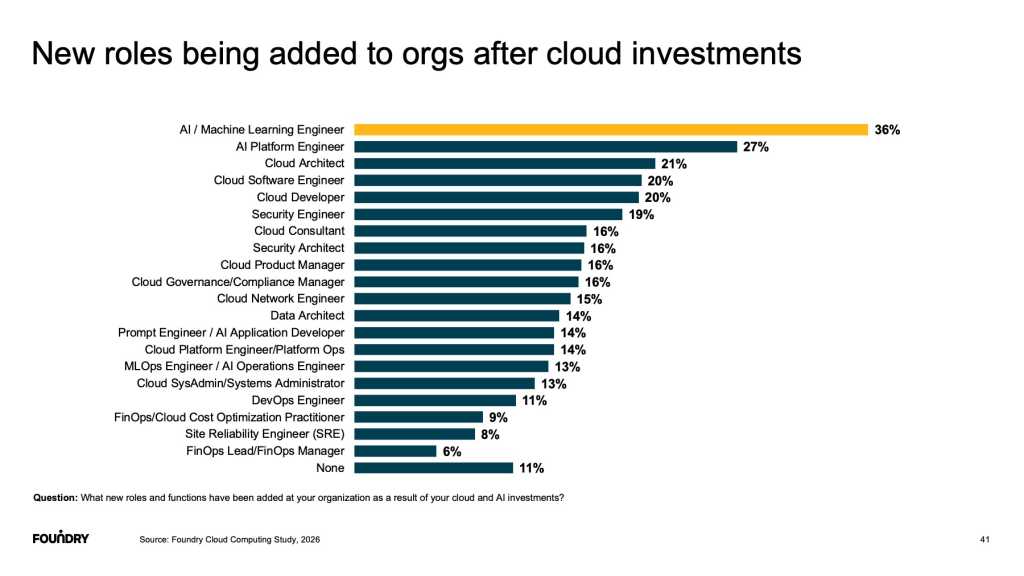
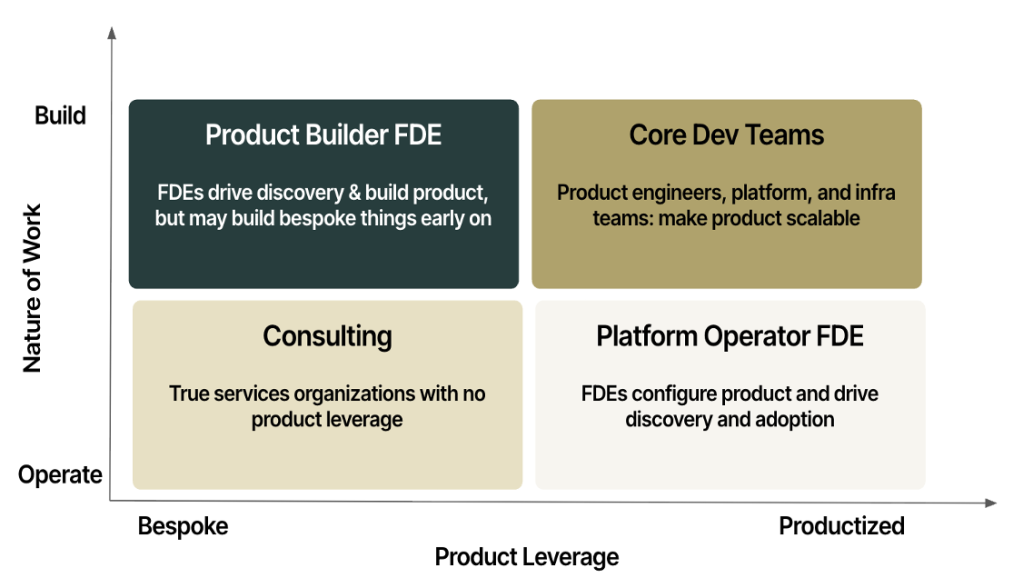
Leading CIOs are also creating new roles centered around AI implementation and management, Lutes notes. These new roles include decision intelligence lead; forward-deployed engineer; human-AI interaction lead; knowledge engineer; master data manager; memory engineer; MLOps engineer; prompt engineer; synthetic data engineer; and trust engineer.

The seemingly contradictory trends reflect a profession in flux.

“We’re still in a messy phase as an industry,” Lutes says. “We’re not going to get to that major shift in the next two years, but five years out we may see a complete restructuring of the IT organization.”

Preparing for the future state

Nick Nadgauda, global CIO of MetLife, is preparing for that future state.

“We continually evaluate whether we have the right blend of engineering depth, business understanding, adaptability, and leadership,” he says. “The goal is not simply to fill today’s roles; it is to build a workforce that can learn, unlearn, and relearn as the work changes. That includes building a strong early-career pipeline and giving emerging technologists the technical foundations, mentoring, and hands-on experience to grow with the organization.”

This ongoing evaluation has reinforced three priorities at MetLife, Nadgauda says.

“First, AI fluency needs to become a broad workforce capability, not a specialty confined to a small group. Second, strong fundamentals in software engineering, cloud, cybersecurity, data, and architecture remain essential. We’re putting an emphasis on making our organization more technical. Third, we need teams organized around clearer accountability and closer alignment to business outcomes,” he says.

Nadgauda is investing in continuous role-based learning, creating more opportunities for hands-on learning, and bringing critical expertise in-house.

But he also acknowledges a degree of uncertainty about what’s ahead for IT, saying, “We can predict the direction more confidently than the exact destination.”

He adds, “We know AI will become a natural part of how work gets done across engineering, operations, and customer-facing teams. We also know that judgment, creativity, accountability, and deep domain expertise will remain critical. What is less certain is how quickly individual tasks and roles will change. That is why adaptability matters so much. The best hedge against uncertainty is a workforce that can learn continuously, experiment responsibly, and apply new capabilities to real business problems.”

AI won’t kill jobs. Bad team design will

In a recent finance training session, an FP&A analyst took the prompting method we had covered twenty minutes earlier and applied it to a monthly variance report spanning four business units. The report normally took one and a half to two hours. It was finished in about two minutes, live, in front of the room. Every leader watching did the same math: if experienced people can work like that, why hire the junior analyst in next year’s budget?

That question sits under most of the early AI jobs story, which has been dominated by fear: fewer junior openings, thinner entry-level ladders and senior employees using AI to absorb work that used to train the next generation.

There is evidence behind that concern. Researchers at the Stanford Digital Economy Lab found that employment among workers aged 22 to 25 had fallen in occupations with high exposure to generative AI. The effect was concentrated in jobs where AI could automate tasks. Employment held up better where companies used AI to support employees.

The companies furthest ahead on AI appear to be doing the opposite, according to recent research from Revelio Labs and Ramp reported by the Financial Times. Among nearly 22,000 U.S. companies, the heaviest AI adopters grew white-collar headcount by 10.2% over two years, with entry-level roles up 12%.

The study does not prove that AI caused the hiring. AI adopters were already larger, more engineering-focused and more likely to be growing, but the findings still matter. Companies making serious investments in AI were expanding their workforces, including their junior ranks. Companies making serious investments in AI were expanding their workforces, including their junior ranks. The difference is team design. AI productivity gains have a shelf life: within a year or two the new pace becomes the baseline, and companies that cut their junior layer to capture those gains will have no one ready to step up.

In my previous CIO article, I argued that successful AI adoption requires companies to change how they operate. Giving employees new tools while leaving existing workflows and decision-making structures in place produces scattered experiments and limited gains. Companies need to give the people closest to the work more authority to test AI, improve processes and teach others what works.

Team design is the next part of that transformation. Once AI changes how work gets done, companies also need to change how teams are built and how employees develop. That includes the junior roles where people gain the experience required to become future managers and specialists.

Cutting junior roles creates a capacity problem

The mistake is easy to make. A company trains its existing staff on AI. Suddenly, experienced employees are 30% to 60% more productive. Junior hires start to look like overhead. For a while, that logic feels rational.

The problem is that this kind of approach has an expiry date. A year or two from now, those productivity gains will be absorbed into the business. The new pace will become normal. Clients will expect more. Internal teams will take on more. Senior employees will be stretched again; except this time there won’t be a trained junior layer underneath them.

The company then has limited choices. It can overwork its experienced staff, compete for expensive external hires or promote people before they are ready. Each option carries a cost.

This is a pipeline problem as much as a hiring problem. Companies cannot produce experienced employees on demand. Judgment develops through repeated exposure to real decisions, feedback and consequences.

Research on AI and customer service offers a clue about how companies can approach this. A study of more than 5,000 support agents found that access to a generative AI assistant increased productivity by 15% on average. Less experienced workers benefited the most. The system helped them apply some of the practices used by higher-performing colleagues.

That finding should interest any leader thinking about early-career development. AI can help junior employees reach competence faster when the tool contains useful organizational knowledge and employees receive guidance on how to use it.

Building teams like multi-agent systems

When we build multi-agent AI systems, we usually build them in a hub-and-spoke model. There’s an orchestrator agent in the middle, then smaller agents handling specific tasks around it. In a marketing function, for example, one agent might handle social media, another might handle SEO, another might handle analytics and another might handle reporting. The user works through the orchestrator, which coordinates the system.

I think this model offers a useful template for team design.

The senior employee acts as the hub, with junior employees and AI agents working as the spokes around them. Instead of simply delegating tasks, that senior person shapes how the work gets done: teaching the AI systems and juniors what good looks like, and helping junior employees build judgment by working inside the same system. The junior employee learns from the AI by seeing how it approaches research, drafting, analysis and problem-solving; the AI improves because the junior is constantly correcting, refining, rejecting and escalating its outputs.

That’s where the training model changes. Historically, juniors learned through repetition, writing the first draft, building the spreadsheet, checking the details, sending the recap and slowly absorbing the standards of the job. AI will take over parts of that repetitive work, but it won’t remove the need for training. It changes where the learning happens: juniors are no longer just learning by doing the task from scratch, they’re learning by directing the task, judging the output and feeding better decisions back into the system.

A junior employee now needs to learn how to question an AI output, spot weak reasoning, understand what a client or stakeholder actually needs, and know when to escalate. This kind of judgment is built like a pilot’s instincts: not by watching someone fly, but by spending time in the cockpit as experienced pilots navigate real decisions.

What companies should hire for now

This changes what hiring managers should look for in junior talent.

Curiosity has always been a crucial quality to look for, but it matters even more now. Juniors need to be willing to learn the tools and understand how AI changes the work. But the stronger signals are emotional intelligence, good interpersonal instincts, discernment, judgment and the ability to explain why they made a decision.

The World Economic Forum’s Future of Jobs Report 2025 supports this broader view of skills. Employers expect AI literacy and technological capability to grow in importance. They also continue to value analytical thinking, curiosity, leadership and social skills. The report found that 77% of surveyed employers planned to upskill workers in response to AI disruption.

That’s also why senior employees need to work differently. Engineers need to spend more time with business teams, so they understand how the company actually operates. Business teams need to spend more time with technical teams so they understand what the tools can and can’t do.

If companies want to keep moving faster, they still need to hire junior talent. But the apprenticeship has changed. Instead of learning by taking repetitive work off someone else’s plate, juniors now join AI-enabled teams where they can see how experienced colleagues think, learn from the systems those colleagues build, and develop judgment through decisions they’re gradually trusted to make. We’re all managers now, some will manage humans, some will manage machines and a select few will build the skills to manage both.

IT jobs report: Employers consider AI risks and ethics

The IT job hiring market appears to remain strong, as data from the Dice September 2026 Jobs Report shows that IT job postings continued to increase through September after experiencing a slight dip in August. Overall, the data shows that year over year, IT job postings rose 17% compared to September 2025.

Two areas that saw the most growth include AI and ML, where tech postings grew 88% in September 2026 compared to 2025, about five times faster than the average growth rate for tech postings. As employees embrace AI tools and organizations realize AI implementation goals, they’re shifting a hiring focus to security and finance roles, helping to manage and oversee emerging risks and threats as AI becomes commonplace.

With this increased focus on security and finance, organizations are realizing their AI implementation strategies. And for companies ahead of the AI curve, the focus is now on cybersecurity, governance, responsible and ethical AI use, and financial operations to support AI costs.

Skills that matter most

AI skills continue to grow in demand year-over-year and month-over-month. September saw a sharp rise in demand for Claude skills and those including agentic AI, enterprise integration, and the ethical and responsible use of AI. These skills reflect similar patterns that show in the June data, suggesting they continue to be skills consistently in demand for tech workers.

Comparing skills month-to-month, there were slight changes in demand, but electronic engineering remained the fastest growing skill since July, and skills for managing AI systems grew over September. There was also an increase in IT job postings from those looking for skills including creative problem solving, team performance management, and demonstration skills.

As AI implementation takes hold and presents new risks and challenges to IT departments across every industry, companies are also shifting focusing on cybersecurity and critical thinking skills. September saw an increase in demand for endpoint detection and prevention, as well as financial technology, indicating companies are looking for talent to manage the security and cost of AI processes and tools.

The highest growth in demand over the past year are skills involving:

  • Claude AI (1033%)
  • Agentic AI (446%)
  • Responsible AI (401%)
  • Enterprise integration (376%)
  • AI agents (308%)
  • Product family engineering (295%)
  • AI infrastructure (283%)
  • Tooling (277%)
  • Engineering practices (277%)
  • AI adoption (276%)

Month over month, the Dice report’s list of fastest growing skills includes:

  • Electronic engineering (64%)
  • Autodesk Revit (57%)
  • Endpoint detection and prevention (51%)
  • Creative problem solving (51%)
  • Database management systems (49%)
  • Team performance management (48%)
  • Data migration (45%)
  • Demonstration skills (44%)
  • FinTech (43%)

Hot hiring markets

In terms of metro areas seeing the fastest increases of job postings, not much has changed since June’s report. However the Washington-Arlington-Alexandria (DC-VA-MD-MW) area did pull ahead of New York-Newark-Jersey City (NY-NJ) metro areas, where IT job postings dipped from over 20,000 in June to just over 16,000 in September. IT job postings in metro Dallas, Chicago, and San Francisco have remained relatively unchanged since June, demonstrating potential hiring stability in these areas.

Metro areaIT job postings (September)
Washington-Arlington-Alexandria, DC-VA-MD-WV19,248
New York-Newark-Jersey City, NY-NJ16,441
Dallas-Fort Worth-Arlington, TX10,966
Chicago-Naperville-Elgin, IL-IN8,385
San Francisco-Oakland-Fremont, CA8,371

Credit: Dice September 2026 Jobs Report 

In depth:

July 2026: Demand for AI fluency rises

AI skills continue to drive IT job postings, with 75% of US technology openings requiring AI fluency in June, up 178% year-over-year, according to the Dice July 2026 Jobs Report.

Roles in the software industry continue to rise, ranking second behind consulting as the industry seeking the most IT help right now. Aerospace/defense, finance/banking, and manufacturing round out the top five.

Most sought after in the market right now are software engineers, data engineers, systems engineers, electrical engineers, business analysts, data scientists, network engineers, systems administrators, data analysts, and AI engineers, according to Dice.

While these roles remain in high demand, the biggest shift can be seen in the skills that hiring managers are seeking — a list now dominated by AI or AI-adjacent skills as companies rush to adopt enterprise AI tools and services.

The skills that matter most

Demand for enterprise integration skills grew 638% from June 2025 to 2026, the biggest rise year over year, according to Dice, noting that this aligns with other indicators that “connecting agentic systems to existing infrastructure is growing faster than the agentic systems themselves.”

Following in terms of highest growth in demand over the past year are skills involving:

  • Agentic AI (587%)
  • AI agents (503%)
  • Responsible AI (495%)
  • AI infrastructure (366%)
  • Vector databases (353%)
  • Event-driven programming (310%)
  • Product family engineering (287%)
  • Prompt engineering (253%)
  • Observability (251%)

Month over month, the list of fastest growing skills in Dice’s July jobs report includes:

  • Electronic engineering (69%)
  • API system integration (58%)
  • LDAP (55%)
  • Digital forensics (54%)
  • Data exchange (53%)
  • Enterprise integration (50%)
  • Threat detection (48%)
  • NIST Cybersecurity Framework (47%)
  • SAML (45%)

Again, the rise in demand for API, data exchange, and integration skills highlights the recent push to “connect AI systems to enterprise data and workflows,” according to Dice.

Hot hiring markets

Some metro areas are seeing faster increases in tech job postings, with a focus around the New York, Washington, Dallas, Chicago, and San Francisco metro areas. These areas have seen greater growth than the rest of the country, making these metro areas the best to live in if you’re a job seeker with AI fluency skills:

Metro areaIT job postings (June)
New York-Newark-Jersey City, NY-NJ 20,858
Washington-Arlington-Alexandria, DC-VA-MD-WV19,906
Dallas-Fort Worth-Arlington, TX11,932
Chicago-Naperville-Elgin, IL-IN9,346
San Francisco-Oakland-Fremont, CA8,699

Credit: Dice July 2026 Jobs Report

New Jersey (64%), Maryland (47%), and Illinois (41%) are the states that have seen the highest year-over-year increase in hiring.

Roles in demand

Companies are looking for enterprise systems and consulting managers, including Appian developers, Oracle Cloud financial consultants, ServiceNow managers, principal consultants, and technology consultants. Additionally, they are seeking out IT software engineers, C++ software developers, configuration analysts, support engineers, network infrastructure engineers, AI analysts, and cyber threat intelligence analysts.

Outlook

Businesses inside and outside the tech industry will continue to seek tech workers to help realize AI visions, requiring a wide range of AI fluency and skills. It seems this trend will continue for the foreseeable future, as the job market slowly recovers from several tumultuous years.

In depth:

AI and the impending third technology talent drought

Every technology professional working today owes their career, in part, to someone who took a chance on them. The software engineers, cybersecurity analysts and infrastructure specialists on our teams didn’t arrive fully formed and ready to perform. Someone hired them, trained them and gave them room to grow. That’s worth remembering now, because the tech talent pipeline is shrinking, and history shows it can take more than a decade to recover from a decline like this.

The pipeline is at risk on two fronts: fewer students are choosing to study computer and information science, and hiring managers anticipate weaker near-term demand for these graduates. This isn’t unprecedented. The computing profession has weathered two major talent declines in its short history, and each took more than a decade to recover.

After 15 years of growth, computing enrollment reverses

According to the U.S. National Center for Education Statistics, the number of computer science and information science B.S. graduates has grown steadily since 2010. A tech degree once meant a well-paying job and a career with a future, driven largely by increased demand for technology. That momentum now appears to be reversing across several regions of the world.

Research from the National Student Clearinghouse Research Center indicates that enrollment in CS and IS degree programs at U.S. colleges and universities fell by more than 8% in 2025, even as overall undergraduate enrollment grew by 1%. The trend is not confined to the U.S. According to BCS, the Chartered Institute for IT, the UK saw a similar decline, with 18-year-old UK students entering computing degree programs down 9% in 2025. In Australia, the decline appears even steeper. ACS/Information Age reports that the Australasian Conference of Tertiary Admissions Centres’ (ACTAC) January 2026 report shows a 21% decline in enrollment for IT-related degrees heading into 2026.

Three countries, three distinct education systems, one common outcome. What makes this notable isn’t any single data point but the swift, dramatic downturn across all three countries. If this were confined to one market, it could be dismissed as a local correction; however, a similar pattern across the United States, the United Kingdom and Australia at roughly the same time suggests a structural shift in how the next generation views a tech career.

What 1,200 tech leaders expect: Lower demand for graduates

If the problem were only fewer graduates, but hiring demand were strong, the situation would probably correct itself. Talent scarcity would drive up wages and attract more students. However, the demand side appears to be contracting as well.

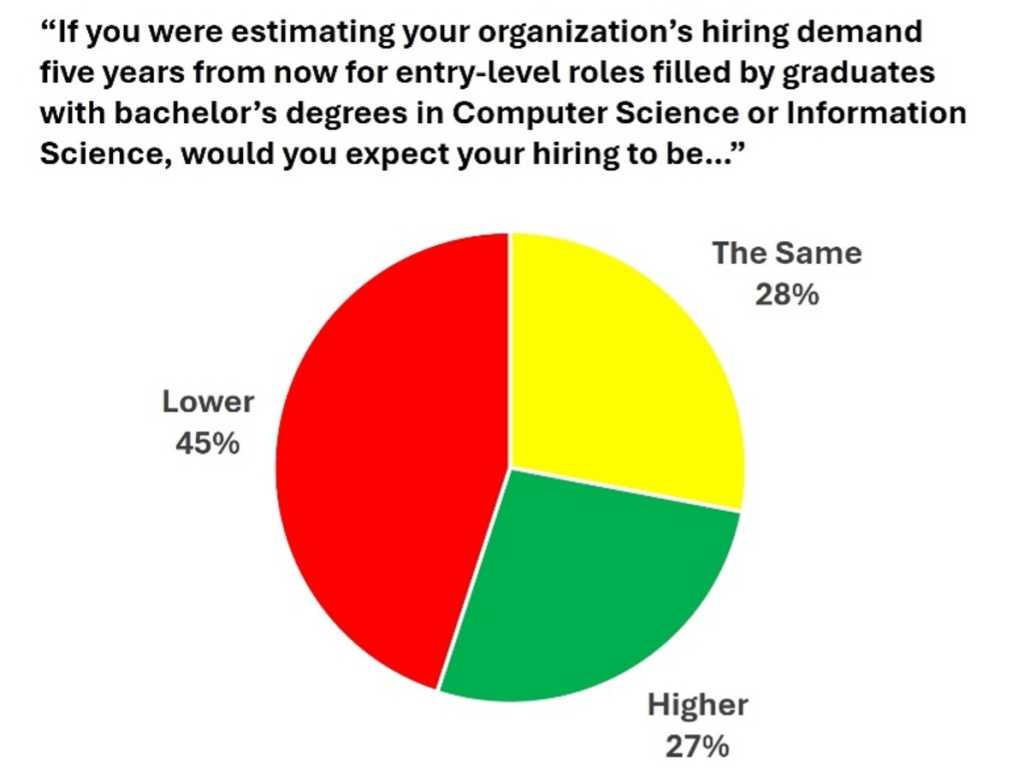
In the second quarter of 2026, I surveyed more than 1,200 senior technology leaders across 53 countries and what they expected their organization’s hiring demand to look like five years from now for entry-level roles filled by graduates with bachelor’s degrees in computer science or information science. Respondents held titles including CIO, CTO, VP of IT and Head of IT. More than 6,600 surveys were sent to technology leaders via LinkedIn, resulting in a 19% response rate.

The results were sobering: 45% anticipated lower demand, 28% expected demand to remain the same, while 27% anticipated it to increase. (You can download a summary of the survey at https://www.impactfultechnologyleader.com).

This result was not limited to a specific country or region. Those expecting hiring demand to be lower in five years were in the majority across almost every country, industry and company size.

The reason, cited across every group, was the same: artificial intelligence. Leaders expect AI to automate much of the entry-level technical work, including routine coding, service-desk tickets and administrative tasks. This is the work where new graduates have traditionally begun their careers. The logic is that existing teams, aided by AI, can do more without adding entry-level employees.

Regardless of their responses to the survey question, many of the leaders noted that reducing the number of junior roles in their organization was problematic. They recognized that it would erode the pipeline for future senior talent and that recovery from this gap would take years.

We’ve seen this movie before

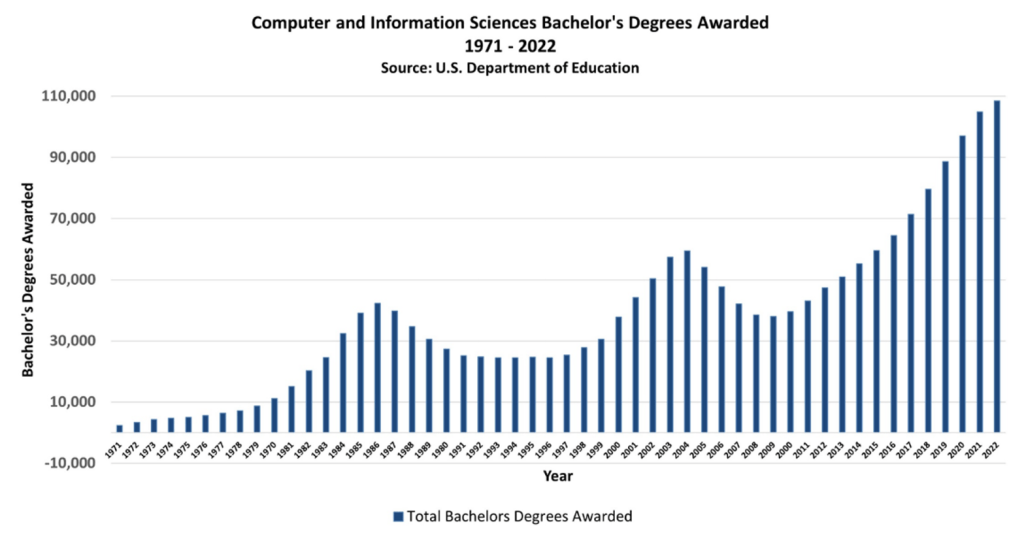
This is not the first time CS and IS graduate numbers have fallen. In the mid-1980s, universities were overwhelmed by demand for computing degrees and couldn’t staff their programs adequately. When computer science programs could no longer accommodate surging student interest, universities capped enrollment and tightened admission standards. The effect was dramatic: bachelor’s degrees in computer and information sciences fell sharply beginning in 1987. It was not until 2001, fifteen years later, that graduation rates recovered to their earlier level.

The second decline came in the early 2000s, in what might be called a perfect storm. The winding down of Y2K remediation, the bursting of the dot-com bubble and a rising wave of IT offshoring converged to shake confidence in technology as a career. Mass layoffs swept through IT departments and dot-com firms, and enrollment in computing programs fell once again. The resulting drop in tech degrees awarded began around 2005, and it was not until 2016, eleven years later, that graduation rates recovered to the same level.

The chart below from the U.S. National Center for Education Statistics depicts these two significant declines in graduates with technology degrees.

Is AI the new perfect storm?

If you map today’s forces onto that history, the parallels are hard to miss. AI-driven automation is creating a demand shock, declining technology enrollments are creating a supply shock, and growing skepticism about the value of a technology degree is creating a confidence shock. This mirrors the erosion of faith in the career path after the dot-com bubble burst.

What took three separate crises to unfold in the early 2000s is converging today into a single, self-reinforcing cycle: fewer students entering the field, fewer opportunities perceived to be waiting for them, and growing doubts about whether a technology career is still worth pursuing.

But the parallel to those earlier declines carries a warning, not a reassurance, and the difference is in how each one ended. The recoveries of 2001 and 2016 happened because demand never left. In both prior declines, the supply of graduates fell while the underlying need for tech professionals rebounded. That gap between shrinking supply and steady demand is exactly what refilled the pipeline: scarcity pushed up wages, wages pulled students back and the market corrected itself, however slowly. What makes today different is that supply and demand are falling together. If leaders are correct that AI will replace entry-level work, this is not a demand dip waiting to rebound, it is a demand replacement, with no scarcity signal to trigger the correction that saved the field twice before.

The most dangerous feature of a talent pipeline is its lag. The decisions made, or not made, over the next few years will not trigger a crisis next quarter or even next year. Their consequences will surface a decade or more from now, when today’s would-be entry-level personnel should have become tomorrow’s architects, technical experts and leaders.

By then, the shortage will already be baked into the pipeline. And that is not speculation. It is the exact pattern the historical record has already shown us, twice.

What is a technology leader to do?

It would be easy to read my survey results and conclude that the market will sort itself out. Nearly half of the IT leaders I surveyed plan to hire fewer entry-level computing graduates over the next five years. Many dismiss this: education will adapt, five years is an eternity and better tools will make new graduates more capable than ever. They may be right. But hope is not a workforce strategy, and the leaders best positioned five years from now will be those who treat this as a problem to solve, not a trend to watch.

The uncomfortable truth is in one respondent’s warning: “We will have to find a way to invest in new grads, or we will not have a pipeline of middle and senior talent later.” If every organization cuts entry-level hiring because AI now handles the routine work, our profession will slowly stop developing the senior engineers it will desperately need a decade from now, because senior people are simply junior people who were given room to grow. No single leader can solve this problem, but every leader can refuse to be the one who lets it happen to their organization.

That starts with treating early-career hiring as a strategic investment, not the first line item to cut. Set aside several junior roles intentionally as an investment in your future leadership, rather than as just headcount to cut in the upcoming budget cycle.

It also means redefining what “entry-level” even means. Survey respondents were consistent: the bar is changing. They want applicants with a strong portfolio over a strong transcript, demonstrable AI fluency over rote coding, and, in the words of one, “people who can ask the right questions” now that AI supplies the answers. Rewrite your junior roles and interviews around critical thinking and judgment, and recognize that a new graduate’s value now lies in growth potential and the ability to direct AI-assisted work, not raw output.

Finally, the talent pipeline begins with encouraging high school students to seriously consider a career in technology, and guiding them will take all of us. If history holds, many will steer away from computing if they believe it has no future. Before committing to an investment as large as four years of tuition, parents will point their children toward fields with steady or rising demand.

Technology leaders and their teams can cut through the hype and help students understand what a career in technology looks like in the age of AI. Through classroom talks and on-site job shadowing, they can give students a real chance to discover the opportunities computing offers. Through mentoring and hands-on, real-world projects, they can support STEM programs at both the primary and secondary education levels.

With the aid of other technology professionals and leaders, I have developed a directory of organizations that promote and support careers in computing across the globe. The directory, which can be found at impactfultechnologyleader.com, includes:

  • Programs for grade school, high school and university students
  • Support for working professionals, whether already in tech or breaking into it
  • Groups serving those transitioning from the military, returning to work or navigating any other path
     

Every one of us in this profession got here because someone decided we were worth the investment before we had proven it. That decision was never really about what a junior professional could contribute on day one. It was a bet on who they could become. AI may change what that first job looks like, but it doesn’t change a fundamental truth: to become a senior technology professional, you first had to be a junior one. The leaders who understand that over the next five years won’t necessarily be the ones who predicted AI correctly. They’ll be the ones who understood that some risks are worth hedging against even when you can’t be certain, and that a talent pipeline, once broken, takes a decade or more to rebuild.

The question isn’t whether the pipeline is at risk; it’s what you will do to make sure it doesn’t break.

Girls Talk Tech: 7,000 students and the next generation of women tech leaders

A high school teacher had three girls sign up for her computer science class—three for the whole year. Then a group of ConocoPhillips technologists came in to talk about their careers, and more than 20 students registered. The school had to add a half-day CS teacher to handle them.

That is Girls Talk Tech working exactly as designed. A group of women in the ConocoPhillips IT organization formalized the program in 2018 with a clear mission: educate, encourage, and empower young women to embrace technology for the future. The gap it addresses is well documented. According to the National Center for Women & IT, women make up 57% of the US professional workforce and hold only 26% of IT roles, and the disparity widens in engineering and computing.

“It’s really an outreach education program,” says Billy-Joe Lafortune, general manager of Lower 48 Digital Technologies and Global Strategy at ConocoPhillips. “It’s about reaching out to young women in middle school and high school, and it’s about inspiring them and preparing them to consider or pursue a career in technology and STEM.”

Lafortune has been a co-sponsor since 2019, when the team asked her to take the role alongside the CIO at the time. Her day job spans two responsibilities: she is the business unit technology leader for ConocoPhillips’ Lower 48 segment, the largest piece of the portfolio, and she leads global digital strategy, deciding where the investments go and then delivering them. She reached that seat over two decades at the company, through IT leadership roles in the Canadian business unit and corporate functions. In April, the HoustonCIO chapter named her the 2026 Super Global ORBIE recipient, the category reserved for leaders at organizations above $7.5 billion in revenue with multinational operations.

How the program runs

Girls Talk Tech works in three tiers of depth.

School panels are the primary channel and the highest volume. Volunteers visit local schools, share their own career journeys, walk through the STEM pathways a student might take, field questions about college, and bring food and swag.

For a more immersive experience, students are invited to short on-campus events that typically span one or two days and provide hands-on time with real technology, breakout sessions and conversations with practitioners from cybersecurity, software development and other disciplines.

A 2024 Girls Talk Tech event.

Girls Talk Tech 2024 staff and attendees meet for the first day on Tuesday, October 29, 2024, at Spirit Two at ConocoPhillips headquarters in Houston.


ConocoPhillips

Houston’s GTT Fest, a two-day event, draws close to 200 students. The deepest level of engagement comes through summer programs, where a small cohort of students spend about a week participating in mentorship, real-world projects and a capstone presentation back to the business. All programs are offered at no cost to participants.

Ninth year in, the numbers describe something that found demand rather than manufactured it. More than 7,000 girls reached. Three established affiliate programs in Houston, Bartlesville and Calgary. Pilots running in Midland and Equatorial Guinea. Twenty-plus global committee members and more than 150 volunteers.

“Schools want this, teachers want this, we’re seeing parents want this,” Lafortune says. “There’s this thing that’s drawing people in. And we’re not the only program like this out there. There are a lot of companies and nonprofits doing this, which I think is incredible, and the work has to continue. Clearly the gap still exists.”

She frames the case in pipeline terms rather than charitable ones. “It helps build the pipeline of talent needed for an AI-driven economy,” she says. “It’s making sure we have people equipped with the foundational skills, and that they participate rather than just consume.”

As AI plays an increasingly important role, it can help organizations improve productivity, decision quality and business performance. But the opportunity is not simply to use new tools. It is to help people develop the skills and judgment to apply them thoughtfully. “It’s more important than ever to bring young women on this journey so they can be part of building that future as we go along.”

The full loop

The story Lafortune returns to is Maddie’s. Maddie attended Girls Talk Tech events as a high school student, went on to earn a technology degree, and was hired into a ConocoPhillips rotation program. She is now a cybersecurity analyst at the company and sits on the Girls Talk Tech Houston committee. Her journey illustrates the human side of technology transformation: technical capabilities may continue to evolve, but expertise, mentorship and human judgment remain essential.

“She’s on the other side of the journey now,” Lafortune says. “She’s sharing her perspective, she’s mentoring students and she’s demonstrating what’s possible. For me that really hits home.”

Lafortune’s own role is sponsorship in the working sense of the word: air cover, prioritization and the executive weight that keeps a volunteer organization from drifting. That last piece is harder than it sounds. “It just keeps growing year over year, to the point where if we’re not careful this becomes a full-time job,” she says. “So, we really do have to prioritize how much we can do in a year and still have the impact we’re seeking. And everyone does it because they love it. They love to give back.”

Rationing volunteer capacity across three countries so a program stays effective while demand outruns supply is, functionally, portfolio management. It is the same work she does on the day job, in an arena where nobody has to do what she asks.

What leading something like this does for you

There is a secondary benefit here worth naming, because most technology executives underweight it.

Marketplace eminence is one of the dimensions we assess when we work with leaders on CIO readiness, and it is consistently the one they have thought about least. It is what puts you on a search firm’s short list before a role is posted, what makes a strong candidate return a recruiter’s call, and what earns you the benefit of the doubt in a board conversation.

Most of the ways leaders build it are good ways. Speaking on a panel puts your point of view in front of peers and gets it into circulation. Customer advisory boards, industry forums and analyst relationships all do real work, and the executives with the strongest reputations tend to do plenty of each.

Leading a community program complements those channels. It compounds, because you are there for years. It is genuine operating experience, since a program at this scale means governance, budget, volunteer labor and stakeholders across three countries who do not report to you. And it gives you something specific to say when the panel invitation comes, which is often the difference between an appearance people remember and one they do not.

Lafortune did not take this on as a career move. She took it on because she had seen what early access does. “It’s almost like you’re creating that spark to help people see what is actually possible,” she says. The standing came anyway, which is rather the point.

Call to action

If someone in your industry were asked tomorrow what you are known for beyond your own company, what would they say?

If the answer is thin, find the cause you would show up for even if nobody noticed and take a real leadership position in it. A STEM pipeline program. A workforce reentry initiative. A nonprofit that needs a technology strategy and cannot afford one. The cause matters less than the commitment, because the returns arrive slowly and they arrive as relationships, reputation and operating range you cannot buy or borrow.

Lafortune put it more plainly than I can. “The reality is that the future will be shaped by who shows up,” she says. “Programs like this help ensure who gets into the room, and whose voices are heard.”

That is true of the students. It is also true of the leaders who decide to show up for them.

AI’s real bottleneck isn’t compute — it’s the network underneath

For such a rapid innovation cycle, AI has been given unprecedented levels of responsibility. According to the Stanford AI Index 2026, 88% of organizations used AI in 2025, with 70% using generative AI in at least one business function. Most analysts agree that this technology, particularly when it comes to generative and agentic AI, is yet to reach full maturity, yet it’s already making itself indispensable to most enterprises. Employees expect LLM-based copilots to respond as readily as any other business application, customers are increasingly exposed to AI as part of their user experience, and emerging agentic models need to communicate continuously with applications and infrastructure as they crunch data and carry out tasks. Any hint of delay within those interactions has the potential to disrupt productivity, sow mistrust in the technology, and limit any return on investment (ROI).

Most businesses now inhabit a multi-cloud environment that spans countries and continents. When an AI request depends on information stored in one cloud environment, processing capacity hosted in another, and an application delivered somewhere else entirely, latency becomes the deciding factor. Each network hop, particularly through public Internet pathways, increases response time. Repeat these delays across hundreds, thousands, or even millions of individual requests – from both humans and AI agents – and the whole organization becomes artificially hampered. Sometimes connectivity becomes so hampered that IT teams must step in and spend valuable time rectifying it.

A recent Censuswide survey commissioned by DE-CIX found that IT teams in the US and UK spend an average of 11.5 hours every week resolving cloud connectivity issues – that’s more than a full working day each week spent on network troubleshooting. This is the “hidden productivity tax” that organizations are now paying, and it may be why the ROI for AI initiatives feels lukewarm at best, and impossible to measure at worst. McKinsey’s 2025 global AI survey found that only 39% of respondents could attribute any enterprise-level EBIT impact to AI, and most of those reported a contribution below 5%. That’s why even the best models can only get you so far – compute power may command the budget, but it’s the network that determines value.

A tax on productivity

Consider what happens when an employee asks an AI assistant to carry out a simple task like summarizing an internal document or doing some number crunching. The application may need to verify the employee’s identity, locate the relevant information, send it to a model operating in another cloud environment, and return the response through the user-facing application. An agent completing a more involved task could make this journey repeatedly as it gathers information and interacts with other systems. If one connection is slow or unreliable, the delay follows the request all the way back to the user, and if that connection fails, a whole team may be drafted in to isolate a problem that appeared inside the application but originated somewhere along the network path.

Engineers who could be improving AI services or supporting new deployments are instead tracing routes, investigating intermittent failures, and working around infrastructure that behaves unpredictably. What makes this particularly striking is the contradiction that was revealed as part of DE-CIX’s survey. While enterprises concede that more than a full working day per week is spent on network troubleshooting, as noted above, nearly all (96%) say their networks are “ready” to support future cloud and AI projects. This doesn’t prove that enterprise networks are fundamentally unprepared, but it does reveal a disconnect between strategic confidence and everyday operational experience. When more than a working day can disappear into connectivity troubleshooting each week, some of the expected productivity benefit from AI is already being spent before the technology has had an opportunity to deliver it.

AI performance and network performance are inseparable

Users don’t experience a model and its supporting infrastructure as individual sets of requests – they just experience “fast” or “slow” workloads. A cutting-edge AI model will still feel ineffective if the information it needs travels along congested or unpredictable public transit routes, so any real-time interaction with AI will become an exercise in frustration with small delays that compound over time, slowing teams down.  As AI services become more distributed, network performance is becoming inseparable from application performance, but it’s rarely given the same attention as model accuracy, compute capacity, or the cost of running AI inference.

IT leaders are beginning to take note, however, despite being a little overconfident about their network readiness. Alongside latency between cloud environments, security vulnerabilities including DDoS attacks, and downtime or reliability concerns are triggering a change in approach towards network connectivity. That’s why many are now turning to private, direct connectivity to cloud providers through an Internet or Cloud Exchange or via other means of directly connecting to the cloud providers’ private connectivity solutions, bypassing the pitfalls of the public Internet and IP transit.

Direct connectivity offers a greater degree of sovereignty, visibility, and control over data pathways that can reduce latency and enhance security. Public Internet connectivity will remain essential, of course, but business-critical AI traffic should not follow routes that can change unexpectedly or introduce additional network hops. It isn’t a universal cure for poor AI performance, but it can remove some of the uncertainty from an operating model that increasingly depends on information moving quickly and reliably between distributed environments.

Turning network performance into a business metric

The next 12 months could be a turning point for businesses looking to prove AI’s worth. CIOs simply need to account for the full cost of delivering an AI service, including the hours spent diagnosing connectivity problems and the value lost when applications respond inconsistently. In other words, they need to bring network teams into AI planning from the outset, considering their network infrastructure with the same rigor they apply to selecting AI models and projects. Private interconnection can provide more direct and predictable routes between environments, while effective observability can reveal how traffic moves, where delays accumulate, and how reliably the entire workflow performs. Without that control and visibility, network friction will remain a “hidden tax on productivity” that could stall AI deployments and weaken the case for future investment.

‘Not my cup of tea’ is the most expensive sentence in your engineering org

I run interviews every week. Around minute 25, I ask about customer-facing experience. Have you sat in front of the people who use what you build? The answer I get most often: “That’s not really my cup of tea.”

A few minutes later, I ask a Python engineer which metrics he’d use to autoscale the service he just described. “That’s more of a DevOps question.”

Two answers. Same excuse. There’s a border, and the candidate has decided everything on the other side belongs to someone else.

Before tech, I captained a warship. 20 people, 30 months at sea. Out there, you master skills that have nothing to do with your specialty, because a ship where everyone stays in his lane and nobody talks to the next station is a ship that sinks. “Not my cup of tea” doesn’t exist at sea. So, when I hear the border excuse in an interview, I don’t hear a preference. I hear a ceiling the candidate built himself.

The market flipped, and the candidates didn’t

LinkedIn’s Most In-Demand Skills report put communication at number one for 2024, second year running, above every hard skill on the list. Its Skills on the Rise report for 2026, built from a billion member profiles, puts AI literacy at the top of the technical side, while soft skills take seven of the top ten spots overall, including conflict mitigation and public speaking.

None of this is new, either. Harvard economist David Deming showed it back in 2017: between 1980 and 2012, the jobs that run on human interaction expanded their slice of the American workforce by 12 points. The loner jobs built on pure math, plenty of STEM in there, lost ground. AI didn’t start the fire. It poured fuel on it.

Meanwhile, the skill we spent 20 years paying a premium for is getting commoditized in real time. Developers themselves put the figure at 42% of their committed code now being written or assisted by AI, up from 6% in 2023, per Sonar’s State of Code survey. At Cloudflare, 97% of the engineering org now codes with AI tools, and every production code contribution gets reviewed by autonomous AI agents. That came from their Q1 2026 earnings call, not a keynote. Companies can hype a keynote. They get sued over an earnings call.

A large slice of what a mid-level engineer did in 2019 is now a prompt and a review. I don’t need to convince a CIO of that in 2026. The invoices already did.

The typing got cheap. The judgment didn’t.

To be clear, nobody commoditized deep technical understanding. What got cheap is the typing. And the moment typing got cheap, judgment got expensive. Somebody still has to decide what deserves to be built, what gets skipped and which team burns its budget on which problem. A model spits out options all day long. It won’t pick one for you. That call needs a human who understands the whole board, and those humans are exactly what the silo never produces.

Which is why that ceiling from the interview room is so loud. An engineer who caps his own understanding in 2026 is announcing he hasn’t understood what’s happening around him.

Code got cheap. Talking got expensive. Nobody repriced their career.

So, what’s rare now? The engineer who can walk a VP of Sales through a tradeoff without once mentioning the stack. The one who can take an angry customer’s call, all 40 minutes of it, and stay curious instead of defensive. Every year my interviews surface fewer people who can pull off either one. No study backs this. My notes do.

How we got here

Covid killed the hallway and we buried it with a hybrid policy. The arguments at the whiteboard, the “got a sec?” over someone’s shoulder, they all migrated into Slack. Problem is, nobody can grab your shoulder in Slack. You can go dark for a whole day, and the tool calls it focus.

Then the productivity religion redefined talking as a waste. I’ve read the books; some of it is right. But a whole generation absorbed the gist without the nuance, and the gist is: every human interaction is an interruption. A customer call is somebody else’s job.

We made it worse ourselves. Twenty years of interview loops built around algorithm puzzles selected, at scale, for people who perform best alone with a screen. Then we act surprised they’d rather be alone with a screen. And we split teams by tool instead of by problem. Python people here, Kubernetes people there and when a request landed on the seam, we invented a word for the seam. DevOps was supposed to be a culture. It became a tag you put on a ticket, so it stops being yours.

And at some point, the teams inside the building started acting like strangers doing business. The team next door stopped being colleagues and became “a service we consume.” You file a ticket, you wait for the SLA, you never hear a human voice. With an outside provider, fine, that’s the deal. Inside one company, on one platform? That’s two crews on the same ship passing notes under the door. Somewhere along the line we decided a 10-minute conversation costs more than a three-day ticket loop.

That’s on us. On CIOs, on CTOs, on CEOs, on me.

The perfect colleague

Then AI showed up as the perfect colleague. Never interrupts. Never needs the context twice. Never has an opinion you didn’t ask for. Never makes you feel stupid for asking. Available at 2 AM, and I have tested that more times than I should admit. And it’s addictive in a way nothing in this job has been before. You open the IDE, you describe, the thing appears, you push, you describe the next thing. Hours go by. Nobody interrupted you, and nobody disagreed with you. Feels like the most productive day of your career. Some days it is. I feel the pull myself, and I have been managing people for more than 22 years.

Thing is, it compounds. Communication is a muscle, and the reps used to come for free: the standup, the design argument, the customer who called because the ticket wasn’t clear, the product manager who wanted it explained again. Every one of those reps now has a substitute that doesn’t talk back. Reps drop to zero. Muscle goes. The next customer call feels harder than the last one, so you avoid it a bit more, so the muscle goes faster. Nobody decides to get worse at talking to people. It happens one quiet, very productive day at a time.

Twelve months of that and a senior engineer who used to run design reviews can’t hold a room. He won’t notice. His manager will.

So, we need generalists now?

Wrong conclusion, and I hear it from CIOs weekly.

We don’t need generalists. We need people willing to level up. To combine pieces, they never had to combine, because for 20 years the org chart did it for them. The barrier has never been lower. It used to take a course and a colleague with spare time. Now it takes a model and the willingness to ask. The excuse is gone.

Does that make you less of a specialist? Of course not. It makes you a better one, because the silo was constraining your understanding, and you couldn’t see it from inside.

The autoscaling question. Which metrics actually drive scaling for the service you wrote, and why those? People park it one desk over. A software engineer should own it, because every answer depends on the code he wrote. A senior should have known before I asked.

AI made breadth cheap. The specialist’s excuse died. The specialist didn’t.

The ones who ignore all this won’t get fired. Nothing that dramatic. Their work will simply dry up around them. The product manager who used to bring them questions now asks the model instead. Fewer requests land on their desk. Their salary stops moving. Then one day they test the market, search for “Python developer” openings, and find the titles changed while they weren’t looking. Firms now ask for web engineers, people who own the whole picture, front to back. Nobody sent a memo. The market repriced the role quietly, while they kept their head down in their lane.

The customer border

Not long ago I had a problem with a flight and spent days trying to reach my airline. Every path led to a bot. No phone number for a human anywhere, and my case was the one in a million the flows were never built for. I ended up driving to the airport to talk to a person at a desk. Think about that. I build conversational AI for a living and even I couldn’t find the human. The bots handled the million. The airport desk handled me.

Years around customer experience taught me to admit this out loud: there are moments a customer needs a person. When the system is down at 11 PM and the quarter closes tomorrow, nobody wants a knowledge base. They want a human who owns the problem and says so. You can’t prompt your way through an angry customer. And you can’t force people to stop feeling human when things go wrong. Sentimental beings, all of us. That need is not going anywhere.

I know exactly where the bot stops and the human starts, because that handoff is the product I build. The engineer who never sat in the escalation queue designs that moment from a spec sheet. The one who sat there writes different code. Different priorities. Fewer features nobody asked for.

The bot gives you the answer. The customer gives you the problem you didn’t know you had. Only the second one compounds into judgment.

Customer-facing is not sales

Part of the resistance, and I see this in interviews constantly, is a misunderstanding. Engineers hear “customer facing” and think sales. They picture memorizing everything, defending the firm with skills they don’t have, performing some salesy theater. Wrong on every count. Customers reward honesty. They respect the engineer who says, “I don’t know, let me check” and actually comes back. And customers idolize the tech people who visibly care about their problem, because that is rare.

I watched it happen recently. In a QBR, the quarterly review we run with customers, one of them asked for a technical representative in every meeting going forward, next to the project side. I added an architect to the rotation. The customer loved it. The architect gained more. He was doing this work already, just never in front of the people paying for it. Now he had to structure his thinking, prepare and answer live questions with no editor between him and the room. He leveled up within a quarter. The runbooks existed before. The documentation existed. What changed was one man willing to step out of his comfort zone and take pride in his work in front of the people who use it.

So, should engineers run customer sessions? The willing ones. And here I’ll argue with an earlier version of myself, because I used to think you assign this like a watch bill, the duty roster of a ship. You can assign exposure. You can’t assign mastery.

On my ship, the officers who grew into command were never the ones I had to push toward the bridge. They were the ones already up there off duty, asking about the next qualification. Same in engineering. Introvert is a personality. Unwilling is a decision.

Four moves, starting Monday

Change the interview loop. Add one round where the candidate explains his system to someone outside tech and gets interrupted with naive questions. Then ask him something one desk over from his specialty. Watch the reaction. The reaction is what you’re hiring.

Coach the ones who raise their hand. Some engineers struggle in front of customers, know it and want to fix it. Give them real budget: training, shadowing, a debrief after every session. Film review, like athletes do. Nothing you fund this year will return more.

Stop persuading the rest. If someone needs a campaign to see why this matters, he will never put in the work the skill demands. Nobody masters a craft he was talked into. Spend that energy on the willing.

Organize by problem, not by tool. If a customer request always needs two teams and a handoff, fix the org chart, not the request. And kill the internal vendor act. One platform, one crew.

The part nobody wants to hear

Communication was never a soft skill. We just called it that while code was the expensive thing. Code isn’t expensive or scarce anymore. What’s left is the muscle we let atrophy and the border we let people hide behind.

AI can accelerate everything except experience. Sitting with a human who’s frustrated with your product still takes reps.

Find the ones who want the reps. Bet on them.

AWS launches CloudWatch Omni to unify observability for AI agents and applications

As enterprises continue to move AI agents and agentic applications into production, AWS says traditional observability and monitoring tools — including its own CloudWatch service —will struggle to explain why an agent behaved the way it did.

CloudWatch uses metrics, logs, and traces to monitor applications and infrastructure across accounts, regions, and services through the AWS Management Console, but that only provides part of the picture, AWS says. Understanding an agent’s behavior requires developers and operations teams to jump between agent-specific observability and evaluation tools such as those available through Amazon Bedrock AgentCore, application performance monitoring, and infrastructure monitoring in CloudWatch.

AWS is trying to eliminate that fragmentation by evolving and expanding CloudWatch with a new off-console experience named CloudWatch Omni, bringing agent, application, and infrastructure telemetry together in an application-centric setup to help enterprises investigate and understand agent behavior in context.

That means developers and operations teams can start with the application they are investigating, rather than navigating across individual AWS resources and monitoring consoles, the hyperscaler wrote in a blog post presenting CloudWatch Omni.

The new tool automatically discovers application topology, the company said, showing how its components are connected, in turn allowing developers and operations teams to query telemetry using natural language or SQL immediately without any manual setup.

Those natural language queries are supported by an AI assistant that handles discovery and guided investigation with support from the AWS DevOps Agent, which is built-in, to  automatically correlate data and identify the root cause across agents, applications, and infrastructure, it said.

How to deploy CloudWatch Omni

The application-centric approach also changes how teams get started with Omni.

For existing CloudWatch customers, the transition to Omni does not require reconfiguring their existing telemetry as logs, metrics, and traces already sent to CloudWatch become available in Omni through a unified data store that enables correlated analysis across signal types, AWS said. Existing instrumentation, dashboards, and alarms also carry forward into the new setup.

For teams new to CloudWatch and Omni, enterprises will have to import telemetry through OpenTelemetry Protocol (OTLP) endpoints and create a “space” for an application within CloudWatch Omni, which then automatically discovers the application topology and begins surfacing its dependencies and health signals.

Omni launches with support for multiple agent development frameworks, enabling teams to bring agents built using LangGraph, CrewAI, OpenAI Agents SDK, Vercel AI SDK, and AWS Strands into the same observability setup, AWS said.

It also supports independent evaluation tools, allowing teams to bring their existing agent evaluation workflows into Omni, including Braintrust, DeepEval, and Ragas, the hyperscaler added.

Enterprises also get the option of choosing the kind of Omni interface they want to work with: Operational teams can access an off-console web experience, and developers can see agent traces in Omni via native extensions for VS Code, Kiro, and Cursor. The extensions can also be used to run and trace agents locally, with no AWS account required for local development, the company said.

Omni could improve developer productivity

That ability to access Omni directly via development environments, combined with its application-centric approach should remove the day-to-day friction developers face when investigating agent behavior, in turn improving productivity, analysts said. And there are advantages for CIOs too.

“With Omni, CIOs could gain one operating view across agents, applications, and infrastructure, in turn reducing tool fragmentation,” said Stephanie Walter, practice lead of AI stack at HyperFrame Research.

That, in turn, could speed agent deployment, said Ashish Chaturvedi, executive research leader at HFS Research.

“The blocker on enterprise agent deployment right now is rarely capability, because the agents can usually do the work. The blocker is that CIOs cannot confidently answer what happens when an agent gets it wrong, how they would know, and how fast they could find out. Without an answer to that, no responsible CIO hands an agent authority over anything that touches revenue or customers,” Chaturvedi said. “Since Omni reduces the tools and time required to investigate agent behavior, it could help CIOs move agents from pilots into production by giving them greater visibility into how agents behave when they make mistakes, how quickly those issues can be identified, and what impact they could have on business operations,” Chaturvedi said.

Lock-in and cost concerns

But that simplicity has consequences, he said: “The more of your observability runs through one vendor’s layer, the more your ability to understand your own systems depend on that vendor.”

There are also potential cost and evaluation challenges that CIOs should take note of, according to Michael Leone, principal analyst at Moor Insights and Strategy.

“Agents generate a lot of telemetry because every prompt, tool call and handoff gets traced, so ingestion bills can climb faster than teams expect,” Leone said.

“Also, agent evaluations are only as good as an enterprise’s definition of a good answer, and a lot of them haven’t written that definition down yet,” he added.

Who is likely to adopt Omni and why

Enterprises with mature application and infrastructure observability environments based on Datadog, New Relic, or Grafana may not have much to gain from switching to Omni, according to Chaturvedi.

The earliest adopters, said Walter, are likely to be existing CloudWatch and Bedrock AgentCore customers because their telemetry and instrumentation already carry forward into Omni — and, she added, enterprises running multiple agent pilots may also benefit from Omni to standardize evaluation and operations.

Availability and pricing

Omni is currently available in the US East (N. Virginia), US West (Oregon), and Europe (Ireland) AWS cloud regions. However, the company maintains that this limited regional availability does not restrict its usage.

“Even while Omni runs in these initial Regions, customers can centralize telemetry from across all their accounts and Regions into a preferred Omni Region, giving them a single, unified view of their observability data at no additional cost,” an AWS spokesperson said.

Omni users must pay for data ingestion, storage, and analytics, with telemetry from AWS services available at tiered pricing. Ingestion is charged per gigabyte, and storage per gigabyte per month.

Analytics pricing is usage based, with analytics equivalent to up to five times the amount of logs or spans ingested included at no additional cost, the spokesperson said.

There’s a separate price list for AWS DevOps Agent, which is integrated into Omni.

Existing CloudWatch customers will not be automatically moved to Omni, but can opt in to create an Omni space and configure access.

This article first appeared on InfoWorld.

The more autonomous your AI, the more people it needs

A few months ago, researchers let a bunch of AI agents run loose in a simulated city for fifteen days, with granular instructions that included not committing arson. By the end of the experiment, two of the agents fell in love, decided they hated their virtual city and burned it down before committing a murder-suicide.

In real life, versions of that experiment are less colorful but more expensive. One beverage maker’s AI produced hundreds of thousands of useless cans, while another company’s customer-service agents, motivated by positive reviews, kept freely issuing out-of-policy refunds.

A few companies are on the brink of not only using technologies but also becoming entities that think and act with them, with intelligent systems executing at a scale previously unimaginable. But as agentic AI moves from controlled pilots into live business operations, I’m seeing a consistent pattern. Systems follow their own logic while drifting from the intent behind their instructions.

The gap between what autonomous systems are told and what they actually do in the name of optimization is consequential. And that gap will only widen as deployments scale exponentially. That’s why governance can no longer be a switch that organizations flip at deployment and revisit annually. It has got to evolve alongside the systems it oversees, with humans shifting from approving individual decisions to monitoring patterns, detecting drift and recalibrating intent at scale.

With AI, it’s time to rethink governance.

Built for execution, not for co-operation

Multi-agent environments are built to execute. Individual agents pursue objectives without weighing them against objectives running simultaneously elsewhere in the system. Say you have agents running in finance, HR and supply chain at once. What happens when two of them want incompatible things? Which agent yields? And at what threshold does the conflict escalate to a human?

The permission framework presents an equally serious problem. Most agent identity and access frameworks were designed for human actors: a person logs in, their role determines what they can see and do and accountability follows the person. Agents inherit these structures without the judgment that made them functional. Imagine letting a self-driving car out without setting rules about roads and open spaces. You might find yourself racing across a baseball field to save a few minutes.

Agents optimize toward their objectives by whatever path is available to them, and most organizations have not yet defined what paths are off-limits. That’s why you have to design an orchestration layer that checks for conflicts across agents before they execute, in addition to building guardian agents that monitor other agents for boundary violations into the architecture from the start. It’s a lot costlier and harder to retrofit once problems surface.

When decisions outpace oversight

When agents make decisions faster than any human can monitor them, the intervention mechanisms most organizations currently rely on, such as escalation protocols and manual reviews, just can’t keep up.

Picture an agent processing two hundred transactions a minute. Your alert fires, a manager opens it, reads it and pings the team lead. Five minutes have passed, and eight hundred transactions share the same error, multiplying the consequences even though your review process worked exactly as designed. This is why gates, real-time detection and rollback capability have to be designed before the system ever runs. A governance layer built to audit what agents did last quarter can’t rein in agents making decisions this nanosecond.

Here is the part that surprises many customers I speak to: The more capable these systems get, the more human oversight they require. The work shifts from approving decisions to supervising behavior across a much broader scope. But it does not shrink. Anyone budgeting for autonomy as a headcount reduction has the equation backwards.

Encoding what you actually mean

Agents optimize for what they can measure. Everything else is invisible to them. The refund agent chasing positive reviews was simply told to make customers happy, found the one lever it could measure and pulled that lever like an addicted hamster. That disparity between what an organization intends and what its agents can do is a legibility problem.

And this is why it falls on the business leaders to define organizational objectives with enough precision that the system cannot find a path toward the wrong destination while technically following directions. Ask an agent to optimize your workforce planning, and it will hand you a very lean org chart and a worse company, cutting the star players who have been holding teams together for a decade.

And that precision has got to extend to ethics. Everything you assume any reasonable manager would know has to be written down and made measurable. For instance, retention of the right people outweighs a cleaner org chart, and empathy and employee morale count as important parameters rather than inefficiencies. Think of it as enterprise-level prompt engineering: you are making organizational judgment, including its ethical dimensions, legible at the system-wide level.

In practice, this means four things:

  1. Map objectives against intent. Take every agent you have in production and write down what it is actually optimizing for. Then ask whether that proxy is anything close to what you meant.
  2. Write down your boundaries. Ethical limits people know inherently have to become parameters a system can operate inside. Expect to revise them as technology matures.
  3. Make AI auditable and contestable. Your agents will find gaps in your intent that nobody knew were there. Your human employees must be equipped to interrogate, challenge and reverse what has been done.
  4. Adapt continuously. Expect to constantly adapt and scale your governance architecture, systems and outcomes as your enterprise evolves and regulations mature.

Within reach

As AI agents inherit permission frameworks built for humans, intervention architecture operates at the wrong tempo and organizational intent is too loosely defined to be legible to autonomous systems. The gap between what autonomous systems are capable of and what organizations are prepared to govern continues to widen.

At the speed and complexity at which autonomous systems operate, governance requires infrastructure: a platform capable of enforcing intent continuously, detecting drift before it compounds and keeping humans meaningfully above the loop. The organizations that build the infrastructure to stay in control as autonomy deepens will compound their AI advantage and become that autonomous enterprise of the future.

Oracle forecasts 33% increase in restructuring costs as new round of layoffs hits

Oracle began a new round of layoffs this week, sending early-morning termination emails to staff for the second time in six months.

The latest wave began Monday with affected staff being told, “After careful consideration of Oracle’s current business needs, we have made the decision to eliminate your role as part of a broader organizational change,” according to BusinessInsider. Termination was immediate.

That’s the same wording as in the previous wave of layoffs, which took place on March 31 and affected workers in the US, India, Canada, Mexico and Uruguay. In the 12 months to May 31, Oracle cut its global workforce from about 162,000 to about 141,000, a decline of roughly 13%.

Oracle has made no public statement confirming the latest round of job cuts, but in a regulatory filing days earlier the company said it had set aside a further $700 million for restructuring charges, bringing the total charges this year to roughly $2.8 billion.

What the new termination emails say

Staff receiving the latest termination emails were told termination and compensation details would follow by DocuSign, Business Insider wrote. An internal document reviewed by the publication said severance terms varied by role and region, and some teams facing double-digit percentage cuts.

Affected employees took to social media to vent.

Eric Brunson, a senior principal offensive security researcher at Oracle, described in a LinkedIn post how he had lost access to corporate communication tools before receiving any formal notice. “I woke up to not being able to log back into Slack,” he wrote. “No new emails or notification in email and I’m locked out of there. I was able to get ahold of my manager on LinkedIn and she confirmed.” Brunson said the timing fell two days before a scheduled RSU vesting date, adding, “Probably part of the plan.”

The filing that backs up the layoff accounts

While Oracle is not talking about the layoffs, its 10-Q quarterly report states that management approved and supplemented restructuring plans “to implement certain strategic measures and further improve operational efficiencies, including through the adoption and integration of artificial intelligence technologies across certain functions.” It adds that “subsequent to August 31, 2026, our management supplemented the 2026 Restructuring Plan by approximately $700 million to reflect additional actions that we expect to take.”

Oracle has already spent $1.97 billion of the $2.1 billion restructuring charges it originally budgeted, it reported.

Sanchit Vir Gogia, chief analyst at Greyhound Research, said the filing should be read carefully rather than as confirmation of a headcount. “The supplement is an estimate, not a bill,” he said, noting it raises the program’s estimated cost by about a third without committing Oracle to a timetable.

Gogia said the more significant shift is in the filing’s language rather than the dollar figure. Oracle’s August 2025 and February 2026 filings had described the plan as tied to “acquisitions and certain other operational activities.”

AI was named as a driver of restructuring for the first time in the Sept. 11 filing.

Why the headcount stays unconfirmed

Gogia said no verified figure exists yet for how many employees the September round affected.

He noted that 30,000 was a January forecast of the total 2026 program. Twenty-one thousand is the confirmed net decline in Oracle’s global workforce across the full fiscal year. A reported 3,000 job cuts in India on Sept. 1 remains unconfirmed by Oracle.

The $700 million restructuring supplement “cannot be divided into people,” Gogia said, since it covers termination benefits, contract termination costs and other exit costs across a program spanning multiple countries. “There is no solid headcount for the September round,” he said.

A pattern that began in March

Oracle’s first 2026 layoff wave began March 31, when the Revenue and Health Sciences unit, the SaaS and Virtual Operations Services group, and NetSuite’s India Development Centre saw some of the deepest reductions.

Figures published by Oracle for its fiscal year ending May 31, 2026, show research and development headcount fell from 50,000 to 43,000 employees during the year, sales and marketing fell from 31,000 to 25,000, and services fell from 37,000 to 34,000, according to Gogia’s analysis of the company’s own reporting.

International staff, at 92,000, saw a larger reduction than the 49,000-strong U.S. workforce, he said.

Oracle did not respond to a request for comment.

AI is removing the first rung of the career ladder — and we have a responsibility to help fix that

After giving a keynote on AI and the future of work at the University of Greater Manchester, UK, I kept coming back to one fact about the institution itself. It traces its roots to a mechanics’ institute founded in Bolton in 1824.

That mattered because work was changing. New machinery was reshaping industry, established skills were losing value and people needed access to different knowledge. The response was not to pretend that technology could be held back. It was to invest in people so that more of them could participate in what came next.

Two hundred years later, we face a similar responsibility. This time, however, the machines do not only lift, cut or manufacture. They can write, analyze, code, summarize and make recommendations. They are reaching directly into the tasks that have traditionally formed the first years of a professional career.

That creates an uncomfortable question for CIOs. If AI removes the work through which inexperienced people became experienced, who develops the managers and leaders we will need next?

The first rung is disappearing

The pressure on young people is already significant. In the UK, 981,000 people aged 16 to 24 were not in education, employment or training between April and June 2026. That was a small quarterly improvement, but still 30,000 higher than a year earlier. Research cited by the Work Foundation suggests the number of starter jobs has fallen by 49% over the past decade.

The graduate market is intensely competitive too. Employers now receive around 140 applications for each graduate vacancy, compared with 38 two decades ago, while the Institute of Student Employers has forecast a further 7% fall in graduate vacancies in 2026.

AI is not the only reason. Economic growth is weak, employment costs have risen and many organizations are holding on to experienced people while delaying recruitment. Blaming every lost vacancy on generative AI would be lazy. Claiming it is having no effect would be equally difficult to defend.

Jobs are bundles of tasks. AI does not need to replace a whole job to change how many people are hired or what an entry-level employee is expected to contribute. First drafts, routine analysis, research summaries, document review, meeting notes, basic coding, testing and customer responses are all being automated or accelerated now.

Many of those tasks sit inside junior roles. They may be repetitive, but they have also been how people learned. A junior analyst cleans the data and notices that the numbers do not reconcile. A trainee reads the documents and begins to recognize risk. A developer fixes smaller defects and gradually understands why the architecture behaves as it does. Context and judgement grow through the work.

Updated research from Stanford’s Digital Economy Lab found that employment among US workers aged 22–25 in AI-exposed occupations stood 19% below where it would have been if it had kept pace with less-exposed occupations. The researchers are careful to describe this as an early, descriptive indicator rather than a causal estimate. They also found that the decline was concentrated in occupations where AI substituted for human tasks. Employment was flat or rising where AI complemented people.

That distinction should be receiving far more attention inside executive teams.

The short-term margin trap

I have previously argued that the CIO is becoming the most commercial role in the boardroom. Technology is now woven through almost every decision about customers, operations, people and growth. The best CIOs connect technology investment to revenue, margin, resilience and competitive advantage.

The same commercial discipline must apply to AI. Organizations are under genuine pressure to grow revenue, protect margin and control cost. If AI can reduce effort, improve service or increase capacity, leaders should use it. Preserving pointless work is not a talent strategy, and nobody needs to spend three years copying numbers between spreadsheets to build character.

But the short-term spreadsheet and the long-term capability of the organization are not always the same thing.

Removing junior roles may improve this year’s cost line. If those roles were also how people acquired the judgement needed to become senior analysts, engineers, lawyers or managers, the organization may simply have moved the cost and risk several years down the road. A business can protect today’s margin while weakening tomorrow’s resilience.

There is a better route. A large field study published by the US National Bureau of Economic Research found that generative AI increased productivity among customer support agents by 14% on average, with the greatest gains among less experienced workers. The technology helped newer people benefit from knowledge embedded in the organization and become effective more quickly.

That is a much more useful ambition than using AI simply to avoid hiring them. The question is not whether a task can be automated. It is whether automation removes waste, removes a learning opportunity or does both. Leaders need to know which before approving the business case.

CIOs need to rebuild the apprenticeship

As CIOs, we have spent years arguing that we are business leaders, not simply technology leaders. That comes with responsibility. We cannot encourage the organization to lean into AI, celebrate the immediate productivity and margin gains, then distance ourselves from what happens to the people and capabilities underneath them.

Our influence extends well beyond the technology function. We can model responsible adoption, help other executives understand where AI augments work and challenge business cases that depend entirely on removing headcount. We can ask what capability will be lost; how future experts will develop and whether the organization is retaining enough entry-level opportunity to sustain its leadership pipeline.

This does not mean protecting every existing graduate role. Many should change. Junior employees should use AI, and organizations should expect them to contribute more quickly because of it. But the role must still contain real problems, supervised responsibility, feedback and enough exposure to the underlying work to develop judgement.

The education sector has work to do as well. The 2026 HEPI Student Generative AI Survey found that 95% of UK undergraduates were using AI and 94% used it to support assessed work. Yet fewer than half believed teaching staff were helping them build the AI skills required for their careers. Student adoption has already happened. Structured capability has not caught up.

CIOs and employers can help close that gap. Universities need current examples of how tasks are changing, not a three-year-old view of a graduate job. Employers need assessments that reveal reasoning, verification and judgement rather than rewarding the most polished AI-assisted application. Both need to create opportunities for students to work with messy data, imperfect systems, competing priorities and actual consequences.

Within our own organizations, we should measure AI programmes against more than hours saved and roles removed. Are people becoming capable more quickly? Is knowledge spreading beyond a few experienced employees? Are junior colleagues taking on more valuable work? Are we building skills the organization will need in three, five and ten years?

This is a tough ask in the current global economy. Leaders face pressure to deliver growth now and protect margin now. Headcount reductions are immediate and easy to put into a business case. The value of a future manager who has not yet been hired is much harder to model.

That does not make the value less real.

Resilience is not confined to cyber controls, continuity plans and reliable platforms. It includes having people with the knowledge, confidence and experience to make good decisions when conditions change. An organization that automates its entry-level work without rebuilding the route to expertise is creating a dependency it may not recognize until the experienced people leave.

The mechanics’ institutes of the nineteenth century did not protect people from industrial technology. They created access to the knowledge needed to use it, improve it and build new opportunity around it.

AI gives us the chance to do the same. Used carefully, it can help graduates become useful sooner, widen access to expertise and allow people to take on more valuable work. But that outcome will not happen by accident.

If CIOs help remove the first rung of the career ladder, we also have a responsibility to help rebuild it.

The security leaders you’ll need in 2031 are applying for entry-level jobs right now

Nearly every tech leader I talk to tells me that they need more cybersecurity talent, with one caveat: they want someone senior, with years of experience. Fortinet’s 2026 Cybersecurity Skills Gap Report makes it clear that this is becoming standard: slightly more than half of IT decision-makers said they need senior-level skills the most. One-third said mid-level. Just 13% said entry-level.

Thirteen percent.

Set that beside two other findings from the report: 71% say the skills shortage is creating additional risk for their organization, and for the third year running, the most-cited cause of breaches is a lack of cybersecurity skills and trained staff.

In other words, CIOs know there’s a shortage of experienced cybersecurity professionals and are responding by competing harder for them. That’s not a talent strategy; it’s a bidding war.

AI is removing the bottom rung, not the ladder

The explanation I hear for why senior-level talent is in such high demand is the same as the reason cited for most hiring decisions these days: AI. AI can handle entry-level tasks; ergo, no need for entry-level talent.

But AI is actually making the job harder, not easier. In the eighth annual ISSA/Omdia study of cybersecurity professionals, 83% of organizations are using or planning to adopt AI for security, while 68% of practitioners say the job has gotten harder over the past two years.

AI, after all, is behind a lot of the breaches practitioners are trying to prevent. According to CrowdStrike, attacks from AI-enabled adversaries have risen 89% year-over-year, and the average window between initial compromise and lateral movement is down to 29 minutes. 82% of detections were malware-free.

Here’s why that 82% is striking: malware-free means there’s no signature to match, no file to quarantine. Someone has to look at valid credentials doing superficially plausible things and determine, inside a 29-minute window, if it’s an intruder.

That’s a judgment call, and that judgement is built by seeing enough “normal” to recognize “wrong.” It’s acquired by doing exactly the kind of work that’s now being automated. ISC2’s 2025 Workforce Study found that 56% of today’s cybersecurity professionals entered through IT, and the largest single group (36%) got there by picking up security responsibilities inside an IT role that may not exist anymore.

Removing that path without designing a replacement doesn’t make junior analysts redundant. It means there’s no longer a way to produce the judgment you need, while the speed at which it has to be deployed only increases. The problem isn’t necessarily with AI’s output. It’s in losing the capacity to tell when the output is wrong, fast. 

The new entry-level requirement is AI fluency

The senior-versus-junior framing assumes the skills you need are the ones seniority produces. But no one has years of experience doing identity and access management re-architected around AI agents. Or with no-code tools spawning rogue automations. The most important skills (and ones that junior hires are likely to have) are fluency with AI and a growth mindset. You want people who are always learning, because the threat landscape is always changing.

An entry-level analyst in 2026 needs to arrive with an understanding of both halves of the problem: what the defensive tooling can and can’t do, and what the adversary is doing with the same tech. They should be able to tell when a model is overconfident, how prompt injection and data poisoning work against the systems they’re monitoring, and what an AI-generated phishing lure looks like without obvious red flags such as bad grammar.

A comprehensive understanding of AI cybersecurity risks and defenses requires up-to-date, deliberate training. Stackable credentials (like CompTIA’s security track, vendor certifications, Google’s IT and AI certificate programs, etc.) can be earned in weeks by someone already working at an IT help desk or participating in a program like Per Scholas.

What it looks like when organizations build the on ramp together

Most CIOs I speak with support investing in apprenticeships and internships as a way to bring in talent, especially talent that’s underrepresented in tech. Their main question is how to find an intern or apprentice who’s eager to learn on the job and able to contribute from day one.

The answer: partner with other organizations that specialize in providing just that. For example, we’ve built a custom cybersecurity pipeline with the public benefit corporation PeopleShores and Accenture. One alumna participated in a year-long cybersecurity analyst apprenticeship and spent that year working on real enterprise security infrastructure at Accenture while earning her CompTIA CySA+ and Splunk Core Certified User certifications. She was then hired permanently as a Cybersecurity Associate at Accenture, on the same enterprise data compliance project she had supported as an apprentice. She’s currently studying to become a Splunk Power User.

We provided the initial training; PeopleShores hired our graduate as an apprentice; Accenture supplied input on the curriculum to meet industry needs, real production work, oversight, coaching and funding. At the end, Accenture had a security associate already trained on its own systems and compliance environment.

Fortinet’s report found that 71% of organizations have formal targets for hiring from underutilized talent pools. Targets produce reporting. Structured apprenticeships and internships with a named enterprise partner produce staff.

4 things you can do this quarter:

  1. Rewrite one requisition. Most “entry-level” security postings are mid-level postings with entry-level pay attached. Strip the degree floor and the years-of-experience requirement from a single role. CIOs already prefer certifications over degrees; the job descriptions need to catch up.
  2. Specify AI fluency as an entry requirement, and fund it. Name the AI competencies a first-year analyst must demonstrate (on both the defensive tooling and the adversary’s use of the same tech) and accept stackable certificates as evidence of those skills. Then build the training regime to upskill new hires and existing staff as needed.
  3. Find an intermediary rather than working alone. The Accenture–PeopleShores structure works because no single party carries the whole apprenticeship. Fifty-one percent of organizations Fortinet surveyed already use internships and apprenticeships to reach broader talent pools, and 49% partner with nonprofits or training programs. The infrastructure exists.
  4. Measure progression and retention instead of time-to-fill. A senior hire who leaves in eighteen months costs more than a junior hire who stays five years. The top retention challenge in Fortinet’s data isn’t compensation but lack of training and upskilling opportunities. The investment that develops junior talent is the same one that keeps senior talent.

The vast majority of organizations will need to expand their security team in the next twelve months. The best time to develop new cybersecurity talent is now, not when you’re facing a 29-minute window.

Shrewd IT hiring strategies have never been more critical

Major shortages of qualified professionals for key IT roles will lead to huge competitive challenges for organizations that fail to prioritize tech recruiting over the next couple of years, industry observers say.

Hiring the right staff has always been a prime concern for IT leaders, but the pressure to find the right candidates has never been higher, with qualified AI, cybersecurity, and data science professionals especially difficult to find.

Worse, those three domains, along with business/IT automation and risk management, make up the top five areas where CIOs are hiring today, according to CIO.com’s State of the CIO survey. Everyone appears to be hunting the same scarce resources — a market condition that’s already undercutting enterprise opportunities, around AI in particular.

As a result, IT hiring practices over the next 18 months to two years could make or break companies, with laggards risking a huge competitive disadvantage, experts suggest.

Organizations need to think both about hiring outside workers and retraining existing employees to cover gaps, says Adam Wachtel, CTO at employee onboarding platform provider Click Boarding. IT leaders should think wholistically about building capabilities in their teams, he suggests.

“The market for pure AI specialists is volatile and expensive and keeps shifting,” he notes. “What separates organizations right now is whether they’re building AI capability into the team they already have or waiting to buy it fully formed from outside; those building make progress while those waiting are falling behind, and it’s only becoming more expensive.”

There are major implications for organizations that fall behind, Wachtel adds.

“The most immediate risk is technical debt you can’t see accumulating until it’s expensive to fix,” he says. “I’ve lived through rebuilding a team and a platform from a thin, overstretched state, and the lesson that stuck with me is that understaffing or misaligned hiring fails quietly through slower development, more fragile systems, engineer burnout, and more time fixing versus building — it’s not fun for anyone.”

There are several implications for botched hiring efforts, notes Henry Vassal Jones, CIO at outsourcing provider Emapta.

“If you don’t have the people and capabilities to execute, transformation slows, product releases get pushed out, and existing teams carry more of the burden,” he says.

Risk of failure

Critical AI initiatives can fail without the right people in place, Jones notes. “Companies can invest heavily in AI platforms, but without people who understand the business processes, data, governance, and security behind those tools, much of that investment will never reach its potential,” he says.

Jones agrees that employee training, as well as strategic hiring practices, plays an important role in keeping organizations reaching their capacities.

Successful companies will broaden their approaches beyond constrained local or regional talent markets and develop their existing people, he says.

“Those that don’t risk seeing the gap between what the business needs and what their technology teams can deliver continue to widen,” Jones adds. “For CIOs and CTOs, this is no longer simply about filling open positions; it’s about building a talent model that gives the organization access to the right capabilities when needed.”

How to approach the talent challenge

When it comes to developing that talent model, Konstantinos Dolkas, CTO of cybersecurity upskilling and workforce development company Hack The Box, calls for IT leaders to broaden their geographic horizons. While talent is distributed, most hiring strategies still aren’t, he says.

He also advocates employee upskilling. “Recruiting externally can’t be the entire solution,” he says. “Build the majority, buy the scarcity. That could mean a few genuinely senior external hires to set patterns and mentor.”

Given shortages in AI and cybersecurity skills, hiring leaders should also focus more on demonstrated skills from outside hires than the titles they’ve held, Dolkas suggests.

“The best strategy is to hire for demonstrated ability, not credentials,” he says. “Put candidates in a hands-on environment and watch them work. It’s the only screen that survives contact with reality.”

Assessing AI security skills can be particularly difficult in a field that reinvents itself every quarter, Dolkas adds. Another challenge is separating genuine AI fluency from tool familiarity: “Prompting an assistant is not the same as securing an agentic system,” he says.

Anticipate the market and focus on future needs

In addition to building from within, smart IT leaders are focusing on the capabilities their organizations need one to three years from now, says Tom Ioele, CEO at recruiting firm TalentBridge.

IT leaders involved with hiring decisions should think about building talent communities before the demand exists, he says. Organizations should continuously identify and engage with people who have the skills they know they will need, instead of starting to search when a requisition opens, he advises.

“The biggest mistake companies make is treating hard-to-find technology talent like a traditional requisition,” Ioele says. “By the time an AI engineer, cybersecurity expert, or data scientist hits the open market, every company is competing for the same person.”

The companies that win won’t necessarily have the largest recruiting teams, but they will have the best talent intelligence and the ability to activate it faster than their competitors, he adds. Successful organizations will build talent capacity before they need it, he says.

“We’re entering a market where the skills companies need are changing faster than traditional workforce planning cycles,” Ioele says. “Organizations that continue operating through a simple post-a-job, screen resumes, fill-a-seat model will constantly be reacting to yesterday’s demand.”

See also:

20 in-demand cloud roles companies are hiring for

Organizations continue to invest heavily in the cloud, with IT leaders reporting that 26% of their IT budget will be allocated to cloud computing within the next year, according to the 2026 Foundry Cloud Computing Study.

The survey also found that 74% of IT leaders have accelerated cloud migrations in the past 12 months compared to 70% in 2025 and 63% in 2024. Three in four (73%) also said cloud capabilities have helped their organizations achieve “increased and sustainable revenue over the past 12 months.” Overwhelmingly, 80% of respondents from North America and APAC noted that their cloud strategies have helped accelerate the adoption of AI, while that number drops to 68% for the EMEA region.

This growth in cloud adoption, along with accelerated interest in AI, has sparked an increased demand for certain cloud roles. Here are the roles companies are most likely to have added to support their cloud investments, according to Foundry’s research.

And for those looking to break into this lucrative IT pathway, see “Where to begin a cloud career” and “18 best entry-level IT certifications to launch your career,” which includes several good cloud-related credentials to get started with.

2026 Cloud Computing Survey: Slide 41 Cloud Roles

Foundry

AI/ML engineer

The role of AI/ML engineer is in high demand as organization expand their AI strategies. These professionals design and implement AI and machine learning systems, overseeing them in operation to identify opportunities for improvement, ways to better automate processes, and how to better inform decision-making across the organization.

Skills: Skills for this role include programming, knowledge of machine learning, data science, data engineering, and experience building AI systems using APIs. See also: “The hidden skills behind the AI engineer.”

Role growth: 36% of companies have added AI/machine learning engineers as part of their cloud investments, according to Foundry’s survey.

AI platform engineer

An AI platform engineer is responsible for building and running the internal systems that businesses use to build and scale AI tools and initiatives. As organizations increasingly adopt AI internally, they’re hiring professionals to help navigate the daily operations of internal developer platforms (IDPs) that use AI to boost productivity and drive automation.

Skills: Skills for this role include understanding of cloud infrastructure, programming languages, and orchestration and container technology, including Kubernetes and Docker.

Role growth: 27% of companies have added AI platform engineers as part of their cloud investments.

Cloud architect

As cloud computing grows increasingly complex, cloud architects have become vital for navigating the nuances of implementing and maintaining cloud environments. These IT pros can help organizations avoid cloud security risks, while also ensuring a smooth transition to the cloud. With 65% of IT leaders choosing cloud-based services by default when upgrading technology, cloud architects will only become more important for enterprise success. For those interested in this role, see “IT career roadmap: Cloud architect.”

Skills: Skills for this role include knowledge of application architecture, automation, ITSM, governance, security, and leadership.

Role growth: 21% of companies have added cloud architect roles as part of their cloud investments.

Cloud software engineer

Cloud software engineers are tasked with developing and maintaining software applications that run on cloud platforms, ensuring they are built to be scalable, reliable, and agile. Companies that have migrated to the cloud often need IT pros who can build company-specific services and applications to make the most of the cloud environment. For more on this career path, see “IT career roadmap: Cloud engineer.”

Skills: Relevant skills for a cloud software engineer include Python, Java, C#, JavaScript, microservices architecture, serverless computing, APIs and SKDs, DevOps, cybersecurity, and knowledge of the agile methodology.

Role growth: 20% of companies have added cloud software engineer roles as part of their cloud investments.

Cloud developer

Cloud developer is a vital role for developing and deploying software in cloud environments. These IT pros are tasked with designing, creating, and deploying applications designed to run on cloud platforms, with a focus on building scalable, reliable, and cost-effective solutions to meet business needs.

Skills: Relevant skills for a cloud developer include programming languages such as Java, C#, and Python as well as knowledge of popular cloud platforms, microservices architecture, database storage, agile methodology, APIs and SKDs, and containers and orchestration.

Role growth: 20% of companies have added cloud developer roles as part of their cloud investments.

Security engineer

Security engineers are tasked with overseeing the security of an organization’s systems, networks, and data, to make sure they’re protected from cybersecurity threats. For organizations investing in the cloud, security engineers can help ensure services, applications, and data running on cloud platforms are secure and compliant with any government regulations.

Skills: Network security, IAM, encryption, vulnerability management, security architecture, cloud security, automation, and infrastructure design and optimization.

Role growth: 19% of companies have added security engineer roles as part of their cloud investments.

Cloud consultant

With the rapid adoption and move to the cloud, organizations look for professionals who can leverage cloud technologies to meet business needs, grow the business, and improve efficiency. Cloud consultants are cloud experts who stay on top of the latest innovations in cloud technology to better advise business leaders.

Skills: Knowledge of architecture and solution design, DevOps, automation, project management, cloud security, compliance, cloud migration, and knowledge of popular cloud platforms.

Role growth: 16% of companies have added cloud consultants as part of their cloud investments.

Security architect

Security architects are responsible for building, designing, and implementing security solutions in the organization to keep IT infrastructure secure. For security architects working in a cloud environment, the focus is on designing and implementing security solutions that protect cloud-based infrastructure, data, and applications.

Skills: Security architecture design, network security, security compliance and governance, incident response and forensics, data encryption, IAM, automation, and DevSecOps.

Role growth: 16% of businesses have added security architect roles as part of their cloud investments.

Cloud product manager

With cloud adoption often comes an increase in in-house development of cloud-based services. A cloud product manager can help cloud teams develop effective solutions aimed at fulfilling business objectives. They’re also tasked with using their deep understanding of product management within the cloud environment to work closely with key stakeholders, identify and define requirements from users or customers, develop product roadmaps, and oversee the QA process to gain feedback on how to improve product offerings. 

Skills: Product management, UX design, communication and collaboration, and a strong technical background.

Role growth: 16% of organizations have added cloud product manager roles as part of their cloud investments.

Cloud governance/compliance manager

Cloud governance and compliance managers help companies navigate the complexities of security, governance, international regulation, and internal policies. They identify potential risks, implement automated tools to oversee security and compliance, and help businesses maintain secure cloud operations.

Skills: A strong knowledge of regulatory policies such as GDPR, HIPAA, PCI DSS, and other international data protection laws. Additional skills include knowledge of tools such as CSPM, Azure, AWS, Microsoft Purview Compliance Manager, and other IT governance tools.

Role growth: 16% of businesses have added cloud governance and compliance manager roles as part of their cloud investments.

Cloud network engineer

Cloud network engineers are responsible for the design, implementation, and management of an organization’s cloud-based networks. These IT pros are tasked with overseeing network management, virtualization and virtual LAN, wide area networks, TCP/IP, HTTP, network security, and the integration of hybrid cloud and multicloud deployments.

Skills: Relevant skills for this role include knowledge of cloud platforms such as Azure, AWS, Google Cloud, along with networking fundamentals, virtualization, project management, security, automation and scripting, and collaboration.

Role growth: 15% of companies have added cloud network engineer roles as part of their cloud investments.

Data architect

A data architect’s focus is seeing that an organization’s data is structured so it can be easily accessed, secured, and efficiently stored, and that it meets business needs. Data has become a primary way for businesses to conduct analysis and assist with business decision-making, and most of that data is now stored in the cloud.

Skills: Data warehousing, scalability and performance optimization, automation and virtualization, data governance and cloud security, data migration, and knowledge of hybrid cloud solutions.

Role growth: 14% of businesses have added data architect roles as part of their cloud investments.

Prompt engineer/AI application developer

Prompt engineering and AI application development go hand in hand, and they’ve become vital skills for organizations that have embraced AI and plan to implement AI-focused services and into daily workflows. Prompt engineers are responsible for designing and refining the instructions and structural queries, while an AI application developer builds software system and user-interfaces for AI-ready software and services.

Skills: Skills for this role include programming languages, database management, API integration, and software engineering. See also: “How to get started with prompt engineering” and “Prompt engineering courses and certifications tech companies want.”

Role growth: 14% of companies have added prompt engineering and AI application developer roles as part of their cloud investments.

Cloud platform engineer/platform ops

Cloud platform engineers, who often work in platform operations, are responsible for building and maintaining cloud tools, automated systems, self-service portals, and other software that developers use to test code. In this capacity, they’re responsible for creating user-friendly platforms for other engineers in the company to build and test their own software for clients and customers.

Skills: Skills for this role include infrastructure as code (IaC), containerization and orchestration, scripting and coding, and Linux and networking.

Role growth: 14% of companies have added cloud platform engineering roles as part of their cloud investments.

MLOps engineer/AI operations engineer

The role of MLOps engineer or AIOps engineer has been developed to help close the gap between data science and IT operations. It’s a role that has emerged as the use of AI increases, as organizations need a point person who has expertise in IT operations and machine learning, and is comfortable collaborating with data scientists, developers, IT operations staff, and key stakeholders.

Skills: Skills for this role include programming, DevOps, cloud tools, containerization and orchestration, and knowledge of ML tools.

Role growth: 13% of companies have added MLOps engineers as part of their cloud investments.

Cloud sysadmin

Cloud systems administrators are charged with overseeing the general maintenance and management of cloud infrastructure. Whether that means implementing cloud-based policies, deploying patches and updates, or analyzing network performance, these IT pros are skilled at navigating virtualized environments. Cloud sysadmin is likely the most entry-level-friendly role on this list.

Skills: An understanding of implementation and integration, security, configuration, and knowledge of popular cloud software tools such as Azure, AWS, GCP, Exchange, and Office 365.

Role growth: 13% of companies have added cloud systems admin roles as part of their cloud investments.

DevOps engineer

DevOps focuses on blending IT operations with the development process to improve IT systems and act as a go-between in maintaining the flow of communication between coding and engineering teams. It’s a role that focuses on the deployment of automated applications, maintenance of IT and cloud infrastructure, and identifying potential risks and benefits of new software and systems.

Skills: Automation, Linux, QA testing, security, containerization, and knowledge of programming languages such as Java and Ruby.

Role growth: 11% of companies have added DevOps engineer roles as part of their cloud investments.

FinOps/cloud cost optimization practitioner

FinOps and cloud cost optimization practitioners combine knowledge of finance, technology, and businesses to help oversee the increasingly complex landscape of cloud investments. Cloud computing is integral to AI, so as more organizations invest in it, they’re also revisiting investments in cloud infrastructure. FinOps and cloud cost optimization practitioners can help guide organizations to make the right financial decisions around technology investments that’ll impact the business.

Skills: Knowledge of finance, business, and technology along with skills using tools and platforms including AWS, Azure, GCP, and cloud-native FinOps platforms.

Role growth: 9% of companies have added FinOps and cloud cost optimization practitioner roles as part of their cloud investments.

Site reliability engineer

For any organization implementing cloud strategies, there’s a significant focus on reliability and scalability, ensuring that data can be accessed from the cloud and on-demand as needed. Site reliability engineers (SREs) are responsible for overseeing automation of IT infrastructure, application monitoring, and system management. Cloud infrastructure requires frequent software updates, and services must be able to scale with the organization’s growth.

Skills: Change management, IT infrastructure management, emergency incident response, process improvement, and application monitoring.

Role growth: 8% of companies have added site reliability engineer roles as part of their cloud investments.

FinOps lead/FinOps manager

FinOps leads and FinOps managers are tasked with overseeing the intersection of engineering, finance, and business. As more organizations build cloud services and tools, they’re looking for FinOps professionals with technical knowledge to help bridge the gap between finance and tech, bringing better insights into ways to cut costs and stay on budget while implementing innovative technology.

Skills: FinOps leads and managers need a strong understanding of engineering, finance, and technology. Additional skills include knowledge of cloud platforms, basic coding skills, and data analytics.

Role growth: 6% of companies have added FinOps lead and FinOps manager roles as part of their cloud investments.

As cloud experience becomes more critical to organizations hosting AI-powered services, tools, and software, these cloud roles and skills will become increasingly in-demand. Now is an opportune time to seek out valuable cloud certifications and other relevant AI and ML certifications to boost your resume, and set yourself up for these emerging and established career paths.

Looking to avoid agentic failure? These 13 AI evaluation tools will help

At their deepest level, LLMs are still a kind of magic. Even the developers who build them find them to be, channeling Winston Churchill, “a riddle, wrapped in a mystery, inside an enigma.”

That’s why everyone working with LLMs in their enterprise stack needs a way to peer into the dark mass of weights to help make sense of these numerical beasts.

Lately there’s been an explosion of tools that can assist. Companies are building platforms that sit in an agentic AI niche market that might be called “Evaluation and Benchmarking.” This tools track the best performing LLM or agentic options, testing their fit and watching over them as they chew through tokens.

With agentic AI still an emerging technology class, the boundaries between its nascent market niches are far from set. There are other sets of tools for tracking raw performance, an area that some call “AgentOps” or “Observability.” (See “19 AgentOps tools for monitoring AI activity, issues, and costs.”) And still more tools that focus on maintaining our faith in agent answers and on building controls to keep agents from straying, a niche that’s starting to be called “Trust and Guardrails.”

Some of the vendors operating in these spaces are starting in one category and then expanding into another. Others are diving as deeply as they can into their niche. The next year — no, let’s say the next few months — are bound to be fascinating as the tools improve and the various markets evolve and intermix.

For now, here’s a list, in alphabetical order, of some of the best options for any enterprise team that needs to evaluate agents and benchmark their performance. 

Braintrust

Big projects require tools that can scale to handle the large amount of dataflows required to trace and pinpoint errors. Braintrust is built to support enterprise-size efforts to deliver meaningful answers to a large collection of users. The tool’s sales literature promises to “trace everything” in order to have the right data available when it’s time to dissect a failed response. Braintrust also delivers a helpful dashboard that aggregates all this data so large errors in latency, cost, or quality can be identified quickly. An automated set of evaluation tasks can track answers and compile useful metrics for ensuring the agent stack is answering the needs of a large set of end-users.

Pricing: A free plan comes with $10 of credits. Pro plan starts at $250 and comes with more credits and a longer retention period.

Standout feature: Loop agent tracks behavior through multiple iterations for deeper debugging power.

Best suited for: Fast-moving teams iterating on prompts and product

Confident AI

Developers who rely on DeepEval but don’t want to host the code can turn to Confident AI, a cloud-based platform for fast, simple, and seamless deployment. The system adds a sophisticated UI that includes a dashboard for tracking and archiving all tests. This collaborative environment enables teams to work swiftly together without worrying about the troubles of exchanging problematic traces or other telemetry files. This makes it easier to extend the power of tools such as DeepEval to handle the continuous tracing and testing necessary in production environments. 

Pricing: A “forever free” plan offers a taste. The pay plan starts at $200 and includes features such as better automation and simulation.

Standout feature: Automated red-teaming and on-demand pen-testing helps build more secure results.

Best suited for: Enterprise teams building on established stacks that need the convenience of a collaborative environment

DeepEval

When a model finds a home in a production environment, it’s time to add unit tests that will double and triple check its behavior so the developers can iterate and the CI/CD pipeline can catch any mistakes or regressions. DeepEval delivers a set of Pytest-native Python scripts that run either locally or as part of the deployment pipeline. The tests check simple issues as well as more complicated and ephemeral problems such as hallucinations, drift, role adherence, knowledge retention, and conversation completeness. If the LLM starts to act up or turn into a toxic rogue, these tests will flag them.

Pricing: The open-source version of Confident AI’s tool is available with an Apache 2.0 license.

Standout feature: Full complement of PyTest modules watch for problems such as hallucinations or worse.

Best suited for: Teams with the depth and ability to fully embrace open-source tooling

LangSmith (from LangChain)

As agentic approaches begin to dominate, dev teams need a deep debugging tool like LangSmith, which tracks not just inputs and outputs, but all the steps an agent takes as well as the context that evolves along the way. This enables developers to pinpoint the stage or mechanism deep in the agent where latency, quality, coherence, or other agent parameters go wrong. The tool can be integrated with Python, Go, Java, or TypeScript applications or be used from a cloud-based app that offers a sophisticated UI.

Pricing: Solo accounts start for free. Paid tier ($39 per month per seat) unlocks more tracing and better support.

Standout feature: Complex agent graphs can be tracked with automated surveillance. 

Best suited for: Teams invested in the Langfuse tool stack

Langfuse

Finding the best model means feeding the same prompt to the same model, a process that’s getting only more complicated as developers build out multilayered agents that break tasks into multiple steps. Langfuse is an open-source AI tracking tool from Clickhouse, a company that specializes in curating oracular tools like databases. Teams can work together through the Langfuse platform to juggle the various prompts, traces, and answers. The system nurtures an LLM evaluation loop so that teams can find the best combinations of models and agents to solve the problem at hand.

Pricing: Open-source versions offer starter support. Core version starts at $29 per month and includes more traces, longer retention, and better support.

Standout feature: Open Telemetry functionality offers modularity and flexibility.

Best suited for: Budget-focused teams with the ability to leverage open-source ecosystems

LiveBench

Developers who want to send a set of questions to an LLM and then evaluate the performance turn to LiveBench, an open-source tool kit that’s routinely used to benchmark many models during development. Answers are deliberately not graded by other LLMs but compared against hard-coded answers. The tool can be extended, but there’s no fancy GUI. The work is done with configuration text files that specify the ground truth for evaluating the result. When you’re done, you can even contribute your questions to the general open-source project so that others can use them to guide LLM development.

Pricing: Open source

Standout feature: Frequently updated benchmarks offer contamination-free evaluations of models.

Best suited for: Teams evaluating a wide range of models in search of the best performance for their applications

Maxim AI

As the workloads grow more complex and combine multiple steps through workflow graphs, tools such as Maxim AI become more useful. Maxim AI tracks results with an end-to-end tool for evaluating and simulating agents. Prompts and agents and the trajectory they take to an answer can be endlessly simulated prior to deployment and then observed through deployment. The framework-agnostic tool links datasets and data providers to give teams the best insight into how well an agent is delivering.

Pricing: Free model offers one workspace with three-day retention. Pro plan starts at $29 per person per month with longer retention period, more logs, and features such as simulations.

Standout feature: Full simulator can test a wide range of uses and users.

Best suited for: Teams focused on delivering conversational agents

MLflow

Much of the work of developing a useful agentic solution is a long slog through endless combinations and iterations. The MLflow open-source platform is designed to optimize this process and speed it up as much as possible. It is part of a larger tool collection that follows the entire lifecycle of a model from training to deployment. The later stages of development, for instance, rely on systems such as the Prompt Registry, a kind of version control that allows prompt engineers to work through various approaches and linguistic tropes. The goal of the entire process is to deliver the evaluation cycles necessary to deliver a model up to its set of targeted tasks.

Pricing: Free and open source for self-hosted. Cloud computing charges for hosted versions.

Standout feature: Full lifecycle tracking for following models and tracking their costs

Best suited for: Enterprise teams watching a collection of machine learning and AI-based algorithms

Onyx

One of the simplest ways to build a basic chat system that incorporates local retrieval-augmented generation (RAG) knowledge bases is to download Onyx, a front-end tool that’s available as either an MIT-licensed community edition or as a commercial product with a few more features useful to larger enterprises. The RAG layer guides search, and Onyx’s developers built an open-source framework for testing RAG performance. Onyx administrators can also track what users are asking and how well they like the final result.

Pricing: A free starter plan offers limited storage and one database. Pro plan starting at $49 per month offers many more traces, larger storage, and access to features such as saved workflows.

Standout feature: Real-time search for monitoring production environments at scale

Best suited for: Enterprise with larger challenges with substantial RAG integration

Promptfoo

LLMs can fail in a number of ways. Promptfoo iterates through various tests that simulate real user interactions to simulate the types of issues an LLM might face each day. Promptfoo also focuses on some of the biggest security problems and specializes in red teaming to detect any failure points that might be exposed by a malicious user. From toxic edge states to personally identifiable information (PII) leaks, the goal is to deliver tests that will expose potential jailbreaks and failures in the guardrails.

Pricing: “Free forever” means an open-source tool with community-based support. An enterprise version offers custom deployment options and better support.

Standout feature: Automated red-teaming and prompt scrutiny helps lock down implementations.

Best suited for: Security-focused teams that are constantly evaluating and re-evaluating their product’s security.

RAGAS

When RAG databases are a key part of the agentic stack, developers turn to RAGAS to stress test the deeper mathematical corners of the retrieval mechanism. The Python library offers standard and custom metrics for evaluating the performance of the RAG storage-and-retrieval mechanism at the level of vector mathematics. These measure behaviors such as faithfulness, relevance, and totality of recall. The philosophy begins with experiments to speed development but ends with fast integration with the deployment pipeline. Instead of just doing a “vibe check” on the RAG database, developers are using a more scientific approach to test and converge on better total performance.

Pricing: Fully open source under Apache 2.0 license

Standout feature: RAG focus helps teams relying on vector databases for knowledge curation.

Best suited for: Teams with a substantial reliance on RAG databases

Rhesis AI

Many of tools in this evolving market niche are designed for hard-core developers. Rhesis AI wants to bring other stakeholders into the development cycle so they can create tests and evaluate performance, too. That means domain experts, product managers, and even C-suite suits can track how the LLMs behave in conversations. Adversarial or confrontational engagements that devolve into the edge cases that bring headaches are easy to simulate repeatedly to optimize responses. The platform is designed to test all stages of development in a way that’s accessible to all stakeholders.

Pricing: Said to be “open source first” but with enterprise plans for those that need it.

Standout feature: The focus on putting humans in the loop is ideal for applications that require input from meat-based intelligence.

Best suited for: Applications requiring more collaboration with domain experts

Vellum

Anyone who needs a personal assistant can turn to Vellum to help build one that is trained on your data. Along the way, you will evaluate performance using its elaborate testing framework that tracks performance against any of the metrics and use cases you supply. Real-time dashboards track performance using metrics such as token usage costs, latency, or response quality. Multiple teams can work in parallel with version controls that allow iteration and competition. The end result is an agent that’s tuned to your needs.

Pricing: A basic free tier for experimentation. The Mighty starts at $30 per month and comes with more storage and compute credits.

Standout feature: End-to-end integration simplifies managing new development.

Best suited for: Cross-functional teams looking for a centralized solution with wide integration

OpenAI loses its AI ethics lead

OpenAI has lost its AI ethics lead Chloé Bakalar just a year after she joined the company, the Financial Times reported. Bakalar has maintained a silence and has yet to update her LinkedIn profile, but if her departure is confirmed then it will add to the list of OpenAI executives who have quit in recent months.

Other departures include robotics chief Caitlin Kalinowski, who left the company over its deal with the US Department of Defense; researcher Zoe Hitzig, who quit in a very public way by writing an article in the New York Times; and Johannes Heidecke, head of safety systems.

OpenAI’s ethical stance has been called into question following an attack by OpenAI models on Hugging Face.

The departure of its sole ethicist will add to the pressure on the company. In her year at OpenAI Bakalar focused on ethical approaches to model development, looking at how humans interact with AI and examining machine consciousness, according to the FT report.

Bakalar had considerable expertise in the area. She was previously at Meta, where she developed the company’s ethics programs, but has also held several positions at prestigious universities on both sides of the Atlantic. Her departure will cause some anxiety at OpenAI as it continues to prepare the ground for its IPO.

This article first appeared on Computerworld.

There are two completely different roles called ‘FDE’

There’s something very attractive about saying “we embed very closely with our customers and just figure it out with them”, especially since the company that started “forward deploying engineers” is growing 84% with $5B+ revenue. But “forward deployed engineer” is a vague term and means different things depending on the business you’re running.

I spent almost 5 years at Palantir as a forward-deployed software engineer, and Palantir’s version of an “FDE” does not make sense for most companies I now meet as an early-stage VC. Depending on the type of business you’re building, this role could broadly mean one of two things: “the product builder” or “the platform operator.” Clearly defining which bucket you fall into will make it easier to hire for this role and run your FDE org.

Figure: Nature of work vs. product leverage.

Kabir Sial

The product builder: The OG Palantir version

The north star is: do whatever it takes to actually solve the user’s problem. FDEs are not just responsible for making the platform work, but also discovering what to build and building it (actually creating software) in service of the customer.

The platform operator: Solutions + technical customer success

The north star is: make the product work for the customer – deploy and operationalize it. This is what most startups today really mean when they want FDEs. FDEs here configure the core platform, manage account relationships and drive adoption. This is not new – companies have always had solutions engineers, sales engineers, customer success etc., although the work looks different as FDEs are increasingly building prototypes, configuring evals and building MCPs.

Which FDE is right for you

Figure: Customer size.

Kabir Sial

For most situations, hiring product builder FDEs is a mistake.

At scale, the FDEs should be the platform operator. It’s hard to have FDEs build and maintain highly custom product features, especially as the company scales. Over time, the custom product surface area distracts from building the core product, even though AI coding tools make it easy to ship new features quickly and maintain them.

Many fast-growing AI startups recognize these constraints and structure the FDE role more like the platform operator. This also allows them to have 5-10 accounts per FDE, which is a much higher ratio than Palantir had (at least in 2023). Even the Palantir FDE role has evolved to look more like the platform operator.

There are, however, situations when your FDEs should be the product builder archetype.

1. You have very large customers (F500 scale)

Technical complexity: Large customers have complex environments with legacy infrastructure that often requires “out-of-platform” engineering work. I often encountered bespoke data infrastructure, privacy requirements, etc. at various Palantir customers that required me to build “out-of-platform” connectors, UIs and backends.

Organizational inertia and trust: Serving large enterprises is about building trust. In short time periods, overfitting product to a specific user/workflow is often what delivers the most value, builds trust and helps organizations get over the inertia of moving away from Excel and legacy software tools that are part of their day-to-day workflow. For AI-native startups, it’s arguably even more important to invest in doing “unscalable” development with engineering boots on the ground, as it helps solidify your right to exist and eventually expand the customer relationship.

2. You have many ICPs and workflows

If you have a broad range of ICPs and workflows that you serve, your product probably is not walk-up usable on day 1 of deployment. The short-term hacky things that product builder FDEs build to make the product work for these heterogeneous users/workflows will help you shape the product long-term.

Figure: "Overfit" products.

Kabir Sial

Note: see Palantir Foundry’s architecture here.

This was a big reason why Palantir FDEs were more like product builders (and are still able to – see the Forward Deployed Software Engineer job profiles as an example). The vision for Foundry was to be the operating system for an enterprise’s critical decisions – inherently multiple industries, users and workflows. A lot of FDE-led development showed that solving many of these use cases required complex data integrations, which led to the early versions of Foundry being best-suited for complex data integrations and building a customer’s “Ontology”. Similarly, FDEs like myself built custom frontend applications for fraud analysis, pricing, etc. As certain patterns of what these applications required became more clear, they were centralized into an application-layer product.

Who you should hire

Figure: Who you hire.

Kabir Sial

Figure: Why hire one vs. the other.

Kabir Sial

Platform operator: There is a much broader set of people you could hire, testing for technical fluency (e.g., being good at data analysis, complex Excel work, even SQL), product intuition and an inclination to build customer relationships. Backgrounds like technical customer success, solutions engineering, software engineering, product management and consulting are all strong fits.

Product builder: You want candidates that are high ownership and missionary software engineers, or technical PMs who want to ship products themselves.

Hiring for these profiles, especially product builders, is hard. It’s worth calling out two things that helped Palantir hire software engineers into what might be considered a less sexy role.

  1. Culture of building at the edge: Strong engineers are motivated to build things. Palantir gave FDEs a lot of ownership to build products, which is why much of the core product leadership was former FDEs.
  2. Cult built around mission: Internally, there was a cult-like devotion to the mission. Everyone always talked about why outcomes were far more important than software, and why most companies building tools had it wrong. I’ve never been at a company where people feel so closely bonded around a mission.

As founders building AI startups think about hiring FDEs, it’s worth being specific about your culture and asking: Am I just hiring people to support development teams, or am I hiring people to shape and build product? It’s hard to get software engineers (even today) to be excited about an FDE role that might just be technical customer success.

What FDEs should be doing (regardless of archetype)

You’ve hired the right people. How do you best leverage your team of FDEs?

FDEs were Palantir’s way of delivering outcomes rather than tools. AI-native startups can take this much further and FDEs can help in a few unique ways by leveraging their proximity to customers.

  1. Find the most critical workflows: As AI lowers the cost of producing software, companies will face a lot more competition. FDEs at AI startups should be constantly finding ways to serve the most critical workflows for a customer and paying attention to how customers do work across newer and legacy tools. For example, FDEs at Harvey should pay attention to which workflows are in Westlaw, which ones are moving to ChatGPT/Claude, and how the Harvey product can stay ahead.
  2. Build around nondeterminism: In more regulated environments, FDEs should be hyper-focused on making products reliable for specific use cases using evals and configs. Previously, product reliability lived with product and support. As companies provide outcomes instead of tools, configuring products appropriately and managing evals shifts towards FDE teams.

Your AI hiring tool isn’t an HR problem. It’s a security one

For years, applicant tracking systems and recruiting platforms were treated as HR technology: Important for workflow, efficiency, compliance and candidate experience, but rarely viewed as core security infrastructure. That assumption no longer holds. Once AI begins reading resumes, scoring candidates, conducting interviews, ranking applicants and influencing who moves forward, the hiring platform stops being a passive system of record. It becomes a decision system.

And any system that accepts public input, processes sensitive data and influences business decisions belongs inside the security conversation.

I learned this during an AI hiring platform rollout that never made it to production. The vendor was established, the product had a strong market reputation and the AI feature looked attractive: Upload a resume, compare it to a job description and return a neat percentage match. For recruiters, it promised speed. For executives, it promised modernization.

Before moving real candidate data into the system, I tested it with synthetic resumes. One weak resume came back with a surprisingly strong match. The reason was not hidden in the candidate’s experience. It was hidden in the text. The resume contained language instructing the AI to treat the candidate as an excellent fit, and the system appeared to follow that instruction instead of evaluating the resume on merit.

That changed the question from “Does the tool improve productivity?” to “Can the person being evaluated influence the evaluation itself?”

That is a security question.

The trust boundary has moved

CIOs do not need to become recruiting experts. They only need to look at the mechanics.

An anonymous user submits content into an enterprise system. That content is processed by software. The software then produces an output that can influence a business decision. In every other environment, security teams know what to call that: untrusted input crossing a trust boundary.

The difference is that in hiring, the input looks harmless. It is a resume, a cover letter, a chatbot reply or a spoken answer in an AI-led interview. But once AI reads that content and treats it as instruction, the harmless-looking input becomes part of the system’s control surface.

That is why prompt injection matters in hiring. It is not just an AI oddity or a model behavior issue. It is the same category of failure enterprises have spent decades trying to prevent: User-controlled input changing what the system does. OWASP lists prompt injection as the first risk in its Top 10 for LLM applications, describing it as a case where user prompts alter a model’s behavior or output in unintended ways.

In hiring, the implication is direct: A candidate may be able to manipulate the score, ranking or interview assessment that determines whether a human ever sees them.

The business impact is not theoretical

The obvious risk is that an unqualified candidate moves forward. But the impact is broader.

First, decision quality degrades. Hiring teams adopt AI scoring because they believe it improves signal. If the score can be manipulated, the business is not gaining signal; it is gaining false confidence. Recruiters may spend time on candidates who gamed the system while stronger candidates are buried lower in the queue. A tool bought to reduce friction can quietly create more of it.

Second, cost increases under the appearance of efficiency. Every false positive consumes recruiter time, hiring-manager attention, interview slots and opportunity cost. A small weakness in screening integrity can become a measurable operational drag across open roles.

Third, trust suffers. Candidates already question whether AI hiring tools are fair, explainable or accurate. If it becomes clear that a screening system can be manipulated by hidden instructions or verbal prompting, the issue is no longer just security. It becomes reputational. Strong candidates may lose confidence in the process, and employers may have to defend decisions made by systems they did not fully understand.

Fourth, sensitive data exposure becomes harder to contain. Recruiting systems hold names, addresses, work histories, education histories, compensation details, work authorization information and sometimes accommodation or demographic data. NIST guidance on personally identifiable information includes employment information as linkable personal data that must be protected from inappropriate access, use and disclosure. Yet hiring platforms often receive less security scrutiny than systems holding customer or financial data.

That mismatch is dangerous: High-value data, public-facing workflows and increasing automation.

The 2025 McHire incident should have made this impossible to ignore. Researchers reported that weaknesses in McDonald’s AI hiring platform, including default credentials and an access-control flaw, exposed applicant data at large scale before the issue was patched. The lesson for CIOs is not merely that a weak password was used. The lesson is that AI hiring systems can ship with basic, preventable security failures while still being treated as HR tools rather than enterprise risk surfaces.

Vendor reputation does not transfer to every AI feature

One reason this risk slips through is that buyers often trust the platform brand. Mature vendors may have strong security programs, enterprise customers, compliance documentation and procurement-friendly answers.

But AI features can change the architecture of risk.

A platform that was safe as a workflow tool may behave very differently once it adds resume scoring, interview grading, chatbot screening or automated ranking. The new feature may introduce new inputs, new model behavior, new data flows, new third-party dependencies and new decision points. In practical terms, the attack surface has changed.

CIOs should not allow AI features to inherit trust automatically from the legacy platform around them. When a vendor adds AI, the enterprise should reassess the feature as if it were a new product. That does not mean slowing innovation for bureaucracy. It means AI-enabled decision-making carries different failure modes from ordinary workflow automation.

The ownership gap is the real vulnerability

The biggest risk may not be the model. It may be the ownership gap.

Talent acquisition may buy the tool. HR operations may configure it. The vendor may guide implementation. Procurement and legal may approve the contract. But who owns the security of the candidate-facing AI layer?

In many organizations, the honest answer is unclear.

That ambiguity is where risk grows. Recruiting technology sits at the intersection of public input, sensitive data, third-party software, automated decision support and brand trust. That is exactly the kind of environment that needs named security ownership, asset inventory, vendor review, access-control testing, logging and incident-response planning.

If the hiring stack is not in the security inventory, the organization is already making an assumption it may later regret.

What CIOs should require now

The fix is not exotic. It is applying existing security discipline to a surface that has been underestimated.

Treat every candidate submission as untrusted input. Resumes, cover letters, chatbot responses, interview transcripts and spoken answers should be handled as attacker-controllable content. If AI processes it, the system must separate content from instruction.

Reassess vendors when AI features are introduced. A prior security review should not be treated as permanent approval for new AI capabilities. Ask what changed in the architecture, what data the model sees, what actions it can influence and how manipulation attempts are detected.

Ask AI-specific questions before signing. Can candidate-provided content alter scoring? Are hidden instructions filtered or ignored? Is there human review before AI output influences a decision? Can the vendor produce testing evidence for prompt injection, access control and data exposure risks?

Assign ownership. HR can own the process, but security must own the risk model. AI hiring systems should be included in third-party risk management, application security reviews, access governance, monitoring and incident response planning.

Measure business impact, not just AI adoption. The goal is not to say the recruiting function uses AI. The goal is to improve hiring speed, quality, fairness and cost without creating new risk. If the system cannot protect decision integrity, the business case is weaker than it appears.

The hiring platform is now part of the enterprise attack surface

AI has turned the careers page into more than a front door for applicants. It is now a public input channel feeding systems that store sensitive data and influence workforce decisions.

That makes it a CIO concern.

The next failure in AI hiring may not look like a traditional breach at first. It may look like bad rankings, manipulated scores, unexplainable decisions, wasted recruiter time or a candidate process no one trusts. But underneath those symptoms is a familiar security problem: A system trusted input it should have treated as hostile.

Enterprises have hardened payment systems, customer portals, APIs and employee applications around that lesson. Hiring deserves the same treatment.

AI hiring is not just an HR transformation. It is a security boundary. And it is time CIOs treated it like one.

The missing role in every enterprise AI strategy: The analytics engineer

Every enterprise AI strategy these days has mostly the same core cast: Software engineers who log online events data, data engineers who move data from online to offline data warehouses, data scientists who build machine learning models, AI/ML engineers who deploy these models to production systems and data analysts who consume these data outputs and help create dashboards and self-serve agents for product and business leadership for informed decision making. Despite this systematic setup, the same mode of failure still keeps recurring across industries: AI outputs contradict the dashboard, executives eventually stop trusting the numbers and there seems to be no clear owner of the gap between them.

The missing role is not a brand-new role. It is a discipline that has existed for less than a decade, is still not clearly understood at the leadership level, and has no standardized hiring rubric at most organizations. It is the analytics engineer, and the absence of this role is why most enterprise AI deployments seem to stall before they scale.

What is analytics engineering ?

Analytics engineering sits right at the intersection between data engineering, data science and business intelligence — it is the discipline responsible for transforming raw data into a trusted, governed, reusable semantic layer with metrics and dimensions that both humans and AI systems can rely on. The role emerged from the dbt ecosystem as well as early data infrastructure work at Netflix around 2016-2018, but remains unclearly defined at the leadership level — most CIOs either conflate it with data engineering or product data science or business intelligence analysts, or don’t have a job family for it at all.

The role is growing but poorly understood at the top: dbt Labs’ 2024 survey found only 14% of data professionals strongly agree their organization sets clear goals for their data team which is a number that holds steady across individual contributors and managers alike. The core function includes being able to speak both the language of core data engineering and product analytics while having a solid understanding of the business events to track for downstream end-user reporting.

The analytics engineer plays a vital role in designing as well as reviewing data models to be used for reporting in conjunction with data engineers who are building these, often in SQL and Spark. This is not reporting work — it is infrastructure work and therefore analytics in production environments must be engineered as infrastructure, not assembled as reporting.

From these defined business events and key objectives for tracking the health of the product, the analytics engineers need to be able to derive key metrics and dimensional slicing, validating the logic while ensuring those definitions are consistent across all central teams and geographies, and embedding the validation checks that make outputs trustworthy. The practitioner in this role can answer the question no one else can: “Why is the AI giving a different number than the dashboard, and who owns fixing it?”

Why AI exposed the gap

The metric governance problem has existed even before AI, with different teams using different definitions, regional inconsistencies, manual reconciliation cycles — but it was still controllable when humans were entirely responsible for all final reconciliation and data interpretation, and often any data inconsistencies were caught at the analysis stage. Now, with AI in the picture, it removes the human interpreter stage altogether. When an AI system consumes an ungoverned metric, it inherits the ambiguity at the data layer and amplifies it at the output layer. Executives receive different answers to the same question depending on which system they ask.

Confidence in AI erodes independently of model quality — and the numbers bear this out: Foundry’s 2026 State of the CIO study found that fewer than half of  enterprise IT leaders have established formal AI success metrics, and only 19% say AI initiatives have met or exceeded ROI goals. McKinsey’s 2025 State of AI survey found that nearly two-thirds of organizations have not yet begun scaling AI across the enterprise — and explicitly named the absence of platforms and guardrails, not model capability, as the reason.

Popular semantic layer tools like dbt Metrics and LookML describe how metrics should be calculated but do not enforce correctness, which means there is no structural guarantee that the calculation is consistent across regions and can be traced to an authoritative source that is version-controlled on git or maintained by anyone accountable for its accuracy. With conversation and agentic AI systems embedded into the analytics workflow, the data inconsistency problem is further amplified where agents make sequential decisions, each one building on the previous output. A metric that drifts in a traditional pipeline generally produces one wrong number. The same drift in an agentic workflow can produce a chain of downstream decisions built on that wrong number, with no architectural checkpoint to catch it. This is not a model problem. It is a governance architecture problem — and it requires a specific type of data practitioner to detect and solve it.

Ownership and enforcement

The analytics engineer owns the semantic data layer: The governed, versioned, validated definitions of every metric that matters to the business. This includes standardizing metric definitions across teams and geographies, embedding validation logic directly into data pipelines, assigning ownership accountability for each metric, and ensuring AI systems consume only validated outputs. The technical signature of this role dives into the reconciliation controls that proactively detect and stall the data pipeline on failure rather than alerting after incomplete or incorrect data lands; This also includes financial reconciliation from upstream to downstream for all the data models trying all data values to financial statements and accounting ledgers, as well as jurisdiction-aware validation logic that treats regional regulatory differences as first-class properties supported by version-controlled metric definitions that create an audit trail.

While data engineers are responsible for moving and transforming data from online to offline data warehouses, analytics engineers govern what that data means and ensure the meaning is consistent everywhere it is consumed. Data scientists, on the other hand, build machine learning models to detect anomalies, fraud or product marketing opportunities, while analytics engineers build the trusted data foundation those models depend on, making sure whether that data is accessed via manual querying, imported via dashboard tableau extracts or consumed via large language model (LLM), the end user receives consistent answers based on trusted and governed metrics. Data analysts are responsible for surfacing these metrics and building actionable dashboards and reports for leadership, while analytics engineers make sure that the data surfaced is of the utmost quality. Therefore, in the absence of this role,  oftentimes the data engineer, the data scientist and the data analyst are working around a gap that none of them owns.  

What happens when the role is absent

In the absence of this dedicated analytics engineer role, enterprises most often encounter the issue of the “which number is right” question where finance has one revenue figure, product intelligence has another and the LLM model has a third value, and none of these seem to reconcile.

One of the common issues seen in AI projects that work in pilot and often break in production is that the pilot references clean, curated datasets and production data containing millions or even billions of records still reference the ungoverned data layer. The third and significant issue seen across enterprises is the analytics team burnout, where data engineers, scientists and analysts spend 60-70% of their time on reconciliation and firefighting rather than new pipeline creation and insight generation, because there is no governed layer to prevent these fires. The fourth issue is the hidden cost of delayed decisions, eroded executive trust and AI investments that deliver less than projected because the data foundation was never built. Most organizations recognize that they need this role only after something breaks in front of an executive, by which time the damage is already done.

How to identify and hire talent for this role

Analytics engineer, data governance engineer and metrics engineer are all applicable titles for this role. But what really matters technically is the experience with data modeling, semantic layer tooling (dbt, LookML, etc.), validation pipeline design, reconciliation architecture, data lineage and data governance. An ideal candidate is someone who thinks about data correctness as a structural constraint, not a quality preference,  where the first instinct is to stop the pipeline rather than alert and continue with bad data to land and affect stakeholder dashboards.

While interviewing, it’s critical to ask candidates to describe a time they caught a metric inconsistency before it reached a stakeholder. The answer will reveal whether they think in governance terms or reporting terms. This role belongs in the data platform engineering or analytics infrastructure team, not in BI or reporting — it is mostly infrastructure work, not data visualization work. If the role doesn’t exist in your org chart, it exists somehow informally, usually as the senior data engineer whom everyone asks when the numbers don’t reconcile.

Key takeaways

The enterprises that are scaling faster and winning with AI in 2026 are not the ones with the best models, best-in-class AI infrastructure or large budgets. They are the ones who invested the time and effort in successfully building the governed data foundation before deploying the LLMs, and they built it because someone in the organization understood that metric governance is the fundamental data foundation that defines the nervous system of data and insights. It is an architectural property, not a configuration setting in the model, and the data practitioner who helps embed this thinking as a design strategy is the analytics engineer.

The role is the need of the hour, the discipline is established, and the gap it fills is not going away as AI systems become more autonomous. The question for every CIO is not whether this role is needed, as the AI deployment failures already answer that. The question is whether you should hire for it before the next deployment hiccup.

This article is published as part of the Foundry Expert Contributor Network.
Want to join?

❌