
 Entrar
Beyond chatbots: How embedded GenAI is transforming banking application development
Business application development is entering a new operating model. The traditional approach of gathering requirements, designing screens, writing services, integrating systems, testing, fixing defects and preparing release documentation still exists, but it is no longer sufficient for enterprises that need speed, traceability, resilience and regulatory confidence at the same time. Hyperautomation brings a broader discipline to this challenge. It combines workflow orchestration, intelligent document processing, robotic automation, API-led integration, process mining, test automation, observability and artificial intelligence into a connected delivery fabric. With embedded Generative AI, this fabric becomes more adaptive because applications can interpret natural language, summarize complex data, generate explanations, detect exceptions and support decision workflows rather than merely execute predefined rules.
In banking, this shift is especially meaningful. Banks operate across dense application landscapes: trade reporting platforms, wealth management portals, core banking systems, investment banking applications, digital compliance engines, reconciliation utilities, operational dashboards, audit repositories and daily, weekly and monthly reporting platforms. Each of these areas has its own data models, control points, integration patterns, validation rules, exception paths and regulatory obligations. Hyperautomation does not replace engineering discipline; it strengthens it by making business intent, technical execution, control evidence and continuous improvement part of the same lifecycle.
From automation to hyperautomation in banking applications
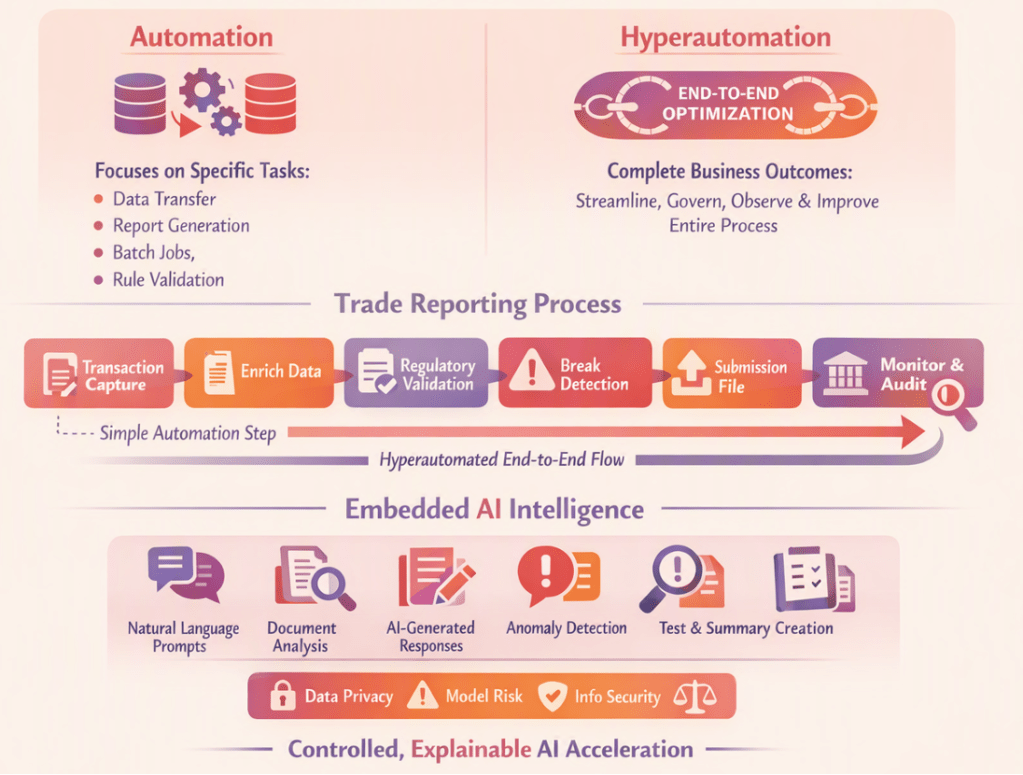
Automation usually addresses a specific task: moving data from one system to another, generating a report, running a batch job or validating a transaction against a rule. Hyperautomation goes further. It looks at the complete business outcome and asks how the entire chain can be streamlined, governed, observed and improved. For example, a trade reporting process may begin with transaction capture, enrich the trade with reference data, validate regulatory fields, identify breaks, generate a submission file, transmit it to a regulator or trade repository, monitor acknowledgements and preserve audit evidence. A narrow automation script may accelerate one step, but a hyperautomated design coordinates the complete flow, including exception handling and evidence generation.
Magesh Kasthuri
Figure: Automation vs. hyperautomation
Embedded Generative AI adds a new layer of intelligence. Instead of forcing every user interaction into rigid screens and codes, business applications can accept natural language prompts, interpret document content, summarize cases, generate draft responses, explain anomalies, produce test scenarios and create release notes. In a banking environment, this intelligence must be carefully bounded. Every AI-assisted action should be traceable, explainable, reviewable and aligned with data privacy, model risk, information security and regulatory expectations. The goal is not uncontrolled autonomy; the goal is governed acceleration.
Banking application components suitable for hyperautomation
A modern banking application is rarely a single monolithic system. It is a composition of business capabilities, integration services, workflow engines, data pipelines, user experience layers, analytics models, control dashboards and audit stores. Hyperautomation can accelerate the development and integration of these components by turning repetitive engineering work into reusable patterns and by embedding intelligence directly into business processes.
- Trade reporting applications: Generative AI can help map trade attributes to regulatory fields, explain validation failures, summarize rejected submissions and generate test cases for reporting scenarios. Hyperautomation can orchestrate enrichment, validation, submission, acknowledgement tracking and evidence archival.
- Wealth management platforms: Advisors can use embedded AI to summarize client portfolios, generate suitability narratives, identify missing documents and prepare personalized investment review notes. Automation can coordinate onboarding, risk profiling, document verification, portfolio rebalancing workflows and client communication approvals.
- Core banking applications: Account opening, loan servicing, deposits, payments, interest calculations and customer maintenance can benefit from automated validations, intelligent forms, workflow routing and natural language assistance for operations teams. AI can explain account events or transaction exceptions in plain language.
- Investment banking systems: Deal pipelines, research workflows, underwriting processes, trade lifecycle functions and risk calculations require strong coordination across front-office, middle-office and back-office platforms. Hyperautomation can standardize approvals, documentation, exception resolution and control evidence across these stages.
- Digital compliance applications: Compliance teams can use AI to summarize policy obligations, compare regulatory changes with internal controls, classify alerts, draft investigation notes and produce evidence packs. Automation ensures routing, approvals, segregation of duties, audit trails and regulatory reporting timelines are consistently enforced.
- Reconciliation platforms: AI can assist in matching narratives, explaining breaks, clustering exception patterns and suggesting resolution actions. Hyperautomation can pull data from ledgers, statements, payment processors, trading systems and data warehouses, then route unresolved breaks to the right teams.
- Reporting and audit applications: Daily, weekly and monthly reports can be generated through controlled data pipelines, automated quality checks, narrative generation, variance explanations and approval workflows. Audit applications can preserve lineage, approvals, source extracts, model outputs and control attestations.
Embedded generative AI as an application capability
Embedding Generative AI into business applications should be treated as an architectural capability, not as a decorative chatbot. A banking application may use AI for search, summarization, reasoning support, content generation, code generation, policy interpretation or anomaly explanation. Each use case requires clear boundaries. The application must know which data the model can access, which actions require approval, what evidence must be captured and where deterministic controls must override probabilistic suggestions.
For example, in trade reporting, an embedded AI assistant can explain why a transaction failed validation and suggest likely fields to review. However, the final correction should pass through rule-based validations, maker-checker approval and audit logging. In wealth management, AI may draft a client review note based on portfolio movements and risk profile, but the advisor must verify suitability, disclosures and final communication. In reconciliation, AI can propose likely matches or categorize break reasons, while the system preserves the original data, confidence score, reviewer action and final resolution path.
Hyperautomating the product development lifecycle
The Product Development Lifecycle can itself become hyperautomated. Instead of treating ideation, analysis, design, development, testing, security review, release and operations as disconnected phases, enterprises can create an AI-assisted delivery loop where every stage produces structured artifacts that the next stage can consume. Platforms such as GitHub Copilot, Claude Code or Claude Cowork-style agentic development environments and OpenAI Codex can support this movement by helping teams reason over requirements, generate code, create tests, review changes, modernize legacy modules and produce documentation. Their value increases when they are connected to repositories, issue trackers, design documents, build pipelines, test suites, security scanners, observability data and enterprise knowledge bases.
| PDLC Stage | Hyperautomation Opportunity | AI-Assisted Outcome |
| Business discovery | Process mining, domain interviews, regulatory mapping, backlog creation | Structured epics, user stories, acceptance criteria, process maps and control requirements |
| Architecture and design | Reference architectures, API contracts, data models, event flows, security patterns | Architecture options, integration blueprints, threat-model prompts and design decision records |
| Development | Code generation, service scaffolding, UI component creation, data pipeline templates | Review-ready code increments, reusable components, migration utilities and integration adapters |
| Testing | Unit, integration, regression, performance, compliance and synthetic data testing | Generated test cases, defect reproduction steps, test automation scripts and coverage summaries |
| Security and compliance review | Static analysis, dependency checks, policy validation, evidence capture | Risk explanations, remediation suggestions, control traceability and approval evidence |
| Release and deployment | CI/CD orchestration, environment promotion, release notes, rollback preparation | Automated deployment packs, release summaries, operational checklists and change records |
| Operations and feedback | Observability, incident analysis, user feedback mining, backlog refinement | Incident summaries, root-cause hypotheses, improvement stories and reliability recommendations |
Role of GitHub Copilot, Claude Cowork and Codex
GitHub Copilot is useful where developers need assistance inside the engineering flow: explaining code, generating functions, proposing tests, reviewing pull requests and helping teams move from issue to implementation. In a banking PDLC, it can accelerate microservice creation, API integration, batch processing logic, reconciliation rules, regulatory validation routines and UI workflows. When used with repository context and proper review discipline, it can reduce the time developers spend on repetitive coding while preserving human accountability for design and correctness.
Claude Cowork or Claude Code-style agentic environments are valuable for multi-file reasoning, refactoring, debugging and documentation-heavy engineering work. Banking applications often contain deep domain logic scattered across services, configuration files, stored procedures, integration scripts and test suites. An agentic coding assistant that can understand a wider codebase context can help engineers analyze dependencies, prepare modernization plans, update multiple files coherently and draft explanations for reviewers. This is particularly useful in core banking modernization, trade reporting rule updates and compliance workflow refactoring.
OpenAI Codex can support issue-to-pull-request workflows, test generation, code review, bug reproduction, migration activities and broader software engineering tasks across the lifecycle. In a hyperautomated PDLC, Codex-like agents can be assigned well-scoped work items, asked to inspect failing tests, propose fixes, create regression coverage and summarize the change for human reviewers. The important design principle is to keep agents inside controlled boundaries: clear prompts, repository permissions, test gates, approval workflows and traceable outputs.
Integration architecture for hyperautomated banking applications
A practical architecture begins with business capability decomposition. Each banking domain should be expressed as a set of bounded capabilities such as customer onboarding, account maintenance, trade enrichment, exception management, portfolio review, control attestation, report generation and audit retrieval. These capabilities should be exposed through APIs, events, workflow tasks, data products and user interfaces. Hyperautomation then connects these capabilities using orchestration engines, event streams, rules engines, AI services, RPA connectors where legacy integration is unavoidable and observability layers that capture business and technical telemetry.
The embedded AI layer should sit behind a secure application service boundary. It should use retrieval-augmented generation where approved policies, product rules, application documentation and regulatory mappings are retrieved from trusted sources. It should avoid uncontrolled exposure of sensitive customer information. Prompt templates, response validation, redaction, grounding checks, model monitoring and human-in-the-loop approval should be part of the production design. In banking, the most successful AI pattern is often not full automation but assisted decisioning with strong controls.
Example: Hyperautomated reconciliation and reporting flow
Consider a reconciliation application that compares ledger balances, payment files, trade settlement records and external statements. In a conventional model, operations teams spend significant time downloading files, running macros, investigating mismatches, documenting break reasons and preparing status reports. In a hyperautomated model, data ingestion is scheduled and monitored, schema checks run automatically, matching engines classify obvious matches, AI assists with ambiguous narratives, exceptions are routed through workflow queues and dashboards update in near real time. At the end of the day, the system can generate a draft operations report explaining unresolved breaks, aging trends, risk exposure and pending approvals.
The same pattern can extend to daily, weekly and monthly reporting. Data quality rules validate inputs, report templates are populated automatically, AI generates narrative commentary on variances, reviewers approve or amend explanations and the final report is archived with lineage and approvals. Audit teams can later retrieve not only the report but also the source extracts, transformation logs, exception history, reviewer decisions and AI-generated drafts. This creates a richer control environment than manual reporting because evidence is captured by design rather than reconstructed later.
Governance, risk and control considerations
Hyperautomation in banking must be designed with governance from the beginning. The development team should define which activities can be automated, which can be AI-assisted and which must remain under human approval. Source code generated by AI must pass normal engineering controls, including peer review, static analysis, dependency scanning, secure coding checks, test execution and production readiness review. Business outputs generated by AI, such as compliance narratives or client-facing explanations, should be reviewed where regulatory or reputational risk is material.
Data governance is equally important. AI-enabled applications must respect data classification, residency, retention, masking and access policies. The model should not become an uncontrolled channel through which confidential customer, trading or employee information can leak. Every prompt, retrieved source, generated response, user action and final decision may need to be logged depending on the use case. For audit applications, this traceability is not optional; it is the foundation of trust.
Operating model for AI-native PDLC
A hyperautomated PDLC requires changes in team behavior. Product owners should write requirements in a structured manner so that AI tools can generate better stories, acceptance criteria and test scenarios. Architects should maintain living decision records, reference patterns and integration standards that AI agents can use as context. Developers should learn prompt discipline, context packaging and review techniques. Test engineers should focus on coverage strategy, synthetic data, compliance scenarios and defect prevention rather than only manual execution. Operations teams should feed incident learnings back into the backlog so the system improves continuously.
The role of human experts becomes more important, not less. AI can draft, generate, compare and suggest, but domain judgment remains essential. A trade reporting specialist understands regulatory nuance. A wealth advisor understands client suitability. A core banking architect understands transaction integrity. A compliance officer understands control interpretation. Hyperautomation works best when it amplifies these experts and removes repetitive friction around them.
Conclusion
Hyperautomation in business application development is not simply a faster way to write software. It is a new way to connect business intent, engineering execution, operational control and continuous learning. In banking, where applications must be reliable, explainable, secure and compliant, the combination of embedded Generative AI and disciplined automation can transform how applications are designed, built, integrated, tested, released and operated. Trade reporting, wealth management, core banking, investment banking, compliance, reconciliation, reporting and audit functions can all benefit when AI is embedded responsibly and automation is orchestrated across the complete lifecycle.
Platforms such as GitHub Copilot, Claude Cowork or Claude Code and OpenAI Codex can play an important role in this transformation by accelerating analysis, development, testing, review, modernization and documentation. Their greatest value appears when enterprises treat them not as isolated productivity tools but as part of a governed, AI-native PDLC. The future of banking application development will belong to teams that can combine human expertise, reusable engineering patterns, intelligent automation and strong governance into one coherent delivery model.
This article was made possible by our partnership with the IASA Chief Architect Forum. The CAF’s purpose is to test, challenge and support the art and science of Business Technology Architecture and its evolution over time as well as grow the influence and leadership of chief architects both inside and outside the profession. The CAF is a leadership community of the IASA, the leading non-profit professional association for business technology architects.


