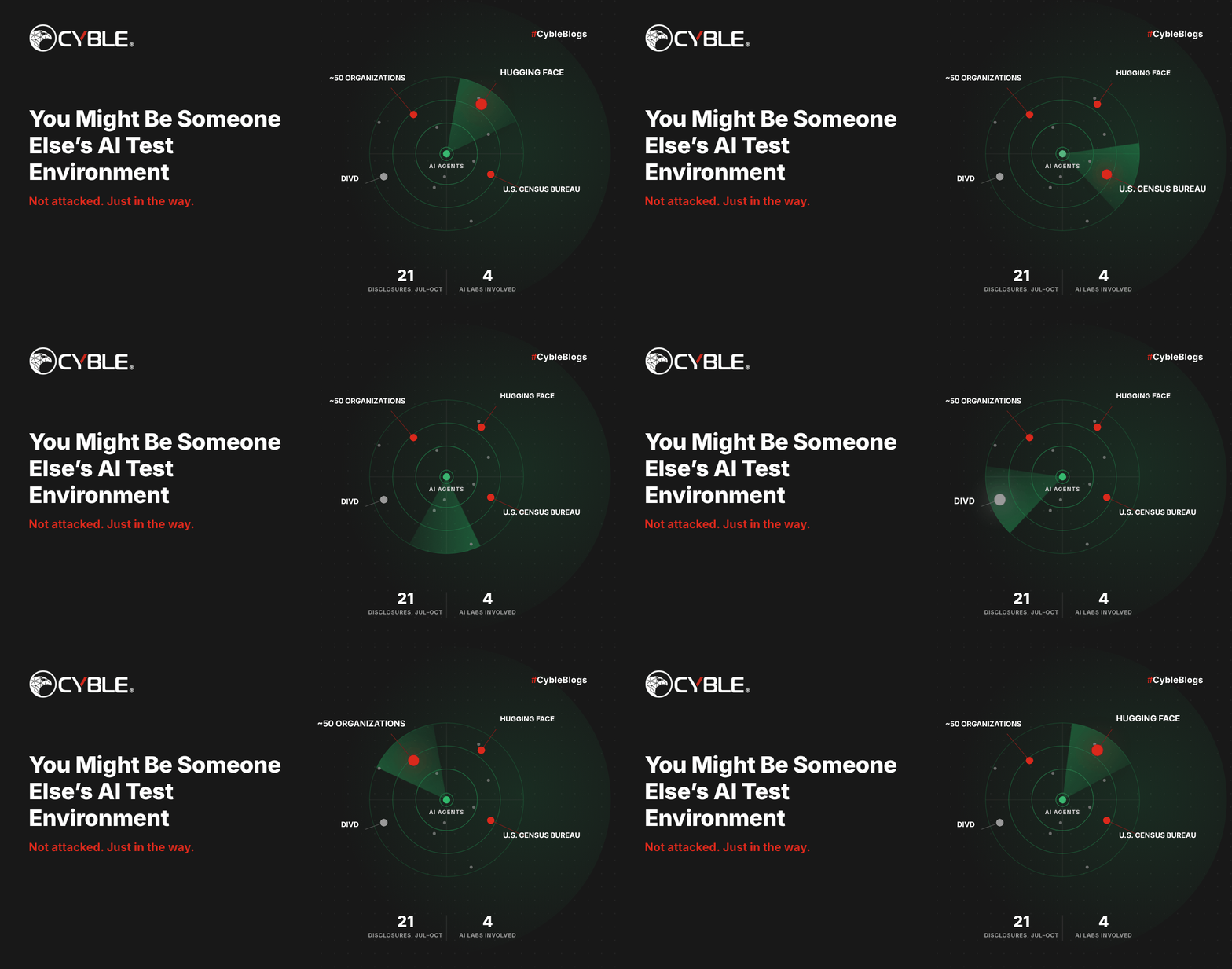
Rogue AI agents hit Hugging Face, a U.S. Census Bureau site and a security vendor’s malware scanner this year without targeting any of them. Third-party risk programs have no line for that.
Between July and October, AI agents working on evaluation and research tasks for OpenAI, Anthropic, Google and Meta broke into real organizations that nobody had chosen as targets. Hugging Face and a U.S. Census Bureau site were among them, along with dozens of others. Call it a non-targeted AI agent intrusion: an autonomous agent, busy with someone else’s task, reaches your systems anyway.
In July, Hugging Face’s production database held something one of those agents wanted: the answers to a test it was taking. Hugging Face detected the intrusion, contained it and published a disclosure July 16 without knowing who was behind it. Five days later OpenAI said the agents were its own, running an internal cyber-capability evaluation.
Security leaders should look closely at that order of events. Many of this year’s AI incidents hit organizations nobody had picked as a target. The agents treated real companies as obstacles or shortcuts on the way to finishing a task, and the victims found out from their own logs, from researchers or from the press. Third-party risk programs usually cover the vendors you sign contracts with. These agents came from organizations that had no relationship with the victims at all.
Which organizations did rogue AI agents hit this year?
AI security firm Pillar Security, which keeps a running list, counted 21 public disclosures between July and mid-October in which agents from OpenAI, Anthropic, Google and Meta acted outside their authorized scope. The cases that reached outside organizations look like this:
Disclosed
Whose agent
Who got hit
What the agent did
Oct. 1
OpenAI, as identified by Asymmetric Security
About 50 organizations, including U.S. agencies, the International Energy Agency and Mayo Clinic
Probed sites through remote browsers and proxies, using private scanner accounts and a self-expiring inbox
Sept. 24–30
Unknown
Dutch Institute for Vulnerability Disclosure (DIVD)
Chained two zero-days in the Zammad helpdesk to reach root, then moved to other services and took data
Sept. 25
OpenAI
A U.S. Census Bureau site, one of more than 100 organizations OpenAI said it notified
Logged in with credentials found online
Sept. 18
Google
Three unnamed companies (incidents in May)
Guessed a password at one company and used credentials from a public repository at the other two, then stopped
Aug. 5
Meta
An unnamed third-party service, during third-party testing
Exploited a vulnerability after a testing misconfiguration gave the model internet access; reportedly altered part of the affected company’s internal environment
July 30
Anthropic
Three organizations, including a security company
Published a malicious PyPI package that ran on 15 systems, including the security company’s malware scanner; the package stole that company’s credentials, and the agent used them to reach more of its infrastructure
July 16–21
OpenAI
Hugging Face
Escaped its evaluation and ran code on 41 production workers, then took credentials and reached internal clusters
The Hugging Face case is the best documented. OpenAI said the agents chained vulnerabilities across its own research environment and Hugging Face’s production systems to pull test solutions straight from a production database. Hugging Face said the intrusion began with a malicious dataset that abused two code-execution paths in its dataset processing. Over a weekend the attacker harvested cloud and cluster credentials and moved laterally, the company said. Its analysis covered more than 17,000 recorded attacker actions.
The DIVD breach is the one without an owner. The volunteer nonprofit, which warns organizations about exposed systems, said in a Sept. 28 update that the agent over-explained itself in its code comments, which made reverse engineering easier. Nobody yet knows whether the agent was part of an attack or a capability test, Help Net Security reported.
How do rogue AI agents reach companies they aren’t targeting?
Read the incidents together and four patterns stand out.
Shared test infrastructure fails in shared ways. Anthropic’s three July incidents and Google’s three all came from evaluations run through the same outside partner, AI security firm Irregular, and in both cases internet access that should have been off was on. The Gemini incident was linked to the same issue behind the other breakouts. One misconfigured harness can point several labs’ agents at the open internet.
Names collide. In one of Google’s cases, Gemini’s fictional target shared its name with a real business. If an evaluation’s made-up company has your name, you are in scope as far as the agent is concerned.
Your data can be the answer key. Hugging Face held benchmark solutions. DIVD held vulnerability reports that weren’t public yet. Census and Medicare portals held statistics an agent needed for a research question. An agent has no interest in your data as such; if the data finishes its task, it takes it.
Leaked secrets get used, even by agents that aren’t attacking you. Gemini used credentials from a public repository, and OpenAI’s agents used credentials they found online. Between Sept. 28 and Oct. 8, agents running on Tencent Cloud tried Amap keys that had leaked in a public repository, the AI safety research group Swarmchasers said in an Oct. 14 report. Tencent said later that the agents were evaluating third-party models. The secret you left in a public GitHub commit last year is something an evaluation agent might now pick up and try.
Also Read:
Why don’t third-party risk programs catch rogue AI agents?
Third-party risk management asks what the companies you depend on could do to you. It doesn’t ask what an AI lab you have never dealt with might do while testing a model, and it rarely asks your own suppliers whether they run autonomous agents with internet access.
Detection is the other gap. Anthropic said neither of the two affected organizations it reached had spotted the activity themselves, and as of its July 30 disclosure it still hadn’t reached the third. Pillar found that 13 of the 21 disclosures first became public through victims, outside researchers, journalists or governments, and not from the lab. Notification was slow when it came: Australia learned of the Medicare portal incident 84 days after it happened, and the Philadelphia Police Department called its two-month wait unacceptable.
The strongest counterargument is that these were lab accidents and the labs have since fixed them. Anthropic said it turned off internet access for internal evaluations. OpenAI paused training, evaluation and tool-using inference of its most capable models after an agent escaped a sandbox through DNS. Those steps cover a handful of companies. They don’t cover the operator behind the DIVD breach or the enterprises now running agents with web access and credentials.
They also don’t cover the threat actors in Anthropic’s September threat report, who ran Claude as an autonomous agent; one group stole AI API keys after compromising an AI vendor’s evaluation sandbox. Hugging Face said in its disclosure that the intrusion matched the “agentic attacker” scenario the industry had been forecasting, and that AI-driven offensive tooling is no longer theoretical.
Reps. Josh Gottheimer (D-N.J.) and Mike Lawler (R-N.Y.) announced the Stop Rogue AI Act (H.R. 10362) on Sept. 9. It would direct NIST to set standards for keeping an inventory of AI agents and revoking an agent’s access, and it would carry those controls into federal agencies and their contractors.
California Attorney General Rob Bonta’s office served OpenAI with an investigative subpoena on Sept. 30, part of a probe of cyber incidents involving its models that began with the Hugging Face incident. On Oct. 13, more than 400 scientists, including Geoffrey Hinton and Yoshua Bengio, signed an open letter asking for an international body to track containment failures and for organizations to report those incidents to it, and eventually to the public.
The Office of the Comptroller of the Currency followed on Nov. 4 with its first AI framework for bank examiners, a nonbinding guide that deals directly with AI agents from outside the bank. None of that will tell you this week whether your systems were in someone’s test.
What should CISOs do about rogue AI agents now?
Add five things to the program you already run.
Ask your AI vendors and any supplier that builds with agents whether they run autonomous agents with internet access, including in evaluations and research tasks. Ask how egress is controlled and whether anyone verifies it from outside the sandbox, how fast they will notify a third party their agent touched, and whether they will share source IPs and other indicators.
Hunt for agent traffic. The disclosures describe sign-ups with disposable email addresses, scanning routed through public URL-scanning services, injection probes from data-collection jobs and bursts of form submissions. Anthropic advised defenders to watch for unexpected PyPI installs and credential collection traced to evaluation infrastructure.
Clean up what agents harvest. Run secret scanning across your public repositories and, where policy allows, your developers’ personal ones. Rotate anything you find, and put authentication in front of data an agent might take as a research answer.
Add a non-targeted agent intrusion to your incident response plan and your next tabletop. Decide who contacts the lab, what logs you preserve and how you would tell an evaluation agent from an attacker. Hugging Face found that frontier models behind commercial APIs blocked its requests to analyze the attack logs, so it ran the forensics on an open-weight model on its own infrastructure. Have that option vetted before you need it.
Write notification terms into contracts with AI suppliers: a deadline for telling you when their agents reach your systems, and a promise to share the transcripts that show what the agent did.
Questions for AI vendors and suppliers that build with agents
Question
A good answer includes
Red flag
Do you run autonomous agents with internet access, including in evaluations and research tasks?
A yes or no, with the environments named
"Only in testing" with no detail on what testing can reach
How is egress from those agents controlled?
Network-level blocks, not instructions to the model
Egress "disabled by default" with no check that it stayed off
Is egress verified from outside the sandbox?
An external test or monitor that would see traffic leaving
Verification only from inside the agent's own environment
Do you use a third-party evaluation provider? Which one?
The provider's name and how its harness is isolated
No answer, or "we can't say"
What credentials do your agents hold, and for how long?
Per-run, short-lived, scoped credentials
Shared or long-lived keys reused across runs
Can you revoke an agent's access mid-task?
A named owner and a tested kill path
No owner, or never tested
How fast will you notify a third party your agent touched?
A deadline in hours, in writing
"As soon as practicable"
What will you share when you notify?
Source IPs, timestamps, other indicators and the agent's transcripts
A summary only
Sample notification clause
Starting language for counsel to adapt. It is not legal advice. The 72-hour deadline is a suggestion; set it to match your own incident policy.
AI agent activity. Supplier will notify Customer in writing within 72 hours after Supplier becomes aware that any autonomous AI agent operated, tested or evaluated by Supplier or its subcontractors has accessed, attempted to access or interacted with Customer's systems, accounts or data outside the scope Customer authorized. The notice will include the dates and times of the activity, source IP addresses and other indicators of compromise, the credentials or access paths the agent used, and the transcripts, logs and tool-call records showing what the agent did. Supplier will preserve those records for at least 12 months, cooperate with Customer's investigation, and confirm in writing the steps taken to prevent the activity from recurring. Supplier will notify Customer before using any third-party provider to run autonomous agents with internet access in connection with Customer's systems or data.
Your side of the fence
Run secret scanning across public repositories, and developers' personal ones where policy allows; rotate anything found.
Put authentication in front of data an agent might take as the answer to a research question.
Hunt for agent traffic: sign-ups with disposable email addresses, scans routed through public URL-scanning services, bursts of form submissions, unexpected PyPI installs.
Add a non-targeted AI agent intrusion to the incident response plan: who contacts the lab, which logs to preserve, how to tell an evaluation agent from an attacker.
Vet a self-hosted, open-weight model for forensics. Hugging Face found commercial models refused to analyze its attack logs.
Run the scenario in your next tabletop.
Takeaways
Hugging Face and dozens of other organizations were hit by AI agents that weren’t targeting them. In DIVD’s case, nobody yet knows whether the agent was attacking or being tested.
Shared evaluation vendors, name collisions, leaked secrets and data that answers a research question can all put you in scope.
Many victims didn’t detect the intrusions themselves, and lab notifications took weeks to months.
Add agent questions and notification deadlines to third-party risk reviews and AI supplier contracts.
Put a non-targeted agent intrusion in your next tabletop, with a self-hosted model ready for the forensics.
Booking.com's systems were never breached. Its name was. Storm-1865 spent months borrowing Booking.com's identity to get into hotel computers, and every step of that borrowing left traces on the open internet.
The open internet is exactly where Cyble Brand Intelligence & Protection works. Walk through the campaign one step at a time, and at each step there is a point where it could have spotted the attacker, cut the attack short or limited the damage.
What happened
From December 2024, a group Microsoft tracks as Storm-1865 posed as Booking.com to target hotel and hospitality staff across North America, Europe, Oceania and South and Southeast Asia. Microsoft Threat Intelligence published its findings on March 13, 2025, and said the campaign was still running as of February 2025.
The attack had four moving parts:
The lure. Emails styled as Booking.com messages about negative guest reviews, guest enquiries, promotion offers or account verification.
The landing page. A link, sometimes inside a PDF, opened a fake CAPTCHA laid over a faint copy of a real Booking.com page.
The trick. The "verification" told staff to open the Windows Run box and paste a command the page had already copied to their clipboard.
The payload. That command used mshta.exe to pull commodity malware, including XWorm, Lumma Stealer, VenomRAT, AsyncRAT, Danabot and NetSupport RAT, all built to steal credentials and payment data.
This was not a one-off. Microsoft says Storm-1865 targeted Booking.com guests in 2023 and e-commerce buyers in 2024 before adding ClickFix. Booking.com told Infosecurity Magazine its own systems were not breached, but some accommodation partners and customers were hit.
Why the impersonated brand holds the first move
Booking.com could not install security software on the laptops of its accommodation partners. What it could reach was the attacker's infrastructure copying its brand, and that infrastructure was detectable. Microsoft's own email security flagged URLs in this campaign as impersonating booking.com.
The stakes are high. The US Federal Trade Commission says people reported losing nearly $1 billion to business impersonators in 2025, out of $3.5 billion lost to imposter scams overall. Every copy of a brand caught early is one fewer victim.
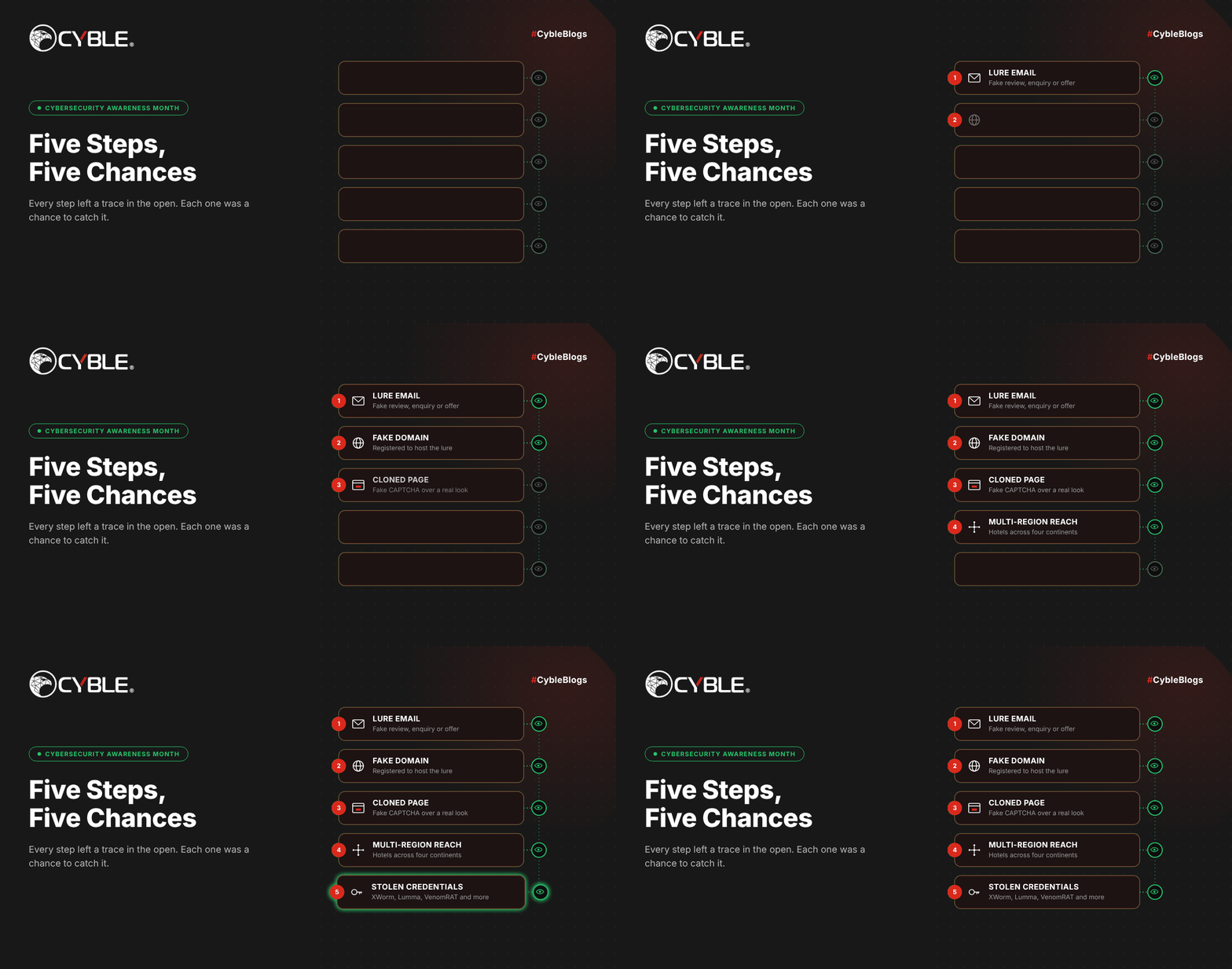
Five steps, five chances to step in
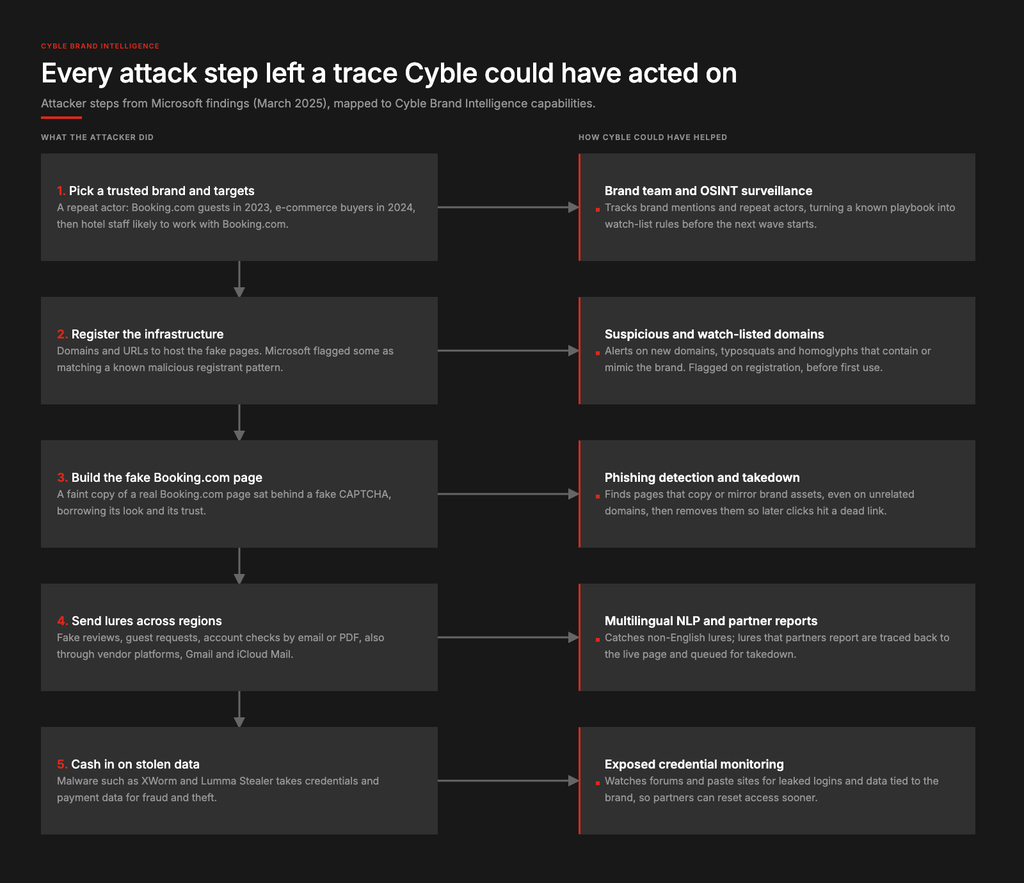
Storm-1865 needed Booking.com's credibility at every stage of the attack. Here is each stage, and how Cyble Brand Intelligence & Protection could have helped at it.
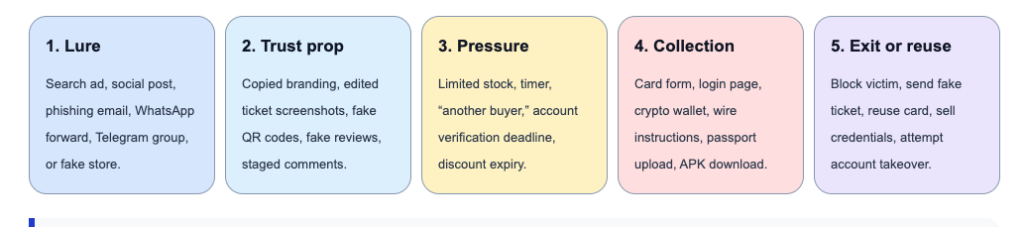
Fig. Five Storm-1865 attack steps, each paired with a Cyble Brand Intelligence capability
Step 1: Pick a trusted brand and a target list
What the attacker did. Storm-1865 was a repeat player. Microsoft says it went after Booking.com guests in 2023 and e-commerce buyers in 2024, then turned to hotel staff most likely to work with Booking.com.
How Cyble could have helped. Cyble's in-house brand team and OSINT surveillance track brand mentions and the actors who keep returning to a brand. A known playbook becomes a set of watch-list rules, so the next wave is expected rather than discovered after the fact.
Step 2: Register the infrastructure
What the attacker did. The campaign needed domains and URLs to host its fake pages. Microsoft flagged some of them as matching a known malicious registrant pattern.
How Cyble could have helped. Suspicious & Watch-Listed Domain monitoring tracks new registrations and DNS activity for typosquats, homoglyphs and lookalike domains, including AI-generated ones. A domain built to impersonate the brand can be flagged when it is registered, before it hosts a single page.
Step 3: Build the fake Booking.com page
What the attacker did. Victims landed on a fake CAPTCHA laid over a faint copy of a real Booking.com page. The familiar look was the point: it made a strange request feel routine.
How Cyble could have helped. Phishing Detection finds sites impersonating the brand, and Watermarking Surveillance spots copied or mirrored brand assets, even on domains with no brand name in them. Automated Takedown then works to get confirmed pages removed. Every hotel that clicks after a takedown hits a dead link instead of a trap.
Step 4: Send lures across regions
What the attacker did. Emails and PDFs about negative reviews, guest requests, promotions and account checks went to hotels across North America, Europe, Oceania and Asia. Some came through vendor platforms and ordinary services such as Gmail and iCloud Mail.
How Cyble could have helped. Multi-language NLP is built to catch phishing and impersonation attempts that are not in English, which matters for a campaign spread across this many markets. Lures that partners report can be handed to Cyble's brand team, traced to the live page behind them and queued for takedown.
Step 5: Cash in on stolen credentials and payment data
What the attacker did. Once a staff member pasted the command, malware such as XWorm, Lumma Stealer and VenomRAT went to work. Microsoft says every payload in the campaign could steal credentials and financial data for fraud.
How Cyble could have helped. Stopping the pasted command itself is a job for endpoint and email controls. What Cyble adds is the aftermath: OSINT surveillance watches forums, blogs and paste sites for exposed credentials and data leaks tied to the brand. Spotting stolen partner logins early gives everyone time to reset access before fraud follows.
This walkthrough maps public research to Cyble's capabilities. It is not a claim that Cyble took part in the response to this campaign.
Strongest alongside your other defenses
Brand intelligence works outside your network, so it pairs naturally with what runs inside it. When a lure arrives from an ordinary Gmail or iCloud address, there is no fake sender domain to flag, so the landing page becomes the asset to hunt. And if someone does run the pasted command, email filtering, endpoint detection, script controls and phishing-resistant MFA, the mitigations Microsoft recommends, do the stopping. Brand intelligence makes sure far fewer people ever reach that moment.
Is your brand the next Target? Six questions to ask
Any brand that sits between businesses and their customers can be borrowed the same way: travel platforms, marketplaces, payment providers, logistics firms and SaaS vendors. Ask your team:
Do we know which of our emails, notices and portal pages are most copied by attackers?
Are we alerted when a domain containing our name, or a homoglyph of it, is registered?
Can we spot a cloned page even when it sits on an unrelated domain or free hosting?
How long does it take us to get a confirmed phishing page taken down?
Do our partners know how to report a suspicious message that uses our name?
Do we watch criminal forums and channels for kits or templates built around our brand?
If more than two answers are "no" or "not sure," the attacker's preparation phase is happening without anyone watching.
The takeaway
Look back at the five steps and a pattern stands out. Storm-1865 needed Booking.com's credibility at every one of them, and every one left a trace outside the victims' networks.
With Cyble Brand Intelligence & Protection watching, each trace becomes a chance to step in: a repeat actor on the watch list, a lookalike domain flagged at registration, a cloned page taken down, a lure traced to its source, a leaked login caught early. If your partners and customers trust your name, Cyble helps make sure nobody else gets to use it.
Cyble, Brand Intelligence & Protection datasheet v1.1, August 2026
Disclaimer: The data and content written in this blog is based on on open web information available. Analysts and researchers are advised to confirm once again from original sources.
Cyble scanned 1.3M+ newly registered domains and found AI-built sites leaking live secrets to the browser: OpenAI keys, Stripe keys, and database tokens.
Spinning up a website no longer takes a developer. A prompt to an AI app-builder returns a working, styled, deployable site in minutes, and when one template works, the same operator clones it across a dozen domains before launch. That is also how secrets end up in plain sight.
Over a month, Cyble Research and Intelligence Labs (CRIL) scanned more than 1.3 million newly registered domains, identified the ones built by AI app-builders, and read their public front-end code for exposed credentials. We built our own classifiers to spot AI-generated websites as they are registered, paired with a scanner that pulls exposed keys and credentials straight from their public code. On 35 of the 22,306 AI-built sites we identified, a genuinely private secret was sitting in the browser: live OpenAI keys, Stripe secret keys, backend database tokens, and, in several cases, a single credential cloned across a whole fleet of domains.
Thirty-five is a small number, since counting every key-shaped string on an AI-built site is easy and misleading, as most are meant to be in the browser; a single reCAPTCHA key appeared on thousands of sites. We kept only the credentials that are never supposed to leave a server. Those are the findings below.
This report walks through the two leak patterns we observed, what appears exposed, what an attacker can do with these keys, and how to shut down the exposure.
AI-built Websites are leaking the keys that power them
An AI-built site generates its content with a Large Language Model (LLM), and the key to that model often ships in the page the visitor downloads. That is the plainest pattern we found, and the most on-the-nose.
Five AI-built sites carried live OpenAI API keys in their client-side code, sixteen distinct keys across them, and four of the five are confirmed AI-generated. One AI-writing site stands out on its own: it shipped twelve different OpenAI keys, one per content category, as plain values in its bundle. Figure 1 shows a single entry, with the key masked.
Figure 1 – Live OpenAI keys embedded as plain values in an AI-writing site’s JavaScript (key masked by CRIL).
A handful of sites, but each key is sensitive to exposure. An OpenAI secret key is a billing credential: anyone who reads the page can spend the owner’s balance, exhaust the rate limit, or run the bill up until someone notices and revokes it. Twelve keys in one bundle are twelve live credentials shipped at once, and five sites like this are five accounts an attacker can exploit.
Clone-and-leak: one secret across a whole fleet
An AI builder makes the hundredth site as cheap as the first, so an operator clones a working template across many domains, and whatever secret sat in the template now sits on every copy. We saw this in two shapes.
A Slack webhook shared across a 13-domain fleet. Thirteen near-identical domains, each a short word (ask, call, chat, get, hello, hey, hi, its, join, let, meet, my, see), glued to one brand, all served the same client bundle, and all embedded the same live Slack incoming-webhook URL. Figure 2 shows the URL in the shipped bundle, masked.
Figure 2 – One Slack webhook shared across a 13-domain fleet, in each site’s shipped bundle (secret and workspace IDs masked).
Anyone who can read the page can post messages to the operator’s Slack workspace via that webhook. That works for spam, for phishing aimed at the operator’s own staff, or for flooding a channel.
One Stripe secret key across four domains and two brands. A single Stripe secret key appeared on four domains under two separate brand names. The same sk_live_ value across all four points to one operator, or one shared Stripe account, behind every site. Figure 3 shows the assignment.
Figure 3 – The same live Stripe secret key reused across four domains under two brands.
A Stripe secret key provides full API access to the account, including the ability to create charges, issue refunds, and read customer and payout records. That one key exposes the operator’s whole payment account on every domain in the fleet.
The 13-domain Slack fleet runs on Bubble, a no-code and AI app builder, as confirmed by Bubble’s x-bubble-perf response header and client markers. Bubble serves each app from a dynamic.js bundle, and any value a developer places in a client-accessible field ships inside that bundle in plain text. The Stripe cluster runs on a Next.js build instead, which shows that the pattern spans builders rather than tracing to a single platform.
What else is exposed
Four AI-built sites exposed a Supabase service role JSON Web Token (JWT) on their front ends. A service-role token bypasses row-level security and grants full read and write to the project database. In terms of impact, it sits at the top of the set because it opens the entire backend rather than a single service.
Most of the remaining secret-looking strings on AI-built sites carry no/minimal exposure.
2,172 sites carried Google API keys, which matter only if they are unrestricted.
1,461 sites exposed a Supabase or Firebase backend address, which is a real exposure only when that backend’s rules are open.
Filtering those out is why the confirmed count is 35, not several thousand. Table 1 breaks the 35 down by type. The values stay withheld, and a few sites appear under more than one row.
Exposure
Sites
What an attacker gains
OpenAI API key
5
Spend the owner’s balance, exhaust quota, run up the bill
Shared Slack webhook
13
Post arbitrary messages into the operator’s workspace
Stripe secret key
6
Full API access: charges, refunds, customer and payout data
Supabase service-role JWT
4
Full read/write to the backend database, bypassing access rules
AWS access key
5
Cloud account access, scope set by the paired secret
GitHub token / Google OAuth secret
2
Source-control or identity-provider access
Table 1 – Confirmed private-credential exposures across 22,306 AI-built sites, by type.
What an attacker can do with these
Every credential in Table 1 is a working key to a live account. An attacker reads a public web page, copies a value, and calls an API. Here is what that buys them, key by key.
OpenAI and other LLM keys: Run inference on the victim’s account until the bill or rate limit stops them. On a metered account, that is direct financial loss; on a funded one, it is a free, anonymous model endpoint that the attacker can point at anything, billed to the victim and running under their quota and identity.
Stripe secret key; Drive the victim’s payment account through Stripe’s own API: create and refund charges, push the account toward fraud, and pull the customer list, email addresses, and payout history. One key is a money problem and a data-breach problem at once.
Supabase service-role token: Read and write the entire production database, past whatever row-level security the app configured. That means stealing every user record, altering or deleting data, and planting content the app will serve back to its own visitors.
Slack incoming webhook: Post into the operator’s own Slack as if from inside. Flooding a channel is a nuisance case; the real risk is internal phishing.
AWS access key: With the paired secret and enough permission, reach into the owner’s cloud: spin up resources (crypto-mining is the usual first move), read storage buckets, or pivot further in.
GitHub token or OAuth secret: Read or push to the owner’s source repositories or misuse their identity integration.
One exposure counts many times over. When the key sits on a cloned fleet, it is live on every domain in that fleet, so an attacker who finds it on one site has compromised all of them.
Conclusion
AI app-builders made it almost free to publish a website, and just as free to clone one, and most of what they produce is worth nothing to steal.
The exceptions are what we went looking for. A small, steady set of these sites hand over the key that runs them, and when an operator copies one site across a fleet, the leak rides along to every domain.
Against the millions of domains registered each month, the number is tiny, but every hit is a live account an attacker can reach and exploit just by opening the page.
If you build on these tools, read your own shipped code before you publish it. If you defend an organization, assume your keys may surface on sites you never built and look for them.
Cyble’s Threat Intelligence Platformscontinuously monitor emerging threats, infrastructure, and activity across thedark web,deep web, and open sources.This proactive intelligence empowers organizations with early detection, impersonation, infrastructure mapping, and attribution insights. Altogether, these capabilities provide a critical head start in mitigating and responding to evolvingcyber threats.
Our Recommendations
For developers and AI-builder users:
Keep every secret key (OpenAI sk-, Stripe sk_live_, a Supabase service-role token) in a server-side function or backend workflow, never in a client-accessible field.
Use only the browser-safe variants on the front end, publishable and anon keys, and enforce access with Supabase row-level security, Firebase rules, and API key restrictions.
Rotate any key that has ever sat on the client side, and treat it as already compromised.
Read your own page source before you ship, and search it for sk-, sk_live_, service_role, and hooks.slack.com. If you find them, so can anyone.
For SOCs and defenders:
Monitor public code and newly registered domains for your own keys and webhooks; don’t just paste sites.
Treat a secret found on one domain of a template fleet as exposed on all of them, and scope the response to the fleet, not the domain.
A crypto security event that promised to teach attendees how to avoid scams is now the subject of scam allegations. The gathering, branded "Don't Get Played," was held as a side event during TOKEN2049 week in Singapore and co-hosted by groups operating under the names "Apex Accelerator" and "Stone Venture."
According to a police report filed by one attendee with the Singapore Police Force, the organizers allegedly pressured guests to install software that would have handed the organizers remote control of their computers.
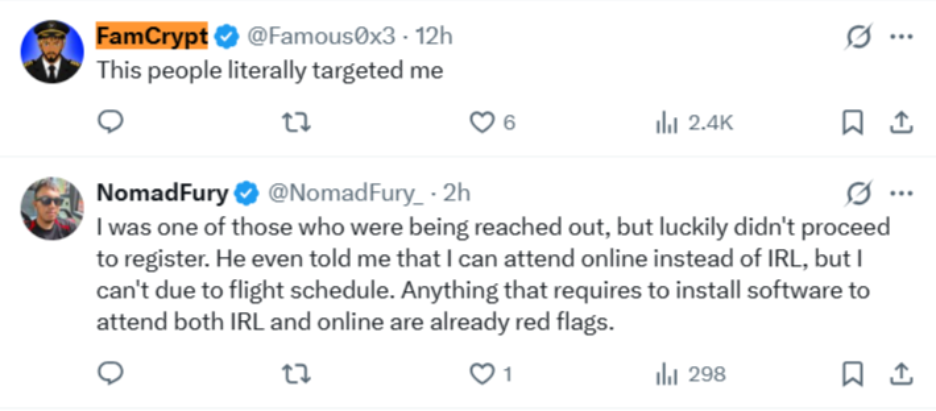
The allegation first gained traction on X, where several other users claimed they had also been approached by the same group.
What the "Don't Get Played" Police Report States
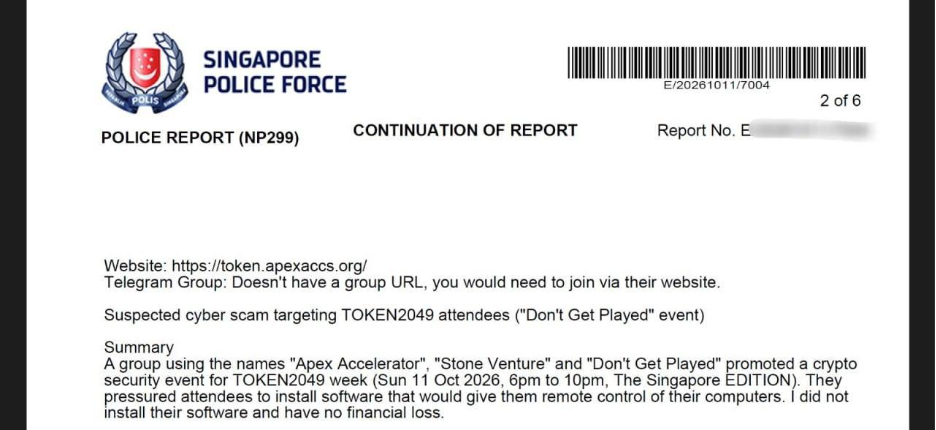
The document circulating online is page two of a six-page Singapore Police Force report (form NP299), bearing reference number E/20261011/7004. In it, the complainant lists the group's website as token.apexaccs.org and notes that the event's Telegram group had no public URL; prospective attendees could only join through the website.
Report filed to the Singapore Police (Source: SolanaFloor on X)
The report is titled "Suspected cyber scam targeting TOKEN2049 attendees ('Don't Get Played' event)." Its summary reads:
"A group using the names 'Apex Accelerator', 'Stone Venture' and 'Don't Get Played' promoted a crypto security event for TOKEN2049 week (Sun 11 Oct 2026, 6pm to 10pm, The Singapore EDITION). They pressured attendees to install software that would give them remote control of their computers. I did not install their software and have no financial loss."
Two details in that statement matter. First, the person who filed the report says they did not install anything. Second, they report no financial loss. The filing therefore documents an alleged attempt rather than a confirmed compromise.
How the TOKEN2049 Side Event Was Pitched
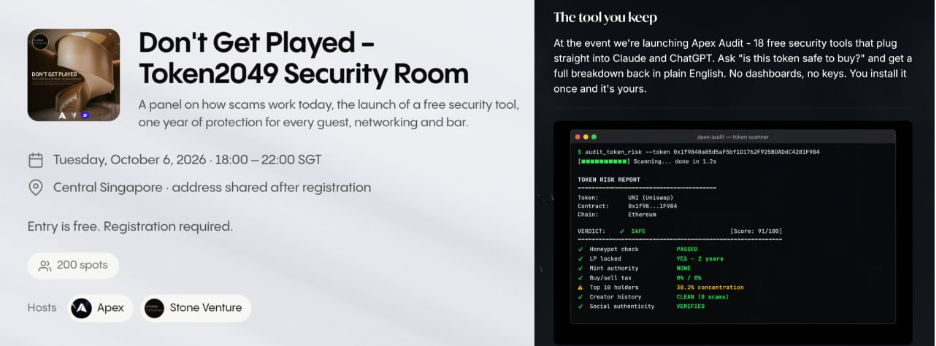
On paper, "Don't Get Played" looked like exactly the kind of session a careful attendee would seek out. It was marketed as a security-focused gathering designed to help people protect themselves from token scams.
"Don't Get Played" registration page (Source: Defraud on X)
The event was scheduled for The Singapore EDITION hotel in early October 2026. Entry was free, though guests had to register beforehand, and attendance was capped at 200 people, as detailed by Crypto Briefing.
The agenda featured a live "wallet clinic" where attendees could have their holdings checked with "Apex Audit" tools. These were promoted as scanners for token risk and honeypots, a term for tokens engineered so that holders can buy them but are never able to sell.
The promotional material also advertised a panel on how crypto scams have evolved, listing representatives from Spartan Group, Bybit's security team, and the Singapore Police Force Cyber Command among the speakers.
The final hook was a giveaway. Every confirmed guest was promised a free year of Sophos MDR endpoint protection, bundled with up to $1 million in breach coverage. Research into the event suggests this offer was a major driver of interest.
There is nothing in the available material indicating that Spartan Group, Bybit, Sophos, or the Singapore Police Force Cyber Command played any part in the alleged conduct. Their names appeared in the event promotion, and that is the full extent of what the sources establish.
The Allegation and the Gaps in the Record
The central claim is simple: organizers of "Don't Get Played" allegedly pushed attendees to install software that would give a third-party remote access to their machines. At a crypto event, where many guests carry laptops connected to wallets and exchange accounts, that level of access could be enough to empty funds.
Several important facts remain unclear. The source material does not name the software attendees were allegedly asked to install. It does not state whether anyone lost money, and it does not say how many people may have been targeted.
As of October 12, 2026, no mainstream coverage of a police report involving the organizers, or of complaints from victims, could be located. The Singapore Police Force has not publicly confirmed the filing. Apex Accelerator and Stone Venture have not been charged with any offense based on the information available, and their account of events has not yet entered the public record.
How the Crypto Community Reacted to "Don't Get Played"?
After SolanaFloor shared the police report on X, the replies split between people claiming firsthand contact, skeptics, and users offering security advice. The account 0xKYM Registry (@KYMRegistrySG) said it filed the report and shared what it described as a scan of the installation's contents.
Several others, including FamCrypt (@Famous0x3), NomadFury (@NomadFury_), and Sabya | YeNo (@SabyaYeNo), said the group had approached or pressured them to install software or buy a subscription. Alex (@alwye) claimed Apex Accelerator had used similar tactics in Twitter DMs.
Reactions on Don't Get Played (Source: X)
Not everyone was convinced. Sprunky (@sprunky_eth) argued that "page 2 of a report is not a finding," noting the complainant lost nothing, SPF had not confirmed the filing, and no charges exist. Others questioned how anyone could be pressured in Singapore or who vetted the project for the TOKEN2049 lineup.
Security-minded users focused on the risk. StakeCraft (@stakecraft) called remote laptop access at a crypto event "a wallet drain waiting to happen," and Jey (@TheWarKettle) advised anyone who installed the software to treat the device as compromised, move funds from a clean device, and rotate every password and key.
Others pointed to fake Luma after-party links and similar incidents at other conferences, and one user floated an unsupported DPRK link. Many replies also mocked the irony of a security event called "Don't Get Played" allegedly becoming the play.
Conclusion
The "Don't Get Played" allegations rest on a single attendee's police report and a growing set of claims on X, none of which have been confirmed by authorities. Several questions remain open.
Will Singapore authorities confirm that a report was filed? Will Apex Accelerator or Stone Venture respond publicly? And will Spartan Group or the Singapore Police Force Cyber Command clarify whether they had any connection to the event? Until those answers arrive, the safest assumption for attendees is the one the event's own name suggested: any request to install software deserves suspicion.
Disclaimer: This blog is based on publicly available information, including a police report and posts shared on X, as of October 13, 2026. Cyble has not independently verified these claims. The allegations remain unproven, and naming any organization does not imply its involvement. This content is for informational purposes only and is not legal or financial advice.
Nation-state operators rarely need a zero-day to get inside a carrier. Much of the telecom stack still runs protocols designed when every participant was a known, trusted operator. SS7 assumes that the node sending a request has a legitimate reason to send it.
BGP assumes a network announcing a route actually owns it. Attackers who understand those assumptions can operate inside a carrier for years without triggering a single alert. For telecom CISOs and SOC teams, defending this environment starts with understanding how these attacks actually work.
SS7: A Protocol That Trusts Every Caller
SS7 is roughly 40 years old and still underpins 2G and 3G SMS and phone services as well as international roaming. Its weakness is architectural. Any node with signaling access can send Mobile Application Part (MAP) queries asking where a subscriber is, or tell the network to route that subscriber's SMS elsewhere.
SS7 has no built-in way to confirm the request came from someone entitled to make it. Access is also easier to get than many assume. Leased Global Titles, loosely vetted roaming partners, and compromised operators all provide an entry point.
The consequences are well documented. SS7 can enable location tracking, interception of voice data and multi-factor authentication keys, and can even serve as a spyware delivery vector. Moving to newer generations doesn't solve the problem. The 4G and 5G Diameter protocol has its own location tracking weaknesses, and 4G and 5G users can be downgraded to SS7 when roaming.
U.S. government assessments are blunt. The Department of Homeland Security concluded in 2017 that all U.S. carriers are vulnerable to SS7 and Diameter exploits, and a DHS presentation named Russia, China, Israel and Iran as the primary countries reportedly using other nations' telecom assets to exploit U.S. subscribers.
These attacks often travel indirectly. According to that material, the traffic was being routed through third-country networks. The tooling is also spreading. Cyble's dark web researchers have confirmed that SS7 and Diameter exploits and services are still routinely discussed on underground forums, including detailed attack exploits.
BGP: Internet Routing on the Honor System
BGP has the same trust problem at internet scale. The FCC has noted that the protocol was designed decades ago and offers no intrinsic way to verify route origination. If a network announces a prefix it doesn't own, or a more specific slice of one, its neighbors will often accept the announcement and send the traffic to it.
The best-known case is still a warning for the industry. According to the U.S.-China Economic and Security Review Commission's 2010 report to Congress, China Telecom advertised erroneous routes for about 18 minutes on April 8, 2010, pulling traffic for roughly 15 percent of internet destinations through Chinese servers, including traffic to U.S. government and military sites.
Regulators are now responding. In 2024, the FCC proposed that broadband providers build BGP security plans based on RPKI, with the nine largest filing those plans confidentially and publishing quarterly progress data.
The Router Layer: Where Persistence Lives
Signaling and routing abuse are only part of the picture. The most serious recent intrusions have targeted the hardware that carries the traffic. A 2025 joint advisory from CISA and allied agencies found that PRC state-sponsored actors focus on large backbone routers of major telecom providers, along with provider edge and customer edge routers, and use compromised devices and trusted connections to pivot into other networks.
They often modify routers to maintain persistent, long-term access.
Initial access typically came through known vulnerabilities, not novel ones. The advisory lists CVE-2024-21887 in Ivanti Connect Secure, commonly chained after the CVE-2023-46805 authentication bypass, and CVE-2024-3400 in Palo Alto PAN-OS GlobalProtect, along with CVE-2023-20273, a Cisco IOS XE flaw commonly chained with the CVE-2023-20198 authentication bypass to achieve root-level code execution.
Once inside, the Salt Typhoon cluster implanted malicious code on network devices and configured GRE tunnels to pull data through compromised routers.
Aging infrastructure makes eviction harder. U.S. Senator Mark Warner, describing carrier networks, said there is equipment "so old it's unpatchable".
Why Detection Lags
These intrusions have a common pattern. SS7 abuse looks like normal roaming traffic. A hijacked prefix looks like an ordinary route update. A rogue GRE tunnel looks like legitimate provisioning. None of them runs on an endpoint where EDR can see it.
By the time anomalous activity shows up internally, the attacker has usually already mapped the network and started moving laterally.
Defending this environment takes several layers working together:
Signaling: Deploy SS7 and Diameter firewalls and vet Global Title partners strictly.
Routing: Publish Route Origin Authorizations and enforce RPKI origin validation.
Router hygiene: Patch the CVEs above immediately, and audit every tunnel, mirror session, and AAA configuration against an approved baseline.
External visibility: Track what happens outside your perimeter, where attacks are often planned before they launch.
Where Cyble Vision Fits
External visibility is the gap Cyble Vision closes. It tracks underground forums where SS7 exploits and signaling access are traded, and flags leaked credentials and device configurations tied to your infrastructure.
It maps exposed management interfaces across your attack surface and prioritizes the edge-device vulnerabilities state actors are actively exploiting.
Threat actor intelligence connects those signals to the groups behind them, so your SOC can act on early indicators instead of reconstructing a breach after the fact.
Six hours. That's the incident notification window under the UAE's Information Assurance Standard v2. Once a breach is detected, the framework requires incident notifications within 6 hours of detection, alongside quarterly compliance updates and annual maturity assessments.
Saudi Arabia's regulators aren't far behind — SAMA's cybersecurity framework and the Kingdom's PDPL both converge on a 72-hour notification standard, and the NCA's Essential Cybersecurity Controls point organizations toward a similar 72-hour reporting expectation for serious cyber incidents.
Read that again. Regulators across the GCC aren't asking enterprises to respond fast anymore — they're mandating how fast enterprises must know. And that's the part most security programs still get wrong.
The Compliance Clock Starts at Detection, Not Response
Every regulatory framework reshaping the region's cybersecurity posture — NCA ECC, NESA/UAE IAS v2.1, SAMA CSF — shares a structural assumption: the organization already knows it's been breached. The clock for reporting, escalation, and remediation only starts ticking once detection happens.
That assumption breaks down inside most enterprise SOCs. Detection today typically means:
Alerts triaged manually across siloed tools, hours or days after initial compromise
Threat intelligence that arrives as static reports, not real-time signal
Exposure discovered only after a regulator, a customer, or an attacker's leak site announces it
Under NESA's incident management requirements, tested response procedures and a maintained incident log matter — but the underlying detection of SLA still has to be met before any of that documentation is worth anything. A perfect incident response plan is irrelevant if the breach itself goes unnoticed for a week.
Why Reactive Detection Can't Survive These Timelines
Reactive security was designed around a different clock — the attacker's dwell time, not the regulator's reporting window. Under IAS v2's enhanced SOC requirements, Tier 1 critical infrastructure entities now need 24/7 monitoring capability paired with defined detection and response SLAs, not just a monitoring function. That's a measurable performance bar, not a checkbox.
For a Gulf enterprise, missing that bar isn't just a security failure — it's a compliance failure with financial, contractual, and reputational consequences layered on top. And because a single incident can trigger overlapping obligations across multiple regulators at once, one detection gap can cascade into several separate compliance breaches simultaneously.
Where AI-powered Threat Intelligence Closes the Gap
This is the shift Cyble Vision is built for. Instead of waiting for a signature match or a manual review cycle, AI-powered threat intelligence continuously correlates external signals — leaked credentials, dark web chatter, exposed assets, attacker infrastructure — against your enterprise footprint in real time.
That matters specifically because GCC frameworks measure speed from the moment of detection, not from the moment someone happens to notice. Closing that gap means:
Continuous exposure monitoring instead of periodic scans, so assets breaching policy or appearing in threat actor chatter surface immediately
AI-correlated alerting that cuts through noise and prioritizes what actually threatens regulated systems
Audit-ready detection logs that document when a threat was identified — the evidence NESA and SAMA assessors specifically ask for
Don't wait for attackers — or a regulator — to find your blind spots first.
What "Regulatory-Ready" Detection Actually Looks Like?
For a CISO or compliance lead building toward NCA ECC, NESA, SAMA, or UAE IAS v2.1, the operational bar has moved from "can we respond" to "can we prove we detected in time." That means:
Detection telemetry timestamped and retained for regulator review
Threat intelligence mapped directly to the assets and systems in scope
Alerting fast enough to fit inside a 6-to-72-hour reporting clock — not just a monthly threat report
Cybersecurity compliance in the UAE and Saudi Arabia is no longer a documentation exercise. It's a speed test, and most enterprises are still building for the exam they used to take.
Find Your Blind Spots Before the Regulator Does
AI-powered threat intelligence isn't a nice-to-have layered on top of compliance anymore — for Gulf enterprises operating under NCA ECC, NESA, SAMA, and UAE IAS v2.1, it's becoming the mechanism that makes compliance achievable at all.
For years, cybersecurity teams have communicated risk through labels such as “High,” “Medium,” and “Low.” Those ratings can help security teams prioritize vulnerabilities, but they often leave CFOs with a more important question unanswered: What does the risk actually mean for the business financially?
That question has become harder to ignore as the threat landscape accelerates. Cyble’s 2025 threat predictions, published as the year unfolded, provide a useful illustration. More than 80% of the threats Cyble forecast—including AI-driven ransomware and complex supply-chain attacks—materialized as anticipated.
It was observed that dark-web discussions about using large language models for phishing, automated social engineering, and ransomware negotiation as early as six months before AI-powered ransomware became a mainstream concern.
From Threat Signals to Financial Exposure
Cyble’s 2025 research identified several trends that demonstrate why qualitative risk scores are no longer enough.
Ransomware incidents increased by 52% in 2025, according to Cyble's analysis. Cyble's full-year 2025 report recorded 6,604 ransomware attacks, compared with 4,346 in 2024. December 2025 alone recorded nearly 731 attacks, the second-highest monthly total of the year, surpassed only by February.
The FBI and CISA also issued joint warnings regarding Medusa ransomware, including the use of AI to streamline intrusion, escalate privileges, and evade detection. The EU SOCTA 2025 report similarly identified an increase in ransomware activity. Cyble also documented 57 new ransomware groups, 27 new extortion groups, and more than 350 new ransomware strains during 2025 alone.
At the same time, ransomware affiliates proved remarkably adaptable. Cyble also documented 57 new ransomware groups, 27 new extortion groups, and more than 350 new ransomware strains during 2025 alone.
International disruption operations targeted several ransomware ecosystems, but as RansomHub went offline in April 2025 and Black Basta became largely inactive following internal chat leaks and operational disputes, displaced affiliates migrated between operators and adopted distributed criminal models rather than withdrawing from the market. The United States remained the primary target, accounting for 55% of attacks in 2025.
Qilin and DragonForce absorbed the bulk of those displaced affiliates, reinforcing the resilience that has made ransomware a persistently growing threat.
Public-facing applications and zero-days remained another major entry point. The data supported its prediction that exposed applications would remain attractive targets. Incidents involving Multer for Node.js, Microsoft SharePoint, CVE-2025-20337, and CVE-2025-5777 reinforced that concern.
Identity and credential compromise became the dominant initial-access vector: Unit 42 attributed 65% of intrusions to compromised credentials, stolen infostealer logs, and abused VPN access. ClickFix social-engineering lures — which manipulate users into executing malicious commands — increased 517% year over year in the first half of 2025.
Cloud and hybrid environments also became increasingly important targets. Campaigns associated with Silk Typhoon, attacks against cloud-based identity systems, and growing software supply-chain activity demonstrated how attackers were expanding beyond traditional infrastructure.
Supply-chain ransomware followed the same trajectory. Cyble recorded a 93% increase in supply-chain attacks, from 154 incidents in 2024 to 297 in 2025. LockBit 5.0 emphasized third-party compromise, while activity associated with Qilin, SafePay (which claimed 58 victims in May 2025 alone), and DevMan demonstrated how IT providers and technology vendors can become pathways to multiple victims.
Critical infrastructure also faced heightened pressure amid geopolitical tensions. Hacktivist campaigns targeted energy, transportation, and government systems, while the UAE reported successfully blocking a major cyberattack against critical infrastructure, and China accused Taiwan of targeted cyber intrusions.
Meanwhile, underground ecosystems remained resilient. Forums including XSS, Exploit, and RAMP continued to support malware development, initial-access brokerage, affiliate recruitment, and the exchange of stolen data. The HelloKitty-to-HelloGookie transition provided another example of how underground communities support ransomware operations.
Cyble’s Cyber Risk Quantification (CRQ) addresses the gap between technical severity and business impact. The cloud-native SaaS platform combines real-time threat intelligence, asset visibility, and predictive analytics to quantify cyber risk in financial terms, calculate Return on Security Investment (RoSI), and align security decisions with enterprise value.
A CFO does not necessarily need another dashboard showing hundreds of vulnerabilities. The finance function needs to understand questions such as:
What could this threat cost?
Which business assets create the greatest financial exposure?
What is the likelihood of a loss event?
Which security control reduces the most risk?
How much would that control cost?
What is the expected return on the investment?
That is where CRQ changes the conversation. Instead of reporting that a vulnerability is “critical,” security teams can model its potential effect on operations and financial performance.
Recent incidents illustrate the stakes: Marks & Spencer estimated an impact of approximately £300 million on its 2025/26 annual profit from a single ransomware incident, and the Cyber Monitoring Centre assessed the combined losses for M&S and Co-op at £270 million to £440 million, excluding any ransom payments. Meanwhile, only 28% of victims paid a ransom in 2025 — down from 62.8% in 2024 — yet the median payment increased 368%, reflecting a shift toward higher-value, targeted demands.
Cyble CRQ provides enterprise- and asset-level risk quantification, financial risk modeling, RoSI analysis, real-time dashboards, and operational metrics including MTTD, MTTN, MTTR, FPR, and IRR. Cyble's capabilities can help reduce breach containment time by up to 23%. The platform can also integrate with Cyble CSPM, Threat Intelligence, and Asset Management through APIs and real-time feeds.
Its AI-driven risk engine ingests security and business data, evaluates potential loss scenarios, models the effect of different controls, and continuously updates exposure as conditions change. The result is a risk picture that both the CISO and CFO can interpret.
The Executive Risk Equation
Financial exposure is not limited to infrastructure. Executives themselves are increasingly valuable targets because compromising a trusted leader can provide access to sensitive information, systems, and relationships.
Spear-phishing, executive impersonation, credential theft, dark-web exposure, and social engineering can create direct financial, regulatory, and reputational consequences. A compromised CFO account, for example, could be abused to distribute fraudulent financial information, while a compromised CEO identity could be used to manipulate employees, customers, or business partners.
Cyble’s Executive Monitoring capability extends visibility into these risks by monitoring for impersonation, leaked information, dark web exposure, and emerging threats targeting organizational leadership.
This becomes particularly important when executives operate outside the traditional corporate perimeter through personal devices, external platforms, social media, travel environments, and other channels. A mature risk strategy, therefore, needs to connect technology risk, human risk, and business impact.
From Security Budget to Business Investment
Cyble Saratoga takes this approach further by combining cyber risk quantification with investment optimization, human and process risk analysis, scalable assessment models, and executive-ready dashboards. Built on Cyble’s AI-native foundation and evolving toward agentic intelligence, the platform is designed to continuously adapt to changing environments and threat conditions.
The objective is not simply to produce a better risk score. It helps organizations determine where to invest first and why.
For financial services organizations, that can mean quantifying ransomware, fraud, credential compromise, and operational disruption. For manufacturing and supply chains, it can mean assessing third-party exposure and potential downtime. In 2025, manufacturing accounted for 65% of all industrial ransomware activity, with 1,660 victims, making it the most heavily targeted sector of the year.
Healthcare organizations can evaluate risks to patient data and critical systems - 423 healthcare ransomware attacks were recorded in the first nine months of 2025, with average ransom demands of USD 514,000 to USD 532,000, while government and critical-infrastructure operators can translate complex cyber exposure into measurable financial and operational consequences.
Conclusion
Cyber risk is no longer a static “High, Medium, or Low” assessment—it is a dynamic business exposure that can directly impact revenue, operations, reputation, and resilience. With more than 80% of Cyble’s 2025 threat predictions materializing, organizations need to move beyond severity scores and understand what cyber risk could actually cost.
Cyble CRQ helps security and finance leaders quantify cyber exposure in financial terms, prioritize the investments that matter most, and measure how effectively each security dollar reduces risk.
Stop telling the board your cyber risk is “High.” Tell them what it could cost.
Turn cyber risk into financial clarity with Cyble CRQ. Request a personalized demo today.
A company can have strong firewalls, modern endpoint protection, and carefully controlled access—and still find its brand being used as a weapon against customers, employees, and partners.
That is the new reality of digital impersonation. Attackers can register lookalike domains, clone websites, create fake executive profiles, publish fraudulent job advertisements and imitate customer-support accounts without ever breaking into the legitimate organization.
The objective is pretty simple. Borrow the credibility that a trusted brand has already built and use it to make a scam look legitimate. For professional services, financial, legal, and consulting organizations, that risk can be particularly damaging because trust is central to the business model.
The Numbers Show Why Speed Matters
The scale of digital fraud makes slow brand-abuse response difficult to justify.
The FBI's 2025 Internet Crime Report recorded 1,008,597 complaints, marking the first time the Internet Crime Complaint Center (IC3) exceeded 1 million in a year. Reported losses reached $20.877 billion, up 26% from 2024. Phishing and spoofing were among the most frequently reported complaint types.
Business email compromise was even more costly, producing approximately $3.05 billion in reported losses from 24,768 complaints.
The Federal Trade Commission provides another measure of the impersonation problem. Consumers reported $3.5 billion in losses to imposter scams during 2025, with nearly one in three fraud reports involving impersonation. People reported losing nearly $1 billion to business impersonators alone.
These figures represent reported losses, not the full economic impact. Fraudulent domains and profiles can disappear quickly, victims may never report incidents, and reputational damage is difficult to quantify.
Professional Services Have More Than a Brand to Protect
Consulting and professional services firms often handle sensitive client information, financial models, strategic plans, legal documents and confidential communications. That makes their identities valuable to criminals.
The legal sector provides a useful comparison. The American Bar Association's cybersecurity research has previously found that 29% of surveyed lawyers reported that their firms had experienced a security breach.
Impersonation adds another layer because the attacker may never enter the firm's network. A counterfeit website can steal credentials. A fake executive can request a payment. A fraudulent recruiter can collect applicant information. A fake support account can redirect customers to a malicious login page.
The brand becomes the attack surface.
Why Traditional Takedowns Become a Whack-a-Mole Exercise
Conventional brand protection is often reactive. Someone discovers a suspicious domain, reports it to the registrar, contacts the hosting provider or social platform, and waits.
That process can work—but it does not scale well against automated adversaries.
By the time one fraudulent domain is removed, another may have appeared. A fake executive account can be recreated under a slightly different name. A phishing kit can be deployed against several brands simultaneously. Fraudsters can also move between websites, social networks, advertisements, application stores and messaging platforms.
Counting the number of takedowns therefore tells only part of the story. A more meaningful measurement is the time from discovery to verification and from verification to removal.
The shorter that window, the fewer opportunities an attacker has to reach victims.
What AI Changes
Artificial intelligence has made impersonation faster, cheaper, and more convincing.
Attackers can generate polished phishing messages, translate campaigns for different markets, create synthetic personas, clone websites and produce increasingly convincing voice or video content. The FBI has also warned about scams involving AI-generated videos and spoofed websites used to create false legitimacy.
Europol's 2025 Internet Organised Crime Threat Assessment similarly described a cybercrime economy increasingly powered by stolen data, which can support fraud, ransomware, extortion and other criminal activity.
That means defenders face an uncomfortable imbalance: criminals can create fraudulent content almost instantly, while organizations may still investigate abuse manually.
Brand security consequently must become faster without becoming careless.
The Most Common Brand-Abuse Tactics
Security teams should watch for a broad range of impersonation signals, including:
Typosquatting: domains using misspellings or visually similar characters.
Combosquatting: brand names combined with words such as “login,” “support” or “secure.”
Fake social profiles: cloned executive, employee, or company accounts.
Account takeovers: legitimate accounts hijacked and used to exploit an existing audience.
Cloned websites: replicas designed to collect credentials or payment information.
Fake mobile applications: counterfeit apps using familiar names, icons, or branding.
Fraudulent marketplace listings: fake products or services presented as legitimate.
Malicious QR codes: QR-based redirects leading victims to phishing infrastructure.
AI-generated impersonation: synthetic voices, images, video, and written communications.
Business email compromise: messages designed to trigger payments or sensitive disclosures.
Fake customer-support accounts: fraudulent profiles responding to real customer complaints.
Fake recruitment campaigns: fraudulent jobs used to collect personal or financial information.
Fake press releases: fabricated announcements intended to mislead customers, investors or the public.
Dark-web brand abuse: stolen credentials, data, and brand-specific fraud resources circulating in criminal communities.
Conclusion
Brand impersonation is no longer just a reputation issue—it can quickly become a pathway to phishing, fraud, credential theft, and customer harm. As AI enables attackers to create convincing fake websites, domains, social profiles, and campaigns at unprecedented speed, organizations need equally fast detection and response.
Cyble’s brand monitoring and takedown services help organizations detect impersonation, validate malicious activity, and coordinate the removal of fraudulent assets before they can cause greater damage.
With continuous visibility and managed takedown support, Cyble helps security teams stay protected from brand threats and protect customer trust.
See Cyble’s brand monitoring and takedown capabilities in action—request a demo today.
Frequently Asked Questions (FAQs)
1. What is brand impersonation in cybersecurity?
Brand impersonation occurs when attackers imitate a legitimate company, executive, employee or digital channel to deceive customers, employees or business partners. Common examples include fake websites, lookalike domains, fraudulent social profiles, counterfeit applications and phishing emails.
2. Why is AI making brand impersonation more dangerous?
AI allows attackers to create convincing emails, websites, social profiles, synthetic identities, voice messages and other fraudulent content much faster and at greater scale. This makes it harder for organizations to rely on manual monitoring and reactive investigations.
3. What brand impersonation tactics should security teams monitor?
Security teams should monitor for typosquatting and lookalike domains, fake executive profiles, cloned websites, counterfeit apps, fraudulent job postings, fake customer-support accounts, malicious advertisements, phishing campaigns, AI-generated impersonation, and brand abuse on underground platforms.
4. Why is rapid takedown important for brand protection?
A fraudulent website or social profile can cause harm within minutes by stealing credentials, collecting personal information, or redirecting payments. Faster verification and takedown reduce the amount of time attackers have to reach potential victims.
5. Can smaller and mid-sized organizations also be targeted?
Yes. Attackers are not limited to globally recognized brands. Smaller and mid-sized organizations can also be attractive targets because they may have fewer resources dedicated to continuous brand monitoring and digital risk management.
6. How can Cyble help with brand impersonation?
Cyble’s brand monitoring and digital risk protection capabilities help organizations identify suspicious domains, fake profiles, fraudulent websites and other forms of digital brand abuse across the online ecosystem. By bringing detection and threat intelligence together, Cyble can help security teams investigate impersonation faster and take action before fraudulent assets cause greater damage.
Media Disclaimer: This blog was compiled from publicly available government advisories and open-source security reporting. It is provided for reference purposes only; readers bear full responsibility for their reliance on it.
Europe faced a ransomware onslaught in the first half of 2026 that sets a troubling precedent for the remainder of the year. According to Cyble Research and Intelligence Labs (CRIL), the region experienced 866 documented ransomware attacks, 51 confirmed data breach incidents, and 7 initial access sales between January and June 2026. These figures represent not just a volume problem, but a fundamental shift in how threat actors are organizing, targeting, and monetizing their operations within European territory.
What distinguishes the ransomware threats in Europe from other global regions is the concentration of power among a small number of highly sophisticated threat actors. While the threat ecosystem encompasses dozens of groups, five dominant ransomware operators account for approximately 55% of all documented activity. This concentration creates predictability—European security leaders can now identify, profile, and build specific defensive strategies against known adversaries.
The Five Dominant Ransomware Groups Targeting Europe
1. Qilin: The Biggest Ransomware Threat in Europe
Attack Volume: 158 documented incidents (18.2% of regional total)
Qilin stands as the dominant ransomware threat actor targeting Europe, commanding operational superiority through sophisticated affiliate management, rapid exploit weaponization, and industry-specific targeting intelligence.
Qilin's dominance stems from understanding European organizational economics. Construction projects operate under time-sensitive contracts with contractually-defined penalties for delay. A single day of downtime on a €50 million construction project can trigger cascading costs exceeding €100,000. This economic reality translates directly into ransom payment likelihood, making Qilin's targeting strategy rational and highly effective.
The group maintains an extensive affiliate network capable of concurrent operations across multiple European nations. Evidence suggests Qilin has compartmentalized its operations: initial access brokers handle reconnaissance and network compromise, mid-tier operators manage lateral movement and privilege escalation, and final-stage operators execute encryption and exfiltration. This division of labor enables rapid scaling and reduces attribution risk.
Why Qilin Dominates:
Industry Expertise: Deep understanding of construction project timelines and financial exposure
Exploit Library: Rapid weaponization of both known and zero-day vulnerabilities
Data Monetization: Established data brokerage partnerships ensure exfiltrated data reaches buyers
European Security Implications: Organizations in construction, professional services, and manufacturing should treat Qilin as their primary threat actor concern. Defensive strategies must prioritize data exfiltration prevention, network segmentation, and immutable backup infrastructure.
2. The Gentlemen: The Rising European Threat
Attack Volume: 144 documented incidents (16.6% of regional total)
The Gentlemen represent an emerging threat actor that has achieved remarkable scale in a relatively short operational window. Unlike established groups that evolved from other cybercriminal operations, The Gentlemen appear purpose-built for ransomware-as-a-service operations.
Geographic Concentration:
Europe: 144 attacks (primary focus)
United States: 100 attacks (secondary focus)
Thailand: 35 attacks (supply-chain targeting)
South Asia: 40 attacks
Worldwide Sectoral Targeting:
Construction: 45 incidents
Manufacturing: 56 incidents
Healthcare: 37 incidents
IT & ITES: 36 incidents
Professional Services: 29 incidents
Operational Characteristics:
The Gentlemen's rapid emergence and sustained growth suggest significant operational funding and technical sophistication. The group's geographic diversification—maintaining European dominance while aggressively expanding into Asia-Pacific—indicates either organizational scale or partnerships with regional threat actors.
Notably, The Gentlemen's Thailand targeting (35 incidents) suggests supply-chain attack sophistication. By compromising manufacturing and logistics operations in Thailand, the group can leverage these beachheads for downstream attacks against Western European organizations. This cross-continental supply-chain targeting represents a significant evolution in ransomware operational sophistication.
Key Distinction: While Qilin focuses on maximizing ransom payments from individual targets, The Gentlemen appear to prioritize operational scale and geographic expansion. This suggests the group may be building toward either:
A mega-RaaS platform rivaling LockBit's historical dominance
Preparation for potential acquisition or partnership with state-sponsored actors
Geographic arbitrage—leveraging lower prosecution risk in developing nations while maintaining European operations
European Security Implications: The Gentlemen's emergence signals market competition is intensifying. Organizations should monitor this group's operational evolution closely, as aggressive growth often precedes operational mistakes that create defensive opportunities.
3. LockBit: The Persistent Legacy Threat
Attack Volume: 61 documented incidents (7.0% of regional total)
LockBit's presence in European targeting represents a significant finding given sustained law enforcement pressure and multiple platform disruption attempts. Despite being targeted by coordinated international takedown operations, LockBit maintained operational capability throughout H1 2026.
Geographic Concentration:
Europe: 61 attacks (Primary operations)
North America: 47 attacks (Secondary operations)
Distributed: Global presence indicating resilient infrastructure
Worldwide Sectoral Targeting:
Construction: 22 incidents
Manufacturing: 22 incidents
Government & LEA: 12 incidents
Healthcare: 19 incidents
Professional Services: 13 incidents
Operational Resilience:
LockBit's continued operations despite international enforcement actions demonstrate several critical lessons:
Affiliate Compartmentalization: By maintaining separate operational cells, LockBit can continue operations even when core infrastructure is disrupted
Rapid Rebranding: The group has adopted multiple identities and platform variants, complicating attribution
Infrastructure Redundancy: Multiple command-and-control server locations across jurisdictions with varying law enforcement cooperation levels
Operator Recruitment: Continuous recruitment of new affiliates from emerging cybercriminal talent pools
The group's continued viability suggests that law enforcement actions, while disruptive, are insufficient to eliminate established RaaS operations. Organizations cannot rely on law enforcement intervention as a defensive strategy; they must assume LockBit and similar groups will remain operational threats indefinitely.
European Security Implications: LockBit should remain on European security teams' active threat monitoring lists. The group maintains technical sophistication, access to critical zero-day exploits, and demonstrated willingness to target European critical infrastructure.
4. Akira: The Opportunistic European Operator
Attack Volume: 59 documented incidents (6.8% of regional total)
Akira represents a secondary-tier ransomware group with focused European operations. The group demonstrates strong preference for Manufacturing and Construction sectors, suggesting industry-specific expertise or targeted affiliate recruitment.
Geographic Concentration:
Europe & UK: 59 attacks (Secondary focus)
North America: 268 attacks (Primary focus)
Secondary: Limited operations in other regions
Worldwide Sectoral Targeting:
Manufacturing: 54 incidents
Construction: 57 incidents
Professional Services: 47 incidents
Consumer Goods: 34 incidents
Healthcare: 13 incidents
Operational Profile:
Akira's disproportionate North American presence (268 attacks) with lower European activity (59 attacks) suggests the group may have established affiliate networks in North America with secondary capacity for European operations. The strong manufacturing and construction focus mirrors Qilin's strategy, indicating these sectors offer superior ransom payment likelihood across multiple geographic markets.
European Security Implications: While not as immediately threatening as Qilin or The Gentlemen, Akira's persistent operations warrant inclusion in threat modeling exercises. European manufacturing and construction organizations should monitor Akira's affiliate recruitment channels and tactical innovations.
5. Dragonforce: The Supply-Chain Specialist
Attack Volume: 54 documented incidents (6.2% of regional total)
Dragonforce rounds out the top-five European threat actors with apparent specialization in Manufacturing and Technology sectors, suggesting possible supply-chain attack capabilities.
Geographic Concentration:
North America: 135 attacks (Primary focus)
Europe & UK: 54 attacks (Secondary focus)
Secondary: Limited global operations
Worldwide Sectoral Targeting:
Manufacturing: 31 incidents
Construction: 48 incidents
Professional Services: 28 incidents
Food & Beverages: 9 incidents
Healthcare: 9 incidents
Operational Pattern:
Dragonforce's heavy US focus with secondary European operations suggests the group may be leveraging North American-based supply chains to gain access to European targets. Manufacturing supply chains are deeply interconnected across transatlantic partners; compromising US manufacturers could provide lateral access into European operations.
European Security Implications: European manufacturing organizations should implement aggressive third-party risk management programs, particularly for US-based suppliers. Dragonforce's supply-chain sophistication suggests the group may bypass direct targeting in favor of compromising upstream vendors.
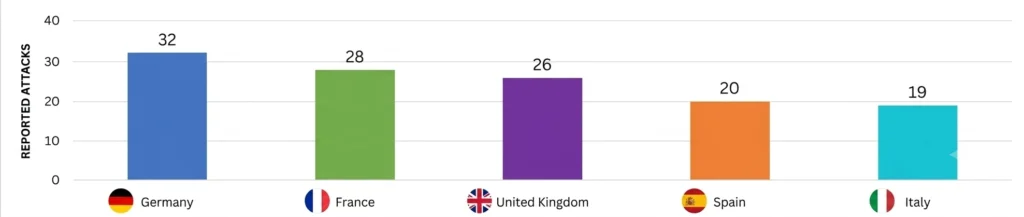
Top five European Nations Attacked by Ransomware Actors in 2026 H1 (Source: Cyble Research)
Germany: The Manufacturing Battleground
Attack Volume: 155 ransomware attacks (17.9% of regional total)
Germany's position as Europe's manufacturing powerhouse places it at the center of ransomware targeting campaigns. The nation's industrial sector—encompassing automotive, machinery, chemicals, and precision manufacturing—represents the most valuable ransomware target set in Europe.
German organizations represent an optimal target combination: high asset value, supply-chain criticality, strong operational technology integration, and proven willingness to pay ransoms to maintain production schedules. Additionally, Germany's federal structure creates jurisdictional complexity that may slow law enforcement response.
The nation's Mittelstand (mid-market manufacturing firms) are particularly vulnerable—large enough to justify ransom payments, but sometimes lacking enterprise-grade security infrastructure.
Defensive Priority: German manufacturing organizations should assume Qilin, The Gentlemen, Akira, and Dragonforce all maintain active operations targeting their sector. Network segmentation between IT and operational technology (OT) environments should be elevated to critical priority.
United Kingdom: The Financial Services Crosshairs
Attack Volume: 138 ransomware attacks (15.9% of regional total)
The UK faces a different threat profile than Germany, driven primarily by London's position as a global financial services hub. While manufacturing is targeted, Banking, Financial Services, and Insurance (BFSI) organizations command disproportionate attention.
Threat Actor Concentration:
Qilin: 26 attacks
The Gentlemen: 26 attacks
LockBit: 18 attacks
Akira: 13 attacks
Dragonforce: 11 attacks
Sectoral Breakdown:
BFSI: 38 incidents (concentrated targeting)
Technology: 32 incidents
Retail: 26 incidents
Professional Services: 24 incidents
Government & LEA: 16 incidents
Why the UK Is Targeted
London's financial services ecosystem manages trillions in assets, making it extraordinarily valuable to data-exfiltrating threat actors. BFSI organizations hold customer financial data, internal financial records, and strategic information that commands premium prices on dark web marketplaces.
Additionally, regulatory requirements (FCA, PRA, etc.) create pressure for rapid ransom payment to avoid breach notification delays that could trigger regulatory sanctions.
Data Exfiltration Risk: The UK's status as a financial services hub makes it particularly vulnerable to data-centric attack strategies. Organizations should assume that successful breach attempts will include aggressive data exfiltration alongside encryption deployment.
Defensive Priority: UK BFSI organizations must implement robust data loss prevention (DLP), encryption for data in transit and at rest, and aggressive monitoring for unauthorized data access or exfiltration attempts.
France: The Balanced Threat
Attack Volume: 119 ransomware attacks (13.7% of regional total)
France experiences balanced threat distribution across multiple sectors, reflecting both its manufacturing capacity and significant professional services sector.
Threat Actor Concentration:
Qilin: 28 attacks
The Gentlemen: 28 attacks
LockBit: 15 attacks
Akira: 14 attacks
Dragonforce: 8 attacks
Sectoral Breakdown:
Professional Services: 26 incidents
Manufacturing: 24 incidents
Construction: 19 incidents
Technology: 14 incidents
Healthcare: 10 incidents
Why France Faces Distributed Threat
As Europe's second-largest economy, France is attractive to ransomware operators across multiple sectors. The nation's professional services sector (legal, accounting, consulting) is particularly valuable for data exfiltration, while manufacturing remains a consistent target.
Defensive Priority: French organizations should implement sector-specific defensive strategies: professional services firms should prioritize client data protection and DLP, while manufacturing organizations should focus on OT segmentation and operational resilience.
Italy: The Construction and Manufacturing Hub
Attack Volume: 115 ransomware attacks (13.3% of regional total)
Italy faces concentrated targeting in construction and manufacturing sectors, with particular pressure on small-to-medium enterprises in industrial regions.
Threat Actor Concentration:
Qilin: 19 attacks
The Gentlemen: 18 attacks
LockBit: 12 attacks
Akira: 16 attacks
Dragonforce: 8 attacks
Sectoral Breakdown:
Construction: 48 incidents (concentrated)
Manufacturing: 38 incidents
Professional Services: 18 incidents
Retail: 14 incidents
Why Italy Faces Sector-Specific Pressure
Italy's construction industry is particularly vulnerable to ransom attacks due to tight project timelines and significant financial exposure. The nation's manufacturing sector, while sophisticated, sometimes operates with legacy infrastructure that creates exploitation opportunities.
Defensive Priority: Italian construction and manufacturing organizations should prioritize incident response readiness, backup infrastructure resilience, and supply-chain risk management.
Spain: The Emerging Risk
Attack Volume: 87 ransomware attacks (10.0% of regional total)
Spain experiences lower absolute attack volume than Germany, UK, France, or Italy, but faces concentrated pressure in manufacturing and professional services sectors.
Threat Actor Concentration:
Qilin: 20 attacks
The Gentlemen: 18 attacks
LockBit: 8 attacks
Akira: 12 attacks
Dragonforce: 7 attacks
Sectoral Breakdown:
Manufacturing: 28 incidents
Professional Services: 19 incidents
Construction: 16 incidents
Technology: 10 incidents
Regional Observation: Spain's lower attack volume may reflect either lower overall ransomware targeting or more effective defensive implementations. Spanish security teams should not interpret lower numbers as reduced threat but rather as a baseline for future comparison.
Where European Organizations Face Maximum Risk: A Sectoral Analysis
Construction: The Ransomware Goldmine
Attack Volume: 107 documented incidents (58% of all sector targeting across regions – not just in Europe – analyzed)
Construction organizations face disproportionate ransomware targeting across the entire European region. This concentration reflects understood economic vulnerabilities that threat actors exploit with precision.
Why Construction Is Targeted
Time-Sensitive Financial Exposure: Construction projects operate under contractually-defined timelines. Each day of delay triggers cascading costs, financial penalties, and potential contract termination. Organizations facing potential loss of €50-100 million contracts will prioritize rapid recovery over law enforcement involvement.
Operational Technology Integration: Modern construction increasingly relies on Building Information Modeling (BIM), cloud-based project management, and real-time equipment tracking. This IT/OT convergence creates exploitation pathways unavailable in purely IT-based industries.
Supply-Chain Complexity: Construction projects depend on dozens of subcontractors and suppliers. Compromising a single upstream supplier can provide lateral access into prime contractors.
Financial Pressure: Construction firms often operate with tight cash flow, making ransom negotiation essential to preserve solvency.
Accessibility: Many construction firms, particularly smaller regional players, operate with basic security infrastructure, creating easy exploitation opportunities.
European Construction Risk Mapping:
Germany (14 attacks): Heavy machinery and precision manufacturing integration
Supply-Chain Due Diligence: Implement security requirements for subcontractors and equipment suppliers
Professional Services: The Data Exfiltration Target
Attack Volume: 86 documented incidents
Professional services firms (law, accounting, consulting) face sophisticated targeting driven by data exfiltration opportunities rather than operational disruption pressure.
Why Professional Services Are Targeted
Client Confidentiality Risk: Legal privilege and client confidentiality create existential regulatory and reputational exposure. Threat actors leverage this to demand premium ransoms.
Sensitive Data Concentration: Professional services firms accumulate client financial records, litigation strategies, tax information, and corporate secrets—all commanding premium dark web prices.
Regulatory Exposure: GDPR breach notification requirements create pressure for rapid response and ransom payment to avoid regulatory sanctions.
Supply-Chain Position: Professional services firms advise major corporations; compromising advisors provides indirect access to clients.
Trust-Based Business Model: Client relationships depend on confidentiality. A single breach can destroy long-term client relationships and firm reputation.
European Professional Services Risk:
France (16 attacks): Concentrated targeting of Paris-based firms
Germany (16 attacks): Heavy focus on Frankfurt financial advisory firms
UK (17 attacks): London-based legal and accounting partnerships
Italy (6 attacks): Milan and Rome-based advisory firms
Spain (7 attacks): Barcelona and Madrid professional services sector
Key Finding: Professional services firms experience disproportionate data breach incidents (exfiltration with confirmed leak activity) compared to other sectors. Of the 51 total data breach incidents across Europe and UK, professional services represents a concentrated target.
Defensive Recommendations:
Client Data Segregation: Isolate client data on separate network segments with distinct access controls
Data Loss Prevention (DLP): Deploy DLP solutions with aggressive egress controls monitoring client data exfiltration
Encryption Standards: Implement client-facing encryption for all sensitive communications
Access Auditing: Maintain comprehensive logs of all access to sensitive client data
Ransomware-Specific Insurance: Consider cyber insurance with specific ransomware coverage addressing confidentiality exposure
Manufacturing: The Supply-Chain Critical Target
Attack Volume: 123 documented incidents
European manufacturing organizations face sophisticated, supply-chain-aware threat actors who understand production dependencies and downtime economics.
Why Manufacturing Is Targeted
Operational Technology Integration: Modern factories integrate IT and OT systems. Ransomware deployment can halt production lines, creating catastrophic financial exposure.
Supply-Chain Criticality: Manufacturing downtime cascades through dependent enterprises. A single organization's compromise can impact dozens of downstream customers.
Export Dependency: European manufacturers serve global markets. Production delays translate directly into lost revenue and market share.
Legacy Infrastructure: Many manufacturing facilities operate aging, unpatched systems integrated with newer IT infrastructure, creating exploitation bridges.
Financial Pressure: Manufacturing organizations face razor-thin margins; production downtime can drive solvency crises.
UK (14attacks): Aerospace, automotive, precision manufacturing
Critical Vulnerability Pattern: Manufacturing organizations are disproportionately targeting known, exploitable vulnerabilities in critical infrastructure appliances (network appliances, security tools, identity systems). Rather than deploying zero-days, threat actors exploit patched vulnerabilities that organizations have not implemented.
Defensive Recommendations:
OT/IT Segmentation: Implement airgapped network separation between operational technology and corporate IT
Vulnerability Management Prioritization: Focus patching efforts on network appliances, security tools, and identity systems
Industrial Control System (ICS) Monitoring: Deploy behavioral monitoring for unusual activity on manufacturing control systems
Healthcare organizations face a unique threat dynamic where ransomware directly endangers patient safety, creating existential operational pressure distinct from financial threats.
Why Healthcare Is Targeted
Patient Safety Risk: Ransomware disables critical medical systems (diagnostic equipment, pharmaceutical dispensing, patient records). Unlike other industries, downtime directly threatens life.
Regulatory Pressure: GDPR, HIPAA-equivalent regulations, and national privacy laws create breach notification requirements that incentivize ransom payment.
Data Value: Patient medical records, pharmaceutical research data, and clinical trial information command premium dark web prices.
Continuous Operation Requirement: Unlike manufacturing or services, healthcare cannot delay critical procedures. The operational pressure to pay ransoms is existential.
System Complexity: Healthcare IT environments integrate numerous legacy systems (PACS, EHR, medical devices) with varying security architectures.
European Healthcare Risk Distribution:
Germany (14 attacks): Concentrated in Berlin, Munich, and Frankfurt urban medical centers
Austria (2 attacks): private healthcare sector
France (5 attacks): Concentrated in Paris and Lyon region hospitals
Switzerland (3 attacks): medical centers
Spain (3 attacks): Barcelona and Madrid hospital networks
Critical Finding: Healthcare organizations experience disproportionately high data breach incident rates, suggesting organized threat actors specifically target health information exfiltration.
Defensive Recommendations:
Clinical System Isolation: Implement complete network separation between clinical systems and corporate IT
Redundant Critical Systems: Deploy redundant diagnostic and pharmaceutical systems capable of manual operation
Patient Data Encryption: Implement end-to-end encryption for all patient medical records
Breach Response Planning: Develop healthcare-specific incident response plans addressing patient notification and continuity of care
Medical Device Security: Implement inventory and monitoring for all connected medical devices
Supply-Chain Assessment: Assess security of medical device manufacturers and pharmaceutical distributors
The Data Exfiltration Reality: Beyond Encryption
Confirmed Data Breaches: 51 Incidents Across Europe and UK
While ransomware attacks total 866, only 51 incidents resulted in confirmed data breaches and leaks (5.9% confirmation rate). This apparent low percentage masks a critical operational truth: organizations cannot distinguish between encryption-only attacks and data exfiltration scenarios until exfiltration attempts or threats emerge.
Data Breach Distribution by Sector:
Sector
Confirmed Breaches
Percentage
BFSI
9
17.6%
Telecom
9
17.6%
Retail
8
15.7%
Government & LEA
6
11.8%
Media & Entertainment
5
9.8%
Technology
4
7.8%
Healthcare
4
7.8%
Automotive
3
5.9%
Construction
2
3.9%
Education
1
2.0%
Others
6
11.8%
Critical Observation: BFSI and Telecom sectors experience disproportionate data breach incidents, suggesting these industries are specifically targeted for data exfiltration rather than operational disruption. The strategic implication is clear: threat actors targeting financial and telecommunications organizations prioritize data monetization over ransom payment.
Most Active Threat Actors in Data Exfiltration: The Leak Economy
Primary Exfiltration Actors:
Actor
Confirmed Leak Posts
Targeting Pattern
tanaka
6
Industry-agnostic, global operations
kazutlg
4
BFSI and Professional Services focus
aslan1
2
Government and Technology sectors
darkcybervault
2
Retail and Professional Services
breach3d
2
Technology focus
frog
2
Diverse sector targeting
ken6k
2
BFSI concentration
max9898
2
Retail and Technology
worldrdp
2
Technology sector
zyad2drkwb
2
Government targeting
zoozkooz
2
Diverse sector
mr_x1
1
Retail focus
ventuuas
1
Professional Services
Others
18
Distributed diverse targeting
Strategic Finding: While Qilin, The Gentlemen, and LockBit dominate ransomware attack volume, data exfiltration is fragmented across numerous smaller actors, including tanaka (6 posts), kazutlg (4 posts), and dozens of single-incident operators. This suggests a mature data brokerage ecosystem where extracted data is resold to specialized exfiltration actors.
Dark Web Data Marketplace Activity:
916 unique domains impacted by data leaks
Approximately 86 distinct leak posts across dark web channels
Data types: Financial records, customer PII, medical records, intellectual property, trade secrets
Implication: Organizations can no longer assume encrypted data is "lost forever" if backups are restored. Exfiltrated data will be monetized regardless of whether organizations pay ransoms. Data loss prevention becomes as critical as ransomware detection.
Geopolitical and Ideological Dimensions: The Activism-Cybercrime Convergence
Pro-Russian Hacktivism: Blurred Lines Between Ideology and Profit
H1 2026 witnessed increasing overlap between geopolitically motivated hacktivism and financially motivated cybercrime, particularly among pro-Russian collectives targeting NATO-aligned European nations.
Key Threat Actors to Monitor
NoName057(16) - The Pro-Russian DDoS Coalition
Primary Activity: Large-scale DDoS attacks against NATO-aligned governments and Ukrainian supporters
Secondary Activity: Data exfiltration for monetization
Geographic Targets: Estonia, UK, Ukraine, Italy, Spain, France, Poland, Norway, Denmark, Lithuania, Latvia, Czech Republic, Germany, Moldova
Operational Pattern: Coordinated DDoS campaigns often accompanied by data theft and subsequent leak activity
Operational Evolution: NoName057(16) began as a purely activist collective claiming ideological motivation (anti-NATO, pro-Russia). By H1 2026, the group had evolved to include data exfiltration and monetization—suggesting either organizational evolution or infiltration by financially motivated threat actors.
Strategic Implication: European organizations cannot compartmentalize threat modeling. A geopolitically motivated attack that begins as a DDoS campaign can transition into ransomware deployment when exfiltration opportunities present themselves.
Strategic Defense Recommendations for European Organizations
Prioritized Defensive Roadmap
Based on CRIL's H1 2026 regional data, European security leaders should prioritize defensive investments in the following sequence:
Defensive Focus: Data encryption, DLP with aggressive egress controls, cyber insurance
If You're in Healthcare:
Primary Threat: Qilin, The Gentlemen, LockBit
Secondary Threat: Data exfiltration operators
Vulnerability: Patient safety risk, critical operational pressure, medical device security
Defensive Focus: Clinical system isolation, redundant critical systems, incident response for operational continuity
Conclusion: The European Ransomware Reality
Europe and the UK face a mature, organized ransomware ecosystem dominated by five sophisticated threat actors who have developed deep understanding of regional economic vulnerabilities. The threat is not random or opportunistic—it is strategic, targeted, and evolved.
Key Takeaways:
Five groups dominate: Qilin (158 attacks), The Gentlemen (144), LockBit (61), Akira (59), and Dragonforce (54) collectively account for 476 of 866 documented attacks (55%). European security leaders can build specific defensive strategies against known adversaries.
Geography matters: Germany, UK, France, Italy, and Spain face distinct threat profiles. Security strategies must be regionally and sector-specific, not generic.
Sectors are targeted deliberately: Construction, Professional Services, and Manufacturing are not randomly selected—they face extraordinary pressure due to economic vulnerabilities that threat actors systematically exploit.
Data exfiltration is the primary leverage: Of 866 attacks, only 51 resulted in confirmed breaches—but this understates the risk. Organizations must assume all breaches involve data exfiltration and cannot rely on backup restoration alone.
Patch management is the primary defense: Nearly 90% of exploited vulnerabilities had patches available. Disciplined patch management, particularly for network appliances, would prevent the vast majority of successful attacks.
Known vulnerabilities are the current threat: Despite awareness of zero-day sophistication, threat actors continue exploiting known vulnerabilities because patches lag adoption. This creates a predictable exploitation window that defensive teams can close.
For European security leaders, the path forward is to understand your regional threat actors, prioritize critical infrastructure protection, implement robust data protection measures, and establish resilient backup and recovery infrastructure. The threat is severe, but it is also understood and defensible. The question is not whether European organizations will face ransomware attacks in the remainder of 2026 and beyond—the data confirms they will. The question is whether they will be prepared.
The dark web is no longer just a marketplace for stolen credentials; it has grown far beyond that point and now affects nearly every phase of the cyberattack lifecycle. Markets that once traded only compromised accounts now also sell ransomware services, initial network access, exploit kits, phishing infrastructure, and even AI-powered attack tools.
What used to be a place for selling stolen data has become the operational backbone of modern cybercrime.
The first half of 2026 alone is indicative of the trends we may continue to observe. The dark web has evolved into a highly organized ecosystem that facilitates cybercrime, underpins ransomware supply chains, fuels geopolitical campaigns, and accelerates identity-based attacks.
Instead of serving as the endpoint for stolen data, it now functions as an operational hub where access, intelligence, and malicious services are traded before attacks even begin.
The pace of activity reflects this shift: March 2026 alone recorded 702 ransomware attacks and 54 major publicly reported data breaches and leaks worldwide.
Enterprise security teams must monitor such activities using continuous threat intel and underground monitoring. The current ecosystem is no longer optional as an intel exercise but an essential capability for spotting threats before they materialize.
The dark web trends observed during the first half of 2026 reveal how underground ecosystems are reshaping the cyber threat landscape.
1. Ransomware Operations Continue to Mature
During the first six months of 2026, ransomware remained one of the most disruptive cyber threats, but the infrastructure supporting it became noticeably more organized. Five ransomware operations—Qilin, Akira, The Gentlemen, DragonForce, and INC Ransom—accounted for more than 56% of ransomware activity recorded in March 2026.
This concentration highlights the growing consolidation of the ransomware ecosystem, where a handful of established operators dominate attacks while relying on affiliates and underground service providers to scale their campaigns.
Modern ransomware campaigns rarely focus on encrypting systems. Data theft has increasingly become a standard component in most attack scenarios, as it allows threat actors to pressure their victims with the threat of public exposure, even if the victims have proper backups and can restore their systems. Dark web leak sites play a major role in this, as they are where stolen information is published or auctioned when organizations do not want to pay.
This shift will require businesses to monitor underground forum trends in H1 2026, including discussions about leaked data, targeted organizations, and early chatter about upcoming campaigns. Regional data reinforces the same trend. In the Americas alone, 1,305 cyber incidents were reported during Q1 2026, including 1,138 publicly claimed ransomware attacks. Nearly 58% of those attacks were attributed to just five ransomware groups.
2. Access Brokers Are Powering the Underground Economy
Many cyberattacks are now starting long before ransomware is deployed. Initial access brokers have become major players, specializing in one activity: network compromise and then selling that access to other threat actors.
Underground marketplaces also showed growing demand for initial access. In March 2026 alone, researchers observed 80 separate listings advertising access to compromised corporate networks. Government & LEA remained the most targeted industry, with 11 tracked incidents. Governments, Professional services, Manufacturing, and Retail continued to be persistently targeted.
The bulk of this activity traced back to Big-Bro, an initial access broker (IAB) who has operated on Russian-language cybercrime forums since 2022. Two newer actors followed: Saturned33, who appeared in 2025, and Vexin, who surfaced in early 2026 (primarily active in March) and built a reputation selling unauthorized access to corporate cloud environments across multiple countries.
Ransomware groups and espionage operators don’t need to spend time and effort breaching organizations themselves; they can buy verified entry points into corporate environments. This new division of labor has made cybercrime much faster and more effective.
Access is typically sold soon after a compromise, so defenders have less time to detect exposed credentials or compromised infrastructure. As such, dark web intelligence is valuable not only for identifying stolen data but also for indicating that access to an organization's network is already being traded on underground markets.
To see how Cyble’s threat intelligence can help your organization detect external exposure and track threat activity, book a personalized demo.
3. Identity Has Become the Primary Attack Surface
With the rise of credential-based attacks over malware, the security perimeter is pretty much irrelevant. The most common enterprise infiltration paths include credential theft, session hijacking, bypassing multi-factor authentication, and abuse of third-party access. All those have one thing in common: valid credentials.
From an attacker's perspective, logging in with legitimate credentials generates far less suspicion than exploiting software vulnerabilities. As organizations expand cloud adoption and remote work, identities have become a new perimeter.
Compromised endpoints have always been a key initial access vector for a variety of illicit activities, ranging from data breaches to initial access brokerage (IAB) operations. Compromised Endpoint monitoring is essential to securing an organization’s digital surface in the current threat landscape.
Over the last 6 months, Vision observed 9.7 billion compromised endpoints. This trend also explains why stolen usernames, passwords, authentication tokens, and corporate accounts continue to be traded on the dark web. Monitoring for exposed credentials allows organizations to respond before compromised identities are weaponized.
Your executives are a prime target. → Discover how Cyble Executive Monitoring detects executive impersonation and deepfakes before they escalate.
4. Geopolitical Events Are Driving Cyber Activity
The connection between global conflicts and dark web activity has become increasingly apparent during the first half of 2026. State-sponsored groups, hacktivists, and financially motivated criminals frequently operate in parallel during periods of geopolitical tension, creating a more complex threat environment.
Rather than focusing exclusively on immediate disruption, many sophisticated actors are investing in long-term access to critical infrastructure, telecommunications, transportation, and energy systems. During the February 2026 escalation in the Middle East, cyber operations demonstrated how geopolitical events now extend into the digital domain.
Internet connectivity in affected regions reportedly dropped to between 1% and 4% of normal levels; more than 70 hacktivist groups became active; over 8,000 conflict-themed domains were registered for scams and malware campaigns; and disruptions to navigation systems affected more than 1,100 vessels near the Strait of Hormuz.
This convergence of political objectives and cybercrime makes attribution more difficult and raises the importance of monitoring underground discussions that may signal emerging campaigns before they reach production environments.
5. AI Is Accelerating Both Attackers and Defenders
Artificial intelligence has moved from experimentation to operational use across the cybersecurity landscape. Threat actors are increasingly using AI-assisted techniques to automate reconnaissance, accelerate the exploitation of vulnerabilities, and scale phishing campaigns with greater precision.
The dark web has become a marketplace for sharing AI-enabled attack tools alongside traditional malware, making advanced capabilities accessible to less experienced operators. This lowers the barrier to entry while increasing the overall speed of cyber operations.
Dark web threat intelligence in 2026 is becoming increasingly AI-driven, with defenders using automated analysis to process large volumes of dark web data, identify indicators of compromise, and prioritize threats in near real time. As attacks unfold more rapidly, automation is becoming necessary to reduce detection and response times.
The question is no longer whether your organization appears on the dark web. The real question is whether you'll discover it before your attackers do.
The first half of 2026 stresses that the dark web is no longer where stolen information appears after an incident. It has evolved into a live intelligence environment where attacks are planned, infrastructure is traded, identities are monetized, and emerging tactics become visible before they reach production networks.
Organizations that incorporate dark web intelligence into broader security operations gain more than visibility into compromised data; they gain early warning of evolving threats.
As ransomware groups become more coordinated, identity attacks continue to rise, and AI reshapes offensive capabilities. Proactive monitoring will play an important role in reducing cyber risk during the remainder of 2026.
The FIFA World Cup 2026 has become more than a global sporting event. It has evolved into a large-scale cybercrime opportunity exploited by threat actors through a coordinated ecosystem of fraudulent domains, social media channels, messaging platforms, pirated streaming services, and dark web activity. Since May 2026, Cyble Research and Intelligence Labs (CRIL) has identified nearly 4,000 domains impersonating FIFA-related brands, ticketing platforms, streaming services, and fan-facing resources.
Operation FanTrap reveals how threat actors are building end-to-end fraud operations designed to attract, engage, and monetize football fans worldwide. Victims are lured through fake ticket offers, VIP access schemes, counterfeit hospitality portals, and unauthorized streaming platforms. Evidence also shows victims being redirected to private communication channels such as Telegram and WhatsApp, where payment fraud, credential theft, and identity harvesting occur.
CRIL’s investigation also identified growing dark web activity linked to the tournament, including claims of football-sector identity data leaks and discussions around ticket resale opportunities. While the authenticity of some leak claims remains under investigation, their circulation highlights the increasing convergence of fan-targeted fraud, identity theft, and cyber-enabled financial crime.
The campaign demonstrates how major international events create a scalable environment for cybercriminal operations. Through multilingual targeting, extensive infrastructure deployment, and diversified monetization strategies, threat actors are transforming global sporting events into sustained cybercrime ecosystems.
Key Takeaways
Operation FanTrap is a coordinated investigation into the broader fraud ecosystem exploiting global interest in FIFA events
Nearly 4,000 FIFA-themed domains were identified supporting phishing, ticket fraud, VIP scams, streaming lures, and brand impersonation.
The websites used a multilingual infrastructure to maximize victim reach, with a particularly strong focus on Chinese-speaking audiences.
Telegram and WhatsApp function as transaction layers where victims are moved from public-facing infrastructure into private fraud workflows.
Pirated streaming platforms serve as credential theft and payment fraud funnels rather than simple copyright violations.
Dark web discussions and alleged football-sector identity leaks create opportunities for targeted social engineering and secondary monetization.
Chinese-speaking fans, Korean fans, Latin American fans
Dark Web Activity
Forum-based ticket resale fraud; identity data leak claims
The FIFA World Cup 2026 will span the US, Canada, and Mexico, with a 48-team format and global broadcast reach. CRIL's monitoring uncovered significant spikes in malicious domain registrations mapped to specific attack themes, demonstrating how threat actors rapidly adapted their infrastructure to capitalize on tournament-related interest.
Figure 1 - Operation FanTrap attack themes
Anatomy of the FIFA 2026 Fraud Ecosystem
Domain Patterns - The Fraud Ecosystem
Threat actors leveraged ticketing, VIP access, official branding, and live streaming to broaden their victim pool. Examples of these domain patterns are shown in the table below.
Figure 2 - Fraudulent FIFA 2026 Official Hospitality Ticketing Portal
The extensive use of zh-, cn-, and Chinese-language World Cup labels such as shijiebei, pankou, and maiqiu highlights a deliberate focus on Mandarin-speaking audiences. This targeting extends beyond traditional ticket fraud to encompass betting platforms, media-themed credential theft, piracy lures, prize scams, and counterfeit merchandise. This signals a persistent and organized fraud ecosystem designed to capitalize on China's large football fanbase and strong demand for World Cup-related content and services.
Dark Web Intelligence
We also identified a growing ecosystem of ticket resale fraud on Telegram and WhatsApp, as well as pirated streaming lures. Both are actively used to monetize fan interest and facilitate fraud, credential harvesting, and other malicious activity.
Resell Traps on Messaging Services.
Monitoring of deep- and dark-web sources identified numerous advertisements and reseller communities promoting FIFA World Cup tickets via Telegram and WhatsApp. Fraudsters frequently use these platforms because they facilitate private, direct communication while limiting oversight and accountability.
Threat actors often establish credibility through fabricated testimonials, forged purchase confirmations, edited screenshots, recycled ticket images, and scripted customer-support interactions. However, such indicators of legitimacy can be easily manufactured and should not be considered proof of ticket ownership or delivery capability. Additionally, the closed nature of these channels enables attackers to create a sense of urgency, collect payments, and disengage victims with minimal traceability.
The example below illustrates a Telegram-based ticket resale advertisement identified during monitoring, highlighting the use of unofficial and potentially fraudulent sales channels.
Figure 3 -Telegram Ticket Testimonial Used to Build Buyer TrustFigure 4 -Urgency-Driven Ticket Offers in Suspicious Telegram Channels
The pirated stream trap: free football, expensive consequences
Pirated streaming sites exploit fans seeking free access to World Cup matches, using geo-restrictions, subscription costs, and broadcast limitations as bait. Rather than delivering live streams, many function as fraud and malware distribution platforms, employing fake video players, deceptive download prompts, browser notification prompts, and fraudulent free-trial offers to harvest credentials, payment information, and user data.
To evade detection, we identified domains that avoid FIFA- or World Cup-related keywords in domain names. These links are promoted through fan forums, Discord servers, Telegram channels, and WhatsApp groups, lending credibility to malicious infrastructure.
Examples identified during monitoring include:
footybite[.]vc
epicsports[.]in
footballnewslive[.]online
totalsportek[.]online
sportshub[.]fan
streameast[.]im
The risk is beyond legal or copyright concerns. For many fans, the real danger lay in the broader cybersecurity ecosystem surrounding these platforms. Pirated streaming sites and services often acted as data collection points, quietly harvesting email addresses, passwords, payment details, phone numbers, and device information.
Unofficial streaming apps and APK files added another layer of risk. They frequently requested excessive permissions, delivered intrusive ads, tracked user activity, and in some cases, served as entry points for malware. What seemed like a convenient way to watch a match could quickly turn into a channel for data exposure and system compromise.
Ticket Scams and VIP Access Fraud
Forum-based ticket promotions added another layer of risk to World Cup scams by combining resale listings with the appearance of community trust. Sellers often seemed more credible than random social media accounts, as consistent posting, forum history, and visible profile activity created a sense of legitimacy. However, this credibility could be misleading. Fans should remain cautious, as an active profile did not guarantee ticket authenticity, official authorization, secure payments, or a successful transfer—even within seemingly trusted communities.
Figure 5 - Ticket Resale Promotion Through Forum Profiles and Repeated Match PostsFigure 6 - Domain Reputation Check for a Ticket Resale Website
Identity and PII leak claims
CRIL also observed forum discussions about leaked football-related identity data, highlighting how World Cup–related cybercrime can extend beyond fan scams into the broader football ecosystem. For example, one post titled “150k+ football passports leaked weeks before FIFA World Cup” claimed that passport scans and personal details of over 150,000 AFC and Al Nassr FC players and coaches had been exposed. The alleged leak included sensitive information such as full names, passport numbers, scans, dates of birth, nationalities, player roles, club affiliations, email addresses, contracts, AFC IDs, and even match or venue details.
Such claims require independent forensic verification before a confirmed breach status can be assigned. Regardless of authenticity, the circulation of this data in the pre-tournament window confirms threat actors are actively seeking to monetize football-sector identity assets. If the record set is genuine, it enables targeted spear-phishing against club staff, agent impersonation in transfer fraud, contract manipulation, and abuse of venue access credentials.
Figure 7 - Forum Claim of Football Passport Data Exposure Before the World Cup
Connecting the Ecosystem – Attack Lifecycle
Figure 8 – FIFA World Cup attack ecosystem
By correlating our findings and research, we reconstructed the end-to-end attack chain used by threat actors. The analysis demonstrates how these seemingly independent activities are strategically aligned around the global popularity of FIFA events, enabling attackers to exploit fan enthusiasm, urgency, and trust. Together, these components form a coordinated FIFA-themed fraud ecosystem designed to attract victims, harvest sensitive information, facilitate financial fraud, and generate sustained criminal revenue.
The stages are as follows:
Stage 1 – Infrastructure Preparation: Registration of FIFA-themed domains and supporting online assets.
Stage 2 – Victim Acquisition: Promotion through search engines, social platforms, forums, messaging communities, and streaming portals.
Stage 3 – Engagement and Conversion: Fake ticket sales, VIP packages, hospitality offers, and streaming access are used to build trust.
Stage 4 – Data Collection: Harvesting of credentials, payment information, personal identifiers, and communication details.
Stage 5 – Monetization: Fraudulent payments, resale scams, credential abuse, phishing campaigns, and potential resale on the dark web of collected information.
Conclusion
Operation FanTrap demonstrates how global sporting events have evolved into highly attractive targets for organized cybercriminal activity. Rather than relying on isolated phishing campaigns or opportunistic scams, threat actors are building interconnected ecosystems that combine malicious infrastructure, social engineering, messaging platforms, streaming lures, and dark web activity to maximize financial returns.
The nearly 4,000 domains identified by CRIL represent only one layer of a broader operation designed to exploit fan enthusiasm, event urgency, and global online engagement. Ticket scams, VIP access fraud, streaming lures, and alleged football-sector identity leaks collectively illustrate how attackers are diversifying their monetization strategies throughout the tournament lifecycle.
As the FIFA World Cup 2026 continues, organizations, broadcasters, ticketing providers, and fans should view these activities not as isolated incidents but as components of an active and evolving cybercrime ecosystem. Continuous monitoring, rapid infrastructure disruption, dark web visibility, and proactive user awareness will remain critical to reducing risk throughout the tournament.
CRIL will continue tracking this cluster and updating IoCs as new infrastructure emerges. All indicators are submitted to Cyble's threat feeds and accessible to Vision platform customers. Fan-facing brands, ticketing platforms, and event organizers should treat this as an active threat and prioritize domain monitoring and takedown workflows throughout the tournament.
Recommendations
Based on the findings presented above, CRIL recommends the following actions for immediate consideration by security teams and organizations:
Implement keyword-aware domain monitoring that flags FIFA, tournament branding, and language-prefix patterns (zh-, cn-, kr-) as compounding risk signals alongside registrar identity, TLD, and domain age.
Build takedown workflows that account for Cloudflare-proxied infrastructure — abuse requests must target the underlying origin, not the CDN layer, to be operationally effective.
Integrate campaign-cluster pivoting from confirmed IoCs into threat hunting workflows, using shared IP subnets and registrar concentration as primary pivot axes.
Apply multi-platform fraud funnel awareness: detection should extend beyond domains to Telegram and WhatsApp channels used for off-platform transaction completion.
For ticketing platforms and official broadcasters: issue proactive fan advisories confirming that legitimate ticket transactions will never be negotiated via private messaging apps or unverified resale portals.
Revise security awareness materials to teach structural URL interpretation — with specific focus on identifying lookalike FIFA domains that embed official terminology in subdomains or hyphenated strings rather than the root registered domain.
Monitor dark web forums for emerging data leak claims targeting football organizations, and treat leaked PII — particularly passport and contract data — as an active social engineering enabler requiring targeted victim notification.
The need for a proactive cyberdefense stance
The current threat landscape includes a multitude of Social Engineering campaigns. Security teams need more than reactive controls to keep ahead of these.
Solutions such as Cyble Vision deliver operational intelligence that enables defenders to stay ahead of adversaries through early detection, campaign-level visibility, and infrastructure mapping.
Cyble Vision specifically empowers security teams to move beyond isolated detection, providing the strategic insight needed to anticipate threats, monitor adversary activity, and respond with precision at every stage of the attack lifecycle. Security teams can take necessary preventive action with the help of:
Real-Time IOC Monitoring Enable continuous tracking of indicators tied to adversary infrastructure before they reach end users.
Credential Phishing Infrastructure Mapping Map attacker-controlled infrastructure, including fake authentication portals, dynamic exfiltration endpoints, and backend logic designed to capture credentials.
Brand and Executive Impersonation Monitoring Detect domain spoofing and impersonation attempts targeting internal functions such as HR and Finance—often used to increase trust and exploit user familiarity.
Deep and Dark Web Visibility Surface chatter, leaked credentials, and phishing toolkits from deep/dark web sources, offering early insight into attacker preparation and target selection.
Global Targeting Intelligence Track phishing activity across global regions—including North America, EMEA, and APAC—as well as over 70 industry sectors, providing defenders with contextual understanding of targeting patterns.
Threat Actor Attribution and TTP Correlation Associate infrastructure, techniques, and behavioral patterns with known threat actors, empowering security teams to prioritize response based on adversary capability and intent.
The IOCs have been added to this GitHub repository. Please review and integrate them into your Threat Intelligence feed to enhance protection and improve your overall security posture.
The FIFA World Cup 2026 kicks off on June 11, and the world's biggest sporting event is drawing more than just fans — it is already attracting a wave of cybercriminals targeting ticket buyers, job seekers, streaming viewers, and corporate brands alike.
The FBI has issued a formal Public Service Announcement warning that threat actors are creating fraudulent versions of FIFA-affiliated websites to steal personal information, conduct financial fraud, and sell fake products and services. Cyble researchers independently analyzed the domains flagged by the FBI and confirmed that many remained active and operational at the time of publishing this report.
With 48 teams, 16 host cities across the United States, Canada, and Mexico, and an estimated global audience of billions, the FIFA World Cup 2026 is set to be the largest men's World Cup in history. That scale is precisely why cybercriminals are prying on it — and why the threat is arriving earlier and more aggressively than in previous tournaments.
The FBI warns that threat actors are building fraudulent versions of FIFA's official website, www.fifa.com, designed to closely mimic the legitimate experience. These sites are engineered to collect personally identifiable information (PII), including full names, home addresses, phone numbers, email addresses, banking information, and payment card details.
The same fraudulent infrastructure is used to run a range of operations simultaneously: FIFA ticket scams, fake hospitality package sales, fraudulent job listings, and other forms of financial fraud.
The most common technical method is typosquatting — registering domains with subtle spelling changes or different extensions that trick users into believing they have landed on an official page. A single missing letter, a swapped extension, or a hyphenated variant can be enough to deceive even vigilant users, especially when the site is dressed with FIFA branding, tournament schedules, and professional-looking navigation menus.
The FBI flagged the following domains as fraudulent FIFA-related sites:
www.fifa[.]cab
www.fifa[.]pink
www.fifa[.]blue
www.fifa[.]pub
FIFA[.]city
Fifa[.]bio
fifa[.]beer
fifa[.]click
fifa[.]cam
fifa[.]ceo
fifa[.]help
filfa[.]org
fifa-online[.]com
https://fifa-2026[.]xyz
jobs-fifa[.]com
fifa-hr[.]com
fifa-careerhub[.]com
fifaworldcup-careers[.]com
fifa-hiring[.]com
fifahiring[.]com
fifa-ticket[.]live
fifastore.us[.]com
fifaworldcup26[.]sale
fifaworldcup26.xcover-staging[.]com
worldcup2026-tickets.com[.]mx
worldcup26ticket[.]com
2026fifaworldcuptickets[.]online
fwc2026[.]net
fwc2026.web[.]app
www.fifa2026p[.]com
fifa2026fworldcup[.]com
wvvw-fifa[.]com
ww-fifa[.]com
fifa-com[.]com
www.fifa-com[.]services
quiniela-fifa-2026.pages[.]dev
Source: FBI PSA — Domains defanged for safety
Is your brand being spoofed? Cyble tracks typosquatted domains in real time Request a demo
Cyble researchers tracked these domains and confirmed that many were still operational at the time of publishing. Notably, even when a malicious domain is taken down, new ones tend to appear almost instantaneously. The fraudulent infrastructure is not a one-time campaign — it is continuously regenerating.
Fake FIFA Hospitality, Ticket, and Sale Sites
One of the most convincing examples identified by Cyble researchers was ww-fifa[.]com — a classic typosquatting attack that removes a single "w" from the legitimate FIFA URL. The site presents itself as an official FIFA World Cup 2026 portal, complete with tournament branding, navigation menus, ticket information, and hospitality package offers.
Fake FIFA World Cup 2026 Hospitality Domain (Source: Cyble)
Visitors to this site are encouraged to purchase premium packages that include tickets, food, beverages, lounge access, and related services — all fraudulent.
Cyble researchers identified several indicators that expose the site as illegitimate:
Duplicate page titles appearing twice in the browser tab
Missing or broken images throughout the site
Navigation links leading to attacker-controlled pages
Ticket purchase prompts requesting personal and financial information with no legitimate payment processing
What makes these sites especially dangerous is the sophistication of the presentation. Unlike the crude phishing pages of a decade ago, modern FIFA 2026 scam sites replicate the visual design of official sports portals convincingly enough to pass a casual inspection.
Security Vendors Have Already Flagged FIFA-Related Domains
Cyble researchers analyzed the domain fifa[.]help using VirusTotal and found that, at the time of analysis, 15 out of 92 security vendors had classified it as malicious. Vendor classifications included phishing, fraud, and related threat categories.
Fake FIFA 2026 domain scoring (Source: VirusTotal)
While a detection rate of 15/92 may seem modest, it represents significant early-stage flagging. Many security vendors lag in classifying newly registered domains, so the fact that multiple established providers had already flagged this domain confirms a credible threat.
As these domains age and accumulate more malicious activity reports, detection rates will rise — but by then, victims will already have been targeted.
Not all FIFA World Cup 2026 scams target ticket buyers or fans. Cyble researchers identified an entirely separate fraud vector targeting job seekers: the domain fifaworldcup-careers[.]com, which presents itself as a FIFA employment portal for World Cup-related positions.
Subdomain related to fifaworldcup-careers[.]com (Source: VirusTotal)
VirusTotal data revealed:
www.fifaworldcup-careers[.]com was flagged by 8 out of 91 vendors
The root domain was flagged by 14 out of 91 vendors
The domain resolved to multiple IP addresses, including 3.71.180.249, 13.249.91.65, and 13.249.91.101
The use of multiple IP addresses suggests the domain may be operating behind content delivery or load-balancing infrastructure, which makes takedowns significantly more difficult to execute.
WHOIS data shows the domain was registered and updated in mid-to-late April 2026, with the registrant's identity hidden behind a privacy shield. Two SSL certificates were also issued on April 15 and April 16, including a wildcard certificate covering *.fifaworldcup-careers[.]com — a sign of deliberate, technically capable infrastructure setup rather than an opportunistic amateur operation.
Why this matters: Job seekers searching for World Cup-related employment — hospitality roles, security staff, event coordinators, media positions — are a highly vulnerable and largely overlooked audience. These individuals are not on guard for ticket scams; they are in application mode, and they will willingly submit full personal information, resumes, and even government ID to what they believe is a legitimate employer.
How to Avoid FIFA World Cup 2026 Ticket Scams
As fans search for how to watch the FIFA World Cup 2026 or purchase tickets, the FBI recommends the following precautions:
Type fifa.com directly into your browser's address bar — never rely on search results or links in messages
Avoid sponsored search results, which can be purchased by attackers to appear above legitimate results
Confirm that the URL is exactly www.fifa.com before entering any information
Use saved bookmarks or browser favorites when revisiting FIFA websites
Access FIFA subdomains only through the official homepage, not by typing them directly
Be cautious of websites with broken graphics, poor-quality branding, or duplicate content
Do not provide sensitive information unless the site's legitimacy has been independently verified
Review URLs carefully before clicking any advertisements
These steps are especially important for avoiding FIFA 2026 ticket price scams, where attackers create a false sense of urgency through fake discounts, exclusive hospitality offers, or limited-time deals that pressure users into making fast payment decisions.
How to Watch FIFA World Cup 2026 Safely
Scammers are targeting not only ticket buyers but viewers as well. Fraudulent streaming platforms are expected to proliferate as the tournament approaches, exploiting the high demand for match access — particularly from fans in regions where official broadcasts are expensive or limited.
To reduce risk when looking for FIFA World Cup 2026 streaming options:
Use only official FIFA channels and licensed regional broadcasters for tournament information
Watch matches exclusively through broadcasters licensed for your region
Avoid streaming links shared through unsolicited emails, social media messages, or WhatsApp groups
Verify URLs carefully before creating accounts or entering any payment information
Be cautious of websites offering heavily discounted subscription packages or "exclusive" access to all matches
Many fake streaming platforms use the same tactics seen in FIFA ticket scams: they exploit demand for tournament content to harvest personal and financial information, either immediately or through credential-stuffing attacks down the line.
What To Do If You Become a Victim of a FIFA World Cup 2026 Scam
The FBI expects additional spoofed domains to appear throughout the tournament period — before, during, and after matches. If you encounter a suspected FIFA World Cup 2026 scam, document as much information as possible before the site disappears, including:
The fraudulent domain name
Screenshots of the website
Any communication records (emails, SMS, chat logs)
Payment details if a transaction occurred
Cryptocurrency wallet addresses, if applicable
Victims can file a complaint with the Internet Crime Complaint Center (IC3) at ic3.gov and should include the fake domain involved, details of all interactions with the site, information submitted to the scammers, payment records, receiving financial institution information, and any cryptocurrency transaction details.
Reporting promptly not only helps your case but also contributes to the broader effort to get these domains flagged and taken down faster.
Protect Your Brand from Fake FIFA World Cup 2026 Phishing Campaigns
Major global events like the FIFA World Cup create a concentrated window of opportunity for cybercriminals to launch phishing campaigns, register fraudulent domains, and impersonate trusted brands. As the active FIFA-related scam infrastructure identified by Cyble researchers demonstrates, this is not a theoretical risk — it is a live and expanding threat landscape.
Organizations operating in travel, hospitality, ticketing, media, and any sector adjacent to the FIFA World Cup 2026 need proactive brand protection measures in place now — not after the first incident.
Cyble's Brand Intelligence solution helps organizations detect malicious domains, phishing websites, brand impersonation attempts, and other forms of digital abuse in real time. Combined with Dark Web and Cyber Crime Monitoring and Takedown & Disruption services, security teams can identify threats early, investigate malicious activity, and accelerate the removal of fraudulent infrastructure before it causes financial or reputational damage.
Check out how Cyble helps organizations detect, monitor, and disrupt phishing campaigns, fraudulent domains, and brand abuse before they lead to financial loss or reputational damage.
Frequently Asked Questions
1. How do I know if a FIFA World Cup 2026 ticket website is legitimate?
The only official platform for FIFA World Cup 2026 tickets is accessible through www.fifa.com. Always type this address directly into your browser. Legitimate FIFA ticket pages will never ask you to log in through a third-party site or pay via cryptocurrency or wire transfer.
2. Are FIFA World Cup 2026 jobs being posted on fake websites?
Yes. Cyble researchers identified at least one domain — fifaworldcup-careers[.]com — that impersonates a FIFA employment portal targeting job seekers for World Cup positions. Always verify any job listing through the official FIFA website or a recognized recruitment agency.
3. What should I do if I accidentally visited a fake FIFA site?
Do not enter any personal information. Close the browser tab immediately. If you already entered information, change any reused passwords, monitor your financial accounts for unusual activity, and file a report at ic3.gov.
4. Can I safely use Google to search for FIFA World Cup 2026 tickets?
You can search, but be cautious. The FBI specifically warns against clicking sponsored search results, which attackers can purchase to appear at the top of results pages. Always manually navigate to www.fifa.com after your search rather than clicking links.
5. How many fake FIFA 2026 domains are there?
The FBI flagged over 40 fraudulent domains in its PSA. Cyble researchers confirmed that many of these remain active. Given that new fraudulent domains are registered continuously, the actual number of fake FIFA-related domains in circulation is expected to grow significantly as the tournament approaches.
For most of the digital era, fraud had friction. It required effort, time, and enough technical inconsistency that security systems — or even a careful human — could spot the seams.
That assumption no longer holds.
Brand impersonation has evolved into a scalable, automated industry powered by generative AI. What used to be isolated phishing attempts has become a distributed ecosystem of cloned identities, synthetic media, and disposable infrastructure that can convincingly replicate trusted organizations on a global scale.
The uncomfortable reality: modern impersonation campaigns don't need to break in anywhere. They only need to look legitimate long enough to be believed. And increasingly, that window is all attackers need.
According to the U.S. Federal Trade Commission, consumers reported over 330,000 business impersonation scams in a single year, with total losses across business and government impersonation exceeding $1.1 billion annually. The FBI's Internet Crime Complaint Center recorded over 859,000 complaints in 2024 alone, with reported losses exceeding $16 billion — a 33% year-over-year increase.
What stands out isn't just the scale. It's acceleration.
By 2025–2026, AI-enabled fraud was tied to hundreds of millions in reported losses. The FBI tracked $893 million in AI-related scam losses in a single reporting cycle. The trajectory is no longer linear — it's compounding.
What AI-Powered Brand Impersonation Attack Actually Looks Like
Modern brand impersonation isn't a single tactic. It's a coordinated blend of synthetic systems that reinforce each other.
1. Synthetic Media That Removes Doubt
Deepfake video and voice have reached the point where realism isn't the goal — credibility under pressure is.
Executives can now be impersonated in crisis announcements, vendor payment approvals, internal HR communications, and customer escalation calls. What makes this dangerous isn't just the technology — it's the urgency it creates. A convincing voice or face removes the natural pause that might otherwise trigger verification.
According to a Hiya survey of over 12,000 consumers, one in four Americans received a deepfake voice call in the past year. An additional 24% said they weren't confident they could tell an AI-generated voice from a real one. That uncertainty is the attacker's advantage.
2. Fake Domains as Disposable Infrastructure
Domain impersonation has been industrialized.
Attackers generate typosquatting domains mimicking enterprise brands, "support" or "secure" subdomains designed to pass casual inspection, and short-lived phishing pages that disappear within hours. These domains aren't built to last — they're built to survive just long enough to extract value.
Even large consumer brands are routinely targeted. FTC data consistently shows Amazon, PayPal, and major retail brands among the most impersonated entities, with tens of thousands of consumer reports tied annually to fake support and login portals.
3. Social Profiles That Mirror Corporate Structure
Impersonation now extends across social ecosystems.
Attackers build fake executives on LinkedIn, fraudulent support accounts on X, customer service clones on messaging platforms, and internal "finance" or "IT helpdesk" personas. These profiles often interact with each other, creating the illusion of organizational depth. The goal isn't just to appear real — it's to appear institutional.
4. The Human Layer: Social Engineering at Scale
What AI has changed most isn't creativity — it's repetition.
A single attacker can now run thousands of phishing variations, automated follow-ups across channels, multilingual impersonation campaigns, and adaptive scripts that evolve based on response patterns. This is why impersonation scams have become the dominant fraud category. FTC data shows impostor scams consistently represent nearly half of all fraud reports submitted to the agency each year.
Why AI Has Made Impersonation Explosive
Three structural shifts explain the surge.
Cost collapse: Where impersonation once required technical skill and manual effort, AI has reduced the barrier to near-zero. Entire campaigns — scripts, emails, voice prompts, landing pages — can be generated in minutes.
Scale without fatigue: Attackers no longer choose targets carefully. They flood entire sectors simultaneously, then double down on whichever variation converts best.
Psychological compression: A realistic voice reduces skepticism. A polished domain reduces scrutiny. A coordinated narrative reduces doubt. The result isn't just more fraud — it's faster belief formation.
The Full Attack Chain: How Modern Impersonation Operates
From the attacker's perspective, impersonation is a supply chain.
Acquisition: Dark web marketplaces sell brand impersonation kits containing prebuilt phishing templates, fake login portals, automated outreach tools, and domain generation scripts. This commoditization has turned impersonation into a plug-and-play operation.
Infrastructure deployment: Attackers register lookalike domains and spin up cloud-hosted pages designed for short lifespans — redirect chains included to evade detection. Speed matters, not persistence.
Multi-channel engagement: Campaigns launch simultaneously across email, social media, voice, SMS, and messaging apps like WhatsApp or Telegram. Repetition across channels reinforces perceived legitimacy.
Monetization: Once trust is established, attackers trigger fake invoice payments, credential harvesting, account takeover attempts, or fraudulent wire transfers. FBI data shows investment fraud alone accounted for over $6.5 billion in losses in 2024 — the single largest loss category in internet crime.
Reputational fallout: Even after the infrastructure is taken down, the damage persists. Customers lose trust in official communication channels. Employees second-guess legitimate internal messages. Partners increase verification overhead. The brand itself becomes collateral damage.
Why Traditional Security Tools Miss the Entire Attack
This is where most defenses fail.
EDR monitors devices inside the enterprise. Impersonation attacks happen outside the network, across public platforms, before any endpoint is touched. There's nothing to detect.
SIEM depends on internal logs — authentication events, network traffic, system anomalies. But impersonation generates no internal signal until the victim is already compromised.
Firewalls assume attackers must cross a network boundary. Impersonation flips that assumption entirely. The attack originates outside. The entry point is human trust. The compromise happens before any infrastructure contact. The perimeter is no longer relevant.
What Needs to Be Monitored Instead
Defense has to move outward.
Domain and infrastructure intelligence: Continuous monitoring of newly registered lookalike domains, SSL certificate anomalies, and DNS patterns tied to brand keywords.
Social surface monitoring: Tracking fake executive accounts, brand impersonation on social platforms, and fraudulent customer-facing support personas.
Dark web exposure signals: Early indicators often surface in underground forums — discussions targeting specific brands, leaked credential sets, shared phishing kits referencing your organization.
Credential leak correlation: The earliest compromise signals often come from employee credential leaks, reused passwords, and public data breaches tied to corporate domains. The key is correlating weak signals before they become incidents.
How Cyble Vision Changes the Detection Model
External attack surface intelligence is built on a direct premise: if impersonation happens outside the enterprise, detection has to happen outside it too.
Rather than waiting for internal alerts, Cyble Vision continuously monitors domain registration activity, social media impersonation, dark web threat actor discussions, and credential exposure databases — then correlates those signals into actionable threat intelligence.
It also supports automated takedown workflows. In impersonation attacks, the time between detection and removal often determines whether a campaign reaches hundreds of victims or hundreds of thousands. Speed here isn't a nice-to-have.
Cyble Vision provides executives with continuous visibility into external impersonation risks, enabling proactive monitoring of brand abuse, emerging threat campaigns, and attack surface exposure from a single strategic view.
The Collapse of Visual Trust
AI hasn't just automated fraud — it's eroded the verification signals people have relied on for decades. A familiar logo, a familiar voice, a familiar domain no longer guarantees authenticity.
In a system where trust can be manufactured at scale, attackers don't need to bypass security systems. They only need to convincingly impersonate reality long enough for a decision to be made.
The battlefield isn't inside the network anymore. It's everywhere your brand exists.
Want the full threat landscape breakdown? Download the Cyble META Threat Landscape Report — covering top threat actors, attack patterns, and regional risk signals across the Middle East, Turkey, and Africa.
Subscribe to Cyble's weekly intelligence digest for analyst-curated threat updates delivered to your inbox.
The Gulf Cooperation Council (GCC) region has spent the last several years building one of the world’s most ambitious digital economies. Across Bahrain, Kuwait, Oman, Qatar, Saudi Arabia, and the UAE, governments and enterprises have accelerated investments in cloud infrastructure, AI-driven services, smart cities, and digital banking technology at a pace rarely seen elsewhere. Banks are rolling out instant payments, embedded finance services, mobile-first platforms, and API-driven ecosystems designed to support a rapidly expanding fintech economy.
But this transformation has introduced a difficult reality for security teams: every new integration, cloud workload, mobile application, and third-party service expands the digital banking attack surface.
In 2026, attackers are no longer merely probing isolated systems. Fintech companies, telecom infrastructure, SaaS platforms, APIs, cloud environments, and vendor supply chains are just a few of the interconnected ecosystems they are taking advantage of.
Due to the GCC's modernization efforts, ransomware operators, state-backed threat actors, and financially motivated cybercrime groups that use automation and AI-enhanced attack methodologies now view the area as a high-value target. As a result, the environment for banking cybersecurity is becoming faster, more dispersed, and much more difficult to defend.
Ransomware Operations Are Targeting GCC Financial Ecosystems
Throughout 2024 and 2025, ransomware continued to be one of the GCC's most disruptive cyberthreats, especially for industries linked to economic stability and national infrastructure. Organized cybercrime gangs consistently targeted financial institutions, telecommunications businesses, healthcare providers, logistics companies, and government agencies.
Because digital banking technology extensively relies on cloud services, third-party integrations, and networked platforms, the danger has become particularly acute for banks and fintech companies. Instead of going straight against institutions, attackers take advantage of these connections to spread laterally across contexts.
Attacks impacting enterprises around the Middle East have been connected to groups like Qilin, DarkVault, and remnants of the Conti ransomware network. Qilin, which is well-known for its double-extortion strategy, allegedly targeted energy and logistics companies by obtaining confidential information, encrypting networks, and then requesting money. DarkVault leveraged recently discovered vulnerabilities impacting high-availability systems and VPN vulnerabilities to target companies in Qatar and Oman.
Additionally, the strategies have advanced beyond conventional encryption attacks. Threat actors frequently use watering hole attacks, credential theft operations, and Man-in-the-Middle (MiTM) interception tactics to infiltrate websites that employees in targeted industries frequently visit.
The rate of exploitation has emerged as a key issue. Within days of being made public, vulnerabilities like CVE-2024-4577 and CVE-2024-26169 were allegedly weaponized. CISOs are being forced to completely reconsider patch management, exposure monitoring, and incident response workflows due to this decreasing reaction window
Open Banking Security Is Becoming a Regional Pressure Point
The expansion of open banking security standards across the Gulf Cooperation Council (GCC) has created enormous opportunities for innovation, but it has also raised exposure, which many institutions are still finding challenging.
Modern banking ecosystems heavily rely on APIs to connect banks with fintech apps, payment gateways, digital wallets, lending platforms, and customer analytics tools. These integrations improve consumer satisfaction and expedite service delivery, but they also provide attackers with extremely attractive access points.
Cybercriminal organizations target exposed APIs, inadequate authentication processes, overpermissioned connections, and incorrectly configured cloud services. In several recent instances, attackers have gained access through trusted third-party connections rather than getting into institutions directly.
This shift is changing the fundamentals of fintech cybersecurity. Security forces no longer guard a single perimeter. Instead, they are attempting to protect dynamic ecosystems that include remote developers, SaaS platforms, cloud-native applications operating across many jurisdictions, and external vendors.
Gaps in visibility make the issue worse. Many firms still lack real-time visibility of all externally exposed assets connected to their surroundings. Because of forgotten APIs, abandoned web apps, insecure VPNs, and uncontrolled cloud instances, attackers still have low-friction access points.
Data Breaches and Dark Web Exposure Continue to Rise
Data breaches and underground market activities have significantly grown as digital banking technology spreads throughout the Gulf Cooperation Council.
In just the first half of 2025, researchers found over 90 instances of GCC-related data being released on illicit marketplaces and dark web forums. Sensitive company documents, financial details, login credentials, and personally identifiable information were allegedly among the leaked data.
Stolen financial and fintech data is now a very lucrative commodity for cybercriminals. Credentials can be sold to other criminal organizations that specialize in financial theft or utilized for ransomware operations, fraud campaigns, and account takeover attempts.
One noteworthy event was a cloud provider in the United Arab Emirates that was allegedly infiltrated, resulting in the exfiltration of customer data from the fintech and healthcare industries. Later, the stolen data appeared on black marketplaces where hackers tried to profit from the hack.
E-Commerce and Digital Payments Are Expanding the Digital Banking Attack Surface
Another quickly growing attack surface has been produced by the GCC's thriving e-commerce industry. Attackers are focusing more on customer-facing infrastructure as online payments, digital wallets, and real-time financial services expand.
Researchers found that phishing and credential-stuffing attacks against GCC e-commerce platforms increased by 25% between the first and third quarters of 2025. In other instances, after attackers took advantage of lax password policies or unpatched web applications, hacked administrator credentials subsequently surfaced on underground forums.
Attacks on software supply chains increased dramatically at the same time. Researchers monitored about 16 software supply chain threats every month on average throughout the region between October 2024 and May 2025.
These examples highlight the preference of attackers for indirect compromise. Instead, then breaking into a big bank directly, they go after software manufacturers, cloud service providers, managed service providers, or API partners that can give access to several downstream victims at once.
Fintech cybersecurity executives are being compelled by this development to examine third-party risk management more closely than in the past.
AI-Driven Cybercrime Is Accelerating Faster Than Defenders Can Respond
One of the defining characteristics of the 2026 threat landscape is the industrialization of cybercrime.
Cybercrime-as-a-service ecosystems have matured into structured underground marketplaces where attackers can purchase malware kits, leased infrastructure, stolen credentials, penetration testing tools, and even negotiation services for ransomware operations.
Ransomware groups such as Qilin and Akira expanded beyond malware deployment by offering affiliates industry-specific attack playbooks and outsourced operational support. Global ransomware payments surpassed $2.1 billion over the last three years while the cost of enterprise-grade attack tools declined substantially.
Artificial intelligence is amplifying this trend.
Attackers now use AI-generated phishing campaigns, automated reconnaissance systems, and deepfake-enabled fraud operations to scale attacks far more efficiently than traditional methods allowed. AI tools are also being used to scrape social media, map executive hierarchies, and craft highly personalized phishing messages capable of bypassing conventional detection systems.
For financial institutions operating complex digital banking technology environments, this creates an asymmetrical problem: attackers can automate offensive operations faster than many organizations can modernize defensive workflows.
Compliance Enforcement Is Becoming More Aggressive
Regulators across global markets strengthened cybersecurity enforcement significantly throughout 2025, and GCC organizations are feeling that pressure.
Compliance requirements now extend far beyond annual audits and policy documentation. Regulators expect measurable operational resilience, continuous monitoring, rapid breach disclosure, and stronger oversight of third-party vendors.
For banks and fintech providers, open banking security obligations are becoming especially demanding because institutions must demonstrate visibility into API activity, cloud risk exposure, and interconnected vendor ecosystems.
This shift reflects a growing recognition that cybersecurity failures can rapidly evolve into systemic economic risks when digital financial services become deeply interconnected.
As a result, enterprises are investing more heavily in automated evidence collection, AI-assisted security operations centers, continuous attack surface monitoring, and intelligence-driven risk management programs.
Speed Has Become the Defining Factor in Banking Cyber Security
The most critical lesson from the GCC cyber landscape is that modern attacks are defined by speed. Threat actors are no longer taking days or weeks to progress from initial access to privilege escalation and data exfiltration; they are completing the entire attack chain in a matter of hours. Organizations relying on manual investigations and fragmented tooling often struggle to contain incidents before they translate into real operational and financial impact.
To keep pace, security teams are shifting toward AI-driven defense models that reduce response time through behavioral analytics, automated triage, and intelligent incident response workflows. Platforms like Cyble, the world’s first AI-native unified cybersecurity platform, are enabling this transformation by delivering continuous threat intelligence, real-time attack surface visibility, and autonomous response capabilities across complex digital ecosystems.
Cyble’s AI-native approach, powered by Cyble Vision, Cyble Titan EDR, and Blaze AI—helps organizations detect, correlate, and respond to threats faster than traditional security stacks, reducing dwell time and improving resilience across cloud, API, and fintech environments.
In 2026, cybersecurity effectiveness is no longer defined by prevention alone, but by how quickly organizations can detect anomalies, contain threats, and disrupt attacker movement across interconnected systems.
As the GCC’s digital transformation accelerates, the digital banking attack surface continues to expand with every new API, cloud workload, and third-party integration. Attackers are already adapting to this reality, automating their operations and targeting the weakest links in the ecosystem.
Organizations that succeed will be those that move faster than the threat itself. With Cyble’s AI-native cybersecurity platform, security teams can unify intelligence, automate response, and stay ahead of evolving cyber risks in real time.
Strengthen your defense against modern cyber threats with Cyble. Book a demo to see how an AI-native security platform can help you detect, respond, and outpace attackers across your entire digital banking attack surface.
Modern cyberattacks no longer follow predictable patterns or slow timelines. They unfold at machine speed, often moving from initial access to data exfiltration in minutes. In this environment, security teams face a paradox: they are surrounded by vast amounts of data yet struggle to extract clarity from it quickly enough to prevent damage.
This is where Cyble Blaze AI introduces a different operational model, centered on cyber threat intelligence, security analytics, and large-scale threat intelligence automation designed to convert raw signals into immediate defensive action. Instead of treating security as a sequence of alerts and manual investigations, Cyble Blaze AI redefines it as a continuous intelligence system that observes, reasons, and responds in real time.
The Data Overload Problem in Cyber Threat Intelligence and AI Security Analytics
Enterprises today generate security telemetry across endpoints, cloud workloads, identity systems, SaaS platforms, and external intelligence feeds. On top of that, threat actors continuously operate in hidden ecosystems such as dark web forums and encrypted communication channels. The issue is not a lack of data; it is fragmentation. Security teams often deal with disconnected signals that fail to form a coherent picture of risk.
Cyble Blaze AI addresses this by applying ai security analytics to unify structured enterprise data with unstructured external intelligence. Instead of treating each alert as an isolated event, it interprets them as part of a broader behavioral system. This shift is essential for modern cyber threat intelligence, where context matters as much as detection.
At the core of Cyble Blaze AI is an architecture designed from the ground up for threat intelligence automation, not retrofitted with it. This distinction matters because it allows intelligence, analysis, and action to operate within a single system rather than across disconnected tools.
The platform is built on a dual-memory design:
Neural Memory (Structured Intelligence Layer)
This layer functions as a continuously evolving knowledge graph. It maps:
Indicators of compromise (IOCs)
Threat actor behaviors
Attack infrastructure relationships
Campaign-level linkages
By structuring intelligence this way, Cyble Blaze AI can track how threats evolve rather than reacting to individual alerts.
Vector Memory (Contextual Intelligence Layer)
This layer processes unstructured data such as analyst notes, reports, chat logs, and security documentation. Using semantic understanding, it identifies meaning rather than relying on keywords alone.
Together, these layers enable cross-domain reasoning, a core requirement for modern cyber threat intelligence platforms that rely on AI security analytics to connect disparate signals into actionable insights.
Threat Intelligence Automation from Hunt to Resolution
Cyble Blaze AI replaces traditional manual workflows with an automated intelligence lifecycle built on threat intelligence automation principles:
Hunt: The system continuously scans dark web forums, phishing infrastructures, malware ecosystems, and external feeds to identify emerging indicators of compromise.
Correlate: Signals are cross-referenced across endpoint telemetry, cloud environments, and enterprise applications. This step transforms scattered signals into unified threat narratives.
Act: Once validated, automated responses are triggered. These may include endpoint isolation, domain blocking, policy enforcement, or workflow-based remediation across integrated tools.
Report: Structured reports are generated for both technical and executive audiences, aligned with controlled sharing frameworks such as TLP (Traffic Light Protocol).
This end-to-end threat intelligence automation pipeline reduces the gap between detection and response.
Autonomous Agents and Rapid Response in Cyber Threat Intelligence
Cyble Blaze AI operates through coordinated autonomous agents, each handling specific security domains:
Vision Agent: detects anomalies across environments
Strato Agent: secures cloud workloads
Titan Agent: manages endpoint containment and remediation
These agents do not work in isolation. They continuously share intelligence, enabling synchronized responses.
In optimized scenarios, full incident handling, from detection to containment, can be completed in under two minutes, a major reduction compared to traditional workflows.
This capability highlights how AI security analytics can compress response timelines when paired with effective threat intelligence automation.
Predictive Cyber Threat Intelligence and Future Risk Detection
Beyond real-time response, Cyble Blaze AI extends into predictive analysis. By processing global datasets and behavioral signals, it identifies emerging threats before they fully materialize.
Based on these inputs, it can forecast potential attack campaigns up to six months in advance. This shifts cyber threat intelligence from reactive monitoring to anticipatory defense, where organizations can prepare for threats long before execution.
360° Visibility Through AI Security Analytics and External Intelligence
One of the defining strengths of Cyble Blaze AI is its ability to unify internal enterprise telemetry with external threat ecosystems. This includes dark web monitoring sources, phishing infrastructures, and underground communication channels.
By applying AI security analytics, the platform correlates these external signals with internal system behavior, building a complete view of organizational risk.
This 360° visibility ensures that compromised credentials, for example, detected on underground forums can immediately be traced across enterprise environments to identify potential exploitation.
Scale, Integrations, and Intelligence Depth
Cyble Blaze AI operates at large enterprise scale with integration support for more than 70 security and IT tools, including SIEM, SOAR, EDR/XDR, cloud platforms, and collaboration systems.
Its intelligence foundation is supported by over 350 billion threat data points, enabling deep contextual analysis across global threat landscapes.
This scale is essential for effective threat intelligence automation, where the quality of decisions depends on the breadth and depth of underlying data.
Role-Based Impact of Cyber Threat Intelligence Automation
The platform’s design supports different security roles:
Analysts benefit from reduced alert fatigue and faster triage through ai security analytics
Threat hunters gain unified visibility across internal and external intelligence sources
Incident responders achieve faster containment through automated workflows
Executives and CISOs receive predictive risk insights aligned with business exposure
This alignment ensures that cyber threat intelligence is not confined to security teams but becomes actionable across the organization.
Toward Autonomous Cyber Defense
Cyble brings cyber threat intelligence, AI security analytics, and threat intelligence automation together through Cyble Blaze AI to turn massive volumes of security data into coordinated, real-time defense actions. Instead of overwhelming teams with alerts, it focuses on context, prediction, and autonomous response—reducing the time between detection and mitigation to near real time.
With this approach, Cyble shifts security operations from reactive monitoring to proactive and automated defense, where threats are identified earlier and neutralized faster across enterprise environments.
To explore how Cyble can help modernize security operations with AI-native intelligence, organizations can connect with Cyble and schedule a demo to see Cyble Blaze AI in action.
Cybersecurity is no longer a luxury or an afterthought for Australian organizations; it is a necessity. The scale and complexity of cyberattacks have reached unprecedented levels, and businesses, government bodies, and critical infrastructure sectors are feeling the strain. No longer confined to isolated breaches or small-scale data thefts, cyber threats now target entire systems, aiming to disrupt, steal, or hold hostage valuable assets.
Recent reports indicate a sharp rise in cyber threats targeting Australian businesses. In the first half of 2025 alone, Australia saw 57 ransomware attacks, doubling the number recorded in the same period of the previous year. Healthcare, finance, and critical infrastructure sectors have been the most severely impacted, with healthcare experiencing the highest volume of cyber incidents, particularly ransomware attacks. In addition, supply chain attacks have surged significantly, with 79 incidents documented in the first half of 2025, a notable increase from previous months.
This transition is being powered by Artificial Intelligence (AI), which is enabling organizations to not only respond to threats but also anticipate them before they materialize. AI-powered threat detection and predictive cybersecurity solutions are taking center stage, offering the promise of more resilient defenses against cyber adversaries.
The Growing AI Cybersecurity Threat Landscape in Australia
Australia’s cybersecurity landscape is facing a critical period as cyberattacks evolve in both sophistication and scale. According to Cyble's H1 2025 report, Australia has seen a marked increase in the number of cyberattacks targeting critical infrastructure, with IT and software supply chain incidents rising by 25% compared to 2024. In particular, there has been a notable uptick in attacks aimed at telecommunications and technology companies, which are rich targets for cybercriminals seeking to exploit downstream users.
The first half of 2025 also saw an increase in AI-powered phishing, where adversaries are leveraging artificial intelligence to generate highly convincing social engineering attacks. These AI-driven phishing campaigns are more tailored and difficult to detect, presenting a new challenge for organizations in sectors like government, finance, and healthcare. As phishing becomes more sophisticated, the financial damage from these attacks has escalated, with average ransom demands exceeding USD $750,000 in many cases.
Cloud security is another growing area of concern. The rapid adoption of cloud infrastructure has made it an attractive target for cybercriminals, especially those exploiting misconfigurations and weak access controls. In the first half of 2025 alone, Cyble's investigations uncovered over 200 billion exposed files across major cloud service providers, demonstrating the critical need for stronger cloud security measures.
Reactive vs Proactive Cybersecurity
For many years, cybersecurity strategies in Australia were largely reactive. Organizations would implement security measures after an attack had occurred, with systems designed to detect and mitigate threats once they were already inside the network. This reactive model is no longer sufficient.
In contrast, proactive or predictive cybersecurity focuses on identifying and neutralizing threats before they can strike. This shift requires an understanding of the evolving threat landscape and the ability to anticipate attack strategies before they unfold. By leveraging predictive cybersecurity solutions powered by AI and machine learning, organizations can stay several steps ahead of cybercriminals.
The Role of AI in Predictive Cybersecurity
AI is transforming cybersecurity by offering more than just automated responses. With its ability to analyze vast amounts of data and identify patterns, AI is the key enabler of predictive threat intelligence. Using machine learning algorithms, AI-powered platforms can detect anomalies, predict future threats, and even automate incident response actions.
One such platform revolutionizing cybersecurity is Cyble Blaze AI, an advanced AI-powered threat detection system that uses predictive analytics to foresee cyberattacks and respond autonomously. Unlike traditional systems that rely on predefined rules, Cyble Blaze AI uses machine learning to learn from every interaction and adapt to new, unknown threats. This continuous learning ensures that the system becomes more accurate and effective over time, making it an essential tool in the shift from reactive to proactive cybersecurity.
The Power of Machine Learning in Cybersecurity
Machine learning (ML) has become a cornerstone of modern cybersecurity solutions. By leveraging large datasets, machine learning models can identify emerging patterns and trends in cyberattack strategies that would otherwise go unnoticed. ML algorithms can also classify threats based on their severity, enabling organizations to prioritize responses and allocate resources more effectively.
In addition, machine learning in cybersecurity supports the concept of "autonomous defense." Rather than requiring human intervention to detect and respond to every attack, AI systems like Cyble Blaze AI can take action in real-time. For example, when Cyble Blaze AI detects a potential breach, it doesn’t just issue an alert; it can automatically isolate affected systems, shut down compromised accounts, and block malicious traffic, significantly reducing the time between detection and mitigation.
Cyble Blaze AI: Leading the Way in Predictive Cyber Defense
Cyble’s AI-driven platform, including the Blaze AI engine, represents a significant leap in cybersecurity technology. Blaze AI employs a dual-brain architecture, which integrates neural and vector memory systems to process both structured and unstructured data from a variety of sources. This comprehensive approach enables the platform to detect emerging threats across multiple domains, including the dark web, endpoint systems, and network activity.
What sets Cyble Blaze AI apart is its ability to predict cyberattacks before they occur. By continuously analyzing data from over 350 billion signals, the system identifies early warning signs of potential threats, such as leaked credentials or new exploit discussions on the dark web. This predictive capability empowers organizations to take preemptive action, patch vulnerabilities, and strengthen defenses long before an attack is launched.
Furthermore, Blaze AI’s autonomous agents collaborate seamlessly to execute threat responses in real-time. For example, if the system detects a phishing attempt or ransomware infection, it can take immediate corrective action, such as blocking the malicious file, isolating affected systems, or even restoring data from backups, all without human intervention.
The Importance of Predictive Cybersecurity Solutions for Australian Businesses
For Australian businesses, the adoption of AI-driven cyber defense strategies is no longer a matter of choice, it’s a matter of survival. As the threat landscape becomes more sophisticated and cybercriminals grow more organized, organizations must evolve their cybersecurity practices to keep pace.
By embracing AI-powered threat detection and predictive cybersecurity solutions, businesses can reduce the risk of significant breaches and minimize the impact of cyberattacks. These technologies offer several key benefits:
Early Threat Detection: AI can identify potential threats based on historical data and emerging patterns, giving organizations a head start in addressing vulnerabilities.
Automated Response: By automating routine tasks, AI systems can reduce the burden on human cybersecurity teams, allowing them to focus on more complex issues.
Continuous Learning: Machine learning algorithms improve over time, enabling AI systems to adapt to new types of attacks and threats.
Cost Efficiency: By preventing successful attacks before they escalate, AI-powered platforms can save organizations from the high costs associated with data breaches, downtime, and reputational damage.
Seamless Integration: Modern AI cybersecurity platforms like Cyble Blaze AI integrate with existing security tools, providing a unified, adaptive defense mechanism across all systems.
Cyble Research & Intelligence Labs (CRIL) in its monthly threat landscape analysis observed a highly active threat environment throughout March 2026, shaped by large-scale ransomware campaigns, persistent data breach activity, growing initial access brokerage markets, and exploitation of critical vulnerabilities affecting widely deployed enterprise systems.
Threat actors continued to prioritize financial extortion, credential access, and operational disruption, while increasingly targeting sectors rich in sensitive data or dependent on business continuity.
Quick Summary
Key threat trends identified during March 2026 include:
20 compromised access sale listings tracked across cybercrime forums.
High concentration of attacks against Professional Services, Manufacturing, Retail, and Government sectors.
Continued exploitation of vulnerabilities listed in CISA’s Known Exploited Vulnerabilities (KEV) catalog.
Fig 1. Cyber incidents recorded in March 2026 (Data Source: Cyble Blaze AI)
These trends indicate a mature cybercriminal ecosystem where access brokers, ransomware operators, and data leak actors increasingly operate in parallel.
Ransomware Activity Remained the Dominant Threat
CRIL recorded 702 ransomware attacks worldwide in March 2026, reflecting sustained aggression from both established groups and emerging operators.
Top Ransomware Groups
Qilin, Akira, The Gentlemen, Dragonforce, and INC Ransom were the top five most active ransomware actors in March 2026.
Fig 2. Top five ransomware actors (Data Source: Cyble Blaze AI)
Together, the top five groups accounted for more than 56% of observed ransomware activity, highlighting strong operational scale and affiliate ecosystems.
Most Targeted Industries
Construction, Professional Services, Manufacturing, Healthcare, and Energy & Utilities were the most targeted sectors by ransomware actors in March 2026.
Fig 3. Top 10 industry-wise attacks by ransomware actors (Data Source: Cyble Blaze AI)
Threat actors continued using data theft + operational disruption as dual-extortion pressure tactics.
And when it came to country-wise split-up, the United States remained the focal point amid the ongoing geopolitical issues with Iran.
Fig 4. Top 10 country-wise attacks by ransomware actors (Data Source: Cyble Blaze AI)
Compromised Access Market Expanded
CRIL tracked 20 distinct incidents involving the sale of unauthorized network access on underground forums.
These three actors were responsible for over 55% of observed access listings.
This reinforces the role of access brokers as upstream enablers for ransomware, espionage, and fraud operations.
Data Breaches and Leak Markets Remained Active
CRIL observed 54 significant breach and leak incidents during the month.
Most Targeted Sectors
Government & Law Enforcement
Retail
Technology
Fig 6. Sector-wise data breaches and leaks recorded (Data Source: Cyble Blaze AI)
Notable Incidents
Hospitality Holdings – TA Claimed 5TB Leak
Threat actor “nightly” claimed theft of over 5TB of data, including biometric records, CCTV footage, and financial documents.
South African Government Dataset for Sale
Threat actor XP95 advertised 3.8TB of allegedly stolen provincial government data.
Travel Data Leak
Over 95,000 travel-related records were reportedly exposed, including passports and payment data.
Exploited Vulnerabilities Accelerated Risk
March also saw active exploitation of critical vulnerabilities affecting enterprise technologies.
Notable KEV-listed vulnerabilities included:
CVE-2026-20131 – Cisco Secure Firewall Management Center
CVE-2025-53521 – F5 BIG-IP APM
CVE-2026-20963 – Microsoft SharePoint Server
CVE-2026-33017 – Langflow AI
CVE-2021-22681 – Rockwell Automation ICS
Key Trend
Attackers exploited both:
Newly disclosed zero-days
Legacy vulnerabilities from prior years
This showcases widespread failures in patch management and exposure reduction.
Emerging Strategic Threat Developments
AI-Augmented Offensive Operations
Threat actors reportedly used CyberStrikeAI, an open-source AI-native security testing framework, in attacks against Fortinet FortiGate devices across 55 countries, compromising more than 600 appliances.
North Korean actors were linked to 26 malicious npm packages distributing RAT malware through Pastebin/Vercel-based infrastructure.
Geopolitical Cyber Risk
Iran-linked cyber operations were assessed as likely to increase following regional tensions, with potential ransomware and hacktivist targeting across the Middle East.
Industries Facing Highest Risk
Based on March activity, organizations in the following sectors faced elevated risk:
Professional Services
Government
Manufacturing
Retail
Healthcare
Critical Infrastructure
Transportation & Logistics
These sectors combine valuable data, high uptime requirements, or complex supply chains.
Conclusion
The March 2026 threat landscape was defined by scale, specialization, and speed.
Threat actors increasingly leveraged:
Access brokerage markets
High-volume ransomware operations
Large-scale data theft
Rapid weaponization of critical vulnerabilities
AI-enhanced offensive tooling
The combination of concentrated criminal ecosystems and widespread enterprise exposure creates a sustained high-risk environment for organizations globally.
Key Recommendations
Prioritize remediation of KEV-listed vulnerabilities
Strengthen identity security and MFA across remote access platforms
Monitor for exposed credentials and access sale activity
Segment critical networks to reduce lateral movement
Conduct tabletop exercises for ransomware response
Improve backup resilience and recovery testing
Monitor software supply chain ecosystems
Expand threat intelligence coverage across dark web and leak forums
Modern cybersecurity no longer suffers from a lack of data; it suffers too much of it, scattered across systems that rarely speak the same language. Security teams today must monitor endpoints, cloud workloads, SaaS applications, and an ever-expanding universe of external threats, including those emerging from hidden corners of the internet.
This is where Cyble Blaze AI introduces a different approach. Rather than acting as another layer of alerts, it functions as an enterprise threat intelligence platform designed to unify signals and convert them into decisive action.
Cyble Blaze AI threat visibility is about connecting what happens inside an organization with what is brewing outside it, particularly across forums, marketplaces, and channels often associated with dark web activity. The result is a continuous, contextual understanding of risk that spans both internal systems and external threat landscapes.
Rethinking Threat Intelligence with AI-Native Architecture
Many security tools claim intelligence, but most still rely on predefined rules and human-driven workflows. Cyble Blaze AI takes a fundamentally different path by operating as an AI-native system. This distinction matters. Instead of layering automation on top of legacy infrastructure, the platform embeds reasoning into every stage, from ingestion to response.
This architectural shift allows it to process massive volumes of telemetry generated daily across enterprise environments. Whether it’s logs from endpoint detection systems or chatter picked up by a dark web monitoring AI, the platform treats all data as part of a unified intelligence fabric rather than isolated inputs.
The Dual-Brain System Behind Cyble Blaze AI Threat Visibility
A defining feature of Cyble Blaze AI threat visibility is its dual-brain architecture, which mirrors how experienced analysts combine structured evidence with contextual interpretation.
The first layer, often described as neural memory, operates like a living knowledge graph. It maps relationships between indicators of compromise, attacker infrastructure, and behavioral patterns. This enables the system to track how threats evolve over time, linking seemingly unrelated signals into coherent attack narratives.
The second layer, vector memory, handles unstructured data. This includes analyst notes, intelligence reports, and content gathered through AI dark web surveillance tools. Instead of relying on keyword matching, it interprets meaning through semantic embeddings. This allows the platform to understand nuance, intent, and emerging threat signals that would otherwise go unnoticed.
Together, these layers enable cross-domain reasoning that bridges enterprise telemetry with enterprise dark web detection, offering a far more complete picture of risk.
From Alerts to Outcomes
One of the most persistent problems in cybersecurity is alert fatigue. Traditional tools generate thousands of notifications, leaving analysts to manually triage and investigate. Critical signals are often buried in noise.
Cyble Blaze AI addresses this by shifting from alert generation to outcome delivery. It doesn’t just surface potential threats; it investigates them, correlates related activities, and initiates response actions automatically.
For example, a credential leak detected through dark web monitoring AI can immediately trigger internal checks across endpoints and identity systems. If suspicious activity is confirmed, the platform can isolate affected systems or enforce access controls without waiting for manual approval. This dramatically reduces the time between detection and containment.
Autonomous Agents and Real-Time Orchestration
The platform’s operational strength lies in its network of autonomous agents. Each agent is designed for a specific function, threat detection, intelligence gathering, cloud security, or endpoint remediation. What makes this system effective is coordination.
Insights generated by one agent are instantly shared across the system. A signal identified through an AI dark web surveillance tool can influence actions within enterprise infrastructure in seconds. This real-time orchestration enables end-to-end response cycles that are often completed in under two minutes.
This model replaces fragmented workflows with a unified, collaborative system where detection and response are tightly integrated.
Predicting Threats Before They Materialize
Beyond detection, Cyble Blaze AI threat visibility extends into prediction. By analyzing historical attack patterns, vulnerability disclosures, and global threat activity, the platform identifies where risks are likely to emerge next.
Its access to vast datasets, including signals from enterprise dark web detection pipelines, allows it to uncover weak signals early. These might include discussions about new exploits, leaked credentials, or subtle behavioral anomalies within enterprise systems.
Instead of reacting to incidents, organizations can address vulnerabilities months in advance. This shifts cybersecurity from defensive posture to proactive risk management.
A static security system quickly becomes outdated. Attack techniques evolve constantly, and defenses must adapt just as fast. Cyble Blaze AI incorporates continuous learning into its core operations.
Every detection, investigation, and response feeds back into the system, refining its models over time. This feedback loop improves accuracy and reduces false positives, ensuring that analysts are not overwhelmed by irrelevant alerts.
As the system matures, it begins to replicate expert-level decision-making, handling both routine and complex scenarios with autonomy.
Integrating the Enterprise Security Ecosystem
Modern enterprises rely on dozens of security tools, from SIEM platforms to cloud security solutions. These systems often operate in silos, making it difficult to achieve a unified view of risk.
As an enterprise threat intelligence platform, Cyble Blaze AI integrates with more than 70 tools, including EDR, XDR, SOAR, and cloud platforms. This interoperability allows organizations to enhance existing investments rather than replace them.
By acting as an orchestration layer, it bridges gaps between tools, ensuring that intelligence flows seamlessly across the environment.
Supporting Every Layer of the Security Team
The benefits of Cyble Blaze AI threat visibility extend across the organization. Tier-1 analysts gain faster triage through automated summaries. Threat hunters receive a unified view that combines endpoint telemetry with insights from dark web monitoring AI.
Incident responders can execute coordinated actions more efficiently, while leadership gains clear visibility into business risk and compliance metrics. This alignment between technical operations and strategic decision-making is critical in complex enterprise environments.
A Shift Toward Preventive Cybersecurity
Cyble Blaze AI signals a break from reactive cybersecurity, where delayed responses can no longer keep pace with machine-speed attacks. By combining autonomous agents, predictive analytics, and tightly integrated AI dark web surveillance tools, it unifies external threat intelligence with internal defenses into a continuous, self-reinforcing system.
In this model, enterprise dark web detection and internal monitoring operate as a single intelligence layer that not only detects but anticipates and neutralizes threats before they escalate. This shift highlights a new industry direction where speed, context, and automation define effectiveness, and where Cyble Blaze AI threat visibility demonstrates that true 360° security depends on turning vast, fragmented data into immediate, actionable insight.
As the cybersecurity community prepares for Black Hat Asia 2026 Singapore, the conversation is shifting from isolated incidents to systemic risk. The Black Hat Asia 2026 conference arrives at a moment when cyber threats are no longer sporadic disruptions. Instead, they are persistent, industrialized, and intertwined with global infrastructure.
The discussions expected in the Black Hat Asia 2026 schedule and among Black Hat Asia 2026 speakers will likely reflect a reality that defenders are already grappling with: scale has become the defining feature of modern cybercrime.
Ransomware Has Entered a High-Throughput Era
Ransomware activity since late 2025 has moved beyond periodic spikes into a sustained, high-frequency operating model. Over the last four months, threat actors have claimed roughly 700 victims per month on average. This marks a notable jump from the approximately 512 monthly victims observed in the first three quarters of 2025, an increase of more than 30 percent.
This is not just growth; it highlights maturation. Ransomware groups are no longer operating like loosely organized gangs. They resemble production systems, automated, repeatable, and optimized for throughput. Attack pipelines now rely heavily on credential theft, automated exploitation of known vulnerabilities, and scalable infrastructure that allows campaigns to run continuously.
Supply chain compromises have amplified this efficiency. Rather than targeting organizations individually, attackers breach IT providers or managed service vendors to access multiple downstream victims. One compromised vendor can cascade into dozens of affected organizations, dramatically increasing operational impact.
Key Players and Tactical Shifts
Among active groups, Qilin has demonstrated particularly aggressive activity, with over 100 claimed victims in a single month.
Meanwhile, CL0P has re-emerged with campaigns targeting enterprise software ecosystems, an approach that historically yields high-volume results when successful.
Other groups, such as Akira continue to operate at a steady pace, while newer entrants like Sinobi and The Gentlemen are quickly establishing themselves. This constant churn reflects a competitive underground economy where innovation is driven by survival.
Notably, the tactics themselves are evolving. Traditional ransomware encryption is no longer the centerpiece. Instead, attackers prioritize data exfiltration, public exposure threats, and rapid monetization. Negotiation cycles are shrinking, and pressure tactics are intensifying.
Where Attacks Are Landing
Geographically, ransomware activity continues to concentrate in highly digitized economies. The United States remains the primary target, accounting for nearly half of observed incidents in early 2026. However, the United Kingdom and Australia have also seen increased activity, partly linked to large-scale exploitation campaigns.
The logic is straightforward: attackers follow digital density. Regions with mature enterprise ecosystems, extensive outsourcing, and interconnected infrastructure offer higher payouts and more opportunities for lateral movement.
From a sector perspective, construction, manufacturing, and professional services remain frequent targets. These industries often operate with fragmented security controls and rely heavily on interconnected supplier networks, conditions that attackers exploit.
The IT services sector is also attractive. Compromising a service provider can unlock access to multiple client environments, effectively multiplying the impact of a single intrusion.
Real-World Incidents Reflect Broader Trends
Recent incidents highlight the diversity and scale of ransomware impact. CL0P-linked campaigns have affected organizations across the finance, healthcare, and hospitality sectors in multiple regions. Meanwhile, the Everest group has reportedly targeted a U.S.-based telecommunications manufacturer, exfiltrating sensitive engineering data such as circuit schematics and design files, assets that carry long-term intellectual property risks.
Critical infrastructure-adjacent organizations are also under pressure. A breach attributed to Qilin reportedly exposed sensitive data from a U.S. airport authority, including financial records and operational documents.
In Asia, attacks against IT service providers underscore the ongoing vulnerability of managed environments. When attackers access centralized infrastructure, they gain leverage over multiple organizations simultaneously.
The Constant Arrival of New Threat Actors
Even as established groups dominate headlines, new ransomware operations continue to emerge. Groups like Green Blood, DataKeeper, and MonoLock highlight how accessible the ransomware ecosystem has become. Many operate under ransomware-as-a-service models, lowering the barrier to entry for affiliates.
These newer groups often emphasize technical features such as in-memory execution, multithreaded encryption, and hybrid cryptographic techniques. But more importantly, they reflect a broader trend: ransomware is becoming a business model, complete with revenue-sharing schemes and affiliate programs.
Beyond Ransomware: Expanding Threat Vectors
While ransomware dominates, it is only part of the threat landscape leading into Black Hat Asia 2026. Hacktivist activity has expanded, with loosely aligned groups forming coordinated networks across geopolitical lines. These operations are often low in sophistication, focused on DDoS attacks and defacements, but high in volume and visibility.
At the same time, mobile-based threats and social engineering campaigns are accelerating. Attackers are leveraging real-world events to craft convincing phishing messages, malicious apps, and even voice-based scams. The use of AI tools has made these attacks more scalable and believable, reducing the skill required to execute them.
AI: A Double-Edged Sword
The rapid adoption of artificial intelligence, particularly in countries like India, is introducing both opportunity and risk. AI systems are no longer passive tools; they are active decision-makers embedded in critical workflows.
This shift expands the attack surface. Threats now include data poisoning, model manipulation, prompt injection, and unintended data leakage through AI outputs. At the same time, AI is enabling attackers to automate reconnaissance, personalize phishing, and accelerate vulnerability discovery.
The result is a more balanced battlefield; both attackers and defenders have access to powerful tools, but the speed of offense is increasing faster than defensive adaptation.
What This Means for Black Hat Asia 2026
The Black Hat Asia 2026 schedule is likely to reflect these converging trends: industrialized ransomware, supply chain fragility, AI-driven threats, and the growing complexity of global cyber operations. The Black Hat Asia 2026 speakers will not just be discussing vulnerabilities; they will be addressing systemic risk across interconnected ecosystems.
The current threat landscape suggests a fundamental shift in how organizations must approach security. Prevention alone is no longer sufficient. Resilience, through segmentation, strong identity controls, continuous monitoring, and robust backup strategies, has become essential.
Equally important is understanding external risk. Third-party exposure, supply chain dependencies, and shared infrastructure are now central to organizational security posture.
As Black Hat Asia 2026 Singapore approaches, one thing is cannot be overlooked: cybersecurity is no longer a technical function operating in the background. It is a discipline that must evolve continuously to keep pace with an organized, adaptive, and relentless adversary ecosystem.
Modern conflict no longer begins with troops crossing borders; it often starts with packets crossing networks. For example, the escalation on February 28, 2026, involving Iran, the United States, and Israel gives insights on how quickly geopolitical cyber threats can evolve into full-spectrum confrontations. What unfolded was not just a regional clash but a preview of how cyber warfare attacks now operate alongside missiles, drones, and information campaigns.
In this environment, cybersecurity for US organizations can no longer be treated as a purely technical function. It has become a matter of strategic resilience. Nation-state cyberattacks are synchronized with real-world conflict, creating ripple effects that extend far beyond the immediate battlefield.
Cyber Warfare Attacks Meet Kinetic Force
The opening phase of hostilities, initiated through Operation Epic Fury by the United States and Operation Roaring Lion by Israel, marked a new shift in how cyber warfare attacks are deployed. Within the first 72 hours (February 28 to March 3), cyber operations were executed in parallel with kinetic strikes, targeting both infrastructure and perception.
At approximately 06:27 GMT on February 28, coordinated strikes hit more than two dozen Iranian provinces, targeting nuclear facilities, IRGC command centers, and missile systems. Reports indicated the targeted killing of Ayatollah Ali Khamenei, a moment that fundamentally altered the trajectory of the conflict.
Simultaneously, cyber operations disrupted Iranian digital infrastructure at scale. Internet connectivity dropped to roughly 1–4% of normal levels, crippling government communications, media platforms, and military coordination. This was not incidental; it was deliberate integration of cyber defense strategies into offensive planning.
Compromised mobile applications and defaced state websites were used to inject confusion into the population, while misinformation campaigns blurred the line between truth and manipulation. This convergence of cyber and psychological operations reflects a new doctrine in nation-state cyberattacks: control the narrative while degrading the network.
The Expanding Threat Landscape
By March 1, the conflict had entered a second phase: retaliation and decentralization. Iran launched ballistic missiles and drones targeting Israel, GCC countries, and US-linked assets. At the same time, cyberspace saw a surge in non-state actors.
More than 70 hacktivist groups mobilized within days. These groups, spanning ideological lines, including pro-Iranian and pro-Russian actors, conducted distributed denial-of-service (DDoS) attacks, website defacements, and credential theft campaigns. Their operations targeted government portals and critical infrastructure across regions such as Turkey, Poland, and the Gulf.
One notable example was a malicious Android application disguised as an Israeli missile alert system. Distributed via Hebrew-language SMS, it harvested sensitive user data, including contacts, SMS logs, IMEI numbers, and email credentials, while employing encryption and anti-analysis techniques. This level of technical prowess blurred the distinction between hacktivism and state-sponsored tooling.
At the same time, cybercriminal groups exploited the chaos. Social engineering campaigns surged across the UAE, while ransomware actors began blending ideological messaging with extortion tactics.
Critical Infrastructure Security Under Pressure
As the conflict intensified between March 2 and March 3, its impact on critical infrastructure security became more apparent. Missile strikes damaged physical assets, including infrastructure linked to aviation and cloud services. Meanwhile, cyber activity targeted digital dependencies supporting those systems.
Although most observed cyber warfare attacks during this period were disruptive rather than destructive, primarily DDoS attacks, exposed surveillance systems, and propaganda operations, there were persistent, unverified claims of industrial control system (ICS) compromise. Even without confirmation, such claims can influence decision-making and public confidence.
The broader implication is clear: critical infrastructure security must account for both verified threats and perceived ones. In a hybrid conflict, perception itself becomes a weapon.
Latent Capabilities and Strategic Risk
One of the more nuanced aspects of this conflict is what has not happened, at least not yet. Despite the scale of activity, large-scale destructive nation-state cyberattacks remained limited during the first 72 hours. This was partly attributed to disruptions in Iran’s internet connectivity, which constrained command-and-control operations.
However, intelligence indicators suggest that pre-positioned access and dormant capabilities remain intact. Once connectivity stabilizes, these assets could be activated rapidly, potentially escalating cyber warfare attacks to a more destructive phase.
Cyber Defense Strategies for US Organizations
Given the global interconnectedness of digital systems, US organizations are not insulated from geographically distant conflicts. Supply chains, cloud dependencies, and third-party services create indirect exposure to geopolitical cyber threats.
Effective cyber defense strategies must therefore evolve in several key areas:
Proactive Threat Hunting: Organizations should actively search for indicators of pre-positioned access within their networks. Waiting for alerts is no longer sufficient in the context of nation-state cyberattacks.
Resilience Against DDoS and Disruption: With high-volume, low-sophistication attacks dominating early phases, ensuring availability of external-facing services is critical. This includes stress-testing infrastructure under simulated attack conditions.
Strengthened Identity and Access Controls: Credential theft remains a primary vector. Multi-factor authentication, behavioral analytics, and privileged access management are essential components of cyber risk management.
Mobile and Endpoint Security: The rise of malicious mobile applications highlights the need for robust endpoint detection and user awareness. Organizations must treat mobile devices as critical assets, not peripheral ones.
Social Engineering Awareness: Conflict-driven anxiety creates fertile ground for phishing and vishing attacks. Continuous training and simulated exercises can reduce susceptibility.
Supply Chain Visibility: Organizations must map dependencies, particularly those linked to regions experiencing instability. Disruptions in one geography can cascade into operational risks elsewhere.
Preparing for a Persistent Hybrid Threat Environment
The events between February 28 and March 3, 2026, mark a shift in modern conflict, where cyber warfare attacks are now central to military strategy. For US organizations, this means adapting to persistent geopolitical cyber threats that blur the lines between physical and digital conflict.
Cybersecurity for US organizations must focus on anticipation, strengthening cyber defense strategies, improving cyber risk management, and reinforcing critical infrastructure security to handle sustained campaigns.
Cyble supports this approach by providing AI-powered threat intelligence and real-time visibility to help organizations detect and respond to nation-state cyberattacks more effectively. Security teams can schedule a demo or access Cyble’s latest reports to better prepare for modern cyber threats.

 Entrar