Visualização de leitura

Inside the Underground Economy: 5 Dark Web Trends Shaping the 2026 Threat Landscape
dark web trends

The dark web is no longer just a marketplace for stolen credentials; it has grown far beyond that point and now affects nearly every phase of the cyberattack lifecycle. Markets that once traded only compromised accounts now also sell ransomware services, initial network access, exploit kits, phishing infrastructure, and even AI-powered attack tools.  

What used to be a place for selling stolen data has become the operational backbone of modern cybercrime. 

The first half of 2026 alone is indicative of the trends we may continue to observe. The dark web has evolved into a highly organized ecosystem that facilitates cybercrime, underpins ransomware supply chains, fuels geopolitical campaigns, and accelerates identity-based attacks.  

Instead of serving as the endpoint for stolen data, it now functions as an operational hub where access, intelligence, and malicious services are traded before attacks even begin.  

The pace of activity reflects this shift: March 2026 alone recorded 702 ransomware attacks and 54 major publicly reported data breaches and leaks worldwide. 

Enterprise security teams must monitor such activities using continuous threat intel and underground monitoring. The current ecosystem is no longer optional as an intel exercise but an essential capability for spotting threats before they materialize.  

The dark web trends observed during the first half of 2026 reveal how underground ecosystems are reshaping the cyber threat landscape

1. Ransomware Operations Continue to Mature

During the first six months of 2026, ransomware remained one of the most disruptive cyber threats, but the infrastructure supporting it became noticeably more organized. Five ransomware operations—Qilin, Akira, The Gentlemen, DragonForce, and INC Ransom—accounted for more than 56% of ransomware activity recorded in March 2026.  

This concentration highlights the growing consolidation of the ransomware ecosystem, where a handful of established operators dominate attacks while relying on affiliates and underground service providers to scale their campaigns. 

Modern ransomware campaigns rarely focus on encrypting systems. Data theft has increasingly become a standard component in most attack scenarios, as it allows threat actors to pressure their victims with the threat of public exposure, even if the victims have proper backups and can restore their systems. Dark web leak sites play a major role in this, as they are where stolen information is published or auctioned when organizations do not want to pay.  

This shift will require businesses to monitor underground forum trends in H1 2026, including discussions about leaked data, targeted organizations, and early chatter about upcoming campaigns. Regional data reinforces the same trend. In the Americas alone, 1,305 cyber incidents were reported during Q1 2026, including 1,138 publicly claimed ransomware attacks. Nearly 58% of those attacks were attributed to just five ransomware groups. 

2. Access Brokers Are Powering the Underground Economy 

Many cyberattacks are now starting long before ransomware is deployed. Initial access brokers have become major players, specializing in one activity: network compromise and then selling that access to other threat actors. 

Underground marketplaces also showed growing demand for initial access. In March 2026 alone, researchers observed 80 separate listings advertising access to compromised corporate networks. Government & LEA remained the most targeted industry, with 11 tracked incidents. Governments, Professional services, Manufacturing, and Retail continued to be persistently targeted. 
 
The bulk of this activity traced back to Big-Bro, an initial access broker (IAB) who has operated on Russian-language cybercrime forums since 2022. Two newer actors followed: Saturned33, who appeared in 2025, and Vexin, who surfaced in early 2026 (primarily active in March) and built a reputation selling unauthorized access to corporate cloud environments across multiple countries. 

Ransomware groups and espionage operators don’t need to spend time and effort breaching organizations themselves; they can buy verified entry points into corporate environments. This new division of labor has made cybercrime much faster and more effective. 

Access is typically sold soon after a compromise, so defenders have less time to detect exposed credentials or compromised infrastructure. As such, dark web intelligence is valuable not only for identifying stolen data but also for indicating that access to an organization's network is already being traded on underground markets. 

To see how Cyble’s threat intelligence can help your organization detect external exposure and track threat activity, book a personalized demo

3. Identity Has Become the Primary Attack Surface 

With the rise of credential-based attacks over malware, the security perimeter is pretty much irrelevant. The most common enterprise infiltration paths include credential theft, session hijacking, bypassing multi-factor authentication, and abuse of third-party access. All those have one thing in common: valid credentials. 

From an attacker's perspective, logging in with legitimate credentials generates far less suspicion than exploiting software vulnerabilities. As organizations expand cloud adoption and remote work, identities have become a new perimeter. 

Compromised endpoints have always been a key initial access vector for a variety of illicit activities, ranging from data breaches to initial access brokerage (IAB) operations. Compromised Endpoint monitoring is essential to securing an organization’s digital surface in the current threat landscape.  

Over the last 6 months, Vision observed 9.7 billion compromised endpoints. This trend also explains why stolen usernames, passwords, authentication tokens, and corporate accounts continue to be traded on the dark web. Monitoring for exposed credentials allows organizations to respond before compromised identities are weaponized. 

Your executives are a prime target. → Discover how Cyble Executive Monitoring detects executive impersonation and deepfakes before they escalate.

4. Geopolitical Events Are Driving Cyber Activity 

The connection between global conflicts and dark web activity has become increasingly apparent during the first half of 2026. State-sponsored groups, hacktivists, and financially motivated criminals frequently operate in parallel during periods of geopolitical tension, creating a more complex threat environment. 

Rather than focusing exclusively on immediate disruption, many sophisticated actors are investing in long-term access to critical infrastructure, telecommunications, transportation, and energy systems. During the February 2026 escalation in the Middle East, cyber operations demonstrated how geopolitical events now extend into the digital domain.  

Internet connectivity in affected regions reportedly dropped to between 1% and 4% of normal levels; more than 70 hacktivist groups became active; over 8,000 conflict-themed domains were registered for scams and malware campaigns; and disruptions to navigation systems affected more than 1,100 vessels near the Strait of Hormuz. 

This convergence of political objectives and cybercrime makes attribution more difficult and raises the importance of monitoring underground discussions that may signal emerging campaigns before they reach production environments. 

When physical events become cyber risks, can you connect the dots? → Explore Cyble's Physical Security Intelligence

5. AI Is Accelerating Both Attackers and Defenders 

Artificial intelligence has moved from experimentation to operational use across the cybersecurity landscape. Threat actors are increasingly using AI-assisted techniques to automate reconnaissance, accelerate the exploitation of vulnerabilities, and scale phishing campaigns with greater precision. 

The dark web has become a marketplace for sharing AI-enabled attack tools alongside traditional malware, making advanced capabilities accessible to less experienced operators. This lowers the barrier to entry while increasing the overall speed of cyber operations. 

Dark web threat intelligence in 2026 is becoming increasingly AI-driven, with defenders using automated analysis to process large volumes of dark web data, identify indicators of compromise, and prioritize threats in near real time. As attacks unfold more rapidly, automation is becoming necessary to reduce detection and response times. 

The question is no longer whether your organization appears on the dark web. The real question is whether you'll discover it before your attackers do. 

Get Cyble’s Global Threat Landscape Report – H1 2026 for critical insights into the new cyber ecosystem and the actions security leaders should prioritize next.

Conclusion 

The first half of 2026 stresses that the dark web is no longer where stolen information appears after an incident. It has evolved into a live intelligence environment where attacks are planned, infrastructure is traded, identities are monetized, and emerging tactics become visible before they reach production networks. 

Organizations that incorporate dark web intelligence into broader security operations gain more than visibility into compromised data; they gain early warning of evolving threats.  

As ransomware groups become more coordinated, identity attacks continue to rise, and AI reshapes offensive capabilities. Proactive monitoring will play an important role in reducing cyber risk during the remainder of 2026. 

References: 

The post Inside the Underground Economy: 5 Dark Web Trends Shaping the 2026 Threat Landscape appeared first on Cyble.
Operation FanTrap: Inside the FIFA 2026 Fraud Ecosystem

FIFA 2026 Fraud

Executive Summary 

The FIFA World Cup 2026 has become more than a global sporting event. It has evolved into a large-scale cybercrime opportunity exploited by threat actors through a coordinated ecosystem of fraudulent domains, social media channels, messaging platforms, pirated streaming services, and dark web activity. Since May 2026, Cyble Research and Intelligence Labs (CRIL) has identified nearly 4,000 domains impersonating FIFA-related brands, ticketing platforms, streaming services, and fan-facing resources. 
 
Operation FanTrap reveals how threat actors are building end-to-end fraud operations designed to attract, engage, and monetize football fans worldwide. Victims are lured through fake ticket offers, VIP access schemes, counterfeit hospitality portals, and unauthorized streaming platforms. Evidence also shows victims being redirected to private communication channels such as Telegram and WhatsApp, where payment fraud, credential theft, and identity harvesting occur. 
 
CRIL’s investigation also identified growing dark web activity linked to the tournament, including claims of football-sector identity data leaks and discussions around ticket resale opportunities. While the authenticity of some leak claims remains under investigation, their circulation highlights the increasing convergence of fan-targeted fraud, identity theft, and cyber-enabled financial crime. 
 
The campaign demonstrates how major international events create a scalable environment for cybercriminal operations. Through multilingual targeting, extensive infrastructure deployment, and diversified monetization strategies, threat actors are transforming global sporting events into sustained cybercrime ecosystems. 

Key Takeaways 

  • Operation FanTrap is a coordinated investigation into the broader fraud ecosystem exploiting global interest in FIFA events 

  • Nearly 4,000 FIFA-themed domains were identified supporting phishing, ticket fraud, VIP scams, streaming lures, and brand impersonation. 

  • The websites used a multilingual infrastructure to maximize victim reach, with a particularly strong focus on Chinese-speaking audiences. 

  • Telegram and WhatsApp function as transaction layers where victims are moved from public-facing infrastructure into private fraud workflows. 

  • Pirated streaming platforms serve as credential theft and payment fraud funnels rather than simple copyright violations. 

  • Dark web discussions and alleged football-sector identity leaks create opportunities for targeted social engineering and secondary monetization. 

Campaign overview 

Parameter  Observed Value 
Campaign Codename (CRIL)  Operation FanTrap 
Monitoring Window  May 2026 – June 2026 (ongoing) 
Dominant Fraud Categories  Ticket scam, VIP access fraud, pirate streaming, phishing 
Primary Target Demography  Chinese-speaking fans, Korean fans, Latin American fans 
Dark Web Activity  Forum-based ticket resale fraud; identity data leak claims 

The FIFA World Cup 2026 will span the US, Canada, and Mexico, with a 48-team format and global broadcast reach. CRIL's monitoring uncovered significant spikes in malicious domain registrations mapped to specific attack themes, demonstrating how threat actors rapidly adapted their infrastructure to capitalize on tournament-related interest. 

Figure 1 - Operation FanTrap attack themes

Anatomy of the FIFA 2026 Fraud Ecosystem 

Domain Patterns - The Fraud Ecosystem 

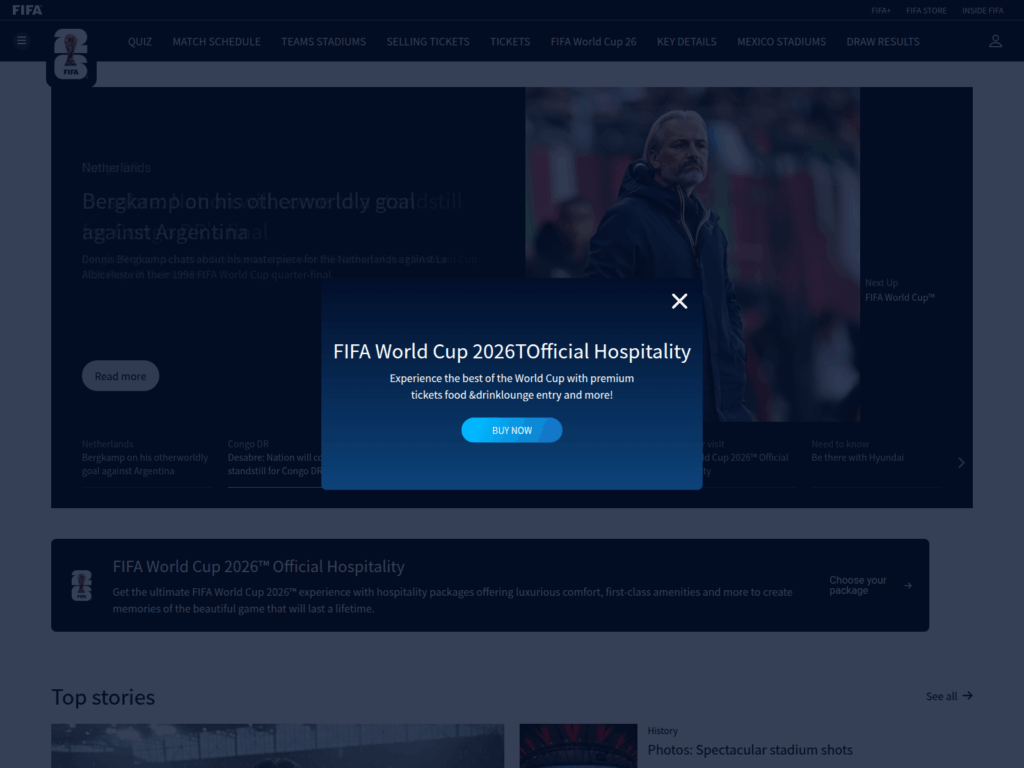
Threat actors leveraged ticketing, VIP access, official branding, and live streaming to broaden their victim pool. Examples of these domain patterns are shown in the table below. 

Domain Pattern  Example Domains  Count  Fraud Category 
zh-[term]-fifa.com  zh-worldcuphub-fifa.com, zh-nowlive-fifa.com  541  Chinese-language phishing/streaming 
cn-[term]-fifa.com  cn-vpn-fifa.com, cn-setting-fifa.com  372  Chinese-language credential/VPN phishing 
[term]-worldcup-fifa.com  play-worldcup-fifa.com, vip-worldcup-fifa.com  413  Brand impersonation 
[term]-wc-fifa.com  cctv-maiqiu-fifa-wc.com, ssl-cn-fifa-wc.com  391  Ticketing/streaming fraud 
fifa-ticket-[term].com  fifa-ticket-26.com, fifa-freetickets.*.top  10+  Ticket scam 
fifa-vip-[term].com  fifa-vip-huya.com, fifa-vip-wcplay.com  84  VIP/premium access fraud 
official-[term]-fifa.com  official-live-fifa.com, official-2026-fifa.com  87  Brand authority impersonation 
live-[term]-fifa.com  vip-live-fifa.com, web-live-fifa.com  219  Pirate streaming 
maiqiu variants  chn-maiqiu-fifa-worldcup.com, cctv-maiqiu-fifa.com  51  Chinese ticket-buying fraud 

Figure 2 - Fraudulent FIFA 2026 Official Hospitality Ticketing Portal

The extensive use of zh-cn-, and Chinese-language World Cup labels such as shijiebeipankou, and maiqiu highlights a deliberate focus on Mandarin-speaking audiences. This targeting extends beyond traditional ticket fraud to encompass betting platforms, media-themed credential theft, piracy lures, prize scams, and counterfeit merchandise. This signals a persistent and organized fraud ecosystem designed to capitalize on China's large football fanbase and strong demand for World Cup-related content and services. 

Dark Web Intelligence 

We also identified a growing ecosystem of ticket resale fraud on Telegram and WhatsApp, as well as pirated streaming lures. Both are actively used to monetize fan interest and facilitate fraud, credential harvesting, and other malicious activity. 

Resell Traps on Messaging Services. 

Monitoring of deep- and dark-web sources identified numerous advertisements and reseller communities promoting FIFA World Cup tickets via Telegram and WhatsApp. Fraudsters frequently use these platforms because they facilitate private, direct communication while limiting oversight and accountability.  

Threat actors often establish credibility through fabricated testimonials, forged purchase confirmations, edited screenshots, recycled ticket images, and scripted customer-support interactions. However, such indicators of legitimacy can be easily manufactured and should not be considered proof of ticket ownership or delivery capability. Additionally, the closed nature of these channels enables attackers to create a sense of urgency, collect payments, and disengage victims with minimal traceability. 

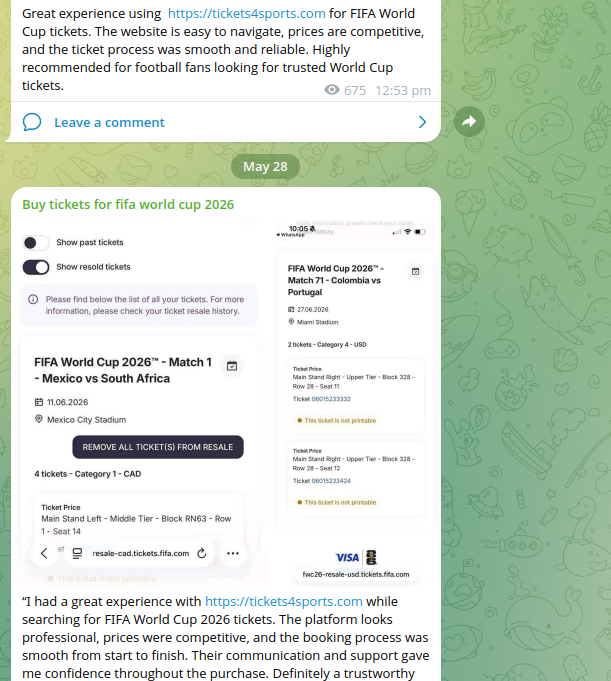
The example below illustrates a Telegram-based ticket resale advertisement identified during monitoring, highlighting the use of unofficial and potentially fraudulent sales channels. 

Figure 3 -Telegram Ticket Testimonial Used to Build Buyer Trust 

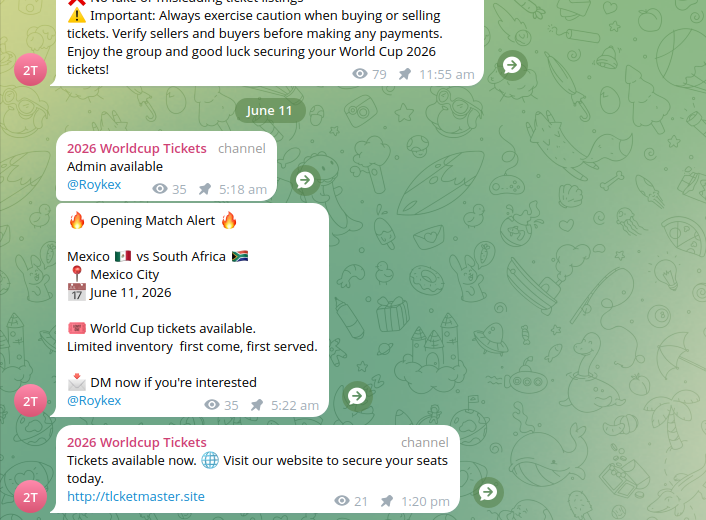
Figure 4 -Urgency-Driven Ticket Offers in Suspicious Telegram Channels

The pirated stream trap: free football, expensive consequences 

Pirated streaming sites exploit fans seeking free access to World Cup matches, using geo-restrictions, subscription costs, and broadcast limitations as bait. Rather than delivering live streams, many function as fraud and malware distribution platforms, employing fake video players, deceptive download prompts, browser notification prompts, and fraudulent free-trial offers to harvest credentials, payment information, and user data.  

To evade detection, we identified domains that avoid FIFA- or World Cup-related keywords in domain names. These links are promoted through fan forums, Discord servers, Telegram channels, and WhatsApp groups, lending credibility to malicious infrastructure. 

Examples identified during monitoring include: 

  • footybite[.]vc 

  • epicsports[.]in 

  • footballnewslive[.]online 

  • totalsportek[.]online 

  • sportshub[.]fan 

  • streameast[.]im 

The risk is beyond legal or copyright concerns. For many fans, the real danger lay in the broader cybersecurity ecosystem surrounding these platforms. Pirated streaming sites and services often acted as data collection points, quietly harvesting email addresses, passwords, payment details, phone numbers, and device information. 

Unofficial streaming apps and APK files added another layer of risk. They frequently requested excessive permissions, delivered intrusive ads, tracked user activity, and in some cases, served as entry points for malware. What seemed like a convenient way to watch a match could quickly turn into a channel for data exposure and system compromise. 

Ticket Scams and VIP Access Fraud  

Forum-based ticket promotions added another layer of risk to World Cup scams by combining resale listings with the appearance of community trust. Sellers often seemed more credible than random social media accounts, as consistent posting, forum history, and visible profile activity created a sense of legitimacy. However, this credibility could be misleading. Fans should remain cautious, as an active profile did not guarantee ticket authenticity, official authorization, secure payments, or a successful transfer—even within seemingly trusted communities. 

Figure 5 - Ticket Resale Promotion Through Forum Profiles and Repeated Match Posts

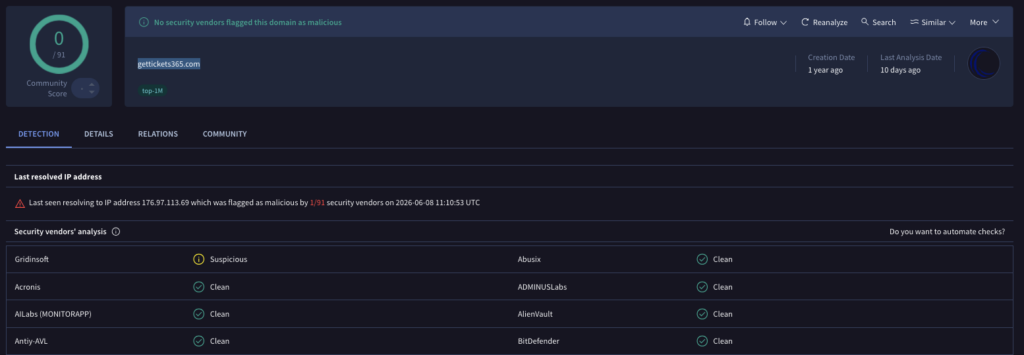
Figure 6 - Domain Reputation Check for a Ticket Resale Website

Identity and PII leak claims  

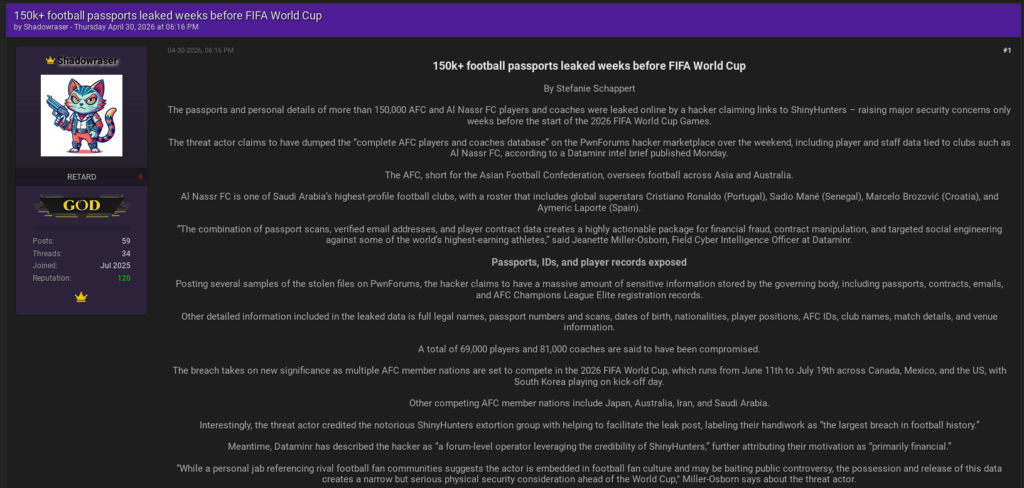
CRIL also observed forum discussions about leaked football-related identity data, highlighting how World Cup–related cybercrime can extend beyond fan scams into the broader football ecosystem. For example, one post titled “150k+ football passports leaked weeks before FIFA World Cup” claimed that passport scans and personal details of over 150,000 AFC and Al Nassr FC players and coaches had been exposed. The alleged leak included sensitive information such as full names, passport numbers, scans, dates of birth, nationalities, player roles, club affiliations, email addresses, contracts, AFC IDs, and even match or venue details.  

Such claims require independent forensic verification before a confirmed breach status can be assigned. Regardless of authenticity, the circulation of this data in the pre-tournament window confirms threat actors are actively seeking to monetize football-sector identity assets. If the record set is genuine, it enables targeted spear-phishing against club staff, agent impersonation in transfer fraud, contract manipulation, and abuse of venue access credentials. 

Figure 7 - Forum Claim of Football Passport Data Exposure Before the World Cup

Connecting the Ecosystem – Attack Lifecycle 

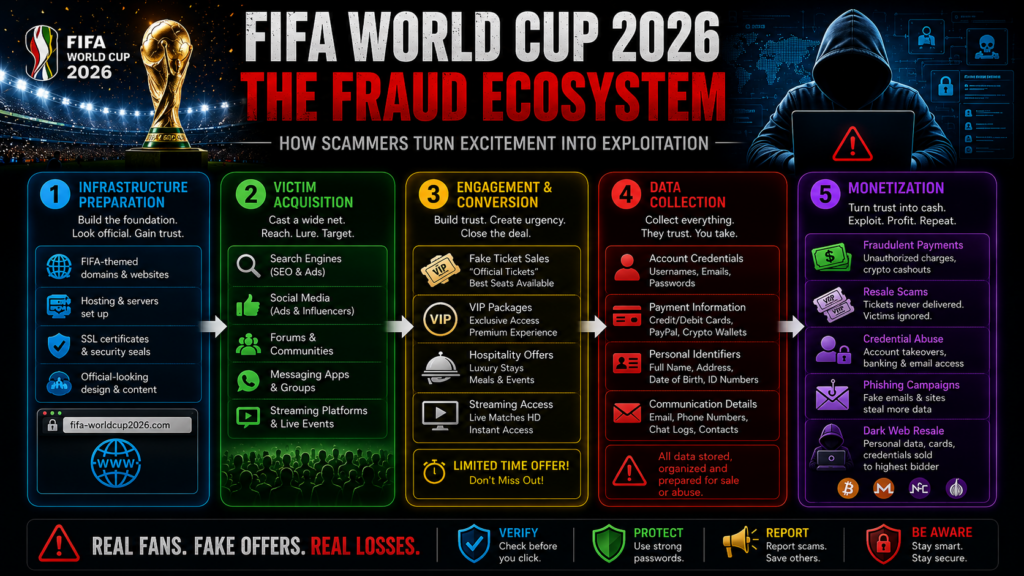
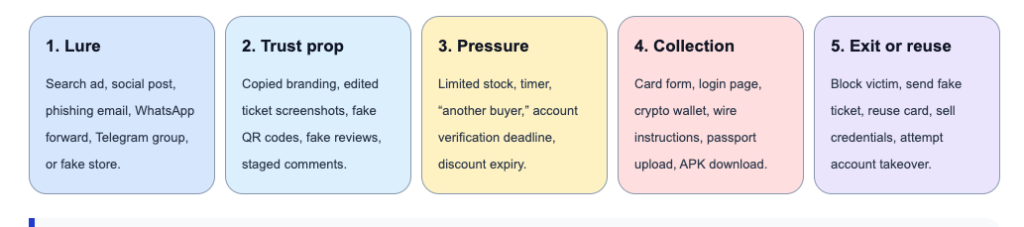
Figure 8 – FIFA World Cup attack ecosystem

By correlating our findings and research, we reconstructed the end-to-end attack chain used by threat actors. The analysis demonstrates how these seemingly independent activities are strategically aligned around the global popularity of FIFA events, enabling attackers to exploit fan enthusiasm, urgency, and trust. Together, these components form a coordinated FIFA-themed fraud ecosystem designed to attract victims, harvest sensitive information, facilitate financial fraud, and generate sustained criminal revenue.

The stages are as follows: 

  • Stage 1 – Infrastructure Preparation: Registration of FIFA-themed domains and supporting online assets. 
  • Stage 2 – Victim Acquisition: Promotion through search engines, social platforms, forums, messaging communities, and streaming portals. 
  • Stage 3 – Engagement and Conversion: Fake ticket sales, VIP packages, hospitality offers, and streaming access are used to build trust. 
  • Stage 4 – Data Collection: Harvesting of credentials, payment information, personal identifiers, and communication details. 
  • Stage 5 – Monetization: Fraudulent payments, resale scams, credential abuse, phishing campaigns, and potential resale on the dark web of collected information. 

Conclusion 

Operation FanTrap demonstrates how global sporting events have evolved into highly attractive targets for organized cybercriminal activity. Rather than relying on isolated phishing campaigns or opportunistic scams, threat actors are building interconnected ecosystems that combine malicious infrastructure, social engineering, messaging platforms, streaming lures, and dark web activity to maximize financial returns. 

The nearly 4,000 domains identified by CRIL represent only one layer of a broader operation designed to exploit fan enthusiasm, event urgency, and global online engagement. Ticket scams, VIP access fraud, streaming lures, and alleged football-sector identity leaks collectively illustrate how attackers are diversifying their monetization strategies throughout the tournament lifecycle. 

As the FIFA World Cup 2026 continues, organizations, broadcasters, ticketing providers, and fans should view these activities not as isolated incidents but as components of an active and evolving cybercrime ecosystem. Continuous monitoring, rapid infrastructure disruption, dark web visibility, and proactive user awareness will remain critical to reducing risk throughout the tournament. 

CRIL will continue tracking this cluster and updating IoCs as new infrastructure emerges. All indicators are submitted to Cyble's threat feeds and accessible to Vision platform customers. Fan-facing brands, ticketing platforms, and event organizers should treat this as an active threat and prioritize domain monitoring and takedown workflows throughout the tournament. 

Recommendations 

Based on the findings presented above, CRIL recommends the following actions for immediate consideration by security teams and organizations: 

  • Implement keyword-aware domain monitoring that flags FIFA, tournament branding, and language-prefix patterns (zh-, cn-, kr-) as compounding risk signals alongside registrar identity, TLD, and domain age. 

  • Build takedown workflows that account for Cloudflare-proxied infrastructure — abuse requests must target the underlying origin, not the CDN layer, to be operationally effective. 

  • Integrate campaign-cluster pivoting from confirmed IoCs into threat hunting workflows, using shared IP subnets and registrar concentration as primary pivot axes. 

  • Apply multi-platform fraud funnel awareness: detection should extend beyond domains to Telegram and WhatsApp channels used for off-platform transaction completion. 

  • For ticketing platforms and official broadcasters: issue proactive fan advisories confirming that legitimate ticket transactions will never be negotiated via private messaging apps or unverified resale portals. 

  • Revise security awareness materials to teach structural URL interpretation — with specific focus on identifying lookalike FIFA domains that embed official terminology in subdomains or hyphenated strings rather than the root registered domain. 

  • Monitor dark web forums for emerging data leak claims targeting football organizations, and treat leaked PII — particularly passport and contract data — as an active social engineering enabler requiring targeted victim notification. 

The need for a proactive cyberdefense stance 

The current threat landscape includes a multitude of Social Engineering campaigns. Security teams need more than reactive controls to keep ahead of these. 

Solutions such as Cyble Vision deliver operational intelligence that enables defenders to stay ahead of adversaries through early detection, campaign-level visibility, and infrastructure mapping. 

Cyble Vision specifically empowers security teams to move beyond isolated detection, providing the strategic insight needed to anticipate threats, monitor adversary activity, and respond with precision at every stage of the attack lifecycle. Security teams can take necessary preventive action with the help of: 

  • Real-Time IOC Monitoring 
    Enable continuous tracking of indicators tied to adversary infrastructure before they reach end users. 

  • Credential Phishing Infrastructure Mapping 
    Map attacker-controlled infrastructure, including fake authentication portals, dynamic exfiltration endpoints, and backend logic designed to capture credentials. 

  • Brand and Executive Impersonation Monitoring 
    Detect domain spoofing and impersonation attempts targeting internal functions such as HR and Finance—often used to increase trust and exploit user familiarity. 

  • Deep and Dark Web Visibility 
    Surface chatter, leaked credentials, and phishing toolkits from deep/dark web sources, offering early insight into attacker preparation and target selection. 

  • Global Targeting Intelligence 
    Track phishing activity across global regions—including North America, EMEA, and APAC—as well as over 70 industry sectors, providing defenders with contextual understanding of targeting patterns. 

  • Threat Actor Attribution and TTP Correlation 
    Associate infrastructure, techniques, and behavioral patterns with known threat actors, empowering security teams to prioritize response based on adversary capability and intent. 

MITRE ATT&CK® Techniques 

Tactic  Technique ID  Technique Name 
Resource Development  T1583.001  Acquire Infrastructure: Domains 
Resource Development  T1583.006  Acquire Infrastructure: Web Services 
Resource Development  T1585.001  Establish Accounts: Social Media Accounts 
Initial Access  T1566.002  Phishing: Spearphishing Link 
Credential Access  T1056.003  Web Portal Capture 
Command and Control  T1102  Web Service 
Impact  T1657  Financial Theft 

Indicators of Compromise (IOCs) 

The IOCs have been added to this GitHub repository. Please review and integrate them into your Threat Intelligence feed to enhance protection and improve your overall security posture. 

The post Operation FanTrap: Inside the FIFA 2026 Fraud Ecosystem appeared first on Cyble.

Why Australian Dark Web Data Is Now Being Sold in Bundles — and What It Means for Organizational Exposure in 2026

Australian dark web data

In 2026, opportunistic assaults and isolated breaches will no longer characterize Australia's cyber risk environment. Industrialized data theft, in which stolen data is packaged, repackaged, and marketed on underground marketplaces, is influencing it. 

Threat actors are already combining Australian data into composite "breach packages," increasing both its commercial worth and its downstream danger, as opposed to single-company breaches occurring in isolation. This trend is also intensifying concerns around Australian dark web data, where aggregated breach packages are increasingly traded and monetized. 

This move has a direct impact on how exposed enterprises will be in 2026 and is not merely cosmetic; rather, it represents a structural shift in how cybercriminal ecosystems monetize stolen information. 

Why are Australian dark web data breaches increasing?

Australian cyber events have sharply increased, according to Cyble cyber threat intelligence monitoring. 71 publicly reported data breaches involving Australian companies were found between January and early October 2025. Compared to the 48 breaches that were reported at the same time in 2024, that is a 48% increase. 

The overall trend is even more telling: 71 breaches in 2025 have already surpassed the 66 Australian breaches that were reported in 2024. This suggests that the year is structurally exceeding previous standards rather than just drifting upward. The rapid escalation in both the number and severity of every major data breach Australia has experienced indicates a maturing underground economy centered on stolen information. 

Cyble reported 1,684 occurrences of reported data breaches worldwide in 2025, an 18% increase. In light of this, Australia's more rapid growth stands out as being disproportionately severe rather than a component of a global increase. 

It is crucial to remember that these numbers only include occurrences that have been reported to the public. Since many breaches never appear on forums or leak sites, the actual exposure baseline is probably much greater. This means the scale of the current Australian data breach landscape may still be underestimated. 

Why “Bundled Data” Has Become the New Trade Standard

The packaging of stolen Australian data into bundled datasets is one of the most significant developments in underground markets. Threat actors are progressively combining several datasets into composite offerings rather than selling a single breach per victim organization. 

Bundled data is easier to monetize, which provides a straightforward economic explanation for this practice. It enables cybercriminals to: 

  • Combine data from several organizations to increase resale value  

  • Attract a larger range of purchasers (ransomware affiliates, fraud groups, and access brokers)  

  • Cut down on the time spent promoting specific violations  

Bundling also indicates maturity in the supply chain for cybercrime from an operational perspective. Data is now curated rather than just stolen. 

This implies that an organization's security posture is no longer the only factor influencing exposure. One vendor or partner's data may unintentionally be included in a larger selling bundle with unrelated victims due to a breach. This is one reason why modern dark web data breach operations are becoming more difficult to contain once information is leaked. 

Ransomware Groups Are Driving the Acceleration

The prevalence of ransomware-related entities is a significant contributing element to Australia's breach rise. 

Ransomware groups were responsible for around half of the 71 breaches that were discovered in 2025. This indicates a change in attribution from around 42% of Australian violations in 2024 to approximately 71% in 2025. 

This modification shows how ransomware tactics have evolved. Data theft is becoming more important to groups than encryption. Even if encryption is never used, attackers exfiltrate sensitive data before using it for extortion or resale, rather than depending only on locking measures. 

This dual-use approach feeds directly into the bundling ecosystem. Stolen datasets become modular assets that can be repackaged across multiple campaigns, contributing to the growing volume of dark web data breaches impacting Australian organizations. 

Supply Chain Attacks Expand the Blast Radius

The increase in supply chain compromise is another significant factor. Attackers are taking advantage of third-party providers' laxer security measures rather than going after companies directly. 

This has a domino effect: 

  • Numerous downstream companies may be exposed by a single hacked vendor  

  • Unintentionally, data from unrelated victims is combined  

  • Attack surfaces extend beyond the impacted enterprise's direct control  

This is one of the main ways that bundled data sales are made possible. Multi-organization datasets are inevitably created by supply chain breaches, consolidated, and resold. 

Sector Exposure: No Industry Left Untouched

Australian breaches in 2025 have impacted a wide range of industries, including: 

  • Professional services  

  • Information technology  

  • Healthcare  

  • Energy and utilities  

  • Banking and financial services  

  • Education  

  • Construction and real estate  

  • Telecommunications  

  • Transportation and hospitality  

  • Manufacturing  

The breadth of targeting highlights a key reality: attackers are no longer selecting industries solely based on prestige or financial value. Instead, any organization with usable data, operational leverage, or weak third-party dependencies becomes a viable target. 

Notable Incidents Highlight the Scale of Exposure

Several incidents in 2025 illustrate the depth and variety of compromised data: 

  • A threat actor operating via a private Telegram channel claimed access to approximately 2TB of sensitive documents allegedly belonging to a major Australian airline  

  • A telecommunications-related database containing around 236,000 records reportedly included names, emails, passwords, phone numbers, billing details, and payment data  

  • A SaaS provider offering loan management and digital signing tools reportedly had its source code exposed, including authentication systems, APIs, and administrative modules  

  • An ICT and telecommunications provider breach allegedly exposed financial records and internal databases, claimed by an extortion group  

  • In construction, 71GB of engineering and infrastructure files were advertised, including geotechnical reports and safety documentation  

  • A trading platform breach reportedly exposed 27,000 records containing KYC data, user identities, and transaction histories  

  • Pension funds were impacted through credential reuse attacks that enabled unauthorized account access and financial losses  

  • Energy and logistics systems were affected by leaks involving millions of operational files from petroleum distribution and internal logistics networks  

Across these incidents, one pattern stands out: attackers are extracting structured, high-value data sets that can be reused, recombined, and resold. 

Why Australia Is in the Crosshairs

The increase in targeting can be explained by several structural factors: 

First, ransomware and data extortion groups find Australian companies appealing because they are very data-driven and technologically advanced. 

Second, systemic exposure is increased by reliance on outside service providers. One provider's security flaws can spread throughout large ecosystems. 

Third, the cost of starting large-scale campaigns is being reduced by attackers using sophisticated tools, such as automation and AI-assisted phishing. 

Lastly, Australia's widespread use of digital technology raises the attack surface and data accessibility. 

Defensive Shifts Required for 2026

Organizations are being forced to adopt intelligence-driven security solutions due to the shifting threat landscape. 

Risk-based vulnerability management, which concentrates remedial efforts on actively exploited vulnerabilities rather than theoretical problems, is becoming important. 

To protect against credential-based assaults, which are commonly employed in supply chain and ransomware incursions, multi-factor authentication is becoming a standard requirement. 

To identify vulnerability outside of their immediate surroundings, organizations are also improving their supply chain risk assessments. 

To combat contemporary threats like AI-generated phishing, deepfake impersonation, and automated social engineering efforts, security awareness programs are changing. 

Behavioral analytics and AI-driven detection systems are becoming more and more important at the infrastructure level to find anomalies that conventional monitoring tools overlook. 

Lastly, as businesses shift from implicit trust to continuous verification models, Zero Trust architectures are becoming more popular. 

The Role of Intelligence-Led Defense Platforms

Platforms such as those developed by Cyble reflect a broader shift toward real-time, intelligence-led security operations. Their approach combines dark web monitoringexternal attack surface visibility, vulnerability intelligence, and endpoint compromise detection. 

While such systems vary in implementation, the broader trend is clear: security teams are moving away from static defense models toward continuous monitoring of external threat ecosystems. 

This shift is especially relevant in environments where stolen data is rapidly aggregated and resold, making early detection of exposure more valuable than post-incident response. 

Bundling Is the New Exposure Multiplier

The 48% increase in Australian data breaches highlights a major shift in cybercrime operations. Stolen data is no longer traded in isolation — cybercriminals are bundling, repackaging, and reselling Australian dark web data across larger underground ecosystems, increasing exposure for multiple organizations at once.

For the upcoming years, organizations must focus not only on preventing breaches but also on understanding how stolen data is reused and monetized after exfiltration. With AI-native threat intelligence, dark web monitoring, and attack surface management, Cyble helps organizations identify exposed data, detect emerging threats, and strengthen cyber resilience.

Want to see the intelligence behind the data in this report or learn how Cyble can help protect your organization?

Schedule a personalized demo with Cyble today.

The post Why Australian Dark Web Data Is Now Being Sold in Bundles — and What It Means for Organizational Exposure in 2026 appeared first on Cyble.

Why Indian Enterprises Are a Prime Target for Dark Web Credential Markets

Dark web credential markets India

The underground economy of stolen credentials has matured into a structured, high-volume marketplace, and Indian enterprises are at the center. What makes this trend notable is not just the scale of cyber incidents in India, but the type of data being exposed and how efficiently it is monetized on dark web credential markets India forums. This has evolved into a corporate data leak India dark web ecosystem. 

Credentials, usernames, passwords, session tokens, have become the currency that powers everything from ransomware intrusions to financial fraud. This is not an abstract risk. It is a measurable, expanding problem backed by government data and visible shifts in attacker behavior. 

A Rapidly Expanding Attack Surface 

India’s digital growth has been aggressive, but security maturity has not scaled at the same pace. According to the Indian Computer Emergency Response Team (CERT-In), the country recorded 29.44 lakh (2.94 million) cybersecurity incidents in 2025. Just four years earlier, that number stood at 14.02 lakh in 2021, effectively doubling within a short span. 

This surge is not just about more attacks; it reflects a widening attack surface and growing enterprise cybersecurity threats India. Every new digital service, cloud migration, or remote access point introduces another potential entry for attackers. More importantly, each successful intrusion increases the likelihood of credential exposure, feeding directly into dark web markets. 

Earlier data reinforces this pattern. CERT-In reported handling 13,91,457 incidents in 2022, spanning phishing, malware infections, and unauthorized access attempts. These are not isolated technical events; they are the primary pipelines through which credentials are harvested at scale. 

Why Credentials Are the Primary Target 

Unlike credit card data, which can be canceled, or systems that can be patched, credentials offer persistent value. A valid login can grant access to corporate networks, financial systems, or sensitive communications without triggering immediate alarms. 

Attackers understand this. Phishing campaigns and malware infections, both widely reported by CERT-In as dominant attack vectors, are designed not just to infiltrate systems but to extract authentication data. Once obtained, these credentials, often part of Indian company login credentials stolen sets, are packaged and sold on underground forums, often categorized by industry, privilege level, or geographic origin. 

India’s enterprise landscape makes it particularly attractive in this context. Organizations across banking, IT services, manufacturing, and government sectors manage vast amounts of sensitive and operationally critical data. This makes their credentials more valuable and more likely to be traded. 

High-Value Targets Across Critical Sectors 

Government-backed reporting highlights the concentration of attacks in sectors that naturally generate high-value credentials. CERT-In’s scope of incident response spans banking, energy, telecom, transport, and IT sectors, all of which rely heavily on identity-driven access controls. 

In 2023 alone, around 2,04,844 cybersecurity incidents were reported within government organizations. Credentials associated with such entities carry strategic value, not just financial. They can be used for espionage, disruption, or long-term access to sensitive systems. 

Similarly, sectors like BFSI and IT services face constant exposure due to their role in handling financial transactions and managing global client data. A single compromised account in these environments can provide entry into broader supply chains or interconnected systems. 

The Dark Web as a Distribution Channel 

What sets the current landscape apart is how efficiently stolen credentials are distributed. Dark web marketplaces have evolved beyond simple data dumps. They now function like structured platforms where access is categorized, reviewed, and resold. 

Credential sets originating from India are often bundled with additional context, such as organization names, roles, or VPN access details, making them more actionable for buyers. In many cases, these credentials are not used immediately. Instead, they are stored, resold, or combined with other datasets to increase their value. 

The presence of compromised access listings and credential sales across underground forums reflects a broader shift: attackers no longer need to breach systems themselves. They can simply purchase access, reducing both effort and risk. 

Weak Points: Human and Systemic 

A portion of credential exposure still traces back to preventable weaknesses. Phishing remains one of the most effective techniques because it exploits human behavior rather than technical flaws. Employees unknowingly provide login details, often bypassing sophisticated security controls. 

On the system side, unpatched vulnerabilities and misconfigured services continue to play a role. Government data consistently highlights the exploitation of vulnerable services and outdated systems as a recurring issue. These weaknesses allow attackers to extract credentials directly from compromised environments or escalate privileges once inside. 

The combination of human error and systemic gaps creates a steady supply of fresh credentials, exactly what dark web markets depend on. 

A Self-Sustaining Ecosystem 

The relationship between cyber incidents in India and dark web credential markets is not coincidental, it is cyclical. More attacks lead to more compromised credentials. More credentials increase the availability of access for other attackers. This, in turn, fuels further attacks. 

The growth from 14.02 lakh incidents in 2021 to 29.44 lakh in 2025 is not just a statistic; it signals the acceleration of this cycle. As long as credentials remain easy to obtain and difficult to monitor once exposed, Indian enterprises will continue to be a prime target. 

Rethinking the Problem 

The challenge is no longer limited to preventing breaches; it now includes understanding what happens after data leaves the network and enters underground ecosystems, where exploitation timelines can be extremely short. Indian enterprises are not uniquely vulnerable, but they are highly valuable due to their scale, sector diversity, and rapid digital adoption, making them consistent targets in an environment where access itself is the commodity.  

Breaking this cycle requires visibility into how stolen credentials are traded, reused, and weaponized, and this is where platforms like Cyble become critical, delivering AI-native threat intelligence, dark web monitoring, and attack surface visibility to help organizations move from reactive defense to proactive risk anticipation.  

With capabilities like Cyble Vision and Cyble Blaze AI, security teams can detect exposure earlier, correlate threats in real time, and respond autonomously before stolen data is exploited. To stay ahead of evolving credential-driven attacks, organizations should evaluate Cyble’s unified threat intelligence platform and request a demo to see how continuous visibility across the dark web and enterprise attack surface can materially reduce risk. 

The post Why Indian Enterprises Are a Prime Target for Dark Web Credential Markets appeared first on Cyble.

China’s APT41 and the Expanding Enterprise Attack Surface: What Security Teams Must Prepare For

China APT41 cyber attacks

The modern enterprise attack surface is no longer confined to corporate networks and endpoints; it now stretches across cloud workloads, supply chains, remote devices, and even operational technology environments.

Within this fragmented landscape, the activities of the APT41 threat group stand out as a signal of how hackers and adversaries are adapting. Known for blending state-sponsored espionage with financially motivated operations, APT41 represents a dual-purpose threat model that security teams can no longer afford to treat as an edge case.

Understanding APT41’s Hybrid Threat Model

Unlike many threat actors that operate with a singular objective, China APT41 cyber-attacks are notable for their breadth of intent. Active since 2012, the group has consistently targeted industries ranging from healthcare and telecommunications to gaming, logistics, and finance. This diversity is not accidental; it reflects a deliberate strategy to exploit both high-value intelligence targets and monetization opportunities. 

Operating under aliases such as Wicked Panda, Brass Typhoon, and BARIUM, the APT41 threat group has demonstrated a level of operational maturity that blends long-term persistence with opportunistic intrusion.  

Their campaigns often involve supply chain compromises, credential harvesting, and stealthy lateral movement, techniques that align closely with the realities of today’s sprawling enterprise environments. 

Maritime Sector: A Case Study in Expanding Risk

One of the more telling examples of this evolution is the maritime industry. Responsible for roughly 90% of global trade, it has become a focal point for cyber operations. Recent threat intelligence findings have documented over a hundred cyber incidents targeting shipping and logistics organizations, with multiple advanced persistent threat groups involved. 

Within this context, China APT41 cyber attacks have impacted shipping entities across Europe and Asia, including targets in the UK, Italy, Spain, Turkey, Taiwan, and Thailand. What makes these attacks particularly concerning is not just their frequency, but their depth.  

Malware frameworks such as DUSTTRAP have been deployed to evade forensic analysis, while tools like ShadowPad and VELVETSHELL enable persistent access and data exfiltration. The maritime sector also highlights a new issue in enterprise attack surface security: the convergence of IT and operational technology. Cargo systems, navigation tools, and logistics platforms are interconnected, creating new entry points that traditional security models often overlook. 

The Scale and Sophistication of Tooling

The operational toolkit associated with APT41 is extensive, spanning more than 90 identified malware families and utilities. These range from widely available tools like Cobalt Strike and Mimikatz to custom-built backdoors, loaders, and rootkits. This combination allows the group to remain flexible, often blending into legitimate administrative activity while maintaining persistence within compromised networks. 

Credential theft tools such as Impacket and pwdump are frequently used to escalate privileges, while reconnaissance frameworks like PowerSploit and PlugX help map internal environments. In parallel, custom implants like KEYPLUG and MoonBounce demonstrate a high degree of technical sophistication, particularly in evading detection. 

Legal Actions and Global Reach

The global footprint of the APT41 threat group has not gone unnoticed. In 2019 and 2020, U.S. authorities unsealed indictments against several individuals allegedly linked to the group, including Zhang Haoran, Tan Dailin, Qian Chuan, Fu Qiang, and Jiang Lizhi. The charges ranged from unauthorized access and identity theft to money laundering and racketeering. 

These cases revealed the scale of APT41’s operations, including attacks on hundreds of organizations worldwide. Victims spanned continents and sectors, with telecommunications providers, social media platforms, and government entities among those impacted. Notably, the group has also been linked to ransomware deployment, further blurring the line between espionage and cybercrime. 

Preparing for What Comes Next

The APT41 threat group stands out for its adaptability, shifting between espionage and financially driven operations while exploiting gaps across the modern enterprise. Defending against APT41 and broader China APT41 cyber attacks requires more than point solutions; it demands strong enterprise attack surface security and continuous attack surface management to understand and reduce exposure across interconnected systems. 

Platforms like Cyble help organizations stay ahead with real-time threat intelligence and AI-driven security. Explore Cyble or schedule a demo to strengthen defenses against evolving threats like APT41. 

References:

The post China’s APT41 and the Expanding Enterprise Attack Surface: What Security Teams Must Prepare For appeared first on Cyble.

❌