Visualização de leitura

Active defense: introducing a stateful vulnerability scanner for APIs

Security is traditionally a game of defense. You build walls, set up gates, and write rules to block traffic that looks suspicious. For years, Cloudflare has been a leader in this space: our Application Security platform is designed to catch attacks in flight, dropping malicious requests at the edge before they ever reach your origin. But for API security, defensive posturing isn’t enough. 

That’s why today, we are launching the beta of Cloudflare’s Web and API Vulnerability Scanner. 

We are starting with the most pervasive and difficult-to-catch threat on the OWASP API Top 10: Broken Object Level Authorization, or BOLA. We will add more vulnerability scan types over time, including both API and web application threats.

The most dangerous API vulnerabilities today aren’t generic injection attacks or malformed requests that a WAF can easily spot. They are logic flaws—perfectly valid HTTP requests that meet the protocol and application spec but defy the business logic.

To find these, you can’t just wait for an attack. You have to actively hunt for them.

The Web and API Vulnerability Scanner will be available first for API Shield customers. Read on to learn why we are focused on API security scans for this first release.

Why purely defensive security misses the mark

In the web application world, vulnerabilities often look like syntax errors. A SQL injection attempt looks like code where data should be. A cross-site scripting (XSS) attack looks like a script tag in a form field. These have signatures.

API vulnerabilities are different. To illustrate, let’s imagine a food delivery mobile app that communicates solely with an API on the backend. Let’s take the orders endpoint:

Endpoint Definition: /api/v1/orders

Method

Resource Path

Description

GET

/api/v1/orders/{order_id}

Check Status. Returns the tracking status of a specific order (e.g., "Kitchen is preparing").

PATCH

/api/v1/orders/{order_id}

Update Order. Allows the user to modify the drop-off location or add delivery instructions.

In a broken authorization attack like BOLA, User A (the attacker) requests to update the delivery address of a paid-for order belonging to User B (the victim). The attacker simply inserts User B’s {order_id} in the PATCH request.

Here is what that request looks like, with ‘8821’ as User B’s order ID. Notice that User A is fully authenticated with their own valid token:

PATCH /api/v1/orders/8821 HTTP/1.1
Host: api.example.com
Authorization: Bearer <User_A_Valid_Token>
Content-Type: application/json

{
  "delivery_address": "123 Attacker Way, Apt 4",
  "instructions": "Leave at front door, ring bell"
}

The request headers are valid. The authentication token is valid. The schema is correct. To a standard WAF, this request looks perfect. A bot management offering may even be fooled if a human is manually sending the attack requests.

User A will now get B’s food delivered to them! The vulnerability exists because the API endpoint fails to validate if User A actually has permission to view or update user B’s data. This is a failure of logic, not syntax. To fix this, the API developer could implement a simple check: if (order.userID != user.ID) throw Unauthorized;

You can detect these types of vulnerabilities by actively sending API test traffic or passively listening to existing API traffic. Finding these vulnerabilities through passive scanning requires context. Last year we launched BOLA vulnerability detection for API Shield. This detection automatically finds these vulnerabilities by passively scanning customer traffic for usage anomalies. To be successful with this type of scanning, you need to know what a "valid" API call looks like, what the variable parameters are, how a typical user behaves, and how the API behaves when those parameters are manipulated.

Yet there are reasons security teams may not have any of that context, even with access to API Shield’s BOLA vulnerability detection. Development environments may need to be tested but lack user traffic. Production environments may (thankfully) have a lack of attack traffic yet still need analysis, and so on. In these circumstances, and to be proactive in general, teams can turn to Dynamic Application Security Testing (DAST). By creating net-new traffic profiles intended specifically for security testing, DAST tools can look for vulnerabilities in any environment at any time.

Unfortunately, traditional DAST tools have a high barrier to entry. They are often difficult to configure, require you to manually upload and maintain Swagger/OpenAPI files, struggle to authenticate correctly against modern complex login flows, and can simply lack any API-specific security tests (e.g. BOLA).

Cloudflare’s API scanning advantage

In the food delivery order example above, we assumed the attacker could find a valid order to modify. While there are often avenues for attackers to gather this type of intelligence in a live production environment, in a security testing exercise you must create your own objects before testing the API’s authorization controls. For typical DAST scans, this can be a problem, because many scanners treat each individual request on its own. This method fails to chain requests together in the logical pattern necessary to find broken authorization vulnerabilities. Legacy DAST scanners can also exist as an island within your security tooling and orchestration environment, preventing their findings from being shared or viewed in context.

Vulnerability scanning from Cloudflare is different for a few key reasons. 

First, Security Insights will list results from our new scans alongside any existing Cloudflare security findings for added context. You’ll see all your posture management information in one place. 

Second, we already know your API’s inputs and outputs. If you are an API Shield customer, Cloudflare already understands your API. Our API Discovery and Schema Learning features passively catalog your endpoints and learn your traffic patterns. While you’ll need to manually upload an OpenAPI spec to get started for our initial release, you will be able to get started quickly without one in a future release.

Third, because we sit at the edge, we can turn passive traffic inspection knowledge into active intelligence. It will be easy to verify BOLA vulnerability detection risks (found via traffic inspection) by sending net-new HTTP requests with the vulnerability scanner.

And finally, we have built a new, stateful DAST platform, as we detail below. Most scanners require hours of setup to "teach" the tool how to talk to your API. With Cloudflare, you can effectively skip that step and get started quickly. You provide the API credentials, and we’ll use your API schemas to automatically construct a scan plan.

Building automatic scan plans

APIs are commonly documented using OpenAPI schemas. These schemas denote the host, method, and path (commonly, an “endpoint”) along with the expected parameters of incoming requests and resulting responses. In order to automatically build a scan plan, we must first make sense of these API specifications for any given API to be scanned.

Our scanner works by building up an API call graph from an OpenAPI document and subsequently walking it, using attacker and owner contexts. Owners create resources, attackers subsequently try to access them. Attackers are fully authenticated with their own set of valid credentials. If an attacker successfully reads, modifies or deletes an unowned resource, an authorization vulnerability is found.

Consider for example the above delivery order with ID 8821. For the server-side resource to exist, it needed to be originally created by an owner, most likely in a “genesis” POST request with no or minimal dependencies (previous necessary calls and resulting data). Modelling the API as a call graph, such an endpoint constitutes a node with no or few incoming edges (dependencies). Any subsequent request, such as the attacker’s PATCH above, then has a data dependency (the data is order_id) on the genesis request (the POST). Without all data provided, the PATCH cannot proceed.

Here we see in purple arrows the nodes in this API graph that are necessary to visit to add a note to an order via the POST /api/v1/orders/{order_id}/note/{note_id} endpoint. Importantly, none of the steps or logic shown in the diagram is available in the OpenAPI specification! It must be inferred logically through some other means, and that is exactly what our vulnerability scanner will do automatically.

In order to reliably and automatically plan scans across a variety of APIs, we must accurately model these endpoint relationships from scratch. However, two problems arise: data quality of API specifications is not guaranteed, and even functionally complete schemas can have ambiguous naming schemes. Consider a simplified OpenAPI specification for the above API, which might look like

openapi: 3.0.0
info:
  title: Order API
  version: 1.0.0
paths:
  /api/v1/orders:
    post:
      summary: Create an order
      requestBody:
        required: true
        content:
          application/json:
            schema:
              type: object
              properties:
                product:
                  type: string
                count:
                  type: integer
              required:
                - product
                - count
      responses:
        '201':
          description: Item created successfully
          content:
            application/json:
              schema:
                type: object
                properties:
                  result:
                    type: object
                    properties:
                      id:
                        type: integer
                      created_at:
                        type: integer
                  errors:
                    type: array
                    items:
                      type: string
  /api/v1/orders/{order_id}:
    patch:
      summary: Modify an order by ID
      parameters:
        - name: order_id
          in: path

We can see that the POST endpoint returns responses such as

{
    "result": {
        "id": 8821,
        "created_at": 1741476777
    },
   "errors": []
}

To a human observer, it is quickly evident that $.result.id is the value to be injected in order_id for the PATCH endpoint. The id property might also be called orderId, value or something else, and be nested arbitrarily. These subtle inconsistencies in OpenAPI documents of arbitrary shape are intractable for heuristics-based approaches.

Our scanner uses Cloudflare’s own Workers AI platform to tackle this fuzzy problem space. Models such as OpenAI’s open-weight gpt-oss-120b are powerful enough to match data dependencies reliably, and to generate realistic fake data where necessary, essentially filling in the blanks of OpenAPI specifications. Leveraging structured outputs, the model produces a representation of the API call graph for our scanner to walk, injecting attacker and owner credentials appropriately.

This approach tackles the problem of needing human intelligence to infer authorization and data relationships in OpenAPI schemas with artificial intelligence to do the same. Structured outputs bridge the gap from the natural language world of gpt-oss back to machine-executable instructions. In addition to Workers AI solving the planning problem, self-hosting on Workers AI means our system automatically benefits from Cloudflare’s highly available, globally distributed architecture.

Built on proven foundations

Building a vulnerability scanner that customers will trust with their API credentials demands proven infrastructure. We did not reinvent the wheel here. Instead, we integrated services that have been validated and deployed across Cloudflare for two crucial components of our scanner platform: the scanner’s control plane and the scanner’s secrets store.

The scanner's control plane integrates with Temporal for Scan Orchestration, on which other internal services at Cloudflare already rely. The complexity of the numerous test plans executed in each Scan is effectively managed by Temporal's durable execution framework. 

The entire backend is written in Rust, which is widely adopted at Cloudflare for infrastructure services. This lets us reuse internal libraries and share architectural patterns across teams. It also positions our scanner for potential future integration with other Cloudflare systems like FL2 or our test framework Flamingo – enabling scenarios where scanning could coordinate more tightly with edge request handling or testing infrastructure.

Credential security through HashiCorp’s Vault Transit Secret Engine

Scanning for broken authentication and broken authorization vulnerabilities requires handling API user credentials. Cloudflare takes this responsibility very seriously.

We ensure that our public API layer has minimal access to unencrypted customer credentials by using HashiCorp's Vault Transit Secret Engine (TSE) for encryption-as-a-service. Immediately upon submission, credentials are encrypted by TSE—which handles the encryption but does not store the ciphertext—and are subsequently stored on Cloudflare infrastructure. 

Our API is not authorized to decrypt this data. Instead, decryption occurs only at the last stage when a TestPlan makes a request to the customer's infrastructure. Only the Worker executing the test is authorized to request decryption, a restriction we strengthen using strict typing with additional safety rails inside Rust to enforce minimal access to decryption methods.

We further secure our customers’ credentials through regular rotation and periodic rewraps using TSE to mitigate risk. This process means we only interact with the new ciphertext, and the original secret is kept unviewable.

What’s next?

We are releasing BOLA vulnerability scanning starting today as an Open Beta for all API Shield customers, and are working on future API threat scans for future release. Via the Cloudflare API, you can trigger scans, manage configuration, and retrieve results programmatically to integrate directly into your CI/CD pipelines or security dashboards. For API Shield Customers: check the developer docs to start scanning your endpoints for BOLA vulnerabilities today.

We are starting with BOLA vulnerabilities because they are the hardest API vulnerability to solve and the highest risk for our customers. However, this scanning engine is built to be extensible.

In the near future, we plan to expand the scanner’s capabilities to cover the most popular of the OWASP Web Top 10 as well: classic web vulnerabilities like SQL injection (SQLi) and cross-site scripting (XSS). To be notified upon release, sign up for the waitlist here, and you’ll be first to learn when we expand the engine to general web application vulnerabilities.
One platform to manage your company’s predictive security posture with Cloudflare

In today’s fast-paced digital landscape, companies are managing an increasingly complex mix of environments — from SaaS applications and public cloud platforms to on-prem data centers and hybrid setups. This diverse infrastructure offers flexibility and scalability, but also opens up new attack surfaces.

To support both business continuity and security needs, “security must evolve from being reactive to predictive”. Maintaining a healthy security posture entails monitoring and strengthening your security defenses to identify risks, ensure compliance, and protect against evolving threats. With our newest capabilities, you can now use Cloudflare to achieve a healthy posture across your SaaS and web applications. This addresses any security team’s ultimate (daily) question: How well are our assets and documents protected?

A predictive security posture relies on the following key components:

  • Real-time discovery and inventory of all your assets and documents

  • Continuous asset-aware threat detection and risk assessment

  • Prioritised remediation suggestions to increase your protection

Today, we are sharing how we have built these key components across SaaS and web applications, and how you can use them to manage your business’s security posture.

Your security posture at a glance

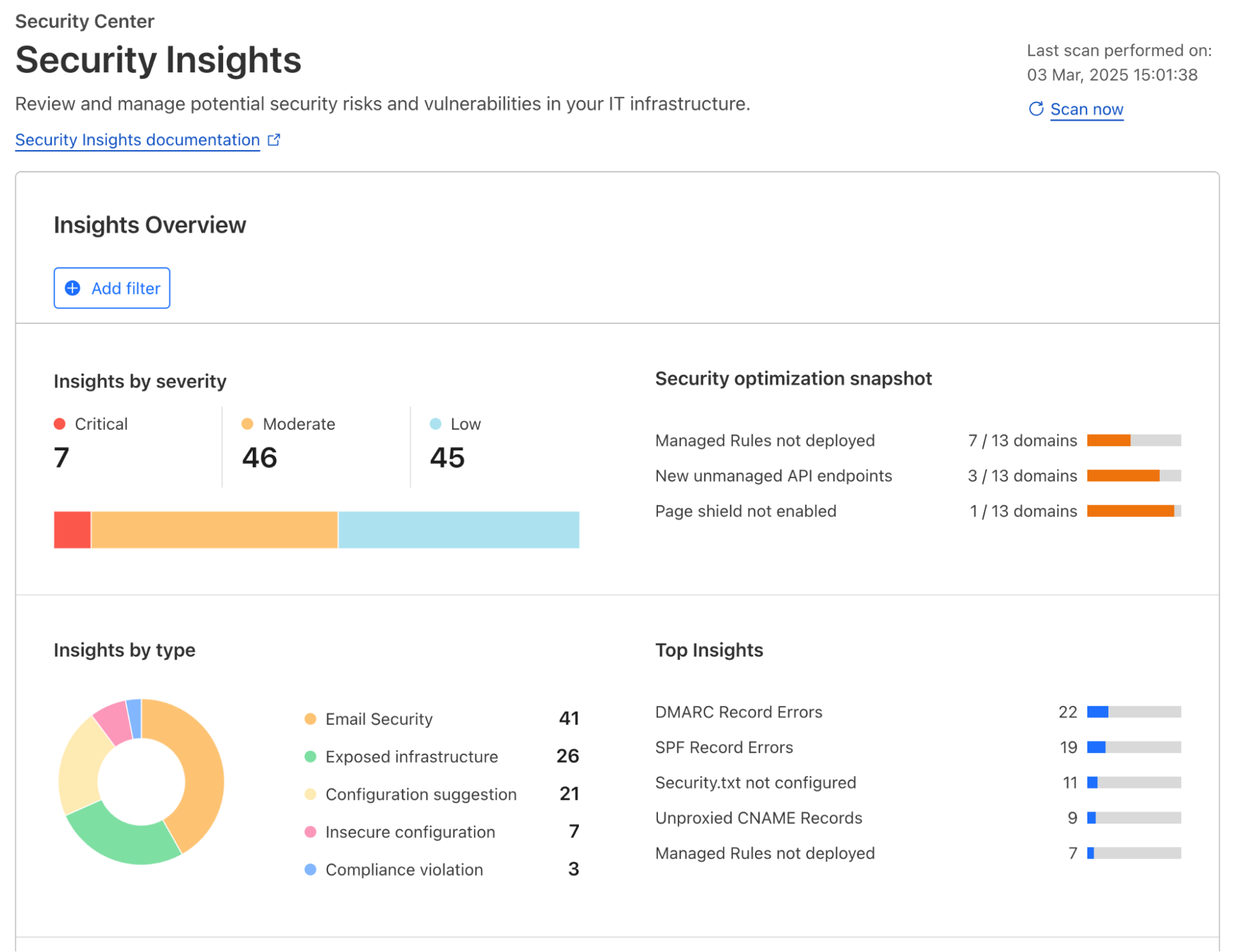
Regardless of the applications you have connected to Cloudflare’s global network, Cloudflare actively scans for risks and misconfigurations associated with each one of them on a regular cadence. Identified risks and misconfigurations are surfaced in the dashboard under Security Center as insights.

Insights are grouped by their severity, type of risks, and corresponding Cloudflare solution, providing various angles for you to zoom in to what you want to focus on. When applicable, a one-click resolution is provided for selected insight types, such as setting minimum TLS version to 1.2 which is recommended by PCI DSS. This simplicity is highly appreciated by customers that are managing a growing set of assets being deployed across the organization.

To help shorten the time to resolution even further, we have recently added role-based access control (RBAC) to Security Insights in the Cloudflare dashboard. Now for individual security practitioners, they have access to a distilled view of the insights that are relevant for their role. A user with an administrator role (a CSO, for example) has access to, and visibility into, all insights.

In addition to account-wide Security Insights, we also provide posture overviews that are closer to the corresponding security configurations of your SaaS and web applications. Let’s dive into each of them.

Securing your SaaS applications

Without centralized posture management, SaaS applications can feel like the security wild west. They contain a wealth of sensitive information – files, databases, workspaces, designs, invoices, or anything your company needs to operate, but control is limited to the vendor’s settings, leaving you with less visibility and fewer customization options. Moreover, team members are constantly creating, updating, and deleting content that can cause configuration drift and data exposure, such as sharing files publicly, adding PII to non-compliant databases, or giving access to third party integrations. With Cloudflare, you have visibility across your SaaS application fleet in one dashboard.

Posture findings across your SaaS fleet

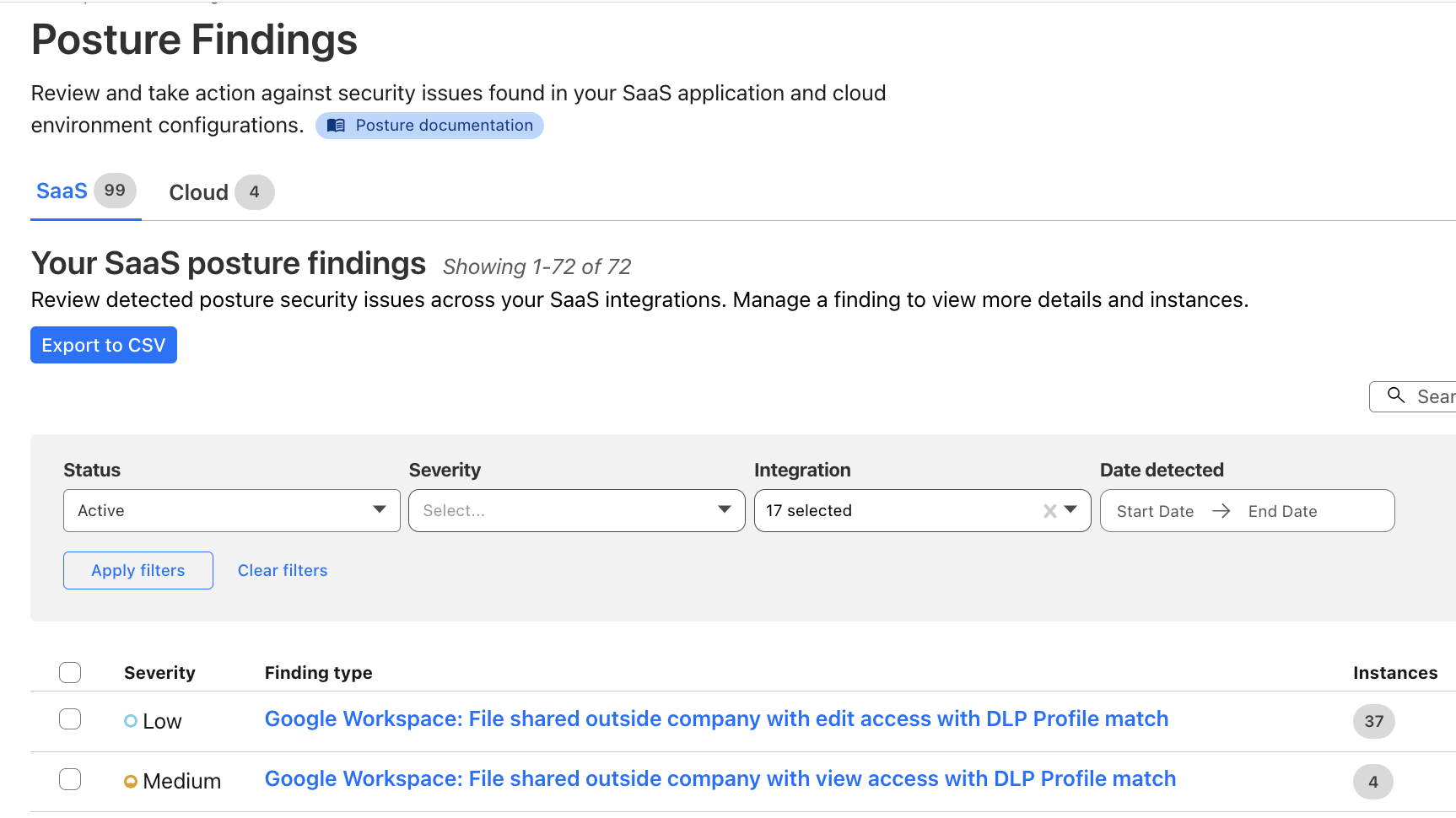
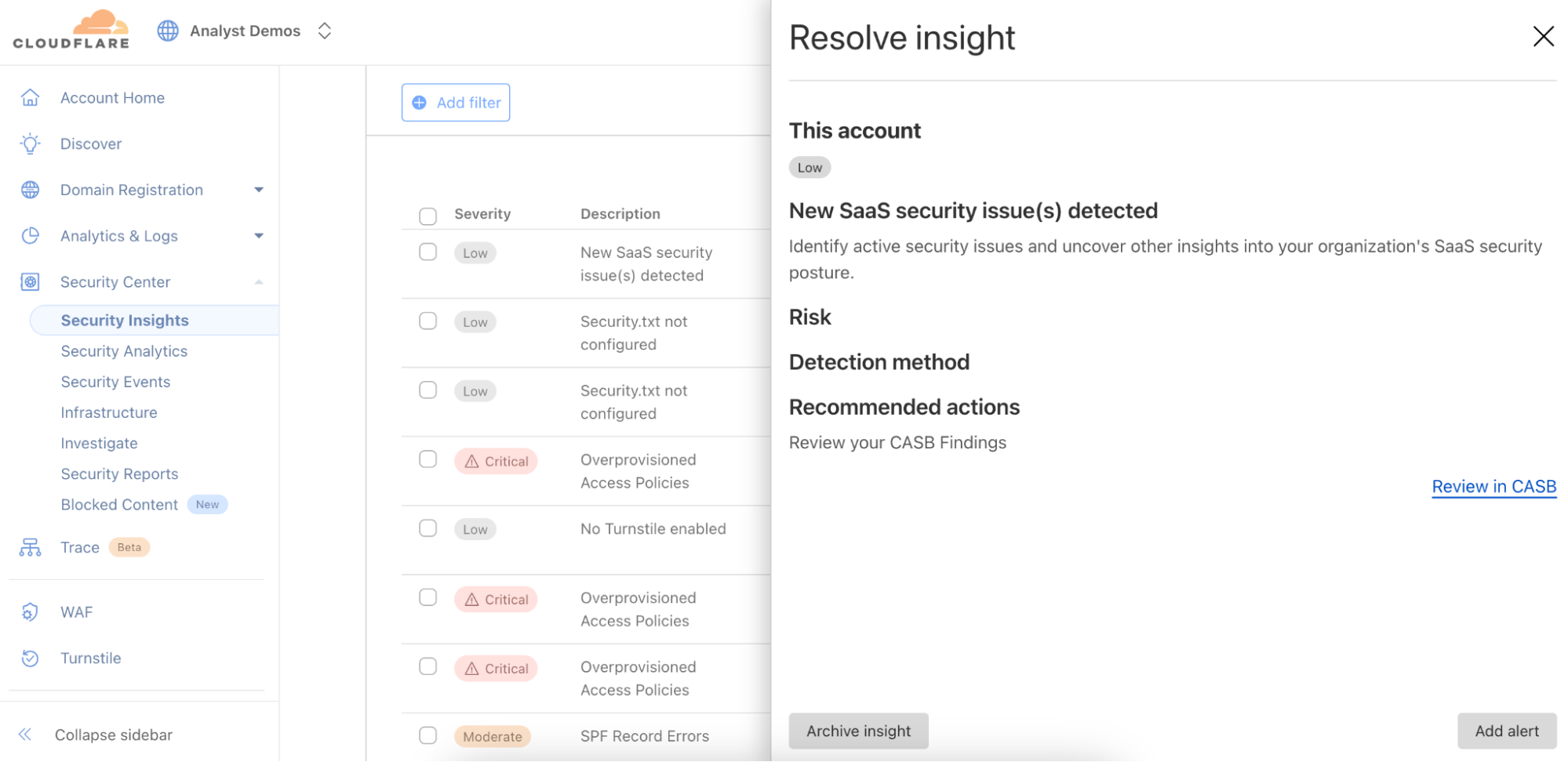
From the account-wide Security Insights, you can review insights for potential SaaS security issues:

You can choose to dig further with Cloud Access Security Broker (CASB) for a thorough review of the misconfigurations, risks, and failures to meet best practices across your SaaS fleet. You can identify a wealth of security information including, but not limited to:

  • Publicly available or externally shared files

  • Third-party applications with read or edit access

  • Unknown or anonymous user access

  • Databases with exposed credentials

  • Users without two-factor authentication

  • Inactive user accounts

You can also explore the Posture Findings page, which provides easy searching and navigation across documents that are stored within the SaaS applications.

Additionally, you can create policies to prevent configuration drift in your environment. Prevention-based policies help maintain a secure configuration and compliance standards, while reducing alert fatigue for Security Operations teams, and these policies can prevent the inappropriate movement or exfiltration of sensitive data. Unifying controls and visibility across environments makes it easier to lock down regulated data classes, maintain detailed audit trails via logs, and improve your security posture to reduce the risk of breaches.

How it works: new, real-time SaaS documents discovery

Delivering SaaS security posture information to our customers requires collecting vast amounts of data from a wide range of platforms. In order to ensure that all the documents living in your SaaS apps (files, designs, etc.) are secure, we need to collect information about their configuration — are they publicly shared, do third-party apps have access, is multi-factor authentication (MFA) enabled? 

We previously did this with crawlers, which would pull data from the SaaS APIs. However, we were plagued with rate limits from the SaaS vendors when working with larger datasets. This forced us to work in batches and ramp scanning up and down as the vendors permitted. This led to stale findings and would make remediation cumbersome and unclear – for example, Cloudflare would be reporting that a file is still shared publicly for a short period after the permissions were removed, leading to customer confusion.

To fix this, we upgraded our data collection pipeline to be dynamic and real-time, reacting to changes in your environment as they occur, whether it’s a new security finding, an updated asset, or a critical alert from a vendor. We started with our Microsoft asset discovery and posture findings, providing you real-time insight into your Microsoft Admin Center, OneDrive, Outlook, and SharePoint configurations. We will be rapidly expanding support to additional SaaS vendors going forward.

Listening for update events from Cloudflare Workers

Cloudflare Workers serve as the entry point for vendor webhooks, handling asset change notifications from external services. The workflow unfolds as follows:

  • Webhook listener: An initial Worker acts as the webhook listener, receiving asset change messages from vendors.

  • Data storage & queuing: Upon receiving a message, the Worker uploads the raw payload of the change notification to Cloudflare R2 for persistence, and publishes it to a Cloudflare Queue dedicated to raw asset changes.

  • Transformation Worker: A second Worker, bound as a consumer to the raw asset change queue, processes the incoming messages. This Worker transforms the raw vendor-specific data into a generic format suitable for CASB. The transformed data is then:

    • Stored in Cloudflare R2 for future reference.

    • Published on another Cloudflare Queue, designated for transformed messages.

CASB Processing: Consumers & Crawlers

Once the transformed messages reach the CASB layer, they undergo further processing:

  • Polling consumer: CASB has a consumer that polls the transformed message queue. Upon receiving a message, it determines the relevant handler required for processing.

  • Crawler execution: The handler then maps the message to an appropriate crawler, which interacts with the vendor API to fetch the most up-to-date asset details.

  • Data storage: The retrieved asset data is stored in the CASB database, ensuring it is accessible for security and compliance checks.

With this improvement, we are now processing 10 to 20 Microsoft updates per second, or 864,000 to 1.72 million updates daily, giving customers incredibly fast visibility into their environment. Look out for expansion to other SaaS vendors in the coming months. 

Securing your web applications

A unique challenge of securing web applications is that no one size fits all. An asset-aware posture management bridges the gap between a universal security solution and unique business needs, offering tailored recommendations for security teams to protect what matters.

Posture overview from attacks to threats and risks

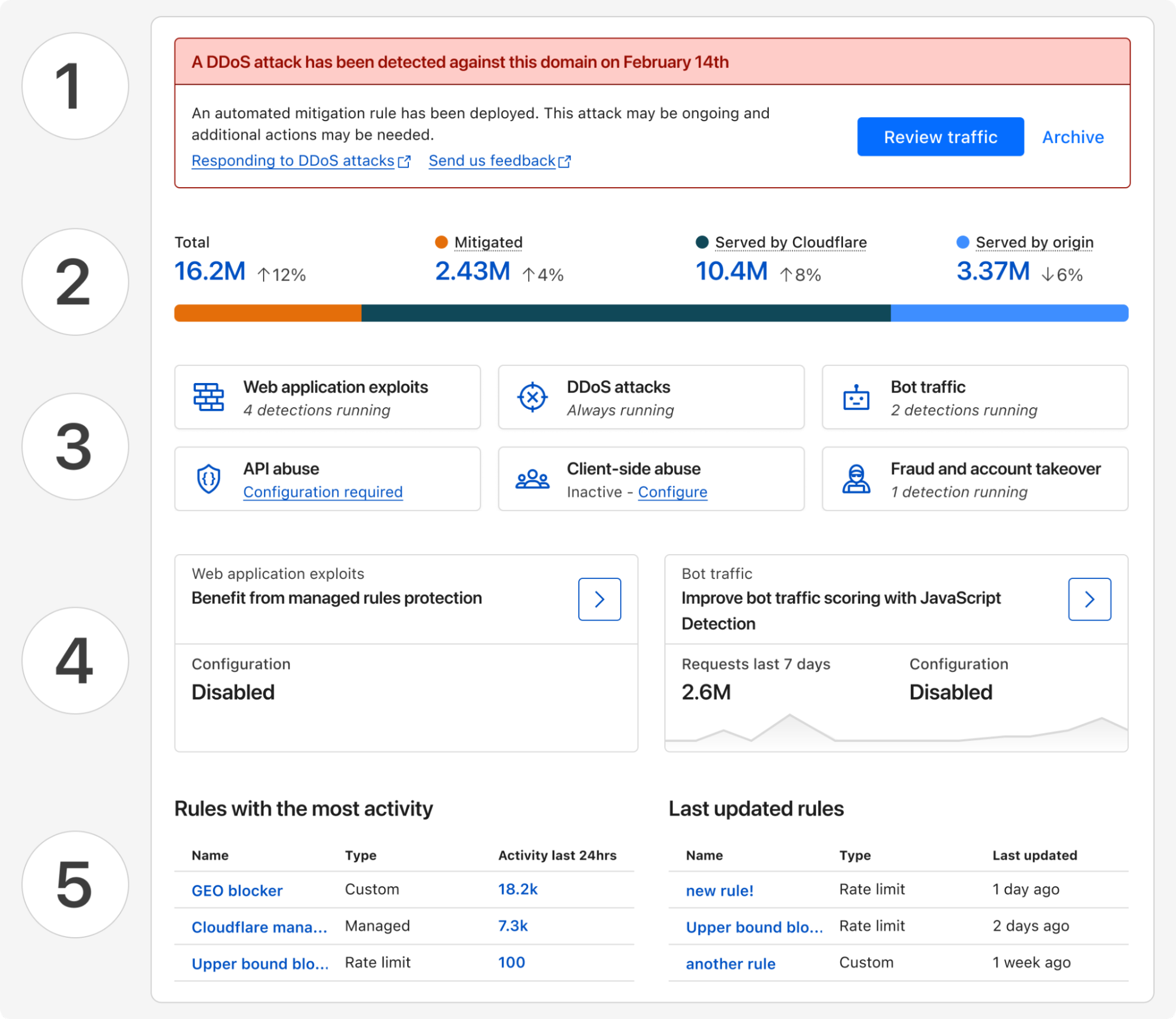
Starting today, all Cloudflare customers have access to Security Overview, a new landing page customized for each of your onboarded domains. This page aggregates and prioritizes security suggestions across all your web applications:

  1. Any (ongoing) attacks detected that require immediate attention

  2. Disposition (mitigated, served by Cloudflare, served by origin) of all proxied traffic over the last 7 days

  3. Summary of currently active security modules that are detecting threats

  4. Suggestions of how to improve your security posture with a step-by-step guide

  5. And a glimpse of your most active and lately updated security rules

These tailored security suggestions are surfaced based on your traffic profile and business needs, which is made possible by discovering your proxied web assets.

Discovery of web assets

Many web applications, regardless of their industry or use case, require similar functionality: user identification, accepting payment information, etc. By discovering the assets serving this functionality, we can build and run targeted threat detection to protect them in depth.

As an example, bot traffic towards marketing pages versus login pages have different business impacts. Content scraping may be happening targeting your marketing materials, which you may or may not want to allow, while credential stuffing on your login page deserves immediate attention.

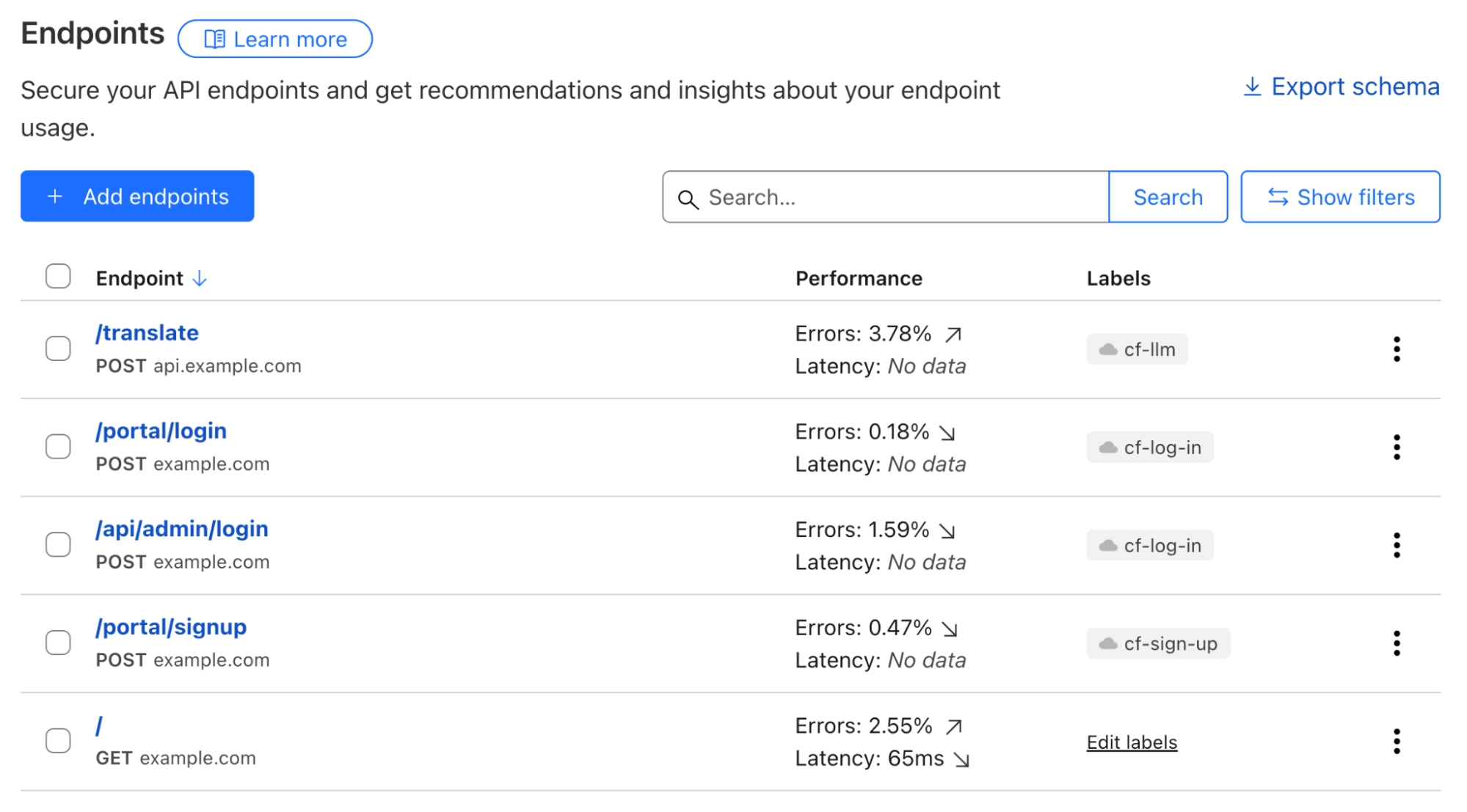
Web assets are described by a list of endpoints; and labelling each of them defines their business goals. A simple example can be POST requests to path /portal/login, which likely describes an API for user authentication. While the GET requests to path /portal/login denote the actual login webpage.

To describe business goals of endpoints, labels come into play. POST requests to the /portal/login endpoint serving end users and to the /api/admin/login endpoint used by employees can both can be labelled using the same cf-log-in managed label, letting Cloudflare know that usernames and passwords would be expected to be sent to these endpoints.

API Shield customers can already make use of endpoint labelling. In early Q2 2025, we are adding label discovery and suggestion capabilities, starting with three labels, cf-log-in, cf-sign-up, and cf-rss-feed. All other customers can manually add these labels to the saved endpoints. One example, explained below, is preventing disposable emails from being used during sign-ups. 

Always-on threat detection and risk assessment

Use-case driven threat detection

Customers told us that, with the growing excitement around generative AI, they need support to secure this new technology while not hindering innovation. Being able to discover LLM-powered services allows fine-tuning security controls that are relevant for this particular technology, such as inspecting prompts, limit prompting rates based on token usage, etc. In a separate Security Week blog post, we will share how we build Cloudflare Firewall for AI, and how you can easily protect your generative AI workloads.

Account fraud detection, which encompasses multiple attack vectors, is another key area that we are focusing on in 2025.

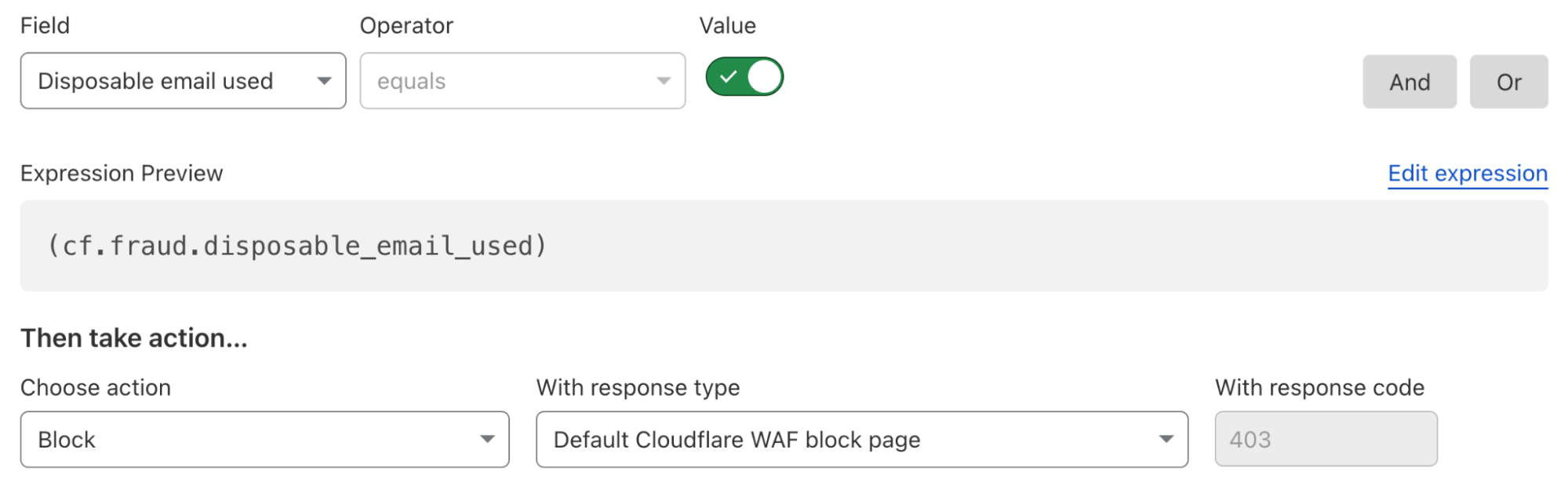
On many login and signup pages, a CAPTCHA solution is commonly used to only allow human beings through, assuming only bots perform undesirable actions. Put aside that most visual CAPTCHA puzzles can be easily solved by AI nowadays, such an approach cannot effectively solve the root cause of most account fraud vectors. For example, human beings using disposable emails to sign up single-use accounts to take advantage of signup promotions.

To solve this fraudulent sign up issue, a security rule currently under development could be deployed as below to block all attempts that use disposable emails as a user identifier, regardless of whether the requester was automated or not. All existing or future cf-log-in and cf-sign-up labelled endpoints are protected by this single rule, as they both require user identification.

Our fast expanding use-case driven threat detections are all running by default, from the first moment you onboarded your traffic to Cloudflare. The instant available detection results can be reviewed through security analytics, helping you make swift informed decisions.

API endpoint risk assessment

APIs have their own set of risks and vulnerabilities, and today Cloudflare is delivering seven new risk scans through API Posture Management. This new capability of API Shield helps reduce risk by identifying security issues and fixing them early, before APIs are attacked. Because APIs are typically made up of many different backend services, security teams need to pinpoint which backend service is vulnerable so that development teams may remediate the identified issues.

Our new API posture management risk scans do exactly that: users can quickly identify which API endpoints are at risk to a number of vulnerabilities, including sensitive data exposure, authentication status, Broken Object Level Authorization (BOLA) attacks, and more.

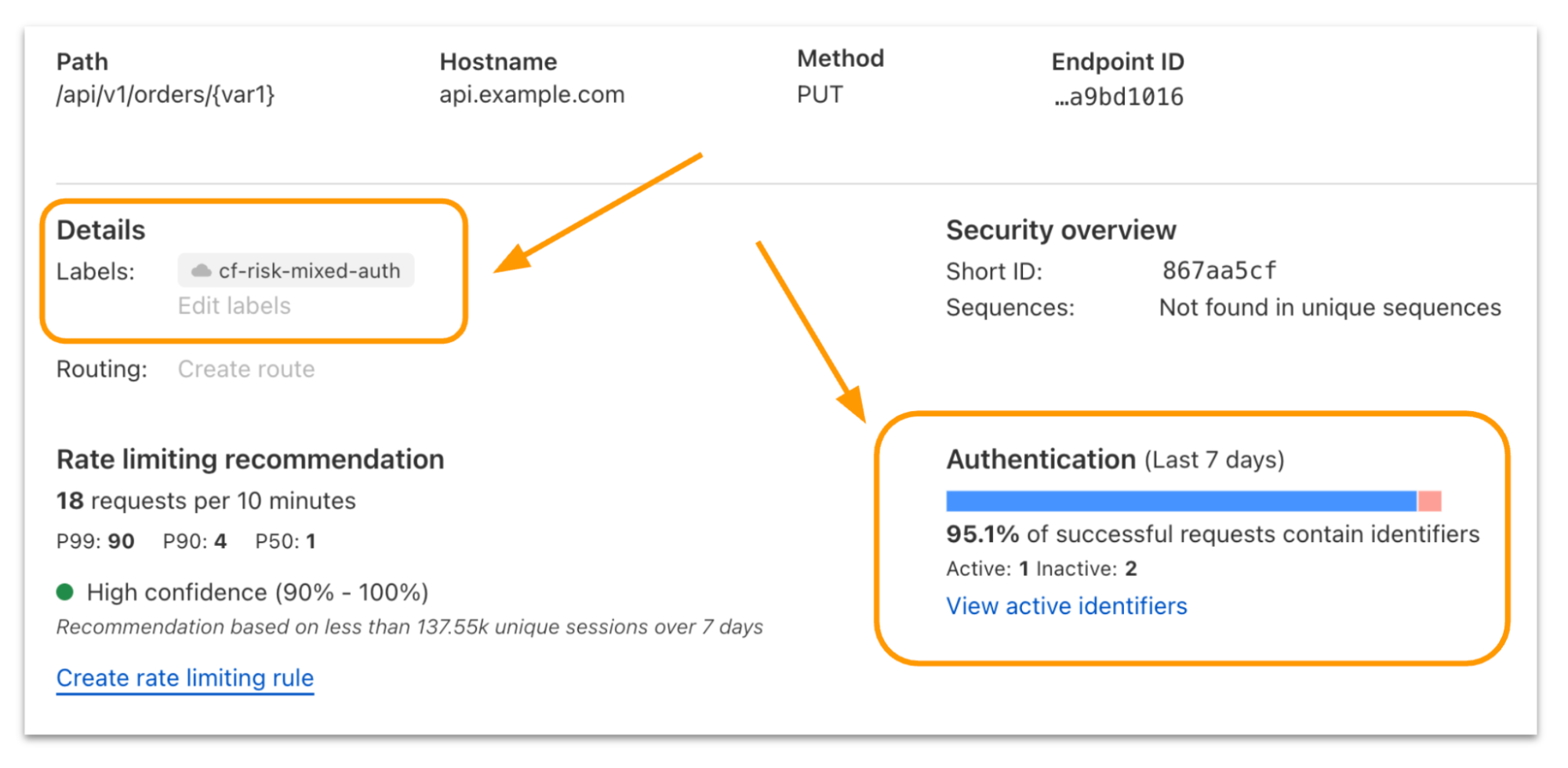
Authentication Posture is one risk scan you’ll see in the new system. We focused on it to start with because sensitive data is at risk when API authentication is assumed to be enforced but is actually broken. Authentication Posture helps customers identify authentication misconfigurations for APIs and alerts of their presence. This is achieved by scanning for successful requests against the API and noting their authentication status. API Shield scans traffic daily and labels API endpoints that have missing and mixed authentication for further review.

For customers that have configured session IDs in API Shield, you can find the new risk scan labels and authentication details per endpoint in API Shield. Security teams can take this detail to their development teams to fix the broken authentication.

We’re launching today with scans for authentication posture, sensitive data, underprotected APIs, BOLA attacks, and anomaly scanning for API performance across errors, latency, and response size.

Simplify maintaining a good security posture with Cloudflare

Achieving a good security posture in a fast-moving environment requires innovative solutions that can transform complexity into simplicity. Bringing together the ability to continuously assess threats and risks across both public and private IT environments through a single platform is our first step in supporting our customers’ efforts to maintain a healthy security posture.

To further enhance the relevance of security insights and suggestions provided and help you better prioritize your actions, we are looking into integrating Cloudflare’s global view of threat landscapes. With this, you gain additional perspectives, such as what the biggest threats to your industry are, and what attackers are targeting at the current moment. Stay tuned for more updates later this year.

If you haven’t done so yet, onboard your SaaS and web applications to Cloudflare today to gain instant insights into how to improve your business’s security posture.

❌