Visualização de leitura

U.S. CISA adds a flaw in Ivanti Endpoint Manager Mobile (EPMM) to its Known Exploited Vulnerabilities catalog

The U.S. Cybersecurity and Infrastructure Security Agency (CISA) adds a flaw in Ivanti Endpoint Manager Mobile (EPMM) to its Known Exploited Vulnerabilities catalog

The U.S. Cybersecurity and Infrastructure Security Agency (CISA) added a flaw in the Ivanti Endpoint Manager Mobile (EPMM), tracked as CVE-2026-6973 (CVSS score of 7.1), to its Known Exploited Vulnerabilities (KEV) catalog.

Ivanti warns customers of a high‑severity zero‑day vulnerability, tracked as CVE‑2026‑6973, in Endpoint Manager Mobile that is already being exploited.

“At the time of disclosure, we are aware of very limited exploitation of CVE-2026-6973, which requires admin authentication for successful exploitation.” reads the advisory. “We are not aware of any customers being exploited by the other vulnerabilities disclosed today.”

The flaw, caused by improper input validation, allows attackers with admin privileges to execute arbitrary code on systems running EPMM 12.8.0.0 and earlier. Customers are urged to patch immediately to prevent compromise.

Ivanti EPMM 12.6.1.1, 12.7.0.1, and 12.8.0.1 address the vulnerability. The vulnerability doesn’t affect Ivanti Neurons for MDM, Ivanti’s cloud-based unified endpoint management solution, Ivanti EPM (a similarly named, but different product), Ivanti Sentry, or any other Ivanti products.

According to Binding Operational Directive (BOD) 22-01: Reducing the Significant Risk of Known Exploited Vulnerabilities, FCEB agencies have to address the identified vulnerabilities by the due date to protect their networks against attacks exploiting the flaws in the catalog.

Experts also recommend that private organizations review the Catalog and address the vulnerabilities in their infrastructure.

CISA orders federal agencies to fix the vulnerability by May 10, 2026.

Pierluigi Paganini

Follow me on Twitter: @securityaffairs and Facebook and Mastodon

(SecurityAffairs – hacking, US CISA Known Exploited Vulnerabilities catalog)

Critical Android vulnerability CVE-2026-0073 fixed by Google

Google patched a critical Android flaw (CVE‑2026‑0073) that lets attackers run code remotely without user action.

Google released a security update for Android to address a critical remote code execution flaw, tracked as CVE‑2026‑0073, in the System component. The bug allowed attackers to run code as the shell user without needing extra permissions, or any user interaction.

The patch prevents potential full device compromise from remote exploitation.

“The vulnerability in this section could lead to remote (proximal/adjacent) code execution as the shell user with no additional execution privileges needed. User interaction is not needed for exploitation.” reads the advisory.

The flaw impacts ‘adbd’ (Android Debug Bridge daemon), the background process on an Android device that enables communication with a computer through the Android Debug Bridge (ADB) tool.

Google is not aware of any public exploits for this issue or of attacks in the wild exploiting CVE-2026-0073.

In March, Google confirmed that another vulnerability, tracked as CVE-2026-21385 (CVSS score of 7.8), in open-source Qualcomm component has been actively exploited.

The flaw is a buffer over-read in the Graphics component that could allow attackers to access sensitive memory data, underscoring ongoing risks to Android users.

The company did not disclose technical details about the attacks exploiting this vulnerability.

Follow me on Twitter: @securityaffairs and Facebook and Mastodon

Pierluigi Paganini

(SecurityAffairs – hacking, Google)

Agent’s claims on WhatsApp access spark security concerns

A US agent claimed WhatsApp encryption is fake and Meta can access messages; the probe was abruptly shut, raising security concerns.

A US agent claimed WhatsApp encryption is fake, alleging Meta accesses all unencrypted messages, but Commerce Department abruptly shut the probe, leaving leaders questioning if consumer apps are safe for sensitive business decisions.

In early 2026, a remarkable exchange unfolded inside the U.S. Commerce Department that has since sparked debate across cybersecurity, privacy, and corporate governance circles. A special agent from the Bureau of Industry and Security (BIS) sent an email asserting something astonishing: Meta’s WhatsApp, despite its public claims of end-to-end encryption, allows the company to access and store all user messages, including texts, photos, audio, and video, in unencrypted form. Just months later, the investigation was abruptly terminated.

“After roughly 10 months of collecting documents and conducting interviews, the agent circulated a Jan. 16 email to more than a dozen officials across federal agencies outlining preliminary conclusions.” reported TechSpot. “According to records reviewed by Bloomberg and corroborated by recipients, the agent asserted that Meta’s systems allow access to message content in ways that conflict with how WhatsApp’s encryption has been publicly described.”

After a 10-month probe internally dubbed “Operation Sourced Encryption,” the BIS agent circulated a January 16 email to over a dozen federal officials.

“There is no limit to the type of WhatsApp message that can be viewed by Meta. Meta can and does view and store all the text messages, photographs, audio and video recordings in an unencrypted format.” reads the email the agent wrote.

The email also described a “tiered permissions system” in place since at least 2019, granting access not only to Meta employees but also to contractors and “a significant number of foreign/overseas workers in India.”

The email also suggested the conduct could involve “civil and criminal violations that span several federal jurisdictions,” though he did not specify which laws. Importantly, this was not a formal accusation, it was a preliminary conclusion from an internal investigation that would soon be scrubbed from existence.

However Shortly after the email circulated, senior leadership at BIS shut down the inquiry.

“The [agency] is not investigating WhatsApp or Meta for violations of export laws,” said a spokesperson for the agency, Lauren Weber Holley.

Meta strongly denied the claims.

“The claim that WhatsApp can access people’s encrypted communications is patently false.” said Meta spokesperson Andy Stone

Meta says that only chat participants can read or hear messages on WhatsApp—not even the company itself. It has also defended this stance in court, including a 2021 case against India’s traceability rules.

Not everyone agrees with the agent’s claims. Former Meta security chief Alex Stamos said they are “almost certainly false.” He noted that any backdoor would have to exist in widely inspected app code, making it easy for researchers to find. He also argued Meta wouldn’t share such powerful access with contractors.

“A widespread backdoor would be easily found by security researchers,” Stamos said. “Also, a backdoor in WhatsApp would be a massive signals intelligence tool. There’s no way Meta would provide that capability to Accenture contractors if they had it.” said Stamos.

Still, two individuals interviewed by the agent claimed broad access to WhatsApp messages while performing content moderation work under contract with Accenture, which did not respond to comment requests.

The investigation’s closure leaves key questions unanswered, including what evidence was found and whether WhatsApp’s encryption will be further examined, keeping uncertainty high.

Follow me on Twitter: @securityaffairs and Facebook and Mastodon

Pierluigi Paganini

(SecurityAffairs – hacking, WhatsApp)

Smashing Security podcast #465: This developer wanted to cheat at Roblox. It cost millions

A developer at an AI startup wanted to cheat at Roblox. They downloaded a dodgy script on their work laptop. That one decision triggered a cascade of failures that ended with a $2 million data breach affecting hundreds of thousands of organisations. All for some free in-game currency. Meanwhile, there's a 1980s phone protocol called SS7 that lets shadowy surveillance companies track anyone, anywhere, via their mobile phone. Governments know about it. Telecoms know about it. Nobody's fixing it. All this and more in episode 465 of the "Smashing Security" podcast with cybersecurity keynote speaker and industry veteran Graham Cluley, joined this week by special guest James Ball. Plus! Don't miss our featured interview with Rob Edmondson of CoreView, discussing how to lock down Microsoft 365 before it's too late.

New Android spyware Morpheus linked to Italian surveillance firm

Osservatorio Nessuno uncovered Morpheus spyware spreading via fake Android apps to steal data, highlighting rising covert surveillance tools.

The non-partisan, non-religious, nonprofit organization Osservatorio Nessuno exposed a new spyware called Morpheus, distributed through fake Android apps posing as updates. Once installed, it can steal extensive data from the infected devices. The report shows strong demand from law enforcement and intelligence agencies, fueling a growing market of spyware vendors, many operating quietly outside public scrutiny.

Attackers used a typical low-cost spyware tactic: disrupt a service and trick the victim into installing a fake app to restore it. In this case, targets received an SMS linking to a site impersonating an ISP. The first stage, a dropper app, installs a hidden second-stage payload embedded within it. It checks if the payload is already present, then silently deploys it with minimal user awareness.

The second stage disguises itself as legitimate system components, using fake icons and names to appear trustworthy. It forces users to grant dangerous permissions, including Accessibility access, which allows it to read screens, interact with apps, and capture sensitive data.

“After granting Accessibility permissions, the spyware starts a Permission Workflow that creates an overlay with a fake update process and a fake reboot screen. In background, the workflow performs all the steps to grant all the needed permissions. This includes enabling Developer Options, turning on Wireless Debugging, and locally pairing to the ADB daemon.” reads the report published by the Osservatorio Nessuno. “Conveniently, during the fake update the app disables the touchscreen by setting FLAG_NOT_TOUCHABLE on the whole full-screen overlay, leaving the user partially unable to respond to the infection.”

The malware also gains persistence by restarting after reboot and can request device admin privileges, making removal difficult. Overall, it enables long-term, covert surveillance of the infected device.

The spyware abuses overlay windows and Accessibility features to take control of the device and bypass protections. Using the powerful SYSTEM_ALERT_WINDOW permission, it displays fake screens, such as updates or reboots, while secretly granting itself permissions in the background, even disabling touch input to limit user control. It can trick victims into approving actions like linking a WhatsApp account by showing a fake biometric prompt.

It also enables Wireless Debugging and connects to ADB to gain elevated privileges, silently granting itself sensitive permissions, disabling security protections like camera/mic indicators and Play Protect, and turning off antivirus tools.

“In the third phase the spyware disables a number of known Antivirus software, including Google’s own SafetyCore, Bitdefender, Sophos, Avast, AVG, Malwarebytes, along with a handful of smaller “cleaner/antivirus” apps popular on low end devices.” continues the report. “None of these requires root, and persists across reboots since the Android security model treats user’s installed anti-malware software like ordinary apps.”

Finally, it adjusts system settings across different Android versions to ensure persistence, avoid detection, and maintain full access to the device.

The analysis of the source code suggests an Italian origin for the spyware, based on language clues and references like “aprafoco” and “Gomorra.” The malware supports multiple languages and Android devices, showing broader targeting. Its infrastructure uses encrypted configs, Italian-hosted servers, and domains linked to small ISPs and obscure entities with generic details.

The researchers found ties between hosting providers, fake or opaque companies, and shared contacts. The phishing domain is registered to a small Italian firm with minimal activity and links to other questionable businesses. Overlapping financial and corporate connections suggest a network of related entities potentially supporting the spyware operation while masking its true ownership.

Osservatorio Nessuno concluded that the spyware is linked to IPS Intelligence, an Italian firm active for over 30 years in lawful interception technologies used by governments to monitor communications through telecom and internet providers.

“While IPS Intelligence is a well‑known commercial surveillance provider, this is, to our knowledge, the first report linking them to the distribution and operation of spyware.” concludes the report. “Morpheus is extremely invasive: it can record audio and video, silently pair a WhatsApp device, erase evidence, and deliberately weaken the security of the infected phone, among other malicious capabilities.”

The researchers did not provide details on how they isolated or identified the sample, so the exact collection and analysis process remains undisclosed.

Follow me on Twitter: @securityaffairs and Facebook and Mastodon

Pierluigi Paganini

(SecurityAffairs – hacking, spyware)

iOS Flaw Let Deleted Notifications Linger, Apple Issues Fix

Apple fixed an iOS flaw that kept deleted notifications on devices, allowing recovery of messages, including from apps like Signal.

Apple released updates for iOS and iPadOS to address the vulnerability CVE-2026-28950, a flaw in Notification Services that stored notifications even after deletion. This logging issue could allow recovery of sensitive data, including messages from apps like Signal. The company resolved it by improving how data is redacted and handled on devices.

The recent revelations about FBI forensic access to Signal messages on an iPhone have reignited a long-standing misunderstanding about mobile privacy: the belief that disappearing messages and encrypted apps guarantee that no trace of communication remains once a message is deleted or an app is removed. A court case in Texas, reported by 404 Media and later analyzed by multiple security researchers, shows why that assumption does not match how modern smartphones actually work.

“The FBI was able to forensically extract copies of incoming Signal messages from a defendant’s iPhone, even after the app was deleted, because copies of the content were saved in the device’s push notification database, multiple people present for FBI testimony in a recent trial told 404 Media. The case involved a group of people setting off fireworks and vandalizing property at the ICE Prairieland Detention Facility in Alvarado, Texas in July, and one shooting a police officer in the neck.” reads the post published by 404 Media. “The news shows how forensic extraction—when someone has physical access to a device and is able to run specialized software on it—can yield sensitive data derived from secure messaging apps in unexpected places.”

Investigators were able to recover incoming messages from a suspect’s iPhone even after Signal had been uninstalled, even though the messages were configured to disappear after a short time. The FBI did not break Signal’s encryption, nor did they exploit any vulnerability in its protocol. Instead, the data was retrieved from a completely different layer of the system: Apple’s own notification storage.

Court testimony reveals that only incoming iPhone messages were recovered, not outgoing ones. This is key because incoming messages are processed by Apple’s push notification system, temporarily stored for lock screen/notification previews, and may leave OS traces even if deleted from the app. Outgoing messages lack this notification trail, explaining the investigators’ limitation.

Users misunderstand what “deleting” or “disappearing” actually means, instant messaging apps like Signal encrypt in transit and delete from their interface per timer, but once delivered, messages decrypt on the recipient’s device for display. The OS may then cache notification content independently, outside Signal’s control.

“There is an important detail to keep in mind here: only incoming messages were recovered, not outgoing ones. This is entirely consistent with how push notifications work.” reads an analysis published by researcher Andrea Fortuna. “When someone sends you a message on Signal, the app server pushes a notification to Apple’s infrastructure, which then delivers it to your device. If the notification content was not stripped before delivery, the text lands in the operating system’s notification database. Outgoing messages, which originate directly from your device to the server, never go through this pathway and therefore leave no equivalent trace.”

Apple’s Push Notification service routes encrypted messages to devices via secure tokens. Payloads with visible alerts (if previews enabled) are decrypted locally but rendered by iOS, which caches notification data for history/reboot recovery. iOS databases persist fragments even after app deletion, enabling forensic recovery of past notifications despite end-to-end encryption.

According to Apple, the issue impacts the following devices:

  • iPhone 11 and later, iPad Pro 12.9-inch 3rd generation and later, iPad Pro 11-inch 1st generation and later, iPad Air 3rd generation and later, iPad 8th generation and later, and iPad mini 5th generation and later.
  • iPhone XR, iPhone XS, iPhone XS Max, iPhone 11 (all models), iPhone SE (2nd generation), iPhone 12 (all models), iPhone 13 (all models), iPhone SE (3rd generation), iPhone 14 (all models), iPhone 15 (all models), iPhone 16 (all models), iPhone 16e, iPad mini (5th generation – A17 Pro), iPad (7th generation – A16), iPad Air (3rd – 5th generation), iPad Air 11-inch (M2 – M3), iPad Air 13-inch (M2 – M3), iPad Pro 11-inch (1st generation – M4), iPad Pro 12.9-inch (3rd – 6th generation), and iPad Pro 13-inch (M4).

iOS 26.4.2, iPadOS 26.4.2iOS 18.7.8, and iPadOS 18.7.8 releases address the flaw.

Signal welcomed Apple’s quick fix, noting that no user action is needed. After installing the update, any stored notifications are deleted and future ones won’t be retained.

“We are very happy that today Apple issued a patch and a security advisory. This comes following @404mediaco reporting that the FBI accessed Signal message notification content via iOS despite the app being deleted.”Signal wrote on X. “Note that no action is needed for this fix to protect Signal users on iOS. Once you install the patch, all inadvertently-preserved notifications will be deleted and no forthcoming notifications will be preserved for deleted applications,”

We are very happy that today Apple issued a patch and a security advisory. This comes following @404mediaco reporting that the FBI accessed Signal message notification content via iOS despite the app being deleted.

Apple’s advisory confirmed that the bugs that allowed this to…

— Signal (@signalapp) April 22, 2026

Follow me on Twitter: @securityaffairs and Facebook and Mastodon

Pierluigi Paganini

(SecurityAffairs – hacking, Signal)

Android 17 ends all-or-nothing access to your contacts

Some of the apps on your phone want your contacts. Most don’t need them all, but have been happily slurping up the lot for years. Google has decided to do something about that with the next version of Android.

Android 17 (currently in preview) is introducing a new Contact Picker that lets users grant apps access to specific contacts rather than the entire list.

Previously, any app that needed a single phone number had to request READ_CONTACTS. That’s a permission that handed over every name, email, and number. It’s the digital equivalent of handing someone your entire Rolodex because they asked for one business card.

An app that can harvest your entire contact list can map your social network, identify your family members, and potentially hand that data to whoever’s buying. So whenever you click “yes” to “show us all your contacts” it isn’t just your privacy you’re playing with.

From Android 17 onward, apps will need to be more specific about what contact data they access. Phone number? Fine. Email address? Sure. Your cousin’s mailing address? Not unless the app has a reason.

Google’s updated Play policy will require apps to use the Contact Picker or the Android Sharesheet as the main way to access contacts. READ_CONTACTS will be reserved for apps that genuinely can’t function without it. 

Location sharing gets the privacy treatment

Location permissions are also set to become more granular and privacy-friendly in Android 17.

Previously, apps could ask for your precise or general location, and you could allow it just once, any time you’re using the app, or not at all. The new button adds nuance by letting app developers ask for your location in the moment, tied to a specific action, like finding a local cafe.

There will also be a persistent indicator to let you know when an app is using your location, similar to the alerts for camera or microphone access. And you’ll be able to find out which apps are tracking you as well.

Google blocked 8.3 billion bad ads in 2025

The tighter permissions management in Android 17 is a big deal for privacy advocates, because overly broad access is how data brokers build detailed profiles about you.

Those profiles can then be used for aggressive or invasive advertising, including scams.


Mobile protection, anywhere, anytime.


Google timed these privacy announcements alongside its latest Ad Safety report, which says it blocked 8.3 billion policy-violating ads and suspended 24.9 million advertiser accounts in the last year. 

The 8.3 billion figure is up from 2024, when Google blocked 5.1 billion ads. The increase suggests that the problem is getting worse, or that Google is getting better at catching it. Scam ads are a big part of that. In 2024, Google blocked 415 million scam-related ads. In 2025, that number grew to 602 million. 

Lest we forget

We’ll give Google credit for trying to tackle this problem from both ends—limiting data collection and cracking down on the kinds of ads that use that data maliciously. But there’s still a sense that it’s not doing quite enough.

Yes, the Android 17 permission changes are good for users, but granular contact access should have been the default years ago. Apple has been doing it for 18 months in iOS 18, and even that was years too late, in our opinion.

And while Google says it caught over 99% of violations before users ever saw them, 1% of an insanely large number is still insanely large.

The ads that still get through are damaging. In December, we reported on sponsored search results pointing to malicious AI chats that instructed people to install infostealer malware. Why does Google run ads that look like search results? Because its business model is driven by advertising revenue. At least it’s making it easier to hide them now.

So we’ll give a cautious hand clap to Google. It’s moving in the right direction. But stories about how it knowingly giving kids’ data inappropriately to advertisers or misusing health data still give us pause.


Scammers know more about you than you think. 

Malwarebytes Mobile Security protects you from phishing, scam texts, malicious sites, and more. With real-time AI-powered Scam Guard built right in. 

Download for iOS → Download for Android → 

EngageLab SDK flaw opens door to private data on 50M Android devices

A flaw in EngageLab SDK exposed up to 50M Android users, including 30M crypto wallets, letting apps bypass security and access private data.

Microsoft researchers found a critical flaw in EngageSDK that lets apps bypass Android sandbox protections and access private data. The flaw put millions of users, including over 30M crypto wallet installs, at risk.

Developers fixed it in version 5.2.1 after coordinated disclosure, and vulnerable apps were removed from Google Play. The good news is that no active exploitation has been confirmed, but the case highlights risks from third-party SDKs widely used in mobile apps.

“As mobile wallets and other high‑value apps become more common, even small flaws in upstream libraries can impact millions of devices. These risks increase when integrations expose exported components or rely on trust assumptions that aren’t validated across app boundaries.” reads the report published by Microsoft.

“Because Android apps frequently depend on external libraries, insecure integrations can introduce attack surfaces into otherwise secure applications.”

Android protects apps by isolating them with unique IDs, private storage, and controlled communication through intents. The EngageLab SDK flaw breaks this protection using an intent redirection issue.

“Intent Redirection occurs when a threat actor manipulates the contents of an intent that a vulnerable app sends using its own identity and permissions.  

In this scenario, the threat actor leverages the trusted context of the affected app to run a malicious payload with the app’s privileges.” continues the report. “This can lead to: 

  • Unauthorized access to protected components  
  • Exposure of sensitive data 
  • Privilege escalation within the Android environment

A malicious app can send a crafted intent to a vulnerable app, which then processes it and unknowingly sends a new intent with its own permissions. This allows the attacker to act with higher privileges.

The problem comes from an exported component called MTCommonActivity, automatically added during the build process. Many developers miss it because it only appears in the merged app configuration. Since it is exported, any app on the device can interact with it. This component reads attacker-controlled data and builds a new intent, but instead of keeping it safe, it creates a targeted intent that directly calls internal components.

The flaw becomes more dangerous because it uses unsafe flags that grant read and write access to data. Once triggered, the attacker can access private files through the app’s content providers, even if those were not meant to be exposed.

In simple terms, this vulnerability lets one app trick another into opening its doors, giving access to sensitive data and bypassing Android’s core security protections.

Many affected apps belong to the crypto and digital wallet ecosystem, making the flaw particularly severe. Microsoft confirmed the issue in multiple Google Play apps before disclosure. Wallet apps alone reached over 30 million installs, while total exposure across all affected apps exceeded 50 million.

Microsoft discovered the vulnerability in EngageLab SDK v4.5.4 and reported it in April 2025, later involving the Android Security Team in May due to Play Store impact. EngageLab fixed the issue in version 5.2.1, released on November 3, 2025, by making the vulnerable component non-exported, blocking access from other apps.

“To keep your apps secure, always review the merged Android manifest, especially when you incorporate third‑party SDKs. This helps you identify any components or permissions that might affect your app’s security or behavior.” concludes Microsoft.

Follow me on Twitter: @securityaffairs and Facebook and Mastodon

Pierluigi Paganini

(SecurityAffairs – hacking, Android)

Apple expands “DarkSword” patches to iOS 18.7.7

Apple widened its latest iOS 18 security update to cover far more iPhones and iPads, specifically to stop real‑world DarkSword attacks that can compromise a device from a single website visit.

After researchers published their findings about the DarkSword attacks and an exploit kit abusing the vulnerabilities appeared on GitHub, Apple quietly updated its March 24 security bulletin.

Apple first released iOS/iPadOS 18.7.7 on March 24 to a small set of older devices (iPhone XS/XS Max/XR and 7th‑gen iPad), fixing several vulnerabilities that are part of the DarkSword exploit chain. Newer devices that had the option to upgrade to iOS/iPadOS 26 had stopped receiving iOS 18 point updates, leaving a large group of users effectively stranded on vulnerable 18.x builds.

DarkSword is a full‑chain iOS exploit kit that strings together six vulnerabilities in WebKit, Safari, the dynamic loader, and the kernel to go from a browser visiting a malicious website to full device compromise. The chain has been observed in the wild since at least November 2025 in campaigns set up by commercial spyware vendors and state‑sponsored actors.

There is no need to tap a link in Messages or approve an install prompt. Just loading a compromised site or even a malicious advertisement inside Safari is enough to trigger the exploit chain if your device is still missing the relevant patches.

In this case, attackers combined six vulnerabilities, some already fixed, some still zero‑day at the time, into a cyber-weapon that could turn a routine website visit into a full device compromise and mass data theft. By the time the exploit chain’s details leaked and proof‑of‑concept code hit GitHub, hundreds of millions of devices were potentially exposed, and even “ordinary” users with no reason to fear state surveillance suddenly had to worry about their photos, chats, and crypto wallets.

How to update your iPhone or iPad

For years, many iPhone users have treated updates as a trade‑off between “features I don’t care about” and “battery life I do care about.” DarkSword, and Apple’s decision to reopen iOS 18 updates to more devices, is a reminder that there’s a third factor: silently accumulating risk.

For iOS and iPadOS users, here’s how to check if you’re using the latest software version:

  • Go to Settings > General > Software Update. You will see if there are updates available and be guided through installing them.
  • Turn on Automatic Updates if you haven’t already—you’ll find it on the same screen.

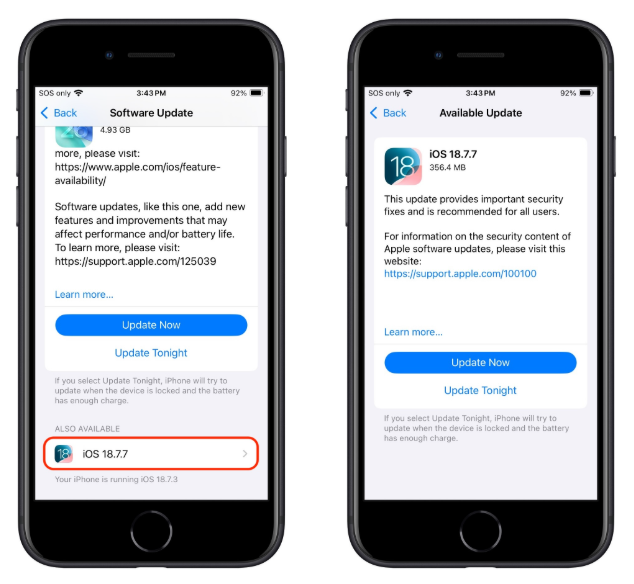
If you prefer, and many people do, you can stay on iOS 18 by using the Also Available option in Software Update and explicitly choosing iOS 18.7.7 instead of 26.4.

Exact steps on the iPhone

  1. Open Settings → General → Software Update.
  2. Wait for the page to load; you’ll see iOS 26.4 as the main, highlighted update at the top (assuming your device supports it).
  3. Scroll down on that same screen until you see a section called “Also Available” showing iOS 18.7.7.
    also available updates section
    Image courtesy of TidBITS
  4. Tap iOS 18.7.7, then choose Download and Install to apply that update instead of 26.4.
  5. Make sure you do not tap the big “Upgrade to iOS 26.4” button if you want to remain on 18.x.

Other advice to stay safe

If you have reason to believe you’re a potential target for attacks of this nature (journalists, activists, or people that have access to sensitive data) it is advisable to enable Lockdown Mode:

  1. Open the Settings app.
  2. Tap Privacy & Security.
  3. Scroll down, tap Lockdown Mode, then tap Turn On Lockdown Mode.
  4. Read the presented information and tap Turn On Lockdown Mode.
  5. Tap Turn On & Restart.
  6. Enter your device passcode when prompted.

Do inform yourself about the consequences of turning on Lockdown Mode. It makes your device a lot less user-friendly, but it has proven effective against highly targeted attacks.

More general tips:

  • Use up-to-date, real-time anti-malware protection for your device to block malicious websites where possible.
  • Avoid following links sent in unsolicited messages, especially for services like Snapchat, crypto exchanges, banking, or email.
  • Use content blockers (for example Malwarebytes Browser Guard) in Safari to reduce exposure to malicious content (though they are not a silver bullet for zero‑days).
  • Move high‑value crypto assets to hardware wallets or dedicated devices, and use mobile wallets only for smaller amounts.
  • Use a password manager with strong authentication, and turn on extra security settings like Face ID/Touch ID and avoid auto‑filling high‑risk credentials.
  • Enable multi-factor authentication (FIDO2 security keys or app‑based 2FA) on exchanges and financial accounts, so stolen passwords alone are not enough to plunder your accounts.
  • Regularly review app permissions and revoke access to sensitive data (Location, Photos, Contacts, Microphone, Camera, Health) revoke where unnecessary.

We don’t just report on phone security—we provide it

Cybersecurity risks should never spread beyond a headline. Keep threats off your mobile devices by downloading Malwarebytes for iOS, and Malwarebytes for Android today.

Italian spyware vendor creates Fake WhatsApp app, targeting 200 users

WhatsApp blocked a fake app by Italian firm SIO/Asigint that targeted 200 users with spyware, urging them to reinstall the official app.

WhatsApp has recently uncovered a malicious fake version of its app that targeted roughly 200 users, most of whom are in Italy. The platform confirmed that the unofficial client contained spyware and was developed by Italian firm Asigint, a subsidiary of SIO Spa, a company known for providing surveillance tools to law enforcement and government agencies.

“Our security team identified around 200 users, mostly in Italy, who we believe may have downloaded this unofficial and harmful client. We logged them out and alerted them to the privacy and security risks,” WhatsApp stated. “We believe this was a social engineering attempt targeting a limited number of users with the goal of inducing them to install harmful software impersonating WhatsApp, likely to gain access to their devices. Today, WhatsApp has taken action against Asigint, an Italian spyware company controlled by Sio Spa that created a fake version of WhatsApp. We believe the individuals behind this malicious client used social engineering techniques to trick people into downloading an unofficial and harmful app disguised as WhatsApp,” the Meta Group company said in a statement, adding that it intends to “send a formal legal notice to this spyware company to cease all harmful activity.”

The affected users were promptly logged out and notified of the potential risks to their privacy and security. WhatsApp advised them to remove the fake app and reinstall the official version, emphasizing that the incident did not involve a vulnerability in WhatsApp itself; the end-to-end encryption of legitimate apps remains intact.

According to WhatsApp, the attackers relied on social engineering techniques, tricking users into installing the counterfeit app, which was not available on official digital stores like the Apple App Store or Google Play. The approach suggests a highly targeted campaign, likely part of a broader investigation, rather than a mass-distribution attack.

“It is important to clarify that this was not a vulnerability in WhatsApp; end-to-end encryption continues to protect the communications of people using the official WhatsApp apps,” the Meta Group platform stated, as reported by the Italian press agency ANSA. “We believe the individuals behind this malicious client used social engineering techniques to convince people to download an unofficial and harmful app, passing it off as WhatsApp, likely to gain access to their devices. We intend to send a formal legal notice to this spyware company to cease any harmful activity.”

SIO, through Asigint, has a long history in the development of government-grade spyware. In a 2025 TechCrunch report, SIO was linked to Spyrtacus, a series of malicious Android apps that disguised themselves as WhatsApp and other popular applications. Spyrtacus allowed attackers to extract sensitive data from devices, including messages, contact lists, and call logs, as well as monitor users through microphones and cameras.

A WhatsApp spokesperson explained that the company plans to issue a formal legal demand to Asigint, requesting that the company cease all malicious activities. The platform stressed that holding spyware developers accountable under law is a crucial part of protecting users from targeted attacks. WhatsApp has previously achieved a precedent-setting outcome by holding a commercial spyware firm responsible under U.S. law for attempting to spy on users’ mobile devices.

The incident highlights a broader trend in digital surveillance: using fake apps as a tool for spying. Cybersecurity experts note that such tactics are common in operations targeting individuals for intelligence or law enforcement purposes.

“The fake WhatsApp campaign demonstrates the sophistication of modern social engineering techniques, where attackers exploit users’ trust in popular software to gain access to sensitive devices,” I told ANSA.

SIO describes itself as a team of software developers and architects leveraging advanced technologies to redefine human-computer interaction. According to its website, the company collaborates closely with law enforcement, government organizations, and intelligence agencies, boasting more than 30 years of experience in the sector. The fake WhatsApp case underlines how firms that operate in the intelligence space can inadvertently, or deliberately, target private users in ways that raise ethical and legal questions.

While the full scope of the attack remains unclear, the proactive response by WhatsApp underscores the importance of vigilance. Users are strongly encouraged to only download official applications and remain alert to suspicious links or prompts, especially when dealing with messaging or banking apps.

This case also demonstrates the evolving challenges of digital security in Italy and globally, where spyware developers increasingly use counterfeit applications to bypass traditional defenses and exploit user trust. Even though most affected individuals were Italian, the lessons extend to anyone using widely trusted apps. Awareness and timely updates are essential defenses against such targeted threats.

In conclusion, the WhatsApp-Asigint incident is a reminder of the ongoing arms race between privacy-focused platforms and surveillance-focused actors. While end-to-end encryption protects users of legitimate apps, attackers will continue to explore indirect methods, such as fake apps, to circumvent safeguards. Vigilance, legal accountability, and prompt user education remain the most effective tools for mitigating these sophisticated threats.

Follow me on Twitter: @securityaffairs and Facebook and Mastodon

Pierluigi Paganini

(SecurityAffairs – hacking, WhatsApp)

Beware of Apps with Excessive Advertising Distributed via Mobile App Stores

AhnLab’s engine development team found a number of apps on the Google Play Store and Apple App Store that disguised themselves as dealing with topics close to our daily lives, such as government policies and learning apps, and displayed excessive ads.   Figure 1. Hyped apps circulating on Google Play Store Figure 2. Hyped apps […]

It’s a mystery … alleged unpatched Telegram zero-day allows device takeover, but Telegram denies

A critical Telegram flaw could allow zero-click remote code execution on devices, but Telegram denies it.

Researcher Michael DePlante (@izobashi) of TrendAI Zero Day disclosed a new Telegram vulnerability through Zero Day Initiative (ZDI).

The vulnerability, tracked as ZDI-CAN-30207 (CVSS score of 9.8) allows attackers to execute code on targeted devices without any user interaction. This vulnerability is especially dangerous because an attacker can exploit it simply by sending a malicious animated sticker, with no action required from the victim. The vulnerability lies in how Telegram automatically processes media to generate previews, allowing crafted files to trigger code execution.

The flaw poses a serious security risk, especially as no patch is currently available, raising concerns across the cybersecurity community.

The vulnerability affects Telegram on Android and Linux; if exploited, it allows attackers to take full control of a device.

At this time it is unclear if threat actors have already exploited it in attacks in the wild.

The Zero Day Initiative did not disclose technical details about the vulnerability to give the company time to address it by July 24, 2026.

The Italian National Cybersecurity Agency (ACN) reported that Telegram has denied the disclosed zero-click vulnerability, stating it does not exist. The company says all stickers are validated server-side before delivery, preventing malicious files from being used as an attack vector and making code execution via stickers technically impossible.

“Following direct discussions, Telegram Messenger has formally denied the existence of the previously reported zero-click vulnerability, stating that the flaw does not exist. The vendor claims that every sticker uploaded to the platform undergoes mandatory validation on its servers before being distributed to client applications.” reads an update published on the ACN’s advisory. “According to this official position, the centralized filtering process prevents corrupted stickers from being used as an attack vector, making it technically impossible to execute malicious code through this method.”

As a mitigation measure, Telegram Business users can limit incoming messages from new contacts. In Settings → Privacy and Security → Messages, they can restrict messages to saved contacts or Premium users only.

Exploits targeting popular platforms like Telegram can be worth millions on underground markets, and threat actors can quickly weaponize them.

Follow me on Twitter: @securityaffairs and Facebook and Mastodon

Pierluigi Paganini

(SecurityAffairs – hacking, zero-day)

❌