Visualização de leitura

Gerenciamento de vulnerabilidades de código aberto | Blog oficial da Kaspersky

Como já comentamos em uma postagem anterior, o desenvolvimento de produtos de software modernos é praticamente impossível sem o uso de componentes de código aberto. Mas, nos últimos anos, os riscos associados a isso tornaram-se cada vez mais diversos, complexos e numerosos. Devemos considerar que, primeiro, as vulnerabilidades afetam a infraestrutura e o código de uma empresa mais rapidamente do que são corrigidas; segundo, os dados são incompletos e pouco confiáveis; e, terceiro, malware pode estar escondido em componentes populares. Portanto, não basta simplesmente verificar os números de versão e solicitar que a equipe de TI corrija os problemas. O gerenciamento de vulnerabilidades deve ser expandido para abranger políticas de download de software, proteções para assistentes de IA e todo o pipeline de criação de software.

Um conjunto confiável de componentes de código aberto

A principal característica de uma solução é impedir o uso de código vulnerável e malicioso. As seguintes medidas devem ser implementadas:

  • Ter um repositório interno de artefatos. A fonte única de componentes para desenvolvimento interno precisa ser um repositório unificado no qual os componentes são admitidos somente após uma série de verificações.
  • Fazer uma triagem rigorosa dos componentes. Isso inclui verificações de versões conhecidas do componente, versões vulneráveis e maliciosas conhecidas, data de publicação, histórico de atividades e reputação do pacote e de seus autores. É obrigatório verificar todo o conteúdo do pacote, incluindo instruções de compilação, casos de teste e outros dados auxiliares. Para filtrar o registro durante a ingestão, use verificadores de código aberto especializados ou uma solução de segurança abrangente de carga de trabalho na nuvem.
  • Fixar versões de dependências. Os processos de compilação, as ferramentas de IA e os desenvolvedores não devem usar modelos (como “o mais recente”) ao especificar versões. As compilações do projeto precisam ser baseadas em versões verificadas. Ao mesmo tempo, as dependências com versões fixas devem ser atualizadas com frequência para as versões verificadas mais recentes que mantêm a compatibilidade e não contêm vulnerabilidades conhecidas. Isso reduz significativamente o risco de ataques à cadeia de suprimentos por meio do comprometimento de um pacote conhecido.

Aperfeiçoamento dos dados de vulnerabilidades

Para identificar vulnerabilidades com mais eficácia e priorizá-las de forma adequada, uma organização precisa estabelecer vários processos de TI e segurança:

  • Enriquecimento de dados de vulnerabilidade. Dependendo das necessidades da organização, isso é necessário para enriquecer as informações combinando dados do NVD, EUVD, BDU, GitHub Advisory Database e osv.dev, ou para comprar um feed de inteligência de vulnerabilidades comercial no qual os dados já estão agregados e enriquecidos. Em ambos os casos, também vale a pena monitorar os feeds de inteligência de ameaças para rastrear tendências de exploração reais e obter um entendimento do perfil dos invasores que visam vulnerabilidades específicas. A Kaspersky fornece um feed de dados especializado especificamente focado em componentes de código aberto.
  • Análise detalhada da composição do software. As ferramentas especializadas de análise de composição de software (SCA) permitem o mapeamento correto da cadeia de dependências no código-fonte aberto para realizar o inventário completo das bibliotecas que estão sendo usadas e descobrir componentes desatualizados ou sem suporte. Os dados sobre componentes íntegros também são úteis para enriquecer o registro de artefatos.
  • Identificação do abandonware. Mesmo que um componente não apresente vulnerabilidades formais e o encerramento do suporte ainda não tenha sido declarado oficialmente, o processo de verificação deve sinalizar os componentes que não receberam atualizações há mais de um ano. Isso garante uma análise separada e uma possível substituição, assim como ocorre com os componentes em EOL (fim da vida útil).

Proteção do código e dos agentes de IA

As atividades dos sistemas de IA usados na codificação devem ser agrupadas em um conjunto abrangente de medidas de segurança: desde a filtragem de dados de entrada até o treinamento do usuário:

  • Restrições de recomendações de dependências. Configure o ambiente de desenvolvimento para garantir que os agentes e assistentes de IA consultem apenas componentes e bibliotecas do registro de artefatos confiável. Se eles não contiverem as ferramentas corretas, o modelo deve acionar uma solicitação para incluir a dependência no registro em vez de extrair algo do PyPI que apenas corresponda à descrição.
  • Filtragem das saídas do modelo. Apesar dessas restrições, tudo o que for gerado pelo modelo também deve ser verificado para garantir que o código de IA não contenha dependências desatualizadas, sem suporte, vulneráveis ou inventadas. Essa verificação deve ser integrada diretamente no processo de aceitação do código ou no estágio de preparação da compilação. Ela não substitui o processo de análise estática tradicional: as ferramentas SAST ainda devem ser incorporadas no pipeline de CI/CD.
  • Treinamento do desenvolvedor. As equipes de TI e de segurança devem estar extremamente familiarizadas com as características dos sistemas de IA, seus princípios operacionais e erros comuns. Para conseguir isso, os funcionários devem completar um curso de treinamento especializado, adaptados às suas funções específicas.

Remoção sistemática de componentes em EOL

Se os sistemas de uma empresa utilizarem componentes de código aberto desatualizados, deve-se adotar uma abordagem sistemática e consistente para lidar com as vulnerabilidades. Existem três métodos principais para fazer isso:

  • Migração. Este é o método mais complexo e caro para uma organização, pois envolve a substituição total de um componente, seguida pela adaptação, reescrita ou substituição dos aplicativos construídos sobre ele. Decidir sobre uma migração é muito mais difícil quando se exige uma revisão geral de todo o código interno. Isso costuma afetar os componentes principais: é impossível migrar facilmente do Node.js 14 ou do Python 2.
  • Suporte de longo prazo (LTS). Existe um mercado de serviços de suporte dedicado para projetos legados de larga escala. Às vezes, isso envolve uma bifurcação do sistema legado mantido por desenvolvedores de terceiros; em outros casos, equipes especializadas fazem o backport de patches que corrigem vulnerabilidades específicas em versões mais antigas e sem suporte. A transição para o LTS geralmente exige custos de suporte contínuos, mas, em muitos casos, isso ainda pode ser mais econômico do que uma migração completa.
  • Controles compensatórios. Com base nos resultados de análises detalhadas, é possível criar um conjunto de medidas de segurança abrangentes para mitigar o risco de exploração das vulnerabilidades de um produto legado. Tanto a eficácia quanto a viabilidade econômica dessa abordagem dependem da função do software na organização.

Os departamentos de segurança, TI e negócios devem trabalhar juntos para escolher um desses três métodos para cada componente abandonado ou com EOL documentado e refletir a escolha feita nos registros de ativos e SBOMs da empresa.

Gerenciamento de vulnerabilidades de código aberto baseado em risco

Todos os métodos listados acima reduzem o volume de softwares e componentes vulneráveis que entram na organização, o que simplifica a detecção e a correção de falhas. Apesar disso, é impossível eliminar todos os defeitos: o número de aplicativos e componentes está crescendo muito rápido.

Portanto, é essencial priorizar as vulnerabilidades com base nos riscos reais que elas representam. O modelo de avaliação de risco deve ser expandido para considerar as características do código aberto, além de responder às seguintes perguntas:

  • A ramificação do código vulnerável é realmente executada no ambiente da organização? Deve-se realizar uma análise de acessibilidade das vulnerabilidades descobertas. Muitos snippets de código defeituosos nunca são realmente executados na implementação específica da organização, fazendo com que seja impossível explorar a vulnerabilidade. Certas soluções de SCA podem realizar esta análise. Esse mesmo processo permite avaliar um cenário alternativo: o que acontece se os procedimentos ou componentes vulneráveis forem removidos completamente do projeto? Às vezes, esse método de remediação é surpreendentemente indolor.
  • O defeito está sendo explorado em ataques reais? Há um PoC disponível? As respostas a essas perguntas fazem parte de estruturas de priorização padrão, como EPSS, mas o rastreamento deve ser realizado em um conjunto muito mais amplo de fontes de inteligência.
  • A atividade de criminosos cibernéticos foi relatada nesse registro de dependência ou em componentes relacionados e semelhantes? Estes são fatores adicionais para a priorização.

A consideração desses fatores permite que a equipe aloque recursos de forma eficaz e corrija os defeitos mais perigosos primeiro.

A transparência nunca sai de moda

O padrão de segurança para softwares de código aberto só vai continuar subindo. As empresas que desenvolvem aplicativos, mesmo que para uso interno, enfrentarão pressões regulatórias que exigem segurança cibernética documentada e verificável nos seus sistemas. De acordo com as estimativas dos especialistas da Sonatype, 90% das empresas em todo o mundo já se enquadram em um ou mais requisitos que as obrigam a fornecer provas da confiabilidade do software que usam. Portanto, os especialistas consideram a transparência “o pilar fundamental da segurança da cadeia de suprimento de software”.

Ao controlar o uso de componentes e aplicativos de código aberto, enriquecer a inteligência contra ameaças e fazer o monitoramento rigoroso dos sistemas de desenvolvimento orientados por IA, as organizações podem introduzir as inovações que tanto desejam, ao mesmo tempo em que atingem o padrão elevado definido por reguladores e clientes.


Riscos que surgem durante o desenvolvimento ou o uso de software de código aberto | Blog oficial da Kaspersky

Até bem pouco tempo, somente as empresas especializadas em software e as gigantes em tecnologia precisavam se preocupar com as vulnerabilidades de código aberto e os ataques direcionados contra a cadeia de suprimentos. Porém, os tempos mudaram. Hoje, até mesmo as pequenas empresas estão mantendo suas próprias lojas de desenvolvimento, e isso torna o problema significativo para todo mundo. De maneira ininterrupta, as equipes internas de TI das empresas estão ocupadas escrevendo código, configurando integrações e automatizando fluxos de trabalho, mesmo que o negócio principal não tenha absolutamente nada a ver com software. É o que a eficiência empresarial moderna exige. No entanto, como consequência disso, surge uma nova geração de vulnerabilidades de software, o tipo muito mais complicado de corrigir do que apenas instalar a atualização mais recente do Windows.

O desenvolvimento de software moderno é inseparável dos componentes de código aberto. Porém, os riscos associados proliferaram nos últimos anos, além de terem aumentado em variedade e sofisticação. Estamos testemunhado a injeção de código malicioso em repositórios populares, dados de vulnerabilidade fragmentados e com falhas, o uso sistemático de componentes desatualizados e vulneráveis e as cadeias de dependência cada vez mais complexas.

A escassez de dados de vulnerabilidade para código aberto

Mesmo que sua organização tenha um processo de gerenciamento de vulnerabilidades sólido para software comercial de terceiros, é possível constatar que o código aberto requer uma revisão completa desse processo. Os bancos de dados públicos mais usados geralmente são incompletos, imprecisos ou simplesmente lentos para obter atualizações quando se trata de código aberto. Isso transforma a priorização de vulnerabilidades em um jogo de adivinhação. Por mais automação que possa existir, ela será inútil se os dados de referência estiverem cheios de falhas.

De acordo com os dados da Sonatype, cerca de 65% das vulnerabilidades de código aberto atribuídas a um CVE ID não possuem uma pontuação de vulnerabilidade (CVSS) no NVD, a base de conhecimento de vulnerabilidades mais usada. Dessas vulnerabilidades não pontuadas, quase 46% seriam classificadas como alta, se analisadas adequadamente.

Mesmo quando uma pontuação CVSS está disponível, fontes diferentes estão de acordo apenas no que se refere à gravidade em cerca de 55% das vezes. Um banco de dados pode sinalizar uma vulnerabilidade como crítica, enquanto outro recebe uma pontuação média para ela. Metadados mais detalhados, como as versões de pacotes afetadas, também costumam estar repletos de erros e inconsistências. Seus verificadores de vulnerabilidades que comparam versões de software acabam gerando falsos positivos ou fornecendo falsamente um atestado de integridade.

O déficit nos dados de vulnerabilidade está crescendo e o processo de geração de relatórios está ficando mais lento. Nos últimos cinco anos, o número total de CVEs dobrou, mas o número de CVEs sem uma pontuação de gravidade explodiu por um fator de 37. De acordo com a Tenable, até 2025, o código de exploração de prova de conceito (PoC) esteve normalmente disponível dentro de uma semana após a descoberta de uma vulnerabilidade, mas obter a mesma vulnerabilidade listada no NVD levou em média 15 dias. Os processos de aprimoramento, como atribuir uma pontuação CVSS, são ainda mais lentos, a Sonatype no mesmo estudo estima que o tempo médio para atribuir uma pontuação CVSS é de 41 dias, com alguns defeitos permanecendo sem classificação por até um ano.

O problema do código aberto legado

Bibliotecas, aplicativos e serviços que não são mais mantidos, que foram abandonados ou que atingiram seu fim de vida útil (EOL), podem ser encontrados em 5 a 15% dos projetos corporativos, de acordo com a HeroDevs. Em cinco registros populares de código aberto, há pelo menos 81 mil pacotes que contêm vulnerabilidades conhecidas, mas pertencem a versões desatualizadas e sem suporte. Esses pacotes nunca verão os patches oficiais. Essa “bagagem legada” é responsável por cerca de 10% dos pacotes no Maven Central e no PyPI, e impressionantes 25% no npm.

Usar esse tipo de código aberto quebra o ciclo de vida padrão do gerenciamento de patches: não é possível atualizar, automática ou manualmente, uma dependência que não é mais compatível. Além disso, quando as versões EOL são omitidas dos boletins de vulnerabilidades oficiais, os verificadores de segurança podem categorizá-las como “não afetadas” por um defeito e ignorá-las.

Um excelente exemplo disso é o Log4Shell, a vulnerabilidade crítica (CVSS 10) na popular biblioteca Log4j descoberta em 2021. A versão vulnerável foi responsável por 40 milhões dos 300 milhões de downloads do Log4j em 2025. É importante ressaltar que estamos falando de uma das vulnerabilidades mais infames e amplamente relatadas da história, uma que foi ativamente explorada, corrigida pelo desenvolvedor e tratada em todos os principais produtos derivados. A situação para os defeitos menos divulgados é significativamente pior.

Para agravar esse problema, existe a lacuna de visibilidade. Muitas organizações não têm as ferramentas necessárias para mapear uma árvore de dependências completa ou obter visibilidade total dos pacotes e versões específicos integrados em sua pilha de software. Desse modo, os componentes desatualizados geralmente permanecem invisíveis e nunca entram na fila de correção.

Malware em registros de código aberto

Os ataques que envolvem pacotes de código aberto infectados ou inerentemente maliciosos se tornaram uma das ameaças de crescimento mais rápida para a cadeia de fornecimento de software. De acordo com pesquisadores da Kaspersky, aproximadamente 14 mil pacotes maliciosos foram descobertos em registros populares até o final de 2024, um aumento de 48% a cada ano. A Sonatype relatou um aumento ainda mais explosivo ao longo de 2025 e detectou mais de 450 mil pacotes maliciosos.

A motivação por trás desses ataques varia muito: roubo de criptomoedas, coleta de credenciais de desenvolvedor, espionagem industrial, obtenção de acesso à infraestrutura por meio de pipelines de CI/CD ou comprometimento de servidores públicos para hospedar campanhas de spam e phishing. Essas táticas são empregadas tanto por grupos APT de espionagem quanto por criminosos virtuais motivados financeiramente. É cada vez mais comum a violação de um pacote de código aberto ser apenas o primeiro passo de uma violação corporativa em vários estágios.

Cenários de ataque comuns incluem comprometer as credenciais de um mantenedor de pacote de código aberto legítimo, publicar uma biblioteca “útil” com código malicioso integrado ou publicar uma biblioteca maliciosa com um nome quase idêntico a um popular. Uma tendência particularmente alarmante em 2025 foi o aumento de ataques automatizados semelhantes a worms. O exemplo mais notório é a campanha Shai-Hulud. Nesse caso, o código malicioso roubou os tokens do GitHub e npm e continuou infectando novos pacotes, eventualmente se espalhando para mais de 700 pacotes npm e dezenas de milhares de repositórios. Ele vazou segredos de CI/CD e chaves de acesso à nuvem para o domínio público no processo.

Embora esse cenário não esteja tecnicamente relacionado a vulnerabilidades, as ferramentas de segurança e as políticas necessárias para seu gerenciamento são as mesmas usadas para o gerenciamento de vulnerabilidades.

Como os agentes de IA aumentam os riscos do uso de código aberto

A integração apressada e onipresente de agentes de IA no desenvolvimento de software aumenta significativamente a velocidade do desenvolvedor, mas também amplifica qualquer erro. Sem supervisão rigorosa e proteções claramente definidas, o código gerado por IA fica excepcionalmente vulnerável. A pesquisa mostra que 45% do código gerado por IA contém falhas da lista OWASP Top 10, enquanto 20% dos aplicativos orientados por IA implementados abrigam erros de configuração perigosos. Isso acontece porque os modelos de IA são treinados em grandes conjuntos de dados que incluem grandes volumes de código desatualizado, demonstrativo ou puramente educacional. Esses problemas sistêmicos ressurgem quando um modelo de IA decide quais componentes de código aberto devem ser incluídos em um projeto. O modelo costuma não saber quais versões do pacote existem no momento, nem quais foram sinalizadas como vulneráveis. Em vez disso, ele sugere uma versão de dependência extraída de seus dados de treinamento, que, provavelmente, estará obsoleta. Em alguns casos, os modelos tentam chamar versões inexistentes ou bibliotecas totalmente alucinadas. Isso abre a porta para ataques de confusão de dependência.

Em 2025, mesmo os principais LLMs recomendaram versões de dependência incorretas, simplesmente inventando uma resposta, em 27% dos casos.

A IA pode simplesmente corrigir tudo?

É uma ideia simples e tentadora: basta apontar um agente de IA para sua base de código para que ele procure e corrija todas as vulnerabilidades. Infelizmente, a IA não pode resolver totalmente esse problema. Os obstáculos fundamentais que discutimos prejudicam os agentes de IA tanto quanto os desenvolvedores humanos. Se os dados de vulnerabilidade estiverem ausentes ou não forem confiáveis, em vez de encontrar vulnerabilidades conhecidas, será necessário redescobrir tudo do zero. Esse processo consome muitos recursos e requer conhecimento de nicho que permanece fora do alcance da maioria das empresas.

Além disso, se uma vulnerabilidade for descoberta em um componente obsoleto ou sem suporte, um agente de IA não poderá “corrigir automaticamente” a vulnerabilidade. Ainda será preciso desenvolver patches personalizados ou executar uma migração complexa. Se uma falha estiver profundamente oculta em uma cadeia de dependências, é provável que a IA ignore isso completamente.

O que fazer?

Para minimizar os riscos descritos acima, será necessário expandir o processo de gerenciamento de vulnerabilidades para incluir políticas de download de pacotes de código aberto, regras operacionais do assistente de IA e o processo de compilação do software. Isso inclui:

É possível ler mais detalhes sobre o gerenciamento de vulnerabilidades em código aberto em uma postagem de blog dedicada.

Adobe Patches Actively Exploited Acrobat Reader Flaw CVE-2026-34621

Acrobat Reader flaw

Adobe has issued emergency security updates addressing a severe Acrobat Reader flaw tracked as CVE-2026-34621, a high-impact Adobe vulnerability that has already been observed being exploited in real-world attacks.   The issue, rated with a CVSS score of 8.6 out of 10.0, affects multiple Acrobat and Reader products across Windows and macOS platforms. According to Adobe, the vulnerability could enable attackers to execute arbitrary code on targeted systems if successfully exploited. 

Acrobat Reader Flaw and CVSS Severity Assessment 

The Acrobat Reader flaw CVE-2026-34621 has been classified as a critical security defect with a CVSS base score of 8.6. The scoring notes impact potential, including confidentiality, integrity, and availability compromise. The CVSS vector associated with the flaw is CVSS:3.1/AV:L/AC:L/PR:N/UI:R/S:C/C:H/I:H/A:H, indicating that local access and user interaction are required for exploitation, while the scope change increases the severity.  Initially, the Adobe vulnerability was assessed with a higher score, but later revisions adjusted the attack vector from network-based (AV:N) to local (AV:L). This change reduced the overall CVSS rating from 9.6 to 8.6, as noted in Adobe’s revision history dated April 12, 2026. 

Adobe Vulnerability Impact and Affected Acrobat Products 

The Adobe vulnerability affects several widely deployed versions of Acrobat and Acrobat Reader. The impacted software includes: 
  • Acrobat DC versions 26.001.21367 and earlier (fixed in 26.001.21411)  
  • Acrobat Reader DC versions 26.001.21367 and earlier (fixed in 26.001.21411)  
  • Acrobat 2024 versions 24.001.30356 and earlier (fixed in 24.001.30362 for Windows and 24.001.30360 for macOS)  
These versions are used across both Windows and macOS environments, increasing the exposure range of the Acrobat Reader flaw CVE-2026-34621 in enterprise and consumer settings.  Adobe classified the update under bulletin APSB26-43, published on April 11, 2026, with a priority rating of 1, indicating the highest urgency level for patch deployment. The bulletin confirms that the Adobe vulnerability can result in arbitrary code execution if exploited successfully. 

Exploitation of Acrobat Reader flaw CVE-2026-34621 in the Wild 

Adobe has confirmed that it is “aware of CVE-2026-34621 being exploited in the wild.” This statement indicates active exploitation attempts against unpatched systems, elevating the urgency of the Acrobat Reader flaw CVE-2026-34621 beyond theoretical risk.  The exploitation activity suggests that threat actors may already be leveraging the Adobe vulnerability in targeted attacks. While specific campaigns have not been fully detailed publicly, the confirmed exploitation status places the flaw in a high-risk category, particularly for organizations that have not yet applied for the latest updates. 

Prototype Pollution Behind the Adobe Vulnerability 

The root cause of the Acrobat Reader flaw CVE-2026-34621 is identified as a prototype pollution issue. Prototype pollution is a JavaScript-based vulnerability class that allows attackers to manipulate object prototypes within an application.  In this case, the Adobe vulnerability is categorized under CWE-1321 (Improperly Controlled Modification of Object Prototype Attributes). Successful exploitation could allow an attacker to manipulate internal object structures, potentially leading to arbitrary code execution within Acrobat environments.  Because prototype pollution affects how objects inherit properties, attackers may be able to inject malicious attributes into running applications, escalating the severity of the Acrobat Reader flaw CVE-2026-34621 when combined with user interaction. 

CVSS-rated fix and APSB26-43 remediation guidance 

Adobe addressed the Adobe vulnerability through security updates released under bulletin APSB26-43. Fixed versions include: 
  • Acrobat DC and Acrobat Reader DC: 26.001.21411  
  • Acrobat 2024: 24.001.30362 (Windows), 24.001.30360 (macOS)  
Adobe recommends immediate updating via built-in update mechanisms (Help > Check for Updates) or through managed deployment systems in enterprise environments such as AIP-GPO, SCUP/SCCM, Apple Remote Desktop, or SSH-based workflows on macOS. Full installers are also available through Adobe’s official download channels.  The CVSS scoring for the Adobe vulnerability CVE-2026-34621 was revised on April 12, 2026. The adjustment reduced the attack vector classification from network (AV:N) to local (AV:L), resulting in a revised CVSS score of 8.6.  Adobe credited researcher Haifei Li of EXPMON for reporting the issue and coordinating disclosure efforts. 

A year of open source vulnerability trends: CVEs, advisories, and malware

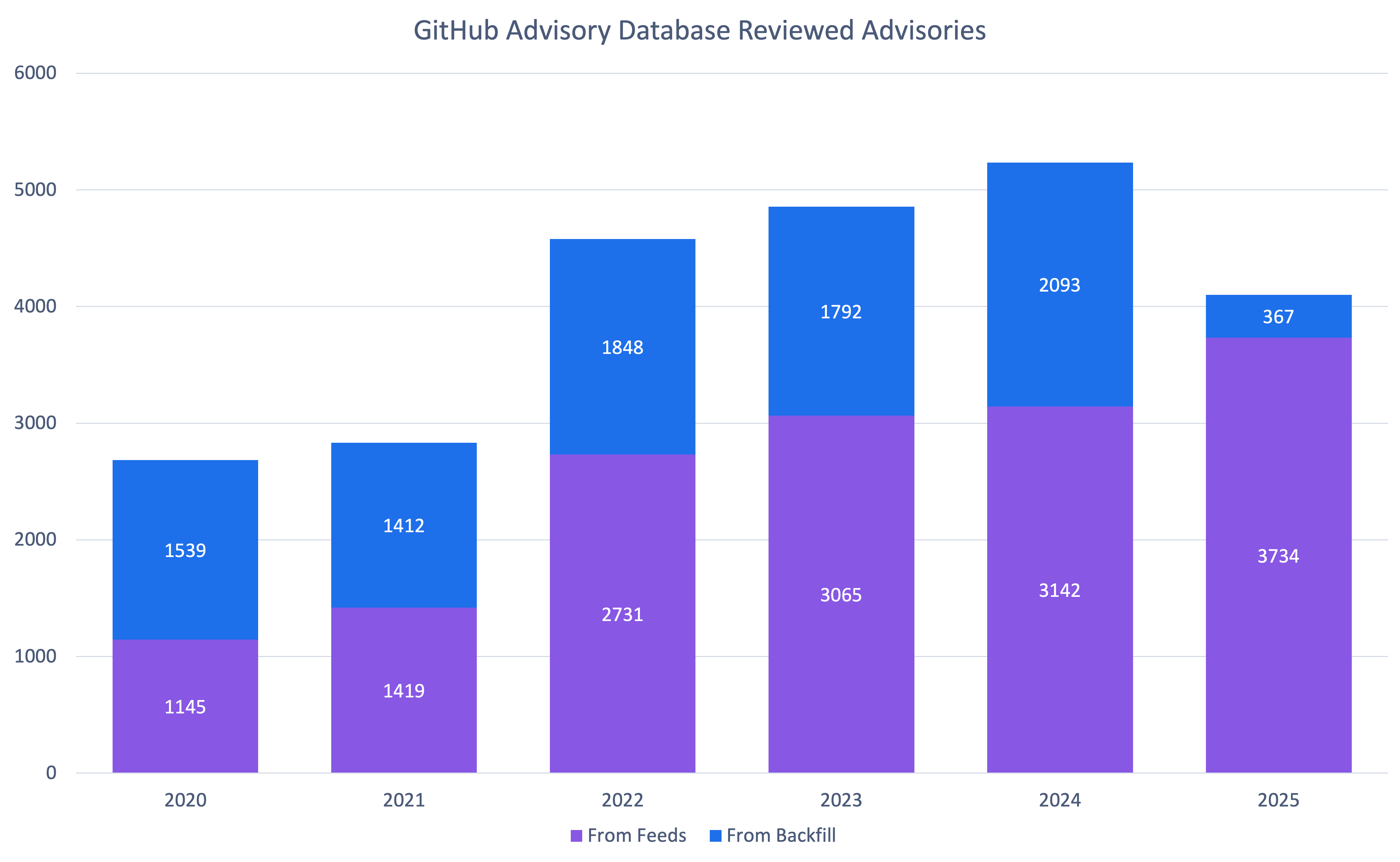
GitHub published 4,101 reviewed advisories in 2025. This is the fewest number of reviewed advisories since 2021.  Does this mean open source is shipping more secure code? Let’s dig into the data to find out.

GitHub reviewed advisories

Fewer advisories reviewed doesn’t mean fewer vulnerabilities were reported. The drop is because GitHub reviewed far fewer older vulnerabilities. When you look only at newly reported vulnerabilities from our sources, GitHub actually reviewed 19% more advisories year over year.

Stacked bar graph showing the number of advisories published from GitHub's feeds and those published from the backfill campaigns.

Reviewed Year	From Feeds	From Backfill
2020	1145	1539
2021	1419	1412
2022	2731	1848
2023	3065	1792
2024	3142	2093
2025	3734	367

So why the change? Quite frankly, we are running out of unreviewed vulnerabilities that are older than the Advisory Database. At the same time, the number of newly reported vulnerabilities hasn’t dropped.

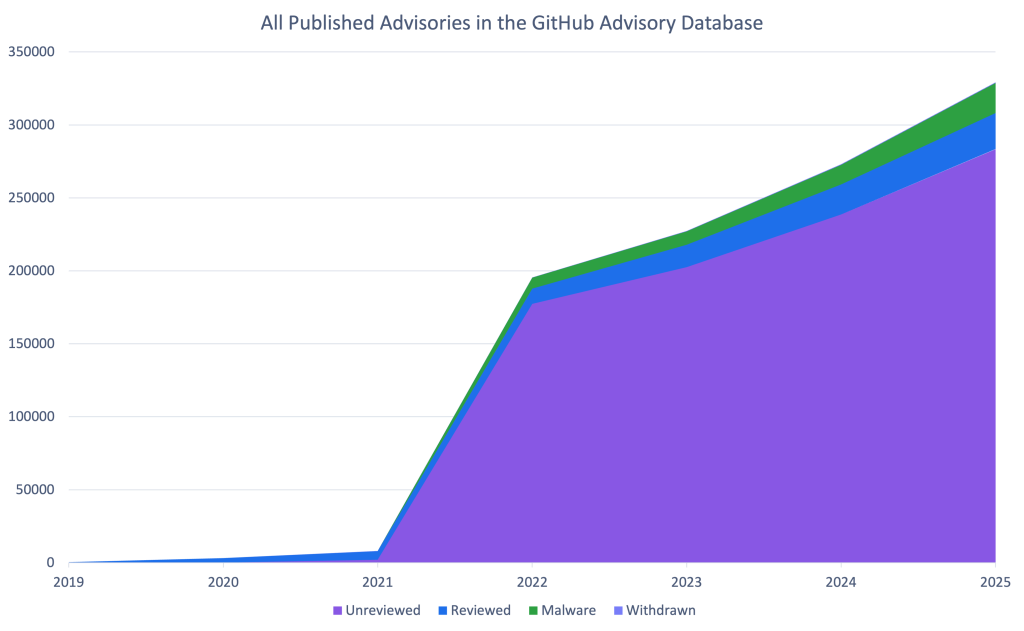
It’s also worth clarifying that “unreviewed” in the database can be misleading: most advisories marked unreviewed have already been looked at by a curator and found not to affect any package in a supported ecosystem, so they may never be fully reviewed.

Stacked line graph showing the cumulative number of advisories of each type over the years.

Year	Unreviewed	Reviewed	Malware	Withdrawn
2019	0	381	0	42
2020	0	3,065	0	101
2021	1,978	5,896	0	140
2022	177,369	10,475	7,433	195
2023	202,583	15,332	9,136	290
2024	238,642	20,567	13,404	413
2025	283,447	24,668	20,649	522

This means that you should be receiving fewer brand-new Dependabot alerts about old vulnerabilities. 

Note: If you find an unreviewed advisory that affects a supported package, please let us know so we can get it reviewed!

How vulnerabilities were distributed across ecosystems in 2025

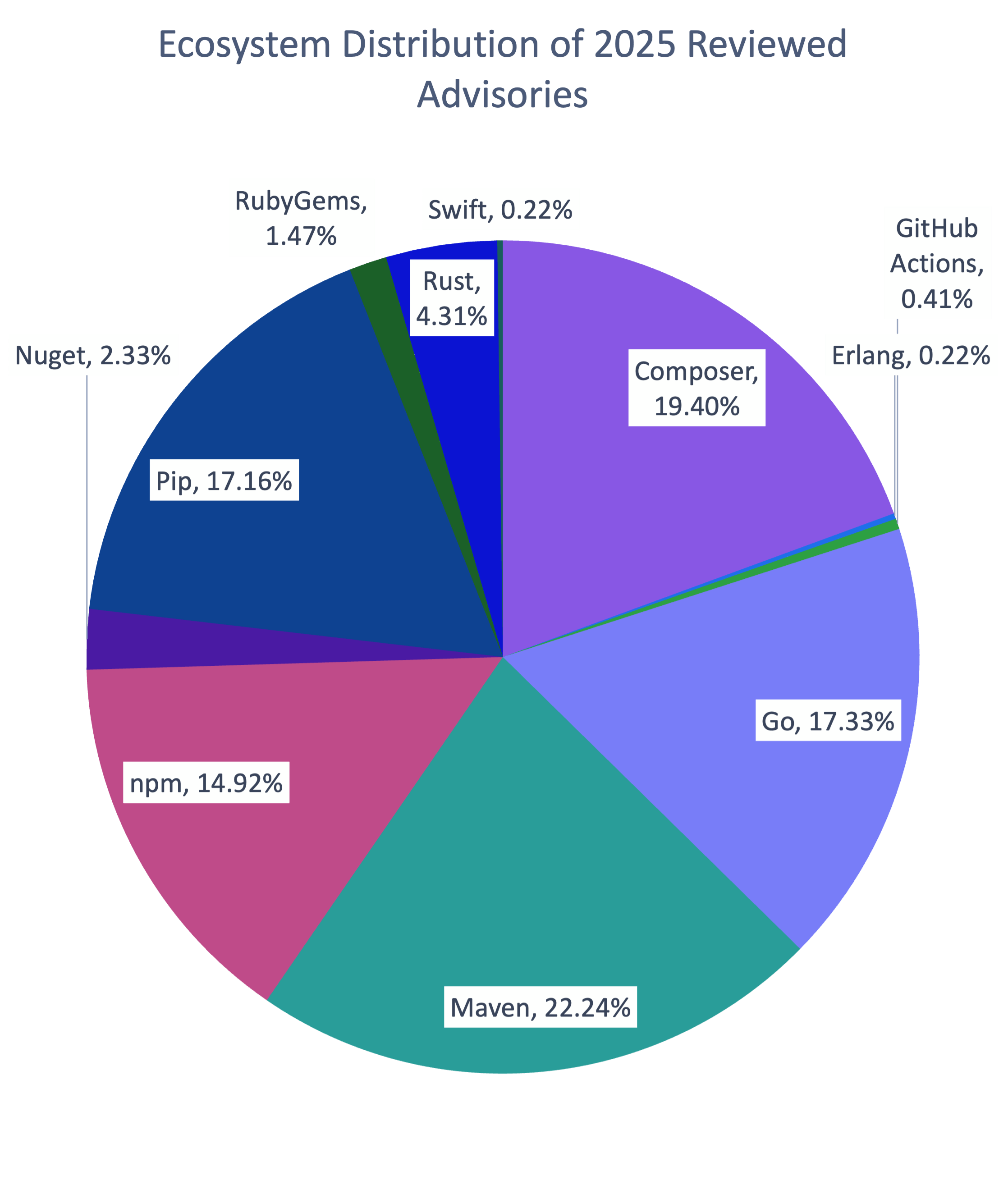
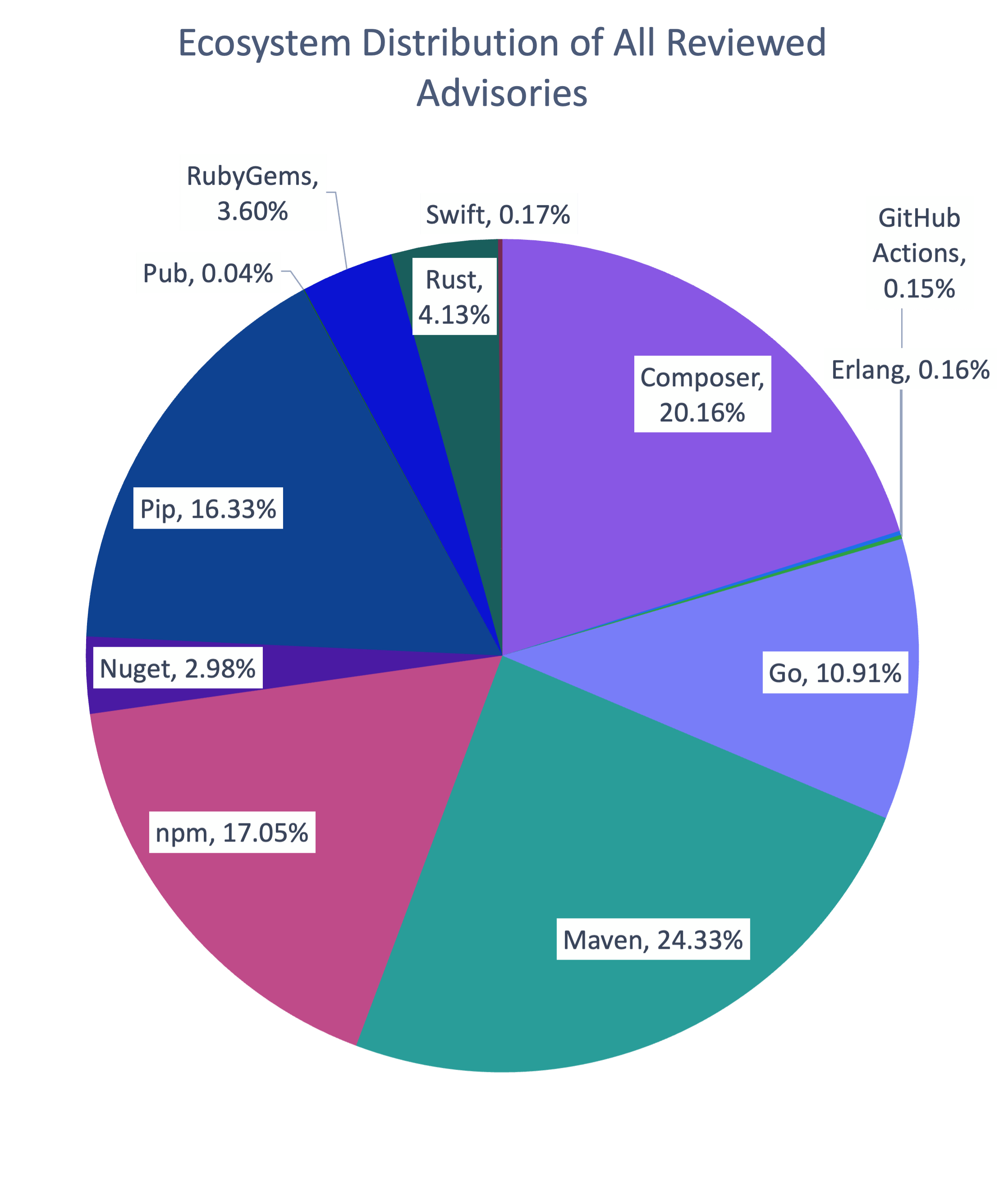
The distribution of ecosystems in advisories reviewed in 2025 is similar to the overall distribution in the database, with the exception of Go. Go is overrepresented in 2025 advisories by 6%. This is largely due to dedicated campaigns to re-examine potentially missing advisories found through an internal review for packages where we had inconsistent coverage.

Circle graph showing the distributions of ecosystems of advisories reviewed in 2025.

Ecosystem	Proportion of 2025 Reviewed Advisories
Composer	19.40%
Erlang	0.22%
GitHub Actions	0.41%
Go	17.33%
Maven	22.24%
npm	14.92%
Nuget	2.33%
Pip	17.16%
RubyGems	1.47%
Rust	4.31%
Swift	0.22%
Circle graph showing the distributions of ecosystems of reviewed advisories across the entire GitHub Advisory Database.

Ecosystem	Proportion of All Reviewed Advisories
Composer	20.16%
Erlang	0.16%
GitHub Actions	0.15%
Go	10.91%
Maven	24.33%
npm	17.05%
Nuget	2.98%
Pip	16.33%
Pub	0.04%
RubyGems	3.60%
Rust	4.13%
Swift	0.17%

How the types of vulnerabilities changed in 2025

RankCommon Weakness Enumeration (CWE)Number of 2025 Advisories*Change in Rank from 2024Change in Rank from the Overall Database
1CWE-79672+0+0
2CWE-22214+2+1
3CWE-863169+9+8
4CWE-20154+1+1
5CWE-200145-2-1
6CWE-400144+4+0
7CWE-770136+7+10
8CWE-502134+5+1
9CWE-94119-3-1
10CWE-918103+5+8

* An advisory may have more than CWE. For example, an advisory might have both CWE-400 and CWE-770. It would then count for both.

As usual, cross-site scripting (CWE-79) is by far the most common vulnerability type. However, there are significant changes in the following areas. Resource exhaustion (CWE-400 and CWE-770), unsafe deserialization (CWE-502), and server-side request forgery (CWE-918) were unusually common in 2025. CWE-863 (“Incorrect Authorization”) saw a significant jump, but that is largely due to reclassification away from CWE-284 (“Improper Access Control”) and CWE-285 (“Improper Authorization”), which are higher level CWEs that the CWE program discourages using.

One of the biggest quality improvements in 2025 was more specific, more consistent CWE tagging. Advisories without any CWE dropped 85% (from 452 in 2024 to 65 in 2025). CWE-20 (“Improper Input Validation”) is still common, but in prior years it was often the only CWE listed on an advisory. 

In 2025, advisories far more often list CWE-20 plus one or more additional CWEs that describe the concrete failure mode. This added specificity makes the data more actionable for triage, prioritization, and remediation.

To find out how to filter Dependabot alerts by CWE, see our documentation on auto-triage rules.

How to prioritize your response

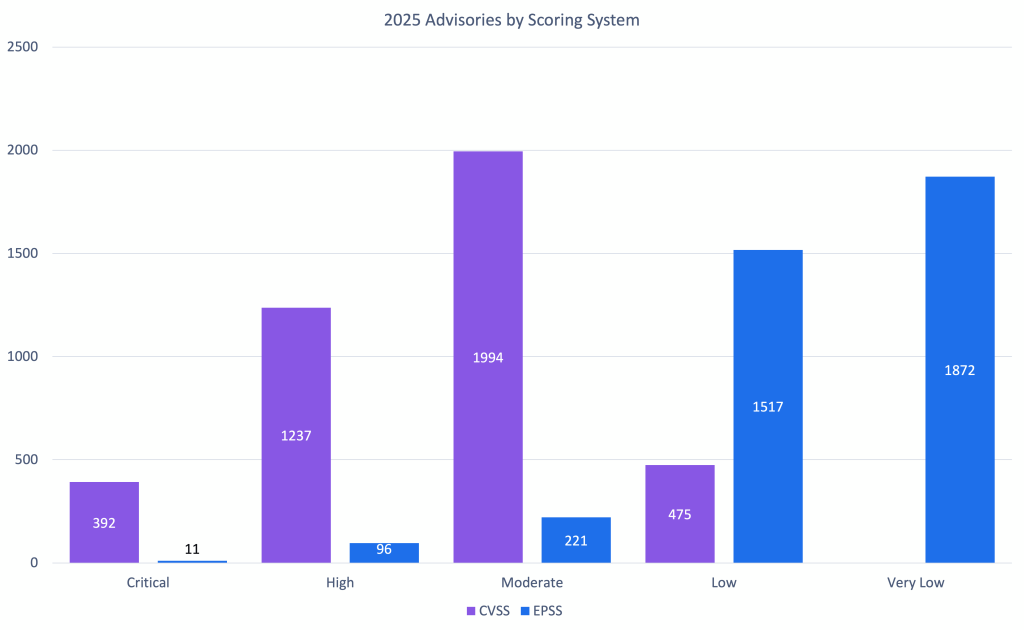
We provide two scoring systems for prioritization: 

Together, they can give you a head start on your risk assessment process.

Priority	CVSS	EPSS
Critical	392	11
High	1237	96
Moderate	1994	221
Low	475	1517
Very Low		1872

As you can see, when considering impact, most vulnerabilities skew moderate to high of the impact range. Low-impact vulnerabilities are likely more common than the CVSS data suggests but are often not considered worth the time and effort for researchers and maintainers to report. The EPSS scores for moderate to high impact vulnerabilities support this decision.

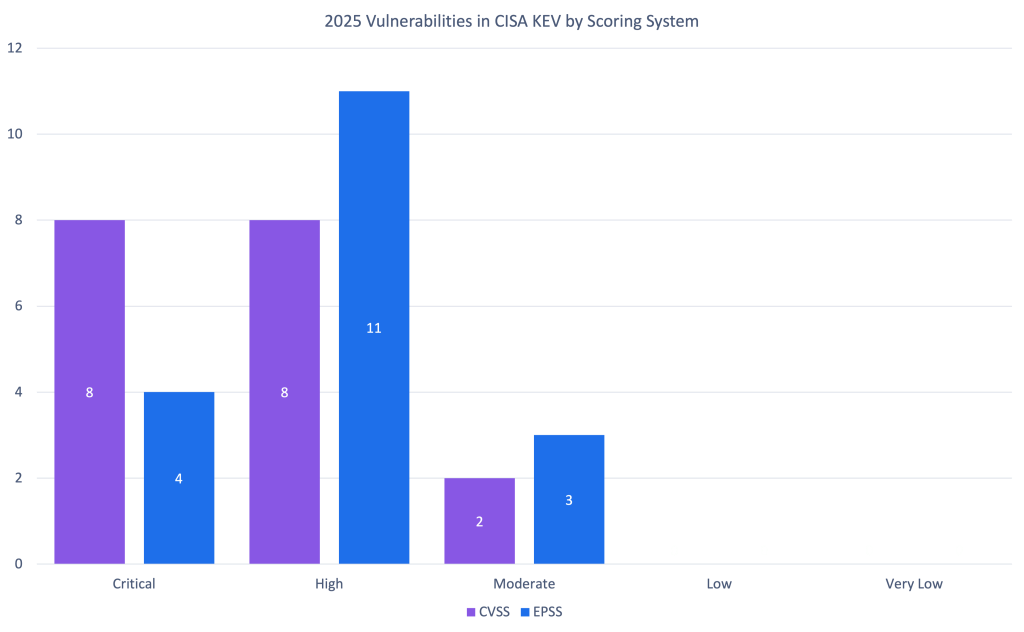
Priority	CVSS	EPSS
Critical	8	4
High	8	11
Moderate	2	3
Low	0	0
Very Low	0	0

So should you trust the EPSS or CVSS scores? To judge that, let’s look at how they match up to vulnerabilities in CISA’s Known Exploited Vulnerabilities Catalog. The exploited vulnerabilities are at least scored moderate, and most are critical or high. While CVSS has more of the exploited vulnerabilities as critical, it also has far more vulnerabilities in the range in general. Combining the two can help you prioritize which vulnerabilities to address to prevent exploitation.

npm malware advisories

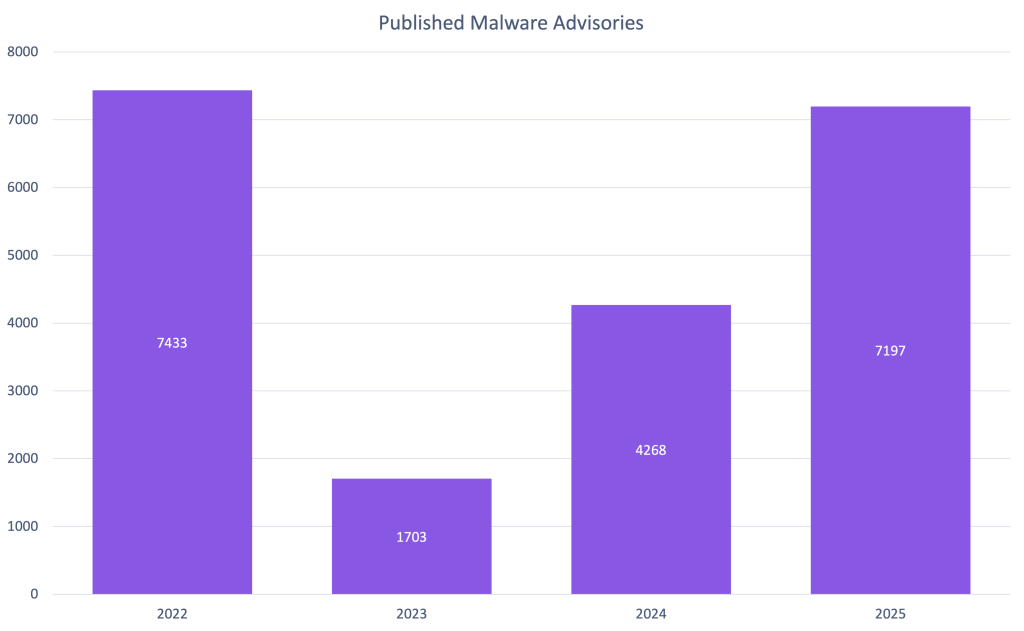
2025 was a huge year for npm malware advisories. Due to large malware campaigns, such as SHA1-Hulud, GitHub saw a 69% increase in published malware advisories compared to 2024. This is the most malware advisories GitHub has published since our initial release of historical malware when we added support in 2022.

You can receive Dependabot alerts when your repositories depend on npm packages with known malicious versions. When you enable malware alerting, Dependabot matches your npm dependencies against malware advisories in the GitHub Advisory Database.

Bar graph showing the number of published malware advisories each year.

Publication Year	Published Malware Advisories
2022	7433
2023	1703
2024	4268
2025	7197

GitHub CVE Numbering Authority (CNA)

CVE publications

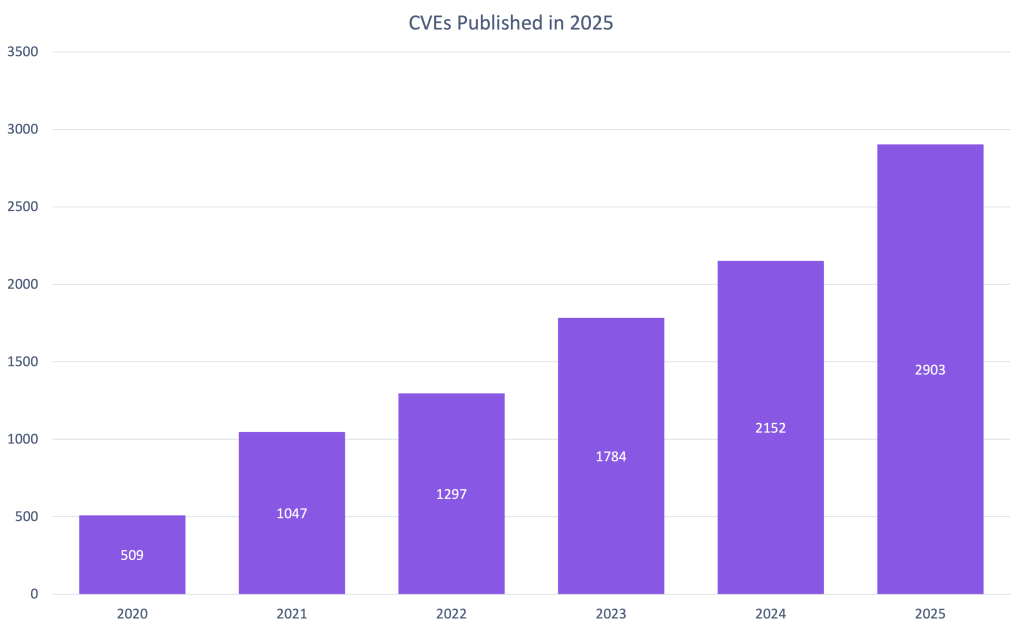
2025 was a big year for the GitHub, Inc. CNA. We saw a 35% increase in published CVE records, outpacing the overall CVE Project’s increase of 21%.

Bar graph showing the number of CVEs GitHub published year.

Published Year	CVEs Published in 2025
2020	509
2021	1047
2022	1297
2023	1784
2024	2152
2025	2903

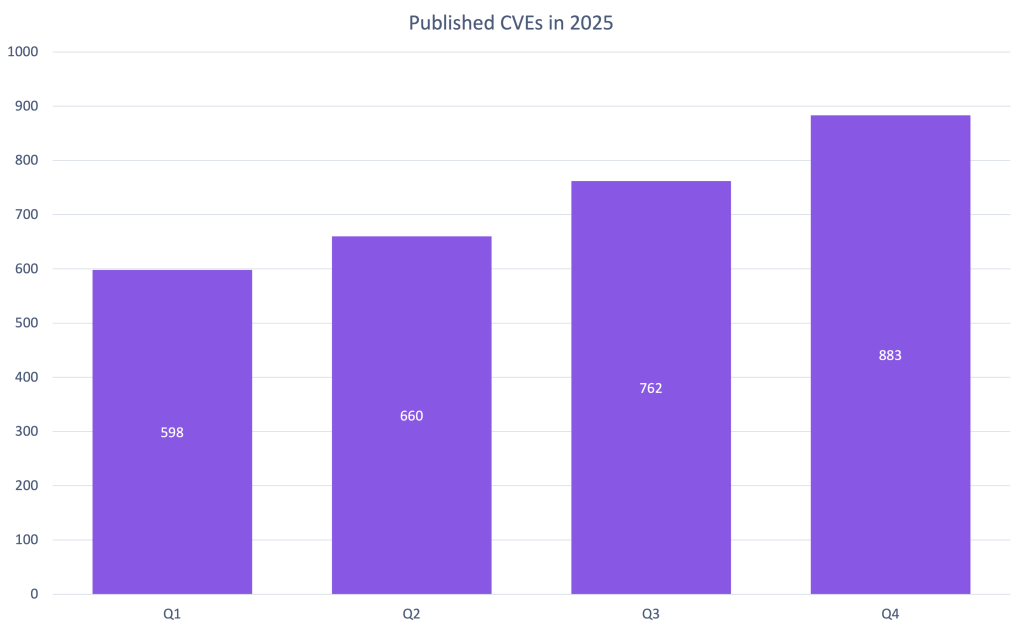
In fact, we saw 10 to 16% growth every quarter. If this trend continues, GitHub will publish over 50% more CVEs in 2026.

Bar graph showing the number of CVEs published by GitHub each quarter in 2025.

2025 Published Quarter	Number of CVEs
Q1	598
Q2	660
Q3	762
Q4	883

You can help make that a reality by requesting a CVE from us the next time you publish a repository security advisory about a vulnerability!

Organizations using GitHub’s CNA

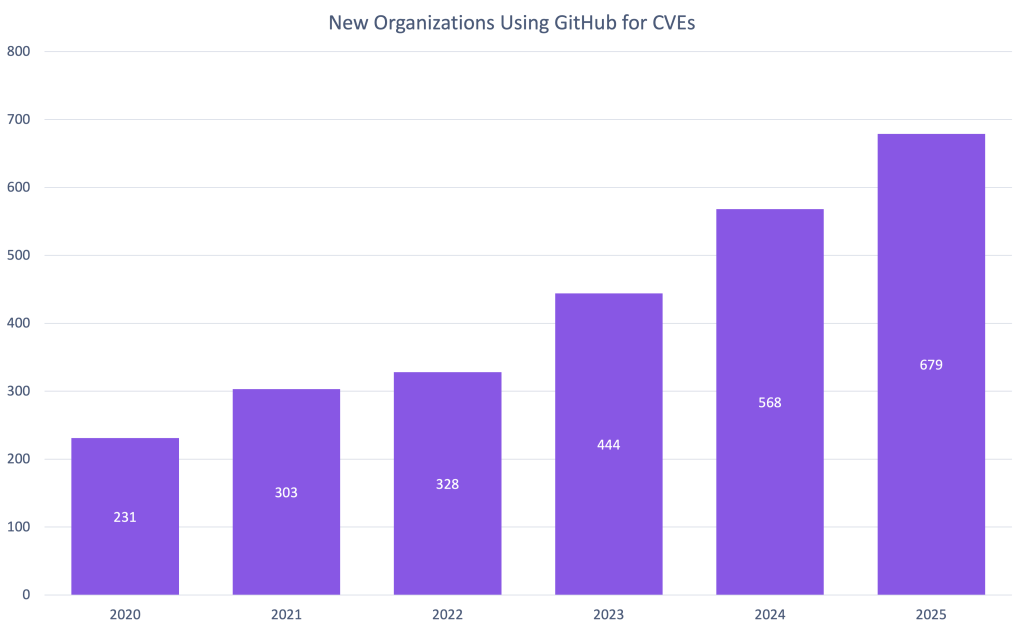
Every year, GitHub sees more organizations use its CNA services. 2025 is no exception with a 20% increase in new organizations requesting CVE IDs.

Bar graph showing the number of new organizations using GitHub for CVEs for each year.

First CVE Year	New Organizations Using GitHub for CVEs
2020	231
2021	303
2022	328
2023	444
2024	568
2025	679

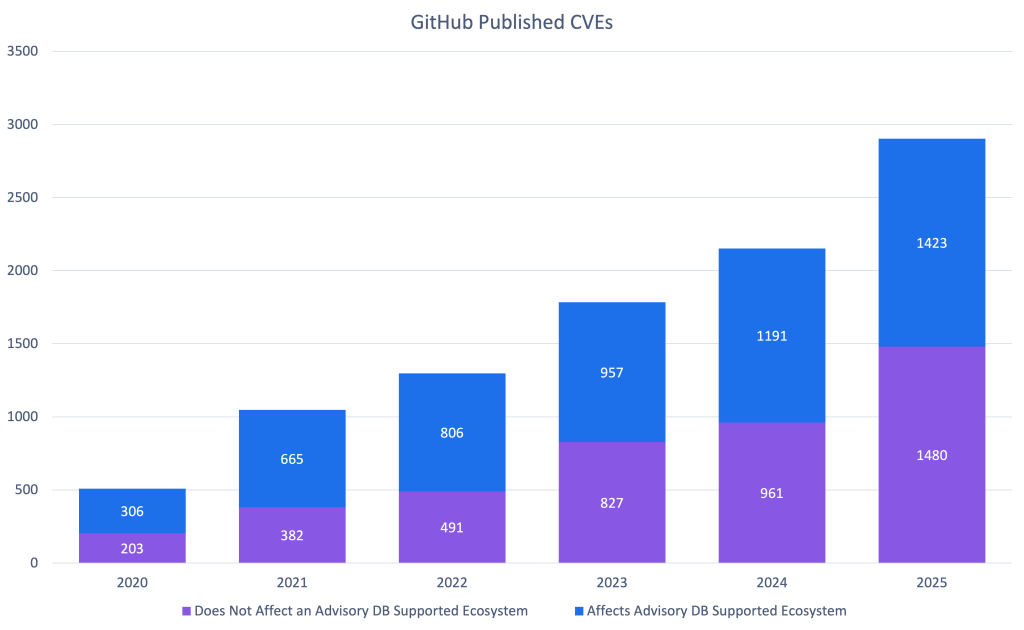
Unlike reviewed global advisories, which are always mapped to packages in ecosystems we support, any maintainer on GitHub can request a CVE, even if they don’t publish that package to a supported ecosystem. In fact, 2025 is the first year that GitHub has published more CVEs from organizations that do not use a supported ecosystem than those that do.

Stacked bar graph showing the number of CVEs GitHub published for vulnerabilities affected supported packages vs CVEs that don’t.

Published Year	Does Not Affect an Advisory DB Supported Ecosystem	Affects Advisory DB Supported Ecosystem
2020	203	306
2021	382	665
2022	491	806
2023	827	957
2024	961	1191
2025	1480	1423

We would like to thank all 987 organizations that published CVEs with us in 2025 and highlight the top 10 most prolific organizations.

Top 10 organizations using the GitHub CNA
OrganizationNumber of 2025 CVEs
LabReDeS (WeGIA)*130
XWiki40
Frappe28
Discourse27
Enalean27
FreeScout*27
DataEase26
Nextcloud25
GLPI24
DNN Software*23

* Organizations that published CVEs through GitHub for the first time in 2025

Onward to 2026

The data from 2025 shows incredible growth: 

  • 4,101 reviewed advisories 
  • 7,197 malware advisories 
  • 2,903 CVEs published
  • 679 new organizations using our CNA services

These numbers represent real security improvements for millions of developers.

You can be part of this in 2026. Here’s how: 

1. Use our CNA services

Publishing CVEs shouldn’t be complicated. Request a CVE directly from your repository security advisory, and we’ll take care of curating and publishing it for you. It’s free, it’s fast, and it helps the entire ecosystem understand and respond to vulnerabilities.

2. Improve advisory accuracy

Found an unreviewed advisory affecting a supported package? See incorrect severity scores or missing affected versions? Suggest edits. Your edits will be reviewed by the Advisory Database team and ultimately, will help make the database more accurate for everyone. In 2025, 675 contributions from the community improved the quality of this data for the entire software industry!

3. Protect your projects

The most direct impact you can have is protecting your own code. Enable Dependabot to automatically receive security updates and explore GitHub Advanced Security for comprehensive protection.

4. Make reporting a vulnerability easier

Let researchers know how to report to you and what you will and will not accept by creating a security policy for your repository. Enable private vulnerability reporting to make the coordination process smooth and secure.

Let’s make 2026 even better. See you in next year’s review! 🚀

The post A year of open source vulnerability trends: CVEs, advisories, and malware appeared first on The GitHub Blog.

GitHub Advisory Database by the numbers: Known security vulnerabilities and what you can do about them

The GitHub Advisory Database (Advisory DB) is a vital resource for developers, providing a comprehensive list of known security vulnerabilities and malware affecting open source packages. This post analyzes trends in the Advisory DB, highlighting the growth in reviewed advisories, ecosystem coverage, and source contributions in 2024. We’ll delve into how GitHub provides actionable data to secure software projects.

Advisories

The GitHub Advisory Database contains a list of known security vulnerabilities and malware, grouped in three categories: 

  • GitHub-reviewed advisories: Manually reviewed advisories in software packages that GitHub supports.
  • Unreviewed advisories: These are automatically pulled from the National Vulnerability Database (NVD) and are either in the process of being reviewed, do not affect a supported package, or do not discuss a valid vulnerability.
  • Malware advisories: These are specific to malware threats identified by the npm security team.

Reviewed advisories

GitHub-reviewed advisories are security vulnerabilities that have been mapped to packages in ecosystems we support. We carefully review each advisory for validity and ensure that they have a full description, and contain both ecosystem and package information.

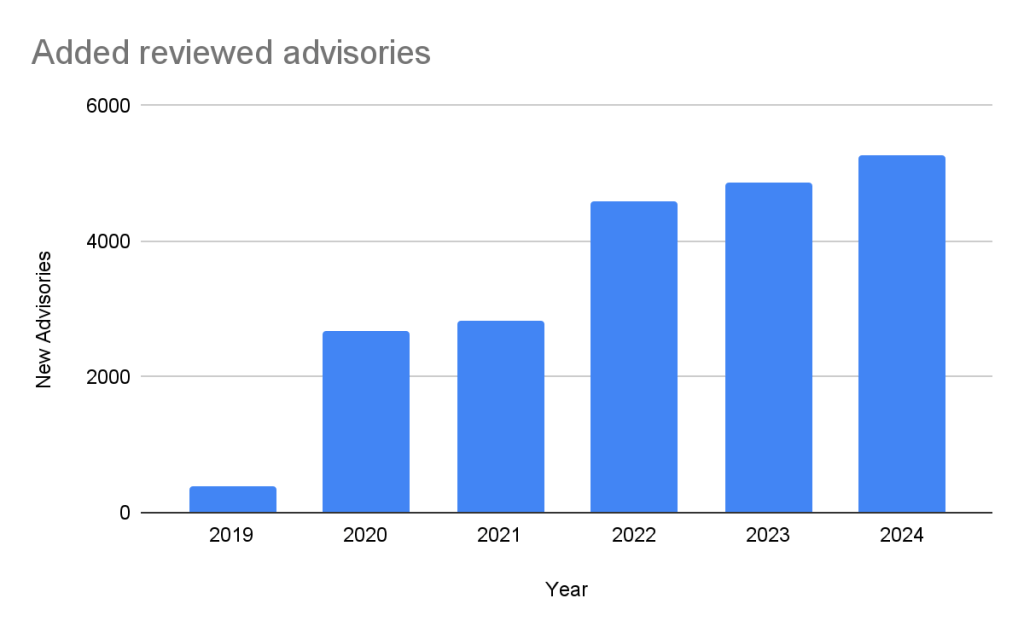
Every year, GitHub increases the number of advisories we publish. We have been able to do this due to the increase in advisories coming from our sources (see Sources section below), expanding our ecosystem coverage (also described below), and review campaigns of advisories published before we started the database. 

The bar graph shows the number of reviewed advisories added each year. The graph starts with 385 advisories added in 2019, shows an increase over time, and ends with 5256 advisories added in 2024.

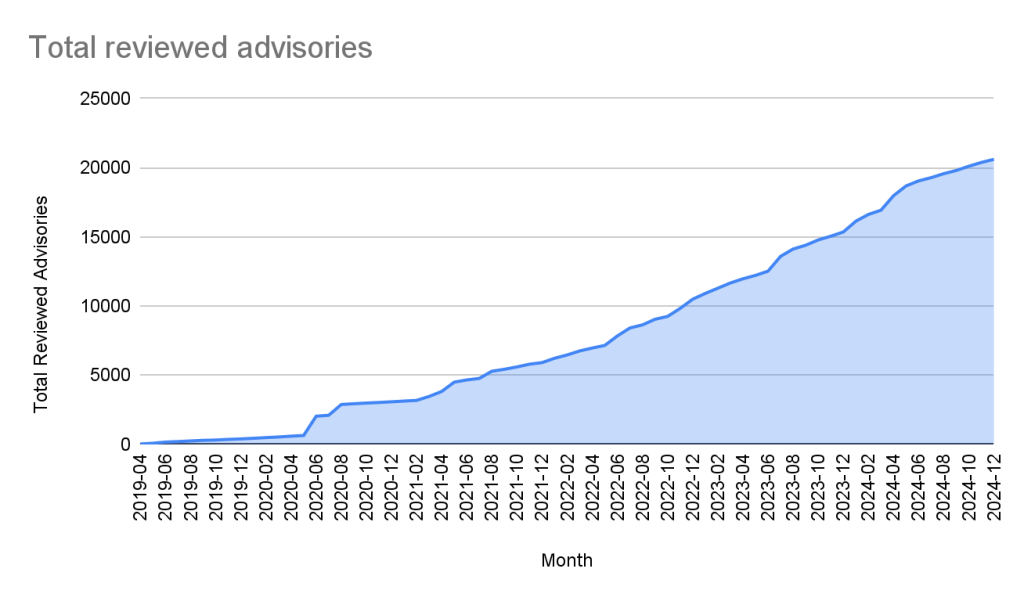
In the past five years, the database has gone from fewer than 400 reviewed advisories to over 20,000 reviewed advisories in October of 2024.

The line graph shows the total reviewed advisories steadily increasing from 0 in 2019 to 20607 at the end of 2024.

Unreviewed advisories

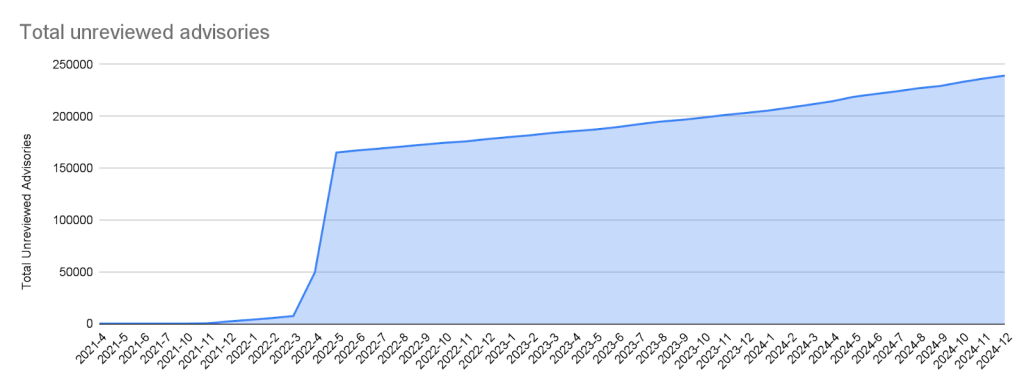
Unreviewed advisories are security vulnerabilities that we publish automatically into the GitHub Advisory Database directly from the National Vulnerability Database feed. The name is a bit of a misnomer as many of these advisories have actually been reviewed by a GitHub analyst. The reason why they fall into this category is because they are not found in a package in one of the supported ecosystems or are not discussing a valid vulnerability, and all have been reviewed by analysts other than someone from the GitHub Security Lab. Even though most of these advisories will never turn into a reviewed advisory, we still publish them so that you do not have to look in multiple databases at once.

The line graph shows the total number of advisories overtime. The graph shows a sudden jump in April 2022, when GitHub started publishing all vulnerabilities from the National Vulnerability Database feed. It then shows a gradual increase over time.

Malware

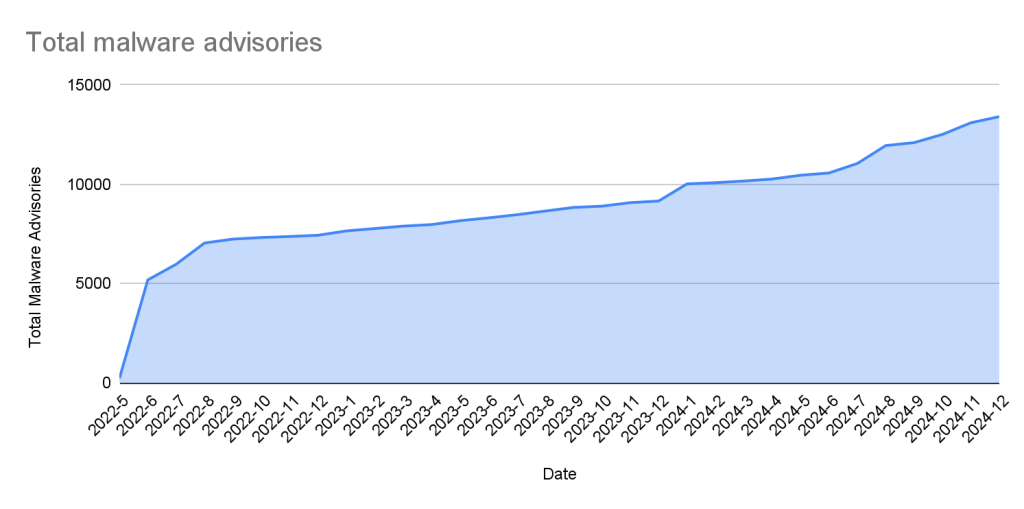
Malware advisories relate to vulnerabilities caused by malware, and are security advisories that GitHub publishes automatically into the GitHub Advisory Database directly from information provided by the npm security team. Malware advisories are currently exclusive to the npm ecosystem. GitHub doesn’t edit or accept community contributions on these advisories.

The line graph shows the total malware advisories over time, from May 2022 to December 2024. The line shows a general upward trend in malware advisories over the period, ending at 13405 advisories.

Ecosystem coverage

GitHub-reviewed advisories include security vulnerabilities that have been mapped to packages in ecosystems we support. Generally, we name our supported ecosystems after the software programming language’s associated package registry. We review advisories if they are for a vulnerability in a package that comes from a supported registry.

EcosystemTotal advisoriesVulnerable packagesFirst added
pip (registry: https://pypi.org/)337810442019-04-19
Maven (registry: https://repo.maven.apache.org/maven2)51719552019-04-22
Composer (registry: https://packagist.org/)42388122019-04-26
npm (registry: https://www.npmjs.com/)365326522019-04-26
RubyGems (registry: https://rubygems.org/)8403712019-04-26
NuGet (registry: https://www.nuget.org/)6514892019-04-26
Go (registry: https://pkg.go.dev/)20118652021-04-01
Rust (registry: https://crates.io/)8575532021-05-25
Erlang (registry: https://hex.pm/)31262022-01-27
GitHub Actions (https://github.com/marketplace?type=actions/)21212022-07-29
Pub (registry: https://pub.dev/packages/registry)1092022-08-04
Swift (registry: N/A)33212023-05-10
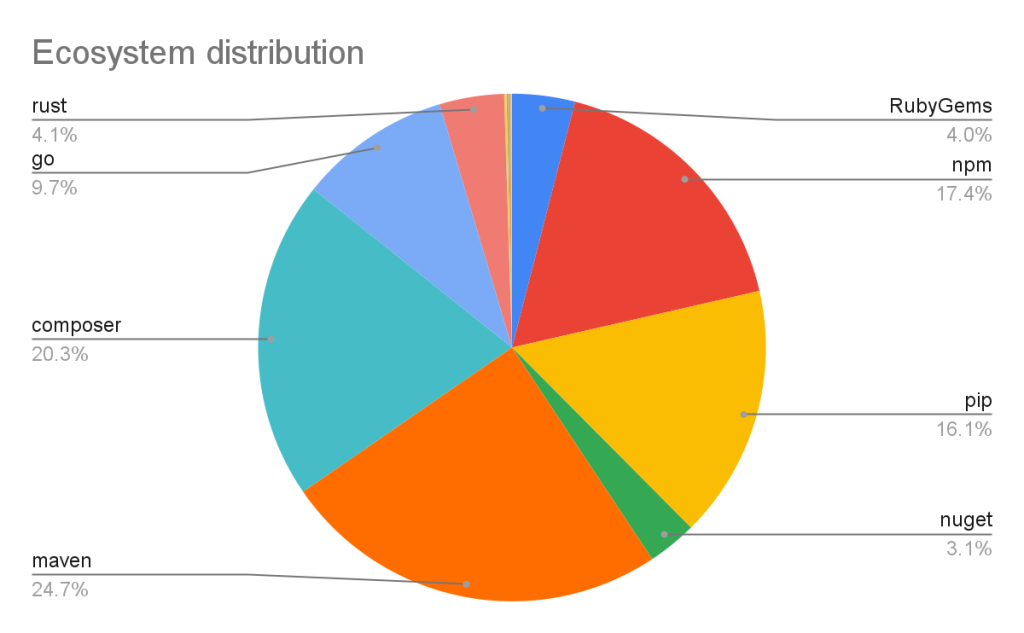
The pie chart shows the proportion of advisories across different software ecosystems. Maven, Composer, npm, Pip, and Go are the largest ecosystems.

Vulnerabilities in Maven and Composer packages are nearly half of the advisories in the database. npm, pip, and Go make up much of the rest, while the other ecosystems have a much smaller footprint.

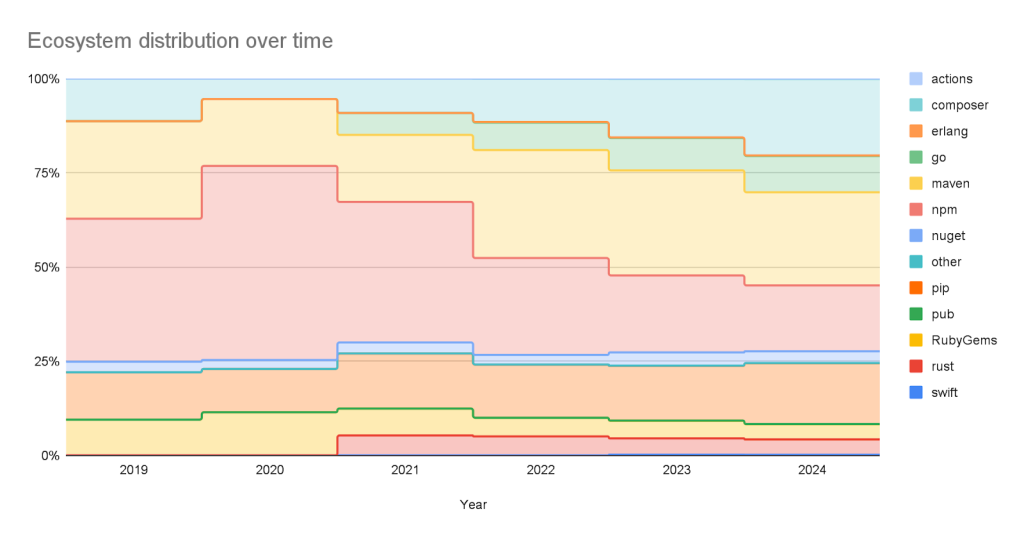
This has not always been the case. When the database was initially launched, NPM advisories dominated the database, but as we have expanded our coverage and added support for new ecosystems, the distribution mix has changed.

The stacked area line graph shows the percentage distribution of various ecosystems from 2019 to 2024. The graph starts with half the advisories being for NPM but over time, other ecosystems like Maven and Composer become more prominent.

Sources: Where do the advisories come from?

We add advisories to the GitHub Advisory Database from the following sources:

SourceAdvisoriesReviewed advisoriesSole sourceCoverage
NVD2674291829574506.84%
GitHub Repository Advisories12247531156443.37%
Community Contributions451241601092.20%
PyPA Advisories304027391490.10%
Go Vulncheck15811528796.65%
NPM Advisories1411140862999.79%
FriendsOfPHP1406139640099.29%
RustSec94384917190.03%
RubySec873861498.63%
  • NVD: This is a huge source of vulnerabilities covering all types of software. We publish all NVD advisories but only review those relevant to our supported ecosystems, which reduces noise for our users.
  • GitHub Repository Advisories: The second largest source is made up of advisories published through GitHub’s repository security advisory feature. Similar to NVD, these aren’t restricted to our supported ecosystems. However, we provide better coverage of the repository advisories because they focus exclusively on open source software.
  • Community Contributions: These are reports from the community that are almost exclusively requesting updates to existing advisories.
  • Other Specialized Sources: Sources like PyPA Advisories (for Python) and Go Vulncheck (for Go) that focus on specific ecosystems. Because they only cover packages within our supported ecosystems, most of their advisories are relevant to us and get reviewed.
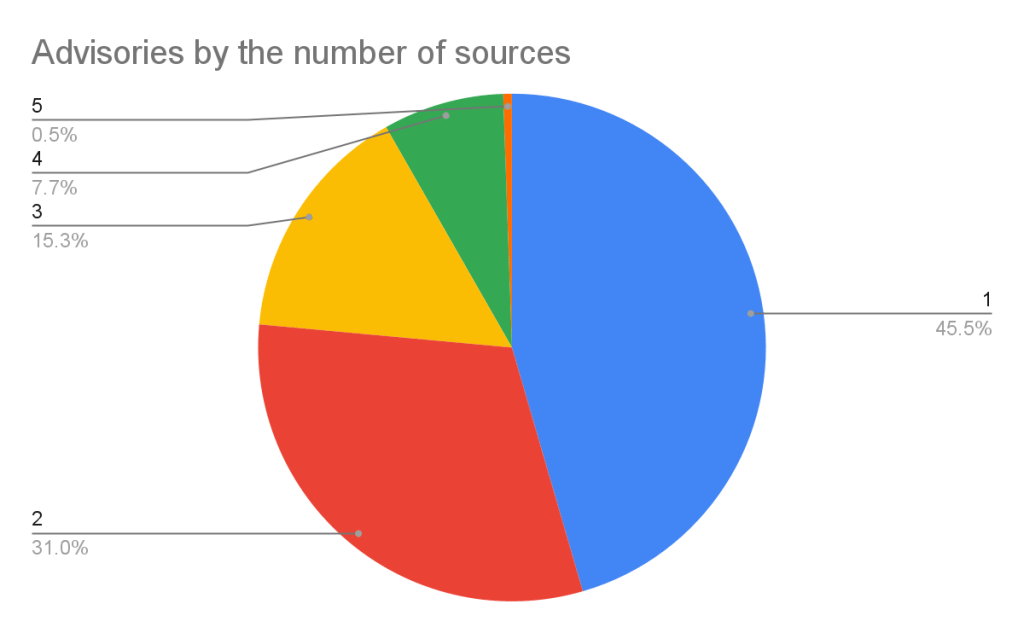
The pie graph shows the proportion of advisories by the number of sources they have. This shows that 46% of the advisories have only one source and 85% have three or fewer.

If you add up the number of reviewed advisories from each source, you will find that total is more than the total reviewed advisories. This is because each source can publish an advisory for the same vulnerability. In fact, over half of our advisories have more than one source.

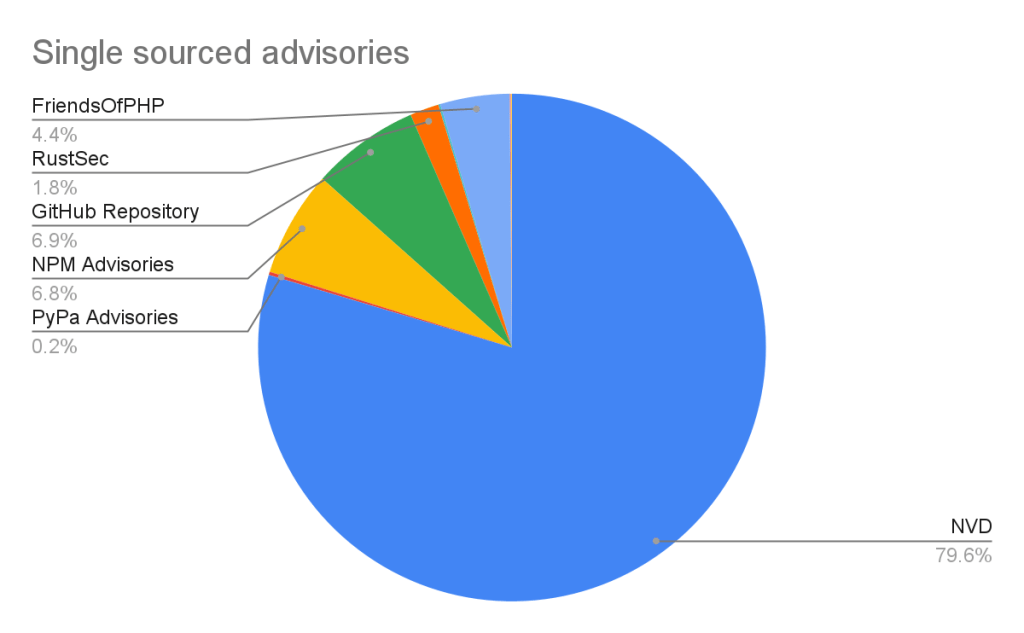
The pie graph shows the proportion of advisories that have a single source by the source they came from. The graph shows that 80% of all single sourced advisories come from the National Vulnerability Database.

Of the advisories with a single source, nearly all of them come from NVD/CVE. This justifies NVD/CVE as a source, even though it is by far the noisiest.

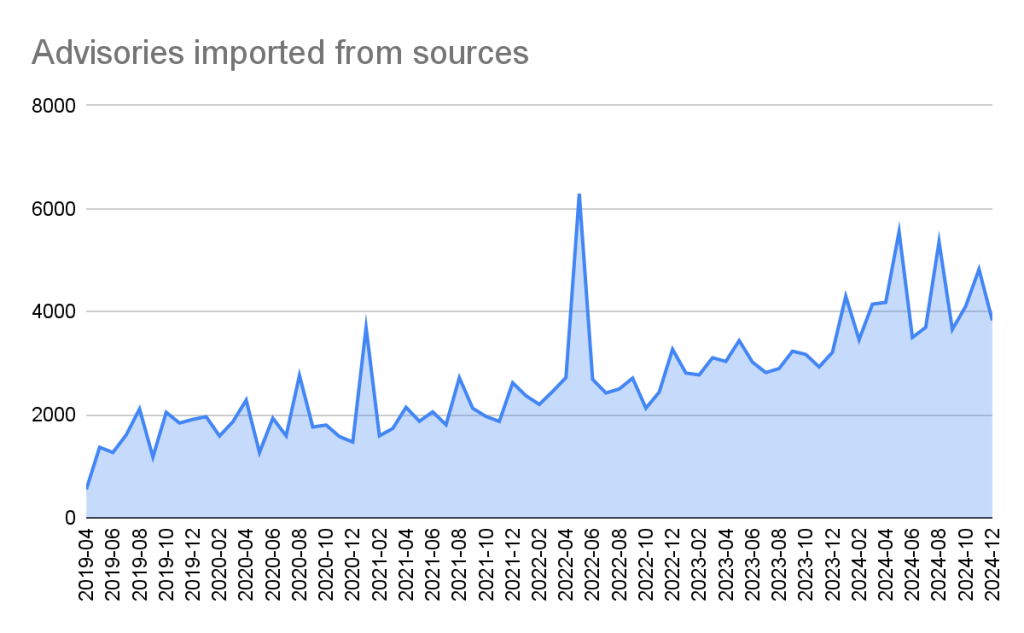
The line graph shows the number of advisories imported over time. The graph shows an increase in imports over time.

2024 saw a significant increase (39%) in the number of advisories imported from our sources. This is for the most part caused by an increase in the number of CVE records published.

CVE Numbering Authority

In addition to publishing advisories in the GitHub Advisory Database, we are also a CVE Numbering Authority (CNA) for any repository on GitHub. This means that we issue CVE IDs for vulnerabilities reported to us by maintainers, and we publish the vulnerabilities to the CVE database once the corresponding repository advisory is published.

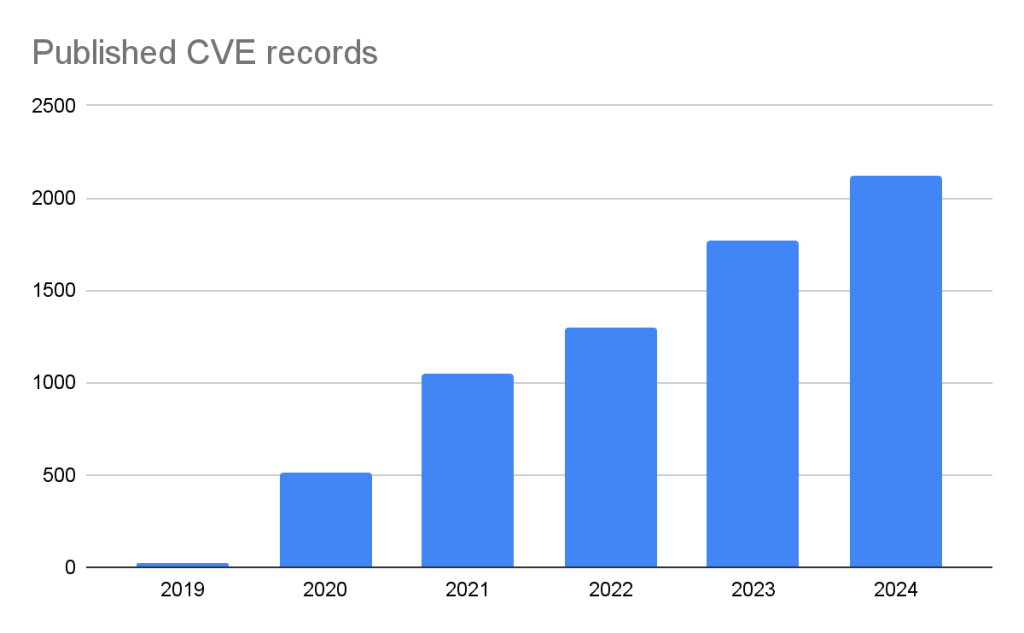
GitHub published over 2,000 CVE records in 2024, making us the fifth-largest CNA in the CVE Program.

The bar graph shows the number of CVE records published by the Advisory Database CNA over time. Every year shows an increase in the number published.

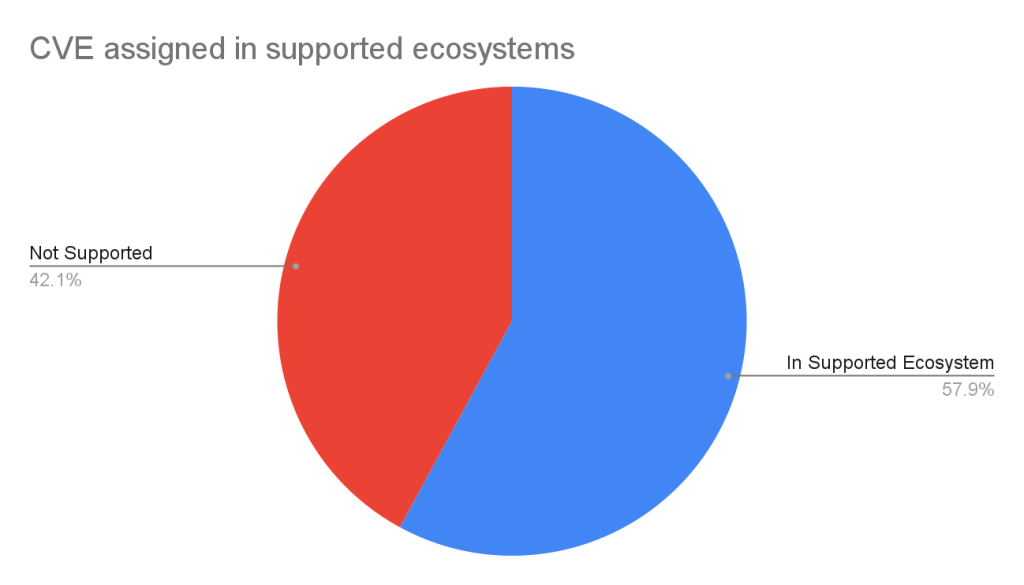
The GitHub CNA is open to all repositories on GitHub, not just ones in a supported ecosystem.

The pie graph shows the proportion of CVEs assigned by the Advisory Database that in a supported ecosystem. 58% are in a supported ecosystem and 42% are not.

Advisory prioritization

Given the constant deluge of reported vulnerabilities, you’ll want tools that can help you prioritize your remediation efforts. To that end, GitHub provides additional data in the advisory to allow readers to prioritize their vulnerabilities. In particular, there are:

  • Severity Rating/CVSS: A low to critical rating for how severe the vulnerability is likely to be, along with a corresponding CVSS score and vector.
  • CWE: CWE identifiers provide a programmatic method for determining the type of vulnerability.
  • EPSS: The Exploit Prediction Scoring System, or EPSS, is a system devised by the global Forum of Incident Response and Security Teams (FIRST) for quantifying the likelihood a vulnerability will be attacked in the next 30 days.

GitHub adds a severity rating to every advisory. The severity level is one of four possible levels defined in the Common Vulnerability Scoring System (CVSS), Section 5.

  • Low
  • Medium/Moderate
  • High
  • Critical

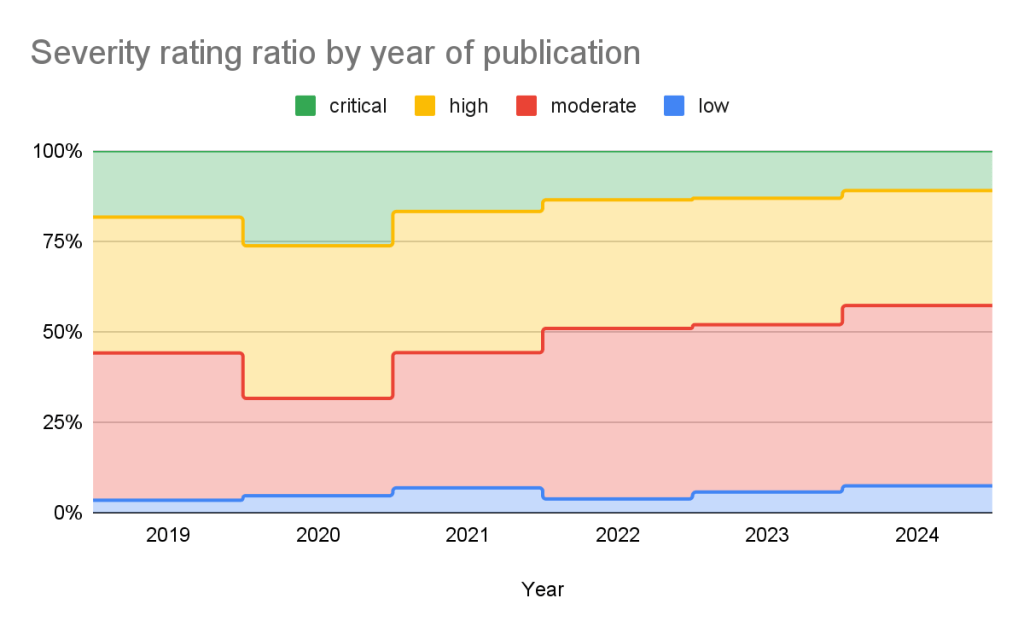
Using these ratings, half of all vulnerabilities (15% are Critical and 35% are High) warrant immediate or near-term attention. By focusing remediation efforts on these, you can significantly reduce risk exposure while managing workload more efficiently.

The stacked area line graph shows the severity rating ration by year of advisory publication. The graph shows that critical vulnerabilities were more common (20 - 25 percent) early on and moderates becoming more common over the years.

The CVSS specification says the base score we provide, “reflects the severity of a vulnerability according to its intrinsic characteristics which are constant over time and assumes the reasonable worst-case impact across different deployed environments.” However, the worst-case scenario for your deployment may not be the same as CVSS’s. After all, a crash in a word processor is not as severe as a crash in a server. In order to give more context to your prioritization, GitHub allows you to filter alerts based on the type of vulnerability or weakness using CWE identifiers. So you have the capability to never see another regular expression denial of service (CWE-1333) vulnerability again or always see SQL injection (CWE-89) vulnerabilities.

RankCWE IDCWE nameNumber of advisories in 2024Change in rank from 2023
1CWE-79Improper Neutralization of Input During Web Page Generation (‘Cross-site Scripting’)936+0
2CWE-200Exposure of Sensitive Information to an Unauthorized Actor320+0
3CWE-22Improper Limitation of a Pathname to a Restricted Directory (‘Path Traversal’)259+2
4CWE-20Improper Input Validation202+0
5CWE-94Improper Control of Generation of Code (‘Code Injection’)188+2
6CWE-89Improper Neutralization of Special Elements used in an SQL Command (‘SQL Injection’)181+3
7CWE-352Cross-Site Request Forgery (CSRF)161-4
8CWE-284Improper Access Control153+4
9CWE-400Uncontrolled Resource Consumption149-3
10CWE-287Improper Authentication124+11

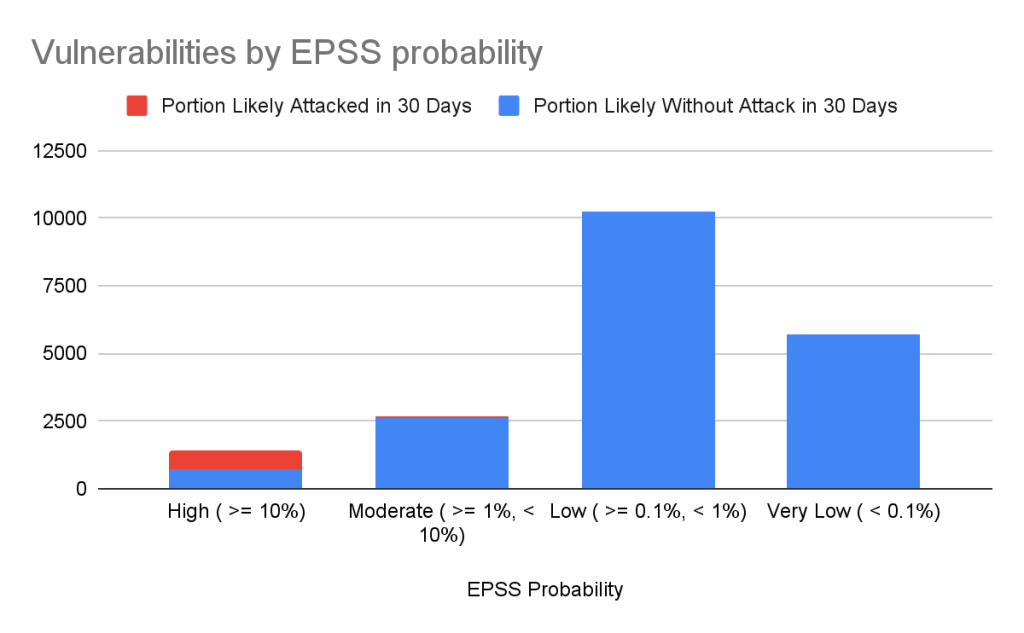
Still drowning in vulnerabilities? Try using EPSS to focus on vulnerabilities likely to be attacked in the next 30 days. EPSS uses data from a variety of sources to create a probability of whether exploitation attempts will be seen in the next 30 days for a given vulnerability. As you can see from the chart below, if you focus on vulnerabilities with EPSS scores of 10% or higher (approx. 7% of all vulnerabilities in the Advisory DB), you can cover nearly all of the vulnerabilities that are likely to see exploit activity.

The bar graph shows the number of advisories by EPSS probability. Most of the advisories are in the Low or Very Low probability.
EPSS probabilityVulnerabilities in rangePercentage of overall vulnerabilitiesExpected vulnerabilities in range attacked within the next 30 daysPercentage of total attacked vulnerabilities
High ( >= 10%)14407.17%74185.96%
Moderate ( >= 1%, < 10%)268713.37%849.74%
Low ( >= 0.1%, < 1%)1026451.09%354.06%
Very Low ( < 0.1%)570128.37%20.23%

Important caveats to remember when using EPSS:

  • Low probability events occur.
  • EPSS does not tell you whether a vulnerability is exploited; it only claims how likely it is.
  • EPSS scores are updated daily and will change as new information comes in, so a low-probability vulnerability today may become high probability tomorrow.

For more details on how to use CVSS and EPSS for prioritization, see our blog on prioritizing Dependabot alerts.

Actionable data

The GitHub Advisory DB isn’t just a repository of vulnerabilities. It powers tools that help developers secure their projects. Services like Dependabot use the Advisory DB to:

  • Identify vulnerabilities: It checks if your projects use any software packages with known vulnerabilities.
  • Suggest fixes: It recommends updated versions of packages that fix those vulnerabilities when available.
  • Reduce noise: You’ll only get notified about vulnerabilities that affect the version of the package you are using.
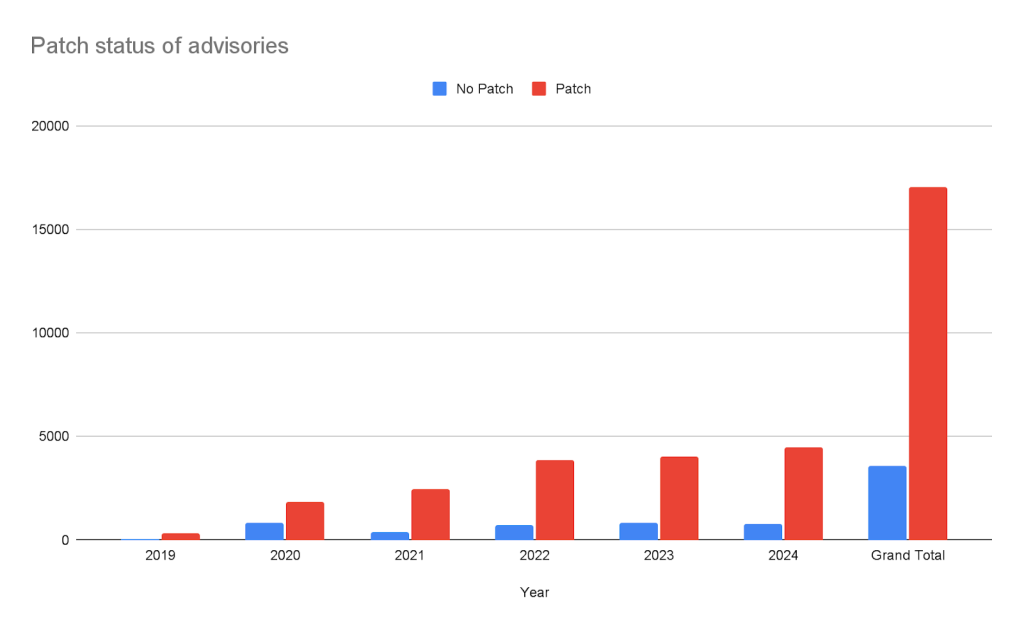
The bar graph shows the number of advisories published with a patch each year next to the number of advisories without a patch. For every year, nearly all of the advisories have a patch.

Take this with you

The GitHub Advisory Database is a powerful resource for tracking open source software vulnerabilities, with over 22,000 reviewed advisories to date. By focusing on popular package registries, GitHub allows you to definitively connect vulnerabilities to the packages you are using. Additional data such as CVSS and EPSS scores help you properly prioritize your mitigation efforts.

GitHub’s role as a CVE Numbering Authority extends beyond the Advisory Database, ensuring that thousands of vulnerabilities each year reach the broader CVE community. Want to ensure your vulnerability fix reaches your users? Create a GitHub security advisory in your repository to take advantage of both the GitHub Advisory Database and GitHub’s CNA services.

Want to dive deeper? Explore security blog posts >

The post GitHub Advisory Database by the numbers: Known security vulnerabilities and what you can do about them appeared first on The GitHub Blog.

❌