While more than two-thirds of human-generated TLS traffic to Cloudflare is already protected by post-quantum cryptography, the world of site-to-site networking has been a different story. For years, the IPsec community remained caught between the high bar of Internet-scale interoperability and the niche requirements of specialized hardware. That gap is now closing.
Earlier this month, we announced that Cloudflare has moved its target for full post-quantum security forward to 2029, spurred by several recent advances in quantum computing. To advance that goal, we’ve made post-quantum encryption in Cloudflare IPsec generally available.
Using the new IETF draft for hybrid ML-KEM (FIPS 203), we’ve successfully tested interoperability with branch connectors from Fortinet and Cisco — meaning you can start protecting your wide-area network (WAN) against harvest-now-decrypt-later attacks today using hardware you already have.
This post explains how we implemented the new hybrid IPsec handshake, why it took four years longer to land than its TLS counterpart, and how the industry is finally consolidating around a standard that works at Internet scale.
Cloudflare IPsec
Cloudflare IPsec is a WAN Network-as-a-Service that replaces legacy network architectures by connecting data centers, branch offices, and cloud VPCs to Cloudflare's global IP Anycast network. Customers get simplified configuration, high availability (if a data center becomes unavailable, traffic is automatically rerouted to the nearest healthy one), and the scale of Cloudflare's global network. This is done through encrypted IPsec tunnels that support both site-to-site WAN, outbound Internet connections, and connectivity to the Cloudflare One SASE platform.
Post-quantum encryption in IPsec
Cloudflare IPsec now uses post-quantum encryption with hybrid ML-KEM (FIPS 203) to stop harvest-now-decrypt-later attacks. These are attacks where an adversary harvests data today and then decrypts later, after Q-Day, when there are powerful quantum computers that can break the classical public key cryptography used across the Internet. Harvest-now-decrypt-later attacks are becoming a concern for more organizations as Q-Day approaches faster than expected.
ML-KEM (Module-Lattice-Based Key-Encapsulation Mechanism) is a post-quantum cryptography algorithm that is based on mathematical assumptions that are not known to be vulnerable to attacks by quantum computers. It does not require special hardware or a dedicated physical link between sender and receiver. ML-KEM is intentionally designed to be implemented in software across standard processors to provide post-quantum encryption of network traffic.
Draft-ietf-ipsecme-ikev2-mlkem specifies post-quantum encryption for IPsec using hybrid ML-KEM, which combines the well-understood security of classical Diffie-Hellman and the post-quantum security of ML-KEM in a single, standards-compliant handshake. Specifically, a classical Diffie-Hellman exchange runs first, its derived key encrypts a second exchange that runs ML-KEM, and the outputs of both are mixed into the session keys that secure IPsec data plane traffic sent using the Encapsulating Security Payload (ESP) protocol.
Our interoperable implementation
Earlier we announced the closed beta of our implementation of draft-ietf-ipsecme-ikev2-mlkem in production in our Cloudflare IPsec product and tested it against a reference implementation (strongswan). Now that we have made this implementation generally available, we have also confirmed interoperability with several other vendors, including Cisco and Fortinet, which is a big win for this new standard.
Fortinet: Customers using Fortinet FortiOS 7.6.6 and later as their branch connector can now establish post-quantum Cloudflare IPsec tunnels to Cloudflare's global network per draft-ietf-ipsecme-ikev2-mlkem.
The importance of being interoperable
Given that upgrading cryptography is hard and can take years, our 2029 target date for a full update to post-quantum cryptography is going to require concentrated effort. That’s why we hope the IPsec community continues to focus on the development of interoperable standards like draft-ietf-ipsecme-ikev2-mlkem.
Let us explain why these standards are vitally important. A full specification for hybrid ML-KEM in IPsec, draft-ietf-ipsecme-ikev2-mlkem, became available only in late 2025. That's roughly four years after support for hybrid ML-KEM landed in TLS. (In fact, Cloudflare turned on hybrid post-quantum key agreement with TLS in 2022, even before NIST finalized the standardization of ML-KEM, because the TLS community quickly converged on a single, interoperable approach and pushed it into production. Today more than two-thirds of the human-generated TLS traffic to Cloudflare's network is protected with hybrid ML-KEM.)
The four-year delay is likely due in part to the IPsec community's continued interest in Quantum Key Distribution (QKD), as codified in RFC 8784, published in 2020. We've written before about why QKD is not part of our post-quantum strategy: QKD requires specialized hardware and a dedicated physical link between the two parties, which fundamentally means it will not operate at Internet scale. Also, QKD does not provide authentication, so you still need post-quantum cryptography anyway to stop active attackers. It’s difficult to find implementations of QKD that interoperate across vendors.
The U.S. NSA, Germany's BSI, and the UK's NCSC have all warned against solely relying on QKD. Post-quantum cryptography, by contrast, runs on the hardware you already have, authenticates the parties at both ends, and works end-to-end across the Internet.
RFC 9370, published in 2023, opened the door to post-quantum cryptography in IPsec, allowing up to seven key exchanges to be run in parallel with classical Diffie-Hellman. However, RFC 9370 did not specify which ciphersuites should be used in these parallel key exchanges. In the absence of that specification, some vendors shipped early implementations under RFC 9370 before the hybrid ML-KEM draft was available, defining their own ciphersuites including some which are not NIST-standardized. This is exactly the kind of “ciphersuite bloat” NIST SP 800 52r2 warned against. And the risks to interoperability have played out in practice: Cloudflare IPsec does not yet interoperate with Palo Alto Networks' RFC 9370–based implementation, because it was launched before draft-ietf-ipsecme-ikev2-mlkem was available.
Fortunately, we now have draft-ietf-ipsecme-ikev2-mlkem that fills in the gaps in RFC 9370, specifying hybrid ML-KEM as one of the key exchange mechanisms that can be operated in parallel with classical Diffie-Hellman. We hope to add Palo Alto Networks to the list of interoperable post-quantum branch connectors as the industry continues to consolidate around draft-ietf-ipsecme-ikev2-mlkem.
But the journey towards interoperable post-quantum IPsec standards is not over yet. While draft-ietf-ipsecme-ikev2-mlkem supports post-quantum encryption, we still need IPsec standards for post-quantum authentication, so that we can stop attacks by quantum adversaries on live systems after Q-Day. Given the shortened timeline for full post-quantum readiness, we hope the IPsec community will continue to focus on interoperable PQC implementations, rather than diverting focus to niche use cases with QKD.
Towards an interoperable post-quantum Internet
At Cloudflare, we’re helping make a secure and post-quantum Internet accessible to everyone, without specialized hardware and at no extra cost to our customers. Post-quantum Cloudflare IPsec is one more step on our path to full post-quantum security by 2029, and we’re doing it in a way that ensures that the Internet remains open and interoperable for years to come.
Cloudflare is accelerating its post-quantum roadmap. We now target 2029 to be fully post-quantum (PQ) secure including, crucially, post-quantum authentication.
At Cloudflare, we believe in making the Internet private and secure by default. We started by offering free universal SSL certificates in 2014, began preparing our post-quantum migration in 2019, and enabled post-quantum encryption for all websites and APIs in 2022, mitigating harvest-now/decrypt-later attacks. While we’re excited by the fact that over 65% of human traffic to Cloudflare is post-quantum encrypted, our work is not done until authentication is also upgraded. Credible new research and rapid industry developments suggest that the deadline to migrate is much sooner than expected. This is a challenge that any organization must treat with urgency, which is why we’re expediting our own internal Q-Day readiness timeline.
What happened? Last week, Google announced they had drastically improved upon the quantum algorithm to break elliptic curve cryptography, which is widely used to secure the Internet. They did not reveal the algorithm, but instead provided a zero-knowledge proof that they have one.
This is not even the biggest breakthrough. That same day, Oratomic published a resource estimate for breaking RSA-2048 and P-256 on a neutral atom computer. For P-256, it only requires a shockingly low 10,000 qubits. Google’s motivation behind their recent announcement to also pursue neutral atoms alongside superconducting quantum computers becomes clear now. Although Oratomic explains their basic approach, they still leave out crucial details on purpose.
These independent advances prompted Google to accelerate their post-quantum migration timeline to 2029. What’s more, in their announcement and other talks, Google has placed a priority on quantum-secure authentication over mitigating harvest-now/decrypt-later attacks. As we discuss next, this priority indicates that Google is concerned about Q-Day coming as soon as 2030. Following the announcements, IBM Quantum Safe’s CTO is more pessimistic and can’t rule out quantum “moonshot attacks” on high value targets as early as 2029.
The quantum threat is well known: Q-Day is the day that sufficiently capable quantum computers can break essential cryptography used to protect data and access across systems today.Cryptographically relevant quantum computers (CRQCs) don’t exist yet, but many labs across the world are pursuing different approaches to building one. Until recently, progress on CRQCs has been mostly public, but there is no reason to expect that will continue. Indeed, there is ample reason to expect that progress will leave the public eye. As quantum computer scientist Scott Aaronson warned at the end of 2025:
[A]t some point, the people doing detailed estimates of how many physical qubits and gates it’ll take to break actually deployed cryptosystems using Shor’s algorithm are going to stop publishing those estimates, if for no other reason than the risk of giving too much information to adversaries. Indeed, for all we know, that point may have been passed already.
That point has now passed indeed.
Why now: independent progress on three fronts
We’d like to spend some words on why it’s difficult to predict progress on quantum computing. Sudden “quantum” leaps in understanding, like the one we witnessed last week, can occur even if everything happens in the public eye. Simply put, breaking cryptography with a quantum computer requires engineering on three independent fronts: quantum hardware, error correction, and quantum software. Progress on each front compounds progress on the others.
Hardware. There are many different competing approaches. We mentioned neutral atoms and superconducting qubits, but there are also ion-trap, photonics, and moonshots like topological qubits. Complementary approaches can even be combined. Most of these approaches are pursued by several labs around the world. They all have their distinct engineering challenges and problems to solve before they can scale up. A few years ago, all of them had a long list of open challenges, and it was unclear if any of them would scale. Today most of them have made good progress. None have been demonstrated to scale yet: if they had, we wouldn’t have a couple of years left. But these approaches are much closer now, especially neutral atoms. To ignore this progress, you’d have to believe that every single approach will hit a wall.
Error correction. All quantum computers are noisy and require error-correcting codes to perform meaningful computation. This adds quite a bit of overhead, though how much depends on the architecture. More noise requires more error correction, but more interestingly, improved qubit connectivity allows for much more efficient codes. For a sense of scale: typically around a thousand physical qubits are required for one logical qubit for the superconducting quantum computers that are noisy and only have neighbor qubit connectivity. We knew “reconfigurable qubits” such as those of neutral-atom machines allow for an order of magnitude better error-correcting codes. Surprisingly, Oratomic showed the advantage is even larger: only about 3-4 physical neutral atom qubits are required per logical qubit.
Software. Lastly, the quantum algorithms to crack cryptography can be improved. This is Google’s breakthrough: they massively sped up the algorithm to crack P-256. On top of that, Oratomic showed further architecture specific optimizations for reconfigurable qubits.
The picture comes together: in 2025 neutral atoms turned out to be more scalable than expected, and now Oratomic figured out how to do much better error-correcting codes with such highly connected qubits. On top of that, breaking P-256 requires much less work. The result is that Q-Day has been pulled forward significantly from typical 2035+ timelines, with neutral atoms in the lead, and other approaches not far behind.
In previous blog posts we’ve discussed how different quantum computers compare on physical qubit count and fidelity, compared to the conservative goalpost of cracking RSA-2048 on a superconducting qubit architecture. This analysis gives us a rough idea of how much time we have, and it’s certainly better than tracking quantum factoring records, but it misses architecture-specific optimization and software improvements. What to watch for now is when the final missing capabilities for each architecture are achieved.
It’s time to focus on authentication
Historically, the industry’s focus on post-quantum cryptography (PQC) has been based largely on PQ encryption, which stops harvest-now/decrypt-later (HNDL) attacks. In an HNDL attack, an adversary harvests sensitive encrypted network traffic today and stores it until a future date when it can use a powerful quantum computer to decrypt the data. HNDL attacks are the primary threat when Q-Day is far away. That’s why our focus, thus far, has been on mitigating this risk, by adopting post-quantum encryption by default in our products since 2022. Today, as we mentioned above, most Cloudflare products are secure against HNDL attacks, and we’re working to upgrade the rest as we speak.
The other category of attacks is against authentication: adversaries armed with functioning quantum computers impersonate servers or forge access credentials. If Q-Day is far off, authentication is not urgent: deploying PQ certificates and signatures does not add any value, only effort.
An imminent Q-Day flips the script: data leaks are severe, but broken authentication is catastrophic. Any overlooked quantum-vulnerable remote-login key is an access point for an attacker to do as they wish, whether that’s to extort, take down, or snoop on your system. Any automatic software-update mechanism becomes a remote code execution vector. An active quantum attacker has it easy — they only need to find one trusted quantum-vulnerable key to get in.
When experts in the field of building quantum computers start patching authentication systems, we should all listen. The question is no longer "when will our encrypted data be at risk?" but "how long before an attacker walks in the front door with a quantum-forged key?"
Prioritizing the most vulnerable systems
If quantum computers arrive in the next few years, they will be scarce and expensive. Attackers will prioritize high-value targets, like long-lived keys that unlock substantial assets or persistent access such as root certificates, API auth keys and code-signing certs. If an attacker is able to compromise one such key, they retain indefinite access until they are discovered or that key is revoked.
This suggests long-lived keys should be prioritized. That is certainly true if the quantum attack of a single key is expensive and slow, which is to be expected for the first generation of neutral atom quantum computers. That’s not the case for scalable superconducting quantum computers and later generations of neutral atom quantum computers, which could well crack keys much faster. Such fast CRQCs flip the script again, and an adversary with one might focus purely on HNDL attacks so that their attacks remain undetected. Google’s Sophie Schmieg compares this scenario to Enigma’s cryptanalysis that changed the direction of World War II.
Adding support for PQ cryptography is not enough. Systems must disable support for quantum-vulnerable cryptography to be secure against downgrade attacks. In larger, especially federated systems such as the web, this is not feasible because not every client (browser) will support post-quantum certificates, and servers need to keep supporting these legacy clients. However, downgrade protection for HTTPS is still achievable using “PQ HSTS” and/or certificate transparency.
Disabling quantum-vulnerable cryptography is not the last step: once done, all secrets such as passwords and access tokens previously exposed in the quantum-vulnerable system need to be rotated. Unlike post-quantum encryption, which takes one big push, migrating to post-quantum authentication has a long dependency chain — not to mention third-party validation and fraud monitoring. This will take years, not months.
It’s natural for organizations reading this to rush out and think about which internal systems they need to upgrade. But that’s not the end of the story. Q-day threatens all systems. As such, it’s important to understand the impact of a potential Q-day on third-party dependencies, both direct and indirect. Not just the third-parties you speak cryptography to, but also any third parties that are critical business dependencies like financial services and utilities.
With Q-day approaching on a shorter timeline, post-quantum authentication is top priority. Long-term keys should be upgraded first. Deep dependency chains and the fact that everyone has third-party vendors means this effort will take on the order of years, not months. Upgrading to post-quantum cryptography is not enough: to prevent downgrades, quantum-vulnerable cryptography must also be turned off.
Cloudflare’s roadmap to full post-quantum security
Today, Cloudflare provides post-quantum encryption for the majority of our products mitigating harvest-now/decrypt-later. This is the product of work we started over a decade ago to protect our customers and the Internet at large.
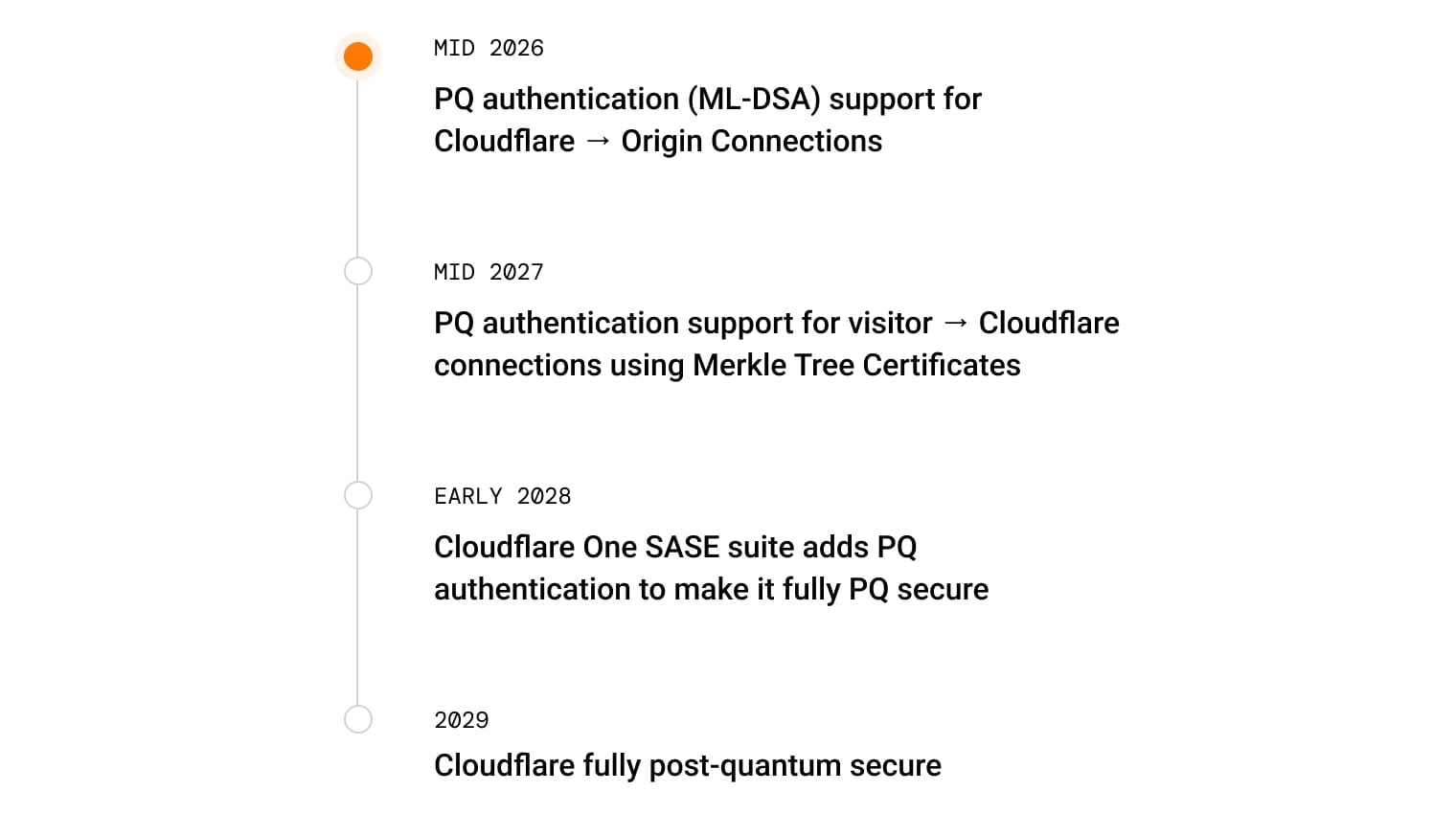
We are targeting full post-quantum security including authentication for our entire product suite by 2029. Here we’re sharing some intermediate milestones we’ve set, subject to change as our understanding of the risk and deployment challenges evolve.
What we recommend
For businesses, we recommend making post-quantum support a requirement for any procurement. Common best practices, like keeping software updated and automating certificate issuance, are meaningful and will get you pretty far. We recommend assessing critical vendors early for what their failure to take action would mean for your business.
For regulatory agencies and governments: leading by setting early timelines has been crucial for industry-wide progress so far. We are now in a pivotal position where fragmentation in standards and effort between and within jurisdictions could put progress at risk. We recommend that governments assign and empower a lead agency to coordinate the migration on a clear timeline, stay security-focused, and promote the use of existing international standards. Governments need not panic, but can lead migration with confidence.
For Cloudflare customers, with respect to our services, you do not need to take any mitigating action. We are following the latest advancements in quantum computing closely and taking proactive steps to protect your data. As we have done in the past, we will turn on post-quantum security by default, with no switches to flip. What we don’t control is the other side: browsers, applications, and origins need to upgrade. Corporate network traffic on Cloudflare need not worry: Cloudflare One offers end-to-end protection when tunnelling traffic through our post-quantum encrypted infrastructure.
Privacy and security are table stakes for the Internet. That's why every post-quantum upgrade we build will continue to be available to all customers, on every plan, at no additional cost. Making post-quantum security the default is the only way to protect the Internet at scale.
Free TLS helped encrypt the web. Free post-quantum cryptography will help secure it for what comes next.
Cloudflare Radar already offers a wide array of security insights — from application and network layer attacks, to malicious email messages, to digital certificates and Internet routing.
And today we’re introducing even more. We are launching several new security-related data sets and tools on Radar:
We are extending our post-quantum (PQ) monitoring beyond the client side to now include origin-facing connections. We have also released a new tool to help you check any website's post-quantum encryption compatibility.
A new Key Transparency section on Radar provides a public dashboard showing the real-time verification status of Key Transparency Logs for end-to-end encrypted messaging services like WhatsApp, showing when each log was last signed and verified by Cloudflare's Auditor. The page serves as a transparent interface where anyone can monitor the integrity of public key distribution and access the API to independently validate our Auditor’s proofs.
Routing Security insights continue to expand with the addition of global, country, and network-level information about the deployment of ASPA, an emerging standard that can help detect and prevent BGP route leaks.
Measuring origin post-quantum support
Since April 2024, we have tracked the aggregate growth of client support for post-quantum encryption on Cloudflare Radar, chronicling its global growth from under 3% at the start of 2024, to over 60% in February 2026. And in October 2025, we added the ability for users to check whether their browser supports X25519MLKEM768 — a hybrid key exchange algorithm combining classical X25519 with ML-KEM, a lattice-based post-quantum scheme standardized by NIST. This provides security against both classical and quantum attacks.
However, post-quantum encryption support on user-to-Cloudflare connections is only part of the story.
For content not in our CDN cache, or for uncacheable content, Cloudflare’s edge servers establish a separate connection with a customer’s origin servers to retrieve it. To accelerate the transition to quantum-resistant security for these origin-facing fetches, we previously introduced an API allowing customers to opt in to preferring post-quantum connections. Today, we’re making post-quantum compatibility of origin servers visible on Radar.
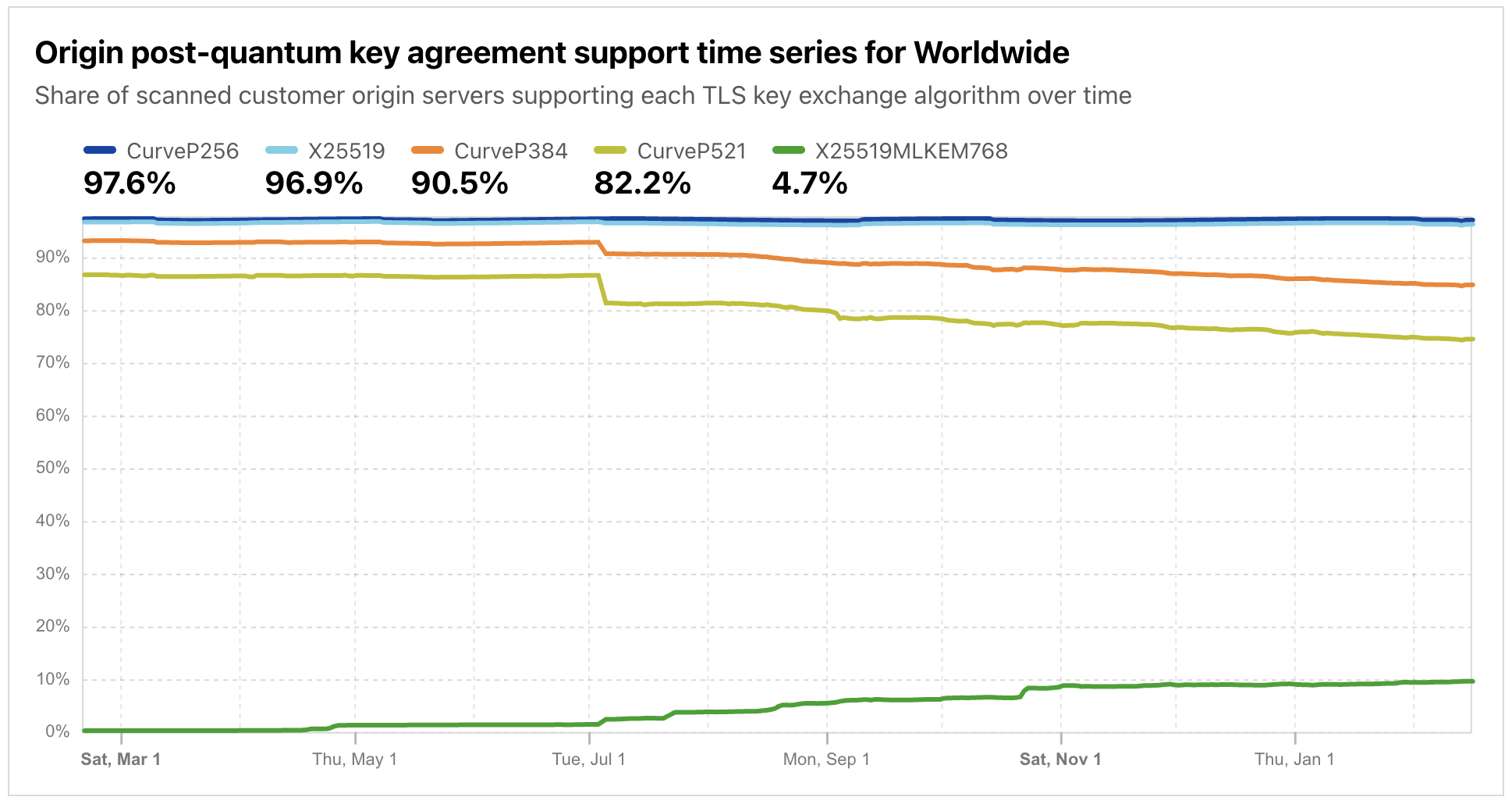
The new origin post-quantum support graph on Radar illustrates the share of customer origins supporting X25519MLKEM768. This data is derived from our automated TLS scanner, which probes TLS 1.3-compatible origins and aggregates the results daily. It is important to note that our scanner tests for support rather than the origin server's specific preference. While an origin may support a post-quantum key exchange algorithm, its local TLS key exchange preference can ultimately dictate the encryption outcome.
While the headline graph focuses on post-quantum readiness, the scanner also evaluates support for classical key exchange algorithms. Within the Radar Data Explorer view, you can also see the full distribution of these supported TLS key exchange methods.
As shown in the graphs above, approximately 10% of origins could benefit from a post-quantum-preferred key agreement today. This represents a significant jump from less than 1% at the start of 2025 — a 10x increase in just over a year. We expect this number to grow steadily as the industry continues its migration. This upward trend likely accelerated in 2025 as many server-side TLS libraries, such as OpenSSL 3.5.0+, GnuTLS 3.8.9+, and Go 1.24+, enabled hybrid post-quantum key exchange by default, allowing platforms and services to support post-quantum connections simply by upgrading their cryptographic library dependencies.
A screenshot of the tool in Radar to test whether a hostname supports post-quantum encryption.
The tool presents a simple form where users can enter a hostname (such as cloudflare.com or www.wikipedia.org) and optionally specify a custom port (the default is 443, the standard HTTPS port). After clicking "Test", the result displays a tag indicating PQ support status alongside the negotiated TLS key exchange algorithm. If the server prefers PQ secure connections, a green "PQ" tag appears with a message confirming the connection is "post-quantum secure." Otherwise, a red tag indicates the connection is "not post-quantum secure", showing the classical algorithm that was negotiated.
Under the hood, this tool uses Cloudflare Containers — a new capability that allows running container workloads alongside Workers. Since the Workers runtime is not exposed to details of the underlying TLS handshake, Workers cannot initiate TLS scans. Therefore, we created a Go container that leverages the crypto/tls package's support for post-quantum compatibility checks. The container runs on-demand and performs the actual handshake to determine the negotiated TLS key exchange algorithm, returning results through the Radar API.
With the addition of these origin-facing insights, complementing the existing client-facing insights, we have moved all the post-quantum content to its own section on Radar.
Securing E2EE messaging systems with Key Transparency
End-to-end encrypted (E2EE) messaging apps like WhatsApp and Signal have become essential tools for private communication, relied upon by billions of people worldwide. These apps use public-key cryptography to ensure that only the sender and recipient can read the contents of their messages — not even the messaging service itself. However, there's an often-overlooked vulnerability in this model: users must trust that the messaging app is distributing the correct public keys for each contact.
If an attacker were able to substitute an incorrect public key in the messaging app's database, they could intercept messages intended for someone else — all without the sender knowing.
Key Transparency addresses this challenge by creating an auditable, append-only log of public keys — similar in concept to Certificate Transparency for TLS certificates. Messaging apps publish their users' public keys to a transparency log, and independent third parties can verify and vouch that the log has been constructed correctly and consistently over time. In September 2024, Cloudflare announced such a Key Transparency auditor for WhatsApp, providing an independent verification layer that helps ensure the integrity of public key distribution for the messaging app's billions of users.
Today, we're publishing Key Transparency audit data in a new Key Transparency section on Cloudflare Radar. This section showcases the Key Transparency logs that Cloudflare audits, giving researchers, security professionals, and curious users a window into the health and activity of these critical systems.
The new page launches with two monitored logs: WhatsApp and Facebook Messenger Transport. Each monitored log is displayed as a card containing the following information:
Status: Indicates whether the log is online, in initialization, or disabled. An "online" status means the log is actively publishing key updates into epochs that Cloudflare audits. (An epoch represents a set of updates applied to the key directory at a specific time.)
Last signed epoch: The most recent epoch that has been published by the messaging service's log and acknowledged by Cloudflare. By clicking on the eye icon, users can view the full epoch data in JSON format, including the epoch number, timestamp, cryptographic digest, and signature.
Last verified epoch: The most recent epoch that Cloudflare has verified. Verification involves checking that the transition of the transparency log data structure from the previous epoch to the current one represents a valid tree transformation — ensuring the log has been constructed correctly. The verification timestamp indicates when Cloudflare completed its audit.
Root: The current root hash of the Auditable Key Directory (AKD) tree. This hash cryptographically represents the entire state of the key directory at the current epoch. Like the epoch fields, users can click to view the complete JSON response from the auditor.
The data shown on the page is also available via the Key Transparency Auditor API, with endpoints for auditor information and namespaces.
If you would like to perform audit proof verification yourself, you can follow the instructions in our Auditing Key Transparency blog post. We hope that these use cases are the first of many that we publish in this Key Transparency section in Radar — if your company or organization is interested in auditing for your public key or related infrastructure, you can reach out to us here.
Tracking RPKI ASPA adoption
While the Border Gateway Protocol (BGP) is the backbone of Internet routing, it was designed without built-in mechanisms to verify the validity of the paths it propagates. This inherent trust has long left the global network vulnerable to route leaks and hijacks, where traffic is accidentally or maliciously detoured through unauthorized networks.
Although RPKI and Route Origin Authorizations (ROAs) have successfully hardened the origin of routes, they cannot verify the path traffic takes between networks. This is where ASPA (Autonomous System Provider Authorization)comes in. ASPA extends RPKI protection by allowing an Autonomous System (AS) to cryptographically sign a record listing the networks authorized to propagate its routes upstream. By validating these Customer-to-Provider relationships, ASPA allows systems to detect invalid path announcements with confidence and react accordingly.
While the specific IETF standard remains in draft, the operational community is moving fast. Support for creating ASPA objects has already landed in the portals of Regional Internet Registries (RIRs) like ARIN and RIPE NCC, and validation logic is available in major software routing stacks like OpenBGPD and BIRD.
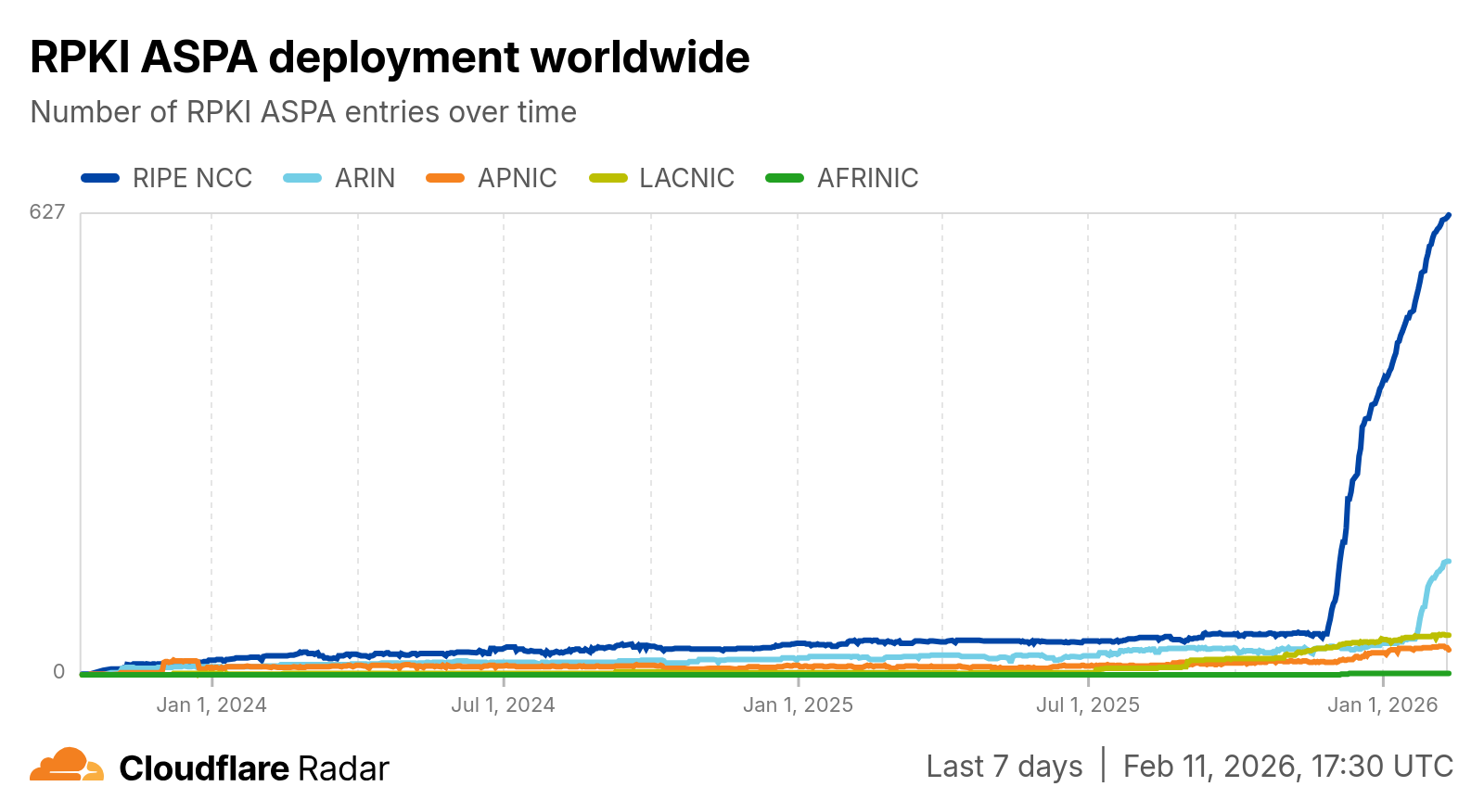
To provide better visibility into the adoption of this emerging standard, we have added comprehensive RPKI ASPA support to the Routing section of Cloudflare Radar. Tracking these records globally allows us to understand how quickly the industry is moving toward better path validation.
Our new ASPA deployment view allows users to examine the growth of ASPA adoption over time, with the ability to visualize trends across the five Regional Internet Registries (RIRs) based on AS registration. You can view the entire history of ASPA entries, dating back to October 1, 2023, or zoom into specific date ranges to correlate spikes in adoption with industry events, such as the introduction of ASPA features on ARIN and RIPE NCC online dashboards.
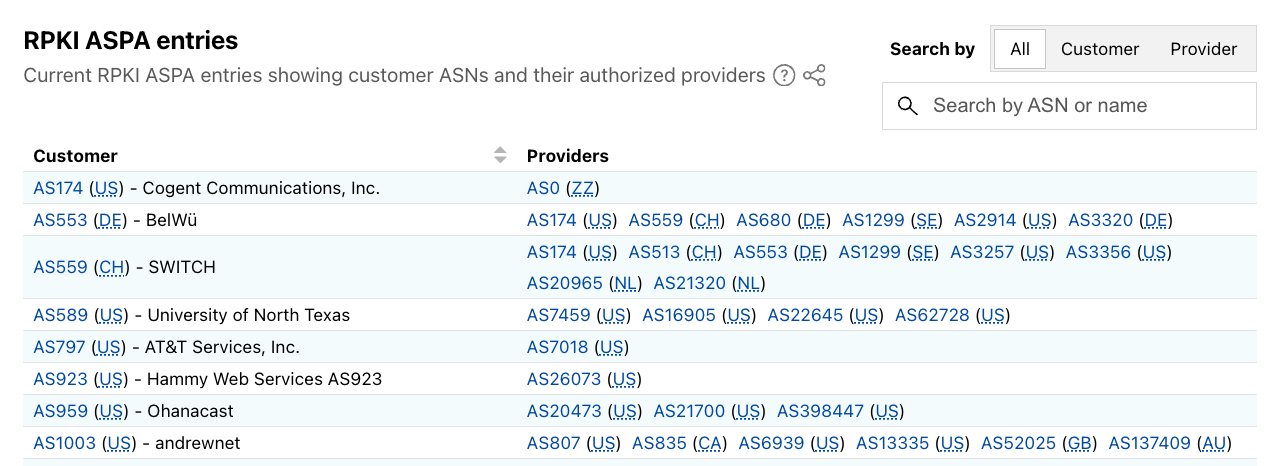
Beyond aggregate trends, we have also introduced a granular, searchable explorer for real-time ASPA content. This table view allows you to inspect the current state of ASPA records, searchable by AS number, AS name, or by filtering for only providers or customer ASNs. This allows network operators to verify that their records are published correctly and to view other networks’ configurations.
We have also integrated ASPA data directly into the country/region routing pages. Users can now track how different locations are progressing in securing their infrastructure, based on the associated ASPA records from the customer ASNs registered locally.
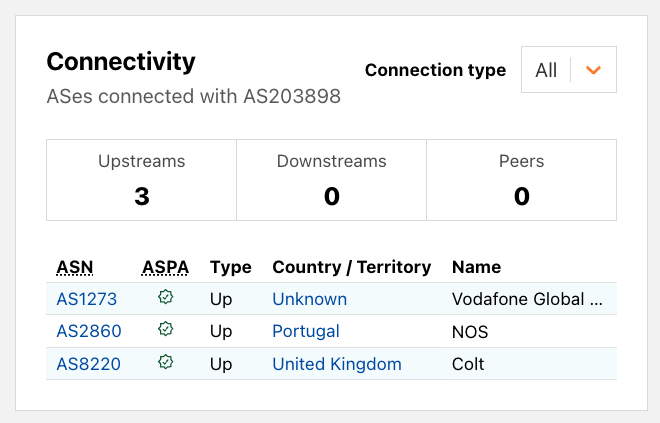
On individual AS pages, we have updated the Connectivity section. Now, when viewing the connections of a network, you may see a visual indicator for "ASPA Verified Provider." This annotation confirms that an ASPA record exists authorizing that specific upstream connection, providing an immediate signal of routing hygiene and trust.
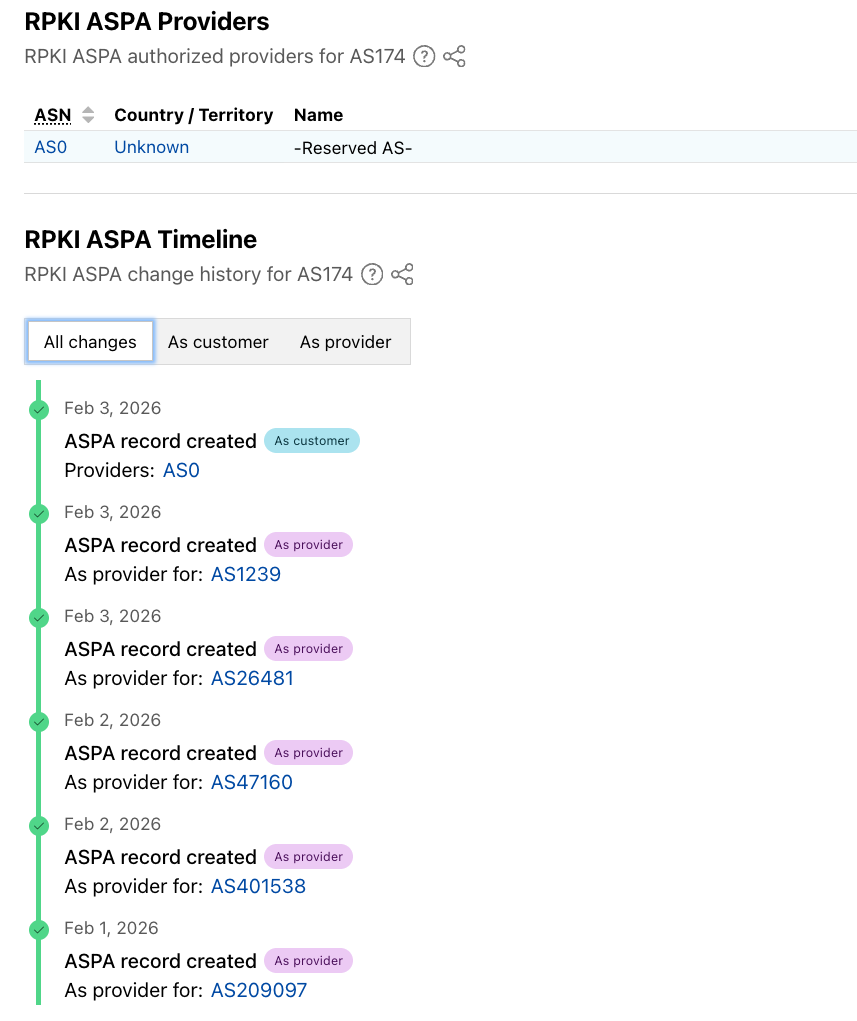
For ASes that have deployed ASPA, we now display a complete list of authorized provider ASNs along with their details. Beyond the current state, Radar also provides a detailed timeline of ASPA activity involving the AS. This history distinguishes between changes initiated by the AS itself ("As customer") and records created by others designating it as a provider ("As provider"), allowing users to immediately identify when specific routing authorizations were established or modified.
Visibility is an essential first step toward broader adoption of emerging routing security protocols like ASPA. By surfacing this data, we aim to help operators deploy protections and assist researchers in tracking the Internet's progress toward a more secure routing path. For those who need to integrate this data into their own workflows or perform deeper analysis, we are also exposing these metrics programmatically. Users can now access ASPA content snapshots, historical timeseries, and detailed changes data using the newly introduced endpoints in theCloudflare Radar API.
As security evolves, so does our data
Internet security continues to evolve, with new approaches, protocols, and standards being developed to ensure that information, applications, and networks remain secure. The security data and insights available on Cloudflare Radar will continue to evolve as well. The new sections highlighted above serve to expand existing routing security, transparency, and post-quantum insights already available on Cloudflare Radar.
If you share any of these new charts and graphs on social media, be sure to tag us: @CloudflareRadar (X), noc.social/@cloudflareradar (Mastodon), and radar.cloudflare.com (Bluesky). If you have questions or comments, or suggestions for data that you’d like to see us add to Radar, you can reach out to us on social media, or contact us via email.
* This post was updated at 11:45 a.m. Pacific time to clarify that the use case described here is a proof of concept and a personal project. Some sections have been updated for clarity.
Matrix is the gold standard for decentralized, end-to-end encrypted communication. It powers government messaging systems, open-source communities, and privacy-focused organizations worldwide.
For the individual developer, however, the appeal is often closer to home: bridging fragmented chat networks (like Discord and Slack) into a single inbox, or simply ensuring your conversation history lives on infrastructure you control. Functionally, Matrix operates as a decentralized, eventually consistent state machine. Instead of a central server pushing updates, homeservers exchange signed JSON events over HTTP, using a conflict resolution algorithm to merge these streams into a unified view of the room's history.
But there is a "tax" to running it. Traditionally, operating a Matrix homeserver has meant accepting a heavy operational burden. You have to provision virtual private servers (VPS), tune PostgreSQL for heavy write loads, manage Redis for caching, configure reverse proxies, and handle rotation for TLS certificates. It’s a stateful, heavy beast that demands to be fed time and money, whether you’re using it a lot or a little.
We wanted to see if we could eliminate that tax entirely.
Spoiler: We could. In this post, we’ll explain how we ported a Matrix homeserver to Cloudflare Workers. The resulting proof of concept is a serverless architecture where operations disappear, costs scale to zero when idle, and every connection is protected by post-quantum cryptography by default. You can view the source code and deploy your own instance directly from Github.
From Synapse to Workers
Our starting point was Synapse, the Python-based reference Matrix homeserver designed for traditional deployments. PostgreSQL for persistence, Redis for caching, filesystem for media.
Porting it to Workers meant questioning every storage assumption we’d taken for granted.
The challenge was storage. Traditional homeservers assume strong consistency via a central SQL database. Cloudflare Durable Objects offers a powerful alternative. This primitive gives us the strong consistency and atomicity required for Matrix state resolution, while still allowing the application to run at the edge.
We ported the core Matrix protocol logic — event authorization, room state resolution, cryptographic verification — in TypeScript using the Hono framework. D1 replaces PostgreSQL, KV replaces Redis, R2 replaces the filesystem, and Durable Objects handle real-time coordination.
Here’s how the mapping worked out:
From monolith to serverless
Moving to Cloudflare Workers brings several advantages for a developer: simple deployment, lower costs, low latency, and built-in security.
Easy deployment: A traditional Matrix deployment requires server provisioning, PostgreSQL administration, Redis cluster management, TLS certificate renewal, load balancer configuration, monitoring infrastructure, and on-call rotations.
With Workers, deployment is simply: wrangler deploy. Workers handles TLS, load balancing, DDoS protection, and global distribution.
Usage-based costs: Traditional homeservers cost money whether anyone is using them or not. Workers pricing is request-based, so you pay when you’re using it, but costs drop to near zero when everyone’s asleep.
Lower latency globally: A traditional Matrix homeserver in us-east-1 adds 200ms+ latency for users in Asia or Europe. Workers, meanwhile, run in 300+ locations worldwide. When a user in Tokyo sends a message, the Worker executes in Tokyo.
Built-in security: Matrix homeservers can be high-value targets: They handle encrypted communications, store message history, and authenticate users. Traditional deployments require careful hardening: firewall configuration, rate limiting, DDoS mitigation, WAF rules, IP reputation filtering.
Workers provide all of this by default.
Post-quantum protection
Cloudflare deployed post-quantum hybrid key agreement across all TLS 1.3 connections in October 2022. Every connection to our Worker automatically negotiates X25519MLKEM768 — a hybrid combining classical X25519 with ML-KEM, the post-quantum algorithm standardized by NIST.
Classical cryptography relies on mathematical problems that are hard for traditional computers but trivial for quantum computers running Shor’s algorithm. ML-KEM is based on lattice problems that remain hard even for quantum computers. The hybrid approach means both algorithms must fail for the connection to be compromised.
Following a message through the system
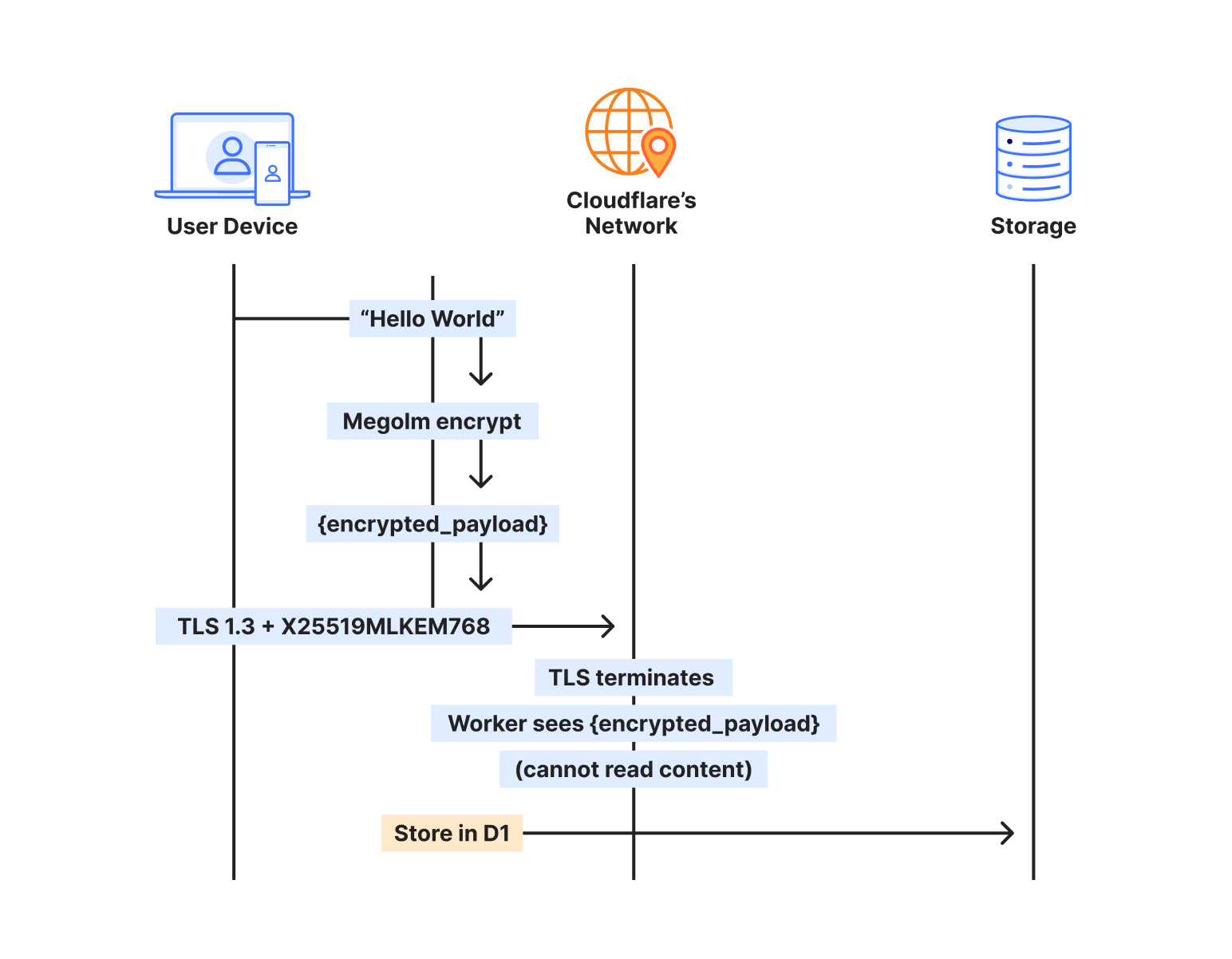
Understanding where encryption happens matters for security architecture. When someone sends a message through our homeserver, here’s the actual path:
The sender’s client takes the plaintext message and encrypts it with Megolm — Matrix’s end-to-end encryption. This encrypted payload then gets wrapped in TLS for transport. On Cloudflare, that TLS connection uses X25519MLKEM768, making it quantum-resistant.
The Worker terminates TLS, but what it receives is still encrypted — the Megolm ciphertext. We store that ciphertext in D1, index it by room and timestamp, and deliver it to recipients. But we never see the plaintext. The message “Hello, world” exists only on the sender’s device and the recipient’s device.
When the recipient syncs, the process reverses. They receive the encrypted payload over another quantum-resistant TLS connection, then decrypt locally with their Megolm session keys.
Two layers, independent protection
This protects via two encryption layers that operate independently:
The transport layer (TLS) protects data in transit. It’s encrypted at the client and decrypted at the Cloudflare edge. With X25519MLKEM768, this layer is now post-quantum.
The application layer (Megolm E2EE) protects message content. It’s encrypted on the sender’s device and decrypted only on recipient devices. This uses classical Curve25519 cryptography.
Who sees what
Any Matrix homeserver operator — whether running Synapse on a VPS or this implementation on Workers — can see metadata: which rooms exist, who’s in them, when messages were sent. But no one in the infrastructure chain can see the message content, because the E2EE payload is encrypted on sender devices before it ever hits the network. Cloudflare terminates TLS and passes requests to your Worker, but both see only Megolm ciphertext. Media in encrypted rooms is encrypted client-side before upload, and private keys never leave user devices.
What traditional deployments would need
Achieving post-quantum TLS on a traditional Matrix deployment would require upgrading OpenSSL or BoringSSL to a version supporting ML-KEM, configuring cipher suite preferences correctly, testing client compatibility across all Matrix apps, monitoring for TLS negotiation failures, staying current as PQC standards evolve, and handling clients that don’t support PQC gracefully.
With Workers, it’s automatic. Chrome, Firefox, and Edge all support X25519MLKEM768. Mobile apps using platform TLS stacks inherit this support. The security posture improves as Cloudflare’s PQC deployment expands — no action required on our part.
The storage architecture that made it work
The key insight from porting Tuwunel was that different data needs different consistency guarantees. We use each Cloudflare primitive for what it does best.
D1 for the data model
D1 stores everything that needs to survive restarts and support queries: users, rooms, events, device keys. Over 25 tables covering the full Matrix data model.
CREATE TABLE events (
	event_id TEXT PRIMARY KEY,
	room_id TEXT NOT NULL,
	sender TEXT NOT NULL,
	event_type TEXT NOT NULL,
	state_key TEXT,
	content TEXT NOT NULL,
	origin_server_ts INTEGER NOT NULL,
	depth INTEGER NOT NULL
);
D1’s SQLite foundation meant we could port Tuwunel’s queries with minimal changes. Joins, indexes, and aggregations work as expected.
We learned one hard lesson: D1’s eventual consistency breaks foreign key constraints. A write to rooms might not be visible when a subsequent write to events checks the foreign key. We removed all foreign keys and enforce referential integrity in application code.
KV for ephemeral state
OAuth authorization codes live for 10 minutes, while refresh tokens last for a session.
// Store OAuth code with 10-minute TTL
kv.put(&format!("oauth_code:{}", code), &token_data)?
	.expiration_ttl(600)
	.execute()
	.await?;
KV’s global distribution means OAuth flows work fast regardless of where users are located.
R2 for media
Matrix media maps directly to R2, so you can upload an image, get back a content-addressed URL – and egress is free.
Durable Objects for atomicity
Some operations can’t tolerate eventual consistency. When a client claims a one-time encryption key, that key must be atomically removed. If two clients claim the same key, encrypted session establishment fails.
Durable Objects provide single-threaded, strongly consistent storage:
#[durable_object]
pub struct UserKeysObject {
	state: State,
	env: Env,
}

impl UserKeysObject {
	async fn claim_otk(&self, algorithm: &str) -> Result<Option<Key>> {
    	// Atomic within single DO - no race conditions possible
    	let mut keys: Vec<Key> = self.state.storage()
        	.get("one_time_keys")
        	.await
        	.ok()
        	.flatten()
        	.unwrap_or_default();

    	if let Some(idx) = keys.iter().position(|k| k.algorithm == algorithm) {
        	let key = keys.remove(idx);
        	self.state.storage().put("one_time_keys", &keys).await?;
        	return Ok(Some(key));
    	}
    	Ok(None)
	}
}
We use UserKeysObject for E2EE key management, RoomObject for real-time room events like typing indicators and read receipts, and UserSyncObject for to-device message queues. The rest flows through D1.
Complete end-to-end encryption, complete OAuth
Our implementation supports the full Matrix E2EE stack: device keys, cross-signing keys, one-time keys, fallback keys, key backup, and dehydrated devices.
Modern Matrix clients use OAuth 2.0/OIDC instead of legacy password flows. We implemented a complete OAuth provider, with dynamic client registration, PKCE authorization, RS256-signed JWT tokens, token refresh with rotation, and standard OIDC discovery endpoints.
Point Element or any Matrix client at the domain, and it discovers everything automatically.
Sliding Sync for mobile
Traditional Matrix sync transfers megabytes of data on initial connection, draining mobile battery and data plans.
Sliding Sync lets clients request exactly what they need. Instead of downloading everything, clients get the 20 most recent rooms with minimal state. As users scroll, they request more ranges. The server tracks position and sends only deltas.
Combined with edge execution, mobile clients can connect and render their room list in under 500ms, even on slow networks.
The comparison
For a homeserver serving a small team:
Traditional (VPS)
Workers
Monthly cost (idle)
$20-50
<$1
Monthly cost (active)
$20-50
$3-10
Global latency
100-300ms
20-50ms
Time to deploy
Hours
Seconds
Maintenance
Weekly
None
DDoS protection
Additional cost
Included
Post-quantum TLS
Complex setup
Automatic
*Based on public rates and metrics published by DigitalOcean, AWS Lightsail, and Linode as of January 15, 2026.
The economics improve further at scale. Traditional deployments require capacity planning and over-provisioning. Workers scale automatically.
The future of decentralized protocols
We started this as an experiment: could Matrix run on Workers? It can—and the approach can work for other stateful protocols, too.
By mapping traditional stateful components to Cloudflare’s primitives — Postgres to D1, Redis to KV, mutexes to Durable Objects — we can see that complex applications don't need complex infrastructure. We stripped away the operating system, the database management, and the network configuration, leaving only the application logic and the data itself.
Workers offers the sovereignty of owning your data, without the burden of owning the infrastructure.
I have been experimenting with the implementation and am excited for any contributions from others interested in this kind of service.
Ready to build powerful, real-time applications on Workers? Get started withCloudflare Workers and exploreDurable Objects for your own stateful edge applications. Join ourDiscord community to connect with other developers building at the edge.
The world is in a race to build its first quantum computer capable of solving practical problems not feasible on even the largest conventional supercomputers. While the quantum computing paradigm promises many benefits, it also threatens the security of the Internet by breaking much of the cryptography we have come to rely on.
To mitigate this threat, Cloudflare is helping to migrate the Internet to Post-Quantum (PQ) cryptography. Today, about 50% of traffic to Cloudflare's edge network is protected against the most urgent threat: an attacker who can intercept and store encrypted traffic today and then decrypt it in the future with the help of a quantum computer. This is referred to as the harvest now, decrypt laterthreat.
However, this is just one of the threats we need to address. A quantum computer can also be used to crack a server's TLS certificate, allowing an attacker to impersonate the server to unsuspecting clients. The good news is that we already have PQ algorithms we can use for quantum-safe authentication. The bad news is that adoption of these algorithms in TLS will require significant changes to one of the most complex and security-critical systems on the Internet: the Web Public-Key Infrastructure (WebPKI).
The central problem is the sheer size of these new algorithms: signatures for ML-DSA-44, one of the most performant PQ algorithms standardized by NIST, are 2,420 bytes long, compared to just 64 bytes for ECDSA-P256, the most popular non-PQ signature in use today; and its public keys are 1,312 bytes long, compared to just 64 bytes for ECDSA. That's a roughly 20-fold increase in size. Worse yet, the average TLS handshake includes a number of public keys and signatures, adding up to 10s of kilobytes of overhead per handshake. This is enough to have a noticeable impact on the performance of TLS.
That makes drop-in PQ certificates a tough sell to enable today: they don’t bring any security benefit before Q-day — the day a cryptographically relevant quantum computer arrives — but they do degrade performance. We could sit and wait until Q-day is a year away, but that’s playing with fire. Migrations always take longer than expected, and by waiting we risk the security and privacy of the Internet, which is dear to us.
It's clear that we must find a way to make post-quantum certificates cheap enough to deploy today by default for everyone — not just those that can afford it. In this post, we'll introduce you to the plan we’ve brought together with industry partners to the IETF to redesign the WebPKI in order to allow a smooth transition to PQ authentication with no performance impact (and perhaps a performance improvement!). We'll provide an overview of one concrete proposal, called Merkle Tree Certificates (MTCs), whose goal is to whittle down the number of public keys and signatures in the TLS handshake to the bare minimum required.
But talk is cheap. We knowfromexperience that, as with any change to the Internet, it's crucial to test early and often. Today we're announcing our intent to deploy MTCs on an experimental basis in collaboration with Chrome Security. In this post, we'll describe the scope of this experiment, what we hope to learn from it, and how we'll make sure it's done safely.
The WebPKI today — an old system with many patches
Why does the TLS handshake have so many public keys and signatures?
Let's start with Cryptography 101. When your browser connects to a website, it asks the server to authenticate itself to make sure it's talking to the real server and not an impersonator. This is usually achieved with a cryptographic primitive known as a digital signature scheme (e.g., ECDSA or ML-DSA). In TLS, the server signs the messages exchanged between the client and server using its secret key, and the client verifies the signature using the server's public key. In this way, the server confirms to the client that they've had the same conversation, since only the server could have produced a valid signature.
If the client already knows the server's public key, then only 1 signature is required to authenticate the server. In practice, however, this is not really an option. The web today is made up of around a billion TLS servers, so it would be unrealistic to provision every client with the public key of every server. What's more, the set of public keys will change over time as new servers come online and existing ones rotate their keys, so we would need some way of pushing these changes to clients.
This scaling problem is at the heart of the design of all PKIs.
Trust is transitive
Instead of expecting the client to know the server's public key in advance, the server might just send its public key during the TLS handshake. But how does the client know that the public key actually belongs to the server? This is the job of a certificate.
A certificate binds a public key to the identity of the server — usually its DNS name, e.g., cloudflareresearch.com. The certificate is signed by a Certification Authority (CA) whose public key is known to the client. In addition to verifying the server's handshake signature, the client verifies the signature of this certificate. This establishes a chain of trust: by accepting the certificate, the client is trusting that the CA verified that the public key actually belongs to the server with that identity.
Clients are typically configured to trust many CAs and must be provisioned with a public key for each. Things are much easier however, since there are only 100s of CAs instead of billions. In addition, new certificates can be created without having to update clients.
These efficiencies come at a relatively low cost: for those counting at home, that's +1 signature and +1 public key, for a total of 2 signatures and 1 public key per TLS handshake.
That's not the end of the story, however. As the WebPKI has evolved, so have these chains of trust grown a bit longer. These days it's common for a chain to consist of two or more certificates rather than just one. This is because CAs sometimes need to rotatetheir keys, just as servers do. But before they can start using the new key, they must distribute the corresponding public key to clients. This takes time, since it requires billions of clients to update their trust stores. To bridge the gap, the CA will sometimes use the old key to issue a certificate for the new one and append this certificate to the end of the chain.
That's +1 signature and +1 public key, which brings us to 3 signatures and 2 public keys. And we still have a little ways to go.
Trust but verify
The main job of a CA is to verify that a server has control over the domain for which it’s requesting a certificate. This process has evolved over the years from a high-touch, CA-specific process to a standardized, mostly automated process used for issuing most certificates on the web. (Not all CAs fully support automation, however.) This evolution is marked by a number of security incidents in which a certificate was mis-issued to a party other than the server, allowing that party to impersonate the server to any client that trusts the CA.
Automation helps, but attacks are still possible, and mistakes are almost inevitable. Earlier this year, several certificates for Cloudflare's encrypted 1.1.1.1 resolver were issued without our involvement or authorization. This apparently occurred by accident, but it nonetheless put users of 1.1.1.1 at risk. (The mis-issued certificates have since been revoked.)
Ensuring mis-issuance is detectable is the job of the Certificate Transparency (CT) ecosystem. The basic idea is that each certificate issued by a CA gets added to a public log. Servers can audit these logs for certificates issued in their name. If ever a certificate is issued that they didn't request itself, the server operator can prove the issuance happened, and the PKI ecosystem can take action to prevent the certificate from being trusted by clients.
Major browsers, including Firefox and Chrome and its derivatives, require certificates to be logged before they can be trusted. For example, Chrome, Safari, and Firefox will only accept the server's certificate if it appears in at least two logs the browser is configured to trust. This policy is easy to state, but tricky to implement in practice:
Operating a CT log has historically been fairly expensive. Logs ingest billions of certificates over their lifetimes: when an incident happens, or even just under high load, it can take some time for a log to make a new entry available for auditors.
Clients can't really audit logs themselves, since this would expose their browsing history (i.e., the servers they wanted to connect to) to the log operators.
The solution to both problems is to include a signature from the CT log along with the certificate. The signature is produced immediately in response to a request to log a certificate, and attests to the log's intent to include the certificate in the log within 24 hours.
Per browser policy, certificate transparency adds +2 signatures to the TLS handshake, one for each log. This brings us to a total of 5 signatures and 2 public keys in a typical handshake on the public web.
The future WebPKI
The WebPKI is a living, breathing, and highly distributed system. We've had to patch it a number of times over the years to keep it going, but on balance it has served our needs quite well — until now.
Previously, whenever we needed to update something in the WebPKI, we would tack on another signature. This strategy has worked because conventional cryptography is so cheap. But 5 signatures and 2 public keys on average for each TLS handshake is simply too much to cope with for the larger PQ signatures that are coming.
The good news is that by moving what we already have around in clever ways, we can drastically reduce the number of signatures we need.
Crash course on Merkle Tree Certificates
Merkle Tree Certificates (MTCs) is a proposal for the next generation of the WebPKI that we are implementing and plan to deploy on an experimental basis. Its key features are as follows:
All the information a client needs to validate a Merkle Tree Certificate can be disseminated out-of-band. If the client is sufficiently up-to-date, then the TLS handshake needs just 1 signature, 1 public key, and 1 Merkle tree inclusion proof. This is quite small, even if we use post-quantum algorithms.
The MTC specification makes certificate transparency a first class feature of the PKI by having each CA run its own log of exactly the certificates they issue.
Let's poke our head under the hood a little. Below we have an MTC generated by one of our internal tests. This would be transmitted from the server to the client in the TLS handshake:
Looks like your average PEM encoded certificate. Let's decode it and look at the parameters:
$ openssl x509 -in merkle-tree-cert.pem -noout -text
Certificate:
    Data:
        Version: 3 (0x2)
        Serial Number: 531 (0x213)
        Signature Algorithm: 1.3.6.1.4.1.44363.47.0
        Issuer: 1.3.6.1.4.1.44363.47.1=44363.48.3
        Validity
            Not Before: Oct 21 15:33:26 2025 GMT
            Not After : Oct 28 15:33:26 2025 GMT
        Subject: CN=cloudflareresearch.com
        Subject Public Key Info:
            Public Key Algorithm: id-ecPublicKey
                Public-Key: (256 bit)
                pub:
                    04:70:ed:e1:96:87:b4:22:ef:fb:dc:a9:cd:9c:5c:
                    ef:1e:9e:ab:1b:6d:d7:11:74:7b:76:c8:3c:a1:5f:
                    94:37:45:99:d8:80:e3:5c:24:4f:28:46:b5:bf:84:
                    60:d8:fc:eb:82:5a:c4:4e:33:90:c7:b3:36:51:0c:
                    92:6d:bf:88:27
                ASN1 OID: prime256v1
                NIST CURVE: P-256
        X509v3 extensions:
            X509v3 Key Usage: critical
                Digital Signature
            X509v3 Extended Key Usage:
                TLS Web Server Authentication
            X509v3 Subject Alternative Name:
                DNS:cloudflareresearch.com, DNS:static-ct.cloudflareresearch.com
    Signature Algorithm: 1.3.6.1.4.1.44363.47.0
    Signature Value:
        00:00:00:00:00:00:02:00:00:00:00:00:00:00:02:58:00:e0:
        44:be:03:a5:bd:6a:b7:f2:9e:39:77:4c:16:4c:f8:06:e5:e1:
        55:c0:93:21:c6:79:83:3c:dd:5b:e6:57:89:c0:75:b3:4c:ec:
        75:8a:0b:53:a0:ca:1c:07:0c:1a:92:dd:c7:7c:a2:23:5d:83:
        0e:e4:23:43:38:af:43:20:a8:66:44:34:95:87:ea:2b:f0:0f:
        16:52:bb:ea:67:67:1e:89:36:4f:90:d4:05:55:89:46:f1:b7:
        b6:68:84:d3:57:31:ae:2b:c3:79:31:86:85:9d:24:ed:cf:25:
        a4:5c:fd:8f:f6:76:14:55:dd:67:2e:df:d6:8c:25:0d:52:48:
        c8:e3:fe:f9:7c:e6:a5:30:52:a5:b5:c7:3a:89:a5:c1:f6:4b:
        5b:95:ef:70:b8:91:fc:61:0f:6d:16:de:39:e9:a0:59:49:2b:
        34:71:7c:2a:16:da:c7:af:de:f7:01:94:10:c4:62:d1:f5:00:
        87:bd:e8:a2:f4:df:3b:35:79:27:0e:fc:cc:43:e7:60:5a:df:
        df:06:e8:d3:7e:eb:b3:bf:7b:25:43:0f:34:9a:26:c0:d3:6d:
        5d:0c:28:bc:87:58:58:15:00:00
While some of the parameters probably look familiar, others will look unusual. On the familiar side, the subject and public key are exactly what we might expect: the DNS name is cloudflareresearch.com and the public key is for a familiar signature algorithm, ECDSA-P256. This algorithm is not PQ, of course — in the future we would put ML-DSA-44 there instead.
On the unusual side, OpenSSL appears to not recognize the signature algorithm of the issuer and just prints the raw OID and bytes of the signature. There's a good reason for this: the MTC does not have a signature in it at all! So what exactly are we looking at?
The trick to leave out signatures is that a Merkle Tree Certification Authority (MTCA) produces its signatureless certificates in batches rather than individually. In place of a signature, the certificate has an inclusion proof of the certificate in a batch of certificates signed by the MTCA.
To understand how inclusion proofs work, let's think about a slightly simplified version of the MTC specification. To issue a batch, the MTCA arranges the unsigned certificates into a data structure called a Merkle tree that looks like this:
Each leaf of the tree corresponds to a certificate, and each inner node is equal to the hash of its children. To sign the batch, the MTCA uses its secret key to sign the head of the tree. The structure of the tree guarantees that each certificate in the batch was signed by the MTCA: if we tried to tweak the bits of any one of the certificates, the treehead would end up having a different value, which would cause the signature to fail.
An inclusion proof for a certificate consists of the hash of each sibling node along the path from the certificate to the treehead:
Given a validated treehead, this sequence of hashes is sufficient to prove inclusion of the certificate in the tree. This means that, in order to validate an MTC, the client also needs to obtain the signed treehead from the MTCA.
This is the key to MTC's efficiency:
Signed treeheads can be disseminated to clients out-of-band and validated offline. Each validated treehead can then be used to validate any certificate in the corresponding batch, eliminating the need to obtain a signature for each server certificate.
During the TLS handshake, the client tells the server which treeheads it has. If the server has a signatureless certificate covered by one of those treeheads, then it can use that certificate to authenticate itself. That's 1 signature,1 public key and 1 inclusion proof per handshake, both for the server being authenticated.
Now, that's the simplified version. MTC proper has some more bells and whistles. To start, it doesn’t create a separate Merkle tree for each batch, but it grows a single large tree, which is used for better transparency. As this tree grows, periodically (sub)tree heads are selected to be shipped to browsers, which we call landmarks. In the common case browsers will be able to fetch the most recent landmarks, and servers can wait for batch issuance, but we need a fallback: MTC also supports certificates that can be issued immediately and don’t require landmarks to be validated, but these are not as small. A server would provision both types of Merkle tree certificates, so that the common case is fast, and the exceptional case is slow, but at least it’ll work.
Experimental deployment
Ever since early designs for MTCs emerged, we’ve been eager to experiment with the idea. In line with the IETF principle of “running code”, it often takes implementing a protocol to work out kinks in the design. At the same time, we cannot risk the security of users. In this section, we describe our approach to experimenting with aspects of the Merkle Tree Certificates design without changing any trust relationships.
Let’s start with what we hope to learn. We have lots of questions whose answers can help to either validate the approach, or uncover pitfalls that require reshaping the protocol — in fact, an implementation of an early MTC draft by Maximilian Pohl and Mia Celeste did exactly this. We’d like to know:
What breaks? Protocol ossification (the tendency of implementation bugs to make it harder to change a protocol) is an ever-present issue with deploying protocol changes. For TLS in particular, despite having built-in flexibility, time after time we’ve found that if that flexibility is not regularly used, there will be buggy implementations and middleboxes that break when they see things they don’t recognize. TLS 1.3 deployment took years longer than we hoped for this very reason. And more recently, the rollout of PQ key exchange in TLS caused the Client Hello to be split over multiple TCP packets, something that many middleboxes weren't ready for.
What is the performance impact? In fact, we expect MTCs to reduce the size of the handshake, even compared to today's non-PQ certificates. They will also reduce CPU cost: ML-DSA signature verification is about as fast as ECDSA, and there will be far fewer signatures to verify. We therefore expect to see a reduction in latency. We would like to see if there is a measurable performance improvement.
What fraction of clients will stay up to date? Getting the performance benefit of MTCs requires the clients and servers to be roughly in sync with one another. We expect MTCs to have fairly short lifetimes, a week or so. This means that if the client's latest landmark is older than a week, the server would have to fallback to a larger certificate. Knowing how often this fallback happens will help us tune the parameters of the protocol to make fallbacks less likely.
In order to answer these questions, we are implementing MTC support in our TLS stack and in our certificate issuance infrastructure. For their part, Chrome is implementing MTC support in their own TLS stack and will stand up infrastructure to disseminate landmarks to their users.
As we've done in past experiments, we plan to enable MTCs for a subset of our free customers with enough traffic that we will be able to get useful measurements. Chrome will control the experimental rollout: they can ramp up slowly, measuring as they go and rolling back if and when bugs are found.
Which leaves us with one last question: who will run the Merkle Tree CA?
Bootstrapping trust from the existing WebPKI
Standing up a proper CA is no small task: it takes years to be trusted by major browsers. That’s why Cloudflare isn’t going to become a “real” CA for this experiment, and Chrome isn’t going to trust us directly.
Instead, to make progress on a reasonable timeframe, without sacrificing due diligence, we plan to "mock" the role of the MTCA. We will run an MTCA (on Workers based on our StaticCT logs), but for each MTC we issue, we also publish an existing certificate from a trusted CA that agrees with it. We call this the bootstrap certificate. When Chrome’s infrastructure pulls updates from our MTCA log, they will also pull these bootstrap certificates, and check whether they agree. Only if they do, they’ll proceed to push the corresponding landmarks to Chrome clients. In other words, Cloudflare is effectively just “re-encoding” an existing certificate (with domain validation performed by a trusted CA) as an MTC, and Chrome is using certificate transparency to keep us honest.
Conclusion
With almost 50% of our traffic already protected by post-quantum encryption, we’re halfway to a fully post-quantum secure Internet. The second part of our journey, post-quantum certificates, is the hardest yet though. A simple drop-in upgrade has a noticeable performance impact and no security benefit before Q-day. This means it’s a hard sell to enable today by default. But here we are playing with fire: migrations always take longer than expected. If we want to keep an ubiquitously private and secure Internet, we need a post-quantum solution that’s performant enough to be enabled by default today.
Merkle Tree Certificates (MTCs) solves this problem by reducing the number of signatures and public keys to the bare minimum while maintaining the WebPKI's essential properties. We plan to roll out MTCs to a fraction of free accounts by early next year. This does not affect any visitors that are not part of the Chrome experiment. For those that are, thanks to the bootstrap certificates, there is no impact on security.
We’re excited to keep the Internet fast and secure, and will report back soon on the results of this experiment: watch this space! MTC is evolving as we speak, if you want to get involved, please join the IETF PLANTS mailing list.
The Internet is in constant motion. Sites scale, traffic shifts, and attackers adapt. Security that worked yesterday may not be enough tomorrow. That’s why the technologies that protect the web — such as Transport Layer Security (TLS) and emerging post-quantum cryptography (PQC) — must also continue to evolve. We want to make sure that everyone benefits from this evolution automatically, so we enabled the strongest protections by default.
During Birthday Week 2024, we announced Automatic SSL/TLS: a service that scans origin server configurations of domains behind Cloudflare, and automatically upgrades them to the most secure encryption mode they support. In the past year, this system has quietly strengthened security for more than 6 million domains — ensuring Cloudflare can always connect to origin servers over the safest possible channel, without customers lifting a finger.
Now, a year after we started enabling Automatic SSL/TLS, we want to talk about these results, why they matter, and how we’re preparing for the next leap in Internet security.
The Basics: TLS protocol
Before diving in, let’s review the basics of Transport Layer Security (TLS). The protocol allows two strangers (like a client and server) to communicate securely.
Every secure web session begins with a TLS handshake. Before a single byte of your data moves across the Internet, servers and clients need to agree on a shared secret key that will protect the confidentiality and integrity of your data. The key agreement handshake kicks off with a TLS ClientHello message. This message is the browser/client announcing, “Here’s who I want to talk to (via SNI), and here are the key agreement methods I understand.” The server then proves who it is with its own credentials in the form of a certificate, and together they establish a shared secret key that will protect everything that follows.
TLS 1.3 added a clever shortcut: instead of waiting to be told which method to use for the shared key agreement, the browser can guess what key agreement the server supports, and include one or more keyshares right away. If the guess is correct, the handshake skips an extra round trip and the secure connection is established more quickly. If the guess is wrong, the server responds with a HelloRetryRequest (HRR), telling the browser which key agreement method to retry with. This speculative guessing is a major reason TLS 1.3 is so much faster than TLS 1.2.
Once both sides agree, the chosen keyshare is used to create a shared secret that encrypts the messages they exchange and allows only the right parties to decrypt them.
The nitty-gritty details of key agreement
Up until recently, most of these handshakes have relied on elliptic curve cryptography (ECC) using a curve known as X25519. But looming on the horizon are quantum computers, which could one day break ECC algorithms like X25519 and others. To prepare, the industry is shifting toward post-quantum key agreement with MLKEM, deployed in a hybrid mode (X25519 + MLKEM). This ensures that even if quantum machines arrive, harvested traffic today can’t be decrypted tomorrow. X25519 + MLKEM is steadily rising to become the most popular key agreement for connections to Cloudflare.
The TLS handshake model is the foundation for how we encrypt web communications today. The history of TLS is really the story of iteration under pressure. It’s a protocol that had to keep evolving, so trust on the web could keep pace with how Internet traffic has changed. It’s also what makes technologies like Cloudflare’s Automatic SSL/TLS possible, by abstracting decades of protocol battles and crypto engineering into a single click, so customer websites can be secured by default without requiring every operator to be a cryptography expert.
History Lesson: Stumbles and Standards
Early versions of TLS (then called SSL) in the 1990s suffered from weak keys, limited protection against attacks like man-in-the-middle, and low adoption on the Internet. To stabilize things, the IETF stepped in and released TLS 1.0, followed by TLS 1.1 and 1.2 through the 2000s. These versions added stronger ciphers and patched new attack vectors, but years of fixes and extensions left the protocol bloated and hard to evolve.
The early 2010s marked a turning point. After the Snowden disclosures, the Internet doubled down on encryption by default. Initiatives like Let’s Encrypt, the mass adoption of HTTPS, and Cloudflare’s own commitment to offer SSL/TLS for free turned encryption from optional, expensive, and complex into an easy baseline requirement for a safer Internet.
All of this momentum led to TLS 1.3 (2018), which cut away legacy baggage, locked in modern cipher suites, and made encrypted connections nearly as fast as the underlying transport protocols like TCP—and sometimes even faster with QUIC.
The CDN Twist
As Content Delivery Networks (CDNs) rose to prominence, they reshaped how TLS was deployed. Instead of a browser talking directly to a distant server hosting content (what Cloudflare calls an origin), it now spoke to the nearest edge data center, which may in-turn speak to an origin server on the client’s behalf.
This created two distinct TLS layers:
Edge ↔ Browser TLS: The front door, built to quickly take on new improvements in security and performance. Edges and browsers adopt modern protocols (TLS 1.3, QUIC, session resumption) to cut down on latency.
Edge ↔ Origin TLS: The backhaul, which must be more flexible. Origins might be older, more poorly maintained, run legacy TLS stacks, or require custom certificate handling.
In practice, CDNs became translators: modernizing encryption at the edge while still bridging to legacy origins. It’s why you can have a blazing-fast TLS 1.3 session from your phone, even if the origin server behind the CDN hasn’t been upgraded in years.
This is where Automatic SSL/TLS sits in the story of how we secure Internet communications.
Automatic SSL/TLS
Automatic SSL/TLS grew out of Cloudflare’s mission to ensure the web was as encrypted as possible. While we had initially spent an incredibly long time developing secure connections for the “front door” (from browsers to Cloudflare’s edge) with Universal SSL, we knew that the “back door” (from Cloudflare’s edge to origin servers) would be slower and harder to upgrade.
One option we offered was Cloudflare Tunnel, where a lightweight agent runs near the origin server and tunnels traffic securely back to Cloudflare. This approach ensures the connection always uses modern encryption, without requiring changes on the origin itself.
But not every customer uses Tunnel. Many connect origins directly to Cloudflare’s edge, where encryption depends on the origin server’s configuration. Traditionally this meant customers had to either manually select an encryption mode that worked for their origin server or rely on the default chosen by Cloudflare.
To improve the experience of choosing an encryption mode, we introduced our SSL/TLS Recommender in 2021.
The Recommender scanned customer origin servers and then provided recommendations for their most secure encryption mode. For example, if the Recommender detected that an origin server was using a certificate signed by a trusted Certificate Authority (CA) such as Let’s Encrypt, rather than a self-signed certificate, it would recommend upgrading from Full encryption mode to Full (Strict) encryption mode.
Based on how the origin responded, Recommender would tell customers if they could improve their SSL/TLS encryption mode to be more secure. The following encryption modes represent what the SSL/TLS Recommender could recommend to customers based on their origin responses:
However, in the three years after launching our Recommender we discovered something troubling: of the over two million domains using Recommender, only 30% of the recommendations that the system provided were followed. A significant number of users would not complete the next step of pushing the button to inform Cloudflare that we could communicate with their origin over a more secure setting.
We were seeing sub-optimal settings that our customers could upgrade from without risk of breaking their site, but for various reasons, our users did not follow through with the recommendations. So we pushed forward by building a system that worked with Recommender and actioned the recommendations by default.
How does Automatic SSL/TLS work?
Automatic SSL/TLSworks by crawling websites, looking for content over both HTTP and HTTPS, then comparing the results for compatibility. It also performs checks against the TLS certificate presented by the origin and looks at the type of content that is served to ensure it matches. If the downloaded content matches, Automatic SSL/TLS elevates the encryption level for the domain to the compatible and stronger mode, without risk of breaking the site.
More specifically, these are the steps that Automatic SSL/TLS takes to upgrade domain’s security:
Each domain is scheduled for a scan once per month (or until it reaches the maximum supported encryption mode).
The scan evaluates the current encryption mode for the domain. If it’s lower than what the Recommender thinks the domain can support based on the results of its probes and content scans, the system begins a gradual upgrade.
Automatic SSL/TLS begins to upgrade the domain by connecting with origins over the more secure mode starting with just 1% of its traffic.
If connections to the origin succeed, the result is logged as successful.
If they fail, the system records the failure to Cloudflare’s control plane and aborts the upgrade. Traffic is immediately downgraded back to the previous SSL/TLS setting to ensure seamless operation.
If no issues are found, the new SSL/TLS encryption mode is applied to traffic in 10% increments until 100% of traffic uses the recommended mode.
Once 100% of traffic has been successfully upgraded with no TLS-related errors, the domain’s SSL/TLS setting is permanently updated.
Special handling for Flexible → Full/Strict: These upgrades are more cautious because customers’ cache keys are changed (from http to https origin scheme).
In this situation, traffic ramps up from 1% to 10% in 1% increments, allowing customers’ cache to warm-up.
After 10%, the system resumes the standard 10% increments until 100%.
We know that transparency and visibility are critical, especially when automated systems make changes. To keep customers informed, Automatic SSL/TLS sends a weekly digest to account Super Administrators whenever updates are made to domain encryption modes. This way, you always have visibility into what changed and when.
In short, Automatic SSL/TLS automates what used to be trial and error: finding the strongest SSL/TLS mode your site can support while keeping everything working smoothly.
How are we doing so far?
So far we have onboarded all Free, Pro, and Business domains to use Automatic SSL/TLS. We also have enabled this for all new domains that will onboard onto Cloudflare regardless of plantype. Soon, we will start onboarding Enterprise customers as well. If you already have an Enterprise domain and want to try out Automatic SSL/TLS we encourage you to enable it in the SSL/TLS section of the dashboard or via the API.
As of the publishing of this blog, we’ve upgraded over 6 million domains to be more secure without the website operators needing to manually configure anything on Cloudflare.
Previous Encryption Mode
Upgraded Encryption Mode
Number of domains
Flexible
Full
~ 2,200,000
Flexible
Full (strict)
~ 2,000,000
Full
Full (strict)
~ 1,800,000
Off
Full
~ 7,000
Off
Full (strict)
~ 5,000
We’re most excited about the over 4 million domains that moved from Flexible or Off, which uses HTTP to origin servers, to Full or Strict, which uses HTTPS.
If you have a reason to use a particular encryption mode (e.g., on a test domain that isn’t production ready) you can always disable Automatic SSL/TLS and manually set the encryption mode that works best for your use case.
Today, SSL/TLS mode works on a domain-wide level, which can feel blunt. This means that one suboptimal subdomain can keep the entire domain in a less secure TLS setting, to ensure availability. Our long-term goal is to make these controls more precise, so that Automatic SSL/TLS and encryption modes can optimize security per origin or subdomain, rather than treating every hostname the same.
Impact on origin-facing connections
Since we began onboarding domains to Automatic SSL/TLS in late 2024 and early 2025, we’ve been able to measure how origin connections across our network are shifting toward stronger security. Looking at the ratios across all origin requests, the trends are clear:
Encryption is rising. Plaintext connections are steadily declining, a reflection of Automatic SSL/TLS helping millions of domains move to HTTPS by default. We’ve seen a correlated 7-8% reduction in plaintext origin-bound connections. Still, some origins remain on outdated configurations, and these should be upgraded to keep pace with modern security expectations.
TLS 1.3 is surging. Since late 2024, TLS 1.3 adoption has climbed sharply, now making up the majority of encrypted origin traffic (almost 60%). While Automatic SSL/TLS doesn’t control which TLS version an origin supports, this shift is an encouraging sign for both performance and security.
Older versions are fading. Month after month, TLS 1.2 continues to shrink, while TLS 1.0 and 1.1 are now so rare they barely register.
The decline in plaintext connections is encouraging, but it also highlights a long tail of servers still relying on outdated packages or configurations. Sites like SSL Labs can be used, for instance, to check a server’s TLS configuration. However, simply copy-pasting settings to achieve a high rating can be risky, so we encourage customers to review their origin TLS configurations carefully. In addition, Cloudflare origin CA or Cloudflare Tunnel can help provide guidance for upgrading origin security.
Upgraded domain results
Instead of focusing on the entire network of origin-facing connections from Cloudflare, we’re now going to drill into specific changes that we’ve seen from domains that have been upgraded by Automatic SSL/TLS.
By January 2025, most domains had been enrolled in Automatic SSL/TLS, and the results were dramatic: a near 180-degree shift from plaintext to encrypted communication with origins. After that milestone, traffic patterns leveled off into a steady plateau, reflecting a more stable baseline of secure connections across the network. There is some drop in encrypted traffic which may represent some of the originally upgraded domains manually turning off Automatic SSL/TLS.
But the story doesn’t end there. In the past two months (July and August 2025), we’ve observed another noticeable uptick in encrypted origin traffic. This likely reflects customers upgrading outdated origin packages and enabling stronger TLS support—evidence that Automatic SSL/TLS not only raised the floor on encryption but continues nudging the long tail of domains toward better security.
To further explore the “encrypted” line above, we wanted to see what the delta was between TLS 1.2 and 1.3. Originally we wanted to include all TLS versions we support but the levels of 1.0 and 1.1 were so small that they skewed the graph and were taken out. We see a noticeable rise in the support for both TLS 1.2 and 1.3 between Cloudflare and origin servers. What is also interesting to note here is the network-wide decrease in TLS 1.2 but for the domains that have been automatically upgraded a generalized increase, potentially also signifying origin TLS stacks that could be updated further.
Finally, for Full (Strict) mode,we wanted to investigate the number of successful certificate validations we performed. This line shows a dramatic, approximately 40%, increase in successful certificate validations performed for customers upgraded by Automatic SSL/TLS.
We’ve seen a largely successful rollout of Automatic SSL/TLS so far, with millions of domains upgraded to stronger encryption by default. We’ve seen help Automatic SSL/TLS improve origin-facing security, safely pushing connections to stronger modes whenever possible, without risking site breakage. Looking ahead, we’ll continue to expand this capability to more customer use cases as we help to build a more encrypted Internet.
What will we build next for Automatic SSL/TLS?
We’re expanding Automatic SSL/TLS with new features that give customers more visibility and control, while keeping the system safe by default. First, we’re building an ad-hoc scan option that lets you rescan your origin earlier than the standard monthly cadence. This means if you’ve just rotated certificates, upgraded your origin’s TLS configuration, or otherwise changed how your server handles encryption, you won’t need to wait for the next scheduled pass—Cloudflare will be able to re-evaluate and move you to a stronger mode right away.
In addition, we’re working on error surfacing that will highlight origin connection problems directly in the dashboard and provide actionable guidance for remediation. Instead of discovering after the fact that an upgrade failed, or a change on the origin resulted in a less secure setting than what was set previously, customers will be able to see where the issue lies and how to fix it.
Finally, for newly onboarded domains, we plan to add clearer guidance on when to finish configuring the origin before Cloudflare runs its first scan and sets an encryption mode. Together, these improvements are designed to reduce surprises, give customers more agency, and ensure smoother upgrades. We expect all three features to roll out by June 2026.
Post Quantum Era
Looking ahead, quantum computers introduce a serious risk: data encrypted today can be harvested and decrypted years later once quantum attacks become practical. To counter this harvest-now, decrypt-later threat, the industry is moving towards post-quantum cryptography (PQC)—algorithms designed to withstand quantum attacks. We have extensively written on this subject in our previous blogs.
In August 2024, NIST finalized its PQC standards: ML-KEM for key agreement, and ML-DSA and SLH-DSA for digital signatures. In collaboration with industry partners, Cloudflare has helped drive the development and deployment of PQC. We have deployed the hybrid key agreement, combining ML-KEM (post-quantum secure) and X25519 (classical), to secure TLS 1.3 traffic to our servers and internal systems. As of mid-September 2025, around 43% of human-generated connections to Cloudflare are already protected with the hybrid post-quantum secure key agreement – a huge milestone in preparing the Internet for the quantum era.
But things look different on the other side of the network. When Cloudflare connects to origins, we act as the client, navigating a fragmented landscape of hosting providers, software stacks, and middleboxes. Each origin may support a different set of cryptographic features, and not all are ready for hybrid post-quantum handshakes.
To manage this diversity without the risk of breaking connections, we relied on HelloRetryRequest. Instead of sending post-quantum keyshare immediately in the ClientHello, we only advertise support for it. If the origin server supports the post-quantum key agreement, it uses HelloRetryRequest to request it from Cloudflare, and creates the post-quantum connection. The downside is this extra round trip (from the retry) cancels out the performance gains of TLS 1.3 and makes the connection feel closer to TLS 1.2 for uncached requests.
Back in 2023, we launched an API endpoint, so customers could manually opt their origins into preferring post-quantum connections. If set, we avoid the extra roundtrip and try to create a post-quantum connection at the start of the TLS session. Similarly, we extended post-quantum protection to Cloudflare tunnel, making it one of the easiest ways to get origin-facing PQ today.
Starting Q4 2025, we’re taking the next step – making it automatic. Just as we’ve done with SSL/TLS upgrades, Automatic SSL/TLS will begin testing, ramping, and enabling post-quantum handshakes with origins—without requiring customers to change a thing, as long as their origins support post-quantum key agreement.
Behind the scenes, we’re already scanning active origins about every 24 hours to test support and preferences for both classical and post-quantum key agreements. We’ve worked directly with vendors and customers to identify compatibility issues, and this new scanning system will be fully integrated into Automatic SSL/TLS.
And the benefits won't stop at post-quantum. Even for classical handshakes, optimization matters. Today, the X25519 algorithm is used by default, but our scanning data shows that more than 6% of origins currently prefer a different key agreement algorithm, which leads to unnecessary HelloRetryRequests and wasted round trips. By folding this scanning data into Automatic SSL/TLS, we’ll improve connection establishment for classical TLS as well—squeezing out extra speed and reliability across the board.
As enterprises and hosting providers adopt PQC, our preliminary scanning pipeline has already found that around 4% of origins could benefit from a post-quantum-preferred key agreement even today, as shown below. This is an 8x increase since we started our scans in 2023. We expect this number to grow at a steady pace as the industry continues to migrate to post-quantum protocols.
As part of this change, we will also phase out support for the pre-standard version X25519Kyber768 to support the final ML-KEM standard, again using a hybrid, from edge to origin connections.
With Automatic SSL/TLS, we will soon by default scan your origins proactively to directly send the most preferred keyshare to your origin removing the need for any extra roundtrip, improving both security and performance of your origin connections collectively.
At Cloudflare, we’ve always believed security is a right, not a privilege. From Universal SSL to post-quantum cryptography, our mission has been to make the strongest protections free and available to everyone. Automatic SSL/TLS is the next step—upgrading every domain to the best protocols automatically. Check the SSL/TLS section of your dashboard to ensure it’s enabled and join the millions of sites already secured for today and ready for tomorrow.
Organizations have finite resources available to combat threats, both by the adversaries of today and those in the not-so-distant future that are armed with quantum computers. In this post, we provide guidance on what to prioritize to best prepare for the future, when quantum computers become powerful enough to break the conventional cryptography that underpins the security of modern computing systems. We describe how post-quantum cryptography (PQC) can be deployed on your existing hardware to protect from threats posed by quantum computing, and explain why quantum key distribution (QKD) and quantum random number generation (QRNG) are neither necessary nor sufficient for security in the quantum age.
Are you quantum ready?
“Quantum” is becoming one of the most heavily used buzzwords in the tech industry. What does it actually mean, and why should you care?
At its core, “quantum” refers to technologies that harness principles of quantum mechanics to perform tasks that are not feasible with classical computers. Quantum computers have exciting potential to unlock advancements in materials science and medicine, but also pose a threat to computer security systems. The term Q-day refers to the day that adversaries possess quantum computers that are large and stable enough to break the conventional public-key cryptography that secures much of today’s data and communications. Recent advances in quantum computing have made it clear that it is no longer a question of if Q-day will arrive, but when.
What does it mean, then, for your organization to be quantum ready? At Cloudflare, our definition is simple: your systems and communications should be secure even after Q-day.
However, this definition often gets muddied by vendors insisting that products built using quantum technology are required in order to secure an organization against quantum adversaries. In this blog post we explain why quantum technologies are neither necessary nor sufficient to protect against attacks by a quantum adversary.
The good news is that there is already a solution: post-quantum cryptography (PQC). PQC protects against attacks by quantum adversaries, but PQC is not a quantum technology — it runs on conventional computers without specialized hardware. You can use PQC today on the computers you already have, without buying expensive new hardware.
Post-quantum cryptography
We’ve written quite a few blog posts on post-quantum cryptography already, so we will keep this section brief.
The public-key cryptography that we’ve used for decades to secure our data and communications is based on math problems (like factoring large numbers) that are believed to be computationally hard to solve on conventional computers. If you can efficiently solve the underlying math problem, you can efficiently break the cryptography and the systems that depend on it. As it turns out, the math problems underlying much of today’s public-key cryptography can be efficiently solved by specialized algorithms, like Shor’s algorithm, on large-scale quantum computers.
Post-quantum cryptography (PQC) runs on your existing phones, laptops, and servers. PQC runs at Internet scale and can even be more performant than classical cryptography. Except in rare cases, like when you need additional hardware acceleration in cheap smartcards or to replace legacy systems that lack cryptographic agility, there is no need to purchase new hardware to migrate to PQC.
If you want to know how to protect your organization from security threats posed by quantum computers, you can stop reading now. Post-quantum cryptography is the solution.
Alternatively, you can read below for our perspective on hardware-based quantum security technologies that are sometimes marketed as security solutions.
This is exciting technology and fundamental scientific research. But this technology is not required to secure data and communications against quantum attackers.
In this section, we’ll explain why quantum security technologies do not need to be part of your quantum readiness strategy, and any decision to invest in quantum technology should not be based on a desire to defend data and communications systems against the threat of quantum adversaries. Instead, investments should be based on a desire to improve quantum technologies in their own right, for example to help with applications like chemistry, machine learning, and financial modeling.
Quantum key distribution (QKD) is a hardware-based solution to secure communications across point-to-point links. Rather than relying on hard mathematical problems, QKD relies on principles of quantum physics to establish a shared symmetric secret between two parties, while ensuring that eavesdropping can be detected. QKD provides security guarantees that are based on physical properties of the communication channel. Once a shared secret is established, parties can switch to traditional symmetric-key cryptography for secure communication. QKD is the first step towards a futuristic “quantum Internet.” However, there are some fundamental reasons why QKD cannot be a general replacement for classical cryptography running on conventional hardware.
Most importantly, QKD does not operate at Internet scale. QKD is used to establish an unauthenticated secret between pairs of parties with a direct physical link between them. The parties can then use an authentication mechanism based on conventional cryptography to bootstrap a secure communication channel over that link. While building dedicated physical links may be feasible for cross-datacenter communication or across major Internet backbones, it is not possible for most pairs of parties on the Internet. In particular, deploying QKD for the “last-mile” connection to end-user devices would require that each device has a direct physical connection to every server or device it needs to securely communicate with.
Connectivity aside, there's a good reason why the Internet doesn't rely on secure point-to-point links: they do not scale (or rather, they scale exponentially). Bringing a new device online would require a change to every other device it needs to communicate with, a massive operational burden on everyone. Fortunately, there’s a better way. The OSI model for networking provides an abstraction such that two parties can communicate even if they don’t share a direct physical link, so long as some chain of physical links exists between them. Public-key cryptography, invented in the seminal “New Directions in Cryptography” paper in 1976, allows two parties participating in the same public-key infrastructure to establish a secure end-to-end encrypted communication channel, without requiring any prior setup between them. The massive scaling enabled by these technologies is why the secure Internet exists as we know it. Secure point-to-point links are not part of the solution.
Lack of scalability is enough for us to disqualify QKD outright: if a technology can’t bring security to the whole Internet, we’re not going to spend much time on it.
The challenges with QKD don’t stop there though.
QKD touts theoretical security guarantees, but achieving security in practice is not so simple. QKD systems have been plagued by implementation attacks, both classical sidechannel attacks and new ones specific to the technology. Further, QKD works best over a special medium: either fiber or a vacuum. QKD has been demonstrated over the air, but performance and the implementation security mentioned before suffers. We still have not seen QKD work on a mobile phone or over Wi-Fi networks.
Further, neither QKD nor any other quantum technologies provide authentication to prove that the party on the other end of the key exchange is who you think they are. This opens the door for a classic monster in the middle (MITM) attack, where an adversary intercepts your connection, establishes a separate secure QKD link to you and your intended destination, and then sits in the middle reading and relaying all traffic. To prevent this, you must authenticate the identity of the party you are connecting to, using either pre-shared keys or conventional public-key cryptography. The bottom line is, whether or not you invest in QKD, you still need a solution for authentication to protect against active attackers armed with quantum computers. Practically speaking, that means you need PQC, but PQC is already a standalone solution that provides both authentication and key agreement, which leads to questions of why use QKD in the first place.
Some proponentsargue that QKD should be integrated into existing systems as an extra security layer. The value proposition of QKD relates to the “harvest now, decrypt later” threat. In public-key cryptography, the key exchange messages used to set up encryption keys to secure a communication channel are exchanged in full view of a potential adversary. If an adversary records the key exchange messages, they might hope to use improved techniques in the future to solve the hard math problems upon which the security of the key exchange relies, allowing them to recover the encryption keys and decrypt the communication. If encryption keys are exchanged directly via QKD instead, the eavesdropper protections provided by QKD stop an adversary from recording messages that could later allow them to recover the encryption key (e.g. by using a quantum computer or other advances in cryptanalysis). The problem is, however, that this “extra security layer” is brittle, and limited to a single physical link. As soon as the data is transmitted elsewhere — for instance at an Internet exchange point or to travel to an end-user — the QKD security ends. For the rest of its journey, the data is protected by standard protocols like TLS, making the value of the initial QKD link questionable.
While we hope the technology progresses, QKD is neither necessary nor sufficient for security against a quantum adversary. PQC is sufficient for security against a quantum adversary, already runs on your existing hardware, and works everywhere.
In cryptography and computer security, the essential property required from a random number generator is that the outputs are unpredictable and unbiased. This can be achieved by taking a small seed (say, 256 bits) of true randomness and feeding it to a cryptographically-secure pseudorandom number generator (CSPRNG) to produce an essentially limitless stream of pseudorandom output indistinguishable from true randomness. The randomness used to seed the CSPRNG can be based on either classical or quantum physical processes, as long as it is not known to the adversary. Whether or not you use a QRNG to generate the seed, a CSPRNG is essential for cryptographic applications.
We are the first to get excited about funnewsources of randomness. However, we’d like to emphasize that randomness derived from quantum effects is not necessary to combat threats from quantum computers. Quantum computers do not enable any practical new attacks against classical TRNGs in widespread use today. Your decision to invest in QRNGs should be based on a perceived improvement in the quality of randomness they produce and not on a perceived threat to classical TRNGs from quantum computing.
Post-quantum cryptography at Cloudflare
Cloudflare has been at the forefront of developing and deploying PQC, and we are committed to making PQC available for free and by default for all of our products. And we run it at scale — already over 40% of the human-generated traffic to our network uses PQC.
So what’s in that 40%? PQC is supported for all website and API traffic served through Cloudflare, most of Cloudflare’s internal network traffic, and traffic running over our Zero-Trust platform. All these connections use post-quantum key agreement to protect against the “harvest now, decrypt later” threat, where an adversary intercepts and stores encrypted data today with the hope of decrypting with a quantum computer or other cryptanalytic advances in the future. Key agreement is an important first step, but there’s still more work to be done. We’re actively working with stakeholders in the industry to prepare for the upcoming migration to post-quantum signatures to prevent active impersonation attacks from quantum adversaries (after Q-day).
Quantum readiness strategy
If purchasing quantum hardware is not necessary, how should organizations prepare for a quantum future? The most effective strategy will depend on your organization’s individual needs, but some general strategies will pay off for most organizations:
Investing in basic security practices is a good start. Hire the right expertise if you don’t already have it. Find vendors that support post-quantum encryption in their offerings today, and whose products are cryptographically agile so you can enjoy a seamless transition to post-quantum signatures and certificates when the industry migrates before Q-day. Follow a tunneling strategy: routing application traffic over the Internet via secure quantum safe tunnels allows you to reduce your attack surface area with minimal changes to existing systems. If you’re already a Cloudflare customer (or want to be), our Content Distribution Network and Zero Trust platform makes this easy. Learn more about how we can help at our Post-Quantum Cryptography webpage.

 Entrar