Visualização de leitura

A year of open source vulnerability trends: CVEs, advisories, and malware

GitHub published 4,101 reviewed advisories in 2025. This is the fewest number of reviewed advisories since 2021.  Does this mean open source is shipping more secure code? Let’s dig into the data to find out.

GitHub reviewed advisories

Fewer advisories reviewed doesn’t mean fewer vulnerabilities were reported. The drop is because GitHub reviewed far fewer older vulnerabilities. When you look only at newly reported vulnerabilities from our sources, GitHub actually reviewed 19% more advisories year over year.
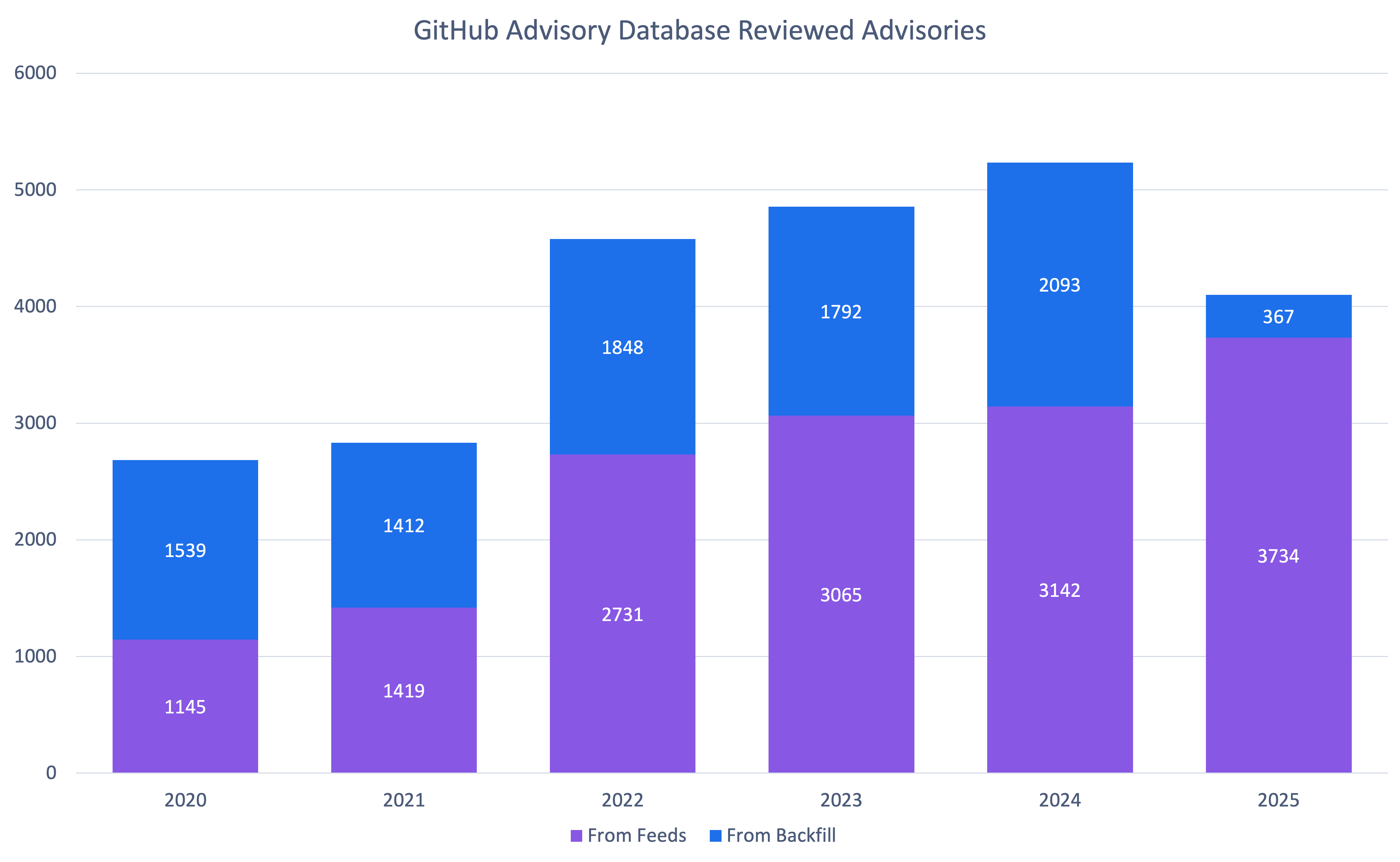
Stacked bar graph showing the number of advisories published from GitHub's feeds and those published from the backfill campaigns.

Reviewed Year	From Feeds	From Backfill
2020	1145	1539
2021	1419	1412
2022	2731	1848
2023	3065	1792
2024	3142	2093
2025	3734	367

So why the change? Quite frankly, we are running out of unreviewed vulnerabilities that are older than the Advisory Database. At the same time, the number of newly reported vulnerabilities hasn’t dropped.

It’s also worth clarifying that “unreviewed” in the database can be misleading: most advisories marked unreviewed have already been looked at by a curator and found not to affect any package in a supported ecosystem, so they may never be fully reviewed.
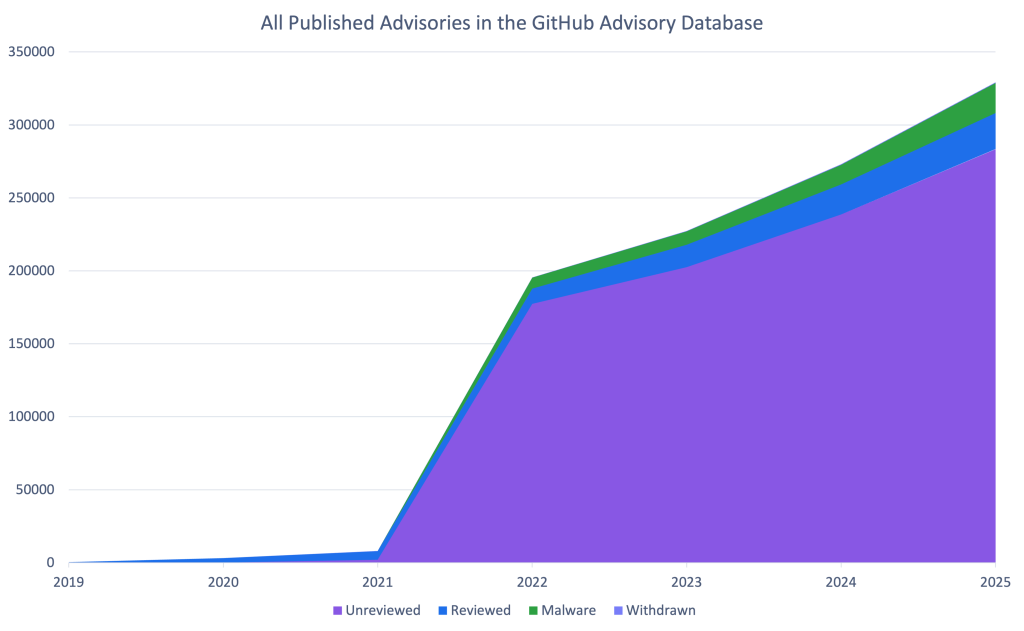
Stacked line graph showing the cumulative number of advisories of each type over the years.

Year	Unreviewed	Reviewed	Malware	Withdrawn
2019	0	381	0	42
2020	0	3,065	0	101
2021	1,978	5,896	0	140
2022	177,369	10,475	7,433	195
2023	202,583	15,332	9,136	290
2024	238,642	20,567	13,404	413
2025	283,447	24,668	20,649	522

This means that you should be receiving fewer brand-new Dependabot alerts about old vulnerabilities. 

Note: If you find an unreviewed advisory that affects a supported package, please let us know so we can get it reviewed!

How vulnerabilities were distributed across ecosystems in 2025

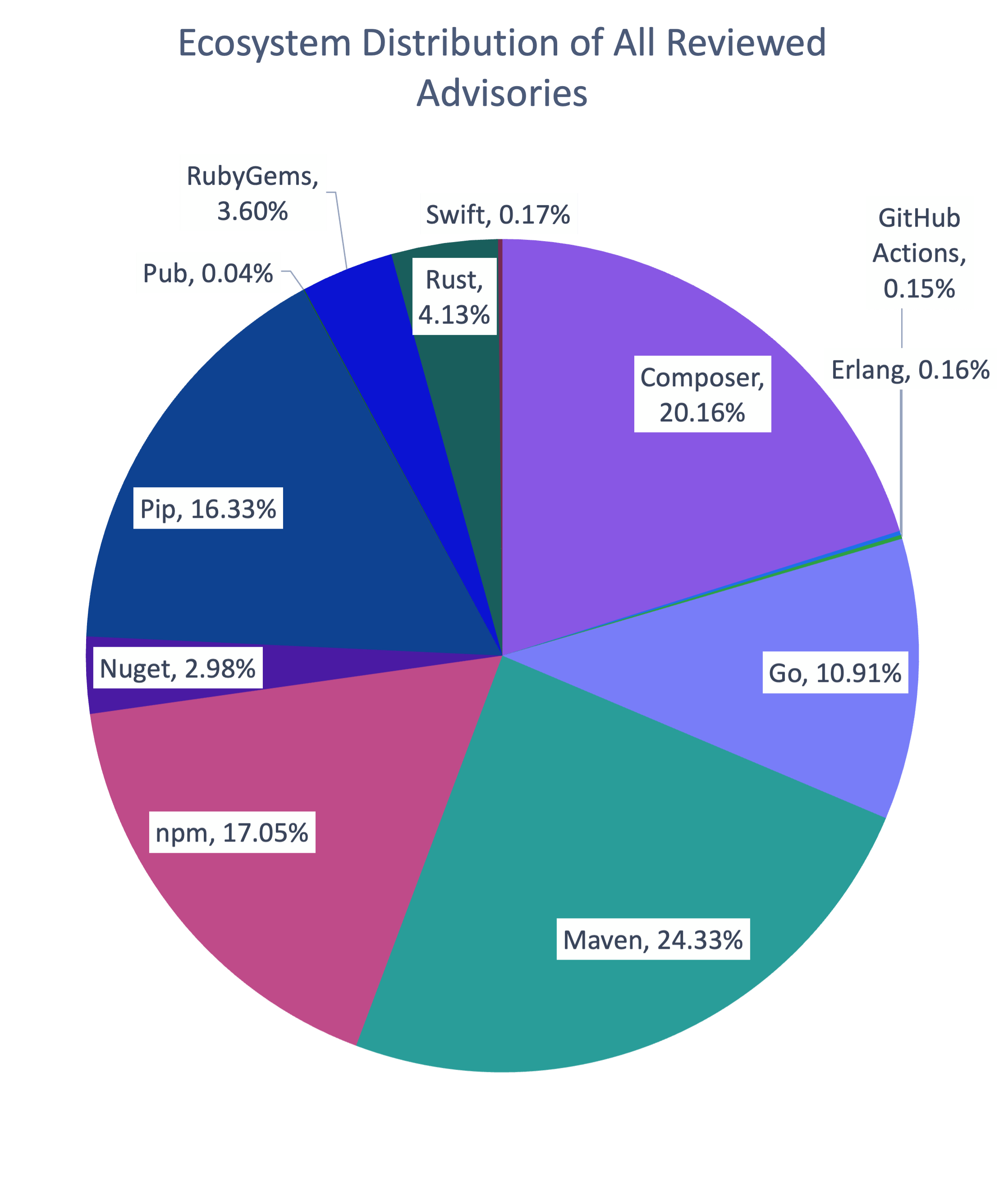
The distribution of ecosystems in advisories reviewed in 2025 is similar to the overall distribution in the database, with the exception of Go. Go is overrepresented in 2025 advisories by 6%. This is largely due to dedicated campaigns to re-examine potentially missing advisories found through an internal review for packages where we had inconsistent coverage.
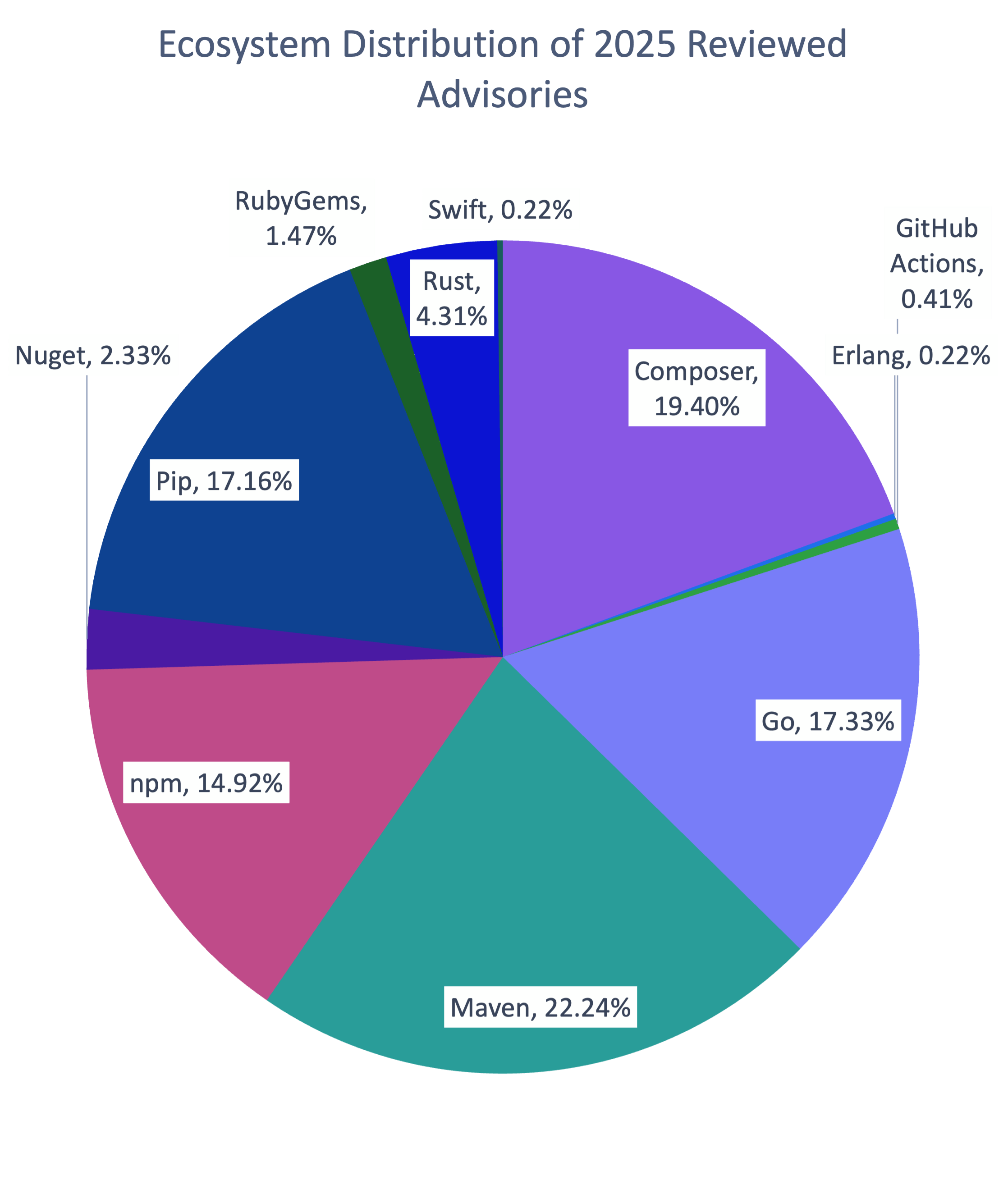
Circle graph showing the distributions of ecosystems of advisories reviewed in 2025.

Ecosystem	Proportion of 2025 Reviewed Advisories
Composer	19.40%
Erlang	0.22%
GitHub Actions	0.41%
Go	17.33%
Maven	22.24%
npm	14.92%
Nuget	2.33%
Pip	17.16%
RubyGems	1.47%
Rust	4.31%
Swift	0.22%
Circle graph showing the distributions of ecosystems of reviewed advisories across the entire GitHub Advisory Database.

Ecosystem	Proportion of All Reviewed Advisories
Composer	20.16%
Erlang	0.16%
GitHub Actions	0.15%
Go	10.91%
Maven	24.33%
npm	17.05%
Nuget	2.98%
Pip	16.33%
Pub	0.04%
RubyGems	3.60%
Rust	4.13%
Swift	0.17%

How the types of vulnerabilities changed in 2025

RankCommon Weakness Enumeration (CWE)Number of 2025 Advisories*Change in Rank from 2024Change in Rank from the Overall Database
1CWE-79672+0+0
2CWE-22214+2+1
3CWE-863169+9+8
4CWE-20154+1+1
5CWE-200145-2-1
6CWE-400144+4+0
7CWE-770136+7+10
8CWE-502134+5+1
9CWE-94119-3-1
10CWE-918103+5+8

* An advisory may have more than CWE. For example, an advisory might have both CWE-400 and CWE-770. It would then count for both.

As usual, cross-site scripting (CWE-79) is by far the most common vulnerability type. However, there are significant changes in the following areas. Resource exhaustion (CWE-400 and CWE-770), unsafe deserialization (CWE-502), and server-side request forgery (CWE-918) were unusually common in 2025. CWE-863 (“Incorrect Authorization”) saw a significant jump, but that is largely due to reclassification away from CWE-284 (“Improper Access Control”) and CWE-285 (“Improper Authorization”), which are higher level CWEs that the CWE program discourages using.

One of the biggest quality improvements in 2025 was more specific, more consistent CWE tagging. Advisories without any CWE dropped 85% (from 452 in 2024 to 65 in 2025). CWE-20 (“Improper Input Validation”) is still common, but in prior years it was often the only CWE listed on an advisory. 

In 2025, advisories far more often list CWE-20 plus one or more additional CWEs that describe the concrete failure mode. This added specificity makes the data more actionable for triage, prioritization, and remediation.

To find out how to filter Dependabot alerts by CWE, see our documentation on auto-triage rules.

How to prioritize your response

We provide two scoring systems for prioritization: 

Together, they can give you a head start on your risk assessment process.
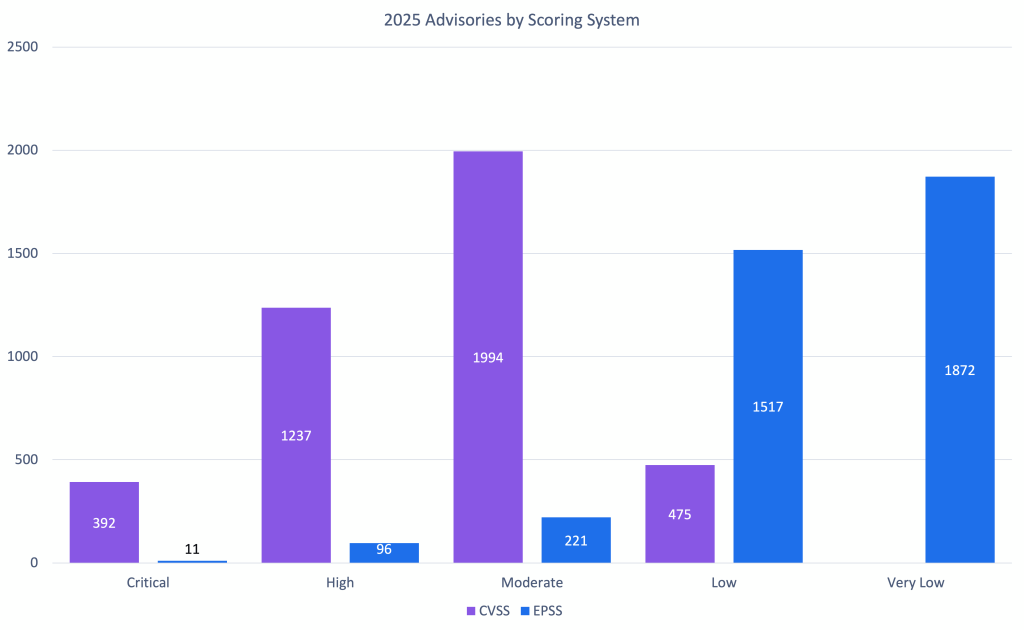
Priority	CVSS	EPSS
Critical	392	11
High	1237	96
Moderate	1994	221
Low	475	1517
Very Low		1872

As you can see, when considering impact, most vulnerabilities skew moderate to high of the impact range. Low-impact vulnerabilities are likely more common than the CVSS data suggests but are often not considered worth the time and effort for researchers and maintainers to report. The EPSS scores for moderate to high impact vulnerabilities support this decision.
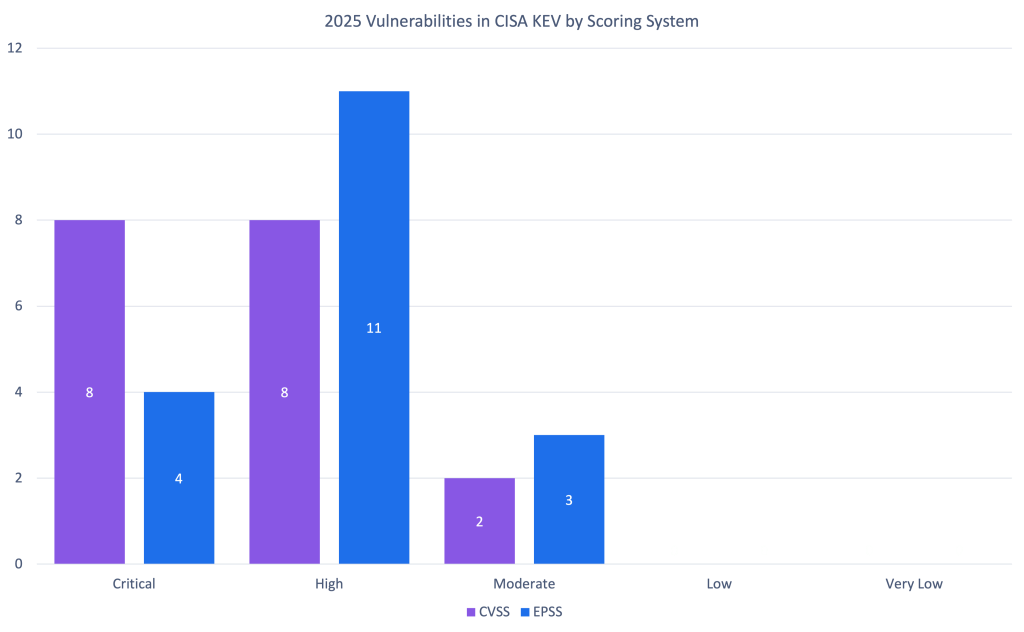
Priority	CVSS	EPSS
Critical	8	4
High	8	11
Moderate	2	3
Low	0	0
Very Low	0	0

So should you trust the EPSS or CVSS scores? To judge that, let’s look at how they match up to vulnerabilities in CISA’s Known Exploited Vulnerabilities Catalog. The exploited vulnerabilities are at least scored moderate, and most are critical or high. While CVSS has more of the exploited vulnerabilities as critical, it also has far more vulnerabilities in the range in general. Combining the two can help you prioritize which vulnerabilities to address to prevent exploitation.

npm malware advisories

2025 was a huge year for npm malware advisories. Due to large malware campaigns, such as SHA1-Hulud, GitHub saw a 69% increase in published malware advisories compared to 2024. This is the most malware advisories GitHub has published since our initial release of historical malware when we added support in 2022.

You can receive Dependabot alerts when your repositories depend on npm packages with known malicious versions. When you enable malware alerting, Dependabot matches your npm dependencies against malware advisories in the GitHub Advisory Database.
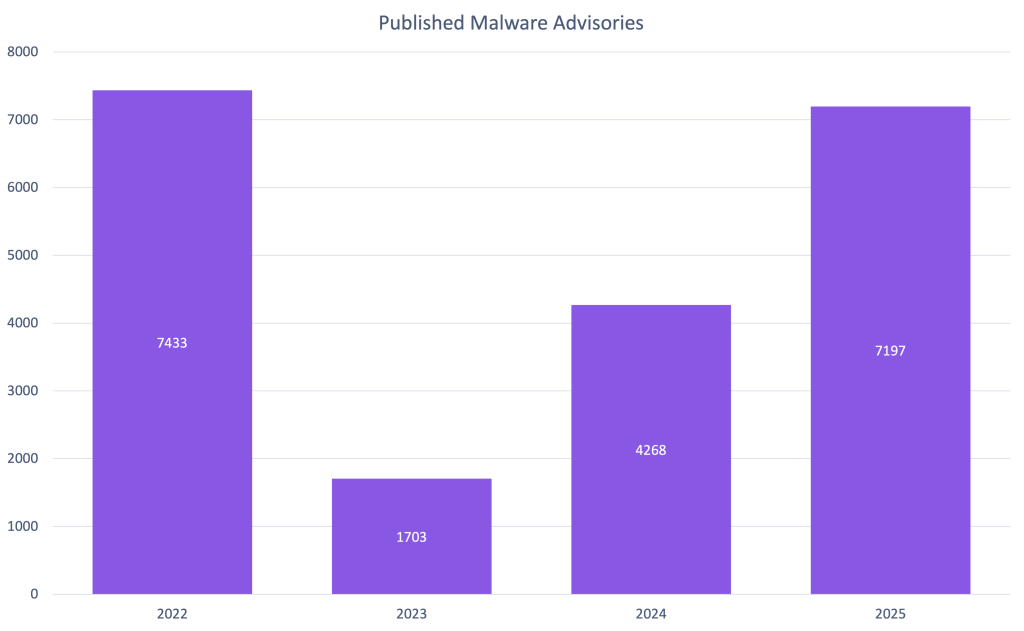
Bar graph showing the number of published malware advisories each year.

Publication Year	Published Malware Advisories
2022	7433
2023	1703
2024	4268
2025	7197

GitHub CVE Numbering Authority (CNA)

CVE publications

2025 was a big year for the GitHub, Inc. CNA. We saw a 35% increase in published CVE records, outpacing the overall CVE Project’s increase of 21%.
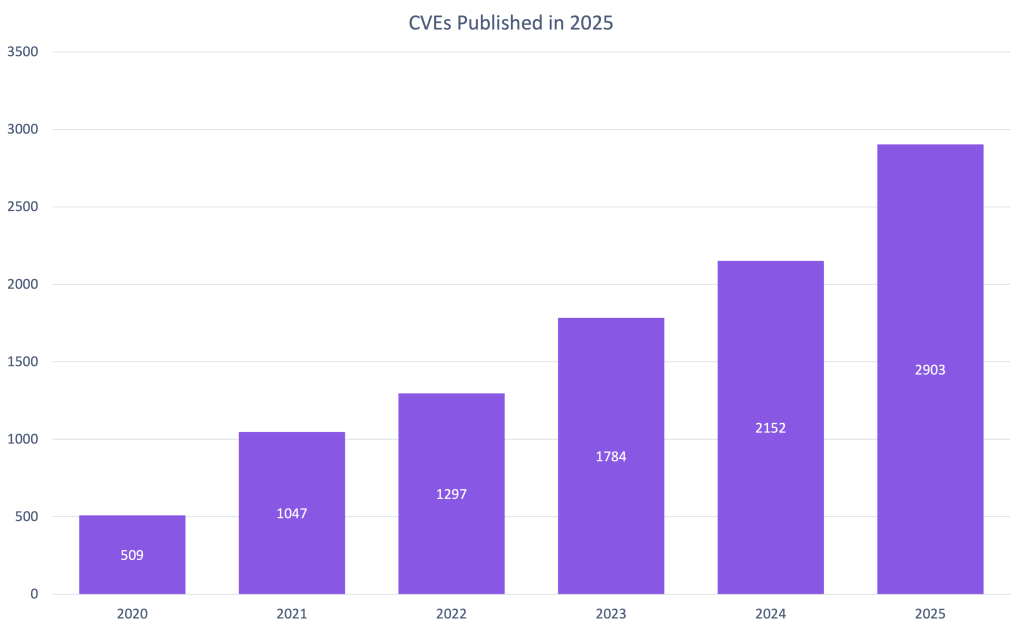
Bar graph showing the number of CVEs GitHub published year.

Published Year	CVEs Published in 2025
2020	509
2021	1047
2022	1297
2023	1784
2024	2152
2025	2903

In fact, we saw 10 to 16% growth every quarter. If this trend continues, GitHub will publish over 50% more CVEs in 2026.
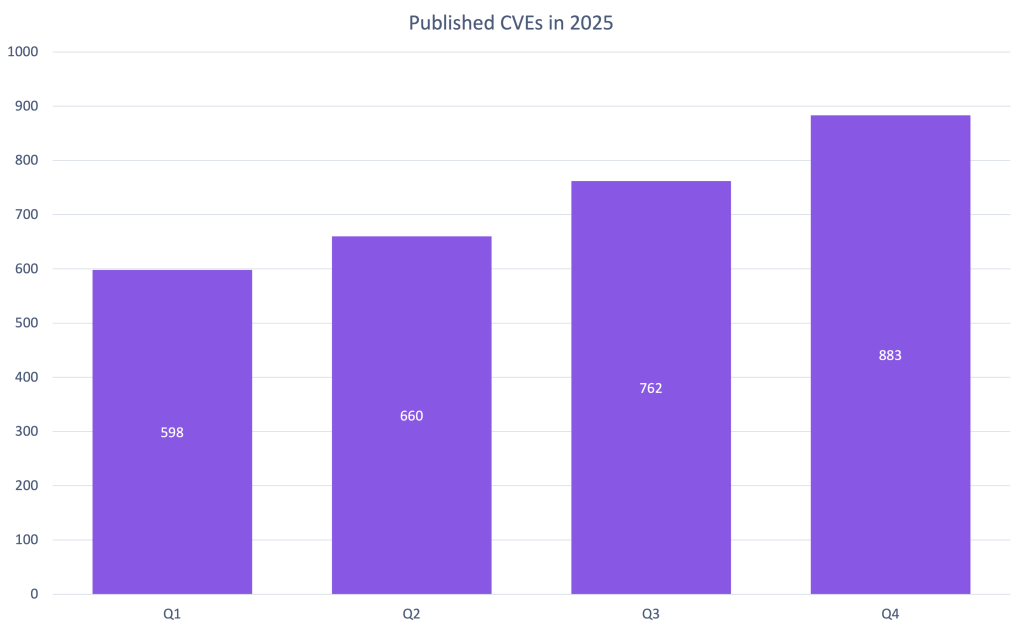
Bar graph showing the number of CVEs published by GitHub each quarter in 2025.

2025 Published Quarter	Number of CVEs
Q1	598
Q2	660
Q3	762
Q4	883

You can help make that a reality by requesting a CVE from us the next time you publish a repository security advisory about a vulnerability!

Organizations using GitHub’s CNA

Every year, GitHub sees more organizations use its CNA services. 2025 is no exception with a 20% increase in new organizations requesting CVE IDs.
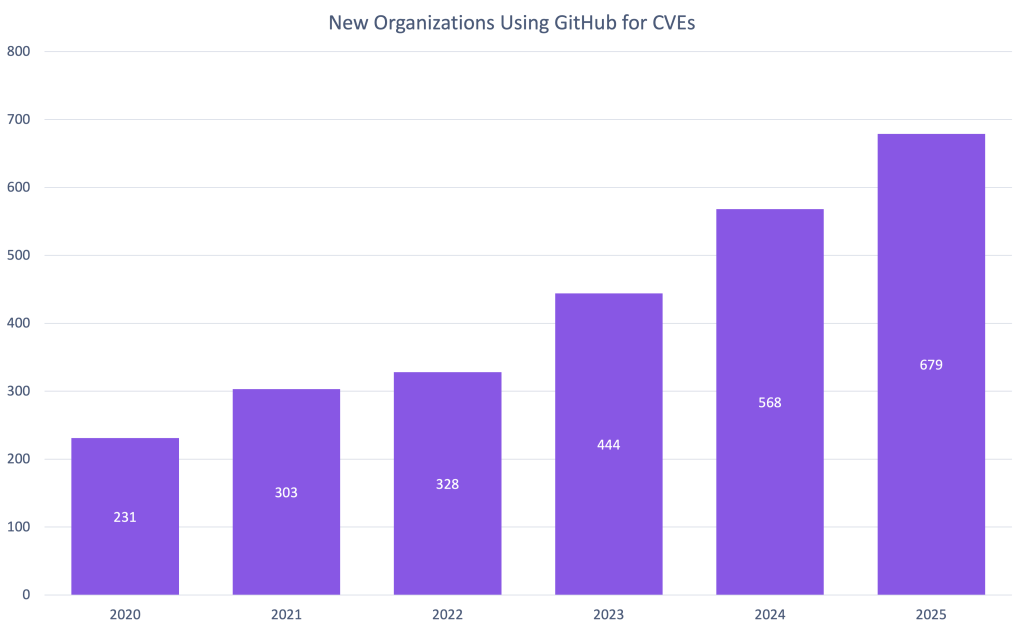
Bar graph showing the number of new organizations using GitHub for CVEs for each year.

First CVE Year	New Organizations Using GitHub for CVEs
2020	231
2021	303
2022	328
2023	444
2024	568
2025	679

Unlike reviewed global advisories, which are always mapped to packages in ecosystems we support, any maintainer on GitHub can request a CVE, even if they don’t publish that package to a supported ecosystem. In fact, 2025 is the first year that GitHub has published more CVEs from organizations that do not use a supported ecosystem than those that do.
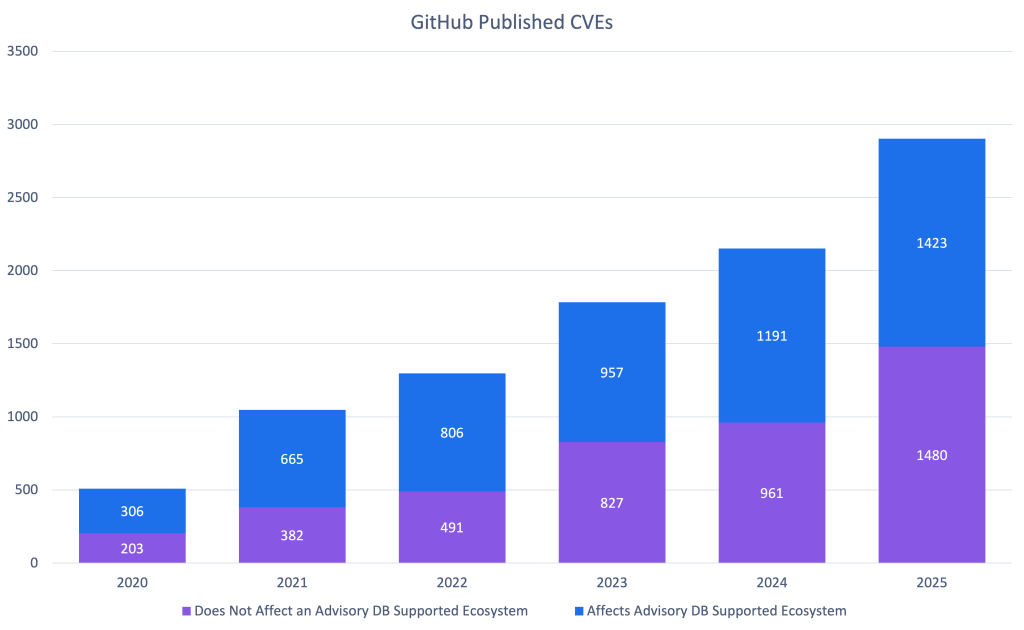
Stacked bar graph showing the number of CVEs GitHub published for vulnerabilities affected supported packages vs CVEs that don’t.

Published Year	Does Not Affect an Advisory DB Supported Ecosystem	Affects Advisory DB Supported Ecosystem
2020	203	306
2021	382	665
2022	491	806
2023	827	957
2024	961	1191
2025	1480	1423

We would like to thank all 987 organizations that published CVEs with us in 2025 and highlight the top 10 most prolific organizations.

Top 10 organizations using the GitHub CNA
OrganizationNumber of 2025 CVEs
LabReDeS (WeGIA)*130
XWiki40
Frappe28
Discourse27
Enalean27
FreeScout*27
DataEase26
Nextcloud25
GLPI24
DNN Software*23

* Organizations that published CVEs through GitHub for the first time in 2025

Onward to 2026

The data from 2025 shows incredible growth: 

  • 4,101 reviewed advisories 
  • 7,197 malware advisories 
  • 2,903 CVEs published
  • 679 new organizations using our CNA services

These numbers represent real security improvements for millions of developers.

You can be part of this in 2026. Here’s how: 

1. Use our CNA services

Publishing CVEs shouldn’t be complicated. Request a CVE directly from your repository security advisory, and we’ll take care of curating and publishing it for you. It’s free, it’s fast, and it helps the entire ecosystem understand and respond to vulnerabilities.

2. Improve advisory accuracy

Found an unreviewed advisory affecting a supported package? See incorrect severity scores or missing affected versions? Suggest edits. Your edits will be reviewed by the Advisory Database team and ultimately, will help make the database more accurate for everyone. In 2025, 675 contributions from the community improved the quality of this data for the entire software industry!

3. Protect your projects

The most direct impact you can have is protecting your own code. Enable Dependabot to automatically receive security updates and explore GitHub Advanced Security for comprehensive protection.

4. Make reporting a vulnerability easier

Let researchers know how to report to you and what you will and will not accept by creating a security policy for your repository. Enable private vulnerability reporting to make the coordination process smooth and secure.

Let’s make 2026 even better. See you in next year’s review! 🚀

The post A year of open source vulnerability trends: CVEs, advisories, and malware appeared first on The GitHub Blog.
GitHub Advisory Database by the numbers: Known security vulnerabilities and what you can do about them

The GitHub Advisory Database (Advisory DB) is a vital resource for developers, providing a comprehensive list of known security vulnerabilities and malware affecting open source packages. This post analyzes trends in the Advisory DB, highlighting the growth in reviewed advisories, ecosystem coverage, and source contributions in 2024. We’ll delve into how GitHub provides actionable data to secure software projects.

Advisories

The GitHub Advisory Database contains a list of known security vulnerabilities and malware, grouped in three categories: 

  • GitHub-reviewed advisories: Manually reviewed advisories in software packages that GitHub supports.
  • Unreviewed advisories: These are automatically pulled from the National Vulnerability Database (NVD) and are either in the process of being reviewed, do not affect a supported package, or do not discuss a valid vulnerability.
  • Malware advisories: These are specific to malware threats identified by the npm security team.

Reviewed advisories

GitHub-reviewed advisories are security vulnerabilities that have been mapped to packages in ecosystems we support. We carefully review each advisory for validity and ensure that they have a full description, and contain both ecosystem and package information.

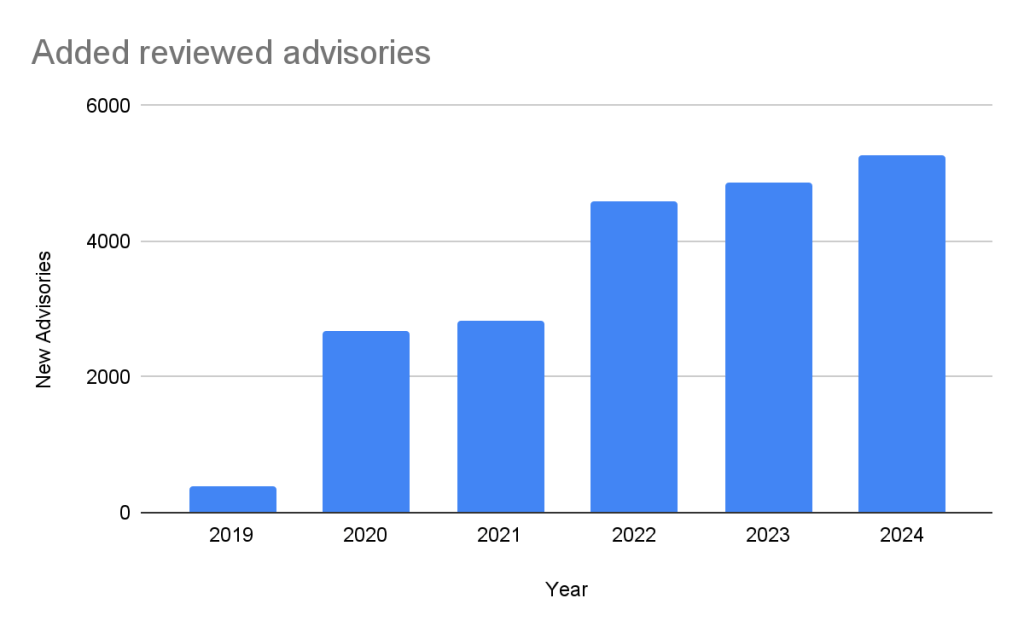
Every year, GitHub increases the number of advisories we publish. We have been able to do this due to the increase in advisories coming from our sources (see Sources section below), expanding our ecosystem coverage (also described below), and review campaigns of advisories published before we started the database. 

The bar graph shows the number of reviewed advisories added each year. The graph starts with 385 advisories added in 2019, shows an increase over time, and ends with 5256 advisories added in 2024.

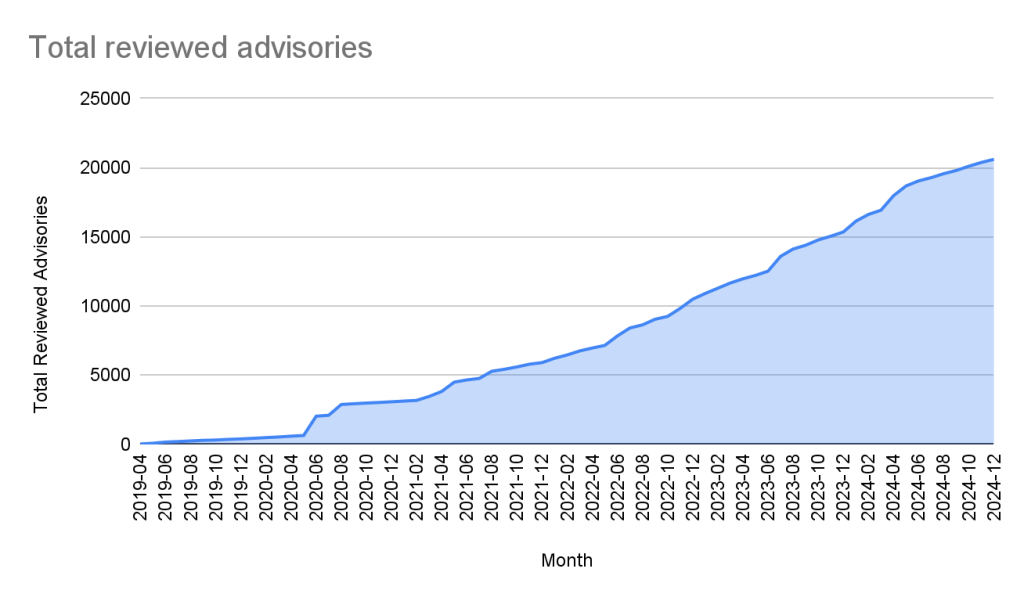
In the past five years, the database has gone from fewer than 400 reviewed advisories to over 20,000 reviewed advisories in October of 2024.

The line graph shows the total reviewed advisories steadily increasing from 0 in 2019 to 20607 at the end of 2024.

Unreviewed advisories

Unreviewed advisories are security vulnerabilities that we publish automatically into the GitHub Advisory Database directly from the National Vulnerability Database feed. The name is a bit of a misnomer as many of these advisories have actually been reviewed by a GitHub analyst. The reason why they fall into this category is because they are not found in a package in one of the supported ecosystems or are not discussing a valid vulnerability, and all have been reviewed by analysts other than someone from the GitHub Security Lab. Even though most of these advisories will never turn into a reviewed advisory, we still publish them so that you do not have to look in multiple databases at once.

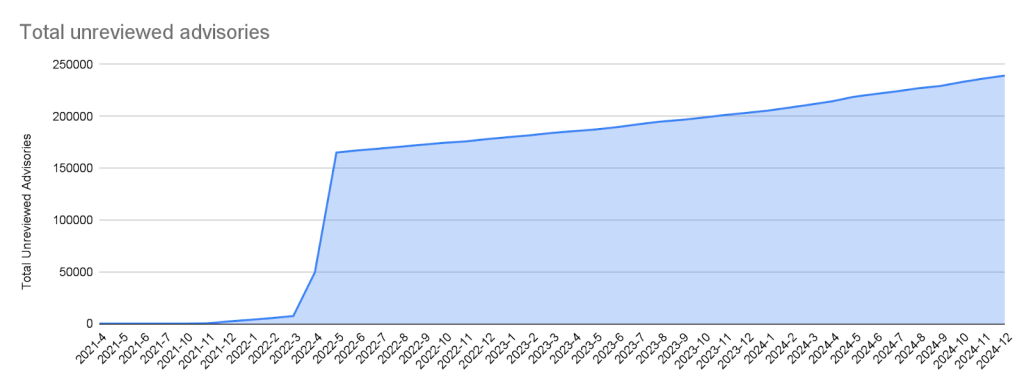
The line graph shows the total number of advisories overtime. The graph shows a sudden jump in April 2022, when GitHub started publishing all vulnerabilities from the National Vulnerability Database feed. It then shows a gradual increase over time.

Malware

Malware advisories relate to vulnerabilities caused by malware, and are security advisories that GitHub publishes automatically into the GitHub Advisory Database directly from information provided by the npm security team. Malware advisories are currently exclusive to the npm ecosystem. GitHub doesn’t edit or accept community contributions on these advisories.

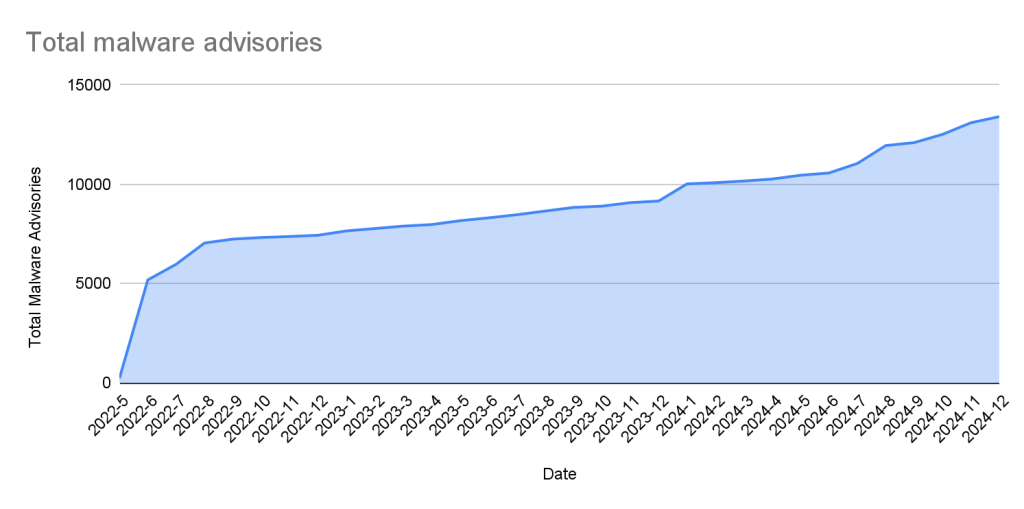
The line graph shows the total malware advisories over time, from May 2022 to December 2024. The line shows a general upward trend in malware advisories over the period, ending at 13405 advisories.

Ecosystem coverage

GitHub-reviewed advisories include security vulnerabilities that have been mapped to packages in ecosystems we support. Generally, we name our supported ecosystems after the software programming language’s associated package registry. We review advisories if they are for a vulnerability in a package that comes from a supported registry.

EcosystemTotal advisoriesVulnerable packagesFirst added
pip (registry: https://pypi.org/)337810442019-04-19
Maven (registry: https://repo.maven.apache.org/maven2)51719552019-04-22
Composer (registry: https://packagist.org/)42388122019-04-26
npm (registry: https://www.npmjs.com/)365326522019-04-26
RubyGems (registry: https://rubygems.org/)8403712019-04-26
NuGet (registry: https://www.nuget.org/)6514892019-04-26
Go (registry: https://pkg.go.dev/)20118652021-04-01
Rust (registry: https://crates.io/)8575532021-05-25
Erlang (registry: https://hex.pm/)31262022-01-27
GitHub Actions (https://github.com/marketplace?type=actions/)21212022-07-29
Pub (registry: https://pub.dev/packages/registry)1092022-08-04
Swift (registry: N/A)33212023-05-10
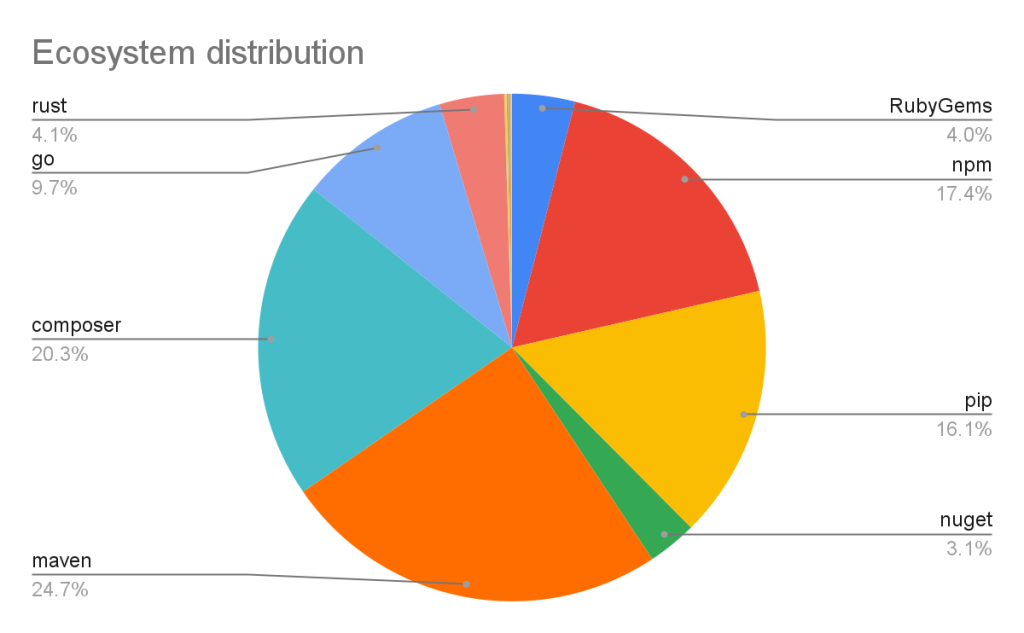
The pie chart shows the proportion of advisories across different software ecosystems. Maven, Composer, npm, Pip, and Go are the largest ecosystems.

Vulnerabilities in Maven and Composer packages are nearly half of the advisories in the database. npm, pip, and Go make up much of the rest, while the other ecosystems have a much smaller footprint.

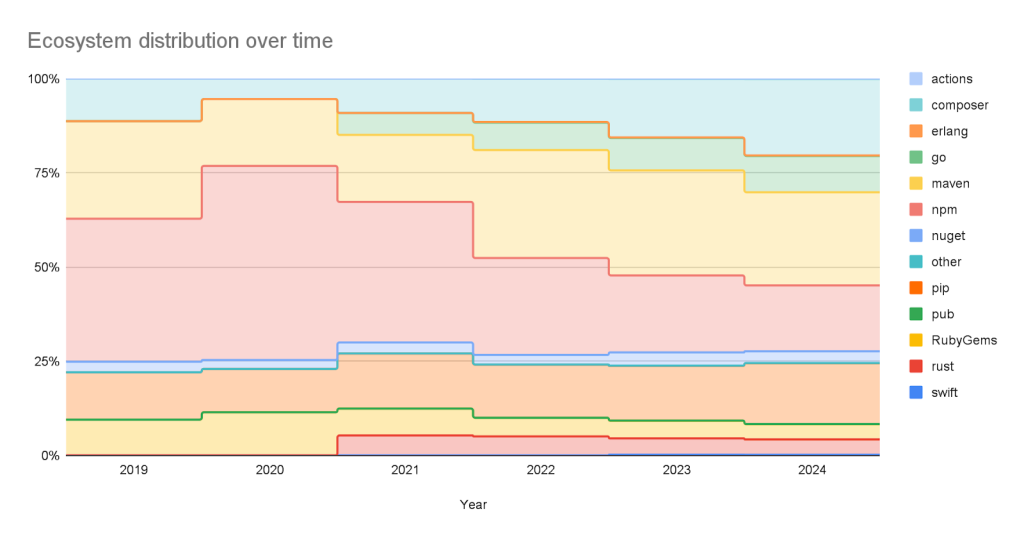
This has not always been the case. When the database was initially launched, NPM advisories dominated the database, but as we have expanded our coverage and added support for new ecosystems, the distribution mix has changed.

The stacked area line graph shows the percentage distribution of various ecosystems from 2019 to 2024. The graph starts with half the advisories being for NPM but over time, other ecosystems like Maven and Composer become more prominent.

Sources: Where do the advisories come from?

We add advisories to the GitHub Advisory Database from the following sources:

SourceAdvisoriesReviewed advisoriesSole sourceCoverage
NVD2674291829574506.84%
GitHub Repository Advisories12247531156443.37%
Community Contributions451241601092.20%
PyPA Advisories304027391490.10%
Go Vulncheck15811528796.65%
NPM Advisories1411140862999.79%
FriendsOfPHP1406139640099.29%
RustSec94384917190.03%
RubySec873861498.63%
  • NVD: This is a huge source of vulnerabilities covering all types of software. We publish all NVD advisories but only review those relevant to our supported ecosystems, which reduces noise for our users.
  • GitHub Repository Advisories: The second largest source is made up of advisories published through GitHub’s repository security advisory feature. Similar to NVD, these aren’t restricted to our supported ecosystems. However, we provide better coverage of the repository advisories because they focus exclusively on open source software.
  • Community Contributions: These are reports from the community that are almost exclusively requesting updates to existing advisories.
  • Other Specialized Sources: Sources like PyPA Advisories (for Python) and Go Vulncheck (for Go) that focus on specific ecosystems. Because they only cover packages within our supported ecosystems, most of their advisories are relevant to us and get reviewed.
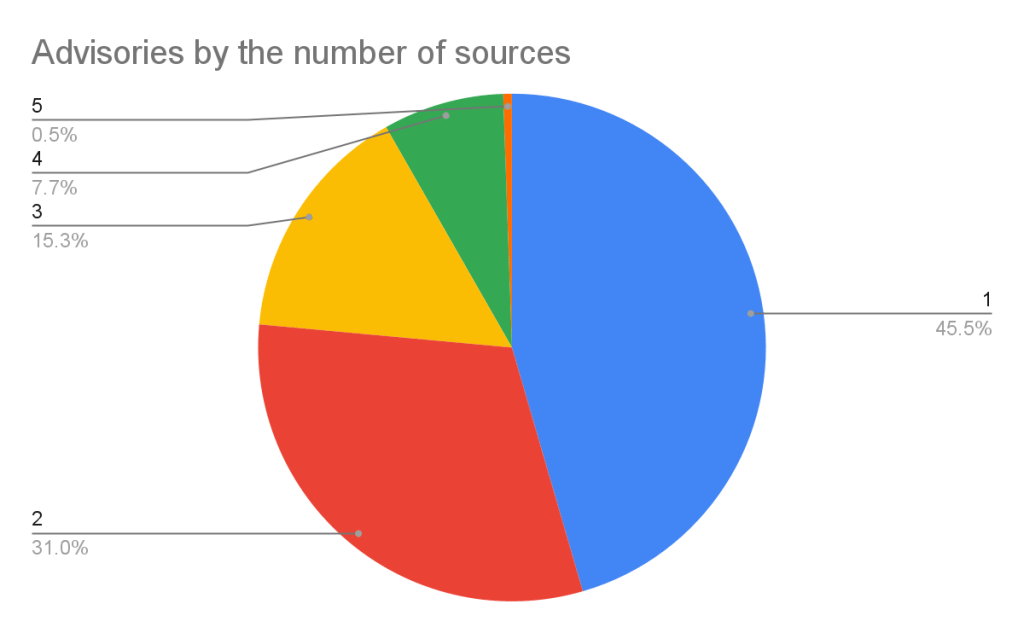
The pie graph shows the proportion of advisories by the number of sources they have. This shows that 46% of the advisories have only one source and 85% have three or fewer.

If you add up the number of reviewed advisories from each source, you will find that total is more than the total reviewed advisories. This is because each source can publish an advisory for the same vulnerability. In fact, over half of our advisories have more than one source.

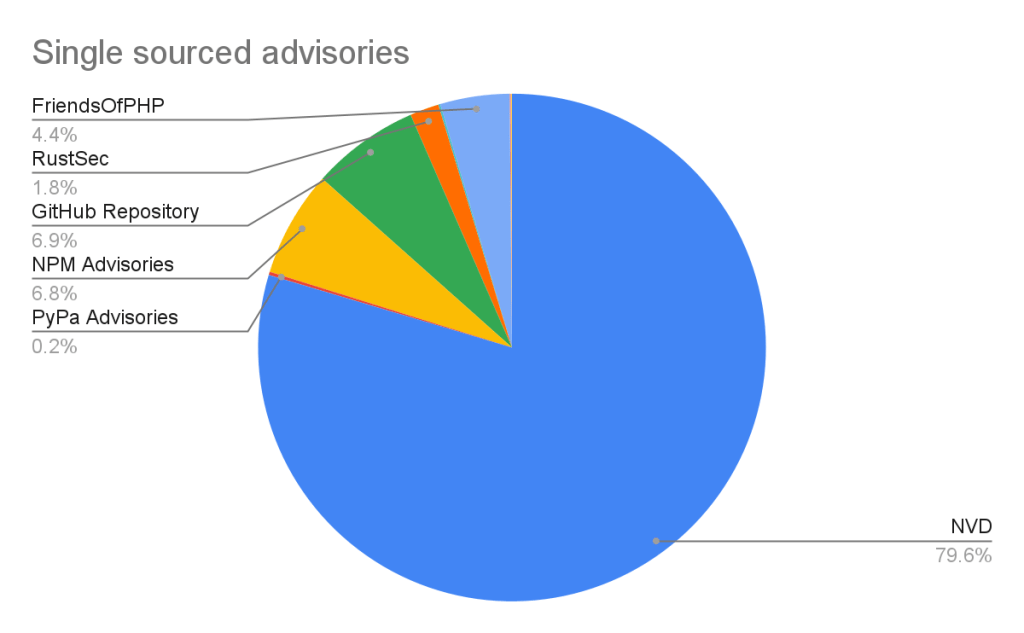
The pie graph shows the proportion of advisories that have a single source by the source they came from. The graph shows that 80% of all single sourced advisories come from the National Vulnerability Database.

Of the advisories with a single source, nearly all of them come from NVD/CVE. This justifies NVD/CVE as a source, even though it is by far the noisiest.

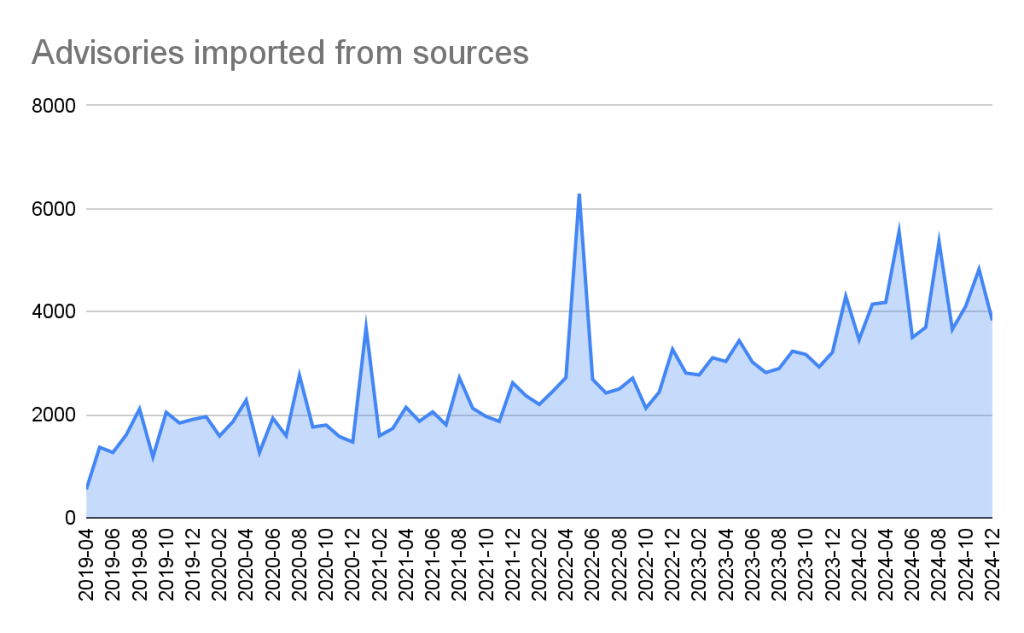
The line graph shows the number of advisories imported over time. The graph shows an increase in imports over time.

2024 saw a significant increase (39%) in the number of advisories imported from our sources. This is for the most part caused by an increase in the number of CVE records published.

CVE Numbering Authority

In addition to publishing advisories in the GitHub Advisory Database, we are also a CVE Numbering Authority (CNA) for any repository on GitHub. This means that we issue CVE IDs for vulnerabilities reported to us by maintainers, and we publish the vulnerabilities to the CVE database once the corresponding repository advisory is published.

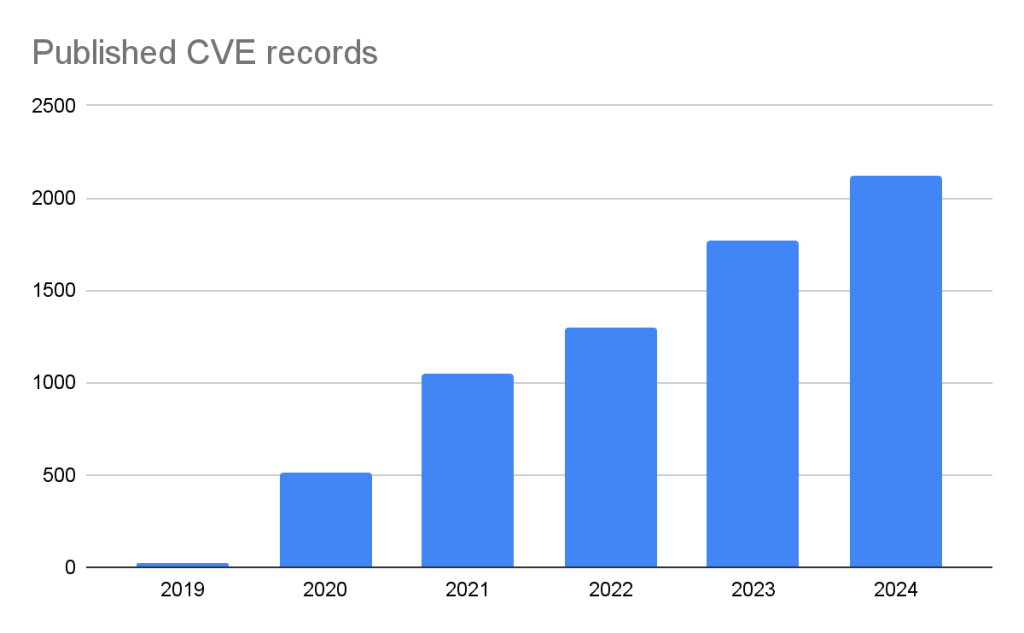
GitHub published over 2,000 CVE records in 2024, making us the fifth-largest CNA in the CVE Program.

The bar graph shows the number of CVE records published by the Advisory Database CNA over time. Every year shows an increase in the number published.

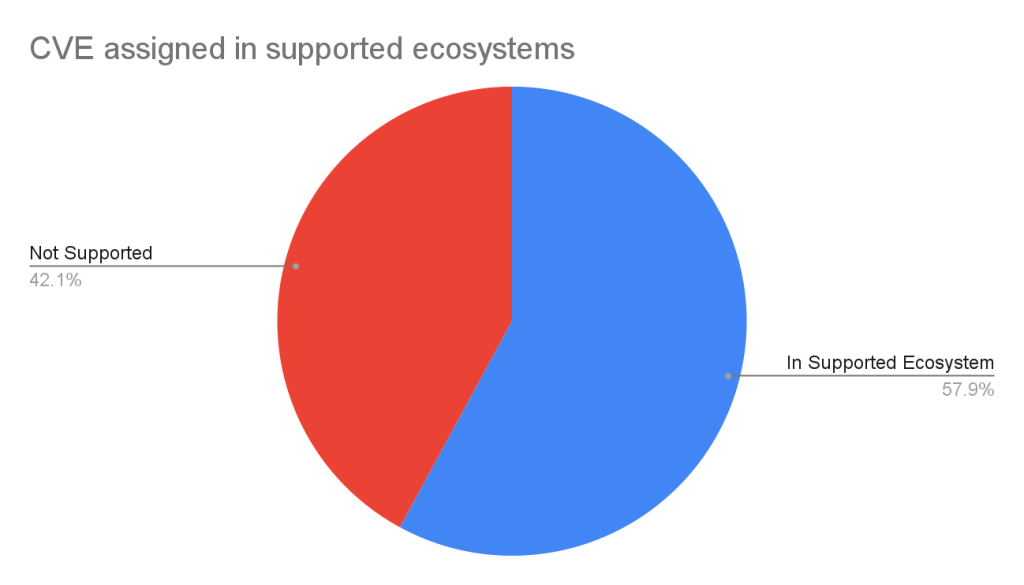
The GitHub CNA is open to all repositories on GitHub, not just ones in a supported ecosystem.

The pie graph shows the proportion of CVEs assigned by the Advisory Database that in a supported ecosystem. 58% are in a supported ecosystem and 42% are not.

Advisory prioritization

Given the constant deluge of reported vulnerabilities, you’ll want tools that can help you prioritize your remediation efforts. To that end, GitHub provides additional data in the advisory to allow readers to prioritize their vulnerabilities. In particular, there are:

  • Severity Rating/CVSS: A low to critical rating for how severe the vulnerability is likely to be, along with a corresponding CVSS score and vector.
  • CWE: CWE identifiers provide a programmatic method for determining the type of vulnerability.
  • EPSS: The Exploit Prediction Scoring System, or EPSS, is a system devised by the global Forum of Incident Response and Security Teams (FIRST) for quantifying the likelihood a vulnerability will be attacked in the next 30 days.

GitHub adds a severity rating to every advisory. The severity level is one of four possible levels defined in the Common Vulnerability Scoring System (CVSS), Section 5.

  • Low
  • Medium/Moderate
  • High
  • Critical

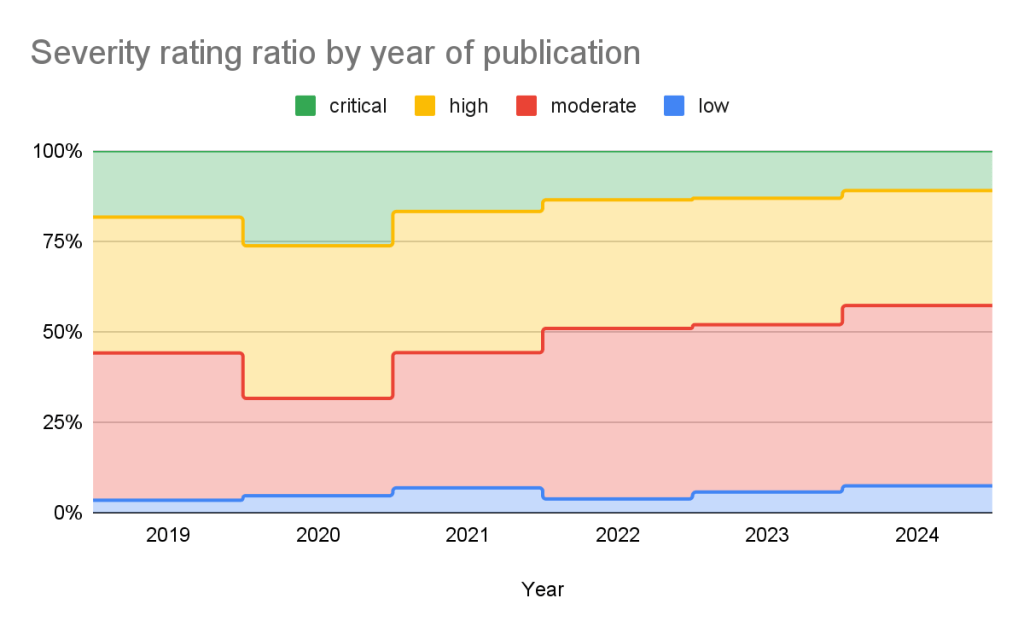
Using these ratings, half of all vulnerabilities (15% are Critical and 35% are High) warrant immediate or near-term attention. By focusing remediation efforts on these, you can significantly reduce risk exposure while managing workload more efficiently.

The stacked area line graph shows the severity rating ration by year of advisory publication. The graph shows that critical vulnerabilities were more common (20 - 25 percent) early on and moderates becoming more common over the years.

The CVSS specification says the base score we provide, “reflects the severity of a vulnerability according to its intrinsic characteristics which are constant over time and assumes the reasonable worst-case impact across different deployed environments.” However, the worst-case scenario for your deployment may not be the same as CVSS’s. After all, a crash in a word processor is not as severe as a crash in a server. In order to give more context to your prioritization, GitHub allows you to filter alerts based on the type of vulnerability or weakness using CWE identifiers. So you have the capability to never see another regular expression denial of service (CWE-1333) vulnerability again or always see SQL injection (CWE-89) vulnerabilities.

RankCWE IDCWE nameNumber of advisories in 2024Change in rank from 2023
1CWE-79Improper Neutralization of Input During Web Page Generation (‘Cross-site Scripting’)936+0
2CWE-200Exposure of Sensitive Information to an Unauthorized Actor320+0
3CWE-22Improper Limitation of a Pathname to a Restricted Directory (‘Path Traversal’)259+2
4CWE-20Improper Input Validation202+0
5CWE-94Improper Control of Generation of Code (‘Code Injection’)188+2
6CWE-89Improper Neutralization of Special Elements used in an SQL Command (‘SQL Injection’)181+3
7CWE-352Cross-Site Request Forgery (CSRF)161-4
8CWE-284Improper Access Control153+4
9CWE-400Uncontrolled Resource Consumption149-3
10CWE-287Improper Authentication124+11

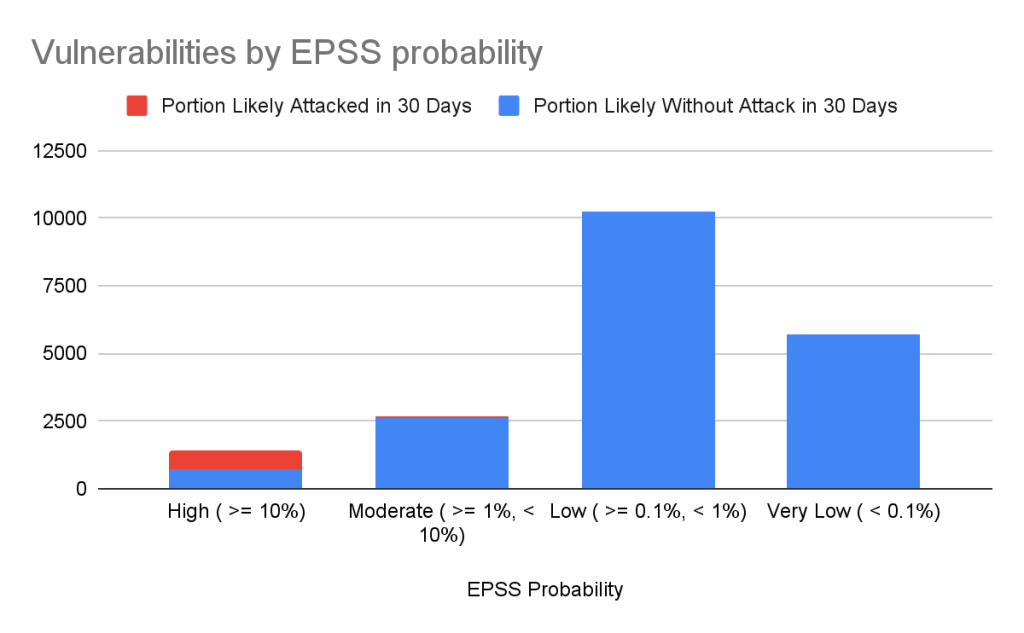
Still drowning in vulnerabilities? Try using EPSS to focus on vulnerabilities likely to be attacked in the next 30 days. EPSS uses data from a variety of sources to create a probability of whether exploitation attempts will be seen in the next 30 days for a given vulnerability. As you can see from the chart below, if you focus on vulnerabilities with EPSS scores of 10% or higher (approx. 7% of all vulnerabilities in the Advisory DB), you can cover nearly all of the vulnerabilities that are likely to see exploit activity.

The bar graph shows the number of advisories by EPSS probability. Most of the advisories are in the Low or Very Low probability.
EPSS probabilityVulnerabilities in rangePercentage of overall vulnerabilitiesExpected vulnerabilities in range attacked within the next 30 daysPercentage of total attacked vulnerabilities
High ( >= 10%)14407.17%74185.96%
Moderate ( >= 1%, < 10%)268713.37%849.74%
Low ( >= 0.1%, < 1%)1026451.09%354.06%
Very Low ( < 0.1%)570128.37%20.23%

Important caveats to remember when using EPSS:

  • Low probability events occur.
  • EPSS does not tell you whether a vulnerability is exploited; it only claims how likely it is.
  • EPSS scores are updated daily and will change as new information comes in, so a low-probability vulnerability today may become high probability tomorrow.

For more details on how to use CVSS and EPSS for prioritization, see our blog on prioritizing Dependabot alerts.

Actionable data

The GitHub Advisory DB isn’t just a repository of vulnerabilities. It powers tools that help developers secure their projects. Services like Dependabot use the Advisory DB to:

  • Identify vulnerabilities: It checks if your projects use any software packages with known vulnerabilities.
  • Suggest fixes: It recommends updated versions of packages that fix those vulnerabilities when available.
  • Reduce noise: You’ll only get notified about vulnerabilities that affect the version of the package you are using.
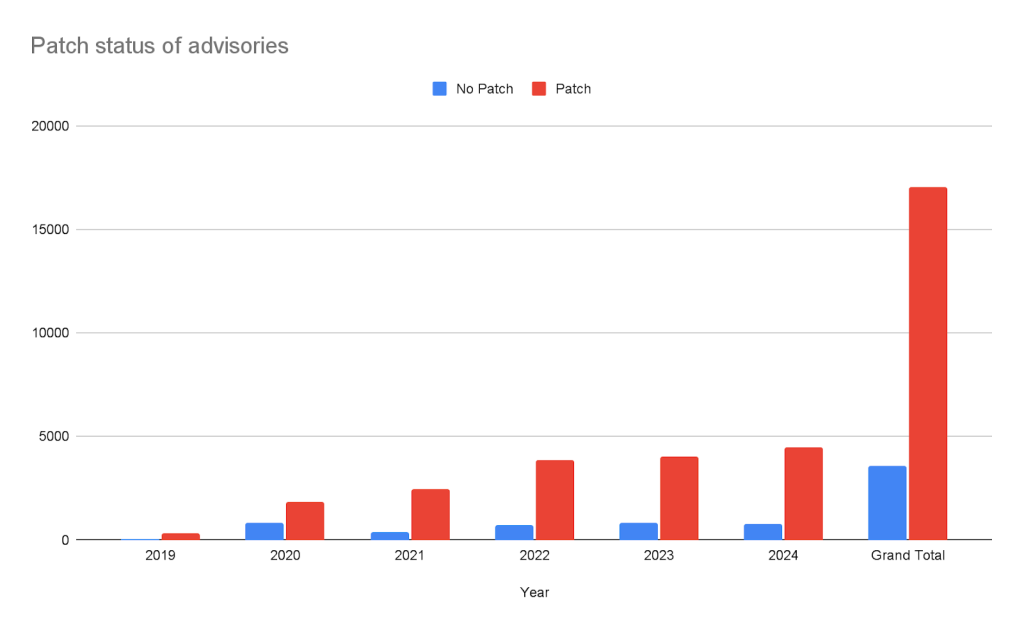
The bar graph shows the number of advisories published with a patch each year next to the number of advisories without a patch. For every year, nearly all of the advisories have a patch.

Take this with you

The GitHub Advisory Database is a powerful resource for tracking open source software vulnerabilities, with over 22,000 reviewed advisories to date. By focusing on popular package registries, GitHub allows you to definitively connect vulnerabilities to the packages you are using. Additional data such as CVSS and EPSS scores help you properly prioritize your mitigation efforts.

GitHub’s role as a CVE Numbering Authority extends beyond the Advisory Database, ensuring that thousands of vulnerabilities each year reach the broader CVE community. Want to ensure your vulnerability fix reaches your users? Create a GitHub security advisory in your repository to take advantage of both the GitHub Advisory Database and GitHub’s CNA services.

Want to dive deeper? Explore security blog posts >

The post GitHub Advisory Database by the numbers: Known security vulnerabilities and what you can do about them appeared first on The GitHub Blog.
❌