Visualização de leitura

Painkiller Pipeline: 300 Million Tapentadol Pills Sent from India to West Africa

This article is the result of a collaboration with Indian media outlet Newslaundry. You can find Newslaundry’s editorially independent coverage here.

Collage illustration by Klawe Rzeczy. Elements from Unsplash.

Indian companies have shipped more than 320 million synthetic opioid pills to West Africa – where they have not been approved by regulators – over the past three years, a Bellingcat investigation has found.

Export records from trade data provider 52wmb show that more than 1,400 consignments of tapentadol worth almost USD $130 million were sent from India to West Africa between January 2023 and December 2025.

Tapentadol, a painkiller two to three times more potent than tramadol, has not been approved for use in most West African countries, where some nations are grappling with an escalating opioid abuse epidemic.

However, this investigation shows that dozens of Indian suppliers have flooded the region with tapentadol over the past three years. Where dosages were listed, more than half the pills were in powerful strengths of 200mg or more – dosages that are not even approved in India.

The exports, cross-checked against records provided by trade data aggregator ImportGenius, show most tapentadol pills sent between 2023 and 2025 had the coastal nations of Sierra Leone and Ghana listed as their declared destinations.

The two West African countries were collectively marked as the destination for more than 80 per cent of the total value of tapentadol sent to the region.
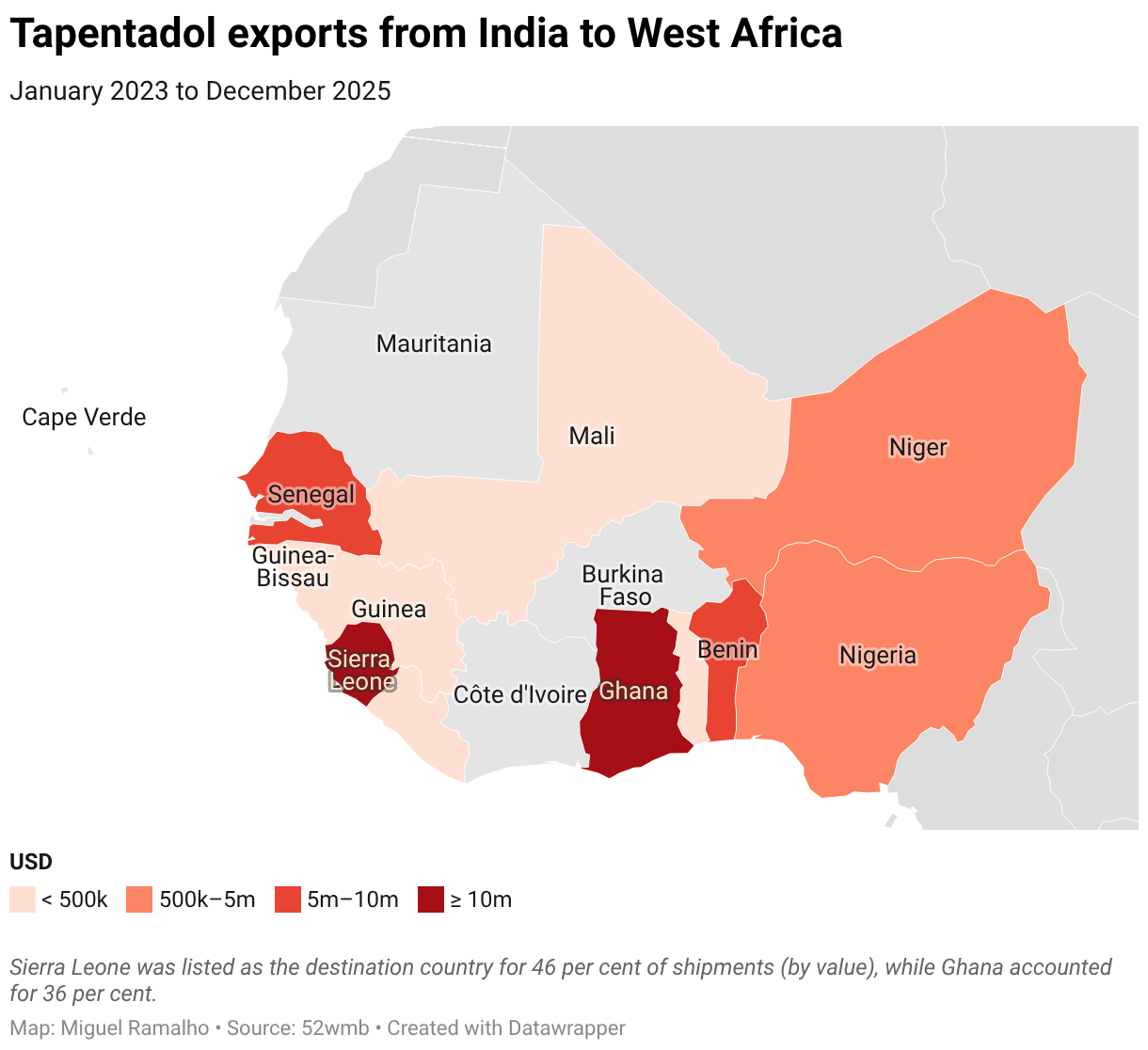
Tapentadol exports from India to West Africa (Choropleth map)

Experts have documented how drug traffickers adapt quickly to international regulations and law enforcement efforts. In 2018, India tightened export controls around the opioid tramadol, one of the most trafficked synthetic drugs to West Africa.

In 2021, the International Narcotics Control Board (INCB) said large-scale tapentadol trafficking had been identified, particularly in consignments destined for Africa. It had previously noted that India’s strengthened tramadol controls could lead traffickers to substitute the drug with other potent synthetic opioids.

A BBC investigation last year revealed that Indian company Aveo Pharmaceuticals was illegally exporting tablets containing a mix of tapentadol and the muscle relaxant carisoprodol to West Africa. This led India’s drug regulator, the Central Drugs Standard Control Organisation (CDSCO), to ban the manufacture and export of all combinations of the two drugs.

Bellingcat’s investigation, in collaboration with Indian publishing partner Newslaundry, reveals that the supply of tapentadol pills from India to West Africa has surged in recent years.

Export data from 52wmb shows the value of tapentadol sent to the region has risen from about USD $27 million in the three year period from 2020 to 2022, to almost USD $130 million from 2023 to 2025.

Julius Maada Bio, Sierra Leone’s president, in 2024 declared a national emergency over rampant drug abuse and branded kush – a toxic blend of psychoactive substances including cannabis and synthetic opioids – a “death trap”.

Authorities in Sierra Leone have intercepted illegal tapentadol, including last July when the National Revenue Authority (NRA) said it thwarted a smuggling operation near its north-west border with Guinea.

The NRA and other agencies including the Transnational Organised Crime Unit, National Drug Law Enforcement Agency, and the Pharmacy Board of Sierra Leone did not respond to Bellingcat’s requests for comment.

Sierra Leone’s NRA said customs officers seized tapentadol near a border crossing in July. Source: National Revenue Authority

Ghana’s Narcotics Control Commission (NACOC) said the illegal importation of tapentadol was first recorded in 2022 after international efforts to curb the tramadol crisis resulted in criminal networks shifting production to other pharmaceutical opioids including tapentadol, tafrodol and carisoprodol.

The agency has recorded a “steady rise” in tapentadol trafficking over the past three years, with authorities seizing more than 3.7 million tablets (250mg strength). Most were traced back to India, it said.

“NACOC investigations confirm that the bulk of tapentadol is trafficked into Ghana through seaports and by air, via express courier services,” a spokesperson said. “At the ports, the drug is concealed in containerized cargo falsely declared as pharmaceuticals, electrical materials or household goods. Express courier services are used for smaller, high-value quantities, often packed alongside legitimate consignments to avoid detection.”

NACOC said Ghana had emerged as both a destination and transit hub for tapentadol, with the majority of intercepted consignments bound for Niger, Mali, Burkina Faso and Nigeria. When sold domestically, it said the street drug was promoted as a tramadol substitute.

Ghana’s Food and Drugs Authority (FDA) said last year that the abuse of pharmaceutical opioids such as tapentadol — commonly known on the street as “Red” — was on the rise.

The FDA told Bellingcat it had “never issued any permit” for the manufacture or importation of tapentadol, in any strength, to any importer or to any country. It said any tapentadol shipments to Ghana were for “trans-shipment to neighbouring country”.

Import data for Ghana shows that no tapentadol entered the country between 2023 and 2025, which supports NACOC’s position that the drugs are being concealed and falsely declared. Import data for Sierra Leone was not available through 52wmb.

Ghana’s FDA destroyed 230 cartons of the illegally imported tapentadol last April and seized 7,700 tapentadol tablets at a border crossing last August. NACOC said it was combatting opioid importation through regulation, enforcement and cooperation with its counterparts in other countries. Source: FDA

India’s drug and pharmaceutical exports have grown to more than $30 billion a year, according to the Pharmaceuticals Export Promotion Council of India (Pharmexcil), a division of the ministry of commerce and industry.

While tapentadol is available in India on prescription in strengths of up to 100mg (immediate release) and 200mg (extended release), authorities are aware of its risk of misuse. Last year, the Indian drug regulator’s Technical Advisory Board said the Department of Revenue may be requested to schedule the painkiller under the Narcotic Drugs and Psychotropic Substances Act, which would tighten rules around its export.

To export pharmaceutical products at strengths that are not approved in India, exporters are required to obtain an export “no objection certificate” (NOC) from the CDSCO, for which they have to submit proof of the drug’s approval in the importing country. Publicly available information shows tapentadol is not approved for use in any of the West African nations identified as part of this investigation.

The CDSCO did not respond to questions from Bellingcat or our publishing partner, Newslaundry.

In response to “Right to Information” requests submitted by Newslaundry, the CDSCO said only two companies had been granted authorisation to manufacture tapentadol for export between 2019 and 2024. However, the trade data analysed by Bellingcat did not list either company as an exporter of tapentadol to West Africa.

The CDSCO also said it had issued export NOCs for tapentadol to 51 companies since 2024, but that these were not for export to West African countries.

Meanwhile, Bellingcat’s analysis of trade data shows that more than 60 Indian suppliers have exported tapentadol to West Africa since 2023. The exporters are mostly pharmaceutical companies but also include smaller operations, such as one company owned by a Nigerian man who sent more than US $4 million of tapentadol to Niger and Ghana.

In the BBC’s investigation, journalist Surabhi Tandon reported on the increase in cross-border smuggling of tramadol, “a catch-all name to describe the range of opioids used as street drugs”, from Ghana to Nigeria. Source: BBC News

Dinesh Thakur, co-author of the book Truth Pill, told Newslaundry there were gaps in India’s drug regulatory framework that made it possible for potentially unsafe medicines to be manufactured and exported without proper oversight.

“There is no regulatory framework which checks a genuine importer and counterfeit importer between countries,” said Thakur, a former pharmaceutical executive who now works as a public health activist.

Mohammed Adinoyi Usman, a consultant anaesthetist at Rasheed Shekoni Federal University Teaching Hospital in Nigeria, said tackling Africa’s opioid crisis was complicated by a lack of resources across the region, weak government responses, and inaction by law enforcement agencies.

He said more collaboration and intelligence sharing was needed, especially across West African countries, to combat the problem. “We see so many opioids coming into our region because of a range of factors including under-funded institutions like customs and drug agencies, weak border controls and corruption,” he said.

“Africa is different. Even southern Africa is different from western Africa – each region has its peculiarities. In Nigeria, we don’t have well-functioning institutions to help control it. But our government is trying.”

Dr Usman said access to prescription opioids in Africa was inadequate, and pointed to research showing the disparity in distribution of legal opioids to low-income countries compared to high-income nations that consume the bulk of the world’s pain relief medication. He said opioid abuse was linked to crime and negative health outcomes.

“Sadly, access to prescription opioids is very limited in Africa,” Dr Usman said, “but the costs of illegal use are high.”


Bellingcat is a non-profit and the ability to carry out our work is dependent on the kind support of individual donors. If you would like to support our work, you can do so here. You can also subscribe to our Patreon channel here. Subscribe to our Newsletter and follow us on Bluesky here, Instagram here, Reddit here and YouTube here.

The post Painkiller Pipeline: 300 Million Tapentadol Pills Sent from India to West Africa appeared first on bellingcat.
Taiwanese operator of Incognito Market sentenced to 30 years over $105M darknet drug ring

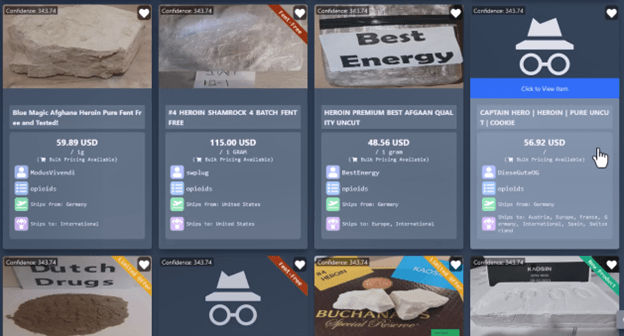
A Taiwanese man was sentenced to 30 years for running Incognito Market, a major darknet drug site that sold over $105 million in illegal drugs.

Rui-Siang Lin (24) was sentenced to 30 years in prison for running Incognito Market, a major darknet drug marketplace that sold over one ton of narcotics. The Taiwanese man pled guilty in December 2024.

“United States Attorney for the Southern District of New York, Jay Clayton, announced that RUI-SIANG LIN was sentenced to 30 years in prison for conspiring to distribute narcotics, money laundering, and conspiring to sell adulterated and misbranded medication, in connection with LIN’s ownership and operation of the Incognito Market, an online narcotics marketplace that sold more than one ton of narcotics before its closure in March 2024.” reads the press release published by DoJ.

Incognito Market ran on the dark web from 2020 to 2024 and sold over $105 million in drugs worldwide. Operated by Rui-Siang Lin under the alias “Pharaoh,” the site trafficked massive amounts of cocaine, meth, and other narcotics, including fentanyl-laced pills. Lin controlled every part of the operation, from vendors to customers.

The marketplace worked like a polished online shop for drugs. Users logged in, browsed thousands of listings, and paid with crypto. Vendors paid a 5% fee on each sale, the platform supported a built-in crypto “bank” to handle payments and kept buyers and sellers anonymous.

LIN co-founded Incognito Market in October 2020, took control by early 2022, and shut it down in March 2024 while operating from places including St. Lucia. Despite running a major dark web drug market, he even led a local police training on cybercrime and crypto. Under his leadership, Incognito grew to over 400,000 buyers, 1,800 vendors, and more than 640,000 drug transactions. He allowed opiate sales, including fake “oxycodone” that was actually fentanyl, linked to at least one fatal overdose. When closing the site, LIN stole over $1 million in user funds and tried to extort users by threatening to expose their data.

“In imposing the sentence, Judge McMahon stated to the defendant that Incognito Market was “a business that made [him] a drug kingpin,” and that this was the “most serious drug crime I have ever been confronted with in 27.5 years.”” continues the press release.

Along with the prison sentence, LIN received five years of supervised release and was ordered to forfeit about $105 million.

“Rui-Siang Lin was one of the world’s most prolific drug traffickers, using the internet to sell more than $105 million of illegal drugs throughout this country and across the globe,” said U.S. Attorney Jay Clayton.  “While Lin made millions, his offenses had devastating consequences.  He is responsible for at least one tragic death, and he exacerbated the opioid crisis and caused misery for more than 470,000 narcotics users and their families.  Today’s sentence puts traffickers on notice: you cannot hide in the shadows of the Internet.  And our larger message is simple: the internet, ‘decentralization,’ ‘blockchain’—any technology—is not a license to operate a narcotics distribution business.”

Follow me on Twitter: @securityaffairs and Facebook and Mastodon

Pierluigi Paganini

(SecurityAffairs – hacking, dark web)

A Chinese Fentanyl Smuggling Network’s Footprints in Japan

This article is the result of a collaboration with Japanese publishing partner Nikkei. You can find Nikkei’s investigation here.

Earlier this year, a man and a woman stood trial in a New York courtroom on charges related to the illicit drugs trade. They had been arrested as part of an undercover sting by the US Drug Enforcement Administration (DEA) after more than 200 kilograms of precursor chemicals used to make the synthetic opioid fentanyl were shipped from China to the US. It was enough to make 25 million deadly doses of the drug, authorities said. 

The Chinese nationals were also accused of conspiring to import tonne-quantities of fentanyl precursors to the US, where tens of thousands of people die from opioid overdoses every year. After a two-week trial, a Manhattan jury found the pair guilty of conspiracy to import fentanyl precursors and conspiracy to commit money laundering. 

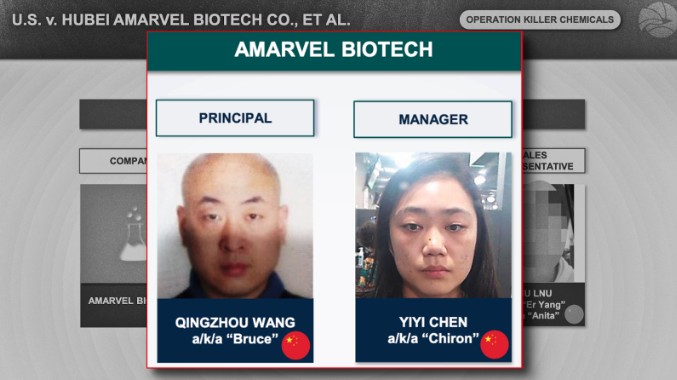
Qingzhou “Bruce” Wang, 36, and Yiyi “Chiron” Chen, 32, worked for Hubei Amarvel Biotech (AmarvelBio), a chemical firm based in the Chinese city of Wuhan. They were arrested in 2023 after being lured from China to Fiji as part of a DEA operation and subsequently extradited to the US. The case marked the first time US authorities prosecuted Chinese company executives for trafficking fentanyl precursors.

AmarvelBio’s principal executive Qingzhou Wang and marketing manager Yiyi Chen “conspired to import massive amounts of fentanyl precursors … with callous disregard for the effect that such deadly chemicals would ultimately have here in the United States,” US Attorney Danielle R. Sassoon said. Source: DEA

But court documents showed there may be links to another East Asian country. Bellingcat was contacted by the Japanese newspaper Nikkei, which was investigating AmarvelBio’s connection to Japan, suspecting the country was being used as a command post for the cross-border smuggling operation. 

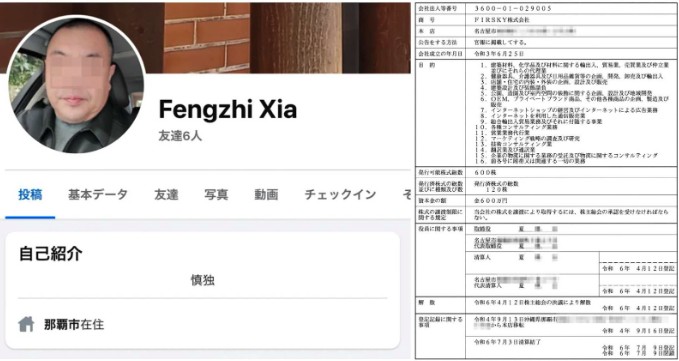
Nikkei was looking into Xia Fengzhi, a Chinese man referred to in the New York legal proceedings as “the boss in Japan”. It had found an individual by that name who was listed as the owner of a Chinese company selling raw chemical materials called Fushikai Trading Co Ltd, which according to Nikkei was active under the brand name “Firsky”. A website for Firsky China included a certificate for Fushikai Trading with the same identification code seen on Fushikai’s corporate records. The company, according to its website, was a wholly owned subsidiary of Firsky Co. Ltd., which was registered in Nagoya, an industrial city in central Japan. 

Nikkei pulled the corporate records for Firsky in Japan, which showed Xia headed the company. Records obtained by Nikkei also showed that the Chinese company’s supervisor was listed as Qingzhou Wang, the same name as one of the two AmarvelBio executives convicted in the US.

Left: Fengzhi Xia’s Facebook profile. Right: Publicly available documents for Firsky, set up in Japan in 2021, show Xia was named as head of the company. The company was liquidated in July 2024. Source: Nikkei

Nikkei asked Bellingcat’s financial investigations team to leverage its expertise in open source research to independently verify the Japanese company’s connection to AmarvelBio. Our investigation uncovered evidence showing the two companies are not only part of the same international smuggling network – they are effectively one and the same. This is how we did it.

The Japan Connection

Linking AmarvelBio and Firsky through domain records was not possible because both websites were registered through a provider that uses privacy protection, which conceals personal details from the public. However, information obtained by US law enforcement can become public during court proceedings.

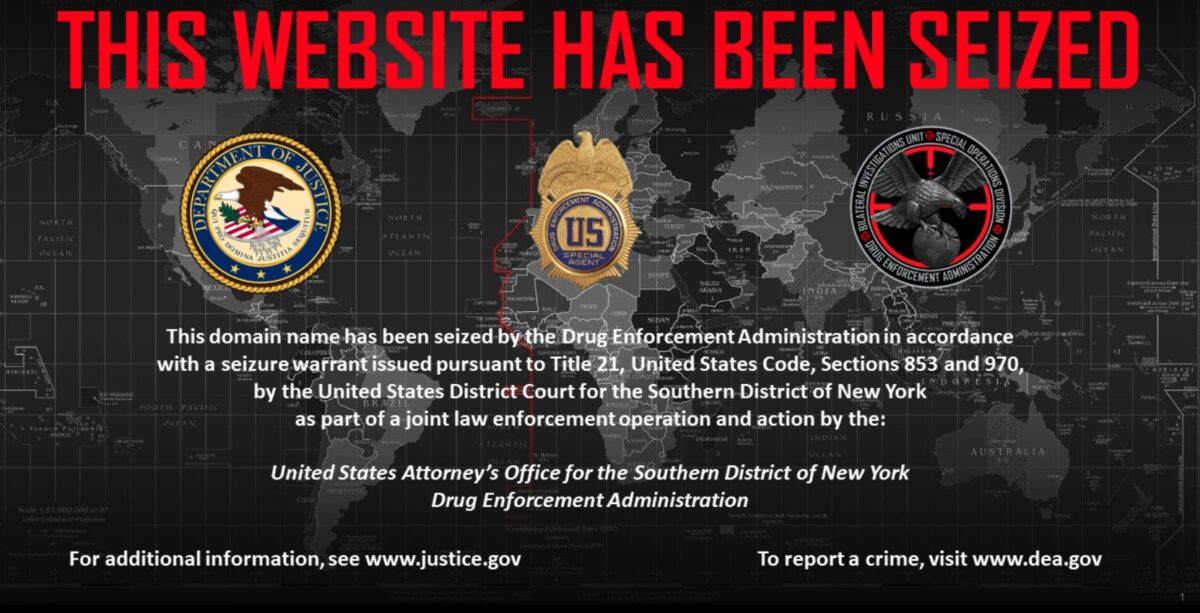
AmarvelBio’s website and 11 others linked to the company were seized by the DEA. This seizure notice was displayed to users attempting to access the sites. Source: DEA

CourtListener’s Advanced RECAP Search is a free tool operated by the non-profit Free Law Project that allows users to search millions of federal court documents made available through the Public Access to Court Electronic Records (PACER) service. 

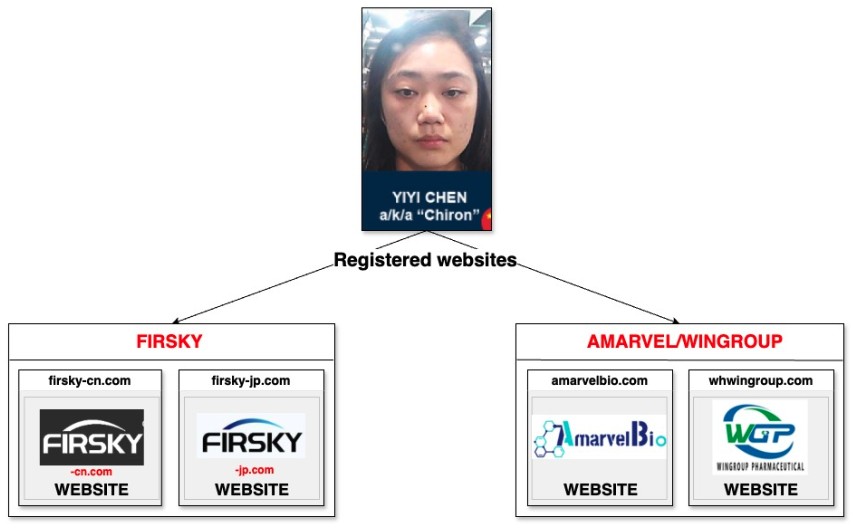
A CourtListener search for “amarvelbio.com” returned multiple results, including an exhibit from the federal case against AmarvelBio. This contained subpoenaed domain registration data, which showed that convicted AmarvelBio employee Yiyi “Chiron” Chen registered a number of domains, including for AmarvelBio, its “sister company” Wuhan Wingroup, and Firsky (in both China and Japan).

Diagram created by Bellingcat showing AmarvelBio marketing manager Yiyi “Chiron” Chen registered the AmarvelBio, Firsky and Wingroup websites. Source: US District Court (Southern District of New York)

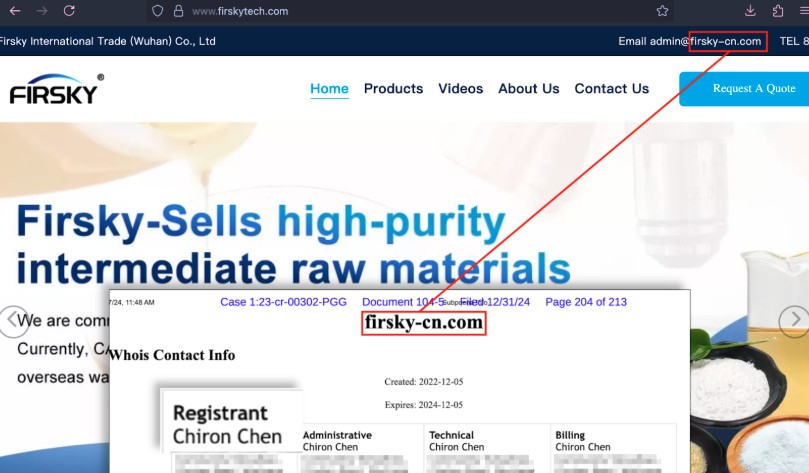
Another domain (firskytech.com) that was not included in the documents available on CourtListener was registered months after Chen’s 2023 arrest and remains online as of publication. This website lists an address in Wuhan and describes itself as a wholly Japanese-owned supplier of “high purity” chemical intermediates. While its registration details remain private, the contact email listed on the site uses the domain for Firsky China – “firsky-cn.com” – which was registered by Chen and is therefore linked to the network.

The firskytech.com homepage lists a domain registered by Chen. Source: firskytech.com, US District Court (Southern District of New York)

Bellingcat also found Chen’s personal gmail address in the source code in archives of three websites (here, here and here) that were in both the subpoenaed registration records and a list of 12 domains US authorities seized after linking them to AmarvelBio, further corroborating her involvement.

Additional domain links between AmarvelBio and the Japanese iteration of Firsky were identified in archived advertisements from the darknet marketplace Breaking Bad, which were found via leak aggregator intelx.io. The chemicals ads were posted under AmarvelBio’s rebranded name, AmarvelTech, following the Chinese company’s indictment in 2023. 

Some of the ads led to whrchem.com – one of the 12 websites seized by the DEA. Domain records discovered via intelx.io revealed that whrchem.com was controlled by two email accounts, one of which used the domain for Firsky Japan – “firsky-jp.com”. The same email is also listed as an “author” on an archive of whrchem.com.

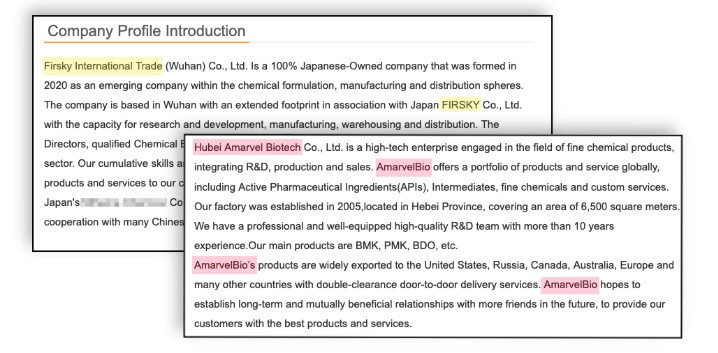
Bellingcat’s analysis of AmarvelBio and Firsky’s profiles, advertisements and salespeople uncovered further links between the two companies, including recycled phone numbers, photographs, watermarks, company bios and compliance certificates that could not be verified.

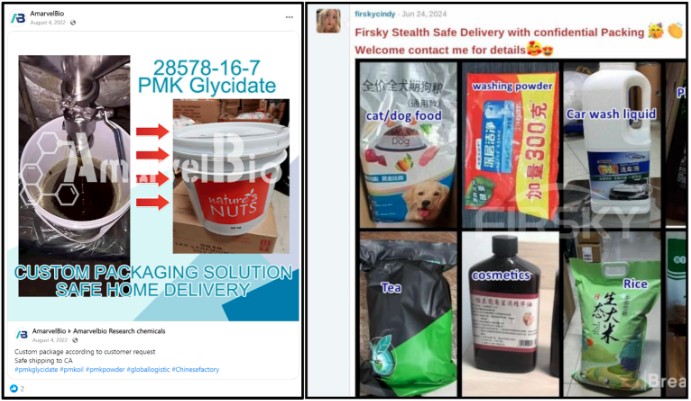
Authorities said AmarvelBio advertised chemicals online and used deceptive packaging – including labeling exports as dog food, nuts and motor oil – to thwart law enforcement. The same “stealth” packaging service was seen in Firsky-branded ads. Source: US Attorney’s Office (Southern District of New York), Breaking Bad

Searches for Firsky on the Breaking Bad forum returned an existing profile for a salesperson called “Cindy”, whose contact website was listed as bmkpmkbdo.com. A 2024 archive of the site displays Cindy’s WhatsApp number which, searches show, had previously been used in an AmarvelBio advertisement posted on Breaking Bad. 

Firsky has a seller profile with more than 350 active listings on the e-commerce platform ChemicalBook. But in one ad, under descriptions of the company, Firsky is interchangeably described as AmarvelBio.

The link between AmarvelBio and Firsky is indicated by both companies being listed within the same seller profile on an e-commerce site. Source: ChemicalBook

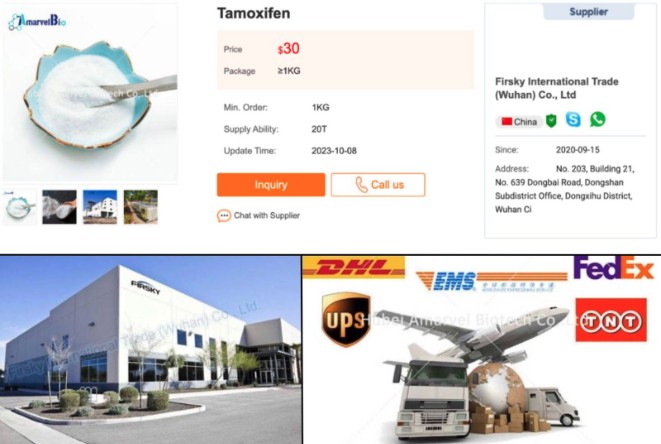
While many Firsky ads included stock images branded with its watermark, some products advertised by Firsky were clearly branded as AmarvelBio and displayed the “Hubei Amarvel Biotech Co., Ltd” watermark. One Firsky website and AmarvelBio’s ChemicalBook profile both displayed an image of the same factory.

Top: An ad posted by Firsky includes photos displaying the AmarvelBio watermark. Bottom: Ads on Firsky’s seller profile show both its watermark (left) and AmarvelBio’s. Source: ChemicalBook

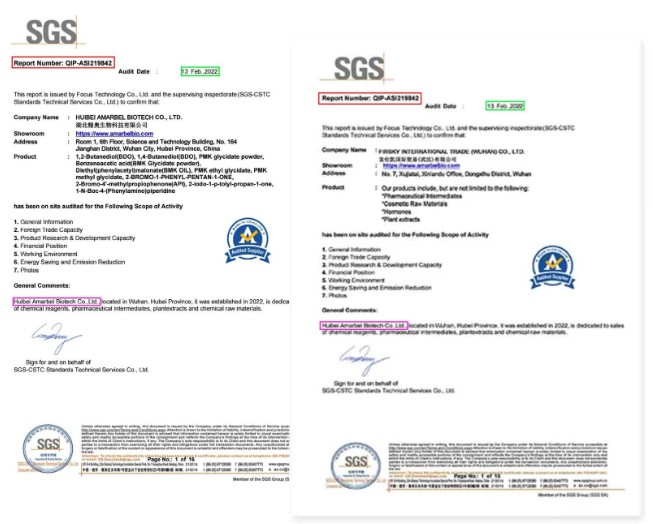
AmarvelBio also has a ChemicalBook seller’s profile and displays a certificate (though “Amarvel” appears to be misspelled “Amarbel”) claiming to show it passed a third party quality inspection. An image of a certificate bearing an identical report number and date, but with Firsky listed under “company name”, was found on one of Firsky’s websites. Under the “General Comments” section, both the Amarvel and Firsky certificates contain a reference to “Huibei Amarbel Biotech Co., Ltd., located in Wuhan”.

Certificates posted by AmarvelBio (left) and Firsky (right). Source: ChemicalBook, firskytech.com

The company said to have issued the certificates, SGS-CSTC Standards Technical Services Co. Ltd., told Bellingcat it was unable to verify the documents because they were incomplete.

Earlier this year, Bellingcat and the Estonian outlet Postimees investigated the online sale of nitazene opioids from Chinese suppliers. It found that entities involved in selling the super-strength drugs also used Russian Doll-like setups involving multiple companies sharing the same contact details, salespeople, advertisements and website layouts.

‘Room for Exploitation’

Illicit fentanyl sourced from China and Mexico has fueled the most lethal drug crisis in America’s history. The synthetic opioid is 50 times more potent than heroin – a dose as small as 2mg can be lethal. While fatalities have declined in recent years, the opioid epidemic killed more than 100,000 people between February 2022 and January 2023, and overdose remains the leading cause of death for Americans aged 18 to 44. 

The US government this year imposed tariffs on China aimed at putting pressure on Beijing to stem the flow of fentanyl precursor chemicals into the country. In June, China added two fentanyl precursors to the list of controlled substances in what it described as an initiative to fulfill UN drug control obligations, reflecting its “attitude of actively participating in global drug governance”. At least one of these precursors has been advertised by AmarvelBio and its affiliated companies, including some listings that remain online on third-party trading websites. 

Takehiro Masutomo, a Tokyo-based journalist and the author of Run Ri: Tracing the Footsteps of Chinese Elites Escaping to Japan, has written extensively about the new wave of immigration to Japan by Chinese people, who now make up that largest group of foreign residents in the country. He told Bellingcat that Japan was an attractive destination not only because of its proximity to China, cultural ties, and the relative ease with obtaining long-term residential status via business routes, but also because there were fewer regulatory barriers. He said this left “room for exploitation” by criminals. 

“It’s really easy to set up a company here, and everything is cheap compared with other global cities. That’s the main reason,” Takehiro said. “I have been interviewing a lot of newly arrived Chinese people here, and I came across some people, including criminals. Japan may face a potential increase in financial crimes, including money laundering, involving individuals from China.” 

Nikkei reported that Japan may have been chosen as a base because it is not widely associated with trafficking fentanyl precursors and therefore less likely to have shipments inspected. While Firsky has been liquidated in Japan, Nikkei said AmarvelBio’s network continues to operate in China. The whereabouts of Xia Fengzhi, described in US court documents as “the boss in Japan”, remain unknown.

In response to a question on the Breaking Bad forum about the case against AmarvelBio in 2023, a user tagged as an “AmarvelBio Vendor” said US sanctions have “no effect” on Chinese companies. “The only thing they can do is blocking [sic] our website,” they said. “This is no pain to us, we will build a lot of new websites”.

Xia Fengzhi did not respond to requests for comment from Nikkei. Lawyers for Wang and Chen, who are due to be sentenced this month, did not respond to requests for comment as of publication.


George Katz and Connor Plunkett contributed to this article.

Bellingcat is a non-profit and the ability to carry out our work is dependent on the kind support of individual donors. If you would like to support our work, you can do so here. You can also subscribe to our Patreon channel here. Subscribe to our Newsletter and follow us on Bluesky here and Mastodon here.

The post A Chinese Fentanyl Smuggling Network’s Footprints in Japan appeared first on bellingcat.
❌