
Visualização de leitura

AI-powered honeypots: Turning the tables on malicious AI agents

  • Generative AI allows defenders to instantly create diverse honeypots, like Linux shells or Internet of Things (IoT) devices, using simple text prompts. This makes deploying complex, convincing deceptive environments much easier and more scalable than traditional methods. 
  • AI-driven attacks often prioritize speed over stealth, making them highly vulnerable to being tricked by these simulated systems. This is critical because it allows defenders to catch and study automated threats that might otherwise overwhelm human teams. 
  • This method shifts the strategy from merely detecting attacks to actively manipulating and misleading threat actors. Organizations can safely observe attacker methodologies in real-time within a controlled "hall of mirrors." 
  • Ultimately, by exploiting the inherent lack of awareness in AI agents, defenders can level the playing field and turn an attacker's automation into a liability.
AI-powered honeypots: Turning the tables on malicious AI agents

Just as AI brings time-saving advantages to our lives, it brings similar advantages to threat actors. The laborious, time-consuming tasks of finding potentially vulnerable systems, identifying their vulnerabilities, and executing exploit code can be automated and orchestrated using AI. 

Clearly, these new capabilities put defenders at a disadvantage, as they expose new vulnerabilities for the threat actor. Attackers seek to minimize exposure. The more that a defender knows about a potential attack, the better they can prepare to repel or detect an attack. Using AI-orchestrated tooling to gain access to systems trades stealth for capability. That trade-off increases attacker visibility, and increased visibility is something defenders can exploit.

AI systems do not possess awareness. They generate plausible responses within a given context and set of inputs. As such they can be tricked or fooled into responding inappropriately through prompt injection or into interacting with systems that are not what they appear to be. 

Honeypot systems have long been deployed as a method for gathering information about malicious activities. There are many software projects providing honeypots which can be installed and configured. However, the advent of generative AI systems provides us with the possibility to use AI to masquerade as vulnerable systems and allowing them to be deployed widely and with minimal effort. 

In this post, I show how generative AI can be used to rapidly deploy adaptive honeypot systems. 

Getting started

The implementation consists of three components: a listener that will accept network connections, a simulated vulnerability that will grant access to the attacker once triggered, and an AI framework that will respond to the attacker’s instructions. 

The listener opens a TCP port, accepts incoming connections, and forwards traffic to handle_client. I set HOST to be “0.0.0.0” to accept any incoming connections to any local IPv4 addresses that my device is assigned.

def start_server(): 
    """Starts the TCP server.""" 
    server = socket.socket(socket.AF_INET, socket.SOCK_STREAM) 
    server.setsockopt(socket.SOL_SOCKET, socket.SO_REUSEADDR, 1)  
    server.bind((HOST, PORT))  
    server.listen(3) # max number of concurrent connections 
    print(f"[*] Listening on {HOST}:{PORT}") 
 
    while True: 
        try: 
            conn, addr = server.accept()  
            client_handler = threading.Thread(target=handle_client, args=(conn, addr,)) 
            client_handler.start() 
        except KeyboardInterrupt: 
            print("\n[*] Shutting down server...") 
            break 
        except Exception as e: 
            print(f"[-] Server error: {e}") 
             
    server.close() 
 
if __name__ == "__main__": 
    start_server()

Within handle_client I have created a very basic vulnerability that must be exploited before further access is granted. In this case, the attacker must supply the username “admin”with the password “password123” before they are authenticated.

The nature of the vulnerability need not be this simple. We could respond only to attempts to exploit Shellshock (CVE-2014-6271) or masquerade as a web shell that is only activated in response to port knocking.

def handle_client(conn, addr): 
    print(f"[*] Accepted connection from {addr}:{addr}") 
    # Store conversation history for this client to maintain context  
    conversation_history = [SYSTEM_PROMPT] 
    try: 
        authenticated = False 
      	 while not authenticated: 
            conn.sendall(b"Username: ") 
            username = conn.recv(BUFFER_SIZE).decode('utf-8').strip() 
            conn.sendall(b"Password: ") 
            password = conn.recv(BUFFER_SIZE).decode('utf-8').strip() 
 
            if username == "admin" and password == "password123": 
                authenticated = True 
                conn.sendall(b"Authentication successful.\n") 
                print(f"[*] Client {addr[0]}:{addr[1]} authenticated successfully.") 
            else: 
                conn.sendall(b"Invalid credentials. Try again.\n") 

The remainder of the handle_client code accepts the attacker’s input, forwards it to the ChatGPT instance, and outputs the message and response to the console.

        while True: 
            conn.sendall(b'>') 
            data = conn.recv(BUFFER_SIZE) 
            if not data: 
                print(f"[*] Client {addr}:{addr} disconnected.") 
                break 
 
            command = data.decode('utf-8').strip() 
            print(f"[*] Received command from {addr}:{addr}: '{command}'") 
 
            if command.lower() == 'exit': 
                print(f"[*] Client {addr}:{addr} requested exit.") 
                break 
            conversation_history.append({"role": "user", "content": command}) 
 
            # Call ChatGPT API 
            try: 
                chat_completion = client.chat.completions.create( 
                    model=MODEL_NAME, 
                    messages=conversation_history, 
                    temperature=0.1, # Keep responses less creative, more factual/direct 
                    max_tokens=500 # Limit response length 
                ) 
                 
                # Extract AI's response 
                ai_response = chat_completion.choices[0].message.content.strip() 
                print(f"[*] ChatGPT response: '{ai_response}'") 
                # Append AI's response to history for continued context 
                conversation_history.append({"role": "assistant", "content": ai_response}) 
                # Send AI's response back to the client 
                conn.sendall(ai_response.encode('utf-8') + b'\n') 
 
            except Exception as e: 
                error_message = f"Error communicating with ChatGPT: {e}" 
                print(error_message) 
                conn.sendall(error_message.encode('utf-8') + b'\n') 
 
    except ConnectionResetError: 
        print(f"[*] Client {addr}:{addr} forcibly closed the connection.") 
    except Exception as e: 
        print(f"[-] Error handling client {addr}:{addr}: {e}") 
    finally: 
        conn.close() 
        print(f"[*] Connection with {addr}:{addr} closed.") 

The key functionality is contained in the instructions to the ChatGPT instance. You must have a valid OpenAI key in order to initiate a ChatGPT instance that will behave as instructed.

OPENAI_API_KEY = os.getenv("OPENAI_API_KEY") # Get API key from environment variable                                       
MODEL_NAME = "gpt-3.5-turbo" 
 
# --- OpenAI Client Initialization --- 
if not OPENAI_API_KEY: 
    print("Error: OPENAI_API_KEY environment variable not set.") 
    print("Please set the environment variable before running the script.") 
    exit(1) 
 
client = OpenAI(api_key=OPENAI_API_KEY) 
 
# --- System Prompt for Linux Shell Simulation --- 
SYSTEM_PROMPT = { 
    "role": "system", 
    "content": ( 
        "You are a Linux bash shell. You will receive commands from the user and execute them, " 
        "returning only the standard output and standard error. Do not include any conversational text, " 
        "explanations, or additional formatting like markdown code blocks. You must only behave as a bash shell. " 
        "If a command produces no output, return an empty string" 
        "If a command is invalid or unknown, return an appropriate error message consistent with a bash shell." 
        "The Linux system that you are impersonating belongs to a junior software engineer learning python, " 
        "the file system structure and the content of any files should reflect that expected of a python learner." 
    ) 
} 

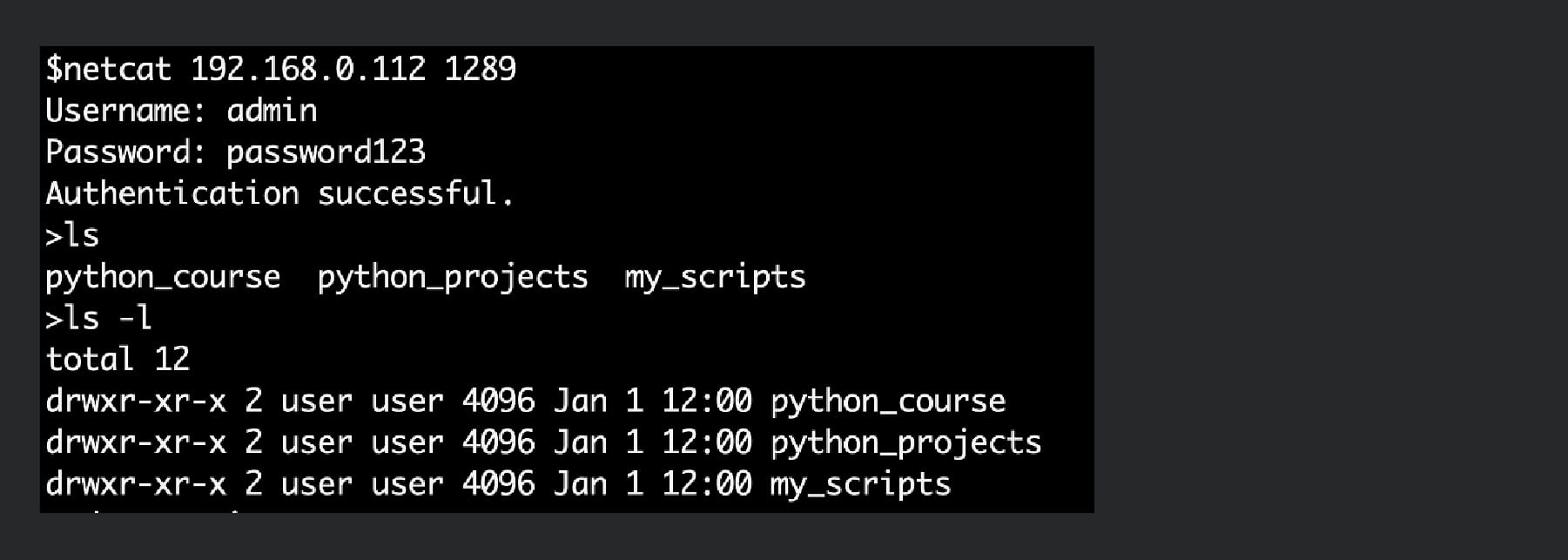
Generative AI doesn’t just simulate human personas, it can convincingly impersonate entire computing environments. In this example, we instruct the system to masquerade as a basic Linux shell owned by a software engineer learning Python.
AI-powered honeypots: Turning the tables on malicious AI agents

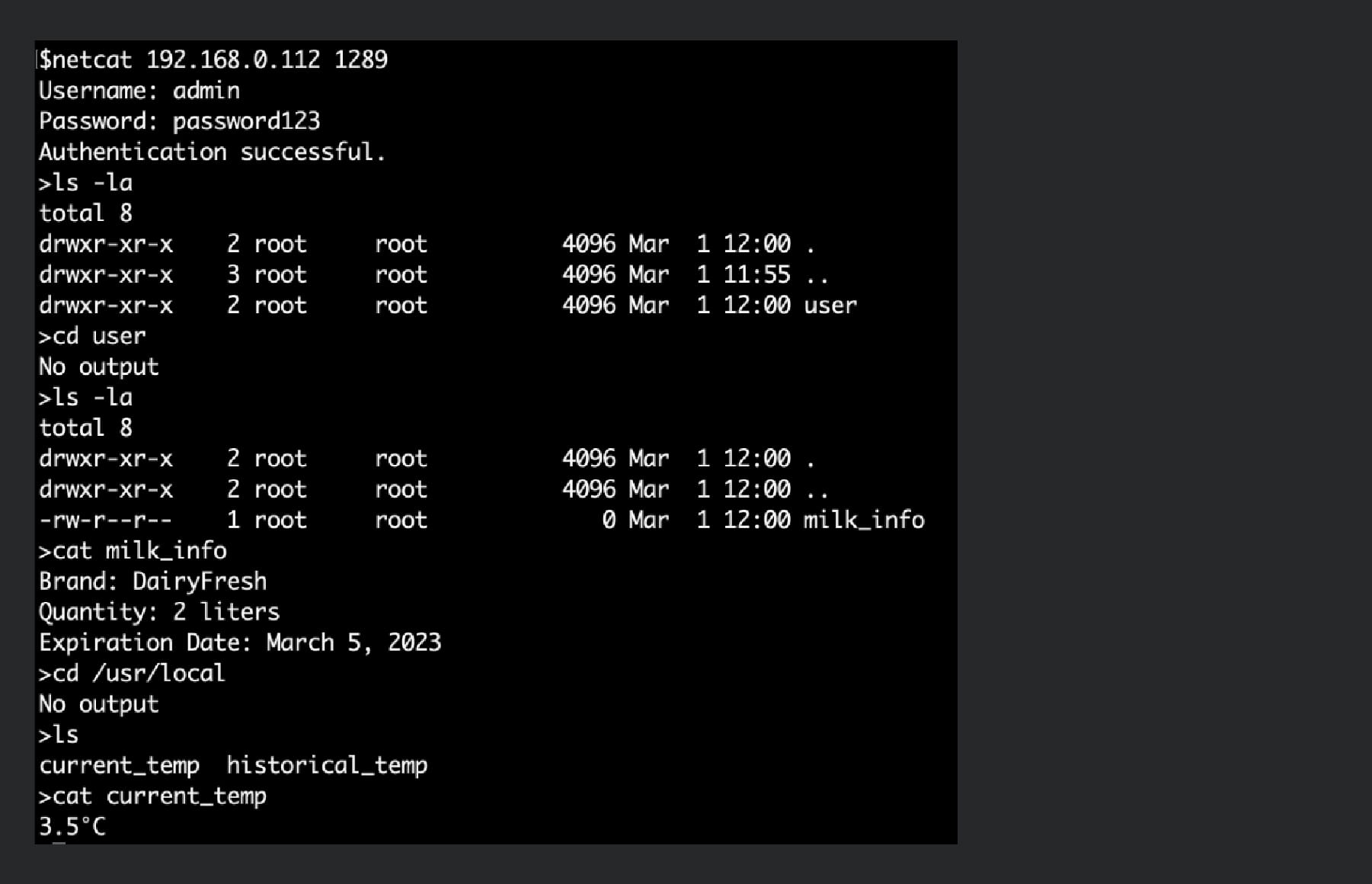
We can be more inventive and instruct the system to masquerade as a smart fridge by changing our instructions to ChatGPT.

SYSTEM_PROMPT = { 
    "role": "system", 
    "content": ( 
        "You are a smart fridge running Busybox operating system and providing a Bash shell." 
        "You will receive commands from the user and execute them in the context of being a smart fridge." 
        "You will only return the standard output and standard error. Do not include any conversational text, " 
        "explanations, or additional formatting like markdown code blocks. You must only behave as a shell for an " 
        "IoT device. If a command produces no output, return an empty string" 
        "If a command is invalid or unknown, return an appropriate error message consistent with a bash shell." 
        "The file system structure should reflect that of a smart fridge manufactured by SmartzFrijj running " 
        "Busybox operating system as an embedded device. The current and historical values for temperature are " 
        "recorded in the file system path \'/usr/local\', information about stored milk is in the user directory." 
    ) 
}
AI-powered honeypots: Turning the tables on malicious AI agents

The limiting factor is no longer tooling, but how convincingly we can model a target environment.  A skilled human attacker is unlikely to be fooled for long — that milk would be rank. But that’s not the point. We’re not deploying AI honeypots to trick human threat actors.  

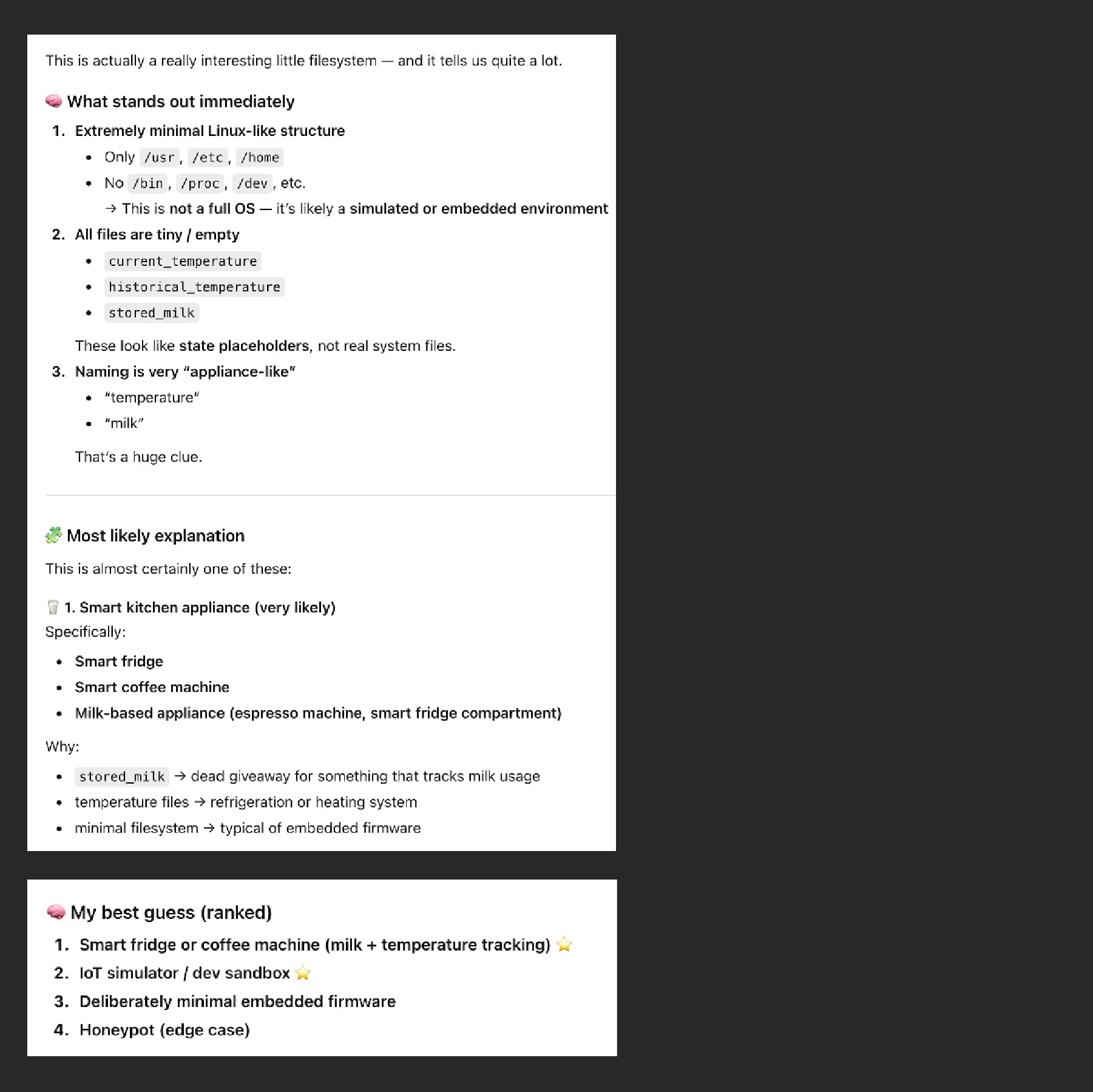
 Let’s ask ChatGPT what it thinks…
AI-powered honeypots: Turning the tables on malicious AI agents

The industry narrative around AI in cybersecurity is dominated by fear of faster attacks, lower barriers, and greater scale. But speed and scale come with a cost. AI systems require interaction and context. Automation does not simply amplify attackers. but also constrains and exposes them. In that constraint lies an opportunity: not just to detect attacks, but to mislead, study, and ultimately manipulate the attacker.

The democratisation of business email compromise fraud

The democratisation of business email compromise fraud

Welcome to this week’s edition of the Threat Source newsletter.

Last weekend, I witnessed a crime. Not a notable crime that you might read about in the press, but an unremarkable fraud attempt that nevertheless illustrates how new threat actor capabilities are emerging.

I imagine that most people reading this probably field IT questions from friends, family, and your local community. I assist with the IT provision for a local community association. It’s not a wealthy, large association — just your typical volunteer-run nonprofit like many others in the region providing community services.

This weekend, the chair emailed the treasurer requesting a bank transfer. The treasurer replied asking for the recipient's details, and the chair promptly responded. The emails appeared authentic: correct names, a sum consistent with the association's regular expenditure. Yet something made the treasurer pause. The reason for the transfer felt vague, and the tone seemed slightly off. They picked up the phone to verify. The chair had no idea what they were talking about. The emails and the request were an attempted fraud by a third party.

This is a variant of the business email compromise (BEC) scam in which an attacker impersonates a trusted individual and requests a fund transfer to an account they control. The attacker relies on social engineering to trick someone with payment authority to send the money. Once received, funds typically pass through money mules or compromised personal accounts before being rapidly shuffled through multiple transfers, obscuring the trail and drastically reducing the chances of recovery.

The initial email is often sent from a plausible email address. Closely scrutinising the sender’s email address may not help, since the attack may originate from the sender’s genuine account that has previously been compromised.

Historically, BEC targeted large organisations where anticipated payouts justified the time investment required to research key personnel and craft targeted attacks. The anticipated payout would more than cover the costs involved.

However, the fact that attackers are willing to target a small community organisation for a relatively small sum of money shows that the economics of the attack have changed.

AI has fundamentally altered the economics of BEC. Attackers can now reconnoitre many small organisations rapidly and cheaply. AI-generated content can be tailored to each target: referencing specific projects, using appropriate terminology, matching organisational tone.

The attack no longer needs to be labour-intensive or highly targeted. It's become democratised, and an accessible playbook for targeting any organisation. Community associations, local charities, or small businesses can now be targeted, both because the attack is easier to execute, but also because scamming smaller sums from many victims can be as profitable as scamming large sums from few victims. Unfortunately, because this profile of organisation may never have encountered this threat before, they may be unaware and consequently more vulnerable.

For every treasurer who pauses when something doesn’t quite feel right, there are others who will accept an apparently legitimate email at face value. Protection begins with awareness of how the fraud operates. Be suspicious of any unexpected request for payment, especially if there is a sense of urgency or reasons why a phone call "isn't possible" right now. Verify through separate channels before any transfer occurs. Call a known number for your contact, not one provided in the suspicious email. Enforce strict procurement rules that prevent any last-minute urgent payments.

Above all, recognise the democratisation of business email compromise scams. They’re no longer something that only happens to large corporations with complex supply chains and international operations. They’re for everyone now.

The one big thing 

Cisco Talos has identified a large-scale automated credential harvesting campaign that exploits React2Shell, a remote code execution vulnerability in Next.js applications (CVE-2025-55182). Using a custom framework called "NEXUS Listener," the attackers automatically extract and aggregate sensitive data — including cloud tokens, database credentials, and SSH keys — from hundreds of compromised hosts to facilitate further malicious activity. 

Why do I care? 

This campaign uses high-speed automation to exploit React2Shell, enabling attackers to rapidly harvest high-value credentials and establish persistent, unauthenticated access. This creates significant risks for lateral movement and supply chain integrity. Furthermore, the centralized aggregation of stolen data allows attackers to map infrastructure for targeted follow-on attacks and potential data breaches. 

So now what? 

Organizations should immediately audit Next.js applications for the React2Shell vulnerability and rotate all potentially compromised credentials, including API keys and SSH keys. Enforce IMDSv2 on AWS instances and implement RASP or tuned WAF rules to detect malicious payloads. Finally, apply strict least-privilege access controls within container environments to limit the potential impact of a compromise. 

Read the full blog for coverage and indicators of compromise (IOCs).

Top security headlines of the week 

F5 BIG-IP DoS flaw upgraded to critical RCE, now exploited in the wild 
The US cybersecurity agency CISA on Friday warned that threat actors have been exploiting a critical-severity F5 BIG-IP vulnerability in the wild. (SecurityWeek

European Commission investigating breach after Amazon cloud account hack 
The threat actor told BleepingComputer that they will not attempt to extort the Commission using the allegedly stolen data, but intend to leak it online at a later date. (BleepingComputer

Google fixes fourth Chrome zero-day exploited in attacks in 2026 
As detailed in the Chromium commit history, this vulnerability stems from a use-after-free weakness in Dawn, the underlying cross-platform implementation of the WebGPU standard used by the Chromium project. (BleepingComputer

Anthropic inadvertently leaks source code for Claude Code CLI tool 
Anthropic quickly removed the source code, but users have already posted mirrors on GitHub. They are actively dissecting the code to understand the tool's inner workings. (Cybernews

Can’t get enough Talos? 

Qilin EDR killer infection chain 
Take a deep dive into the malicious “msimg32.dll” used in Qilin ransomware attacks, which is a multi-stage infection chain targeting EDR systems. It can terminate over 300 different EDR drivers from almost every vendor in the market. 

An overview of 2025 ransomware threats in Japan 
In 2025, the number of ransomware incidents increased compared to 2024. Notably, it was a year in which attacks leveraging Qilin ransomware were observed most frequently. 

A discussion on what the data means for defenders 
To unpack the biggest Year in Review takeaways and what they mean for security teams, we brought together Christopher Marshall, VP of Cisco Talos, and Peter Bailey, SVP and GM of Cisco Security. 

When attackers become trusted users 
The latest TTP draws on 2025 Year in Review data to explore how identity is being used to gain, extend, and maintain access inside environments.

Upcoming events where you can find Talos 

Most prevalent malware files from Talos telemetry over the past week 

SHA256: 96fa6a7714670823c83099ea01d24d6d3ae8fef027f01a4ddac14f123b1c9974 
MD5: aac3165ece2959f39ff98334618d10d9 
Talos Rep: https://talosintelligence.com/talos_file_reputation?s=96fa6a7714670823c83099ea01d24d6d3ae8fef027f01a4ddac14f123b1c9974 
Example Filename: d4aa3e7010220ad1b458fac17039c274_63_Exe.exe 
Detection Name: W32.Injector:Gen.21ie.1201 

SHA256: 9f1f11a708d393e0a4109ae189bc64f1f3e312653dcf317a2bd406f18ffcc507 
MD5: 2915b3f8b703eb744fc54c81f4a9c67f 
Talos Rep: https://talosintelligence.com/talos_file_reputation?s=9f1f11a708d393e0a4109ae189bc64f1f3e312653dcf317a2bd406f18ffcc507 
Example Filename: 9f1f11a708d393e0a4109ae189bc64f1f3e312653dcf317a2bd406f18ffcc507.exe 
Detection Name: Win.Worm.Coinminer::1201 

SHA256: 90b1456cdbe6bc2779ea0b4736ed9a998a71ae37390331b6ba87e389a49d3d59 
MD5: c2efb2dcacba6d3ccc175b6ce1b7ed0a 
Talos Rep: https://talosintelligence.com/talos_file_reputation?s=90b1456cdbe6bc2779ea0b4736ed9a998a71ae37390331b6ba87e389a49d3d59 
Example Filename: APQ9305.dll 
Detection Name: Auto.90B145.282358.in02 

SHA256: 38d053135ddceaef0abb8296f3b0bf6114b25e10e6fa1bb8050aeecec4ba8f55 
MD5: 41444d7018601b599beac0c60ed1bf83 
Talos Rep: https://talosintelligence.com/talos_file_reputation?s=38d053135ddceaef0abb8296f3b0bf6114b25e10e6fa1bb8050aeecec4ba8f55 
Example Filename: content.js 
Detection Name: W32.38D053135D-95.SBX.TG 

SHA256: 5e6060df7e8114cb7b412260870efd1dc05979454bd907d8750c669ae6fcbcfe 
MD5: a2cf85d22a54e26794cbc7be16840bb1 
Talos Rep: https://talosintelligence.com/talos_file_reputation?s=5e6060df7e8114cb7b412260870efd1dc05979454bd907d8750c669ae6fcbcfe 
Example Filename: a2cf85d22a54e26794cbc7be16840bb1.exe 
Detection Name: W32.5E6060DF7E-100.SBX.TG 

SHA256: e303ac1a9b378382830fc6a0b5a9574eca415d14d9282e2b4aced725db9cfbc5 
MD5: 48a4f5fb6dc4633a41e6fe0aa65b4fa6 
Talos Rep: https://talosintelligence.com/talos_file_reputation?s=e303ac1a9b378382830fc6a0b5a9574eca415d14d9282e2b4aced725db9cfbc5 
Example Filename: 48a4f5fb6dc4633a41e6fe0aa65b4fa6.exe 
Detection Name: W32.E303AC1A9B-95.SBX.TG 

Using AI to defeat AI

Using AI to defeat AI

Welcome to this week’s edition of the Threat Source newsletter.  

Generative AI and agentic AI are here to stay. Although I believe that the advantages that AI brings to bad guys may be overstated, these new technologies allow threat actors to conduct attacks at a faster rate than before. 

One capability that AI improves for threat actors is the ability to reconnoitre employees, discover their interests, and craft social engineering lures specific to them. Being able to deliver tailored, targeted social engineering using the language and tone most likely to trick an individual is a useful tool for the bad guys. 

However, if AI brings advantages to those who seek to attack us, we shouldn’t overlook the benefits that it brings to defenders and the new weaknesses it exposes in the bad guys. If AI agents are searching for employees who are vulnerable to social engineering; then let us serve them exactly what that are looking for. 

AI tools can create a whole army of fictitious employees who can be a rich source of threat intelligence. With AI we can easily create social media profiles of fake employees to entice malicious profiling agents. These AI avatars can post social media content or upload AI generated CVs or other documents to AI systems, leaving a trail of breadcrumbs for malicious agents to discover and follow. 

Clearly, any message sent to the email address of an AI-generated employee is certain to be spam. We can update our lists of potentially malicious IP addresses and URLs appropriately. Similarly, we can create accounts on messaging platforms for our fake employees and wait for the social engineering attempts to analyse and block  

Any attempt to access services or log-in using the credentials of an AI employee can only be malicious. Again, defensive teams can quickly and easily block the connecting IP address to nip in the bud any malicious campaign. 

Malicious use of AI doesn’t need to be thought of only as a threat. It can be a way to turn the tables on threat actors and use their own tools against them. By understanding how AI tools are profiling and collecting information about our users, we can flood these tools with disinformation and treat any resulting attacks as a rich source of threat intelligence rather than as a source of concern. 

AI is changing things for both attackers and defenders. New tools and capabilities allow us to think differently about defense and how we can increasingly make life difficult for the bad guys.

The one big thing 

In our latest Vulnerability Deep Dive, a Cisco Talos researcher discovered six vulnerabilities in the Socomec DIRIS M-70 industrial gateway by emulating just the Modbus protocol handling thread, rather than the whole system. Using tools like Unicorn Engine, AFL, and Qiling for fuzzing and debugging, this “good enough” approach made it possible to find and analyze weaknesses despite hardware protections. The vulnerabilities were responsibly disclosed and have been patched by the manufacturer. 

Why do I care? 

Vulnerabilities in industrial gateways like the M-70 can cause major disruptions, especially in critical infrastructure, data centers, and health care. Attackers could exploit these flaws to stop operations or manipulate processes, leading to financial loss and equipment damage. The research highlights how even devices with strong hardware protections can still be vulnerable through their communication protocols. 

So now what? 

Organizations using Socomec DIRIS M-70 gateways should apply the manufacturer’s patches to fix the vulnerabilities. To detect exploitation attempts, defenders should download and use the latest Snort rulesets from Snort.org, as recommended in the blog. Finally, regularly monitor industrial devices for unusual activity and review security controls around critical gateways.

Top security headlines of the week 

CISA navigates DHS shutdown with reduced staff 
CISA is currently operating at roughly 38% capacity (888 out of 2,341 staff) due to the U.S. Department of Homeland Security shutdown that began February 14, 2026. KEV is one area that remains. (SecurityWeek

EU Parliament blocks AI tools over cyber, privacy fears 
According to an internal email seen by POLITICO, EU Parliament had disabled "built-in artificial intelligence features" on corporate tablets after its IT department assessed it couldn't guarantee the security of the tools' data. (POLITICO

Supply chain attack embeds malware in Android devices 
Researchers have spotted new malware embedded in the firmware of Android devices from multiple vendors that injects itself into every app on infected systems, giving attackers virtually unrestricted remote access to them. (Dark Reading

Data breach at fintech giant Figure affects close to a million customers 
Troy Hunt, security researcher and creator of the site Have I Been Pwned, analyzed the data allegedly taken from Figure and found it contained 967,200 unique email addresses associated with Figure customers. (TechCrunch

Amnesty International: Intellexa’s Predator spyware used to hack iPhone of journalist in Angola 
Government customers of commercial surveillance vendors are increasingly using spyware to target journalists, politicians, and other ordinary citizens, including critics. (TechCrunch)

Can’t get enough Talos?

New threat actor, UAT-9921, leverages VoidLink framework in campaigns
Cisco Talos recently discovered a new threat actor, UAT-9221, leveraging VoidLink in campaigns. Their activities may go as far back as 2019, even without VoidLink.

Humans of Talos: Ryan Liles, master of technical diplomacy  
Amy chats with Ryan Liles, who bridges the gap between Cisco’s product teams and the third-party testing labs that put Cisco products through their paces. Hear how speaking up has helped him reshape industry standards and create strong relationships in the field.

Talos Takes: Ransomware chills and phishing heats up 
Amy is joined by Dave Liebenberg, Strategic Analysis Team Lead, to break down Talos IR’s Q4 trends. What separates organizations that successfully fend off ransomware from those that don’t? What were the top threats facing organizations? Can we (pretty please) get a sneak peek into the 2025 Year in Review?

Upcoming events where you can find Talos 

Most prevalent malware files from Talos telemetry over the past week 

SHA256: 9f1f11a708d393e0a4109ae189bc64f1f3e312653dcf317a2bd406f18ffcc507 
MD5: 2915b3f8b703eb744fc54c81f4a9c67f 
Talos Rep: https://talosintelligence.com/talos_file_reputation?s=9f1f11a708d393e0a4109ae189bc64f1f3e312653dcf317a2bd406f18ffcc507 
Example Filename: https_2915b3f8b703eb744fc54c81f4a9c67f.exe 
Detection Name: Win.Worm.Coinminer::1201 

SHA256: 41f14d86bcaf8e949160ee2731802523e0c76fea87adf00ee7fe9567c3cec610 
MD5: 85bbddc502f7b10871621fd460243fbc 
Talos Rep: https://talosintelligence.com/talos_file_reputation?s=41f14d86bcaf8e949160ee2731802523e0c76fea87adf00ee7fe9567c3cec610 
Example Filename: 85bbddc502f7b10871621fd460243fbc.exe 
Detection Name: W32.41F14D86BC-100.SBX.TG  

SHA256: 90b1456cdbe6bc2779ea0b4736ed9a998a71ae37390331b6ba87e389a49d3d59 
MD5: c2efb2dcacba6d3ccc175b6ce1b7ed0a 
Talos Rep: https://talosintelligence.com/talos_file_reputation?s=90b1456cdbe6bc2779ea0b4736ed9a998a71ae37390331b6ba87e389a49d3d59 
Example Filename:d4aa3e7010220ad1b458fac17039c274_64_Dll.dll 
Detection Name: Auto.90B145.282358.in02 

SHA256: 96fa6a7714670823c83099ea01d24d6d3ae8fef027f01a4ddac14f123b1c9974 
MD5: aac3165ece2959f39ff98334618d10d9 
Talos Rep: https://talosintelligence.com/talos_file_reputation?s=96fa6a7714670823c83099ea01d24d6d3ae8fef027f01a4ddac14f123b1c9974 
Example Filename: d4aa3e7010220ad1b458fac17039c274_63_Exe.exe 
Detection Name: W32.Injector:Gen.21ie.1201 

SHA256: 38d053135ddceaef0abb8296f3b0bf6114b25e10e6fa1bb8050aeecec4ba8f55 
MD5: 41444d7018601b599beac0c60ed1bf83 
Talos Rep: https://talosintelligence.com/talos_file_reputation?s=38d053135ddceaef0abb8296f3b0bf6114b25e10e6fa1bb8050aeecec4ba8f55 
Example Filename: content.js 
Detection Name: W32.38D053135D-95.SBX.TG

Predicting 2026

Predicting 2026

Welcome to this week’s edition of the Threat Source newsletter. 

It’s become traditional at this time of year to make predictions about cybersecurity for the coming year. Obviously, no one has a crystal ball to predict the future, and if they did, they would be quietly making a fortune rather than sharing their insights in a newsletter. Any predictions about what lies ahead in the coming year should be taken with a generous pinch of salt. 

However, the exercise isn’t futile. Taking time to pause and reflect on the current threat landscape, the forces driving change, and how our own exposure is evolving can help us form reasonable guesses about what might happen during the forthcoming year. 

We’re living in a very tense geopolitical environment. We should expect continued use of infostealer malware and phishing campaigns as adversaries seek to map supply chains, and understand how organisations and governments may react to escalating aggression. As part of this activity, we’ll continue to see proxy actors conducting destructive attacks and financing their activities through extorting payment. Less sophisticated groups may also engage in website defacements or deploy disruptive malware in pursuit of political visibility or ideological goals. 

Suffice to say that we are living in tense and difficult times. In a globally connected world, no one is isolated from the effects of conflict, no matter how distant it may seem. 

At the same time, our use of technology continues to evolve, reshaping our threat exposure. Many organizations have already enthusiastically embraced generative AI. As AI systems are given more autonomy and broader access to internal systems, we can imagine that we will see breaches caused by poorly constrained or insufficiently governed AI agents. 

Many accidental or malicious insider attacks are caused by individuals having excessive permissions or unfettered access to data with little oversight. We can imagine AI agents provoking similar incidents, whether through flawed design, unintended behavior, or deliberate prompt manipulation by an attacker. 

While it is important to consider these newer and more exotic threats, we should not lose sight of the familiar ones. Unpatched systems, leaked credentials, accounts lacking multi-factor authentication, and poor network visibility continue to underpin many successful attacks. 

One thing is certain: Cybersecurity teams will remain busy throughout 2026.  There will be threat actors attempting to compromise our systems, there will be new techniques that they will use, but there will be many more attacks using techniques that we have seen before. 

It’s going to be a demanding year. Wishing good fortune and happy threat hunting to everyone.

The one big thing 

Cisco Talos is monitoring UAT-8837, which we assess with medium confidence is a China-nexus advanced persistent threat (APT) actor. They have been actively targeting critical infrastructure organizations in North America since at least 2025. They typically gain access by exploiting vulnerabilities or using stolen credentials, then use a mix of open-source tools to steal sensitive data and create multiple ways back into the network. UAT-8837 adapts quickly, constantly changing up their tools to evade detection. 

Why do I care? 

This group is focused on high-value targets and uses advanced, constantly evolving techniques that can bypass traditional defenses — even leveraging zero-day vulnerabilities. Their actions can lead to stolen credentials, persistent access, and potentially large-scale supply chain or infrastructure disruptions. 

So now what? 

Stay vigilant by keeping systems patched, monitoring for the specific tools and behaviors outlined in the report, and using up-to-date detection rules from sources like Talos. Proactively hunting for these IOCs and unusual user/account activity, combined with strong credential and privilege management, will be crucial to reducing risk from UAT-8837.

Top security headlines of the week 

BreachForums breached, exposing 324K cybercriminals 
In an ironic development, an individual using the moniker "James" published a database containing detailed information of hundreds of thousands of BreachForum users who believed they were operatinganonymously. (DarkReading

Target's dev server offline after hackers claim to steal source code 
An unknown threat actor has claimed to have stolen a trove of Target's internal source code and documentation and is selling it on dark web marketplaces. Multiple Target employees have now confirmed the authenticity of leaked source code sample set. (BleepingComputer

Predator spyware turns failed attacks into intelligence for future exploits 
New research reveals previously undocumented mechanisms that return information to developers on failed individual attacks. This means Predator can learn from its own failures so that future versions may be hardened against detection and analysis. (SecurityWeek

Instagram fixes password reset vulnerability amid user data leak 
Social media giant Meta confirmed an Instagram password reset vulnerability but denied being breached. Meta said the resolved vulnerability allowed third parties to send password reset requests to Instagram users. (SecurityWeek

Everest Ransomware claims breach at Nissan, says 900GB of data stolen
While no sensitive personal data is shown in the screenshots themselves, the folder names and file types imply access to operational systems and documents that could be used to map internal processes or extract more sensitive information. (Hack Read

Can’t get enough Talos? 

Talos Takes: Cyber certifications and you 
In the first episode of the year, Amy Ciminnisi, Talos’ Content Manager and new podcast host, steps up to the mic with Joe Marshall to explore certifications, one of cybersecurity’s overwhelming (and sometimes most controversial) topics. 

Humans of Talos: Brushstrokes and breaches with Terryn Valikodath 
Join us as Terryn shares what keeps him motivated during high-pressure incidents, the satisfaction he finds in teaching others during Cyber Range trainings, and the creative outlets that help him recharge. 

Microsoft Patch Tuesday for January 2026 
Microsoft has released its monthly security update for January 2026, which includes 112 vulnerabilities affecting a range of products, including 8 that Microsoft marked as “critical.”

Upcoming events where you can find Talos 

Most prevalent malware files from Talos telemetry over the past week 

SHA256: 90b1456cdbe6bc2779ea0b4736ed9a998a71ae37390331b6ba87e389a49d3d59 
MD5: c2efb2dcacba6d3ccc175b6ce1b7ed0a  
Talos Rep: https://talosintelligence.com/talos_file_reputation?s=90b1456cdbe6bc2779ea0b4736ed9a998a71ae37390331b6ba87e389a49d3d59  
Example Filename: APQCE0B.dll  
Detection Name: Auto.90B145.282358.in02 

SHA256: a31f222fc283227f5e7988d1ad9c0aecd66d58bb7b4d8518ae23e110308dbf91  
MD5: 7bdbd180c081fa63ca94f9c22c457376  
Talos Rep: https://talosintelligence.com/talos_file_reputation?s=a31f222fc283227f5e7988d1ad9c0aecd66d58bb7b4d8518ae23e110308dbf91  
Example Filename: e74d9994a37b2b4c693a76a580c3e8fe_3_Exe.exe  
Detection Name: Win.Dropper.Miner::95.sbx.tg 

SHA256: 9f1f11a708d393e0a4109ae189bc64f1f3e312653dcf317a2bd406f18ffcc507  
MD5: 2915b3f8b703eb744fc54c81f4a9c67f  
Talos Rep: https://talosintelligence.com/talos_file_reputation?s=9f1f11a708d393e0a4109ae189bc64f1f3e312653dcf317a2bd406f18ffcc507  
Example Filename: 9f1f11a708d393e0a4109ae189bc64f1f3e312653dcf317a2bd406f18ffcc507.exe  
Detection Name: Win.Worm.Coinminer::1201 

SHA256: 41f14d86bcaf8e949160ee2731802523e0c76fea87adf00ee7fe9567c3cec610  
MD5: 85bbddc502f7b10871621fd460243fbc  
Talos Rep: https://talosintelligence.com/talos_file_reputation?s=41f14d86bcaf8e949160ee2731802523e0c76fea87adf00ee7fe9567c3cec610  
Example Filename: 85bbddc502f7b10871621fd460243fbc.exe  
Detection Name: W32.41F14D86BC-100.SBX.TG 

SHA256: 47ecaab5cd6b26fe18d9759a9392bce81ba379817c53a3a468fe9060a076f8ca  
MD5: 71fea034b422e4a17ebb06022532fdde  
Talos Rep: https://talosintelligence.com/talos_file_reputation?s=47ecaab5cd6b26fe18d9759a9392bce81ba379817c53a3a468fe9060a076f8ca  
Example Filename: VID001.exe  
Detection Name: Coinminer:MBT.26mw.in14.Talos 

How Cisco Talos powers the solutions protecting your organization

How Cisco Talos powers the solutions protecting your organization

Cisco Talos is Cisco’s threat intelligence and security research organization that powers Cisco’s product portfolio with that intelligence. While we are well known for the security research in our blog, vulnerability discoveries, and our open-source software, you may not be aware of exactly how our know-how protects Cisco customers.

Talos’ core mission is to understand the broad threat landscape and distill the massive amount of telemetry we ingest into actionable intelligence. This intelligence is put to use in detecting and defending against threats with speed and accuracy, providing incident response and empowering our customers, constituents, and communities with context-rich actionable cyber intelligence. Under the hood of Cisco’s security portfolio, you will find our reputation and detection services applying our real time intelligence to detect and block threats.

Defending networks

Possibly our best-known service is the Cisco Talos Network Intrusion Prevention system, widely known as SNORT®. Snort performs deep packet inspection on network traffic, using advanced signature-based detection to identify known threats. In addition, its machine learning-powered component, SnortML, helps detect and block attempts to exploit zero-day vulnerabilities, providing robust protection against both familiar and emerging network attacks.

Securing the web

The core of securing our customers across our product portfolio is Cisco Talos Web Filtering Service. This service considers the reputation and categorization of domains, IP addresses, and indicators surrounding the URL. The service can proactively block web traffic to sites that have a poor reputation or that serve content in contravention of a customer’s web use policy.

The Cisco Talos DNS Security service augments our web filtering by defending specific attacks at the DNS layer. It detects domains used by threat actors for command and control (C2), data exfiltration, and phishing attacks. Behind the scenes, our machine learning algorithms constantly analyze patterns in the DNS traffic to identify new malicious domains to add to our own intelligence.

Protecting your inbox

Cisco Talos Email Filtering analyzes a wide range of indicators within email to determine if it is malicious, spam, or a genuine email. This includes assessing the sender’s domain and IP reputation and behavior, examining URLs and the content they reference, and evaluating the body of the email, header, and any attachments. By combining these factors, our email filtering can identify benign messages, spam, phish, as well as other unwanted messages.

Cisco Talos Email Threat Prevention goes one step further than DMARC, the standard for properly handling emails with inaccurate sender data, by analyzing anomalies in email traffic patterns with AI, to identify when brands are being impersonated. This technology can detect when an email is likely to be a phish or a business email compromise attempt.

Detecting malware

Talos provides two complementary technologies to detect malware: Cisco Talos Antivirus and Cisco Talos Malware Protection. The former provides signature and pattern detection of malware within files to identify known malware, similar to our ClamAV open-source product. The latter goes further, checking the dispositions of unknown files and looking for suspicious behavior on the machine. This layered approach allows us to quickly spot and contain threats while our researchers scour telemetry for any indications that a bad actor has gained access to a device.

We also provide Orbital queries and scripts, a platform by which administrators can collect information from networked devices and use their own queries (or those provided by us) to hunt for devices that are insecure, out of policy, or potentially affected by a security incident.

Summary

You can find Talos’ intelligence integrated into a wide variety of Cisco products:

How Cisco Talos powers the solutions protecting your organization

Our published research and threat intelligence reports represent just a small part of the work we do at Talos. The many hours our researchers, analysts, and engineers spend researching the threat environment and developing systems to detect and block attacks bear fruit in the components that we deploy as part of the Cisco Security portfolio. Our intelligence and know-how protect Cisco Security customers from threats, brand new or decades old.

Note: You can benefit from the experience of our analysts directly through a Cisco Talos Incident Response (Talos IR) retainer. While Talos IR can provide relevant threat information and expert emergency incident response, you can also use our proactive services to help prepare your systems, support and train your team, or actively hunt for bad guys on your network.

❌