
 Entrar
Visualização de leitura

2 US Cybersecurity Experts Jailed for Aiding ALPHV (BlackCat) Ransomware
Feds Tie ‘Scattered Spider’ Duo to $115M in Ransoms
U.S. prosecutors last week levied criminal hacking charges against 19-year-old U.K. national Thalha Jubair for allegedly being a core member of Scattered Spider, a prolific cybercrime group blamed for extorting at least $115 million in ransom payments from victims. The charges came as Jubair and an alleged co-conspirator appeared in a London court to face accusations of hacking into and extorting several large U.K. retailers, the London transit system, and healthcare providers in the United States.
At a court hearing last week, U.K. prosecutors laid out a litany of charges against Jubair and 18-year-old Owen Flowers, accusing the teens of involvement in an August 2024 cyberattack that crippled Transport for London, the entity responsible for the public transport network in the Greater London area.

A court artist sketch of Owen Flowers (left) and Thalha Jubair appearing at Westminster Magistrates’ Court last week. Credit: Elizabeth Cook, PA Wire.
On July 10, 2025, KrebsOnSecurity reported that Flowers and Jubair had been arrested in the United Kingdom in connection with recent Scattered Spider ransom attacks against the retailers Marks & Spencer and Harrods, and the British food retailer Co-op Group.
That story cited sources close to the investigation saying Flowers was the Scattered Spider member who anonymously gave interviews to the media in the days after the group’s September 2023 ransomware attacks disrupted operations at Las Vegas casinos operated by MGM Resorts and Caesars Entertainment.
The story also noted that Jubair’s alleged handles on cybercrime-focused Telegram channels had far lengthier rap sheets involving some of the more consequential and headline-grabbing data breaches over the past four years. What follows is an account of cybercrime activities that prosecutors have attributed to Jubair’s alleged hacker handles, as told by those accounts in posts to public Telegram channels that are closely monitored by multiple cyber intelligence firms.
EARLY DAYS (2021-2022)
Jubair is alleged to have been a core member of the LAPSUS$ cybercrime group that broke into dozens of technology companies beginning in late 2021, stealing source code and other internal data from tech giants including Microsoft, Nvidia, Okta, Rockstar Games, Samsung, T-Mobile, and Uber.
That is, according to the former leader of the now-defunct LAPSUS$. In April 2022, KrebsOnSecurity published internal chat records taken from a server that LAPSUS$ used, and those chats indicate Jubair was working with the group using the nicknames Amtrak and Asyntax. In the middle of the gang’s cybercrime spree, Asyntax told the LAPSUS$ leader not to share T-Mobile’s logo in images sent to the group because he’d been previously busted for SIM-swapping and his parents would suspect he was back at it again.
The leader of LAPSUS$ responded by gleefully posting Asyntax’s real name, phone number, and other hacker handles into a public chat room on Telegram:
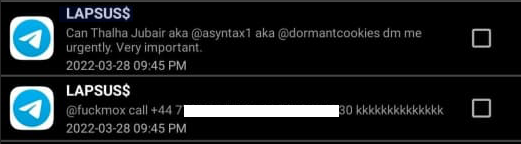
In March 2022, the leader of the LAPSUS$ data extortion group exposed Thalha Jubair’s name and hacker handles in a public chat room on Telegram.
That story about the leaked LAPSUS$ chats also connected Amtrak/Asyntax to several previous hacker identities, including “Everlynn,” who in April 2021 began offering a cybercriminal service that sold fraudulent “emergency data requests” targeting the major social media and email providers.
In these so-called “fake EDR” schemes, the hackers compromise email accounts tied to police departments and government agencies, and then send unauthorized demands for subscriber data (e.g. username, IP/email address), while claiming the information being requested can’t wait for a court order because it relates to an urgent matter of life and death.
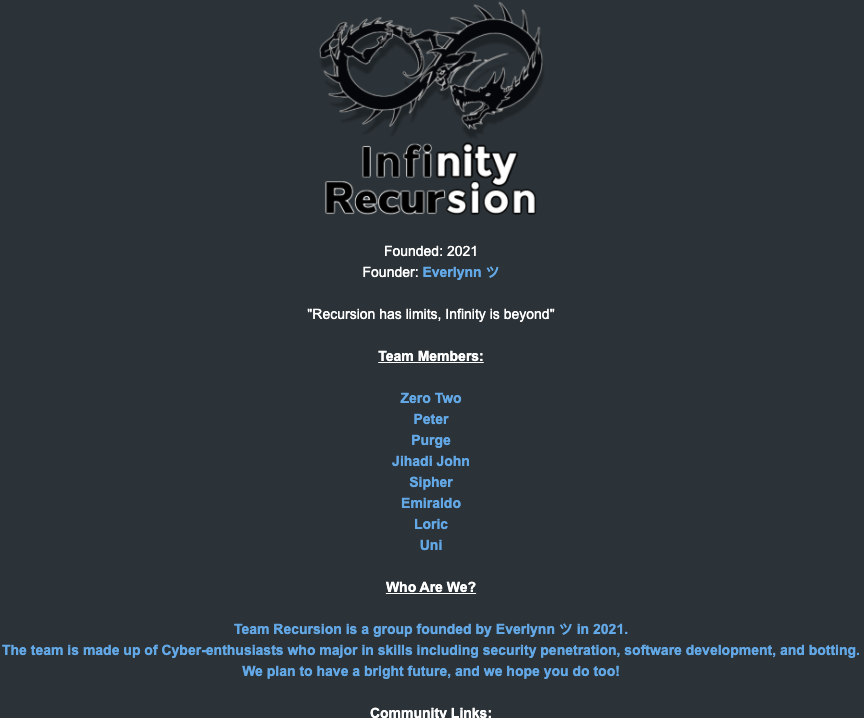
The roster of the now-defunct “Infinity Recursion” hacking team, which sold fake EDRs between 2021 and 2022. The founder “Everlynn” has been tied to Jubair. The member listed as “Peter” became the leader of LAPSUS$ who would later post Jubair’s name, phone number and hacker handles into LAPSUS$’s chat channel.
EARTHTOSTAR
Prosecutors in New Jersey last week alleged Jubair was part of a threat group variously known as Scattered Spider, 0ktapus, and UNC3944, and that he used the nicknames EarthtoStar, Brad, Austin, and Austistic.
Beginning in 2022, EarthtoStar co-ran a bustling Telegram channel called Star Chat, which was home to a prolific SIM-swapping group that relentlessly used voice- and SMS-based phishing attacks to steal credentials from employees at the major wireless providers in the U.S. and U.K.
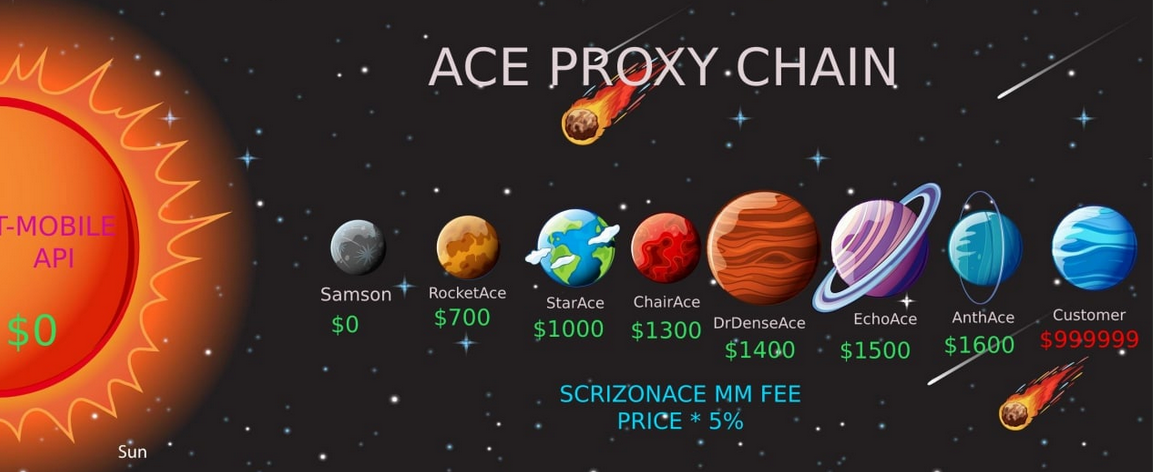
Jubair allegedly used the handle “Earth2Star,” a core member of a prolific SIM-swapping group operating in 2022. This ad produced by the group lists various prices for SIM swaps.
The group would then use that access to sell a SIM-swapping service that could redirect a target’s phone number to a device the attackers controlled, allowing them to intercept the victim’s phone calls and text messages (including one-time codes). Members of Star Chat targeted multiple wireless carriers with SIM-swapping attacks, but they focused mainly on phishing T-Mobile employees.
In February 2023, KrebsOnSecurity scrutinized more than seven months of these SIM-swapping solicitations on Star Chat, which almost daily peppered the public channel with “Tmo up!” and “Tmo down!” notices indicating periods wherein the group claimed to have active access to T-Mobile’s network.
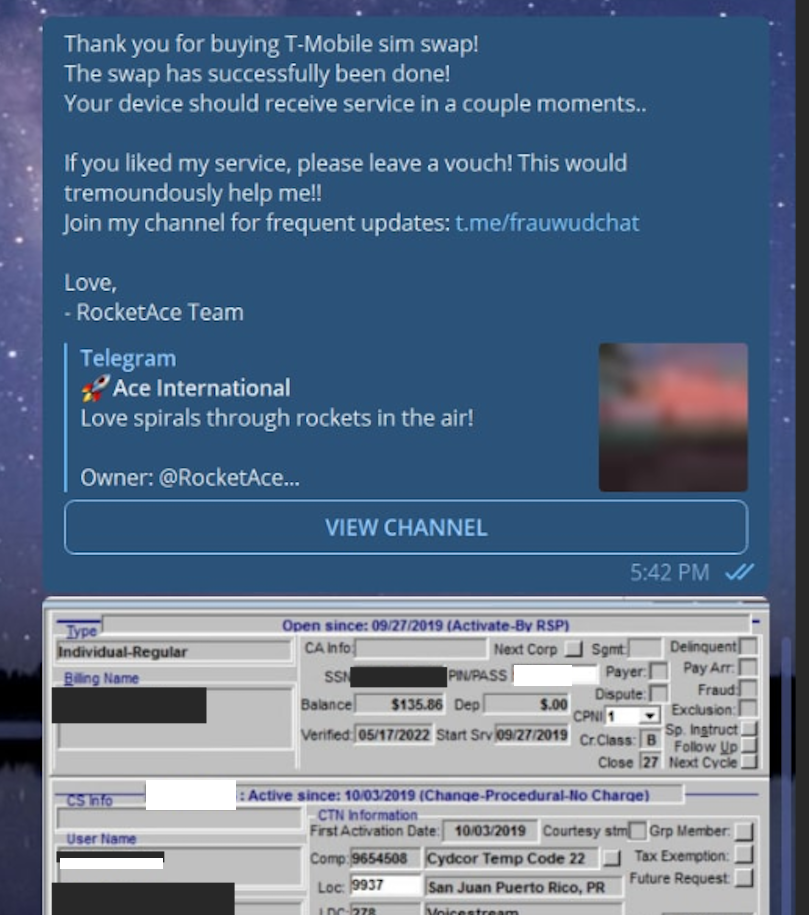
A redacted receipt from Star Chat’s SIM-swapping service targeting a T-Mobile customer after the group gained access to internal T-Mobile employee tools.
The data showed that Star Chat — along with two other SIM-swapping groups operating at the same time — collectively broke into T-Mobile over a hundred times in the last seven months of 2022. However, Star Chat was by far the most prolific of the three, responsible for at least 70 of those incidents.
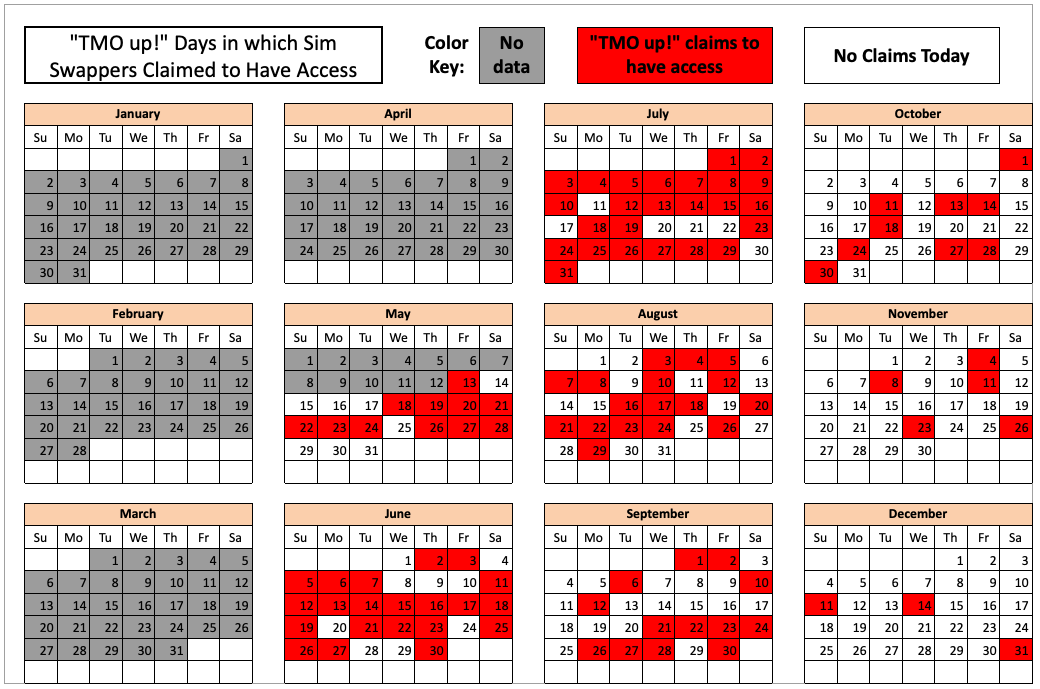
The 104 days in the latter half of 2022 in which different known SIM-swapping groups claimed access to T-Mobile employee tools. Star Chat was responsible for a majority of these incidents. Image: krebsonsecurity.com.
A review of EarthtoStar’s messages on Star Chat as indexed by the threat intelligence firm Flashpoint shows this person also sold “AT&T email resets” and AT&T call forwarding services for up to $1,200 per line. EarthtoStar explained the purpose of this service in post on Telegram:
“Ok people are confused, so you know when u login to chase and it says ‘2fa required’ or whatever the fuck, well it gives you two options, SMS or Call. If you press call, and I forward the line to you then who do you think will get said call?”
New Jersey prosecutors allege Jubair also was involved in a mass SMS phishing campaign during the summer of 2022 that stole single sign-on credentials from employees at hundreds of companies. The text messages asked users to click a link and log in at a phishing page that mimicked their employer’s Okta authentication page, saying recipients needed to review pending changes to their upcoming work schedules.
The phishing websites used a Telegram instant message bot to forward any submitted credentials in real-time, allowing the attackers to use the phished username, password and one-time code to log in as that employee at the real employer website.
That weeks-long SMS phishing campaign led to intrusions and data thefts at more than 130 organizations, including LastPass, DoorDash, Mailchimp, Plex and Signal.
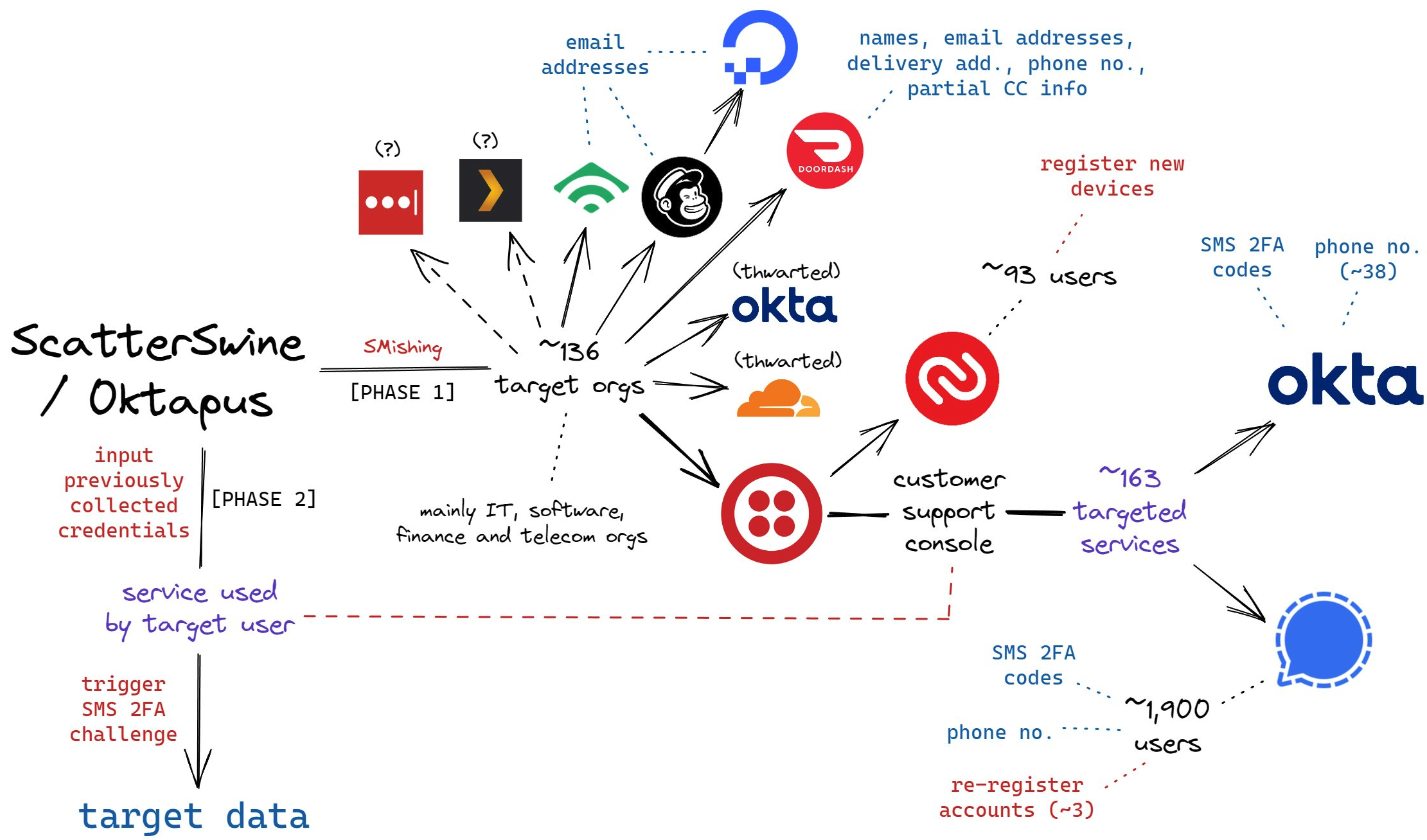
A visual depiction of the attacks by the SMS phishing group known as 0ktapus, ScatterSwine, and Scattered Spider. Image: Amitai Cohen twitter.com/amitaico.
DA, COMRADE
EarthtoStar’s group Star Chat specialized in phishing their way into business process outsourcing (BPO) companies that provide customer support for a range of multinational companies, including a number of the world’s largest telecommunications providers. In May 2022, EarthtoStar posted to the Telegram channel “Frauwudchat”:
“Hi, I am looking for partners in order to exfiltrate data from large telecommunications companies/call centers/alike, I have major experience in this field, [including] a massive call center which houses 200,000+ employees where I have dumped all user credentials and gained access to the [domain controller] + obtained global administrator I also have experience with REST API’s and programming. I have extensive experience with VPN, Citrix, cisco anyconnect, social engineering + privilege escalation. If you have any Citrix/Cisco VPN or any other useful things please message me and lets work.”
At around the same time in the Summer of 2022, at least two different accounts tied to Star Chat — “RocketAce” and “Lopiu” — introduced the group’s services to denizens of the Russian-language cybercrime forum Exploit, including:
-SIM-swapping services targeting Verizon and T-Mobile customers;
-Dynamic phishing pages targeting customers of single sign-on providers like Okta;
-Malware development services;
-The sale of extended validation (EV) code signing certificates.
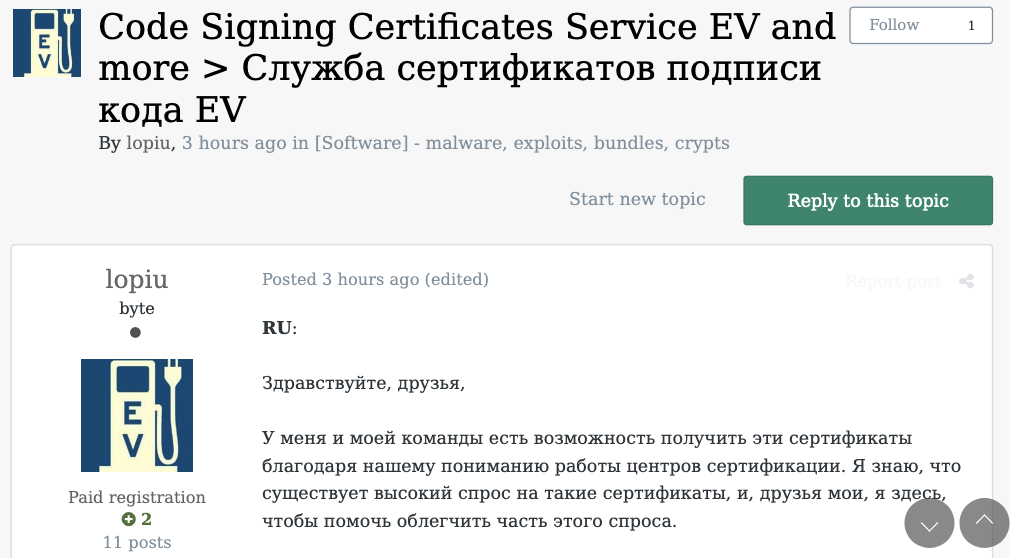
The user “Lopiu” on the Russian cybercrime forum Exploit advertised many of the same unique services offered by EarthtoStar and other Star Chat members. Image source: ke-la.com.
These two accounts on Exploit created multiple sales threads in which they claimed administrative access to U.S. telecommunications providers and asked other Exploit members for help in monetizing that access. In June 2022, RocketAce, which appears to have been just one of EarthtoStar’s many aliases, posted to Exploit:
Hello. I have access to a telecommunications company’s citrix and vpn. I would like someone to help me break out of the system and potentially attack the domain controller so all logins can be extracted we can discuss payment and things leave your telegram in the comments or private message me ! Looking for someone with knowledge in citrix/privilege escalation
On Nov. 15, 2022, EarthtoStar posted to their Star Sanctuary Telegram channel that they were hiring malware developers with a minimum of three years of experience and the ability to develop rootkits, backdoors and malware loaders.
“Optional: Endorsed by advanced APT Groups (e.g. Conti, Ryuk),” the ad concluded, referencing two of Russia’s most rapacious and destructive ransomware affiliate operations. “Part of a nation-state / ex-3l (3 letter-agency).”
2023-PRESENT DAY
The Telegram and Discord chat channels wherein Flowers and Jubair allegedly planned and executed their extortion attacks are part of a loose-knit network known as the Com, an English-speaking cybercrime community consisting mostly of individuals living in the United States, the United Kingdom, Canada and Australia.
Many of these Com chat servers have hundreds to thousands of members each, and some of the more interesting solicitations on these communities are job offers for in-person assignments and tasks that can be found if one searches for posts titled, “If you live near,” or “IRL job” — short for “in real life” job.
These “violence-as-a-service” solicitations typically involve “brickings,” where someone is hired to toss a brick through the window at a specified address. Other IRL jobs for hire include tire-stabbings, molotov cocktail hurlings, drive-by shootings, and even home invasions. The people targeted by these services are typically other criminals within the community, but it’s not unusual to see Com members asking others for help in harassing or intimidating security researchers and even the very law enforcement officers who are investigating their alleged crimes.
It remains unclear what precipitated this incident or what followed directly after, but on January 13, 2023, a Star Sanctuary account used by EarthtoStar solicited the home invasion of a sitting U.S. federal prosecutor from New York. That post included a photo of the prosecutor taken from the Justice Department’s website, along with the message:
“Need irl niggas, in home hostage shit no fucking pussies no skinny glock holding 100 pound niggas either”
Throughout late 2022 and early 2023, EarthtoStar’s alias “Brad” (a.k.a. “Brad_banned”) frequently advertised Star Chat’s malware development services, including custom malicious software designed to hide the attacker’s presence on a victim machine:
We can develop KERNEL malware which will achieve persistence for a long time,
bypass firewalls and have reverse shell access.This shit is literally like STAGE 4 CANCER FOR COMPUTERS!!!
Kernel meaning the highest level of authority on a machine.
This can range to simple shells to Bootkits.Bypass all major EDR’s (SentinelOne, CrowdStrike, etc)
Patch EDR’s scanning functionality so it’s rendered useless!Once implanted, extremely difficult to remove (basically impossible to even find)
Development Experience of several years and in multiple APT Groups.Be one step ahead of the game. Prices start from $5,000+. Message @brad_banned to get a quote
In September 2023 , both MGM Resorts and Caesars Entertainment suffered ransomware attacks at the hands of a Russian ransomware affiliate program known as ALPHV and BlackCat. Caesars reportedly paid a $15 million ransom in that incident.
Within hours of MGM publicly acknowledging the 2023 breach, members of Scattered Spider were claiming credit and telling reporters they’d broken in by social engineering a third-party IT vendor. At a hearing in London last week, U.K. prosecutors told the court Jubair was found in possession of more than $50 million in ill-gotten cryptocurrency, including funds that were linked to the Las Vegas casino hacks.
The Star Chat channel was finally banned by Telegram on March 9, 2025. But U.S. prosecutors say Jubair and fellow Scattered Spider members continued their hacking, phishing and extortion activities up until September 2025.
In April 2025, the Com was buzzing about the publication of “The Com Cast,” a lengthy screed detailing Jubair’s alleged cybercriminal activities and nicknames over the years. This account included photos and voice recordings allegedly of Jubair, and asserted that in his early days on the Com Jubair used the nicknames Clark and Miku (these are both aliases used by Everlynn in connection with their fake EDR services).

Thalha Jubair (right), without his large-rimmed glasses, in an undated photo posted in The Com Cast.
More recently, the anonymous Com Cast author(s) claimed, Jubair had used the nickname “Operator,” which corresponds to a Com member who ran an automated Telegram-based doxing service that pulled consumer records from hacked data broker accounts. That public outing came after Operator allegedly seized control over the Doxbin, a long-running and highly toxic community that is used to “dox” or post deeply personal information on people.
“Operator/Clark/Miku: A key member of the ransomware group Scattered Spider, which consists of a diverse mix of individuals involved in SIM swapping and phishing,” the Com Cast account stated. “The group is an amalgamation of several key organizations, including Infinity Recursion (owned by Operator), True Alcorians (owned by earth2star), and Lapsus, which have come together to form a single collective.”
The New Jersey complaint (PDF) alleges Jubair and other Scattered Spider members committed computer fraud, wire fraud, and money laundering in relation to at least 120 computer network intrusions involving 47 U.S. entities between May 2022 and September 2025. The complaint alleges the group’s victims paid at least $115 million in ransom payments.
U.S. authorities say they traced some of those payments to Scattered Spider to an Internet server controlled by Jubair. The complaint states that a cryptocurrency wallet discovered on that server was used to purchase several gift cards, one of which was used at a food delivery company to send food to his apartment. Another gift card purchased with cryptocurrency from the same server was allegedly used to fund online gaming accounts under Jubair’s name. U.S. prosecutors said that when they seized that server they also seized $36 million in cryptocurrency.
The complaint also charges Jubair with involvement in a hacking incident in January 2025 against the U.S. courts system that targeted a U.S. magistrate judge overseeing a related Scattered Spider investigation. That other investigation appears to have been the prosecution of Noah Michael Urban, a 20-year-old Florida man charged in November 2024 by prosecutors in Los Angeles as one of five alleged Scattered Spider members.
Urban pleaded guilty in April 2025 to wire fraud and conspiracy charges, and in August he was sentenced to 10 years in federal prison. Speaking with KrebsOnSecurity from jail after his sentencing, Urban asserted that the judge gave him more time than prosecutors requested because he was mad that Scattered Spider hacked his email account.
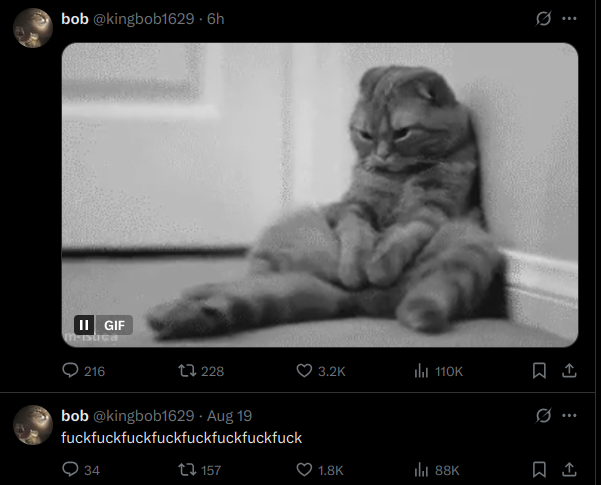
Noah “Kingbob” Urban, posting to Twitter/X around the time of his sentencing on Aug. 20.
A court transcript (PDF) from a status hearing in February 2025 shows Urban was telling the truth about the hacking incident that happened while he was in federal custody. The judge told attorneys for both sides that a co-defendant in the California case was trying to find out about Mr. Urban’s activity in the Florida case, and that the hacker accessed the account by impersonating a judge over the phone and requesting a password reset.
Allison Nixon is chief research officer at the New York based security firm Unit 221B, and easily one of the world’s leading experts on Com-based cybercrime activity. Nixon said the core problem with legally prosecuting well-known cybercriminals from the Com has traditionally been that the top offenders tend to be under the age of 18, and thus difficult to charge under federal hacking statutes.
In the United States, prosecutors typically wait until an underage cybercrime suspect becomes an adult to charge them. But until that day comes, she said, Com actors often feel emboldened to continue committing — and very often bragging about — serious cybercrime offenses.
“Here we have a special category of Com offenders that effectively enjoy legal immunity,” Nixon told KrebsOnSecurity. “Most get recruited to Com groups when they are older, but of those that join very young, such as 12 or 13, they seem to be the most dangerous because at that age they have no grounding in reality and so much longevity before they exit their legal immunity.”
Nixon said U.K. authorities face the same challenge when they briefly detain and search the homes of underage Com suspects: Namely, the teen suspects simply go right back to their respective cliques in the Com and start robbing and hurting people again the minute they’re released.
Indeed, the U.K. court heard from prosecutors last week that both Scattered Spider suspects were detained and/or searched by local law enforcement on multiple occasions, only to return to the Com less than 24 hours after being released each time.
“What we see is these young Com members become vectors for perpetrators to commit enormously harmful acts and even child abuse,” Nixon said. “The members of this special category of people who enjoy legal immunity are meeting up with foreign nationals and conducting these sometimes heinous acts at their behest.”
Nixon said many of these individuals have few friends in real life because they spend virtually all of their waking hours on Com channels, and so their entire sense of identity, community and self-worth gets wrapped up in their involvement with these online gangs. She said if the law was such that prosecutors could treat these people commensurate with the amount of harm they cause society, that would probably clear up a lot of this problem.
“If law enforcement was allowed to keep them in jail, they would quit reoffending,” she said.
The Times of London reports that Flowers is facing three charges under the Computer Misuse Act: two of conspiracy to commit an unauthorized act in relation to a computer causing/creating risk of serious damage to human welfare/national security and one of attempting to commit the same act. Maximum sentences for these offenses can range from 14 years to life in prison, depending on the impact of the crime.
Jubair is reportedly facing two charges in the U.K.: One of conspiracy to commit an unauthorized act in relation to a computer causing/creating risk of serious damage to human welfare/national security and one of failing to comply with a section 49 notice to disclose the key to protected information.
In the United States, Jubair is charged with computer fraud conspiracy, two counts of computer fraud, wire fraud conspiracy, two counts of wire fraud, and money laundering conspiracy. If extradited to the U.S., tried and convicted on all charges, he faces a maximum penalty of 95 years in prison.
In July 2025, the United Kingdom barred victims of hacking from paying ransoms to cybercriminal groups unless approved by officials. U.K. organizations that are considered part of critical infrastructure reportedly will face a complete ban, as will the entire public sector. U.K. victims of a hack are now required to notify officials to better inform policymakers on the scale of Britain’s ransomware problem.
For further reading (bless you), check out Bloomberg’s poignant story last week based on a year’s worth of jailhouse interviews with convicted Scattered Spider member Noah Urban.
Analysis of Counter-Ransomware Activities in 2024

The scourge of ransomware continues primarily because of three main reasons: Ransomware-as-a-Service (RaaS), cryptocurrency, and safe havens.
- RaaS platforms enable aspiring cybercriminals to join a gang and begin launching attacks with a support system that help extract ransom payments from their victims.
- Cryptocurrency enables cybercriminals to receive funds from victims around the world without the option to freeze or refund them due to the immutable nature of the virtual funds.
- Safe havens are countries that permit cybercriminals to launch attacks without immediate fear of arrest, enabling them to earn vast fortunes through ransomware campaigns.
With these three challenges in mind, law enforcement and governments have a very difficult job to do when it comes to fighting ransomware but fight it they must. In this blog we shall recall what counter-ransomware activities took place in 2024, analyse their effectiveness, and assess how the landscape shall evolve as a result.
A podcast version of this blog is also available here.
Ransomware Operator Arrests and Sanctions
During 2024, there were significant disruption operations by
law enforcement and financial authorities targeting individuals behind
ransomware campaigns (see the Table below). The main focus of 2024 for Western
law enforcement was squarely on the LockBit RaaS and its affiliates as it was
the largest and highest earning ransomware operation to date.
Several key players of the ransomware ecosystem were
arrested, including the main developer of LockBit ransomware. Interestingly,
Russian law enforcement also decided to arrest ransomware threat actors located
in Moscow and Kaliningrad as well.
| Month | Group(s) | Law Enforcement Activity |
|---|---|---|
| February 2024 | SugarLocker, REvil | Russian authorities have identified and arrested three alleged members in Moscow of a ransomware gang called SugarLocker. |
| February 2024 | LockBit | The LockBit leak site was seized. Two LockBit affiliates were arrested in Poland and Ukraine. Up to 28 servers belonging to LockBit were taken down. |
| February 2024 | LockBit | Two Russian nationals, Ivan Kondratiev and Artur Sungatov, were sanctioned by the US Treasury for being affiliates of LockBit, among other RaaS. |
| May 2024 | LockBit | Dmitry Khoroshev, the administrator and developer of LockBit was sanctioned by the US Treasury. |
| May 2024 | IcedID, SystemBC, Pikabot, Smokeloader, Bumblebee, TrickBot | European police took down malicious spam botnets that support ransomware campaigns. This resulted in 4 arrests (1 in Armenia and 3 in Ukraine), over 100 servers and 2,000 domains being seized. One of the main suspects earned €69 million by renting out infrastructure sites to deploy ransomware. |
| June 2024 | Conti, LockBit | A Ukrainian national was arrested for supporting Conti and LockBit ransomware attacks as a crypter developer. |
| August 2024 | Reveton, RansomCartel | Maksim Silnikau, a Belarusian national, was arrested in Spain for running Reveton and RansomCartel. |
| August 2024 | Karakurt, Conti | Deniss Zolotarjovs, a Latvian national was arrested and extradited to the US from Georgia for running the Karakurt data extortion gang linked to Conti. |
| October 2024 | Evil Corp, LockBit | The UK, alongside the US and Australia, has sanctioned 16 members of Evil Corp, including Aleksandr Ryzhenkov, Viktor Yakubets, and Eduard Benderskiy. |
| November 2024 | Phobos | Evgenii Ptitsyn, a Russian national, was arrested and extradited to the US from South Korea for running the Phobos ransomware gang. |
| December 2024 | LockBit | Rostislav Panev, a dual Russian and Israeli national, was arrested in Israel for developing LockBit ransomware. |
| December 2024 | LockBit, Babuk, Hive | Mikhail “Wazawaka” Matveev was arrested in Russia for violating domestic laws against the creation and use of malware. He was fined and had his cryptocurrency seized and is awaiting trial. |
The ransomware ecosystem has fragmented due to the law enforcement disruptions of the largest players, such as
ALPHV/BlackCat and LockBit. In the case of ALPHV/BlackCat, the operators staged
a law enforcement takedown as they put up a fake seizure notice as part of
an exit scam in March 2024 after the attack on UnitedHealth.
Following these disruptions, some affiliates have migrated
to less effective strains or launched their own strains. This includes
Akira and RansomHub at the top of the list as well as Hunters International and
PLAY.
Cryptocurrency Exchanges Disrupted
During 2024, law enforcement seized funds from and
sanctioned a number of cryptocurrency exchanges and individuals running payment
processors using cryptocurrency (see the Table below).
One of the most interesting disclosures this year came from
the UK National Crime Agency (NCA) around Operation Destablise. The NCA linked
payments to ransomware gangs to money laundering networks used by Russian
oligarchs to covertly purchase property and Russia Today, the state-run media
organization, to covertly fund pro-Russia foreign entities.
Another notable investigation in 2024 was when the US
Treasury sanctioned more Russian cryptocurrency exchanges, such as PM2BTC and
Cryptex, that led to money launderers that facilitate the cashing out of ransom
payments being arrested by Russian law enforcement.
| Month | Exchange(s) | Law Enforcement Activity |
|---|---|---|
| August 2024 | Cryptonator | The US Justice Department indicted Russian national Roman Pikulev and Cryptonator, which processed a total of $1.4 billion in transactions, of which $8 million were ransom payments. Cryptonator also has ties to other sanctioned entities including Blender, Hydra Market, Bitzlato, and Garantex, among others. |
| September 2024 | PM2BTC, Cryptex, UAPS | FinCEN identified PM2BTC as being of “primary money laundering concern” in connection with Russian illicit finance. This was alongside Cryptex and Sergey Sergeevich Ivanov, a Russian national, who is associated with UAPS and PinPays, as well as Genesis Market. Cryptex also facilitated more than $115 million of proceeds from ransomware payments. |
| September 2024 | 47 exchanges | In Operation Final Exchange, German federal police (BKA) shut down 47 cryptocurrency exchange services that ransomware gangs use that operated without requiring registration or identity verification. |
| October 2024 | Cryptex, UAPS | Russian authorities have arrested nearly 100 suspected cybercriminals linked to the anonymous payment system UAPS and the cryptocurrency exchange Cryptex. |
| November 2024 | Smart, TGR Group | The NCA uncovered a Russian money-laundering network operated by two companies called Smart and TGR Group as part of Operation Destabilise that involved UK-based cash-to-crypto networks that laundered Ryuk ransom payments as well as the money of Russian oligarchs and Russia Today. |
Safe Havens Enabling Ransomware
While ransomware is a global problem, there are only a few
countries that are to blame for this rapid expansion of the ransomware
ecosystem. The state that is blamed the most for preventing many ransomware operators
from facing justice is Russia. There are explicit rules posted to
Russian-speaking cybercrime forums that state as long as members avoid
targeting Russia and the Commonwealth of Independent States (CIS), they are
free to operate.
The Russian ransomware safe haven theory was further proven
following sanctions levied against Evil Corp by the UK, US, and Australia. One
of the sanctioned men connected to Evil Corp was Eduard
Benderskiy, a former Russian federal security service (FSB) official.
Benderskiy is reportedly
the father-in-law of Maksim Yakubets, the leader of Evil Corp, an organized cybercrime
group responsible for multiple
ransomware strains including BitPaymer, WastedLocker, Hades, PhoenixLocker,
and MacawLocker. In total, Evil Corp has reportedly extorted at least $300
million from victims globally, according to the UK NCA. It is now clear that
Evil Corp has protection from a highly connected Russian FSB official who has
also been involved
in multiple overseas assassinations on behalf of the Kremlin, according to
Bellingcat investigators.
While a number of ransomware operators were arrested in 2024
and some were extradited to the US, the work done by law enforcement
specializing in cybercrime was put in the spotlight during the August
2024 prisoner swap. Multiple countries decided to release cybercriminals,
spies and an assassin as part of a historic
prisoner exchange with Russia at an airport in Ankara, Turkey. The US negotiated
the release of 16 people from Russia, including five Germans as well as seven
Russian citizens who were political prisoners in their own country.
Notably, from a cybercrime intelligence perspective, the Russian
nationals released from the West included the infamous cybercriminals Roman
Seleznev and Vladislav Klyushin. The latter, Klyushin, was sentenced
in 2023 to nine years in US prison after he was caught in a $93 million stock
market cheating scheme that involved hacking into US companies for insider
knowledge. The other cybercriminal, Seleznev, was sentenced
to 27 years in prison in 2017 for stealing and selling millions of credit card
numbers from 500 businesses using point-of-sale (POS) malware and causing more
than $169 million in damage to small businesses and financial institutions,
including those in the US.
In 2024, we saw several more Russian nationals get
extradited to the US after being arrested by law enforcement in the country
they were residing in. This includes the Phobos operator living in South Korea
and the LockBit developer living in Israel. This follows others arrested in
previous years such as a TrickBot developer arrested
in South Korea as well as the two LockBit affiliates extradited
to the US. There is a potential that these Russian nationals involved in
ransomware could be used in prisoner exchanges in the future.
Further, another curious trend in 2024 was that some Russians
inside Russia, which is firmly considered a safe haven for ransomware gang, did
get arrested. This includes the SugarLocker operators arrested in Moscow and
the LockBit affiliate Wazawaka who was arrested in Kaliningrad. This is
alongside the money launderers arrested around Russia linked to the Cryptex
exchange.
The arrests of Russian nationals in Russia for ransomware
activities appear to be more symbolic than a true crackdown on this type of
activity. This is because there are several dozen Russian-speaking ransomware
gangs that continue to operate, as well as a plethora of other types of cybercrime
in the Russian-speaking underground.
Outlook
In 2024, there was lots of significant action by law
enforcement to shake up the ransomware economy. One of the main successes of the
notable Operation Cronos action taken against LockBit was the sowing of
distrust and disharmony in the ransomware ecosystem. Despite the admins of
LockBit trying to recover, their reputation and army of affiliates have been
smashed.
Many of Russian law enforcement activities could all be
related to the costs of the Russian invasion of Ukraine. Russian authorities seizing funds of the illicit cryptocurrency exchanges could be to pay for
the war in Ukraine and they could be recruiting arresting cybercriminals for offensive
cyber operations related to the war in Ukraine. The true motivations of Russian law enforcement arresting these specific ransomware operators but allowing others to operate are unclear. The cybercriminals could also simply have not paid their protection money or lack connections in the FSB like Evil Corp has.
Due to the fall of LockBit and ALPHV/BlackCat in 2024, there has been a rise of other ransomware groups like RansomHub and Akira to fill the vacuum. However, the rate of attacks by these emerging groups is still noticeably lower than when LockBit was operating at full force. This should be perceived as a success for law enforcement operations in 2024 due to the overall number of ransomware attacks lowering, which we should all be thankful for.

