Visualização de leitura

2025 Q4 DDoS threat report: A record-setting 31.4 Tbps attack caps a year of massive DDoS assaults

Welcome to the 24th edition of Cloudflare’s Quarterly DDoS Threat Report. In this report, Cloudforce One offers a comprehensive analysis of the evolving threat landscape of Distributed Denial of Service (DDoS) attacks based on data from the Cloudflare network. In this edition, we focus on the fourth quarter of 2025, as well as share overall 2025 data.

The fourth quarter of 2025 was characterized by an unprecedented bombardment launched by the Aisuru-Kimwolf botnet, dubbed “The Night Before Christmas" DDoS attack campaign. The campaign targeted Cloudflare customers as well as Cloudflare’s dashboard and infrastructure with hyper-volumetric HTTP DDoS attacks exceeding rates of 200 million requests per second (rps), just weeks after a record-breaking 31.4 Terabits per second (Tbps) attack.

Key insights

  1. DDoS attacks surged by 121% in 2025, reaching an average of 5,376 attacks automatically mitigated every hour.

  2. In the final quarter of 2025, Hong Kong jumped 12 places, making it the second most DDoS’d place on earth. The United Kingdom also leapt by an astonishing 36 places, making it the sixth most-attacked place.

  3. Infected Android TVs — part of the Aisuru-Kimwolf botnet — bombarded Cloudflare’s network with hyper-volumetric HTTP DDoS attacks, while Telcos emerged as the most-attacked industry.

2025 saw a huge spike in DDoS attacks

In 2025, the total number of DDoS attacks more than doubled to an incredible 47.1 million. Such attacks have soared in recent years: The number of DDoS attacks spiked 236% between 2023 and 2025.

In 2025, Cloudflare mitigated an average of 5,376 DDoS attacks every hour — of these, 3,925 were network-layer DDoS attacks and 1,451 were HTTP DDoS attacks. 

Network-layer DDoS attacks more than tripled in 2025

The most substantial growth was in network-layer DDoS attacks, which more than tripled year over year. Cloudflare mitigated 34.4 million network-layer DDoS attacks in 2025, compared to 11.4 million in 2024.

A substantial portion of the network-layer attacks — approximately 13.5 million — targeted global Internet infrastructure protected by Cloudflare Magic Transit and Cloudflare’s infrastructure directly, as part of an 18-day DDoS campaign in the first quarter of 2025. Of these attacks, 6.9 million targeted Magic Transit customers while the remaining 6.6 million targeted Cloudflare directly. 

This assault was a multi-vector DDoS campaign comprising SYN flood attacks, Mirai-generated DDoS attacks, and SSDP amplification attacks to name a few. Our systems detected and mitigated these attacks automatically. In fact, we only discovered the campaign while preparing our DDoS threat report for 2025 Q1 — an example of how effective Cloudflare’s DDoS mitigation is!

In the final quarter of 2025, the number of DDoS attacks grew by 31% over the previous quarter and 58% over 2024. Network-layer DDoS attacks fueled that growth. In 2025 Q4, network-layer DDoS attacks accounted for 78% of all DDoS attacks. The amount of HTTP DDoS attacks remained the same, but surged in their size to rates that we haven’t seen since the HTTP/2 Rapid Reset DDoS campaign in 2023. These recent surges were launched by the Aisuru-Kimwolf botnet, which we will cover in the next section. 

“The Night Before Christmas” DDoS campaign

On Friday, December 19, 2025, the Aisuru-Kimwolf botnet began bombarding Cloudflare infrastructure and Cloudflare customers with hyper-volumetric DDoS attacks. What was new in this campaign was its size: The botnet used hyper-volumetric HTTP DDoS attacks exceeding rates of 20 million requests per second (Mrps).

The Aisuru-Kimwolf botnet is a massive collection of malware-infected devices, primarily Android TVs. The botnet comprises an estimated 1-4 million infected hosts. It is capable of launching DDoS attacks that can cripple critical infrastructure, crash most legacy cloud-based DDoS protection solutions, and even disrupt the connectivity of entire nations.

Throughout the campaign, Cloudflare’s autonomous DDoS defense systems detected and mitigated all of the attacks: 384 packet-intensive attacks, 329 bit-intensive attacks, and 189 request-intensive attacks, for a total of 902 hyper-volumetric DDoS attacks, averaging 53 attacks a day.
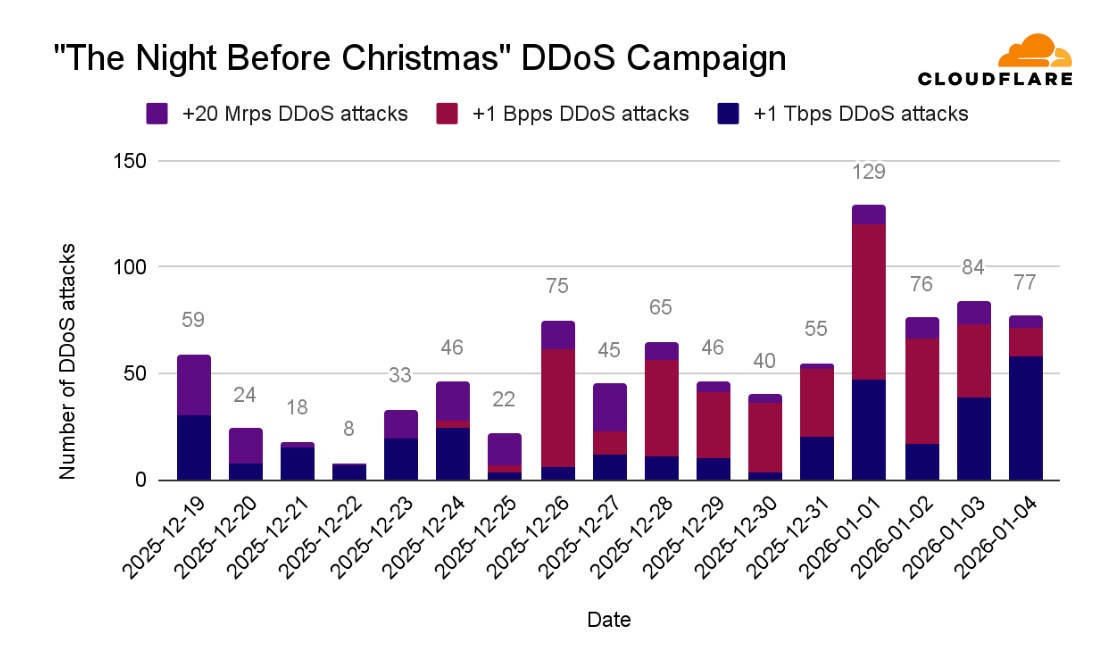
The average size of the hyper-volumetric DDoS attacks during the campaign were 3 Bpps, 4 Tbps, and 54 Mrps. The maximum rates recorded during the campaign were 9 Bpps, 24 Tbps, and 205 Mrps.

To put that in context, the scale of a 205 Mrps DDoS attack is comparable to the combined populations of the UK, Germany, and Spain all simultaneously typing a website address and then hitting 'enter’ at the same second.

While highly dramatic, The Night Before Christmas campaign accounted for only a small portion of the hyper-volumetric DDoS attacks we saw throughout the year.

Hyper-volumetric DDoS attacks

Throughout 2025, Cloudflare observed a continuous increase in hyper-volumetric DDoS attacks. In 2025 Q4, hyper-volumetric attacks increased by 40% compared to the previous quarter.

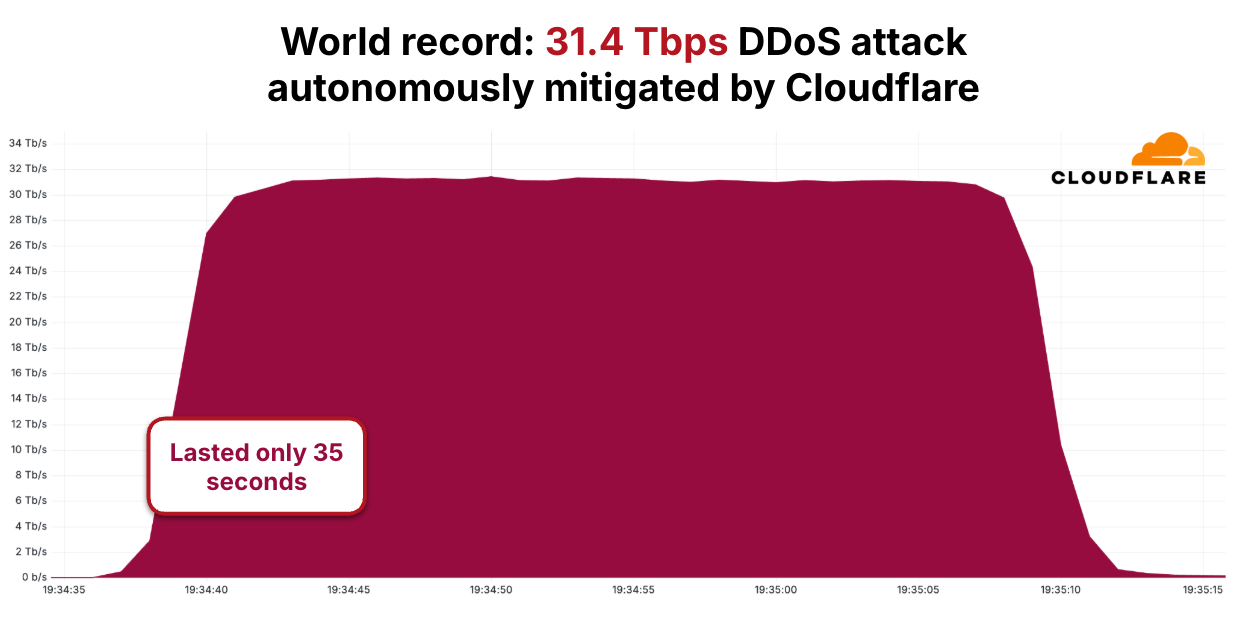
As the number of attacks increased over the course of 2025, the size of the attacks increased as well, growing by over 700% compared to the large attacks seen in late 2024, with one reaching 31.4 Tbps in a DDoS attack that lasted just 35 seconds. The graph below portrays the rapid growth in DDoS attack sizes as seen and blocked by Cloudflare — each one a world record, i.e. the largest ever disclosed publicly by any company at the time.

Like all of the other attacks, the 31.4 Tbps DDoS attack was detected and mitigated automatically by Cloudflare’s autonomous DDoS defense, which was able to adapt and quickly lock on to botnets such as Aisuru-Kimwolf.
Most of the hyper-volumetric DDoS attacks targeted Cloudflare customers in the Telecommunications, Service Providers and Carriers industry. Cloudflare customers in the Gaming industry and customers providing Generative AI services were also heavily targeted. Lastly, Cloudflare’s own infrastructure itself was targeted by multiple attack vectors such as HTTP floods, DNS attacks and UDP flood.

Most-attacked industries

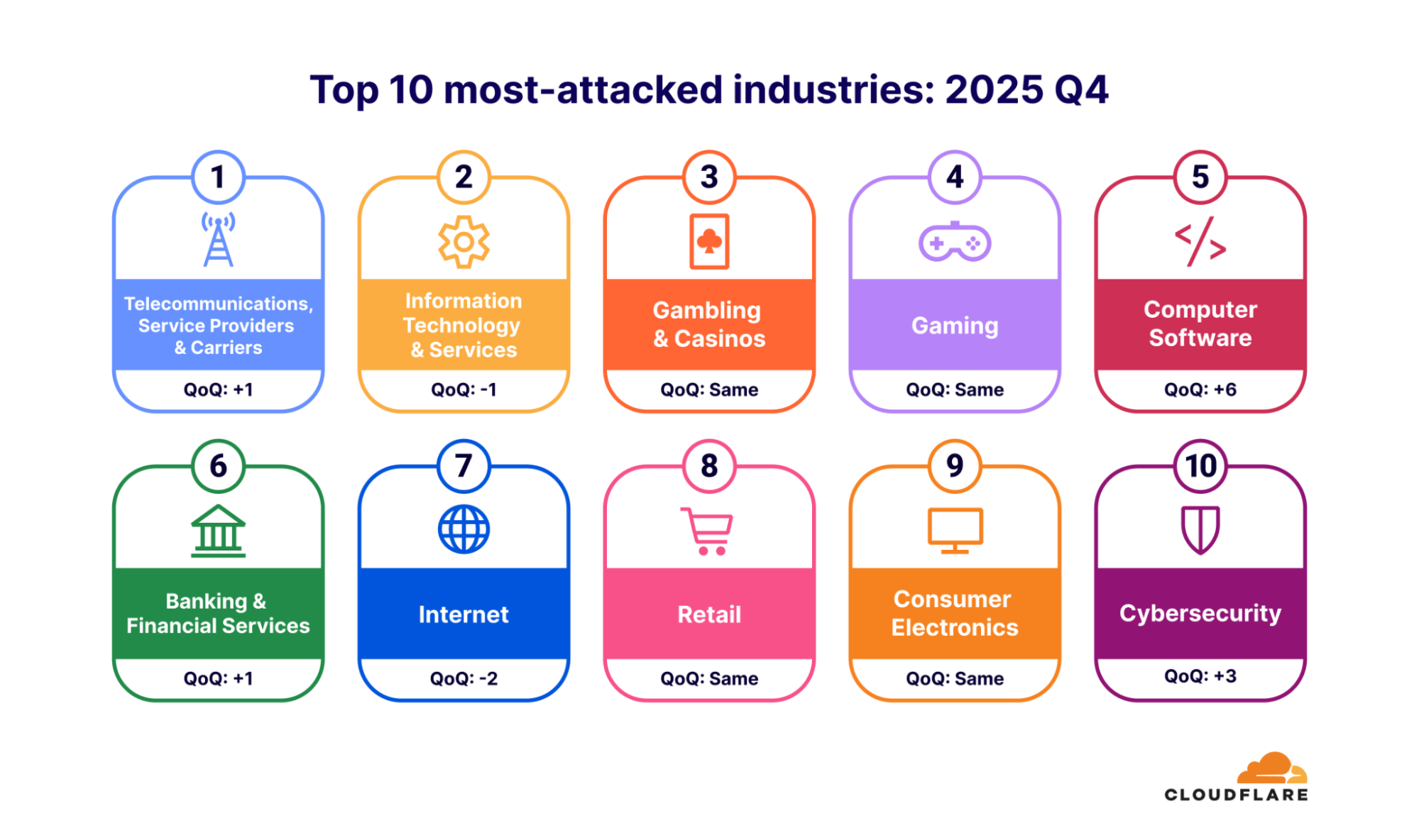
When analyzing DDoS attacks of all sizes, the Telecommunications, Service Providers and Carriers industry was also the most targeted. Previously, the Information Technology & Services industry held that unlucky title.

The Gambling & Casinos and Gaming industries ranked third and fourth, respectively. The quarter’s biggest changes in the top 10 were the Computer Software and Business Services industries, which both climbed several spots. 

The most-attacked industries are defined by their role as critical infrastructure, a central backbone for other businesses, or their immediate, high-stakes financial sensitivity to service interruption and latency.
Most-attacked locations

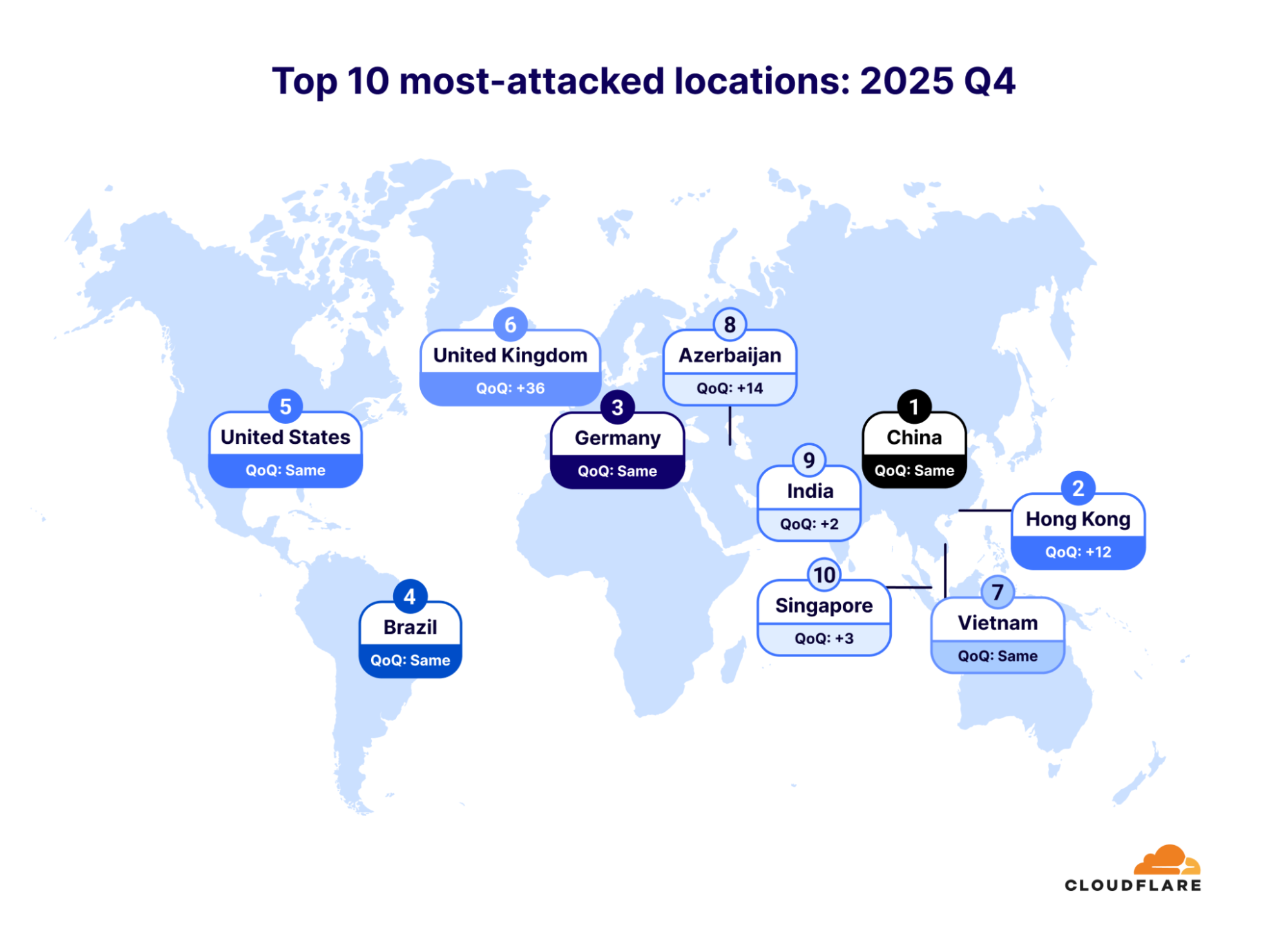
The DDoS landscape saw both predictable stability and dramatic shifts among the world's most-attacked locations. Targets like China, Germany, Brazil, and the United States were the top five, demonstrating persistent appeal for attackers. 

Hong Kong made a significant move, jumping twelve spots to land at number two. However, the bigger story was the meteoric rise of the United Kingdom, which surged an astonishing 36 places this quarter, making it the sixth most-attacked location.  

Vietnam held its place as the seventh most-attacked location, followed by Azerbaijan in eighth, India in ninth, and Singapore as number ten.
Top attack sources

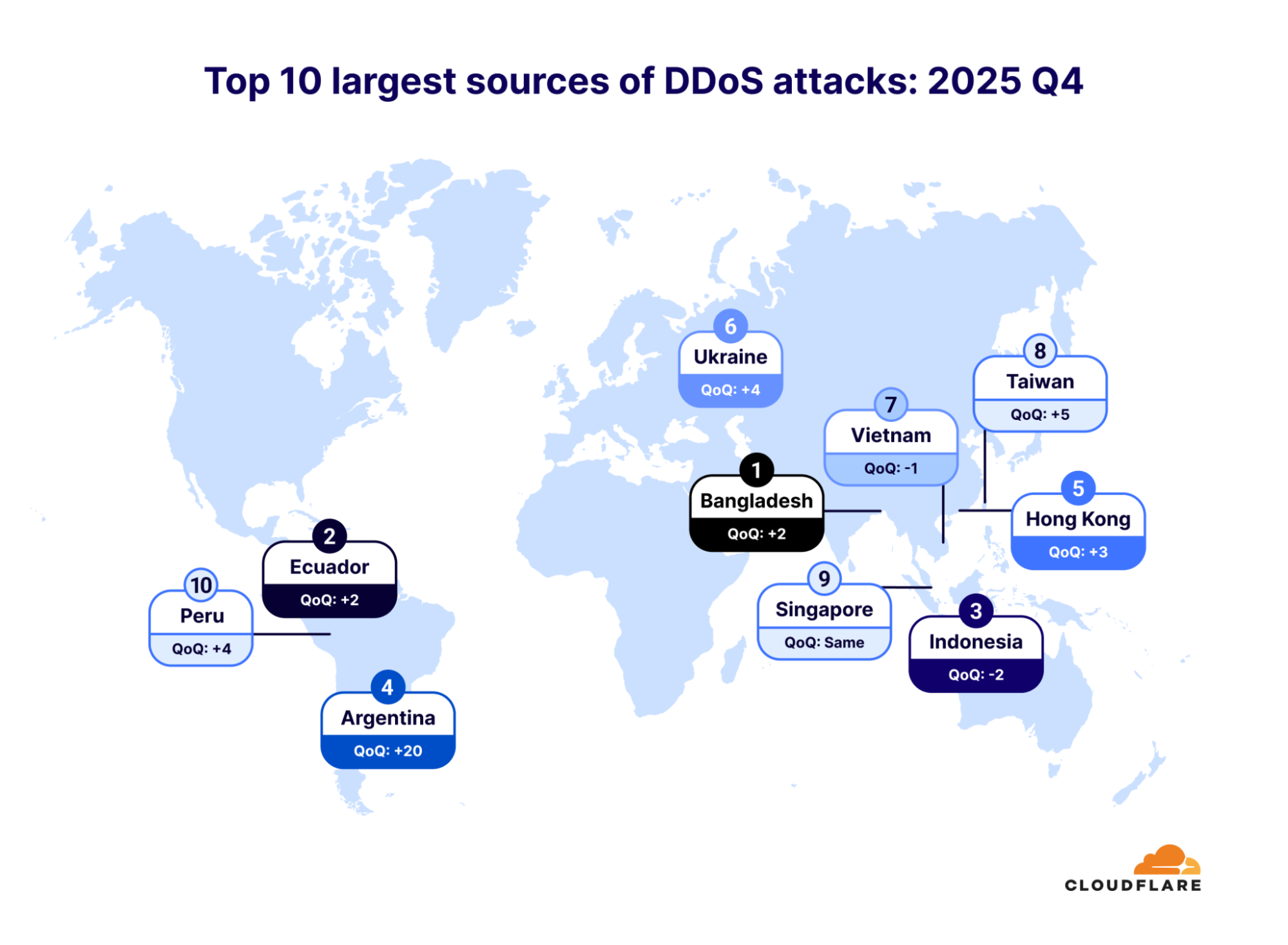
Bangladesh dethroned Indonesia as the largest source of DDoS attacks in the fourth quarter of 2025. Indonesia dropped to the third spot, after spending a year as the top source of DDoS attacks. Ecuador also jumped two spots, making it the second-largest source.

Notably, Argentina soared an incredible twenty places, making it the fourth-largest source of DDoS attacks. Hong Kong rose three places, taking fifth place. Ukraine came in sixth place, followed by Vietnam, Taiwan, Singapore, and Peru.
Top source networks

The top 10 list of attack source networks reads like a list of Internet giants, revealing a fascinating story about the anatomy of modern DDoS attacks. The common thread is clear: Threat actors are leveraging the world's most accessible and powerful network infrastructure — primarily large, public-facing services. 

We see most DDoS attacks coming from IP addresses associated with Cloud Computing Platforms and Cloud Infrastructure Providers, including DigitalOcean (AS 14061), Microsoft (AS 8075), Tencent (AS 132203), Oracle (AS 31898), and Hetzner (AS 24940). This demonstrates the strong link between easily-provisioned virtual machines and high-volume attacks. These cloud sources, heavily concentrated in the United States, are closely followed by a significant presence of attacks coming from IP addresses associated with traditional Telecommunications Providers (Telcos). These Telcos, primarily from the Asia-Pacific region (including Vietnam, China, Malaysia, and Taiwan), round out the rest of the top 10.

This geographic and organizational diversity confirms a two-pronged attack reality: While the sheer scale of the highest-ranking sources often originates from global cloud hubs, the problem is truly worldwide, routed through the Internet's most critical pathways from across the globe. In many DDoS attacks, we see thousands of various source ASNs, highlighting the truly global distribution of botnet nodes.

To help hosting providers, cloud computing platforms and Internet service providers identify and take down the abusive IP addresses/accounts that launch these attacks, we leverage Cloudflare’s unique vantage point on DDoS attacks to provide a free DDoS Botnet Threat Feed for Service Providers

Over 800 networks worldwide have signed up for this feed, and we’ve already seen great collaboration across the community to take down botnet nodes.

Helping defend the Internet

DDoS attacks are rapidly growing in sophistication and size, surpassing what was previously imaginable. This evolving threat landscape presents a significant challenge for many organizations to keep pace. Organizations currently relying on on-premise mitigation appliances or on-demand scrubbing centers may benefit from re-evaluating their defense strategy.

Cloudflare is dedicated to offering free, unmetered DDoS protection to all its customers, regardless of the size, duration, or volume of attacks, leveraging its vast global network and autonomous DDoS mitigation systems.

About Cloudforce One

Driven by a mission to help defend the Internet, Cloudforce One leverages telemetry from Cloudflare’s global network — which protects approximately 20% of the web — to drive threat research and operational response, protecting critical systems for millions of organizations worldwide.

Automating threat analysis and response with Cloudy

Security professionals everywhere face a paradox: while more data provides the visibility needed to catch threats, it also makes it harder for humans to process it all and find what's important. When there’s a sudden spike in suspicious traffic, every second counts. But for many security teams — especially lean ones — it’s hard to quickly figure out what’s going on. Finding a root cause means diving into dashboards, filtering logs, and cross-referencing threat feeds. All the data tracking that has happened can be the very thing that slows you down — or worse yet, what buries the threat that you’re looking for. 

Today, we’re excited to announce that we’ve solved that problem. We’ve integrated Cloudy — Cloudflare’s first AI agent — with our security analytics functionality, and we’ve also built a new, conversational interface that Cloudflare users can use to ask questions, refine investigations, and get answers.  With these changes, Cloudy can now help Cloudflare users find the needle in the digital haystack, making security analysis faster and more accessible than ever before.  

Since Cloudy’s launch in March of this year, its adoption has been exciting to watch. Over 54,000 users have tried Cloudy for custom rule creation, and 31% of them have deployed a rule suggested by the agent. For our log explainers in Cloudflare Gateway, Cloudy has been loaded over 30,000  times in just the last month, with 80% of the feedback we received confirming the summaries were insightful. We are excited to empower our users to do even more.

Talk to your traffic: a new conversational interface for faster RCA and mitigation

Security analytics dashboards are powerful, but they often require you to know exactly what you're looking for — and the right queries to get there. The new Cloudy chat interface changes this. It is designed for faster root cause analysis (RCA) of traffic anomalies, helping you get from “something’s wrong” to “here’s the fix” in minutes. You can now start with a broad question and narrow it down, just like you would with a human analyst.

For example, you can start an investigation by asking Cloudy to look into a recommendation from Security Analytics.

From there, you can ask follow-up questions to dig deeper:

  • "Focus on login endpoints only."

  • "What are the top 5 IP addresses involved?"

  • "Are any of these IPs known to be malicious?"

This is just the beginning of how Cloudy is transforming security. You can read more about how we’re using Cloudy to bring clarity to another critical security challenge: automating summaries of email detections. This is the same core mission — translating complex security data into clear, actionable insights — but applied to the constant stream of email threats that security teams face every day.

Use Cloudy to understand, prioritize, and act on threats

Analyzing your own logs is powerful — but it only shows part of the picture. What if Cloudy could look beyond your own data and into Cloudflare’s global network to identify emerging threats? This is where Cloudforce One's Threat Events platform comes in.

Cloudforce One translates the high-volume attack data observed on the Cloudflare network into real-time, attacker-attributed events relevant to your organization. This platform helps you track adversary activity at scale — including APT infrastructure, cybercrime groups, compromised devices, and volumetric DDoS activity. Threat events provide detailed, context-rich events, including interactive timelines and mappings to attacker TTPs, regions, and targeted verticals. 

We have spent the last few months making Cloudy more powerful by integrating it with the Cloudforce One Threat Events platform.  Cloudy now can offer contextual data about the threats we observe and mitigate across Cloudflare's global network, spanning everything from APT activity and residential proxies to ACH fraud, DDoS attacks, WAF exploits, cybercrime, and compromised devices. This integration empowers our users to quickly understand, prioritize, and act on indicators of compromise (IOCs) based on a vast ocean of real-time threat data. 

Cloudy lets you query this global dataset in a natural language and receive clear, concise answers. For example, imagine asking these questions and getting immediate actionable answers:

  • Who is targeting my industry vertical or country?

  • What are the most relevant indicators (IPs, JA3/4 hashes, ASNs, domains, URLs, SHA fingerprints) to block right now?

  • How has a specific adversary progressed across the cyber kill chain over time?

  • What novel new threats are threat actors using that might be used against your network next, and what insights do Cloudflare analysts know about them?

Simply interact with Cloudy in the Cloudflare Dashboard > Security Center > Threat Intelligence, providing your queries in natural language. It can walk you from a single indicator (like an IP address or domain) to the specific threat event Cloudflare observed, and then pivot to other related data — other attacks, related threats, or even other activity from the same actor. 

This cuts through the noise, so you can quickly understand an adversary's actions across the cyber kill chain and MITRE ATT&CK framework, and then block attacks with precise, actionable intelligence. The threat events platform is like an evidence board on the wall that helps you understand threats; Cloudy is like your sidekick that will run down every lead.

How it works: Agents SDK and Workers AI

Developing this advanced capability for Cloudy was a testament to the agility of Cloudflare's AI ecosystem. We leveraged our Agents SDK running on Workers AI. This allowed for rapid iteration and deployment, ensuring Cloudy could quickly grasp the nuances of threat intelligence and provide highly accurate, contextualized insights. The combination of our massive network telemetry, purpose-built LLM prompts, and the flexibility of Workers AI means Cloudy is not just fast, but also remarkably precise.

And a quick word on what we didn’t do when developing Cloudy: We did not train Cloudy on any Cloudflare customer data. Instead, Cloudy relies on models made publicly available through Workers AI. For more information on Cloudflare’s approach to responsible AI, please see these FAQs.

What's next for Cloudy

This is just the next step in Cloudy’s journey. We're working on expanding Cloudy's abilities across the board. This includes intelligent debugging for WAF rules and deeper integrations with Alerts to give you more actionable, contextual notifications. At the same time, we are continuously enriching our threat events datasets and exploring ways for Cloudy to help you visualize complex attacker timelines, campaign overviews, and intricate attack graphs. Our goal remains the same: make Cloudy an indispensable partner in understanding and reacting to the security landscape.

The new chat interface is now available on all plans, and the threat intelligence capabilities are live for Cloudforce One customers. Learn more about Cloudforce One here and reach out for a consultation if you want to go deeper with our experts.

Perplexity is using stealth, undeclared crawlers to evade website no-crawl directives

We are observing stealth crawling behavior from Perplexity, an AI-powered answer engine. Although Perplexity initially crawls from their declared user agent, when they are presented with a network block, they appear to obscure their crawling identity in an attempt to circumvent the website’s preferences. We see continued evidence that Perplexity is repeatedly modifying their user agent and changing their source ASNs to hide their crawling activity, as well as ignoring — or sometimes failing to even fetch — robots.txt files.

The Internet as we have known it for the past three decades is rapidly changing, but one thing remains constant: it is built on trust. There are clear preferences that crawlers should be transparent, serve a clear purpose, perform a specific activity, and, most importantly, follow website directives and preferences. Based on Perplexity’s observed behavior, which is incompatible with those preferences, we have de-listed them as a verified bot and added heuristics to our managed rules that block this stealth crawling.

How we tested

We received complaints from customers who had both disallowed Perplexity crawling activity in their robots.txt files and also created WAF rules to specifically block both of Perplexity’s declared crawlers: PerplexityBot and Perplexity-User. These customers told us that Perplexity was still able to access their content even when they saw its bots successfully blocked. We confirmed that Perplexity’s crawlers were in fact being blocked on the specific pages in question, and then performed several targeted tests to confirm what exact behavior we could observe.

We created multiple brand-new domains, similar to testexample.com and secretexample.com. These domains were newly purchased and had not yet been indexed by any search engine nor made publicly accessible in any discoverable way. We implemented a robots.txt file with directives to stop any respectful bots from accessing any part of a website:  

We conducted an experiment by querying Perplexity AI with questions about these domains, and discovered Perplexity was still providing detailed information regarding the exact content hosted on each of these restricted domains. This response was unexpected, as we had taken all necessary precautions to prevent this data from being retrievable by their crawlers.

Obfuscating behavior observed

Bypassing Robots.txt and undisclosed IPs/User Agents

Our multiple test domains explicitly prohibited all automated access by specifying in robots.txt and had specific WAF rules that blocked crawling from Perplexity’s public crawlers. We observed that Perplexity uses not only their declared user-agent, but also a generic browser intended to impersonate Google Chrome on macOS when their declared crawler was blocked.

Declared

Mozilla/5.0 AppleWebKit/537.36 (KHTML, like Gecko; compatible; Perplexity-User/1.0; +https://perplexity.ai/perplexity-user)

20-25m daily requests

Stealth

Mozilla/5.0 (Macintosh; Intel Mac OS X 10_15_7) AppleWebKit/537.36 (KHTML, like Gecko) Chrome/124.0.0.0 Safari/537.36

3-6m daily requests

Both their declared and undeclared crawlers were attempting to access the content for scraping contrary to the web crawling norms as outlined in RFC 9309.

This undeclared crawler utilized multiple IPs not listed in Perplexity’s official IP range, and would rotate through these IPs in response to the restrictive robots.txt policy and block from Cloudflare. In addition to rotating IPs, we observed requests coming from different ASNs in attempts to further evade website blocks. This activity was observed across tens of thousands of domains and millions of requests per day. We were able to fingerprint this crawler using a combination of machine learning and network signals.

An example: 

Of note: when the stealth crawler was successfully blocked, we observed that Perplexity uses other data sources — including other websites — to try to create an answer. However, these answers were less specific and lacked details from the original content, reflecting the fact that the block had been successful. 

How well-meaning bot operators respect website preferences

In contrast to the behavior described above, the Internet has expressed clear preferences on how good crawlers should behave. All well-intentioned crawlers acting in good faith should:

Be transparent. Identify themselves honestly, using a unique user-agent, a declared list of IP ranges or Web Bot Auth integration, and provide contact information if something goes wrong.

Be well-behaved netizens. Don’t flood sites with excessive traffic, scrape sensitive data, or use stealth tactics to try and dodge detection.

Serve a clear purpose. Whether it’s powering a voice assistant, checking product prices, or making a website more accessible, every bot has a reason to be there. The purpose should be clearly and precisely defined and easy for site owners to look up publicly.

Separate bots for separate activities. Perform each activity from a unique bot. This makes it easy for site owners to decide which activities they want to allow. Don’t force site owners to make an all-or-nothing decision.

Follow the rules. That means checking for and respecting website signals like robots.txt, staying within rate limits, and never bypassing security protections.

More details are outlined in our official Verified Bots Policy Developer Docs.

OpenAI is an example of a leading AI company that follows these best practices. They clearly outline their crawlers and give detailed explanations for each crawler’s purpose. They respect robots.txt and do not try to evade either a robots.txt directive or a network level block. And ChatGPT Agent is signing http requests using the newly proposed open standard Web Bot Auth.

When we ran the same test as outlined above with ChatGPT, we found that ChatGPT-User fetched the robots file and stopped crawling when it was disallowed. We did not observe follow-up crawls from any other user agents or third party bots. When we removed the disallow directive from the robots entry, but presented ChatGPT with a block page, they again stopped crawling, and we saw no additional crawl attempts from other user agents. Both of these demonstrate the appropriate response to website owner preferences.

How can you protect yourself?

All the undeclared crawling activity that we observed from Perplexity’s hidden User Agent was scored by our bot management system as a bot and was unable to pass managed challenges. Any bot management customer who has an existing block rule in place is already protected. Customers who don’t want to block traffic can set up rules to challenge requests, giving real humans an opportunity to proceed. Customers with existing challenge rules are already protected. Lastly, we added signature matches for the stealth crawler into our managed rule that blocks AI crawling activity. This rule is available to all customers, including our free customers.  

What’s next?

It's been just over a month since we announced Content Independence Day, giving content creators and publishers more control over how their content is accessed. Today, over two and a half million websites have chosen to completely disallow AI training through our managed robots.txt feature or our managed rule blocking AI Crawlers. Every Cloudflare customer is now able to selectively decide which declared AI crawlers are able to access their content in accordance with their business objectives.

We expected a change in bot and crawler behavior based on these new features, and we expect that the techniques bot operators use to evade detection will continue to evolve. Once this post is live the behavior we saw will almost certainly change, and the methods we use to stop them will keep evolving as well. 

Cloudflare is actively working with technical and policy experts around the world, like the IETF efforts to standardize extensions to robots.txt, to establish clear and measurable principles that well-meaning bot operators should abide by. We think this is an important next step in this quickly evolving space.

Unleashing improved context for threat actor activity with our Cloudforce One threat events platform

Today, one of the greatest challenges that cyber defenders face is analyzing detection hits from indicator feeds, which provide metadata about specific indicators of compromise (IOCs), like IP addresses, ASNs, domains, URLs, and hashes. While indicator feeds have proliferated across the threat intelligence industry, most feeds contain no contextual information about why an indicator was placed on the feed. Another limitation of most feeds today is that they focus solely on blockable indicators and cannot easily accommodate more complex cases, such as a threat actor exploiting a CVE or an insider threat. Instead, this sort of complex threat intelligence is left for long form reporting. However, long-form reporting comes with its own challenges, such as the time required for writing and editing, which can lead to significant delays in releasing timely threat intelligence.

To help address these challenges, we are excited to launch our threat events platform for Cloudforce One customers. Every day, Cloudflare blocks billions of cyber threats. This new platform contains contextual data about the threats we monitor and mitigate on the Cloudflare network and is designed to empower security practitioners and decision makers with actionable insights from a global perspective. 

On average, we process 71 million HTTP requests per second and 44 million DNS queries per second. This volume of traffic provides us with valuable insights and a comprehensive view of current (real-time) threats. The new threat events platform leverages the insights from this traffic to offer a comprehensive, real-time view of threat activity occurring on the Internet, enabling Cloudforce One customers to better protect their assets and respond to emerging threats.

How we built the threat events platform leveraging Cloudflare’s traffic insights

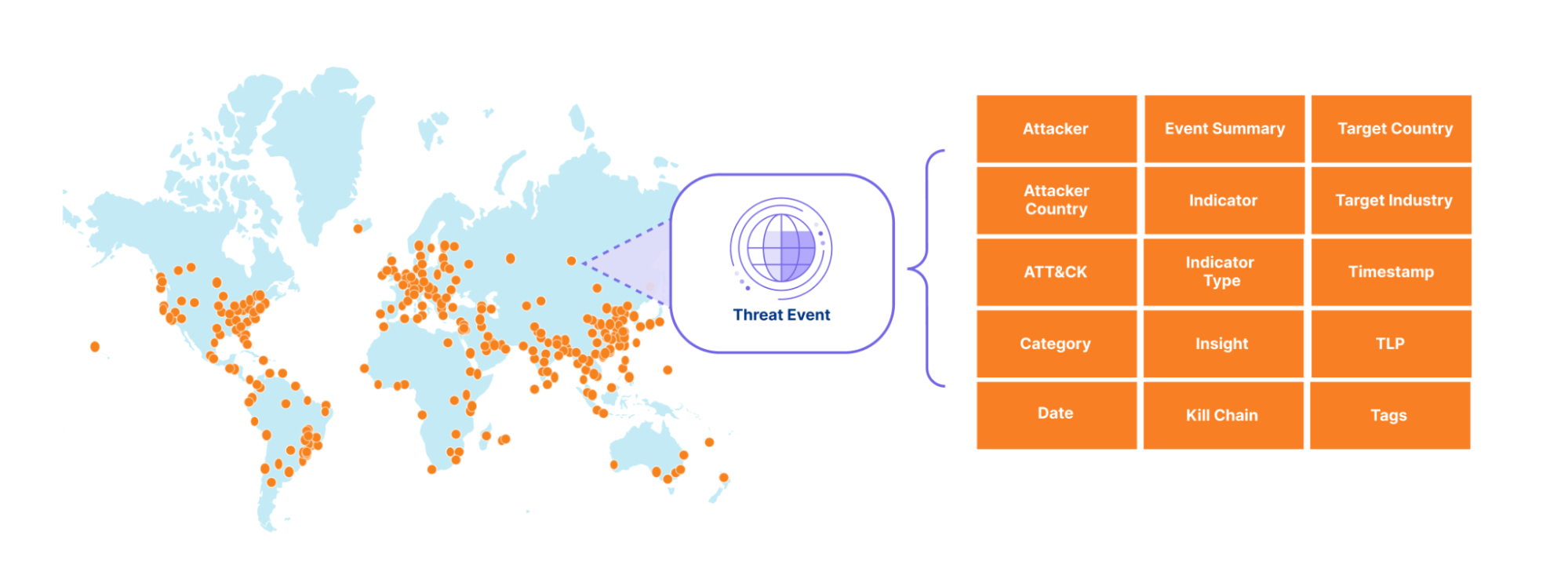
The sheer volume of threat activity observed across Cloudflare’s network would overwhelm any system or SOC analyst. So instead, we curate this activity into a stream of events that include not only indicators of compromise (IOCs) but also context, making it easier to take action based on Cloudflare’s unique data. To start off, we expose events related to denial of service (DOS) attacks observed across our network, along with the advanced threat operations tracked by our Cloudforce One Intelligence team, like the various tools, techniques, and procedures used by the threat actors we are tracking. We mapped the events to the MITRE ATT&CK framework and to the cyber kill chain stages. In the future, we will add events related to traffic blocked by our Web Application Firewall (WAF), Zero Trust Gateway, Zero Trust Email Security Business Email Compromise, and many other Cloudflare-proprietary datasets. Together, these events will provide our customers with a detailed view of threat activity occurring across the Internet.

Each event in our threat events summarizes specific threat activity we have observed, similar to a STIX2 sighting object and provides contextual information in its summary, detailed view and via the mapping to the MITRE ATT&Ck and KillChain stages. For an example entry, please see the API documentation.

Our goal is to empower customers to better understand the threat landscape by providing key information that allows them to investigate and address both broad and specific questions about threats targeting their organization. For example:

  • Who is targeting my industry vertical?

  • Who is targeting my country?

  • What indicators can I use to block attacks targeting my verticals?

  • What has an adversary done across the kill chain over some period of time?

Each event has a unique identifier that links it to the identified threat activity, enabling our Cloudforce One threat intelligence analysts to provide additional context in follow-on investigations.

How we built the threat events platform using Cloudflare Workers

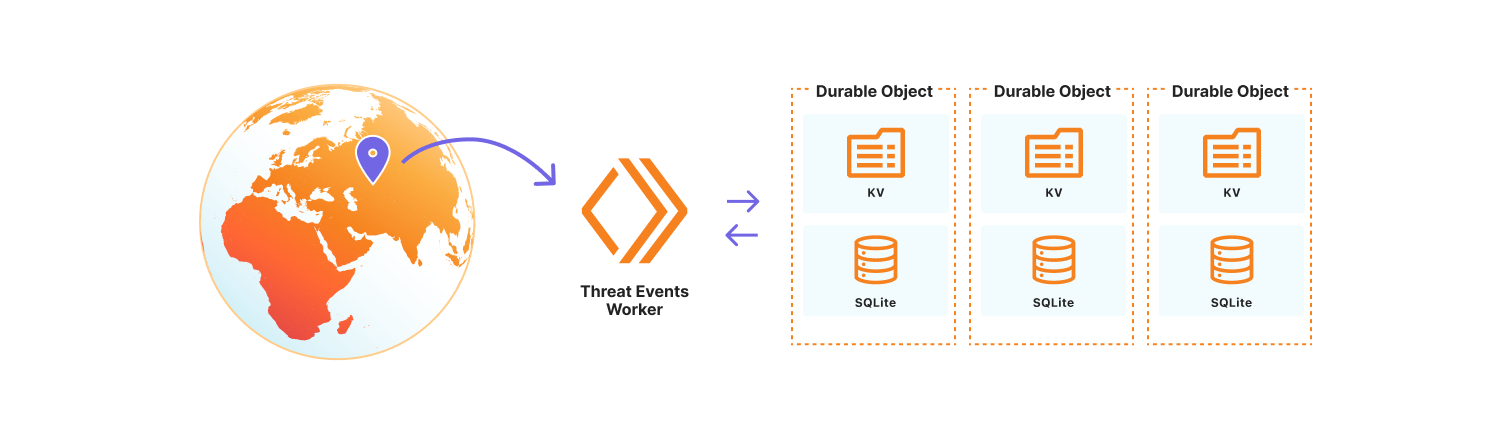
We chose to use the Cloudflare Developer Platform to build out the threat events platform, as it allowed us to leverage the versatility and seamless integration of Cloudflare Workers. At its core, the platform is a Cloudflare Worker that uses SQLite-backed Durable Objects to store events observed on the Cloudflare network. We opted to use Durable Objects over D1, Cloudflare’s serverless SQL database solution, because it permits us to dynamically create SQL tables to store uniquely customizable datasets. Storing datasets this way allows threat events to scale across our network, so we are resilient to surges in data that might correlate with the unpredictable nature of attacks on the Internet. It also permits us to control events by data source, share a subset of datasets with trusted partners, or restrict access to only authorized users.  Lastly, the metadata for each individual threat event is stored in the Durable Object KV so that we may store contextual data beyond our fixed, searchable fields. This data may be in the form of requests-per-second for our denial of service events, or sourcing information so Cloudforce One analysts can tie the event to the exact threat activity for further investigation.

How to use threat events

Cloudforce One customers can access threat events through the Cloudflare Dashboard in Security Center or via the Cloudforce One threat events API. Each exposes the stream of threat activity occurring across the Internet as seen by Cloudflare, and are customizable by user-defined filters. 

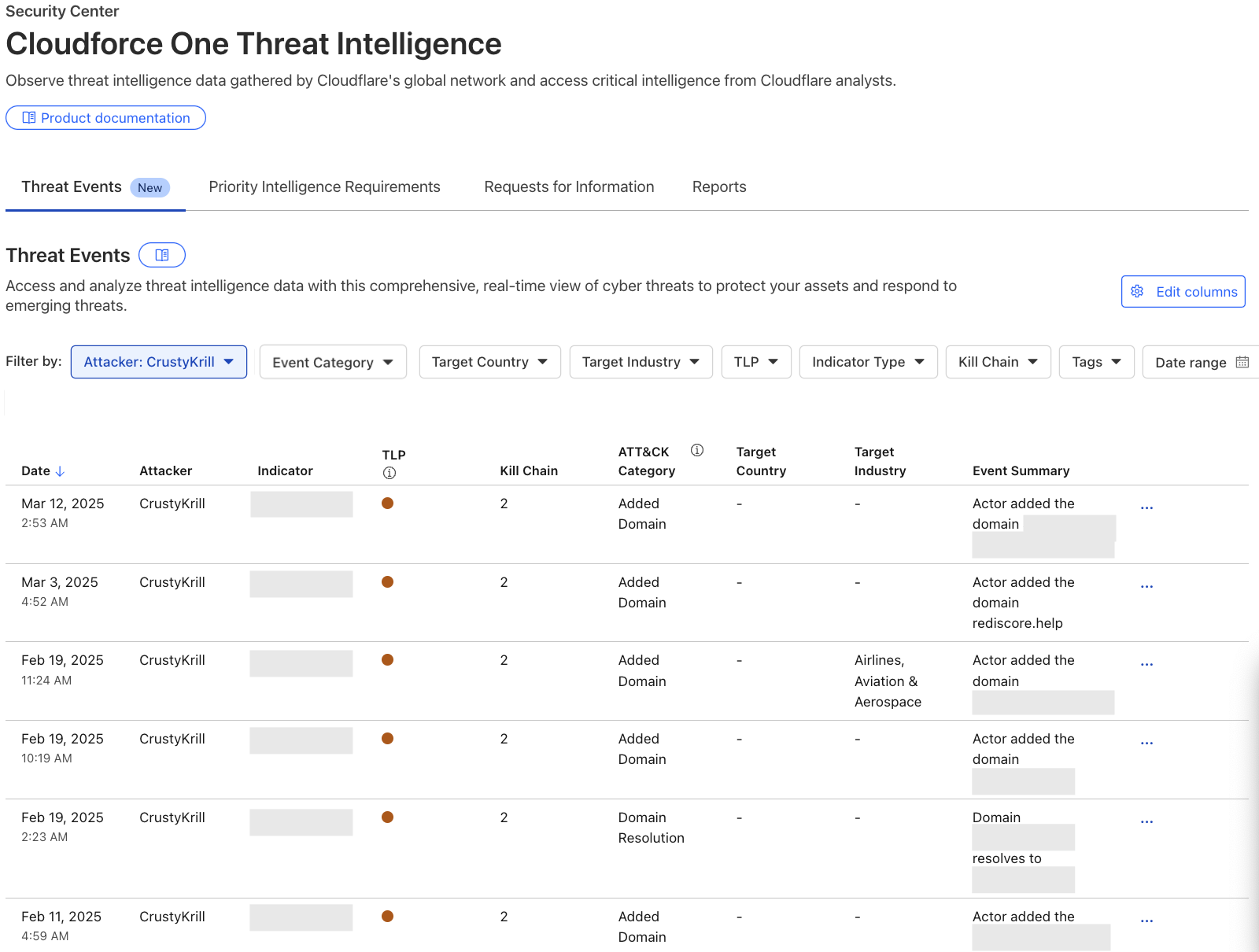
In the Cloudflare Dashboard, users have access to an Attacker Timelapse view, designed to answer strategic questions, as well as a more granular events table for drilling down into attack details. This approach ensures that users have the most relevant information at their fingertips.

Events Table

The events table is a detailed view in the Security Center where users can drill down into specific threat activity filtered by various criteria. It is here that users can explore specific threat events and adversary campaigns using Cloudflare’s traffic insights. Most importantly, this table will provide our users with actionable Indicators of Compromise and an event summary so that they can properly defend their services. All of the data available in our events table is equally accessible via the Cloudforce One threat events API

To showcase the power of threat events, let’s explore a real-world case:

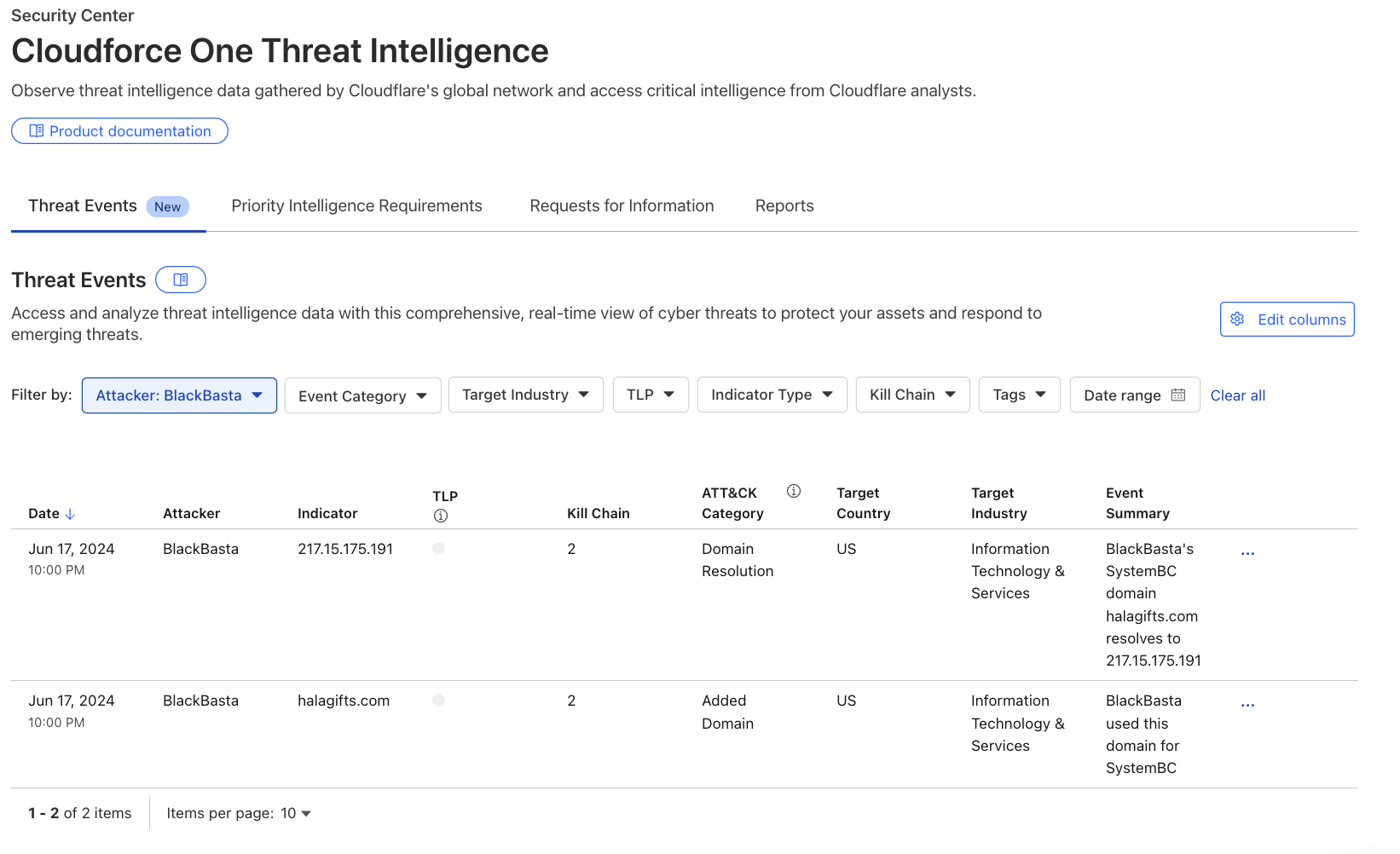
Recently leaked chats of the Black Basta criminal enterprise exposed details about their victims, methods, and infrastructure purchases. Although we can’t confirm whether the leaked chats were manipulated in any way, the infrastructure discussed in the chats was simple to verify. As a result, this threat intelligence is now available as events in the threat events, along with additional unique Cloudflare context. 

Analysts searching for domains, hosts, and file samples used by Black Basta can leverage the threat events to gain valuable insight into this threat actor’s operations. For example, in the threat events UI, a user can filter the “Attacker” column by selecting ‘BlackBasta’ in the dropdown, as shown in the image below. This provides a curated list of verified IP addresses, domains, and file hashes for further investigation. For more detailed information on Cloudflare’s unique visibility into Black Basta threat activity see Black Basta’s blunder: exploiting the gang’s leaked chats.

Why we are publishing threat events

Our customers face a myriad of cyber threats that can disrupt operations and compromise sensitive data. As adversaries become increasingly sophisticated, the need for timely and relevant threat intelligence has never been more critical. This is why we are introducing threat events, which provides deeper insights into these threats. 

The threat events platform aims to fill this gap by offering a more detailed and contextualized view of ongoing threat activity. This feature allows analysts to self-serve and explore incidents through customizable filters, enabling them to identify patterns and respond effectively. By providing access to real-time threat data, we empower organizations to make informed decisions about their security strategies.

To validate the value of our threat events platform, we had a Fortune 20 threat intelligence team put it to the test. They conducted an analysis against 110 other sources, and we ranked as their #1 threat intelligence source. They found us "very much a unicorn" in the threat intelligence space. It’s early days, but the initial feedback confirms that our intelligence is not only unique but also delivering exceptional value to defenders.

What’s next

While Cloudforce One customers now have access to our API and dashboard, allowing for seamless integration of threat intelligence into their existing systems, they will also soon have access to more visualisations and analytics for the threat events in order to better understand and report back on their findings. This upcoming UI will include enhanced visualizations of attacker timelines, campaign overviews, and attack graphs, providing even deeper insights into the threats facing your organization. Moreover, we’ll add the ability to integrate with existing SIEM platforms and share indicators across systems.

Read more about the threat intelligence research our team publishes here or reach out to your account team about how to leverage our new threat events to enhance your cybersecurity posture. 

Watch on Cloudflare TV

❌