In those cases, scammers created a PayPal subscription and then paused it, which triggered PayPal’s genuine “Your automatic payment is no longer active” notification. They also set up a fake subscriber account, likely a Google Workspace mailing list, which automatically forwarded any email it received to all other group members.
Recently, ConsumerWorld.org alerted us that tech support scammers have found a way to manipulate the subject line of PayPal payment notifications.
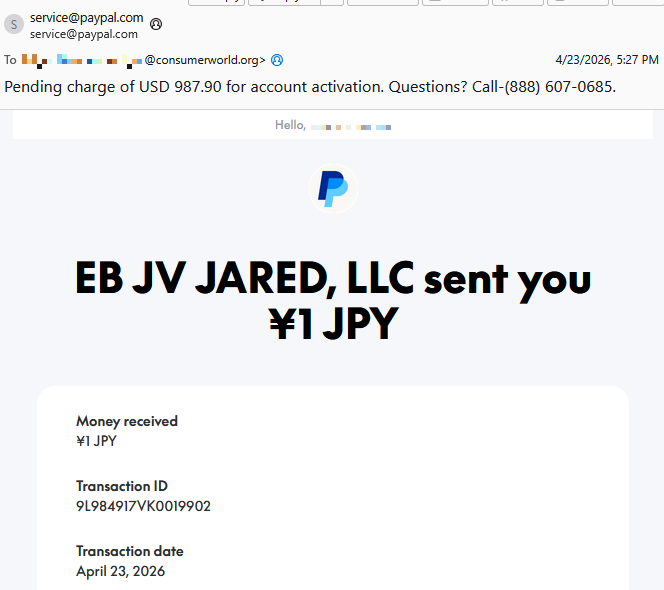
This is a screenshot of the example they sent us.
Screenshot email from PayPal scammers
As you can see, the email comes from service@paypal.com. It wasn’t spoofed, which means it passes standard security checks (DKIM, SPF, DMARC).
While the body of the email says that you received a payment of ¥1 JPY (a whopping $0.0063), the subject line tells a different story:
“Pending charge of USD 987.90 for account activation. Questions? Call-(888) 607-0685.”
As an extra bonus for the scammers, the email contains personalized details—the recipient’s actual name and a real transaction ID.
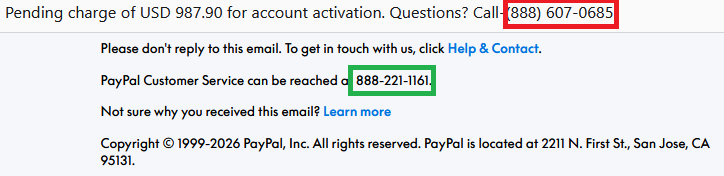
The number in the subject line is not PayPal’s. The legitimate contact number appears inside the email.
“The amount doesn’t match what I see in the email body—that’s weird and scary.”
“I need to call this number immediately to dispute this charge.”
They call the number in the subject line, only to reach tech support scammers.
These scammers pretend to be PayPal support and may try to:
Get you to “verify” payment methods
Collect banking details
Convince you to install remote access tools
Take control of accounts or devices
All of the above
How the subject line is altered is still unclear. Based on PayPal’s documented email behavior, subject lines are typically fixed and not meant to include arbitrary free text or phone numbers. Our findings indicate that the subject line was already weaponized at the point PayPal’s systems signed the email. If someone along the way had rewritten the subject, the dkim=pass header.d=paypal.com result would likely fail.
One possibility is that the scammer abused PayPal’s note or remittance field in a way that surfaces in certain payout templates, including the subject line and HTML <title>, even though normal merchant payment‑received emails don’t allow arbitrary subjects.
The title tag matches the subject line of the email
We have contacted PayPal for comment and will update this post if we hear back.
How to avoid PayPal scams
The best way to stay safe is to stay informed about the tricks scammers use. Learn to spot the red flags that almost always give away scams and phishing emails, and remember:
Use verified, official ways to contact companies. Don’t call numbers listed in suspicious emails or attachments.
Beware of someone wanting to connect to your computer remotely. One of the tech support scammer’s biggest weapons is their ability to connect remotely to their victims. If they do this, they essentially have total access to all of your files and folders.
Report suspicious emails to PayPal.Send the email to phishing@paypal.com to support their investigations.
If you’ve fallen victim to a tech support scam:
Paid the scammer? Contact your bank or card provider and let them know what’s happened. You can also file a complaint with the FTC or your local law enforcement, depending on your region.
Shared a password? Change it anywhere it’s used. Consider using a password manager and enable 2FA for important accounts.
Gave access to your device?Run a full security scan. If scammers had access to your system, they may have planted a backdoor so they can revisit whenever they feel like it. Malwarebytes can remove these and other software left behind by scammers.
Watch your accounts: Keep an eye out for unexpected payments or suspicious charges on your credit cards and bank accounts.
Be wary of suspicious emails. If you’ve fallen for one scam, they may target you again.
Pro tip: Malwarebytes Scam Guard recognized this email as a call back scam. Upload any suspicious text, emails, attachments, and other files to ask for its opinion. It’s really very good at recognizing scams.
Something feel off? Check it before you click.
Malwarebytes Scam Guard helps you analyze suspicious links, texts, and screenshots instantly.
In 2025, the financial cyberthreat landscape continued to evolve. While traditional PC banking malware declined in relative prevalence, this shift was offset by the rapid growth of credential theft by infostealers. Attackers increasingly relied on aggregation and reuse of stolen data, rather than developing entirely new malware capabilities.
To describe the financial threat landscape in 2025, we analyzed anonymized data on malicious activities detected on the devices of Kaspersky security product users and consensually provided to us through the Kaspersky Security Network (KSN), along with publicly available data and data on the dark web.
We analyzed the data for
financial phishing,
banking malware,
infostealers and the dark web.
Key findings
Phishing
Phishing activity in 2025 shifted toward e-commerce (14.17%) and digital services (16.15%), with attackers increasingly tailoring campaigns to regional trends and user behavior, making social engineering more targeted despite reduced focus on traditional banking lures.
Banking malware
Financial PC malware declined in prevalence but remained a persistent threat, with established families continuing to operate, while attackers increasingly prioritize credential access and indirect fraud over deploying complex banking Trojans. To the contrary, mobile banking malware continues growing, as we wrote in detail in our mobile malware report.
Infostealers and the dark web
Infostealers became a central driver of financial cybercrime, fueling a growing dark web economy where stolen credentials, payment data, and full identity profiles are traded at scale, enabling widespread and destructive fraud operations.
Financial phishing
In 2025, online fraudsters continued to lure users to phishing and scam pages that mimicked the websites of popular brands and financial organizations. Attackers leveraged increasingly convincing social engineering techniques and brand impersonation to exploit user trust. Rather than relying solely on volume, campaigns showed greater targeting and contextual adaptation, reflecting a maturation of phishing operations.
The distribution of top phishing categories in 2025 shows a clear shift toward digital platforms that aggregate multiple user activities, with web services (16.15%), online games (14.58%), and online stores (14.17%) leading globally. Compared to 2024, the rise of online games and the decline of social networks and banks indicate that attackers are increasingly targeting environments where users are more likely to take a risk or engage impulsively. Categories such as instant messaging apps and global internet portals remain significant phishing targets, reflecting their role as communication and access hubs that can be exploited for credential harvesting.
TOP 10 categories of organizations mimicked by phishing and scam pages that were blocked on home users’ devices, 2025 (download)
Regional patterns further reinforce the adaptive nature of phishing campaigns, showing that attackers closely align category targeting with local digital habits. For example, online stores dominate heavily in the Middle East.
TOP 10 categories of organizations mimicked by phishing and scam pages that were blocked on home users’ devices in the Middle East, 2025 (download)
Online games and instant messaging platforms feature more prominently in the CIS, suggesting a focus on younger or highly connected user bases.
TOP 10 categories of organizations mimicked by phishing and scam pages that were blocked on home users’ devices in the CIS, 2025 (download)
APAC demonstrates almost equal shares of online games and banks which signifies a combined approach targeting different users.
TOP 10 categories of organizations mimicked by phishing and scam pages that were blocked on home users’ devices in APAC, 2025 (download)
In Africa, a stronger emphasis on banks reflects the continued importance of traditional financial services. Most likely, this is due to the lower security level of the financial institutions in the region.
TOP 10 categories of organizations mimicked by phishing and scam pages that were blocked on home users’ devices in Africa, 2025 (download)
Whereas in LATAM, delivery companies appearing in the top categories indicate attackers exploiting the growth of e-commerce logistics.
TOP 10 categories of organizations mimicked by phishing and scam pages that were blocked on home users’ devices in Latin America, 2025 (download)
Europe presents a more balanced distribution across categories, pointing to diversified attack strategies.
TOP 10 categories of organizations mimicked by phishing and scam pages that were blocked on home users’ devices in Europe, 2025 (download)
Attackers actively localize their tactics to maximize relevance and effectiveness.
The distribution of financial phishing pages by category in 2025 reveals strong regional asymmetries that reflect both user behavior and attacker prioritization.
Globally, online stores dominated (48.45%), followed by banks (26.05%) and payment systems (25.50%). The decline in bank phishing may suggest that these services are becoming increasingly difficult to successfully impersonate, so fraudsters are turning to easier ways to access users’ finances.
However, this balance shifts significantly at the regional level.
In the Middle East, phishing is overwhelmingly concentrated on e-commerce (85.8%), indicating a heavy reliance on online retail lures, whereas in Africa, bank-related phishing leads (53.75%), which may indicate that user account security there is still insufficient. LATAM shows a more balanced distribution but with a higher share of online store targeting (46.30%), while APAC and Europe display a more even spread across all three categories, pointing to diversified attack strategies. These variations suggest that attackers are not operating uniformly but are instead adapting campaigns to regional digital habits, payment ecosystems, and trust patterns – maximizing effectiveness by aligning phishing content with the most commonly used financial services in each market.
Distribution of financial phishing pages by category and region, 2025 (download)
Online shopping scams
The distribution of organizations mimicked by phishing and scam pages in 2025 highlights a clear shift toward globally recognized digital service and e-commerce brands, with attackers prioritizing platforms that have large, active user bases and frequent payment interactions.
Netflix (28.42%) solidified its ranking as the most impersonated brand, followed by Apple (20.55%), Spotify (18.09%), and Amazon (17.85%). This reflects a move away from traditional retail-only targets toward subscription-based and ecosystem-driven services.
TOP 10 online shopping brands mimicked by phishing and scam pages, 2025 (download)
Regionally, this trend varies: Netflix dominates heavily in the Middle East, Apple leads in APAC, while Spotify ranks first across Europe, LATAM, and Africa. Although most of the top platforms are highly popular across different regions, we may suggest that the attackers tailor brand impersonation to regional popularity and user engagement.
Payment system phishing
Phishing campaigns are impersonating multiple payment ecosystems to maximize coverage. While PayPal was the most mimicked in 2024 with 37.53%, its share dropped to 14.10% in 2025. Mastercard, on the contrary, attracted cybercriminals’ attention, its share increasing from 30.54% to 33.45%, while Visa accounted for a significant 20.06% (last year, it wasn’t in the TOP 5), reinforcing the growing focus on widely used banking card networks. The continued presence of American Express (3.87%) and the increasing number of pages mimicking PayPay (11.72%) further highlight attacker experimentation and regional adaptation.
TOP 5 payment systems mimicked by phishing and scam pages, 2025 (download)
Financial malware
In 2025, the decline in users affected by financial PC malware continued. On the one hand, people continue to rely on mobile devices to manage their finances. On the other hand, some of the most prominent malware families that were initially designed as bankers had not used this functionality for years, so we excluded them from these statistics.
Changes in the number of unique users attacked by banking malware, by month, 2023–2025 (download)
Windows systems remained the primary platform targeted by attackers with financial malware. According to Kaspersky Security Bulletin, overall detections included 1,338,357 banking Trojan attacks globally from November 2024 to October 2025, though this number is also declining due to increasing focus on mobile vectors. Desktop threats continued to be distributed via traditional delivery methods like malicious emails, compromised websites, and droppers.
In 2025, Brazilian-origin families such as Grandoreiro (part of the Tetrade group) stood out for their constant activity and global reach. Despite a major law enforcement disruption in early 2024, Grandoreiro remained active in 2025, re-emerging with updated variants and continuing to operate. Other notable actors included Coyote and emerging families like Maverick, which abused WhatsApp for distribution while maintaining fileless techniques and overlaps with established Brazilian banking malware to steal credentials and enable fraudulent transactions on desktop banking platforms. Besides traditional bankers, other Brazilian malware families are worth mentioning, which specifically target relatively new and highly popular regional payment systems. One of the most prominent threats among these is GoPix Trojan focusing on the users of Brazilian Pix payment system. It is also capable of targeting local Boleto payment method, as well as stealing cryptocurrency.
There was also a surge in incidents in 2025 in which fraudsters targeted organizations through electronic document management (EDM) systems, for example, by substituting invoice details to trick victims into transferring funds. The Pure Trojan was most frequently encountered in such attacks. Attackers typically distribute it through targeted emails, using abbreviations of document names, software titles, or other accounting-related keywords in the headers of attached files. Globally in the corporate segment, Pure was detected 896 633 times over 2025, with over 64 thousand users attacked.
Contrary to PC banking malware, mobile banker attacks grew by 1.5 times in 2025 compared to the previous reporting period, which is consistent with their growth in 2024. They also saw a sharp surge in the number of unique installation packages. More statistics and trends on mobile banking malware can be found in our yearly mobile threat report.
Complementing traditional financial malware, infostealers played a significant role in enabling financial crime both on PCs and mobile devices by harvesting credentials, cookies, and autofill data from browsers and applications, which attackers then used for account takeovers or direct banking fraud. Kaspersky analyses pointed to a surge in infostealer detections (up by 59% globally on PCs), fueling credential-based attacks.
Financial cyberthreats on the dark web
The Kaspersky Digital Footprint Intelligence (DFI) team closely monitors infostealer activity on both PC and mobile devices to analyze emerging trends and assess the evolving tactics of cybercriminals.
Fraudsters especially target financial data such as payment cards, cryptocurrency wallets, login credentials and cookies for banking services, as well as documents stored on the victim’s device. The stolen data is collected in log files and shared on dark web resources, where they are bought, sold, or distributed freely and then used for financial fraud.
With access to financial data, fraudsters can gain control of users’ bank accounts and payment cards, and withdraw funds. Compromised accounts and cards are also frequently used in subsequent activities, turning the victims into intermediaries in a fraud scheme.
Compromised accounts
Kaspersky DFI found that in 2025, over one million online banking accounts (these are not Kaspersky product users) served by the world’s 100 largest banks fell victim to infostealers: their credentials were being freely shared on the dark web.
The countries with the highest median number of compromised accounts per bank were India, Spain, and Brazil.
The chart below shows the median number of compromised accounts per bank for the TOP 10 countries.
TOP 10 countries with the highest compromised account median (download)
Compromised payment cards
Seventy-four percent of payment cards that were compromised by infostealer malware, published on dark web resources and identified by the Digital Footprint Intelligence team in 2025, remained valid as of March 2026. This means that attackers could still use the cards that had been stolen months or even years prior.
It should be noted that the number of bank accounts and payment cards known to have been compromised by infostealers in 2025 will continue to rise, because fraudsters do not publish the log files immediately after the compromise but only after a delay of months or even years.
Data breaches
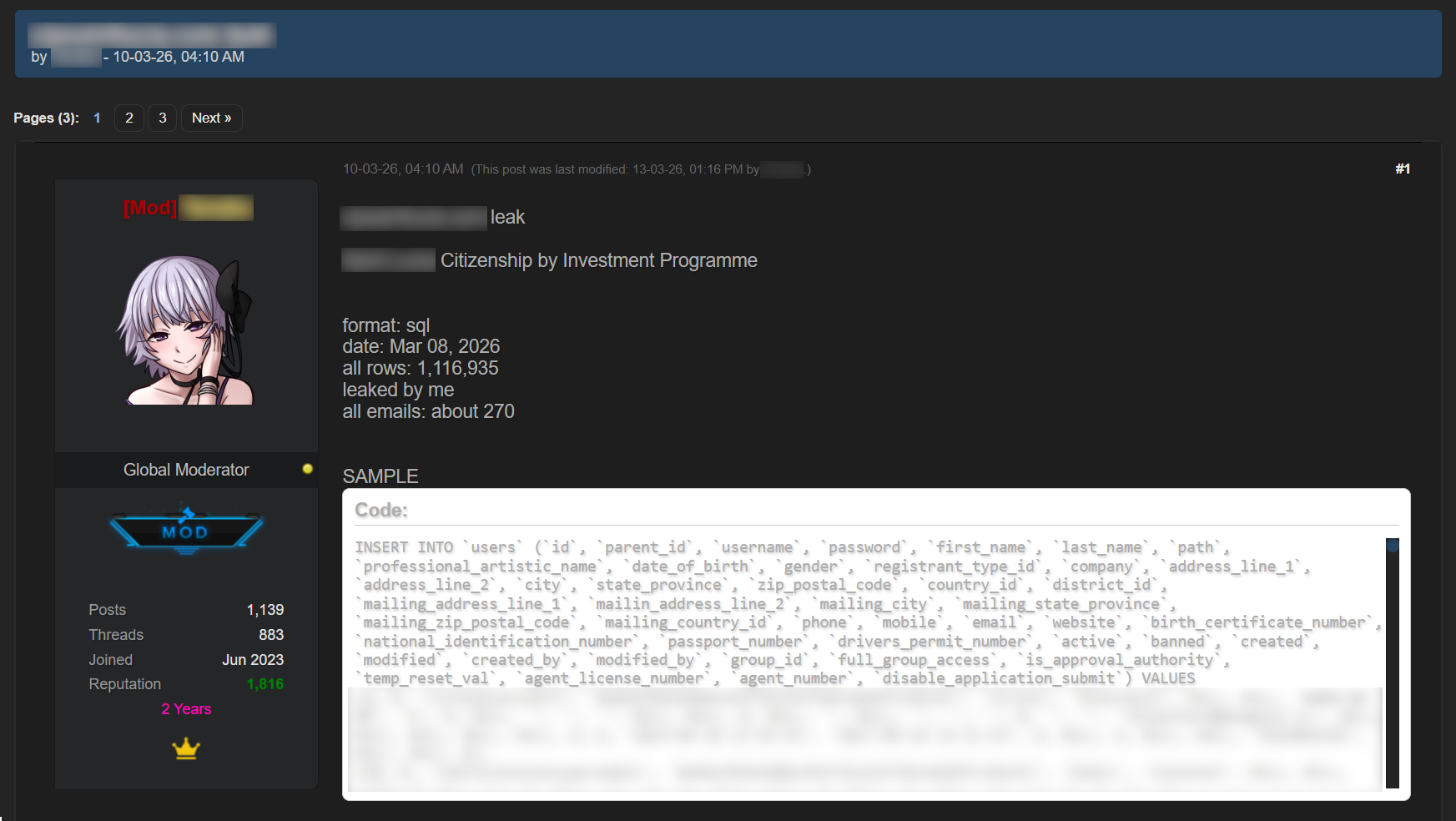
Regardless of the industry in which the target company operates, data breaches often expose users’ financial data, including payment card information, bank account details, transaction histories and other financial information. As a consequence, the compromised databases are sold and distributed on underground resources.
It should be noted that the threat is not limited to the exposure of financial information alone. Various identity documents and even seemingly public data, such as names, phone numbers and email addresses, can become a risk when they are published on the dark web. Such data attracts fraudsters’ attention and can be used in social engineering attacks to gain access to the user’s financial assets.
An example of a post offering a database
Sale of bank accounts and payment cards
The dark web often features services provided by stores that specialize in selling bank accounts and payment cards. Fraudsters typically obtain data for sale from a variety of sources, including infostealer logs and leaked databases, which are first repackaged and then combined.
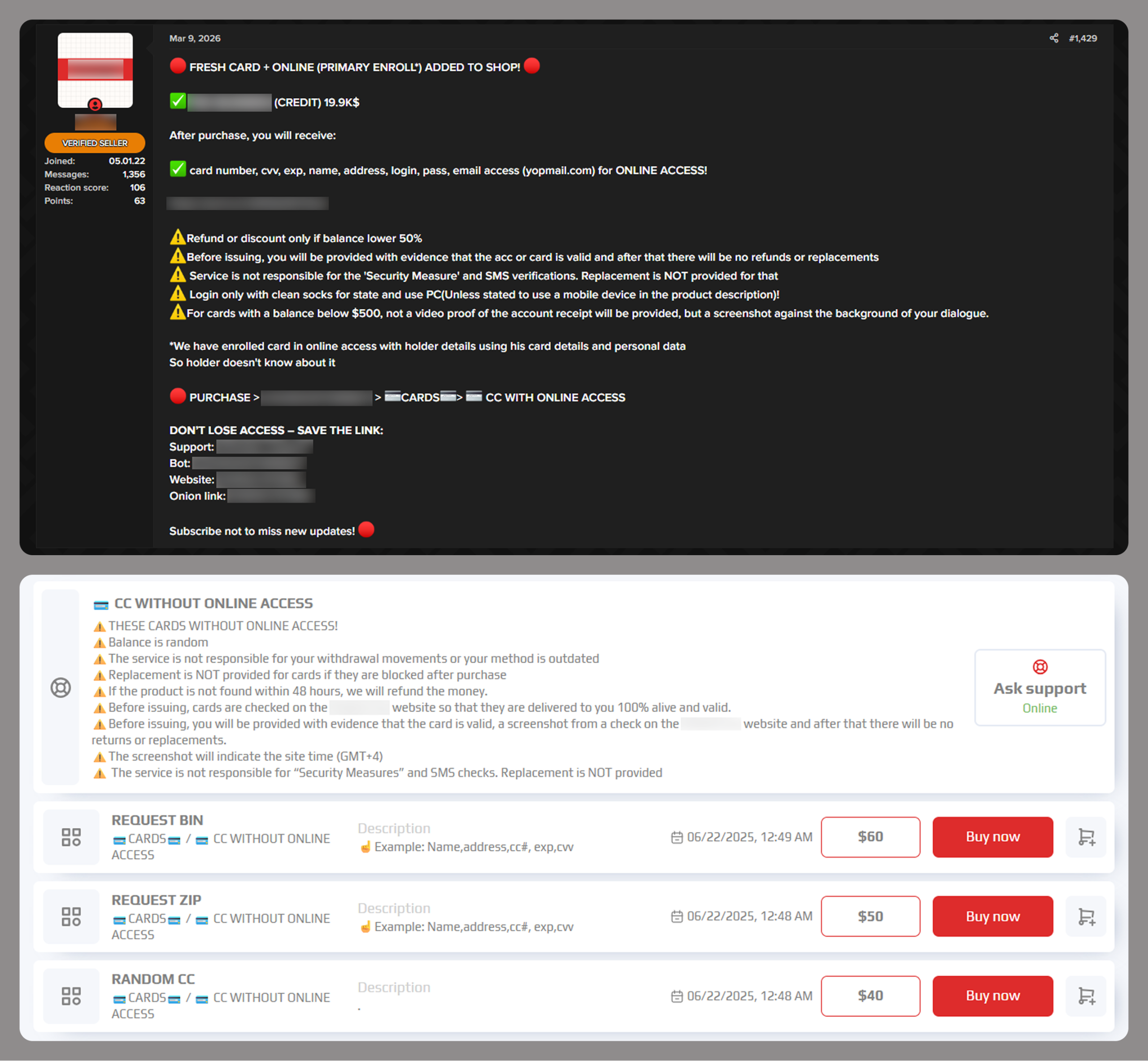
Examples of a post (top) and a site (bottom) offering payment cards
Often, sellers offer complete victim profiles, referred to by fraudsters as “fullz”. These include not only bank accounts or payment cards but also identification documents, dates of birth, residential addresses, and other personal details. A full‑information package is usually more expensive than a payment card or a bank account alone.
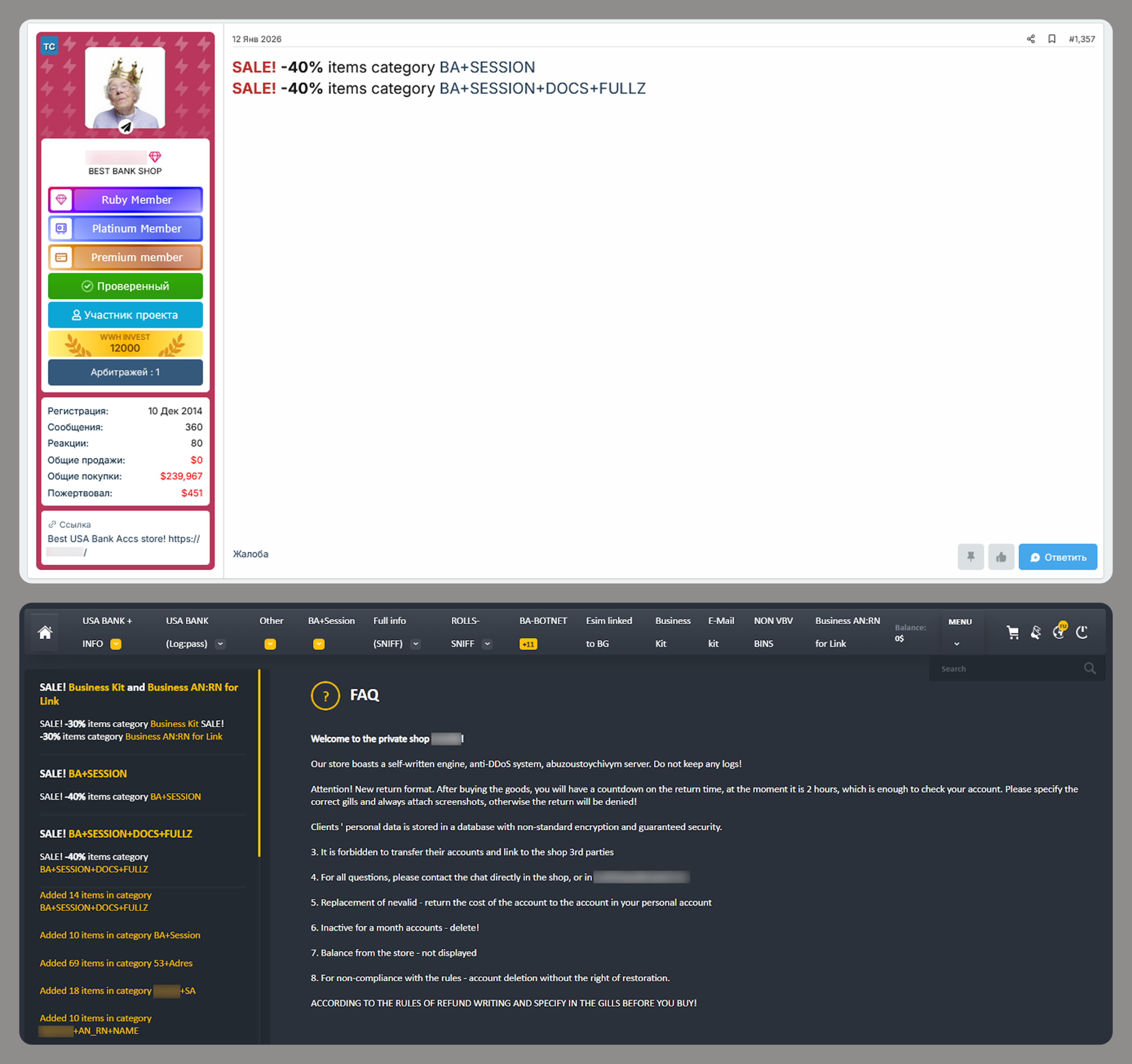
Examples of a post (top) and a site (bottom) offering bank accounts
Compiled databases
Fraudsters exploit various sources, including previously leaked databases, to compile new, thematic ones. Finance- and, in particular, cryptocurrency-related databases, are among the most popular. Compilations aimed at specific user groups, such as the elderly or wealthy people, are also of interest to cybercriminals.
Usually, thematic databases contain personal information about users, such as names, phone numbers, and email addresses. Fraudsters can use this data to launch social engineering attacks.
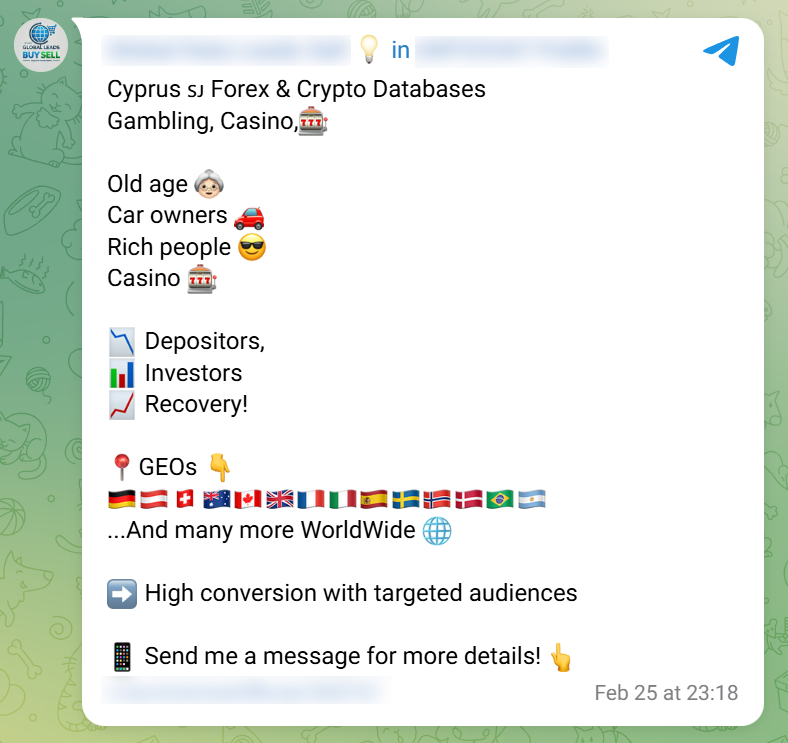
An example of a message offering compiled databases
Creation of phishing websites
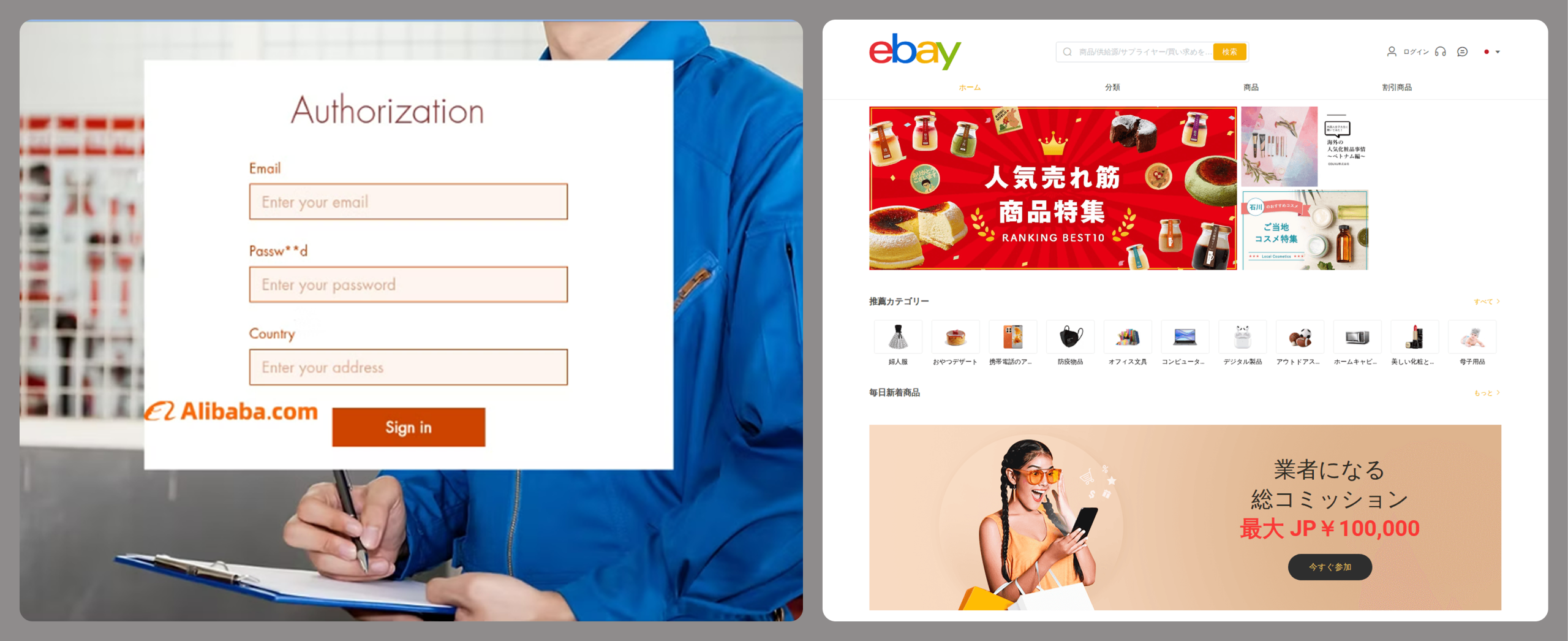
Phishing websites have become a powerful tool for the financial enrichment of fraudsters. Cybercriminals create fraudulent sites that masquerade as legitimate resources of companies operating in various industries. Gambling and retail sites remain among the most popular targets.
In order to obtain personal and financial information from unsuspecting users, adversaries seek out ways to create such phishing websites. Ready-made layouts and website copies are sold on the dark web and advertised as profitable tools. Moreover, fraudsters offer phishing website creation services.
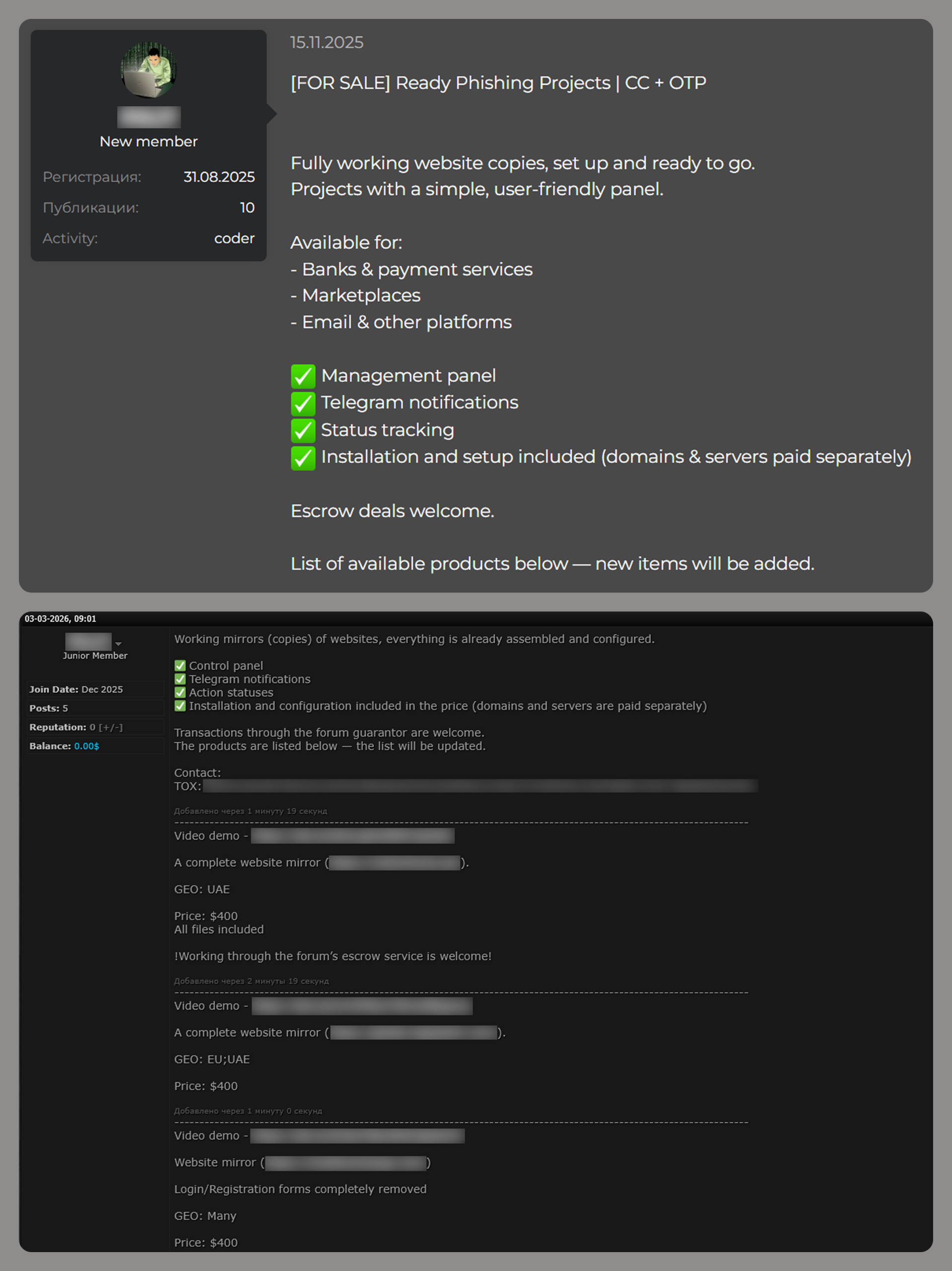
Examples of posts offering creation of phishing websites
Conclusion
The decline of traditional PC banking malware is not an indicator of reduced risk; rather, it highlights a redistribution of attacker effort toward more efficient methods targeting mobile devices, credential theft, and social engineering. Infostealers, in particular, are a force multiplier, enabling widespread compromise at scale.
Looking ahead to 2026, the financial threat landscape is expected to become even more data-driven and automated. Organizations must adapt by focusing on identity protection, real-time monitoring, and cross-channel threat intelligence, while users must remain vigilant against increasingly sophisticated and personalized attack techniques.
PayPal disclosed a six-month data breach that exposed sensitive user data, including Social Security numbers, due to a software error.
PayPal has disclosed a data breach caused by a software bug in its PayPal Working Capital loan app. The flaw exposed sensitive customer information, including customers’ business contact details (name, email, phone number, address), along with Social Security numbers and dates of birth, since July 1, 2025, before it was discovered and fixed.
On December 12, 2025, PayPal discovered that a coding error in its PayPal Working Capital loan application had exposed the personal information of a small number of customers to unauthorized parties between July 1 and December 13, 2025. The company has since addressed the issue and said the notification was not delayed due to any law enforcement investigation.
“On December 12, 2025, PayPal identified that due to an error in its PayPal Working Capital (“PPWC”) loanapplication, the PII of a small number of customers was exposed to unauthorized individuals during thetimeframe of July 1, 2025 to December 13, 2025. PayPal has since rolled back the code change responsiblefor this error, which potentially exposed the PII.” reads the data breach notification. “We have not delayed this notification as a result of any law enforcement investigation”
After detecting the unauthorized access, the company launched an investigation, blocked the intrusion, and reset affected passwords. PayPal also announced the implementation of stronger security checks. The company confirmed that a small number of customers observed unauthorized transactions, which have already been refunded.
The company also offers impacted users two years of complimentary credit monitoring and identity restoration services through Equifax.
Affected users should closely monitor their accounts, transaction history, and free credit reports for suspicious activity and report any fraud immediately. Customers are also encouraged to enroll in complimentary three-bureau credit monitoring through Equifax by June 30, 2026. The company advises reviewing guidance on fraud alerts, free credit reports, and FTC resources to better protect personal information.
In January 2023, PayPal announced that 34942 customers’ accounts had been compromised between December 6 and December 8, 2022. The company added that the unauthorized access was the result of credential stuffing attacks and that its systems were not breached.
PayPal disclosed a software error in its Working Capital platform that exposed sensitive customer data, including Social Security numbers, for months in 2025.
AI tool Vercel was abused by cybercriminals to create a Malwarebytes lookalike website.
Cybercriminals no longer need design or coding skills to create a convincing fake brand site. All they need is a domain name and an AI website builder. In minutes, they can clone a site’s look and feel, plug in payment or credential-stealing flows, and start luring victims through search, social media, and spam.
One side effect of being an established and trusted brand is that you attract copycats who want a slice of that trust without doing any of the work. Cybercriminals have always known it is much easier to trick users by impersonating something they already recognize than by inventing something new—and developments in AI have made it trivial for scammers to create convincing fake sites.
Registering a plausible-looking domain is cheap and fast, especially through registrars and resellers that do little or no upfront vetting. Once attackers have a name that looks close enough to the real thing, they can use AI-powered tools to copy layouts, colors, and branding elements, and generate product pages, sign-up flows, and FAQs that look “on brand.”
Over a three‑month period leading into the 2025 shopping season, researchers observed more than 18,000 holiday‑themed domains with lures like “Christmas,” “Black Friday,” and “Flash Sale,” with at least 750 confirmed as malicious and many more still under investigation. In the same window, about 19,000 additional domains were registered explicitly to impersonate major retail brands, nearly 3,000 of which were already hosting phishing pages or fraudulent storefronts.
These sites are used for everything from credential harvesting and payment fraud to malware delivery disguised as “order trackers” or “security updates.”
Attackers then boost visibility using SEO poisoning, ad abuse, and comment spam, nudging their lookalike sites into search results and promoting them in social feeds right next to the legitimate ones. From a user’s perspective, especially on mobile without the hover function, that fake site can be only a typo or a tap away.
When the impersonation hits home
A recent example shows how low the barrier to entry has become.
We were alerted to a site at installmalwarebytes[.]org that masqueraded from logo to layout as a genuine Malwarebytes site.
Close inspection revealed that the HTML carried a meta tag value pointing to v0 by Vercel, an AI-assisted app and website builder.
The tool lets users paste an existing URL into a prompt to automatically recreate its layout, styling, and structure—producing a near‑perfect clone of a site in very little time.
The history of the imposter domain tells an incremental evolution into abuse.
Registered in 2019, the site did not initially contain any Malwarebytes branding. In 2022, the operator began layering in Malwarebytes branding while publishing Indonesian‑language security content. This likely helped with search reputation while normalizing the brand look to visitors. Later, the site went blank, with no public archive records for 2025, only to resurface as a full-on clone backed by AI‑assisted tooling.
Traffic did not arrive by accident. Links to the site appeared in comment spam and injected links on unrelated websites, giving users the impression of organic references and driving them toward the fake download pages.
Payment flows were equally opaque. The fake site used PayPal for payments, but the integration hid the merchant’s name and logo from the user-facing confirmation screens, leaving only the buyer’s own details visible. That allowed the criminals to accept money while revealing as little about themselves as possible.
Behind the scenes, historical registration data pointed to an origin in India and to a hosting IP (209.99.40[.]222) associated with domain parking and other dubious uses rather than normal production hosting.
Combined with the AI‑powered cloning and the evasive payment configuration, it painted a picture of low‑effort, high‑confidence fraud.
AI website builders as force multipliers
The installmalwarebytes[.]org case is not an isolated misuse of AI‑assisted builders. It fits into a broader pattern of attackers using generative tools to create and host phishing sites at scale.
Threat intelligence teams have documented abuse of Vercel’s v0 platform to generate fully functional phishing pages that impersonate sign‑in portals for a variety of brands, including identity providers and cloud services, all from simple text prompts. Once the AI produces a clone, criminals can tweak a few links to point to their own credential‑stealing backends and go live in minutes.
Research into AI’s role in modern phishing shows that attackers are leaning heavily on website generators, writing assistants, and chatbots to streamline the entire kill chain—from crafting persuasive copy in multiple languages to spinning up responsive pages that render cleanly across devices. One analysis of AI‑assisted phishing campaigns found that roughly 40% of observed abuse involved website generation services, 30% involved AI writing tools, and about 11% leveraged chatbots, often in combination. This stack lets even low‑skilled actors produce professional-looking scams that used to require specialized skills or paid kits.
Growth first, guardrails later
The core problem is not that AI can build websites. It’s that the incentives around AI platform development are skewed. Vendors are under intense pressure to ship new capabilities, grow user bases, and capture market share, and that pressure often runs ahead of serious investment in abuse prevention.
As Malwarebytes General Manager Mark Beare put it:
“AI-powered website builders like Lovable and Vercel have dramatically lowered the barrier for launching polished sites in minutes. While these platforms include baseline security controls, their core focus is speed, ease of use, and growth—not preventing brand impersonation at scale. That imbalance creates an opportunity for bad actors to move faster than defenses, spinning up convincing fake brands before victims or companies can react.”
Site generators allow cloned branding of well‑known companies with no verification, publishing flows skip identity checks, and moderation either fails quietly or only reacts after an abuse report. Some builders let anyone spin up and publish a site without even confirming an email address, making it easy to burn through accounts as soon as one is flagged or taken down.
To be fair, there are signs that some providers are starting to respond by blocking specific phishing campaigns after disclosure or by adding limited brand-protection controls. But these are often reactive fixes applied after the damage is done.
Meanwhile, attackers can move to open‑source clones or lightly modified forks of the same tools hosted elsewhere, where there may be no meaningful content moderation at all.
In practice, the net effect is that AI companies benefit from the growth and experimentation that comes with permissive tooling, while the consequences is left to victims and defenders.
We have blocked the domain in our web protection module and requested a domain and vendor takedown.
How to stay safe
End users cannot fix misaligned AI incentives, but they can make life harder for brand impersonators. Even when a cloned website looks convincing, there are red flags to watch for:
Before completing any payment, always review the “Pay to” details or transaction summary. If no merchant is named, back out and treat the site as suspicious.
Do not follow links posted in comments, on social media, or unsolicited emails to buy a product. Always follow a verified and trusted method to reach the vendor.
If you come across a fake Malwarebytes website, please let us know.
We don’t just report on threats—we help safeguard your entire digital identity
After an investigation by BleepingComputer, PayPal closed a loophole that allowed scammers to send emails from the legitimate service@paypal.com email address.
Following reports from people who received emails claiming an automatic payment had been cancelled, BleepingComputer found that cybercriminals were abusing a PayPal feature that allows merchants to pause a customer’s subscription.
The scammers created a PayPal subscription and then paused it, which triggers PayPal’s genuine “Your automatic payment is no longer active” notification to the subscriber. They also set up a fake subscriber account, likely a Google Workspace mailing list, which automatically forwards any email it receives to all other group members.
This allowed the criminals to use a similar method to one we’ve described before, but this time with the legitimate service@paypal.com address as the sender, bypassing email filters and a first casual check by the recipient.
Image courtesy of BleepingComputer
“Your automatic payment is no longer active
You’ll need to contact Sony U.S.A. for more details or to reactivate your automatic payments. Here are the details:”
BleepingComputer says there are slight variations in formating and phone numbers to call, but in essence they are all based on this method.
To create urgency, the scammers made the emails look as though the target had been charged for some high-end, expensive device. They also added a fake “PayPal Support” phone number, encouraging targets to call in case if they wanted to cancel the payment of had questions
In this type of tech support scam, the target calls the listed number, and the “support agent” on the other end asks to remotely log in to their computer to check for supposed viruses. They might run a short program to open command prompts and folders, just to scare and distract the victim. Then they’ll ask to install another tool to “fix” things, which will search the computer for anything they can turn into money. Others will sell you fake protection software and bill you for their services. Either way, the result is the same: the victim loses money.
PayPal contacted BleepingComputer to let them know they were closing the loophole:
“We are actively mitigating this matter, and encourage people to always be vigilant online and mindful of unexpected messages. If customers suspect they are a target of a scam, we recommend they contact Customer Support directly through the PayPal app or our Contact page for assistance.”
How to stay safe
The best way to stay safe is to stay informed about the tricks scammers use. Learn to spot the red flags that almost always give away scams and phishing emails, and remember:
Use verified, official ways to contact companies. Don’t call numbers listed in suspicious emails or attachments.
Beware of someone wanting to connect to your computer remotely. One of the tech support scammer’s biggest weapons is their ability to connect remotely to their victims. If they do this, they essentially have total access to all of your files and folders.
If you’ve already fallen victim to a tech support scam:
Paid the scammer? Contact your credit card company or bank and let them know what’s happened. You may also want to file a complaint with the FTC or contact your local law enforcement, depending on your region.
Shared a password? If you shared your password with a scammer, change it everywhere it’s used. Consider using a password manager and enable 2FA for important accounts.
Scan your system: If scammers had access to your system, they may have planted a backdoor so they can revisit whenever they feel like it. Malwarebytes can remove these and other software left behind by scammers.
Watch your accounts: Keep an eye out for unexpected payments or suspicious charges on your credit cards and bank accounts.
Be wary of suspicious emails. If you’ve fallen for one scam, they may target you again.
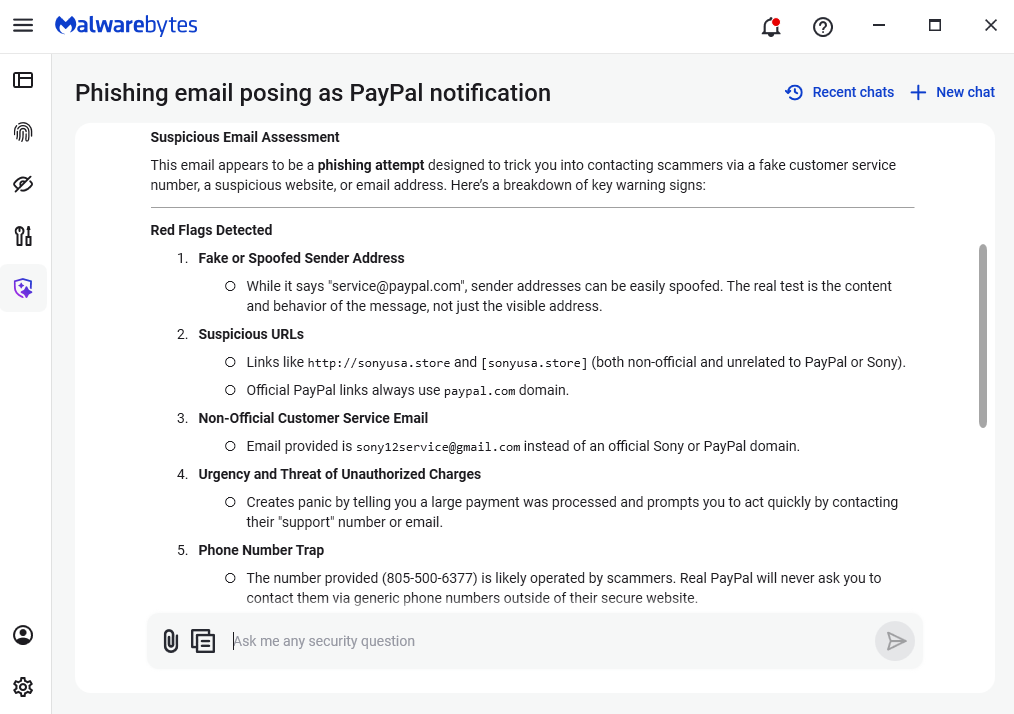
Pro tip: Malwarebytes Scam Guard recognized this email as a scam. Upload any suspicious text, emails, attachments and other files to ask for its opinion. It’s really very good at recognizing scams. Here’s what it reported back for this particular scam:
“Suspicious Email Assessment
This email appears to be a phishing attempt designed to trick you into contacting scammers via a fake customer service number, a suspicious website, or email address. Here’s a breakdown of key warning signs:
Red Flags Detected
Fake or Spoofed Sender Address
While it says “service@paypal.com”, sender addresses can be easily spoofed. The real test is the content and behavior of the message, not just the visible address.
Suspicious URLs
Links like http://sonyusa.store and [sonyusa.store] (both non-official and unrelated to PayPal or Sony).
Official PayPal links always use paypal.com domain.
Non-Official Customer Service Email
Email provided is sony12service@gmail.com instead of an official Sony or PayPal domain.
Urgency and Threat of Unauthorized Charges
Creates panic by telling you a large payment was processed and prompts you to act quickly by contacting their “support” number or email.
Phone Number Trap
The number provided (805-500-6377) is likely operated by scammers. Real PayPal will never ask you to contact them via generic phone numbers outside of their secure website.
Unusual Formatting and Grammar
Awkward phrasing and formatting errors are common in scams.”
We don’t just report on scams—we help detect them
Cybersecurity risks should never spread beyond a headline. If something looks dodgy to you, check if it’s a scam using Malwarebytes Scam Guard, a feature of our mobile protection products. Submit a screenshot, paste suspicious content, or share a text or phone number, and we’ll tell you if it’s a scam or legit. Download Malwarebytes Mobile Security for iOS or Android and try it today!
A 22-year-old Oregon man has been arrested on suspicion of operating “Rapper Bot,” a massive botnet used to power a service for launching distributed denial-of-service (DDoS) attacks against targets — including a March 2025 DDoS that knocked Twitter/X offline. The Justice Department asserts the suspect and an unidentified co-conspirator rented out the botnet to online extortionists, and tried to stay off the radar of law enforcement by ensuring that their botnet was never pointed at KrebsOnSecurity.
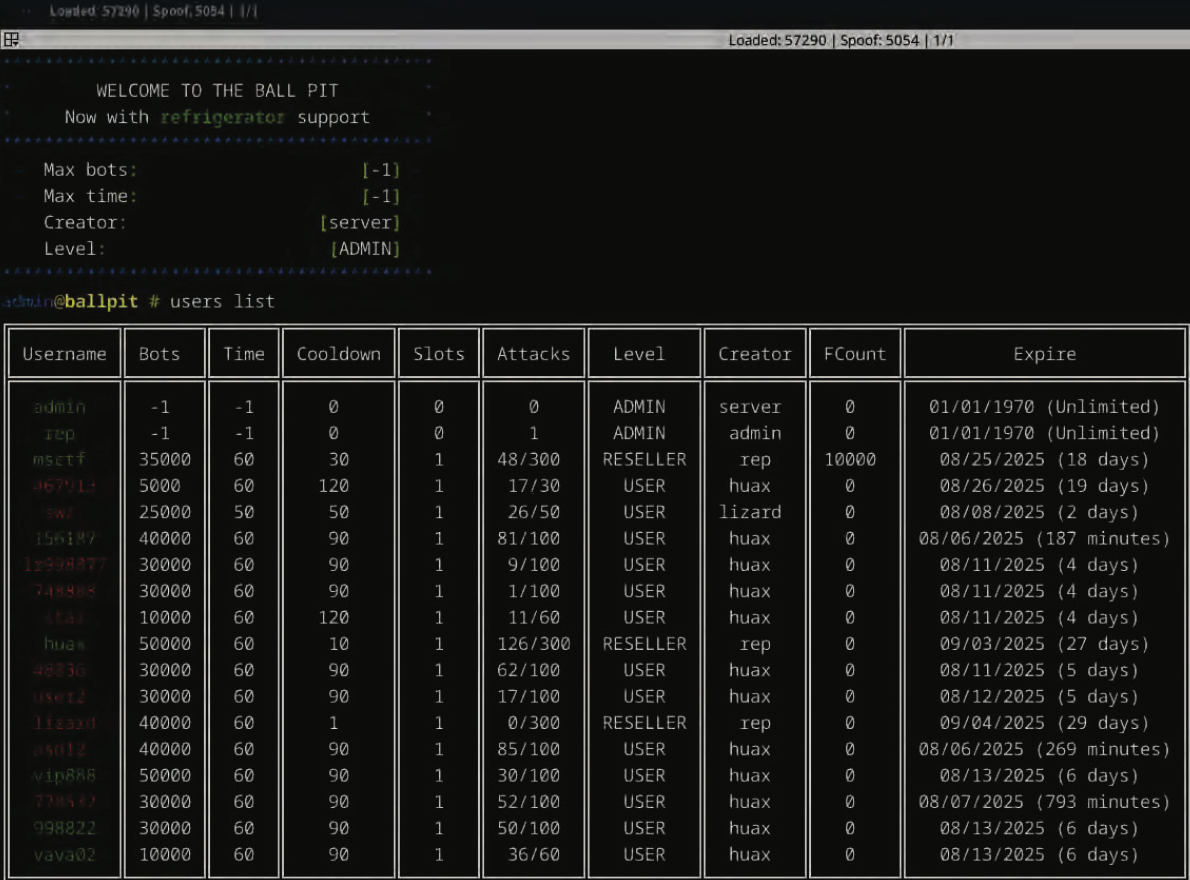
The control panel for the Rapper Bot botnet greets users with the message “Welcome to the Ball Pit, Now with refrigerator support,” an apparent reference to a handful of IoT-enabled refrigerators that were enslaved in their DDoS botnet.
On August 6, 2025, federal agents arrested Ethan J. Foltz of Springfield, Ore. on suspicion of operating Rapper Bot, a globally dispersed collection of tens of thousands of hacked Internet of Things (IoT) devices.
The complaint against Foltz explains the attacks usually clocked in at more than two terabits of junk data per second (a terabit is one trillion bits of data), which is more than enough traffic to cause serious problems for all but the most well-defended targets. The government says Rapper Bot consistently launched attacks that were “hundreds of times larger than the expected capacity of a typical server located in a data center,” and that some of its biggest attacks exceeded six terabits per second.
Indeed, Rapper Bot was reportedly responsible for the March 10, 2025 attack that caused intermittent outages on Twitter/X. The government says Rapper Bot’s most lucrative and frequent customers were involved in extorting online businesses — including numerous gambling operations based in China.
The criminal complaint was written by Elliott Peterson, an investigator with the Defense Criminal Investigative Service (DCIS), the criminal investigative division of the Department of Defense (DoD) Office of Inspector General. The complaint notes the DCIS got involved because several Internet addresses maintained by the DoD were the target of Rapper Bot attacks.
Peterson said he tracked Rapper Bot to Foltz after a subpoena to an ISP in Arizona that was hosting one of the botnet’s control servers showed the account was paid for via PayPal. More legal process to PayPal revealed Foltz’s Gmail account and previously used IP addresses. A subpoena to Google showed the defendant searched security blogs constantly for news about Rapper Bot, and for updates about competing DDoS-for-hire botnets.
According to the complaint, after having a search warrant served on his residence the defendant admitted to building and operating Rapper Bot, sharing the profits 50/50 with a person he claimed to know only by the hacker handle “Slaykings.” Foltz also shared with investigators the logs from his Telegram chats, wherein Foltz and Slaykings discussed how best to stay off the radar of law enforcement investigators while their competitors were getting busted.
Specifically, the two hackers chatted about a May 20 attack against KrebsOnSecurity.com that clocked in at more than 6.3 terabits of data per second. The brief attack was notable because at the time it was the largest DDoS that Google had ever mitigated (KrebsOnSecurity sits behind the protection of Project Shield, a free DDoS defense service that Google provides to websites offering news, human rights, and election-related content).
The May 2025 DDoS was launched by an IoT botnet called Aisuru, which I discovered was operated by a 21-year-old man in Brazil named Kaike Southier Leite. This individual was more commonly known online as “Forky,” and Forky told me he wasn’t afraid of me or U.S. federal investigators. Nevertheless, the complaint against Foltz notes that Forky’s botnet seemed to diminish in size and firepower at the same time that Rapper Bot’s infection numbers were on the upswing.
“Both FOLTZ and Slaykings were very dismissive of attention seeking activities, the most extreme of which, in their view, was to launch DDoS attacks against the website of the prominent cyber security journalist Brian Krebs,” Peterson wrote in the criminal complaint.
“You see, they’ll get themselves [expletive],” Slaykings wrote in response to Foltz’s comments about Forky and Aisuru bringing too much heat on themselves.
“Prob cuz [redacted] hit krebs,” Foltz wrote in reply.
“Going against Krebs isn’t a good move,” Slaykings concurred. “It isn’t about being a [expletive] or afraid, you just get a lot of problems for zero money. Childish, but good. Let them die.”
“Ye, it’s good tho, they will die,” Foltz replied.
The government states that just prior to Foltz’s arrest, Rapper Bot had enslaved an estimated 65,000 devices globally. That may sound like a lot, but the complaint notes the defendants weren’t interested in making headlines for building the world’s largest or most powerful botnet.
Quite the contrary: The complaint asserts that the accused took care to maintain their botnet in a “Goldilocks” size — ensuring that “the number of devices afforded powerful attacks while still being manageable to control and, in the hopes of Foltz and his partners, small enough to not be detected.”
The complaint states that several days later, Foltz and Slaykings returned to discussing what that they expected to befall their rival group, with Slaykings stating, “Krebs is very revenge. He won’t stop until they are [expletive] to the bone.”
“Surprised they have any bots left,” Foltz answered.
“Krebs is not the one you want to have on your back. Not because he is scary or something, just because he will not give up UNTIL you are [expletive] [expletive]. Proved it with Mirai and many other cases.”
[Unknown expletives aside, that may well be the highest compliment I’ve ever been paid by a cybercriminal. I might even have part of that quote made into a t-shirt or mug or something. It’s also nice that they didn’t let any of their customers attack my site — if even only out of a paranoid sense of self-preservation.]
Foltz admitted to wiping the user and attack logs for the botnet approximately once a week, so investigators were unable to tally the total number of attacks, customers and targets of this vast crime machine. But the data that was still available showed that from April 2025 to early August, Rapper Bot conducted over 370,000 attacks, targeting 18,000 unique victims across 1,000 networks, with the bulk of victims residing in China, Japan, the United States, Ireland and Hong Kong (in that order).
The complaint says Foltz and his partner did not allow most customers to launch attacks that were more than 60 seconds in duration — another way they tried to keep public attention to the botnet at a minimum. However, the government says the proprietors also had special arrangements with certain high-paying clients that allowed much larger and longer attacks.
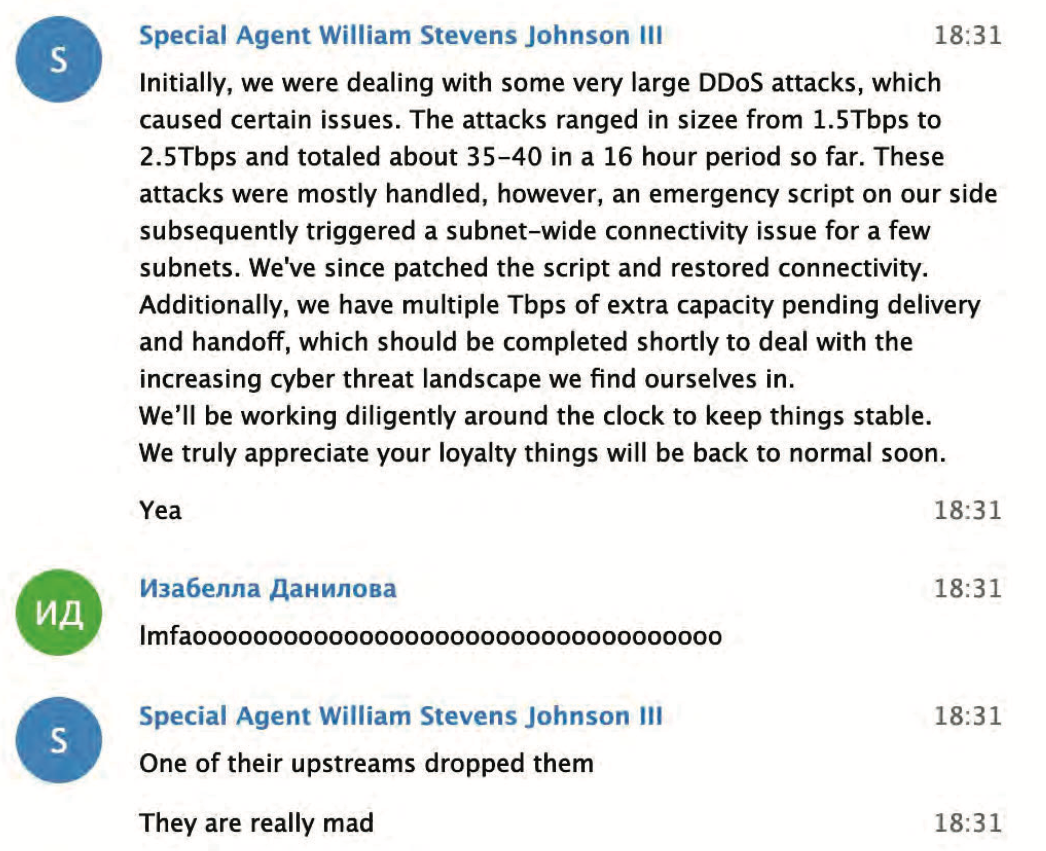
The accused and his alleged partner made light of this blog post about the fallout from one of their botnet attacks.
Most people who have never been on the receiving end of a monster DDoS attack have no idea of the cost and disruption that such sieges can bring. The DCIS’s Peterson wrote that he was able to test the botnet’s capabilities while interviewing Foltz, and that found that “if this had been a server upon which I was running a website, using services such as load balancers, and paying for both outgoing and incoming data, at estimated industry average rates the attack (2+ Terabits per second times 30 seconds) might have cost the victim anywhere from $500 to $10,000.”
“DDoS attacks at this scale often expose victims to devastating financial impact, and a potential alternative, network engineering solutions that mitigate the expected attacks such as overprovisioning, i.e. increasing potential Internet capacity, or DDoS defense technologies, can themselves be prohibitively expensive,” the complaint continues. “This ‘rock and a hard place’ reality for many victims can leave them acutely exposed to extortion demands – ‘pay X dollars and the DDoS attacks stop’.”
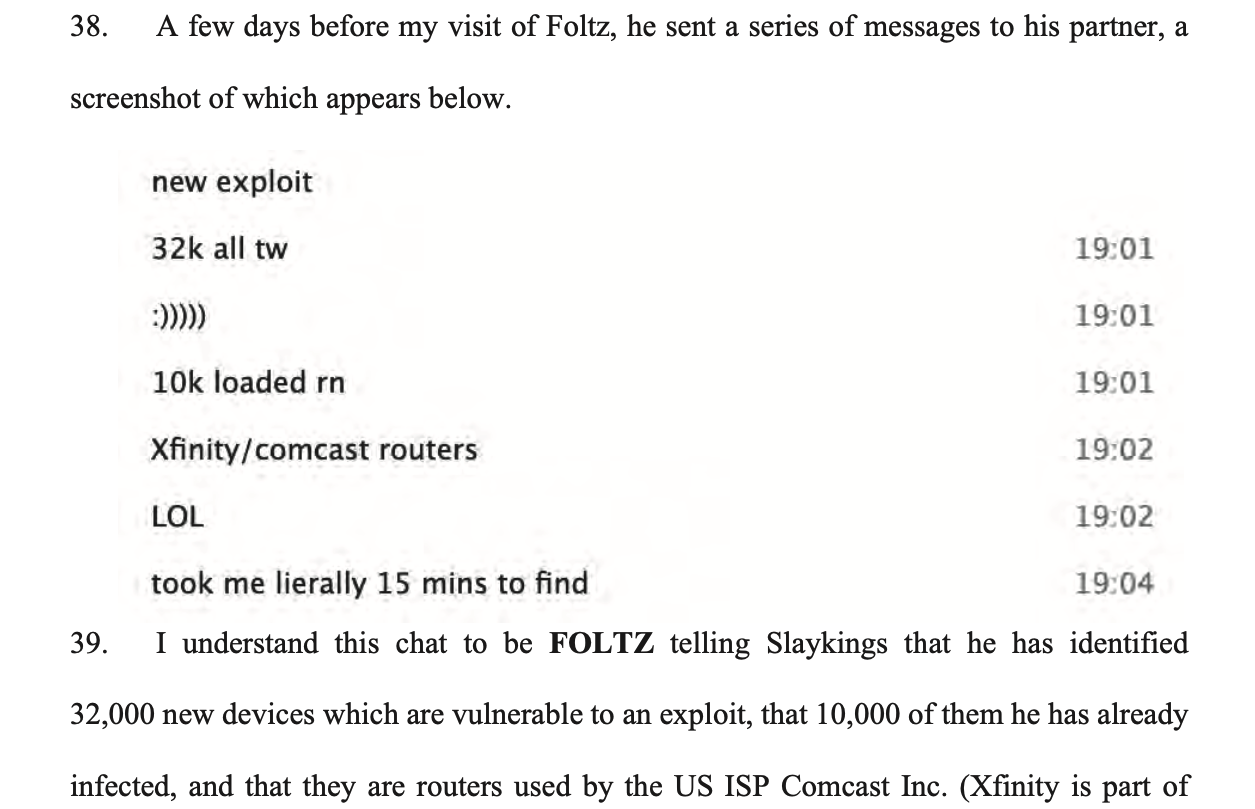
The Telegram chat records show that the day before Peterson and other federal agents raided Foltz’s residence, Foltz allegedly told his partner he’d found 32,000 new devices that were vulnerable to a previously unknown exploit.
Foltz and Slaykings discussing the discovery of an IoT vulnerability that will give them 32,000 new devices.
Shortly before the search warrant was served on his residence, Foltz allegedly told his partner that “Once again we have the biggest botnet in the community.” The following day, Foltz told his partner that it was going to be a great day — the biggest so far in terms of income generated by Rapper Bot.
“I sat next to Foltz while the messages poured in — promises of $800, then $1,000, the proceeds ticking up as the day went on,” Peterson wrote. “Noticing a change in Foltz’ behavior and concerned that Foltz was making changes to the botnet configuration in real time, Slaykings asked him ‘What’s up?’ Foltz deftly typed out some quick responses. Reassured by Foltz’ answer, Slaykings responded, ‘Ok, I’m the paranoid one.”
The case is being prosecuted by Assistant U.S. Attorney Adam Alexander in the District of Alaska (at least some of the devices found to be infected with Rapper Bot were located there, and it is where Peterson is stationed). Foltz faces one count of aiding and abetting computer intrusions. If convicted, he faces a maximum penalty of 10 years in prison, although a federal judge is unlikely to award anywhere near that kind of sentence for a first-time conviction.

 Entrar