Visualização de leitura

16-30 April 2026 Cyber Attacks Timeline

In the second timeline of April 2026 I collected 108 events, corresponding to an average of 7.2 events per day, a number that confirms a growing trend, driven by the increasing number of supply chain attacks, compared to the previous timeline, where I collected 94 events (6.27 events/day).

Canvas Breach Disrupts Schools & Colleges Nationwide

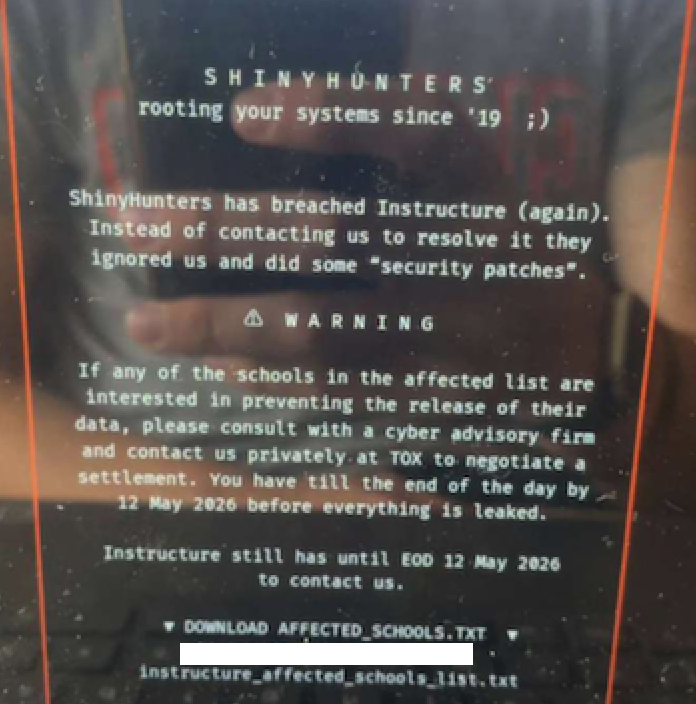
An ongoing data extortion attack targeting the widely-used education technology platform Canvas disrupted classes and coursework at school districts and universities across the United States today, after a cybercrime group defaced the service’s login page with a ransom demand that threatened to leak data from 275 million students and faculty across nearly 9,000 educational institutions.

A screenshot shared by a reader showing the extortion message that was shown on the Canvas login page today.

Canvas parent firm Instructure responded to today’s defacement attacks by disabling the platform, which is used by thousands of schools, universities and businesses to manage coursework and assignments, and to communicate with students.

Instructure acknowledged a data breach earlier this week, after the cybercrime group ShinyHunters claimed responsibility and said they would leak data on tens of millions of students and faculty unless paid a ransom. The stated deadline for payment was initially set at May 6, but it was later pushed back to May 12.

In a statement on May 6, Instructure said the investigation so far shows the stolen information includes “certain identifying information of users at affected institutions, such as names, email addresses, and student ID numbers, as well as as messages among users.” The company said it found no evidence the breached data included more sensitive information, such as passwords, dates of birth, government identifiers or financial information.

The May 6 update stated that Canvas was fully operational, and that Instructure was not seeing any ongoing unauthorized activity on their platform. “At this stage, we believe the incident has been contained,” Instructure wrote.

However, by mid-day on Thursday, May 7, students and faculty at dozens of schools and universities were flooding social media sites with comments saying that a ransom demand from ShinyHunters had replaced the usual Canvas login page. Instructure responded by pulling Canvas offline and replacing the portal with the message, “Canvas is currently undergoing scheduled maintenance. Check back soon.”

“We anticipate being up soon, and will provide updates as soon as possible,” reads the current message on Instructure’s status page.

While the data stolen by ShinyHunters may or may not contain particularly sensitive information (ShinyHunters claims it includes several billion private messages among students and teachers, as well as names, phone numbers and email addresses), this attack could hardly have come at a worse time for Instructure: Many of the affected schools and universities are in the middle of final exams, and a prolonged outage could be highly damaging for the company.

The extortion message that greeted countless Canvas users today advised the affected schools to negotiate their own ransom payments to prevent the publication of their data — regardless of whether Instructure decides to pay.

“ShinyHunters has breached Instructure (again),” the extortion message read. “Instead of contacting us to resolve it they ignored us and did some ‘security patches.'”

A source close to the investigation who was not authorized to speak to the press told KrebsOnSecurity that a number of universities have already approached the cybercrime group about paying. The same source also pointed out that the ShinyHunters data leak blog no longer lists Instructure among its current extortion victims, and that the samples of data stolen from Canvas customers were removed as well. Data extortion groups like ShinyHunters will typically only remove victims from their leak sites after receiving an extortion payment or after a victim agrees to negotiate.

Dipan Mann, founder and CEO of the security firm Cloudskope, slammed Instructure for referring to today’s outage as a “scheduled maintenance” event on its status page. Mann said Shiny Hunters first demonstrated they’d breached Instructure on May 1, prompting Instructure’s Chief Information Security Officer Steve Proud to declare the following day that the incident had been contained. But Mann said today’s attack is at least the third time in the past eight months that Instructure has been breached by ShinyHunters.

In a blog post today, Mann noted that in September 2025, ShinyHunters released thousands of internal University of Pennsylvania files — donor records, internal memos, and other confidential materials — through what the Daily Pennsylvanian and other outlets later determined was, in part, a Canvas/Instructure-mediated access path.

“Penn was the named victim,” Mann wrote. “Instructure was the mechanism. The incident was treated as a Penn-specific story by most of the national press and quietly handled by Instructure as a customer-specific matter. That framing was wrong then. It is dramatically more wrong in light of the May 2026 events, which now look like the planned escalation of an attack pattern that ShinyHunters had been working against Instructure’s environment for at least eight months prior. The September 2025 Penn breach was the proof of concept. The May 1, 2026 incident was the production run. The May 7, 2026 recompromise was ShinyHunters demonstrating publicly that the May 2 ‘containment’ did not happen.”

In February, a ShinyHunters spokesperson told The Daily Pennsylvanian that Penn failed to pay a $1 million ransom demand. On March 5, ShinyHunters published 461 megabytes worth of data stolen from Penn, including thousands of files such as donor records and internal memos.

ShinyHunters is a prolific and fluid cybercriminal group that specializes in data theft and extortion. They typically gain access to companies through voice phishing and social engineering attacks that often involve impersonating IT personnel or other trusted members of a targeted organization.

Last month, ShinyHunters relieved the home security giant ADT of personal information on 5.5 million customers. The extortion group told BleepingComputer they breached the company by compromising an employee’s Okta single sign-on account in a voice phishing attack that enabled access to ADT’s Salesforce instance. BleepingComputer says ShinyHunters recently has taken credit for a number of extortion attacks against high-profile organizations, including Medtronic, Rockstar Games, McGraw Hill, 7-Eleven and the cruise line operator Carnival.

The attack on Canvas customers is just one of several major cybercrime campaigns being launched by ShinyHunters at the moment, said Charles Carmakal, chief technology officer at the Google-owned Mandiant Consulting. Carmakal declined to comment specifically on the Canvas breach, but said “there are multiple concurrent and discrete ShinyHunters intrusion and extortion campaigns happening right now.”

Cloudskope’s Mann said what happens next depends largely on whether Instructure’s customers — the universities, K-12 districts, and education ministries paying for Canvas — choose to apply pressure or absorb the breach quietly.

“The history of education-vendor incidents suggests the path of least resistance is the second one,” he concluded.

Ransom & Dark Web Issues Week 1, May 2026

ASEC Blog publishes Ransom & Dark Web Issues Week 1, May 2026         Guatemalan Government Agency Data Sold on DarkForums BlackWater Ransomware Attack Targets Chinese Auto Parts Manufacturer Japanese Fintech Firm Suffers Unauthorized GitHub Access

U.S. court sentences Karakurt ransomware negotiator to 8.5 years

Deniss Zolotarjovs was sentenced to 8.5 years in the U.S. after pleading guilty to money laundering and fraud tied to ransomware.

Deniss Zolotarjovs, a Latvian national linked to the Karakurt ransomware gang, has been sentenced to 8.5 years in U.S. prison, marking a significant step in efforts to combat global ransomware operations.

“A Latvian national was sentenced today to 102 months in prison for his role in a major Russian ransomware organization that stole from and extorted over 54 companies.” reads the press release published by DoJ.

In August 2024, the man was charged with money laundering, wire fraud, and extortion. He was arrested in Georgia in December 2023 and extradited to the U.S. in 2014.

In 2025, he pleaded guilty to money laundering and wire fraud conspiracy. Rather than carrying out technical intrusions, Zolotarjovs acted as a negotiator and strategist.

He analyzed stolen data, set ransom demands, and communicated directly with victims, earning about 10% of ransom payments through cryptocurrency laundering. Prosecutors described him as a key intermediary within a broader cybercrime ecosystem tied to former members of the Conti ransomware group.

Between 2021 and 2023, the group targeted over 54 organizations, causing over $56 million in losses. Victims included businesses, government entities, and even a pediatric healthcare provider.

“According to court documents, Deniss Zolotarjovs (Денисс Золотарёвс), 35, of Moscow, Russia, was a member of a ransomware organization led by former leaders of the Conti ransomware group. Brands used to identify the organization in ransom notes to their victims during the time of his involvement include Conti, Karakurt, Royal, TommyLeaks, SchoolBoys Ransomware, and Akira, among others.” continues the press release. “During the time of Zolotarjovs’s active participation in the organization, approximately June 2021 to August 2023, the organization stole data from over 54 companies, including many in the United States. “

In one case, Zolotarjovs suggested leaking children’s medical data to pressure payment, highlighting the coercive tactics used. Another attack disrupted a U.S. 911 emergency dispatch system, underscoring the real-world impact of these operations.

“In one attack on a pediatric healthcare company, Zolotarjovs deliberately leveraged children’s health information for extortion.” DoJ states. “When he failed in extracting a ransom from this victim, he urged coconspirators to be “DESTROYERS” and to leak or sell copies of these pediatric health records to sow fear among future victims.”

Authorities say the case reflects the increasingly organized and professional nature of ransomware groups, which operate like businesses with defined roles such as negotiators, operators, and data brokers. It also demonstrates growing international cooperation, particularly between U.S. agencies and Georgian authorities, in tracking and prosecuting cybercriminals.

Officials from the Federal Bureau of Investigation emphasized that this sentencing sends a strong message: even individuals operating within Russia-linked cybercrime networks can be identified, pursued, and brought to justice. The case highlights both the human cost of ransomware attacks and the expanding reach of global law enforcement in tackling cyber extortion.

“With this sentence, a cruel, ruthless, and dangerous international cybercriminal is now behind bars,” said Assistant Attorney General A. Tysen Duva of the Justice Department’s Criminal Division. “Deniss Zolotarjovs helped his ransomware gang profit from hacks of dozens of companies, and even on a government entity whose 911 system was forced offline. He also used stolen children’s health information to increase his leverage to extort victim payments. The Criminal Division will continue to investigate and prosecute international hackers and extortionists from around the world, no matter where they live or operate.”

Accenture researchers first detailed the activity of the sophisticated financially motivated threat actor in December 2021. The group’s activity was first spotted in June 2021, but the group has been more active in Q3 2021.

Zolotarjovs is the first member of the Karakurt group to be sentenced in the United States.

Most of the known victims are based in North America, while the remaining are in Europe. 

The analysis of the attack chain associated with this threat actor revealed that it primarily leverages VPN credentials to gain initial access to the target’s network.

In the initial attacks, the group gained persistence by using the popular post-exploitation tool Cobalt Strike. Later, the group switched on the VPN IP pool or AnyDesk software to establish persistence and avoid detection.

Once access is gained to the target network, the group used various tools to escalate privileges, including Mimikatz or PowerShell to steal ntds.dit that contains Active Directory data.

However, the threat group in most attacks escalated privileges using previously obtained credentials.

For data exfiltration the group used 7zip and WinZip for compression, as well as Rclone or FileZilla (SFTP) to upload data to Mega.io cloud storage.

The Karakurt cyber extortion group typically gave victims one week to pay a ransom, which ranges from $25,000 to $13 million in Bitcoin. This information comes from a joint alert issued by the FBI, CISA, the Department of the Treasury, and FinCEN.

Follow me on Twitter: @securityaffairs and Facebook and Mastodon

Pierluigi Paganini

(SecurityAffairs – hacking, Karakurt ransomware)

Ransomware Gang Member Linked to Russian Cybercrime Group Sentenced to Prison

A Latvian national operating from Moscow has been sentenced to 102 months in federal prison for his role as a key negotiator within a prolific Russian ransomware network. Deniss Zolotarjovs, 35, participated in a cybercrime syndicate that orchestrated data theft and extortion campaigns against over 54 organizations worldwide between June 2021 and August 2023. The […]

The post Ransomware Gang Member Linked to Russian Cybercrime Group Sentenced to Prison appeared first on GBHackers Security | #1 Globally Trusted Cyber Security News Platform.

Sandhills Medical Foundation Ransomware Breach Draws Class Action Investigation Nearly a Year Later

What happened A ransomware attack on Sandhills Medical Foundation, a Federally Qualified Community Health Center in McBee, South Carolina, is now the subject of a class action investigation, nearly a year after the incident was first discovered. Sandhills Medical discovered the ransomware attack on May 8, 2025. A forensic investigation determined that an unauthorized third […]

The post Sandhills Medical Foundation Ransomware Breach Draws Class Action Investigation Nearly a Year Later appeared first on CISO Whisperer.

The post Sandhills Medical Foundation Ransomware Breach Draws Class Action Investigation Nearly a Year Later appeared first on Security Boulevard.

DOJ Sentences Two Americans for ALPHV BlackCat Ransomware Attacks

The U.S. Department of Justice (DOJ) has sentenced two American cybersecurity professionals to prison for their involvement in ALPHV BlackCat ransomware attacks that targeted multiple U.S. organizations in 2023. The case highlights the growing threat of insider expertise being misused in ransomware-as-a-service (RaaS) operations. Ryan Goldberg, 40, from Georgia, and Kevin Martin, 36, from Texas, […]

The post DOJ Sentences Two Americans for ALPHV BlackCat Ransomware Attacks appeared first on GBHackers Security | #1 Globally Trusted Cyber Security News Platform.

Two US cybersecurity experts sentenced in ransomware case, third awaits July ruling

Two US security experts were sentenced to 4 years for helping ransomware attacks. A third accomplice pleaded guilty and awaits sentencing.

Two US cybersecurity professionals, Ryan Goldberg and Kevin Martin, were sentenced to four years in prison for their role in supporting ransomware attacks. Both pleaded guilty to conspiracy involving extortion. A third individual, Angelo Martino, also admitted involvement in the scheme and is currently awaiting sentencing that is scheduled for July 9. The case highlights how even security experts can take part in cybercrime activities.

“Ryan Goldberg, 40, of Georgia, and Kevin Martin, 36, of Texas, were sentenced.” reads the press release published by DoJ. “According to court documents, they and another co-conspirator, Angelo Martino, 41, of Florida, successfully deployed the ransomware known as ALPHV BlackCat between April 2023 and December 2023 against multiple victims located throughout the United States.”

In January, the two U.S. cybersecurity professionals pleaded guilty to charges tied to their roles in BlackCat/Alphv ransomware attacks that occurred in 2023.

Court records show Ryan Goldberg, Kevin Martin, and Martino deployed ALPHV BlackCat ransomware against U.S. victims from April to December 2023, sharing 20% of ransoms with operators. Despite working in cybersecurity, they extorted about $1.2M in Bitcoin from one victim, split the proceeds, and laundered the funds.

“According to court documents, Ryan Goldberg, 40, of Georgia, Kevin Martin, 36, of Texas, and another co-conspirator successfully deployed the ransomware known as ALPHV BlackCat between April 2023 and December 2023 against multiple victims located throughout the United States.” reads the press release published by DoJ. “All three men worked in the cybersecurity industry — meaning that they had special skills and experience in securing computer systems against harm, including the type of harm they themselves were committing against the victims in this case.”

In November, U.S. prosecutors charged Ryan Clifford Goldberg, Kevin Tyler Martin, and another Florida-based accomplice (aka “Co-Conspirator 1”) for using BlackCat ransomware to hack and extort five U.S. companies in 2023.

Between May and November 2023, the defendants carried out ransomware attacks on five U.S. companies, demanding different ransom sums from each target: approximately $10 million from a medical device company (which ultimately paid about $1.27 million in cryptocurrency), an unspecified amount from a Maryland-based pharmaceutical firm, $5 million from a California doctor’s office, $1 million from a California engineering company, and $300,000 from a Virginia-based drone manufacturer.

While only the medical device firm paid, the others refused.

Ryan Clifford Goldberg is a former incident response manager at cybersecurity firm Sygnia. Kevin Tyler Martin was a ransomware threat negotiator for cybersecurity firm DigitalMint at the time of the alleged conspiracy.

DigitalMint denied any misconduct, dismissed the two employees, and fully cooperated with investigators.

In October 2025, the DOJ indicted CLIFFORD GOLDBERG and KEVIN TYLER MARTIN for hacking and extortion in attacks on at least five U.S. companies.

“According to an affidavit filed in September by an FBI agent, the three men began using malicious software in May 2023 “to conduct ransomware attacks against victims,” first hitting a medical company in Florida by locking its servers and demanding $10 million to unlock the systems, court records say.” reported the Chicago Sun Times. “The FBI agent noted the men ultimately made off with $1.2 million, although it was apparently the only successful attack.”

The FBI said their scheme ran until April 2025. Goldberg admitted to helping launder $1.2M in crypto from a medical firm through mixers and wallets to hide the funds. He claimed debt drove him to join and later feared life imprisonment. After learning the FBI had raided a co-conspirator, Goldberg fled to Paris with his wife. Both he and Martin were indicted on October 2 for extortion and computer damage.

Martin pleaded not guilty, while Goldberg allegedly confessed to the FBI that he was recruited by an unnamed co-conspirator to “ransom some companies” to escape debt. The third individual has not yet been indicted.

Court documents say ALPHV BlackCat hit over 1,000 victims worldwide using a ransomware-as-a-service model. Developers built and maintained the malware and infrastructure, while affiliates targeted high-value victims. After ransom payments, proceeds were shared between developers and affiliates.

“Today’s sentencings show that ransomware criminals can operate anywhere, including right here in the United States, and that the FBI is actively working to track them down and dismantle their networks — wherever they exist,” said Assistant Director Brett Leatherman of the FBI’s Cyber Division. “Goldberg and Martin leveraged their technical skills and cyber security knowledge to extort millions from victims across the U.S., but the FBI’s global reach ensured that they ultimately faced justice. When Goldberg sought to flee abroad and escape prosecution, the FBI tracked him through 10 countries, demonstrating the lengths we will go to hold cyber criminals accountable and protect victims. The FBI thanks our DOJ partners for their help securing today’s outcome.” 

Follow me on Twitter: @securityaffairs and Facebook and Mastodon

Pierluigi Paganini

(SecurityAffairs – hacking, DoJ)

AI-Powered Ransomware Surge Hits 7,831 Victims Worldwide

Ransomware attacks surged dramatically in 2025, with global victims reaching 7,831. The sharp rise highlights how cybercrime has evolved into a highly organized, AI-driven ecosystem in which attackers operate at speed, with automation and scale. This surge is largely fueled by the widespread availability of AI-powered cybercrime tools such as WormGPT, FraudGPT, and BruteForceAI, which […]

The post AI-Powered Ransomware Surge Hits 7,831 Victims Worldwide appeared first on GBHackers Security | #1 Globally Trusted Cyber Security News Platform.

Ransom & Dark Web Issues Week 5, April 2026

ASEC Blog publishes Ransom & Dark Web Issues Week 5, April 2026           Emergence of a new ransomware group, M3RX Data from a South Korean religious organization sold on DarkForums ShinyHunters claims a data leak from a US interactive media company

VECT 2.0 Ransomware Wipes Large Files Across Windows, Linux & ESXi

The “new” VECT 2.0 ransomware is essentially a cross‑platform data wiper that permanently destroys most enterprise files rather than encrypting them for recovery. For any file larger than 131,072 bytes (128 KB), VECT processes four separate chunks using four different randomly generated ChaCha20‑IETF nonces, but only writes the last nonce to disk at the end […]

The post VECT 2.0 Ransomware Wipes Large Files Across Windows, Linux & ESXi appeared first on GBHackers Security | #1 Globally Trusted Cyber Security News Platform.

❌