
 Entrar
The post The Script Editor Shift: How ClickFix Evades macOS 26.4 Security to Deliver Atomic Stealer appeared first on Daily CyberSecurity.
Visualização de leitura

OpenAI Responds to Axios npm Supply Chain Attack, Rotates macOS Certificates
OpenAI Confirms Limited Exposure to Axios npm Supply Chain Attack
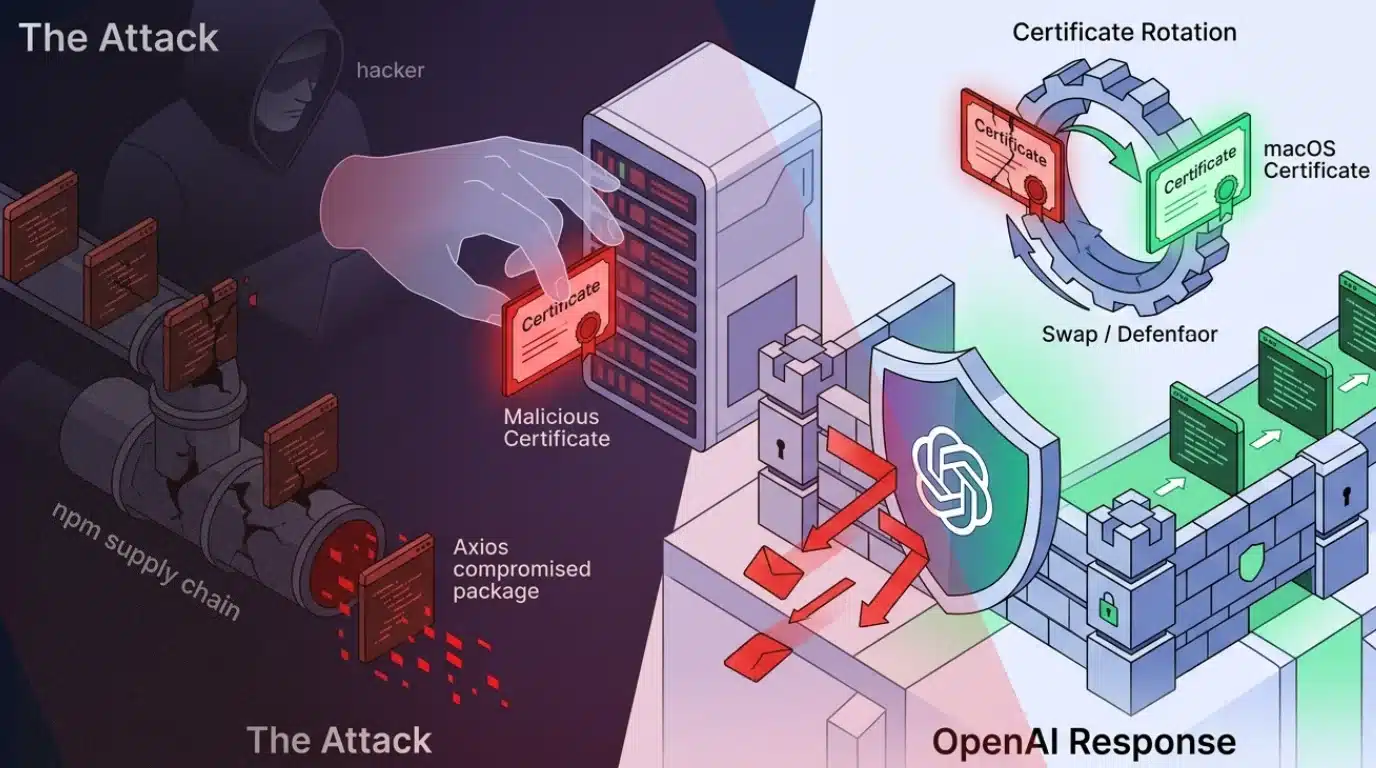
In its official statement, OpenAI said, “We recently identified a security issue involving a third-party developer tool, Axios, that was part of a widely reported, broader industry incident.” The company clarified that while it was affected by the broader Axios npm supply chain attack, there is no evidence of compromise to user data or internal systems. “We found no evidence that OpenAI user data was accessed, that our systems or intellectual property was compromised, or that our software was altered,” the statement added. The exposure occurred on March 31, 2026, when a GitHub Actions workflow used in OpenAI’s macOS app-signing process executed a malicious version of Axios (v1.14.1). This workflow had access to sensitive code-signing certificates used for validating OpenAI applications like ChatGPT Desktop, Codex, Codex CLI, and Atlas.Certificate Rotation and macOS App Updates
As a direct response to the Axios npm supply chain attack, OpenAI has initiated a full rotation of its macOS code-signing certificates. While internal analysis suggests the certificate was likely not exfiltrated, the company is treating it as potentially compromised. To mitigate any residual risk, OpenAI is requiring users to update their macOS applications. Older versions of affected apps will lose support and functionality after May 8, 2026. Updated versions will carry new certificates to ensure authenticity. This move is designed to prevent threat actors from distributing malicious software disguised as legitimate OpenAI applications, a known risk in supply chain attacks involving code-signing materials.Investigation and Security Measures
OpenAI engaged a third-party digital forensics and incident response firm to investigate the impact of the Axios npm supply chain attack. The company also coordinated with Apple to block any new notarization attempts using the old certificate. Additional steps taken include:- Publishing new builds of all affected macOS applications
- Reviewing all past software notarizations for anomalies
- Ensuring no unauthorized modifications were made to distributed software
Root Cause: GitHub Workflow Misconfiguration
The root cause of OpenAI’s exposure to the Axios npm supply chain attack was traced to a misconfiguration in its GitHub Actions workflow. Specifically, the workflow relied on a floating tag instead of a fixed commit hash and lacked a minimum release age for dependencies, both of which increased the risk of pulling compromised packages. This highlights a broader industry issue where development pipelines remain vulnerable to upstream compromises, especially in open-source ecosystems.No Impact on User Data or Other Platforms
OpenAI emphasized that the incident is limited strictly to macOS applications. There is no impact on iOS, Android, Windows, Linux, or web-based services. The company also reassured users:- No user data or API keys were compromised
- No passwords need to be changed
- No malware signed as OpenAI has been detected
What Happens Next
OpenAI will fully revoke the old certificate on May 8, 2026, after a 30-day transition window. This approach is intended to minimize disruption while ensuring users have adequate time to update their applications. The company noted that any software signed with the old certificate will be blocked by macOS security protections after revocation, further reducing the risk of misuse.Growing Impact of Axios npm Supply Chain Attack
The Axios npm supply chain attack highlight the escalating risks tied to third-party software dependencies. With attribution pointing to a state-sponsored group, the incident reflects how supply chain attacks are increasingly being leveraged for financial and strategic objectives. As organizations continue to rely heavily on open-source libraries, the incident serves as a reminder of the need for stricter dependency management, secure development practices, and continuous monitoring of software pipelines.
Apple Rolls Out Fix: New macOS Update Could Protect 100M Mac Users
Apple’s macOS 26.4 update adds a Terminal warning to help stop ClickFix-style attacks by flagging potentially harmful pasted commands.
The post Apple Rolls Out Fix: New macOS Update Could Protect 100M Mac Users appeared first on TechRepublic.
Apple Rolls Out Real-Time Security Fixes Across iPhone, iPad, and Mac
Apple launches Background Security Improvements to fix vulnerabilities in real time, starting with a WebKit flaw affecting Safari on iPhone, iPad, and Mac.
The post Apple Rolls Out Real-Time Security Fixes Across iPhone, iPad, and Mac appeared first on TechRepublic.
Critical Apple Flaw Exploited in ‘Sophisticated’ Attacks, Company Urges Rapid Patching
Apple urges users to update after patching CVE-2026-20700, a zero-day flaw exploited in sophisticated targeted attacks across multiple devices.
The post Critical Apple Flaw Exploited in ‘Sophisticated’ Attacks, Company Urges Rapid Patching appeared first on TechRepublic.
