Researchers have uncovered an Android malware framework dubbed the MiningDropper. Security researchers at Cyble Research and Intelligence Labs (CRIL) have identified a sharp increase in campaigns using MiningDropper, a modular platform capable of distributing multiple types of malicious payloads, including cryptocurrency miners, infostealers, Remote Access Trojans (RATs), and banking malware. A notable aspect of this campaign is its abuse of the open-source Lumolight application, which has been repurposed as a trojanized entry point.
A Modular Android Malware Framework at Scale
MiningDropper is not a conventional malware strain. Instead, it operates as a multi-stage delivery framework designed to evade detection and dynamically deploy payloads. Its architecture integrates XOR-based obfuscation, AES-encrypted payload staging, dynamic DEX loading, and anti-emulation techniques. These layers collectively delay analysis and reduce the likelihood of detection by traditional antivirus solutions.Over 1,500 MiningDropper samples have been observed in the wild within a single month, with more than 50% showing minimal antivirus detection. Notably, around 668 samples registered only three antivirus detections, indicating widespread distribution with low visibility.
Lumolight as the Initial Infection Vector
A recent variant of MiningDropper uses a trojanized version of Lumolight as its initial payload. Victims unknowingly install this compromised application through phishing links, fraudulent websites, or social media campaigns. Once installed, the malicious application triggers a native library, “librequisitionerastomous.so”, which begins the execution chain.This native layer decrypts XOR-obfuscated strings at runtime and checks whether the app is running in an emulator or rooted environment. If such conditions are detected, the malware halts execution to avoid analysis. Otherwise, it proceeds to decrypt and load the first-stage payload from the app’s assets.
Initial Stage: The native code decrypts an embedded asset using a hardcoded XOR key, producing a DEX file. This file is dynamically loaded using DexClassLoader and executes a bootstrap component.
First Stage: The bootstrap loader decrypts a second-stage payload using AES encryption. The AES key is derived from the SHA-1 hash of the file name, making it harder for analysts to extract static keys.
Second Stage: This stage presents a fake Google Play update interface, a social engineering tactic designed to maintain user trust. Behind the scenes, it decrypts additional payloads and configuration files. The malware can operate in two modes: a cryptocurrency miner or a user-defined malicious payload.
Configuration files such as “norweyanlinkediting” (miner path) and “udela” (user payload path) dictate the behavior. These configurations include parameters like remote control capabilities, payload splits, and subscription timelines.
Third Stage: The malware extracts a ZIP archive containing further DEX files and native libraries. Acting as a split-APK installer, it reconstructs and installs the final payload based on the configuration.
Campaigns Targeting Multiple Regions
CRIL identified two primary campaign clusters leveraging MiningDropper:
Infostealer Campaign (India): This campaign targets Indian users by impersonating trusted entities such as Regional Transport Office (RTO) services, banks, telecom providers, and popular apps. In October 2025, a campaign using RTO-themed lures distributed malicious APK files that ultimately deployed infostealers to harvest sensitive financial and personal data.
BTMOB RAT Campaign (Global): Another campaign distributes MiningDropper across Europe, Latin America, and Asia. In this case, the final payload is BTMOB RAT, a powerful Android trojan first identified in February 2024 as a variant of SpySolr malware. It supports credential theft, real-time remote control, device takeover, and financial fraud operations.
Interestingly, while BTMOB RAT was initially distributed without obfuscation and detected by multiple antivirus engines, its integration with MiningDropper has reduced detection rates to as low as one to three engines.
Final Payload Capabilities
The final payload delivered by MiningDropper depends on the configuration:
Infostealers: Extract sensitive data such as login credentials and financial information.
RATs (e.g., BTMOB RAT): Enable full device compromise, including screen monitoring, file access, audio recording, and command execution via WebSocket-based communication.
Banking Trojans: Facilitate financial fraud through credential harvesting and transaction manipulation.
Cryptocurrency Miners: Utilize device resources for unauthorized mining operations.
The malware also abuses Android Accessibility Services to gain extensive control over infected devices, allowing it to simulate user interactions and grant additional permissions.
A Scalable Malware-as-a-Framework Model
MiningDropper demonstrates a shift toward malware frameworks that prioritize scalability and adaptability. Its ability to switch between payloads using configuration changes, without altering the core architecture, makes it highly reusable across campaigns. This modularity enables threat actors to rapidly expand operations while maintaining low detection rates.MiningDropper is more than just another Android malware strain. By combining advanced obfuscation, multi-stage execution, and the exploitation of legitimate projects like Lumolight, it represents a threat model capable of sustaining large-scale, global campaigns.
AhnLab SEcurity intelligence Center (ASEC) has confirmed the RAT distribution of the Remcos RAT targeting users in South Korea. While the original distribution pages remain unknown, the malware appears to masquerade as VeraCrypt installers or software associated with illegal gambling websites. 1. Malware Distribution One of the initial malware samples displays an interface labeled […]
A member of our web research team pointed me to a fake WinRAR installer that was linked from various Chinese websites. When these links start to show up, that’s usually a good indicator of a new campaign.
So, I downloaded the file and started an analysis, which turned out to be something of a Matryoshka doll. Layer after layer, after layer.
WinRAR is a popular utility that’s often downloaded from “unofficial” sites, which gives campaigns offering fake downloads a bigger chance of being effective.
Often, these payloads contain self-extracting or multi-stage components that can download further malware, establish persistence, exfiltrate data, or open backdoors, all depending on an initial system analysis. So it was no surprise that one of the first actions this malware took was to access sensitive Windows data in the form of Windows Profiles information.
This, along with other findings from our analysis (see below), indicates that the file selects the “best-fit” malware for the affected system before further compromising or infecting it.
How to stay safe
Mistakes are easily made when you’re looking for software to solve a problem, especially when you want that solution fast. A few simple tips can help keep you safe in situations like this.
Only download software from official and trusted sources. Avoid clicking links that promise to deliver that software on social media, in emails, or on other unfamiliar websites.
Use a real-time, up-to-date anti-malware solution to block threats before they can run.
Analysis
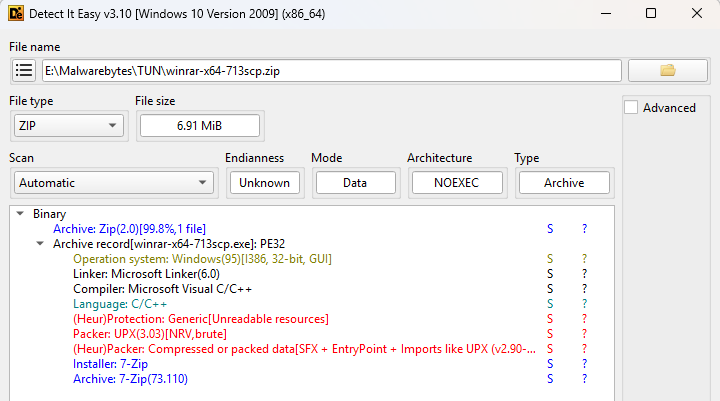
The original file was called winrar-x64-713scp.zip and the initial analysis with Detect It Easy (DIE) already hinted at several layers.
Detect It Easy first analysis: 7-Zip, UPX, SFX — anything else?
Unzipping the file produced winrar-x64-713scp.exe which turned out to be a UPX packed file that required the --force option to unpack it due to deliberate PE anomalies. UPX normally aborts compression if it finds unexpected values or unknown data in the executable header fields, as that data may be required for the program to run correctly. The --force option tells UPX to ignore these anomalies and proceed with decompression anyway.
Looking at the unpacked file, DIE showed yet another layer: (Heur)Packer: Compressed or packed data[SFX]. Looking at the strings inside the file I noticed two RunProgram instances:
RunProgram="nowait:\"1winrar-x64-713scp1.exe\" "
RunProgram="nowait:\"youhua163
These commands tell the SFX archive to run the embedded programs immediately after extraction, without waiting for it to complete (nowait).
Using PeaZip, I extracted both embedded files.
The Chinese characters “安装” complicated the string analysis, but they translate as “install,” which further piqued my interest. The file 1winrar-x64-713scp1.exe turned out to be the actual WinRAR installer, likely included to ease suspicion for anyone running the malware.
After removing another layer, the other file turned out to be a password-protected zip file named setup.hta. The obfuscation used here led me to switch to dynamic analysis. Running the file on a virtual machine showed that setup.hta is unpacked at runtime directly into memory. The memory dump revealed another interesting string: nimasila360.exe.
This is a known file often created by fake installers and associated with the Winzipper malware. Winzipper is a known Chinese-language malicious program that pretends to be a harmless file archive so it can sneak onto a victim’s computer, often through links or attachments. Once opened and installed, it quietly deploys a hidden backdoor that lets attackers remotely control the machine, steal data, and install additional malware, all while the victim believes they’ve simply installed legitimate software.
Indicators of Compromise (IOCs)
Domains:
winrar-tw[.]com
winrar-x64[.]com
winrar-zip[.]com
Filenames:
winrar-x64-713scp.zip
youhua163安装.exe
setup.hta (dropped in C:\Users\{username}\AppData\Local\Temp)
Malwarebytes’ web protection component blocks all domains hosting the malicious file and installer.
AhnLab SEcurity intelligence Center (ASEC) previously covered the case of threat actors exploiting the GeoServer vulnerability to install CoinMiner and NetCat through the “CoinMiner Attacks Exploiting GeoServer Vulnerability” blog. [1] The threat actors have been continuously targeting vulnerable GeoServers to install CoinMiner. This post will cover the identified cases of CoinMiner installation. 1. GeoServer […]

 Entrar

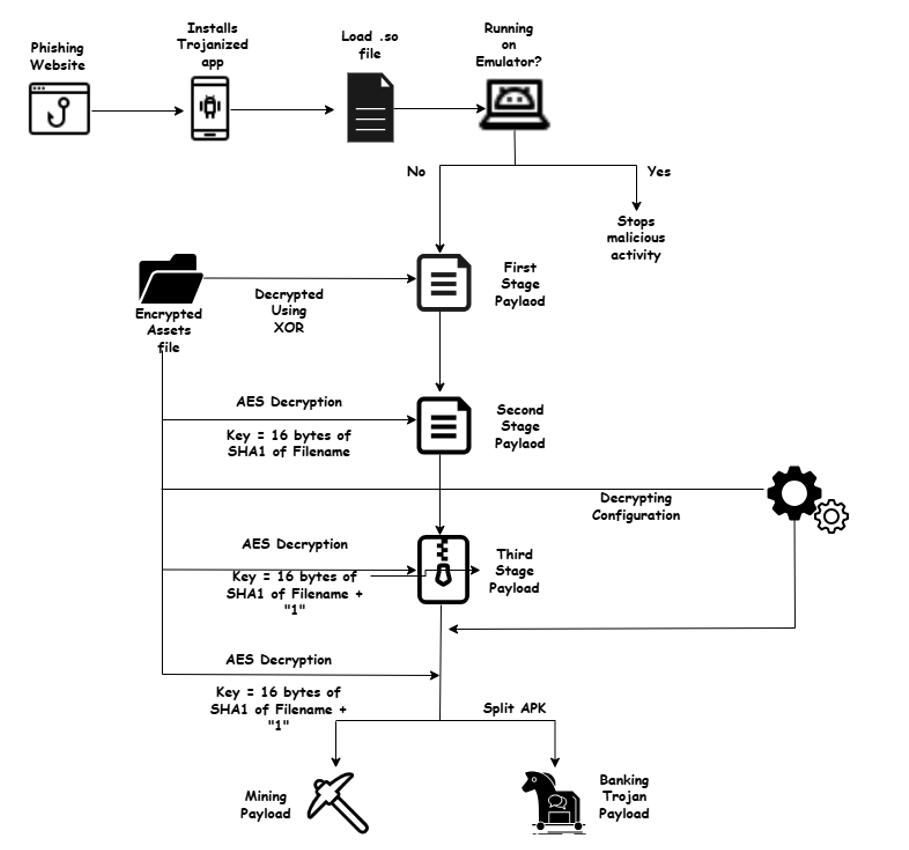 MiningDropper attack chain (Source: Cyble)[/caption]
MiningDropper’s infection chain unfolds across multiple stages:
MiningDropper attack chain (Source: Cyble)[/caption]
MiningDropper’s infection chain unfolds across multiple stages:

![Malwarebytes blocks winrar-tw[.]com](https://www.malwarebytes.com/wp-content/uploads/sites/2/2026/01/blocked.png)
