
Visualização de leitura

Microsoft Agent 365, now generally available, expands capabilities and integrations

Microsoft Agent 365

Now generally available for commercial customers.

Choose an ecosystem partner for agent security and governance

AI agents aren’t coming—they’re already in your environment. They show up in places you expect (like Microsoft CopilotMicrosoft Teams, and Microsoft 365) and even more places as technology evolves (a local autonomous personal AI assistant or a new software as a service (SaaS) agent connected to your sensitive data.)

The problem isn’t that agents exist. It’s that they proliferate fast, span apps, endpoints and cloud, and often operate outside the visibility and control of the teams accountable for risk. When an agent can invoke tools, access data, and interact with other agents, any “helpful” workflow can turn into data oversharing, tool misuse, or over-privileged actions in seconds. And as agents become even easier to create and deploy, your attack surface grows with them. 

That’s why end-to-end observability matters: you can’t govern what you can’t see, and you can’t secure what you don’t understand—especially when the number of agents is a moving target. 

Microsoft Agent 365 helps you take control of agent sprawl as your control plane to observe, govern, and secure agents and their interactions—including agents built with Microsoft AI and agents from our ecosystem partners—using the admin and security workflows your teams already run. 

General availability starts today for Agent 365.

Additionally, we’re announcing the previews of new Agent 365 capabilities and integrations to help you scale agent adoption with the right controls in place. 

  • Observability, governance, and security for agents operating independently—Agent 365 is expanding to cover agents that operate with their own credentials and permissions.
  • Discovery of agents and shadow AI, using capabilities of Microsoft Defender and Microsoft Intune for both local and cloud agents.
  • A secured, managed environment for agents to work in Windows 365 for Agents.
  • Coverage for a wide ecosystem of SaaS agents, including agents innovated by software development companies (SDCs).
  • Support for evaluation, adoption, and usage from Microsoft and ecosystem partners worldwide.

Manage agents with a single control plane, regardless of how or where they work

As organizations move from pilot to adoption, AI agents are being deployed across increasingly diverse use cases. Some act with delegated access, working on behalf of users; others operate with their own credentials and permissions, participating in team workflows or operating behind the scenes. 

With Agent 365, you can observe, govern, and secure AI agents whether they act on behalf of users with delegated access—for example, an agent that helps employees organize their inbox—or agents that operate with their own access and scope of work—such as an agent autonomously triaging support tickets. 

Supported by Agent 365
Agents working on behalf of
users (delegated access) 
Generally available 
Agents operating behind
the scenes (own access) 
Generally available 
Agents participating in team
workflows (own access) 
Public Preview   

Discover and manage local and cloud-hosted agents 

Users are installing agents like OpenClaw and Claude Code on their devices and adopting SaaS agents built by developers on new and emerging platforms. Many of these local and cloud-hosted agents run unmanaged and outside of traditional governance, as they autonomously execute tasks, modify code, or access confidential information, creating a new wave of shadow AI.  

To help organizations address accelerating agent sprawl and the rise of unmanaged agents, we’re introducing new capabilities as part of Agent 365, Microsoft Defender, and Intune so you can discover shadow agents, and apply appropriate controls, such as blocking unmanaged agents. 

Discover and manage local agents

With Microsoft Defender and Intune, organizations will be able to discover and manage local AI agents running on Windows devices, starting with OpenClaw agents and expanding soon to other widely used agents like GitHub Copilot CLI and Claude Code. Customers enrolled in the Frontier program can see if OpenClaw agents are being used in the organization, which devices they are running on, and use Intune policies to block common ways that OpenClaw runs on the new Shadow AI page in Agent 365 in the Microsoft 365 admin center and in the Intune admin center. Through Agent 365 registry, the inventory of local agents will be available in Defender and Intune so IT, endpoint management, and security teams can get a consistent view of discovered local agents in their environment and take appropriate action.
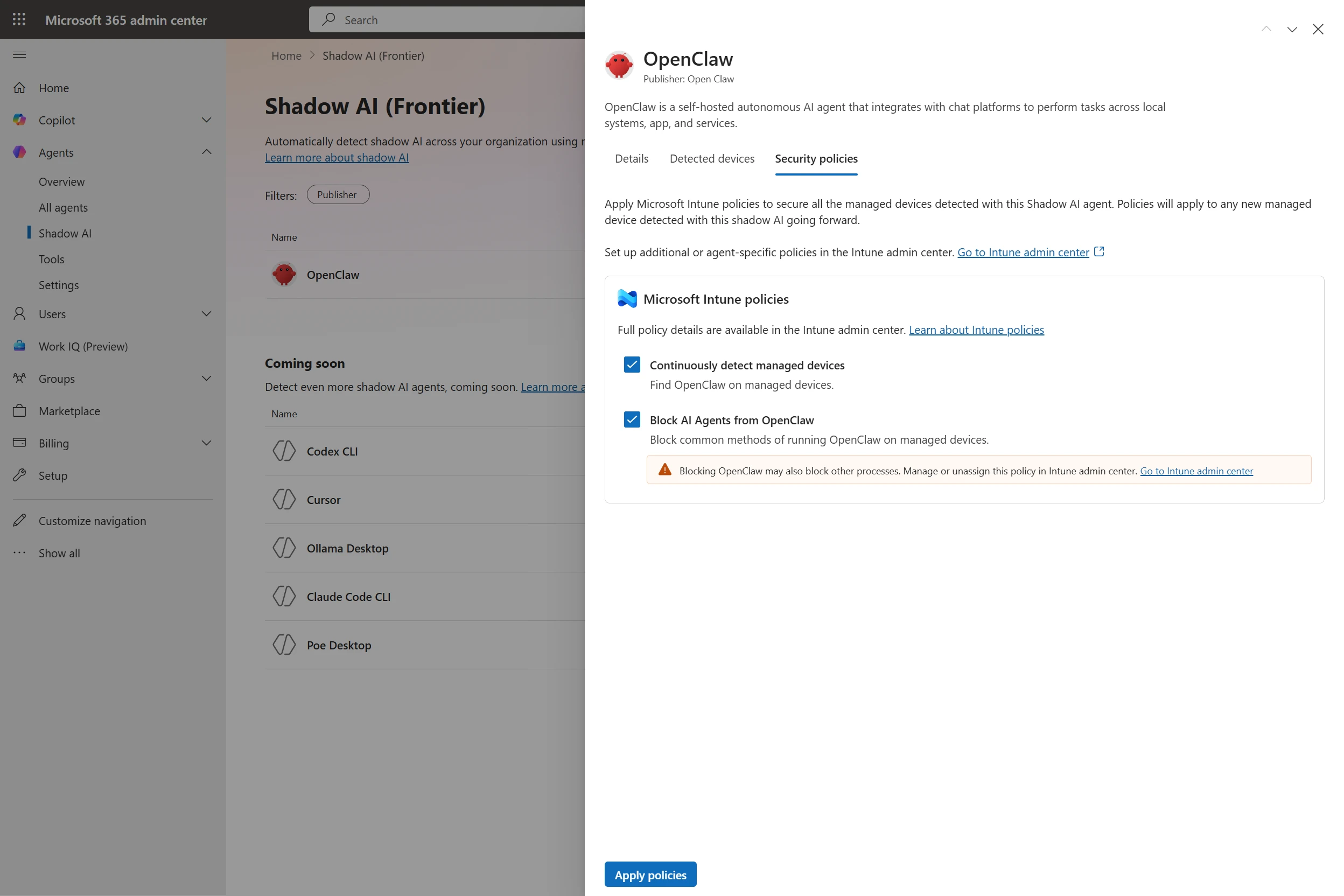
Microsoft 365 admin center showing Shadow AI OpenClaw agent with Intune security policies enabled to detect and block unmanaged AI agents.
In the Microsoft 365 admin center, an IT professional can apply Intune policies to continuously detect managed devices and block the common methods of running OpenClaw on them. 

Starting in June 2026, Microsoft Defender will also provide asset context mapping for each agent including the devices they run on, MCP servers configured for those agents, the identities associated with them, and the cloud resources those identities can reach. This will give security teams the context needed to assess exposure and potential blast radius. They can then investigate agent activity, such as file access and network behavior, using familiar endpoint data, and use those insights to identify misconfigurations and even define custom detections.
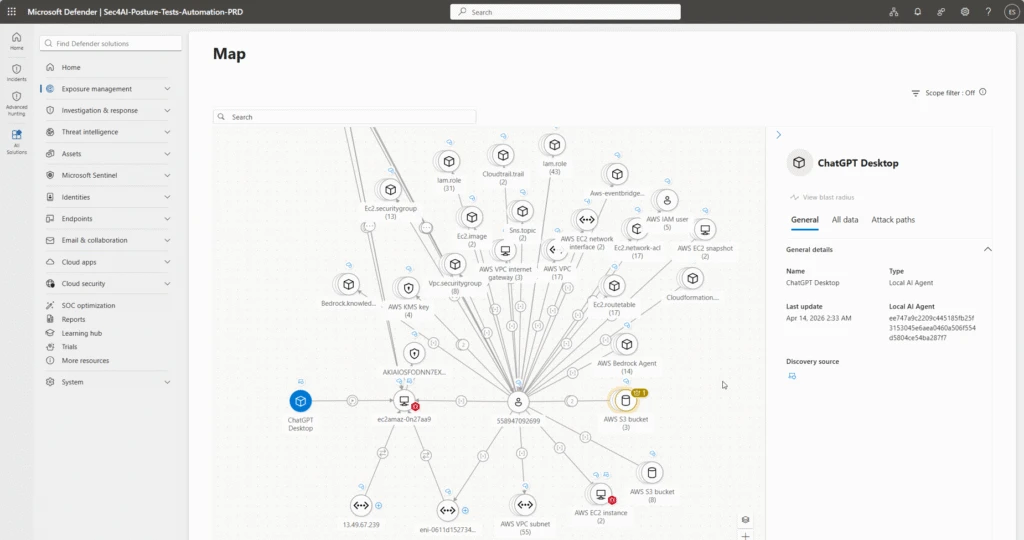
Microsoft Defender interface displaying a security graph map of connected AI agents and AWS resources with ChatGPT Desktop node highlighted.
Security teams can investigate local AI agent exposure in Microsoft Defender through a relationship map that shows where an agent runs, which MCP servers are configured for use, which identities are associated with it, and which cloud resources those identities can reach. Defender context such as resource criticality and sensitive-data exposure helps teams prioritize the agents and paths that matter most. 

Beyond monitoring, organizations will be able to apply policy-based controls to set guardrails for what agents are allowed to do—helping protect both agents and organizations from compromise and misuse—with initial support delivered for OpenClaw through Intune. If a managed agent exhibits malicious behavior patterns, such as attempting to access or exfiltrate sensitive data, Defender will be able to block coding agents in runtime and generate alerts with rich incident context to support investigation and response.  

Context mapping capabilities, policy-based controls, plus runtime blocking and alerts will be available in Agent 365 through Intune and Defender public preview in June 2026. 

Visibility across clouds and AI-builder platforms

As developers are rapidly building agents with Microsoft Foundry, AWS Bedrock, and Google Gemini Enterprise Agent Platform (formerly Google Vertex AI) and deploying cloud agents across multicloud and multi-platform environments, the agent sprawl challenge intensifies. To manage potential security risks or vulnerabilities before they become breaches, security and IT teams need visibility to which cloud agents are running, what models these agents are built on, and what resources they’re accessing.

Today, we are excited to announce the public preview of Agent 365 registry sync with AWS Bedrock and Google Cloud connections, enabling IT teams to automatically discover, inventory, and, soon, perform basic lifecycle governance—for example, start, stop, delete agents—across these platforms.
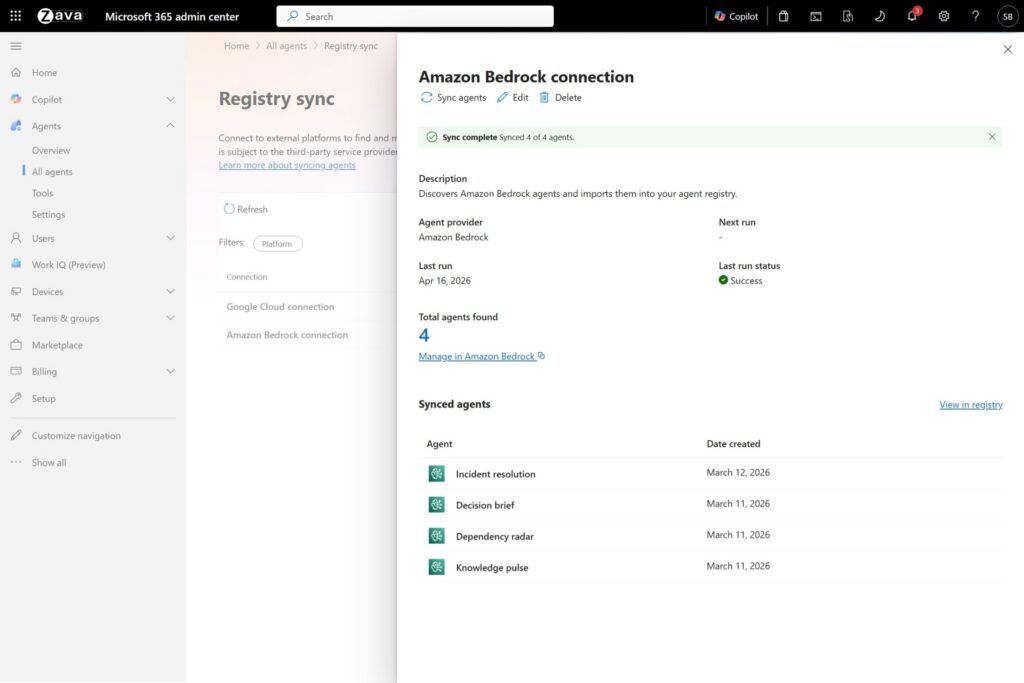
Microsoft 365 admin center Registry sync page showing successful Amazon Bedrock connection with four synced AI agents listed.
Now in public preview, Microsoft 365 admins can connect and sync the Agent 365 registry with Amazon Bedrock and Google Cloud for cross-platform observability and governance. 

Manage a wide ecosystem of SaaS agents 

Agent 365 works with prebuilt agents in Microsoft 365 Copilot and Teams, agents built with Microsoft Copilot Studio or Microsoft Foundry for your organization, and agents built by software development companies partnered with Microsoft.

Delivering on our promise of control plane for the broad agent ecosystem, we’re excited to announce ecosystem partner agents fully configured to be managed by Agent 365, including Genspark, Zensai, Egnyte, and Zendesk, and agents built on agent factories, including Kasisto, Kore, and n8n. Organizations can observe, govern, and secure these agents in the Agent 365 control plane, with no integration work by IT or security teams.  

Agent 365 software development company launch partners
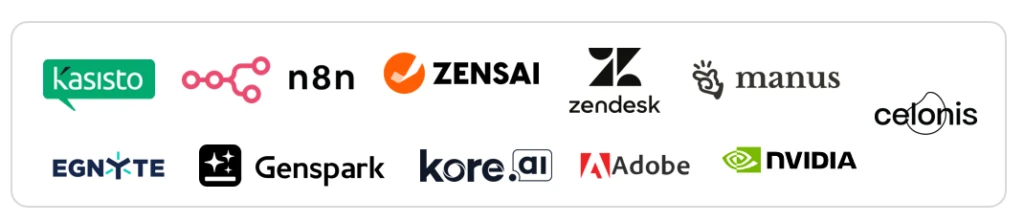
Collection of AI and software vendor logos including Adobe, NVIDIA, Zendesk, n8n, Kore.ai, and Celonis.
Agent 365 Software Development Company Launch Partners have built agents fully enabled to be managed by Agent 365. 

Enterprises can easily build AI agents today, but scaling them with trust and governance is where most initiatives stall. With Kore.ai deeply integrated into Microsoft Agent 365, identity, security, and governance are built in from the start—empowering enterprises to move from pilots to AI at scale with confidence.

—– Raj Koneru, Chief Executive Officer of Kore.ai

The Agent 365 developer and ecosystem partners play a critical role in extending agents into line-of-business systems, building vertical and scenario-specific integrations, modernizing legacy automation into agent workflows, extending Copilot experiences with custom agents, and helping customers operationalize agent ecosystems at scale. These Agent 365 enabled agents are then observable, governable, and securable in the Agent 365 control plane, accelerating adoption for your organization.

Secure agents as they work in Windows 365 

While Agent 365 provides the control plane to observe, govern, and secure agent activity across the enterprise, Windows 365 for Agents—now available in public preview (in the United States only)—provides a secured, managed environment where agents can carry out that work. It introduces a new class of Cloud PCs purpose-built for agentic workloads and managed in Intune, allowing agents to run in policy-controlled environments, interact with applications, and operate with the same identity, security, and management controls already used for employees.

Now, with Agent 365, you can also observe and secure agents running on Windows 365 for Agents in Microsoft 365 admin center, understanding which agents are connected to the cloud-powered compute. Together, they enable organizations to move from visibility and governance of agents to confidently running them in production environments. 

Secure agents against internet threats with network controls  

AI agents can operate much faster than human users. Without proper guardrails, they can connect to risky web destinations, interact with unsanctioned AI services, handle sensitive files unsafely, or be manipulated through malicious prompt-based attacks. These risks are harder to manage when security teams lack consistent visibility and controls for agent traffic to internet, SaaS, and AI services. 

To give security teams a consistent way to inspect agent traffic at the network layer, in general availability today, Agent 365 extends Microsoft Entra network controls to Microsoft Copilot Studio agents and agents running on user endpoint devices, including local agents such as OpenClaw. These controls can help identify unsanctioned AI usage, restrict connections to only approved web destinations, filter risky file movement, and help block malicious prompt-based attacks before they lead to harmful actions. 

Confidently scale and govern AI agents while maintaining security and control 

Agent 365 extends even further beyond Microsoft platforms to discover, observe, govern, and secure local, SaaS, and cloud agents across your agentic AI ecosystem. Each of today’s announcements build upon Agent 365 capabilities we shared in March 2026 as well as detailed feedback of customers using the Frontier program, developers integrating with the platform, and partners testing Agent 365 capabilities. 

With Agent 365, we can scale and govern AI agents with confidence, while maintaining enterprise grade security and control. Agent 365 enables organizations to move beyond experimentation, driving tangible business value and innovation through trusted AI adoption. By providing a robust and integrated platform, Agent 365 empowers teams to confidently embrace AI and accelerate transformation across the enterprise.

—Yuji Shono, Head of the Global AI Office, NTT DATA Group Corporation, a global infrastructure, networking, and IT services provider.

As organizations begin to adopt Agent 365 at scale, we’ve collaborated with strategic partners to create targeted services to help customers onboard, tackle governance challenges and realize the platform’s full value.

Grid of enterprise services partner logos including Accenture, KPMG, Cognizant, Capgemini, Avanade, Deloitte, EY, PwC, and TCS.
Featured Agent 365 launch partners, including Accenture, Bechtle, Capgemini, Insight, KPMG, Protiviti and Slalom, collaborated with Microsoft engineering teams to develop services for planning, adopting, and managing your agent control plane implementation.

Partner services offered today include expertise and guidance for: 

  • Inventory and ownership: What agents exist, who owns them, and where they run.
  • Least privilege: Right-sizing permissions and enforcing access guardrails without slowing delivery.
  • Compliance and data protection: Preventing oversharing and producing audit-ready evidence.
  • Threats and multi-platform estates: Understanding attack paths and governing across vendors and clouds.
  • Ongoing operations: Lifecycle management, monitoring, and continuous governance hygiene. 

These valuable services are typically scoped as workshops and assessments (diagnose and roadmap), governance and enablement (stand up the control plane and guardrails), managed services (run and improve continuously), advisory and readiness (operating model and adoption readiness), and security and integration (harden posture and integrate third-party agents.)

How to get started with Agent 365  

Agent 365 is now available in Microsoft 365 E7 or standalone at USD15 per user per month. Each Agent 365 license covers an individual who manages or sponsors agents, or uses agents to do work on their behalf, ensuring all agent activity is consistently governed across the organization in a way that’s predictable for scaled growth.  

In addition to the expertise of your Microsoft 365 team and partners, Agent 365 resources to support your experience include:

Plus, on Tuesday, May 12, 2026, a team of Agent 365 experts are hosting a live “Ask Microsoft Anything” to answer your questions about Agent 365—we hope you’ll join for the discussion.

Microsoft Agent 365

Now generally available for commercial customers.

Choose an ecosystem partner for agent security and governance

The post Microsoft Agent 365, now generally available, expands capabilities and integrations appeared first on Microsoft Security Blog.
Addressing the OWASP Top 10 Risks in Agentic AI with Microsoft Copilot Studio

Agentic AI is moving fast from pilots to production. That shift changes the security conversation. These systems do not just generate content. They can retrieve sensitive data, invoke tools, and take action using real identities and permissions. When something goes wrong, the failure is not limited to a single response. It can become an automated sequence of access, execution, and downstream impact.

Security teams are already familiar with application risk, identity risk, and data risk. Agentic systems collapse those domains into one operating model. Autonomy introduces a new problem: a system can be “working as designed” while still taking steps that a human would be unlikely to approve, because the boundaries were unclear, permissions were too broad, or tool use was not tightly governed.

The OWASP Top 10 for Agentic Applications (2026) outlines the top ten risks associated with autonomous systems that can act across workflows using real identities, data access, and tools.

This blog is designed to do two things: First, it explores the key findings of the OWASP Top 10 for Agentic Applications. Second, it highlights examples of practical mitigations for risks surfaced in the paper, grounded in Agent 365 and foundational capabilities in Microsoft Copilot Studio.

OWASP helps secure agentic AI around the world

OWASP (the Open Worldwide Application Security Project) is an online community led by a nonprofit foundation that publishes free and open security resources, including articles, tools, and documentation used across the application security industry. In the years since the organization’s founding, OWASP Top 10 lists have become a common baseline in security programs.

In 2023, OWASP identified a security gap that needed urgent attention: traditional application security guidance wasn’t fully addressing the nascent risks stemming from the integration of LLMs and existing applications and workflows. The OWASP Top 10 for Agentic Applications was designed to offer concise, practical, and actionable guidance for builders, defenders, and decision-makers. It is the work of a global community spanning industry, academia, and government, built through an “expert-led, community-driven approach” that includes open collaboration, peer review, and evidence drawn from research and real-world deployments.

Microsoft has been a supporter of the project for quite some time, and members of the Microsoft AI Red Team helped review the Agentic Top 10 before it was published. Pete Bryan, Principal AI Security Research Lead, on the Microsoft AI Red Team, and Daniel Jones, AI Security Researcher on the Microsoft AI Red Team, also served on the OWASP Agentic Systems and Interfaces Expert Review Board.

Agentic AI delivers a whole range of novel opportunities and benefits. However, unless it is designed and implemented with security in mind, it can also introduce risk. OWASP Top 10s have been the foundation of security best practice for years. When the Microsoft AI Red Team gained the opportunity to help shape a new OWASP list focused on agentic applications, we were excited to share our experiences and perspectives. Our goal was to help the industry as a whole create safe and secure agentic experiences.

Pete Bryan, Principal AI Security Research Lead

The 10 failure modes OWASP sees in agentic systems

Read as a set, the OWASP Top 10 for Agentic Applications makes one point again and again: agentic failures are rarely “bad output.” But they are bad outcomes. Many risks show up when an agent can interpret untrusted content as instruction, chain tools, act with delegated identity, and keep going across sessions and systems. Here is a quick breakdown of the types of risk called out in greater detail in the Top 10:

  1. Agent goal hijack (ASI01): Redirecting an agent’s goals or plans through injected instructions or poisoned content.
  2. Tool misuse and exploitation (ASI02): Misusing legitimate tools through unsafe chaining, ambiguous instructions, or manipulated tool outputs.
  3. Identity and privilege abuse (ASI03): Exploiting delegated trust, inherited credentials, or role chains to gain unauthorized access or actions.
  4. Agentic supply chain vulnerabilities (ASI04): Compromised or tampered third-party agents, tools, plugins, registries, or update channels.
  5. Unexpected code execution (ASI05): Turning agent-generated or agent-invoked code into unintended execution, compromise, or escape.
  6. Memory and context poisoning (ASI06): Corrupting stored context (memory, embeddings, RAG stores) to bias future reasoning and actions.
  7. Insecure inter-agent communication (ASI07): Spoofing, intercepting, or manipulating agent-to-agent messages due to weak authentication or integrity checks.
  8. Cascading failures (ASI08): A single fault propagating across agents, tools, and workflows into system-wide impact.
  9. Human–agent trust exploitation (ASI09): Abusing user trust and authority bias to get unsafe approvals or extract sensitive information.
  10. Rogue agents (ASI10): Agents drifting or being compromised in ways that cause harmful behavior beyond intended scope.

For security teams, knowing that these issues are top of mind across the global community of agentic AI users is only the first half of the equation. What comes next is addressing each of them through properly implemented controls and guardrails.

Build observable, governed, and secure agents with Microsoft Copilot Studio

In agentic AI, the risk isn’t just what an agent is designed to do, but how it behaves once deployed. That’s why governance and security must span both in development (where intent, permissions, and constraints are defined), and operation (where behavior must be continuously monitored and controlled). For organizations building and deploying agents, Copilot Studio provides a secure foundation to create trustworthy agentic AI. From the earliest stages of the agent lifecycle, built in capabilities help ensure agents are safe and secure by design. Once deployed, IT and security teams can observe, govern, and secure agents across their lifecycle.

In development, Copilot Studio establishes clear behavioral boundaries. Agents are built using predefined actions, connectors, and capabilities, limiting exposure to arbitrary code execution (ASI05), unsafe tool invocation (ASI02), or uncontrolled external dependencies (ASI04). By constraining how agents interact with systems, the platform reduces the risk of unintended behavior, misuse, or redirection through indirect inputs. Copilot Studio also emphasizes containment and recoverability. Agents run in isolated environments, cannot modify their own logic without republishing (ASI10), and can be disabled or restricted when necessary (ASI07, ASI08). For example, if a deployed support agent is coaxed (via an indirect input) to “add a new action that forwards logs to an external endpoint,” it can’t quietly rewrite its own logic or expand its toolset on the fly; changes require republishing, and the agent can be disabled or restricted immediately if concerns arise. These safeguards prevent localized agent failures from propagating across systems and reinforce a key principle: agents should be treated as managed, auditable applications, not unmanaged automation.

To support governance and security during operation, Microsoft Agent 365 will be generally available on May 1. Currently in preview, Agent 365 enables organizations to observe, govern, and secure agents across their lifecycle, providing IT and security teams with centralized visibility, policy enforcement, and protection capabilities for agentic AI.

Once agents are deployed, Security and IT teams can use Agent 365 to gain visibility into agent usage, manage how agents are used, and enforce organizational guardrails across their environment. This includes insights into agent usage, performance, risks, and connections to enterprise data and tools. Teams can also implement policies and controls to help ensure safe and compliant operations. For example, if an agent accesses a sensitive document, IT and security teams can detect the activity in Agent 365, investigate the associated risk, and quickly restrict access or disable the agent before any impact occurs. Key capabilities include:

  • Access and identity controls alongside policy enforcement to ensure agents operate within the appropriate user or service context, helping reduce the risk of privilege escalation and applying guardrails like access packages and usage restrictions (ASI03).
  • Data security and compliance controls to prevent sensitive data leakage and detect risky or non-compliant interactions (ASI09).
  • Threat protection to identify vulnerabilities (ASI04) and detect incidents such as prompt injection (ASI01), tool misuse (ASI02), or compromised agents (ASI10).

Together, these capabilities provide continuous oversight and enable rapid response when agent behavior deviates from expected boundaries.

Keep learning about agentic AI security

Agentic AI changes not just what software can do, but how it operates, introducing autonomy, delegated authority, and the ability to act across systems. The shift places new demands on how systems are designed, secured, and operated. Organizations that treat agents as privileged applications, with clear identities, scoped permissions, continuous oversight, and lifecycle governance, are better positioned to manage and reduce risk as they adopt agentic AI. Establishing governance early allows teams to scale innovation confidently, rather than retroactively building controls after the agents are embedded in workflows. Here are some resources to look over as the next step in your journey:

OWASP Top 10 for Agentic Applications (2026): The baseline: top risks for agentic systems, with examples and mitigations.

Copilot Studio: OWASP Top 10 Mitigations: At-a-glance mapping from each OWASP risk to Copilot Studio controls and Microsoft Security layers.

Microsoft AI Red Team: How Microsoft stress-tests AI systems and what teams can learn from that practice.

Microsoft Security for AI: Microsoft’s approach to protecting AI across identity, data, threat protection, and compliance.

Microsoft Agent 365: The enterprise control plane for observing, governing, and securing agents.

Microsoft AI Agents Hub: Role-based readiness resources and guidance for building agents.

To learn more about Microsoft Security solutions, visit our website. Bookmark the Security blog to keep up with our expert coverage on security matters. Also, follow us on LinkedIn (Microsoft Security) and X (@MSFTSecurity) for the latest news and updates on cybersecurity.


OWASP Top 10 for Agentic Applications content © OWASP Foundation. This content is licensed under CC BY-SA 4.0. For more information, visit https://creativecommons.org/licenses/by-sa/4.0/ 

The post Addressing the OWASP Top 10 Risks in Agentic AI with Microsoft Copilot Studio appeared first on Microsoft Security Blog.

CTI-REALM: A new benchmark for end-to-end detection rule generation with AI agents

Excerpt: CTI-REALM is Microsoft’s open-source benchmark for evaluating AI agents on real-world detection engineering—turning cyber threat intelligence (CTI) into validated detections. Instead of measuring “CTI trivia,” CTI-REALM tests end-to-end workflows: reading threat reports, exploring telemetry, iterating on KQL queries, and producing Sigma rules and KQL-based detection logic that can be scored against ground truth across Linux, AKS, and Azure cloud environments.


Security is Microsoft’s top priority. Every day, we process more than 100 trillion security signals across endpoints, cloud infrastructure, identity, and global threat intelligence. That’s the scale modern cyber defense demands, and AI is a core part of how we protect Microsoft and our customers worldwide. At the same time, security is, and always will be, a team sport.

That’s why Microsoft is committed to AI model diversity and to helping defenders apply the latest AI responsibly. We created CTI‑REALM and open‑sourced it so the broader industry can test models, write better code, and build more secure systems together.


CTI-REALM (Cyber Threat Real World Evaluation and LLM Benchmarking) is Microsoft’s open-source benchmark that evaluates AI agents on end-to-end detection engineering. Building on work like ExCyTIn-Bench, which evaluates agents on threat investigation, CTI-REALM extends the scope to the next stage of the security workflow: detection rule generation. Rather than testing whether a model can answer CTI trivia or classify techniques in isolation, CTI-REALM places agents in a realistic, tool-rich environment and asks them to do what security analysts do every day: read a threat intelligence report, explore telemetry, write and refine KQL queries, and produce validated detection rules.

We curated 37 CTI reports from public sources (Microsoft Security, Datadog Security Labs, Palo Alto Networks, and Splunk), selecting those that could be faithfully simulated in a sandboxed environment and that produced telemetry suitable for detection rule development. The benchmark spans three platforms: Linux endpoints, Azure Kubernetes Service (AKS), and Azure cloud infrastructure with ground-truth scoring at every stage of the analytical workflow.

Why CTI-REALM exists

Existing cybersecurity benchmarks primarily test parametric knowledge: can a model name the MITRE technique behind a log entry, or classify a TTP from a report? These are useful signals. However, they miss the harder question: can an agent operationalize that knowledge into detection logic that finds attacks in production telemetry?

No current benchmark evaluates this complete workflow. CTI-REALM fills that gap by measuring:

  • Operationalization, not recall: Agents must translate narrative threat intelligence into working Sigma rules and KQL queries, validated against real attack telemetry.
  • The full workflow: Scoring captures intermediate decision quality—CTI report selection, MITRE technique mapping, data source identification, iterative query refinement. Scoring is not just limited to the final output.
  • Realistic tooling: Agents use the same types of tools security analysts rely on: CTI repositories, schema explorers, a Kusto query engine, MITRE ATT&CK and Sigma rule databases.

Business Impact

CTI-REALM gives security engineering leaders a repeatable, objective way to prove whether an AI model improves detection coverage and analyst output.

Traditional benchmarks tend to provide a single aggregate score where a model either passes or fails but doesn’t always tell the team why. CTI-REALM’s checkpoint-based scoring answers this directly. It reveals whether a model struggles with CTI comprehension, query construction, or detection specificity. This helps teams make informed decisions about where human review and guardrails are needed.

Why CTI-REALM matters for business

  • Measures operationalization, not trivia: Focuses on translating narrative threat intel into detection logic that can be validated against ground truth.
  • Captures the workflow: Evaluates intermediate steps (e.g., technique extraction, telemetry identification, iterative refinement) in addition to the final rule quality.
  • Supports safer adoption: Helps teams benchmark models before considering any downstream use and reinforces the need for human review before operational deployment.

Latest results

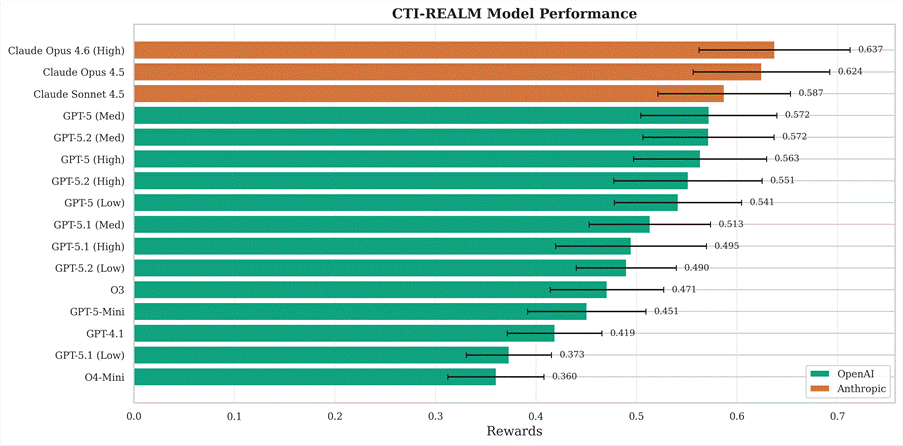
We evaluated 16 frontier model configurations on CTI-REALM-50 (50 tasks spanning all three platforms).

Animated Gif Image
Model performance on CTI-REALM-50, sorted by normalized reward.

What the numbers tell us

  • Anthropic models lead across the board. Claude occupies the top three positions (0.587–0.637), driven by significantly stronger tool-use and iterative query behavior compared to OpenAI models.
  • More reasoning isn’t always better. Within the GPT-5 family, medium reasoning consistently beats high across all three generations, suggesting overthinking hurts in agentic settings.
  • Cloud detection is the hardest problem. Performance drops sharply from Linux (0.585) to AKS (0.517) to Cloud (0.282), reflecting the difficulty of correlating across multiple data sources in APT-style scenarios.
  • CTI tools matter. Removing CTI-specific tools degraded every model’s output by up to 0.150 points, with the biggest impact on final detection rule quality rather than intermediate steps.
  • Structured guidance closes the gap. Providing a smaller model with human-authored workflow tips closed about a third of the performance gap to a much larger model, primarily by improving threat technique identification.

For complete details around techniques and results, please refer to the paper here: [2603.13517] CTI-REALM: Benchmark to Evaluate Agent Performance on Security Detection Rule Generation Capabilities.

Get involved

CTI-REALM is open-source and free to access. CTI-REALM will be available on the Inspect AI repo soon. You can access it here: UKGovernmentBEIS/inspect_evals: Collection of evals for Inspect AI.

Model developers and security teams are invited to contribute, benchmark, and share results via the official GitHub repository. For questions or partnership opportunities, reach out to the team at msecaimrbenchmarking@microsoft[.]com.

CTI-REALM helps teams evaluate whether an agent can reliably turn threat intelligence into detections before relying on it in security operations.

References

  1. Microsoft raises the bar: A smarter way to measure AI for cybersecurity | Microsoft Security Blog
  2. [2603.13517] CTI-REALM: Benchmark to Evaluate Agent Performance on Security Detection Rule Generation Capabilities
  3. CTI-REALM: Cyber Threat Intelligence Detection Rule Development Benchmark by arjun180-new · Pull Request #1270 · UKGovernmentBEIS/inspect_evals

The post CTI-REALM: A new benchmark for end-to-end detection rule generation with AI agents appeared first on Microsoft Security Blog.

Secure agentic AI end-to-end

Next week, RSAC™ Conference celebrates its 35-year anniversary as a forum that brings the security community together to address new challenges and embrace opportunities in our quest to make the world a safer place for all. As we look towards that milestone, agentic AI is reshaping industries rapidly as customers transform to become Frontier Firms—those anchored in intelligence and trust and using agents to elevate human ambition, holistically reimagining their business to achieve their highest aspirations. Our recent research shows that 80% of Fortune 500 companies are already using agents.1

At the same time, this innovation is happening against a sea change in AI-powered attacks where agents can become “double agents.” And chief information officers (CIOs), chief information security officers (CISOs), and security decision makers are grappling with the resulting security implications: How do they observe, govern, and secure agents? How do they secure their foundations in this new era? How can they use agentic AI to protect their organization and detect and respond to traditional and emerging threats?

The answer starts with trust, and security has always been the root of trust. In this agentic era, security must be woven into, and around, every layer of the AI estate. It must be ambient and autonomous, just like the AI it protects. This is our vision for security as the core primitive of the AI stack.

At RSAC 2026, we are delivering on that vision with new purpose-built capabilities designed to help organizations secure agents, secure their foundations, and defend using agents and experts. Fueled by more than 100 trillion daily signals, Microsoft Security helps protect 1.6 million customers, one billion identities, and 24 billion Copilot interactions.2 Read on to learn how we can help you secure agentic AI.

Secure agents

Earlier this month, we announced that Agent 365 will be generally available on May 1. Agent 365—the control plane for agents—gives IT, security, and business teams the visibility and tools they need to observe, secure, and govern agents at scale using the infrastructure you already have and trust. It includes new Microsoft Defender, Entra, and Purview capabilities to help you secure agent access, prevent data oversharing, and defend against emerging threats.

Agent 365 is included in Microsoft 365 E7: The Frontier Suite along with Microsoft 365 Copilot, Microsoft Entra Suite, and Microsoft 365 E5, which includes many of the advanced Microsoft Security capabilities below to deliver comprehensive protection for your organization.

Secure your foundations

Along with securing agents, we also need to think of securing AI comprehensively. To truly secure agentic AI, we must secure foundations—the systems that agentic AI is built and runs on and the people who are developing and using AI. At RSAC 2026, we are introducing new capabilities to help you gain visibility into risks across your enterprise, secure identities with continuous adaptive access, safeguard sensitive data across AI workflows, and defend against threats at the speed and scale of AI.

Gain visibility into risks across your enterprise

As AI adoption accelerates, so does the need for comprehensive and continuous visibility into AI risks across your environment—from agents to AI apps and services. We are addressing this challenge with new capabilities that give you insight into risks across your enterprise so you know where AI is showing up, how it is being used, and where your exposure to risk may be growing. New capabilities include:

  • Security Dashboard for AI provides CISOs and security teams with unified visibility into AI-related risk across the organization. Now generally available.
  • Entra Internet Access Shadow AI Detection uses the network layer to identify previously unknown AI applications and surface unmanaged AI usage that might otherwise go undetected. Generally available March 31.
  • Enhanced Intune app inventory provides rich visibility into your app estate installed on devices, including AI-enabled apps, to support targeted remediation of high-risk software. Generally available in May.

Secure identities with continuous, adaptive access

Identity is the foundation of modern security, the most targeted layer in any environment, and the first line of defense. With Microsoft Entra, you can secure access and deliver comprehensive identity security using new capabilities that help you harden your identity infrastructure, improve tenant governance, modernize authentication, and make intelligent access decisions.

  • Entra Backup and Recovery strengthens resilience with an automated backup of Entra directory objects to enable rapid recovery in case of accidental data deletion or unauthorized changes. Now available in preview.
  • Entra Tenant Governance helps organizations discover unmanaged (shadow) Entra tenants and establish consistent tenant policies and governance in multi-tenant environments. Now available in preview.
  • Entra passkey capabilities now include synced passkeys and passkey profiles to enable maximum flexibility for end-users, making it easy to move between devices, while organizations looking for maximum control still have the option of device-bound passkeys. Plus, Entra passkeys are now natively integrated into the Windows Hello experience, making phishing-resistant passkey authentication more seamless on Windows devices. Synced passkeys and passkey profiles are generally available, passkey integration into Windows Hello is in preview. 
  • Entra external Multi-Factor Authentication (MFA) allows organizations to connect external MFA providers directly with Microsoft Entra so they can leverage pre-existing MFA investments or use highly specialized MFA methods. Now generally available.
  • Entra adaptive risk remediation helps users securely regain access without help-desk friction through automatic self-remediation across authentication methods, adapting to where they are in their modern authentication journey. Generally available in April.
  • Unified identity security provides end-to-end coverage across identity infrastructure, the identity control plane, and identity threat detection and response (ITDR)—built for rapid response and real-time decisions. The new identity security dashboard in Microsoft Defender highlights the most impactful insights across human and non-human identities to help accelerate response, and the new identity risk score unifies account-level risk signals to deliver a comprehensive view of user risk to inform real-time access decisions and SecOps investigations. Now available in preview.

Safeguard sensitive data across AI workflows

With AI embedded in everyday work, sensitive data increasingly moves through prompts, responses, and grounding flows—often faster than policies can keep up. Security teams need visibility into how AI interacts with data as well as the ability to stop data oversharing and data leakage. Microsoft brings data security directly into the AI control plane, giving organizations clear insight into risk, real-time enforcement at the point of use, and the confidence to enable AI responsibly across the enterprise. New Microsoft Purview capabilities include:

  • Expanded Purview data loss prevention for Microsoft 365 Copilot helps block sensitive information such as PII, credit card numbers, and custom data types in prompts from being processed or used for web grounding. Generally available March 31.
  • Purview embedded in Copilot Control System provides a unified view of AI‑related data risk directly in the Microsoft 365 Admin Center. Generally available in April.
  • Purview customizable data security reports enable tailored reporting and drilldowns to prioritized data security risks. Available in preview March 31.

Defend against threats across endpoints, cloud, and AI services

Security teams need proactive 24/7 threat protection that disrupts threats early and contains them automatically. Microsoft is extending predictive shielding to proactively limit impact and reduce exposure, expanding our container security capabilities, and introducing network-layer protection against malicious AI prompts.

  • Entra Internet Access prompt injection protection helps block malicious AI prompts across apps and agents by enforcing universal network-level policies. Generally available March 31.
  • Enhanced Defender for Cloud container security includes binary drift and antimalware prevention to close gaps attackers exploit in containerized environments. Now available in preview.
  • Defender for Cloud posture management adds broader coverage and supports Amazon Web Services and Google Cloud Platform, delivering security recommendations and compliance insights for newly discovered resources. Available in preview in April.
  • Defender predictive shielding dynamically adjusts identity and access policies during active attacks, reducing exposure and limiting impact. Now available in preview.

Defend with agents and experts

To defend in the agentic age, we need agentic defense. This means having an agentic defense platform and security agents embedded directly into the flow of work, augmented by deep human expertise and comprehensive security services when you need them.

Agents built into the flow of security work

Security teams move fastest with targeted help where and when work is happening. As alerts surface and investigations unfold across identities, data, endpoints, and cloud workloads, AI-powered assistance needs to operate alongside defenders. With Security Copilot now included in Microsoft 365 E5 and E7, we are empowering defenders with agents embedded directly into daily security and IT operations that help accelerate response and reduce manual effort so they can focus on what matters most.

New agents available now include:

  • Security Analyst Agent in Microsoft Defender helps accelerate threat investigations by providing contextual analysis and guided workflows. Available in preview March 26.
  • Security Alert Triage Agent in Microsoft Defender has the capabilities of the phishing triage agent and then extends to cloud and identity to autonomously analyze, classify, prioritize, and resolve repetitive low-value alerts at scale. Available in preview in April.
  • Conditional Access Optimization Agent in Microsoft Entra enhancements add context-aware recommendations, deeper analysis, and phased rollout to strengthen identity security. Agent generally available, enhancements now available in preview.
  • Data Security Posture Agent in Microsoft Purview enhancements include a credential scanning capability that can be used to proactively detect credential exposure in your data. Now available in preview.
  • Data Security Triage Agent in Microsoft Purview enhancements include an advanced AI reasoning layer and improved interpretation of custom Sensitive Information Types (SITs), to improve agent outputs during alert triage. Agent generally available, enhancements available in preview March 31.
  • Over 15 new partner-built agents extend Security Copilot with additional capabilities, all available in the Security Store.

Scale with an agentic defense platform

To help defenders and agents work together in a more coordinated, intelligence-driven way, Microsoft is expanding Sentinel, the agentic defense platform, to unify context, automate end-to-end workflows, and standardize access, governance, and deployment across security solutions.

  • Sentinel data federation powered by Microsoft Fabric investigates external security data in place in Databricks, Microsoft Fabric, and Azure Data Lake Storage while preserving governance. Now available in preview.
  • Sentinel playbook generator with natural language orchestration helps accelerate investigations and automate complex workflows. Now available in preview.
  • Sentinel granular delegated administrator privileges and unified role-based access control enable secure and scaling management for partners and enterprise customers with cross-tenant collaboration. Now available in preview.
  • Security Store embedded in Purview and Entra makes it easier to discover and deploy agents directly within existing security experiences. Generally available March 31.
  • Sentinel custom graphs powered by Microsoft Fabric enable views unique to your organization of relationships across your environment. Now available in preview.
  • Sentinel model context protocol (MCP) entity analyzer helps automate faster with natural language and harnesses the flexibility of code to accelerate responses. Generally available in April.

Strengthen with experts

Even the most mature security organizations face moments that call for deeper partnership—a sophisticated attack, a complex investigation, a situation where seasoned expertise alongside your team makes all the difference. The Microsoft Defender Experts Suite brings together expert-led services—technical advisory, managed extended detection and response (MXDR), and end-to-end proactive and reactive incident response—to help you defend against advanced cyber threats, build long-term resilience, and modernize security operations with confidence.

Apply Zero Trust for AI

Zero Trust has always been built on three principles: verify explicitly, use least privilege, and assume breach. As AI becomes embedded across your entire environment—from the models you build on, to the data they consume, to the agents that act on your behalf—applying those principles has never been more critical. At RSAC 2026, we’re extending our Zero Trust architecture, the full AI lifecycle—from data ingestion and model training to deployment agent behavior. And we’re making it actionable with an updated Zero Trust for AI reference architecture, workshop, assessment tool, and new patterns and practices articles to help you improve your security posture.

See you at RSAC

If you’re joining the global security community in San Francisco for RSAC 2026 Conference, we invite you to connect with us. Join us at our Microsoft Pre-Day event and stop by our booth at the RSAC Conference North Expo (N-5744) to explore our latest innovations across Microsoft Agent 365, Microsoft Defender, Microsoft Entra, Microsoft Purview, Microsoft Sentinel, and Microsoft Security Copilot and see firsthand how we can help your organization secure agents, secure your foundation, and help you defend with agents and experts. The future of security is ambient, autonomous, and built for the era of AI. Let’s build it together.

To learn more about Microsoft Security solutions, visit our website. Bookmark the Security blog to keep up with our expert coverage on security matters. Also, follow us on LinkedIn (Microsoft Security) and X (@MSFTSecurity) for the latest news and updates on cybersecurity.


1Based on Microsoft first-party telemetry measuring agents built with Microsoft Copilot Studio or Microsoft Agent Builder that were in use during the last 28 days of November 2025.

2Microsoft Fiscal Year 2026 First Quarter Earnings Conference Call and Microsoft Fiscal Year 2026 Second Quarter Earnings Conference Call

The post Secure agentic AI end-to-end appeared first on Microsoft Security Blog.

Secure agentic AI for your Frontier Transformation

Today we shared the next step to make Frontier Transformation real for customers across every industry with Wave 3 of Microsoft 365 Copilot, Microsoft Agent 365, and Microsoft 365 E7: The Frontier Suite.

As our customers rapidly embrace agentic AI, chief information officers (CIOs), chief information security officers (CISOs), and security decision makers are asking urgent questions: How do I track and monitor all these agents? How do I know what they are doing? Do they have the right access? Can they leak sensitive data? Are they protected from cyberthreats? How do I govern them?

Agent 365 and Microsoft 365 E7: The Frontier Suite, generally available on May 1, 2026, are designed to help answer these questions and give organizations the confidence to go further with AI.

Agent 365—the control plane for agents

As organizations adopt agentic AI, growing visibility and security gaps can increase the risk of agents becoming double agents. Without a unified control plane, IT, security, and business teams lack visibility into which agents exist, how they behave, who has access to them, and what potential security risks exist across the enterprise. With Microsoft Agent 365 you now have a unified control plane for agents that enables IT, security, and business teams to work together to observe, govern, and secure agents across your organization—including agents built with Microsoft AI platforms and agents from our ecosystem partners—using new Microsoft Security capabilities built into their existing flow of work.

Here is what that looks like in practice:

As we are now running Agent 365 in production, Avanade has real visibility into agent activity, the ability to govern agent sprawl, control resource usage, and manage agents as identity-aware digital entities in Microsoft Entra. This significantly reduces operational and security risk, represents a critical step forward in operationalizing the agent lifecycle at scale, and underscores Microsoft’s commitment to responsible, production-ready AI.

—Aaron Reich, Chief Technology and Information Officer, Avanade

Key Agent 365 capabilities include:

Observability for every role

With Agent 365, IT, security, and business teams gain visibility into all Agent 365 managed agents in their environment, understand how they are used, and can act quickly on performance, behavior, and risk signals relevant to their role—from within existing tools and workflows.

  • Agent Registry provides an inventory of agents in your organization, including agents built with Microsoft AI platforms, ecosystem partner agents, and agents registered through APIs. This agent inventory is available to IT teams in the Microsoft 365 admin center. Security teams see the same unified agent inventory in their existing Microsoft Defender and Purview workflows.
  • Agent behavior and performance observability provides detailed reports about agent performance, adoption and usage metrics, an agent map, and activity details.
  • Agent risk signals across Microsoft Defender*, Entra, and Purview* help security teams evaluate agent risk—just like they do for users—and block agent actions based on agent compromise, sign-in anomalies, and risky data interactions. Defender assesses risk of agent compromise, Entra evaluates identity risk, and Purview evaluates insider risk. IT also has visibility into these risks in the Microsoft 365 admin center.
  • Security policy templates, starting with Microsoft Entra, automate collaboration between IT and security. They enable security teams to define tenant-wide security policies that IT leaders can then enforce in the Microsoft 365 admin center as they onboard new agents.

*These capabilities are in public preview and will continue to be on May 1.

Secure and govern agent access

Unmanaged agents may create significant risk, from accessing resources unchecked to accumulating excessive privileges and being misused by malicious actors. With Microsoft Entra capabilities included in Agent 365, you can secure agent identities and their access to resources.

  • Agent ID gives each agent a unique identity in Microsoft Entra, designed specifically for the needs of agents. With Agent ID, organizations can apply trusted access policies at scale, reduce gaps from unmanaged identities, and keep agent access aligned to existing organizational controls.
  • Identity Protection and Conditional Access for agents extend existing user policies that make real-time access decisions based on risks, device compliance from Microsoft Intune, and custom security attributes to agents working on behalf of a user. These policies help prevent compromise and help ensure that agents cannot be misused by malicious actors.
  • Identity Governance for agents enables identity leaders to limit agent access to only resources they need, with access packages that can be scoped to a subset of the users permissions, and includes the ability to audit access granted to agents.

Prevent data oversharing and ensure agent compliance

Microsoft Purview capabilities in Agent 365 provide comprehensive data security and compliance coverage for agents. You can protect agents from accessing sensitive data, prevent data leaks from risky insiders, and help ensure agents process data responsibly to support compliance with global regulations.

  • Data Security Posture Management provides visibility and insights into data risks for agents so data security admins can proactively mitigate those risks.
  • Information Protection helps ensure that agents inherit and honor Microsoft 365 data sensitivity labels so that they follow the same rules as users for handling sensitive data to prevent agent-led sensitive data leaks.
  • Inline Data Loss Prevention (DLP) for prompts to Microsoft Copilot Studio agents blocks sensitive information such as personally identifiable information, credit card numbers, and custom sensitive information types (SITs) from being processed in the runtime.
  • Insider Risk Management extends insider risk protection to agents to help ensure that risky agent interactions with sensitive data are blocked and flagged to data security admins.
  • Data Lifecycle Management enables data retention and deletion policies for prompts and agent-generated data so you can manage risk and liability by keeping the data that you need and deleting what you don’t.  
  • Audit and eDiscovery extend core compliance and records management capabilities to agents, treating AI agents as auditable entities alongside users and applications. This will help ensure that organizations can audit, investigate, and defensibly manage AI agent activity across the enterprise.
  • Communication Compliance extends to agent interactions to detect and enable human oversight of risky AI communications. This enables business leaders to extend their code of conduct and data compliance policies to AI communications.

Defend agents against emerging cyberthreats

To help you stay ahead of emerging cyberthreats, Agent 365 includes Microsoft Defender protections purpose-built to detect and mitigate specific AI vulnerabilities and threats such as prompt manipulation, model tampering, and agent-based attack chains.

  • Security posture management for Microsoft Foundry and Copilot Studio agents* detects misconfigurations and vulnerabilities in agents so security leaders can stay ahead of malicious actors by proactively resolving them before they become an attack vector.
  • Detection, investigation, and response for Foundry and Copilot Studio agents* enables the investigation and remediation of attacks that target agents and helps ensure that agents are accounted for in security investigations.
  • Runtime threat protection, investigation, and hunting** for agents that use the Agent 365 tools gateway, helps organizations detect, block, and investigate malicious agent activities.

Agent 365 will be generally available on May 1, 2026, and priced at $15 per user per month. Learn more about Agent 365.

*These capabilities are in public preview and will continue to be on May 1.

**This new capability will enter public preview in April 2026 and continue to be on May 1.

Microsoft 365 E7: The Frontier Suite

Microsoft 365 E7 brings together intelligence and trust to enable organizations to accelerate Frontier Transformation, equipping employees with AI across email, documents, meetings, spreadsheets, and business application surfaces. It also gives IT and security leaders the observability and governance needed to operate AI at enterprise scale.

Microsoft 365 E7 includes Microsoft 365 Copilot, Agent 365, Microsoft Entra Suite, and Microsoft 365 E5 with advanced Defender, Entra, Intune, and Purview security capabilities to help secure users, delivering comprehensive protection across users and agents. It will be available for purchase on May 1, 2026, at a retail price of $99 per user per month. Learn more about Microsoft 365 E7.

End-to-end security for the agentic era

Frontier Transformation is anchored in intelligence and trust, and trust starts with security. Microsoft Security capabilities help protect 1.6 million customers at the speed and scale of AI.1 With Agent 365, we are extending these enterprise-grade capabilities so organizations can observe, secure, and govern agents and delivering comprehensive protection across agents and users with Microsoft 365 E7.

Secure your Frontier Transformation today with Agent 365 and Microsoft 365 E7: The Frontier Suite. And join us at RSAC Conference 2026 to learn more about these new solutions and hear from industry experts and customers who are shaping how agents can be observed, governed, secured, and trusted in the real world.

To learn more about Microsoft Security solutions, visit our website. Bookmark the Security blog to keep up with our expert coverage on security matters. Also, follow us on LinkedIn (Microsoft Security) and X (@MSFTSecurity) for the latest news and updates on cybersecurity.


1Microsoft Fiscal Year 2026 Second Quarter Earnings Conference Call.

The post Secure agentic AI for your Frontier Transformation appeared first on Microsoft Security Blog.

❌