
Visualização de leitura

Bringing more transparency to post-quantum usage, encrypted messaging, and routing security

Cloudflare Radar already offers a wide array of security insights — from application and network layer attacks, to malicious email messages, to digital certificates and Internet routing.

And today we’re introducing even more. We are launching several new security-related data sets and tools on Radar: 

  • We are extending our post-quantum (PQ) monitoring beyond the client side to now include origin-facing connections. We have also released a new tool to help you check any website's post-quantum encryption compatibility. 

  • A new Key Transparency section on Radar provides a public dashboard showing the real-time verification status of Key Transparency Logs for end-to-end encrypted messaging services like WhatsApp, showing when each log was last signed and verified by Cloudflare's Auditor. The page serves as a transparent interface where anyone can monitor the integrity of public key distribution and access the API to independently validate our Auditor’s proofs. 

  • Routing Security insights continue to expand with the addition of global, country, and network-level information about the deployment of ASPA, an emerging standard that can help detect and prevent BGP route leaks. 

Measuring origin post-quantum support

Since April 2024, we have tracked the aggregate growth of client support for post-quantum encryption on Cloudflare Radar, chronicling its global growth from under 3% at the start of 2024, to over 60% in February 2026. And in October 2025, we added the ability for users to check whether their browser supports X25519MLKEM768 — a hybrid key exchange algorithm combining classical X25519 with ML-KEM, a lattice-based post-quantum scheme standardized by NIST. This provides security against both classical and quantum attacks. 

However, post-quantum encryption support on user-to-Cloudflare connections is only part of the story.

For content not in our CDN cache, or for uncacheable content, Cloudflare’s edge servers establish a separate connection with a customer’s origin servers to retrieve it. To accelerate the transition to quantum-resistant security for these origin-facing fetches, we previously introduced an API allowing customers to opt in to preferring post-quantum connections. Today, we’re making post-quantum compatibility of origin servers visible on Radar.

The new origin post-quantum support graph on Radar illustrates the share of customer origins supporting X25519MLKEM768. This data is derived from our automated TLS scanner, which probes TLS 1.3-compatible origins and aggregates the results daily. It is important to note that our scanner tests for support rather than the origin server's specific preference. While an origin may support a post-quantum key exchange algorithm, its local TLS key exchange preference can ultimately dictate the encryption outcome.

While the headline graph focuses on post-quantum readiness, the scanner also evaluates support for classical key exchange algorithms. Within the Radar Data Explorer view, you can also see the full distribution of these supported TLS key exchange methods.
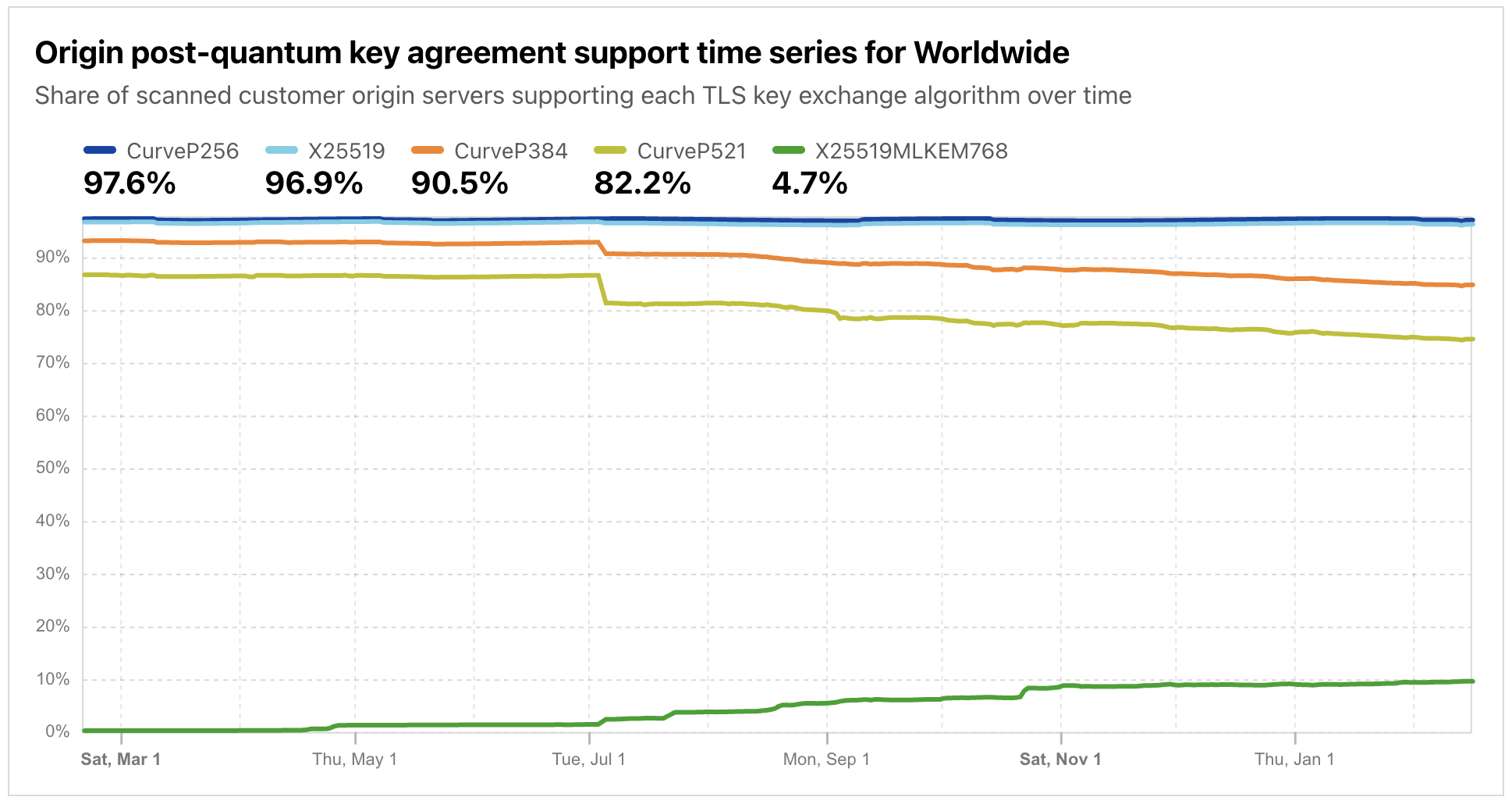
As shown in the graphs above, approximately 10% of origins could benefit from a post-quantum-preferred key agreement today. This represents a significant jump from less than 1% at the start of 2025 — a 10x increase in just over a year. We expect this number to grow steadily as the industry continues its migration. This upward trend likely accelerated in 2025 as many server-side TLS libraries, such as OpenSSL 3.5.0+, GnuTLS 3.8.9+, and Go 1.24+, enabled hybrid post-quantum key exchange by default, allowing platforms and services to support post-quantum connections simply by upgrading their cryptographic library dependencies.

In addition to the Radar and Data Explorer graphs, the origin readiness data is available through the Radar API as well.

As an additional part of our efforts to help the Internet transition to post-quantum cryptography, we are also launching a tool to test whether a specific hostname supports post-quantum encryption. These tests can be run against any publicly accessible website, as long as they allow connections from Cloudflare’s egress IP address ranges

A screenshot of the tool in Radar to test whether a hostname supports post-quantum encryption.

The tool presents a simple form where users can enter a hostname (such as cloudflare.com or www.wikipedia.org) and optionally specify a custom port (the default is 443, the standard HTTPS port). After clicking "Test", the result displays a tag indicating PQ support status alongside the negotiated TLS key exchange algorithm. If the server prefers PQ secure connections, a green "PQ" tag appears with a message confirming the connection is "post-quantum secure." Otherwise, a red tag indicates the connection is "not post-quantum secure", showing the classical algorithm that was negotiated.

Under the hood, this tool uses Cloudflare Containers — a new capability that allows running container workloads alongside Workers. Since the Workers runtime is not exposed to details of the underlying TLS handshake, Workers cannot initiate TLS scans. Therefore, we created a Go container that leverages the crypto/tls package's support for post-quantum compatibility checks. The container runs on-demand and performs the actual handshake to determine the negotiated TLS key exchange algorithm, returning results through the Radar API.

With the addition of these origin-facing insights, complementing the existing client-facing insights, we have moved all the post-quantum content to its own section on Radar

Securing E2EE messaging systems with Key Transparency

End-to-end encrypted (E2EE) messaging apps like WhatsApp and Signal have become essential tools for private communication, relied upon by billions of people worldwide. These apps use public-key cryptography to ensure that only the sender and recipient can read the contents of their messages — not even the messaging service itself. However, there's an often-overlooked vulnerability in this model: users must trust that the messaging app is distributing the correct public keys for each contact.

If an attacker were able to substitute an incorrect public key in the messaging app's database, they could intercept messages intended for someone else — all without the sender knowing.

Key Transparency addresses this challenge by creating an auditable, append-only log of public keys — similar in concept to Certificate Transparency for TLS certificates. Messaging apps publish their users' public keys to a transparency log, and independent third parties can verify and vouch that the log has been constructed correctly and consistently over time. In September 2024, Cloudflare announced such a Key Transparency auditor for WhatsApp, providing an independent verification layer that helps ensure the integrity of public key distribution for the messaging app's billions of users.

Today, we're publishing Key Transparency audit data in a new Key Transparency section on Cloudflare Radar. This section showcases the Key Transparency logs that Cloudflare audits, giving researchers, security professionals, and curious users a window into the health and activity of these critical systems.

The new page launches with two monitored logs: WhatsApp and Facebook Messenger Transport. Each monitored log is displayed as a card containing the following information:

  • Status: Indicates whether the log is online, in initialization, or disabled. An "online" status means the log is actively publishing key updates into epochs that Cloudflare audits. (An epoch represents a set of updates applied to the key directory at a specific time.)

  • Last signed epoch: The most recent epoch that has been published by the messaging service's log and acknowledged by Cloudflare. By clicking on the eye icon, users can view the full epoch data in JSON format, including the epoch number, timestamp, cryptographic digest, and signature.

  • Last verified epoch: The most recent epoch that Cloudflare has verified. Verification involves checking that the transition of the transparency log data structure from the previous epoch to the current one represents a valid tree transformation — ensuring the log has been constructed correctly. The verification timestamp indicates when Cloudflare completed its audit.

  • Root: The current root hash of the Auditable Key Directory (AKD) tree. This hash cryptographically represents the entire state of the key directory at the current epoch. Like the epoch fields, users can click to view the complete JSON response from the auditor.

The data shown on the page is also available via the Key Transparency Auditor API, with endpoints for auditor information and namespaces.

If you would like to perform audit proof verification yourself, you can follow the instructions in our Auditing Key Transparency blog post. We hope that these use cases are the first of many that we publish in this Key Transparency section in Radar — if your company or organization is interested in auditing for your public key or related infrastructure, you can reach out to us here.

Tracking RPKI ASPA adoption

While the Border Gateway Protocol (BGP) is the backbone of Internet routing, it was designed without built-in mechanisms to verify the validity of the paths it propagates. This inherent trust has long left the global network vulnerable to route leaks and hijacks, where traffic is accidentally or maliciously detoured through unauthorized networks.

Although RPKI and Route Origin Authorizations (ROAs) have successfully hardened the origin of routes, they cannot verify the path traffic takes between networks. This is where ASPA (Autonomous System Provider Authorization) comes in. ASPA extends RPKI protection by allowing an Autonomous System (AS) to cryptographically sign a record listing the networks authorized to propagate its routes upstream. By validating these Customer-to-Provider relationships, ASPA allows systems to detect invalid path announcements with confidence and react accordingly.

While the specific IETF standard remains in draft, the operational community is moving fast. Support for creating ASPA objects has already landed in the portals of Regional Internet Registries (RIRs) like ARIN and RIPE NCC, and validation logic is available in major software routing stacks like OpenBGPD and BIRD.

To provide better visibility into the adoption of this emerging standard, we have added comprehensive RPKI ASPA support to the Routing section of Cloudflare Radar. Tracking these records globally allows us to understand how quickly the industry is moving toward better path validation.
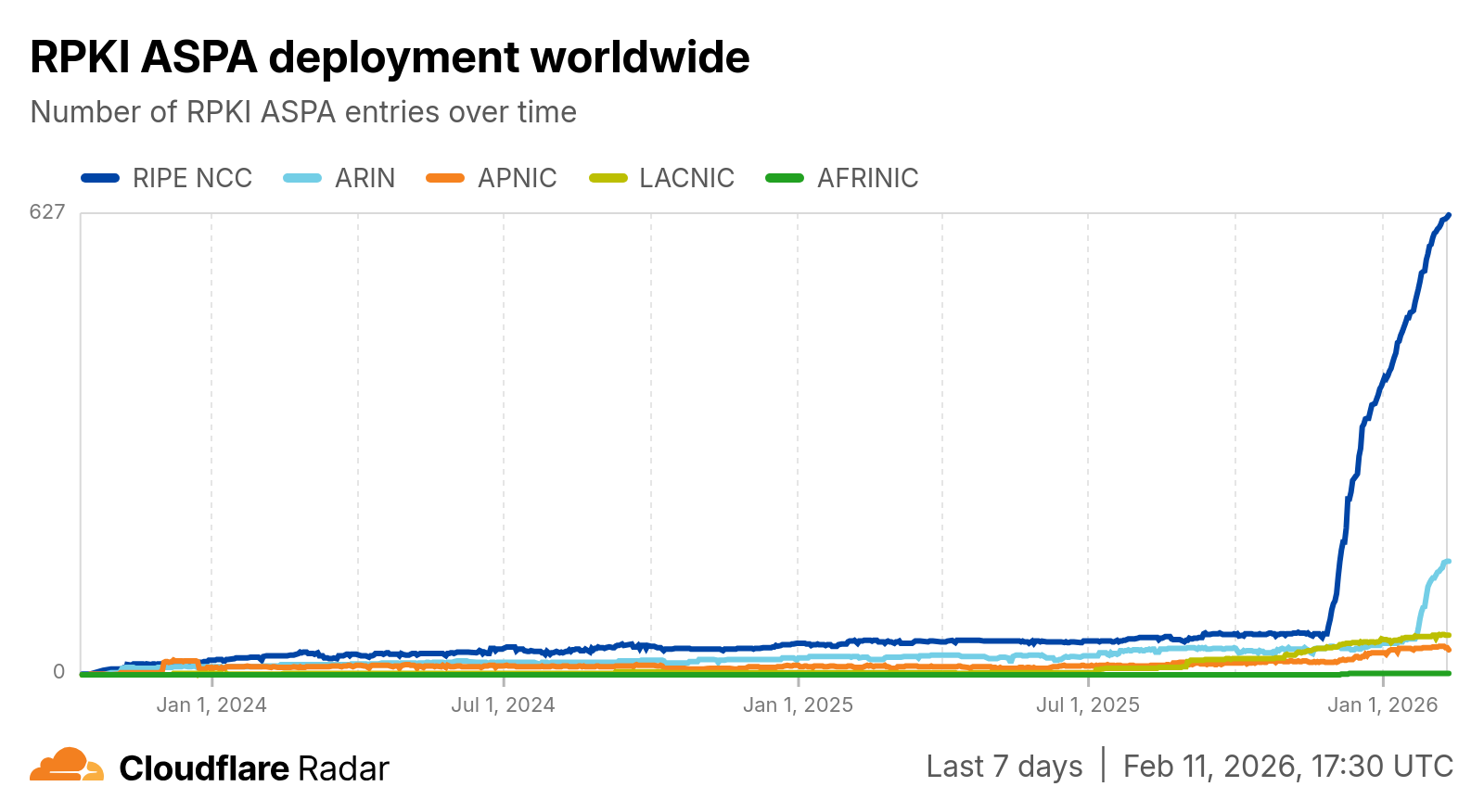
Our new ASPA deployment view allows users to examine the growth of ASPA adoption over time, with the ability to visualize trends across the five Regional Internet Registries (RIRs) based on AS registration. You can view the entire history of ASPA entries, dating back to October 1, 2023, or zoom into specific date ranges to correlate spikes in adoption with industry events, such as the introduction of ASPA features on ARIN and RIPE NCC online dashboards.

Beyond aggregate trends, we have also introduced a granular, searchable explorer for real-time ASPA content. This table view allows you to inspect the current state of ASPA records, searchable by AS number, AS name, or by filtering for only providers or customer ASNs. This allows network operators to verify that their records are published correctly and to view other networks’ configurations.
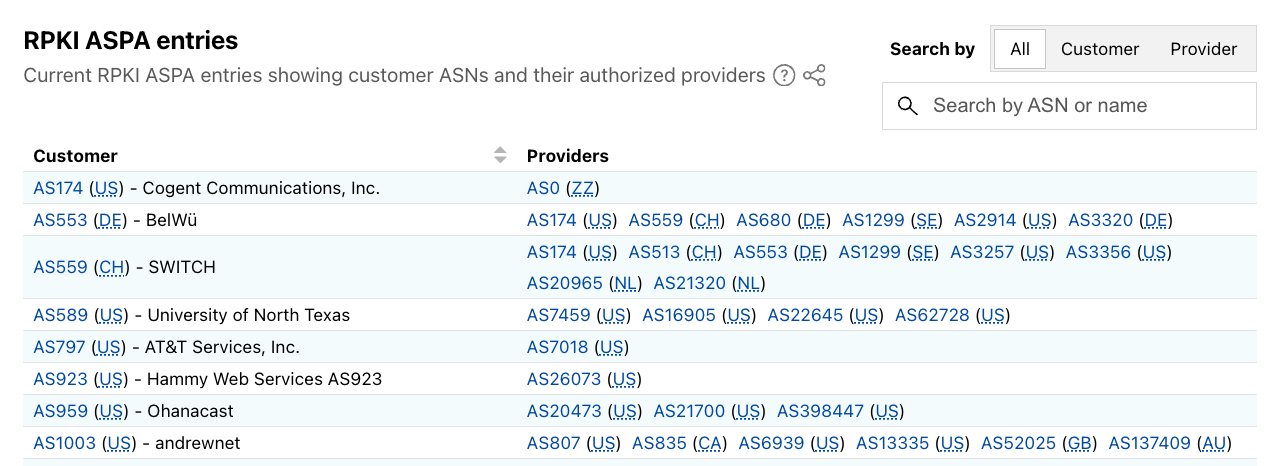
We have also integrated ASPA data directly into the country/region routing pages. Users can now track how different locations are progressing in securing their infrastructure, based on the associated ASPA records from the customer ASNs registered locally.

On individual AS pages, we have updated the Connectivity section. Now, when viewing the connections of a network, you may see a visual indicator for "ASPA Verified Provider." This annotation confirms that an ASPA record exists authorizing that specific upstream connection, providing an immediate signal of routing hygiene and trust.
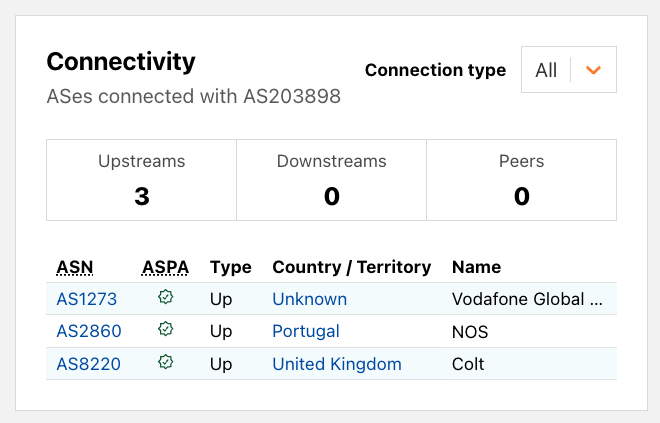
For ASes that have deployed ASPA, we now display a complete list of authorized provider ASNs along with their details. Beyond the current state, Radar also provides a detailed timeline of ASPA activity involving the AS. This history distinguishes between changes initiated by the AS itself ("As customer") and records created by others designating it as a provider ("As provider"), allowing users to immediately identify when specific routing authorizations were established or modified.
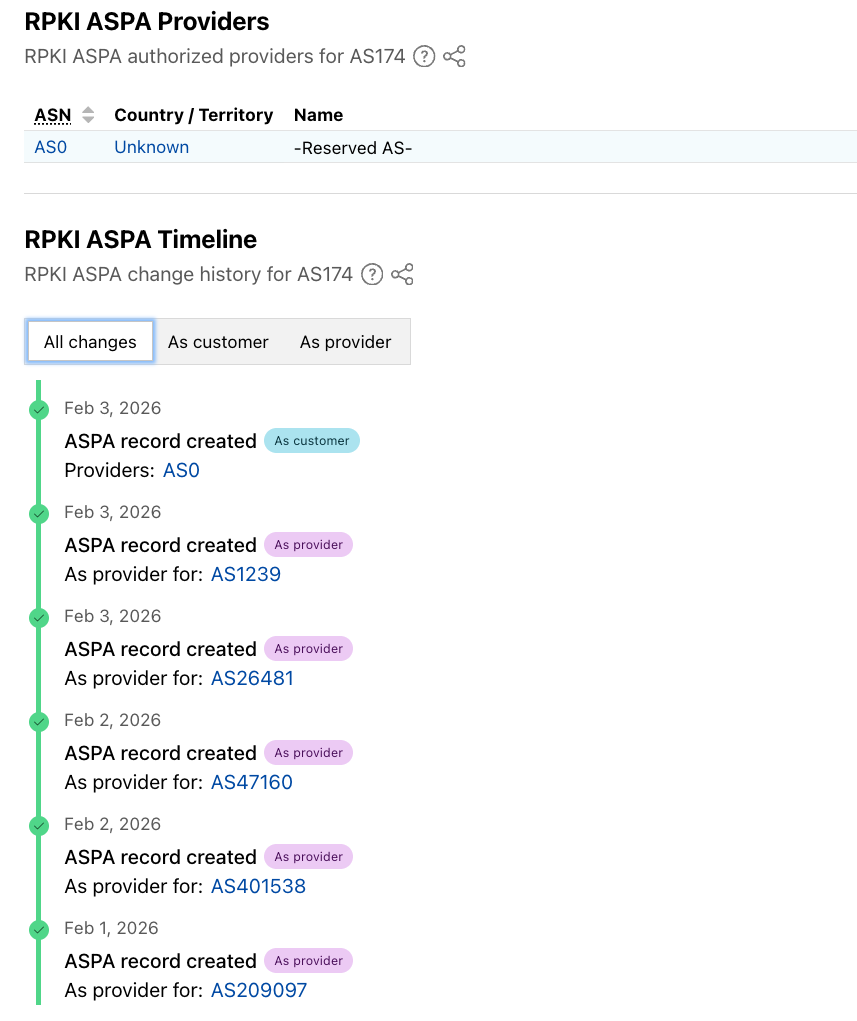
Visibility is an essential first step toward broader adoption of emerging routing security protocols like ASPA. By surfacing this data, we aim to help operators deploy protections and assist researchers in tracking the Internet's progress toward a more secure routing path. For those who need to integrate this data into their own workflows or perform deeper analysis, we are also exposing these metrics programmatically. Users can now access ASPA content snapshots, historical timeseries, and detailed changes data using the newly introduced endpoints in the Cloudflare Radar API.

As security evolves, so does our data

Internet security continues to evolve, with new approaches, protocols, and standards being developed to ensure that information, applications, and networks remain secure. The security data and insights available on Cloudflare Radar will continue to evolve as well. The new sections highlighted above serve to expand existing routing security, transparency, and post-quantum insights already available on Cloudflare Radar. 

If you share any of these new charts and graphs on social media, be sure to tag us: @CloudflareRadar (X), noc.social/@cloudflareradar (Mastodon), and radar.cloudflare.com (Bluesky). If you have questions or comments, or suggestions for data that you’d like to see us add to Radar, you can reach out to us on social media, or contact us via email.

Automatically Secure: how we upgraded 6,000,000 domains by default to get ready for the Quantum Future

The Internet is in constant motion. Sites scale, traffic shifts, and attackers adapt. Security that worked yesterday may not be enough tomorrow. That’s why the technologies that protect the web — such as Transport Layer Security (TLS) and emerging post-quantum cryptography (PQC) — must also continue to evolve. We want to make sure that everyone benefits from this evolution automatically, so we enabled the strongest protections by default.

During Birthday Week 2024, we announced Automatic SSL/TLS: a service that scans origin server configurations of domains behind Cloudflare, and automatically upgrades them to the most secure encryption mode they support. In the past year, this system has quietly strengthened security for more than 6 million domains — ensuring Cloudflare can always connect to origin servers over the safest possible channel, without customers lifting a finger.

Now, a year after we started enabling Automatic SSL/TLS, we want to talk about these results, why they matter, and how we’re preparing for the next leap in Internet security.

The Basics: TLS protocol

Before diving in, let’s review the basics of Transport Layer Security (TLS). The protocol allows two strangers (like a client and server) to communicate securely.

Every secure web session begins with a TLS handshake. Before a single byte of your data moves across the Internet, servers and clients need to agree on a shared secret key that will protect the confidentiality and integrity of your data. The key agreement handshake kicks off with a TLS ClientHello message. This message is the browser/client announcing, “Here’s who I want to talk to (via SNI), and here are the key agreement methods I understand.” The server then proves who it is with its own credentials in the form of a certificate, and together they establish a shared secret key that will protect everything that follows. 

TLS 1.3 added a clever shortcut: instead of waiting to be told which method to use for the shared key agreement, the browser can guess what key agreement the server supports, and include one or more keyshares right away. If the guess is correct, the handshake skips an extra round trip and the secure connection is established more quickly. If the guess is wrong, the server responds with a HelloRetryRequest (HRR), telling the browser which key agreement method to retry with. This speculative guessing is a major reason TLS 1.3 is so much faster than TLS 1.2.

Once both sides agree, the chosen keyshare is used to create a shared secret that encrypts the messages they exchange and allows only the right parties to decrypt them.

The nitty-gritty details of key agreement

Up until recently, most of these handshakes have relied on elliptic curve cryptography (ECC) using a curve known as X25519. But looming on the horizon are quantum computers, which could one day break ECC algorithms like X25519 and others. To prepare, the industry is shifting toward post-quantum key agreement with MLKEM, deployed in a hybrid mode (X25519 + MLKEM). This ensures that even if quantum machines arrive, harvested traffic today can’t be decrypted tomorrow. X25519 + MLKEM is steadily rising to become the most popular key agreement for connections to Cloudflare.

The TLS handshake model is the foundation for how we encrypt web communications today. The history of TLS is really the story of iteration under pressure. It’s a protocol that had to keep evolving, so trust on the web could keep pace with how Internet traffic has changed. It’s also what makes technologies like Cloudflare’s Automatic SSL/TLS possible, by abstracting decades of protocol battles and crypto engineering into a single click, so customer websites can be secured by default without requiring every operator to be a cryptography expert.

History Lesson: Stumbles and Standards

Early versions of TLS (then called SSL) in the 1990s suffered from weak keys, limited protection against attacks like man-in-the-middle, and low adoption on the Internet. To stabilize things, the IETF stepped in and released TLS 1.0, followed by TLS 1.1 and 1.2 through the 2000s. These versions added stronger ciphers and patched new attack vectors, but years of fixes and extensions left the protocol bloated and hard to evolve.

The early 2010s marked a turning point. After the Snowden disclosures, the Internet doubled down on encryption by default. Initiatives like Let’s Encrypt, the mass adoption of HTTPS, and Cloudflare’s own commitment to offer SSL/TLS for free turned encryption from optional, expensive, and complex into an easy baseline requirement for a safer Internet.

All of this momentum led to TLS 1.3 (2018), which cut away legacy baggage, locked in modern cipher suites, and made encrypted connections nearly as fast as the underlying transport protocols like TCP—and sometimes even faster with QUIC.

The CDN Twist

As Content Delivery Networks (CDNs) rose to prominence, they reshaped how TLS was deployed. Instead of a browser talking directly to a distant server hosting content (what Cloudflare calls an origin), it now spoke to the nearest edge data center, which may in-turn speak to an origin server on the client’s behalf.

This created two distinct TLS layers:

  • Edge ↔ Browser TLS: The front door, built to quickly take on new improvements in security and performance. Edges and browsers adopt modern protocols (TLS 1.3, QUIC, session resumption) to cut down on latency.

  • Edge ↔ Origin TLS: The backhaul, which must be more flexible. Origins might be older, more poorly maintained, run legacy TLS stacks, or require custom certificate handling.

In practice, CDNs became translators: modernizing encryption at the edge while still bridging to legacy origins. It’s why you can have a blazing-fast TLS 1.3 session from your phone, even if the origin server behind the CDN hasn’t been upgraded in years. 

This is where Automatic SSL/TLS sits in the story of how we secure Internet communications. 

Automatic SSL/TLS 

Automatic SSL/TLS grew out of Cloudflare’s mission to ensure the web was as encrypted as possible. While we had initially spent an incredibly long time developing secure connections for the “front door” (from browsers to Cloudflare’s edge) with Universal SSL, we knew that the “back door” (from Cloudflare’s edge to origin servers) would be slower and harder to upgrade. 

One option we offered was Cloudflare Tunnel, where a lightweight agent runs near the origin server and tunnels traffic securely back to Cloudflare. This approach ensures the connection always uses modern encryption, without requiring changes on the origin itself.

But not every customer uses Tunnel. Many connect origins directly to Cloudflare’s edge, where encryption depends on the origin server’s configuration. Traditionally this meant customers had to either manually select an encryption mode that worked for their origin server or rely on the default chosen by Cloudflare. 

To improve the experience of choosing an encryption mode, we introduced our SSL/TLS Recommender in 2021.

The Recommender scanned customer origin servers and then provided recommendations for their most secure encryption mode. For example, if the Recommender detected that an origin server was using a certificate signed by a trusted Certificate Authority (CA) such as Let’s Encrypt, rather than a self-signed certificate, it would recommend upgrading from Full encryption mode to Full (Strict) encryption mode.

Based on how the origin responded, Recommender would tell customers if they could improve their SSL/TLS encryption mode to be more secure. The following encryption modes represent what the SSL/TLS Recommender could recommend to customers based on their origin responses: 

SSL/TLS mode

HTTP from visitor

HTTPS from visitor

Off

HTTP to Origin

HTTP to Origin

Flexible

HTTP to Origin

HTTP to Origin

Full

HTTP to Origin

HTTPS to Origin without certification validation check

Full (strict)

HTTP to Origin

HTTPS to Origin with certificate validation check

Strict (SSL-only origin pull)

HTTPS to Origin with certificate validation check

HTTPS to Origin with certificate validation check

However, in the three years after launching our Recommender we discovered something troubling: of the over two million domains using Recommender, only 30% of the recommendations that the system provided were followed. A significant number of users would not complete the next step of pushing the button to inform Cloudflare that we could communicate with their origin over a more secure setting. 

We were seeing sub-optimal settings that our customers could upgrade from without risk of breaking their site, but for various reasons, our users did not follow through with the recommendations. So we pushed forward by building a system that worked with Recommender and actioned the recommendations by default. 

How does Automatic SSL/TLS work? 

Automatic SSL/TLS works by crawling websites, looking for content over both HTTP and HTTPS, then comparing the results for compatibility. It also performs checks against the TLS certificate presented by the origin and looks at the type of content that is served to ensure it matches. If the downloaded content matches, Automatic SSL/TLS elevates the encryption level for the domain to the compatible and stronger mode, without risk of breaking the site.

More specifically, these are the steps that Automatic SSL/TLS takes to upgrade domain’s security: 

  1. Each domain is scheduled for a scan once per month (or until it reaches the maximum supported encryption mode).

  2. The scan evaluates the current encryption mode for the domain. If it’s lower than what the Recommender thinks the domain can support based on the results of its probes and content scans, the system begins a gradual upgrade.

  3. Automatic SSL/TLS begins to upgrade the domain by connecting with origins over the more secure mode starting with just 1% of its traffic.

  4. If connections to the origin succeed, the result is logged as successful.

    1. If they fail, the system records the failure to Cloudflare’s control plane and aborts the upgrade. Traffic is immediately downgraded back to the previous SSL/TLS setting to ensure seamless operation.

  5. If no issues are found, the new SSL/TLS encryption mode is applied to traffic in 10% increments until 100% of traffic uses the recommended mode.

  6. Once 100% of traffic has been successfully upgraded with no TLS-related errors, the domain’s SSL/TLS setting is permanently updated.

  7. Special handling for Flexible → Full/Strict: These upgrades are more cautious because customers’ cache keys are changed (from http to https origin scheme).

    1. In this situation, traffic ramps up from 1% to 10% in 1% increments, allowing customers’ cache to warm-up.

    2. After 10%, the system resumes the standard 10% increments until 100%.

We know that transparency and visibility are critical, especially when automated systems make changes. To keep customers informed, Automatic SSL/TLS sends a weekly digest to account Super Administrators whenever updates are made to domain encryption modes. This way, you always have visibility into what changed and when.  

In short, Automatic SSL/TLS automates what used to be trial and error: finding the strongest SSL/TLS mode your site can support while keeping everything working smoothly.

How are we doing so far?  

So far we have onboarded all Free, Pro, and Business domains to use Automatic SSL/TLS. We also have enabled this for all new domains that will onboard onto Cloudflare regardless of plantype. Soon, we will start onboarding Enterprise customers as well. If you already have an Enterprise domain and want to try out Automatic SSL/TLS we encourage you to enable it in the SSL/TLS section of the dashboard or via the API. 

As of the publishing of this blog, we’ve upgraded over 6 million domains to be more secure without the website operators needing to manually configure anything on Cloudflare. 

Previous Encryption Mode

Upgraded Encryption Mode

Number of domains

Flexible

Full

~ 2,200,000

Flexible

Full (strict)

~ 2,000,000

Full 

Full (strict)

~ 1,800,000

Off

Full

~ 7,000

Off

Full (strict)

~ 5,000

We’re most excited about the over 4 million domains that moved from Flexible or Off, which uses HTTP to origin servers, to Full or Strict, which uses HTTPS. 

If you have a reason to use a particular encryption mode (e.g., on a test domain that isn’t production ready) you can always disable Automatic SSL/TLS and manually set the encryption mode that works best for your use case.

Today, SSL/TLS mode works on a domain-wide level, which can feel blunt. This means that one suboptimal subdomain can keep the entire domain in a less secure TLS setting, to ensure availability. Our long-term goal is to make these controls more precise, so that Automatic SSL/TLS and encryption modes can optimize security per origin or subdomain, rather than treating every hostname the same.

Impact on origin-facing connections

Since we began onboarding domains to Automatic SSL/TLS in late 2024 and early 2025, we’ve been able to measure how origin connections across our network are shifting toward stronger security. Looking at the ratios across all origin requests, the trends are clear:

  • Encryption is rising. Plaintext connections are steadily declining, a reflection of Automatic SSL/TLS helping millions of domains move to HTTPS by default. We’ve seen a correlated 7-8% reduction in plaintext origin-bound connections. Still, some origins remain on outdated configurations, and these should be upgraded to keep pace with modern security expectations.

  • TLS 1.3 is surging. Since late 2024, TLS 1.3 adoption has climbed sharply, now making up the majority of encrypted origin traffic (almost 60%). While Automatic SSL/TLS doesn’t control which TLS version an origin supports, this shift is an encouraging sign for both performance and security.

  • Older versions are fading. Month after month, TLS 1.2 continues to shrink, while TLS 1.0 and 1.1 are now so rare they barely register.

The decline in plaintext connections is encouraging, but it also highlights a long tail of servers still relying on outdated packages or configurations. Sites like SSL Labs can be used, for instance, to check a server’s TLS configuration. However, simply copy-pasting settings to achieve a high rating can be risky, so we encourage customers to review their origin TLS configurations carefully. In addition, Cloudflare origin CA or Cloudflare Tunnel can help provide guidance for upgrading origin security.

Upgraded domain results

Instead of focusing on the entire network of origin-facing connections from Cloudflare, we’re now going to drill into specific changes that we’ve seen from domains that have been upgraded by Automatic SSL/TLS

By January 2025, most domains had been enrolled in Automatic SSL/TLS, and the results were dramatic: a near 180-degree shift from plaintext to encrypted communication with origins. After that milestone, traffic patterns leveled off into a steady plateau, reflecting a more stable baseline of secure connections across the network. There is some drop in encrypted traffic which may represent some of the originally upgraded domains manually turning off Automatic SSL/TLS.

But the story doesn’t end there. In the past two months (July and August 2025), we’ve observed another noticeable uptick in encrypted origin traffic. This likely reflects customers upgrading outdated origin packages and enabling stronger TLS support—evidence that Automatic SSL/TLS not only raised the floor on encryption but continues nudging the long tail of domains toward better security.

To further explore the “encrypted” line above, we wanted to see what the delta was between TLS 1.2 and 1.3. Originally we wanted to include all TLS versions we support but the levels of 1.0 and 1.1 were so small that they skewed the graph and were taken out. We see a noticeable rise in the support for both TLS 1.2 and 1.3 between Cloudflare and origin servers. What is also interesting to note here is the network-wide decrease in TLS 1.2 but for the domains that have been automatically upgraded a generalized increase, potentially also signifying origin TLS stacks that could be updated further.

Finally, for Full (Strict) mode, we wanted to investigate the number of successful certificate validations we performed. This line shows a dramatic, approximately 40%, increase in successful certificate validations performed for customers upgraded by Automatic SSL/TLS. 

We’ve seen a largely successful rollout of Automatic SSL/TLS so far, with millions of domains upgraded to stronger encryption by default. We’ve seen help Automatic SSL/TLS improve origin-facing security, safely pushing connections to stronger modes whenever possible, without risking site breakage. Looking ahead, we’ll continue to expand this capability to more customer use cases as we help to build a more encrypted Internet.

What will we build next for Automatic SSL/TLS? 

We’re expanding Automatic SSL/TLS with new features that give customers more visibility and control, while keeping the system safe by default. First, we’re building an ad-hoc scan option that lets you rescan your origin earlier than the standard monthly cadence. This means if you’ve just rotated certificates, upgraded your origin’s TLS configuration, or otherwise changed how your server handles encryption, you won’t need to wait for the next scheduled pass—Cloudflare will be able to re-evaluate and move you to a stronger mode right away.

In addition, we’re working on error surfacing that will highlight origin connection problems directly in the dashboard and provide actionable guidance for remediation. Instead of discovering after the fact that an upgrade failed, or a change on the origin resulted in a less secure setting than what was set previously, customers will be able to see where the issue lies and how to fix it. 

Finally, for newly onboarded domains, we plan to add clearer guidance on when to finish configuring the origin before Cloudflare runs its first scan and sets an encryption mode. Together, these improvements are designed to reduce surprises, give customers more agency, and ensure smoother upgrades. We expect all three features to roll out by June 2026.

Post Quantum Era

Looking ahead, quantum computers introduce a serious risk: data encrypted today can be harvested and decrypted years later once quantum attacks become practical. To counter this harvest-now, decrypt-later threat, the industry is moving towards post-quantum cryptography (PQC)—algorithms designed to withstand quantum attacks. We have extensively written on this subject in our previous blogs.

In August 2024, NIST finalized its PQC standards: ML-KEM for key agreement, and ML-DSA and SLH-DSA for digital signatures. In collaboration with industry partners, Cloudflare has helped drive the development and deployment of PQC. We have deployed the hybrid key agreement, combining ML-KEM (post-quantum secure) and X25519 (classical), to secure TLS 1.3 traffic to our servers and internal systems. As of mid-September 2025, around 43% of human-generated connections to Cloudflare are already protected with the hybrid post-quantum secure key agreement – a huge milestone in preparing the Internet for the quantum era.

But things look different on the other side of the network. When Cloudflare connects to origins, we act as the client, navigating a fragmented landscape of hosting providers, software stacks, and middleboxes. Each origin may support a different set of cryptographic features, and not all are ready for hybrid post-quantum handshakes.

To manage this diversity without the risk of breaking connections, we relied on HelloRetryRequest. Instead of sending post-quantum keyshare immediately in the ClientHello, we only advertise support for it. If the origin server supports the post-quantum key agreement, it uses HelloRetryRequest to request it from Cloudflare, and creates the post-quantum connection. The downside is this extra round trip (from the retry) cancels out the performance gains of TLS 1.3 and makes the connection feel closer to TLS 1.2 for uncached requests.

Back in 2023, we launched an API endpoint, so customers could manually opt their origins into preferring post-quantum connections. If set, we avoid the extra roundtrip and try to create a post-quantum connection at the start of the TLS session. Similarly, we extended post-quantum protection to Cloudflare tunnel, making it one of the easiest ways to get origin-facing PQ today.

Starting Q4 2025, we’re taking the next step – making it automatic. Just as we’ve done with SSL/TLS upgrades, Automatic SSL/TLS will begin testing, ramping, and enabling post-quantum handshakes with origins—without requiring customers to change a thing, as long as their origins support post-quantum key agreement.

Behind the scenes, we’re already scanning active origins about every 24 hours to test support and preferences for both classical and post-quantum key agreements. We’ve worked directly with vendors and customers to identify compatibility issues, and this new scanning system will be fully integrated into Automatic SSL/TLS.

And the benefits won't stop at post-quantum. Even for classical handshakes, optimization matters. Today, the X25519 algorithm is used by default, but our scanning data shows that more than 6% of origins currently prefer a different key agreement algorithm, which leads to unnecessary HelloRetryRequests and wasted round trips. By folding this scanning data into Automatic SSL/TLS, we’ll improve connection establishment for classical TLS as well—squeezing out extra speed and reliability across the board.

As enterprises and hosting providers adopt PQC, our preliminary scanning pipeline has already found that around 4% of origins could benefit from a post-quantum-preferred key agreement even today, as shown below. This is an 8x increase since we started our scans in 2023. We expect this number to grow at a steady pace as the industry continues to migrate to post-quantum protocols.

As part of this change, we will also phase out support for the pre-standard version X25519Kyber768 to support the final ML-KEM standard, again using a hybrid, from edge to origin connections.

With Automatic SSL/TLS, we will soon by default scan your origins proactively to directly send the most preferred keyshare to your origin removing the need for any extra roundtrip, improving both security and performance of your origin connections collectively.

At Cloudflare, we’ve always believed security is a right, not a privilege. From Universal SSL to post-quantum cryptography, our mission has been to make the strongest protections free and available to everyone. Automatic SSL/TLS is the next step—upgrading every domain to the best protocols automatically. Check the SSL/TLS section of your dashboard to ensure it’s enabled and join the millions of sites already secured for today and ready for tomorrow.

❌