Visualização de leitura

Cibersegurança virou tema de sobrevivência eleitoral

SEGURANÇA DA INFORMAÇÃO · CAMPANHAS POLÍTICAS — MATRIX AWARENESS
CYBER POLITICAL SECURITY — ASSESSORIA TÉCNICA
AWARENESS Nº 04 / 2026 — SEGURANÇA DA INFORMAÇÃO ELEITORAL

// RELATÓRIO TÉCNICO · CAMPANHAS E COMITÊS ELEITORAIS

Sites, e-mails, redes sociais e bases de eleitores formam a espinha dorsal de qualquer campanha. Quando essa infraestrutura falha, a eleição falha junto. Este awareness organiza o papel do analista de segurança, as políticas internas do comitê e os casos que provam o custo de negligenciar o tema.

5+ estados atendidos com equipes dedicadas, sem incidentes registrados
24h é a janela crítica de resposta a um vazamento ou conta sequestrada
1 clique de um voluntário é a origem da maioria dos incidentes de campanha
01

O papel do analista de segurança na campanha

Não é um técnico que "cuida dos computadores". É a função que atravessa infraestrutura, reputação, resposta a crise e cultura interna da equipe — as cinco frentes abaixo.

Proteção de infraestrutura

Sites, servidores, e-mails institucionais, aplicativos internos e dispositivos usados pela equipe.

Monitoramento reputacional

Acompanhamento contínuo de menções em redes sociais, portais e grupos privados, para flagrar ataques coordenados antes que ganhem escala.

Análise de calúnias e desinformação

Triagem técnica e jurídica de montagens, vídeos manipulados e conteúdos com IA, sustentando notificações e pedidos de remoção ao TSE e às plataformas.

Resposta a incidentes

Plano de ação para vazamento de dados, invasão de contas e ataques de negação de serviço, com protocolo claro para as primeiras horas.

Governança e treinamento da equipe

A maior parte dos incidentes não nasce de um hacker genial, mas de um voluntário que clicou no link errado ou reutilizou uma senha. A maioria dos vazamentos tem origem dentro da própria campanha, por negligência ou descuido — não por sofisticação do atacante. Não basta um bom firewall: é preciso cultura de segurança em todo o comitê.

02

Políticas de segurança para o time do partido

Um comitê organizado tem políticas escritas — não improvisadas. Sete cláusulas mínimas para qualquer equipe de campanha.

Gestão de acesso

Cada função tem permissões diferentes; ninguém acumula acesso total, e tudo é revogado no desligamento.

Autenticação forte

Senhas únicas por serviço, gerenciador corporativo e 2FA obrigatório em e-mail e redes sociais.

Segurança de e-mail

Filtro antiphishing e protocolo claro para links e anexos suspeitos — o vetor de ataque mais comum.

Segurança de dispositivos

Notebooks e celulares institucionais com criptografia, backup automático e apagamento remoto.

Proteção do site oficial

SSL, monitoramento de uptime, backups regulares e testes de vulnerabilidade contra defacement.

Conformidade com a LGPD eleitoral

Tratamento adequado da base de eleitores conforme diretrizes conjuntas do TSE e da ANPD.

Protocolo de resposta a crise

Manual de 24 horas: quem aciona o jurídico, quem notifica plataformas, quem fala com a imprensa.

03

Redes sociais: estratégia e regras do TSE

A presença digital do candidato é, ao mesmo tempo, o maior ativo da campanha e a maior superfície de ataque. O que é publicado precisa de cuidado; comentários e haters precisam de mitigação.

  • Contas oficiais verificadas nas plataformas, evitando perfis falsos que se passam pelo candidato — prática comum em disputas acirradas.
  • Ferramentas homologadas de análise — Meta Business Suite, TikTok Ads Manager, X Ads, YouTube Studio — para métricas confiáveis de alcance e origem de tráfego.
  • Registro técnico de evidências — prints, hashes de arquivo, metadados — sempre que um conteúdo ofensivo é identificado, para sustentar denúncia na Justiça Eleitoral.
  • Cuidado com o que é publicado — todo post, story ou vídeo passa por revisão antes de ir ao ar. Conteúdo digital é permanente e pode ser usado contra a campanha.
  • Mitigação de comentários e haters — equipe dedicada a moderar, ocultar ou denunciar ataques coordenados; não engajar em provocações; documentar padrões de ódio para denúncia.
⚠ ACOMPANHAMENTO OBRIGATÓRIO As resoluções do TSE sobre propaganda em redes sociais mudam a cada eleição — impulsionamento pago, identificação de conteúdo patrocinado, uso de inteligência artificial em peças e prazos de remoção de conteúdo irregular. O comitê precisa de alguém acompanhando as normas em tempo real, não descobrindo a regra depois de multado.

Um relatório da ABIN citado pela imprensa especializada projeta que as eleições brasileiras de 2026 vão enfrentar ataques com uso de inteligência artificial e campanhas de desinformação coordenadas, incluindo possível interferência estrangeira. Monitoramento reputacional deixou de ser "extra" e virou orçamento básico.

04

Casos que decidiram eleições

A história recente mostra, repetidas vezes, que falha de segurança da informação não é um problema técnico isolado — é um problema eleitoral.

2016 · ESTADOS UNIDOS

Vazamento de e-mails da campanha presidencial democrata

A invasão da conta do chefe de campanha e o vazamento de e-mails do comitê nacional alimentaram semanas de cobertura negativa no período decisivo da corrida — referência mundial sobre o custo político de uma conta comprometida.

2018 · ESTADOS UNIDOS

Invasão ao comitê republicano de campanha à Câmara

O comitê confirmou intrusão em seus sistemas de e-mail meses antes da eleição. Depois, a liderança admitiu ter passado a contratar equipe especializada em cibersegurança — reconhecimento tardio de estrutura insuficiente.

2018–2022 · BRASIL

Uso indevido de bases de dados de eleitores

Investigações jornalísticas revelaram o uso abusivo de dados pessoais em campanhas, com bases formadas a partir de vazamentos e fontes irregulares, usadas para disparos em massa — processos no TSE e desgaste de imagem.

2020 · BRASIL

Exposição de bases do TSE em dia de eleição

Hackers divulgaram acesso a sistemas do próprio Tribunal Superior Eleitoral — episódio que reforçou o debate sobre a fragilidade da infraestrutura pública e privada ligada ao processo eleitoral.

RECORRENTE

Sequestro de contas e vídeos falsos gerados por IA

Candidatos perdem o controle de perfis com milhares de seguidores, ou são alvo de vídeos manipulados por IA. Sem protocolo de resposta rápida, a mentira circula dias antes de qualquer desmentido — e, num calendário eleitoral curto, dias perdidos podem ser votos perdidos.

⚠ Em todos os casos, o padrão se repete: o problema não era falta de tecnologia disponível — era falta de investimento prévio em segurança da informação e de um time preparado para agir nas primeiras horas.
05

Proteção e boas práticas — dispositivos e redes

Dicas práticas para blindar a campanha no dia a dia. Dispositivos e redes sociais são os vetores mais explorados.

Dispositivos (notebooks e celulares)

  • Ativar criptografia de disco (BitLocker / FileVault / Android encryption)
  • 2FA em todas as contas institucionais — preferencialmente app authenticator, não SMS
  • Senhas únicas no gerenciador (1Password, Bitwarden corporativo)
  • Backup automático diário e teste de restauração mensal
  • Apagamento remoto configurado (Find My / MDM)
  • Não usar Wi-Fi público sem VPN institucional
  • Atualizar SO e apps no mesmo dia do patch de segurança
  • Separar dispositivo de campanha do uso pessoal

Redes sociais — o que publicar e como moderar

  • Toda publicação passa por revisão antes de ir ao ar
  • Não responder haters em tom de confronto — documentar e denunciar
  • Equipe de moderação com horários definidos (manhã / noite / debate)
  • Ocultar ou restringir comentários que tenham ódio, ameaça ou desinformação
  • Guardar evidências (print + URL + horário) de ataques coordenados
  • Evitar lives improvisadas sem roteiro e sem backup de conexão
  • Desativar localização em stories e posts quando não for necessário
  • Revogar acesso de voluntários e prestadores no fim da campanha

Mitigação de haters e comentários tóxicos

  • Mapear padrões: horários, hashtags e contas repetidas
  • Não amplificar o ataque — não citar o hater no desmentido público
  • Usar filtros de palavras e listas de bloqueio nas plataformas
  • Preparar respostas padrão para fake news recorrentes
  • Escalar para jurídico quando houver crime (ameaça, calúnia, injúria)
  • Treinar a equipe para não engajar emocionalmente

Conteúdo digital — cuidado permanente

  • Assumir que tudo publicado pode ser capturado e reutilizado
  • Evitar dados sensíveis de equipe, agenda ou doações em posts
  • Marcar conteúdo impulsionado conforme regra do TSE
  • Conferir se imagens e vídeos com IA estão identificados quando exigido
  • Manter histórico de versões e aprovação de peças
  • Ter plano de despublicação rápida se houver erro ou vazamento
06

Benefícios para o comitê

Comitês que tratam segurança da informação como prioridade estratégica — não como item de última hora — colhem resultados concretos.

Continuidade da campanha

Site, e-mail e redes funcionando sem interrupção em momentos críticos, como o dia da eleição ou de um debate.

Resposta rápida a fake news

Awareness técnicos prontos aceleram remoção de conteúdo falso junto às plataformas e ao TSE.

Proteção de dados de eleitores

Evita multas e processos por descumprimento da LGPD eleitoral.

Reputação preservada

Um incidente evitável não apaga meses de trabalho da equipe de comunicação.

Tranquilidade da equipe

Candidato e coordenadores focam em estratégia sabendo que a infraestrutura está monitorada.

Credibilidade institucional

Comitês auditados e com políticas claras transmitem profissionalismo a doadores e imprensa.

"Cibersegurança virou tema de sobrevivência eleitoral — não é assunto só do especialista de TI."

A experiência acumulada em atuação com jornalistas, times de web design, estrategistas e produção de conteúdo verificado — em múltiplos estados e candidatos, sem incidentes registrados — mostra que esse modelo funciona quando tratado como prioridade desde o primeiro dia de campanha, e não como reação a uma crise já instalada.

AWARENESS TÉCNICO — USO INTERNO DE COMITÊS E ASSESSORIAS DE CAMPANHA CYBER POLITICAL SECURITY

SonicWall Warns of Two Actively Exploited SMA1000 Zero-Days, One Rated Maximum Severity

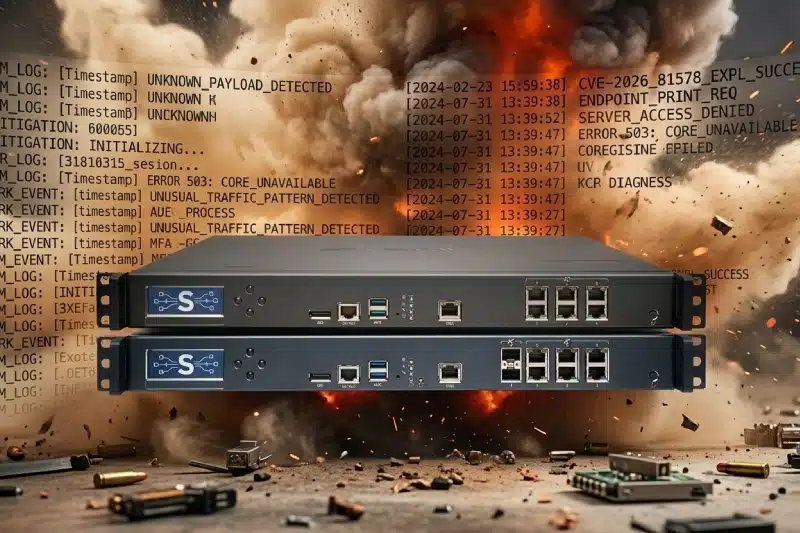
Graphic showing SonicWall SMA1000 devices, CVE-2026-83548, the maximum-severity SonicWall SMA1000 pre-authentication vulnerability

SonicWall disclosed this week that attackers are chaining two previously unknown vulnerabilities in its SMA1000 secure access appliances to run commands on unpatched devices, and urged customers to install an emergency hotfix.

The more severe flaw, CVE-2026-83548, is a pre-authentication server-side request forgery weakness in the appliance's Appliance Work Place interface, rated 10.0 on the CVSS scale. It lets a remote attacker with no credentials reach sensitive internal functionality. The second, CVE-2026-83549, is an operating-system command injection bug in the Appliance Management Console rated 7.8; on its own it requires administrative authentication, but paired with the SSRF flaw it yields remote code execution.

The vendor said it found both issues internally and then observed them being used together in live attacks. SonicWall has not published indicators of compromise or described the attackers.

Affected products are the SMA1000 series 6210, 7210 and 8200v, in both hardware and virtual form. Fixed builds are 12.4.3-03526 and later, and 12.5.0-02952 and later. SonicWall firewalls running SSL-VPN and the separate SMA 100 line are not affected.

Remediation guidance goes beyond patching. SonicWall told customers to contact its support organization to review appliances for signs of intrusion and, where compromise is suspected, to re-image or redeploy the device, rotate all credentials and reset TOTP tokens — an acknowledgment that one-time-password seeds stored on a breached appliance survive a software update. The company said customers should move to the hotfix release as quickly as possible.

Shadowserver Foundation scanning has tracked more than 400 internet-exposed SMA1000 appliances, though an unknown share of those are already patched. The small install base belies the risk profile. These are remote-access gateways that sit at the network edge and hold credentials for the environments behind them.

The disclosure extends a difficult run for the product line. Attackers exploited a separate pair of SMA1000 zero-days in July 2026, tracked as CVE-2026-15409 and CVE-2026-15410, to deploy custom malware; CISA later confirmed ransomware operators were abusing that access.

Read: CISA Adds SonicWall SMA1000 Vulnerabilities to KEV Catalog Following Active Exploitation

Another zero-day surfaced in December 2025. Seventeen SonicWall vulnerabilities across the company's product families currently sit in CISA's Known Exploited Vulnerabilities catalog. Edge appliances from SonicWall, Ivanti, Citrix and Fortinet have collectively become the preferred initial-access route for ransomware affiliates and espionage crews, because they are internet-facing by design and rarely instrumented with endpoint detection.

Two critical Chrome flaws put users at risk on malicious websites

Update September 4, 2026

Shortly after this article was published, Google released another Chrome update that patches an actively exploited flaw in the V8 JavaScript engine, tracked as CVE-2026-85046.

Google rates the vulnerability as high severity and says an exploit already exists in the wild. An attacker could use a crafted HTML page to execute arbitrary code inside the Chrome sandbox. Because it is already being exploited, HKCERT rates the overall risk as extremely high.

After installing the latest update, Chrome should be at version 152.0.7977.82/.83 on Windows and Mac, or 152.0.7977.82 on Linux.

Chrome is rolling out an update for its desktop browser. The update includes 26 security fixes, two of which Google rates as critical use-after-free vulnerabilities.

How to update Chrome

If you don’t want to wait for the rollout to reach you, manually updating is easy.

The easiest option is to allow Chrome to update automatically. But you can end up lagging behind if you never close your browser or if something goes wrong with the update.

To update manually, click the More menu (three dots), then go to Settings > About Chrome. If an update is available, Chrome will start downloading it automatically. Restart Chrome to complete the update, and you’ll be protected against these vulnerabilities.

You can find an explanation of the version numbering system and step-by-step instructions in our guide: How to update Chrome on every operating system.

Technical details

Let’s look at the two critical vulnerabilities. Both are use-after-free (UAF) vulnerabilities. A use-after-free vulnerability occurs when a program attempts to access a memory location after it has been freed. That can cause crashes or, in some cases, allow an attacker to run their own code.

The first, tracked as CVE-2026-84353, was found in Shared Tab Groups and could allow a remote attacker using social engineering to execute arbitrary code outside the browser sandbox via a crafted HTML page. Here, social engineering likely means an attacker would have to lure you to a malicious website or open an email in HTML format.

The other critical vulnerability, tracked as CVE-2026-84352, was found in WebGL. WebGL, short for Web Graphics Library, is a browser technology that lets websites display interactive 2D and 3D graphics. The vulnerability could allow a remote attacker to execute arbitrary code outside the sandbox via a crafted HTML page.

Chrome vulnerabilities that enable remote code execution outside the browser sandbox are particularly valuable to attackers because they can turn a visit to a malicious or compromised website into direct code running on the underlying operating system, often without requiring additional exploitation steps.


Stop threats before they can do any harm.

Malwarebytes Browser Guard blocks phishing pages and malicious sites automatically. Free, one click to install. Add it to your browser →

July 2026 Cyber Attacks Statistics

July 2026 saw 188 confirmed cyber attacks across 69 countries, with financially motivated Cyber Crime driving three in four incidents. Malware remained attackers' weapon of choice, exposed public-facing applications were the most common way in, and Information & Communication infrastructure absorbed the heaviest share of targeting. Here's the full breakdown of who attacked, how, and where.

Patch Tuesday: Update now to fix 421 flaws, including three zero-days

Microsoft’s August 2026 Patch Tuesday addresses 421 Microsoft vulnerabilities, including 62 rated Critical. One Windows vulnerability has been exploited in the wild by the Lazarus group to gain SYSTEM privileges.

The August update is smaller than July’s record-breaking release, but it’s still among Microsoft’s largest Patch Tuesday batches. More importantly, it includes several flaws likely to attract attacker interest: a publicly disclosed Windows privilege escalation flaw with a proof-of-concept (PoC), a newly completed unauthenticated SharePoint remote code execution (RCE) chain, and a potentially wormable Windows DNS Server flaw.

How to apply patches and check if you’re protected

These updates fix security problems and help keep your Windows PC protected. Here’s how to make sure you’re up to date:

  • Click the Start button, then open Settings.
  • Select Windows Update (usually at the bottom of the menu on the left).
  • Click Check for updates. Windows will search for the latest security updates. If you’ve enabled Get the latest updates as soon as they’re available under More options, you may be prompted to restart immediately to complete the update. Otherwise, continue to the next step.
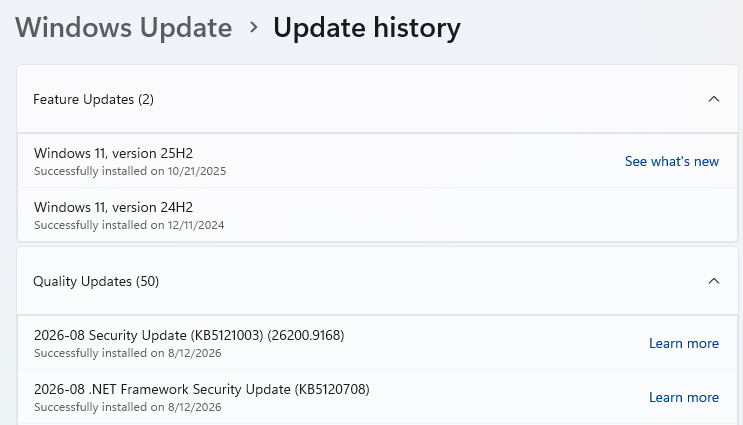
Windows update history - August 12, 2026
  • If updates are available, they’ll start downloading automatically. When they’re ready, click Install or Restart now if prompted. Your computer may need a restart to finish the update.
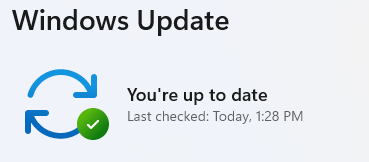
  • After restarting, go back to Windows Update and check again. If it says You’re up to date, you’re all set.
Windows up to date

Technical details

Windows Deployment Services (WDS) users should prioritize CVE-2026-62893 (CVSS score 9.8 out of 10), an unauthenticated RCE flaw in the TFTP (Trivial File Transfer Protocol) server. TFTP normally runs on UDP port 69 and has no built-in authentication. It is primarily an enterprise and school network issue, but it could enable lateral movement where WDS is deployed.

Microsoft also fixed CVE-2026-62832, a publicly disclosed elevation of privilege (EoP) vulnerability in the Windows User Profile Service. It maps to the issue researchers called LegacyHive, for which a limited public proof of concept was released in July.

The PoC demonstrates how a local authenticated attacker could abuse the service’s registry hive handling to load another user’s hive, potentially including an administrator’s. The released demonstration is deliberately constrained and requires credentials for another user, but the availability of code and the broad Windows footprint make this one a strong candidate for exploitation attempts.

Another good reason to promptly update is the number (I counted 48) of remote code execution (RCE) fixes for Office applications and components, including Excel, Word, Outlook, PowerPoint, and the Office graphics component. Document-borne vulnerabilities are attractive to phishing operators because email attachments and shared documents provide delivery mechanisms that people are likely to open.


CNET Editors' Choice Award 2026

“One of the best cybersecurity suites on the planet.” 

According to CNET. Read their review


Microsoft Plugs Nearly 400 Security Holes

Microsoft today released updates to remedy at least 398 security vulnerabilities in its Windows operating systems and supported software, including one weakness that is already being actively exploited and two others that were publicly detailed prior to today.

Image: Shutterstock, Mallika Home Studio.

August’s overstuffed bundle of patch joy from Microsoft did not eclipse its recording breaking release of more than 570 security updates last month, but it is double June’s then-record batch of nearly 200 fixes. Microsoft has attributed the recent patch deluge to vulnerability discoveries aided by artificial intelligence, and experts roundly agree that Windows users should get used to the idea of Patch Tuesdays (the second Tuesday of each month) covering hundreds of newly discovered security flaws.

Fully 42 of the 398 flaws that Microsoft patched today earned Redmond’s most-dire “critical” rating, meaning they are severe enough that malware or malcontents could exploit them to gain remote control over a Windows computer with little to no help from the user.

The sole known “zero day” bug fixed by Microsoft this month is CVE-2026-68820, a privilege escalation weakness in a core Windows component called afd.sys, which the security firm Automox describes as “the driver behind Windows socket connections on effectively every endpoint.”

“This isn’t a front-door bug,” Automox’s Landon Miles wrote in a Patch Tuesday blog post. “It’s step two in a chain: an attacker phishes their way into a low-privilege foothold, then uses the driver flaw to take the box. The 7.0 score reflects the high attack complexity, because race conditions are fiddly. The exploit has to be thrown over and over until the timing lands. Someone is clearly landing it anyway.”

CVE-2026-62832 is another privilege escalation flaw that Microsoft has labeled likely to be exploited; this flaw, in the Windows User Profile Service, may be related to the recent “LegacyHive” public disclosure from the prolific bug hunter known as Nightmare Eclipse. The other publicly disclosed flaw is CVE-2026-72971, a low-impact local tampering vulnerability that Microsoft reckons is unlikely to be exploited.

Other major software makers are likewise increasing their patch volumes and cadence thanks to AI, including Adobe which last month moved to twice-monthly security bulletins published on the 2nd and 4th Tuesday of each month. Cisco, Google, Mozilla and Oracle also are shipping updates far more frequently and abundantly.

By all accounts, AI is quite good at finding security holes in software. But for now at least, patching the resulting bugpocalypse remains a heavily human-centric endeavor, and the jury is still out on whether AI technologies will turn out to be as good at fixing vulnerabilities as they are at finding and exploiting them. This is an important question when one considers that these same AI technologies also are suggesting fixes for the vulnerabilities they find.

Researchers at 1Password recently examined what happens when different large language models (LLMs) generate vulnerability patches for newly disclosed, complex vulnerabilities. They found the LLMs produced patches that failed to fix the flaw or added a new weakness in the process (or both) more than half the time.

Ed Skoudis, president of the SANS Technology Institute, said his team has seen excellent results using AI to generate patches, provided there are humans in the loop to test the suggested fixes and push for iterative improvements.

“AI is rapidly becoming astonishingly good at finding vulnerabilities, but this research shows that fixing them is a very different problem,” Skoudis wrote in a SANS newsletter today. “Don’t expect one-shot AI patching to work reliably. Instead, iterate, test, challenge, improve, and verify. AI can be an extraordinary patching partner, but today it still needs a skilled human at the keyboard.”

Tyler Reguly at Fortra says while reports of Microsoft patching hundreds of vulnerabilities in one go have prompted some organizations to try to patch faster, it’s important to bear in mind that only one of the almost 400 bugs addressed today is known to be actively exploited. Reguly suggested security leaders check in with their teams to see how they’re handling the increasing workloads, which often involve testing fixes before deploying them in production environments.

“If you’re a chief security officer talk to your teams about how they are shifting or modifying their workflows to better accommodate the patching shift that we’re seeing and support them across various organizational units by enabling the changes they want to see made,” Reguly said. “There’s no need to rush these updates, no matter what various vendors and organizations try to tell you. You need to make sure that you are rolling out safe updates that will not negatively impact your systems.”

Speaking of the humans behind the keyboards, don’t neglect to backup your system and/or data before applying this month’s monster patch load. The day after each month’s Patch Tuesday is sometimes derisively referred to as Reboot Wednesday, but it generally doesn’t hurt to wait a few days to apply these huge update bundles because it sometimes takes a couple of days for the occasional misbehaving patch to get ironed out properly by Microsoft.

For a clickable, per-patch breakdown by severity and urgency, check out this roundup from the SANS Internet Storm Center.

One Country Absorbed Nearly Half of the World’s Ransomware Attacks in Just Six Months – The United States

Ransomware Attacks, Qilin, US, Ransomware Attacks on US

Strip away the geopolitics, the hacktivist noise, and the espionage headlines, and one number from the first half of 2026 stands out above everything else: 1,721. That's how many ransomware attacks hit organizations in the United States between January and June, according to new research from Cyble Research and Intelligence Labs (CRIL). It's not just the highest total of any country tracked in the report — it's more than the next nine most-targeted countries combined.

Canada, in second place worldwide, recorded 179 attacks. Germany logged 155. The United Kingdom, 138. Add up the rest of the global top 10 — France, Italy, Spain, Thailand, India and Brazil — and the total still falls more than 600 attacks short of the U.S. figure alone. Out of 3,836 ransomware attacks CRIL tracked worldwide this half, roughly 45% landed on American soil.

Also read: Fairlife Ransomware Attack Hits Production Systems, U.S. Operations Suspended

A Single Region, an Outsized Share

Widen the lens slightly and the picture holds. North America as a whole recorded 1,981 ransomware attacks in H1 2026 — more than half of every ransomware incident Cyble observed globally — alongside 35 data breach and leak incidents and 9 initial access sale listings. The report describes the region as home to "a mature, persistently active RaaS ecosystem operating at high volume across a wide range of industries and geographies."

Two ransomware-as-a-service operators did much of the damage. Qilin, the single most prolific gang worldwide, claimed 370 of those North American attacks on its own — nearly 19% of the regional total. Akira followed with 268, and INC Ransom added another 164. Together, Qilin and Akira alone accounted for more than half of all recorded ransomware activity across the region, a level of concentration that points to a small number of highly organized affiliate networks doing the bulk of the damage rather than a diffuse swarm of opportunists.

Also read: Qilin Ransomware Group’s TTPs Examined by Researchers

Where the Pressure Lands

Professional Services bore the brunt of North American ransomware activity, with INC Ransom showing a marked preference for law firms and other high-value services with sensitive client data. Construction, Manufacturing and Healthcare followed close behind.

One operator, AiLock, stood out for a coordinated wave of victim disclosures that all landed on the same day — March 3 — a pattern consistent with a mass-exploitation campaign rather than isolated intrusions. LockBit, despite years of law enforcement pressure and takedown attempts, kept up a steady tempo against public-sector and educational targets throughout the period, showcasing how difficult the group has been to fully dismantle.

On the data breach side, Technology and financial services (BFSI) were the most frequently targeted sectors in North America, together accounting for roughly 43% of incidents — a reflection of how much intellectual property and monetizable personal data those industries hold.

Notably, Agriculture & Livestock emerged as a significant target for initial access brokers, accounting for a third of all access listings tied to the region. Cyble flags this as a sign of "growing risk in the food supply chain," an area that has historically drawn less attention from ransomware operators than finance or healthcare.

The initial access market itself was strikingly concentrated: two sellers, tracked under the handles "redpin" and "xpl0itrs," accounted for nearly all listings targeting North American organizations. Threat actors also continued to lean on known and zero-day vulnerabilities in widely deployed enterprise platforms — including products from Ivanti and Palo Alto Networks — as their preferred way into corporate networks.

Hacktivism Blurs into Cybercrime

North America wasn't spared the hacktivism wave sweeping the rest of the world either. Collectives including SOLDADOS DIGITALES – UNIÓN AMERICANA and LYSTIC TEAM #ID drove roughly 56 data leak or dump posts and touched about 360 unique domains across the region, with Government, Technology, financial services and telecommunications entities most frequently in the crosshairs.

Cyble's broader findings suggest many groups marketing themselves as ideologically driven hacktivists are, in practice, running side businesses in stolen data brokerage and DDoS-for-hire services — a blurring of motive that complicates how defenders triage the threat.

The scale of the U.S. numbers doesn't necessarily mean American companies have weaker defenses than their global peers — the concentration also reflects the sheer size and digital density of the U.S. economy, and its outsized share of the high-value targets ransomware affiliates chase. But the data does argue for a shift in posture.

Cyble's broader recommendations — treating data exfiltration, not just encryption, as the primary risk; prioritizing patches for the recurring vendor list; and monitoring initial access markets as a leading indicator rather than an afterthought — apply nowhere more urgently than in a country absorbing this much of the world's ransomware volume on its own.

1-15 July 2026 Cyber Attacks Timeline Infographic

Cyber Crime dominated the first half of July 2026, driving 76.5% of all confirmed activity, with Malware the clear weapon of choice at 43.5% of attack techniques. Exploitation of public-facing applications (MITRE T1190) led initial access methods at 27.6%, while Information & Communication infrastructure bore the brunt of targeting, accounting for 32% of sector hits — well ahead of Public Administration and Financial Services.

1-15 July 2026 Cyber Attacks Timeline

85 confirmed cyber incidents shaped the first half of July 2026, with cyber crime accounting for more than three-quarters of all attacks. Malware — spanning RATs, infostealers, spyware, and backdoors — was the dominant weapon, involved in 37 of 85 incidents (43.5%). Information & Communication infrastructure emerged as the hardest-hit sector, targeted in nearly 1 in 3 sector mentions.

US Seizes 1,000+ Domains Used to Illegally Stream FIFA World Cup

illegal World Cup streaming domains

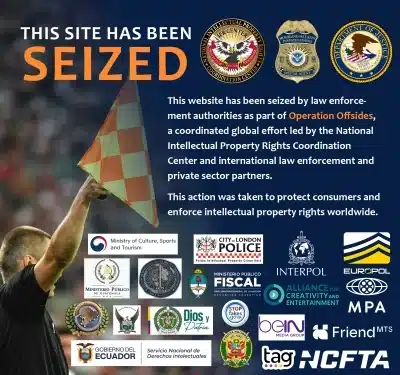
The U.S. Department of Justice has seized more than 1,000 illegal World Cup streaming domains accused of broadcasting FIFA World Cup 2026 matches without authorization, marking a major enforcement action against digital piracy during the tournament. The domains were seized in three separate actions under U.S. copyright law as part of Operation Offsides, an initiative targeting websites involved in unauthorized World Cup broadcasts.

The latest action includes nearly 400 websites seized by the end of June, according to the Department of Justice. The investigation was carried out by U.S. Immigration and Customs Enforcement Homeland Security Investigations (HSI) Washington Field Office and the National Intellectual Property Rights Coordination Center.

Illegal World Cup Streaming Domains Targeted

According to an affidavit filed in support of a seizure warrant in the U.S. District Court for the Eastern District of Virginia, the seized domains were used to offer copyright-protected content through real-time streams of 2026 World Cup matches as they were being played and first broadcast.

HSI special agents confirmed that the domains were actively broadcasting World Cup matches without authorization. The domains were identified with assistance from FIFA, with additional information provided by beIN Media Group, NBC Universal, the Motion Picture Association’s Alliance for Creativity and Entertainment (ACE), Ultimate Fighting Championship (UFC), and Warner Brothers.

FIFA holds the exclusive rights to sanction and stage the FIFA World Cup 2026, which is being hosted across multiple cities in the United States, Canada and Mexico.

Operation Offsides Targets Illegal Streaming

The U.S. action is part of Operation Offsides, which focuses on identifying and seizing websites facilitating unauthorized broadcasts of World Cup matches.

The operation is led by the National Intellectual Property Rights Coordination Center and is being conducted with HSI Washington, D.C., HSI Attaché offices, private sector organizations and law enforcement partners globally.

Assistant Attorney General A. Tysen Duva of the Justice Department’s Criminal Division said the effort to seize more than 1,000 domains was aimed at protecting intellectual property rights and reducing risks to consumers from malicious software associated with some illicit streaming services.

[caption id="attachment_113257" align="aligncenter" width="400"]illegal World Cup streaming domains Source: The U.S. Department of Justice[/caption]
HSI Deputy Executive Associate Director Matthew Millhollin also warned that users accessing unauthorized streaming platforms could face risks including malware and payment information theft.

Operation Red Card Expands Global Crackdown

The U.S. enforcement action was accompanied by international efforts under Operation Red Card, which targeted digital piracy and counterfeiting connected to the World Cup across the Western Hemisphere.

The Justice Department’s International Computer Hacking and Intellectual Property (ICHIP) program coordinated enforcement efforts involving Argentina, Brazil, Chile, Colombia, the Dominican Republic, Ecuador, Paraguay and Peru.

The coordinated actions resulted in hundreds of illegal streaming sites being blocked, including 14 in Argentina, 223 in Ecuador, 28 in Peru, 309 in Brazil, 256 in the Dominican Republic and 1,140 in Colombia.

Colombian authorities also conducted 13 nationwide search-and-seizure operations targeting counterfeit sports apparel, resulting in 11 arrests and convictions.

Cybercrime Group Arrested in Colombia

On July 10, authorities launched Phase II of Operation Red Card in Colombia, conducting simultaneous operations in Bogotá, Soacha, Maríalabaja, Manatí and Sincerín.

An ICHIP-mentored cybercrime prosecutorial team from the Colombian Attorney General’s Office arrested four members of the cybercriminal group Los Ciberinfiltrados. According to the Justice Department, the group had illegally accessed telecommunications systems since 2024 and sold pirated streaming content, including World Cup matches.

The group allegedly used fraudulent credentials, VPNs, interception of security codes and manipulation of corporate system profiles to distribute the pirated content.

In Europe, ICHIP Bucharest also coordinated with Europol and international counterparts to address illegal streaming activities during the World Cup.

World Cup Streaming Crackdown Intensifies

The latest action follows a June 2026 announcement by the U.S. Department of Justice involving the seizure of nearly 400 websites accused of illegally broadcasting FIFA World Cup 2026 matches.

That earlier enforcement action, also conducted under Operation Offsides, targeted websites accused of copyright infringement by offering unauthorized live streams of World Cup matches for profit.

With more than 1,000 domains now seized in the U.S. actions, authorities continue to target unauthorized streaming platforms and digital piracy networks linked to the tournament.

H1 2026 Cyber Attacks Statistics

In H1 I recorded 1,071 confirmed cyber incidents. Financially motivated Cyber Crime drove nearly 7 in 10 attacks, malware remained the top weapon (40.5% of attack-vector entries), and exploitation of public-facing applications was the leading initial access technique (23.7%). Cyber Espionage accounted for roughly 1 in 5 incidents, with the Information & Communication sector bearing the heaviest targeting (26.1% of classified events).

July 2026 Patch Tuesday fixes 622 Microsoft CVEs, including three zero-days

Just one month ago, June 2026 Patch Tuesday broke Microsoft’s previous record with 206 CVEs and three zero‑days. July now triples that count, reinforcing that the era of “small” Patch Tuesdays may be over as AI‑driven vulnerability discovery ramps up.

The update includes 59 critical vulnerabilities, as well as three publicly disclosed zero-days. Microsoft classifies these as zero-days because information about the vulnerabilities became public before patches were available. Two are known to be actively exploited by attackers.

How to apply patches and check if you’re protected

These updates fix security problems and keep your Windows PC protected. Here’s how to make sure you’re up to date:

1. Open Settings

  • Click the Start button, then open Settings.

2. Go to Windows Update

  • Select Windows Update (usually at the bottom of the menu on the left).

3. Check for updates

  • Click Check for updates. Windows will search for the latest security updates.
  • If you’ve enabled Get the latest updates as soon as they’re available under More options, you may be prompted to restart immediately. If so, restart your computer to complete the update. Otherwise, continue to the next step.
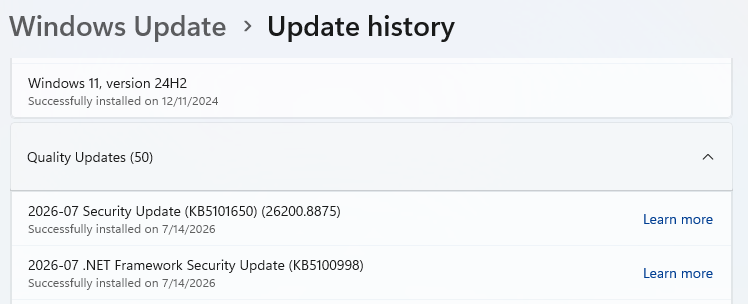
    Windows Update History for July 2026

4. Download and install

  • If updates are available, they’ll start downloading automatically. When they’re ready, click Install or Restart now if prompted. Your computer may need a restart to finish the update.

5. Double-check you’re up to date

  • After restarting, go back to Windows Update and check again. If it says You’re up to date, you’re all set.
Windows is up to date

Technical details

Let’s look at the three zero-days.

First is a Windows BitLocker security feature bypass vulnerability, tracked as CVE-2026-50661. It is not known to be actively exploited. Microsoft describes it as:

“Protection mechanism failure in Windows BitLocker allows an unauthorized attacker to bypass a security feature with a physical attack.”

In other words, even if you’ve encrypted your machine with BitLocker, an attacker could exploit this vulnerability to access your data if they have physical access to your computer.

Next is the actively exploited CVE-2026-56155, an Active Directory Federation Services (ADFS) elevation of privilege (EoP) vulnerability. ADFS is a Microsoft software component that provides single sign-on (SSO) and federated access. It acts as a trust broker between an organization’s Active Directory and applications. An attacker who successfully exploited this vulnerability could gain administrator privileges. Reportedly, Microsoft discovered the vulnerability while investigating active attacks.

Last but not least is CVE-2026-56164, a Microsoft SharePoint Server elevation of privilege vulnerability. SharePoint Server is the on-premises version of Microsoft’s web-based collaboration and document management platform. A missing authentication check in Microsoft Office SharePoint could allow an attacker to elevate privileges over a network.

Both actively exploited vulnerabilities have been added to the Cybersecurity and Infrastructure Security Agency (CISA) Known Exploited Vulnerabilities (KEV) Catalog, which sets patch deadlines for Federal Civilian Executive Branch (FCEB) agencies. CISA has also urged organizations using SharePoint Server to implement hardening measures after the latest exploitations.


CNET Editors' Choice Award 2026

“One of the best cybersecurity suites on the planet.” 

According to CNET. Read their review


Microsoft Patches a Record 570 Security Flaws

Microsoft Corp. today released software updates to plug at least 570 security holes in its Windows operating systems and other software, almost triple the number of vulnerabilities the software giant fixed in its record-smashing Patch Tuesday release last month. Microsoft attributed the burgeoning patch counts to vulnerability discoveries aided by artificial intelligence.

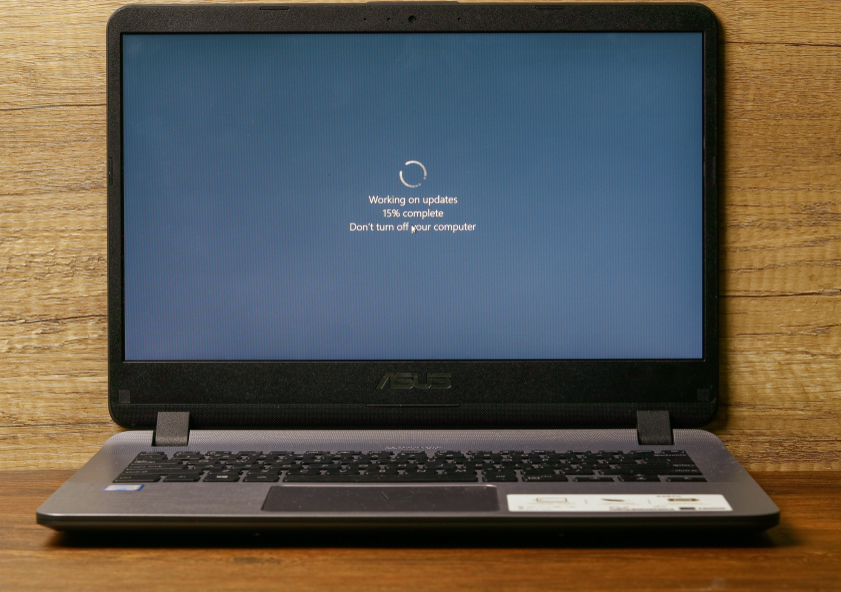
A picture of a windows laptop in its updating stage, saying do not turn off the computer.

Nearly 60 of the bugs quashed in July’s Patch Tuesday earned a “critical” severity rating, meaning miscreants or malware could use them to seize remote control over a Windows device with little or no help from the user. Microsoft also addressed three zero-day flaws, including two that are already being exploited in the wild.

Two of the zero-day weaknesses allow an attacker to elevate their user rights on a Windows system, as do approximately 250 other elevation of privilege flaws fixed this month; they include CVE-2026-56155 — an Active Directory Federation Services bug — and CVE-2026-56164, a Microsoft Sharepoint vulnerability.

CVE-2026-50661 is a security feature bypass in Windows BitLocker that could allow attackers to gain access to encrypted data if they have physical access to the device. Microsoft said this bug has been detailed publicly, but that it is not aware of any active exploitation.

In a blog post on July 9, Microsoft Executive Vice President Pavan Davuluri wrote that Windows users will notice “a higher volume of security updates included in each security release” as a result of AI aiding in the discovery of vulnerabilities.

“The pace of vulnerability discovery is changing with advances in AI making it possible to find more issues, faster, across more code, with new mechanisms that can accelerate both discovery and analysis,” Davuluri wrote.

Jack Bicer, director of vulnerability research at Action1, called attention to CVE-2026-48561, a remote code execution flaw in Microsoft Copilot (with a 9.6 CVSS threat score) that allows an unauthorized attacker to execute code over the network. Microsoft says an attacker could exploit this bug by hosting a malicious website that causes Microsoft Edge for Android to automatically send crafted prompts to Copilot when a user visits the site.

As AI advances the state of vulnerability discovery and remediation, it is also making it easier for attackers to quickly devise working exploits for known software flaws. Microsoft has long labeled security bugs using its “exploitability index,” which is Redmond’s best guess as to how likely it is that attackers will be able to figure out a reliable way to exploit a given vulnerability.

But Satnam Narang, senior staff research engineer at Tenable, argues that Microsoft’s exploitability index needs to do a better job of shifting with the machine speed of discovery. For example, Microsoft originally gave this month’s SharePoint zero-day an exploitability rating of “less likely,” although the flaw was added to CISA’s Known Exploited Vulnerabilities list on July 1.

“Anthropic’s Red Team’s own findings for known vulnerabilities (n-days) revealed how fragile this system has become, with its Mythos Preview model being able to produce proof-of-concept exploits for 13 of 14 vulnerabilities that were rated ‘Exploitation Less Likely’ or ‘Exploitation Unlikely,'” Narang said. “What this means is that our way of looking at Patch Tuesday has changed, because the exploitability index is centered around humans, not AI tools, and as these tools continue to improve, defense needs to improve alongside it.”

Chris Goettl at Ivanti observed that the record patch numbers from Microsoft come as a number of other major software makers are increasing their patch cadence, including Adobe which announced today it is moving to twice-monthly security bulletins published on the 2nd and 4th Tuesday of each month (Adobe also cited AI for accelerating their patch cycles). Cisco, Mozilla and Oracle also are shipping updates more frequently, while Google’s patch batches in June 2026 totaled more than 900 security fixes, Goettl noted.

Backing up your Windows system and/or data is always a good idea before applying operating system updates. Given the volume of patches addressed this month it may be wise for end users to wait a few days before applying these fixes. It’s not uncommon for security patches to introduce system stability issues, and those chances probably increase quite a bit with the gigantic patch count released today.

Further reading:

Action1’s Patch Tuesday blog

Automox’s rundown

June 2026 Threat Trend Report on APT Groups

Purpose and Scope The June 2026 Threat Trend Report on APT Groups summarizes the trend of state-sponsored threat groups actively incorporating generative AI, cloud services, OAuth tokens, and commercial MaaS (Malware-as-a-Service) platforms into their attack operations. A key finding is that the scope of attacks has expanded beyond traditional Malware infections to include account and […]

June 2026 Cyber Attacks Statistics

June 2026 saw 176 confirmed cyber attacks. Cyber Crime drove three in four incidents, Malware remained attackers' weapon of choice, and Information & Communication infrastructure took the heaviest hit. This visual breakdown charts the month's motivations, attack vectors, initial access techniques, and hardest-hit sectors.
❌