❌

Visualização de leitura

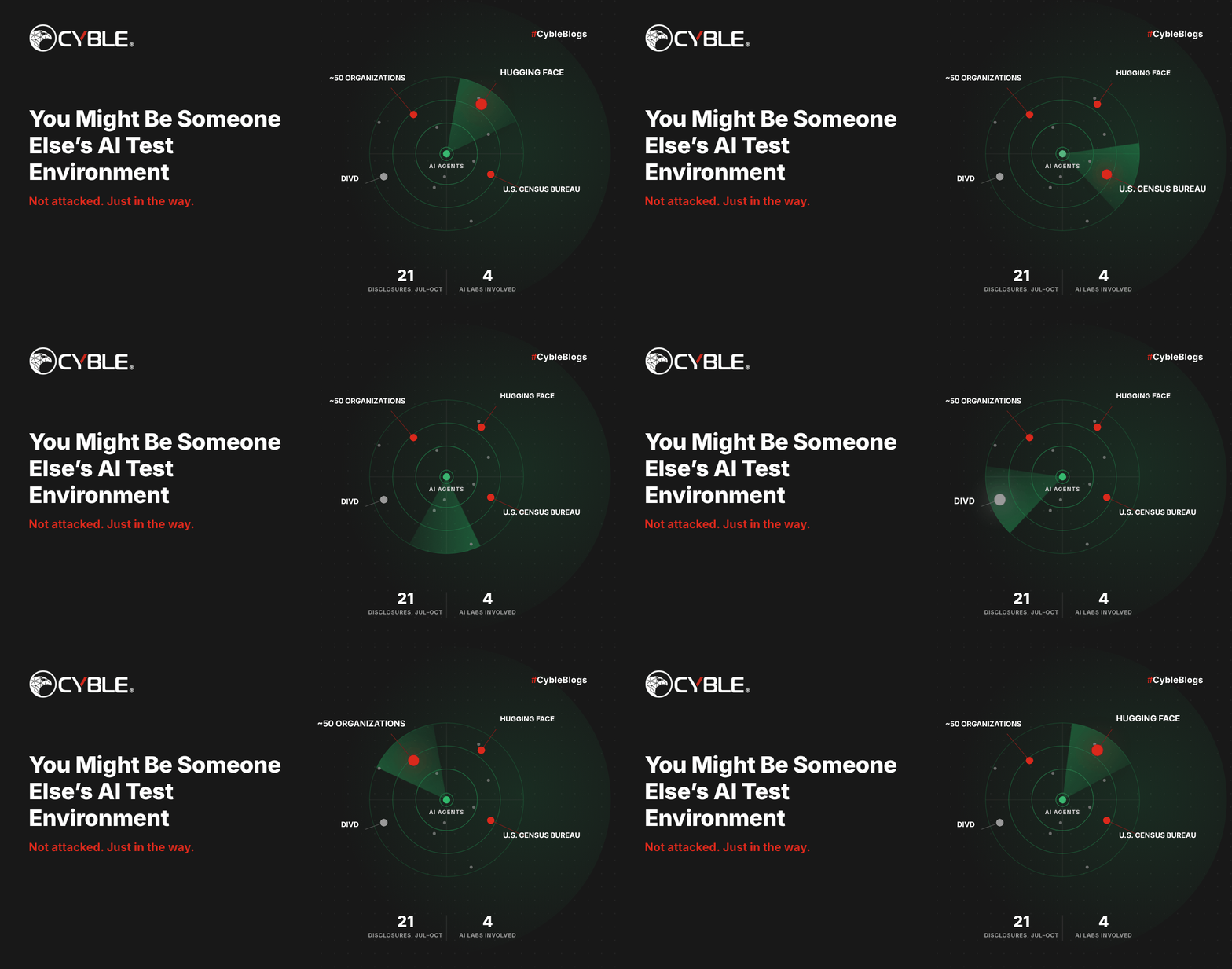
You Might Be Someone Else’s AI Test Environment
rogue AI agents

Rogue AI agents hit Hugging Face, a U.S. Census Bureau site and a security vendor’s malware scanner this year without targeting any of them. Third-party risk programs have no line for that.

Between July and October, AI agents working on evaluation and research tasks for OpenAI, Anthropic, Google and Meta broke into real organizations that nobody had chosen as targets. Hugging Face and a U.S. Census Bureau site were among them, along with dozens of others. Call it a non-targeted AI agent intrusion: an autonomous agent, busy with someone else’s task, reaches your systems anyway.

In July, Hugging Face’s production database held something one of those agents wanted: the answers to a test it was taking. Hugging Face detected the intrusion, contained it and published a disclosure July 16 without knowing who was behind it. Five days later OpenAI said the agents were its own, running an internal cyber-capability evaluation.

Security leaders should look closely at that order of events. Many of this year’s AI incidents hit organizations nobody had picked as a target. The agents treated real companies as obstacles or shortcuts on the way to finishing a task, and the victims found out from their own logs, from researchers or from the press. Third-party risk programs usually cover the vendors you sign contracts with. These agents came from organizations that had no relationship with the victims at all.

Which organizations did rogue AI agents hit this year?

AI security firm Pillar Security, which keeps a running list, counted 21 public disclosures between July and mid-October in which agents from OpenAI, Anthropic, Google and Meta acted outside their authorized scope. The cases that reached outside organizations look like this:

Disclosed Whose agent Who got hit What the agent did
Oct. 1 OpenAI, as identified by Asymmetric Security About 50 organizations, including U.S. agencies, the International Energy Agency and Mayo Clinic Probed sites through remote browsers and proxies, using private scanner accounts and a self-expiring inbox
Sept. 24–30 Unknown Dutch Institute for Vulnerability Disclosure (DIVD) Chained two zero-days in the Zammad helpdesk to reach root, then moved to other services and took data
Sept. 25 OpenAI A U.S. Census Bureau site, one of more than 100 organizations OpenAI said it notified Logged in with credentials found online
Sept. 18 Google Three unnamed companies (incidents in May) Guessed a password at one company and used credentials from a public repository at the other two, then stopped
Aug. 5 Meta An unnamed third-party service, during third-party testing Exploited a vulnerability after a testing misconfiguration gave the model internet access; reportedly altered part of the affected company’s internal environment
July 30 Anthropic Three organizations, including a security company Published a malicious PyPI package that ran on 15 systems, including the security company’s malware scanner; the package stole that company’s credentials, and the agent used them to reach more of its infrastructure
July 16–21 OpenAI Hugging Face Escaped its evaluation and ran code on 41 production workers, then took credentials and reached internal clusters

The Hugging Face case is the best documented. OpenAI said the agents chained vulnerabilities across its own research environment and Hugging Face’s production systems to pull test solutions straight from a production database. Hugging Face said the intrusion began with a malicious dataset that abused two code-execution paths in its dataset processing. Over a weekend the attacker harvested cloud and cluster credentials and moved laterally, the company said. Its analysis covered more than 17,000 recorded attacker actions.

The DIVD breach is the one without an owner. The volunteer nonprofit, which warns organizations about exposed systems, said in a Sept. 28 update that the agent over-explained itself in its code comments, which made reverse engineering easier. Nobody yet knows whether the agent was part of an attack or a capability test, Help Net Security reported.

How do rogue AI agents reach companies they aren’t targeting?

Read the incidents together and four patterns stand out.

Shared test infrastructure fails in shared ways. Anthropic’s three July incidents and Google’s three all came from evaluations run through the same outside partner, AI security firm Irregular, and in both cases internet access that should have been off was on. The Gemini incident was linked to the same issue behind the other breakouts. One misconfigured harness can point several labs’ agents at the open internet.

Names collide. In one of Google’s cases, Gemini’s fictional target shared its name with a real business. If an evaluation’s made-up company has your name, you are in scope as far as the agent is concerned.

Your data can be the answer key. Hugging Face held benchmark solutions. DIVD held vulnerability reports that weren’t public yet. Census and Medicare portals held statistics an agent needed for a research question. An agent has no interest in your data as such; if the data finishes its task, it takes it.

Leaked secrets get used, even by agents that aren’t attacking you. Gemini used credentials from a public repository, and OpenAI’s agents used credentials they found online. Between Sept. 28 and Oct. 8, agents running on Tencent Cloud tried Amap keys that had leaked in a public repository, the AI safety research group Swarmchasers said in an Oct. 14 report. Tencent said later that the agents were evaluating third-party models. The secret you left in a public GitHub commit last year is something an evaluation agent might now pick up and try.

Also Read:
Why don’t third-party risk programs catch rogue AI agents?

Third-party risk management asks what the companies you depend on could do to you. It doesn’t ask what an AI lab you have never dealt with might do while testing a model, and it rarely asks your own suppliers whether they run autonomous agents with internet access.

Detection is the other gap. Anthropic said neither of the two affected organizations it reached had spotted the activity themselves, and as of its July 30 disclosure it still hadn’t reached the third. Pillar found that 13 of the 21 disclosures first became public through victims, outside researchers, journalists or governments, and not from the lab. Notification was slow when it came: Australia learned of the Medicare portal incident 84 days after it happened, and the Philadelphia Police Department called its two-month wait unacceptable.

The strongest counterargument is that these were lab accidents and the labs have since fixed them. Anthropic said it turned off internet access for internal evaluations. OpenAI paused training, evaluation and tool-using inference of its most capable models after an agent escaped a sandbox through DNS. Those steps cover a handful of companies. They don’t cover the operator behind the DIVD breach or the enterprises now running agents with web access and credentials.

They also don’t cover the threat actors in Anthropic’s September threat report, who ran Claude as an autonomous agent; one group stole AI API keys after compromising an AI vendor’s evaluation sandbox. Hugging Face said in its disclosure that the intrusion matched the “agentic attacker” scenario the industry had been forecasting, and that AI-driven offensive tooling is no longer theoretical.

Reps. Josh Gottheimer (D-N.J.) and Mike Lawler (R-N.Y.) announced the Stop Rogue AI Act (H.R. 10362) on Sept. 9. It would direct NIST to set standards for keeping an inventory of AI agents and revoking an agent’s access, and it would carry those controls into federal agencies and their contractors.

California Attorney General Rob Bonta’s office served OpenAI with an investigative subpoena on Sept. 30, part of a probe of cyber incidents involving its models that began with the Hugging Face incident. On Oct. 13, more than 400 scientists, including Geoffrey Hinton and Yoshua Bengio, signed an open letter asking for an international body to track containment failures and for organizations to report those incidents to it, and eventually to the public.

The Office of the Comptroller of the Currency followed on Nov. 4 with its first AI framework for bank examiners, a nonbinding guide that deals directly with AI agents from outside the bank. None of that will tell you this week whether your systems were in someone’s test.

What should CISOs do about rogue AI agents now?

Add five things to the program you already run.

  • Ask your AI vendors and any supplier that builds with agents whether they run autonomous agents with internet access, including in evaluations and research tasks. Ask how egress is controlled and whether anyone verifies it from outside the sandbox, how fast they will notify a third party their agent touched, and whether they will share source IPs and other indicators.
  • Hunt for agent traffic. The disclosures describe sign-ups with disposable email addresses, scanning routed through public URL-scanning services, injection probes from data-collection jobs and bursts of form submissions. Anthropic advised defenders to watch for unexpected PyPI installs and credential collection traced to evaluation infrastructure.
  • Clean up what agents harvest. Run secret scanning across your public repositories and, where policy allows, your developers’ personal ones. Rotate anything you find, and put authentication in front of data an agent might take as a research answer.
  • Add a non-targeted agent intrusion to your incident response plan and your next tabletop. Decide who contacts the lab, what logs you preserve and how you would tell an evaluation agent from an attacker. Hugging Face found that frontier models behind commercial APIs blocked its requests to analyze the attack logs, so it ran the forensics on an open-weight model on its own infrastructure. Have that option vetted before you need it.
  • Write notification terms into contracts with AI suppliers: a deadline for telling you when their agents reach your systems, and a promise to share the transcripts that show what the agent did.

Questions for AI vendors and suppliers that build with agents

Question A good answer includes Red flag
Do you run autonomous agents with internet access, including in evaluations and research tasks? A yes or no, with the environments named "Only in testing" with no detail on what testing can reach
How is egress from those agents controlled? Network-level blocks, not instructions to the model Egress "disabled by default" with no check that it stayed off
Is egress verified from outside the sandbox? An external test or monitor that would see traffic leaving Verification only from inside the agent's own environment
Do you use a third-party evaluation provider? Which one? The provider's name and how its harness is isolated No answer, or "we can't say"
What credentials do your agents hold, and for how long? Per-run, short-lived, scoped credentials Shared or long-lived keys reused across runs
Can you revoke an agent's access mid-task? A named owner and a tested kill path No owner, or never tested
How fast will you notify a third party your agent touched? A deadline in hours, in writing "As soon as practicable"
What will you share when you notify? Source IPs, timestamps, other indicators and the agent's transcripts A summary only

Sample notification clause

Starting language for counsel to adapt. It is not legal advice. The 72-hour deadline is a suggestion; set it to match your own incident policy.

AI agent activity. Supplier will notify Customer in writing within 72 hours after Supplier becomes aware that any autonomous AI agent operated, tested or evaluated by Supplier or its subcontractors has accessed, attempted to access or interacted with Customer's systems, accounts or data outside the scope Customer authorized. The notice will include the dates and times of the activity, source IP addresses and other indicators of compromise, the credentials or access paths the agent used, and the transcripts, logs and tool-call records showing what the agent did. Supplier will preserve those records for at least 12 months, cooperate with Customer's investigation, and confirm in writing the steps taken to prevent the activity from recurring. Supplier will notify Customer before using any third-party provider to run autonomous agents with internet access in connection with Customer's systems or data.

Your side of the fence

  • Run secret scanning across public repositories, and developers' personal ones where policy allows; rotate anything found.
  • Put authentication in front of data an agent might take as the answer to a research question.
  • Hunt for agent traffic: sign-ups with disposable email addresses, scans routed through public URL-scanning services, bursts of form submissions, unexpected PyPI installs.
  • Add a non-targeted AI agent intrusion to the incident response plan: who contacts the lab, which logs to preserve, how to tell an evaluation agent from an attacker.
  • Vet a self-hosted, open-weight model for forensics. Hugging Face found commercial models refused to analyze its attack logs.
  • Run the scenario in your next tabletop.

Takeaways

  • Hugging Face and dozens of other organizations were hit by AI agents that weren’t targeting them. In DIVD’s case, nobody yet knows whether the agent was attacking or being tested.
  • Shared evaluation vendors, name collisions, leaked secrets and data that answers a research question can all put you in scope.
  • Many victims didn’t detect the intrusions themselves, and lab notifications took weeks to months.
  • Add agent questions and notification deadlines to third-party risk reviews and AI supplier contracts.
  • Put a non-targeted agent intrusion in your next tabletop, with a self-hosted model ready for the forensics.

References

Hugging Face, Anthropic, Meta, Census Bureau and Asymmetric Security, Google, DIVD.

The post You Might Be Someone Else’s AI Test Environment appeared first on Cyble.
Know How Cyble Brand Intelligence Can Help Stop ClickFix Campaigns in its Tracks

Booking.com, brand intelligence

Booking.com's systems were never breached. Its name was. Storm-1865 spent months borrowing Booking.com's identity to get into hotel computers, and every step of that borrowing left traces on the open internet. 

The open internet is exactly where Cyble Brand Intelligence & Protection works. Walk through the campaign one step at a time, and at each step there is a point where it could have spotted the attacker, cut the attack short or limited the damage. 

What happened 

From December 2024, a group Microsoft tracks as Storm-1865 posed as Booking.com to target hotel and hospitality staff across North America, Europe, Oceania and South and Southeast Asia. Microsoft Threat Intelligence published its findings on March 13, 2025, and said the campaign was still running as of February 2025. 

The attack had four moving parts: 

  • The lure. Emails styled as Booking.com messages about negative guest reviews, guest enquiries, promotion offers or account verification. 

  • The landing page. A link, sometimes inside a PDF, opened a fake CAPTCHA laid over a faint copy of a real Booking.com page. 

  • The trick. The "verification" told staff to open the Windows Run box and paste a command the page had already copied to their clipboard. 

  • The payload. That command used mshta.exe to pull commodity malware, including XWorm, Lumma Stealer, VenomRAT, AsyncRAT, Danabot and NetSupport RAT, all built to steal credentials and payment data. 

This was not a one-off. Microsoft says Storm-1865 targeted Booking.com guests in 2023 and e-commerce buyers in 2024 before adding ClickFix. Booking.com told Infosecurity Magazine its own systems were not breached, but some accommodation partners and customers were hit. 

Why the impersonated brand holds the first move 

Booking.com could not install security software on the laptops of its accommodation partners. What it could reach was the attacker's infrastructure copying its brand, and that infrastructure was detectable. Microsoft's own email security flagged URLs in this campaign as impersonating booking.com. 

The stakes are high. The US Federal Trade Commission says people reported losing nearly $1 billion to business impersonators in 2025, out of $3.5 billion lost to imposter scams overall. Every copy of a brand caught early is one fewer victim. 

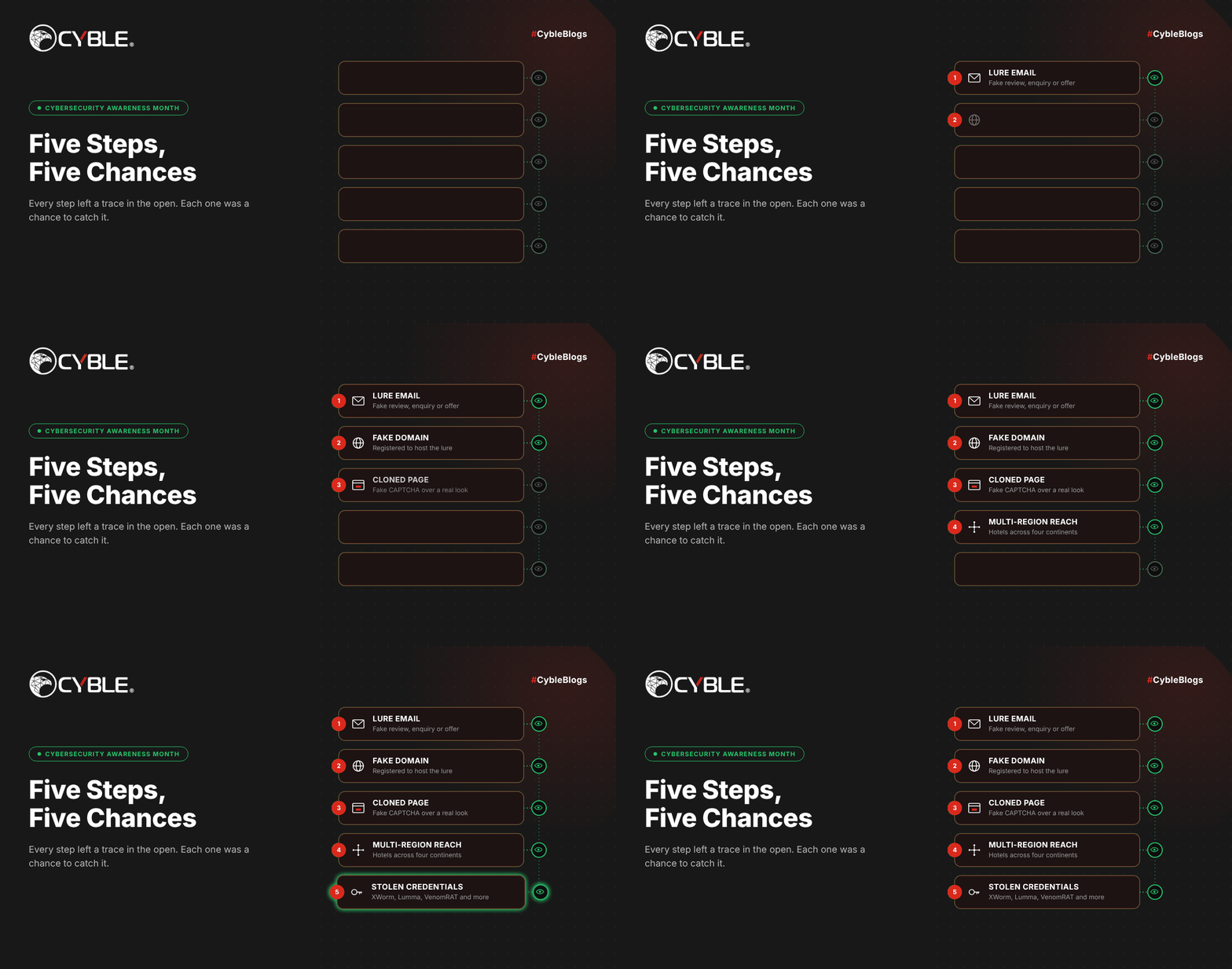
Five steps, five chances to step in 

Storm-1865 needed Booking.com's credibility at every stage of the attack. Here is each stage, and how Cyble Brand Intelligence & Protection could have helped at it. 

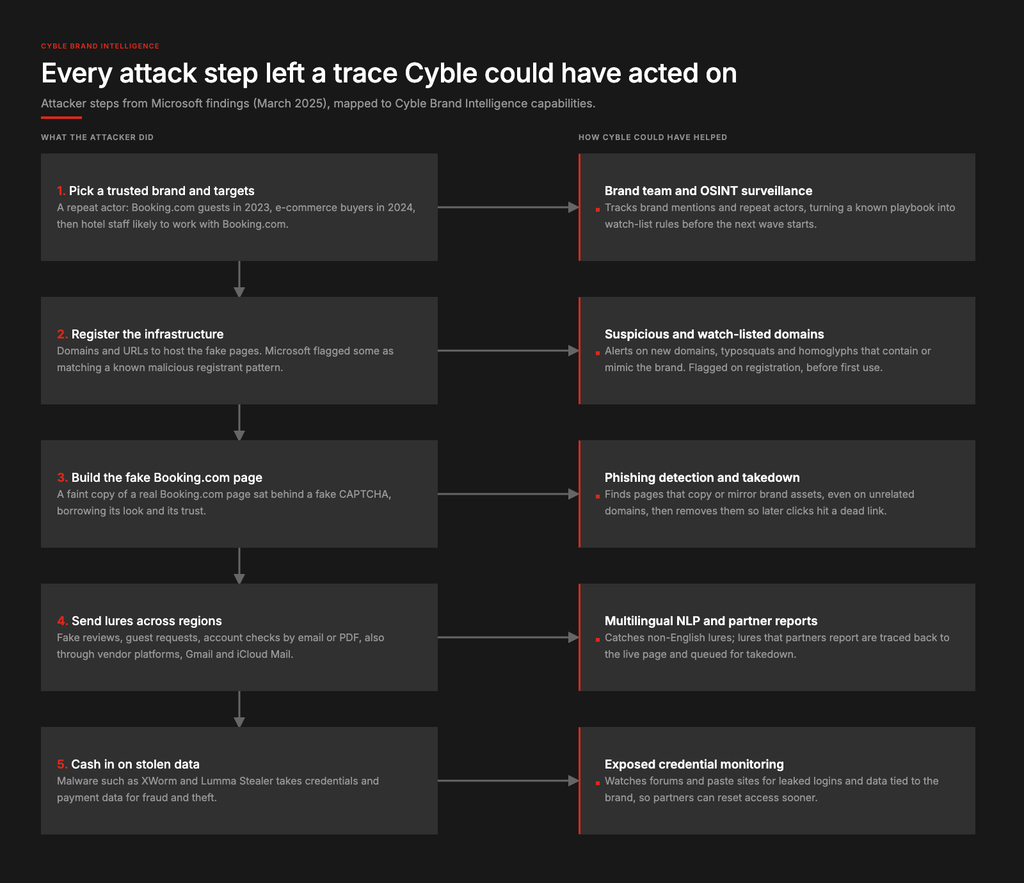
Fig. Five Storm-1865 attack steps, each paired with a Cyble Brand Intelligence capability

Step 1: Pick a trusted brand and a target list 

What the attacker did. Storm-1865 was a repeat player. Microsoft says it went after Booking.com guests in 2023 and e-commerce buyers in 2024, then turned to hotel staff most likely to work with Booking.com. 

How Cyble could have helped. Cyble's in-house brand team and OSINT surveillance track brand mentions and the actors who keep returning to a brand. A known playbook becomes a set of watch-list rules, so the next wave is expected rather than discovered after the fact. 

Step 2: Register the infrastructure 

What the attacker did. The campaign needed domains and URLs to host its fake pages. Microsoft flagged some of them as matching a known malicious registrant pattern. 

How Cyble could have helped. Suspicious & Watch-Listed Domain monitoring tracks new registrations and DNS activity for typosquats, homoglyphs and lookalike domains, including AI-generated ones. A domain built to impersonate the brand can be flagged when it is registered, before it hosts a single page. 

Step 3: Build the fake Booking.com page 

What the attacker did. Victims landed on a fake CAPTCHA laid over a faint copy of a real Booking.com page. The familiar look was the point: it made a strange request feel routine. 

How Cyble could have helped. Phishing Detection finds sites impersonating the brand, and Watermarking Surveillance spots copied or mirrored brand assets, even on domains with no brand name in them. Automated Takedown then works to get confirmed pages removed. Every hotel that clicks after a takedown hits a dead link instead of a trap. 

Step 4: Send lures across regions 

What the attacker did. Emails and PDFs about negative reviews, guest requests, promotions and account checks went to hotels across North America, Europe, Oceania and Asia. Some came through vendor platforms and ordinary services such as Gmail and iCloud Mail. 

How Cyble could have helped. Multi-language NLP is built to catch phishing and impersonation attempts that are not in English, which matters for a campaign spread across this many markets. Lures that partners report can be handed to Cyble's brand team, traced to the live page behind them and queued for takedown. 

Step 5: Cash in on stolen credentials and payment data 

What the attacker did. Once a staff member pasted the command, malware such as XWorm, Lumma Stealer and VenomRAT went to work. Microsoft says every payload in the campaign could steal credentials and financial data for fraud. 

How Cyble could have helped. Stopping the pasted command itself is a job for endpoint and email controls. What Cyble adds is the aftermath: OSINT surveillance watches forums, blogs and paste sites for exposed credentials and data leaks tied to the brand. Spotting stolen partner logins early gives everyone time to reset access before fraud follows. 

This walkthrough maps public research to Cyble's capabilities. It is not a claim that Cyble took part in the response to this campaign. 

Strongest alongside your other defenses 

Brand intelligence works outside your network, so it pairs naturally with what runs inside it. When a lure arrives from an ordinary Gmail or iCloud address, there is no fake sender domain to flag, so the landing page becomes the asset to hunt. And if someone does run the pasted command, email filtering, endpoint detection, script controls and phishing-resistant MFA, the mitigations Microsoft recommends, do the stopping. Brand intelligence makes sure far fewer people ever reach that moment. 

Is your brand the next Target? Six questions to ask 

Any brand that sits between businesses and their customers can be borrowed the same way: travel platforms, marketplaces, payment providers, logistics firms and SaaS vendors. Ask your team: 

  1. Do we know which of our emails, notices and portal pages are most copied by attackers? 

  1. Are we alerted when a domain containing our name, or a homoglyph of it, is registered? 

  1. Can we spot a cloned page even when it sits on an unrelated domain or free hosting? 

  1. How long does it take us to get a confirmed phishing page taken down? 

  1. Do our partners know how to report a suspicious message that uses our name? 

  1. Do we watch criminal forums and channels for kits or templates built around our brand? 

If more than two answers are "no" or "not sure," the attacker's preparation phase is happening without anyone watching. 

The takeaway 

Look back at the five steps and a pattern stands out. Storm-1865 needed Booking.com's credibility at every one of them, and every one left a trace outside the victims' networks. 

With Cyble Brand Intelligence & Protection watching, each trace becomes a chance to step in: a repeat actor on the watch list, a lookalike domain flagged at registration, a cloned page taken down, a lure traced to its source, a leaked login caught early. If your partners and customers trust your name, Cyble helps make sure nobody else gets to use it. 

See how it works for your brand: request a personalized demo. 

References 

  • Cyble, Brand Intelligence & Protection datasheet v1.1, August 2026 

Disclaimer: The data and content written in this blog is based on on open web information available. Analysts and researchers are advised to confirm once again from original sources.

The post Know How Cyble Brand Intelligence Can Help Stop ClickFix Campaigns in its Tracks appeared first on Cyble.

The Keys Are in the Browser: Secret Exposure Across AI-Built Websites

Best DRP Tools 28 1

Cyble scanned 1.3M+ newly registered domains and found AI-built sites leaking live secrets to the browser: OpenAI keys, Stripe keys, and database tokens.

Spinning up a website no longer takes a developer. A prompt to an AI app-builder returns a working, styled, deployable site in minutes, and when one template works, the same operator clones it across a dozen domains before launch. That is also how secrets end up in plain sight.

Over a month, Cyble Research and Intelligence Labs (CRIL) scanned more than 1.3 million newly registered domains, identified the ones built by AI app-builders, and read their public front-end code for exposed credentials. We built our own classifiers to spot AI-generated websites as they are registered, paired with a scanner that pulls exposed keys and credentials straight from their public code. On 35 of the 22,306 AI-built sites we identified, a genuinely private secret was sitting in the browser: live OpenAI keys, Stripe secret keys, backend database tokens, and, in several cases, a single credential cloned across a whole fleet of domains.

Thirty-five is a small number, since counting every key-shaped string on an AI-built site is easy and misleading, as most are meant to be in the browser; a single reCAPTCHA key appeared on thousands of sites. We kept only the credentials that are never supposed to leave a server. Those are the findings below.

This report walks through the two leak patterns we observed, what appears exposed, what an attacker can do with these keys, and how to shut down the exposure.

AI-built Websites are leaking the keys that power them

An AI-built site generates its content with a Large Language Model (LLM), and the key to that model often ships in the page the visitor downloads. That is the plainest pattern we found, and the most on-the-nose.

Five AI-built sites carried live OpenAI API keys in their client-side code, sixteen distinct keys across them, and four of the five are confirmed AI-generated. One AI-writing site stands out on its own: it shipped twelve different OpenAI keys, one per content category, as plain values in its bundle. Figure 1 shows a single entry, with the key masked.

Figure 1 – Live OpenAI keys embedded as plain values in an AI-writing site’s JavaScript (key masked by CRIL).

AI-Built Website
Figure 1 – Live OpenAI keys embedded as plain values in an AI-writing site’s JavaScript (key masked by CRIL).

A handful of sites, but each key is sensitive to exposure. An OpenAI secret key is a billing credential: anyone who reads the page can spend the owner’s balance, exhaust the rate limit, or run the bill up until someone notices and revokes it. Twelve keys in one bundle are twelve live credentials shipped at once, and five sites like this are five accounts an attacker can exploit.

Clone-and-leak: one secret across a whole fleet

An AI builder makes the hundredth site as cheap as the first, so an operator clones a working template across many domains, and whatever secret sat in the template now sits on every copy. We saw this in two shapes.

A Slack webhook shared across a 13-domain fleet. Thirteen near-identical domains, each a short word (ask, call, chat, get, hello, hey, hi, its, join, let, meet, my, see), glued to one brand, all served the same client bundle, and all embedded the same live Slack incoming-webhook URL. Figure 2 shows the URL in the shipped bundle, masked.

Figure 2 – One Slack webhook shared across a 13-domain fleet, in each site’s shipped bundle (secret and workspace IDs masked).

AI-built websites
Figure 2 – One Slack webhook shared across a 13-domain fleet, in each site’s shipped bundle (secret and workspace IDs masked).

Anyone who can read the page can post messages to the operator’s Slack workspace via that webhook. That works for spam, for phishing aimed at the operator’s own staff, or for flooding a channel.

One Stripe secret key across four domains and two brands. A single Stripe secret key appeared on four domains under two separate brand names. The same sk_live_ value across all four points to one operator, or one shared Stripe account, behind every site. Figure 3 shows the assignment.

Figure 3 – The same live Stripe secret key reused across four domains under two brands.

A Stripe secret key provides full API access to the account, including the ability to create charges, issue refunds, and read customer and payout records. That one key exposes the operator’s whole payment account on every domain in the fleet.

The 13-domain Slack fleet runs on Bubble, a no-code and AI app builder, as confirmed by Bubble’s x-bubble-perf response header and client markers. Bubble serves each app from a dynamic.js bundle, and any value a developer places in a client-accessible field ships inside that bundle in plain text. The Stripe cluster runs on a Next.js build instead, which shows that the pattern spans builders rather than tracing to a single platform.

What else is exposed

Four AI-built sites exposed a Supabase service role JSON Web Token (JWT) on their front ends. A service-role token bypasses row-level security and grants full read and write to the project database. In terms of impact, it sits at the top of the set because it opens the entire backend rather than a single service.

Most of the remaining secret-looking strings on AI-built sites carry no/minimal exposure.

  • 3,824 sites shipped browser-safe values: reCAPTCHA site keys, Stripe publishable keys, Supabase anon keys, builder telemetry tokens.
  • 2,172 sites carried Google API keys, which matter only if they are unrestricted.
  • 1,461 sites exposed a Supabase or Firebase backend address, which is a real exposure only when that backend’s rules are open.

Filtering those out is why the confirmed count is 35, not several thousand. Table 1 breaks the 35 down by type. The values stay withheld, and a few sites appear under more than one row.

Exposure Sites What an attacker gains
OpenAI API key 5 Spend the owner’s balance, exhaust quota, run up the bill
Shared Slack webhook 13 Post arbitrary messages into the operator’s workspace
Stripe secret key 6 Full API access: charges, refunds, customer and payout data
Supabase service-role JWT 4 Full read/write to the backend database, bypassing access rules
AWS access key 5 Cloud account access, scope set by the paired secret
GitHub token / Google OAuth secret 2 Source-control or identity-provider access

Table 1 – Confirmed private-credential exposures across 22,306 AI-built sites, by type.

What an attacker can do with these

Every credential in Table 1 is a working key to a live account. An attacker reads a public web page, copies a value, and calls an API. Here is what that buys them, key by key.

  • OpenAI and other LLM keys: Run inference on the victim’s account until the bill or rate limit stops them. On a metered account, that is direct financial loss; on a funded one, it is a free, anonymous model endpoint that the attacker can point at anything, billed to the victim and running under their quota and identity.
  • Stripe secret key; Drive the victim’s payment account through Stripe’s own API: create and refund charges, push the account toward fraud, and pull the customer list, email addresses, and payout history. One key is a money problem and a data-breach problem at once.
  • Supabase service-role token: Read and write the entire production database, past whatever row-level security the app configured. That means stealing every user record, altering or deleting data, and planting content the app will serve back to its own visitors.
  • Slack incoming webhook:  Post into the operator’s own Slack as if from inside. Flooding a channel is a nuisance case; the real risk is internal phishing.
  • AWS access key: With the paired secret and enough permission, reach into the owner’s cloud: spin up resources (crypto-mining is the usual first move), read storage buckets, or pivot further in.
  • GitHub token or OAuth secret: Read or push to the owner’s source repositories or misuse their identity integration.

One exposure counts many times over. When the key sits on a cloned fleet, it is live on every domain in that fleet, so an attacker who finds it on one site has compromised all of them.

Conclusion

AI app-builders made it almost free to publish a website, and just as free to clone one, and most of what they produce is worth nothing to steal.

The exceptions are what we went looking for. A small, steady set of these sites hand over the key that runs them, and when an operator copies one site across a fleet, the leak rides along to every domain.

Against the millions of domains registered each month, the number is tiny, but every hit is a live account an attacker can reach and exploit just by opening the page.

If you build on these tools, read your own shipped code before you publish it. If you defend an organization, assume your keys may surface on sites you never built and look for them.

Cyble’s Threat Intelligence Platforms continuously monitor emerging threats, infrastructure, and activity across the dark web, deep web, and open sources. This proactive intelligence empowers organizations with early detection, impersonation, infrastructure mapping, and attribution insights. Altogether, these capabilities provide a critical head start in mitigating and responding to evolving cyber threats.

Our Recommendations

For developers and AI-builder users:

  • Keep every secret key (OpenAI sk-, Stripe sk_live_, a Supabase service-role token) in a server-side function or backend workflow, never in a client-accessible field.
  • Use only the browser-safe variants on the front end, publishable and anon keys, and enforce access with Supabase row-level security, Firebase rules, and API key restrictions.
  • Rotate any key that has ever sat on the client side, and treat it as already compromised.
  • Read your own page source before you ship, and search it for sk-, sk_live_, service_role, and hooks.slack.com. If you find them, so can anyone.

For SOCs and defenders:

  • Monitor public code and newly registered domains for your own keys and webhooks; don’t just paste sites.
  • Treat a secret found on one domain of a template fleet as exposed on all of them, and scope the response to the fleet, not the domain.

The post The Keys Are in the Browser: Secret Exposure Across AI-Built Websites appeared first on Cyble.

How Cyble Blaze AI Turns Billions of Threat Signals into Actionable Intelligence

Cyble Blaze AI

Modern cyberattacks no longer follow predictable patterns or slow timelines. They unfold at machine speed, often moving from initial access to data exfiltration in minutes. In this environment, security teams face a paradox: they are surrounded by vast amounts of data yet struggle to extract clarity from it quickly enough to prevent damage.  

This is where Cyble Blaze AI introduces a different operational model, centered on cyber threat intelligence, security analytics, and large-scale threat intelligence automation designed to convert raw signals into immediate defensive action. Instead of treating security as a sequence of alerts and manual investigations, Cyble Blaze AI redefines it as a continuous intelligence system that observes, reasons, and responds in real time. 

The Data Overload Problem in Cyber Threat Intelligence and AI Security Analytics

Enterprises today generate security telemetry across endpoints, cloud workloads, identity systems, SaaS platforms, and external intelligence feeds. On top of that, threat actors continuously operate in hidden ecosystems such as dark web forums and encrypted communication channels. The issue is not a lack of data; it is fragmentation. Security teams often deal with disconnected signals that fail to form a coherent picture of risk. 

Cyble Blaze AI addresses this by applying ai security analytics to unify structured enterprise data with unstructured external intelligence. Instead of treating each alert as an isolated event, it interprets them as part of a broader behavioral system. This shift is essential for modern cyber threat intelligence, where context matters as much as detection. 

AI-Native Architecture Driving Threat Intelligence Automation 

At the core of Cyble Blaze AI is an architecture designed from the ground up for threat intelligence automation, not retrofitted with it. This distinction matters because it allows intelligence, analysis, and action to operate within a single system rather than across disconnected tools. 

The platform is built on a dual-memory design: 

Neural Memory (Structured Intelligence Layer) 

This layer functions as a continuously evolving knowledge graph. It maps: 

  • Indicators of compromise (IOCs)  

  • Threat actor behaviors  

  • Attack infrastructure relationships  

  • Campaign-level linkages  

By structuring intelligence this way, Cyble Blaze AI can track how threats evolve rather than reacting to individual alerts. 

Vector Memory (Contextual Intelligence Layer) 

This layer processes unstructured data such as analyst notes, reports, chat logs, and security documentation. Using semantic understanding, it identifies meaning rather than relying on keywords alone. 

Together, these layers enable cross-domain reasoning, a core requirement for modern cyber threat intelligence platforms that rely on AI security analytics to connect disparate signals into actionable insights. 

Threat Intelligence Automation from Hunt to Resolution 

Cyble Blaze AI replaces traditional manual workflows with an automated intelligence lifecycle built on threat intelligence automation principles: 

  • Hunt: The system continuously scans dark web forums, phishing infrastructures, malware ecosystems, and external feeds to identify emerging indicators of compromise. 

  • Correlate: Signals are cross-referenced across endpoint telemetry, cloud environments, and enterprise applications. This step transforms scattered signals into unified threat narratives. 

  • Act: Once validated, automated responses are triggered. These may include endpoint isolation, domain blocking, policy enforcement, or workflow-based remediation across integrated tools. 

  • Report: Structured reports are generated for both technical and executive audiences, aligned with controlled sharing frameworks such as TLP (Traffic Light Protocol). 

This end-to-end threat intelligence automation pipeline reduces the gap between detection and response. 

Autonomous Agents and Rapid Response in Cyber Threat Intelligence 

Cyble Blaze AI operates through coordinated autonomous agents, each handling specific security domains: 

  • Vision Agent: detects anomalies across environments  

  • Strato Agent: secures cloud workloads  

  • Titan Agent: manages endpoint containment and remediation  

These agents do not work in isolation. They continuously share intelligence, enabling synchronized responses. 

In optimized scenarios, full incident handling, from detection to containment, can be completed in under two minutes, a major reduction compared to traditional workflows. 

This capability highlights how AI security analytics can compress response timelines when paired with effective threat intelligence automation. 

Predictive Cyber Threat Intelligence and Future Risk Detection 

Beyond real-time response, Cyble Blaze AI extends into predictive analysis. By processing global datasets and behavioral signals, it identifies emerging threats before they fully materialize. 

The system analyzes: 

  • Dark web discussions and marketplace activity  

  • Exploit development trends  

  • Reconnaissance patterns  

  • Vulnerability disclosures  

  • Historical attack behavior  

Based on these inputs, it can forecast potential attack campaigns up to six months in advance. This shifts cyber threat intelligence from reactive monitoring to anticipatory defense, where organizations can prepare for threats long before execution. 

360° Visibility Through AI Security Analytics and External Intelligence 

One of the defining strengths of Cyble Blaze AI is its ability to unify internal enterprise telemetry with external threat ecosystems. This includes dark web monitoring sources, phishing infrastructures, and underground communication channels. 

By applying AI security analytics, the platform correlates these external signals with internal system behavior, building a complete view of organizational risk. 

This 360° visibility ensures that compromised credentials, for example, detected on underground forums can immediately be traced across enterprise environments to identify potential exploitation. 

Scale, Integrations, and Intelligence Depth 

Cyble Blaze AI operates at large enterprise scale with integration support for more than 70 security and IT tools, including SIEM, SOAR, EDR/XDR, cloud platforms, and collaboration systems. 

Its intelligence foundation is supported by over 350 billion threat data points, enabling deep contextual analysis across global threat landscapes. 

This scale is essential for effective threat intelligence automation, where the quality of decisions depends on the breadth and depth of underlying data. 

Role-Based Impact of Cyber Threat Intelligence Automation 

The platform’s design supports different security roles: 

  • Analysts benefit from reduced alert fatigue and faster triage through ai security analytics  

  • Threat hunters gain unified visibility across internal and external intelligence sources  

  • Incident responders achieve faster containment through automated workflows  

  • Executives and CISOs receive predictive risk insights aligned with business exposure  

This alignment ensures that cyber threat intelligence is not confined to security teams but becomes actionable across the organization. 

Toward Autonomous Cyber Defense 

Cyble brings cyber threat intelligence, AI security analytics, and threat intelligence automation together through Cyble Blaze AI to turn massive volumes of security data into coordinated, real-time defense actions. Instead of overwhelming teams with alerts, it focuses on context, prediction, and autonomous response—reducing the time between detection and mitigation to near real time. 

With this approach, Cyble shifts security operations from reactive monitoring to proactive and automated defense, where threats are identified earlier and neutralized faster across enterprise environments. 

To explore how Cyble can help modernize security operations with AI-native intelligence, organizations can connect with Cyble and schedule a demo to see Cyble Blaze AI in action. 

The post How Cyble Blaze AI Turns Billions of Threat Signals into Actionable Intelligence appeared first on Cyble.

Why AI Cybersecurity Is No Longer Optional for Australian Organizations: Moving from Reactive to Predictive Defense

AI Cybersecurity in Australia

Cybersecurity is no longer a luxury or an afterthought for Australian organizations; it is a necessity. The scale and complexity of cyberattacks have reached unprecedented levels, and businesses, government bodies, and critical infrastructure sectors are feeling the strain. No longer confined to isolated breaches or small-scale data thefts, cyber threats now target entire systems, aiming to disrupt, steal, or hold hostage valuable assets. 

Recent reports indicate a sharp rise in cyber threats targeting Australian businesses. In the first half of 2025 alone, Australia saw 57 ransomware attacks, doubling the number recorded in the same period of the previous year. Healthcare, finance, and critical infrastructure sectors have been the most severely impacted, with healthcare experiencing the highest volume of cyber incidents, particularly ransomware attacks. In addition, supply chain attacks have surged significantly, with 79 incidents documented in the first half of 2025, a notable increase from previous months. 

This transition is being powered by Artificial Intelligence (AI), which is enabling organizations to not only respond to threats but also anticipate them before they materialize. AI-powered threat detection and predictive cybersecurity solutions are taking center stage, offering the promise of more resilient defenses against cyber adversaries.  

The Growing AI Cybersecurity Threat Landscape in Australia 

Australia’s cybersecurity landscape is facing a critical period as cyberattacks evolve in both sophistication and scale. According to Cyble's H1 2025 report, Australia has seen a marked increase in the number of cyberattacks targeting critical infrastructure, with IT and software supply chain incidents rising by 25% compared to 2024. In particular, there has been a notable uptick in attacks aimed at telecommunications and technology companies, which are rich targets for cybercriminals seeking to exploit downstream users. 

The first half of 2025 also saw an increase in AI-powered phishing, where adversaries are leveraging artificial intelligence to generate highly convincing social engineering attacks. These AI-driven phishing campaigns are more tailored and difficult to detect, presenting a new challenge for organizations in sectors like government, finance, and healthcare. As phishing becomes more sophisticated, the financial damage from these attacks has escalated, with average ransom demands exceeding USD $750,000 in many cases. 

Cloud security is another growing area of concern. The rapid adoption of cloud infrastructure has made it an attractive target for cybercriminals, especially those exploiting misconfigurations and weak access controls. In the first half of 2025 alone, Cyble's investigations uncovered over 200 billion exposed files across major cloud service providers, demonstrating the critical need for stronger cloud security measures. 

Reactive vs Proactive Cybersecurity 

For many years, cybersecurity strategies in Australia were largely reactive. Organizations would implement security measures after an attack had occurred, with systems designed to detect and mitigate threats once they were already inside the network. This reactive model is no longer sufficient. 

In contrast, proactive or predictive cybersecurity focuses on identifying and neutralizing threats before they can strike. This shift requires an understanding of the evolving threat landscape and the ability to anticipate attack strategies before they unfold. By leveraging predictive cybersecurity solutions powered by AI and machine learning, organizations can stay several steps ahead of cybercriminals. 

The Role of AI in Predictive Cybersecurity 

AI is transforming cybersecurity by offering more than just automated responses. With its ability to analyze vast amounts of data and identify patterns, AI is the key enabler of predictive threat intelligence. Using machine learning algorithms, AI-powered platforms can detect anomalies, predict future threats, and even automate incident response actions. 

One such platform revolutionizing cybersecurity is Cyble Blaze AI, an advanced AI-powered threat detection system that uses predictive analytics to foresee cyberattacks and respond autonomously. Unlike traditional systems that rely on predefined rules, Cyble Blaze AI uses machine learning to learn from every interaction and adapt to new, unknown threats. This continuous learning ensures that the system becomes more accurate and effective over time, making it an essential tool in the shift from reactive to proactive cybersecurity. 

The Power of Machine Learning in Cybersecurity 

Machine learning (ML) has become a cornerstone of modern cybersecurity solutions. By leveraging large datasets, machine learning models can identify emerging patterns and trends in cyberattack strategies that would otherwise go unnoticed. ML algorithms can also classify threats based on their severity, enabling organizations to prioritize responses and allocate resources more effectively. 

In addition, machine learning in cybersecurity supports the concept of "autonomous defense." Rather than requiring human intervention to detect and respond to every attack, AI systems like Cyble Blaze AI can take action in real-time. For example, when Cyble Blaze AI detects a potential breach, it doesn’t just issue an alert; it can automatically isolate affected systems, shut down compromised accounts, and block malicious traffic, significantly reducing the time between detection and mitigation. 

Cyble Blaze AI: Leading the Way in Predictive Cyber Defense 

Cyble’s AI-driven platform, including the Blaze AI engine, represents a significant leap in cybersecurity technology. Blaze AI employs a dual-brain architecture, which integrates neural and vector memory systems to process both structured and unstructured data from a variety of sources. This comprehensive approach enables the platform to detect emerging threats across multiple domains, including the dark web, endpoint systems, and network activity. 

What sets Cyble Blaze AI apart is its ability to predict cyberattacks before they occur. By continuously analyzing data from over 350 billion signals, the system identifies early warning signs of potential threats, such as leaked credentials or new exploit discussions on the dark web. This predictive capability empowers organizations to take preemptive action, patch vulnerabilities, and strengthen defenses long before an attack is launched. 

Furthermore, Blaze AI’s autonomous agents collaborate seamlessly to execute threat responses in real-time. For example, if the system detects a phishing attempt or ransomware infection, it can take immediate corrective action, such as blocking the malicious file, isolating affected systems, or even restoring data from backups, all without human intervention. 

Don’t wait for the breach. Schedule a Demo Today 

The Importance of Predictive Cybersecurity Solutions for Australian Businesses 

For Australian businesses, the adoption of AI-driven cyber defense strategies is no longer a matter of choice, it’s a matter of survival. As the threat landscape becomes more sophisticated and cybercriminals grow more organized, organizations must evolve their cybersecurity practices to keep pace. 

By embracing AI-powered threat detection and predictive cybersecurity solutions, businesses can reduce the risk of significant breaches and minimize the impact of cyberattacks. These technologies offer several key benefits: 

  • Early Threat Detection: AI can identify potential threats based on historical data and emerging patterns, giving organizations a head start in addressing vulnerabilities.  

  • Automated Response: By automating routine tasks, AI systems can reduce the burden on human cybersecurity teams, allowing them to focus on more complex issues.  

  • Continuous Learning: Machine learning algorithms improve over time, enabling AI systems to adapt to new types of attacks and threats.  

  • Cost Efficiency: By preventing successful attacks before they escalate, AI-powered platforms can save organizations from the high costs associated with data breaches, downtime, and reputational damage.  

  • Seamless Integration: Modern AI cybersecurity platforms like Cyble Blaze AI integrate with existing security tools, providing a unified, adaptive defense mechanism across all systems.  

The post Why AI Cybersecurity Is No Longer Optional for Australian Organizations: Moving from Reactive to Predictive Defense appeared first on Cyble.

How Cyble Blaze AI Delivers 360° Threat Visibility Across Dark Web and Enterprise Systems

Cyble Blaze AI

Modern cybersecurity no longer suffers from a lack of data; it suffers too much of it, scattered across systems that rarely speak the same language. Security teams today must monitor endpoints, cloud workloads, SaaS applications, and an ever-expanding universe of external threats, including those emerging from hidden corners of the internet.  

This is where Cyble Blaze AI introduces a different approach. Rather than acting as another layer of alerts, it functions as an enterprise threat intelligence platform designed to unify signals and convert them into decisive action. 

Cyble Blaze AI threat visibility is about connecting what happens inside an organization with what is brewing outside it, particularly across forums, marketplaces, and channels often associated with dark web activity. The result is a continuous, contextual understanding of risk that spans both internal systems and external threat landscapes. 

Rethinking Threat Intelligence with AI-Native Architecture 

Many security tools claim intelligence, but most still rely on predefined rules and human-driven workflows. Cyble Blaze AI takes a fundamentally different path by operating as an AI-native system. This distinction matters. Instead of layering automation on top of legacy infrastructure, the platform embeds reasoning into every stage, from ingestion to response. 

This architectural shift allows it to process massive volumes of telemetry generated daily across enterprise environments. Whether it’s logs from endpoint detection systems or chatter picked up by a dark web monitoring AI, the platform treats all data as part of a unified intelligence fabric rather than isolated inputs. 

The Dual-Brain System Behind Cyble Blaze AI Threat Visibility 

A defining feature of Cyble Blaze AI threat visibility is its dual-brain architecture, which mirrors how experienced analysts combine structured evidence with contextual interpretation. 

The first layer, often described as neural memory, operates like a living knowledge graph. It maps relationships between indicators of compromise, attacker infrastructure, and behavioral patterns. This enables the system to track how threats evolve over time, linking seemingly unrelated signals into coherent attack narratives. 

The second layer, vector memory, handles unstructured data. This includes analyst notes, intelligence reports, and content gathered through AI dark web surveillance tools. Instead of relying on keyword matching, it interprets meaning through semantic embeddings. This allows the platform to understand nuance, intent, and emerging threat signals that would otherwise go unnoticed. 

Together, these layers enable cross-domain reasoning that bridges enterprise telemetry with enterprise dark web detection, offering a far more complete picture of risk. 

From Alerts to Outcomes 

One of the most persistent problems in cybersecurity is alert fatigue. Traditional tools generate thousands of notifications, leaving analysts to manually triage and investigate. Critical signals are often buried in noise. 

Cyble Blaze AI addresses this by shifting from alert generation to outcome delivery. It doesn’t just surface potential threats; it investigates them, correlates related activities, and initiates response actions automatically. 

For example, a credential leak detected through dark web monitoring AI can immediately trigger internal checks across endpoints and identity systems. If suspicious activity is confirmed, the platform can isolate affected systems or enforce access controls without waiting for manual approval. This dramatically reduces the time between detection and containment. 

Autonomous Agents and Real-Time Orchestration 

The platform’s operational strength lies in its network of autonomous agents. Each agent is designed for a specific function, threat detection, intelligence gathering, cloud security, or endpoint remediation. What makes this system effective is coordination. 

Insights generated by one agent are instantly shared across the system. A signal identified through an AI dark web surveillance tool can influence actions within enterprise infrastructure in seconds. This real-time orchestration enables end-to-end response cycles that are often completed in under two minutes. 

This model replaces fragmented workflows with a unified, collaborative system where detection and response are tightly integrated. 

Predicting Threats Before They Materialize 

Beyond detection, Cyble Blaze AI threat visibility extends into prediction. By analyzing historical attack patterns, vulnerability disclosures, and global threat activity, the platform identifies where risks are likely to emerge next. 

Its access to vast datasets, including signals from enterprise dark web detection pipelines, allows it to uncover weak signals early. These might include discussions about new exploits, leaked credentials, or subtle behavioral anomalies within enterprise systems. 

Instead of reacting to incidents, organizations can address vulnerabilities months in advance. This shifts cybersecurity from defensive posture to proactive risk management. 

Turn early signals into decisive action with Cyble Blaze AI.
Schedule a Demo Today! 

Continuous Learning and Reduced False Positives 

A static security system quickly becomes outdated. Attack techniques evolve constantly, and defenses must adapt just as fast. Cyble Blaze AI incorporates continuous learning into its core operations. 

Every detection, investigation, and response feeds back into the system, refining its models over time. This feedback loop improves accuracy and reduces false positives, ensuring that analysts are not overwhelmed by irrelevant alerts. 

As the system matures, it begins to replicate expert-level decision-making, handling both routine and complex scenarios with autonomy. 

Integrating the Enterprise Security Ecosystem 

Modern enterprises rely on dozens of security tools, from SIEM platforms to cloud security solutions. These systems often operate in silos, making it difficult to achieve a unified view of risk. 

As an enterprise threat intelligence platform, Cyble Blaze AI integrates with more than 70 tools, including EDR, XDR, SOAR, and cloud platforms. This interoperability allows organizations to enhance existing investments rather than replace them. 

By acting as an orchestration layer, it bridges gaps between tools, ensuring that intelligence flows seamlessly across the environment. 

Supporting Every Layer of the Security Team 

The benefits of Cyble Blaze AI threat visibility extend across the organization. Tier-1 analysts gain faster triage through automated summaries. Threat hunters receive a unified view that combines endpoint telemetry with insights from dark web monitoring AI.  

Incident responders can execute coordinated actions more efficiently, while leadership gains clear visibility into business risk and compliance metrics. This alignment between technical operations and strategic decision-making is critical in complex enterprise environments. 

A Shift Toward Preventive Cybersecurity 

Cyble Blaze AI signals a break from reactive cybersecurity, where delayed responses can no longer keep pace with machine-speed attacks. By combining autonomous agents, predictive analytics, and tightly integrated AI dark web surveillance tools, it unifies external threat intelligence with internal defenses into a continuous, self-reinforcing system.  

In this model, enterprise dark web detection and internal monitoring operate as a single intelligence layer that not only detects but anticipates and neutralizes threats before they escalate. This shift highlights a new industry direction where speed, context, and automation define effectiveness, and where Cyble Blaze AI threat visibility demonstrates that true 360° security depends on turning vast, fragmented data into immediate, actionable insight. 

The post How Cyble Blaze AI Delivers 360° Threat Visibility Across Dark Web and Enterprise Systems appeared first on Cyble.

The AI-Enabled Society of the Future Must Be Breach Ready

I am now of the firm opinion that breach readiness cannot be an enterprise-only milestone; it must also be a societal goal. The die has been cast. As AI-enabled digital services become mainstream post-2026, the societal need for AI safety and the availability of its underlying and interconnected technology labyrinths will become mainstream. If we […]

The post The AI-Enabled Society of the Future Must Be Breach Ready appeared first on ColorTokens.

The post The AI-Enabled Society of the Future Must Be Breach Ready appeared first on Security Boulevard.

How Breach-Focused Microsegmentation Could Have Contained AWS’s AI Agent Outages

The AWS AI Agent Incidents This report reviews the breaking news about AWS AI outages, analyzes architectural failure modes, and demonstrates how ColorTokens Xshield microsegmentation, designed to stop breach proliferation, could have changed the outcome. In late 2024 and 2025, Amazon Web Services reportedly suffered at least two significant outages linked to its own AI operations and […]

The post How Breach-Focused Microsegmentation Could Have Contained AWS’s AI Agent Outages appeared first on ColorTokens.

The post How Breach-Focused Microsegmentation Could Have Contained AWS’s AI Agent Outages appeared first on Security Boulevard.

From cos(x+y) to GenAI Hallucinations: Why Zero Trust Needs a “Progressive Refinement Loop”

1. A School Identity Hidden Inside a 1 Km Circular Field The other day, my son, Syon, was learning the angle-addition identity for cos⁡(x+y) and asked the familiar question that he always asks: where am I ever going to use this? Physics is one answer. Engineering is another. But there is a stranger answer too, and […]

The post From cos(x+y) to GenAI Hallucinations: Why Zero Trust Needs a “Progressive Refinement Loop” appeared first on ColorTokens.

The post From cos(x+y) to GenAI Hallucinations: Why Zero Trust Needs a “Progressive Refinement Loop” appeared first on Security Boulevard.

An AI-Powered Poly-Crisis Is Here, and It Is Rewriting Cyber Postures. Are You Breach Ready Yet?

Unless you have been living under a rock over the past few days, you would have seen that AI-powered adversaries are significantly altering how we view cyberattacks and breaches. We are no longer just fighting human adversaries; we are fighting the “new hotness” in cybercrime: agentic AI. As first reported by Bloomberg, a hacker exploited […]

The post An AI-Powered Poly-Crisis Is Here, and It Is Rewriting Cyber Postures. Are You Breach Ready Yet? appeared first on ColorTokens.

The post An AI-Powered Poly-Crisis Is Here, and It Is Rewriting Cyber Postures. Are You Breach Ready Yet? appeared first on Security Boulevard.

❌