Google's November security update fixes a critical Android vulnerability that can interrupt cellular calls through a hidden message. Here's how to check your device.
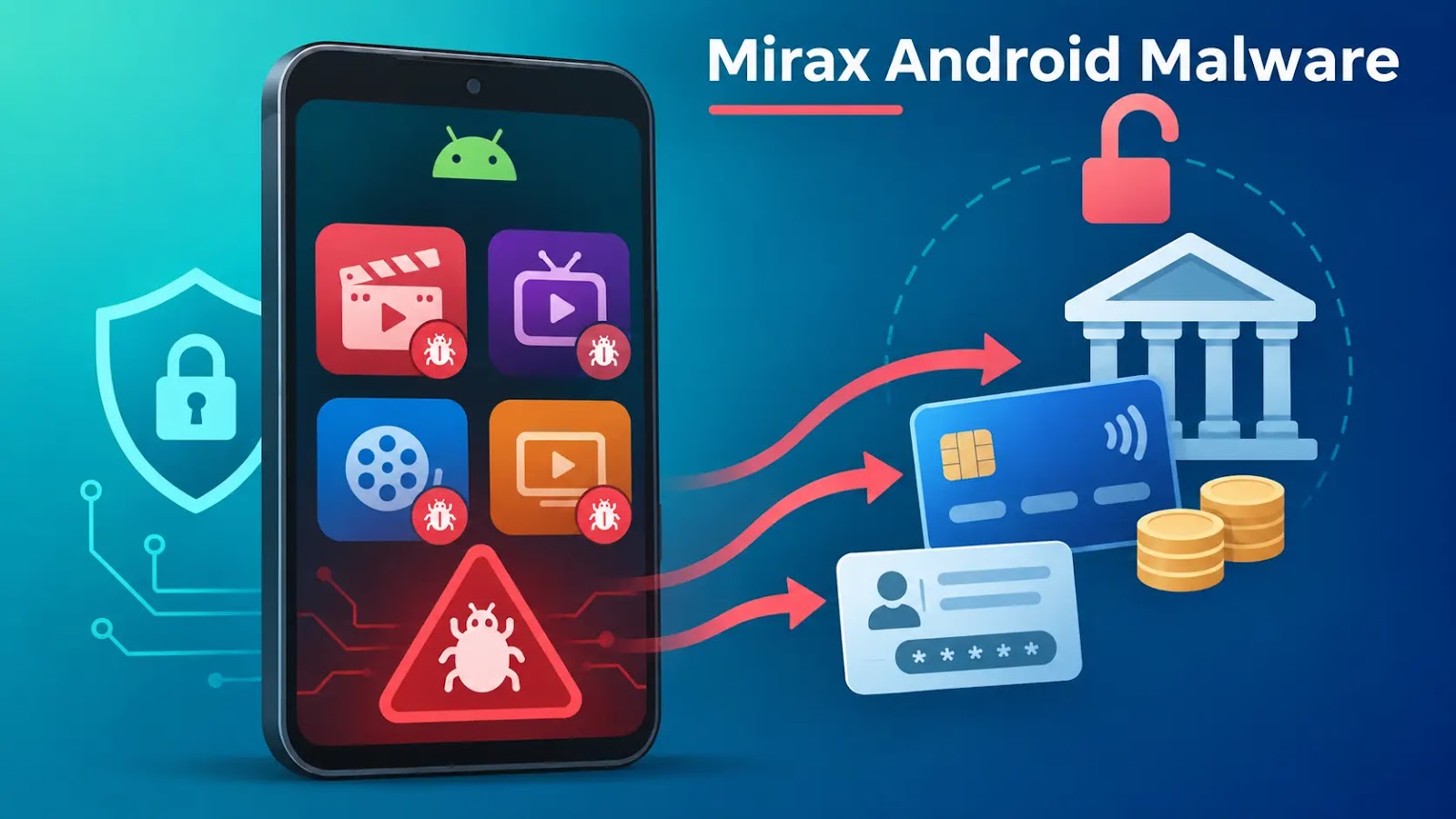
Hackers are using streaming app lures to distribute Mirax. This Android banking trojan lets operators remotely control victims’ phones and initiate fraudulent transfers. Estimated losses reach millions of dollars, although confirmed cases capture only part of the campaign’s impact. The operation remained active when Group-IB published its November 5 investigation. Researchers linked the infections through […]
Russia-linked group APT29 targeted iOS and Android users through hijacked websites and a compromised analytics service.
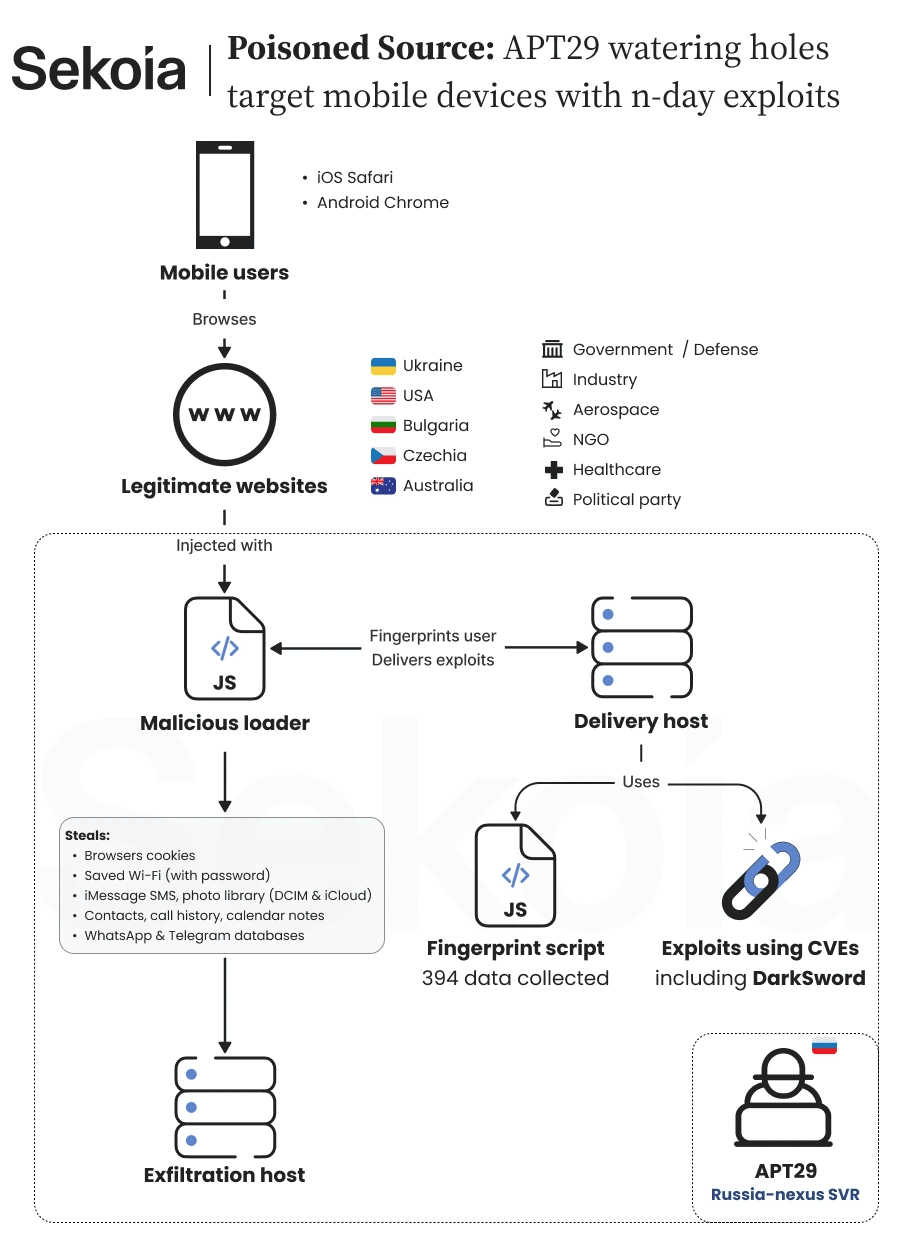
Sekoia says a large-scale watering hole campaign is going after iOS and Android users, and it links the campaign to APT29 (aka SVR group, Cozy Bear, Nobelium, BlueBravo, Midnight Blizzard, and The Dukes), the Russian group tied to the SVR foreign intelligence service. A watering hole is a site that attackers poison so visitors infect themselves.
Sekoia found the campaign in mid-October 2026. It involved hacked or cloned high-profile websites in the US, Ukraine, the Czech Republic and Bulgaria. There’s also a supply-chain attack on a Ukrainian web analytics service, Plerdy, loaded by thousands of websites, most of them Ukrainian.
The attackers used three different methods to reach victims, but all led to the same malicious payload. They injected JavaScript into hacked websites, created fake websites that copied legitimate ones and secretly added malicious code, and compromised the Plerdy analytics service to infect websites using its script.
Sekoia first spotted the campaign on the website of a Ukrainian gas production company. Other compromised sites included a major US chemical industry association, a European far-right political party and a Bulgarian website linked to the military. In the Bulgarian case, attackers modified an existing JavaScript library without changing the website’s visible pages. Researchers found no clear pattern in the targeted organizations, although they believe some websites may have been selected to reach specific individuals.
Sekoia also identified two fake websites designed to impersonate legitimate services. One copied America250, the US initiative marking the country’s 250th anniversary, while another reproduced the website of Raffles London at The OWO, a luxury hotel close to the UK Ministry of Defence and Downing Street.
“The second website, theowo[.]club, now offline, acted as a reverse proxy for the website of Raffles London at The OWO, a prestigious luxury hotel housed in the historic Old War Office building.” reads the report published by Sekoia. “The hotel’s location is particularly noteworthy because of its proximity to some of the United Kingdom’s most sensitive government institutions, including the Ministry of Defence and 10 Downing Street, the official residence and office of the British Prime Minister.”
The hotel connection is particularly interesting because Ukrainian President Volodymyr Zelensky reportedly stayed there during a visit to London on October 14. Sekoia believes the fake website may have been used to target diplomatic delegations through spear-phishing, but stresses that this remains an unconfirmed possibility.
Between August 27 and September 3, 2026, the attackers compromised the Plerdy tracker at a.plerdy[.]com. For a week, visitors loaded both Plerdy’s script and the attackers’ profiling script. Several affected sites relate to the military and military recruitment, including army, special forces and military equipment websites.
“Between 27 August and 3 September 2026, the intrusion set compromised the Ukrainian Plerdy analytics tracker hosted under the domain a.plerdy[.]com, which is loaded by thousands of websites, the large majority of them Ukrainian.” reads the report. “It remains unclear whether the attackers intended to target visitors to specific websites or sought to compromise as many unpatched mobile devices as possible, indiscriminately exfiltrating data before selectively identifying and exploiting information of interest.”
Sekoia can’t say whether the aim was specific visitors or as many unpatched phones as possible, with the sorting done later. It also considers that the attackers may have used Plerdy after failing to inject code directly into Ukrainian high-value sites that relied on it. The Plerdy payload pointed to a load-balancing domain that sent traffic across several delivery servers.
The profiling script, which the attackers call UltimateFingerprinter, is attached to a minified AngularJS library that makes up 98 percent of a 2.3 MB file. Sekoia thinks that bulk might stop analysis by large language models, or make the script look legitimate. The script runs 61 collectors that build 394 fields, then sends them to a server that decides whether to answer with exploit code.
Strangely, almost none of that data matters. Only implausible screen sizes, like 99999, or a device reporting zero touch points block delivery. Sekoia doesn’t know why the attackers collect so much and sees no sign the data was used later.
Sekoia pulled three exploit chains from the delivery server. Class A hits iOS 16.7 and steals cookies. Class B hits iOS 18.5 and takes full device data. Class C hits Android Chrome versions 139 to 145, minus 143 for reasons Sekoia can’t explain, and steals Chrome cookies and Wi-Fi passwords.
“During the investigation, we tested different browser profiles against the fingerprinting endpoint at static[.]flux-telemetry[.]com in order to retrieve the exploits served to visitors.” states the report. “This allowed us to retrieve three complete exploit chains (afternamed A, B and C), along with their final payloads, targeting both Android and iOS. Here is a summary of what we found:”
Class B is DarkSword, which Sekoia describes as a suspected iOS exploit kit from a commercial surveillance vendor, uploaded to VirusTotal in September 2026. It takes text messages and iMessages, Mail indexes, voicemail, WhatsApp and Telegram databases, Keychain passwords and tokens, account credentials and Wi-Fi keys. It also takes contacts, call history, calendar, notes, Safari history and cookies, location caches, Health data, photos and iCloud Drive.
The Android payload, which Sekoia calls AndroSnitch, collects Chrome cookies, saved logins and history, plus Wi-Fi settings. It stops on one phone model, the Samsung Galaxy S25 Ultra. It resembles a 2024 payload that Google TAG documented, called AndroSnatch, but the sample is too small to prove lineage. The iOS cookie chains set a marker cookie meant to block reinfection for a day, but a coding mistake makes it expire in a minute.
All stolen data goes to ad.starx-net[.]com:8881/telemetry/v12. None of the chains persist on the device. All of them rely on known flaws, and none uses a zero-day.
For attribution, Sekoia has several threads. A CERT said a compromised site’s backend files held traces matching a private report on a 2025 APT29 watering hole campaign, and Google TAG said the framework resembles an APT29 campaign against Mongolian government websites in 2024. Victims also skew to Europe and the US with a focus on Ukraine, infrastructure sits across multiple hosters, and a hacked Czech far-right site fits APT29’s record of targeting European political parties. It rates the link moderate to high confidence, and it’s coordinating with the CERTs of affected countries.
The campaign shows how exploit kits move down the market. Sekoia says state-backed groups keep reusing frameworks from commercial surveillance vendors such as DarkSword, and that packaged exploit chains lower the cost and skill needed for advanced mobile attacks. It expects such reuse to become more frequent.
The good news is that Sekoia’s attackers don’t have fresh tricks. Every flaw was fixed by its vendor before the campaign began, and none works against fully updated devices.
“None of them contain zero-days or work against fully updated devices. Each flaw was resolved by the respective vendor before this campaign began. This operation targets unpatched devices using n-days; a user running an up-to-date operating system is safe from these attacks.” concludes the report.
“This watering hole campaign, which we assess with moderate to high confidence to be linked to APT29, combines multiple web delivery vectors with n-day mobile exploit chains targeting Android and iOS devices. Across the directly compromised websites, no single sectoral targeting pattern emerges from our analysis. While the victimology shows a focus on Ukraine and the United States, the inclusion of unrelated entities such as an Australian medical clinic complicates a broad strategic interpretation. However, we assess that these websites may have been selected to profile and infect specific individuals of interest based on targeting intelligence to which we do not have visibility. The operators adapted by deploying Adversary-in-the-Middle-ish to intercept visitors associated with diplomatic or high-profile events.”
Google announced the Google Quick Share SDK for Android and iOS, bringing cross-platform file sharing and native AirDrop compatibility to third-party apps.
Critical Android flaw CVE-2026-58868 could allow remote code execution without user interaction on devices running Android 14 through 17.
Google has fixed CVE-2026-58868, a critical Android vulnerability affecting versions 14 through 17. The flaw is a critical Android vulnerability caused by a heap buffer overflow in the onOutputReceived function of FrameDecoder.cpp. The flaw can trigger an out-of-bounds write, potentially allowing a remote attacker to execute arbitrary code on a vulnerable device. Exploitation requires neither user interaction nor additional execution privileges, making it a potential zero-click attack.
“cve-2026-58868 In onOutputReceived of FrameDecoder.cpp, there is a possible out-of-bounds write due to a heap buffer overflow.” reads the advisory. “This could lead to remote code execution with no additional execution privileges needed. User interaction is not needed for exploitation.”
Devices receive the fix through security patch level 2026-11-01 or later, depending on manufacturers and carriers. Google is not aware of active exploitation of the flaws in its November 2026 bulletin.
Google’s November 2026 Android security bulletin addresses 216 vulnerabilities, including 23 rated Critical. Two of these flaws, CVE-2026-58876 and CVE-2026-58936, affect the System component and could allow remote code execution without user interaction.
The bulletin also lists five other Critical flaws in the System component. Three could lead to privilege escalation, while two could cause denial-of-service conditions. Another Critical vulnerability affects the Framework component and could also allow remote code execution.
Six Critical vulnerabilities affect the Android kernel. Two involve Bluetooth code, three affect the protected Kernel-based Virtual Machine (pKVM), and one is in the Human Interface Device (HID) component. The most severe kernel flaw could allow a remote attacker to gain elevated privileges without user interaction.
The November 5 patch level also addresses Critical vulnerabilities in MediaTek modem code and a closed-source Qualcomm component. Google’s bulletin lists eight Critical MediaTek modem flaws, while MediaTek’s own November security bulletin details six of them: CVE-2026-20499 and CVE-2026-20545 through CVE-2026-20549.
MediaTek describes these six vulnerabilities as out-of-bounds write flaws caused by missing bounds checks, integer overflow or improper input validation. The company says it is not aware of any active exploitation in the wild.
The Qualcomm issue is tracked as CVE-2026-25285 and affects a closed-source component. Google does not provide further technical details in its bulletin.
One of the critical issues fixed by Google is CVE-2026-58882 (aka SMS of Death), which could allow attackers to remotely disable a phone by sending a specially crafted SMS message. The flaw affects decodeWapPdu, a function responsible for processing WAP Push messages, a type of content delivered through the SMS infrastructure.
The vulnerability is particularly concerning because exploitation reportedly requires no user interaction. An attacker only needs the victim’s phone number to send a malicious message. The message doesn’t appear in the SMS inbox, so the victim may have no indication of what caused the problem.
The issue also raises concerns about the reliability of mobile communications during an attack. According to a technical analysis published on October 29 by security researcher Mark B, a malformed WAP Push message can crash com.android.phone, the Android system component responsible for handling telephony functions. The crash can terminate ongoing calls, including emergency calls.
Tests on several Android phone models reportedly reproduced the crash consistently. The phone can also become stuck in a crash loop because Android retries processing the malicious message whenever the device starts. As a result, the device may continue crashing until the offending message is removed.
There is an important distinction, however. Google’s security bulletin and the CVE record identify the vulnerable decodeWapPdu function, but neither explicitly confirms that CVE-2026-58882 is the same issue described in the researcher’s SMS of Death report. The technical overlap is worth investigating, but the two reports shouldn’t be treated as definitively describing the same vulnerability without further confirmation.
Google released its November 2026 Android Security Bulletin, which addresses critical vulnerabilities that could allow remote code execution without user interaction or additional execution privileges. Published on November 2, the bulletin highlights a framework vulnerability as the most severe issue and also documents other critical remote code execution flaws in Android’s system components. According to […]
Google’s new Android app store program brings one-tap installs and automatic updates, but US users are excluded, and marketplaces face a $10,000 annual fee.
SMS of Death lets attackers crash Android call services with a hidden, zero-click message, blocking phone calls, even emergency calls too.
A specially manipulated SMS message is enough to crash Android’s phone service, interrupt ongoing calls, and temporarily render the smartphone unusable. The attack requires no interaction from the victim and can even compromise the ability to contact emergency services.
The vulnerability, dubbed the SMS of Death, is bringing renewed attention to the security of the messaging system in Android smartphones. The issue, documented by independent researcher Mark Blaszczyk, allows a remote attacker to cause a disruption in phone service by sending a single, specially crafted WAP Push message.
WAP Push (Wireless Application Protocol Push) is a particular message transmitted over the mobile network, generally in the form of a binary SMS, which contains structured data and is processed automatically by the smartphone without requiring user intervention. Unlike a traditional SMS, it can carry notifications, links to Internet resources, and configurations for mobile services.
The most worrying aspect is the execution method. It’s a zero-click attack, in which the recipient doesn’t have to open the message, select a link, or authorize any action. The content is automatically processed by the operating system and can cause the process responsible for phone functionality to crash.
The vulnerability affects “WapPushOverSms“, an Android framework component located in the “frameworks/opt/telephony” path, responsible for interpreting and managing WAP Push messages received by the device.
The technical cause lies in the incorrect handling of a numeric value used during message interpretation. Specifically, the “decodeWapPdu()” function, the researcher explains, reads the length of the WSP header through a value encoded as “uintvar” , initially returned as a 64-bit number. The value is subsequently converted to a 32-bit integer without prior range checking. This operation can transform a seemingly valid number into a negative value, which is then used to determine the size of an array. The consequence of this is a “NegativeArraySizeException” exception, thrown when Android attempts to allocate a negative-sized array. The exception is not handled correctly in the processing path and causes the “com.android.phone” process, responsible for telephony functions, to terminate.
The researcher demonstrated that a five-byte WSP header can generate the value “-2147483648“, which is sufficient to trigger the issue. Therefore, it is not necessary to transmit particularly large amounts of content to cause the issue.
“A 5-byte uintvar of 88 80 80 80 00 decodes to 0x80000000. Cast to a signed 32-bit int, that is -2147483648. Allocating new byte[-2147483648] throws an uncaught NegativeArraySizeException on the telephony main thread, killing com.android.phone:” reads the analysis.
An invisible attack that also interrupts emergency calls
The message is transmitted as a data SMS via the WAP Push channel on port 2948. Unlike a regular SMS, it isn’t displayed in the message inbox and doesn’t generate a user-recognizable notification. The sender’s number isn’t normally visible in the conversation, and when the device receives the message, Android automatically starts processing it. A crash in the phone process causes a temporary loss of connectivity and interrupts active voice calls, including those to emergency services.
According to the researcher’s published evidence, each message processing can cause a disruption in telephone service lasting about one to two seconds, during which the component is rebooted. However, the problem can become much more serious if the message is processed repeatedly.
One of the most significant aspects of SMS of Death is the ability to transform a simple crash into a persistent Denial of Service condition. The malicious message can remain in the incoming SMS queue and be reprocessed during subsequent delivery attempts. The telephone operator’s retransmission mechanism can also contribute to a repeat of the event, causing further service disruptions.
The researcher reports observing intermittent crashes for up to a week after receiving a single message. Sending around twenty specially crafted messages can render the device unusable for an extended period. In more severe cases, the phone process can continue to crash during system startup, triggering a condition similar to a boot loop. Recovery may require using the Android Debug Bridge (ADB) on a computer, directly intervening in the queue of messages waiting to be processed. For a typical user, this is far from a simple procedure.
A threat to communications availability
SMS of Death demonstrates how a cyberattack doesn’t necessarily have to involve information theft, code execution, or device control to have significant consequences. In this case, the target is phone service availability, a crucial feature especially when contacting emergency services. The ability to interrupt communications without any user interaction makes this vulnerability particularly sensitive. To reduce exposure, it’s important to check the Android security patch level installed and apply available updates, paying particular attention to devices no longer receiving manufacturer support.
Testing conducted by Mark Blah has shown that the issue is reproducible on several devices, including the Google Pixel 9 and Samsung smartphones from the Galaxy and Galaxy A families. The vulnerable code appears to be present on Android versions ranging from Android 12 to Android 17. However, the availability of the fix is not uniform across all generations of the operating system.
According to documentation published by the researcher, Google has distributed a fix via the October 2026 security update for Android 14, 15, 16, and 17. Older devices, such as those running Android 12 and 13, may remain exposed if they do not receive corrective updates.
It's assigned CVE-2026-58882 and a Critical severity in the November 2026 Android Security Bulletin. We've had it listed as one of the patches included in our security preview releases since our 2026072901 release which you can see in the release notes:https://t.co/tBoWBpALw1
About the author: Salvatore Lombardo (X @Slvlombardo)
Electronics engineer and Clusit member, for some time now, espousing the principle of conscious education, he has been writing for several online magazine on information security. He is also the author of the book “La Gestione della Cyber Security nella Pubblica Amministrazione”. “Education improves awareness” is his slogan.
uCreater is Android spyware disguised as trusted apps, stealing credentials, messages and wallet data through a rentable platform.
uCreater is a rentable Android spyware platform that hides inside repackaged legitimate apps, targeting messaging services and mobile wallets. Its YingGai framework can intercept one-time passwords, steal account and chat data, collect contacts, manipulate sessions and spoof camera feeds to bypass identity checks. Victims may install modified versions of Telegram, WeChat or GCash through sideloading or social engineering.
Researcher Ovi found stolen data on a control server, but the number of victims and links between operators and customers remain unconfirmed.
“The repackaged APK can be relatively thin: target-specific instrumentation is retrieved after installation from the operator’s Alibaba OSS and MinIO infrastructure, including buckets and paths named Huuk_<target> and fengzhuang-app (literally, “packaging”). Distribution hosts include telegram-apk.uzyzx.com.” researcher Ovi states. “I could reconstruct much of the post-installation execution chain from the recovered code, but I could not directly establish the initial delivery mechanism for every victim.”
Ovi rebuilt most of the chain from recovered code but couldn’t establish how every victim got the first install.
The product is older than the samples. The package com.ucreater.autotool dates to about 2014, Windows tools tied to ucreater.com were signed between 2016 and 2019, and the YingGai mobile line shows up in records from September 2021. The samples Ovi studied run from 2024 to 2026: uip.exe builds from February to December 2024, Telegram repacks from July and November 2024, the WeChat host and Telegram framework from December 2024, and the Onion Box client from March 2026. The control server’s ICP filing, 湘ICP备2024061212号, dates to 2024.
The infrastructure hints at scale, though not at victim numbers. Ovi counts about 20 target apps with confirmed code support, six operator domains with dozens of subdomains, three Redis buses, two MQTT buses, and a cloud-phone cluster in Changsha spread across several ISPs. A Censys search for the operator’s Tengine gateway fingerprint returned roughly 48 hosts. It looks like a multi-year product sold to many downstream operators, but he can’t say how many customers used it or how many devices fell.
Attributing the platform to a specific legal entity is more difficult. Hunan Youchuang Technology is linked to the ucreater.com brand and a self-signed certificate on videoflow.cn. Changsha Sukai Network holds the ICP filing for the control server’s main domain, qianxuncc.cn, while Changsha Zhuoqing E-commerce appears as the signing identity on uip.exe, using a DigiCert certificate. A common owner is plausible but unproven.
Another lead involves hunanzhijing.com, a domain belonging to the Hunan Intelligent Police Public Safety Technology Research Institute. It shares the same gateway fingerprint, and an official Hunan document connects the institute to an intelligent-policing research project. However, shared cloud infrastructure establishes only co-tenancy, not ownership or operational involvement. There is no evidence that the police developed or operated uCreater.
Other infrastructure links also require caution. A Thailand-based relay used by the Telegram component, hosted on Huawei Cloud, also served gambling websites, an advertising-account service and an SMS service. The cloud-phone web client displayed a certificate for another vendor, while the gateway served a Vue application titled 舆情交易, meaning “public-opinion trading”. These observations are leads for further investigation, not proof of common ownership.
uCreater relies on app virtualization, a technique already identified by Zimperium as a growing mobile threat. VirtualApp runs another application inside a container, LSPatch merges code hooks into repackaged apps without requiring root access, and Pine hooks Android’s runtime. Together, these components allow malicious code to operate inside a legitimate app while it is signed in and has access to decrypted data.
“uCreater is notable because it turns these techniques into a reusable, remotely managed product.” the researchers continues.
Operators distribute modified versions of Telegram-X, Telegram-Web and other messaging apps, integrating modules through LSPatch or loading them from an asset called TgJarPine.dex. WeChat can instead run inside a VirtualApp container, including the va_vx or Onion Box host. LSPatch also stores the original APK under cache/lspatch/origin/*.apk. The presence of this path or the specific asset can help identify an infected device.
The approach differs from GodFather, a banking trojan documented by Zimperium that runs apps in a virtual container and displays fake overlays to capture credentials. uCreater operates inside the real application without relying on an overlay. It uses XposedBridge hooks, reflection and access to the app’s own database interfaces. This allows it to reach beyond login screens and potentially support any application for which the vendor develops a module. Ovi found no evidence linking the two platforms.
One distinguishing feature is a local command server embedded in each hooked application. It exposes around 40 numbered handlers, with descriptions and parameters that allow operators to discover available functions. The code supports device monitoring, contact and SMS collection, installed-app enumeration, message sending, chat-history retrieval, session management and account-related actions.
The Telegram module can execute SQL queries directly against the application’s live database through its own interface. Its Db_MessagesStorageRawQuery handler accepts operator-supplied SQL and returns results through compatibility classes that recreate Telegram objects. This can expose information that would otherwise be protected in the app’s encrypted or locally stored data while the application is running.
The module also hooks Telegram’s SRPHelper.getX routine, capturing the two-step verification password in cleartext before hashing and storing it for exfiltration. The code provides functions to list or reset sessions, change or confirm a linked phone number, delete an account and lock users out. It can also remove its own session from the victim’s device list, potentially concealing the operator’s access. Ovi stresses that the source code demonstrates these capabilities, not that every action has been successfully performed against victims.
The implant retrieves its control-server address from Redis using the Domain key, optionally selecting a value for a particular channel. It caches the address and can fall back to a hardcoded value, explaining why callback domains differ between builds. Signed JSON beacons report to endpoints under /api/callback/Tg*, while command requests include a device fingerprint and signature and use retries with increasing delays.
Updates and additional code arrive through Alibaba Object Storage Service (OSS) and MinIO. The Telegram module retrieves an update manifest and hooks from designated storage paths, while a contacts.vcf file can supply contact information. The WeChat component subscribes to a Redis channel identified by a device-specific machine ID, with its host and credentials embedded in a child code file.
The WeChat module focuses on account access rather than chat-history collection. Its _2_0_UploadAppLoginInfo command retrieves login identity information, after which the app data can be packaged, uploaded to OSS and used in account cloning. Ovi found no evidence that the examined sample accessed WeChat’s encrypted database.
Ovi tested uCreater on a Pixel 10 Pro running Android 17 and found that its bundled Pine engine fails because of changes to Android’s internal APIs. The latest sample, dated July 29, 2026, still uses the outdated engine. Although this creates obstacles for operators, updating Pine could restore functionality, and other devices remain untested. Ovi also identified five samples that successfully contacted the control server, confirming active deployments targeting Telegram, Telegram-X and WeChat.
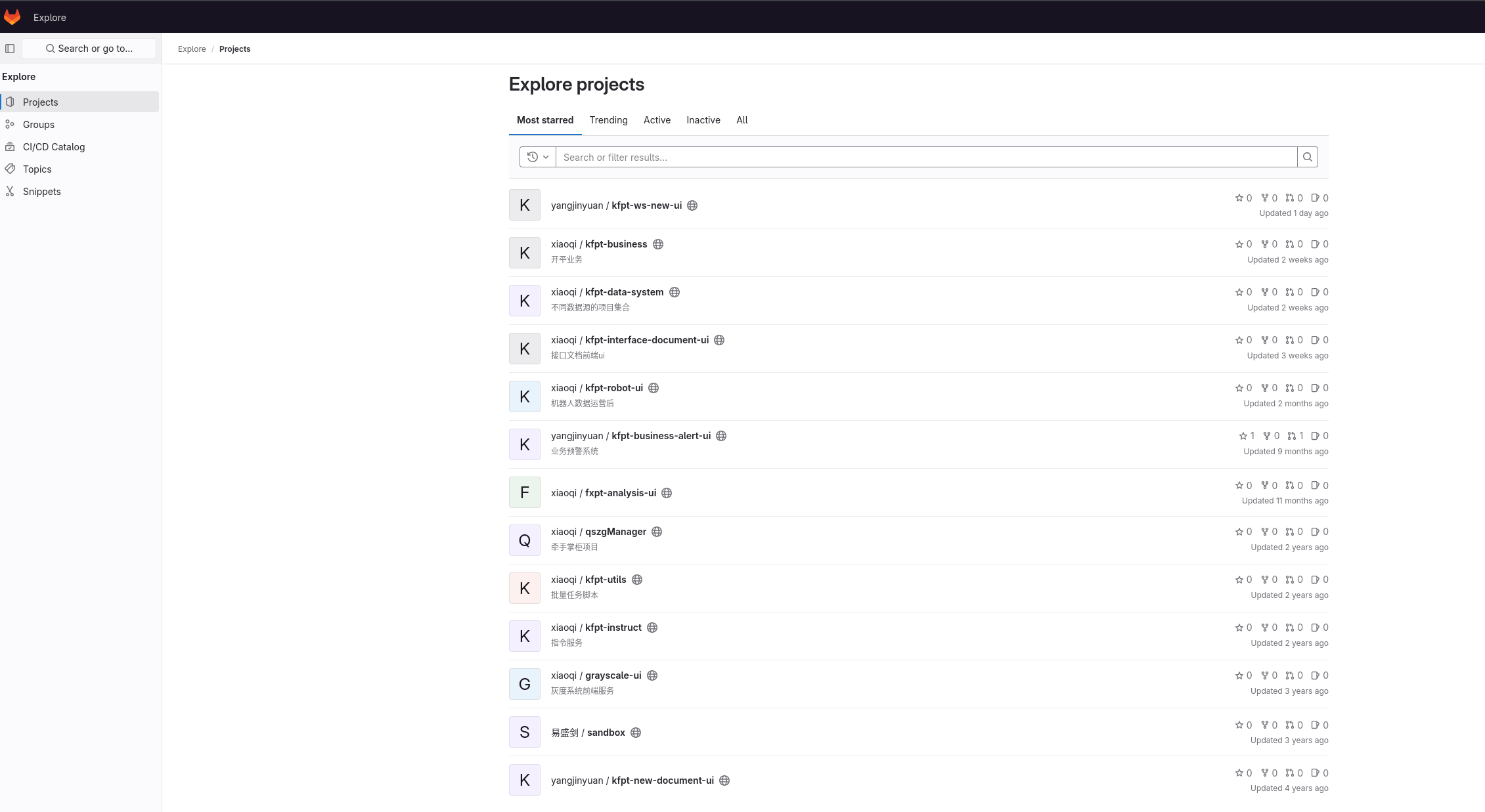
Ovi and researcher Jurre discovered the platform’s source code after finding an exposed GitLab server. Other infrastructure was protected by IP allowlists, but this server contained the control platform’s source code, configuration and operational details.
The repositories revealed Spring Cloud services for command dispatch, authorization capture, data collection, backups and message bridging, alongside a Vue-based administration console. Thirteen repositories contained commit histories identifying roughly three dozen developers, with activity timestamps consistent with China time. At least one commit used a corporate email domain associated with Tanzhou, a Changsha software firm.
uCreater’s backend is a rented, multi-tenant platform that lets operators manage infected devices, steal account data and automate contact collection. Kafka, RocketMQ, Redis and Nacos coordinate commands and schedule activity to avoid triggering security controls. The infrastructure runs on Aliyun and Huawei Cloud, with control services and storage hosted in China. Although GitLab records identify developers behind key components, Ovi stresses they are not confirmed operators. The recovered backend did not appear to support Telegram, and some callback domains are no longer active.
Ovi attributes the platform to a vendor in Changsha and Hunan operating through three companies, each linked to a different technical or infrastructure artifact. The reseller model, focus on mobile wallets and theft of authentication codes suggest financially motivated crime, but the researcher presents this as an assessment rather than a proven fact.
The technical findings show that uCreater goes beyond a conventional banking trojan or a tool that merely steals credentials. By embedding code inside legitimate applications, it can manipulate sessions, access account data, collect contacts and potentially take control of messaging accounts. Its rented, multi-tenant architecture also allows different operators to use the same underlying platform.
The scale of the infrastructure indicates a substantial operation, but neither the number of customers nor the number of compromised devices has been established. Likewise, infrastructure overlaps and developer records provide investigative leads, not conclusive proof of who operated the spyware or who was responsible for individual attacks.
“Mapping points to a commercial resale structure, and targeting driven by wallets and OTPs. My assumption is financially-motivated crimeware.” concludes the report.
 Entrar