Visualização de leitura

ClickFix Attacks Drive UAC-0145 Cyber Campaigns, CERT-UA Warns

ClickFix Attacks

The ClickFix attacks technique has become a key initial access method for the UAC-0145 cyber threat cluster, according to a new report from Ukraine's Computer Emergency Response Team (CERT-UA). The agency said the threat group, also tracked as Sandworm, APT44, Seashell Blizzard, and a subcluster of UAC-0002, has shifted its tactics during 2026, increasingly relying on fake CAPTCHA prompts and social engineering to compromise systems.

CERT-UA said it has worked with Ukrainian cybersecurity agencies for several years to investigate the activities of UAC-0145. While the group previously relied on infected software installers distributed through torrent websites, recent campaigns have increasingly used ClickFix to trick users into executing malicious PowerShell commands.

ClickFix Attacks Emerging as Primary Initial Access Vector

According to CERT-UA, infections recorded during the spring and summer of 2026 frequently began when victims visited compromised websites displaying fake CAPTCHA pages. Users were instructed to copy and execute PowerShell commands in their terminal, a phishing technique commonly referred to as ClickFix.

The downloaded commands were designed to retrieve malicious files such as GHETTOVIBE, a Visual Basic Script (VBS) that establishes persistence by placing itself in the Windows Startup directory.

Once executed, attackers could deploy SCOUTCURL, a PowerShell reconnaissance tool capable of collecting information about the compromised system, including device specifications, installed software, browser data, and local files before exfiltrating the information.

CERT-UA also observed malware loaders including FLUIDLEECH, disguised as antivirus software, and LOADLOOP being used during these campaigns.

Backdoors and Data Theft Tools Widely Deployed

The report noted that attackers continue using malware families such as KALAMBUR, SUMBUR, and TAMBUR after gaining access to victim systems.

To maintain remote access, the group relied on legitimate utilities including OpenSSH and Tor, forwarding local network ports such as 445, 3389, and 22 to attacker-controlled infrastructure.

CERT-UA also found malware designed to steal messaging data from Signal and WhatsApp, with stolen information reportedly exfiltrated using RSYNC.

On infected systems examined during cyber defense operations, investigators additionally identified FREAKYPOLL, a Python-based backdoor distributed as compiled bytecode (.pyc), providing attackers with persistent unauthorized access.

Compromised Websites Used to Deliver Fake CAPTCHA Pages

During June and July 2026, CERT-UA analyzed more than ten compromised websites involved in ClickFix attacks.

Investigators found attackers using both the Cloaking.House service and custom malware called SMARTAXE to dynamically modify legitimate webpages. SMARTAXE retrieves remote domains from blockchain smart contracts through Ethereum's eth_call function before displaying fake CAPTCHA pages or redirecting visitors to malicious content.

CERT-UA warned that any website used in these attacks should be considered compromised, potentially through vulnerable content management systems (CMS), stolen credentials, web shells, malicious plugins, modified website scripts, or server-side backdoors.

The agency urged website administrators and hosting providers to strengthen website security and respond quickly to incident reports.

Android Malware Also Part of UAC-0145 Operations

The report also highlighted growing use of Android malware distributed through messaging applications.

Attackers were observed sharing APK files disguised as security or antivirus tools. One such malware family, tracked as COWARDDUCK, functions as a full-featured Android backdoor capable of collecting device information, contacts, files, and real-time geolocation.

The malware targets files from directories including DCIM, Documents, Downloads, Pictures, and Alarms while searching for formats such as DOCX, XLSX, PPTX, ZIP, RAR, JSON, and OVPN files.

According to CERT-UA, COWARDDUCK uploads stolen files through the Dropbox API while receiving commands from legitimate services including Steam Community and StockMemory domains through proxy infrastructure.

Microsoft Sees Global Rise in ClickFix Campaigns

Microsoft Threat Intelligence and Microsoft Defender Experts also reported that ClickFix campaigns have increased significantly since early 2024, targeting thousands of enterprise and consumer devices globally each day.

Microsoft said the technique commonly delivers malware such as Lumma Stealer by persuading users to copy and execute commands through Windows Run, Windows Terminal, or Windows PowerShell. The campaigns are often combined with phishing, malvertising, and drive-by compromise techniques that imitate trusted brands.

Because ClickFix attacks rely on user interaction rather than exploiting software vulnerabilities directly, Microsoft recommends organizations strengthen user awareness and apply security policies that restrict unnecessary use of command execution tools.
UAC-0057 Attack Detection: OYSTERFRESH, OYSTERSHUCK, and OYSTERBLUES Fuel Phishing Campaigns Against Ukrainian State Organizations

Phishing remains one of the most effective tools in the cybercriminal arsenal, especially when threat actors abuse trusted identities, compromised legitimate accounts, and familiar online services to increase victim interaction. Europol notes that phishing techniques remain a main distribution vector for data-stealing malware, while CERT-UA’s latest advisory shows that the same social engineering logic continues to drive targeted campaigns against Ukrainian public-sector organizations.

In its May 21, 2026 advisory, CERT-UA warned that UAC-0057 had updated its malware toolkit and was using OYSTERFRESH, OYSTERSHUCK, and OYSTERBLUES in a phishing campaign targeting Ukrainian state organizations. The lure theme centered on obtaining certificates through the Prometheus educational platform, while the broader tradecraft overlaps with the long-running Ghostwriter / FrostyNeighbor / UNC1151 activity cluster that security researchers continue to associate with Belarus-aligned espionage operations against Ukrainian government entities.

Recent reporting shows that Ghostwriter’s 2026 activity against Ukraine is not isolated to a single infection chain. ESET documented fresh March 2026 campaigns targeting Ukrainian government organizations with geofenced PDF lures that ultimately delivered Cobalt Strike, underscoring how the actor continues to refresh both its delivery mechanisms and its malware stack. CERT-UA’s latest UAC-0057 advisory fits that same pattern of ongoing adaptation, this time with a newly documented OYSTER-branded toolset distributed through phishing emails sent from compromised real-world accounts.

Sign up for the SOC Prime Platform to proactively defend your organization against UAC-0057 attacks. Just press Explore Detections below and access a relevant detection rule stack, enriched with AI-native CTI, mapped to the MITRE ATT&CK® framework, and compatible with a wide range of SIEM, EDR, and Data Lake technologies.

Security teams can search the Threat Detection Marketplace library using the “UAC-0057” tag to identify relevant detections and track related content updates. Cyber defenders can also rely on Uncoder AI to turn fresh threat reports into performance-optimized queries, document and improve detection logic, and generate Attack Flows based on the latest CERT-UA reporting.

Explore Detections

Analyzing UAC-0057 Attacks Using OYSTERFRESH, OYSTERSHUCK, and OYSTERBLUES

According to reporting that summarizes CERT-UA’s advisory, the campaign has been active since spring 2026 and relies on large-scale phishing emails sent to Ukrainian state organizations from compromised accounts belonging to real employees. The lure theme is framed around obtaining certificates via the Prometheus educational platform, which helps the emails appear plausible to recipients and increases the odds of interaction.

The infection chain begins with a PDF document that contains an active link leading to a ZIP archive. That archive contains a JavaScript file classified as OYSTERFRESH. When launched, the script displays benign decoy text to the victim while quietly starting the malicious workflow in the background. From there, OYSTERFRESH performs two main tasks: it stores an encoded and obfuscated OYSTERBLUES payload in the Windows Registry and downloads OYSTERSHUCK, which acts as the decoder component for the next stage.

For deobfuscation, OYSTERSHUCK reportedly applies a sequence of string reversal, ROT13, and URL decoding before restoring the OYSTERBLUES payload. Once decoded, OYSTERBLUES fingerprints the compromised machine by collecting the device name, current username, operating system version, last boot time, and the list of running processes. The harvested data is sent to a command-and-control server via HTTP POST, and the server responds with arbitrary JavaScript that is executed through eval, effectively giving the operators remote control over the host.

CERT-UA-linked reporting further indicates that the next stage commonly involves the delivery of Cobalt Strike components. This aligns with the broader UAC-0057 / Ghostwriter tradecraft documented by ESET, which shows the group continuing to use phishing-delivered JavaScript downloaders and staged payload validation before deploying higher-value implants. In other words, the newly documented OYSTER toolset appears to extend an already familiar post-compromise pattern rather than replace it.

Infrastructure choices also support the attribution. Reporting on the advisory says the actor’s command-and-control layer remains masked behind Cloudflare, while many of the associated domains are registered in the .icu zone. Together with the campaign’s tooling style and targeting, these characteristics are consistent with activity tracked by CERT-UA as UAC-0057, also known publicly as Ghostwriter, UNC1151, and FrostyNeighbor.

MITRE ATT&CK Context

Leveraging MITRE ATT&CK helps contextualize the latest UAC-0057 phishing activity targeting Ukrainian state organizations. Based on the TTPs described in CERT-UA-linked reporting, the most relevant ATT&CK techniques likely include Spearphishing Link (T1566.002), User Execution (T1204), Command and Scripting Interpreter: JavaScript (T1059.007), Registry-based storage or abuse for payload staging, System Information Discovery (T1082), Process Discovery (T1057), Ingress Tool Transfer (T1105), and Command and Control over Web Protocols (T1071.001). The likely use of Cobalt Strike in follow-on stages also points to broader post-exploitation, persistence, and lateral movement opportunities once initial foothold is established.


The post UAC-0057 Attack Detection: OYSTERFRESH, OYSTERSHUCK, and OYSTERBLUES Fuel Phishing Campaigns Against Ukrainian State Organizations appeared first on SOC Prime.

UAC-0247 Attack Detection: AGINGFLY Malware Targets Hospitals, Local Governments, and FPV Operators in Ukraine

Phishing remains one of the most effective tactics in the cybercriminal playbook, particularly when attackers exploit urgent humanitarian themes, trusted online resources, and legitimate system tools to increase victim engagement. Europol also notes that phishing continues to serve as a primary delivery vector for data-stealing malware. This pattern is clearly reflected in the latest activity tracked by CERT-UA, where threat actors used humanitarian-aid themed lures and multi-stage malware delivery to target Ukrainian organizations.

In a CERT-UA article, researchers described a UAC-0247 campaign targeting local self-government bodies, communal healthcare institutions, and likely representatives of Ukraine’s Defense Forces. The operation ultimately deployed AGINGFLY and related malicious tools, combining phishing, deceptive web delivery, and abuse of legitimate Windows utilities to establish access and support follow-on compromise.

CERT-UA’s latest reporting highlights another wave of phishing-driven intrusions targeting Ukraine’s civilian and potentially defense-adjacent sectors. In the campaign described in the article, attackers used humanitarian-aid themed emails to lure victims into opening malicious content that eventually deployed AGINGFLY, a malware family associated with remote access, credential theft, and follow-on post-compromise activity. The observed targets included local self-government bodies, communal healthcare institutions, including clinical and emergency hospitals, and likely individuals connected to FPV drone operations.

Sign up for the SOC Prime Platform to proactively defend your organization against UAC-0247 attacks. Just press Explore Detections below and access a relevant detection rule stack, enriched with AI-native CTI, mapped to the MITRE ATT&CK® framework, and compatible with a wide range of SIEM, EDR, and Data Lake technologies.

Security teams can search the Threat Detection Marketplace using the “UAC-0247” tag to identify relevant detections and monitor related content updates. Cyber defenders can also rely on Uncoder AI to convert raw threat intelligence into performance-optimized queries, document and improve rule logic, and generate Attack Flows based on the latest CERT-UA reporting.

Explore Detections

Analyzing UAC-0247 Attacks Delivering AGINGFLY via Humanitarian-Themed Phishing Lures

According to CERT-UA, the attack chain began with phishing emails disguised as humanitarian aid proposals. Victims were prompted to click a link that redirected either to a legitimate website compromised through cross-site scripting (XSS) or to a fake website generated with AI tools. In both scenarios, the objective was to persuade the victim to download and open an archive containing a malicious LNK file.

Once launched, the shortcut file abused mshta.exe to retrieve and execute a remote HTA file. The HTA displayed a decoy form to distract the victim while simultaneously downloading an executable that injected shellcode into a legitimate process, such as RuntimeBroker.exe. CERT-UA also noted that more recent stages of the campaign relied on a two-stage loader, with the second stage using a proprietary executable format and the final payload additionally compressed and encrypted to complicate detection and analysis.

Among the next-stage components identified in the campaign were RAVENSHELL, which acted as a reverse-shell style stager, SILENTLOOP, a PowerShell-based tool capable of executing commands and obtaining command-and-control data, and AGINGFLY, the primary malware family used in the operation. CERT-UA-linked reporting indicates that AGINGFLY is designed for remote control, data theft, and follow-on compromise activity.

The campaign also supported credential theft, reconnaissance, and lateral movement. Investigators observed the use of tooling to extract data from Chromium-based browsers, access messaging-related data, scan internal networks, and tunnel traffic across compromised environments. In one of the investigated cases, forensic evidence suggested that representatives of Ukraine’s Defense Forces may have been targeted using malicious ZIP archives distributed via Signal and designed to deploy AGINGFLY through DLL side-loading.

To reduce exposure to this activity, CERT-UA recommends restricting the execution of risky file types such as LNK, HTA, and JS, while also limiting or closely monitoring the use of native Windows tools frequently abused in the infection chain, including mshta.exe, powershell.exe, and wscript.exe.

MITRE ATT&CK Context

Leveraging MITRE ATT&CK helps contextualize the latest UAC-0247 activity. Based on the reported TTPs, the most relevant techniques likely include Phishing: Spearphishing Link (T1566.002), Command and Scripting Interpreter, Process Injection (T1055), Web Protocols / WebSockets for C2, Credential Access, and Lateral Movement via tunneling and proxying tools. This mapping reflects the phishing lures, deceptive web delivery, LNK-to-HTA execution, shellcode injection, AGINGFLY deployment, and follow-on credential theft and internal reconnaissance.


The post UAC-0247 Attack Detection: AGINGFLY Malware Targets Hospitals, Local Governments, and FPV Operators in Ukraine appeared first on SOC Prime.

Ukraine Warns of Surge in Cyberattacks on Hospitals, Local Governments by UAC-0247 Hackers

UAC-0247, CERT-UA, Ukrainian IP Addresses, IP Addresses, Digital Assets, Russia, Ukraine

Ukrainian cyber defenders reported a newly intensified cyber campaign that is targeting Ukraine’s healthcare system and local government agencies, with attackers deploying increasingly sophisticated malware and social engineering tactics.

In a fresh advisory, the CERT-UA said the activity—linked to a threat cluster tracked as UAC-0247—spiked between March and April 2026, with clinical hospitals, emergency services, and municipal bodies bearing the brunt of the attacks.

UAC-0247 Used Humanitarian Aid Lures as Entry Point

The campaign begins with phishing emails disguised as offers of humanitarian assistance—a tactic designed to exploit trust during wartime conditions. Victims are urged to click on links that appear legitimate, sometimes backed by convincingly crafted fake websites or compromised third-party resources.

Behind the scenes, however, the links trigger a multi-stage infection chain that ultimately gives attackers remote control over the victim’s system.

Once clicked, victims download an archive containing a malicious shortcut file. This file activates a built-in Windows tool to execute remote code, initiating a sequence that includes decoy documents to avoid suspicion.

Also read: Hackers Impersonate Ukrainian CERT to Plant a RAT on Government, Hospital Networks

The attack escalates quickly. Malicious executables are deployed via scheduled tasks, injecting code into legitimate system processes such as RuntimeBroker.exe to evade detection.

Recent campaigns show an evolution in sophistication, with attackers introducing multi-stage loaders and custom executable formats. Payloads are often encrypted and compressed, making analysis and detection more difficult.

At later stages, attackers deploy reverse shell tools—including variants resembling “RAVENSHELL”—to establish encrypted communication with command-and-control servers and execute remote commands.

Persistent Access and Remote Control

To maintain long-term access, attackers install a custom backdoor known as AGINGFLY, a C#-based malware designed for full remote system control. The tool enables:

  • Command execution
  • File exfiltration
  • Screenshot capture
  • Keylogging

Unlike conventional malware, AGINGFLY dynamically retrieves and compiles its command logic from remote servers, making it more adaptable and harder to detect.

Complementing this is a PowerShell-based tool dubbed SILENTLOOP, which helps maintain persistence and retrieves command server addresses—sometimes even pulling them from Telegram channels.

Credential Theft and Lateral Movement

Once inside a network, attackers move quickly to expand access. CERT-UA observed tools like CHROMELEVATOR being used to extract browser credentials, while ZAPIXDESK targets WhatsApp data.

The attackers also conduct internal reconnaissance using both custom scripts and publicly available tools such as RUSTSCAN. For stealthy movement across networks, tunneling tools like LIGOLO-NG and CHISEL are deployed.

In at least one case, attackers went further—embedding the XMRIG cryptocurrency miner inside a modified version of the legitimate WireGuard application, highlighting a secondary motive of financial gain.

Military Targets Also in Scope

The campaign isn’t limited to civilian infrastructure. CERT-UA noted an incident in March where individuals connected to Ukraine’s defense sector were targeted via the Signal platform.

Attackers distributed a trojanized version of software used by FPV drone operators, packaged as a seemingly legitimate update. In reality, the download triggered a DLL side-loading attack that installed the AGINGFLY backdoor.

CERT-UA recommends reducing exposure by restricting the execution of high-risk file types such as LNK, HTA, and JavaScript files. The agency also urges organizations to limit the use of native Windows tools like mshta.exe and PowerShell where possible, as these are frequently abused in attacks.

UAC-0255 Attack Detection: Threat Actors Impersonate CERT-UA to Infect Ukrainian Public and Private Sector Organizations With AGEWHEEZE RAT

UAC-0255 Attack Detection

Phishing remains one of the most effective tools in the cybercriminal arsenal, especially when threat actors abuse the credibility of trusted institutions and familiar digital services to increase victim interaction. In late March 2026, CERT-UA revealed a phishing campaign tracked as UAC-0255 in which attackers impersonated the agency and attempted to infect organizations across Ukraine’s public and private sectors with the AGEWHEEZE RAT.

Detect UAC-0255 Attacks Covered in CERT-UA#21075

Europol notes that phishing remains the main distribution vector for data-stealing malware, reflecting how email- and URL-driven social engineering remains central to malware delivery. The same pattern is visible across the phishing activity CERT-UA has been documenting against Ukraine throughout 2026. 

Earlier this year, CERT-UA reported a UAC-0190 campaign targeting the Ukrainian Armed Forces with the PLUGGYAPE backdoor, and later disclosed UAC-0252 activity in which emails impersonating central executive authorities and regional administrations lured victims into running SHADOWSNIFF and SALATSTEALER payloads. The latest UAC-0255 attack covered in CERT-UA#21075 alert fits the same broader trend, with threat actors now abusing CERT-UA’s own identity to make the lure more convincing and expand targeting across both public and private sector organizations. 

Register for the SOC Prime Platform to proactively detect UAC-0255 and similar attacks at the earliest stages possible. Just press Explore Detections below and access a relevant detection rule stack, enriched with AI-native CTI, mapped to the MITRE ATT&CK® framework, and compatible with multiple SIEM, EDR, and Data Lake technologies.

Explore Detections

Security experts can also use the “CERT-UA#21075” tag based on the relevant CERT-UA alert identifier to search for the detection stack directly and track any content changes. For more rules to detect adversary-related attacks, cyber defenders can search the Threat Detection Marketplace library using the “UAC-0255” tag.

Cybersecurity professionals can also rely on Uncoder AI to analyze threat intelligence in real time, generate Attack Flows, Sigma rules, simulations and validations, design detections in 56 languages, and create custom agentic workflows. Visit https://socprime.ai/ to learn more.

Analyzing UAC-0255 Attacks Impersonating CERT-UA to Deploy AGEWHEEZE

On March 26–27, 2026, CERT-UA identified a phishing campaign in which attackers impersonated the agency and urged recipients to download password-protected archives from the Files.fm service, including “CERT_UA_protection_tool.zip” and “protection_tool.zip.” The archives contained malicious content presented as specialized software to be installed by targeted organizations. 

Malicious emails were distributed broadly across Ukraine and targeted government organizations, medical centers, security firms, educational institutions, financial organizations, software development companies, and other entities, highlighting the campaign’s reach across both public and private sectors.

​​CERT-UA#21075 alert also details the discovery of the fraudulent website cert-ua[.]tech, which reused materials from the official cert.gov.ua website and included instructions for downloading the fake protection tool. This helped the attackers reinforce the legitimacy of the lure and increase the chances of user interaction by abusing trust in Ukraine’s Computer Emergency Response Team.

The executable offered for installation was determined to be a multifunctional remote access malware strain tracked by CERT-UA as AGEWHEEZE. AGEWHEEZE is a Go-based RAT that supports a broad set of remote administration capabilities. In addition to standard functions such as command execution and file management, the malware can stream screen content, emulate mouse and keyboard input, interact with the clipboard, manage processes and services, and open URLs on the compromised host.

The malware’s command-and-control infrastructure was hosted on the network of French provider OVH (AS16276). On port 8443/tcp, researchers observed a web page titled “The Cult” containing an authentication form, while the HTML source included russian-language strings noting about blocked access to the service. CERT-UA also found that the associated self-signed SSL certificate had been created on March 18, 2026, and that the Organization field contained the value “TVisor.”

During a review of the AI-generated cert-ua[.]tech website, CERT-UA found embedded references to the CyberSerp Telegram channel, including the phrase “With Love, CYBER SERP.” On March 28, 2026, the same Telegram channel publicly claimed responsibility for the attack, helping remove uncertainty around the technical attribution. Based on these findings, CERT-UA assigned the activity the identifier UAC-0255.

Despite the breadth of targeting, CERT-UA assessed the attack as unsuccessful. Investigators identified only several infected personal devices belonging to employees of educational institutions, and the response team provided the necessary practical and methodological assistance. 

MITRE ATT&CK Context

Leveraging MITRE ATT&CK offers in-depth insight into the latest UAC-0255 phishing campaign impersonating CERT-UA. The table below displays all relevant Sigma rules mapped to the associated ATT&CK tactics, techniques, and sub-techniques.

Tactics

Techniques

Sigma Rules

Initial Access

Phishing: Spearphishing Attachment (T1566)

Execution

Scheduled Task/Job: Scheduled Task (T1053.005)


Defense Evasion

Obfuscated Files or Information (T1027)

Command and Control

Application Layer Protocol: Web Protocols (T1071.001)


Ingress Tool Transfer (T1105)


The post UAC-0255 Attack Detection: Threat Actors Impersonate CERT-UA to Infect Ukrainian Public and Private Sector Organizations With AGEWHEEZE RAT appeared first on SOC Prime.

UAC-0252 Attack Detection: SHADOWSNIFF and SALATSTEALER Fuel Phishing Campaigns in Ukraine

Since January 2026, CERT-UA has been tracking a series of intrusions attributed to UAC-0252 and built around SHADOWSNIFF and SALATSTEALER infostealers. The campaigns rely on well-crafted phishing lures, payload staging on legitimate infrastructure, and user-driven execution of disguised EXE files.

Detect UAC-0252 Attacks Covered in CERT-UA#20032

According to the Phishing Trends Q2 2025 research by Check Point, phishing remains a core tool for cybercriminals, and the impersonation of widely trusted, high-usage brands continues to rise. Against the backdrop of more coordinated and sophisticated operations aimed at critical infrastructure and government organizations, CISA published its 2025–2026 International Strategic Plan to advance global risk reduction and improve collective resilience.

Sign up for the SOC Prime Platform to proactively defend your organization against UAC-0252 attacks. Just press Explore Detections below and access a relevant detection rule stack, enriched with AI-native CTI, mapped to the MITRE ATT&CK® framework, and compatible with a wide range of SIEM, EDR, and Data Lake technologies.

Explore Detections

Security experts can also use the “CERT-UA#20032” tag based on the relevant CERT-UA alert identifier to search for the detection stack directly and track any content changes. For more rules to detect adversary-related attacks, cyber defenders can search the Threat Detection Marketplace library using the “UAC-0252” tag.

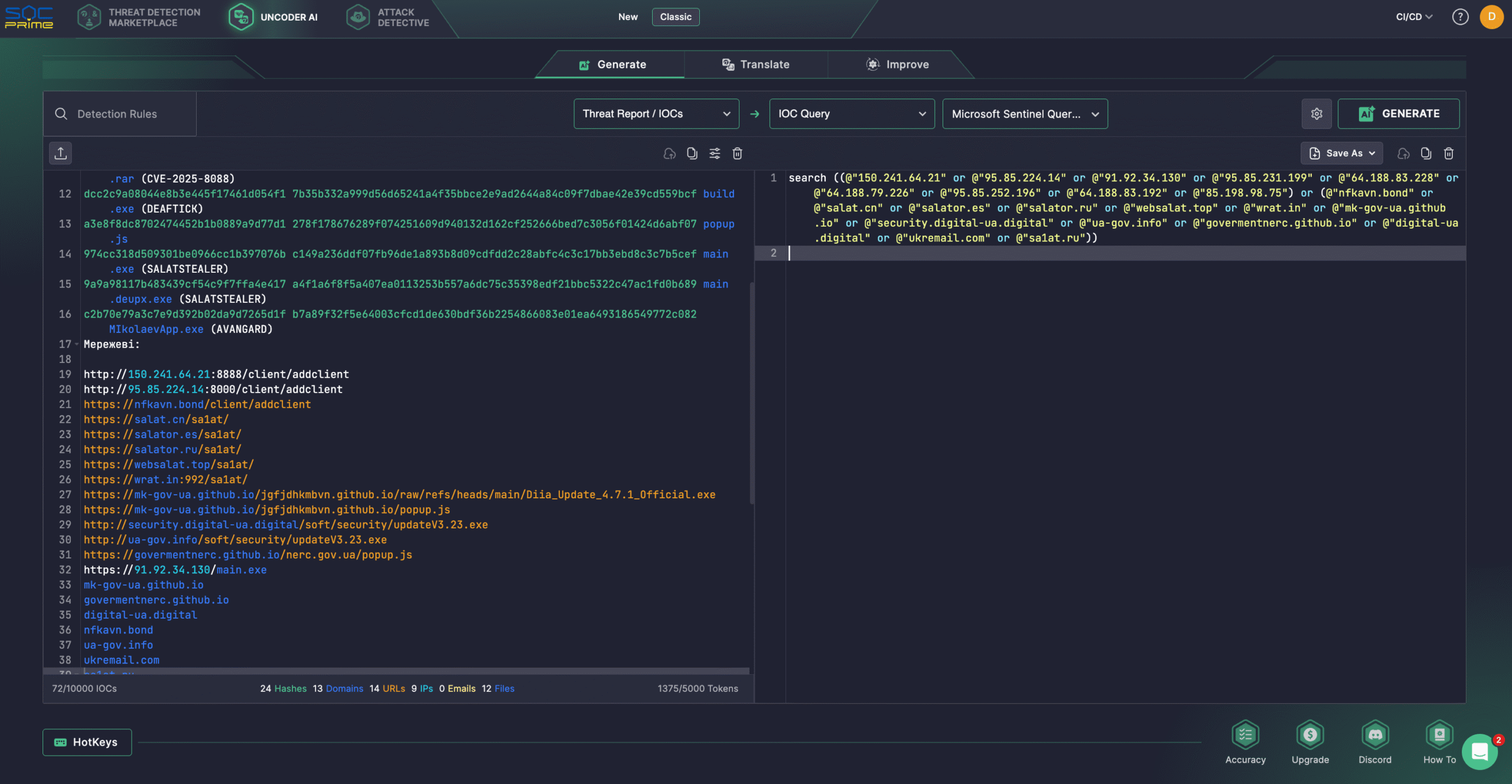
SOC Prime users can also rely on Uncoder AI to create detections from raw threat reports, document and optimize rule code, and generate Attack Flows in a couple of clicks. By leveraging threat intel from the latest CERT-UA alert, teams can easily convert IOCs into performance-optimized queries ready to hunt in the chosen SIEM or EDR environment.

IOC-to-query conversion via Uncoder based on UAC-0252 IOCs from CERT-UA

Analyzing UAC-0252 Attacks Using SHADOWSNIFF and SALATSTEALER

Since January 2026, CERT-UA has been tracking repeated phishing campaigns targeting entities in Ukraine. The email messages are crafted to impersonate central government bodies or regional administrations and typically urge recipients to update mobile apps used in widely deployed civilian and military systems.

CERT-UA#20032 alert describes two common delivery paths. In the first one, the email includes an attached archive that contains an EXE file. The attacker relies on the recipient to open the archive and run the executable. In the second one, the email contains a link to a legitimate website that is vulnerable to cross-site scripting (XSS). When the victim visits the page, the injected JavaScript runs in the browser and downloads an executable file onto the computer. In both scenarios, CERT-UA notes that the EXE files and scripts are hosted on the legitimate GitHub service, which helps the activity blend into normal web traffic and makes basic domain blocking less effective in many environments.

During January and February 2026, CERT-UA confirmed that the activity used several malicious tools, including SHADOWSNIFF, SALATSTEALER, and DEAFTICK. 

SHADOWSNIFF was reported as being hosted on GitHub, while SALATSTEALER is commonly described as a Go-based infostealer that targets browser credentials, steals active sessions, and collects crypto-related data, operating under a Malware-as-a-Service (MaaS) model. In the same toolset, CERT-UA also reported DEAFTICK, a primitive backdoor written in Go that likely helps attackers maintain basic access on compromised hosts and support follow-on actions.


During repository analysis, CERT-UA reports discovering a program with characteristics of a ransomware encryptor, internally named «AVANGARD ULTIMATE v6.0». The same GitHub ecosystem also contained an archive with an exploit for WinRAR (CVE-2025-8088), a path traversal issue in Windows WinRAR that can enable arbitrary code execution via crafted archives and has been reported as exploited in the wild. This suggests the operators were not only stealing credentials, but also experimenting with additional tooling that could expand impact.

Based on the investigation details and the tooling overlaps, including experiments with publicly available instruments, CERT-UA links the described activity to individuals discussed in the «PalachPro» Telegram channel, while continuing to track the campaign under UAC-0252.

MITRE ATT&CK Context

Leveraging MITRE ATT&CK offers in-depth insight into the latest UAC-0252 phishing campaigns targeting Ukrainian entities. The table below displays all relevant Sigma rules mapped to the associated ATT&CK tactics, techniques, and sub-techniques.

Tactics

Techniques

Sigma Rules

Initial Access

Phishing: Spearphishing Attachment (T1566)


Execution

Exploitation for Client Execution (T1203)

User Execution: Malicious File (T1204.002)

Persistence

Boot or Logon Autostart Execution: Registry Run Keys / Startup Folder (T1547.001)

Defense Evasion

Masquerading: Masquerade Task or Service (T1036.004)

Masquerading: Match Legitimate Resource Name or Location (T1036.005)

Process Injection: Process Hollowing (T1055.012)

Impair Defenses: Disable or Modify Tools (T1562.001)

Hide Artifacts: Hidden Files and Directories (T1564.001)

Hide Artifacts: File/Path Exclusions (T1564.012)

Command and Control

Application Layer Protocol: Web Protocols (T1071.001)


The post UAC-0252 Attack Detection: SHADOWSNIFF and SALATSTEALER Fuel Phishing Campaigns in Ukraine appeared first on SOC Prime.

UAC-0001 (APT28) Attack Detection: russia-Backed Actor Actively Exploits CVE-2026-21509 Targeting Ukraine and the EU

Right after Microsoft disclosed an actively exploited Office zero-day (CVE-2026-21509) on January 26, 2026, CERT-UA reported UAC-0001 (APT28) leveraging the vulnerability in the wild. The russia-backed threat actor targeted organizations in Ukraine and the EU with malicious Office documents, and metadata shows one sample was created on January 27 at 07:43 UTC, illustrating the rapid weaponization of CVE-2026-21509.

Detect UAC-0001 aka APT28 Activity Based on the CERT-UA#19542 Alert

APT28 (UAC-0001) has a long record of conducting cyber operations aligned with russian state interests, with a persistent focus on Ukraine and its allied partners. Ukraine frequently serves as an initial testing environment for newly developed tactics, techniques, and procedures that are later scaled to broader international targets. 

The latest UAC-0001 campaign in the limelight follows the same pattern. According to CERT-UA#19542, UAC-0001 targeted Ukrainian state bodies with malicious Office documents exploiting CVE-2026-21509 to deploy the COVENANT framework. The same attack pattern was later observed against EU organizations, demonstrating rapid operational expansion beyond Ukraine.

Sign up for the SOC Prime Platform to proactively defend your organization against UAC-0001 (APT28) attacks exploiting CVE-2026-21509. Just press Explore Detections below and access a relevant detection rule stack, enriched with AI-native CTI, mapped to the MITRE ATT&CK® framework, and compatible with a wide range of SIEM, EDR, and Data Lake technologies.

Explore Detections

Security experts can also use the “CERT-UA#19542” tag based on the relevant CERT-UA alert identifier to search for the detection stack directly and track any content changes.  For more rules to detect attacks related to the UAC-0001 adversary activity, security teams can search the Threat Detection Marketplace library leveraging the “UAC-0001” or “APT28” tags based on the group identifier, as well as the relevant “CVE-2026-21509” tag addressing the Microsoft Office zero-day exploitation.

Additionally, users can refer to a dedicated Active Threats item on the UAC-0001 (APT28) latest attacks to access the AI summary, related detection rules, simulations, and the attack flow in one place.

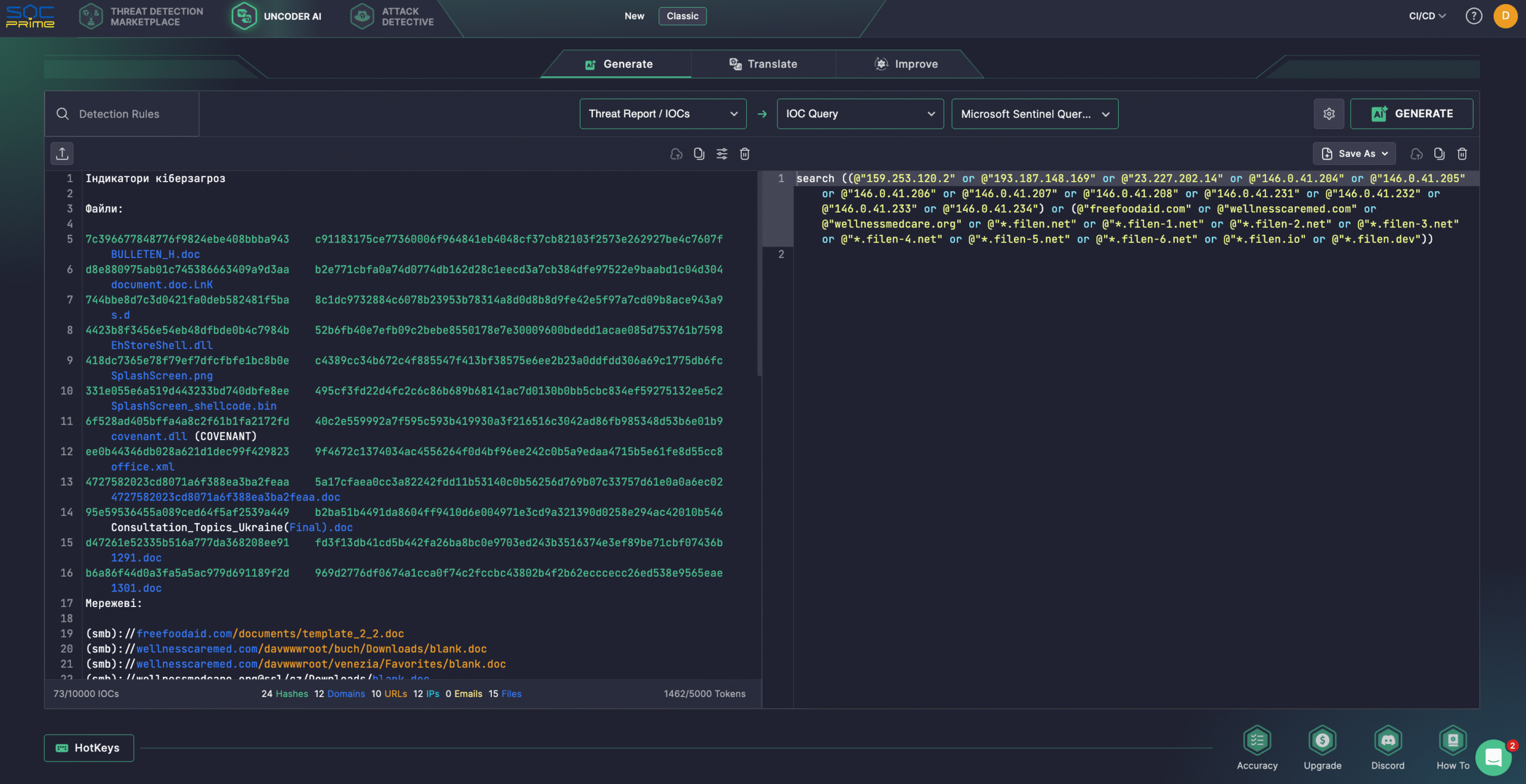
Security teams can also rely on Uncoder AI to create detections from raw threat reports, document and optimize code, and generate Attack Flows. Additionally, cyber defenders can easily convert IOCs from the latest CERT-UA#19542 alert into performance-optimized queries compatible with your security stack.

Analyzing UAC-0001 (APT28) Attacks Exploiting CVE-2026-21509

In late January 2026, CERT-UA observed a series of targeted cyber attacks attributed to UAC-0001 (APT28) that leveraged an actively exploited Microsoft Office vulnerability tracked as CVE-2026-21509. The malicious activity emerged shortly after Microsoft publicly disclosed the flaw and was initially directed at Ukrainian government entities before expanding to organizations across the European Union.

To establish initial access, attackers distributed specially crafted Microsoft Word documents exploiting CVE-2026-21509. One document, titled “Consultation_Topics_Ukraine(Final).doc,” referenced COREPER, the Committee of Permanent Representatives of the EU, which prepares decisions and coordinates policy among EU member states. Although the file became publicly accessible on January 29, metadata analysis showed it had been created on January 27 (one day after Microsoft’s advisory), indicating rapid weaponization of the vulnerability.

In parallel, CERT-UA received reports of phishing emails impersonating official correspondence from the Ukrainian Hydrometeorological Center. These messages, sent to more than 60 recipients primarily within central executive authorities of Ukraine, contained malicious DOC attachments. When opened in Microsoft Office, the documents established a network connection to an external resource over WebDAV and downloaded a shortcut file containing code designed to retrieve and launch an executable file.

Successful execution of the downloaded payload results in the creation of a malicious DLL file, EhStoreShell.dll, masquerading as the legitimate Enhanced Storage Shell Extension library, and an image file (SplashScreen.png) containing shellcode. The attack also modifies the Windows registry path for CLSID {D9144DCD-E998-4ECA-AB6A-DCD83CCBA16D}, implementing COM hijacking, and creates a scheduled task named OneDriveHealth.

Scheduled execution of the task causes the explorer.exe process to terminate and restart, which (due to the COM hijacking) ensures the loading of EhStoreShell.dll. The DLL executes shellcode from the image file, ultimately resulting in the launch of the COVENANT framework. Command-and-control communications for COVENANT relied on legitimate cloud storage infrastructure provided by Filen (filen.io).

Toward the end of January 2026, CERT-UA identified additional documents using the same exploit chain and delivery mechanisms in attacks against EU-based organizations. Technical overlaps in document structure, embedded URLs, and supporting infrastructure suggest these incidents were part of a coordinated UAC-0001 (APT28) campaign, demonstrating the rapid scaling of the operation beyond its initial Ukrainian targets.

Given the active exploitation of a Microsoft Office zero-day and the challenges many organizations face in promptly applying patches or mitigations, further abuse of CVE-2026-21509 is expected in the near term. 

To reduce the attack surface, organizations should implement the mitigation measures outlined in Microsoft’s advisory, including recommended Windows registry configurations. In addition, as UAC-0001 (APT28) leverages legitimate Filen cloud infrastructure for COVENANT command-and-control operations, network interactions with Filen-related domains and IP addresses should be restricted or placed under enhanced monitoring.

Additionally, security experts can rely on SOC Prime’s AI-Native Detection Intelligence Platform, which equips SOC teams with cutting-edge technologies and top cybersecurity expertise to stay ahead of APT28 attacks while maintaining operational effectiveness. 

MITRE ATT&CK Context

Leveraging MITRE ATT&CK offers in-depth insight into the latest UAC-0001 (APT28) attacks leveraging CVE-2026-21509 exploit to target Ukrainian and EU entities. The table below displays all relevant Sigma rules mapped to the associated ATT&CK tactics, techniques, and sub-techniques.

Tactics 

Techniques

Sigma Rule

Persistence

Scheduled Task/Job: Scheduled Task (T1053.005)

Event Triggered Execution: Component Object Model Hijacking (T1546.015)

Defense Evasion

Masquerading: Match Legitimate Resource Name or Location (T1036.005)

Command and Control

Application Layer Protocol: Web Protocols (T1071.001)

Ingress Tool Transfer (T1105)

Impact

Service Stop (T1489)


The post UAC-0001 (APT28) Attack Detection: russia-Backed Actor Actively Exploits CVE-2026-21509 Targeting Ukraine and the EU appeared first on SOC Prime.

❌