Visualização de leitura

Microsoft’s August Patch Tuesday: 400+ Bugs Fixed, One Zero-Day Already Under Attack

Microsoft’s August Patch Tuesday fixes about 400 security flaws, including an actively exploited Windows zero-day and multiple 9.8-rated RCE bugs.

The post Microsoft’s August Patch Tuesday: 400+ Bugs Fixed, One Zero-Day Already Under Attack appeared first on TechRepublic.

North Korean Lazarus Group Uses Windows Zero-Day in Operation Dream Job

Lazarus targets defense professionals with fake Lockheed Martin jobs, exploiting a Windows zero-day to deploy backdoors and evade security controls.

Check Point Research has uncovered a new wave of Operation Dream Job, the long-running North Korean campaign that lures defense and aerospace professionals with convincing fake job offers. This iteration is more dangerous than previous versions: it includes a previously unknown Windows vulnerability now patched as CVE-2026-68820, a newly documented backdoor called Troy, and command infrastructure built almost entirely from legitimate servers the attackers didn’t build, they hijacked them. Targets confirmed in France, Germany, Brazil, and India.

“The attackers used a previously unknown vulnerability in Windows (CVE-2026-68820) to gain full control of infected computers and evade EDR visibility. Check Point reported the issue to Microsoft, which released a fix before this research was published” reads the report published by Check Point Research. “Rather than running their own servers, the attackers are hijacking legitimate but compromised websites and webmail servers to relay commands, making the malicious traffic harder to distinguish from normal activity”

The vulnerability, CVE-2026-68820, is the same actively exploited zero-day that Microsoft patched on August 11 as part of Patch Tuesday, a privilege escalation flaw in AFD.sys, the kernel driver underlying Windows Sockets. Check Point reported the issue to Microsoft on July 28, Microsoft confirmed it three days later, and the fix shipped two weeks after that. The zero-day in this campaign and the zero-day under active exploitation are the same bug.

The attack runs through two parallel infection chains. In the first, victims download an encrypted archive containing a legitimate signed PDF viewer and a malicious DLL. The DLL displays a convincing Lockheed Martin job description while silently loading MISTPEN, a lightweight downloader that communicates through Microsoft Graph API and OneDrive. MISTPEN then runs reconnaissance modules, triggers the AFD.sys exploit to achieve SYSTEM privileges, and deploys ForestTiger, a well-documented Lazarus backdoor, along with an updated version of the group’s kernel-mode rootkit, FudModule 3.1, which can now tamper with Windows Smart App Control to bypass software verification.

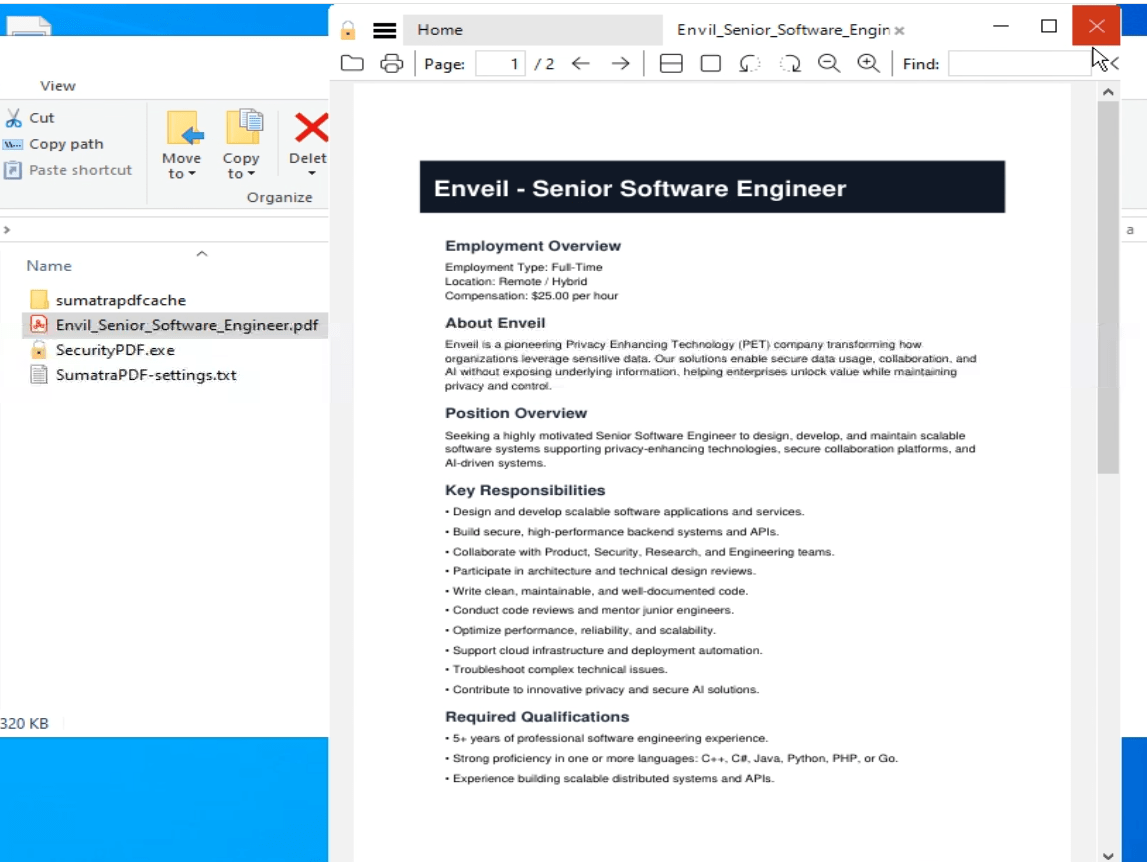
“The second chain is more recent and shares several characteristics with a campaign described by ESET against the UAV sector in 2025. Victims are instructed to download SecurityPDF, a trojanized PDF viewer, from one of several websites impersonating Enveil, a legitimate privacy technology company with no actual connection to the attack. Once installed, the modified viewer inspects any PDF opened through it for a hidden marker.” continues the report. “When the marker is present, the application decrypts and launches an embedded payload that loads the Troy backdoor directly into memory.”

Troy is a single DLL implant that supports 17 operator commands covering file operations, shell access, process termination, in-memory DLL injection, and configuration updates. Its name comes from a PDB path embedded in the binary that Check Point also observed in earlier Lazarus samples. Enveil has no connection to the campaign; its brand was simply borrowed because it sounds credible to defense sector professionals.

The C2 infrastructure is built from compromised Roundcube webmail installations and WordPress sites, many vulnerable to CVE-2025-49113, infected with a previously undocumented PHP webshell called RelayShell. RelayShell functions as a relay rather than a traditional backdoor, exchanging commands and responses through simple text files. In at least one confirmed case, an already-breached French organization was used to send phishing messages to new victims — the attackers borrowed the company’s reputation to get past filters. Check Point identified at least 17 unique server identifiers in this relay network, with operators connecting through commercial VPNs to further obscure their location.

The most urgent action is applying the August 2026 Patch Tuesday update, which contains the CVE-2026-68820 fix. For organizations running public-facing Roundcube or CMS installations, the secondary risk is becoming part of the relay infrastructure rather than the intended target: the servers used in this campaign were compromised through leaked credentials and a known unpatched vulnerability, not anything exotic. The full indicators of compromise are in Check Point’s report.

“Given the combination of a zero day vulnerability that now have a patch, a new modular backdoor, and web based infrastructure designed to resemble legitimate traffic, security teams in these sectors should prioritize the August Patch Tuesday update, review the indicators of compromise published in Check Point Research publication, and apply the same level of scrutiny to unsolicited recruiting outreach that they would apply to any unverified download request.” concludes the report.

Follow me on Twitter: @securityaffairs and Facebook and Mastodon

Pierluigi Paganini

(SecurityAffairs – hacking, Lazarus)

Microsoft Patch Tuesday for August 2026 Fixed a Zero-Day and Wormable RCE

Microsoft Patch Tuesday for August 2026 fixes 398 CVEs, including an actively exploited zero-day and a wormable DNS flaw enabling remote code execution.

Microsoft released its Patch Tuesday security updates for August 2026 on Tuesday, covering 398 new CVEs across Windows, Office, Azure, Exchange Server, SharePoint, Teams, GitHub Copilot, .NET, and a range of other components. Sixty-two are rated Critical. One is already being exploited in the wild. The good news, such as it is, is that the ratio of bugs being reported to bugs being actively exploited hasn’t moved — there’s no equivalent surge in zero-day exploitation to match the volume of fixes.

The actively exploited bug is CVE-2026-68820, a use-after-free flaw in afd.sys, the kernel-mode driver that underpins the Windows Sockets API. CVE-2026-68820 is a Windows WinSock driver flaw that can let attackers execute code with SYSTEM-level privileges. Microsoft says it is actively exploited, although its CVSS assessment lists exploit maturity as “Unproven.”

“Use after free in Windows Ancillary Function Driver for WinSock allows an authorized attacker to elevate privileges locally.” reads the advisory. “An attacker who successfully exploited this vulnerability could gain SYSTEM privileges. Successful exploitation of this vulnerability requires an attacker to win a race condition.”

The DNS bug, tracked as CVE-2026-62878, deserves immediate attention. CVE-2026-62878 is a critical Windows DNS Server flaw that allows remote, unauthenticated attackers to execute code with elevated privileges without user interaction. The stack-based buffer overflow could be wormable, making rapid patching especially important for internet-facing DNS servers.

“An unauthenticated attacker could exploit this vulnerability by sending a specially crafted packet to an affected service over the network.” reads the advisory. “Successful exploitation could allow the attacker to execute code on the target system. No authentication or user interaction is required.”

A wormable remote code execution flaw with no authentication requirement on a service that’s almost universally exposed is exactly the kind of thing that turns into a widespread incident if patching lags.

Three other remote code execution bugs round out the urgent list. CVE-2026-62893 hits Windows Deployment Services TFTP server, TFTP has no authentication, runs on UDP port 69, and any WDS server doing PXE boot is exposed. CVE-2026-62815 is in Microsoft’s QUIC implementation, the transport protocol underlying HTTP/3, and affects roughly 13.5 million websites. CVE-2026-59124 is a CVSS 9.8 flaw in Microsoft HPC Pack that Microsoft itself rates as “exploitation more likely”, the Important severity rating reflects that HPC isn’t on by default, not that the bug is less dangerous.

The Exchange bug, CVE-2026-62911, is an elevation of privilege flaw via authentication bypass that was demonstrated with working code at Pwn2Own Berlin. If exploited successfully, an attacker can take over all mailboxes on the Exchange server — reading, sending, and downloading attachments across every user account. Microsoft’s exploitability ratings here are worth ignoring in favor of the Pwn2Own context: functional exploit code exists and was handed to Microsoft directly. Two publicly disclosed bugs — CVE-2026-62832 in Windows User Profile Service and CVE-2026-72971 in the Container Isolation FS Filter Driver — are also in this release, with the User Profile Service flaw considered likely to see exploitation. The August updates also fix two CVEs in the TPM 2.0 reference implementation, one spoofing and one information disclosure.

The full list of CVEs addressed by Microsoft Patch Tuesday security updates for August 2026 is available here.

Follow me on Twitter: @securityaffairs and Facebook and Mastodon

Pierluigi Paganini

(SecurityAffairs – hacking, Microsoft Patch Tuesday)

Microsoft Plugs Nearly 400 Security Holes

Microsoft today released updates to remedy at least 398 security vulnerabilities in its Windows operating systems and supported software, including one weakness that is already being actively exploited and two others that were publicly detailed prior to today.

Image: Shutterstock, Mallika Home Studio.

August’s overstuffed bundle of patch joy from Microsoft did not eclipse its recording breaking release of more than 570 security updates last month, but it is double June’s then-record batch of nearly 200 fixes. Microsoft has attributed the recent patch deluge to vulnerability discoveries aided by artificial intelligence, and experts roundly agree that Windows users should get used to the idea of Patch Tuesdays (the second Tuesday of each month) covering hundreds of newly discovered security flaws.

Fully 42 of the 398 flaws that Microsoft patched today earned Redmond’s most-dire “critical” rating, meaning they are severe enough that malware or malcontents could exploit them to gain remote control over a Windows computer with little to no help from the user.

The sole known “zero day” bug fixed by Microsoft this month is CVE-2026-68820, a privilege escalation weakness in a core Windows component called afd.sys, which the security firm Automox describes as “the driver behind Windows socket connections on effectively every endpoint.”

“This isn’t a front-door bug,” Automox’s Landon Miles wrote in a Patch Tuesday blog post. “It’s step two in a chain: an attacker phishes their way into a low-privilege foothold, then uses the driver flaw to take the box. The 7.0 score reflects the high attack complexity, because race conditions are fiddly. The exploit has to be thrown over and over until the timing lands. Someone is clearly landing it anyway.”

CVE-2026-62832 is another privilege escalation flaw that Microsoft has labeled likely to be exploited; this flaw, in the Windows User Profile Service, may be related to the recent “LegacyHive” public disclosure from the prolific bug hunter known as Nightmare Eclipse. The other publicly disclosed flaw is CVE-2026-72971, a low-impact local tampering vulnerability that Microsoft reckons is unlikely to be exploited.

Other major software makers are likewise increasing their patch volumes and cadence thanks to AI, including Adobe which last month moved to twice-monthly security bulletins published on the 2nd and 4th Tuesday of each month. Cisco, Google, Mozilla and Oracle also are shipping updates far more frequently and abundantly.

By all accounts, AI is quite good at finding security holes in software. But for now at least, patching the resulting bugpocalypse remains a heavily human-centric endeavor, and the jury is still out on whether AI technologies will turn out to be as good at fixing vulnerabilities as they are at finding and exploiting them. This is an important question when one considers that these same AI technologies also are suggesting fixes for the vulnerabilities they find.

Researchers at 1Password recently examined what happens when different large language models (LLMs) generate vulnerability patches for newly disclosed, complex vulnerabilities. They found the LLMs produced patches that failed to fix the flaw or added a new weakness in the process (or both) more than half the time.

Ed Skoudis, president of the SANS Technology Institute, said his team has seen excellent results using AI to generate patches, provided there are humans in the loop to test the suggested fixes and push for iterative improvements.

“AI is rapidly becoming astonishingly good at finding vulnerabilities, but this research shows that fixing them is a very different problem,” Skoudis wrote in a SANS newsletter today. “Don’t expect one-shot AI patching to work reliably. Instead, iterate, test, challenge, improve, and verify. AI can be an extraordinary patching partner, but today it still needs a skilled human at the keyboard.”

Tyler Reguly at Fortra says while reports of Microsoft patching hundreds of vulnerabilities in one go have prompted some organizations to try to patch faster, it’s important to bear in mind that only one of the almost 400 bugs addressed today is known to be actively exploited. Reguly suggested security leaders check in with their teams to see how they’re handling the increasing workloads, which often involve testing fixes before deploying them in production environments.

“If you’re a chief security officer talk to your teams about how they are shifting or modifying their workflows to better accommodate the patching shift that we’re seeing and support them across various organizational units by enabling the changes they want to see made,” Reguly said. “There’s no need to rush these updates, no matter what various vendors and organizations try to tell you. You need to make sure that you are rolling out safe updates that will not negatively impact your systems.”

Speaking of the humans behind the keyboards, don’t neglect to backup your system and/or data before applying this month’s monster patch load. The day after each month’s Patch Tuesday is sometimes derisively referred to as Reboot Wednesday, but it generally doesn’t hurt to wait a few days to apply these huge update bundles because it sometimes takes a couple of days for the occasional misbehaving patch to get ironed out properly by Microsoft.

For a clickable, per-patch breakdown by severity and urgency, check out this roundup from the SANS Internet Storm Center.

❌