❌

Visualização de leitura

U.S. CISA adds Microsoft Windows Shell flaw to its Known Exploited Vulnerabilities catalog

U.S. Cybersecurity and Infrastructure Security Agency (CISA) adds Microsoft Windows Shell flaw to its Known Exploited Vulnerabilities catalog.

The U.S. Cybersecurity and Infrastructure Security Agency (CISA) added a Microsoft Windows Shell flaw, tracked as CVE-2026-96951 (CVSS score of 8.8), to its Known Exploited Vulnerabilities (KEV) catalog.

Microsoft Patch Tuesday security updates for October 2026 address a record 1,415 vulnerabilities, including a zero-day under active attack. The flaw, tracked as CVE-2026-96951, is a Windows Shell command injection vulnerability that allows an unauthorized attacker to bypass security protections over a network. Exploitation can evade Mark of the Web (MOTW) defenses, which help protect users from potentially dangerous files downloaded from the internet. Microsoft confirmed that the flaw is being actively exploited.

“An attacker who successfully exploited the vulnerability could evade Mark of the Web (MOTW) defenses.” reads the advisory. “In an email or instant message attack scenario, the attacker could send the targeted user a specially crafted file that is designed to exploit the vulnerability. In any case an attacker would have no way to force a user to view attacker-controlled content. Instead, an attacker would have to convince a user to take action. For example, an attacker could entice a user to either click a link that directs the user to the attacker’s site or send a malicious attachment.”

According to Binding Operational Directive (BOD) 22-01: Reducing the Significant Risk of Known Exploited Vulnerabilities, FCEB agencies have to address the identified vulnerabilities by the due date to protect their networks against attacks exploiting the flaws in the catalog.

Experts also recommend that private organizations review the Catalog and address the vulnerabilities in their infrastructure.

CISA orders federal agencies to fix the flaw by October 16, 2026.

The U.S. Cybersecurity and Infrastructure Security Agency (CISA) also added an Ivanti Connect Secure FortiMail flaw, tracked as CVE-2026-104935 (CVSS score of 8.6), to its Kev Catalog.

The vulnerability is an authentication bypass issue caused by spoofing in ICS versions before 25.1.3.0 that could allow a remote, unauthenticated attacker to execute arbitrary commands. ICS versions 22.7R2.14 and earlier are not affected.

Follow me on Twitter: @securityaffairs and Facebook and Mastodon

Pierluigi Paganini

(SecurityAffairs – hacking, CISA)

Microsoft Patch Tuesday Sets New Record with 1,415 CVEs in October 2026 Updates

Microsoft Patch Tuesday security updates for October 2026 address a record 1,415 vulnerabilities. Prioritize the exploited zero-day, critical bugs and potentially wormable vulnerabilities.

Microsoft just shattered every patch record in the book. October 2026 brought us a staggering 1,415 new CVEs from Microsoft alone.

“Well, it’s a new record release from Microsoft, again. This is also the first four-digit volume we have ever seen and includes six-digit CVEs. As always, counting this load is tricky, but I see 1,415 new CVEs from Microsoft. That puts this month at a greater volume than any previous YEAR from Microsoft. I’m starting to think I don’t like this new normal.” states ZDI. “As for the products affected by this release, we have Windows and Windows components, Office and Office Components, Developer Tools and .NET, SharePoint, Linux kernel, Skype for Business and Microsoft Lync, SQL Server and Dynamics, Azure and cloud services, and Exchange server.”

This is the first time Microsoft has reported more than 1,000 vulnerabilities in a single month. To help security teams handle this huge number of flaws, Microsoft introduced “risk cohorts” to group related vulnerabilities, similar to the old security bulletin system. AI is clearly helping researchers find bugs faster, both for attackers and defenders. The good news is that vulnerabilities are still being discovered faster than attackers are exploiting them. Security teams should focus on the most serious threats first instead of trying to patch every low-risk flaw at once.

Instead, focus immediately on what’s actively burning in the wild. The single zero-day under active attack this month is CVE-2026-96951, a Windows Shell security feature bypass used to dodge Mark of the Web protections.

“An attacker who successfully exploited the vulnerability could evade Mark of the Web (MOTW) defenses.” reads the advisory. “In an email or instant message attack scenario, the attacker could send the targeted user a specially crafted file that is designed to exploit the vulnerability. In any case an attacker would have no way to force a user to view attacker-controlled content. Instead, an attacker would have to convince a user to take action. For example, an attacker could entice a user to either click a link that directs the user to the attacker’s site or send a malicious attachment.”

Other high-priority threats include a critical unauthenticated SharePoint privilege escalation bug (CVE-2026-102866), a high-scoring SQL Server remote code execution flaw (CVE-2026-65674), and a massive wave of 59 potentially wormable vulnerabilities spanning core network services like DHCP, Remote Desktop Gateway, and DNS.

Below are the descriptions for the above issues:

  • CVE-2026-96951 (CVSS score of 8.8) is a Windows Shell command injection vulnerability that allows an unauthorized attacker to bypass security protections over a network. Exploitation can evade Mark of the Web (MOTW) defenses, which help protect users from potentially dangerous files downloaded from the internet. Microsoft confirmed that the flaw is being actively exploited.
  • CVE-2026-102866 (CVSS score of 8.1) is a Microsoft SharePoint Server vulnerability caused by improper verification of cryptographic signatures. It allows an unauthenticated attacker to elevate privileges over a network, potentially gaining unauthorized access to sensitive information or modifying data.
  • CVE-2026-65674 (CVSS score of 8.8) is a Microsoft SQL Server remote code execution vulnerability caused by the deserialization of untrusted data. An authorized attacker with the required privileges could exploit the flaw over a network to execute code on the affected server.

“I may be wrong about some of these – there are a few where the description is somewhat…er…ambiguous, but regardless, this number of wormable bugs in 2026 should cause some level of concern. Not panic.” concludes ZDI. “There’s no need for that, but it is disconcerting to see this many juicy targets sitting out there. Please do your best to test and deploy these fixes in a timely manner.”

Prioritize the proven, public, and exploited flaws first, and take a deep breath before diving into the rest of the patch mountain. Make sure your operational priorities remain laser-focused on real risk rather than chasing vanity metrics.

Make every effort to test and apply these patches as soon as possible.

Follow me on Twitter: @securityaffairs and Facebook and Mastodon

Pierluigi Paganini

(SecurityAffairs – hacking, Patch Tuesday)

Update Windows: Record Patch Tuesday fixes flaw already under attack

Microsoft’s October Patch Tuesday release addresses a record-breaking 1,413 vulnerabilities, including an actively exploited Windows Shell zero-day and two other publicly disclosed flaws.

Just when you thought a previous record would stand for a while, Microsoft comes out again with the largest monthly Patch Tuesday release. Microsoft has said its growing use of AI to find and fix security vulnerabilities means users should expect more fixes in its monthly updates.

How to apply patches and check if you’re protected

These updates fix security problems and help keep your Windows PC protected. Here’s how to make sure you’re up to date:

  • Click the Start button, then open Settings.
  • Select Windows Update (usually at the bottom of the menu on the left).
  • Click Check for updates. Windows will search for the latest security updates. If you’ve enabled Get the latest updates as soon as they’re available under More options, you may be prompted to restart immediately to complete the update.
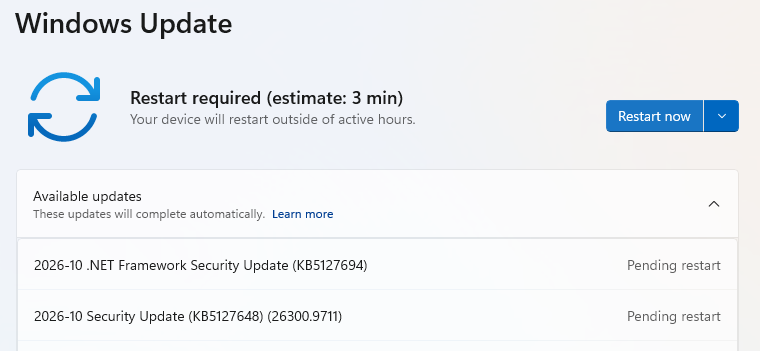
    restart to update
  • Otherwise, continue to the next step.
  • If updates are available, they’ll start downloading automatically. When they’re ready, click Install or Restart now if prompted. Your computer may need a restart to finish the update.
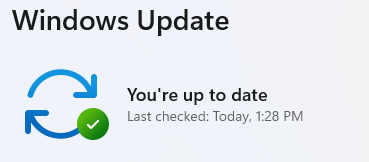
  • After restarting, go back to Windows Update and check again. If it says You’re up to date, you’re all set.
Windows update

Technical details

As usual, we’ve selected a few vulnerabilities to highlight for readers interested in the technical details.

We’ll start with the actively exploited vulnerability tracked as CVE-2026-96951 (CVSS score 8.8 out of 10), a Windows Shell security feature bypass vulnerability.

The security feature it can bypass is the Mark of the Web (MOTW) defense, which can warn users about potentially unsafe downloaded files.

Successful exploitation requires user interaction. For example, in an email or instant message attack, the attacker could send the targeted user a specially crafted file designed to exploit the vulnerability, but the user would have to click a link or open an attachment.

Another one to keep an eye on is CVE-2026-108398 (CVSS score 8.8 out of 10), where an untrusted search path in .NET Framework allows an authorized attacker to bypass a security feature locally. The bypassed feature is Windows Defender Application Control (WDAC), which could lead to the ability to run unauthorized applications on target systems. This vulnerability was publicly disclosed before the patch.

Another publicly disclosed vulnerability is CVE-2026-92707 (CVSS score 5.3 out of 10). The flaw can let an unauthenticated remote attacker exhaust memory in affected applications that process specially crafted MessagePack data. MessagePack-CSharp is a software component that helps applications pack and unpack data in a compact format, making it efficient to store or exchange information. Exposure depends on how a service uses the library to pack and unpack the information.


From reporting threats to removing them.

Cybersecurity risks should never spread beyond a headline. Keep threats off your devices by downloading Malwarebytes today.

Microsoft Patches More Than 1,400 Security Flaws

Microsoft today issued updates to fix more than 1,400 security vulnerabilities in its Windows operating systems and other software. Today’s epic patch batch dwarfs September’s record of nearly 1,000 fixes, which was already about ten times the normal monthly patch load from Redmond.

Just one of the weaknesses patched this week is considered a “zero day,” or already exploited in the wild. CVE-2026-96951 is a security feature bypass in the Windows Shell that affects Windows 10 and 11 systems, as well as some Server versions.

Windows 10 users might be wondering if they can still expect security updates after this month. Microsoft had been slated to stop shipping updates for Windows 10 systems in October 2025, but ended up adding another year of free updates after considerable pushback. A few months ago, Microsoft quietly extended that support for another year (until October 2027).

At least 78 of the flaws fixed this month are rated “critical,” meaning they could be exploited with little or no action by the user, and most of those critical bugs allow an attacker to execute code of their choice on the vulnerable system.

While Microsoft said there are no signs anyone is exploiting it yet, a security feature bypass in the .NET Framework (CVE-2026-108398) was publicly disclosed prior to today, potentially giving attackers advance time to work out how to exploit the bug.

Satnam Narang at Tenable said the number of flaws fixed this month far surpasses the previous record-setting year 2020, when Microsoft patched 1,261 CVEs.

“We’ve now crossed the 4,000 CVE mark with two months left to go,” he said.

Microsoft credits large language models for the high volume of bug discovery, and presumably AI gets credit for many of the patches used to fix these flaw. Meanwhile, security experts have been warning that these unusually large patch volleys from Microsoft are placing extra strain on corporate security teams, which often have to test individual updates before deploying them across a network to ensure the fixes don’t cause problems for other software.

Tyler Reguly, associate director of security research and development at Fortra, notes that just 26 Microsoft vulnerabilities appeared in the “Known Exploited Vulnerabilities” (KEV) catalog maintained by the U.S. Cybersecurity & Infrastructure Security Agency (CISA) so far this year, and security teams would do well to prioritize patching those 26 vulnerabilities first.

“Security leaders should focus on exploitable risk, and ask whether their teams have the clarity, capacity and support to act,” Reguly said.

Which vulnerabilities deserve the most scrutiny in your organization? The folks at Cisco Talos have a useful roundup of the more noteworthy flaws that Microsoft fixed today, and of course the SANS Internet Storm Center has a reliable roundup that indexes vulnerabilities by severity, CVE number and affected software.

❌