Visualização de leitura

Chinese Hackers Use AI Agents in Multi-Country Cyber Campaign

Hunt.io uncovered a Chinese-speaking campaign using AI agents to automate cyberattacks against Asian government, education and industrial targets.

Threat intelligence firm Hunt.io just documented a second, separate China-linked campaign wiring commercial AI models directly into live cyberespionage operations, this time hitting Taiwan’s Kuomintang Party archives, Indonesia’s Ministry of Foreign Affairs, government and education systems in mainland China, and industrial hosts in Vietnam.
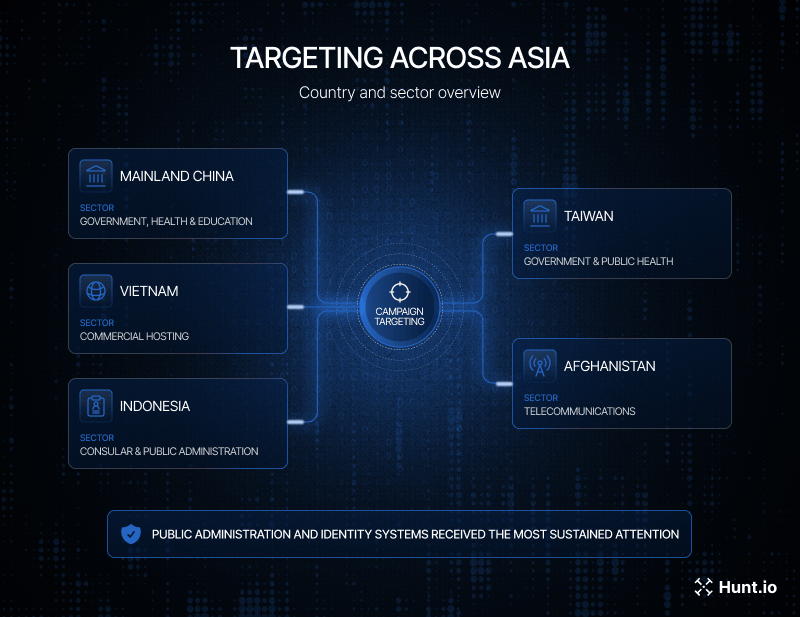
The full report traces the operation through five exposed open directories the operators accidentally left publicly accessible, which is how researchers reconstructed the entire orchestration system from the inside.

“Five open directories, one campaign. The exposed directories map to an AI orchestration host, a Java/CAS exploitation workspace, a fake MySQL deserialization service, a Shellshock and credential-testing node, and a payload-distribution store.” reads the report. “SecFlow split reconnaissance, exploitation, collection, and reporting among specialist workers. The runtime could switch between Claude, Qwen, and DeepSeek profiles without changing the task interface.”

The framework behind the campaign, called SecFlow by the operators, could use different AI models, including Claude, Qwen, and DeepSeek. The operators could switch between them without changing how the system worked. Instead of using the models’ official APIs, SecFlow routed requests through private proxy servers linked to the niestools.com domain.
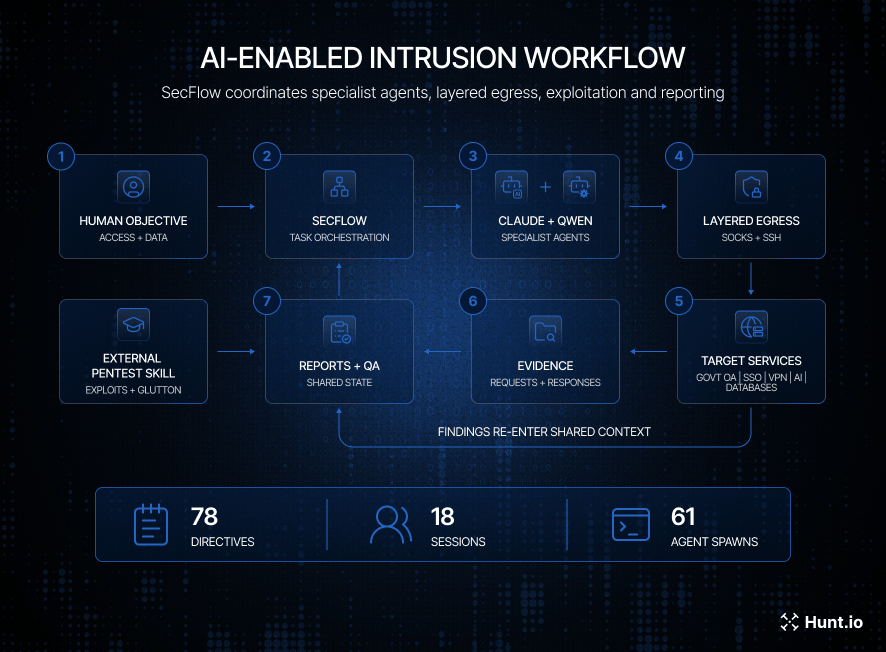
The AI models did not break into systems on their own. They helped automate and organize traditional hacking tasks, such as scanning for vulnerabilities, testing stolen credentials, trying exploits, deploying webshells, collecting data and evidence, and generating reports. The attackers built the infrastructure that connected these AI capabilities to real-world intrusions.

The most damaging confirmed breach hit a Fengtai District government Office Automation environment in China, and it ran the full playbook from web shell to data theft.

“The most extensive compromise hit a Fengtai District government environment, where the operator achieved command execution, collected LSASS and registry hives, accessed government and health records, and deployed multiple Windows implants. Separate activity exposed a Chinese education AI platform and obtained root database access to a university campus-card system.” Hunt.io states. “SecFlow coordinated reconnaissance, exploitation, and reporting across Claude, Qwen, and DeepSeek workers. “

Operators achieved Windows command execution through internet-facing web applications, then used ASPX web shells not just to run commands but as a persistent operational backbone: querying internal databases, pulling an LSASS memory dump apart in 37 separate chunks to avoid detection, and extracting SAM and SYSTEM registry hives containing password hash material.

“The operator divided the LSASS dump into 37 blocks, requested each block through an authenticated SOCKS route, verified the expected byte count, and reconstructed the complete file.” continues the report. “The operator also collected the SAM and SYSTEM registry hives. Another server-side page, extract.aspx, scanned sections of the memory dump for Windows password-hash material.”

From there they pulled 822 OA user account records, created a new privileged account of their own for backup access, and walked away with 949 attachments totaling 1.28GB, including a chronic-disease report containing real patient health information.

In a separate case, the operators also exposed the management backend of a Chinese education AI platform. The irony is hard to miss: an AI company was compromised partly because its own AI infrastructure was not properly secured.

Hunt.io found a backend that anyone could access without authentication. It exposed 23 AI agent configurations, 14 API secret fields containing credentials, and 104 complete chatbot conversations. Some of those logs included real student data, such as names, student ID numbers, majors and academic advisers, taken from career-guidance and study-partner chats.

The exposed credentials were not just old or unused secrets. They worked against the platform’s live production API, meaning attackers could use the stolen keys to access real systems.

One particularly clever access method used a fake MySQL server as bait rather than a target. A malicious service impersonating a MySQL database would accept connections from vulnerable Java applications, then return specially crafted data designed to trigger unsafe object deserialization on the client side the moment it connected, turning what should have been an outbound database query into inbound code execution. That’s initial access flipped on its head, exploiting the assumption that connecting out to a database is inherently safer than accepting connections in.

The webshell tooling itself, a custom framework the operators called GLUTTON, hid its payloads inside PNG image files using steganography, literally embedding executable code in the red, green, and blue color channel data of ordinary-looking images. A small decoder script on the server would read the image pixel by pixel, XOR-decrypt the hidden bytes using a fixed key, and load the resulting code directly into memory without ever writing an obviously malicious file to disk. Any security control that only checks file extensions or content types for image uploads would sail right past this without noticing anything wrong.

This isn’t an isolated incident for the underlying pattern either. It’s the second campaign in two months where researchers caught commercial AI coding tools embedded as operational components of live nation-state intrusions, following a similar Hunt.io discovery in June involving the same Claude Code and DeepSeek combination against separate government and financial targets in Afghanistan and Thailand. Anthropic itself disclosed a related pattern back in November 2025, describing attackers who convinced Claude it was doing legitimate defensive penetration testing by splitting malicious requests into small, individually harmless-looking pieces.

The operators also left a clear trace across their own infrastructure. The username “Nie” appeared several times in hardcoded file paths inside the GLUTTON tools and was reused in proxy credentials, linking all five compromised workspaces to the same campaign.

For defenders, this is especially important if they use Java frameworks vulnerable to deserialization attacks, older Apache or Grafana systems, or public-facing office automation software. The campaign shows that attackers can treat commercial AI models as interchangeable tools. The key question is no longer which AI model carried out an attack, but how quickly defenders can recognize the attack pattern, regardless of which model was used.

Follow me on Twitter: @securityaffairs and Facebook and Mastodon

Pierluigi Paganini

(SecurityAffairs – hacking, AI Agents)

China-linked Fire Ant Hides Inside Trusted Infrastructure

Fire Ant hijacked Cisco routers, stole credentials and altered logs to hide its tracks, using trusted infrastructure to reach high-value networks.

Chinese-linked cyber espionage group Fire Ant has spent the past year quietly graduating from hacking individual computers to hacking the infrastructure that connects them. Sygnia’s new report traces how the group expanded from compromising hypervisors into routers, authentication servers, and Linux management hosts, the unglamorous plumbing that decides who gets to log in where and what gets recorded when they do.

The investigation started with something that looked like a minor configuration mistake. A tunnel interface showed up as active on a Cisco IOS XR router with no corresponding entry in the configuration history, no commit anyone could point to that explained how it got there.

“The investigation began with an anomaly that appeared, at first, to be a configuration inconsistency: a tunnel interface became operational on a Cisco IOS XR router even though no corresponding running configuration or commit history could explain its creation. The interface was associated with a specific VRF and used GRE encapsulation, but standard configuration review did not provide a reliable explanation for how it appeared.” reads the report. “This discrepancy became a key investigative lead because it suggested that the device’s operational state could no longer be trusted to match the configuration and audit records visible to administrators.”

That single inconsistency became the thread that unraveled the whole operation, because it meant the router’s own records could no longer be trusted to reflect what the device was actually doing.

What Fire Ant built inside that router wasn’t generic malware bolted onto Linux. The toolkit was purpose-written for IOS XR’s own internals, hooking into logging, command execution, and routing functions directly. One component disguised itself as a legitimate boot service and ran on a bizarre schedule, active only during odd-numbered hours and shut off during even ones, apparently timed to dodge routine inspection windows. Another modified the router’s own syslog function so that any log message not containing the word “Health” would silently vanish instead of being recorded, a filter so specific it reads like something built to survive a very particular kind of audit.

Following that anomalous tunnel led investigators to a second compromised machine, an aging Linux system acting as the tunnel’s far end. From there, Fire Ant wasn’t just maintaining access, it was actively scanning outward toward other high-value networks, probing SSH, RDP, and web ports on systems connected through the compromised infrastructure.

“The actor appeared to use the compromised environment as an infrastructure platform from which it could explore reachability into connected high-value networks, including critical infrastructure.” states Sygnia. “In this model, routers, TACACS servers and jump hosts are not peripheral assets. They are the path to the target behind the target.”

The authentication layer got its own dedicated attack, and this is the part that should concern anyone who thinks compromised credentials are the worst-case scenario. Fire Ant injected a malicious library directly into a running TACACS authentication daemon, the software responsible for approving administrator logins across network devices, then intercepted live sessions as they were accepted and quietly copied the credential material flowing through. That’s not stealing a password from a phishing page; that’s sitting inside the process whose entire job is deciding who to trust, watching every legitimate login happen in real time.

“The acpid component embedded a modified IOS XR syslog library. In the modified evsyslog flow, log delivery was routed through a custom wrapper that checked for the string “Health” before calling mq_send. When the condition was not met, the wrapper returned a success-like value without forwarding the message, indicating selective manipulation of router log delivery.” states the report.

Fire Ant also used deep, persistent backdoors on Linux systems. Some had remained dormant since 2025 and were disguised as normal system services, making them easy to overlook. One even posed as SentinelOne’s security agent and stayed active in memory after its file was deleted, making standard disk-based forensic checks ineffective on their own.

Perhaps the most technically distinctive piece was a backdoor that didn’t listen on any port at all in the conventional sense. Instead it silently inspected raw network traffic, waiting for specific packets carrying an embedded magic string before it would activate and open an interactive shell. This design shares real code-level overlap with tooling publicly tied to UNC3886, a China-nexus espionage cluster Google and Mandiant have tracked for years, though the specific activation strings and packet-handling logic here differ enough from earlier public reporting that Sygnia treats it as an evolution rather than a straight reuse.

“The key choice is notable because Mandiant previously documented UNC3886 TACACS credential-collection tooling in which captured credential records were also XORed with 0xEF before being written to a credential log file.” continues the report.

Once inside, Fire Ant didn’t just avoid detection, it actively edited the evidence. Login records in Linux’s own wtmp, utmp, and btmp files got rewritten to swap out the router’s real IP address for an internal one, and sudo-related entries were stripped from system logs to erase any trace of privilege escalation. Sygnia’s core warning for defenders cuts against a habit most incident responders have built their careers on: logs are not automatically ground truth anymore, and any investigation into infrastructure this deeply compromised has to cross-check log evidence against memory, disk state, and network telemetry independently rather than trusting any single source on its own.

The bigger concern is that Fire Ant was not mainly interested in the systems it first compromised. It used them as a stepping stone into more valuable networks connected through trusted routing and authentication relationships — what Sygnia calls the “target behind the target.” This means edge routers, TACACS servers and Linux jump hosts can be just as important to protect as systems holding sensitive data, especially when they connect to critical infrastructure. These often-overlooked systems can give a patient and well-resourced attacker a trusted path deeper into the environment, making them a valuable target rather than an unimportant middle layer.

“The central lesson is that defenders must protect more than the systems that store sensitive data. They must protect the infrastructure that makes other systems reachable, trusted, and observable.” concludes the report. “When that layer is compromised, the impact extends beyond a single organization: the actor may gain a vantage point for collection, a path toward connected targets, and the ability to make trusted infrastructure tell an incomplete story.”

Follow me on Twitter: @securityaffairs and Facebook and Mastodon

Pierluigi Paganini

(SecurityAffairs – hacking, Fire Ant)

Philippine Nuclear and Naval Targets Hit by Suspected Chinese Operator

An alleged Chinese-speaking actor breached Philippine nuclear and naval targets by exploiting known flaws, stealing sensitive data.

A suspected Chinese-speaking operator targeted a Philippine nuclear research body and a marine engineering company that supports the Philippine Navy, using well-known vulnerabilities in internet-facing ownCloud and WordPress systems. The activity was uncovered after Hunt.io found an exposed server in Amsterdam that contained attack scripts, logs, offensive tooling and data taken from the two organisations.

“Hunt.io Attack Capture discovered an open directory containing tooling which documented intrusion activity against two Philippine organizations.” reads the report published by Hunt.io. “A recovered CSV references roughly 9 GB of material stolen from the nuclear agency, most absent from the current directories contents, and a compromise of a project management application, indicating a possible third victim.”

Hunt.io disclosed the findings to CERT-PH under the TLP:AMBER sharing standard and delayed publication until 25 August 2026 so the national response team could notify the affected organisations. The incident arrives amid sustained tensions in the South China Sea and continuing reports of suspected Chinese cyber activity against Philippine government, defence and critical-infrastructure targets.

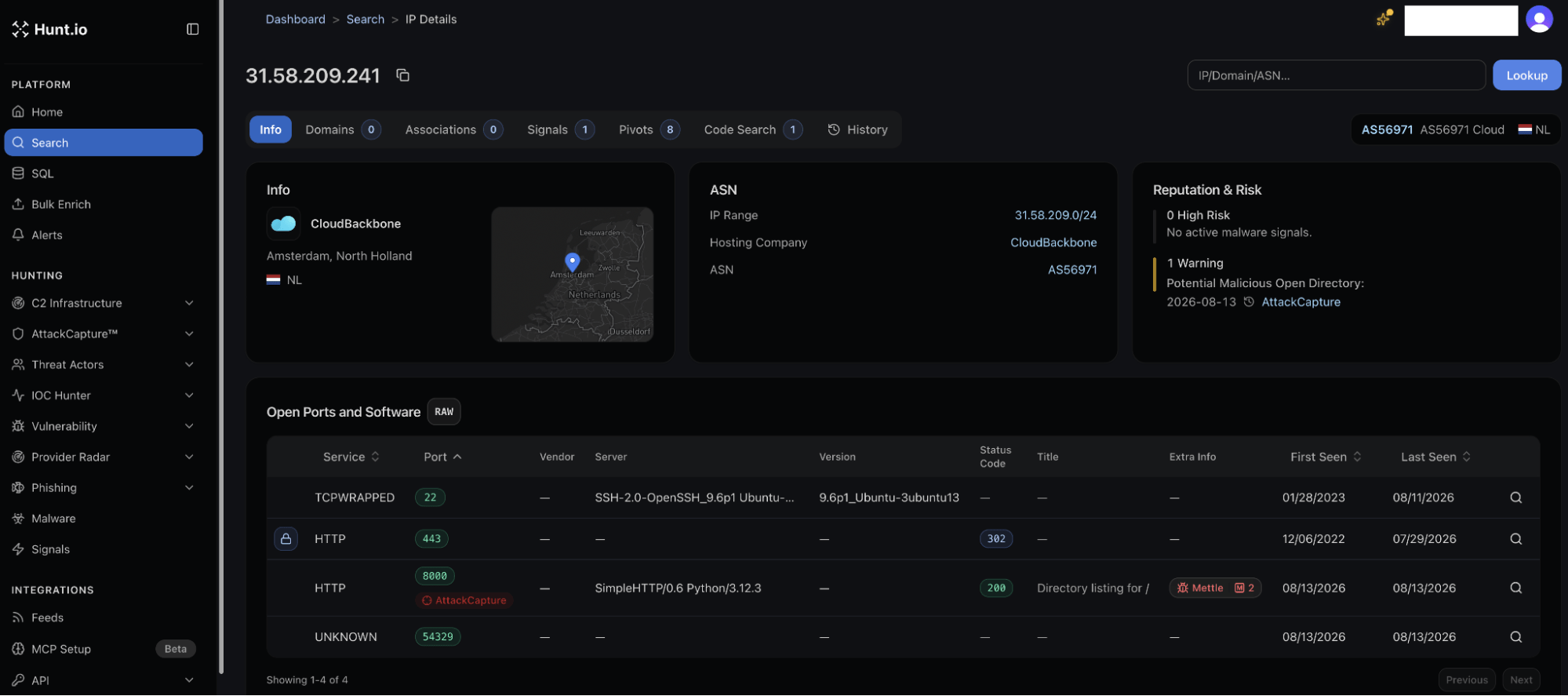
“On August 13, 2026, Hunt.io Attack Capture identified an open directory on the host 31.58.209[.]241. The server staged custom Python scripts, per-file transfer logs, open-source offensive security tooling, and exfiltrated data from two Philippine organizations. The scripts targeted an ownCloud instance operated by a nuclear research body, using pre-signed URLs generated with an empty signing secret, which allowed for the unauthenticated retrieval of files over WebDAV.” states the report.”A separate intrusion was observed exploiting a WordPress site operated by a Philippine marine engineering and shipbuilding company that provides services to the Philippine Navy.”

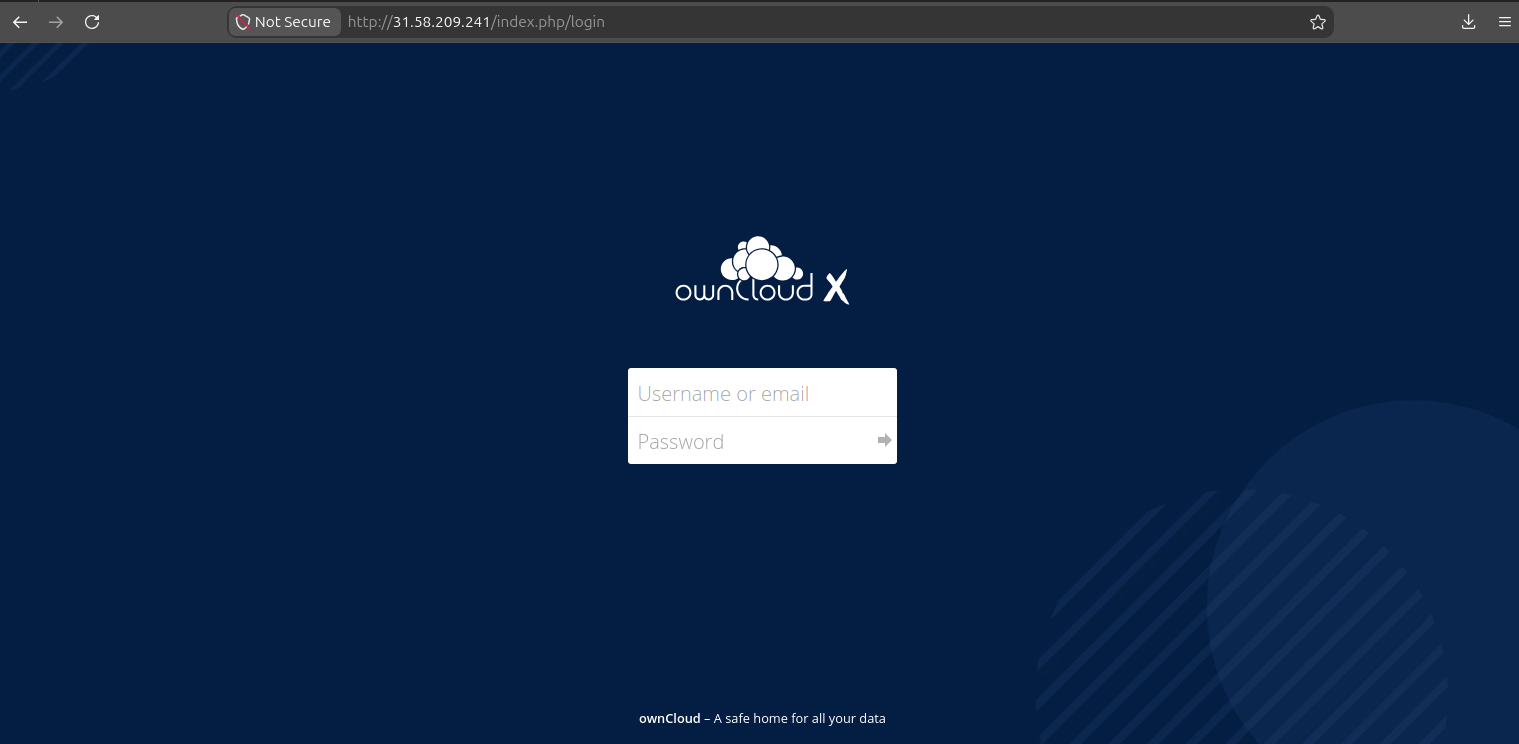
The server was not a sophisticated hidden service. It exposed a Python SimpleHTTP directory on port 8000, along with SSH, a self-hosted ownCloud login page and other services. The directory contained 1,310 files in 86 folders, totaling 1.17 GB, including scripts, stolen data and tools such as Sliver, Metasploit and Mettle.

Researchers gained a rare view of the attacker’s operations after finding tools, logs and stolen files left exposed on the server. The main entry point was likely the nuclear research body’s internet-facing ownCloud service, compromised by exploiting CVE-2023-49105, an authentication-bypass flaw in ownCloud versions before 10.13.1.

In this condition, an attacker who knows a valid username can generate WebDAV requests that the server accepts as if they were made by that user. No password is needed. Hunt.io found five custom Python scripts implementing this technique, four focused on individual accounts and a fifth capable of enumerating directories and recording every attempted download. hunt

“In vulnerable instances when no such key was configured, a default state on new installs, the signing routine still executed using an empty secret. An attacker with knowledge of valid usernames on the instance could construct signed WebDAV requests that would be accepted by the server as authentication action by that user, without ever supplying credentials.” continues the report. “A total of five custom Python scripts saved from the directory implement this exact technique described above. Four target a single account each; the fifth moves further to include directory enumeration and logging.”

The attacker used random delays to make data collection less noticeable and avoid volume-based alerts. Scripts, logs and folders consistently used Simplified Chinese, including labels for nuclear, radiation-safety, finance and IT files. This suggests a Chinese-speaking operator, but does not prove links to a specific government or threat group.

The stolen data included nuclear reactor component databases, fuel inventories, radiation-safety documents, incident records and authorised-user lists. It also included strategic plans, IT documents, staff records, CVs, passport and travel data, and financial disclosures from Philippine officials.

The exposed server held 176 files, about 372 MB in total. However, a CSV created by the attacker referred to roughly 9 GB of stolen data. This gap suggests the server contained only part of the haul and that the attacker may have accessed much more than researchers could recover.

The material also included a KeePass database, AxCrypt-encrypted files and a BitLocker recovery key. Those artefacts matter because they can support follow-on access: a data theft operation can become a credential-theft operation, and a credential-theft operation can become a longer-term intrusion.

Researchers additionally recovered a 192 MB SQL dump from a ZKTeco BioTime attendance and personnel system. Such a database can link people to badge identifiers, departments and access records, enabling an attacker to build a picture of who works where, who may have sensitive access and which people are worth targeting next.

The same server also contained evidence of a breach involving a Philippine marine engineering and shipbuilding company that works with the Philippine Navy. The attacker exploited CVE-2024-28000, a privilege-escalation flaw in the LiteSpeed Cache WordPress plugin.

The flaw let attackers create a WordPress admin account without authentication by exploiting a predictable security hash through the REST API. Hunt.io found the exploit code, compiled tools and logs showing that the attacker successfully gained admin access.

The attacker also used WordPress XML-RPC to test passwords for the admin account with the well-known rockyou.txt list. The logs show that this method also found valid credentials.

That gave the operator redundancy. Even if one access path were closed, the attacker could retain an administrator account, a valid password or data such as WordPress hashes and secret values from the stolen site database. Redundant access is not glamorous. It is, unfortunately, effective.

While examining the compromised WordPress site, Hunt.io also discovered an active EtherHiding-style injection that it believes may be unrelated to the Chinese-speaking operator. The malicious JavaScript used an Ethereum smart contract as a place to retrieve content, then displayed a fake Google verification page designed to push visitors into a ClickFix-style infection flow.

The campaign used a service worker for persistence and collected visitor fingerprint data. Hunt.io found 174 unique IP addresses hosting pages with the same NoChain loader strings and smart-contract reference, but said the evidence did not link that activity to the operator who attacked the nuclear and naval-linked targets.

That distinction matters. A compromised website can host multiple intrusions or payloads at once, often run by unrelated actors. Analysts should resist the temptation to treat every malicious artefact on one server as evidence of a single campaign.

The technical lesson is blunt: old and known weaknesses still provide access to high-value targets. Organisations using ownCloud should upgrade to version 10.13.3 or later, apply the vendor’s relevant fixes and ensure that pre-signed URLs use a strong, non-empty signing key.

Teams should also examine WebDAV logs for suspicious PROPFIND directory-enumeration requests, large volumes of file retrieval across multiple accounts, or recurring requests from a single source with artificial gaps between them. Low-and-slow collection is still collection.

For WordPress, organisations should update LiteSpeed Cache to version 6.4 or later, remove or restrict XML-RPC when it is not needed, enforce strong unique administrator passwords and require multi-factor authentication. The XML-RPC compromise in this case succeeded against a password from a public wordlist, which is not a vulnerability in WordPress so much as an invitation nobody should leave on the doorstep.

Follow me on Twitter: @securityaffairs and Facebook and Mastodon

Pierluigi Paganini

(SecurityAffairs – hacking, Philippine nuclear and naval targets)

FBI Seizes China-Linked Hacking Platforms QScan and QTRouter Used Against Critical Infrastructure

FBI seizes QScan and QTRouter, China-linked platforms used to hide intrusions and target U.S. critical infrastructure.

The U.S. Department of Justice and the FBI have seized two platforms, QScan and QTRouter, used by a China-linked group to hide cyberattacks and target critical infrastructure. The operation matters because it shows how state-backed actors no longer need to build every part of an attack from scratch: they can rely on shared scanning tools, compromised devices, commercial proxy services, and rented servers.

U.S. authorities attribute the activity to a group known as QTFY, which they say operated through the China-based company Nanjing Xinjiuwei Network Technology Company. According to the Justice Department, the group offered hacking services to paying clients that included China’s Ministry of State Security and the People’s Liberation Army.

“The Justice Department and FBI announced court-authorized domain seizures today to deny malicious cyber actors access to two complementary hacking platforms known as “QScan” and “QTRouter,” used to target U.S. critical infrastructure and other sensitive networks. As described in court documents unsealed in the Southern District of California, a People’s Republic of China (PRC) state-sponsored group known as “QTFY,” employed by China-based Nanjing Xinjiuwei Network Technology Company (南京鑫玖维网络科技有限公司), created and operated QScan and QTRouter.” reads the press release published by DoJ.

According to the Justice Department, QTFY targeted NASA, the Federal Reserve, the Departments of Energy, Justice, and Health and Human Services, the National Institutes of Health, and the U.S. Senate. Those are not random targets caught in a broad scan.

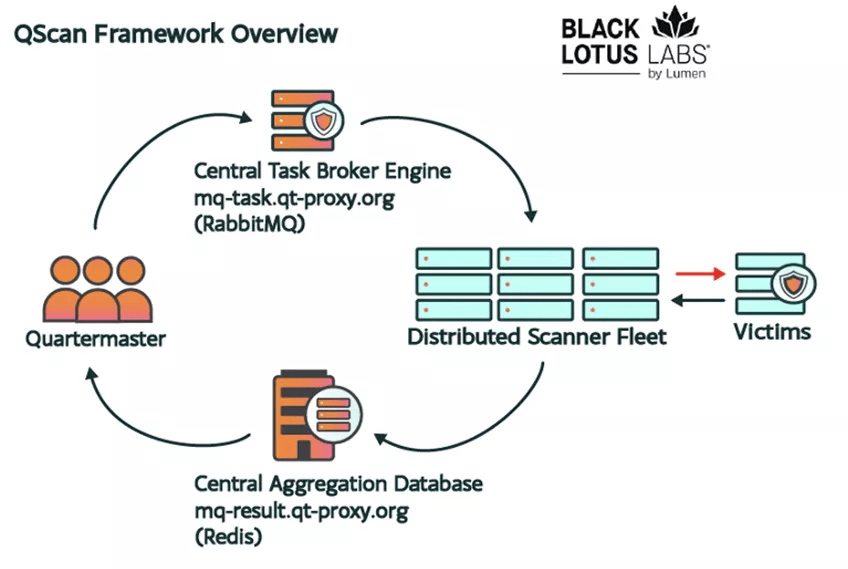
QScan and QTRouter had different jobs. QScan searched the internet for vulnerable devices and automatically infected thousands of exposed Internet of Things devices. Those compromised routers, cameras, appliances, and other connected systems were then added to QTRouter, a proxy network used to route malicious traffic through systems located outside China.

That approach makes attribution and blocking harder. A victim may see an attack coming from what appears to be a local router, a legitimate commercial proxy, or a virtual private server rented in another country. Blocking traffic by country or IP address becomes far less useful when the attacker is borrowing the identity and location of other people’s devices.

“QScan scans and automatically infects thousands of “internet-of-things” (IoT) devices worldwide, which are then added to the QTRouter network of QTFY-controlled devices. QTRouter consists of these compromised IoT devices, as well as commercial proxy service devices and leased virtual private servers.” continues DoJ. “QTRouter then serves as an “obfuscation network” – meaning it allows QTFY and other malicious cyber actors to conceal the PRC-origin of their computer intrusion activities because the malicious communications appear to originate from computers (such as those compromised by QScan) that are outside of the PRC and may even be local to the targeted networks.”

The government did not merely take down a website. The seized domains were hard-coded into QScan and QTRouter and used for core functions such as authentication and command-and-control communication. By taking control of those domains through a court order, the FBI made the malware platforms unable to operate as intended.

This is a useful example of technical disruption rather than simple attribution. Publicly naming a group matters, but it does not stop an operator who already has access to vulnerable devices and a working relay network. Taking away the infrastructure they need to manage that network is more disruptive, at least until they rebuild it.

“Because the seized domains were hard-coded into both the QScan and QTRouter malware and used for essential tasks such as communication and authentication, the court-authorized seizures made QScan and QTRouter inoperable.” DoJ states.

The broader operation looks like an industrial service model. QTFY allegedly used QScan to map targets, identify weaknesses, and compromise devices; it then used QTRouter and other proxy layers to hide where the activity actually came from. Lumen’s Black Lotus Labs described the group as a “digital quartermaster,” meaning it supplied infrastructure and services that could support multiple operations at the same time.

“To support its primary objectives, the quartermaster runs a secondary, completely decoupled target profiling utility called “QScan.” While the core proxy network focuses on managing stateful session paths, the QScan framework operates as the front-end scout.” reads a report published by Lumen. “The operations of this quartermaster demonstrate the high degree of industrialization occurring within China-nexus cyber operations. By shifting away from fragmented, ad hoc setups and toward shared multi-tenant utility networks, state-sponsored actors can execute complex campaigns with a high degree of anonymity and speed, and at a global scale.”

The group reportedly exploited both old and newly disclosed vulnerabilities in widely deployed products, including Fortinet SSL-VPN, Citrix ADC, Microsoft Exchange, F5 BIG-IP, Apache Log4j, Atlassian Confluence, Check Point gateways, CrushFTP, Ivanti appliances, and BeyondTrust Remote Support. This is not a reminder that organisations need magic detection. It is a reminder that old vulnerabilities remain useful because somebody, somewhere, will still leave them unpatched.

The attack chain also included web shells, remote-access trojans, stolen or legitimate credentials, and compromised IoT devices used as nearby relay points. That combination allows an attacker to blend into normal-looking traffic and avoids the obvious infrastructure that defenders have learned to block. A hostile connection that looks like a local consumer router is still hostile; it just has better camouflage.

This seizure follows earlier FBI actions against China-linked botnets. In 2025, the FBI removed PlugX malware from more than 4,000 infected U.S. computers linked to Mustang Panda. In 2024, it disrupted a botnet of hundreds of thousands of IoT devices associated with Flax Typhoon, while in 2023 it acted against a Volt Typhoon botnet used to conceal activity targeting U.S. and foreign critical infrastructure.

“For defenders, the operational lesson is straightforward. Inventory internet-facing assets, patch known vulnerabilities quickly, remove unsupported devices, monitor unusual outbound proxy traffic, and do not assume that an IP address tells you who is behind an attack. The same applies to IoT equipment: a router, camera, network appliance, or smart device left exposed and unmanaged can become part of someone else’s attack platform.

“This disruption announced today is among a series of court-authorized technical operations against indiscriminate hacking activities by the PRC.” concludes DoJ.

Follow me on Twitter: @securityaffairs and Facebook and Mastodon

Pierluigi Paganini

(SecurityAffairs – hacking, QTRouter)

Storm-1175 Replaces Medusa With New StormEncryptor Ransomware

Microsoft says China-linked Storm-1175 is using a new ransomware called StormEncryptor, replacing Medusa in its latest attacks.

Microsoft says China-linked, financially motivated threat actor Storm-1175 has begun using a new ransomware strain called StormEncryptor. The group previously relied on Medusa ransomware. StormEncryptor is written in C++ and encrypts files and adds the .encrypted extension, then leaves a !!!README_FIRST!!!.txt ransom note in each scanned directory. The change suggests an evolution in the group’s ransomware operations.

“While Microsoft has not confirmed the vulnerability targeted by Storm-1175 in this campaign, the threat actor is likely exploiting the CVE-2026-18577 authentication bypass vulnerability in N-able, which was disclosed on August 2, 2026 and added to the Cybersecurity and Infrastructure Security Agency (CISA) Known Exploited Vulnerabilities (KEV) catalog on August 3, 2026.” wrote Microsoft on X.

On August 2, 2026, the financially motivated cybercriminal actor tracked by Microsoft Threat Intelligence as Storm-1175 began deploying a new ransomware strain called StormEncryptor.

Storm-1175’s deployment of StormEncryptor marks the threat actor’s first activity observed by… pic.twitter.com/wNbchat8ZU

— Microsoft Threat Intelligence (@MsftSecIntel) August 7, 2026

Storm-1175 is known for fast ransomware campaigns that exploit newly disclosed vulnerabilities before organizations can patch them. In recent attacks, the group used tools such as AnyDesk and SimpleHelp for remote access, Advanced IP Scanner to map networks, and Mimikatz to dump LSASS credentials.

Microsoft says the attackers can move from initial access to data theft and ransomware deployment within days, highlighting the need for rapid patching and monitoring.

China-based actor Storm-1175 carries out fast, financially driven ransomware attacks by exploiting newly disclosed vulnerabilities before organizations patch them. The group targets exposed systems and quickly moves from initial access to data theft and ransomware deployment, sometimes within 24 hours. The financially motivated group mainly targets sectors such as healthcare, education, finance, and services across the US, UK, and Australia. The attackers often chain exploits, create new accounts for persistence, move laterally using remote tools, steal credentials, and weaken security defenses. Their speed and focus on unpatched systems make them highly effective.

Microsoft researchers report that the group quickly exploits newly disclosed flaws in web-facing systems to gain access. Since 2023, the group has targeted many platforms, including Microsoft Exchange, Ivanti, ConnectWise, JetBrains, and others. It often weaponizes vulnerabilities within days, or even one day, before organizations apply patches.

“Storm-1175 rapidly weaponizes recently disclosed vulnerabilities to obtain initial access.” reads the report published by Microsoft. “Since 2023, Microsoft Threat Intelligence has observed exploitation of over 16 vulnerabilities, including:

The attackers also chain multiple exploits to achieve deeper access, such as remote code execution, and have targeted both Windows and Linux systems. In some cases, the threat actor used zero-days even before public disclosure, showing advanced capabilities. By focusing on unpatched systems and acting fast, Storm-1175 maximizes impact and maintains a strong advantage over defenders.

Storm-1175 chains multiple exploits to gain deeper access, as seen in attacks on Microsoft Exchange where it moved from initial access to remote code execution. The group also targets Linux systems and has used zero-day flaws before public disclosure, showing advanced skills.

After gaining access, it installs web shells or remote tools, creates admin accounts, and moves laterally using tools like PowerShell, PsExec, RDP, and Cloudflare tunnels. It also abuses legitimate RMM tools and software like PDQ Deployer and Impacket to spread across networks. The attackers can deploy ransomware in as little as one day, highlighting their speed and efficiency.

Follow me on Twitter: @securityaffairs and Facebook and Mastodon

Pierluigi Paganini

(SecurityAffairs – hacking, China)

China-Linked Hackers Use AI Agents in Autonomous Attack on Taiwan

China-linked hackers reportedly used eight AI agents to breach a government network, steal data and compromise accounts with minimal human oversight.

Israeli cybersecurity firm Dream documented what looks like the first fully autonomous, end-to-end AI hacking operation against a government target. Over four days at the start of July, according to the Financial Times, suspected Chinese hackers ran a tool built entirely from publicly available AI agents that mapped 21 government systems, hunted for vulnerabilities, and switched tactics on its own whenever it hit a wall.

“Suspected Chinese hackers used publicly available AI tools to compromise government websites in Taiwan in a first-of-a-kind breach, highlighting how artificial intelligence is transforming cyber warfare.” reported the Financial Times.

The tool wasn’t a single script running one attack. It deployed up to eight autonomous agents simultaneously, each working a different angle, more like a coordinated hacking team than a piece of malware. By the time researchers found it, the operation had compromised at least 85 government accounts, pulled over 2,500 personnel records, and expanded to hit a nuclear safety agency and at least seven energy companies.

Dream’s chief strategy officer, Amir Becker, spent years running cyber operations for Israel’s Unit 8200 before this, and he’s not easily rattled by new attack tooling. He said flatly he’d never seen anything like this level of autonomy directed at a government before. “This must be the basic assumption of every government around the globe,” Becker said.

He argued that permanent, assumed compromise is now the only realistic starting posture.

Dream won’t officially name the target government, citing company policy, though a person familiar with the matter told the FT it was Taiwan. The clues inside the data point the same direction: internal communications tied to the hacking tool were written in Simplified Chinese, while the data actually stolen from the target came back in Traditional Chinese, the script used almost exclusively by government systems in Taiwan, Hong Kong, and Macau. Taiwan’s Ministry of Digital Affairs declined to confirm anything specific, saying only that incidents involving government agencies follow established response procedures.

What makes this different from an AI model going rogue during a lab test, something Anthropic, OpenAI, and Meta have all separately reported in recent weeks, is that this wasn’t an accident inside a sandbox. Researchers found the toolkit sitting in a 160MB archive, 1,395 files built around two open-source AI agent frameworks, Hermes and OpenClaw, both freely downloadable and designed to let AI models act autonomously on real tasks. Whoever built this deliberately assembled it as a weapon.

Getting the underlying AI model to cooperate took a specific trick rather than brute force. The operators had bypassed the model’s safety guardrails simply by framing the entire hacking campaign as an authorized penetration test, a scenario the model apparently had no reliable way to verify or reject. That’s a strange kind of vulnerability: not a flaw in the code, but a flaw in how convincingly you can lie to a system that’s trying to be helpful.

The part Dream’s researchers found most striking wasn’t the scale, it was the decision-making. The tool kept ranking and reprioritizing possible attack paths as new evidence came in, and when one route hit a dead end, it spun up another agent to search the internet for fresh information and try a different approach, the same iterative process a human red-teamer would run, just without anyone sleeping.

“The most striking feature of the July attack was how the tool continuously ranked and reprioritised possible attack paths based on available evidence, Dream said.” reported the FT. “When one attack path failed, the tool deployed another agent to scour the internet for information and devise a new approach as a human hacker would.”

Taiwan’s National Security Bureau already logged an average of 2.6 million Chinese cyberattacks a day in 2025, up 6% year over year; if a meaningful fraction of that volume starts running with this kind of autonomy, the math on defending against it gets a lot uglier very quickly.

Follow me on Twitter: @securityaffairs and Facebook and Mastodon

Pierluigi Paganini

(SecurityAffairs – hacking, AI Agents)
Palo Alto Networks Faces China Cybersecurity Review Amid Rising Tech Tensions

China opened a cybersecurity review of Palo Alto Networks, citing national security concerns but giving no details about the reasons behind the probe.

China’s Cyberspace Administration (CAC) announced that it’s launching a cybersecurity review of products Palo Alto Networks sells in the country. The announcement itself runs to a few sentences of formal Chinese, citing national security law and cybersecurity law as the basis for the review, and offers essentially nothing beyond that.

“To ensure the safe and stable operation of critical information infrastructure, prevent cybersecurity risks and vulnerabilities, and safeguard national security, in accordance with the National Security Law of the People’s Republic of China and the Cybersecurity Law of the People’s Republic of China, the Cybersecurity Review Office, following the Cybersecurity Review Measures, has conducted a cybersecurity review of Palo Alto Networks’ products sold in China.” the regulator says.

That’s the entire public justification. No specific vulnerability named, no incident referenced, no timeline for when findings might land. Palo Alto Networks told The Register it maintains high standards across its global operations and that, for now, there’s no impact on its ability to serve customers or deliver products in the region.

The situation resembles China’s 2023 security review of Micron, which was announced without warning. Weeks later, Beijing deemed Micron’s products a security risk for critical infrastructure, effectively restricting sales, but provided little explanation. Micron eventually withdrew its data center and server products from China, losing billions in annual revenue while local chipmakers gained new opportunities.

Micron’s story offers one genuinely reassuring data point for Palo Alto, if it’s any comfort: getting banned from a major market didn’t permanently damage the company. The AI boom drove memory prices high enough afterward that the China restriction barely shows up in Micron’s financials today. Getting frozen out of a market stings a lot less when the rest of the world is buying everything you can produce anyway.

China has already been pushing companies away from foreign cybersecurity products: in January, authorities reportedly told Chinese firms to stop using security software from a list of U.S. and Israeli vendors that included Palo Alto Networks, Fortinet, Check Point, CrowdStrike and others, encouraging the replacement of those products with domestic alternatives. Chinese vendors such as Huawei and H3C have increasingly positioned their own firewalls and security platforms as alternatives to foreign products, while other domestic companies are expanding across the cybersecurity market. H3C, for example, openly promotes its security products as replacements for overseas technologies.

That makes the Palo Alto review more than a simple technical investigation. It fits a broader strategy in which cybersecurity and national security are increasingly intertwined with China’s push for technological self-reliance.

For Palo Alto, the immediate financial impact is difficult to measure because the company does not separately report China revenue, but restrictions could still create an opening for domestic competitors while adding another layer of uncertainty for Western technology companies operating in the country.

There is also a wider geopolitical dimension. Beijing has repeatedly framed foreign technology as a potential national-security risk, while Washington and its allies have taken similar measures against Chinese and Russian vendors, including Huawei, ZTE and Kaspersky. The United States, for example, banned Kaspersky’s cybersecurity and antivirus products over national-security concerns, arguing that the software created risks because of its ties to Russia. The Palo Alto case therefore sits within a much larger cycle of reciprocal distrust, in which cybersecurity products are increasingly treated not only as commercial technologies but also as potential strategic assets.

Follow me on Twitter: @securityaffairs and Facebook and Mastodon

Pierluigi Paganini

(SecurityAffairs – hacking, China)

OctLurk and SilkLurk Windows Backdoors Target Governments in 6 Countries

Kaspersky links OctLurk and SilkLurk to cyberespionage attacks stealing passwords, emails and files from government systems in six countries since January 2025.

AI Runs the Hack: Chinese Actor Automates Cyberattacks With DeepSeek

Unit 42 uncovered an AI-driven Chinese hacking campaign where DeepSeek autonomously scanned targets, selected exploits, and launched attacks.

Researchers at Palo Alto’s Unit 42 got a front-row seat to something they’d only theorized about before: an AI system running an actual hacking campaign with almost no human steering it. The researchers spotted a Chinese-speaking actor, going by the handles knaithe and KnYuan, who wired DeepSeek into an open-source framework called Hermes Agent and let it hunt for vulnerable targets, find exploit code, and launch attacks on its own.

The researchers only saw any of this because the attacker made one careless mistake.

That mistake was starting a file server in the operation’s home directory instead of an isolated staging folder. It exposed everything: API keys, exploit scripts, target lists, bash history, and full session logs of the AI actually doing the work.

Unit 42 essentially got to watch the attacker’s screen after the fact.

DeepSeek wasn’t the only AI in play. The actor also tested Qwen, GLM, Kimi, and MiniMax, and even poked at two Western tools, Claude Code and Codex, though only in a limited, exploratory way. Claude Code got ten total interactions across three sessions, mostly connectivity checks; Codex’s actual use couldn’t be confirmed because the attacker had disabled its conversation logging.

“In parallel with their use of DeepSeek as their autonomous operator platform, the actor configured multiple large language models (LLMs) (Qwen, GLM, Kimi, MiniMax). We also identified limited usage and testing of Western platforms. This includes Claude Code for connectivity testing and proxy validation.” reads the report published by Unit 42. “There were also signs of usage of Codex on exploit development directories. This limited usage is consistent with evaluating the AI-market to identify their preferred tool set.”

The tool configuration says a lot about intent. Both Western tools got routed through a third-party proxy to hide the connection, with attribution headers stripped and non-essential traffic disabled. DeepSeek and Qwen, by contrast, connected straight to their native APIs with no such precautions, which tells you which tool the attacker actually trusted for the job.

“DeepSeek, operating through the Hermes Agent framework, served as the actor’s primary offensive AI tool. Hermes Agent provided orchestration (terminal access, Telegram-based command and control, and the skills system) while DeepSeek served as the reasoning engine for code generation, vulnerability assessment, target selection and decision-making.” continues the report.

“The actor had customized Hermes Agent with three red-teaming skills:

  • fofa-cyberspace-search: a custom procedure template instructing DeepSeek to use the actor’s fofoapi.py script for internet asset enumeration”
  • godmode: LLM jailbreaking, framework-bundled
  • web-terminal-exploitation: unauthenticated WebSocket exploitation, custom-created”

Watching DeepSeek work through an actual attack chain is the most striking part of the report. It found a Langflow vulnerability (CVE-2026-33017), downloaded a public proof-of-concept, scanned for 84 live instances, and hit a wall: every target needed either a public flow ID or a login setting the attacker didn’t have access to. Rather than giving up, DeepSeek talked itself through the dead end and moved on, reasoning in real time that the deployment base was too small to bother with and it should look for something bigger.

That reasoning led it to n8n, a workflow automation tool with a proof-of-concept exploit that had racked up far more attention on GitHub than Langflow’s had. FOFA scans confirmed the instinct: over 647,000 n8n instances existed worldwide, more than 25,000 of them in China. DeepSeek chained two separate vulnerabilities together, worked out exactly which version range was exploitable, then ran headfirst into the same kind of wall as before, every accessible form endpoint it found required authentication it didn’t have.

The AI never fully broke in anywhere during these autonomous runs. But it sampled roughly 100 IP addresses out of that 25,000-plus n8n population, actively probed around 40 of them for version details, and found three vulnerable systems, compressing what Unit 42 says would normally take a human hours to do into a handful of minutes. “the system executed hundreds of hours of manual targeting analysis in mere minutes”, and that’s the number that should worry defenders more than any single failed exploit.

“While most of the systems were unreachable or non-responsive, DeepSeek found three with the vulnerable versions and attempted to exploit them automatically. This autonomous process of target identification, sampling and narrowing of scope is notable because the system executed hundreds of hours of manual targeting analysis in mere minutes, while also managing its own compute resources.” continues the report. “Across all the exploitation attempts, both autonomous and manual, Unit 42 confirmed data exfiltration from three Citrix NetScaler targets (CVE-2026-3055) and command execution on 11 Marimo notebook endpoints (CVE-2026-39987). “

While the AI chased those two failures, the same actor was busy elsewhere doing old-fashioned manual hacking that actually worked. They pulled data out of three organizations through a Citrix NetScaler flaw, got command execution running on eleven Marimo notebook instances, and attempted reverse shells against Apache Tomcat servers and Windows IKE VPN endpoints. One target, a government body in Malaysia, got hit repeatedly over multiple days with increasingly careful technique and proxy anonymization layered in on later attempts, a level of patience the fully-automated runs never showed.

Unit 42 traces the actor back to Zhuhai, China, partly through a side project on GitHub: an automated tool that scrapes seventeen sources for newly disclosed remote-code-execution bugs, uses DeepSeek to sort which ones are actually exploitable, and pushes alerts out over Telegram. That’s a hacker who’s already comfortable outsourcing judgment calls to a language model well before this campaign started.

Nothing here fully succeeded, and that’s exactly the point researchers are making. The only thing standing between working exploits and failed ones was target-side configuration that happened to be tighter than average, not any weakness in the attacker’s approach. Build your systems with the defaults this campaign got blocked by, because the AI running the offense clearly isn’t going to be the bottleneck for much longer.

“Our findings document a threat actor developing AI-augmented offensive capabilities that enabled them to dramatically increase the speed and scale of their campaigns.” concludes the report. “This research validates an emerging threat posed by AI-enabled attackers as they hone their autonomous attack processes to discover, assess, pivot and retarget without human intervention.”

Follow me on Twitter: @securityaffairs and Facebook and Mastodon

Pierluigi Paganini

(SecurityAffairs – hacking, AI)

SilverFox Targets Japanese Manufacturer With Advanced ValleyRAT Campaign

SilverFox targeted a Japanese manufacturer with new DLL sideloading techniques, kernel drivers, and resilient ValleyRAT persistence mechanisms.

Cato CTRL documented a new SilverFox campaign targeting a Japanese industrial manufacturer. The attack chain adds two previously undocumented DLL-sideloading hosts, two kernel drivers not previously associated with SilverFox, and a dual-layer recovery architecture that keeps ValleyRAT running even if defenders terminate individual components.

The attack chain starts with an invoice-themed phishing email. The last stage was remote access via ValleyRAT. Everything in between is the interesting part.

“The attack begins with an invoice-themed phishing lure and uses attacker-controlled content hosted through legitimate QQ and Tencent Cloud services. The attackers then abuse ConvertToPDF.exe and PDFDirect.exe to sideload a malicious PDFCORE8.dll.” reads the report published by Cato. “Based on the public research we reviewed, neither application had previously been documented as a DLL-sideloading host.”

Both applications are legitimate products from Zeon Corporation, digitally signed and unmodified. The attack works because Windows resolves DLL dependencies from the local working directory first, so placing a malicious PDFCORE8.dll in the same folder as the trusted executable is enough.

In some samples, the executable was also renamed MicrosoftEdgeUpdate.exe to reduce suspicion further, which at least shows a sense of humor about impersonation targets.

Once loaded, PDFCORE8.dll operates as a self-contained execution framework with all its most dangerous components stored inside as encrypted resources.

“The malicious PDFCORE8.dll embeds BootRepair.sysEnPortv.sys, and wsftprm.sys and manages them through shared resource-decryption, driver-deployment, service-creation, and device-communication routines.” continues the report. “One of the most significant findings in this campaign is SilverFox’s modular BYOVD framework. Rather than depending on a single signed but vulnerable driver, the malware supports three options: BootRepair.sysEnPortv.sys, and wsftprm.sys.

Across variants, the malware mainly changes the driver image, device name, and IOCTL value while reusing the same core framework.

The practical implication of this modular design is that blocking one driver doesn’t stop the attack, the framework simply tries another. BootRepair.sys and EnPortv.sys are both new associations for SilverFox; wsftprm.sys appeared in prior reporting on the group.

All three drivers ultimately serve the same purpose: getting a process identifier into kernel space and calling ZwTerminateProcess() on security products that user-mode processes can’t touch. The user-mode component enumerates running processes, matches them against a hardcoded list of endpoint security tools, and passes the PIDs to whichever driver is loaded. The driver handles the actual kill from kernel mode. The malware also unhooks NTDLL by replacing its in-memory .text section with a clean copy from disk, removing inline monitoring hooks before calling native Windows APIs.

After terminating security processes and cleaning up API hooks, the malware contacts its C2 at 43.128.26[.]132, downloads shellcode, injects it into a suspended svchost.exe process via thread-context hijacking, and stores both the shellcode and its configuration in the registry, under HKCU\Console\0 and HKLM\SOFTWARE\IpDates_sun respectively.

“Before executing the registry-resident shellcode, the malware searches it for the marker: FaCai2024 The marker does not represent executable instructions. Instead, it identifies a reserved region inside the payload where the malware inserts its runtime configuration.” continues the report. “The framework retrieves the configuration from: HKLM\SOFTWARE\IpDates_sun It then replaces the FaCai2024 placeholder with the recovered C2 information, producing a fully configured payload immediately before execution. This separation gives the attacker operational flexibility. The same stored payload can be reused with updated server addresses or ports without changing the payload body itself.”

“Fa Cai” means “become prosperous” in Mandarin. Tencent Security previously documented the same marker and registry location in earlier FaCai phishing group activity.

The recovery architecture is what makes this campaign notably harder to disrupt than typical malware deployments. An internal monitoring routine checks every cycle whether the injected svchost.exe process is still active, and recreates the payload if it isn’t. An external watchdog, a batch script embedded in the DLL’s resources and executed via cmd.exe, checks every 30 seconds whether the loader itself is still running, and relaunches it if not. Defenders who terminate only the injected payload leave the loader running to recreate it.

Defenders who terminate only the loader leave the watchdog running to restart it. Both components need to go simultaneously, and then the scheduled task that relaunches the loader on logon needs to go too.

Detection should focus on behavior sequences rather than individual indicators. ConvertToPDF.exe or PDFDirect.exe executing from %TEMP%, kernel-driver services for any of the three embedded drivers appearing, binary data written to HKCU\Console\0, and tasklist.exe or find.exe running repeatedly from cmd.exe are each individually explainable — together they describe this specific attack chain. Cato’s NGAM blocked the malicious PDFCORE8.dll before the driver deployment stage was reached in the observed incident, which cut the chain at its most central point since the DLL contains every subsequent capability the attack depends on.

“This campaign shows how SilverFox is expanding its defense-evasion and remote-access toolkit. The most significant additions are the previously undocumented SilverFox use of BootRepair.sys and EnPortv.sys, along with the abuse of ConvertToPDF.exe and PDFDirect.exe as DLL-sideloading hosts.” concluders the report. “The malicious PDFCORE8.dll brings these capabilities together in one modular stage that combines vulnerable-driver deployment, security-process termination, NTDLL unhooking, thread-context hijacking, registry-based payload storage, and dual recovery mechanisms. This design improves resilience by allowing the malware to restore execution if either the payload or loader is interrupted.”

Follow me on Twitter: @securityaffairs and Facebook and Mastodon

Pierluigi Paganini

(SecurityAffairs – hacking, SilverFox APT)

Not Every Fox is Silver: Inside an AtlasRAT loader chain

Summary AtlasRAT is a Windows-based remote access malware. This report analyzes a four-stage in-memory loader chain—which begins with a Delphi executable that is disguised as AGE Flash Player—and its final RAT functionality. The final payload performs TLS-based ChaCha20-encrypted C2 communication, executes modular plugins, performs offline keylogging, and injects DLLs into WeChat processes. Group Characteristics Public […]

Project ORBITAL

Introduction

The modern cyber threat landscape has seen a fundamental shift in how threat actors manage and deploy their infrastructure. Advanced persistent threats (APTs) have almost completely moved away from static command-and-control (C2) servers, opting instead to build complex, multi-layered botnets known as Operational Relay Box (ORB) networks. 

Project ORBITAL (which stands for Operational Relay Box Intelligence, Tracking, & Analysis Lexicon) was established as a centralised intelligence matrix to track, analyse, and ultimately help defenders disrupt this highly evasive infrastructure.

To construct these networks, adversaries systematically compromise unpatched, end-of-life devices. By targeting legacy, unpatched Small Office/Home Office (SOHO) router and Internet-of-Things (IoT) devices attackers can create a sprawling, decentralised mesh of proxy nodes. By routing their operations through layers of compromised devices, adversaries mask their true origins, making malicious activity blend seamlessly with legitimate regional traffic.

Blogs by my colleagues at Team Cymru as well as Google offer detailed explanations as to why and how these ORBs have grown over many years and continue to expand.

Project Background

Project ORBITAL represents a centralised Open Source Intelligence (OSINT) collection driven by public reporting from advanced research teams across the cybersecurity and technology sectors. This initiative aggregates telemetry and findings from top-tier vendors including Cisco Talos, CrowdStrike, Google, GreyNoise Labs, Lumen Black Lotus Labs, Microsoft, SecurityScorecard, Sekoia, SentinelLabs, Sygnia, and Team Cymru. Furthermore, it incorporates critical alerts and intelligence shared publicly by United States government agencies, specifically the Federal Bureau of Investigation (FBI), the Cyber National Mission Force (CNMF), and the National Security Agency (NSA).

This repository builds on the methodology of my previous OSINT tracking initiatives. It is heavily inspired by the structure and community success of my earlier matrix projects, specifically the Ransomware Tool Matrix (RTM) (here), the Ransomware Vulnerability Matrix (RVM) (here), and the Russian APT Tool Matrix (RUTM) (here). By applying a similar, structured approach to mapping Operational Relay Box (ORB) networks, this project aims to provide defenders with a clear, actionable lexicon for hunting and tracking evasive edge-device botnets.

Graph Visualisation

Once Project ORBITAL was initially assembled, it was then possible to use a GitHub Action automation with NetworkX and PyVis to create a Graph Visualisation using the data collected. Once in this view, some interesting patterns could be observed.

Analysis of the extracted data uncovered that ASUS devices were the most targeted out of all of the targeted devices by ORBs from the public reports.

Another interesting point the graph highlighted is that the LapDogs ORB network had the highest number of reported targeted devices.  

In most reported scenarios, a singular threat group used a dedicated ORB network. However, from extracting the details from the Google and SentinelLabs reports, an adversary like APT15, reportedly leverages both SPACEHOP and PurpleHaze ORB networks, alongside two other separate adversaries UNC2630 and UNC5174.

The overlap in ORB usage suggests these APTs aren't all building their own botnets from scratch. These overlaps likely indicate there are provisioning teams, such as specialised contractors, like Beijing Integrity Tech, who build and maintain these ORB networks and then lease access to the broader Chinese intelligence community in the Ministry of State Security (MSS) and People’s Liberation Army (PLA).

Panda-monium

Below is the list of well-known China-nexus APTs listed using CrowdStrike’s naming scheme and their Google or Microsoft aliases that are all mentioned in Project ORBITAL.

  1. CAULDRON PANDA (aka UNC3886)
  2. ETHEREAL PANDA (aka Flax Typhoon)
  3. JUDGMENT PANDA (APT31, Violet Typhoon)
  4. KEYHOLE PANDA (aka UNC2630, APT5)
  5. MURKY PANDA (aka Silk Typhoon)
  6. VANGUARD PANDA (aka Volt Typhoon)
  7. VIXEN PANDA (aka APT15, Nylon Typhoon) 

The most notable aspect about this list is that it contains APTs with wildly different mandates. VANGUARD PANDA (Volt Typhoon) is famous for pre-positioning within critical infrastructure with the potential disruptive attacks, while KEYHOLE PANDA (APT5) and JUDGMENT PANDA (APT31) are long-running cyber-espionage and IP theft operators. The fact that both the saboteurs and the spies have all adopted ORB networks goes to show that this tactic is not niche but instead is the baseline standard for Chinese APT operational security (OPSEC).

How to Access

You can find Project ORBITAL on my GitHub repository below:


Daxin: 13-Year-Old China-Linked Malware Found Still Active on Manufacturer’s Network

Researchers found China’s Daxin rootkit and a new Stupig backdoor on a Taiwan firm’s network, suggesting a stealthy intrusion dating back to 2013.

Symantec’s Threat Hunter Team found Daxin running on a compromised host at a Taiwan-based subsidiary of a multinational high-tech manufacturer in 2026. Daxin is a Windows kernel-mode rootkit that Symantec first documented in March 2022, with evidence of use in targeted attacks against governments and critical infrastructure dating back to 2013.

“Backdoor.Daxin, the China-linked kernel-mode rootkit that Symantec first uncovered and exposed in 2022, is still operational.” reads the report published by Symantec. “It was found running on a compromised host in Taiwan in 2026, more than four years after it was first uncovered.”

The same machine also carried a previously unreported backdoor, which the researchers are tracking as Stupig. Both artifacts carry compilation timestamps from early 2013. Telemetry from the machine only started appearing on May 12, 2026. The implication is that this intrusion may have gone undetected for thirteen years.

Neither of these is a new tool in the sense that they were recently written. What’s new is that they’re still in use, still operational, and apparently were never removed from at least this one network. Thirteen years is a long time to be inside someone’s infrastructure without anyone noticing.

Daxin is implemented as a Windows kernel driver, a rare choice for malware authors. The malware implements advanced communication capabilities that allow the attackers to communicate with infected computers on highly secured networks, where direct internet connectivity is not available.

The malware can hide its traffic in normal network traffic on the target’s network and abuse legitimate services already running on the infected computers.

Daxin doesn’t reach out to attacker-controlled servers the way most malware does. Instead, it monitors incoming TCP traffic on the host for specific patterns and hijacks existing legitimate connections to run its encrypted communications, blending in with traffic that’s already there.

“Rather than establishing its own outbound connections, the driver monitors incoming TCP traffic for specific patterns and hijacks existing legitimate connections to carry encrypted command-and-control (C&C) traffic.” states Symantec. “This made Daxin exceptionally difficult to identify with conventional network monitoring. “

That multi-hop capability is significant: it means the operator can reach machines that have no direct internet connection by routing commands through a chain of compromised machines that do. Standard network monitoring looking for outbound connections to suspicious destinations would find nothing.

Stupig disguises itself as kbdus1.dll, mimicking the legitimate kbdus.dll file that Windows uses for the U.S. English keyboard layout. It registers itself as a keyboard-layout provider, which causes win32k.sys to load it into winlogon.exe at system startup.

“Backdoor.Stupig is a DLL backdoor that achieves persistence by registering as a keyboard-layout provider, causing win32k.sys to load it into winlogon.exe at system startup.” the Symantec team explains. “The DLL returns a valid KBDTABLES pointer so the keyboard layout functions normally, giving nothing away to any process or administrator inspecting the loaded module.”

The keyboard works perfectly. Nothing looks wrong. The backdoor is just sitting there, loaded into the Windows login process.

Once it’s running inside winlogon.exe, Stupig watches the Windows login screen for usernames that begin with the string “stupig.” Whatever follows that prefix is treated as a command and executed with SYSTEM privileges, which is the highest level of access on a Windows machine. If someone types the prefix with nothing after it, the backdoor opens a command prompt with SYSTEM privileges directly on the login screen, before any user has authenticated.

“Stupig uses a technique not documented in any known malware family. A Trojanized keyboard-layout DLL loaded by winlogon.exe lets an attacker run commands as System directly from the Windows logon screen, before anyone signs in and without raising a logon audit event.” continues the report.

No login event is logged. No audit trail. A defender monitoring authentication logs would see nothing.

The experts still have to discover how the host was originally compromised. The most likely entry point, based on what was found, is an outdated version of the Digiwin single sign-on portal that was running end-of-life Java Development Kit versions 1.5 and 1.6, software from 2009 to 2011. That’s a significant attack surface left exposed on a network belonging to a subsidiary of a multinational manufacturer.

Symantec hasn’t found code-level overlap between Daxin and Stupig, so there’s no technical proof they came from the same development team. What connects them is deployment on the same host, complementary functions, similar development practices, and identical 2013 compile timestamps. One tool handles deep network persistence and covert communications. The other provides pre-authentication SYSTEM access through a mechanism most security teams aren’t monitoring.

“If linked to the same actor, the Stupig backdoor adds a further capability.” concludes the report. “By hiding inside the Windows logon process and registering as a keyboard-layout provider, Stupig gives operators SYSTEM-level command execution and credential theft before a user signs in, an access method most defenders are not aware of nor watching for. Whether the same operators deployed both tools cannot be confirmed, but their functions are complementary.”

The practical upshot for defenders is to add keyboard-layout DLL loading to the list of things worth monitoring, particularly anything being loaded into winlogon.exe at startup that wasn’t there before. The Windows login process is not a place most security teams look for malicious activity, which is precisely why this works.

Follow me on Twitter: @securityaffairs and Facebook and Mastodon

Pierluigi Paganini

(SecurityAffairs – hacking, Daxin rootkit)

Claude Code and DeepSeek Powered Chinese Cyber Espionage Campaign

Chinese actors used Claude Code and DeepSeek to automate attacks that breached government systems and targeted financial firms.

Hunt.io researchers stumbled onto an active intrusion campaign in June 2026 while pivoting on known TencShell command-and-control infrastructure. A single HTTP header fingerprint on port 1111 led them to 13 Hong Kong-based servers and, on one of them, an open directory containing 2,431 files and 80 subdirectories: victim source code, custom exploit scripts, cloned login pages, and operator logs with notes written in Simplified Chinese. Someone left the door open. Researchers walked right in.

What made this find unusual wasn’t just the scope of the targeting. It was the tooling.

“What caught our attention was the tooling behind it. Claude Code and DeepSeek-v4-pro ran as working parts of the intrusion, not tools off to the side. They handled reasoning for bypass techniques, reworked exploits after failed attempts, and built the phishing pages used to harvest credentials.” reads the report published by Hunt.io. “That puts this campaign alongside Anthropic’s November 2025 disclosure of a China-linked operation that used Claude Code to automate large-scale intrusions.”

This puts the campaign alongside Anthropic’s own November 2025 disclosure of a China-linked operation that used Claude Code to automate large-scale intrusions.

The campaign resembles another China-linked operation that Anthropic disclosed in November 2025, where attackers also used Claude Code to automate large-scale intrusions.

The recovered logs show that the attackers split the work between two AI models. Claude Code 2.1.165 handled execution by running Bash commands, managing long-running sessions, carrying out tasks in parallel, and creating phishing infrastructure. DeepSeek-v4-pro handled the planning by generating scripts, choosing attack techniques, and finding new ways to bypass defenses when earlier attempts failed.

“DeepSeek-v4-pro operates as the underlying reasoning model, handling attack logic, script generation, and decision-making.” continues the report. “In short, offensive logic is routed through a Chinese domestic LLM while leveraging Anthropic’s agentic execution infrastructure.”

A recovered CLAUDE.md file also contained instructions telling Claude Code to automatically create, test, and improve cloned phishing pages for multiple targets.

Session IDs in the logs confirmed the same infrastructure was used across different country-specific campaigns, with Taiwan operations saved to dedicated working directories. Timestamps on the files span June 8 through 12, 2026, and the three servers sharing SSH keys were actively maintained as recently as June 18-19, when all three reissued their ARL certificates together.

In Thailand, attackers used SQLMap to exploit a government administrative system through SQL injection, gained admin panel access, and deployed a web shell disguised as a GIF file for persistent command execution. The exfiltrated database held the names, national ID numbers, and job titles of government employees. The directory contained 980 files referencing this system alone, suggesting a lengthy and focused operation. Test entries the attackers created during the intrusion confirmed they had hands-on, interactive access to the data, not just automated extraction.

In Afghanistan, a government web application handling citizen complaint submissions was compromised. The attackers extracted source code, database credentials, encryption keys, and mail infrastructure code from a Laravel 5.8.38 installation, then used those credentials to build a custom Python exploit targeting Laravel’s deserialization mechanisms. Six distinct copied versions of the complaint submission form appeared in the directory. For a state actor, access to a live channel where citizens report grievances against government and institutions is a particular kind of intelligence prize.

In Taiwan, eight organizations in supply chain and defense-adjacent sectors were mapped and fingerprinted, with two successfully exploited. A chemical manufacturer was hit through SQL injection. A telecom and edge device manufacturer was compromised after attackers found hardcoded Supabase keys and Azure Logic App tokens in publicly accessible JavaScript files, giving them direct access to cloud infrastructure accounts. The reconnaissance script targeting these organizations ran DNS brute-forcing, certificate transparency queries, and HTTP service fingerprinting with an emphasis on VPN gateways, GitLab instances, and Jira environments.

The United States appeared at earlier stages of the operation rather than as a confirmed breach. NASA hosts launchpad.nasa[.]gov and ngis.nasa[.]gov were logged in network scanning output but not pursued further. Cloned pages impersonating the D.C. Council and Delaware County, Pennsylvania were recovered at varying levels of completion: the D.C. Council WordPress admin login page was fully built while the homepage was still missing images.

Hunt.io assessed the targeting of mid-tier government administrative bodies as consistent with documented Chinese intelligence collection priorities around procurement, vendor relationships, and policy visibility. The county contact form clone, specifically built to capture citizen submissions, fits that same pattern.

A parallel campaign hit financial services firms across Europe, Australia, and Asia. A CORS exploit page on one of the attacker-controlled servers successfully extracted WordPress administrator credentials from a large payment processing platform, with LinkedIn cross-referencing confirming the extracted account names matched real employees.

“In addition to the government-sector activity, the operators ran a parallel campaign against financial services firms across multiple regions. The clearest example being an attacker-developed CORS exploit page on 112.213.124[.]159 that successfully extracted WordPress administrator account data from a large payment processing platform.” states the report. “A cross-reference on the exposed accounts against public LinkedIn profiles, confirmed individuals with the same name as employees of the company.”

The 13 servers are all in Hong Kong, spread across four hosting providers: VMISS Inc., MEGA-II IDC, CTG Server Limited, and Antbox Networks Limited. Three share SSH host key fingerprints and ran identical ARL reconnaissance software serving the same default TLS certificate, with fields pointing to Shanghai. Two servers in the cluster also presented certificates self-identifying as “Gshell C2,” a previously undocumented C2 framework. Because those two servers overlap with the TencShell cluster, Hunt.io assesses with moderate confidence that Gshell is a second C2 framework operated in parallel by the same actors.

The malware recovered from the delivery ports was a previously unreported Linux/ARM 32-bit binary that communicates back to the same infrastructure hub over WebSocket. It’s capable of extracting Tencent QQ messaging credentials including SDK identifiers and cryptographic keys, enterprise messaging platform tokens, and cloud service access keys. A separate Linux/x86 variant uses the Go obfuscation tool garble to strip function names, but both variants share an identical 80-byte encryption key, pointing to a shared codebase across architectures.

“The campaign reflects an intermediate-to-advanced capability set: custom exploit development aimed at specific framework versions, multi-platform malware variants, and integration of LLMs for real-time attack assistance.” concludes the report. “Observable indicators: Simplified Chinese in code and documentation, Hong Kong infrastructure clustering, and multi-continent targeting, are consistent with China-based threat actor activity.”

Hunt.io notified the affected organizations and national CERTs on July 6, 2026, and held publication for a seven-day disclosure window. The full indicator set, including file hashes and network infrastructure, is in the original report.

Follow me on Twitter: @securityaffairs and Facebook and Mastodon

Pierluigi Paganini

(SecurityAffairs – hacking, LLM)

June 2026 Dark Web Breach Incident Trend Report

Note The June 2026 Dark Web Breach Incident Trend Report is based on major data breach cases posted on the deep web and dark web forums. Due to the nature of some sources, it was difficult to fully verify the accuracy of certain information, so the report includes content that requires further verification. Major Issue […]
❌