CoolClient is a backdoor family attributed to the HoneyMyte APT group (also known as Mustang Panda) that has been used in their cyber-espionage campaigns targeting organizations across Asia and Russia. It supports such capabilities as keylogging, clipboard theft, credential harvesting, file management, system reconnaissance, and plugin-based extensions.
Since its first public disclosure by Sophos in 2022 and subsequent analysis by Trend Micro in 2023, CoolClient has continued to evolve. In 2025, we analyzed a newer variant that introduced clipboard theft and HTTP traffic interception for credential harvesting.
In late 2025 and 2026, our latest investigation reveal another major evolution. The newest CoolClient variant can deploy a signed kernel-mode driver as a Windows service and communicate with it through IOCTL requests. The driver enhances the malware’s stealth by hiding the CoolClient process, protecting related files and registry entries, and preventing them from being inspected or modified. The overall design is comparable to the kernel-mode enhancements previously observed in ToneShell, but the CoolClient driver exposes dedicated IOCTL handlers that allow the user-mode backdoor to communicate directly with the driver.
We have observed this updated CoolClient variant and its accompanying driver in intrusions across multiple countries in Asia, including Pakistan, Mongolia, and Myanmar.
Technical analysis
In the observed campaign targeting Myanmar, HoneyMyte used PlugX as the initial post-compromise implant to deploy the CoolClient components. Before deploying the malware, the actor added both a folder exclusion and a file exclusion to Microsoft Defender for the fake Windows Defender installation directory and the renamed sideloader executable (defender.exe).
The actor then created a fake Windows Defender installation directory, copied the CoolClient components into it, and renamed a legitimate Sangfor executable, usually named Sang.exe, to defender.exe to serve as the DLL sideloader.
When executed, defender.exe sideloads the malicious libngs.dll, initiating the CoolClient execution chain described in the following sections.
CoolClient components
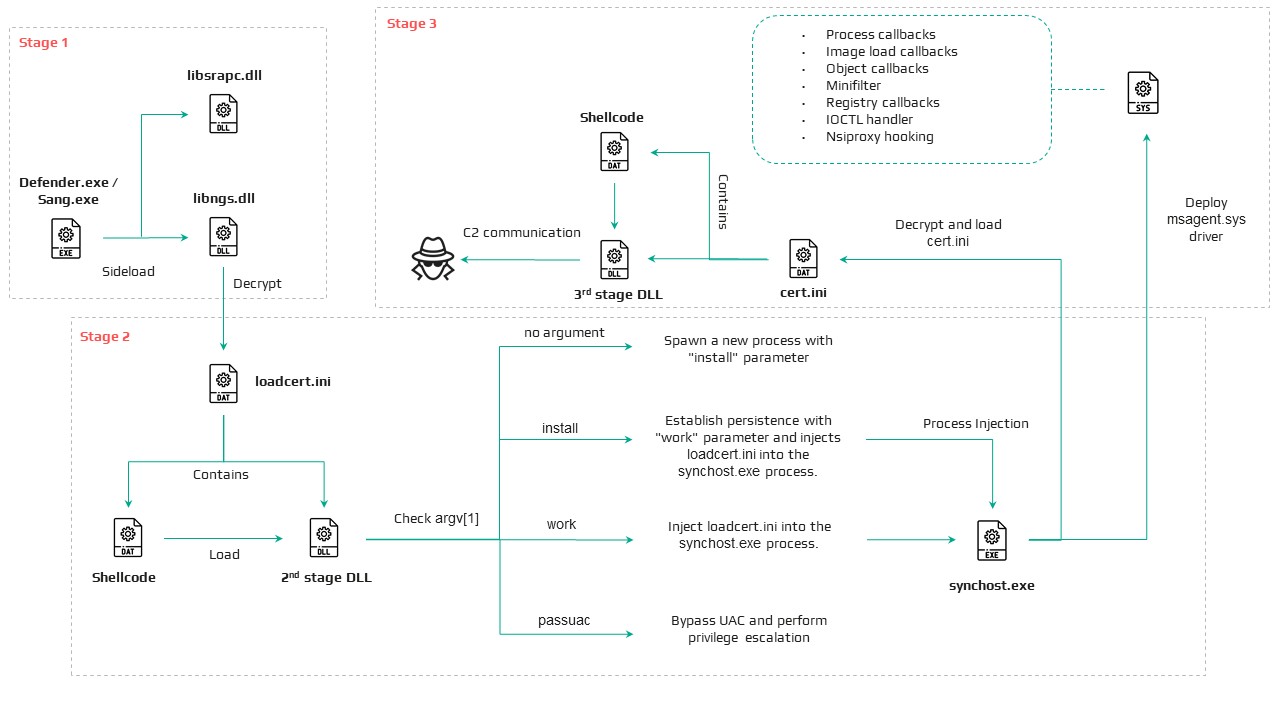
Similar to previous variants, the latest CoolClient user-mode component follows a multi-stage execution chain, with each component performing a distinct role during execution.
Component
Description
defender.exe / Sang.exe
Legitimate Sangfor application abused for DLL sideloading
libsrapc.dll
Benign dependency required for the Sangfor application to execute normally
libngs.dll
First-stage loader that decrypts and loads the next stage into memory (First stage)
loadcert.ini
Encrypted DLL implementing the core CoolClient functionality, including command handling, process injection, driver deployment, and persistence (Second stage)
cert.ini
Final-stage implant responsible for C2 communication and backdoor functionality (Final stage)
time.ini
CoolCleint configuration file
Our previous CoolClient analysis focused primarily on the final-stage implant (main.dat), including its backdoor commands and plugin framework, while the first-stage loader (libngs.dll) and second-stage component (loader.dat) received only a brief overview. In the latest variant CoolClient, loader.dat and main.dat have been renamed to loadcert.ini and cert.ini, respectively. This article revisits those earlier stages, focusing on the second-stage component and the newly introduced kernel-mode driver that extends CoolClient with rootkit capabilities.
Overview of the new variant of CoolClient
First stage: libngs.dll
Execution begins when the legitimate Sangfor application (defender.exe or Sang.exe) loads the malicious libngs.dll through DLL sideloading. As in previous CoolClient variants, the malware continues to abuse the same Sangfor application to execute its first-stage loader.
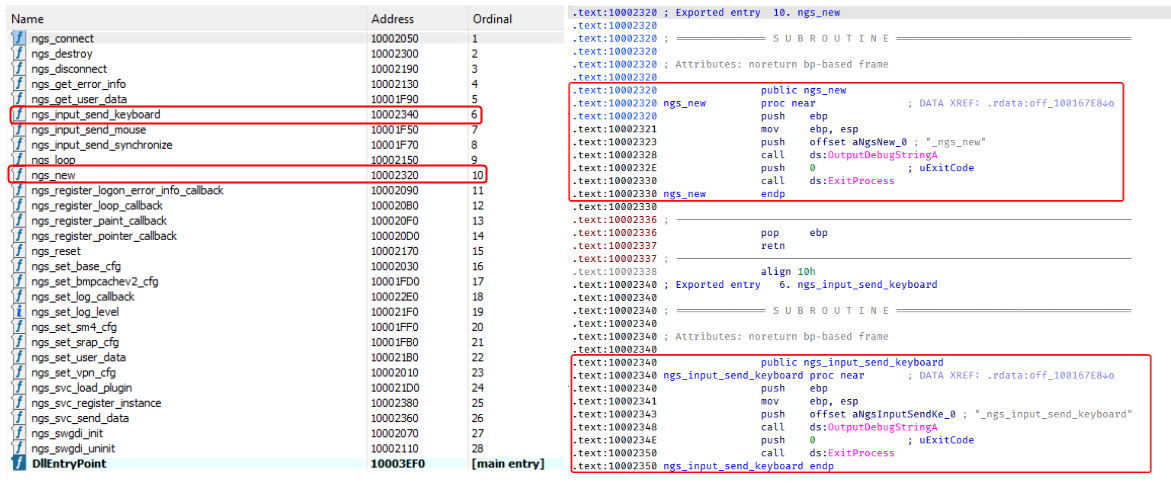
To make the DLL appear legitimate, libngs.dll exports numerous dummy functions. Each export simply calls OutputDebugStringA with its corresponding function name before immediately invoking ExitProcess, serving no functional purpose other than mimicking the expected export table of the legitimate DLL.
Dummy export functions in libngs.dll invoking OutputDebugStringA and ExitProcess
The actual malicious logic is executed from DllMain (DllEntryPoint). Although heavily obfuscated through control flow flattening and numerous unconditional jumps, the routine ultimately performs a straightforward task: loading, decrypting, and executing the encrypted second-stage DLL, loadcert.ini.
The loader resolves the required Windows APIs, reads loadcert.ini into memory, and decrypts it using a 0x32-byte repeating XOR keystream derived from a transformed seed value of 0xA4. After decryption, the DLL is loaded directly into memory, and execution is transferred to loadcert.ini.
Second stage: loadcert.ini (before synchost.exe injection)
The second-stage DLL, loadcert.ini, is responsible for preparing the execution environment before the malware transitions into its injected process. It first determines its execution context by checking whether the current module is synchost.exe.
If the DLL is running under the original sideloaded process (for example, Sang.exe), it performs the initial setup, including persistence, UAC bypass, registry modifications, and process injection.
If the DLL is already executing inside synchost.exe, it follows a different execution path that decrypts time.ini, deploys the kernel-mode driver, and loads the final-stage implant (cert.ini).
Command handler
The command handler remains largely unchanged from previous CoolClient variants, with one notable difference: the malware now injects into synchost.exe instead of write.exe.
Execution is controlled through three command-line parameters:
Parameter
Purpose
install
Performs the initial setup, including persistence, privilege checks, and preparation for the injected execution path.
work
Executes the primary second-stage functionality from the injected synchost.exe process, including driver deployment and third-stage loading.
passuac
Continues execution after privilege elevation.
If no parameter is supplied, the malware creates a new Sang.exe process with the install parameter using CreateProcessW.
Establishing AutoRun persistence
When executed with the install parameter, CoolClient creates an AutoRun entry under:
The registry value, named goopdate, launches Sang.exe (or defender.exe, depending on the deployment) with the work parameter whenever the user logs on.
Process injection into synchost.exe
Upon establishing the AutoRun registry entry, CoolClient decrypts loadcert.ini using a 0x32-byte repeating XOR keystream derived from the hardcoded base key 0x4D.
The decrypted DLL is then injected into a newly created suspended instance of synchost.exe. The malware allocates memory in the target process, writes the decrypted payload, redirects the thread context to the injected code, resumes execution, and finally terminates the original process with ExitProcess.
From this point onward, execution continues entirely within synchost.exe, where the malware proceeds with kernel-mode driver deployment before loading the final-stage implant (cert.ini).
Service installation
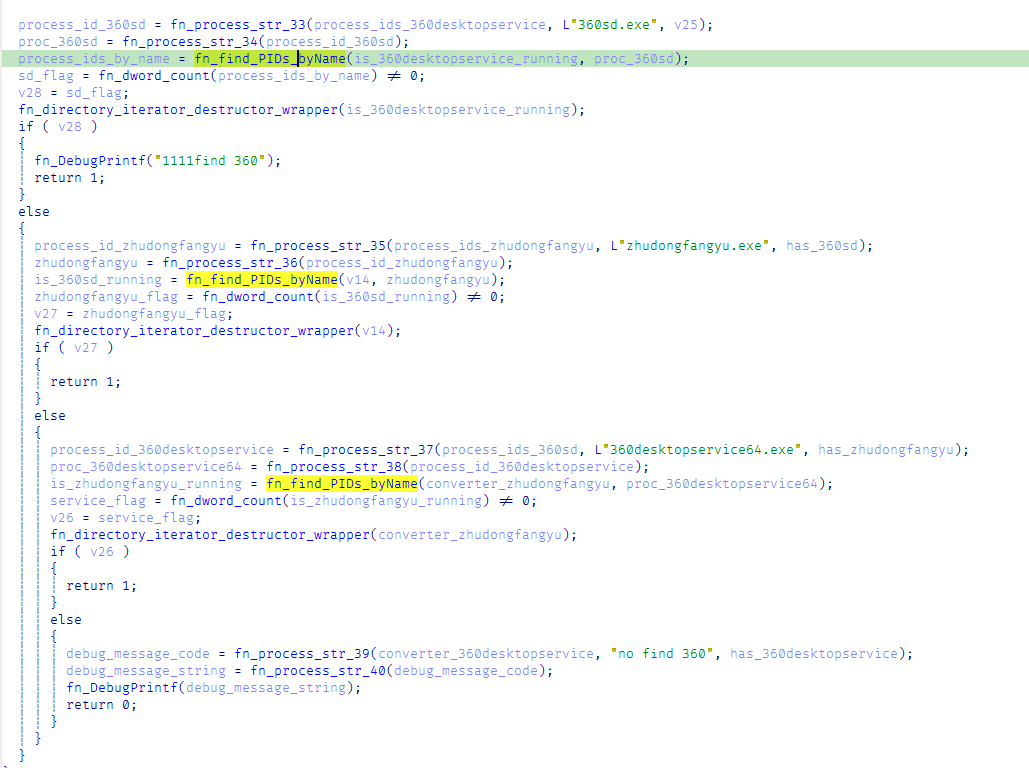
When executed with the install parameter, CoolClient establishes an additional persistence mechanism by installing itself as a Windows service. Before doing so, it verifies that it has sufficient access to the Service Control Manager and that no 360 Total Security software processes (360sd.exe, zhudongfangyu.exe, or 360desktopservice64.exe) are running.
Function to check for running 360 Total Security software processes
If both checks succeed, the malware decrypts time.ini to retrieve the service configuration, including the service name and description. It then checks whether the service media_updaten already exists. If found, the existing service is stopped and deleted before a new one is created.
The new service is configured to execute Sang.exe<.code> with the work parameter using CreateServiceA. The malware then starts the service by executing "sc start media_updaten" via WinExec.
Administrator privilege check
If the service installation path is not taken, CoolClient checks whether the current process is running with administrator privileges by verifying membership in the local Administrators group.
When administrative privileges are available, the malware relaunches itself with the passuac parameter before continuing with the remaining execution flow.
Elevated relaunch and UAC bypass
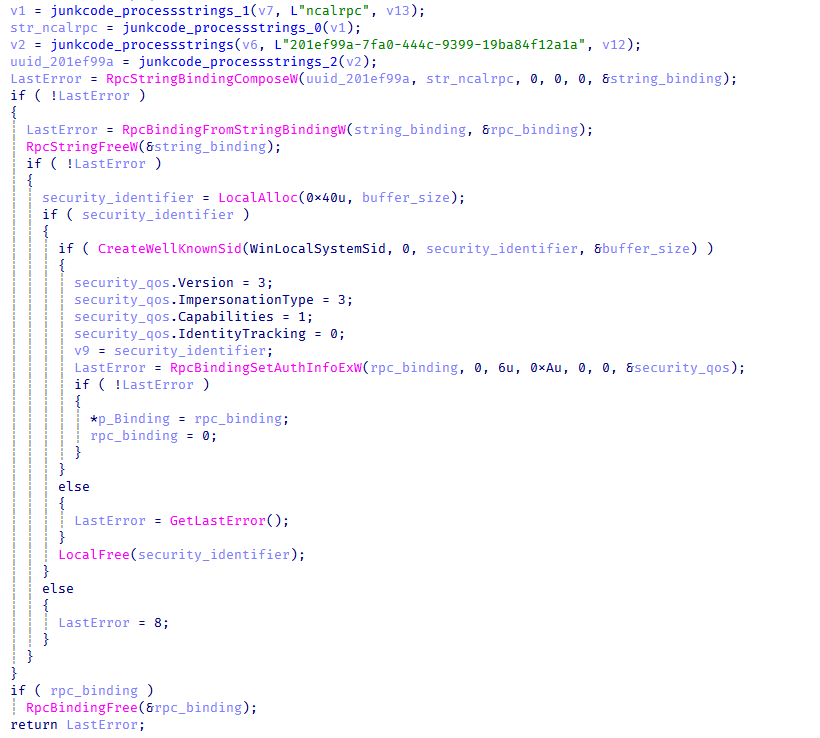
To continue execution with elevated privileges while concealing its true parent process, CoolClient implements an RPC-based process creation technique similar to the method described by Google Project Zero. The technique combines RPC process creation with parent process ID (PPID) spoofing to launch a new elevated instance of itself.
The malware first checks for the presence of escanmon.exe. If the process is running, it constructs the path to C:\Windows\System32\winver.exe and establishes a connection to the local ncalrpc endpoint (201ef99a-7fa0-444c-9399-19ba84f12a1a). It then invokes NdrAsyncClientCall to launch winver.exe through the RPC interface.
Authenticated RPC binding used during the RPC-based UAC bypass
After winver.exe is created, CoolClient retrieves its debug object using NtQueryInformationProcess, detaches the debugger through NtRemoveProcessDebug, and terminates the process. The obtained debug object is later reused during the remainder of the UAC bypass routine.
Next, the malware repeats the same RPC-based process creation technique to launch computerdefaults.exe. It associates the previously obtained debug object with the current thread using DbgUiSetThreadDebugObject, waits for the resulting process creation event through WaitForDebugEvent, and duplicates the process handle using NtDuplicateObject, obtaining a handle with full access rights.
Finally, CoolClient relaunches itself as Sang.exe passuac using CreateProcessW with an extended startup attribute list. By configuring PROC_THREAD_ATTRIBUTE_PARENT_PROCESS through UpdateProcThreadAttribute, the duplicated process handle is assigned as the parent of the new process. As a result, the new Sang.exe passuac instance executes with an elevated context while appearing to have been spawned by the trusted Windows process instead of the original CoolClient process.
Second stage: loadcert.ini (Injected Execution)
After being injected into synchost.exe, loadcert.ini follows its injected execution path, where it deploys the kernel-mode driver and launches the final-stage implant (cert.ini). If administrative privileges are unavailable, the malware skips driver deployment and proceeds directly to the third-stage injection.
Kernel-Mode driver deployment
The deployment routine begins by decrypting time.ini. CoolClient then verifies that it has sufficient privileges to install a kernel-mode driver by checking for full access to the Service Control Manager (SCM) and the presence of SeTcbPrivilege.
If both conditions are met, CoolClient extracts an embedded LZMA-compressed driver from loadcert.ini, decompresses it, and writes it to disk as msagent.sys in the same directory as cert.ini, for example:
Next, the malware checks whether a service named msagent already exists. If present, the existing service is stopped and deleted before a new driver service is created and started, loading the kernel-mode component into the operating system.
Driver initialization
After the driver is loaded, CoolClient establishes communication with it by opening the device \\.\msagent using CreateFileW. The user-mode component then initializes the driver by issuing three DeviceIoControl requests.
IOCTL
Purpose
0x222120
Registers the current CoolClient process with the driver.
0x2221E0
Sends the configured C2 IPv4 address to the driver.
0x2220F0
Registers filesystem and registry paths that should be protected or hidden.
The first request (0x222120) registers the current CoolClient process as a trusted process within the driver. The request includes the process ID, an operation code, and a flag that marks the process as trusted, allowing it to interact with protected files, registry keys, and processes.
The second request (0x2221E0) passes the configured C2 IPv4 address extracted from time.ini.
Finally, 0x2220F0 registers the CoolClient installation directory (for example, C:\Program Files\Microsoft\Windows Defender\) together with the service registry path (\Registry\Machine\SYSTEM\CurrentControlSet\Services\media_updaten). These entries allow the driver to protect the malware’s files and registry objects from inspection, modification, and deletion.
As part of the initialization, CoolClient updates the HKLM\SYSTEM\RNG\Wid_H1deF5Dirs registry value by appending its installation directory if it is not already present. This registry value is later used by the driver when applying its hiding and protection mechanisms.
The implementation of these IOCTL handlers and the corresponding driver functionality are discussed in the msagent.sys section.
Cert.ini process injection
Once the driver has been initialized, CoolClient proceeds to launch the final-stage implant (cert.ini). Before creating the target process, the malware enumerates active WinStation sessions to identify a suitable interactive user session.
After selecting a session, CoolClient duplicates its access token, updates the session identifier, and creates a new synchost.exe process using CreateProcessAsUserA. The decrypted cert.ini DLL is then injected into the suspended process using the same memory allocation, thread context modification, and ResumeThread technique described earlier.
This marks the final transition in the execution chain, where the third-stage implant takes over C2 communication and the remaining backdoor functionality.
Msagent.sys driver
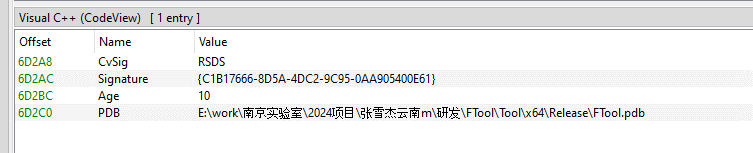
Analysis of the deployed kernel-mode driver reveals an embedded PDB path:
The path contains several notable strings, including “Nanjing Laboratory” (南京实验室) and “Zhang Xuejie Yunnan m” (张雪杰云南m), which likely refer to the driver’s development environment. However, our OSINT analysis did not identify any information linking these strings to a known organization, developer, or threat actor.
The driver is digitally signed with a certificate issued to "Nanjing Ranyi Technology Co., Ltd.", with serial number 3E 62 DC 5D 8D 61 2A 26 33 E7 6B DF D6 07 19 DD. The certificate was valid from August 2013 to September 2014.
We identified several older malicious drivers signed with the same certificate that were compiled around 2013. However, we found no evidence directly linking those samples to the CoolClient activity described in this article.
Driver configuration
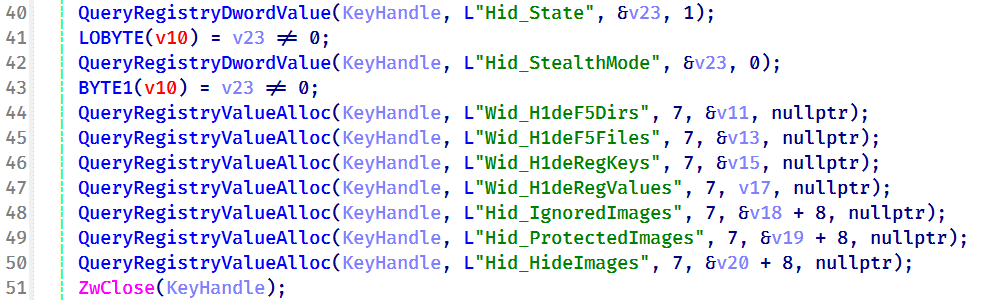
During initialization, the driver loads its stealth configuration from the registry key \REGISTRY\MACHINE\SYSTEM\RNG. The configuration defines which system objects should be hidden or protected and controls the driver’s operating mode.
Registry configuration loaded by the driver during initialization
Two REG_DWORD values control the driver’s operating mode:
Registry Value
Default
Description
Hid_State
1
Enables the driver’s rootkit functionality.
Hid_StealthMode
0
Controls additional stealth features used by selected driver routines.
In addition, the driver loads several REG_MULTI_SZ values that define the objects to be hidden or protected.
Registry Value
Purpose
Wid_H1deF5Dirs
Directories to hide
Wid_H1deF5Files
Files to hide
Wid_H1deRegKeys
Registry keys to hide
Wid_H1deRegValues
Registry values to hide
Hid_IgnoredImages
Processes to ignore
Hid_ProtectedImages
Processes to protect
Together, these registry values determine which filesystem paths, registry objects, and processes are managed by the driver’s protection mechanisms.
After loading the configuration, the driver converts the registry entries into internal lookup structures that are shared across its various protection components.
These structures are later referenced by the filesystem minifilter, registry callback, process callback, object callback, image load callback, and IOCTL handlers to determine whether a file, registry object, or process should be hidden, protected, or ignored.
Preparation for process hiding
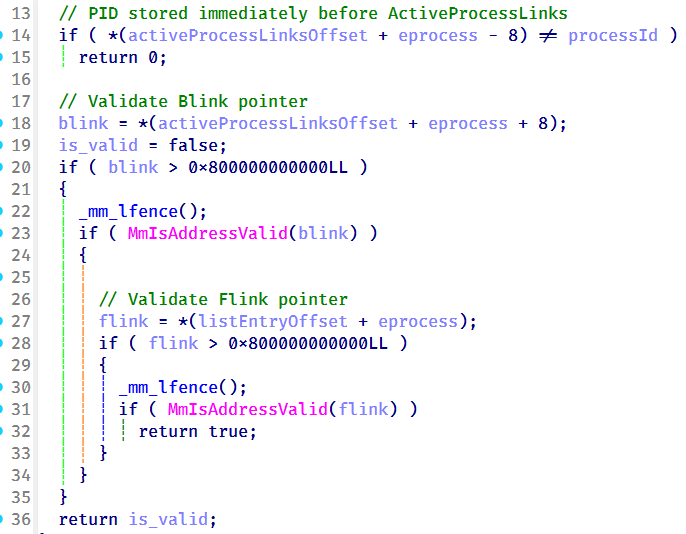
Next, the driver dynamically locates the ActiveProcessLinks (LIST_ENTRY) field within the EPROCESS structure instead of relying on hardcoded offsets. It first validates several predefined offsets and, if none match, performs a linear scan of the EPROCESS structure to identify the correct location. This approach allows the driver to remain compatible across different Windows versions, where the layout of EPROCESS may differ.
The driver validates candidate ActiveProcessLinks layouts before enabling process hiding
Once the correct offset has been identified, it is stored for later use by the process hiding routines. During process hiding and restoration, the driver uses IOCTLs 0x22219C and 0x2221A0 to unlink and relink entries in the Windows active process list, effectively hiding or restoring processes on demand.
Process, object, and image load callbacks
After preparing its process tracking structures, the driver initializes several AVL trees and populates them with configuration entries loaded from the registry, including Wid_H1deF5Dirs, Wid_H1deF5Files, Wid_H1deRegKeys, Wid_H1deRegValues, Hid_IgnoredImages, Hid_ProtectedImages, and Hid_HideImages.
These AVL trees provide efficient lookups for protected files, registry objects, and tracked processes, and are shared by the callback routines and IOCTL handlers.
The driver then registers three types of kernel callbacks that form the foundation of its protection and monitoring mechanisms:
Object callbacks using ObRegisterCallbacks
Process creation and termination callbacks using PsSetCreateProcessNotifyRoutineEx
Image load callbacks using PsSetLoadImageNotifyRoutine
Registration of object, process, and image load callbacks during driver initialization
After registration, these callbacks maintain the driver’s internal tracking structures as processes, threads, and images are created or loaded.
Object callbacks
To protect selected processes, the driver registers object callbacks for process (PsProcessType) and thread (PsThreadType) objects using ObRegisterCallbacks with an altitude of 1203. These callbacks intercept requests to open process and thread handles. If the target process is protected, the driver reduces the access rights granted to the requesting process, preventing operations such as process termination, code injection, and other forms of process manipulation. In this sample, the protected process is the injected CoolClient code running inside synchost.exe.
Process and image load callbacks
The driver registers process creation and termination callbacks using PsSetCreateProcessNotifyRoutineEx, together with an image load callback via PsSetLoadImageNotifyRoutine.
When a process is created, its image name is compared against the configuration lists Hid_IgnoredImages, Hid_ProtectedImages, and Hid_HideImages. Matching processes are added to the driver’s internal tracking structures, allowing them to be protected, hidden, or managed through subsequent IOCTL requests. When a tracked process terminates, its entry is removed from the tracking structures.
The image load callback monitors modules loaded into tracked processes and updates the driver’s internal state to support subsequent protection and hiding operations.
To ensure that processes already running before the driver is initialized are also tracked, the driver performs a one-time enumeration of all active processes after registering the callbacks and adds any matching processes to the tracking structures.
MiniFilter registration
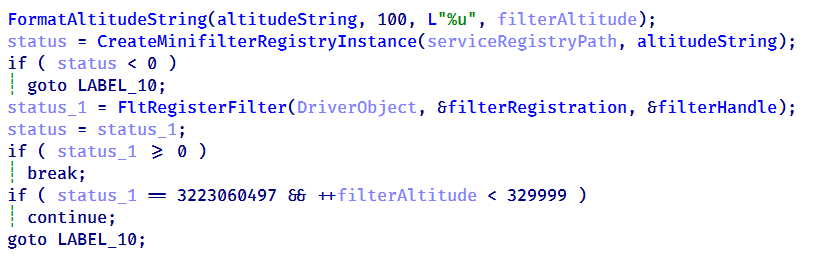
To protect files and directories, the driver registers a filesystem minifilter. During initialization, it creates internal path filter lists, loads the configured directory and file entries (Wid_H1deF5Dirs and Wid_H1deF5Files), and creates the required minifilter registry entries under HKLM\SYSTEM\CurrentControlSet\Services\msagent\Instances. To avoid altitude conflicts, the driver dynamically assigns a filter altitude and retries registration until a unique value is obtained.
Retrying minifilter registration with incrementing filter altitude values until FltRegisterFilter succeeds
The driver then activates the minifilter using FltRegisterFilter. The filter works together with the IOCTL interface, which dynamically adds, removes, or clears protected path entries (0x2220F0, 0x2220F4, and 0x2220F8). During filesystem operations, the minifilter compares accessed paths against its internal path lists and denies access to matching entries, effectively hiding protected files and directories from users and applications.
Registry callback registration
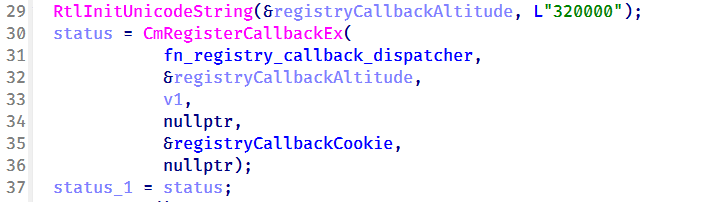
To protect registry keys and values, the driver registers a registry callback using CmRegisterCallbackEx with an altitude of 320000. During initialization, it creates separate lookup structures for protected registry keys and values, then populates them using the configured entries from Wid_H1deRegKeys and Wid_H1deRegValues.
Registration of the registry callback using CmRegisterCallbackEx with an altitude of 320000
Once registered, the callback intercepts registry operations and compares the target key or value against the protected entries. For enumeration requests, matching keys and values are removed from the results before they are returned to user mode, effectively hiding them from registry viewers. For direct access requests, such as opening, modifying, or deleting protected registry objects, the callback returns STATUS_ACCESS_DENIED, preventing the operation.
Before applying these restrictions, the driver verifies whether the requesting process is trusted. Processes registered through IOCTL 0x222120, including the CoolClient user-mode component, bypass the filtering logic and retain unrestricted access, while all other processes remain subject to the driver’s registry protection rules.
IOCTL command dispatcher
To communicate with the user-mode component, the driver creates a device object named \Device\ToolTool together with the symbolic link \DosDevices\ToolTool to allow the user-mode CoolClient component to communicate with the driver through DeviceIoControl requests.
The driver implements 33 IOCTL handlers, although the analyzed CoolClient sample uses only three during normal execution:
0x222120: registers the current CoolClient process with the driver.
0x2221E0: passes the configured C2 IPv4 address.
0x2220F0: registers filesystem and registry paths for protection.
The remaining IOCTL handlers were not invoked by the analyzed sample.
IOCTL
Handler
Functionality
0x222000
0x140001E04
Enable or disable the rootkit.
0x222004
0x1400020B0
Query the current rootkit state.
0x2220F0
0x140002320
● Register protected filesystem or registry paths
● Used by CoolClient to register its installation directory and service registry key.
0x2220F4
0x1400034DC
Remove a protected filesystem or registry path.
0x2220F8
0x140003464
Clear all protected filesystem and registry path entries.
0x222118
0x1400024B0
Register process or path protection entries.
0x22211C
0x140002A20
Query registered protection entries.
0x222120
0x140003794
Update process protection entries. Used by CoolClient to register itself as a trusted process.
0x222124
0x14000362C
Remove a protection entry.
0x222128
0x14000349C
Clear all process protection entries.
0x222130
0x14000265C
Register a protected process by PID.
0x222134
0x140010E88
Inject shellcode into a target process using NtCreateThreadEx.
0x222138
0x14000F498
Hide a kernel module by unlinking it from PsLoadedModuleList.
0x222144
0x14000270C
Delete a file.
0x222148
0x14000286C
Decrypt an embedded buffer and write it to disk.
0x22214C
0x1400027F4
Read and decrypt an encrypted file.
0x222168
0x140002780
Unmap the image section of a target process.
0x22216C
0x140013984
Terminate a process by PID.
0x222194
0x140011F50
Remove Protected Process Light (PPL) protection.
0x222198
0x140002940
Create or modify a registry value.
0x22219C
0x140010630
Hide a process by unlinking it from the active process list.
0x2221A0
0x140010670
Restore a previously hidden process.
0x2221A4
0x14000F8A0
Hide a module within a process.
0x2221A8
0x14000F954
Restore a hidden module.
0x2221AC
0x140016368
Enumerate and restore kernel notification callbacks.
0x2221B0
0x140016458
Disable or restore kernel notification callbacks.
0x2221B4
0x140012408
Manually load a secondary kernel driver.
0x2221B8
0x14001262C
Debug/test handler.
0x2221BC
0x1400165F6
Write to an arbitrary kernel address.
0x2221C0
0x14000BB00, 0x14000BB78
Enables deny-rootkit mode by registering image-load monitoring and enabling the patching logic.
0x2221C4
0x14000BB6C, 0x14000BB10
Disables deny-rootkit mode by clearing state and unregistering/removing the monitoring logic.
0x2221E0
0x1400126C0
Register a C2 IPv4 address.
0x2221E4
0x140012E50
Delete a C2 IPv4 address.
After initializing the IOCTL dispatcher, the driver releases the temporary configuration buffer that was previously loaded from \REGISTRY\MACHINE\SYSTEM\RNG.
Kernel module enumeration and hiding
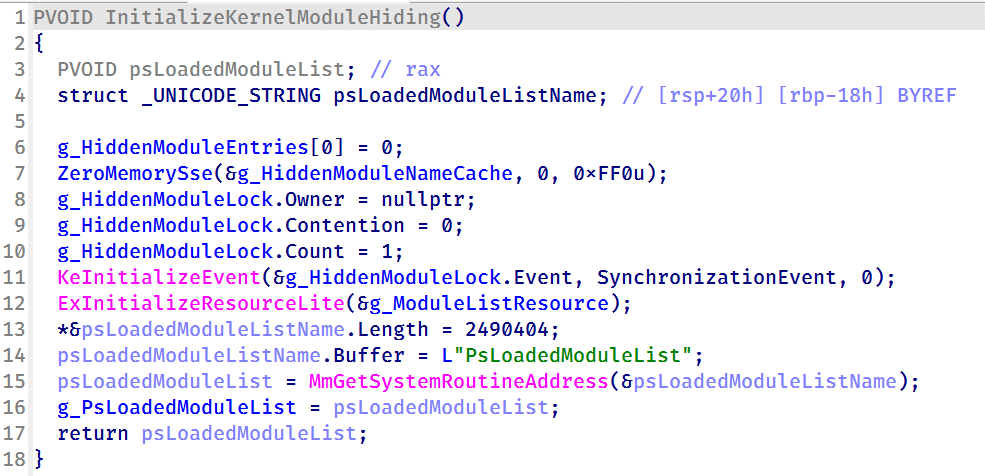
To support kernel module hiding, the driver resolves the address of the non-exported kernel variable PsLoadedModuleList at runtime using MmGetSystemRoutineAddress. This global linked list maintains information about all loaded kernel modules and drivers, allowing the rootkit to enumerate and manipulate module entries.
Driver initialization routine resolving the address of PsLoadedModuleList for subsequent kernel module hiding
This functionality is exposed through IOCTL 0x222138, which accepts a module name or path from the user-mode component. When a matching module is found, the driver locates the corresponding entry in PsLoadedModuleList and unlinks it by updating its Flink and Blink pointers. As a result, the hidden module no longer appears in standard kernel module enumeration routines.
Nsiproxy hooking and data filtering
The driver also hooks the Nsiproxy driver to filter network-related data returned to user mode. This functionality is connected to IOCTL 0x2221E0, which allows the user-mode component to register C2 IPv4 addresses with the driver.
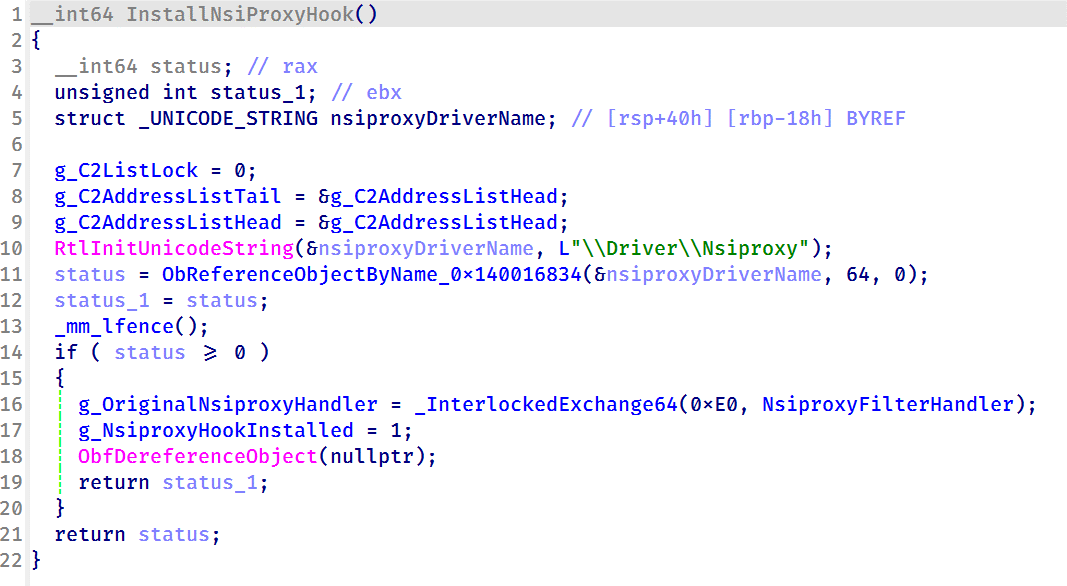
To install the hook, the driver obtains a reference to \Driver\Nsiproxy using ObReferenceObjectByName and replaces one of the Nsiproxy handler pointers with its own filtering routine. The hook preserves the original handler and forwards execution after processing the returned data.
Installing the Nsiproxy hook by resolving \Driver\Nsiproxy and replacing the original handler with the driver’s filtering routine
When the hooked routine processes network information, the driver compares the returned entries against its registered C2 address list. Matching IP addresses are removed before the data is returned to user mode, preventing applications that rely on Nsiproxy-provided network information from seeing the malware’s C2 addresses.
Finally, the driver registers a DriverUnload routine to release allocated resources when the driver is unloaded.
Victimology
The latest CoolClient variant continues to target organizations consistent with previously observed HoneyMyte activity. Based on our investigations, we identified victims in Myanmar, Mongolia, Pakistan, and Russia, including confirmed government entities.
Across the observed intrusions, CoolClient was consistently deployed as a secondary backdoor following a PlugX infection, indicating that HoneyMyte continues to use PlugX as its initial post-compromise implant before transitioning to CoolClient.
Attribution
Our analysis confirms that the investigated malware is a new CoolClient variant associated with the HoneyMyte threat group. While the overall execution flow remains consistent with previously documented CoolClient variants, this sample introduces a previously undocumented kernel-mode driver that significantly expands the malware’s stealth capabilities.
The deployment chain observed in this investigation is also consistent with previous HoneyMyte campaigns, in which PlugX serves as the initial foothold before CoolClient is deployed as a secondary backdoor, further reinforcing the attribution.
Conclusion
The latest CoolClient variant represents a significant evolution of the malware. Rather than operating solely as a user-mode backdoor with plugin support, it now deploys and communicates with a kernel-mode driver that extends its capabilities beyond earlier versions. Through this driver, CoolClient can hide and protect processes, files, and registry objects, as well as filter selected network information, making detection and analysis considerably more difficult.
HoneyMyte has previously introduced kernel-mode functionality in ToneShell. The addition of a kernel-mode driver to CoolClient suggests that the group continues to expand its use of rootkit capabilities to improve stealth, persistence, and defense evasion during post-compromise operations.
Security researchers found 150 lookalike Open VSX extensions published under trusted names, highlighting how extension marketplaces can expose developer credentials, source code, and CI/CD systems to supply-chain risk.
XCSSET v40 malware infects macOS developers through poisoned Xcode projects on GitHub, then hides in memory. Unit 42 found 17 modules and Chrome hijacking.
Cisco Talos found hackers using simple authorization claims to bypass AI guardrails, build DDoS attack tools, steal credentials and access live camera services.
Summary AtlasRAT is a Windows-based remote access malware. This report analyzes a four-stage in-memory loader chain—which begins with a Delphi executable that is disguised as AGE Flash Player—and its final RAT functionality. The final payload performs TLS-based ChaCha20-encrypted C2 communication, executes modular plugins, performs offline keylogging, and injects DLLs into WeChat processes. Group Characteristics Public […]
While monitoring attack cases targeting MS-SQL servers, the AhnLab SEcurity intelligence Center (ASEC) identified an instance in which the Larva-26009 threat actor installed the XMRig CoinMiner. While the installation of CoinMiner is common in attack cases targeting MS-SQL servers, in this particular attack case, the attacker installed VShell and GotoHTTP to gain control over the […]
CCTV: como uma ferramenta de código aberto expôs a localização de usuários do Telegram | OSINT Brasil
RDS Consultoria / OSINT Brasil">
$
OSINT · Privacidade Digital · Contrainteligência
CCTV: a ferramenta de código aberto que transformou o Telegram em um mapa de rastreamento em tempo real
Como o recurso "Pessoas Próximas" virou vetor de geolocalização, o que a repercussão global do caso ensina sobre exposição digital, e o que diz a lei brasileira sobre esse tipo de monitoramento.
Análise Analítico de Dados · OSINT Brasil · "Quem não controla a informação, vira alvo dela." — Rogério Souza
O que foi o caso CCTV
Em 2024, um projeto de código aberto batizado Close-Circuit Telegram Vision (CCTV) ganhou notoriedade internacional por demonstrar, na prática, uma fragilidade conceitual em um recurso que milhões de pessoas usam sem pensar duas vezes: o "Pessoas Próximas" do Telegram, criado originalmente para sugerir contatos e canais locais.
A ferramenta automatizava um processo que, isoladamente, qualquer usuário do Telegram poderia repetir manualmente: consultar a distância aproximada informada pelo aplicativo entre a conta que faz a busca e outras contas próximas. Ao repetir essa consulta a partir de múltiplos pontos simulados, era possível aplicar um raciocínio de trilateração — a mesma lógica geométrica usada por GPS e por técnicas clássicas de GEOINT — para convergir sobre a localização real de um alvo, com precisão relatada na faixa de 50 a 100 metros.
Ponto de virada: em 6 de setembro de 2024, o Telegram desativou o recurso "Pessoas Próximas" em nível de plataforma. Isso encerrou de forma definitiva o funcionamento de todas as ferramentas construídas sobre esse vetor, incluindo o CCTV. O caso ilustra um padrão recorrente em OSINT: recursos de conveniência de UX frequentemente carregam superfícies de exposição que só se tornam visíveis quando alguém as instrumentaliza publicamente.
Por que o caso repercutiu tanto
A cobertura do caso não ficou restrita a um nicho técnico. Veículos e comunidades de segurança em pelo menos quatro idiomas noticiaram o tema — da imprensa especializada em tecnologia à imprensa investigativa russa, passando por publicações de segurança na Itália e na Espanha. O padrão de repercussão é um indicador clássico de que a ferramenta tocou em uma preocupação real e generalizada: a sensação de que aplicativos de mensageria, mesmo os que se posicionam como focados em privacidade, podem carregar funcionalidades cujo risco não é comunicado com clareza ao usuário final.
Do ponto de vista de quem trabalha com Threat Intelligence e investigação digital defensiva, o episódio é um estudo de caso relevante sobre três frentes que se cruzam:
Superfície de exposição por design — recursos pensados para conveniência (encontrar pessoas/canais perto de você) podem ser reaproveitados como primitivas de rastreamento quando automatizados em escala.
Assimetria entre usuário comum e agente malicioso — a maioria dos usuários não tem ideia de que uma funcionalidade de "descoberta local" pode ser convertida em ferramenta de perseguição (stalking) por qualquer pessoa com conhecimento básico de scripting.
Velocidade de resposta da plataforma — o desligamento do recurso, embora tardio em relação à circulação pública da ferramenta, mostra que pressão pública e cobertura de imprensa continuam sendo um dos poucos mecanismos efetivos de correção rápida quando não há regulação específica em tempo real.
A lógica técnica, em nível conceitual
Sem reproduzir instruções operacionais — o que não é o objetivo deste artigo nem de qualquer conteúdo produzido pela OSINT Brasil —, vale entender a lógica subjacente para fins de conscientização defensiva:
O aplicativo informa uma distância aproximada entre duas contas quando ambas têm o recurso de descoberta local ativo.
Repetindo essa consulta a partir de coordenadas de referência diferentes (um processo de deslocamento simulado), obtêm-se múltiplos "raios" de distância até o mesmo alvo.
A interseção geométrica desses raios — o mesmo princípio usado por sistemas de posicionamento por satélite — converge para uma área cada vez menor, até aproximar a localização real com margem de dezenas de metros.
Essa lógica não é exclusiva do Telegram. Qualquer serviço que exponha "distância até outro usuário" sem limitar a granularidade, a frequência de consulta ou o comportamento automatizado (via API) está sujeito ao mesmo tipo de abuso. É por isso que, em auditorias de exposição digital, um dos pontos de verificação padrão da metodologia OSINT Brasil é justamente mapear quais aplicativos do cliente expõem, mesmo que de forma aproximada, sinais de proximidade geográfica.
Enquadramento jurídico no Brasil
Ferramentas com essa finalidade — rastrear a localização de uma pessoa sem consentimento, para fins de monitoramento, controle ou vigilância — esbarram em pelo menos três frentes do ordenamento jurídico brasileiro:
Lei do Stalking (Lei nº 14.132/2021)
Incluiu no Código Penal o crime de perseguição (art. 147-A), que criminaliza perseguir alguém reiteradamente, por qualquer meio, ameaçando sua integridade física ou psicológica, restringindo sua capacidade de locomoção ou, de qualquer forma, invadindo ou perturbando sua esfera de liberdade ou privacidade. O uso de uma ferramenta de geolocalização não consentida para monitorar deslocamentos de uma pessoa se encaixa diretamente nesse tipo penal quando há reiteração e finalidade de vigilância.
LGPD (Lei nº 13.709/2018)
Dados de geolocalização são dados pessoais e, dependendo do contexto (por exemplo, quando revelam rotina, endereço residencial ou deslocamentos que permitem inferir características sensíveis), podem se aproximar do regime mais rigoroso do art. 11. O tratamento sem base legal — e monitoramento oculto de terceiros certamente não se enquadra nas hipóteses do art. 7º — configura ilícito civil, sujeito a indenização por danos morais e, no caso de agentes de tratamento formais, a sanções administrativas da ANPD.
Marco Civil da Internet (Lei nº 12.965/2014)
Reforça a proteção à privacidade e à intimidade como princípios da disciplina do uso da internet no Brasil (art. 3º, incisos II e III), servindo de base complementar em ações que discutam responsabilidade de provedores de aplicação diante de vazamentos de funcionalidade que facilitem rastreamento não consentido.
Nota sobre jurisprudência recente: tribunais superiores brasileiros vêm consolidando, ao longo de 2025 e 2026, o entendimento de que o tratamento de dados pessoais sem base legal adequada gera dever de indenizar quando há exposição concreta de intimidade — e o STJ tem atuado para uniformizar decisões sobre compartilhamento indevido de dados pessoais, inclusive sob o CPC (arts. 927 e 1.036), buscando reduzir divergências entre tribunais de segunda instância. Na esfera criminal, o STF já assentou que provas obtidas a partir de dados de geolocalização ou conteúdo telemático sem autorização judicial são nulas em investigações penais — precedente que reforça, por analogia, a ilicitude de qualquer coleta de localização à margem do devido processo.
Lições defensivas: como reduzir sua superfície de exposição
Vetor de risco
Ação recomendada
Recursos de "descoberta por proximidade"
Desative funcionalidades de geolocalização social sempre que não forem estritamente necessárias.
Compartilhamento de localização em tempo real
Restrinja a contatos específicos e por tempo limitado, nunca de forma permanente.
Metadados em fotos e stories
Remova metadados de GPS antes de publicar (revisão EXIF), especialmente em conteúdo próximo à residência ou local de trabalho.
Apps de terceiros com permissão de localização
Audite periodicamente quais aplicativos têm acesso contínuo (não apenas "durante o uso").
Padrões de rotina expostos publicamente
Evite postar em tempo real; publique com atraso quando o conteúdo revelar padrões de deslocamento previsíveis.
Cenários prospectivos
O desligamento do recurso pelo Telegram resolve o vetor específico do CCTV, mas não elimina o problema estrutural. Alguns cenários prováveis para os próximos ciclos:
Migração do vetor para outras plataformas — qualquer aplicativo que ainda exponha distância aproximada entre usuários (redes de namoro, apps de encontros, redes sociais de nicho) permanece candidato a réplicas conceituais da mesma técnica.
Pressão regulatória crescente — a tendência, tanto na União Europeia (DSA/GDPR) quanto no Brasil (agenda da ANPD), é de exigir de plataformas testes de "privacy by design" mais rigorosos antes do lançamento de recursos sociais baseados em proximidade.
Judicialização de casos concretos — é razoável esperar um aumento de ações envolvendo a Lei do Stalking combinadas a pedidos de indenização sob a LGPD, à medida que vítimas de monitoramento digital não consentido buscam reparação civil e criminal simultaneamente.
Uso em due diligence e investigação defensiva — o caso já se consolidou como referência didática em treinamentos de OSINT e threat intelligence, justamente pelo caráter reproduzível do princípio geométrico por trás da técnica.
Conclusão
O caso CCTV não foi apenas sobre uma ferramenta específica — foi sobre como um detalhe aparentemente inofensivo de design de produto pode se transformar em vetor de vigilância em escala quando cai nas mãos certas (ou erradas). Para profissionais de segurança da informação, investigação digital e compliance, o episódio reforça uma regra permanente: toda funcionalidade que revela proximidade, distância ou presença de um usuário é, por definição, uma funcionalidade de geolocalização — e deve ser tratada com o mesmo rigor jurídico e técnico que qualquer outro dado sensível.
Conteúdo produzido pela OSINT Brasil para fins de conscientização em segurança da informação e investigação digital defensiva. Este artigo não reproduz nem incentiva o uso de ferramentas de rastreamento não consentido de pessoas, prática que pode configurar crime de perseguição (art. 147-A do Código Penal) e ilícito civil sob a LGPD.
Chinese actors used Claude Code and DeepSeek to automate attacks that breached government systems and targeted financial firms.
Hunt.io researchers stumbled onto an active intrusion campaign in June 2026 while pivoting on known TencShell command-and-control infrastructure. A single HTTP header fingerprint on port 1111 led them to 13 Hong Kong-based servers and, on one of them, an open directory containing 2,431 files and 80 subdirectories: victim source code, custom exploit scripts, cloned login pages, and operator logs with notes written in Simplified Chinese. Someone left the door open. Researchers walked right in.
What made this find unusual wasn’t just the scope of the targeting. It was the tooling.
“What caught our attention was the tooling behind it. Claude Code and DeepSeek-v4-pro ran as working parts of the intrusion, not tools off to the side. They handled reasoning for bypass techniques, reworked exploits after failed attempts, and built the phishing pages used to harvest credentials.” reads the report published by Hunt.io. “That puts this campaign alongside Anthropic’s November 2025 disclosure of a China-linked operation that used Claude Code to automate large-scale intrusions.”
This puts the campaign alongside Anthropic’s own November 2025 disclosure of a China-linked operation that used Claude Code to automate large-scale intrusions.
The campaign resembles another China-linked operation that Anthropic disclosed in November 2025, where attackers also used Claude Code to automate large-scale intrusions.
The recovered logs show that the attackers split the work between two AI models. Claude Code 2.1.165 handled execution by running Bash commands, managing long-running sessions, carrying out tasks in parallel, and creating phishing infrastructure. DeepSeek-v4-pro handled the planning by generating scripts, choosing attack techniques, and finding new ways to bypass defenses when earlier attempts failed.
“DeepSeek-v4-pro operates as the underlying reasoning model, handling attack logic, script generation, and decision-making.” continues the report. “In short, offensive logic is routed through a Chinese domestic LLM while leveraging Anthropic’s agentic execution infrastructure.”
A recovered CLAUDE.md file also contained instructions telling Claude Code to automatically create, test, and improve cloned phishing pages for multiple targets.
Session IDs in the logs confirmed the same infrastructure was used across different country-specific campaigns, with Taiwan operations saved to dedicated working directories. Timestamps on the files span June 8 through 12, 2026, and the three servers sharing SSH keys were actively maintained as recently as June 18-19, when all three reissued their ARL certificates together.
In Thailand, attackers used SQLMap to exploit a government administrative system through SQL injection, gained admin panel access, and deployed a web shell disguised as a GIF file for persistent command execution. The exfiltrated database held the names, national ID numbers, and job titles of government employees. The directory contained 980 files referencing this system alone, suggesting a lengthy and focused operation. Test entries the attackers created during the intrusion confirmed they had hands-on, interactive access to the data, not just automated extraction.
In Afghanistan, a government web application handling citizen complaint submissions was compromised. The attackers extracted source code, database credentials, encryption keys, and mail infrastructure code from a Laravel 5.8.38 installation, then used those credentials to build a custom Python exploit targeting Laravel’s deserialization mechanisms. Six distinct copied versions of the complaint submission form appeared in the directory. For a state actor, access to a live channel where citizens report grievances against government and institutions is a particular kind of intelligence prize.
In Taiwan, eight organizations in supply chain and defense-adjacent sectors were mapped and fingerprinted, with two successfully exploited. A chemical manufacturer was hit through SQL injection. A telecom and edge device manufacturer was compromised after attackers found hardcoded Supabase keys and Azure Logic App tokens in publicly accessible JavaScript files, giving them direct access to cloud infrastructure accounts. The reconnaissance script targeting these organizations ran DNS brute-forcing, certificate transparency queries, and HTTP service fingerprinting with an emphasis on VPN gateways, GitLab instances, and Jira environments.
The United States appeared at earlier stages of the operation rather than as a confirmed breach. NASA hosts launchpad.nasa[.]gov and ngis.nasa[.]gov were logged in network scanning output but not pursued further. Cloned pages impersonating the D.C. Council and Delaware County, Pennsylvania were recovered at varying levels of completion: the D.C. Council WordPress admin login page was fully built while the homepage was still missing images.
Hunt.io assessed the targeting of mid-tier government administrative bodies as consistent with documented Chinese intelligence collection priorities around procurement, vendor relationships, and policy visibility. The county contact form clone, specifically built to capture citizen submissions, fits that same pattern.
A parallel campaign hit financial services firms across Europe, Australia, and Asia. A CORS exploit page on one of the attacker-controlled servers successfully extracted WordPress administrator credentials from a large payment processing platform, with LinkedIn cross-referencing confirming the extracted account names matched real employees.
“In addition to the government-sector activity, the operators ran a parallel campaign against financial services firms across multiple regions. The clearest example being an attacker-developed CORS exploit page on 112.213.124[.]159 that successfully extracted WordPress administrator account data from a large payment processing platform.” states the report. “A cross-reference on the exposed accounts against public LinkedIn profiles, confirmed individuals with the same name as employees of the company.”
The 13 servers are all in Hong Kong, spread across four hosting providers: VMISS Inc., MEGA-II IDC, CTG Server Limited, and Antbox Networks Limited. Three share SSH host key fingerprints and ran identical ARL reconnaissance software serving the same default TLS certificate, with fields pointing to Shanghai. Two servers in the cluster also presented certificates self-identifying as “Gshell C2,” a previously undocumented C2 framework. Because those two servers overlap with the TencShell cluster, Hunt.io assesses with moderate confidence that Gshell is a second C2 framework operated in parallel by the same actors.
The malware recovered from the delivery ports was a previously unreported Linux/ARM 32-bit binary that communicates back to the same infrastructure hub over WebSocket. It’s capable of extracting Tencent QQ messaging credentials including SDK identifiers and cryptographic keys, enterprise messaging platform tokens, and cloud service access keys. A separate Linux/x86 variant uses the Go obfuscation tool garble to strip function names, but both variants share an identical 80-byte encryption key, pointing to a shared codebase across architectures.
“The campaign reflects an intermediate-to-advanced capability set: custom exploit development aimed at specific framework versions, multi-platform malware variants, and integration of LLMs for real-time attack assistance.” concludes the report. “Observable indicators: Simplified Chinese in code and documentation, Hong Kong infrastructure clustering, and multi-continent targeting, are consistent with China-based threat actor activity.”
Hunt.io notified the affected organizations and national CERTs on July 6, 2026, and held publication for a seven-day disclosure window. The full indicator set, including file hashes and network infrastructure, is in the original report.
China warned organizations to remove certain Claude Code versions over alleged backdoor risks, while Anthropic called the feature anti-abuse protection.
A newly disclosed Linux kernel vulnerability, CVE-2026-53359, dubbed Januscape, has exposed a critical weakness in the Linux Kernel-based Virtual Machine (KVM) hypervisor. The flaw resides in the shadow MMU code and allows attackers to escape a virtual machine (VM), compromise the underlying host, and potentially execute arbitrary code.Security researchers warn that the issue poses a serious risk to multi-tenant x86 public cloud environments running untrusted guests with nested virtualization enabled.
Januscape Flaw Affects KVM Shadow MMU Code
Discovered by security researcher Hyunwoo Kim (@v4bel), CVE-2026-53359 is described as a use-after-free vulnerability in the KVM/x86 shadow MMU code. According to Kim, the flaw can be triggered entirely from within a guest VM to corrupt the host kernel's shadow page state, ultimately breaking guest-to-host isolation.Kim demonstrated Januscape as a zero-day during Google's KVMCTF bug bounty program, which offers rewards of up to $250,000 for complete VM escape vulnerabilities. The researcher noted that this is the first publicly known KVM guest-to-host exploit research that can be triggered on both Intel and AMD systems, rather than being limited to a single architecture.
CVE-2026-53359 impact and affected systems
Successful exploitation of Januscape can result in complete compromise of the host. Kim explained, "An attacker who has rented just a single instance on a public cloud could panic the host kernel to take down every other tenant VM on the same physical machine (DoS), or run code with root privilege on the host to take over the host and all the guests on it (RCE)."In addition to VM escape, CVE-2026-53359 can enable local privilege escalation on certain Linux distributions. On systems such as Red Hat Enterprise Linux (RHEL), where /dev/kvm is world-writable (0666), unprivileged users may escalate privileges to root.The vulnerability requires root privileges inside the guest VM, which public cloud users typically receive by default. If root access is unavailable, Kim said attackers could chain the flaw with another privilege escalation vulnerability, such as Dirty Frag.
Patch availability and disclosure timeline
According to the official GitHub advisory, Januscape remained hidden in the Linux kernel for roughly 16 years. The affected code spans the commit from 2032a93d66fa (August 1, 2010) through 81ccda30b4e8 (June 16, 2026). The issue was patched in the mainline Linux kernel on June 19, 2026, when commit 81ccda30b4e8 was merged.The advisory states that a proof-of-concept (PoC) executed inside a guest VM can reliably trigger a host's kernel panic within seconds or minutes. While a full VM escape exploit exists in a controlled environment, it has not been publicly released. Following coordinated disclosure through linux-distros@vs.openwall.org and the end of the agreed embargo, the exploit details were published on oss-security along with technical documentation.The advisory also clarifies that CVE-2026-53359 affects only Intel and AMD-based KVM hosts, not arm64 systems. It further notes that the vulnerability exists within KVM's in-kernel MMU code, making it independent of QEMU's emulation and potentially impacting cloud providers using custom virtualization stacks. Administrators running multi-tenant x86 KVM hosts with nested virtualization are advised to ensure the 81ccda30b4e8 patch has been applied.
If you weren’t taking deepfakes seriously before, it’s too late now to ignore them.
According to new research from Malwarebytes, one in three people who use AI every day said it’s okay to generate pornography of people without their consent.
Nearly 10 years ago, “deepfake” technology provided hobbyists and film editors with artificial intelligence (AI) tools to swap the face of one person onto the body of another. In its infancy, this technology brought silly film experiments like swapping Tom Cruise in Mission Impossible with Keanu Reeves. Today, this same technology produces something far more harmful—fake nude images of teenagers.
On the Lock and Code podcast today with host David Ruiz, we are re-visiting an interview from 2024, in which we spoke with a lawyer named David Chiu about his lawsuit against 16 deepfake nude generation websites.
The websites named in that lawsuit often needed just one image of a person to generate fake pornography. And while nearly everyone has at least one image of themselves online, even if they had hundreds, the path towards deletion is somewhat understood—start by deactivating and deleting popular social media accounts. But for teenagers today, raised mostly online, and who share images directly with friends and boyfriends and girlfriends and exes, it’s likely impossible to remove every visual trace of themselves. Also, they shouldn’t have to face this problem alone.
The Lock and Code podcast frequently discusses structural problems that require individual management. You have to skirt corporate data collection. You have to find the automated license plate readers in your hometown. You have to review every single message you get with a certain antagonism, to guard yourself against scams.
So, it’s rare to encounter a solution that benefits more than one person.
Chiu serves as the City Attorney for San Francisco, which means his department can file a lawsuit on behalf of not just the people of San Francisco, but also California, and that’s what his team did in going after the deepfake websites.
Since then, Chiu’s department has shut down 10 deepfake nude websites, and it received a settlement agreement from a company called Briver LLC to no longer operate any website that creates nonconsensual deepfake pornography.
And, as California goes, so goes the nation.
In May of last year, the Take It Down Act became effective as law in the United States, which criminalizes “revenge porn” and AI-generated nonconsensual intimate imagery. The law is not perfect but so far it is being used as intended. Last month, two men in the US were among the first to be charged with violating the Take It Down act for allegedly creating deepfake nudes that, according to the AP, “included both celebrities as well as private women, including recent high school graduates.”
Today, we revisit our conversation with San Francisco City Attorney David Chiu about the important fight against deepfake porn and the clear threat that his department found against the public.
“At least one of these websites specifically promotes the non-consensual nature of this. So, and I’ll just quote, ‘Imagine wasting time taking her out on dates when you can just use website X to get her nudes.'”
Microsoft today released software updates to plug nearly 200 security holes across its Windows operating systems and supported software, a record number of fixes for the company’s monthly Patch Tuesday cycle. Nearly three dozen of those bugs earned Microsoft’s most dire “critical” rating, and exploit code for at least three of the weaknesses is now publicly available.
The software giant said in a blog post last month that both its engineers and the security community are increasing using artificial intelligence tools to find bugs, meaning this month’s heavy Patch Tuesday may start to become the norm, said Satnam Narang, senior staff research engineer at Tenable.
“Some surveys put AI usage among security professionals generally at 90%, so it’s unsurprising that this volume of patches may be the norm,” Narang said. “Pandora’s proverbial box has been opened, and as more advanced AI models become available, we expect the norm to continue upward across the board, not just for Patch Tuesday.”
June’s zero-day bugs include CVE-2026-49160, a denial of service vulnerability affecting a range of web servers, including Microsoft Internet Information Services (IIS). Microsoft says the flaw was reported by OpenAI’s Codex.
Two of the zero-days addressed this month appear to stem from recent vulnerability disclosures by Nightmare Eclipse, the nickname chosen by a security researcher who has been dropping exploits for various Windows flaws. One of those, dubbed “GreenPlasma,” leverages an elevation of privilege weakness in the Windows Collaborative Translation Framework, the same framework patched today in CVE-2026-45586.
Nightmare Eclipse also last month released “YellowKey,” an exploit for a Windows BitLocker vulnerability that allows an attacker with physical access to view encrypted data, and CVE-2026-50507 is a patch for an elevation of privilege bug in BitLocker.
Microsoft received heavy blowback on social media last month after it said in a blog post that it was considering taking legal action against the security researcher. The company later clarified on Twitter/X that while it has no intention of pursuing legal actions against researchers, it would report them to authorities if they break the law. The advisories for CVE-2026-49160 and CVE-2026-50507 do not credit any researchers in the acknowledgement section, saying only that “Microsoft recognizes the efforts of those in the security community who help us protect customers through coordinated vulnerability disclosure.”
Nightmare Eclipse claims to be a former employee of Microsoft, although Microsoft has not responded to questions about this claim. Rapid7 notes that a recent blog post by Nightmare Eclipse included an image of Albert Wesker, a character from the Resident Evil video game series who formerly worked as a researcher for a technology company before going rogue.
Nightmare Eclipse has pledged to release even more zero-day exploits for Windows in what they called a “bone shattering” drop planned for July 14 (the same day as next month’s Patch Tuesday). Immediately following the release of Microsoft patches today, the researcher published an exploit for what they claimed was a zero-day bug in Windows Defender.
While 200 vulnerabilities may be a record for Patch Tuesday, the actual number of security flaws Microsoft addressed this month is far higher, said Rapid7’s Adam Barnett.
“So far this month, Microsoft has provided patches to address 360 browser vulnerabilities, which is an order of magnitude more than has been typical in any given month over the past few years,” Barnett wrote. “As usual, browser [flaws] are not included in the Patch Tuesday count above. Indeed, the vast, and presumably sustained, uptick in the number of browser vulnerabilities has led to Microsoft no longer enumerating Chromium CVEs in the Security Update Guide.”
Microsoft also patched a zero-day vulnerability in Visual Studio Code that allows attackers to steal GitHub tokens with a single click. The company was forced to push a stopgap fix for the flaw on June 3, after a researcher published instructions showing how to exploit it. The researcher said they opted not to work with Microsoft because of a recent experience wherein Redmond silently patched a flaw they reported without offering credit or recognition.
Microsoft battled its own internal zero-day emergencies last week, after at least 72 of the company’s public code repositories were infected with a variant of the Shai-Hulud worm. Researchers found that all of the affected packages were connected to Microsoft official Azure Durable Task SDK, which got hit by the same Shai-Hulud worm in May.
Other major software makers are also shipping outsized update bundles this month. Adobe has released updates to fix a massive number of critical vulnerabilities across a range of products, including Adobe Experience Manager, Acrobat Reader and Cold Fusion. On June 3, Google resolved a whopping 429 vulnerabilities in its latest Chrome browser update (Chrome automatically downloads updates but installing them usually requires a complete restart of the browser).
As ever, please consider backing up your data before applying operating system updates, and drop a note in the comments if you run into any problems with this month’s patches.

 Entrar