Visualização de leitura

JSCeal Hides Crypto Malware in V8 Bytecode

JSCeal hides crypto-stealing malware in V8 bytecode, but researchers built a tool to decompile it and expose its advanced theft capabilities.

JSCeal is a cryptocurrency stealer that Check Point Research has tracked since early 2025. Unlike most malware, it hides its code in a format that makes analysis much harder. Check Point presented its latest research at Black Hat USA 2026 and showed how its team built a tool that converts the hidden code into a form analysts can understand.

JSCeal uses a clever trick. Instead of delivering normal JavaScript, its creators compile the malware into V8 bytecode, the format that Chrome and Node.js use to run JavaScript efficiently. They then package the bytecode with a Node.js runtime that executes it.

The original JavaScript never reaches the victim’s computer. As a result, most tools designed to analyze JavaScript have little useful code to work with.

“JSCeal is a stealer delivered as compiled V8 bytecode (.jsc) and executed by a bundled Node.js runtime, targeting cryptocurrency applications (other vendors also tag it with the names WEEVILPROXY or MeadowLocust). ” states the report. “Unlike ordinary JavaScript malware, JSCeal reaches the analyst after two transformations have already removed much of the information that source-oriented tools depend on. First, the JavaScript is heavily obfuscated. Then it is compiled into V8’s internal bytecode representation and shipped as cached data rather than source code. The resulting format is version-specific, poorly served by mature reverse-engineering tooling, and unsuitable for most standard JavaScript deobfuscation workflows.”

Before compilation even happens, the JavaScript source gets run through a commercial-grade obfuscator too, adding a second wall on top of the first. Function and variable names get replaced with meaningless strings, important text gets split into encrypted chunks reconstructed only at runtime, and the program’s actual logic gets scrambled into a state machine that hides the real order operations execute in.

Stack two separate obfuscation techniques on top of each other, and you get a payload that’s expensive to analyze but was genuinely cheap for the attacker to produce, since none of these tools are custom-built; they’re just assembled from existing open-source components.

Check Point’s answer was building on top of View8, an existing open-source V8 bytecode decompiler, and extending it with a purpose-built pipeline specifically tuned to JSCeal’s patterns. The process has to happen in a strict sequence, because each layer of deobfuscation exposes information the next layer needs: recovering encrypted strings reveals dictionary keys, those keys unlock proxy function relationships, and cleaning up the proxies finally exposes what the code is actually doing underneath. Applied across 23 different JSCeal samples collected over several months, the pipeline produced usable, readable output in every single case.

What that recovered code actually shows is a genuinely broad toolkit built for financial theft. JSCeal steals saved passwords and cookies from eight different Chromium-based browsers, harvests Telegram session data, logs keystrokes, takes screenshots, and installs a locally generated, attacker-controlled certificate to intercept and modify HTTPS traffic in transit. That last capability lets it silently rewrite what a victim actually sees from real financial platforms, swapping login QR codes on Binance, injecting fake security challenges on Bybit, and replacing legitimate scripts served by Ledger’s own website with content the attacker controls.

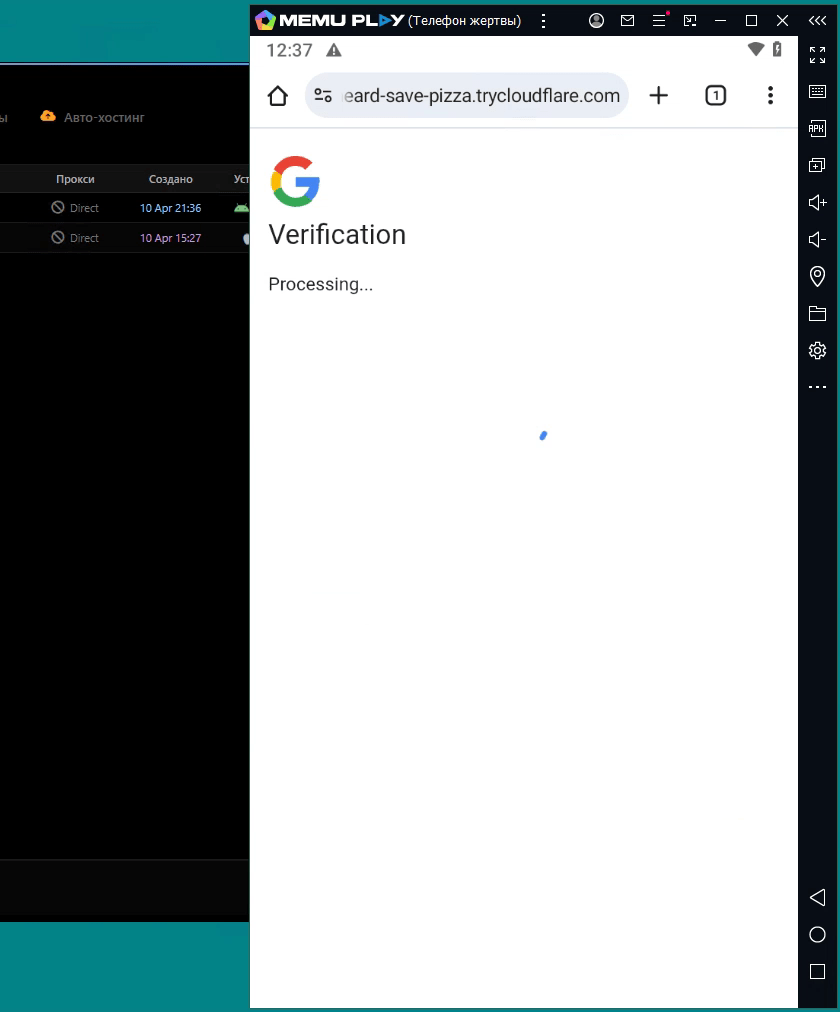
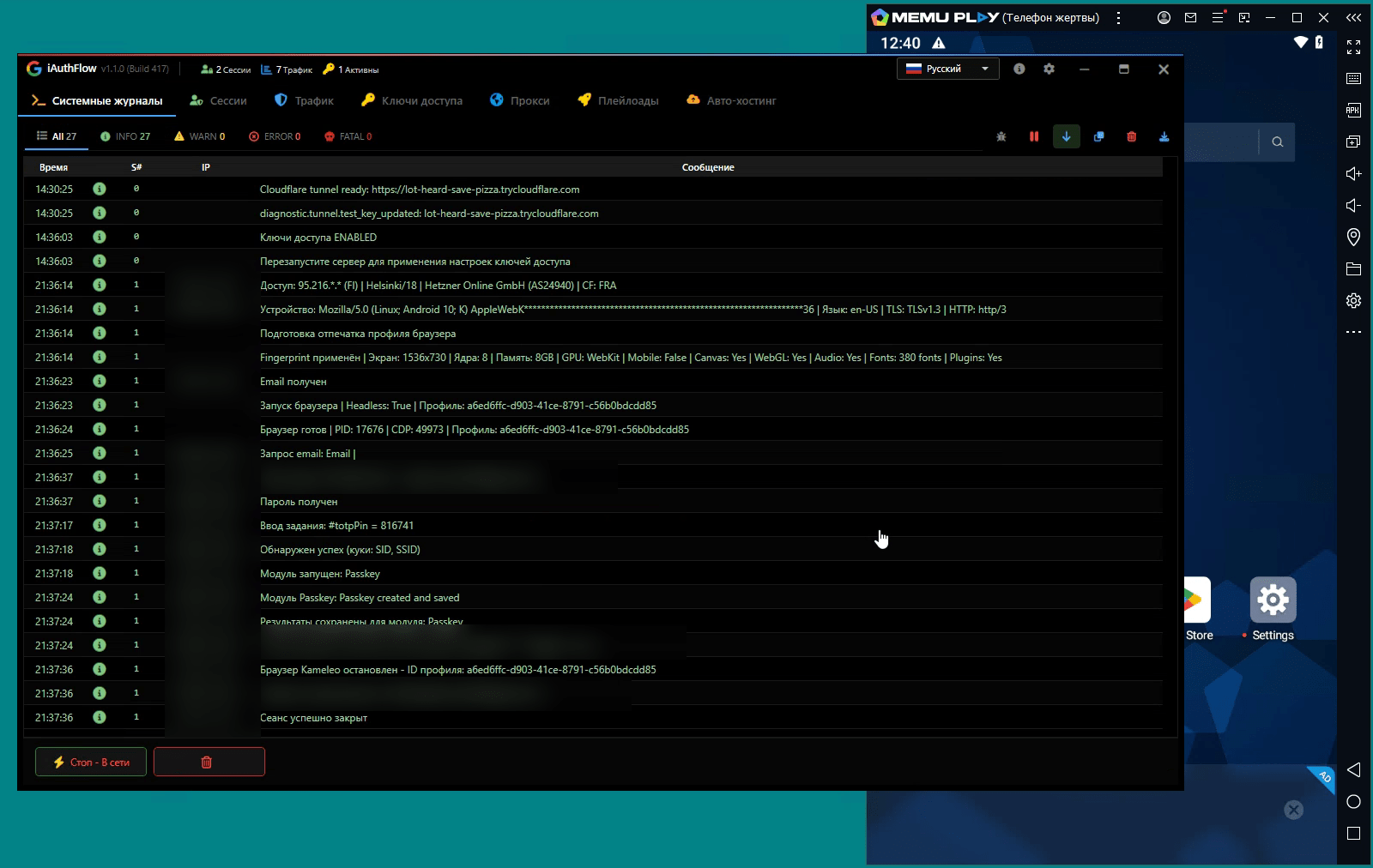
One capability goes well beyond passive data theft into something closer to automated account takeover. The malware can launch a victim’s own installed browser, inject stolen session cookies, and navigate through Google’s actual account authentication flow using automation tooling built specifically to avoid looking like a bot.

“The proxy is not limited to passive interception. The recovered code contains dedicated handlers that modify selected requests and responses for specific services.” continues the report. “A configuration function exposes separate overrides for Binance, Bybit, and Ledger, as well as generic handlers for replacing HTML, blocking hosts, and clearing selected cookies.”

When it hits a password prompt, it tries every credential it previously stole from that same machine until one works, then walks away with a fresh, valid OAuth token, essentially replaying a stolen identity rather than just filing away a list of passwords for later.

Once Check Point recovered the code, another problem appeared: thousands of functions had meaningless names, making the code almost impossible to understand manually.

To help, the team added an optional AI step that used Claude and GPT to suggest clearer names for the functions. They tested the results on 142 function trees. Claude produced useful and accurate names in 128 cases, while GPT did so in only 30.

Check Point stresses that AI-generated names are only suggestions. Analysts still need to check the actual code before trusting them.

JSCeal hasn’t stood still since this research began either. Later samples upgraded to a newer Node.js runtime that broke compatibility with the team’s existing disassembler, added a fresh AES encryption layer wrapped around the compressed payload with the decryption key supplied externally rather than baked into the file, and expanded targeting to macOS for the first time.

“The authors introduced another obstacle by adding an AES-256-CBC encryption layer around the Brotli-compressed payload. The first encrypted payload we observed was generated on 2025-11-11 (581e2e2265d0c1509b3799c5a9039374). The AES key is not stored in the malware bundle itself. Instead, another stage of the deployment chain provides it through an environment variable.” continues the report. “Recovering the underlying V8 code cache therefore requires obtaining the corresponding key from the surrounding infection chain, which is not always possible when only an isolated bundle or payload is available. Protecting a payload with an encryption key supplied by an earlier deployment stage is an effective anti-analysis technique, consistent with patterns seen in other mature malware frameworks.”

That’s a malware family under active, well-resourced development, not a one-off campaign, and it’s specifically going after anyone running a crypto exchange account, a browser full of saved passwords, or a Ledger hardware wallet connected to a compromised machine.

If your organization touches cryptocurrency infrastructure in any capacity, this is worth reading past the technical deep dive, because the local proxy and certificate installation technique here works regardless of which specific exchange your team happens to use.

“JSCeal combines two forms of analysis friction: a version-specific compiled V8 format and several layers of JavaScript obfuscation applied before compilation.” concludes the report. “Neither makes the malware impossible to reverse, but together they move it outside the workflows that analysts normally rely on.”

Follow me on Twitter: @securityaffairs and Facebook and Mastodon

Pierluigi Paganini

(SecurityAffairs – hacking, malware)
Berlin Ransomware Leak Exposes State Secrets

Berlin refused a 30 Bitcoin ransom, leading hackers to leak 6TB of sensitive state administration and national defense data on the dark web.

When a ransomware gang dumps nearly six terabytes of state administration files onto the dark web, ignoring them does not make the problem go away. The Rhysida ransomware group recently carried out this exact threat against Berlin after local authorities refused to pay a thirty Bitcoin ransom.

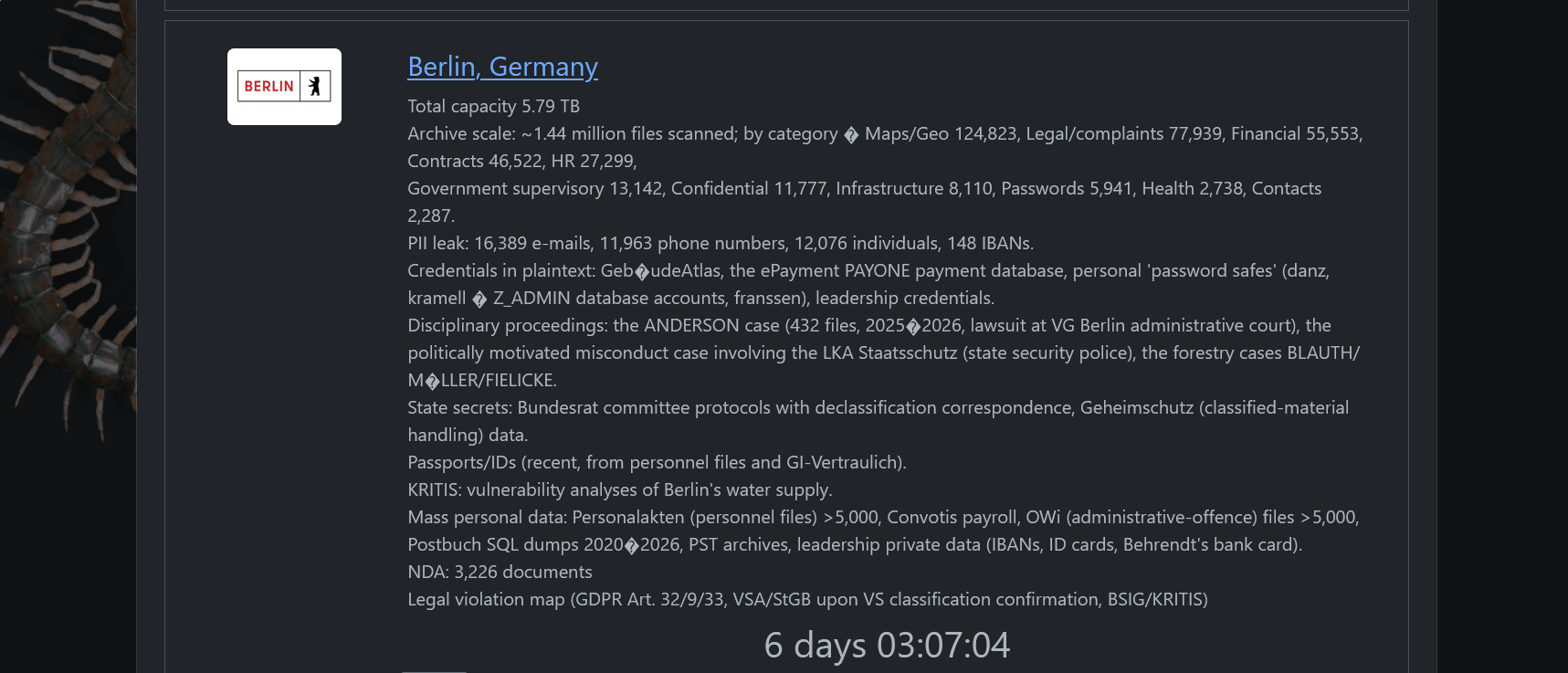
At the end of August, Berlin’s state government confirmed it was dealing with an extortion attempt following an August cyberattack on the city-state’s administrative network, and officials have already refused the requested ransom. The ransomware group Rhysida claimed responsibility on its leak site August 28, posting an entry titled simply “Berlin, Germany” and claiming 5.79 terabytes of data across roughly 1.44 million files, with personal information on 12,076 individuals allegedly included.

Rhysida claimed it stole 5.79 TB of data, covering around 1.44 million files. The alleged dataset includes:

  • Personal data: 12,076 individuals, 16,389 email addresses, 11,963 phone numbers and 148 IBANs.
  • Sensitive records: more than 5,000 personnel files, more than 5,000 administrative-offence files, payroll data and leadership information.
  • Credentials: plaintext passwords and credentials for systems including GebäudAtlas, the ePayment PAYONE database and Z_ADMIN accounts.
  • Government and legal material: disciplinary proceedings, court cases, supervisory documents, NDA records and Bundesrat committee protocols.
  • Classified information: data related to classified-material handling and documents allegedly containing state secrets.
  • Critical infrastructure: vulnerability analyses concerning Berlin’s water supply.
  • Identity documents: passports and ID cards from personnel records.
  • Other material: contracts, financial documents, HR records, infrastructure files, health data, password stores and SQL/PST archives.

The group also claimed that the material could involve violations of GDPR, German classified-information rules, criminal law and KRITIS/BSIG requirements. These are Rhysida’s claims and have not been independently verified.

The scale of the breach is staggering. Investigators are now looking at roughly 1.4 million files containing personal details of civil servants, internal infrastructure records, and critical government data.

The fallout goes far beyond routine data theft. Investigative journalist Lars Winkelsdorf pointed out the gravity of the situation on social media.

Die absolute Vollkatastrophe ist eingetreten

Dieses Datenleck ist schlimmer als alle bisherigen Terroranschläge zusammen 1/xhttps://t.co/epU4mCYgew

— Lars Winkelsdorf (@winkelsdorf) September 4, 2026

“In addition to LKA documents related to investigations, the files also include plans concerning national defense—ranging from the federal government’s secret communication channels in the event of an apocalypse to defense-related companies and emergency plans developed by government agencies,” Winkelsdorf wrote.

Exposing crisis response plans and secret communication channels turns a financial shakedown into a national security headache.

Worse still, the leaked material includes files concerning chemical, biological, radiological, and nuclear threats.

“Among the published files is a folder titled “AG CBRN-Rahmenplanung.” CBRN stands for chemical, biological, radiological and nuclear threats,” notes the Euronews report

Having that kind of operational data floating around public forums gives hostile actors a blueprint for disaster.

Refusing to pay ransoms is the right policy, but it rarely stops the bleeding once the network is compromised. Governments keep treating cybersecurity like an IT expense rather than an existential line of defense.

Until boards start treating network segmentation with the same seriousness as physical security, we will keep watching expensive countdown timers tick down to zero.

Berlin’s state government announced the launch of a crisis response after the threat actors published the stolen data.

“A ‌central ⁠crisis unit will oversee the review, verification and assessment of the leaked data and support efforts to inform affected citizens and ​businesses, said the ​city.” Reuters reports.

Follow me on Twitter: @securityaffairs and Facebook and Mastodon

Pierluigi Paganini

(SecurityAffairs – hacking, Berlin)

PaperCut Flaws Exploited in Attacks on U.S. and European Schools

Attackers are exploiting two new PaperCut flaws to steal credentials and gain privileged access in education-sector attacks across the U.S. and Europe.

Attackers are exploiting two recelty disclosed PaperCut flaws, CVE-2026-81578 and CVE-2026-82078, in attacks targeting schools and other education organizations in the U.S. and Europe, as reported by TheHackerNews.

Arctic Wolf researchers observed threat actors chaining an authentication bypass with remote code execution to run commands, perform reconnaissance and create privileged accounts. The activity shows how quickly attackers can turn newly disclosed vulnerabilities into real-world attacks, putting sensitive credentials and systems at risk.

“Arctic Wolf observed exploitation of PaperCut servers affected by CVE-2026-81578 and CVE-2026-82078 leading to command execution, reconnaissance, and attempts to create privileged accounts.” reads the advisory. “Observed post-exploitation activity included delivery of Windows registry hive collection tools, Metasploit/Meterpreter-related Java payloads, and commands used to identify hosts, users, processes, and sensitive configuration data.”

PaperCut, an enterprise print-management platform, has a history of exploitation, including attacks that delivered LockBit ransomware. PaperCut disclosed active exploitation of the latest flaws on August 27, 2026. CISA added both to its Known Exploited Vulnerabilities catalog on August 31.

Attackers used PaperCut flaws to run basic system checks, create a privileged account named Administrator17, and collect system and user data.

They downloaded credential-harvesting tools with certutil and used Meterpreter Java payloads to establish remote sessions. The attackers also searched PaperCut configuration files for passwords, secrets, LDAP settings and tokens.

Researchers observed lsa_collect.exe extracting registry keys to recover the Windows BootKey, which could give attackers access to the SAM database and stored credentials.

Defenders should review PaperCut server.log files for known exploitation indicators and look for unusual five-character .class, .cmd, or .out files. Monitor pc-app.exe for command shells such as cmd.exe and powershell.exe, and investigate commands like whoami, tasklist, ver, and uname.

Also check for credential-harvesting tools, unexpected privileged accounts such as Administrator17, suspicious requests to /custom/pcp_*.txt, and large downloads using python-requests.

Finally, keep PaperCut management interfaces off the public internet and install the vendor’s security fixes.

Follow me on Twitter: @securityaffairs and Facebook and Mastodon

Pierluigi Paganini

(SecurityAffairs – hacking, PaperCut)

Crooks Behind Manchester Airports Group Hack Leaked Data of 8.8 Million People

Manchester Airports Group (MAG) data allegedly leaked by FulcrumSec exposes emails and phone numbers of 8.8 million people.

Manchester Airports Group, which operates Manchester, London Stansted and East Midlands airports, has confirmed a data breach involving customer information held in a third-party database. The company says airport operations, passenger safety and aviation security were not affected, but the incident has exposed data that can make fraud far more convincing.

The data related to parking, lounge and Fast Track bookings, as well as airport Wi-Fi sign-ups. MAG said attackers took email addresses, phone numbers, vehicle registration details and postcodes, while payment-card data was not accessed.

The group disclosed the incident on 27 August and said it had contained the risk, engaged specialist advisers and notified relevant authorities.

The extortion group FulcrumSec claimed responsibility for the intrusion and leaked the data after MAG had refused its ransom demand.

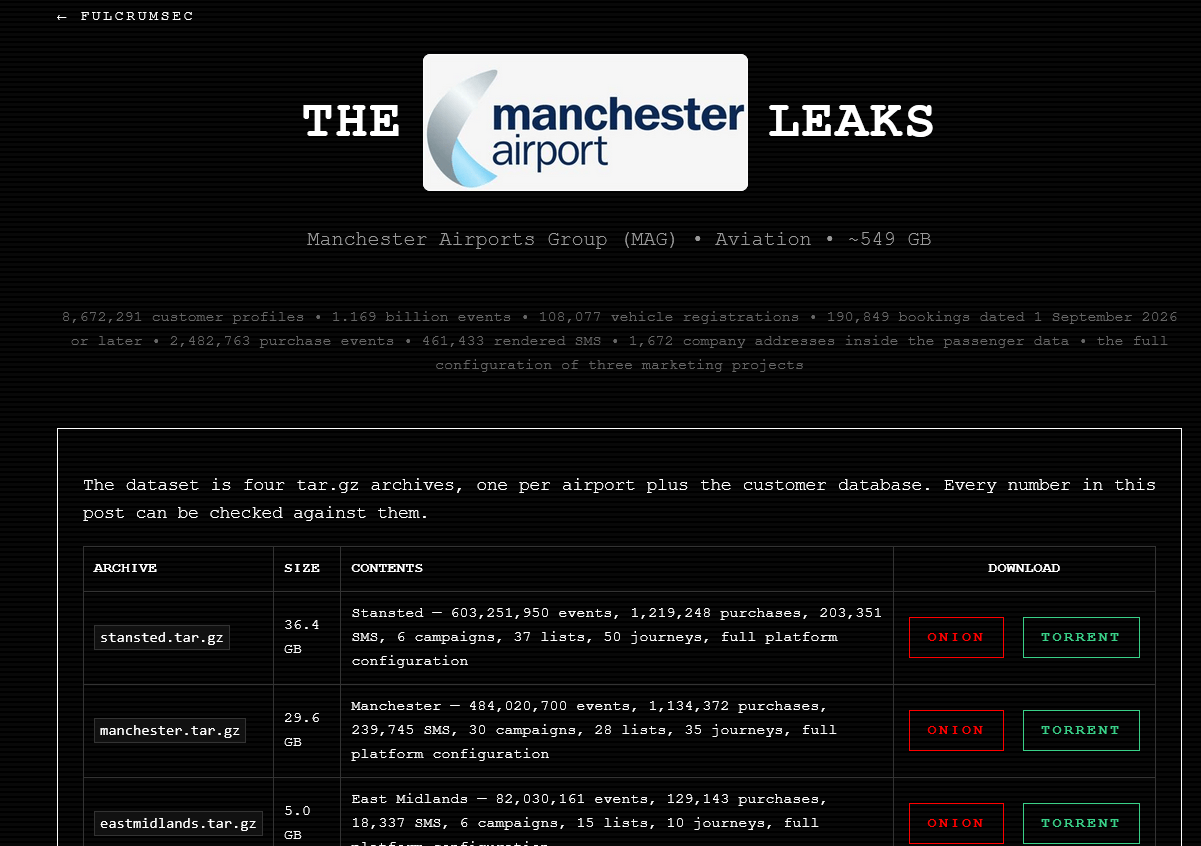
“Today we are releasing the Manchester Airports Group dataset: every customer, event, configuration that serves Manchester Airport, London Stansted and East Midlands Airport. Half a terabyte, and every byte of it is pure PII. However, we have decided to withhold the most dangerous part of the breach : the nearly 200,000 passengers whose entire upcoming travel schedules were exposed by MAG’s negligence, which, when linked with their full PII and vehicle information, creates an ideal opportunity for burglars, stalkers, and worse.” FulcrumSec wrote on its data leak site. “Unfortunately for them, MAG made zero effort to protect all their data they’d been collecting. The way we gained access was so simple it is tragi-comical: Iterable admin keys in the frontend JavaScript of each of its three airports’ websites: manchesterairport.co.uk, stanstedairport.com, and eastmidlandsairport.com. Each site had its own key hardcoded into it that provided access to millions of passengers who had passed through that airport. That means for this breach to have occurred at the scale it did, MAG had to make a catastrophic security mistake not once, not twice, but THREE times.”

FulcrumSec claims it accessed MAG’s systems using administrator keys exposed in the JavaScript of its three airport websites. MAG hasn’t confirmed this, and SecurityWeek hasn’t independently verified it, so the claim remains unproven. Still, the case highlights a basic security rule: keep secrets off client-side code, rotate them regularly, limit access and scan code, repositories, logs and configurations for accidental exposure.

The group then published roughly 550 GB of uncompressed data it says came from the airport operator’s systems.

“These exposed keys gave us access to the following:

  • 8,672,291 customer profiles with email, name, mobile, home town, postal region, and the residential IP address the account last connected from
  • 1,169,302,811 events, of which 1,160,120,195 are email-channel events: 611,629,550 sends, 463,286,223 opens, 36,878,965 clicks, plus every subscribe, unsubscribe, bounce and complaint
  • 2,482,763 purchases — every booking every customer of its parking, lounge, and fast-track products has ever made. An analysed subset of 1,154,675 transactions, from 877,754 identified purchasers, totals £83,413,317.89
  • 461,433 SMS messages rendered with a passenger’s booking date, car park and vehicle registration spelled out in plain text
  • 108,077 unique UK vehicle registration plates tied to the owner’s email, mobile, airport, car park and dated booking
  • The complete platform configuration: every campaign, every journey, every list, every segment and every template, all as live JSON” FulcrumSec added.

The announcement claims that a leaked MAG database exposes 190,849 future bookings, including 142,755 linked to vehicle registrations, potentially revealing when homes will be empty.

It also claims the data includes thousands of government, judicial, military, police, NHS and defence-industry employees, creating significant security risks. The attackers say they removed the most sensitive travel details before publishing, while accusing MAG of downplaying the breach.

Databreach notification service Have I Been Pwned processed the available dataset and added the incident to its breach database. The service reports that approximately 8.8 million email addresses and phone numbers were compromised, alongside names, IP addresses, browser user-agent details, geographic information, purchases and vehicle registration plates.

That is not just a list of email addresses. It is a working fraud kit: a criminal can link a person to an airport, a booking type, a car, a location and a contact number. They don’t need to guess much after that.

What affected people should do

Anyone who has used MAG’s parking, lounge, Fast Track or airport Wi-Fi services should assume that phishing attempts may become more tailored. They should be cautious with messages claiming to concern a booking, refund, parking penalty, account problem or payment request.

Users should change passwords if they reused one associated with these services elsewhere, especially on email accounts. They should also enable multi-factor authentication, review account-recovery methods and avoid clicking links in unexpected messages.

A legitimate organisation will not ask for a password, a banking PIN or a one-time authentication code by email, SMS or phone. If a message refers to a booking, open the relevant airport or provider site manually rather than following the link it contains.

The Have I Been Pwned breach entry allows users to check whether their email address appears in the published dataset.

Follow me on Twitter: @securityaffairs and Facebook and Mastodon

Pierluigi Paganini

(SecurityAffairs – hacking, Manchester Airports Group)

Dark Web Service Nexus Sells 153M+ Driver’s Licenses

FBI probes suspected breach at IDScan.net after dark web service Nexus offered 153M+ US and Canadian driver’s license scans.

A dark web identity theft service called Nexus appeared on September 1, 2026, offering searchable access to more than 153 million scanned driver’s licenses belonging to people in the United States and Canada.

The FBI’s New Orleans field office opened a formal investigation the same day. Brian Krebs at KrebsOnSecurity, who broke the story, traced the source to idscan.net, a New Orleans-based identity verification company whose clients include Hertz, Target, FedEx, Motorola Solutions, Caesars Entertainment, and the financial services firm Jack Henry.

“On Monday, Aug. 31, a source alerted KrebsOnSecurity to a service advertised by a new user on the Russian cybercrime forum Exploit, offering access to digital scans of identity documents on more than 170 million people in North America. The source brought it to my attention because the proprietor of this identity theft service offered my Virginia drivers license as a free sample in their initial sales thread on Exploit.” wrote Krebs. “The service, dubbed Nexus, claims to have more than 153 million drivers licenses for people in the United States and Canada, as well as more than 10 million identification cards; more than three million travel documents and/or international IDs; and at least 579,000 medical cards.”

The record total was also increasing by roughly 400,000 per day at the time of publication, which the operators attributed to ongoing active exfiltration from a live breach they claim has been running for over a year.

Krebs found his own driver’s license in the database after a source alerted him to the service. The operators had posted his Virginia license as a free sample on the Russian cybercrime forum Exploit. Each record contains six images of the license, showing the front and back in visible, infrared, and ultraviolet light, with a timestamp. Krebs’ timestamp matched a June 2025 flight and car rental.

He then checked nine friends and relatives, and everyone who found their license confirmed traveling or renting a car around the same date. His license and his mother’s, who rented a Hertz car with him that day, had timestamps just seconds apart.

Security researcher Zach Edwards, whose license also appeared in Nexus, narrowed the source further. His timestamp matched a trip to Las Vegas for DEF CON in August. He hadn’t rented a car, but he had shown his license at a marijuana dispensary: Planet13, a multi-state chain. In 2022, idscan.net published a press release announcing an exclusive identity verification partnership with Planet13’s dispensaries nationally. The company now serves more than 1,000 marijuana dispensaries in 19 states, and its own documentation confirms that its technology scans IDs with both infrared and ultraviolet light, precisely the format of the images appearing in Nexus.

Idscan.net performs more than 21 million verifications per month at more than 20,000 locations globally. Its client list spans car rentals, retailers, hotels, financial services, and dispensaries, which explains both the volume and the geographic spread of the records. The dataset also includes marijuana dispensary cards and records marked with the notation “CAC,” which may refer to Common Access Cards, the government-issued credentials used to enter federal buildings and secure facilities. If confirmed, that would significantly expand the security implications beyond consumer identity theft.

The database reportedly contained the driver’s licenses of U.S. Defense Secretary Pete Hegseth and the FBI’s assistant director, but not FBI Director Kash Patel’s.

Idscan.net said Krebs’ findings would help its internal investigation but gave no further details. The company later said it was working with law enforcement and forensic experts. Soon after the story became public, the Nexus service went offline.

Identity verification systems that require driver’s licenses are spreading sensitive data across an expanding network of third-party vendors, and oversight mechanisms haven’t kept pace. Every bar, hotel, car rental counter, dispensary, and age-verification system that scans an ID is creating a copy of that image in a system whose security posture the cardholder has no way to assess.

The idscan.net incident, if confirmed at the reported scale, would be among the largest exposures of government-issued identity document images ever recorded.

Krebs reports that Nexus shut down after his article, while the FBI opened an investigation after learning that stolen IDs may include licenses belonging to FBI agents.

Follow me on Twitter: @securityaffairs and Facebook and Mastodon

Pierluigi Paganini

(SecurityAffairs – hacking, Nexus)

412,000 The Town 2025 Ticket Buyers’ Data Hits the Dark Web

412,000 The Town 2025 festival buyer records are being sold for $10,000, with Brazil’s data openly marketed for bank fraud, loans and SIM registration.

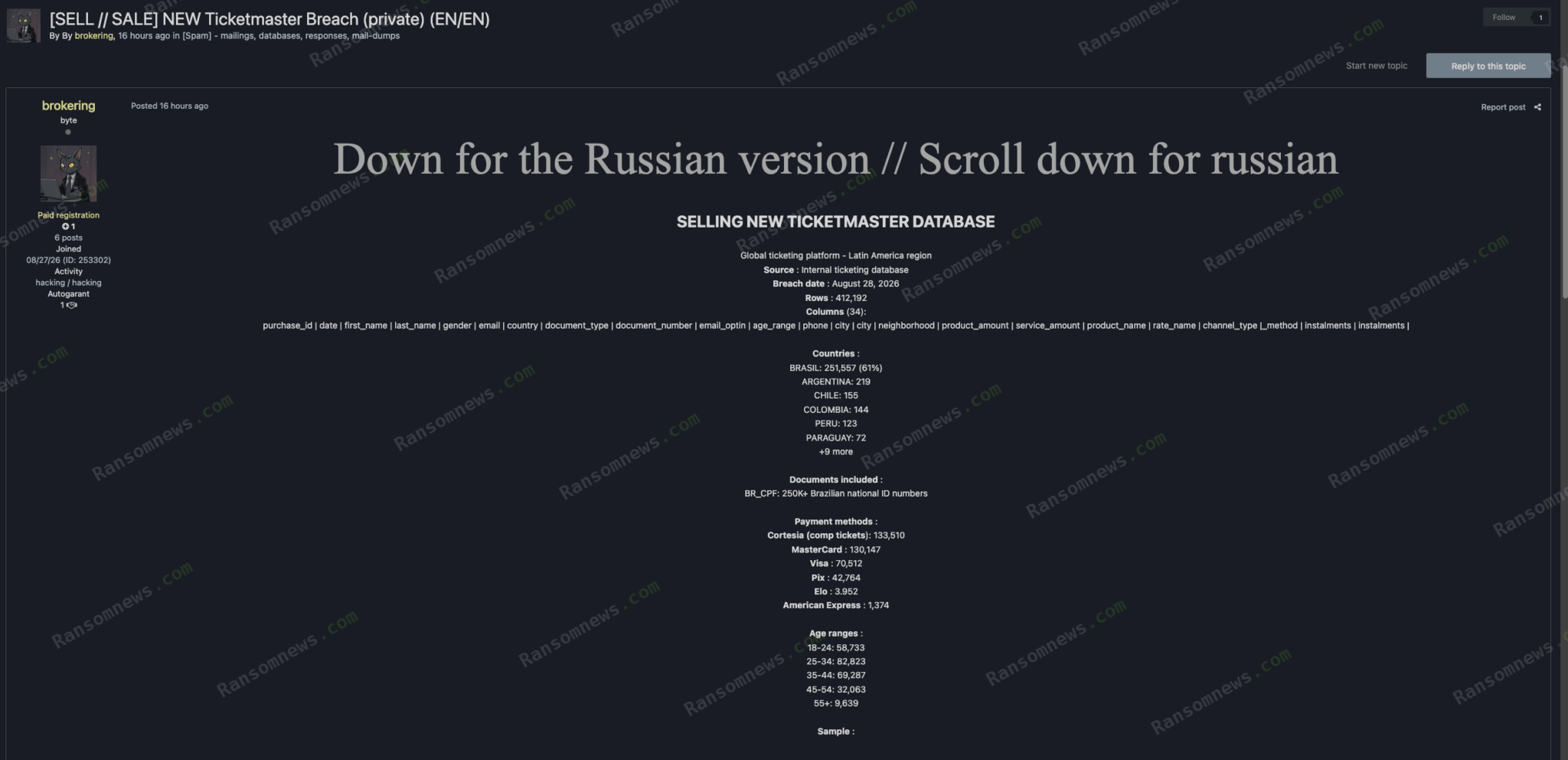
A seller on a Russian-language data-trading forum listed what they’re calling a Ticketmaster database on September 2, claiming over 412,000 Latin American purchase records with a heavy concentration of Brazilian data. Ransomnews’s analysis confirms the sample is genuine ticket-buyer data from The Town 2025, the São Paulo music festival, though who actually lost the data and how remains unconfirmed.

“The listing is headed “SELLING NEW TICKETMASTER DATABASE” and describes a global ticketing platform, Latin America region, with an internal ticketing database as the source and a breach date of 28 August 2026. It advertises 412,192 rows across 34 columns.” reported Ransomnews. “The country breakdown is dominated by Brazil at 251,557 records, or 61%, with Argentina at 219, Chile 155, Colombia 144, Peru 123 and Paraguay 72, plus nine more countries not itemised.”

The seller is asking $10,000 for the full database, or $80 for every 1,000 records, with escrow available. The 251,557 Brazilian records make up about 61% of the database, meaning the seller is effectively asking around four cents per person.

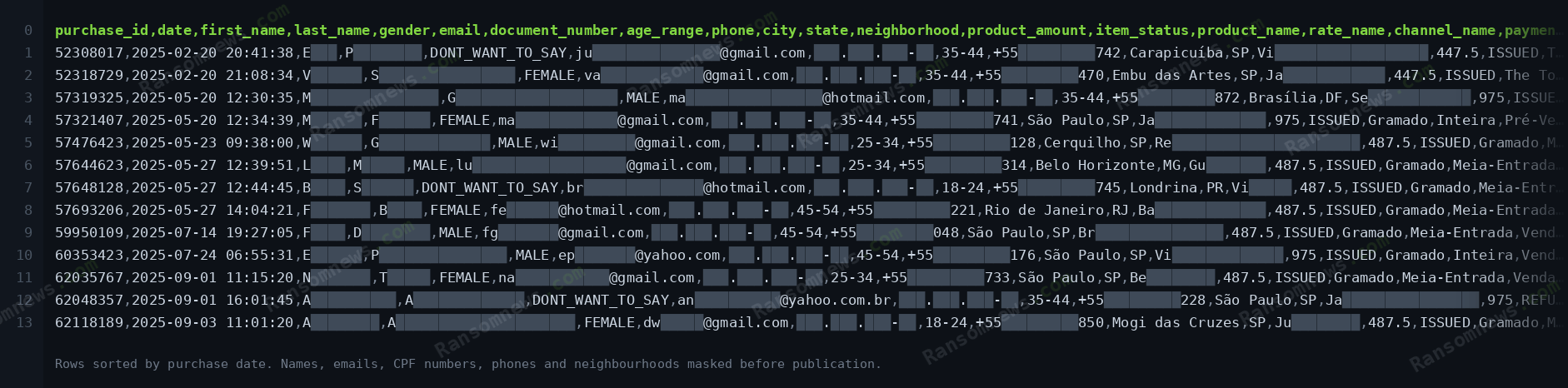
The data includes names, email addresses, CPF numbers, phone numbers, neighborhoods, ticket types, and payment details. Together, these details provide a detailed profile that could be used for identity theft and fraud.

“The seller’s own notes are the part that should concern Brazilian readers most. Alongside the sales copy, the listing states that the CPF numbers work “for Brazilian bank fraud, loan apps and SIM registration”.” continues the report.”That is not our characterisation of the risk. It is the seller describing the intended use of the file.”

Ransomnews ran the kind of checks that usually expose fake listings within minutes, and this one kept passing. Purchase IDs across the sample rise in strict chronological order, exactly what an auto-incrementing database key produces and something close to statistically impossible to fake by chance. Every CPF number in the sample passes Brazil’s official check-digit validation, phone area codes correctly match the state listed on each row rather than defaulting to a single city, and neighborhood names map precisely onto their stated cities, the kind of granular accuracy a random data generator simply doesn’t produce.

The ticket prices provide another strong sign that the database is genuine. Full-price tickets cost exactly 975 reais, while discounted tickets cost 487.50 reais, matching Brazil’s legal student discount. The database also lists Pix and Elo as payment methods, both widely used in Brazil.

Even the incomplete records look realistic. Complimentary tickets issued by the festival’s back office contain no name or CPF, only the ticket type and date. These kinds of inconsistencies are common in real databases but would be unusual in fabricated data.

However, there is an important detail that challenges the claim of a direct Ticketmaster breach. Every record in the sample has exactly the same processing timestamp: October 1, 2025 at 23:05:41, about two weeks after the festival ended.

A live database dump would normally contain different timestamps. The identical timestamp instead suggests that the data may have been exported in a single batch after the event and then shared with a promoter, sponsor, payment provider, or another partner. Ransomnews therefore warns that blaming Ticketmaster directly would go beyond what the available evidence currently shows.

That distinction matters more than it might seem, because it points at an industry-wide blind spot rather than one company’s failure. Brazilian ticketing requires CPF collection to enforce discount eligibility rules, which means live-events companies routinely end up holding a national identity number, a verified phone, and a home neighborhood for hundreds of thousands of people, data with the sensitivity of a bank record sitting inside an industry with nothing like a bank’s security requirements. The moment that data gets exported into a spreadsheet to reconcile ticket sales with a partner, which happens constantly and rarely makes headlines, it becomes dramatically easier to lose.

“If you bought tickets to The Town 2025, treat your CPF as exposed.” concludes the report. “A CPF cannot be reissued the way a password can, and the seller is explicitly marketing these numbers for credit and telecoms fraud.”

If you bought tickets to The Town 2025, the practical response here isn’t panic, it’s specific vigilance. A CPF can’t be reissued the way a password gets reset, so treat it as permanently exposed and check your credit record through Brazil’s Central Bank registry or services like Serasa for accounts you didn’t open. Watch closely for SIM swap attempts given the seller’s explicit mention of telecom fraud, and be skeptical of any inbound call or message referencing your actual festival purchase, since whoever holds this file knows exactly which days you attended and how you paid, more than enough detail to make a scam call sound completely legitimate.

Follow me on Twitter: @securityaffairs and Facebook and Mastodon

Pierluigi Paganini

(SecurityAffairs – hacking, The Town 2025)

Attackers Access Aesto Health AWS Infrastructure, Exposing 9.5 Million Records

Aesto Health suffered a breach exposing personal and health data of more than 9.5 million people after attackers accessed its AWS infrastructure.

Aesto Health, a U.S. healthcare technology company, disclosed a data breach that exposed personal and health information belonging to more than 9.5 million people. The company discovered the incident on December 18, 2025, after attackers gained access to part of its Amazon Web Services infrastructure.

Aesto Health is a U.S. healthcare technology company based in Birmingham, Alabama. It helps healthcare providers manage and protect electronic health records and other legacy medical data. Its services include secure data migration, electronic health record (EHR) exchanges and long-term data archiving. Aesto works with medical practices and healthcare organizations that need to move, store or access patient information securely.

“On or about December 18, 2025, Aesto experienced a network security incident that impacted a limited portion of our Amazon Web Services infrastructure.” reads the Notice of Data Security Incident. “After an extensive forensic investigation and manual document review, on May 26, 2026, we confirmed that between on or about December 2, 2025, and December 18, 2025, certain protected health information belonging to patients of various Covered Entity clients stored within Aesto’s network may have been accessed and/or acquired by an unauthorized actor.”

The company launched an investigation into the incident with external leading cybersecurity experts.

The network security incident affected part of its Amazon Web Services infrastructure between December 2 and 18, 2025. On May 26, 2026, Aesto confirmed that an unauthorized actor may have accessed or acquired protected health information stored in its network. Exposed data may include names, birth dates, medical and insurance information, driver’s license and government ID numbers, financial account details, taxpayer IDs and, for a limited number of people, Social Security numbers.

Aesto says it found no evidence of identity theft or financial fraud linked to the breach. Starting June 26, 2026, it notified affected healthcare clients whose patients’ data may have been accessed.

The company announced it has already implemented measures to strengthen security and set up a dedicated helpline for questions.

The healthcare firm also notified the US Department of Health and Human Services (HHS), reporting that the incident impacted 9540683 individuals.

Follow me on Twitter: @securityaffairs and Facebook and Mastodon

Pierluigi Paganini

(SecurityAffairs – hacking, Aesto Health)

Five Venezuelan Nationals Plead Guilty in Kansas ATM Jackpotting Attempt

Five Venezuelan nationals pleaded guilty after failed ATM jackpotting attempts in Kansas. The FBI recorded 700+ cases in 2025, causing $20M in losses.

Five Venezuelan nationals have pleaded guilty after trying to steal cash from ATMs in Kansas using the popular ATM jackpotting technique. The U.S. Department of Justice announced the case on August 31, following an FBI investigation that ended with the suspects’ arrests just days after the attempted thefts.

The case started in December 2025, when the five defendants traveled from Indiana to Kansas and targeted ATMs in Wamego and Manhattan. According to court documents cited by the DOJ, their plan was to install malware directly onto the machines and then remotely trigger the infected ATMs to dispense cash, which the group would collect afterward.

“The conspirators were unsuccessful in installing the malware on the ATM in Wamego, but their attempts at installing the malware triggered the alarm causing law enforcement to respond, and the culprits didn’t return to the site. In Manhattan, the group was equally unsuccessful in getting the ATM to dispense money. Both attempted thefts were captured by surveillance cameras, and the perpetrators were arrested a few days later.”

“According to court documents, Luis Alberto Velasquez-Artigas, 27, Royder Adrian Figuera-Perez, 29, Javier Mejia, Jr, 27, Gabriel Alexjandro Corales-Garcia, 33, and Italo Lizandro Corrales-Carrillo, 26, all pleaded guilty to one count of conspiracy to commit bank larceny.” reads DoJ.

The operation failed at both locations. In Wamego, attempts to install the malware triggered the ATM’s alarm, bringing law enforcement to the site and forcing the group to leave without completing the attack; in Manhattan, the criminals again failed to make the ATM dispense money. Surveillance cameras captured both attempts, and investigators arrested the suspects a few days later.

The DOJ identifies the five defendants as Luis Alberto Velasquez-Artigas, 27; Royder Adrian Figuera-Perez, 29; Javier Mejia Jr., 27; Gabriel Alexjandro Corales-Garcia, 33; and Italo Lizandro Corrales-Carrillo, 26. All pleaded guilty to one count of conspiracy to commit bank larceny. Velasquez-Artigas has already received a nine-month prison sentence, while the other four defendants are awaiting sentencing.

The important point for financial institutions is that jackpotting doesn’t depend on a customer using a stolen card or entering fraudulent credentials. Instead, criminals attack the ATM itself, using malware to take control of its cash-dispensing function. The FBI describes this as an emerging nationwide problem and says these attacks can allow criminals to steal cash without any legitimate transaction taking place.

The numbers help explain why federal authorities are paying attention. In a February 2026 FLASH, the FBI reported 1,900 ATM jackpotting incidents since 2020, including more than 700 in 2025 alone, with losses exceeding $20 million during that year.

The Kansas case also shows that jackpotting is not simply a software problem. The criminals needed physical access to the ATM to install the malware, but their plan then relied on remote activation to make the machine release the cash. That combination of physical intrusion and remote control makes jackpotting a hybrid security problem for banks.

The DOJ says the group specifically targeted ATMs they believed were more vulnerable to malware. That’s a relevant detail because it suggests some attackers may assess ATM technology before choosing their targets, rather than simply trying the technique against random machines.

That also explains why the U.S. Attorney’s Office is urging banks and other financial institutions to take preventive action. The advice is not limited to investigating theft after the fact. Authorities are asking institutions to invest in technology and security updates designed to prevent jackpotting attempts from succeeding in the first place.

For banks, the case is a reminder that ATM security now sits at the intersection of physical security, cybersecurity and fraud prevention. Protecting the customer account isn’t enough when the criminal’s objective is to compromise the machine and make it hand over the cash itself.

The FBI has made clear that it plans to continue working with financial institutions and law-enforcement partners to identify these schemes and strengthen defenses. The Kansas case shows that the attackers don’t need a successful cash-out to attract federal attention. In this case, the alarm went off before the ATM did its part.

“Jackpotting bandits are sweeping the nation. This particular group’s strategy was to specifically target ATMs they thought were by design more vulnerable to malware,” said U.S. Attorney Ryan A. Kriegshauser. “Fortunately, there is technology to help thwart jackpotting. We at the U.S. Attorney’s Office encourage banks and other financial institutions to invest in these updates, and we’re happy to answer questions about how to do so.”

Follow me on Twitter: @securityaffairs and Facebook and Mastodon

Pierluigi Paganini

(SecurityAffairs – hacking, ATM jackpotting)

1-15 August 2026 Cyber Attacks Timeline

Cyber crime dominated the first half of August 2026, driving 108 confirmed incidents in just fifteen days. Malware remained the attacker's weapon of choice, a third of breaches traced back to an exploited public-facing application, and Public Administration emerged as the hardest-hit sector.

ValleyRAT: When Legitimate Software Becomes a Malware Delivery Tool

ValleyRAT hides behind legitimate adware, using DLL sideloading to evade detection, steal data and give Silver Fox control of infected systems.

ValleyRAT doesn’t always need to disguise itself as a cracked game or a fake browser update. It can also hide behind something much more ordinary: an application that looks like adware and appears to serve a legitimate purpose.

Kaspersky’s latest analysis shows how this works. Researchers found a malicious installer that uses a modified version of QN Wallpaper, a legitimate Chinese desktop wallpaper application, to deliver the ValleyRAT backdoor while making the infection look like a normal software installation.

Researchers found a malicious installer that uses a modified version of QN Wallpaper, a legitimate Chinese desktop wallpaper application, to deliver the ValleyRAT backdoor while making the infection look like a normal software installation.

The interesting part is how the attackers make the first stages look harmless. The installer can present itself as software associated with DingTalk, Google Chrome or Tencent Meeting, depending on the filename, while quietly deploying the modified wallpaper application in the background.

That gives the victim something familiar to look at while the real work happens elsewhere. It’s a simple trick, but it removes one of the most obvious warning signs of a malware infection: the feeling that something unusual has just been installed.

Kaspersky originally received one of the samples because a customer wanted it classified as adware. An initial look at the file suggested exactly that, but suspicious network activity changed the picture and led researchers to examine the sample more closely. They found that the advertising component didn’t actually perform its supposed job. Instead, it started an infection chain that eventually loaded ValleyRAT.

“The original version of QN Wallpaper is genuine adware: on installation, it delivers bundled partner apps to the device and then displays ad banners to the user.” reads Kaspersky’s report. “In this case, however, the attackers use it to carry out DLL sideloading, a technique that allows malicious code to run under the guise of a signed process by way of a malicious DLL.”

That distinction matters because the attackers aren’t inventing a fake application from scratch. They’re abusing software that already looks legitimate and using its normal execution flow to load malicious code.

The technique is DLL sideloading. In simple terms, the attacker places a malicious DLL where a legitimate program expects to find a library, allowing the trusted application to load the attacker’s code.

Here, the relevant library is libcef.dll. QN Wallpaper and its companion process load that library when they start, giving the attackers a convenient place to execute their own code under the name of a legitimate application.

The installer also creates persistence and disables Windows Defender through the DisableAntiSpyware registry key before launching QnWallpaper.exe. That combination makes the infection considerably more serious than ordinary adware.

Once the malicious library runs, it checks whether the current user has administrator privileges. If necessary, it attempts to relaunch the process with elevated privileges before continuing with the next stage.

The actual ValleyRAT payload sits encrypted inside the infection chain. Depending on which legitimate process loads the malicious library, the backdoor comes from either a separate PeLoader file or resources embedded in libcef.dll.

The payloads use AES encryption and contain ValleyRAT as an encrypted DLL. Their configurations differ mainly in the command-and-control addresses they use, giving the operators more than one way to manage infected systems.

ValleyRAT then starts behaving like the backdoor it actually is. It reads its configuration, connects to its command-and-control infrastructure and prepares a range of functions that give an attacker control over the compromised machine.

The malware can collect keystrokes and clipboard contents, monitor the active window and gather detailed information about the infected system. That includes the hostname, IP addresses, Windows version, CPU information, available disk space, graphics adapter, language settings and other system details.

“The backdoor also has spyware functionality. While running, it tracks keystrokes and the currently focused window by using functions from the DirectInput8 library. It also captures clipboard contents.” continues the report. “All collected data is saved to a file on disk.”

The operator can also order the backdoor to take screenshots, reboot or shut down the machine, wipe logs, change its command-and-control addresses and download additional modules. ValleyRAT can retrieve those modules from either its own C2 infrastructure or a third-party address.

That last capability gives the attackers room to change what the malware does after the initial infection. They don’t need to put every capability into the first payload if they can download new components later.

The malware also takes steps to make itself harder to remove. Depending on its configuration, it can inject code into svchost.exe so that the backdoor restarts if someone stops it. It can also mark its own process as critical, meaning that terminating it can trigger a system crash.

That’s not subtle, but it’s effective. The malware is essentially telling the defender that killing the process isn’t supposed to be a clean operation.

Kaspersky says ValleyRAT can detect security and traffic-analysis tools, while the campaign has been detected over 100,000 times in 2026, affecting more than 1,500 users, mainly in China and India. The activity is linked to Silver Fox, focused on both espionage and financial gain.

In July 2026, Cato CTRL documented a SilverFox campaign targeting a Japanese industrial manufacturer. The attack chain adds two previously undocumented DLL-sideloading hosts, two kernel drivers not previously associated with SilverFox, and a dual-layer recovery architecture that keeps ValleyRAT running even if defenders terminate individual components.

That broader activity puts the Kaspersky finding into perspective. The adware campaign isn’t an isolated curiosity. It fits a larger pattern in which Silver Fox uses legitimate software, familiar brands and trusted execution paths to get malicious code onto Windows systems and keep it there.

For defenders, blocking a known ValleyRAT file is not enough because the real risk is how the malware gets executed. A legitimate-looking application, signed component or familiar installer can become part of a malicious chain. Antivirus exclusions can make the problem worse by creating blind spots.

“This case is a clear example of how adware and affiliate networks can turn out to be far more dangerous than they appear. ValleyRAT is a sophisticated backdoor capable of collecting sensitive data such as keystrokes and clipboard contents, taking screenshots, and delivering additional malicious modules.” concludes the report. “The attackers exploited a well-known adware application to run the backdoor under the guise of a signed process, which complicates detection.”

Kaspersky recommends clear rules for third-party software, security awareness and avoiding suspicious applications or exclusions simply because a program asks for them. The malware does not need to look dangerous; it only needs to look legitimate enough that nobody questions why an ordinary application suddenly behaves like a backdoor.

Follow me on Twitter: @securityaffairs and Facebook and Mastodon

Pierluigi Paganini

(SecurityAffairs – hacking, newsletter)

Extortion Group FulcrumSec Claims 86GB Manchester Airports Group Data Theft

Extortion group FulcrumSec claims they stole 86GB of Manchester Airports Group data after finding API credentials exposed in client-side JavaScript.

Manchester Airports Group (MAG) disclosed a data breach on August 27 affecting customers of Manchester, London Stansted, and East Midlands airports. Two days later, BleepingComputer reports the extortion group FulcrumSec claimed responsibility, saying it stole roughly 86GB of data, considerably more detailed than what MAG’s original disclosure suggested.

MAG’s own statement describes a relatively limited set of exposed data. It says the breach affected car park, lounge, Fast Track bookings, and airport WiFi registrations, exposing email addresses, phone numbers, vehicle registrations, and postcodes.

MAG disclosed that the data breach impacted 8.7 million customers, however, the company says most of those customers had only their email addresses exposed.

FulcrumSec tells a different story. The group shared samples with BleepingComputer that included a 21.5GB export of Manchester customer data, with personal identifiers, historical booking details, and marketing information. BleepingComputer checked one record against a real traveler’s purchase history and found matching Fast Track bookings, arrival times, terminal information, and payment amounts.

The alleged way into the system is particularly concerning. FulcrumSec says it found airport-specific Iterable API credentials inside client-side JavaScript. That code runs in users’ browsers, so anyone inspecting the website with developer tools could potentially see those credentials.

“The group claims it obtained access using airport-specific Iterable API credentials exposed in client-side JavaScript and that the stolen material includes nearly 200,000 records related to upcoming travel during the remainder of 2026.” states the report. These records allegedly contain dates, times and booking information linked to personally identifiable information. FulcrumSec says it intends to publish the stolen data and a technical account of the intrusion. If the claim is accurate, attackers did not need a highly sophisticated technique. They simply found sensitive API credentials exposed in code that the website sent directly to customers’ browsers.”

The most concerning specific claim is nearly 200,000 records tied to upcoming travel through the rest of 2026, complete with dates, times, and booking details linked to identifiable individuals. BleepingComputer couldn’t independently verify that number or the full scope of what was actually taken, and MAG declined to directly address FulcrumSec’s specific claims when asked, instead pointing to its existing statement that affected customers with upcoming bookings had already been contacted. MAG is confident that we have taken effective measures to protect our customers and we have contacted all those affected, a spokesperson said, without engaging with the 86GB figure or the exposed-credentials claim directly.

FulcrumSec plans to publish the stolen data but may redact upcoming travel records because of the risk of real-world harm. UK postcodes can identify very small groups of addresses, and combined with vehicle registrations, parking dates and booking details, the data could enable highly convincing phishing messages targeting people with upcoming trips.

UK postcodes make this exposure sharper than the equivalent breach might be in the US. Unlike American ZIP codes covering broad delivery areas, a full UK postcode typically identifies a small cluster of neighboring addresses, sometimes a single property, according to the Office for National Statistics. Combined with vehicle registrations, parking dates, and specific booking references, that’s more than enough raw material for a phishing message referencing a real upcoming trip that would be very hard to distinguish from a genuine MAG communication.

Security researchers commenting on the broader incident have flagged a supply-chain angle worth watching. Airport operations increasingly run through third-party platforms for booking, parking, and loyalty services rather than systems the airport itself directly controls, and Iterable, the marketing platform whose API credentials FulcrumSec claims to have abused, is exactly that kind of outsourced dependency. This also isn’t aviation’s first bad year: a September 2025 ransomware attack on Collins Aerospace‘s check-in software had already grounded systems at Heathrow, Brussels, and Berlin, meaning UK and European aviation infrastructure has now taken two significant hits inside twelve months.

MAG says no payment card or banking data was exposed, however, travelers who recently booked parking, lounge access or Fast Track should assume more travel data may be exposed and treat messages citing real booking details with caution.

Follow me on Twitter: @securityaffairs and Facebook and Mastodon

Pierluigi Paganini

(SecurityAffairs – hacking, Manchester Airports Group (MAG))

Rhysida Ransomware Group Targets Berlin Government Ahead of Vote

Berlin ‘s government faces a Rhysida ransomware attack weeks before elections, with officials refusing to pay despite a claimed 5.79 TB data theft.

Berlin’s state government confirmed this week it’s dealing with an extortion attempt following an August cyberattack on the city-state’s administrative network, and officials have already refused the requested ransom. The ransomware group Rhysida claimed responsibility on its leak site August 28, posting an entry titled simply “Berlin, Germany” and claiming 5.79 terabytes of data across roughly 1.44 million files, with personal information on 12,076 individuals allegedly included.

Rhysida claims it stole 5.79 TB of data, covering around 1.44 million files. The alleged dataset includes:

  • Personal data: 12,076 individuals, 16,389 email addresses, 11,963 phone numbers and 148 IBANs.
  • Sensitive records: more than 5,000 personnel files, more than 5,000 administrative-offence files, payroll data and leadership information.
  • Credentials: plaintext passwords and credentials for systems including GebäudAtlas, the ePayment PAYONE database and Z_ADMIN accounts.
  • Government and legal material: disciplinary proceedings, court cases, supervisory documents, NDA records and Bundesrat committee protocols.
  • Classified information: data related to classified-material handling and documents allegedly containing state secrets.
  • Critical infrastructure: vulnerability analyses concerning Berlin’s water supply.
  • Identity documents: passports and ID cards from personnel records.
  • Other material: contracts, financial documents, HR records, infrastructure files, health data, password stores and SQL/PST archives.

The group also claims that the material could involve violations of GDPR, German classified-information rules, criminal law and KRITIS/BSIG requirements. These are Rhysida’s claims and have not been independently verified.

The timing makes this attack especially sensitive. Berlin will elect its state parliament on September 20, less than a month after the breach, so an attack on government systems just before the vote was bound to raise questions. Interior Senator Iris Spranger said the election remains secure and that, so far, the attackers haven’t taken any election-related data. Security officials support that assessment.

Broadcaster RBB first reported on Thursday that Berlin had received ransom demands.

“The state ​of Berlin will not submit to extortion,” Berlin Mayor Kai Wegner and Berlin’s interior senator, ​Iris Spranger, said in a joint statement on Friday, before the ransomware group claimed the attack ‌on ⁠their Tor data leak site.

That position follows long-standing advice from US federal agencies, which warn that paying a ransom doesn’t guarantee data recovery and can encourage more attacks. Saying no to the ransom is one thing; dealing with the consequences if the attackers publish the stolen data is another.

Berlin first disclosed the compromise on August 17, isolating the Senate Department for Mobility, Transport, Climate Protection and Environment along with a second department from the network. Forensic investigators later found the actual data exfiltration happened earlier than the public disclosure, sometime between August 7 and August 12, with the affected department having flagged an initial outflow internally on August 7, a full week before the network got cut off. That gap between first internal detection and actual network isolation is the kind of detail that tends to get scrutinized hardest once the immediate crisis passes.

Rhysida isn’t a new name to anyone tracking ransomware against government targets. The group has claimed roughly 280 victims since emerging in 2023, according to tracking services cited by Reuters, including nine in Germany alone and headline targets like the British Library and Chile’s army. Roughly half its victims sit in the US, with the UK, Canada, and Italy rounding out the next tier, a spread that suggests Rhysida isn’t picking targets based on geography so much as opportunity.

A joint advisory from CISA, the FBI, and the Multi-State Information Sharing and Analysis Center, first published in November 2023, lays out exactly how Rhysida typically gets in: compromised VPN credentials at organizations without multi-factor authentication, exploitation of the Zerologon vulnerability that Microsoft patched back in 2020, and old-fashioned phishing. None of those entry points are exotic or new, which is precisely the point; Rhysida doesn’t need novel techniques when so many organizations still haven’t closed gaps that have been publicly known for years.

Berlin reconnected all Senate departments to the network on August 23, but forensic teams are still checking the systems. The state’s data protection commissioner and Germany’s federal cybersecurity agency, the BSI, are following the investigation.

As of publication, neither Berlin’s data protection office nor the Senate Chancellery had given specific advice to the roughly 12,000 people whose data Rhysida claims to have stolen. If you’re among them and haven’t received any official message yet, don’t assume that means you’re safe. Investigators are still working to establish exactly what the attackers accessed and took.

Follow me on Twitter: @securityaffairs and Facebook and Mastodon

Pierluigi Paganini

(SecurityAffairs – hacking, Rhysida Ransomware)

Love Electric Breach: 877,000 Driver Records Offered for $600

Love Electric’s alleged data breach exposes sensitive driver data and highlights the identity risks created by third-party salary sacrifice providers.

A seller on an English-language data-breach forum claimed on August 26 that they had obtained the driver database of Love Electric, a UK broker that runs electric-vehicle salary sacrifice schemes. The seller, operating under the name “seraphims”, offered 877,000 records for $600 in cryptocurrency, with the price negotiable.

That headline number needs a qualification. Ransomnews researchers examined a 999-row sample published with the listing and found strong evidence that the sample came from a genuine production database, but the claimed 877,000 records remain unverified. Love Electric had been contacted for comment at the time of publication.

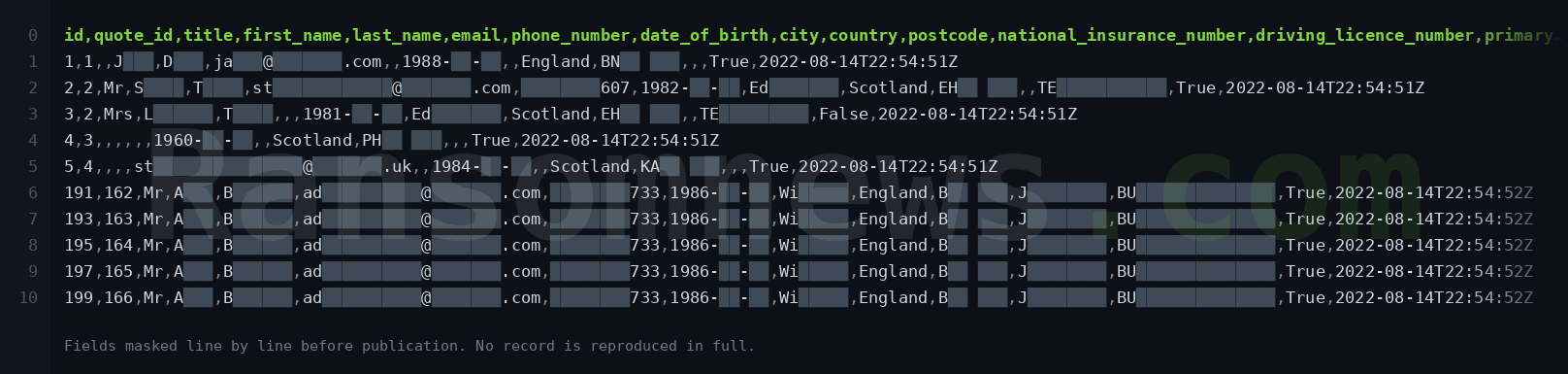
“The 999 rows split into 731 primary drivers and 268 additional named drivers. There are exactly 731 distinct quote IDs, and every quote has exactly one primary driver, 731 out of 731. All 268 additional drivers reference a quote that exists in the file, with no orphans.” reads the Ransomnews’s report. “The consent flag governing National Insurance processing is empty for precisely the 268 additional drivers and populated for every one of the 731 primary drivers. National Insurance numbers appear on primary drivers only. Those are constraints enforced by whatever application wrote the data, and they hold across all 999 rows without exception.”

That matters because fabricated breach databases often fall apart when researchers examine the relationships between records. Here, the relationships hold: additional drivers point to existing quotes, the National Insurance processing flag appears where the underlying application logic would expect it, and National Insurance numbers appear only on primary drivers.

Love Electric Financial Services Limited is an Edinburgh-based company that provides EV salary sacrifice administration, credit broking and related services to employers across the UK. Companies House identifies it as an active Scottish company, registered under number SC374952, while Love Electric’s own documentation confirms that it operates as a salary sacrifice administrator and FCA-regulated credit broker.

The business model explains why its systems can contain information that many people would normally associate with payroll departments. Salary sacrifice arrangements require the broker to identify employees, process the scheme and support insurance and tax-related requirements, so the underlying records can include National Insurance numbers and driving licence information. Love Electric’s privacy policy also says it processes personal information under UK data protection law.

“The seller published a free sample as a 999-row CSV with 24 columns, named in a way that indicates an export of a dbo.drivers table from a Microsoft SQL Server database.” continues the report. “The columns are: id, quote_id, user_id, title, first_name, last_name, email, phone_number, date_of_birth, address, address2, city, country, postcode, national_insurance_number, driving_licence_number, driving_licence_country, allow_processing_national_insurance, primary, created_at, updated_at, deleted_at, weekly_hours and occupation_id.”

The fields included names, email addresses, phone numbers, dates of birth, addresses, postcodes, National Insurance numbers, driving licence numbers, quote IDs and consent-related fields.

The data wasn’t uniformly populated, which is another reason the sample looks like a real production export rather than a synthetic dataset. Around 71% of the rows lacked a name, address or city, 74% had no phone number, and 85% had no National Insurance number, while 147 records contained a National Insurance number and 287 contained a driving licence number.

The geography also made sense. Postcodes clustered around Edinburgh and central Scotland, with records extending into England, while dates of birth ranged from 1946 to 1999 and concentrated around people born in the 1970s and 1980s.

Ransomnews then tested the driving licence numbers against the structure used by UK licences. Of the 108 full-length licence numbers in the sample, 98.1% had a surname block matching the surname in the corresponding record, 97.2% had an initial matching the first name, and 78.7% contained a date-of-birth encoding that matched the stored date of birth.

The imperfections were just as interesting. Licence numbers appeared in many different lengths, only 53% of the National Insurance numbers present matched the expected HMRC format, and phone numbers appeared in three different formats. That kind of mess is exactly what you’d expect from users entering information into a live form, abandoning fields or making mistakes.

“A UK driving licence number is not random. Characters one to five are the holder’s surname padded with the digit 9, characters six to eleven encode the date of birth with 50 added to the month for female holders, and character twelve is the first-name initial. Of the 108 full-length licence numbers in the sample, 98.1% have a surname block matching the record’s own surname field and 97.2% have an initial matching the first-name field. 78.7% carry an encoded date of birth matching the date_of_birth column.” state the researchers. “The roughly one in five that disagree are consistent with people mistyping a sixteen-character string into a web form, which is exactly the error rate real self-reported data carries and synthetic data does not.”

The email addresses provided another useful check. Most belonged to corporate domains associated with identifiable UK employers, Love Electric itself or a European software consultancy, rather than being dominated by Gmail and other consumer providers. That fits the way workplace salary sacrifice schemes operate because employees generally enter through their employer.

The database structure also looked normal. It included a soft-delete field, integer foreign keys for quotes and occupations, regional values for Scotland, England, Wales and Northern Ireland, and even a Jane Doe test record that appears to have survived from the system’s setup. Real databases leave fingerprints like these. Synthetic ones tend to be suspiciously tidy.

The seller’s own history is less convincing than the database evidence. The “seraphims” account was created on July 22, 2026 and had published nine data listings by August 26, roughly two per week, but several of those listings were described by the seller as scrapes rather than breaches.

The Love Electric listing had attracted no replies and only 52 views when Ransomnews checked it. The account’s reputation score of 30 came from a single positive vote posted on August 17 with the comment “keep scrapping”, which says more about the seller’s scraping activity than about a track record of selling verified breach data.

That doesn’t make the Love Electric sample fake. The technical evidence points in the opposite direction. It does mean we should separate two questions: whether the sample appears genuine, and whether the seller really controls 877,000 records.

The second claim is much harder to establish. Ransomnews saw only 0.11% of the alleged dataset, and the sample shows that database rows don’t map directly to individual people. The 999 rows corresponded to 731 quotes and only 58 distinct surname-and-date-of-birth combinations, with one person appearing 48 times.

There’s another clue in the filename. The db2_ prefix suggests that the table may belong to one database among several, so the seller’s 877,000 figure could refer to a larger collection rather than this particular driver table. At this point, treating 877,000 as a confirmed number would go beyond the evidence.

The timeline also deserves caution. The seller claimed an August 2026 attack involving a zero-day in a third-party system, but every sample row carries a created_at timestamp within a six-second window on August 14, 2022. That pattern looks like a bulk migration into a newer platform rather than 999 people signing up within six seconds.

It tells us that the database contains legacy records. It doesn’t tell us when someone took them, how they obtained them or whether the seller’s claimed zero-day played any role.

That last point matters for incident response. “Third-party zero-day” is a claim made by the seller, not an established fact, and attackers have plenty of reasons to make an access story sound more sophisticated than it was. Ransomnews says it has not verified that route.

For the people potentially affected, the more immediate issue is the nature of the exposed information. A password can be replaced. A National Insurance number and a driving licence number can’t simply be rotated because someone has posted them for sale.

That creates an obvious phishing risk. Someone who has a person’s name, date of birth, address, employer and National Insurance number can construct a much more convincing message pretending to be HMRC, a payroll team, an employer or a vehicle leasing provider.

Drivers who used Love Electric should therefore treat unexpected messages about their vehicle scheme, payroll or tax affairs with suspicion. They should verify the sender through a phone number or website they already trust rather than using contact details contained in the message.

Love Electric’s current public material says it works with more than 1,500 companies, which gives some sense of the scale of the service’s employer-facing footprint.

That makes supplier security worth treating as an operational issue rather than a procurement checkbox. If a third-party provider holds National Insurance numbers, driving licence numbers, employment information and contact data, its security controls deserve the same level of scrutiny as any other system handling high-value identity information.

The seller’s alleged third-party entry point is therefore worth investigating, but it shouldn’t become the centre of the story before someone verifies it. The useful evidence is already sitting in the sample: a production-style schema, consistent relationships, realistic user errors and identifiers that line up with real-world records.

The other important detail is the price. $600 for a database containing National Insurance and driving licence numbers isn’t a serious valuation of the data. It’s a price designed to make a quick sale.

And if the seller really has more than the published sample, multiple buyers could obtain the same information. That’s where the risk gets worse: the exposure doesn’t end with the first person who downloads it.

Ransomnews says it did not access or probe Love Electric’s systems, purchase the full dataset, or validate the exposed identifiers against live services. It analysed the free sample, removed identifying information from its publication and notified Love Electric before publication, offering to share the listing and sample with the company’s incident-response team.

Follow me on Twitter: @securityaffairs and Facebook and Mastodon

Pierluigi Paganini

(SecurityAffairs – hacking, data breach)

Australian Police Charge Two Over TeamPCP Credential Theft

Australian police charged two men linked to TeamPCP over malware hidden in open-source code that stole 500,000+ credentials from 1,000+ organizations.

Australian police have charged two men from Western Australia over a global cybercrime operation that allegedly hid malicious code in open-source software and used it to steal data from thousands of organisations.

“Two West Australian men have been charged following a joint investigation between the AFP and Western Australia Police Force (WAPF), working in parallel with the Federal Bureau of Investigation (FBI), into a sophisticated cybercrime syndicate that allegedly created malicious open-source software to rob thousands of global businesses.” states AFP. “The AFP charged the men yesterday (26 August, 2026) with a combined total of 14 offences after executing search warrants in Perth with WAPF, and the assistance of the FBI.”

The Australian Federal Police, the Western Australia Police Force and the FBI executed search warrants in Perth on 26 August 2026 and arrested a 21-year-old from Cottesloe and a 23-year-old from Mandurah. They face a combined total of 14 charges covering unauthorised data modification, possession and supply of data for computer offences, and dealing with proceeds of crime.

Police say the pair were principal participants in a syndicate known as TeamPCP, which allegedly inserted malicious code into software hosted on public repositories and then let other developers pull it in without knowing. Infected components ended up in systems across government, academia and the private sector, giving the group a way to steal credentials and other sensitive material at scale.

“Parallel investigations started in April, 2026, after the AFP and FBI received information from multiple cyber threat assessment companies regarding a syndicate that allegedly inserted malicious code into software available on an open-source repository, which was then unwittingly used by other developers.” continues AFP. “Police will allege infected software was then distributed into computer systems at other organisations across government, academia and the private sector. The software allegedly enabled the syndicate to infiltrate those organisations to steal or harvest sensitive data, including user credentials and authentication materials.”

The numbers are not small. Investigators estimate the malicious code potentially compromised more than 1,000 organisations worldwide, enabling the theft of over 500,000 credentials and the exfiltration of at least 300 gigabytes of data. Remediation costs so far run into the hundreds of millions of dollars.

TeamPCP is behind multiple supply chain attacks, in the past, they targeted PyPI packages and NPM repositories, and most recently the “Mini Shai-Hulud” campaign also caught two OpenAI employees. The pattern is consistent: go after the tools developers trust, poison the supply chain, and let the downstream damage multiply.

The confirmed list of modified tools includes Trivy, a widely used container vulnerability scanner; KICS, a static analysis tool for infrastructure-as-code; LiteLLM, a popular library for routing requests across AI model APIs; and the Telnyx Python SDK.

These aren’t niche utilities. They’re commonly integrated into enterprise CI/CD pipelines, cloud infrastructure workflows, and security scanning processes. Hitting them means hitting a large number of organizations simultaneously through a single poisoned update.

The group also deployed four distinct malware families. CanisterWorm harvested cloud access tokens, credentials, and API keys for AWS, GCP, and Azure. SANDCLOCK extracted AWS credentials, Kubernetes ServiceAccount tokens, local environment variables, and cryptocurrency wallet data. Mini Shai-Hulud was a self-replicating worm designed to spread across both npm and PyPI registries. Miasma was a variant of Mini Shai-Hulud that propagated across those same open-source registries while harvesting credentials and poisoning configuration files.

The worm component is the part that deserves particular attention. Mini Shai-Hulud and its Miasma variant didn’t just infect the initial target and stop. They spread across open-source package registries autonomously, harvesting credentials and poisoning configuration files as they went. The FBI confirmed two GitHub repository names used for exfiltration: tpcp-docs and docs-tpcp. If either of those repository names appears in your GitHub organization, the worm created it using stolen credentials.

TeamPCP’s method was straightforward and effective: inject malicious code into legitimate software packages, push the trojanized versions through normal distribution channels, and wait for CI/CD pipelines to pull them in automatically. The modified tools installed credential-stealing malware and persistent backdoors without any visible sign that anything had changed.

“These men are allegedly members of the cybercriminal group TeamPCP, whose malicious code potentially compromised more than a thousand organizations worldwide,” Assistant Director Leatherman said.

“We are proud to work with the Australian Federal Police and the Western Australia Police Force to impose cost on criminal actors and combat the growing threat of software supply-chain attacks.”

The charges show how serious the alleged operation was. The 21-year-old faces several charges, including changing data without authorization, possessing and supplying data for computer crimes, failing to comply with a production order, and handling at least A$100,000 in criminal proceeds. The 23-year-old faces similar hacking charges, with maximum penalties ranging from three to 20 years.

Police seized electronic devices and other items from properties in Cottesloe, Hamilton Hill and Mandurah. Investigators are now examining a large amount of data and have not ruled out further arrests or charges.

Follow me on Twitter: @securityaffairs and Facebook and Mastodon

Pierluigi Paganini

(SecurityAffairs – hacking, newsletter)

Operation Jackal: 58 Arrests Expose the Money Laundering Machine Behind Global Scams

INTERPOL’s Operation Jackal IV made 58 arrests and exposed global networks laundering money from scams, fraud and sextortion.

INTERPOL announced that Operation Jackal IV, running from November 2025 to June 2026, led to 58 arrests and identified 263 suspects tied to West African organized crime networks, groups like Black Axe that are responsible for a huge share of the world’s romance scams, crypto fraud, and business email compromise (BEC) schemes.

“Operation Jackal IV (November 2025 – June 2026) aimed to disrupt money laundering, identify high-value targets, seize assets, and support arrests and prosecution.” Interpol announced. “The operation, which brought together 22 countries from six continents, is a response to the escalating global threat posed by West African criminal networks – such as the Black Axe and other similar groups. These groups are responsible for a significant share of the world’s cyber-enabled financial fraud, typically through romance scams, cryptocurrency and investment scams or business email compromise fraud, as well as other serious and violent crimes.”

The goal wasn’t to chase individual scammers. Investigators followed the money behind the scams: shell companies, mule accounts and criminal services that help move and hide stolen funds. Tomonobu Kaya of INTERPOL’s Financial Crime and Anti-Corruption Centre explained the approach: By following illicit financial flows across borders, we are attacking the very lifeblood of organized crime.

Argentina turned up one of the operation’s biggest finds. Investigators identified 196 individuals connected to a crime-as-a-service network suspected of supplying website domains and laundering support specifically for West African criminal groups, resulting in 17 arrests. INTERPOL sent an Operational Support Team to help analyze seized data and map out the wider network of suspects, the kind of cross-border analytical work that individual national police forces usually can’t pull off on their own.

South African authorities raided seven locations in Johannesburg linked to a group running romance and investment scams against retirees in English-speaking countries.

The syndicate assigned members to specific roles, such as “conversion” and “retention” agents. The operation led to 39 arrests, $2.67 million seized and 257 bank accounts frozen, the largest number of arrests in the operation.

Italy’s case shows how much damage a single laundering account can absorb. One individual was tied to a pan-European laundering network moving money through shell companies and remittance services, and investigators traced €845,000 laundered through a single account across 560 separate transactions using 20 different financial instruments. That’s not a careless operator; that’s someone who understood exactly how to fragment a large sum into a pattern designed to look unremarkable at every individual step.

Romania’s case was the biggest by dollar value, and arguably the most brutal in its simplicity. A call center ran a fake investment scheme promising big returns on stocks and crypto, funneling victims’ money into wallets the operators controlled, and by the time authorities dismantled it, the estimated theft and laundering total had climbed to around €143 million globally. Eleven arrests and roughly €379,000 in cash and crypto seized, plus six properties and several luxury watches, is a real result, but it’s a fraction of what actually got stolen.

“Beyond individual cases, Operation Jackal IV also enabled the analysis of critical and emerging trends, including a rise in West African organized crime groups using sextortion to target minors, with victims as young as 14. Offenders typically contact minors via social media, build trust and coerce them into sharing explicit images or videos.” concludes INTERPOL. “They then threaten to distribute this material to the victim’s contacts unless a ransom is paid.”

The report’s darkest finding sits outside any single country’s arrest count. INTERPOL flagged a rising trend of these same criminal networks using sextortion against minors as young as 14, building trust through social media before coercing victims into sharing explicit images and then threatening to distribute that material unless a ransom gets paid. Some of these groups were even observed buying crime-as-a-service support through the dark web specifically to outsource pieces of that operation, treating exploitation infrastructure as just another service line alongside laundering and fraud.

That’s the uncomfortable throughline connecting every case here: these aren’t scattered opportunists, they’re networks running organized business models with specialized roles, outsourced services, and financial engineering sophisticated enough to move hundreds of millions across borders. Twenty-two countries coordinating for eight months produced real numbers, real arrests, real frozen accounts. It also produced a fairly clear picture of how much more organized this side of cybercrime has become, and how much further there is to go.

Follow me on Twitter: @securityaffairs and Facebook and Mastodon

Pierluigi Paganini

(SecurityAffairs – hacking, Operation Jackal)

Fake Minecraft Sites Are Still Spreading WeedHack After C2 Takedown

WeedHack Minecraft Malware Survives C2 Takedown: Fake Client Sites Still Active, SEO Poisoning Puts Malicious Downloads at the Top of Google

McAfee Labs published a follow-up report on the WeedHack Malware-as-a-Service campaign this week, documenting ten active malicious sites and multiple file-hosting accounts that are still spreading the infostealer despite a disruption to its command-and-control infrastructure. Over the past month alone, McAfee WebAdvisor blocked more than 6,300 user attempts to reach these sites.

WeedHack was first spotted in early June 2026 when McAfee researcher Aayush Tyagi documented a Malware-as-a-Service operation that had been running since January and had logged 116,464 infected systems, adding between 2,000 and 3,000 new victims every day. The operation offered a free tier that anyone with a Discord account could access, a premium tier with webcam surveillance capability for $5 a month, and a dashboard letting operators view stolen credentials, configure custom payloads, and monitor victims in real time. It spread through fake Minecraft client websites, YouTube videos linking to malicious downloads, and SEO poisoning that pushed those fake sites to the top of search results for popular Minecraft tool names. The malware stole session cookies, passwords, browser data, and cryptocurrency wallet contents, and used EtherHiding, a technique that fetches the attacker’s active server address from the Ethereum blockchain, to maintain contact with its infrastructure even when individual servers were shut down.

“During our investigation of this campaign, we observed that most of these websites appear legitimate, as they are well-crafted and often mimic legitimate websites. We observed a series of dedicated brand-impersonation attacks targeting several popular Minecraft clients.” reads the report published by McAfee.

“We published the original article in the first week of July, and, as a result, we’ve seen a disruption in WeedHack’s campaign: its C2 server is no longer active. Consequently, we have observed a shift in tactics by these attackers.  “

The dashboard is gone. The distribution sites are not.

Each fake website copies the real tool’s features, FAQs, installation steps, developer information and even links to legitimate GitHub repositories. The sites look detailed and convincing, so most users have little reason to suspect anything.

The attackers also use search rankings to reach victims. Researchers found that the first two Google results for “Xenon Client,” a popular Minecraft client, led to fake sites distributing WeedHack. The sites offered installation guides, free and paid downloads, and links to the real Xenon Client GitHub repository. A player searching for the tool, clicking the first result and downloading the file could easily end up installing malware.

The campaigns exploit a structural weakness in the Minecraft modding community: many popular tools don’t have official websites, only GitHub pages and Discord servers. Nova-client.com is a fake website for a client that has no real website; the attackers built one and ranked it above the genuine GitHub repository. 22qq-client.com does the same for a Crystal PVP mod. For nova-client.com, the researchers specifically noted that the credits section lists generic team names instead of anyone who actually worked on the project, which is one of the cleaner ways to spot an impersonation if you know who the real developers are.

One site in the campaign was built using lovable.app, an AI-powered web application builder that accepts natural language instructions and produces working sites. The platform is legitimate; the use here is not. The ready availability of tools like this means the cost and technical skill required to launch a new convincing fake gaming site is now close to zero.

McAfee found that most malicious links came through Discord (49.6%), followed by MediaFire (23.4%), GitHub (8.2%) and Dropbox (4.6%). One Discord channel promoting fake DonutSMP clients had more than 1,900 members, while another site offered eight different mods that all delivered the same malware.

The campaign also spread through trusted Minecraft communities such as Planet Minecraft and EndMods, making the scams harder to spot because users already trusted these platforms.

McAfee recommends downloading mods and clients only from official developer repositories or trusted platforms such as Modrinth and CurseForge. If a tool asks you to disable antivirus protection, treat it as malware.

Follow me on Twitter: @securityaffairs and Facebook and Mastodon

Pierluigi Paganini

(SecurityAffairs – hacking, malware)
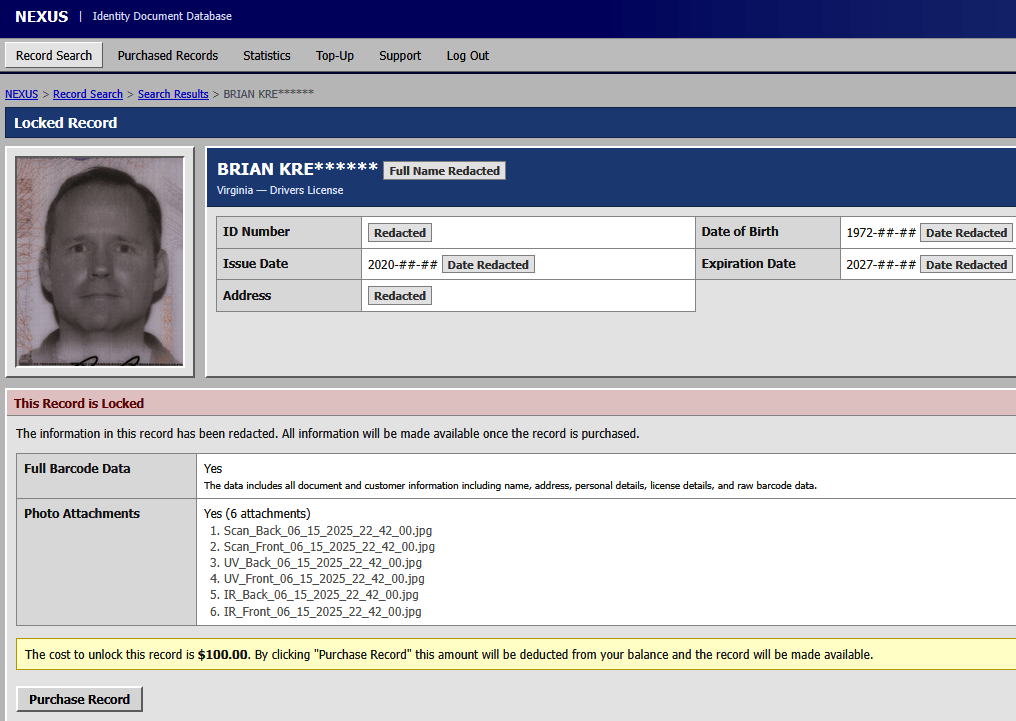
Cybercriminals Turn GTA VI Leaks Into Malware Bait

A fake 113GB GTA VI build is packed with malware, using massive empty files to hide a tiny malicious payload.

GTA VI hype has reached the point where people are volunteering to infect their own computers just to check if a leak is real. Someone on X asked their followers to “take one for the team” and test a 113GB file claiming to be a playable Grand Theft Auto VI build, according to Tom’s Hardware’s reporting. Someone did, and the results were exactly what you’d expect.

A user that goes online with the handler @Aidas29506493 analyzed the file and found that it was completely fake and contained malware. Almost all of its 113GB consisted of empty data, with a tiny malicious payload hidden inside.

did some reverse engineering.
it is fully fake and full of viruses pic.twitter.com/An6VnSNTkd

— Aidas (@Aidas29506493) August 22, 2026

“The decompiled bytecode literally contains commands to whitelist the entire C:\ drive in Windows Defender (powershell Add-MpPreference -ExclusionPath %SystemDrive%\) and kill security software (taskkill -f),” The researcher added in a post on X. They also added in another response, “It’s not 100 GB of actual code—it’s just a tiny 50 KB virus padded with 99.99% empty junk (literally endless zeroes).”

It’s not 100 GB of actual code—it’s just a tiny 50 KB virus padded with 99.99% empty junk (literally endless zeroes).

— Aidas (@Aidas29506493) August 22, 2026

The malware became obvious when researchers examined its code. It included commands to exclude the entire C: drive from Windows Defender and shut down other security software. Anyone who ran it could effectively disable their antivirus before the malware launched its next stage. This was not an accidental side effect, it was a deliberate step to prepare the system for further attacks.

This particular fake didn’t appear in a vacuum. According to to the website IGN, that fake GTA 6 downloads have flooded piracy and torrent sites throughout the recent leak wave, riding genuine momentum from a leaker going by CyberLeek, who’s been releasing real gameplay clips and map footage in protest of Rockstar’s digital pre-order plans. That real leak activity is exactly what makes the fake downloads believable, since fans searching for CyberLeek’s actual content are primed to trust whatever else shows up alongside it.

Every time GTA 6 appears in the news because of leaked footage, people quickly share it across Discord, mirror sites and other platforms. This creates the perfect conditions to trick users with fake downloads and phishing pages. With real and fake content mixed together, it becomes harder for users to tell what is safe.

The scams go beyond huge fake game files. Researchers have found fake GTA 6 websites offering Windows installers that use DLL side-loading to run malware. They also found a fake “GTA 6 Mobile” app that redirects users to a domain linked to infostealers and ransomware. Other fake Rockstar Social Club login pages try to steal users’ account credentials.

None of this should be surprising given the numbers involved. Kaspersky separately documented over 19 million attempted downloads of malware disguised as popular game titles across a single year, with GTA, Minecraft, and Call of Duty topping the list of abused brands specifically because of their large, dedicated communities. Big anticipated titles are a magnet for this stuff regardless of whether there’s an active leak cycle happening, and GTA VI right now has both the hype and the leak chaos simultaneously.

There is no legitimate playable build of GTA VI circulating anywhere, full stop. The game launches November 19 on consoles, with a PC version to follow, and the only responsible move for anyone tempted by a torrent claiming otherwise is to close the tab. If the file looks too good to be true and it’s a hundred gigabytes of an unreleased AAA game showing up on a torrent site months early, it’s not a leak, it’s bait.

Follow me on Twitter: @securityaffairs and Facebook and Mastodon

Pierluigi Paganini

(SecurityAffairs – hacking, GTA VI Leaks)

iAuthFlow v2: The $10,000 Phishing Toolkit That Survives Your Password Reset

iAuthFlow v2 phishing toolkit uses a phished Google session to enroll an attacker-controlled passkey that survives password resets.

Abnormal Security researchers have published an analysis of iAuthFlow v2, a phishing toolkit sold on a Russian-language cybercrime forum for $10,000 base price. The author also offers for sale additional capability modules separately. The headline feature is not the phishing itself. It’s what happens after the phishing succeeds.

“Once the target completes a phishable Google login, the toolkit uses the authenticated session to enroll a passkey controlled by the operator.” reads the report published by Abnormal Security. “In the seller’s recorded demonstration, the account owner later changes their password, invalidating the active session—but the operator authenticates with the newly enrolled passkey and returns to the mailbox.”

That’s the architecture. The phishing flow gives the attacker a temporary window. iAuthFlow v2 uses that window to create a permanent key that doesn’t close when the window does.

The toolkit uses a browser-in-the-middle attack. The victim sees what looks like a real Google login page, while iAuthFlow v2 runs another browser on the attacker’s server. Everything the victim types, including their email, password and two-factor code, is sent to that remote browser, which logs in to Google. The victim provides the credentials, while the attacker gets the authenticated session. In the demo, the fake login page used a trycloudflare.com subdomain, giving the link a valid TLS certificate and a more trustworthy appearance.

Once the relay gives the attacker’s browser Google’s session cookies, iAuthFlow v2 holds the target on a “Verification, Processing” page while the toolkit works inside the account.

This pause is a named state in the software, not a recording artifact. The session log timestamps tell the story precisely: login at 21:37:18, passkey created and saved at 21:37:24. Six seconds to establish persistent access.

The passkey module navigates the target’s Google passkey settings through the authenticated browser and requests a new credential. Google may ask for identity re-verification before allowing the enrollment; the demo shows the toolkit handling this. The enrolled passkey is then stored on the attacker’s side, and the toolkit records “Passkey created and saved.”

“The log records “Passkey created and saved.” At this point, the operator no longer has only the authenticated session created through the phishing flow.” continues the report. “The newly enrolled passkey is a separate authentication credential registered to the target’s Google account. The subsequent demonstration shows Google offering that passkey during a later sign-in, consistent with the operator retaining the credential needed to use it.”

This is more serious than simply stealing a session cookie because a password reset does not remove a passkey. Changing a Google password ends active sessions, revokes app passwords and invalidates some OAuth tokens. A passkey is different: it is a separate cryptographic credential linked to the account and remains active until it is manually removed.

The demo shows the risk clearly. After the victim changes their password, the attacker’s session stops working. But the attacker can choose “Try another way,” use the passkey they previously added and regain access to the mailbox. The victim may have no idea this happened.

Abnormal notes a technically plausible mechanism for how iAuthFlow v2 stores and uses the passkey: Chromium’s software-based virtual authenticators, which support WebAuthn registration and retain private keys without requiring the target’s physical device. The researchers don’t confirm this is what the toolkit uses, since the demonstration doesn’t reveal the implementation. What they confirm is that the behavior shown is consistent with how passkeys work, and there’s an available path to produce it.

The toolkit targets Google in the build Abnormal examined, but the seller advertises versions for Microsoft, iCloud, and LinkedIn. The same post-authentication persistence logic applies wherever passkeys can be enrolled.

Containment after an iAuthFlow v2 compromise needs to go further than incident response teams are often used to going.

“That cleanup is particularly important with iAuthFlow v2 because neither a password reset nor session revocation removes an attacker-enrolled passkey.” states the report. “Restore the account only after unauthorized authentication methods and other persistence mechanisms have been removed.”

The full sweep should cover unauthorized passkeys and security keys, malicious Gmail filters and forwarding rules, delegated access, OAuth grants and app permissions, and recovery settings. Organizations running Google Workspace can use the Security Investigation Tool to audit the account before declaring it clean.

The best way to prevent these attacks is to rely on authentication methods that cannot be easily stolen through phishing. WebAuthn-based authentication is tied to the real website, so stolen passwords or codes cannot be used through a relay attack. Google Workspace can enforce this with the “Only security key” option for 2-Step Verification and through the Advanced Protection Program. These settings also disable app passwords, which the toolkit may target on less protected accounts.

The toolkit’s price and professional sales channels suggest this is an ongoing business, not a one-time release. If a Google account is compromised but appears clean after a password reset, security teams should also check the account’s passkeys and security keys before closing the case.

“iAuthFlow v2 illustrates how phishing has evolved beyond stealing credentials or even hijacking a single authenticated session. Once an attacker gains legitimate access to an account, that access can become a starting point for establishing new authentication methods, modifying account settings, and creating other forms of persistence.” concludes the report. “Response and recovery cannot end with a password reset or session revocation. Organizations must also examine what changed after authentication—especially newly enrolled credentials, recovery methods, OAuth grants, and mailbox settings—and remove anything the attacker left behind. “

Follow me on Twitter: @securityaffairs and Facebook and Mastodon

Pierluigi Paganini

(SecurityAffairs – hacking, iAuthFlow v2 phishing toolkit)

ToxicPanda 2.0 Gets a Major Upgrade, Expanding Attacks Across 16 Countries

ToxicPanda 2.0 targets 349 financial apps and abuses Android Wireless Debugging to gain deeper device access and steal banking credentials.

ToxicPanda used to be a Europe-focused nuisance targeting a manageable list of banks. That version is gone. Zimperium’s zLabs team just documented ToxicPanda 2.0, and the numbers alone tell the story: 349 targeted financial institutions across 16 countries, up from 16 apps in the previous version, plus a command set that ballooned to 167 remote instructions.

The infection starts with a fairly standard trick dressed up in a new coat of paint. The malware poses as a dropper, requesting VPN permissions through a fake installation screen, then quietly uses that access to block communication from Google Play Protect while it decrypts and installs the real payload hiding inside the app’s own asset files. Once installed, it leans on Android’s Accessibility Service, the same feature legitimate screen readers and automation tools rely on, to see and interact with everything happening on the victim’s screen.

ToxicPanda was once a malware mainly targeting a small number of European banks. That has changed. Zimperium’s zLabs team has documented ToxicPanda 2.0, which now targets 349 financial institutions in 16 countries, compared with just 16 apps before. It also has 167 different commands that attackers can send remotely.

The attack starts with a common trick. The malware pretends to be a legitimate app and asks for VPN permissions through a fake installation screen. It then uses this access to block Google Play Protect while secretly installing the real malware hidden inside the app’s files.

Once installed, ToxicPanda abuses Android’s Accessibility Service. This feature is normally used by legitimate tools such as screen readers, but the malware uses it to monitor the victim’s screen and interact with apps and data on the device.

“By abusing the Android Accessibility Service, threat actors can steal every UI element on the screen, alongside an overlay-based credential theft mechanism targeting 349 financial institutions, compared to the previous version, which targeted only 16 banking applications, the latest iteration demonstrates a significant expansion in targeting scope and capabilities.” reads the report published by Zimperium’s zLabs. “Several commands previously identified as unimplemented in Cleafy’s analysis are now fully operational, expanding the malware’s remote control and fraud capabilities.”

What sets this version apart isn’t just scale, it’s a genuinely new privilege escalation trick built around a feature most people have never touched: Android’s Wireless Debugging framework. The malware automates the entire process of turning it on, tapping the build number seven times to unlock developer options, toggling wireless debugging, and then scraping the six-digit pairing code straight off the screen using accessibility permissions.

From there it performs the actual cryptographic pairing handshake itself, gaining shell-level access to the device without the victim ever realizing developer mode got switched on.

ToxicPanda was once a malware mainly targeting a small number of European banks. That has changed. Zimperium’s zLabs team has documented ToxicPanda 2.0, which now targets 349 financial institutions in 16 countries, compared with just 16 apps before. It also has 167 different commands that attackers can send remotely.

The attack starts with a common trick. The malware pretends to be a legitimate app and asks for VPN permissions through a fake installation screen. It then uses this access to block Google Play Protect while secretly installing the real malware hidden inside the app’s files.

Once installed, ToxicPanda abuses Android’s Accessibility Service. This feature is normally used by legitimate tools such as screen readers, but the malware uses it to monitor the victim’s screen and interact with apps and data on the device.

The real danger comes from its ability to use Android Debug Bridge (ADB). Once connected, ToxicPanda can run commands through ADB without showing the usual permission requests. This allows it to give itself more permissions, remove Android restrictions on background activity, enable important components without the user knowing, and maintain access to the device.

“The malware also introduces an automated click-based mechanism to abuse Android Wireless Debugging (ADB), enabling privilege escalation and shell-level access on compromised devices. Additionally, it can steal lock screen credentials by placing overlays on top of the lock screen.” continues the report.

The credential theft itself runs on two separate tracks. For banking and crypto apps specifically, the malware watches which app the victim opens, matches it against a list of 349 targets, and either overlays a fake login screen or deploys an invisible transparent layer to capture every touch and PIN entry directly. Separately, it can now overlay a convincing fake version of the phone’s own lock screen to steal the device PIN, pattern, or password outright, which hands attackers a way back in even after the initial infection window closes.

Several capabilities that security firm Cleafy had previously flagged as unfinished in an earlier ToxicPanda variant are now fully working. The malware can automatically click through OEM-specific permission dialogs across Xiaomi, Samsung, Huawei, and other manufacturers’ customized Android builds, request Device Administrator privileges using a fake “system service” prompt, and even remotely force-reset a victim’s lock screen password using legitimate Android device management APIs. It can also load an attacker-controlled webpage inside a full-screen overlay on command, a feature that simply didn’t exist in prior versions.

Distribution has shifted too, with samples now getting served from Amazon AWS-hosted storage buckets rather than whatever ad-hoc infrastructure earlier campaigns used.

“The updated campaign also reveals a shift in distribution methods, with ToxicPanda 2.0 samples being delivered through Amazon AWS-hosted buckets, indicating the attackers are leveraging cloud infrastructure for malware delivery.” states the report.

Using major cloud providers for malware delivery isn’t new, but it does complicate blocking efforts, since flagging an entire AWS IP range as malicious tends to take down a lot of legitimate traffic along with it.

None of this requires a sophisticated zero-day, which is honestly the more unsettling part. Every capability here abuses a feature Android ships intentionally, Accessibility Services, Wireless Debugging, Device Administrator APIs, all designed for legitimate accessibility and enterprise device management.

“As mobile banking threats like ToxicPanda become increasingly sophisticated, conventional signature-based security layers are no longer sufficient to protect enterprise mobile endpoints.” concludes the report.

If you’re responsible for securing mobile endpoints, this is less a “patch something” problem and more a “detect abnormal use of normal features” problem, and that’s a considerably harder thing to build detection around.

Follow me on Twitter: @securityaffairs and Facebook and Mastodon

Pierluigi Paganini

(SecurityAffairs – hacking, ToxicPanda 2.0)

❌