Entrar

The Cyber Express Weekly Roundup: FBI Blames North Korea for $6B Binance Hack, Hackers Turn Up the Heat on Europe’s Fridges and More

Law enforcement in Europe, supported by Europol and Eurojust, arrested seven suspects and seized over 100 servers targeting a crime-as-a-service (CaaS) investment fraud infrastructure. Operating from Cyprus and Israel, an unnamed vendor supplied fraudulent trading websites to criminal call centers across Albania, Kosovo, North Macedonia, and more.
Following a four-year investigation initiated after victims reported missing funds, investigators linked the infrastructure to fake foreign currency, stock, and cryptocurrency schemes affecting victims in at least 50 countries. Scammers used fake online account profits to coerce larger transfers before cutting contact, leaving victims unable to recover their funds.
In the U.S., a federal grand jury indicted two Canadian nationals, Ryan James Roach and Mathiew James Stubbings, for conspiring to breach multiple American universities to mine for cryptocurrency. Between June 2016 and December 2019, the co-conspirators deployed virtual private servers to infect academic networks across Massachusetts, New York, North Carolina, and Tennessee with malware.
Once inside, the defendants stole user log-ins and data, deployed cryptocurrency mining software, and hijacked high-performance campus supercomputers to conduct unauthorized network vulnerability research. Both men face up to ten years in prison and $250,000 fines following formal extradition proceedings from Canada.
Russian law enforcement authorities arrested three suspected members of the VasyGrek threat group (aka Fluffy Wolf) and dismantled its operational infrastructure. Active since 2016, the financially-motivated group was known for targeting organizations across metallurgy, energy, healthcare, and finance sectors in Russia, Belarus, and Kazakhstan.
Attackers would send phishing emails with malicious accounting attachments to drop remote access trojans and steal corporate funds. Police seized computer equipment and server assets after uncovering a broad network of fake financial domains, dark web remote administration tools, and Golang backdoors used to execute unauthorized commands.
According to a new report, threat actors have been posing as IT help desk staff on Microsoft Teams to message and call corporate employees and leverage external support-themed tenants to trick users into handing over workstation access.
Once connected, attackers instructed victims to launch Quick Assist, a built-in Windows remote-help tool, and read back connection codes to grant full remote desktop control. The intruders then dropped malicious software archives into Downloads folders, unpacking and executing payloads via portable Python, Bun, or Java runtimes disguised as legitimate Windows system updates.
After establishing initial persistence, the attackers abused weak configuration templates within Active Directory Certificate Services (AD CS) to request digital authentication certificates for privileged domain accounts. In one documented intrusion, threat actors exploited an ESC1 misconfiguration to obtain certificates for three highly privileged identities—access that persisted even after password resets or workstation wipes. The attacker used one of those certificates to compromise a domain controller, execute DCSync credential dumping, and exfiltrate internal corporate files to an external server via Rclone.
In a second intrusion, attackers targeted an ESC8 configuration by deploying the ‘PetitPotam’ technique to force a domain controller to authenticate against an attacker-controlled endpoint. The relayed NTLM authentication allowed the actors to request a certificate directly for the domain controller without credentials, securing a persistent Kerberos ticket-granting ticket. The customer isolated the affected workstation, and no further attack progression was observed.
Because these intrusions exploit misconfigured certificate enrollment policies rather than underlying software vulnerabilities, Microsoft advises organizations to confirm unexpected support requests via internal channels, enforce Extended Protection for Authentication on web enrollment endpoints, and audit certificate issuance rules.
Threat actors have targeted internet-exposed refrigeration control systems across Europe this week, altering temperature settings and activating defrost cycles across facilities just three weeks after similar attacks on hundreds of refrigeration systems in French supermarkets.
So far, this second wave has impacted retail chains across Belgium, Estonia, Ireland, Luxembourg, the Netherlands, and Sweden. In several stores, attackers set cooling units to generate heat or raised temperature setpoints to 50°C.
The activity extended into critical healthcare infrastructure when a cyberattack on refrigeration supplier Coolworld Rentals raised temperature thresholds at French Blood Establishment (EFS) cold-storage facilities managing vital blood supplies. However, automated monitoring alarms enabled staff to relocate stored blood products before any inventory was lost.
SentinelLABS’s breakdown notes that similar attacks targeted Israeli and Russian facilities in 2022, a Los Angeles meat processor in 2024, and U.S. military commissaries in August 2026. The intrusions primarily targeted commercial supervisory platforms, such as Danfoss AK-SM, AK-SC, and Copeland Dixell XWEB controllers, that centralize site cooling operations.
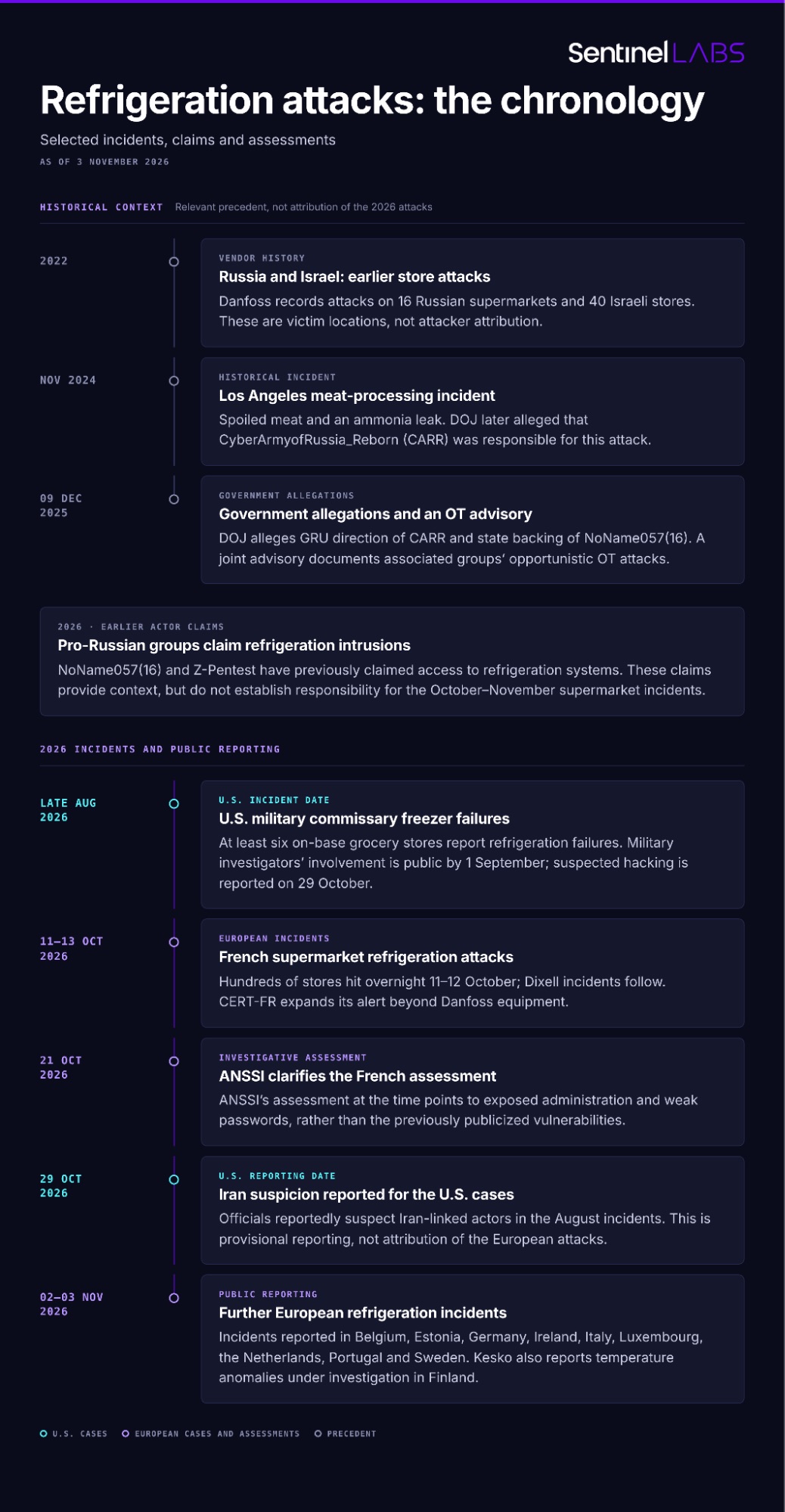
At the time, ANSSI indicated that adversaries gained control by exploiting publicly accessible administration interfaces and weak default credentials rather than executing novel software zero-days.
While Russian-aligned hacktivist collectives including CARR, NoName057(16), and Z-Pentest claimed responsibility for specific disruptions, law enforcement authorities have not formally confirmed attribution. Opportunistic scanning against unhardened building management systems allows multiple threat groups to execute similar disruptions.
To mitigate ongoing operational risks, government advisories from CERT-FR instruct operators to immediately disconnect exposed control panels from the public internet, restrict remote maintenance access to secure virtual private networks, enforce strong authentication controls, and replace legacy end-of-life hardware.




 Image source- Instagram[/caption]
Some virtual and in-person programmes may also be affected, and the library has asked visitors to check with their local branch. Renewals are unavailable during the outage. The library reminded customers that it does not charge late fines on borrowed materials.
"Our IT department is working to resolve the issue, and we will keep you informed," the library said, adding that people can call (718) 990-0728 for help.
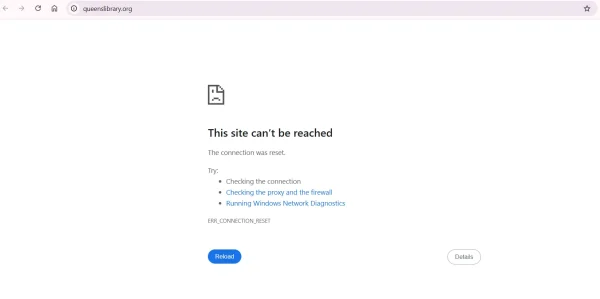
When The Cyber Express tried to access the library's official website, it would not load and displayed the message "This site can't be reached." The Cyber Express reached out to the library for more information but had not received a response at the time of writing.

| Airline | Reported impact |
| Japan Airlines (JAL) | About 92,000 passenger records |
| Cathay Pacific Airways | About 53,000 passenger bookings |
| Singapore Airlines (SIA) | About 46,000 booking records |
| All Nippon Airways (ANA) | Up to 37,800 customer profiles |
| Malaysia Airlines | Customer data exposed across August 2023 to September 2026 |
| Korean Air | Unauthorised access to customer reservation databases |
| Asiana Airlines | Passenger booking references exposed through system account credentials |
| Condor Airlines | Part of the German leisure carrier's international flight data accessed |
| Airline | Link to the breach |
| Japan Transocean Air (JTA) | Affected through parent company Japan Airlines |
| Air Do | Affected through shared system pathways with ANA |
| StarFlyer | Affected through shared system pathways with ANA |
| Solaseed Air | Affected through shared system pathways with ANA |
| Ibex Airlines | Still determining the scope of exposure via its ANA integration |
| Oriental Air Bridge | Still determining the scope of exposure via its ANA integration |




The UK's National Cyber Security Centre (NCSC) has put a date on a threat that security teams across Europe have been bracing for. In its 2026 Annual Review, The State of the Cyber Nation, the agency assesses it is highly likely that AI-powered malware will be used in a ransomware attack on UK Critical National Infrastructure by 2028.
That is not a distant, speculative scenario. It is a two-year window, and it lands alongside a second judgement. By 2028, China, Russia and other nation-states will highly likely be using AI-enabled cyber capabilities routinely to pursue geopolitical goals, with the UK facing sophisticated attacks at greater scale and speed.
The review also recorded that UK and EU member states jointly attributed a December 2025 attack on Poland's energy grid to Russia's FSB Centre 16. Had it succeeded, roughly 500,000 citizens could have lost power. Europe is not watching this threat from the sidelines; it is where the playbook is being tested.
The NCSC's assessment is precise about where AI makes the difference. It calls AI an almost certain "force multiplier" that improves reconnaissance, social engineering, vulnerability discovery and exploit development. The biggest effect, it says, will be faster and larger versions of existing tactics rather than brand-new attack vectors.
Ransomware is where that acceleration hits CNI hardest. The review expects criminal adoption of AI to raise the scale and efficiency of ransomware, social engineering and exploitation. It also warns that open-source AI tools built for security researchers are likely to be repurposed to automate criminal workflows, cutting costs and raising attack volumes against less resilient targets.
The agency is careful not to overstate today's reality. Its Incident Management team has begun to see attackers using AI tools, but none of the observed uses enabled a new class of attack. Human operators remain essential, and the NCSC notes that losing control of an agentic AI is likely to hinder threat actors from reaching their goals.
The review's pessimistic 2028 scenario shows why that caveat may not last. In it, frontier AI is available to everyone from state actors to novice hackers, jailbroken models are sold in criminal marketplaces, and attribution becomes harder as capability spreads. It even describes a realistic possibility of an automated cyber actor operating beyond its operator's control. Cloud-controlled CNI and AI-driven robotics raise the chance that a digital compromise causes physical harm.
The NCSC stresses this is an illustration of the cost of inaction, not a forecast. But it is a scenario written by the agency responsible for defending UK infrastructure, and it is set just two years out.
If the UK is looking at 2028, continental Europe is already living with the threat. The NCSC names Russia as the most audacious cyber threat to the UK today. GCHQ Director Anne Keast-Butler goes further in the review's foreword, warning that tactics Russia developed against Ukraine are now being turned more widely on states and their institutions.
Three data points from the review frame the European picture:
The pattern matters for anyone running energy, water, transport or telecoms in Europe. Grids, interconnectors and supply chains cross borders, and a disruptive attack in one country can cascade into its neighbors. The review also describes how cyber threats to the UK can escalate rapidly and without warning during periods of geopolitical tension.
Add AI to this mix and the timeline compresses. A state actor that today relies on patience and known router flaws could, with AI-assisted discovery and exploitation, find and weaponize new weaknesses across thousands of European edge devices far faster than defenders can patch them.
While Russia is the loudest threat, the NCSC sees China as the most capable. It judges that China highly likely has both the intent and the best position to use AI against CNI and other strategic targets. Its frontier AI programmes are expected to sharpen vulnerability identification, targeting efficiency and access operations.
Data sits at the center of that strategy. The review describes China collecting large volumes of information from the UK and elsewhere, then using it to train models and improve capability. In the AI era, stolen data is no longer just espionage material; it is fuel.
The UK has already acted on this. In December 2025, it sanctioned two China-based firms: i-Soon, which targeted more than 80 government and private IT systems globally, and Integrity Technology Group, which the FBI has linked to the Flax Typhoon intrusions. In April 2026, the NCSC and 15 partners across nine other countries published guidance on the covert networks most China-linked actors use to hide their activity.
The 2028 scenario adds a further concern: China, as a leading developer, may help spread advanced AI-cyber capability to other actors, letting them hide in the noise and making attribution harder for European defenders.
The most useful finding in the review is also the least dramatic: attackers are still getting in through the basics. Over the past year, the NCSC received 1,831 reports of cyber attacks. Of these, 337 needed its direct support, and 80 were classed as nationally significant.
For large organizations, 88% of incidents started through four initial access vectors:
Even state-linked intrusions often used flaws for which patches already existed but had not been applied quickly enough. As the review puts it, sophisticated actors do not need to be sophisticated to gain initial access; their skill shows in what they do once inside.
This is exactly where AI changes the economics. The NCSC expects AI-assisted vulnerability discovery to give attackers more chances to hit systems before owners patch them. It is urging every organization to prepare for a "patch wave": a surge of security updates across the technology stack, many of them critical, as AI exposes years of technical debt.
Two further risks deserve attention:
The financial stakes are already clear. UK government research cited in the review puts the annual cost of malicious cyber activity to UK organizations at about £14.7 billion. The 2025 attack on Jaguar Land Rover alone cost the company around £196 million in direct costs and contributed to UK GDP growing just 0.1% in Q3 2025.
The NCSC's answer is to meet machine-speed attacks with machine-speed defense. Several initiatives in the review stand out:
There are early results. Under the Government Cyber Action Plan, the median time to fix domain-related vulnerabilities fell from 50 days to 8. The Early Warning service now covers 19,922 organizations, up 52% on last year.
For Europe, the lesson is that partnership is now part of the defense. The review highlights the world's first AI security standard developed through ETSI, the European standards body, as proof that allies can shape AI security while the technology is still evolving.
National defense at machine speed also depends on seeing adversaries before they reach the network. Groups like FSB Centre 16 and China-linked operators plan, recruit, and trade access in places most defenders never look. As AI makes attribution harder, government agencies, national CERTs, and defense bodies need intelligence that tracks threat actors across the open, deep, and dark web and connects that activity to the infrastructure being targeted. Cyble Hawk is built for exactly this. It gives national security teams sovereign threat intelligence, adversary profiling, and investigative support. That means early warning of campaigns against critical infrastructure and stronger attribution when an attack does land. Book a demo to see how your agency can move from reacting to incidents to anticipating them.
The NCSC's core message is that AI did not create these weaknesses; it is exposing them faster. Operators of critical infrastructure should act on the following now:
The NCSC has given Europe a deadline. By 2028, AI-powered ransomware against UK critical infrastructure moves from possibility to expectation, and state actors will be using AI as a routine part of their operations. The Poland grid attack and the global router campaign show the targeting is already in place; AI simply adds speed and scale.
The agency's own framing is a "moment of choice." Organizations that modernize, patch fast, and build resilience now will be able to absorb what comes next. Those that defer will find AI exposing their technical debt faster than they can repay it.
For CNI operators across the UK and Europe, the next two years are the window to close the gap. Continuous visibility into emerging vulnerabilities, active exploitation and threat actor activity will be central to staying ahead of attacks that move at machine speed.
The post AI-Powered Ransomware Is Coming for UK Critical Infrastructure, and Europe Is Already the Testing Ground appeared first on Cyble.



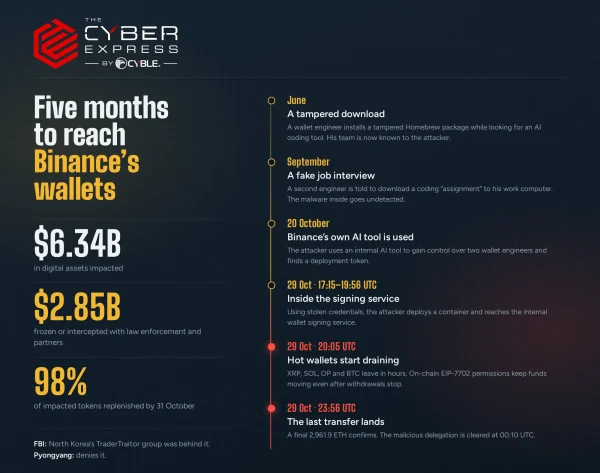 In the second round, held on a popular chat app, Engineer B was told to download an "assignment" onto his work computer. It contained malicious code that ran during setup, swapped a legitimate development tool for a malicious version, and connected to an attacker-controlled server. The zero-day malware was not detected by endpoint security tools at the time.
On October 20, the attackers used Engineer B's compromised computer and an internal AI tool to gain control over Engineer A and another wallet engineer, Engineer C. They then found that Engineer A had a container deployment permission token on his machine.
Polymarket users who had the site open during a short window on October 29 watched their positions get sold and their funds leave their wallets without doing anything themselves. The Polymarket hack did not start inside Polymarket.
It came through a small piece of code from an outside company that loaded on every visit to polymarket.com. The cryptocurrency-based prediction market now says it is returning $3.9 million to affected traders.
In a post-mortem published on October 31, Polymarket said a third-party vendor whose performance-monitoring script ran on polymarket.com had been compromised. The attacker swapped the vendor’s legitimate code for a compromised script built specifically to target Polymarket users.
The attacker did not need anyone’s password. For users who had the site open at the time, the malicious script used their active session to sell positions and move funds out of their wallets. Anyone logged in and browsing during that window was exposed. The vendor has publicly confirmed the compromise.
Polymarket’s status page first reported “unauthorized activity affecting user wallets” on October 29 and marked the incident as resolved later that day.
Performance-monitoring company DebugBear released its own update on the incident. It said its initial findings point to its domain registrar as the point of entry.
“Our DNS records were compromised through our domain registrar,” the company said on X. “We are currently unable to receive emails sent to our domain. Based on our initial investigation this attack targeted the website of a specific customer.”
[caption id="attachment_115172" align="aligncenter" width="538"]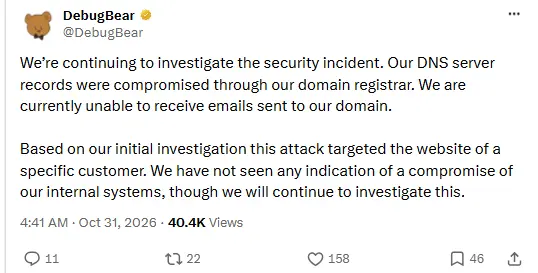 Source- Twitter[/caption]
DebugBear added that it has “not seen any indication of a compromise of our internal systems,” though it is continuing to investigate.
This is the part of the story that should worry other website operators. According to the statements from both companies, the attacker appears to have gone after a vendor’s domain setup rather than Polymarket’s own systems, and used that position to put malicious code in front of Polymarket’s users. DebugBear’s own internal systems, by its account, show no sign of being breached.
Polymarket listed the steps it took once the attack was identified:
The trading pause stopped the bleeding, but it created a second set of losses for traders who were not directly hit by the script.
Polymarket is returning $3.9 million in total. Of that, $2.7 million covers the initial losses from the attack, and $1.2 million covers losses tied to the hours-long shutdown.
As of its post-mortem, the company said 95% of affected wallets had been refunded in full, through a mix of reimbursements for drained wallets and goodwill payments.
The refunds cover more than drained wallets. Polymarket said it also made goodwill payments in two cases:
Users do not need to file claims or tickets. Polymarket said it identified eligible wallets using on-chain and trading data. Anyone who thinks their amount is wrong, or believes they should have received a payment, can submit a form for the company to recheck.
Some questions are still open. Neither company has named the threat actor. DebugBear has said the attack targeted a single customer, but its investigation is ongoing, and it still cannot receive email sent to its domain. Polymarket has also not said exactly how many wallets were affected, only that 95% have been made whole.
The incident shows how much trust a website places in every outside script it loads. Polymarket’s own systems were not the entry point, yet its users still lost money, and it took a trading halt, a session reset and a removal of the vendor’s code to stop it.

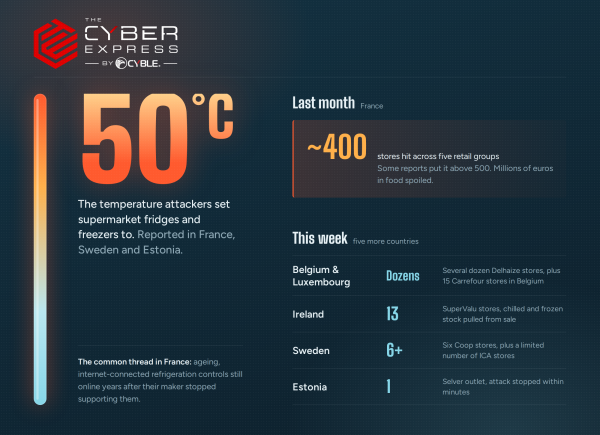 In Ireland, Musgrave Group said refrigeration systems in 13 SuperValu stores were affected by the "cyber incident." Chilled and frozen products were removed from sale as a precaution. By Monday afternoon, the company said the incident had been "fully resolved" and that restocking of chilled and frozen ranges was "well under way."
In Estonia, refrigeration technology company Kitman Coldtech said attackers had accessed a computer controlling a client's refrigeration system and raised the temperature to 50 degrees Celsius, public broadcaster ERR reported. Chief executive Jann Mutso declined to name the store but said the attack was addressed within minutes and caused no significant damage. The Selver supermarket chain confirmed that one of its outlets was affected.