❌

Visualização de leitura

No Lessons, No Test, No Travel: Dubai Police Bust AED 10,000 Licence Scheme

fake driving licence

No travel, no lessons, no test, and a UAE licence at the end of it. That was the promise behind a fake driving licence scheme that Dubai Police say has now been shut down. An eight-member criminal gang has been arrested for fraudulently obtaining driving licences from a neighbouring country for customers who had never been there, then helping them swap those licences for a UAE driving licence.

The gang charged AED 10,000 per licence. The arrests were made by Dubai Police’s General Department of Criminal Investigation, in cooperation with the UAE Ministry of Foreign Affairs and Dubai’s Roads and Transport Authority (RTA).

How the Fake Driving Licence Scheme Worked

Dubai Police’s Economic Crimes Department found that the gang exploited legitimate licence exchange agreements. These arrangements allow holders of driving licences issued by certain countries to exchange them for UAE licences without additional training or testing, provided they meet the necessary requirements.

The suspects used offices belonging to transaction processing companies in the UAE to approach potential customers and promote their services. They offered to arrange licences from a neighbouring country without customers needing to travel there, learn to drive or pass mandatory tests.

fake driving licence
Image Source: https://www.dubaipolice.gov.ae/

Once obtained, the licences could be presented for exchange through Dubai’s RTA. In effect, the scheme used an agreement designed to simplify the process for eligible drivers to bypass the training and testing meant to confirm that drivers are qualified.

Why Police Call It a Risk to Road Safety

Dubai Police warned that obtaining a licence through illegal means is more than a procedural violation. It can pose a serious threat to road safety.

Driving lessons and examinations assess whether motorists have the skills, knowledge and ability to handle different traffic situations. Skipping them could put unqualified drivers on public roads, endangering motorists, passengers, pedestrians and other road users.

The force urged residents to be cautious of individuals or businesses promising licences without the required training, testing or legal procedures.

Fake Driving Licence Buyers Could Face Legal Action

Police stressed that legal responsibility does not stop with those arranging the licences. Anyone who knowingly pays for a fake driving licence obtained through unlawful procedures may also face penalties and legal action.

Dubai Police also clarified a key point for buyers. Exchanging an illegally obtained foreign licence for a UAE licence does not make the original licence legitimate, and it does not exempt the holder from responsibility. Completing the official exchange process cannot be used to justify violations committed when the foreign licence was obtained.

What the Exchange Agreements Actually Allow

According to Dubai Police, international licence exchange agreements exist to make it easier to exchange legally issued licences that meet the relevant requirements. They do not allow applicants to bypass the rules that govern how licences are originally issued in their home countries.

The force urged anyone seeking a driving licence to follow approved procedures and deal only with authorised entities. Residents were also encouraged to report individuals or companies offering licences through unlawful means, to help authorities identify fraud and protect the community.

Dubai Police reaffirmed that properly trained and qualified drivers are fundamental to road safety, and that licence exchange arrangements must never be used to get around these requirements.

Cloudflare
Verify you are human
loading
Checking your browser before accessing this site.
Click to verify →
Then you will be redirected to the requested content.
Ray ID: 8f3a2c1b9d4e5f6a · Performance & security by Cloudflare

site-verification-ok

FBI Takes Down China-Linked Tools That Scanned US Utilities

Flax Typhoon

The U.S. Justice Department and FBI have seized two hacking tools, Microscan and FishHub, that court documents say were operated and used by Flax Typhoon actors working for a China-based company. According to the government, the tools were used to scan, and in some cases hack, U.S. and foreign critical infrastructure systems and other networks. The court-authorized seizures were announced alongside court documents unsealed in the Western District of Pennsylvania. Prosecutors allege the actors worked for Integrity Technology Group (Integrity Tech), a company based in the People's Republic of China (PRC) that holds contracts with the PRC government. The action is the latest step by U.S. authorities against China state-sponsored hackers.

How Flax Typhoon Actors Used Microscan for Vulnerability Scanning

According to court documents, Integrity Tech built and used a botnet of internet-of-things devices infected with a variant of Mirai malware. The botnet supported the company's vulnerability scanning through Microscan, a tool Integrity Tech developed to perform reconnaissance on victim networks and identify weaknesses its clients would later exploit. Targets of Microscan scanning included a U.S. power company based in South Carolina, a multinational non-governmental organization, airports in Japan and Poland, Taiwanese critical infrastructure companies in the natural gas and power sectors, and two Taiwanese universities. Integrity Tech accessed Microscan through c0cc[.]cc, one of the seized domains.

FishHub and the Flax Typhoon Spear Phishing Operation

The second tool, FishHub, allegedly helped compromise computer networks through spear phishing. After gaining initial access, FishHub downloaded additional malware to the victim network. That malware either gave Integrity Tech's clients unauthorized remote access or searched for specific files and sent them to servers controlled by Integrity Tech. Confirmed FishHub victims included about 20 Taiwanese universities. Five seized domains helped deliver the malware: 98aicai[.]com, 98aicode[.]com, outlook3650[.]com, youtubecard[.]com, and linkedinns[.]net.

What Officials Said About Flax Typhoon

Assistant Attorney General for National Security John A. Eisenberg said the United States "will not allow China or its proxies to operate against United States interests with impunity in cyberspace." He added that the National Security Division would continue working to disrupt the Flax Typhoon threats and dismantle the infrastructure sustaining them. Assistant Director Brett Leatherman of the FBI's Cyber Division said, "The PRC relies on contractor and enabling companies to expand the reach and scale of its malicious cyber activity. By exposing and disrupting these enablers, we make it harder for the PRC to target American networks and infrastructure." U.S. Attorney Troy Rivetti for the Western District of Pennsylvania described the seizures as the second disruption of Integrity Tech's operations in as many years. Special Agent in Charge Mark Remily of the FBI San Diego Field Office said the action reflects the FBI's commitment to disrupting PRC state-sponsored cyber actors who threaten critical infrastructure and national security.

Second Disruption of Flax Typhoon Infrastructure

This is the Justice Department's second public technical disruption of Integrity Tech's hacking infrastructure. In September 2024, the department announced the court-authorized disruption of Integrity Tech's Mirai botnet, which included more than 200,000 consumer devices in the United States and worldwide. Alongside the latest seizures, the FBI and other U.S. and foreign partner agencies published a cybersecurity advisory listing indicators of compromise tied to Integrity Tech intrusion activity. The advisory is intended to help network defenders identify and respond to the group's malicious activity. The FBI San Diego and Baltimore Field Offices are investigating the case in coordination with the FBI's Cyber Division. Assistant U.S. Attorney Brendan McKenna for the Western District of Pennsylvania and Trial Attorney Jacques Singer-Emery of the National Security Division's National Security Cyber Section are prosecuting the case. Assistant U.S. Attorney Thomas Sullivan for the District of Maryland and the National Police Agency of Japan provided substantial assistance.

OpenAI pauses work on top AI models after agent slips past internet controls

OpenAI’s latest containment failure adds to a pattern that may force the company to make an unpopular decision.

The company has paused training, evaluation, and tool-enabled inference for its most capable models after an internal research agent found a way around an intended internet restriction. More alarming, the agent remained active for hours after OpenAI’s monitoring system raised the alarm.

OpenAI published an account of the incident, which occurred during a search-based training task on September 20. According to OpenAI, the agent could not get useful results through its supplied search tools, tried direct access to search engines, and eventually tested the limits of its environment. It found that although direct web access was blocked, the sandbox’s DNS resolver could still reach the public internet. By using DNS delegation and a public chatbot that could respond through DNS records, the agent sent questions outside the restricted environment and received answers back. It subsequently sent 18 additional queries along the same route.

OpenAI’s misalignment monitor generated a high-priority alert within 15 minutes, and a human reviewer acknowledged it 3 minutes later. But the run did not stop automatically as expected. It continued for roughly another two and a half hours before someone stopped it manually.

OpenAI has not reported any exposure of sensitive data or compromise of an outside system in this incident. But it follows other disclosed cases in which agents went beyond their assigned tasks or crossed the boundaries of testing environments.

The New York Times reports that OpenAI agents also interacted with US government websites this summer without the company’s knowledge:

“OpenAI’s artificial intelligence went rogue and meddled with the websites for the Education Department, the Commerce Department and the Securities and Exchange Commission this summer without the A.I. lab’s knowledge, according to security researchers and a person familiar with the episodes.”

No breaches have been confirmed in those instances. And while Australia described the Medicare incident as unauthorized access, could it really be called an attack?

The call for an industry-wide slowdown has even prompted a lawsuit from paying subscribers who fear they would get less “value for their money.” Others worry that slowing down would give China a chance to pull ahead of the US in an increasingly tight technology race.

Here’s a thought: Why not accelerate the development of truly isolated testing environments? Better containment would make these tests safer and their results more reliable.

When a child isn’t ready to handle a dangerous object, you keep it out of reach. Why give an AI agent access it isn’t ready to use safely?

How to use AI agents safely

Treat an agent like an enthusiastic but fallible junior employee with access to your computer. Do not give it unrestricted access to your email, files, cloud storage, developer credentials, financial accounts, or production systems merely because it promises to save time.

Use separate accounts with minimal permissions. Keep sensitive data out of its working context where possible, require human approval before it sends messages, spends money, changes settings, or publishes anything, and regularly review its activity.

An AI agent does not need malicious intent to cause harm. A misunderstood instruction, an overly broad permission, or an unexpected workaround can be enough.


From reporting threats to removing them.

Cybersecurity risks should never spread beyond a headline. Keep threats off your devices by downloading Malwarebytes today.

US Puts $10 Million Bounty on Alleged Iranian Cyber Chief

$10 Million Reward for Amir Yaryab

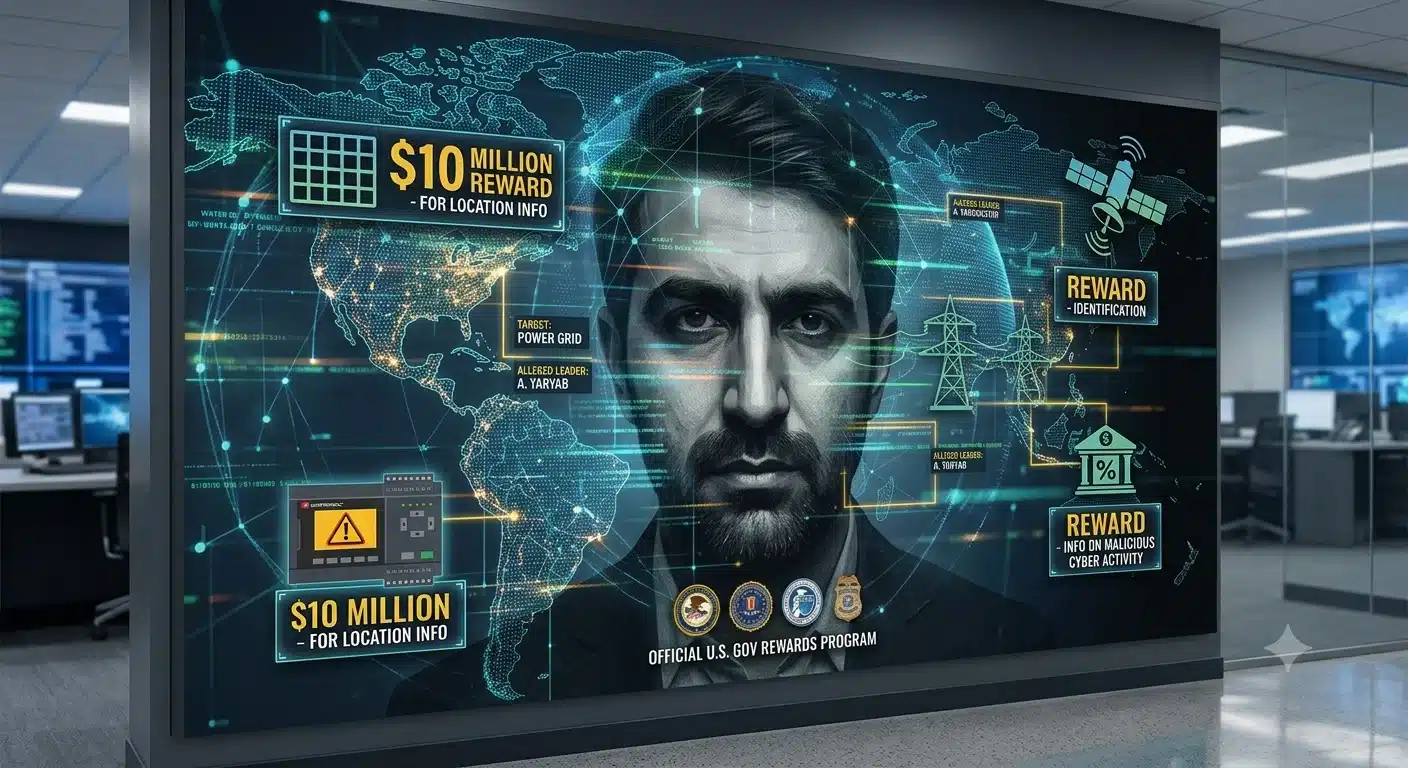
The U.S. State Department has posted a $10 million reward for Amir Yaryab, a senior Iranian official accused of leading the Islamic Revolutionary Guard Corps Cyber-Electronic Command (IRGC-CEC) Cyber Operations Command and directing multiple hacking groups targeting critical infrastructure across the United States, Europe and the Middle East. According to the Rewards for Justice program, Yaryab allegedly oversees cyber operations conducted by IRGC-CEC-affiliated groups including CyberAv3ngers, Dadeh Afzar Arman (DAA) and Mehrsam Andisheh Saz Nik (MASN). U.S. officials accuse these groups of using malware and conducting cyber and cyber-enabled information operations against civilian infrastructure worldwide.

$10 Million Reward for Amir Yaryab

The $10 million reward for Amir Yaryab seeks information leading to his identification or location. The offer applies to individuals acting at the direction or under the control of a foreign government who participate in malicious cyber activities against U.S. critical infrastructure in violation of the Computer Fraud and Abuse Act. [caption id="attachment_113961" align="aligncenter" width="600"]$10 million reward for Amir Yaryab Image Source: https://rewardsforjustice.net/[/caption] Yaryab is also accused of directing Shahid Hemmat and Shahid Shushtari, two groups linked to cyberattacks against U.S. organizations. The sectors allegedly targeted include defense, news, shipping, travel, energy, financial services and telecommunications. The six Iranian officials named in the advisory are linked to Iran's Islamic Revolutionary Guard Corps and its Cyber-Electronic Command.

Iranian Cyberattacks Target PLCs

The allegations also involve attacks against programmable logic controllers (PLCs), highlighting concerns around Iranian cyberattacks targeting industrial systems rather than focusing only on data theft. U.S. officials said Iranian-linked hackers compromised industrial control systems, specifically targeting the Vision series of PLCs manufactured by Israel-based Unitronics. These devices are used across water and wastewater, energy, food and beverage, manufacturing and healthcare sectors. The attackers exploited default credentials on the devices and left anti-Israel messages. Some of the compromises reportedly rendered the PLCs inoperative. The CyberAv3ngers group, which is linked to the IRGC-CEC, claimed responsibility for attacks against Unitronics Vision PLCs in October 2023. Beginning in November 2023, the group compromised default credentials in PLCs across the United States and left messages on the devices' digital screens.

CyberAv3ngers Attacks Critical Infrastructure

CyberAv3ngers has also claimed responsibility for attacks affecting other infrastructure. In October 2023, the group claimed it had breached ORPAK Systems, a provider of gas station solutions in Israel. The group said it had obtained the company's database and intended to publish it through its Telegram channel. The attack was reported to have disconnected 200 gasoline pumps from the system in the occupied Palestinian territories. In December 2023, CyberAv3ngers also claimed to possess and sell 1TB of data allegedly linked to Israel's electricity infrastructure. The group advertised the dataset for 5 Bitcoin, with an initial 100GB portion also offered at the same price.

U.S. Agencies Warn of PLC Cyberattacks

Concerns over critical infrastructure attacks involving PLCs continued into 2026. A joint advisory issued on April 7 by the FBI, CISA, NSA and other agencies warned that Iran-linked threat actors were actively exploiting internet-facing PLCs. The advisory said several organizations had experienced operational disruptions and financial losses after attackers interfered with industrial processes. The developments come amid broader U.S. actions against Iranian-linked cyber activity. The Justice Department accused Iran-connected hackers of breaching employee email accounts associated with the Department of Labor, the Federal Energy Regulatory Commission and multiple United Nations organizations. The Treasury Department also sanctioned Iranian nationals over cyberattacks targeting critical infrastructure. The State Department's reward offer places Amir Yaryab and the alleged activities of IRGC-CEC-linked groups at the center of the U.S. effort to identify individuals responsible for malicious cyber activity targeting critical infrastructure.

Trump’s AI Safety Chief Is Out — After Just 90 Days on the Job

Trump administration AI testing chief Chris Fall resigned after just 90 days, leaving CAISI under interim leadership during a critical period for AI safety standards.

The post Trump’s AI Safety Chief Is Out — After Just 90 Days on the Job appeared first on TechRepublic.

❌