Visualização de leitura

Dutch Police Arrest Key Suspect in €100M Global Crypto Investment Scam

global crypto investment scam

A major global crypto investment scam investigation has led to the arrest of an alleged key figure behind an international criminal organization accused of defrauding victims of more than €100 million every month. Dutch police announced multiple arrests across Europe following a long-running investigation into a fraud network that allegedly employed over 700 people operating from around 20 call centers worldwide.

The main suspect, a 46-year-old dual Israeli and Polish national, was arrested at an airport in Poland on May 26 at the request of Dutch authorities. Investigators believe he played an indispensable role in the organization, which allegedly carried out large-scale investment fraud targeting victims across multiple countries.

Global Crypto Investment Scam Network Operated Through Worldwide Call Centers

According to Dutch police, the organization functioned like a professional company with approximately 700 employees spread across nearly 20 offices globally. Individuals working as financial advisors scam operators allegedly contacted victims daily through online platforms and telephone calls while posing as legitimate investment professionals.

Authorities said the organization was structured with a central headquarters overseeing multiple teams, each assigned to target victims in specific countries. Employees reportedly worked under pseudonyms and used technical measures to hide their identities and locations.


[caption id="attachment_113134" align="aligncenter" width="600"]global crypto investment scam Excerpts from emails that victims sent to scammers[/caption]

As part of the investigation, Belgian police arrested five individuals believed to have worked as fraudulent financial advisors.

Multiple Arrests Made Across Europe

The investigation resulted in several coordinated arrests during May and July.

On July 7, authorities arrested two Dutch nationals aged 45 and 34, along with a 34-year-old Belgian, all residing in Cyprus. A 25-year-old suspect was also arrested in Belgium the same day. On July 10, police arrested a 44-year-old Dutch national in Athens.

The main suspect has since been extradited to the Netherlands, where an examining magistrate ordered 14 days of pre-trial detention. Dutch authorities indicated that additional arrests remain possible as the investigation continues.

How the Global Crypto Investment Scam Worked

Investigators said the online investment scam relied on building long-term trust with victims. Individuals posing as account managers or financial advisors maintained frequent contact through phone calls and online communication, sometimes over several months.

Victims were encouraged to begin with relatively small investments that appeared to generate immediate returns. Police said the investment platforms displayed convincing but fabricated profits, even though no actual investments were being made.

As confidence grew, victims were persuaded to transfer increasingly larger amounts, often in the form of cryptocurrency fraud payments. Instead of being invested, investigators said the funds were diverted directly to the criminal organization.

Authorities also warned that victims who stop investing may later be contacted by so-called recovery companies requesting upfront deposits to recover lost funds. Police believe these recovery operations may also be connected to the same fraud networks.

Hundreds of Complaints Linked to Investment Fraud

Dutch authorities have received approximately 550 reports connected to the organization, while Belgian police have recorded around 200 complaints. Investigators estimate the total number of victims worldwide could reach tens of thousands.

The financial losses reported by victims in the Netherlands alone amount to nearly €25 million, with many individuals losing well over €10,000.

Dutch police said officers proactively contacted some victims after discovering that many remained unaware they had fallen victim to cyber fraud.

Financial investigators are now examining whether assets linked to the suspects can be frozen or seized.

Digital Infrastructure Taken Offline

Investigators said the criminal organization remained active since at least 2021 and relied heavily on concealed digital infrastructure to evade law enforcement.

By tracing financial transactions, IP addresses, and other digital evidence, the Dutch police identified offices, suspects, and critical infrastructure supporting the operation. Authorities worked with commercial service providers to take key elements of the network offline.

The investigation also involved Europol, with intelligence shared across multiple countries to support ongoing criminal prosecutions.

Officials said the case demonstrates the scale and sophistication of modern investment fraud operations and highlighted continued international cooperation to dismantle cyber-enabled financial crime networks.


Operation Endgame Disrupts SocGholish, StealC Malware Networks

Operation Endgame Disrupts SocGholish

Operation Endgame has dealt another blow to cybercriminal operations after international law enforcement agencies and private sector partners dismantled infrastructure supporting the SocGholish, Amadey, and StealC malware families. The coordinated operation resulted in the seizure of more than EUR 41 million in criminal cryptocurrency assets, the recovery of 27 million stolen login credentials, and the disruption of hundreds of servers and domains used to distribute malware.

Led by Europol and Eurojust, the operation brought together authorities from Canada, Denmark, Germany, the Netherlands, the United Kingdom, the United States, Microsoft, and several cybersecurity organizations. Officials said the objective was to disrupt the infrastructure cybercriminals rely on to launch ransomware attacks, financial fraud, and attacks against critical infrastructure.

Operation Endgame Targets Cybercrime Infrastructure

During the coordinated action, authorities targeted the infrastructure supporting malware delivery rather than focusing on a single malware family.

Law enforcement and industry partners took action against 326 servers and 142 domains, significantly disrupting malware distribution channels. Investigators also identified and restricted criminal cryptocurrency assets currently valued at more than EUR 41 million (USD 47 million) while recovering approximately 27 million stolen login credentials.

According to Europol, the operation aimed to disrupt the "assembly line" used by cybercriminals to gain initial access to victim systems before deploying ransomware or stealing sensitive information.

[caption id="attachment_112936" align="aligncenter" width="600"]Operation Endgame Image Soure: Europol[/caption] [caption id="attachment_112937" align="aligncenter" width="600"]Operation Endgame Strikes Malware Image Source: Europol[/caption]

SocGholish, Amadey and StealC Malware Played Different Roles

The operation focused on three malware families that are commonly offered under the cybercrime-as-a-service model.

  • SocGholish functioned as a malware loader that distributed fake browser updates through compromised WordPress websites. Users who installed these fake updates unknowingly infected their systems, allowing attackers to gain initial access and later deploy ransomware or other malicious tools.
  • StealC malware primarily targeted sensitive information stored on infected devices, including passwords, authentication data, and digital identities. The stolen information was later used for fraud or traded within cybercriminal marketplaces.
  • Amadey was mainly distributed through phishing campaigns. It provided attackers with initial access to compromised systems while also offering information-stealing capabilities that enabled the theft of sensitive user data.

Microsoft reported that during the first two weeks of May 2026 alone, Amadey and StealC malware were linked to more than 140,000 infected computers worldwide.

Thousands of Infected WordPress Sites Cleaned

One of the largest actions under Operation Endgame targeted SocGholish, also known as FakeUpdates.

Authorities remediated 14,971 infected WordPress websites, including websites belonging to restaurants, automotive repair businesses, and other organizations. Investigators also disabled the SocGholish botnet by taking control of domains and shutting down supporting servers.

Website owners whose credentials had been exposed were notified through platforms including Have I Been Pwned, DIVD, Spamhaus, CheckjeHack, NoMoreLeaks, Shadowserver, and NL-NCSC.

The Dutch Police urged WordPress administrators to change passwords, enable multi-factor authentication, remove unknown administrator accounts, and keep their websites updated to reduce future compromise risks.

SocGholish Linked to Evil Corp

Authorities said SocGholish has been linked to Evil Corp, a Russian cybercriminal group previously associated with the Zeus and Dridex malware families, as well as multiple ransomware and money laundering operations.

Rather than targeting only malware operators, investigators focused on disrupting the broader infrastructure supporting cybercriminal activity. Europol said this strategy increases operational costs for threat actors and makes large-scale cyberattacks more difficult to execute.

Europol Coordinates Global Cyber Operation

Europol's European Cybercrime Centre (EC3) coordinated operational intelligence sharing through SIENA while providing analytical, technical, and cryptocurrency tracing support throughout the investigation.

The operation forms part of Operation Endgame, described by Europol as the largest international initiative to disrupt ransomware enablers worldwide.

Officials said the latest disruption reflects a growing international strategy of targeting the infrastructure that enables cybercrime operations, rather than responding only after attacks have occurred.

Europol Disrupts StealC and Amadey Malware Infrastructure in Operation Endgame

Operation Endgame disrupted malware services like StealC and Amadey that enable ransomware, fraud, and attacks on critical infrastructure.

Between June 15 and 19, 2026, Europol coordinated a two-week law enforcement operation involving agencies from Canada, Denmark, Germany, the Netherlands, the UK, and the US, alongside private firms like Microsoft, Bitdefender, IBM X-Force, Proofpoint, Infoblox, Shadowserver, Orange Cyberdefense, and a dozen other private partners.

The operation targeted the infrastructure behind three malware families, SocGholish, Amadey, and StealC, that together form the opening stages of the cybercrime attack chain.

“The main common goal was to disrupt the “assembly lines” cybercriminals use to launch ransomware, financial fraud, and attacks on critical infrastructure.” reads the report published by EUROPOL. “Crypto assets of criminal origin currently valued at over EUR 41 million (USD 47 million) were identified, flagged, and thereby restricted from use. “

The numbers from the action are substantial. Law enforcement and private partners actioned 326 servers and 142 domains, recovered 27 million stolen login credentials, and identified, flagged, and restricted over €41 million in criminal cryptocurrency assets.

During the SocGholish portion of the operation, 14,971 infected websites were remediated, including restaurants, auto repair shops, and other everyday businesses whose WordPress installations had been quietly compromised and turned into malware distribution points. The Dutch Police removed vulnerabilities from infected sites and notified owners directly.

SocGholish works by injecting fake browser update prompts into legitimate websites. A visitor clicks what looks like a routine update, and the malware installs.

“This approach, which has caused countless victims, is primarily done by hacking websites built with WordPress and infecting them with malware.” continues the report.” The unauthorised access was then exploited for further crimes, such as installing ransomware for the purpose of digital extortion.”

SocGholish is linked to Evil Corp, the Russian cybercriminal group previously responsible for Zeus and Dridex, and associated with multiple large-scale ransomware and money-laundering operations.

Amadey has been running since October 2018 as a paid dropper service, spreading primarily through phishing campaigns. It gains initial access, delivers additional malware, and also has credential and clipboard stealing capabilities. StealC, which surfaced in January 2023, is the harvesting layer: it pulls passwords, stored credentials, digital identities, and sensitive data from compromised machines and makes them available for resale and fraud.

“Amadey gains initial access to devices, while StealC extracts passwords and sensitive data.” states the report. “Together, they form a critical link in the cybercrime supply chain.”

Microsoft linked both families to over 140,000 infected computers worldwide in just the first two weeks of May 2026.

The operational logic behind targeting these three families simultaneously is what makes this phase of Operation Endgame strategically significant. Rather than focusing on the ransomware payload at the end of the chain, the operation hit the tools that make every subsequent stage possible.

“Operation Endgame targets the initial access malware used to infect devices. Cybercriminals use this malware as a gateway to silently infiltrate victims’ systems and steal sensitive data.” reads the press release published by EuroJust. “By fighting the initial stage of the attack chain, the operation strikes at the heart of the entire ‘cybercrime-as-a-service’ ecosystem.”

Take out the loader, and the ransomware operator has no foothold to monetize.

Victim notifications went out through HaveIBeenPwned, DIVD, Spamhaus, CheckjeHack, NoMoreLeaks, Shadowserver, and the Dutch National Cyber Security Centre. WordPress site owners whose credentials were leaked have been urged to change login credentials, enable multi-factor authentication, delete any unknown admin accounts, and keep their installations updated. For ordinary users, the advice on SocGholish is the same it’s always been and apparently still needs repeating: genuine software updates come from official sources through system settings or app stores, not from browser pop-ups that scream for immediate action.

Operation Endgame is described by Europol as the largest international operation ever undertaken to tackle ransomware enablers worldwide. More than 30 public and private parties support its actions on an ongoing basis.

The operation has an active suspect portal. The message from every law enforcement statement is consistent: each takedown raises costs, degrades operations, and generates intelligence for the next one.

Follow me on Twitter: @securityaffairs and Facebook and Mastodon

Pierluigi Paganini

(SecurityAffairs – hacking, Operation Endgame)

IOCTA 2026 Report Warns of Rising AI-Driven Cybercrime and Dark Web Threats

IOCTA 2026 report

The IOCTA 2026 report released by Europol offers a detailed look at how cybercrime is evolving across Europe, with criminals increasingly using artificial intelligence, encryption, and cryptocurrencies to scale their operations. The latest edition of the Internet Organised Crime Threat Assessment outlines key trends shaping the threat landscape and calls for stronger coordination among law enforcement agencies. According to the IOCTA 2026 report, cybercrime is becoming more complex and interconnected, driven by rapid technological advancements. The findings highlight how criminals are adapting quickly, making it harder for authorities to detect, track, and disrupt their activities.

IOCTA 2026 Report Maps Evolving Cyber Threat Landscape

The IOCTA 2026 report serves as a roadmap for understanding emerging cyber threats, covering areas such as online fraud, ransomware attacks, and child exploitation networks. Edvardas Šileris, Head of the European Cybercrime Centre at Europol, emphasized that the report is intended to help law enforcement agencies respond effectively to these evolving risks. He noted that as cybercriminals continue to exploit new technologies, strengthening capabilities and improving collaboration will be essential to protect citizens and critical infrastructure.

Dark Web Fragmentation and Cryptocurrencies Fuel Crime

A key finding in the IOCTA 2026 report is the continued role of the dark web as a central hub for cybercriminal activity. Despite ongoing crackdowns, marketplaces and forums remain active, with criminals frequently shifting platforms to avoid detection. The report highlights how fragmentation and specialization across these platforms make investigations more difficult. Encrypted messaging services and anonymized networks are increasingly connecting surface and dark web environments, reducing the visibility of criminal operations. Cryptocurrencies also play a significant role, according to the IOCTA 2026 report. Privacy-focused coins and offshore exchanges are widely used to launder ransomware payments, making financial tracking more challenging. The report also points to a growing trend of younger individuals becoming involved in cryptocurrency-related activities, sometimes without understanding the legal risks.

AI-Driven Fraud Expands Across Europe

The IOCTA 2026 report identifies artificial intelligence as a major driver of online fraud. Cybercriminals are using generative AI tools to create highly targeted phishing campaigns and social engineering attacks. These tools allow attackers to:
  • Personalize fraudulent messages at scale
  • Mimic legitimate communication styles
  • Automate large-scale scam operations
The report also highlights the use of caller ID spoofing and SIM farms, which enable attackers to send thousands of messages or calls simultaneously. This combination of AI and automation is increasing both the reach and success rate of fraud campaigns.

Ransomware and Data Extortion Remain Key Threats

Ransomware continues to be a dominant threat, as outlined in the IOCTA 2026 report. A large number of active ransomware groups were observed throughout 2025, with many adopting data extortion tactics. Instead of relying solely on encryption, attackers are increasingly threatening to release stolen data to pressure victims into paying. This shift has made cyberattacks more damaging, particularly for public institutions and large organizations. The report also notes growing links between state-sponsored actors and criminal groups, with some cybercriminals acting as proxies in broader geopolitical strategies. Emerging hacking coalitions are adding another layer of complexity to the threat landscape.

Rise in Online Child Exploitation and Criminal Networks

The IOCTA 2026 report highlights a concerning increase in online child sexual exploitation cases. The financial trade of child abuse material is growing, and the use of synthetic content is creating new challenges for investigators. Encrypted messaging platforms are widely used by offenders, making it harder for authorities to monitor and intervene. The report also points to the emergence of organized online communities that engage in multiple forms of criminal activity. These networks combine cybercrime with violent offenses, creating a complex and dangerous ecosystem that extends beyond digital spaces.

Need for Stronger Law Enforcement Collaboration

The findings of the IOCTA 2026 report reinforce the need for improved coordination between governments, law enforcement agencies, and industry stakeholders. As cyber threats become more advanced, isolated efforts are no longer sufficient. The report provides actionable insights and recommendations aimed at strengthening investigative capabilities and improving response strategies. It also stresses the importance of innovation in tackling new forms of cybercrime.

75,000 DDoS-for-Hire Users Reprimanded as Authorities Seize Dozens of Domains

DDoS-for-Hire, Operation PowerOFF, Europol, U.S. Department of Justice

Law enforcement agencies across Europe, the United States, and other partner nations cracked down on the commercial DDoS-for-hire ecosystem, targeting both operators and customers of services used to knock websites offline.

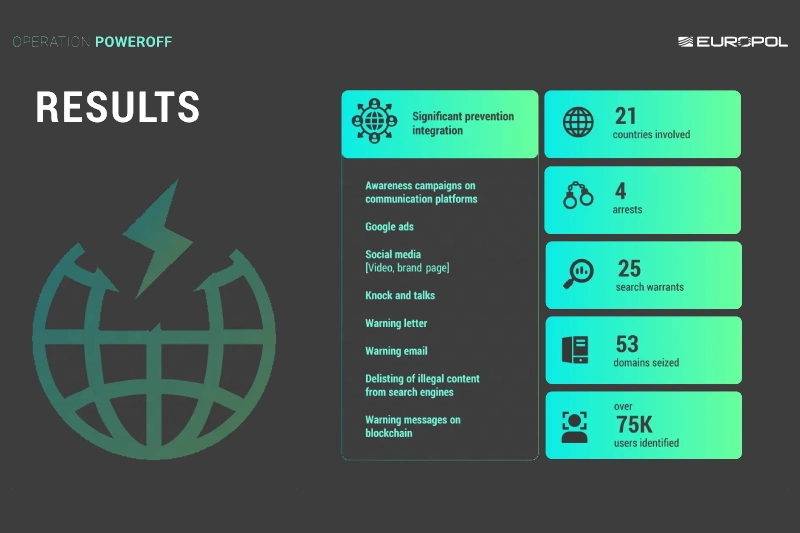
The coordinated effort led to the seizure of 53 domains, four arrests, 25 search warrants, and warning notices sent to more than 75,000 people suspected of using so-called “booter” or “stresser” platforms.

A Crackdown on DDoS-for-Hire

DDoS-for-hire platforms allow customers to pay relatively small fees to launch distributed denial-of-service attacks against websites, gaming services, businesses, and public infrastructure. In fact, AI-driven threat intelligence company Cyble, in a new research report released today said, DDoS was the primary mode of attack during the ongoing Iran-Israel and U.S. conflict. Cyble recorded a 140% increase in DDoS attacks targeting Israeli entities after September 2025, and at the height of the conflict, saw 40 DDoS attacks per day.

These DDoS-for-hire services often market themselves as legitimate stress-testing tools, but authorities say they are widely abused for harassment, extortion, and disruption.

The latest enforcement wave is part of the long-running international initiative known as "Operation PowerOFF," which has previously dismantled multiple booter services and disrupted related infrastructure.

Read: DDoS-for-Hire Empire Dismantled as Poland Arrests Four, U.S. Seizes Nine Domains

U.S. Authorities Seize Key Infrastructure

The U.S. Department of Justice said investigators in Alaska seized infrastructure linked to eight DDoS-for-hire domains, including services branded as Vac Stresser and Mythical Stress, both of which allegedly advertised the ability to launch tens of thousands of attacks per day. Investigators also searched backend servers tied to the platforms.

Officials did not immediately identify those behind the services, but said the action was intended to disrupt the technical backbone used to power attacks globally.

75,000 Users Contacted Directly

In one of the more unusual aspects of the operation, authorities contacted more than 75,000 suspected users directly through warning emails and letters.

Law enforcement agencies appear to be using deterrence alongside takedowns—sending a message that paying for DDoS attacks leaves a trail and may bring legal consequences.

Security experts say the tactic could be particularly effective against younger or low-level offenders who use these platforms for gaming disputes, personal retaliation, or vandalism without fully understanding the legal risks.

Investigators said they identified around three million criminal accounts connected to the wider DDoS-for-hire ecosystem. The sheer number of accounts shows how industrialized cybercrime services have become. Instead of building botnets or malware, users can simply rent attack capability on demand.

DDoS attacks overwhelm a target with traffic, often causing websites, applications, or networks to crash. While sometimes dismissed as nuisance attacks, they can disrupt hospitals, financial institutions, government portals, and emergency services.

Recent years have also seen DDoS attacks used as smokescreens to distract security teams while other intrusions unfold.

Read: Europol Issues Public Alert: ‘We Will Never Call You’ as Phone and App Scams Surge

A Persistent Cat-and-Mouse Game

Despite repeated takedowns, booter services often reappear quickly under new names, new domains, or relocated hosting providers. Researchers have found that while seizures can significantly reduce traffic in the short term, the market has proven resilient over time.

That means operations like PowerOFF may need to combine arrests, infrastructure seizures, financial disruption, and user deterrence to have lasting impact.

March 2026 Dark Web Issue Trends Report

Alert this report is a summary of deep web and dark web source-based material and contains some facts that cannot be fully verified due to the nature of the sources. Major Issues BreachForums’ internal collapse and attempts to rebuild were observed. trust was undermined by the betrayal of moderators and the movement of funds, and […]
❌