Visualização de leitura

Hackers Turn Trusted npm Mirrors Into Hosts for Fake Cloudflare ClickFix Pages.

Threat actors are abusing npm’s package-distribution ecosystem to host convincing fake Cloudflare verification pages on trusted mirror domains, turning developer infrastructure into a phishing delivery layer. OX Security said it identified 24 malicious npm packages containing identical HTML code designed to render a fake CAPTCHA page and redirect visitors to attacker-controlled infrastructure. The campaign does […]

The post Hackers Turn Trusted npm Mirrors Into Hosts for Fake Cloudflare ClickFix Pages. appeared first on GBHackers Security | #1 Globally Trusted Cyber Security News Platform.

Cloudflare Launches Open-Source OS to Secure AI Agents’ Access to Internal Data

Cloudflare has open-sourced Cloudflare OS, a platform designed to provide enterprise AI agents with controlled access to internal systems, company context, and workflows without exposing long-lived credentials or bypassing access controls. This release addresses a significant security challenge for enterprises: while agents need access to business data and tools to be effective, conventional API keys […]

The post Cloudflare Launches Open-Source OS to Secure AI Agents’ Access to Internal Data appeared first on GBHackers Security | #1 Globally Trusted Cyber Security News Platform.

‘CanisterWorm’ Springs Wiper Attack Targeting Iran

A financially motivated data theft and extortion group is attempting to inject itself into the Iran war, unleashing a worm that spreads through poorly secured cloud services and wipes data on infected systems that use Iran’s time zone or have Farsi set as the default language.

Experts say the wiper campaign against Iran materialized this past weekend and came from a relatively new cybercrime group known as TeamPCP. In December 2025, the group began compromising corporate cloud environments using a self-propagating worm that went after exposed Docker APIs, Kubernetes clusters, Redis servers, and the React2Shell vulnerability. TeamPCP then attempted to move laterally through victim networks, siphoning authentication credentials and extorting victims over Telegram.
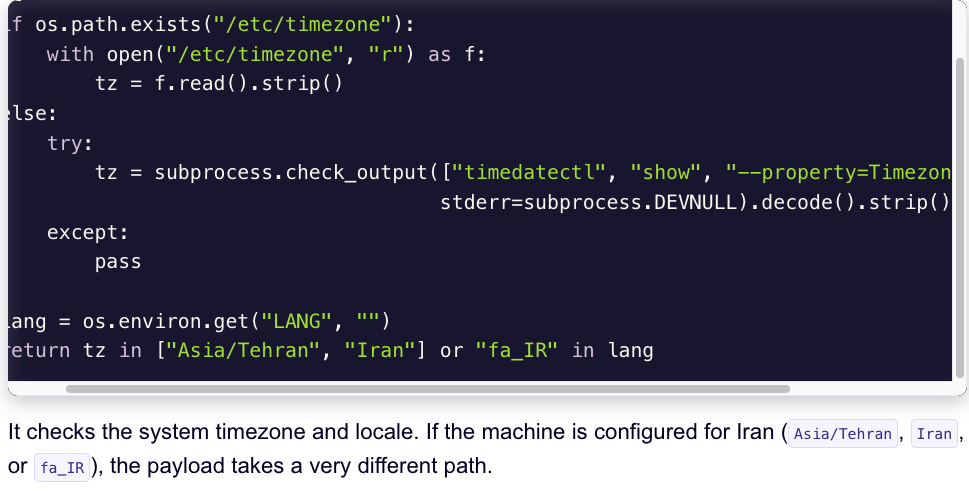
A snippet of the malicious CanisterWorm that seeks out and destroys data on systems that match Iran’s timezone or have Farsi as the default language. Image: Aikido.dev.

In a profile of TeamPCP published in January, the security firm Flare said the group weaponizes exposed control planes rather than exploiting endpoints, predominantly targeting cloud infrastructure over end-user devices, with Azure (61%) and AWS (36%) accounting for 97% of compromised servers.

“TeamPCP’s strength does not come from novel exploits or original malware, but from the large-scale automation and integration of well-known attack techniques,” Flare’s Assaf Morag wrote. “The group industrializes existing vulnerabilities, misconfigurations, and recycled tooling into a cloud-native exploitation platform that turns exposed infrastructure into a self-propagating criminal ecosystem.”

On March 19, TeamPCP executed a supply chain attack against the vulnerability scanner Trivy from Aqua Security, injecting credential-stealing malware into official releases on GitHub actions. Aqua Security said it has since removed the harmful files, but the security firm Wiz notes the attackers were able to publish malicious versions that snarfed SSH keys, cloud credentials, Kubernetes tokens and cryptocurrency wallets from users.

Over the weekend, the same technical infrastructure TeamPCP used in the Trivy attack was leveraged to deploy a new malicious payload which executes a wiper attack if the user’s timezone and locale are determined to correspond to Iran, said Charlie Eriksen, a security researcher at Aikido. In a blog post published on Sunday, Eriksen said if the wiper component detects that the victim is in Iran and has access to a Kubernetes cluster, it will destroy data on every node in that cluster.

“If it doesn’t it will just wipe the local machine,” Eriksen told KrebsOnSecurity.
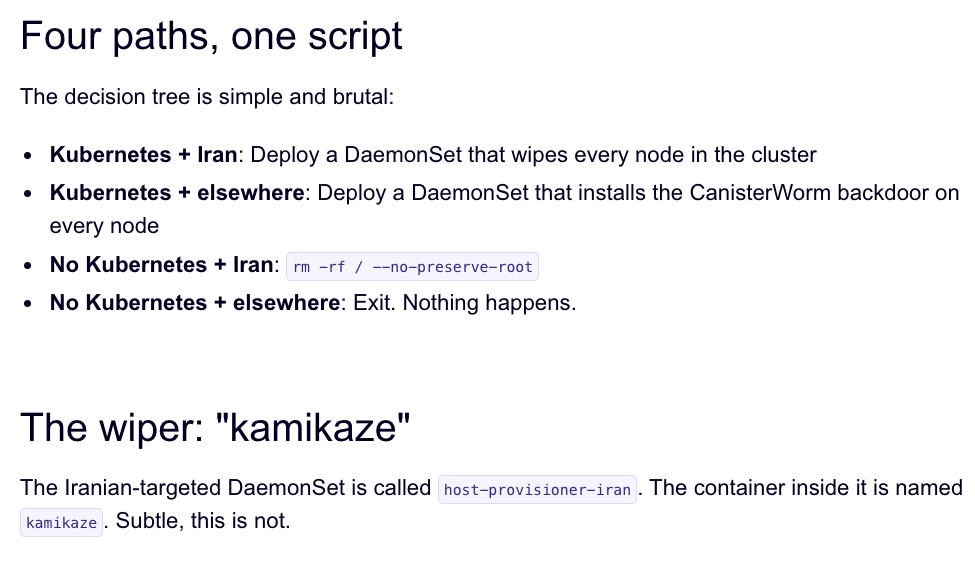
Image: Aikido.dev.

Aikido refers to TeamPCP’s infrastructure as “CanisterWorm” because the group orchestrates their campaigns using an Internet Computer Protocol (ICP) canister — a system of tamperproof, blockchain-based “smart contracts” that combine both code and data. ICP canisters can serve Web content directly to visitors, and their distributed architecture makes them resistant to takedown attempts. These canisters will remain reachable so long as their operators continue to pay virtual currency fees to keep them online.

Eriksen said the people behind TeamPCP are bragging about their exploits in a group on Telegram and claim to have used the worm to steal vast amounts of sensitive data from major companies, including a large multinational pharmaceutical firm.

“When they compromised Aqua a second time, they took a lot of GitHub accounts and started spamming these with junk messages,” Eriksen said. “It was almost like they were just showing off how much access they had. Clearly, they have an entire stash of these credentials, and what we’ve seen so far is probably a small sample of what they have.”

Security experts say the spammed GitHub messages could be a way for TeamPCP to ensure that any code packages tainted with their malware will remain prominent in GitHub searches. In a newsletter published today titled GitHub is Starting to Have a Real Malware Problem, Risky Business reporter Catalin Cimpanu writes that attackers often are seen pushing meaningless commits to their repos or using online services that sell GitHub stars and “likes” to keep malicious packages at the top of the GitHub search page.

This weekend’s outbreak is the second major supply chain attack involving Trivy in as many months. At the end of February, Trivy was hit as part of an automated threat called HackerBot-Claw, which mass exploited misconfigured workflows in GitHub Actions to steal authentication tokens.

Eriksen said it appears TeamPCP used access gained in the first attack on Aqua Security to perpetrate this weekend’s mischief. But he said there is no reliable way to tell whether TeamPCP’s wiper actually succeeded in trashing any data from victim systems, and that the malicious payload was only active for a short time over the weekend.

“They’ve been taking [the malicious code] up and down, rapidly changing it adding new features,” Eriksen said, noting that when the malicious canister wasn’t serving up malware downloads it was pointing visitors to a Rick Roll video on YouTube.

“It’s a little all over the place, and there’s a chance this whole Iran thing is just their way of getting attention,” Eriksen said. “I feel like these people are really playing this Chaotic Evil role here.”

Cimpanu observed that supply chain attacks have increased in frequency of late as threat actors begin to grasp just how efficient they can be, and his post documents an alarming number of these incidents since 2024.

“While security firms appear to be doing a good job spotting this, we’re also gonna need GitHub’s security team to step up,” Cimpanu wrote. “Unfortunately, on a platform designed to copy (fork) a project and create new versions of it (clones), spotting malicious additions to clones of legitimate repos might be quite the engineering problem to fix.”

Update, 2:40 p.m. ET: Wiz is reporting that TeamPCP also pushed credential stealing malware to the KICS vulnerability scanner from Checkmarx, and that the scanner’s GitHub Action was compromised between 12:58 and 16:50 UTC today (March 23rd).

The Cloudflare Outage May Be a Security Roadmap

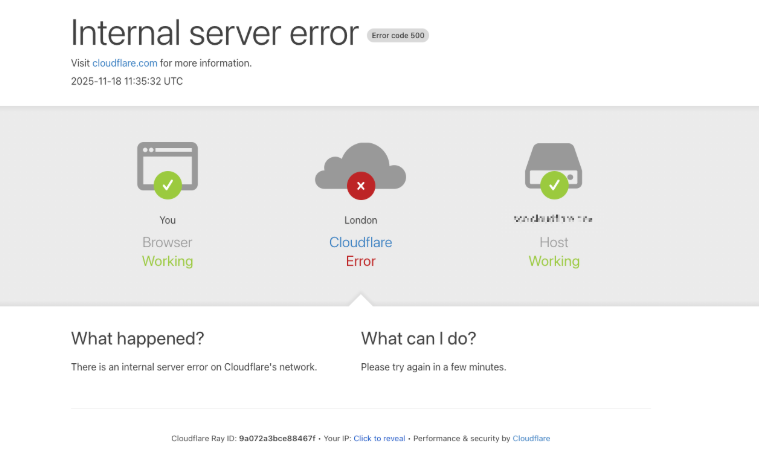
An intermittent outage at Cloudflare on Tuesday briefly knocked many of the Internet’s top destinations offline. Some affected Cloudflare customers were able to pivot away from the platform temporarily so that visitors could still access their websites. But security experts say doing so may have also triggered an impromptu network penetration test for organizations that have come to rely on Cloudflare to block many types of abusive and malicious traffic.

At around 6:30 EST/11:30 UTC on Nov. 18, Cloudflare’s status page acknowledged the company was experiencing “an internal service degradation.” After several hours of Cloudflare services coming back up and failing again, many websites behind Cloudflare found they could not migrate away from using the company’s services because the Cloudflare portal was unreachable and/or because they also were getting their domain name system (DNS) services from Cloudflare.

However, some customers did manage to pivot their domains away from Cloudflare during the outage. And many of those organizations probably need to take a closer look at their web application firewall (WAF) logs during that time, said Aaron Turner, a faculty member at IANS Research.

Turner said Cloudflare’s WAF does a good job filtering out malicious traffic that matches any one of the top ten types of application-layer attacks, including credential stuffing, cross-site scripting, SQL injection, bot attacks and API abuse. But he said this outage might be a good opportunity for Cloudflare customers to better understand how their own app and website defenses may be failing without Cloudflare’s help.

“Your developers could have been lazy in the past for SQL injection because Cloudflare stopped that stuff at the edge,” Turner said. “Maybe you didn’t have the best security QA [quality assurance] for certain things because Cloudflare was the control layer to compensate for that.”

Turner said one company he’s working with saw a huge increase in log volume and they are still trying to figure out what was “legit malicious” versus just noise.

“It looks like there was about an eight hour window when several high-profile sites decided to bypass Cloudflare for the sake of availability,” Turner said. “Many companies have essentially relied on Cloudflare for the OWASP Top Ten [web application vulnerabilities] and a whole range of bot blocking. How much badness could have happened in that window? Any organization that made that decision needs to look closely at any exposed infrastructure to see if they have someone persisting after they’ve switched back to Cloudflare protections.”

Turner said some cybercrime groups likely noticed when an online merchant they normally stalk stopped using Cloudflare’s services during the outage.

“Let’s say you were an attacker, trying to grind your way into a target, but you felt that Cloudflare was in the way in the past,” he said. “Then you see through DNS changes that the target has eliminated Cloudflare from their web stack due to the outage. You’re now going to launch a whole bunch of new attacks because the protective layer is no longer in place.”

Nicole Scott, senior product marketing manager at the McLean, Va. based Replica Cyber, called yesterday’s outage “a free tabletop exercise, whether you meant to run one or not.”

“That few-hour window was a live stress test of how your organization routes around its own control plane and shadow IT blossoms under the sunlamp of time pressure,” Scott said in a post on LinkedIn. “Yes, look at the traffic that hit you while protections were weakened. But also look hard at the behavior inside your org.”

Scott said organizations seeking security insights from the Cloudflare outage should ask themselves:

1. What was turned off or bypassed (WAF, bot protections, geo blocks), and for how long?
2. What emergency DNS or routing changes were made, and who approved them?
3. Did people shift work to personal devices, home Wi-Fi, or unsanctioned Software-as-a-Service providers to get around the outage?
4. Did anyone stand up new services, tunnels, or vendor accounts “just for now”?
5. Is there a plan to unwind those changes, or are they now permanent workarounds?
6. For the next incident, what’s the intentional fallback plan, instead of decentralized improvisation?

In a postmortem published Tuesday evening, Cloudflare said the disruption was not caused, directly or indirectly, by a cyberattack or malicious activity of any kind.

“Instead, it was triggered by a change to one of our database systems’ permissions which caused the database to output multiple entries into a ‘feature file’ used by our Bot Management system,” Cloudflare CEO Matthew Prince wrote. “That feature file, in turn, doubled in size. The larger-than-expected feature file was then propagated to all the machines that make up our network.”

Cloudflare estimates that roughly 20 percent of websites use its services, and with much of the modern web relying heavily on a handful of other cloud providers including AWS and Azure, even a brief outage at one of these platforms can create a single point of failure for many organizations.

Martin Greenfield, CEO at the IT consultancy Quod Orbis, said Tuesday’s outage was another reminder that many organizations may be putting too many of their eggs in one basket.

“There are several practical and overdue fixes,” Greenfield advised. “Split your estate. Spread WAF and DDoS protection across multiple zones. Use multi-vendor DNS. Segment applications so a single provider outage doesn’t cascade. And continuously monitor controls to detect single-vendor dependency.”

❌