Visualização de leitura

July 2026 Dark Web Threat Actor Trend Report

Note The July 2026 Dark Web Threat Actor Trend Report focuses on trends among threat actors—including hacktivists—active on the deep web and dark web. It is explicitly noted that the factual accuracy of some content could not be verified. Major Issues Handala claimed to have compromised the core infrastructure of an Internet service provider in […]

Iran-Linked Actors Breach Are Targeting US Water and Energy Control Systems

US agencies warn Iran-linked actors are targeting internet-exposed water and energy control systems, risking disruption.

Federal agencies updated their cybersecurity advisory this week: Iran-linked actors are inside American water and energy control systems, and they’re not just looking around. They’re changing things.

The updated advisory from CISA, the FBI, NSA, and the Department of Energy says these actors are getting into programmable logic controllers, the small industrial computers that run pumps, valves, and safety alarms. Once inside, they can mess with what operators see on their screens. That’s how you get outages nobody saw coming.

“The authoring agencies urgently warn U.S. organizations of ongoing Iranian-affiliated cyber targeting of internet-connected operational technology (OT) devices, including programmable logic controllers (PLCs).” reads the advisory. “These actions disrupted PLCs across several U.S. critical infrastructure sectors through malicious project file interactions and manipulation of data on human machine interface (HMI) and supervisory control and data acquisition (SCADA) displays, resulting in operational disruption and financial loss.”

This isn’t new territory. Back in April, the same agencies flagged Iranian hackers going after Rockwell Automation controllers specifically. The updated advisory widens the net. Now Schneider Electric and Siemens equipment is on the list too.

US agencies have expanded guidance on detecting malicious code changes in PLCs after observing attacks targeting Rockwell Automation, Schneider Electric, Siemens, and other internet-exposed industrial controllers.

Attackers access exposed devices via OT ports (44818, 2222, 102, 502) and modems over SSH (port 22), then exfiltrate PLC project files using vendor tools such as Studio 5000, EcoStruxure Control Expert, and TIA Portal. They modify or delete project logic, including Add-On Instructions (AOIs), manipulate HMI and SCADA displays, and disable shutdown and alarm functions, allowing industrial systems to enter unsafe states without alerting operators.

Organizations should follow vendor security best practices, remove PLCs from direct internet access using secure gateways and firewalls, and monitor logs for indicators of compromise and suspicious traffic on OT ports such as 44818, 2222, 102, and 502. Rockwell users should set controllers to Run mode, while suspected victims should contact vendors and federal agencies.

The agencies say potentially any internet-exposed industrial control system could be a target. Here’s the part that should make plant operators lose some sleep. In one case, the hackers didn’t just peek at a system. They rewrote the controller’s programming logic to disable the processes meant to trigger shutdowns and alarms during dangerous conditions.

“At one U.S. victim, the FBI observed the APT actors download a malicious project file to a targeted PLC using configuration software. Analysis indicated the project file retained ladder logic for downstream function but added logic that overrode specific instruction sets responsible for maintaining safe operating parameters in the victim’s environment.

“Since at least March 2026, the authoring agencies identified (through engagements with victim organizations) an Iranian-affiliated APT group disrupted the function of PLCs.” states the advisory. “Organizations across several U.S. critical infrastructure sectors (including Government Services and FacilitiesWWS, and Energy Sectors) deployed these PLCs within a wide variety of industrial automation processes. Some of the victims experienced operational disruption and financial loss.”

Systems could then drift into unsafe territory with nobody watching the warning lights, because the warning lights had been switched off from the inside.

“After the actors extracted device project files, the FBI and CISA identified the modification and deletion of project file logic, to include Add-On Instructions (AOIs) and data manipulation on HMI and SCADA displays [T1565].” continues the advisory.” Additionally, the changes disabled critical shutdown and alarm logic, allowing systems to enter unsafe conditions without notifying operators of the anomalies.”

The advisory ties the activity to the ongoing conflict between Iran and the US and Israel, framing it as an effort to cause disruption inside the United States. It fits a pattern going back to February, when the war started and Iranian-linked hacking picked up sharply across the region.

Not all of it looks like this. Some of it has been standard espionage and embarrassment campaigns, like the leak of FBI Director Kash Patel’s personal email account. Some of it has been genuinely destructive. The Iranian group known as Handala remotely wiped tens of thousands of employee devices at medical device maker Stryker, and separately claimed a breach at California’s Cal Water, saying it could disrupt the water supply. Cal Water pushed back, saying it found no sign anyone had touched its operational networks.

That’s the pattern worth watching: espionage on one track, disruption on another, and now a wider set of manufacturers exposed on the operational technology side. If your PLC talks to the internet, it’s not a bystander anymore.

Nobody wants their water plant’s alarm system to be the one thing an adversary quietly switches off. Time to check who can actually reach those controllers from outside.

Follow me on Twitter: @securityaffairs and Facebook and Mastodon

Pierluigi Paganini

(SecurityAffairs – hacking, Iran-Linked Actors)

Dark Web Threat Actor Trend Report, April 2026

Notes the April 2026 Dark Web Threat Actor Trend Report summarizes trends in hacktivists and threat actors operating on the deep web and dark web. due to the nature of the sources, some of the information is difficult to fully verify as factual. Major Issues NoName05716 claimed repeated DDoS attacks against dozens of organizations, including […]

March 2026 Dark Web Threat Actor Trends Report

Alerts this report is a compilation of trends centered on hacktivists operating on the deep web and dark web. some alleged attacks are labeled as observations due to limited independent technical verification. Major Issues Handala’s multi-pronged offensive stood out. The group used a combination of psychological warfare and subversive attacks, including a claimed FBI-linked domain […]

Iran-Backed Hackers Claim Wiper Attack on Medtech Firm Stryker

A hacktivist group with links to Iran’s intelligence agencies is claiming responsibility for a data-wiping attack against Stryker, a global medical technology company based in Michigan. News reports out of Ireland, Stryker’s largest hub outside of the United States, said the company sent home more than 5,000 workers there today. Meanwhile, a voicemail message at Stryker’s main U.S. headquarters says the company is currently experiencing a building emergency.

Based in Kalamazoo, Michigan, Stryker [NYSE:SYK] is a medical and surgical equipment maker that reported $25 billion in global sales last year. In a lengthy statement posted to Telegram, a hacktivist group known as Handala (a.k.a. Handala Hack Team) claimed that Stryker’s offices in 79 countries have been forced to shut down after the group erased data from more than 200,000 systems, servers and mobile devices.
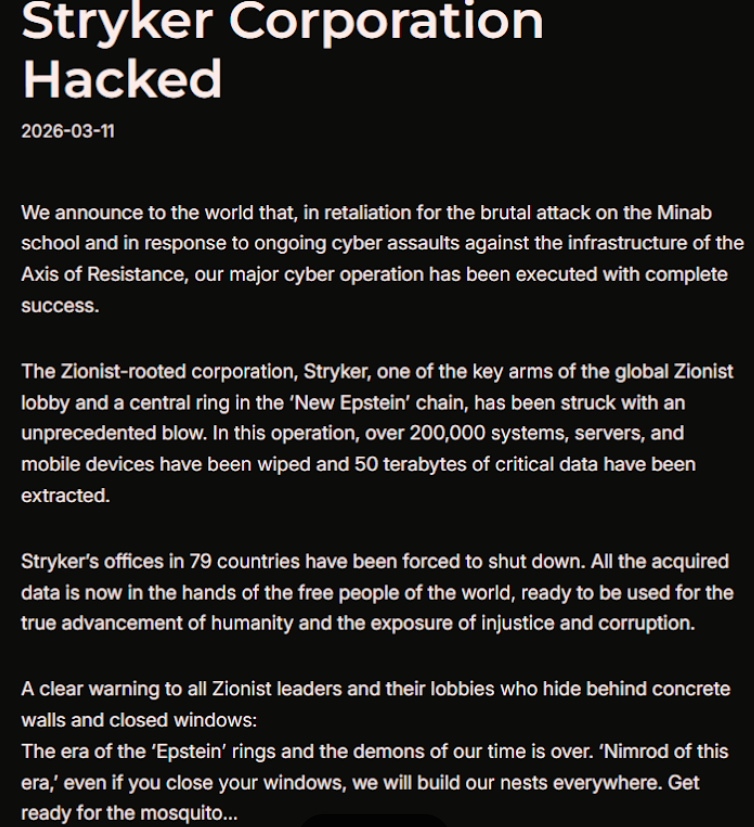
A manifesto posted by the Iran-backed hacktivist group Handala, claiming a mass data-wiping attack against medical technology maker Stryker.

A manifesto posted by the Iran-backed hacktivist group Handala, claiming a mass data-wiping attack against medical technology maker Stryker.

“All the acquired data is now in the hands of the free people of the world, ready to be used for the true advancement of humanity and the exposure of injustice and corruption,” a portion of the Handala statement reads.

The group said the wiper attack was in retaliation for a Feb. 28 missile strike that hit an Iranian school and killed at least 175 people, most of them children. The New York Times reports today that an ongoing military investigation has determined the United States is responsible for the deadly Tomahawk missile strike.

Handala was one of several hacker groups recently profiled by Palo Alto Networks, which links it to Iran’s Ministry of Intelligence and Security (MOIS). Palo Alto says Handala surfaced in late 2023 and is assessed as one of several online personas maintained by Void Manticore, a MOIS-affiliated actor.

Stryker’s website says the company has 56,000 employees in 61 countries. A phone call placed Wednesday morning to the media line at Stryker’s Michigan headquarters sent this author to a voicemail message that stated, “We are currently experiencing a building emergency. Please try your call again later.”

A report Wednesday morning from the Irish Examiner said Stryker staff are now communicating via WhatsApp for any updates on when they can return to work. The story quoted an unnamed employee saying anything connected to the network is down, and that “anyone with Microsoft Outlook on their personal phones had their devices wiped.”

“Multiple sources have said that systems in the Cork headquarters have been ‘shut down’ and that Stryker devices held by employees have been wiped out,” the Examiner reported. “The login pages coming up on these devices have been defaced with the Handala logo.”

Wiper attacks usually involve malicious software designed to overwrite any existing data on infected devices. But a trusted source with knowledge of the attack who spoke on condition of anonymity told KrebsOnSecurity the perpetrators in this case appear to have used a Microsoft service called Microsoft Intune to issue a ‘remote wipe’ command against all connected devices.

Intune is a cloud-based solution built for IT teams to enforce security and data compliance policies, and it provides a single, web-based administrative console to monitor and control devices regardless of location. The Intune connection is supported by this Reddit discussion on the Stryker outage, where several users who claimed to be Stryker employees said they were told to uninstall Intune urgently.

Palo Alto says Handala’s hack-and-leak activity is primarily focused on Israel, with occasional targeting outside that scope when it serves a specific agenda. The security firm said Handala also has taken credit for recent attacks against fuel systems in Jordan and an Israeli energy exploration company.

“Recent observed activities are opportunistic and ‘quick and dirty,’ with a noticeable focus on supply-chain footholds (e.g., IT/service providers) to reach downstream victims, followed by ‘proof’ posts to amplify credibility and intimidate targets,” Palo Alto researchers wrote.

The Handala manifesto posted to Telegram referred to Stryker as a “Zionist-rooted corporation,” which may be a reference to the company’s 2019 acquisition of the Israeli company OrthoSpace.

Stryker is a major supplier of medical devices, and the ongoing attack is already affecting healthcare providers. One healthcare professional at a major university medical system in the United States told KrebsOnSecurity they are currently unable to order surgical supplies that they normally source through Stryker.

“This is a real-world supply chain attack,” the expert said, who asked to remain anonymous because they were not authorized to speak to the press. “Pretty much every hospital in the U.S. that performs surgeries uses their supplies.”

John Riggi, national advisor for the American Hospital Association (AHA), said the AHA is not aware of any supply-chain disruptions as of yet.

“We are aware of reports of the cyber attack against Stryker and are actively exchanging information with the hospital field and the federal government to understand the nature of the threat and assess any impact to hospital operations,” Riggi said in an email. “As of this time, we are not aware of any direct impacts or disruptions to U.S. hospitals as a result of this attack. That may change as hospitals evaluate services, technology and supply chain related to Stryker and if the duration of the attack extends.”

According to a March 11 memo from the state of Maryland’s Institute for Emergency Medical Services Systems, Stryker indicated that some of their computer systems have been impacted by a “global network disruption.” The memo indicates that in response to the attack, a number of hospitals have opted to disconnect from Stryker’s various online services, including LifeNet, which allows paramedics to transmit EKGs to emergency physicians so that heart attack patients can expedite their treatment when they arrive at the hospital.

“As a precaution, some hospitals have temporarily suspended their connection to Stryker systems, including LIFENET, while others have maintained the connection,” wrote Timothy Chizmar, the state’s EMS medical director. “The Maryland Medical Protocols for EMS requires ECG transmission for patients with acute coronary syndrome (or STEMI). However, if you are unable to transmit a 12 Lead ECG to a receiving hospital, you should initiate radio consultation and describe the findings on the ECG.”

This is a developing story. Updates will be noted with a timestamp.

Update, 2:54 p.m. ET: Added comment from Riggi and perspectives on this attack’s potential to turn into a supply-chain problem for the healthcare system.

Update, Mar. 12, 7:59 a.m. ET: Added information about the outage affecting Stryker’s online services.

❌