❌

Visualização de leitura

Workday launches Sana-based UI, autopilot agents, as it deepens its focus on AI

When Workday acquired Sana just about a year ago, it said that the combination of Sana’s AI with Workday’s platform would create a new “front door” to work. Today at its Workday Rising conference, it unveiled that front door, turning Sana into Workday’s default home screen that, it said, “brings tasks, decisions, meetings, and agent activity into one place, helping employees move directly from what needs attention to getting it done.”

The new interface goes beyond merely answering questions to orchestrating Workday’s agents to execute tasks. Each employee’s experience is tailored to their role; when they open the application, they see the tasks and decisions that need their attention and can take action directly from the UI. And, using TypeSafe’s Jev AI model, Sana adapts its UI to each task, the company said, generating forms, calendars, approval cards, visualizations, and other interactive experiences in real time and completing tasks once the employee approves the action. It also supports work that spans multiple days, displaying relevant information at every stage of functions such as financial closing or preparation of workforce plans by HR.

Sana also works within other AI tools and platforms including Anthropic Claude, Google Cloud’s Gemini Enterprise, and Microsoft Copilot, as well as within Microsoft Teams and Slack. But, Workday said in its announcement, “third-party AI tools and platforms never get raw access to Workday data — they can now access this data through Sana, and Sana does the reasoning, applies each company’s own permissions, approvals, and policies, and carries out the work so actions are lawful by design and recorded, regardless of the tool it started in.”

Along with the Sana home page, known as Workday Home, the company introduced Sana Concierge, which brings together the self-service capabilities and Sana for IT Service Management released earlier this year with Workday Help and Case Agent to create AI-native employee services spanning HR and IT. Workday said it can resolve requests such as password resets, access requests, and questions about time off and payroll, as well as performing onboarding and offboarding. The employee just submits a natural language request, and Concierge looks up relevant policies and, based on the employee’s Workday information, guides them through the steps to complete their request.

If a human decision is needed, Concierge routes the request to the right person in the background, but remains the employee’s point of contact.

The Sana Workday Home experience is available today, with more capabilities and support “coming soon,” the company said. Sana Concierge is available now to early adopter customers, with general availability expected in the first quarter of 2027.

From copilots to autopilots

The company also introduced four new autonomous AI agents that act as autopilots across hiring, payroll, accounting, and compliance.

“From co-pilots to autopilots, that’s a big transition that you will see across our agents today,” said Joel Hellermark, former CEO of Sana, who is now Workday’s chief AI officer. “These are now agents that anticipate what needs attention, they apply the company’s policies, they advise on the next step, and then act once the appropriate person approves that. And these autopilots run completely on Workday’s rails, so they’re self-governed and compliant.”

And, he said, while a typical copilot-driven system “sits there” until the user logs in, autopilot agents run on a heartbeat, operating whether or not the user is online.

The Talent Acquisition Agent, for example, monitors the open job queue from the time a position is posted, finding qualified candidates and giving the recruiter information about them. It can generate outreach to potential hires and present it to the recruiter for approval, explain why candidates on a short list are a good fit, and schedule interviews with those the recruiter flags. It then automatically joins the interview and takes notes. Based on recruiter feedback, the agent learns how to improve its recommendations.

The agent works across multiple recruiting tools, including Workday Recruiting, HiredScore, Paradox, native Workday skills, and connected sourcing providers. The autopilot capabilities are available to early adopter customers today, with general availability planned for early 2027.

Three more autopilots will arrive for early adopters in early 2027, for Payroll Agent, Accounting Agent, and Deployment Agent.

This could be the start of a change in the coordination of work, said Melody Brue, analyst in residence at Moor Insights & Strategy. “Workday is trying to connect more of the work around a decision, from weighing options to carrying out the approved plan,” she said. “Sana could become the starting point for that process, giving Workday a larger role in coordinating work beyond its own applications. For current customers, the meaningful change would be less manual coordination between a request, an approval, and a completed transaction. The value depends on whether that reduces the work employees have to manage or shifts it into resolving exceptions when a workflow crosses systems.”

Extending Decision Intelligence

Workday Decision Intelligence, first seen in Adaptive from Workday, is spreading into more areas of the business, said Yasmeen Ahmad, SVP and GM, Workday Data Cloud.

Decision Intelligence is not an agent performing a task, she said. “It’s a planning and reasoning experience built for decisions that are too complex, too high stakes, or too cross-functional for any single task to capture.”

Ahmad described a scenario in which HR revised a hiring plan using Decision Intelligence, passing it to Finance to use as an input for reviewing its quarterly projections with the same tool.

“Normally this would have taken six weeks, five spreadsheets, and analysts trying to stitch it together. Today, it was all just a prompt,” she said.

Brue said that what she finds interesting is whether Workday can take more of the manual modeling out of a staffing discussion. “Workday already supports connected workforce and financial planning,” she said. “If teams can work through several options with fewer model adjustments and less reliance on specialists for routine ones, planning could be more responsive when business needs change.”

Work Intelligence

Work Intelligence, available to early access Workday Human Capital Management customers, breaks jobs into their component tasks, describing the skills employees need to perform them. It draws on Workday Skills Cloud, giving leaders a look at how jobs are changing, and then, using Decision Intelligence, companies can get a picture of their internal readiness for evolving work.

“The task-level analysis is worth watching,” Brue said. “A role is rarely entirely automatable or entirely human-led. Looking inside the role could give customers a more useful basis for redesigning work. But saving time across a dozen tasks doesn’t automatically free someone up for a different assignment. Companies may need to regroup the work, letting agents handle routine steps together and giving employees clear responsibility for what comes next.”

Off with its head

Workday also announced that its Trusted Agent Platform, on which organizations build and run AI agents governed by their business rules, is now headless, allowing customers to use the development tools and models of their choice. It brings together the existing Workday Data Cloud, Agent-Ready Tools, Developer Agent, custom agents, and Agent Harness.

However, Workday CTO Gabe Monroy emphasized that, at the same time, “headless can’t mean lawless. The rules for HR and finance already live in Workday, so customers don’t have to rebuild them for every agent they create. This is what lets companies move fast with agents without losing control.”

And, to enhance the controls, in early 2027 the company will add Agent Context Service and Grounded Reasoning to Agent Harness to provide Workday context that agents need and check requests against company policies, business processes, and tenant data before the agent is allowed to act.

“Governance gets more consequential as agents move from recommendations to actions,” Brue pointed out. “An agent can be authorized and still make the wrong call. Customers need to distinguish permission to recommend from permission to execute. And know which actions require human approval, especially in hiring and finance. The governance question extends to any workflow that crosses platforms. Customers need clear ownership of approvals, exceptions, and the audit trail when a request starts in one system, and an agent acts in another.”

For companies already using Workday and ServiceNow together, she said, there’s an additional consideration: Workday’s expansion into employee-facing AI and agent governance could create more overlap between platforms that have traditionally played complementary roles.

“Joint customers don’t suddenly need to choose one, but they may need to clarify which platform coordinates the work and how controls operate across both,” she said. “A unified experience won’t necessarily mean unified control.”

A human rubber stamp on AI-based HR decisions won’t satisfy California’s No Robo Bosses law

California is setting a precedent for AI use in scenarios where workers’ jobs are at stake.

Governor Gavin Newsom this week signed the No Robo Bosses Act (SB 947), which bans employers from relying solely on AI-powered automated decision-making systems (ADS), also known as “bossware,” to discipline or terminate workers.

Introduced by Senator Jerry McNerney, the act is the first of its kind in the US. It is set to take effect on July 1, 2027.

While applauded by many, on a wider scale, No Robo Bosses raises questions about what adequate human oversight looks like in this age of AI.

“A machine can recommend, but a human must decide,” noted Frank Dickson of Dickson Research. “The hard part is defining what ‘decide’ means.”

Combating AI bias and ‘troubling’ errors

ADS platforms are becoming ever more prevalent in hiring, as they promise to speed up and streamline HR processes, maximize productivity, and reduce costs. According to reports, more than half of employers use ADS to help make decisions around restructuring and role planning.

But, McNerney and others contended, AI is prone to bias and misjudgment, and there are examples of ADS making “troubling” errors, including mistaken firings. Meanwhile, on-device “bossware” or “tattleware” employee monitoring and productivity tracking software could potentially be used in reprimanding or firing decisions.

AI recruitment tools have similarly come under scrutiny of late, with job seekers alleging that platforms like Workday discriminate based on age, race, and disability.

To combat these issues, the bill, SB 947, seeks to set guardrails around AI use in the workplace. The legislation mandates human oversight and verification when enterprises apply ADS tools, and employers must inform workers if they have used them when making decisions about their jobs.

Further, SB 947 prohibits the use of ADS and bossware systems that analyze personal information and behaviors to essentially predict how employees will perform or act in the future. And at a worker’s request, employers must provide at least one year of the data used by an ADS system to make a disciplinary, termination, or deactivation decision.

Enterprises found violating any of these provisions are subject to a $500 civil penalty per violation.

“Employers are devastating workers’ livelihoods and taking no responsibility for the callous decisions of this unchecked technology,” said Lorena Gonzalez, president of the California Federation of Labor Unions, AFL-CIO. “This is unacceptable. We need stronger guardrails to make sure there is human review and oversight of any decision made by a machine that impacts a worker’s job and paycheck.”

Promoting decisions based on context, evidence

Dickson pointed out that the law is narrower than its name implies: ‘No Robo Bosses’ sounds like a ban, but it is not. “The law does not keep AI out of the decision. It keeps a human in it,” he said.

According to the legislation, a human must corroborate the system’s output using the data behind it and other supporting information like performance evaluations, personnel files, work product, peer reviews, or witness interviews. If the reviewer finds the output inaccurate, incomplete, or misleading, the employer cannot use it, Dickson said.

“The test is whether the human checked the evidence and had the power to say no [to the AI’s decision],” he said, observing that a manager simply forwarding the bot’s verdict is a mail carrier, not a decision maker. In a sense, it’s like an instant replay in sporting events: The umpire watches the video and makes a judgment call, rather than just rereading the call from the field.

“What matters is that they examined the evidence, not just the conclusion,” Dickson said. An employee’s disciplinary or termination notice must disclose whether an AI system was used, and confirm that a human reviewed and corroborated the decision. Human accountability is the point here; an employer owns the final decision.

“Accountability can’t be shifted to the AI,” said Valence Howden, advisory fellow at Info-Tech Research Group. How it comes to its conclusions must be continuously assessed for bias, error, and drift. 

“The bot has no human compass for rationale, and context is defined by who controls its model,” Howden said. “Without context, the human has no impact on the end result, and, given the rate of failure here, there are many (legal and other) implications.”

What enterprises can take away from California’s example

The grey area in the bill is the phrase “primarily relies,” Dickson pointed out; it does not specifically define what that means. “A prudent employer may assume that if the system’s output started the conversation, the decision is in scope, and document accordingly,” he said.

Enterprises should consider five factors when developing a plan around discipline and termination, he said:

  1. Inventory: Know which tools score, rank, or flag employees. McNerney’s office cites hundreds of “bossware” products on the market, and many enterprises may not know which ones their managers use.
  2. Reviewers: Name who corroborates decisions, train them, and give them real authority to overrule the system.
  3. Data access: A reviewer cannot corroborate what they cannot see. If a vendor cannot show the inputs behind an output, the tool may be unusable for these decisions. That condition belongs in the contract.
  4. Records: Keep the evidence that the reviewer examined, as employees have the right to request the personal data used.
  5. Notice: Build a plain-language, standalone notice template now.

Dickson said that this is an IT problem as much as an HR one.

“Corroboration requires that the inputs to every automated decision are logged, retained, and retrievable by someone outside IT,” he said. “That is an architecture decision, and the CIO makes it.” And, while the $500 penalty might sound small, larger exposure may come later during wrongful termination disputes in which “the algorithm said so” proves a weak defense.

Info-Tech’s Howden advised enterprises to identify their high-risk, high-human-impact scenarios and cases, clarify which decisions, activities, and actions AI can take, and tag those that require human validation and involvement. They should also look at the volume and scale of these types of action so that volume alone doesn’t become a challenge to human involvement.

This is AI governance at a foundational level, Howden noted. “AI shouldn’t be allowed to make irreversible or material decisions and changes without oversight,” he said.

Ultimately, this move may drive enterprises to actually understand the criteria for hiring and firing, and look for issues and biases in the way decisions are made before an AI exposes poor decision logic and removes critical people. “Legal implications are more likely to shape the direction,” Howden said, “especially with the disclosure requirement.”

AI and the impending third technology talent drought

Every technology professional working today owes their career, in part, to someone who took a chance on them. The software engineers, cybersecurity analysts and infrastructure specialists on our teams didn’t arrive fully formed and ready to perform. Someone hired them, trained them and gave them room to grow. That’s worth remembering now, because the tech talent pipeline is shrinking, and history shows it can take more than a decade to recover from a decline like this.

The pipeline is at risk on two fronts: fewer students are choosing to study computer and information science, and hiring managers anticipate weaker near-term demand for these graduates. This isn’t unprecedented. The computing profession has weathered two major talent declines in its short history, and each took more than a decade to recover.

After 15 years of growth, computing enrollment reverses

According to the U.S. National Center for Education Statistics, the number of computer science and information science B.S. graduates has grown steadily since 2010. A tech degree once meant a well-paying job and a career with a future, driven largely by increased demand for technology. That momentum now appears to be reversing across several regions of the world.

Research from the National Student Clearinghouse Research Center indicates that enrollment in CS and IS degree programs at U.S. colleges and universities fell by more than 8% in 2025, even as overall undergraduate enrollment grew by 1%. The trend is not confined to the U.S. According to BCS, the Chartered Institute for IT, the UK saw a similar decline, with 18-year-old UK students entering computing degree programs down 9% in 2025. In Australia, the decline appears even steeper. ACS/Information Age reports that the Australasian Conference of Tertiary Admissions Centres’ (ACTAC) January 2026 report shows a 21% decline in enrollment for IT-related degrees heading into 2026.

Three countries, three distinct education systems, one common outcome. What makes this notable isn’t any single data point but the swift, dramatic downturn across all three countries. If this were confined to one market, it could be dismissed as a local correction; however, a similar pattern across the United States, the United Kingdom and Australia at roughly the same time suggests a structural shift in how the next generation views a tech career.

What 1,200 tech leaders expect: Lower demand for graduates

If the problem were only fewer graduates, but hiring demand were strong, the situation would probably correct itself. Talent scarcity would drive up wages and attract more students. However, the demand side appears to be contracting as well.

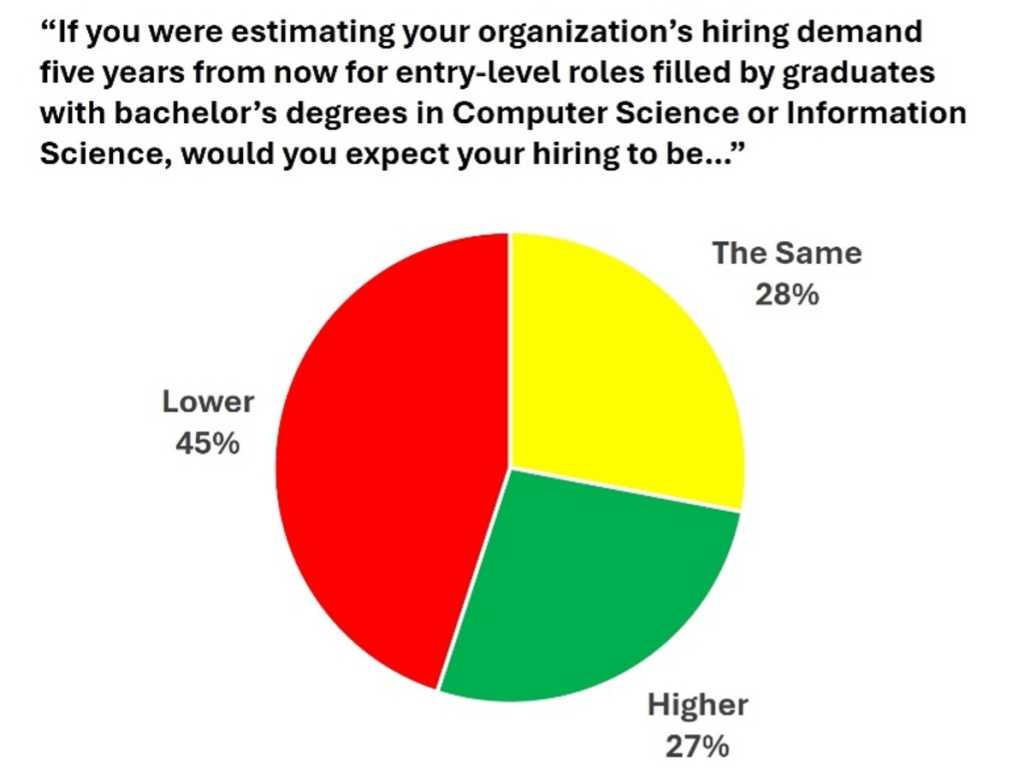
In the second quarter of 2026, I surveyed more than 1,200 senior technology leaders across 53 countries and what they expected their organization’s hiring demand to look like five years from now for entry-level roles filled by graduates with bachelor’s degrees in computer science or information science. Respondents held titles including CIO, CTO, VP of IT and Head of IT. More than 6,600 surveys were sent to technology leaders via LinkedIn, resulting in a 19% response rate.

The results were sobering: 45% anticipated lower demand, 28% expected demand to remain the same, while 27% anticipated it to increase. (You can download a summary of the survey at https://www.impactfultechnologyleader.com).

This result was not limited to a specific country or region. Those expecting hiring demand to be lower in five years were in the majority across almost every country, industry and company size.

The reason, cited across every group, was the same: artificial intelligence. Leaders expect AI to automate much of the entry-level technical work, including routine coding, service-desk tickets and administrative tasks. This is the work where new graduates have traditionally begun their careers. The logic is that existing teams, aided by AI, can do more without adding entry-level employees.

Regardless of their responses to the survey question, many of the leaders noted that reducing the number of junior roles in their organization was problematic. They recognized that it would erode the pipeline for future senior talent and that recovery from this gap would take years.

We’ve seen this movie before

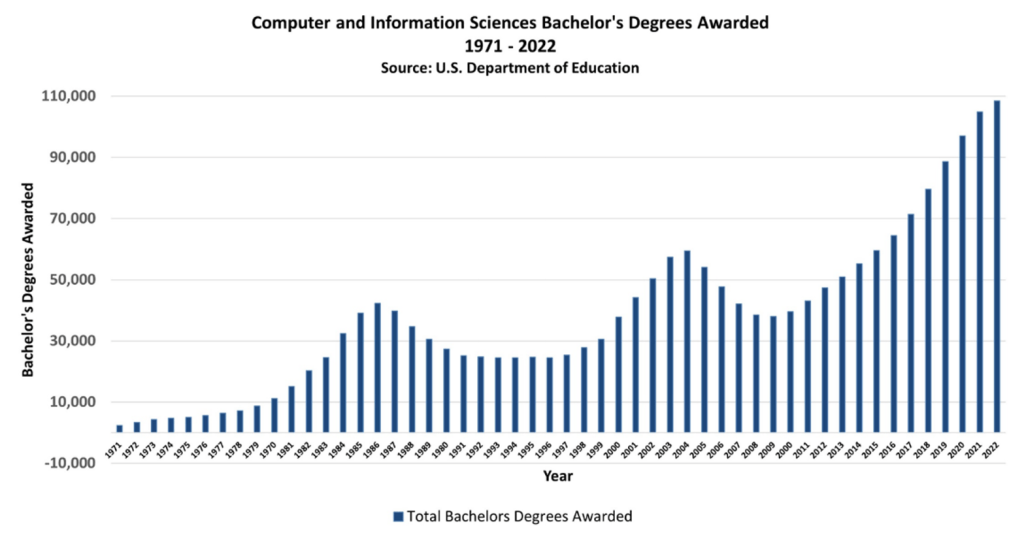
This is not the first time CS and IS graduate numbers have fallen. In the mid-1980s, universities were overwhelmed by demand for computing degrees and couldn’t staff their programs adequately. When computer science programs could no longer accommodate surging student interest, universities capped enrollment and tightened admission standards. The effect was dramatic: bachelor’s degrees in computer and information sciences fell sharply beginning in 1987. It was not until 2001, fifteen years later, that graduation rates recovered to their earlier level.

The second decline came in the early 2000s, in what might be called a perfect storm. The winding down of Y2K remediation, the bursting of the dot-com bubble and a rising wave of IT offshoring converged to shake confidence in technology as a career. Mass layoffs swept through IT departments and dot-com firms, and enrollment in computing programs fell once again. The resulting drop in tech degrees awarded began around 2005, and it was not until 2016, eleven years later, that graduation rates recovered to the same level.

The chart below from the U.S. National Center for Education Statistics depicts these two significant declines in graduates with technology degrees.

Is AI the new perfect storm?

If you map today’s forces onto that history, the parallels are hard to miss. AI-driven automation is creating a demand shock, declining technology enrollments are creating a supply shock, and growing skepticism about the value of a technology degree is creating a confidence shock. This mirrors the erosion of faith in the career path after the dot-com bubble burst.

What took three separate crises to unfold in the early 2000s is converging today into a single, self-reinforcing cycle: fewer students entering the field, fewer opportunities perceived to be waiting for them, and growing doubts about whether a technology career is still worth pursuing.

But the parallel to those earlier declines carries a warning, not a reassurance, and the difference is in how each one ended. The recoveries of 2001 and 2016 happened because demand never left. In both prior declines, the supply of graduates fell while the underlying need for tech professionals rebounded. That gap between shrinking supply and steady demand is exactly what refilled the pipeline: scarcity pushed up wages, wages pulled students back and the market corrected itself, however slowly. What makes today different is that supply and demand are falling together. If leaders are correct that AI will replace entry-level work, this is not a demand dip waiting to rebound, it is a demand replacement, with no scarcity signal to trigger the correction that saved the field twice before.

The most dangerous feature of a talent pipeline is its lag. The decisions made, or not made, over the next few years will not trigger a crisis next quarter or even next year. Their consequences will surface a decade or more from now, when today’s would-be entry-level personnel should have become tomorrow’s architects, technical experts and leaders.

By then, the shortage will already be baked into the pipeline. And that is not speculation. It is the exact pattern the historical record has already shown us, twice.

What is a technology leader to do?

It would be easy to read my survey results and conclude that the market will sort itself out. Nearly half of the IT leaders I surveyed plan to hire fewer entry-level computing graduates over the next five years. Many dismiss this: education will adapt, five years is an eternity and better tools will make new graduates more capable than ever. They may be right. But hope is not a workforce strategy, and the leaders best positioned five years from now will be those who treat this as a problem to solve, not a trend to watch.

The uncomfortable truth is in one respondent’s warning: “We will have to find a way to invest in new grads, or we will not have a pipeline of middle and senior talent later.” If every organization cuts entry-level hiring because AI now handles the routine work, our profession will slowly stop developing the senior engineers it will desperately need a decade from now, because senior people are simply junior people who were given room to grow. No single leader can solve this problem, but every leader can refuse to be the one who lets it happen to their organization.

That starts with treating early-career hiring as a strategic investment, not the first line item to cut. Set aside several junior roles intentionally as an investment in your future leadership, rather than as just headcount to cut in the upcoming budget cycle.

It also means redefining what “entry-level” even means. Survey respondents were consistent: the bar is changing. They want applicants with a strong portfolio over a strong transcript, demonstrable AI fluency over rote coding, and, in the words of one, “people who can ask the right questions” now that AI supplies the answers. Rewrite your junior roles and interviews around critical thinking and judgment, and recognize that a new graduate’s value now lies in growth potential and the ability to direct AI-assisted work, not raw output.

Finally, the talent pipeline begins with encouraging high school students to seriously consider a career in technology, and guiding them will take all of us. If history holds, many will steer away from computing if they believe it has no future. Before committing to an investment as large as four years of tuition, parents will point their children toward fields with steady or rising demand.

Technology leaders and their teams can cut through the hype and help students understand what a career in technology looks like in the age of AI. Through classroom talks and on-site job shadowing, they can give students a real chance to discover the opportunities computing offers. Through mentoring and hands-on, real-world projects, they can support STEM programs at both the primary and secondary education levels.

With the aid of other technology professionals and leaders, I have developed a directory of organizations that promote and support careers in computing across the globe. The directory, which can be found at impactfultechnologyleader.com, includes:

  • Programs for grade school, high school and university students
  • Support for working professionals, whether already in tech or breaking into it
  • Groups serving those transitioning from the military, returning to work or navigating any other path
     

Every one of us in this profession got here because someone decided we were worth the investment before we had proven it. That decision was never really about what a junior professional could contribute on day one. It was a bet on who they could become. AI may change what that first job looks like, but it doesn’t change a fundamental truth: to become a senior technology professional, you first had to be a junior one. The leaders who understand that over the next five years won’t necessarily be the ones who predicted AI correctly. They’ll be the ones who understood that some risks are worth hedging against even when you can’t be certain, and that a talent pipeline, once broken, takes a decade or more to rebuild.

The question isn’t whether the pipeline is at risk; it’s what you will do to make sure it doesn’t break.

Layoff remorse: Gartner says at least one in three positions eliminated by AI will be restored by 2029–at a higher cost

Gartner on Wednesday said that it expects 30% of the positions eliminated by AI-related layoffs to be refilled by 2029, suggesting that the initial terminations were ill-advised and excessive.

“When business and IT executives look back on the early AI era, they will realize their greatest mistake was believing that work automation was the point, when workforce amplification was the opportunity,” said Tori Paulman, VP analyst at Gartner. “The competitive advantage will go to the CIOs and business executives who build an AI-shaped organization where AI value compounds by reshaping roles and allowing workflows to cross traditional boundaries, increasing velocity and reducing friction.”  

The Gartner report noted that it is finding that the cuts “deplete talent pipelines and erode institutional knowledge.” Beyond the immediate workforce disruptions associated with any mass layoff, companies will also face steep increases in costs for recruitment, training, and onboarding.

It also predicted that, by 2027, “75% of organizations that prioritize capturing AI productivity gains as cost savings will be eclipsed by competitors that aggressively reinvest those gains into innovation, modernization and upskilling.”

In an interview with Computerworld, Paulman said that the 30% figure represents the average impact on organizations of all sizes; they estimate that the layoff boomerang for enterprises would be even higher, roughly 40%. 

Paulman said that Gartner’s research found a lot of what they called “AI washing” by executives who want/need to do layoffs for purely budgetary reasons, and will falsely blame AI for the reductions because it makes them look better.

“More than 50% of our enterprise clients have been given a number [by their bosses],” Paulman said, and have been told by senior management to find that percentage of savings from AI.

But despite widespread evidence of problems due to AI-related layoffs, such job cuts are still increasing. 

Layoffs were ‘excessive’

Other analysts and consultants agreed with the Gartner suggestion that many of these job losses attributed to AI are going to be walked back, but questioned the specific statistic. Some also noted that 70% of the AI-attributed layoffs may remain in force, which would suggest that the original terminations were mostly justified. 

However, Frank Dickson, principal analyst at Dickson Research, argued that a lot of the layoff reversals will occur in a variety of ways that will obscure the fact that they are restoring a terminated role. 

“A lot of that 70% never shows up as a clean rehire even when the original cut was wrong,” he said, pointing out that some of the losses caused service to quietly get worse, and stay poor, some of the work was contracted out or offshored, some of the roles were reconstituted with a different position or title, and some was covered by the remaining staff absorbing the load. This,” he noted, “shows up later as burnout and attrition, not as a line item on this report. None of that gets counted in the 30%, and none of it is evidence the original call was sound.”

Melody Brue, principal analyst for Moor Insights & Strategy, added that the 70% scenario “could show that a substantial share of the AI-related workforce reductions is durable,” but, she stressed, “it shouldn’t be mistaken for endorsement of how those layoffs were made. What it doesn’t show is whether the organization captured the full economic value it expected. A lower headcount is not by itself evidence of a successful AI transformation.”

Valence Howden, advisory fellow at Info-Tech Research Group, questioned the methodology behind the calculation of Gartner’s 30% figure, but he agreed with the overall sentiment that layoffs attributed to AI have been excessive.

“I’m not sure we can substantiate those numbers, since it’s much more of a guesswork statement than anything else,” he said. “I do believe the current trend is going to lead to rehiring, especially as AI governance requirements ramp up and given AI’s lack of contextual semantic understanding. We know AI has not provided the value proposition that it has been sold as providing, and unless costs are controlled, it will be cheaper to use humans to perform some of the advanced work.”

Supporting data

Dickson also raised questions about the Gartner report because it lacked comparative layoff statistics. 

“Gartner doesn’t say what the reversal rate looks like for ordinary layoffs, the ones that have nothing to do with AI,” he said. “Suppose normal cuts get walked back at 10% to 15% in a typical five-year window, which is plausible given ordinary churn and business-cycle rehiring. A 30% rate specific to AI-driven layoffs would still run well above that, and that’s a damning number. Without that comparison, 30% is just a figure floating with no anchor.”

However, Dickson pointed to various datapoints supporting the position that AI layoffs have been excessive, noting that Forrester reported that 55% of businesses “already regret AI-driven cuts and are predicting half of those layoffs get quietly reversed.” 

“Robert Half puts it at a third of hiring executives who eliminated roles for AI having already rehired. Ford, IBM, Booz Allen Hamilton, Alphabet and CSX have all walked back cuts or announced rehiring drives,” Dickson said. “Gartner’s 30% by 2029 sits comfortably inside that range.” Klarna has also walked back AI layoffs. 

A ‘major indictment’

He added that many AI layoffs amounted to a corporate version of a crash diet. “You cut fast, you look great on the next earnings call, and eighteen months later, the weight is back, plus interest, because nobody fixed why the cut was made in the first place.”

Gartner’s Paulman agreed, noting, “business and IT executives who use AI primarily as a tool for cost cutting risk making reductions that are too deep and too soon, affecting their ability to innovate their business model and compete in new markets as AI continues to mature.”

Mike Wilkes, enterprise CISO at Aikido Security, said that even if the 30% figure turns out to be accurate, it is a major indictment of the layoffs. 

“If 30% of AI-driven layoffs must be reversed, that is an enormous error rate for a strategic workforce decision,” Wilkes said. “Imagine any other major capital decision where nearly one-third had to be unwound at a premium three years later. No CFO would call that a strong outcome.”

This article originally appeared on Computerworld.

Your AI hiring tool isn’t an HR problem. It’s a security one

For years, applicant tracking systems and recruiting platforms were treated as HR technology: Important for workflow, efficiency, compliance and candidate experience, but rarely viewed as core security infrastructure. That assumption no longer holds. Once AI begins reading resumes, scoring candidates, conducting interviews, ranking applicants and influencing who moves forward, the hiring platform stops being a passive system of record. It becomes a decision system.

And any system that accepts public input, processes sensitive data and influences business decisions belongs inside the security conversation.

I learned this during an AI hiring platform rollout that never made it to production. The vendor was established, the product had a strong market reputation and the AI feature looked attractive: Upload a resume, compare it to a job description and return a neat percentage match. For recruiters, it promised speed. For executives, it promised modernization.

Before moving real candidate data into the system, I tested it with synthetic resumes. One weak resume came back with a surprisingly strong match. The reason was not hidden in the candidate’s experience. It was hidden in the text. The resume contained language instructing the AI to treat the candidate as an excellent fit, and the system appeared to follow that instruction instead of evaluating the resume on merit.

That changed the question from “Does the tool improve productivity?” to “Can the person being evaluated influence the evaluation itself?”

That is a security question.

The trust boundary has moved

CIOs do not need to become recruiting experts. They only need to look at the mechanics.

An anonymous user submits content into an enterprise system. That content is processed by software. The software then produces an output that can influence a business decision. In every other environment, security teams know what to call that: untrusted input crossing a trust boundary.

The difference is that in hiring, the input looks harmless. It is a resume, a cover letter, a chatbot reply or a spoken answer in an AI-led interview. But once AI reads that content and treats it as instruction, the harmless-looking input becomes part of the system’s control surface.

That is why prompt injection matters in hiring. It is not just an AI oddity or a model behavior issue. It is the same category of failure enterprises have spent decades trying to prevent: User-controlled input changing what the system does. OWASP lists prompt injection as the first risk in its Top 10 for LLM applications, describing it as a case where user prompts alter a model’s behavior or output in unintended ways.

In hiring, the implication is direct: A candidate may be able to manipulate the score, ranking or interview assessment that determines whether a human ever sees them.

The business impact is not theoretical

The obvious risk is that an unqualified candidate moves forward. But the impact is broader.

First, decision quality degrades. Hiring teams adopt AI scoring because they believe it improves signal. If the score can be manipulated, the business is not gaining signal; it is gaining false confidence. Recruiters may spend time on candidates who gamed the system while stronger candidates are buried lower in the queue. A tool bought to reduce friction can quietly create more of it.

Second, cost increases under the appearance of efficiency. Every false positive consumes recruiter time, hiring-manager attention, interview slots and opportunity cost. A small weakness in screening integrity can become a measurable operational drag across open roles.

Third, trust suffers. Candidates already question whether AI hiring tools are fair, explainable or accurate. If it becomes clear that a screening system can be manipulated by hidden instructions or verbal prompting, the issue is no longer just security. It becomes reputational. Strong candidates may lose confidence in the process, and employers may have to defend decisions made by systems they did not fully understand.

Fourth, sensitive data exposure becomes harder to contain. Recruiting systems hold names, addresses, work histories, education histories, compensation details, work authorization information and sometimes accommodation or demographic data. NIST guidance on personally identifiable information includes employment information as linkable personal data that must be protected from inappropriate access, use and disclosure. Yet hiring platforms often receive less security scrutiny than systems holding customer or financial data.

That mismatch is dangerous: High-value data, public-facing workflows and increasing automation.

The 2025 McHire incident should have made this impossible to ignore. Researchers reported that weaknesses in McDonald’s AI hiring platform, including default credentials and an access-control flaw, exposed applicant data at large scale before the issue was patched. The lesson for CIOs is not merely that a weak password was used. The lesson is that AI hiring systems can ship with basic, preventable security failures while still being treated as HR tools rather than enterprise risk surfaces.

Vendor reputation does not transfer to every AI feature

One reason this risk slips through is that buyers often trust the platform brand. Mature vendors may have strong security programs, enterprise customers, compliance documentation and procurement-friendly answers.

But AI features can change the architecture of risk.

A platform that was safe as a workflow tool may behave very differently once it adds resume scoring, interview grading, chatbot screening or automated ranking. The new feature may introduce new inputs, new model behavior, new data flows, new third-party dependencies and new decision points. In practical terms, the attack surface has changed.

CIOs should not allow AI features to inherit trust automatically from the legacy platform around them. When a vendor adds AI, the enterprise should reassess the feature as if it were a new product. That does not mean slowing innovation for bureaucracy. It means AI-enabled decision-making carries different failure modes from ordinary workflow automation.

The ownership gap is the real vulnerability

The biggest risk may not be the model. It may be the ownership gap.

Talent acquisition may buy the tool. HR operations may configure it. The vendor may guide implementation. Procurement and legal may approve the contract. But who owns the security of the candidate-facing AI layer?

In many organizations, the honest answer is unclear.

That ambiguity is where risk grows. Recruiting technology sits at the intersection of public input, sensitive data, third-party software, automated decision support and brand trust. That is exactly the kind of environment that needs named security ownership, asset inventory, vendor review, access-control testing, logging and incident-response planning.

If the hiring stack is not in the security inventory, the organization is already making an assumption it may later regret.

What CIOs should require now

The fix is not exotic. It is applying existing security discipline to a surface that has been underestimated.

Treat every candidate submission as untrusted input. Resumes, cover letters, chatbot responses, interview transcripts and spoken answers should be handled as attacker-controllable content. If AI processes it, the system must separate content from instruction.

Reassess vendors when AI features are introduced. A prior security review should not be treated as permanent approval for new AI capabilities. Ask what changed in the architecture, what data the model sees, what actions it can influence and how manipulation attempts are detected.

Ask AI-specific questions before signing. Can candidate-provided content alter scoring? Are hidden instructions filtered or ignored? Is there human review before AI output influences a decision? Can the vendor produce testing evidence for prompt injection, access control and data exposure risks?

Assign ownership. HR can own the process, but security must own the risk model. AI hiring systems should be included in third-party risk management, application security reviews, access governance, monitoring and incident response planning.

Measure business impact, not just AI adoption. The goal is not to say the recruiting function uses AI. The goal is to improve hiring speed, quality, fairness and cost without creating new risk. If the system cannot protect decision integrity, the business case is weaker than it appears.

The hiring platform is now part of the enterprise attack surface

AI has turned the careers page into more than a front door for applicants. It is now a public input channel feeding systems that store sensitive data and influence workforce decisions.

That makes it a CIO concern.

The next failure in AI hiring may not look like a traditional breach at first. It may look like bad rankings, manipulated scores, unexplainable decisions, wasted recruiter time or a candidate process no one trusts. But underneath those symptoms is a familiar security problem: A system trusted input it should have treated as hostile.

Enterprises have hardened payment systems, customer portals, APIs and employee applications around that lesson. Hiring deserves the same treatment.

AI hiring is not just an HR transformation. It is a security boundary. And it is time CIOs treated it like one.

❌