Visualização de leitura

How to upskill IT for agentic AI: 7 pathways to success

There are two prevailing schools of thought regarding the AI-agent workforce. One says organizations should prepare for agentic AI, in which the human-in-the-middle role is largely transitional and serves to buy time to improve agents’ accuracy and build trust in their decision-making. Others say AI agents will largely augment humans, but expect workflows to change drastically from task-based processes to more asynchronous, choreographed operations.

Businesses will likely have a mix of agentic and human-augmented AI agents, with many more in pilot stages. As part of this transformation, CIOs need to consider how to evolve the IT organization and upskill IT employees for this future. According to Deloitte’s 2026 Global Technology Leadership Survey, 75% of IT leaders agree their operating models and processes must change within the next 12 to 18 months to drive greater value.

“Upskilling IT for an AI-agent workforce requires more than training; it requires behavior change because as AI takes on more routine development activities, technology professionals increasingly focus on validating, governing, and directing AI-generated outputs,” says Doug Vargo, VP of consulting services and head of the national AI and alliances team at CGI. “The cognitive habits that define experienced engineers are deeply ingrained, so they need to develop new ways of working focused on reviewing outputs, framing intent, and curating the context that keeps those outputs accurate, secure, and aligned with business objectives.”

How CIOs upskill their organizations will follow several career tracks. Here are the most essential to consider.

Developing business acumen and AI literacy for IT leaders

AI is requiring more IT professionals to shift left into transformational leadership and change-agent roles. These leaders will advise business managers on when to use AI versus other technologies to automate tasks, and when to consider top-down re-engineering workflows based on AI capabilities.

“Leaders need to help their teams understand how work flows across the business, where AI fits into that process, and where humans need to stay accountable,” says Jamie Lyon, chief product and strategy officer at Lucid Software. “As AI agents take on more of the execution, critical thinking becomes even more important because people still need to provide the context, define the process, and make the decisions AI can’t.”

One of the top barriers in delivering value from AI is employee adoption. CIOs need more change agents to drive enthusiasm and help department leaders reimagine emerging job responsibilities. Upskilling IT leaders for change-agent roles often requires embedding them in business units so they can learn their processes and build relationships.

Upskilling focus: AI literacy, critical thinking, business relationship management, and change management are four primary skills. To connect problems to solutions, developing skills in architecture, design thinking, and analytics is also needed. 

Extending AI and data governance for everyone

According to Adobe’s 2026 AI and Digital Trends, 78% of technology leaders say data integration and quality is a top AI challenge, and 52% say limited data unification is holding back AI initiatives. CIOs facing data governance, integration, and management challenges risk seeing their businesses fall behind their competitors who are aggressively pursuing AI-driven opportunities.

“Upskilling for an AI agent workforce starts with understanding that the biggest challenge is the data and operational layer underneath the model itself. IT teams need to know how to connect fragmented data, engineer the context and memory that make AI agents more reliable, and support transactional, analytical, and vector workloads on a unified platform without breaking the budget,” says Adam Luciano, VP of product management at MariaDB. “They also need to understand governance, security, and observability so autonomous systems can safely execute real business processes and expand to higher-value use cases instead of simply generating recommendations.”

Data governance used to be a compliance team’s responsibility, but AI now requires many more in IT to be versed with policies, practices, and related technologies.

“As AI agents begin executing work across enterprise environments, IT teams need to build governance skills, not just AI literacy,” says Doug Gilbert, CIO and chief digital officer at Sutherland. “They should know how to assign accountability, monitor data access, enforce human-style approval workflows, and maintain complete audit trails so AI operates under the same controls as any employee and not as an exception to them.”

Upskilling focus: One upskilling focus should be on data governance, DataOps, data engineering, and data management. A second focus should address data risk management issues, such as data security and AI governance.

Expanding knowledge management to develop AI’s context layer

CIOs looking to scale from dozens of AI agents to thousands of AI-orchestrated workflows will need to develop an AI brain for their organizations, including knowledge graphs, a semantic layer, and a context layer.

“One critical place for CIOs and CISOs to focus upskilling is building the information layer that has to replace the human management layer everyone’s trying to collapse,” says Lior Gavish, co-founder and CTO at Monte Carlo. “A real part of what managers do is information work, including passing context, surfacing priorities, and keeping decisions aligned with the bigger picture. Flatten the org without replacing that function, and you get people, or agents, making locally optimized decisions on incomplete information.”

Organizations will need cross-disciplinary teams to develop and improve their context layers. Data skills to develop include extending unstructured data governance, evolving data fabrics, and building data products.

“The challenge is no longer just teaching employees how to use new tools, but ensuring teams know how to structure, manage, and govern the knowledge that powers them,” says Adam Field, chief AI officer at Tungsten Automation. “This will require new skills around contextual AI training, knowledge management, and information stewardship. Organizations that can effectively connect AI systems to trusted institutional knowledge, while maintaining appropriate security and access controls, will be better positioned to accelerate product development, improve collaboration, and increase access to critical information across their company.”

Upskilling focus: To develop the context layer needed by AI agents, CIOs should promote collaboration and communication skills alongside key data management, integration, and governance skills. In addition, agile data teams will need strong business acumen to partner with department leaders and subject matter experts.

Establishing an AI quality center of excellence

DevOps teams accelerating their deployment cycles while underinvesting in continuous testing were left with one of two bad options. Some tried to get business users to perform extensive user acceptance testing. Others deployed applications with minimal testing, hoping their observability and monitoring would catch errors before users escalated issues.

Underinvesting in testing and automating evaluations of AI agents can lead to significant issues, including increased costs, compliance violations, and operational impacts.

Sanjay Gidwani, CEO and founder at Kosmos, says the skill that will matter more than building AI agents is in confirming their accuracy. “Agents increasingly act on correlations drawn across disconnected systems, and a correlation that a human never confirmed is a decision waiting to go sideways at high speed. Upskill your teams to serve as the confirmation layer for what agents do before anything is acted on,” Gidwani says.

CIOs should think about AI agent quality from three perspectives:

  • When are AI agents in experimental and pilot stages delivering high enough quality to be released into production?
  • Once in production, how are quality metrics used to build trust in which decisions AI agents can automate, versus those that require people’s involvement?
  • How are AI agents’ quality benchmarked in production to detect when their models are drifting and the agents’ performance degrading?

Upskilling focus: CIOs should upskill teams in data quality, test automation, and analytics. Organizations scaling the number of AI agents in production should consider developing an AI quality center of excellence.

Revisiting the skills needed by product and program managers

Before developing that center of excellence, consider how AI is changing the nature of team collaboration. Three examples:

These three spinning process wheels inside IT, with evolving AI capabilities, are one reason why many CIOs are rethinking the IT organization for the AI era. According to Atlassian’s The State of Teams 2026, AI-augmented teams need more coordination, not less: 77% say they expect more horizontal teams with fewer layers, and 73% have blended roles with hybrid responsibilities.

Mal Vivek, CEO and founder at Zeb, says the most valuable capability CIOs can build for an agent workforce is judgment. “Teach teams to decompose work into clear objectives, constraints, and feedback. These skills won’t come from a one-off course or certification; it takes redesigning roles so that human judgment compounds,” Vivek says.

Upskilling focus: CIOs will need more business-facing roles to lead discussions on where to invest in AI. Skills to develop include Six Sigma process skills, product management disciplines, and agile planning practices.

Upskilling junior developers beyond coding skills

If 41% of all global code is AI-generated, do CIOs still need engineers?

According to Karat’s AI Workforce Transformation Report, 73% say strong engineers are now worth at least three times their total compensation. That’s likely because the top engineers were never just coders; they were stewards of the software development lifecycle, drivers of sound architectures, and advocates for addressing technical debt.

“Agent verification should be a top priority for CIOs and CISOs, training professionals to look beyond raw AI outputs and to get ahead of the review burden that can come with increased AI use,” says Samar Abbas, CEO at Temporal. “As agents move to writing more code, tech talent needs to embrace becoming primary evaluators, interrogating an agent’s design decisions, defending the generated architecture under questioning, and confidently proving its correctness.”

Upskilling focus: CIOs should consider apprenticeship programs to accelerate junior developers into senior-level roles and entry-level architecture responsibilities. To start, junior developers will need training in systems thinking and in resolving issues flagged by code review tools. Beyond these basics, guide developers to build technical domain expertise in two to three focus areas such as testing, data, identity management, application performance, API development, integration, and security.

Maturing AgenticOps in IT operations

While many organizations are still in pilot stages with AI agents, others are deploying thousands into production and using AI orchestration platforms to build complex workflows.

“As apps evolve from traditional software into autonomous AI agents, IT’s role shifts from maintaining systems to managing a digital workforce,” says Nikhil Mungel, head of AI R&D at Cribl. “IT teams will need to learn how to onboard and supervise AI agents, ensure they comply with company policies, and monitor for unusual or harmful behavior. The organizations that succeed will be those that invest in teaching IT teams to govern and manage AI systems in production.”

Upskilling focus: AgenticOps skills to focus on include identity management, root cause analysis, and monitoring AI agents. CIOs deploying hundreds of AI agents should plan to extend site reliability engineering to include tracking AI agent reliability and diagnosing their performance issues.

Developing a world-class IT department is not just about delivering business value. Top CIOs recognize that they need to plan their IT organizations to support future needs and update their skills and learning development programs. AI capabilities are evolving quickly, and CIOs need to guide employees on the new skills needed to enable the AI agent workforce.

65% of employees would love to roll back workplace AI

IT leaders have been making generative AI tools available across the enterprise for just three years, and a significant majority of their business users has already had enough.

According to a report from Adaptavist, 65% of 2,500 knowledge workers surveyed say they “regularly feel nostalgic about how work operated before the widespread adoption of AI.”

This “pre-AI nostalgia” appears to be due in part to business users feeling overwhelmed by the responsibility of learning how to use AI on top of their day-to-day job tasks. Moreover, 46% of workers say their concerns about AI have gone unaddressed by management.

“Transparency is critical to truly drive AI engagement; organizations must establish clear guardrails and maintain an open dialogue around AI use and employee choice where workers feel they are being listened to,” Jobin Kuruvilla, field CTO at Adaptavist, tells CIO.

Generational gaps in AI acceptance

Despite an assumption that younger workers are more intuitively adept with AI tools, Gen Z workers (42%) are more likely to prefer the pre-AI world compared to their Gen X colleagues (26%). This may support the growing concern that AI is quickly is hitting entry-level workers the hardest, while creating new career opportunities for more skilled workers who have been in the industry longer.

When asked about fears surrounding job obsolescence due to AI, 54% of all workers surveyed said they are “concerned AI could reduce the need for their role within the next five years.” Broken out by organizational level, junior employees (23%) and C-level executives (29%) expressed the most concern about AI job loss, compared to 13% for mid-level employees and 12% for senior employees.

Additionally, 47% of C-level executives and 36% of directors are looking to move industries, change careers, or step away entirely due to concerns of AI eliminating their positions. Still, plenty of workers are ready to face the new challenges of an AI-driven workplace, with 74% saying they are actively learning new skills to stay relevant, and 85% of C-level leaders saying the same.

Lack of transparency drives AI fatigue

One in three workers (36%) are already experiencing “AI fatigue,” leading to less frequent use of AI tools and active resistance to AI for day-to-day tasks. More than a third of workers (36%) also appears to be confused about AI use expectations in their role.

When implemented quickly without proper training and transparency, AI initiatives can lead to hidden productivity costs. Of those surveyed, 42% say they “spend more time verifying AI output than they save using it,” while 52% say they regularly spend time correcting AI-generated work from colleagues. Additionally, 49% say low-quality AI outputs slow down projects, 55% say AI-generated content reduces overall team efficiency, and 46% say it makes their work feel “more repetitive and less meaningful.”

Half of all workers also feel their performance is now “directly or indirectly compared to AI-generated output.” Providing clarity about how AI impacts or doesn’t impact an employee’s career is important to staving off AI fatigue.

For those chalking this all up to change resistance, know this: 67% of workers surveyed say they want their organization to increase the use of AI, and 69% say they believe AI is being used ethically within the organization. What they lack is a roadmap, guidance, and training to understand how to best implement AI at work, and to ensure it’s being used effectively.

“Ultimately, by automating the mundane tasks that make work feel repetitive —organizations can refocus their specialists on high-value creativity, transforming AI from a source of fatigue into a powerful engine for meaningful human achievement,” says Anand Unadkat, a senior solutions architect at Atlassian.

IT leaders and their executive colleagues need to focus more on the change management artistry necessary to help get them there.

Shrewd IT hiring strategies have never been more critical

Major shortages of qualified professionals for key IT roles will lead to huge competitive challenges for organizations that fail to prioritize tech recruiting over the next couple of years, industry observers say.

Hiring the right staff has always been a prime concern for IT leaders, but the pressure to find the right candidates has never been higher, with qualified AI, cybersecurity, and data science professionals especially difficult to find.

Worse, those three domains, along with business/IT automation and risk management, make up the top five areas where CIOs are hiring today, according to CIO.com’s State of the CIO survey. Everyone appears to be hunting the same scarce resources — a market condition that’s already undercutting enterprise opportunities, around AI in particular.

As a result, IT hiring practices over the next 18 months to two years could make or break companies, with laggards risking a huge competitive disadvantage, experts suggest.

Organizations need to think both about hiring outside workers and retraining existing employees to cover gaps, says Adam Wachtel, CTO at employee onboarding platform provider Click Boarding. IT leaders should think wholistically about building capabilities in their teams, he suggests.

“The market for pure AI specialists is volatile and expensive and keeps shifting,” he notes. “What separates organizations right now is whether they’re building AI capability into the team they already have or waiting to buy it fully formed from outside; those building make progress while those waiting are falling behind, and it’s only becoming more expensive.”

There are major implications for organizations that fall behind, Wachtel adds.

“The most immediate risk is technical debt you can’t see accumulating until it’s expensive to fix,” he says. “I’ve lived through rebuilding a team and a platform from a thin, overstretched state, and the lesson that stuck with me is that understaffing or misaligned hiring fails quietly through slower development, more fragile systems, engineer burnout, and more time fixing versus building — it’s not fun for anyone.”

There are several implications for botched hiring efforts, notes Henry Vassal Jones, CIO at outsourcing provider Emapta.

“If you don’t have the people and capabilities to execute, transformation slows, product releases get pushed out, and existing teams carry more of the burden,” he says.

Risk of failure

Critical AI initiatives can fail without the right people in place, Jones notes. “Companies can invest heavily in AI platforms, but without people who understand the business processes, data, governance, and security behind those tools, much of that investment will never reach its potential,” he says.

Jones agrees that employee training, as well as strategic hiring practices, plays an important role in keeping organizations reaching their capacities.

Successful companies will broaden their approaches beyond constrained local or regional talent markets and develop their existing people, he says.

“Those that don’t risk seeing the gap between what the business needs and what their technology teams can deliver continue to widen,” Jones adds. “For CIOs and CTOs, this is no longer simply about filling open positions; it’s about building a talent model that gives the organization access to the right capabilities when needed.”

How to approach the talent challenge

When it comes to developing that talent model, Konstantinos Dolkas, CTO of cybersecurity upskilling and workforce development company Hack The Box, calls for IT leaders to broaden their geographic horizons. While talent is distributed, most hiring strategies still aren’t, he says.

He also advocates employee upskilling. “Recruiting externally can’t be the entire solution,” he says. “Build the majority, buy the scarcity. That could mean a few genuinely senior external hires to set patterns and mentor.”

Given shortages in AI and cybersecurity skills, hiring leaders should also focus more on demonstrated skills from outside hires than the titles they’ve held, Dolkas suggests.

“The best strategy is to hire for demonstrated ability, not credentials,” he says. “Put candidates in a hands-on environment and watch them work. It’s the only screen that survives contact with reality.”

Assessing AI security skills can be particularly difficult in a field that reinvents itself every quarter, Dolkas adds. Another challenge is separating genuine AI fluency from tool familiarity: “Prompting an assistant is not the same as securing an agentic system,” he says.

Anticipate the market and focus on future needs

In addition to building from within, smart IT leaders are focusing on the capabilities their organizations need one to three years from now, says Tom Ioele, CEO at recruiting firm TalentBridge.

IT leaders involved with hiring decisions should think about building talent communities before the demand exists, he says. Organizations should continuously identify and engage with people who have the skills they know they will need, instead of starting to search when a requisition opens, he advises.

“The biggest mistake companies make is treating hard-to-find technology talent like a traditional requisition,” Ioele says. “By the time an AI engineer, cybersecurity expert, or data scientist hits the open market, every company is competing for the same person.”

The companies that win won’t necessarily have the largest recruiting teams, but they will have the best talent intelligence and the ability to activate it faster than their competitors, he adds. Successful organizations will build talent capacity before they need it, he says.

“We’re entering a market where the skills companies need are changing faster than traditional workforce planning cycles,” Ioele says. “Organizations that continue operating through a simple post-a-job, screen resumes, fill-a-seat model will constantly be reacting to yesterday’s demand.”

See also:

Tableau certification guide: How to boost your data analytics skills

Data visualization platform Tableau is one of the most widely used tools in the rapidly growing business intelligence (BI) space, and individuals with skills in Tableau are in high demand.

In its Data Visualization Tools Market Report 2026, released in July, The Business Research company forecast the global data visualization tools market would grow from $10.73 billion in 2026 to $17.33 billion in 2030 at a compound annual growth rate of 12.7%, driven by growing adoption of augmented analytics, rising demand for embedded analytics solutions, expansion of cloud-native data platforms, increasing use of visualization in AI-driven insights, and a growing focus on predictive and prescriptive analytics.

Tableau is consistently listed as a leader in the BI industry, helping business users better access, prepare, and present data insights. And with the market for data visualization rising, and Tableau’s position well established, certification for Tableau skills can present a lucrative path to career growth. Here’s a guide to Tableau’s array of certifications.

Why get Tableau certified?

According to Pearson VUE’s 2026 Value of IT Certification Employer Report, 99% of the 500 global IT and HR leaders surveyed said their organization measures ROI of certifications, and 93% reported positive results. Estimated per-employee value averaged about $17,500 annually and 88% of respondents said they expect certifications will matter more to their organization in three to five  years.

Tableau’s certifications, in particular, focus on performance-based testing rather than theory in an effort to verify a candidate’s ability to apply the subject matter in a real work environment.

Benefits of Tableau certification

Individuals who’ve obtained Tableau certification say Tableau skills remain in-demand in the job market, and adding Tableau certification to their CVs has helped them gain the attention of hiring managers.

Tableau has also become the go-to tool for data visualization in many enterprises. Nothing outdoes knowledge and experience when it comes to actually landing a job, but a certification can help you stand out and get an interview in the first place. Even those who use Tableau in their jobs regularly say that preparing for the certification exams has helped them learn new capabilities of the tool, and challenged them to think through design and storytelling in different ways.

Tableau says certification has key benefits such as learning in-demand data skills, helping your company be more data-driven, gaining confidence and data literacy, and increasing earning potential.

Career opportunities with Tableau certification

The high demand for data visualization in the enterprise translates into high demand for Tableau professionals. Tableau roles in high demand include:

  • Tableau analyst: These professionals use Tableau software to create reports and presentations to communicate complex information.
  • Tableau developer: Those who create interactive dashboards and reports.
  • Tableau architect: This role designs and maintains the technical infrastructure to effectively use Tableau in the enterprise.
  • Tableau consultant: Consultants focus on integrating Tableau’s capabilities within organizations.
  • Tableau software trainer: These people enhance data literacy across organizations so employees can make better use of Tableau.
  • Tableau visualization expert: These professionals combine analytics and art to make interactive dashboards pop.
  • Tableau BI manager: These leaders drive BI strategy, combining technical know-how and strategic vision to give senior management a view of critical business metrics.

A Tableau certification can help you gain and enhance numerous skills demanded by data-driven enterprises, including:

  • Data visualization and storytelling: The core capability of a Tableau data analyst is communicating complex data in a clear, engaging manner. They can create visualizations that help stakeholders intuitively grasp insights from data.
  • Technical proficiency: Preparing for certification helps data analysts grasp the depth and breadth of Tableau’s capabilities, with understanding of elements like data blending, custom geocoding, and advanced calculations.
  • Analytical and critical thinking: Certification requires candidates understand data preparation, cleaning, and transformation, and they must be skilled in SQL, data warehousing processes, and ETL processes.

Tableau certification salaries

Here are some of the most popular job titles related to Tableau certifications and average salary for each position, according to 2026 data from PayScale:

  • Data analyst: $56,000-$99,000 (median $74,000)
  • Data visualization specialist: $68,000-$149,000 (median $96,000)
  • Business intelligence analyst: $62,000-$111,000 (median $82,000)
  • Senior data analyst: $77,000-$128,000 (median $98,000)
  • BI developer: $72,000-$124,000 (median $93,000)
  • Data scientist: $77,000-$142,000 (median $101,000)
  • Analytics manager: $82,000-$136,000 (median $109,000)
  • Analytics consultant: $81,000-$133,000 (median $92,000)

Tableau certification levels

Tableau offers five certifications, including an associate certification — Certified Tableau Desktop Foundations — and four professional certifications: Certified Tableau Architect, Certified Tableau Consultant, Certified Tableau Data Analyst, and Certified Tableau Server Administrator. The associate certification is for entry-level candidates and demonstrates basic knowledge. The professional certifications are for candidates with a higher level of expertise. They require advanced skills and a deeper understanding of Tableau’s features.

Which is the right Tableau certification level for your career goals?

Choosing a Tableau certification to pursue depends on your career goals. As an associate certification, the Certified Tableau Desktop Foundations certification is likely the certification you should pursue.

From there, it depends on your professional goals. The more advanced certifications are:

  • Certified Tableau Data Analyst: Choose this if you’re a data analyst, business analyst, or other business user using Tableau to analyze data and make business decisions.
  • Certified Tableau Server Administrator: Choose this if you’re an IT professional, systems administrator, or consultant focused on installing, configuring, and administering Tableau Server.
  • Certified Tableau Consultant: Choose this if you’re a consultant focused on helping customers design an analytics solution within the Tableau platform.
  • Certified Tableau Architect: Choose this if you’re an experienced professional focused on implementing Tableau, as well as best practices and maintenance of the overall Tableau ecosystem.

Certified Tableau Foundations

The Certified Tableau Desktop Foundations certification, formerly Tableau Desktop Specialist certification, validates a foundational knowledge of Tableau Desktop and data analytics to solve problems. It demonstrates understanding of Tableau core concepts and terminology, and the ability to connect to, prepare, explore, and analyze data, as well as share insights. Candidates must have at least three months of experience applying their knowledge in Tableau Desktop. The certification doesn’t expire.

Exam: 70-minute exam consisting of 40 multiple-choice and multiple-select questions.

Cost: $75

Training and practice tests: There are no prerequisites, but several training resources can help you prepare:

Certified Tableau Server Administrator

The Certified Tableau Server Administrator certification, formerly Tableau Server Certified Associate, is intended for people with a comprehensive understanding of Tableau Server functionality in a single-machine environment, and approximately six months of experience. Typical roles include system administrators and consultants. Individuals with this title can plan a deployment; install and configure Tableau Server; administer users, groups, projects, and content; and backup, restore, upgrade, and troubleshoot Tableau Server problems. The title is active for two years from the date achieved.

Exam: 90-minute exam consisting of 55 multiple-choice and multiple-response questions.

Cost: $200

Training and practice tests: There are no prerequisites, but several training resources can help you prepare:

Certified Tableau Data Analyst

This certification, formerly the Tableau Certified Data Analyst certification, is part of the analyst learning path. The exam measures the candidate’s knowledge of the capabilities of Tableau Desktop, Tableau Prep, and either Tableau Server or Tableau Online. People with this cert have proven ability to connect to data sources, perform data transformations, explore and analyze data, and create meaningful visualizations that answer key business questions. The Tableau Certified Data Analyst title is active for two years from the date achieved.

Exam: A 105-minute exam of 60 multiple-choice and multiple select questions, as well as five non-scored questions.

Cost: $200

Training and practice tests: There are no prerequisites, but several training options can help you prepare for the exam:

Certified Tableau Consultant

The Certified Tableau Consultant certification, formerly the Tableau Certified Consultant certification, is for those who engage with customers and lead the design of an analytics solution with the Tableau platform. It validates core Tableau knowledge and development skills of employees, partners, customers, and freelancers who need to work with Tableau products like Tableau Prep, Desktop, Cloud, Server, and Bridge. There are no prerequisites to the exam and the certification is valid for two years.

Exam: 105-minute exam consisting of 60 multiple-choice and multiple-select items, and up to five non-scored questions.

Cost: $200

Training and practice tests: There are no prerequisites, but several training resources can help you prepare:

  • The Certified Tableau Consultant Exam Guide provides information about the target audience, the recommended training and documentation, and a complete list of exam objectives.
  • The curriculum of the Analyst Learning Path training includes getting started with Tableau, connecting to and transforming data, creating views and dashboards, exploring and analyzing data, and publishing and managing content.
  • The Designer Learning Path curriculum includes getting started with Tableau Desktop, Tableau fundamentals, Tableau intermediate, visual analytics, and dashboard design.

Certified Tableau Architect

The Certified Tableau Architect certification, formerly the Tableau Certified Architect certification, is intended for experienced professionals who lead the design of a Tableau Server deployment or a Tableau Cloud migration. They have skills and experience designing, deploying, monitoring, and maintaining a scalable Tableau platform and migrations to Tableau Cloud. They also implement complex deployments of Tableau Server in enterprise-level environments. The certification validates core Tableau knowledge and hands-on development skills. There are no prerequisites to the exam and the certification is valid for two years.

Exam: 105-minute exam consisting of 59 multiple-choice and multiple-select items.

Cost: $400

Training and practice tests: There are no prerequisites, but several training resources can help you prepare:

  • The Site Admin Learning Path training includes getting started with Tableau Server and Tableau Cloud basics, introduction to site administration, site management, site monitoring and maintenance, and content ownership.
  • The Server Admin Learning Path includes getting started with Tableau Server and server administration.
  • The Server Architect Learning Path includes getting started with Tableau Basics and Tableau Server Enterprise Deployment Guide.

Tips and strategies to pass the Tableau certification exam

Tableau offers free exam prep guides for its certification exams. These guides provide overviews of each exam and its structure, how it’s scored, and a list of recommended training and resources. The guide explains the skills the exam measures along with some sample questions. Use the list of skills measured as a checklist of the subjects you need to study for the exam.

The recommended training and resources include Tableau’s learning paths and videos designed to train candidates for a particular role.

Real-world examples to practice your Tableau skills

Tableau has published a set of five common advanced analytics scenarios and resources to show how Tableau can be used for data analysis. These include:

For more detail, Tableau has published a whitepaper on advanced analytics with Tableau.

10 steps to implement an effective AI training program

It’s no surprise that reaping the rewards from AI requires careful guidance, especially in helping staff use tools safely and productively. Yet evidence suggests some CIOs and their executive peers aren’t providing the level of guidance employees require.

While three-quarters of IT staff have access to AI tools, one in five technologists are expected to self-learn, and 23% are waiting for formal training, according to the recent Harvey Nash Tech Talent Salary Report, which surveyed over 3,600 technology professionals globally.

The research suggests AI explorations are commonplace, but tailored learning and development initiatives are not. Digital leaders who want to turn AI into a value-generating opportunity, though, must educate their staff. But what elements should AI training schemes include? Here, industry experts offer 10 steps to implement an effective program.

1. Take a comprehensive approach

Michael Cole, chief technology officer at the DP World Tour, the men’s professional golf tour that oversees 42 tournaments in 25 countries, says AI training is an organization-wide effort.

“I’ve asked the training coordinators in our HR department to help me deliver what I believe is going to be a fit-for-purpose training and development program for not only my IT team here at the European Tour, but equally across the business,” he says.

Cole says the crucial element to emphasize is that AI and the range of capabilities it brings is about much more than learning how to use technology. “Using AI effectively is about process, mindset, and culture,” he says. “So, when we start to think about the training and development needed to bring an organization like ours into this AI-enabled era of transformation, it’s a comprehensive program that must extend across the business.”

2. Educate the boss

In an organization-wide program, everyone needs AI education, including the boss. That’s why Emmanuel Frenehard, chief digital officer at biopharmaceutical giant Sanofi, says his firm takes a multi-layer approach to AI training.

The executives there completed Drive Digital, a program that Sanofi designed with the ESSEC business school in Paris. The initiative focused on core considerations, such as use cases and value generation. After 150 managers passed through the program, it was extended to more than 1,000 other professionals across the organization.

“Don’t just look for the solution; don’t just think about Claude or ChatGPT,” says Frenehard, referring to best-practice lessons. “Think about the challenge you’re trying to solve. In our case, that approach means focusing on what we’re doing, the value we’re looking to create, and the dependencies the project will create.”

He says training also needs to help AI doubters overcome their fears. “You have to make it fun and as risk-free as possible,” he says. “People shouldn’t feel they need to be super-technical to use AI productively.”

3. Build clarity and agency

Jo Bishenden, chief learning officer at tech training and talent provider QA, says AI education is often treated as a one‑off awareness session, a compliance requirement, or something reserved for technical specialists. 

The best programs get three things right. They provide a baseline for everyone across the organization, the courses focus on role-specific applications to show how AI impacts everyday activities, and they provide continuous learning to encourage a behavior change as new AI tools are introduced.

“When done well, organizations see better return on AI investment, improved productivity, and more confident decision‑making,” says Bishenden. “Employees gain clarity and agency, understanding how AI augments their expertise rather than replaces it. Ultimately, AI success isn’t determined by the technology alone, but by the capability of the workforce using it.” 

4. Put the human in the loop

Ankur Anand, group CIO at recruiter Harvey Nash, says AI training is often a work in progress, with his firm’s research suggesting one in five technologists are expected to self-learn. “There’s a rush to deliver the tools, but then organizations aren’t investing enough in enabling the capability of the people,” he says.

While technological skills like prompt engineering are an important part of AI learning and development, Anand said the best programs go beyond IT expertise to ensure humans in the loop have thorough understanding of their responsibilities.

“There are so many softer elements that need to be handled as part of AI training,” says Anand. “Good training is about using the tool as well as the governance and risk frameworks that need to be changed accordingly.”

5. Showcase individual successes

Louise Newbury-Smith, head of UK&I at Zoom, says it has AI enablement teams at the local and global level. And while the company provides courses and self-learning opportunities, Newbury-Smith says the enablement element brings AI training to life.

“Our approach is about showcasing individual successes, making it real, and repeating best practices,” she says. “We have what we call a Cook Along session with our AI evangelists. We’ll do those sessions together a lot as a group, and that makes the process fun. If you’ve got champions who can share incredible successes, then that goes a long way.”

She says the key to success is sharing knowledge. “We’re very much focused on the human,” she adds. “All the services, content, and direction of AI is about how we can give humans time back so they can have more valuable interactions with other staff to empower them with the information they need.”

6. Focus on the finer details

Dan Cherowbrier, CTO at Formula E, the motorsport championship for electric cars, is another digital leader whose business focuses on enablement. The company has a dedicated AI engineer who helps employees exploit emerging technology.

“We’ve got an innovative culture and we weren’t short of ideas of what we could do with AI,” he says. “What we needed were the resources to get people going, get the technology tested, and get it out there.”

The AI enablement engineer works with other tech specialists in the company to ensure tools are deployed safely and securely. “We’re beefing up our data and AI team so we can help users across the business plug in and understand APIs, get access to data, run security checks, and then put AI into production,” he says.

7. Develop reusable skills

Murali Swaminathan, CTO at technology firm Freshworks, says there’s so much information about AI models that people can easily take the wrong direction without guidance.

“We’re trying to give our staff structured learning,” he says. “We understand they’re not all on the same page. Some are ahead of others so you need to provide knowledge that applies to their specific job roles.”

Swaminathan says senior managers discuss how to train people effectively, as AI experiences and capabilities vary considerably across business units. However, the chosen pathway to AI learning and deployment must suit the individual and the company.

“I had this challenge with my engineers,” he says. “Initially, we gave them four different tools. Everybody was using AI, but it was so inconsistent, and everyone was trying to do the same thing in different ways. So we’re now trying to build reusable skills. And that approach must be replicated for every job function.”

8. Learn by doing

Luke Gebb, head of global innovation at American Express, says the financial services firm has various training programs. Having seen AI education in different forms, he advocates for learning by doing, or as a second-best strategy, watching someone else use the technology.

“Hearing or reading about AI, or being presented with something where you’re not actually seeing it happen is not nearly as helpful,” he says. “The best thing is to get a homework assignment and try something.”

Gebb says this approach plays out regularly across the people working in his 120-strong innovation group. The team runs one-hour show-and-tell sessions where an employee demonstrates how they use AI tools in their everyday activities.

“Then they get a bunch of questions, they post their best-practice lessons, and then others try the same thing. It’s an approach that works really well.”

9. Use pioneering techniques

Stephen Wood, COO at Rathbones Asset Management, says AI training in his organization is mandatory. “We want everyone to be versed in different types of AI,” he says. “We’re not expecting everyone to be a coding genius and an expert in all this stuff, but everyone needs to understand it.”

The firm takes a proactive approach to training, using education sessions and spreading best practices via digital champions. The company also embraces pioneering techniques, including running a hackathon to help identify in-house capabilities.

“The hackathon showed that with some searching on Google and YouTube, you could start to create agents that could do basic functions,” he says. “That process taught us, with the right training, and repeated sessions and continuous development, we wouldn’t necessarily need to hire people to create big productivity gains. That was quite an exciting moment.”

10. Evaluate new possibilities

Emerging technology can’t exist in a vacuum. Bernhard Seiser, VP of digital, data, and IT at AOP Health, says anyone using AI must be aware of potential consequences. “It’s your responsibility to validate whether what you’ve created is correct,” he says.

Operating in a regulation-heavy industry means AI training is linked to data governance. “We leverage it in areas where compliance isn’t an issue,” he says. “For example, writing text, creating images, and so on. Certain things can be done.”

As new AI tools emerge, AOP Health will consider its options and develop a training program. “That approach could mean bringing in specialized tools for specific tasks,” says Seiser. “It’s part of my job, and part of my team’s job, to evaluate AI for each use case.”

Why people, not technology, drive digital transformation

The concept of digital transformation (DX) has been around for quite some time now. Many companies are adopting digital technologies such as AI, IoT and the cloud to transform their businesses, operations and organizational cultures, striving to improve productivity and create new value.

However, on the other hand,

  • They have introduced IT tools and systems, but their operations haven’t changed
  • They keep repeating proof-of-concept (PoC) projects, but these remain at the PoC stage and do not lead to full-scale deployment
  • Frontline staff and all employees do not view DX as something that directly concerns them

These are just a few of the many challenges frequently reported.

Why does this happen?

The fundamental cause lies in viewing DX merely as a project to introduce digital technology.

The essence of DX is not the D (digital), but the X (transformation).

And throughout history, it has always been people who carry out that transformation.

No matter how brilliant or well-crafted a strategy may be, or how advanced the AI introduced, without the talent capable of mastering it, executing it and turning it into results, the strategy will remain nothing more than a pipe dream, and DX will not move forward. I believe that in the coming era, one of the most important roles required of a CIO is to develop talent capable of executing DX.

DX talent is not simply ‘people who are knowledgeable about IT’

First, let’s clarify what DX talent actually means.

When we hear DX talent, we tend to imagine highly specialized professionals such as data scientists, digital consultants and AI engineers. Of course, such expertise is important. However, it is not enough on its own to truly drive DX forward.

What is truly important in DX is

  • Understanding management and operational challenges
  • Considering value from the customer’s perspective
  • Utilizing digital technology as a tool
  • Driving transformation while engaging others

In other words, DX talent is not merely IT talent.

They are individuals who can apply the equation and apply it to actual business operations, organizational structures and customer experiences.

The Kansai Electric Power Group has also set a goal to transform into an AI-first company by rebuilding operations on the premise that AI exists. However, to achieve this, we need talent who can treat AI not merely as a convenient tool to try out, but as a weapon to master and utilize to the fullest, and who can embed it into the organization’s DNA and operating system.

A DX talent strategy is a business strategy, not merely a training or HR initiative

First and foremost, it is crucial not to confine the DX talent strategy to training initiatives or HR measures.

DX talent development, by its very nature, asks the questions:

  • What kind of company do we aim to become?
  • What competitive advantages we want to build
  • What value do we want to provide to customers and society?

In other words, it is intrinsically linked to the business strategy itself.

For example,

  • We want to use AI to dramatically improve operational productivity
  • We want to use data-driven approaches to enhance the quality of management decision-making
  • We want to enhance the customer experience and improve customer satisfaction and NPS

If so, you must define a DX talent strategy that can make this a reality and strategically advance the development of such talent.

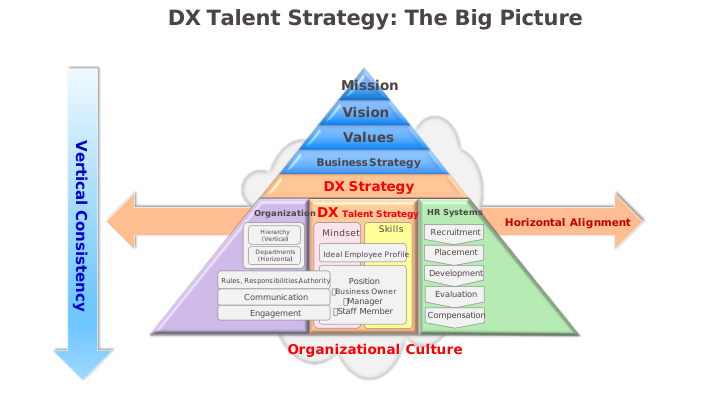
When formulating a DX talent strategy, there is one principle I personally keep in mind. It is to align people and organizations with the strategy through vertical consistency and horizontal coherence.

DX talent strategy – The big picture

Akio Ueda, Kansai Electric Power

First, vertical consistency refers to:

  1. Management philosophy (mission, vision, values) and business strategy
  2. The DX strategy as the means to achieve them
  3. The DX talent strategy for developing the people capable of executing them
  4. Organizational culture, which significantly influences strategy execution

This consistency refers to ensuring that the approach, interpretation, rules and actions regarding these four major areas are maintained along the same policy and logic from start to finish.

Next, horizontal alignment refers to the alignment of the following elements, which tend to have a particularly strong influence on the DX talent strategy:

  • The organization’s hierarchy (vertical) and departments (horizontal), rules, responsibilities and authority, as well as employee communication styles and engagement
  • The HR systems, which consist of the cycle of recruitment → placement → development → evaluation → compensation

Horizontal alignment also ensures these elements do not contradict the DX talent strategy and are logically consistent with it.

If there is even the slightest flaw in this vertical consistency and horizontal coherence, the listener will feel a sense of unease — thinking, “something doesn’t quite add up” or “can I really trust this?” — before even considering the content itself.

  • Have your policies or arguments drifted off course without you realizing it?
  • Are there any contradictions between departments, materials, statements and actions?

Only when both of these elements are in place does an explanation become persuasive, and trust in the organization and its people begins to build. That is precisely why I believe it is crucial, when communicating, to carefully verify the vertical consistency within the flow of policies and arguments, as well as the horizontal coherence among stakeholders, information and actions.

DX won’t move forward just by knowing

There is another pitfall people often fall into when developing DX talent. It is when acquiring knowledge becomes the goal in itself.

For example, someone who:

  • Took a DX training course
  • Learned how to use AI tools through e-learning
  • Attended an external DX seminar

These are certainly necessary. However, they alone will not bring about change in people or organizations.

What matters is not knowing but being able to act. In fact, in many organizations,

  • Participants understood the material during training
  • Got excited during the seminar
  • But nothing changes on the ground

This is because there is a significant barrier between knowledge and action.

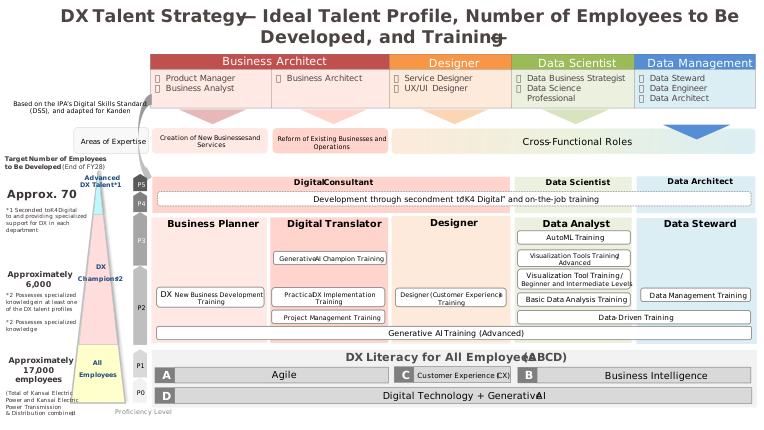
As part of its DX and AI strategy, the Kansai Electric Power Group has defined and publicly announced its DX Talent Strategy, which clarifies the ideal talent profile, the number of employees to be developed and the training framework.

DX talent strategy – Ideal talent profile

Akio Ueda, Kansai Electric Power

  • Target participants are classified into three tiers: Advanced DX Talent, DX Promoters and All Employees
  • We formulated a DX Talent Strategy that defines skills and mindsets based on the Digital Skills Standard (DSS) established by the IPA. As talent development measures tailored to each talent profile and proficiency level, we will offer a total of 31 training courses in fiscal year 2025
  • Through further expansion of training content and other measures, we aim to develop approximately 70 Advanced DX Talents and approximately 5,000 DX Promoters across all departments by the end of fiscal year 2028

A key aspect of implementing this DX talent strategy is

  • Measuring and visualizing the number of employees across the entire organization for each talent profile and proficiency level
  • I believe that rather than simply stopping at attending training sessions, applying what you learn to your actual work allows you to advance your proficiency through the stages of knowing → being able to do → being able to teach.

That is my belief.

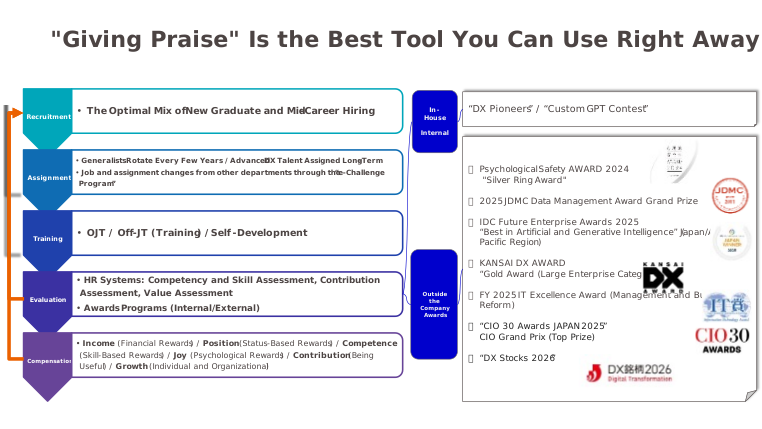
Praise is the best tool you can use right away

At the Kansai Electric Power Group, we’re moving forward while being highly conscious of the alignment between our DX talent strategy and our HR systems — that is, the recruitment → placement → development → evaluation → compensation cycle. Among these, the ideal that people with high DX skills who have achieved results in business and operations receive high financial compensation is something everyone can imagine, but the reality is that there are very high hurdles to overcome when actually trying to implement it.

Even in such circumstances, the most efficient and immediately implementable recommendation is to utilize internal and external recognition programs — in other words, praise.

Giving praise is the best tool you can use right away

Akio Ueda, Kansai Electric Power

At Kansai Electric Power, as part of our internal recognition program, we hold an annual DX event called KANDEN Digital Day, attended by approximately 1,100 members of the Kansai Electric Power Group. At this event, we honor individuals who have excelled in DX and achieved results as DX Pioneers, and we also recognize those who have created and utilized outstanding custom GPTs through our Custom GPT Contest.

We also actively apply for external awards in fields such as IT and DX. Recently, we have been selected for as many as eight awards; most recently, we were selected as the first electric power company to be included in the DX Stocks 2026 initiative, jointly organized by the Ministry of Economy, Trade and Industry, the Tokyo Stock Exchange and the Information-technology Promotion Agency (IPA).

When we are selected for awards through such recognition programs, the people implementing those DX initiatives not only receive social recognition for their work and gain the psychological reward of joy, but this also transforms into self-esteem and confidence, becoming a further source of motivation and fulfillment and leading to personal and organizational growth — thus setting a virtuous cycle in motion.

Another major effect of this initiative is the feedback loop from evaluation and rewards to recruitment. When we win an award through an external recognition program, positive word-of-mouth about Kansai Electric Power’s DX efforts spreads online. Students and people working on DX at other companies who see this might think Kansai Electric Power is quite advanced in DX. It seems like they’re doing all sorts of cutting-edge and interesting things, so I’d definitely like to join the company and work on this together! In other words, we aim to create a world where the evaluation and rewards provided by these awards generate positive feedback that leads to recruitment.

Furthermore, in the age of AI, we believe that Kansai Electric Power should not only be chosen by people but also chosen by AI.

  • Based on the latest information, please create a ranking of companies in the energy industry that are making progress in DX. Please also provide the rationale for your assessment.
  • Based on the latest information, please create a ranking of Kansai-based companies that you would recommend for DX professionals seeking employment. Please also provide the rationale behind your assessment.

I intend to strive for continuous improvement and growth every day so that, when these prompts are entered into generative AI, Kansai Electric Power will remain the kind of company that receives the response: Kansai Electric Power is number one.

A CIO is the leader responsible for developing talent for strategic execution and organizational transformation

As discussed so far, developing DX talent is not merely a matter of conducting training and education. It is interconnected with the company’s management philosophy, strategy, business operations and organizational culture.

That is precisely why CIOs are expected to serve not as leaders responsible for technology adoption, but as leaders responsible for talent development to execute strategy and drive organizational transformation. Especially in the age of AI, I strongly believe that a company’s future competitiveness will hinge on how many people it can cultivate — not merely people who can use AI, but people who can collaborate with AI to execute strategy and create value and people who can drive organizational transformation to make that a reality.

Talent development is the greatest investment in DX

In the world of DX, it’s easy to get caught up in the latest technologies and new tools. However, ultimately, it is people who drive change in companies — in every era.

  • Identifying challenges
  • Consider customer value
  • Master the use of AI
  • Engage those around you
  • Execute the transformation

Only when the number of such talented individuals increases will DX truly take root in an organization.

Developing talent capable of executing DX is not merely about teaching skills. It is, in essence, the very act of building an organization that can continue to evolve.

In this age of AI, the value of people is actually increasing. Isn’t it true that CIOs are expected not only to master technology but also to believe in, nurture and unleash human potential?

There are two completely different roles called ‘FDE’

There’s something very attractive about saying “we embed very closely with our customers and just figure it out with them”, especially since the company that started “forward deploying engineers” is growing 84% with $5B+ revenue. But “forward deployed engineer” is a vague term and means different things depending on the business you’re running.

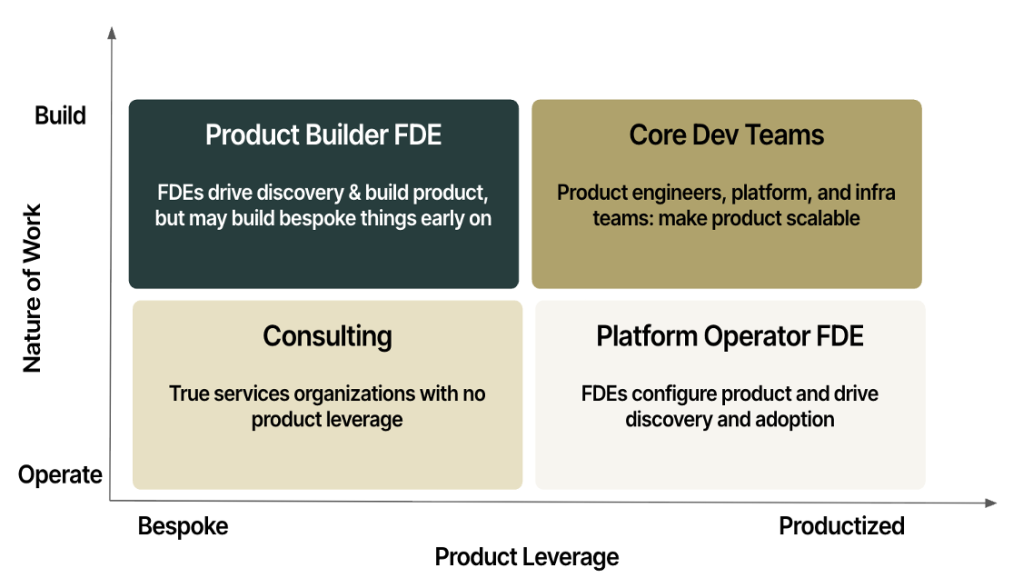
I spent almost 5 years at Palantir as a forward-deployed software engineer, and Palantir’s version of an “FDE” does not make sense for most companies I now meet as an early-stage VC. Depending on the type of business you’re building, this role could broadly mean one of two things: “the product builder” or “the platform operator.” Clearly defining which bucket you fall into will make it easier to hire for this role and run your FDE org.

Figure: Nature of work vs. product leverage.

Kabir Sial

The product builder: The OG Palantir version

The north star is: do whatever it takes to actually solve the user’s problem. FDEs are not just responsible for making the platform work, but also discovering what to build and building it (actually creating software) in service of the customer.

The platform operator: Solutions + technical customer success

The north star is: make the product work for the customer – deploy and operationalize it. This is what most startups today really mean when they want FDEs. FDEs here configure the core platform, manage account relationships and drive adoption. This is not new – companies have always had solutions engineers, sales engineers, customer success etc., although the work looks different as FDEs are increasingly building prototypes, configuring evals and building MCPs.

Which FDE is right for you

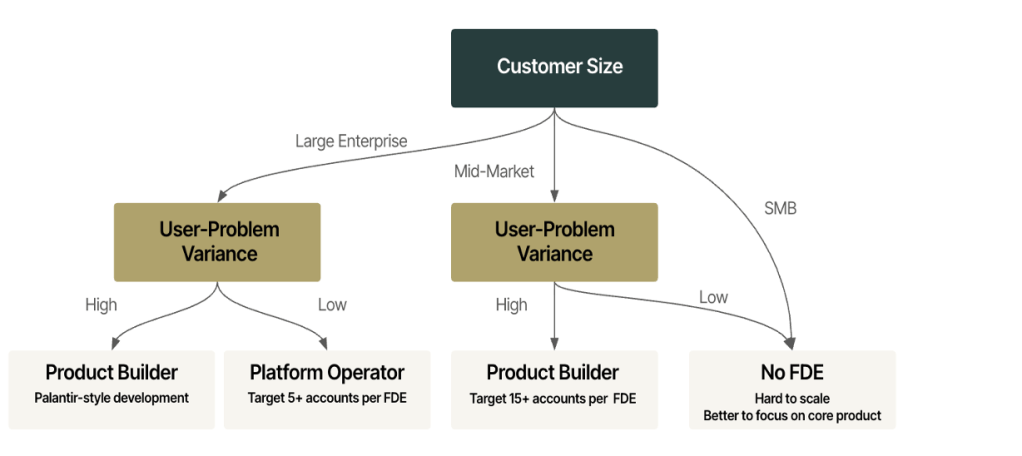
Figure: Customer size.

Kabir Sial

For most situations, hiring product builder FDEs is a mistake.

At scale, the FDEs should be the platform operator. It’s hard to have FDEs build and maintain highly custom product features, especially as the company scales. Over time, the custom product surface area distracts from building the core product, even though AI coding tools make it easy to ship new features quickly and maintain them.

Many fast-growing AI startups recognize these constraints and structure the FDE role more like the platform operator. This also allows them to have 5-10 accounts per FDE, which is a much higher ratio than Palantir had (at least in 2023). Even the Palantir FDE role has evolved to look more like the platform operator.

There are, however, situations when your FDEs should be the product builder archetype.

1. You have very large customers (F500 scale)

Technical complexity: Large customers have complex environments with legacy infrastructure that often requires “out-of-platform” engineering work. I often encountered bespoke data infrastructure, privacy requirements, etc. at various Palantir customers that required me to build “out-of-platform” connectors, UIs and backends.

Organizational inertia and trust: Serving large enterprises is about building trust. In short time periods, overfitting product to a specific user/workflow is often what delivers the most value, builds trust and helps organizations get over the inertia of moving away from Excel and legacy software tools that are part of their day-to-day workflow. For AI-native startups, it’s arguably even more important to invest in doing “unscalable” development with engineering boots on the ground, as it helps solidify your right to exist and eventually expand the customer relationship.

2. You have many ICPs and workflows

If you have a broad range of ICPs and workflows that you serve, your product probably is not walk-up usable on day 1 of deployment. The short-term hacky things that product builder FDEs build to make the product work for these heterogeneous users/workflows will help you shape the product long-term.

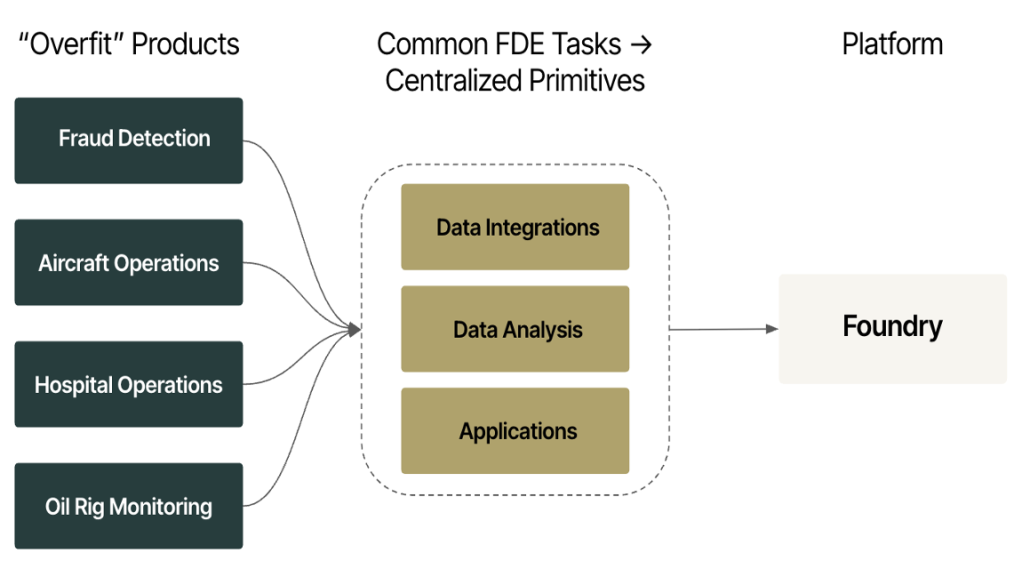
Figure: "Overfit" products.

Kabir Sial

Note: see Palantir Foundry’s architecture here.

This was a big reason why Palantir FDEs were more like product builders (and are still able to – see the Forward Deployed Software Engineer job profiles as an example). The vision for Foundry was to be the operating system for an enterprise’s critical decisions – inherently multiple industries, users and workflows. A lot of FDE-led development showed that solving many of these use cases required complex data integrations, which led to the early versions of Foundry being best-suited for complex data integrations and building a customer’s “Ontology”. Similarly, FDEs like myself built custom frontend applications for fraud analysis, pricing, etc. As certain patterns of what these applications required became more clear, they were centralized into an application-layer product.

Who you should hire

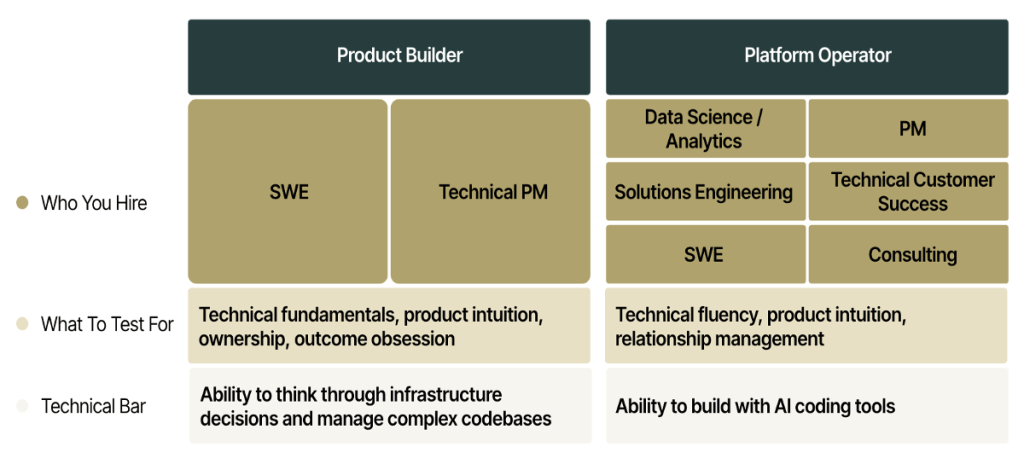
Figure: Who you hire.

Kabir Sial

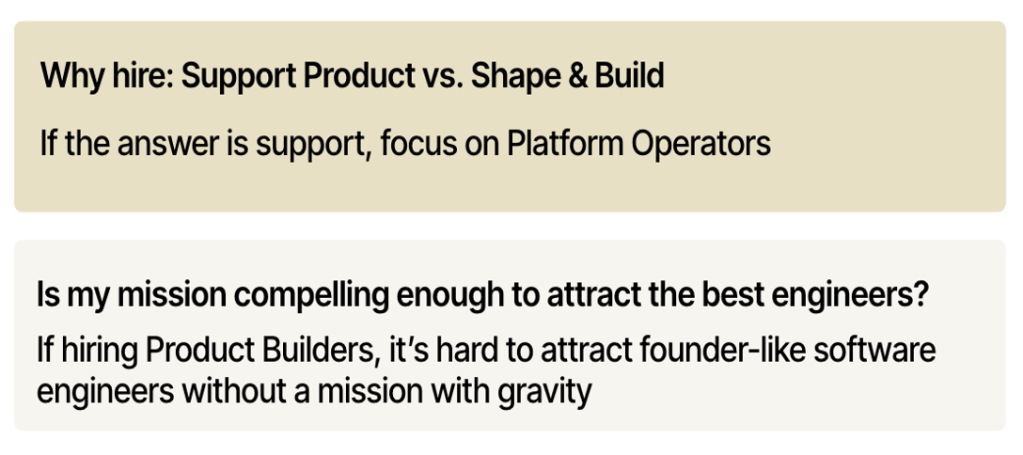
Figure: Why hire one vs. the other.

Kabir Sial

Platform operator: There is a much broader set of people you could hire, testing for technical fluency (e.g., being good at data analysis, complex Excel work, even SQL), product intuition and an inclination to build customer relationships. Backgrounds like technical customer success, solutions engineering, software engineering, product management and consulting are all strong fits.

Product builder: You want candidates that are high ownership and missionary software engineers, or technical PMs who want to ship products themselves.

Hiring for these profiles, especially product builders, is hard. It’s worth calling out two things that helped Palantir hire software engineers into what might be considered a less sexy role.

  1. Culture of building at the edge: Strong engineers are motivated to build things. Palantir gave FDEs a lot of ownership to build products, which is why much of the core product leadership was former FDEs.
  2. Cult built around mission: Internally, there was a cult-like devotion to the mission. Everyone always talked about why outcomes were far more important than software, and why most companies building tools had it wrong. I’ve never been at a company where people feel so closely bonded around a mission.

As founders building AI startups think about hiring FDEs, it’s worth being specific about your culture and asking: Am I just hiring people to support development teams, or am I hiring people to shape and build product? It’s hard to get software engineers (even today) to be excited about an FDE role that might just be technical customer success.

What FDEs should be doing (regardless of archetype)

You’ve hired the right people. How do you best leverage your team of FDEs?

FDEs were Palantir’s way of delivering outcomes rather than tools. AI-native startups can take this much further and FDEs can help in a few unique ways by leveraging their proximity to customers.

  1. Find the most critical workflows: As AI lowers the cost of producing software, companies will face a lot more competition. FDEs at AI startups should be constantly finding ways to serve the most critical workflows for a customer and paying attention to how customers do work across newer and legacy tools. For example, FDEs at Harvey should pay attention to which workflows are in Westlaw, which ones are moving to ChatGPT/Claude, and how the Harvey product can stay ahead.
  2. Build around nondeterminism: In more regulated environments, FDEs should be hyper-focused on making products reliable for specific use cases using evals and configs. Previously, product reliability lived with product and support. As companies provide outcomes instead of tools, configuring products appropriately and managing evals shifts towards FDE teams.

How AI is changing the business analyst role for the better

AI’s impact has been felt across nearly every industry, and its rise has already started to alter several roles in tech, including that of the business analyst. While the rise of agentic AI may have some questioning whether AI will replace business analyst jobs entirely, as we’ve seen with most roles impacted by AI, it’s more likely that AI will augment the role and fundamentally change how BA’s conduct daily business.

“As AI takes on more routine tasks, the human side of the role is becoming even more valuable. It’s becoming more of a hybrid role, where employers are often looking for candidates who can combine technical fluency with strong communication and problem-solving skills, along with sound business judgment,” says Megan Slabinski, district president of technology talent solutions at Robert Half.

AI can save business analysts time in the long run, automating many of the tasks that are time consuming and repetitive around data processing, note taking, and documentation. While automation will impact the daily tasks of the role, business analysts will still be necessary for properly interpreting outputs, collaborating across teams, and maintaining compliance and AI workflows.

AI-driven analysis and automated workflows

With AI-driven analysis, BA’s can use machine learning models for pattern detection, determining risk, and for forecasting demand, while natural language processing (NLP) can be used for text-heavy inputs. AI tools can also assist analysts with decision-making by transcribing meetings and automatically identifying any necessary business requirements, constraints, risks, or dependencies that will impact the project.

As a result, the role is undergoing a shift toward spending less time on monotonous, routine tasks, and instead “spending more time connecting the dots and providing strategic context earlier in the process,” says Slabinksi.

“We’re seeing that business analysts today aren’t spending as much time as they were a few years ago on some manual processes. AI is speeding up tasks like documenting requirements, summarizing stakeholder meetings, generating first drafts of user stories, and even helping create SQL queries or reports,” she adds.

AI can also assist business analysts with interviews and workshops for the discovery phase of a project and autonomously identify patterns in the data that might be overlooked or missed by the human eye. These tools can also enable BAs to create living models that can be adjusted and altered with feedback, as opposed to traditional static documents, and allow for an automated review process for data validation. In terms of maintenance and change management, AI can help with predictive recommendations to get ahead of risks, compliance, and future process updates.

That said, an increased reliance on AI tools while require business analysts to validate AI outputs and assure AI-generated content is accurate, relevant, and ultimately aligned with the overall business strategy. Still responsible for explaining the reasons behind business decisions, business analysts will also need to identifying bias and fairness concerns associated with AI use, and ensure decisions aren’t over-automated.

Ultimately, BA’s will see their responsibilities shift to focusing more on data interpretation, governance, and strategy, and identifying the most practical use cases for enterprise AI adoption.

New skills to focus on

Traditionally, business analysts are responsible for gathering the data as well as processing it for analysis. This comes with a lot of drudgery that can be eased by implementing AI tools into the workflow. Tasks such as routine documentation, formatting, and data crunching can be automated, while analysts provide the human context around that data, as well as a critical eye to the final output.

“Business analysts are often in the mix to make sure that data is accurate and that the requirements are in line with expected outcomes. They can also help ensure AI projects include the appropriate level of human oversight, comply with internal policies and industry regulations, and use data responsibly. While they aren’t solely responsible for AI governance, they often play an important role in raising questions about data sources, bias, whether the outputs make sense, and potential business risks early in a project,” says Slabinski.

BAs will need to develop AI literacy skills to better understand how models are trained and designed as well as data reasoning skills to interpret and validate AI outputs. Prompt-framing skills will also become valuable as analysts will need to know how to properly structure inputs for quality outputs. There will also be a growing emphasis on ethical analysis to identify compliance, bias, and overall fairness of algorithms, and qualified candidates will require strong change management skills to help oversee the adoption of AI-driven workflows.

“The skills becoming more important are the ones that help BAs evaluate AI-generated information and translate it into business recommendations. AI literacy is becoming a baseline expectation, and that includes knowing things like how to query the data and support requirements gathering. Critical thinking, communication, and business acumen are all part of that skill set because employers still need people who can explain what the findings mean and why they matter,” says Slabinski.

12 business analyst certifications to level up your career

Business analysts help organizations make the most of the data they collect by finding trends, patterns, and errors that might otherwise go unnoticed. Successful business analysts have the skills to work with data, the acumen to understand the business side of the organization, and the ability to communicate that information to people outside of IT. Certifications provide a great way to prove your business analyst bona fides or get started in the field.

Business analytics is a lucrative role in IT, with an average entry-level salary of $80,692 per year. Throughout their careers, business analysts report average salaries ranging from $58,000 to $114,000 per year, according to PayScale. If you want to advance your business analyst career, or change career paths, here are 12 certifications that will help prove your mettle. Not finding what you’re looking for? Check out our list of big data and data analytics certifications.

Top 12 business analyst certifications

  • Certified Analytics Professional (CAP)
  • IIBA Entry Certificate in Business Analysis (ECBA)
  • IIBA Certification of Competency in Business Analysis (CCBA)
  • IIBA Certified Business Analysis Professional (CBAP)
  • IIBA Agile Analysis Certification (AAC)
  • IIBA Certification in Business Data Analytics (CBDA)
  • IQBBA Certified Foundation Level Business Analyst (CFLBA)
  • IQBBA Certified Advanced Level Business Analyst (CALBA)
  • IQBBA Certified Agile Business Analyst (CABA)
  • IREB Certified Professional for Requirements Engineering (CPRE)
  • PMI Professional in Business Analysis (PBA)
  • Salesforce Certified Business Analyst

Certified Analytics Professional (CAP)

The Certified Analytics Professional (CAP) is a vendor-neutral certification that certifies your skills and ability to draw valuable insights from complex data sets to help guide strategic businesses decisions. There are three levels of the exam — the essentials, pro, and expert certifications. Essentials is for entry-level analytics professionals, Pro is for mid-career analytics practitioners, and Expert is aimed at senior analytics leaders and directors. Depending on the level of certification, each has different requirements ranging from no-prerequisites at the Essentials level to advanced degrees to qualify for the Expert certification.

  • Essentials exam fee: $195 for INFORMS members, $275 for non-members
  • Professional exam fee: $325 for INFORMS members, $460 for non-members
  • Expert exam fee: $440 for INFORMS members, $640 for non-members

IIBA Entry Certificate in Business Analysis (ECBA)

The Entry Certificate in Business Analysis (ECBA) is the first level of certification with the International Institute of Business Analysis (IIBA), it’s designed for less experienced and entry-level business analysts. You will need to complete at least 21 hours of professional training credits, within the past four years, before you will be eligible for the exam. You don’t have to renew your ECBA certification, but it’s assumed you’ll move on to the second or third levels of certification.

  • Exam fee: $395

For more, see our guide on the ECBA.

IIBA Certification of Competency in Business Analysis (CCBA)

Level 2 of the IIBA certification, the Certification of Competency in Business Analysis (CCBA) requires a minimum 3,750 hours of business analytics work aligned with the IIBA’s BABOK guide in the past 7 years, 900 hours in two of six BABOK knowledge areas, or 500 hours in four of six BABOK knowledge areas. The certification also requires a minimum of 21 hours of professional development training in the past four years and two professional references. The CCBA exam consists of 130 multiple-choice questions that are scenario-based and require some analysis. It covers fundamentals, underlying competencies, key concepts, techniques, and all six knowledge areas covered in the BABOK.

  • Application fee: $145
  • Exam fee: $240 for members, $405 for non-members

IIBA Certified Business Analysis Professional (CBAP)

The Certified Business Analysis Professional (CBAP) certification is the third level of certification with IIBA and is designed for “individuals with extensive business analysis experience.” To qualify for this certification, you’ll need a minimum of 7,500 hours of business analyst work experience in the past 10 years, 900 hours of work experience hours within four of the six BABOK knowledge areas, at least 35 hours of professional development in the past four years and professional references. The exam is 3.5 hours long and includes 120 multiple-choice questions based on case studies. After you pass, you’ll need to report at least 60 hours of continuing development units every three years.

  • Application fee: $145
  • Exam fee: $350 for members, $505 for non-members

For more, see our guide on the CBAP.

IIBA Agile Analysis Certification (AAC)

The agile methodology has been rising in importance for business analysts over the past several years, according to the IIBA. The association’s competency-based Agile Analysis Certification (AAC) exam was designed to address this skillset and to certify business analyst professionals working in agile environments, which require fast adaption and rapid change. The exam was developed using the Agile Extension to the Business Analysis Book of Knowledge (BABOK) guide and released in May 2018 as a standalone certification and is separate from the other IIBA business analyst certifications, which stack on top of one another. The exam’s four main topics include agile mindset (30%), strategy horizon (10%), initiative horizon (25%) and delivery horizon (35%). There aren’t any eligibility requirements to take the exam, but the IIBA recommends at least two to five years of agile-related experience.

  • Exam fee: $250 for members, $405 for non-members

IIBA Certification in Business Data Analytics (CBDA)

The Certification Business Data Analytics (IIBA-CBDA) from the IIBA is a certification that “recognizes your ability to effectively execute analysis-related work in support of business analytics initiatives.” To pass the exam, you will need to examine a real-world business problem, identify the data sources and how to obtain data, analyze the data, interpret and report results from the data. You’ll then need demonstrate how those results can influence business decision-making and guide company-level strategies for business analytics.

  • Exam fee: $250 for members, $405 for non-members

IQBBA Certified Foundation Level Business Analyst (CFLBA)

The International Qualifications Board for Business Analysts (IQBBA) offers the Certified Foundation Level Business Analysis (CFLBA) as an entry-level certification, which will qualify you to earn higher levels of certification. It’s a globally recognized certification with accredited exam and training centers across the world. It’s designed for “people involved in analyzing business processes within an organization, modeling businesses and process improvement.” The foundation level covers enterprise analysis, business analysis process planning, requirements elicitation, requirements analysis, solution validation, tools and techniques, innovation, and design.

  • Exam fee: $215

IQBBA Certified Advanced Level Business Analyst (CALBA)

The IQBBA Certified Advanced Level Business Analysis certification offers an advanced-level qualification for those who have passed the entry-level CFLBA exam. At this level, you’ll gain skills in business analysis process management, strategic analysis and optimization, and requirements management. Learning modules focus on enhancing the skills gained at the foundational level, deepening your knowledge of more advanced skills that will be necessary in your career.

  • Exam fee: $215

IQBBA Certified Agile Business Analysis (CABA)

The IQBBA Certified Agile Business Analyst certification is another foundational-level qualification designed for anyone who wants to strengthen their business analysis skills with a focus on the Agile framework. The course covers how to recognize the role of a BA in agile software development projects, contribute to agile software teams, understand the principles of agile business analysis, and employ BA techniques in an enterprise setting. In addition to BA principles, the course and certification cover agile skills as well, including the 12 principles of the Agile Manifesto and how they intertwine with BA methods.

  • Exam fee: $215

IREB Certified Professional for Requirements Engineering (CPRE)

The International Requirements Engineering Board (IREB) offers the Certified Professional for Requirements Engineering (CPRE) certification is designed for those working in requirements engineering (RE), and it’s offered at three levels. The Foundation Level is first, where you’ll be certified in the basics of RE. The Practitioner Level is next, where you can choose between four paths, including management, modeling, elicitation, and RE@Agile followed by Specialist level in the same four pathways. Finally, the Expert Level certifies you at the “highest level of expert knowledge,” which includes both your hands-on experience as well as your knowledge and skills gained through previous certifications.

Your certification will not expire, and you will not need to renew it. The IREB states that the CPRE is “based on the fundamental methods and approaches of Requirements Engineering, and these alter only slowly,” so at this time, they don’t see a need for renewal.

  • Exam fee: Varies by testing center

PMI Professional in Business Analysis (PBA) Certification

The PMI Professional in Business Analysis (PBA) certification is designed for business analysts who work with projects or programs, or project and program managers who work with analytics. It’s offered through the Project Management Institute, which specializes in widely recognized project management certifications, such as the PMP. The certification focuses on business analysis training through hands-on projects and testing on business analysis principles, tools and fundamentals.

If you’ve already earned a bachelor’s degree, you’ll need at least three years’ experience, or 4,500 hours, in business analysis consecutively within the past eight years to earn this certification. Without a bachelor’s degree, you’ll need five years or 7,500 hours experience.

You’ll be required to earn 60 professional development units within three years after completing the certification to maintain your renewal status. If you let your renewal lapse, your credentials will be suspended for one year until you fulfill the requirements — after that, it will be terminated and you’ll need to reapply.

  • Exam fee: $405 for PMI members, $555 for non-members

Salesforce Certified Business Analyst

The Salesforce Certified Business Analyst certification is a vendor-specific certification for business analysts — or similar roles — who work directly with Salesforce technology. The exam covers customer discovery, collaboration with stakeholders, business process mapping, requirements, user stories, and development support and user acceptance. You will need to pass a 60-question multiple choice question test and up to five additional unscored questions. While it’s not required, candidates should have around 2 years of business analyst experience and Salesforce Platform experience.

  • Exam fee: $200

❌