❌

Visualização de leitura

Enterprises must take blame for their AI agents’ mistakes, say regulators

The UK’s digital watchdogs have warned enterprises that they can’t evade their legal responsibilities by blaming errors on AI agents that they have deployed.

“By taking action on behalf of users, such as making purchases and communicating with businesses, these agents could transform how people use digital services, engage with markets and unlock wider innovation,” said the Digital Regulation Cooperation Forum (DRCF), a body comprising the UK’s Competition and Markets Authority (CMA), Financial Conduct Authority (FCA), Information Commissioner’s Office (ICO), and communications regulator Ofcom, in a joint statement.

While the DRCF welcomed such uses it advised, “firms developing or deploying personal agents should think carefully about how consumers can understand when and how an agent acts on their behalf, how authority to act is given and how their personal data is used.”

The DRCF didn’t pull its punches. “We want to be explicit that existing legal and regulatory frameworks apply to personal AI agents, including competition, consumer and data protection law, online safety, financial services, payments and cyber security requirements,” it said, adding, “An AI agent’s autonomy does not diminish the responsibility of organisations that deploy it to comply with applicable law and relevant regulation.”

There is certainly a degree of uncertainty over the legal position of autonomous AI agents. Gartner has warned that companies are increasingly facing legal challenges over “AI-induced” decisions, while attorneys have weighed in over gray areas in AI governance.

The four UK regulators aren’t immune to that doubt: Only a few weeks earlier, they issued a Call for Input on their 2027-27 work plan to help them avoid overlap and uncertainty about the interplay between their respective regulatory regimes.

HP’s next CEO loves confrontation

The new year will see a new CEO for HP, which after a nine-month search has named Emma Walmsley to lead the company from January 4, 2027.

Walmsley was previously CEO of drug company GSK, where she turned around its finances and spun off its consumer healthcare business into a new company, Haleon. She has a reputation for courting confrontation rather than yes-men in the boardroom. HP needs a shake-up as revenue from printing declines and AI-driven demand for components is forcing up PC prices.

She will take over from HP’s interim CEO Bruce Broussard, who stepped in in February when former CEO Enrique Lores left the company after more than 25 years to become president and CEO at PayPal. There’s a consolation prize for Broussard, who will become chair of HP’s board, succeeding Chip Bergh who remains a board member.

Although Walmsley has been on Microsoft’s board for seven years (she is stepping down in December), this is her first foray into leading a tech company. Her almost 16-year tenure at GSK included more than eight years as CEO, and earlier in her career, she spent 17 years at L’Oréal.

Bergh said that during the executive search, she stood out “for the strength of her leadership experience across multiple industries, the clarity of her strategic thinking and her ability to translate customer insights into new growth.” He particularly cited her people-first leadership approach.

Walmsley reiterated her commitment to the philosophy in a post on LinkedIn. “HP has an extraordinary innovation heritage, an inspiring purpose and an incredible opportunity ahead as AI reshapes technology and what customers need from it. I’m excited to build on those strengths and help translate innovation into impact,” she wrote. “Behind every innovation are the people who work to make someone’s day a little easier, their work more productive, their ideas possible. In an age of AI, I believe human leadership has never mattered more. It’s a privilege to be joining this team.”

Announcing Walmsley’s appointment Broussard said, “We need a leader who can build on our innovation heritage and strengths to boldly shape the company’s future. Emma is a proven CEO with a track record of leading organizations at scale and guiding them through significant change. She has the experience and skills to bring HP’s businesses, capabilities, and people together to capture the opportunities ahead as AI moves to the edge, transforming how we work and live in a more connected world.”

This article first appeared on Computerworld.

Planning for the long game when technology has a shorter shelf life

Over many years of working through successive waves of enterprise technology and IT architecture, including fast-moving AI, I’ve heard the same question in different forms: “How can I build my business with AI while avoiding lock-in and tech debt?”

It came up again during a recent conversation about a major technology investment, when a CIO asked, “Should we really be making this commitment if the technology is changing constantly?” That resonated with me because it reflects a pattern I have seen across technology waves: the architecture must provide stability even as the capabilities around it continue to evolve.

For decades, the goal has been to build a technology foundation that serves the enterprise for five, seven or even 10 years. With the emergence of AI, some technologies become outdated before implementation is complete.

If shorter technology lifecycles are the challenge, adaptability is the answer. Instead of asking, “What will serve us for the next decade?” CIOs should ask, “How can we remain flexible as technology changes?” That requires being deliberate about what must remain durable and where the enterprise must be ready to adapt.

Think of it like a house. The foundation, walls and furnace are built to last, while paint, furniture and bathrooms change as needs and styles evolve. Enterprise architecture increasingly works the same way.

AI is separating the experience of work from the systems behind it

I recently heard about a company that now gives new employees a single onboarding tool: ChatGPT, connected to the enterprise systems and key data sources behind it. Instead of learning multiple applications, employees simply ask for the information or support they need, without knowing which underlying system provides it.

Of course, a single interface doesn’t mean blanket access to enterprise systems. This model requires security measures that ensure employees can access only the information and capabilities they’re authorized to use: carrying each employee’s identity and existing permissions through every request, limiting access to what’s necessary, tracking where information comes from, and logging retrievals and actions. Changes with significant business consequences should also require review.

This does change how we think about work and the technology that supports it. If agents are becoming the primary interface, the central question shifts from “Which application should employees use?” to “Can our data be accessed, understood and used securely by the interfaces and agents we adopt next?”

Adaptability means running at two speeds

Some technology capabilities should endure; others should evolve quickly. The mistake is treating everything as having the same lifecycle.

The durable layer includes ERP, HCM and other core systems, along with data, security and foundational architecture. These investments remain essential, but CIOs should design them around future business possibilities rather than solely around today’s processes.

The fast-moving layer comprises agents, interfaces, analytics, workflows, AI models and tools, experiments and business-specific solutions. The CIO’s role is to distinguish this layer from the durable core and ensure that rapidly evolving capabilities can be replaced without destabilizing the durable foundation.

CIOs need practical ways to change the underlying technology without disrupting the applications the business relies on. That starts with clear, consistent rules for how systems exchange data and interact with APIs, MCP connections and AI agents, keeping the implementation choices behind those boundaries. Before changing a model, agent or application, teams should confirm existing data and integrations will keep working, test security and expected behavior, and introduce changes in stages with a rollback plan if something goes wrong.

This two-speed model is a substantial departure from traditional enterprise IT management and from the way we did things when I was coming up in the tech world. It changes how CIOs plan investments, organize technology functions, structure vendor relationships and govern the connections between durable and fast-moving capabilities.

Invest thoughtfully for both durability and adaptability

In the pre-AI era, CIOs prioritized technologies with decade-long relevance. Today, they should avoid overspending on solutions prone to rapid obsolescence and invest in business outcomes and a durable foundation for intelligence.

Projects lasting more than six months warrant scrutiny: Will the solution remain relevant, or are we embedding processes that AI may soon handle; perhaps with a single prompt?

Durability extends beyond core systems to include the organization’s capacity to understand, evaluate and adopt new technology.

Today, most companies critically underinvest in skills. Knowing how to operate ChatGPT or Claude is not the same as working effectively with AI. OpenAI’s study found that AI power users outperform average users by sixfold. Upskilling gives CIOs leverage by helping employees redesign work and use AI effectively, while stronger leadership fluency facilitates new business models rather than merely supporting existing operations.

Most companies are also underinvesting in the data foundation. In West Monroe’s recent survey of 417 business leaders, AI governance, risk and compliance ranked as the lowest investment priority for the next 12 months. Traditionally, IT addressed data operations to ensure successful ERP implementation. Now, because data quality directly impacts AI value, investing in governance and accessibility is imperative.

CIOs need practices that preserve data meaning and reliability as platforms change. Those include assigning clear ownership, establishing authoritative sources and shared definitions, tracking data lineage and setting standards for quality and access. Definitions and rules should be maintained in portable documentation and data contracts, rather than embedding them in a single AI model or vendor platform, so they carry forward as technology evolves.

Break down IT silos to encourage adaptive architecture

Typically, CIOs organize operations around disciplines such as infrastructure, data, applications and security, with IT teams choosing an application and then defining processes and architecture around it. But as future architecture becomes less certain, CIOs must instead envision future business capabilities and design for change, bringing AI and data into architectural thinking alongside traditional cloud and application expertise.

Consider a reporting process that today moves from data analysis to Excel to PowerPoint to human review before a decision is made. An adaptive architecture focuses less on preserving each of those steps and more on the outcome: turning data into intelligence that informs a decision or action. Excel and PowerPoint may still have a role, but they no longer need to be hardwired into the process.

CIOs also need to break down silos. Teams often define architecture around a single suite, such as Salesforce or SAP, without considering alternatives. While working with an energy company recently, I saw how bringing analytics teams into the discussion shifted the focus from the ERP itself to how data should be accessed and used. Small, cross-functional teams can help create that broader view and design around business needs rather than individual platforms.

Build partnerships around future business outcomes

The most effective CIOs I work with are shifting their focus from simply controlling costs to driving value, actively partnering with the business, and reimagining how functions can evolve with AI, data and IT.

As vendor offerings expand across applications, analytics, agents and interfaces, CIOs need to balance integrated ecosystems with the flexibility to combine providers. Prioritizing open standards, multi-cloud support, data portability, interoperability and adaptable contracts can help organizations use the strongest elements of core systems while integrating agents and data across systems to adapt faster as needs evolve.

CIOs should build flexibility into vendor contracts, so changing providers doesn’t mean losing access to valuable data, context or governance rules. Contracts should provide for usable exports of data and metadata, documented interfaces that vendors keep current, advance notice of discontinued features, and support for testing portability and transitioning to another provider. They should also specify security and audit obligations throughout the relationship and during the transition.

The bottom line: buy with the future in mind. Don’t just ask if an application meets current requirements. Instead, envision what future business functions should look like, then derive technology needs from that vision. Shift the mindset from using HCM checklists to driving workforce optimization, from CRM checklists to revenue management, and from ERP checklists to enterprise data and intelligence.

Find the signal in the noise

As AI gets smarter and cheaper, the challenge will shift from affording it to connecting it to business outcomes. I believe the defining constraint in 2027 will be focus, not cost: CIOs must identify the few high-leverage priorities their organizations can absorb and execute well. That’s easier said than done.

There’s no established playbook for the AI era: we’re all experiencing it for the first time. CIOs face a flood of startups, models, architectural approaches, evolving standards, vendor claims and internal requests. The task becomes curation: deciding what deserves attention. Distinguishing signal from noise is becoming an essential leadership skill.

The new long game for CIOs

I believe CIOs are at a pivotal moment. They can remain excellent IT leaders or help the business rethink work through intelligence. In that sense, the role could evolve into what I call the chief intelligence officer: the leader who helps the enterprise turn fast-changing technology into durable business value.

FBI Blames North Korea for $6B Binance Hack as Recovery Hits 95%

Binance hack

The Binance hack involving more than $6 billion in virtual assets has been attributed to North Korea by the US Federal Bureau of Investigation (FBI), while the cryptocurrency exchange has begun preparing to restore withdrawals in phases and reported that approximately 95% of the affected amount has been covered. The incident, which Binance says occurred around October 29, 2026, has prompted security reviews, efforts to trace stolen assets, and cooperation between law enforcement and industry partners. The FBI refers to the North Korean activity associated with the theft as “TraderTraitor.” In its advisory, the agency said the stolen assets were being converted primarily into Ethereum (ETH), with further laundering through decentralized finance (DeFi) platforms and instant swap services expected. Binance said on November 1 that the first phase of withdrawal services was scheduled to resume between 06:00 and 09:00 UTC. The exchange said the restoration would depend on security assessments and operational readiness checks, with additional assets and networks becoming available as they pass the required checks.

Binance Hack: FBI Attributes $6 Billion Theft to North Korea

According to the FBI, North Korea was responsible for stealing more than $6 billion in virtual assets from Binance on or around October 29, 2026. The agency is working with the US Secret Service (USSS) and the Internal Revenue Service Criminal Investigation division (IRS-CI) to address the activity. The agencies have observed stolen crypto assets being converted primarily into Ethereum. The FBI expects the operators to use DeFi platforms and instant swap services to move the funds through additional laundering stages. The FBI, USSS, and IRS-CI have urged cryptocurrency industry participants to block transactions involving addresses used by the TraderTraitor actors, including transactions derived from those addresses. The request covers THORNode operators, remote procedure call (RPC) node operators, instant exchanges, DeFi services, blockchain analytics firms, and other virtual asset service providers. The FBI has also asked anyone with relevant information to contact a local FBI field office or submit information through the Internet Crime Complaint Center.

Binance Withdrawals to Resume in Phases

In its November 1 recovery update, Binance said it was preparing to restore withdrawals progressively after temporarily suspending the service as a precautionary measure. The exchange said the suspension allowed its teams to contain the impact of the incident, assess affected services, review withdrawal infrastructure, and monitor for residual risks. The company also said it was working with law enforcement and industry partners to trace and recover stolen funds. The first phase prioritizes assets and networks based on user demand over the preceding week. Binance said additional networks and assets would be added as they become ready, rather than reopening every withdrawal service simultaneously. Users may encounter temporary delays or longer processing times during the initial rollout because of traffic volumes. Binance advised users to check the withdrawal page for their selected asset and network, or consult its network status page, to confirm availability. The exchange said deposit services remained open and were not affected by the incident. It also stated that it would absorb the financial impact of the stolen funds rather than pass the losses on to users.

Binance Reports 95% Recovery of Affected Assets

Binance's recovery updates show a steady increase in the amount of affected assets it says has been covered. In its October 31 update, the company reported that coverage had reached approximately 90%, up from around 80% in the previous update. By November 1, Binance said it had covered approximately 95% of the impacted amount. The remaining 5% consists of tokens outside the ten assets it identified as fully backed, which include BTC, ETH, USDT, BNB, SOL, USDC, XRP, USD1, RLUSD, and ZEC. According to Binance, these remaining tokens have lower market liquidity and take longer to acquire at the required scale. The company said it was continuing to purchase the outstanding assets through market transactions and over-the-counter (OTC) channels. The exchange also said its replenishment efforts involved its corporate treasury, a partial deployment of the Secure Asset Fund for Users (SAFU), and a portion of its Futures insurance fund. Binance committed to replenishing SAFU to bring the fund back to approximately $1 billion.

A gift to scammers: why you should probably keep your birthday a secret

Using a fake DOB or leaving the field blank when making an online account can offer protection from identity theft

You get a call from your bank saying there has been suspicious activity on your account. They read out your name, address and date of birth so you are happy it is a legitimate caller.

But you are talking to criminals who have used your date of birth as part of a web of verifying information to convince you they are someone else.

Continue reading...

© Photograph: kmt_rf/Alamy

© Photograph: kmt_rf/Alamy

© Photograph: kmt_rf/Alamy

Cadence Maestro puts domain-trained AI agents to work for chip design

Artificial intelligence has been part of semiconductor design for years, helping engineers optimize chip architectures for performance, power efficiency, silicon area and faster development. More recently, the industry has begun integrating large language models and AI agents into established electronic design automation (EDA) workflows. Now Cadence Design Systems is taking that approach further with its Maestro AI Model Portfolio, a collection of domain-specialized models designed to work with the company’s engineering software and AI Super Agents.

Maestro combines specialized model training, reinforcement learning and established EDA tools to improve how AI agents execute engineering tasks and evaluate results. Cadence claims better design outcomes with greater token efficiency versus general-purpose foundation models. While initially focused on chip and electronic system design, I also see broader implications for enterprise AI economics, proprietary data protection and deployment across complex engineering and business applications.

AI builds on established engineering software

Modern semiconductor design is enormously complex. Engineers must balance performance, power consumption, silicon area, manufacturing constraints and costs across chips containing billions of transistors. Cadence and chief competitor Synopsys have spent decades developing software to optimize for these challenges, and both are now incorporating AI agents capable of executing increasingly complex engineering workflows using those tools.

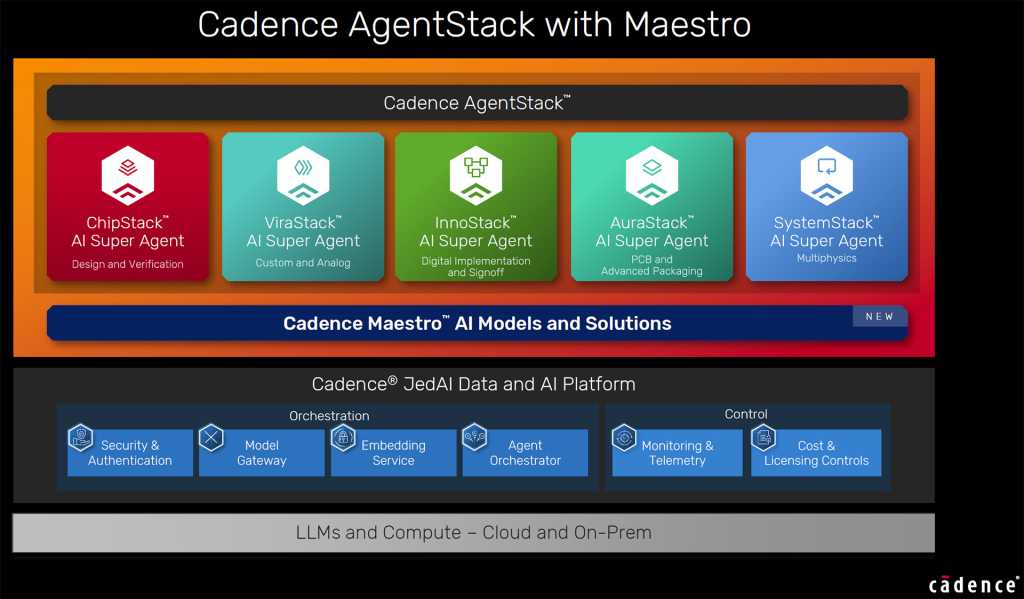
Cadence AgentStack with Maestro

Cadence Design Systems, Inc.

“Revolutionizing complex engineering tasks requires deep domain-specialized intelligence,” notes Cadence president and CEO Anirudh Devgan in the company’s announcement. In my discussions with Cadence executives, we explored how Maestro builds on that approach to improve engineering workflows and design outcomes.

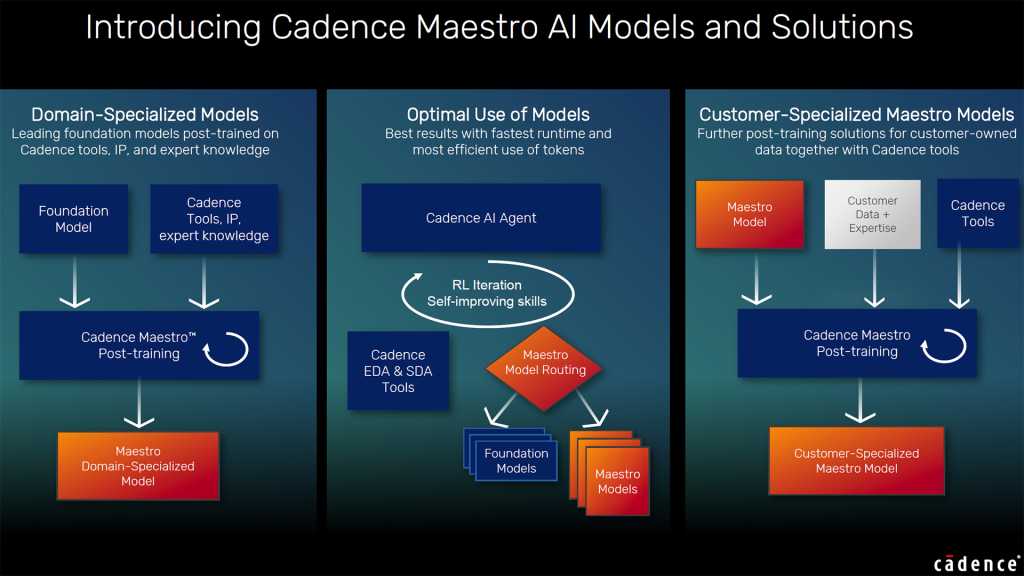
Cadence Maestro combines domain-specialized, post-trained language models, trained decision models and reusable agent skills with Cadence’s EDA and system design automation (SDA) tools. The portfolio supports ChipStack, InnoStack, ViraStack and AuraStack AI Super Agents, which interpret engineering objectives, break them into tasks and engage appropriate models and software tools. Rather than relying on a single model, agents can combine Maestro with commercial frontier and open-weight models according to workload requirements.

What I find particularly interesting is Cadence’s reinforcement learning architecture. EDA tools, evaluation frameworks and deterministic solvers assess AI-generated outputs against engineering constraints, including timing, power and physical design requirements. That feedback can improve subsequent model decisions and agent behavior. It’s a potentially important advantage over relying exclusively on general-purpose LLMs, since engineering results can be evaluated against measurable design constraints rather than language-based assessments alone.

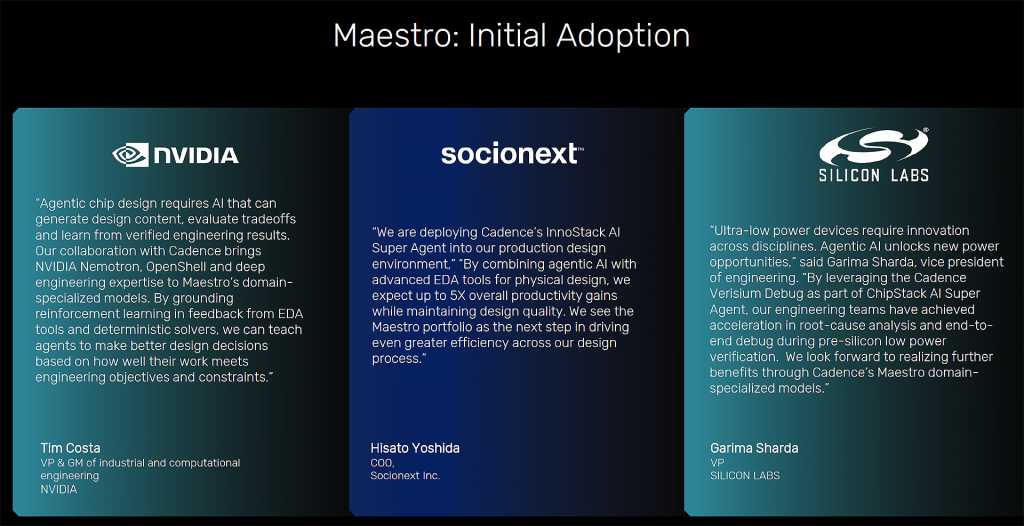
NVIDIA is contributing its Nemotron model technology and collaborating with Cadence on agent security through its OpenShell AI sandboxing architecture, with integration work by both companies underway.

The business case for domain-trained AI in engineering

Cadence Maestro AI models and solutions

Cadence Design Systems, Inc.

Cadence reports that initial Maestro evaluations delivered up to 30% better quality of results and five times greater token efficiency, compared to a general-purpose foundation model. These are early vendor-reported results, however, and Cadence hasn’t disclosed enough benchmark detail to establish how consistently those advantages translate across production workloads.

Greater token efficiency is always a goal of course, particularly for AI agents executing lengthy, iterative engineering tasks. But reducing token consumption doesn’t always translate into proportional cost reductions. Engineering software, simulation infrastructure, verification and available compute resources also contribute substantially to development costs.

To me, the larger opportunity is improving design quality and shortening development cycles. Chip development programs can require hundreds of engineers and substantial capital investment, so even modest productivity improvements or faster time to market can offer significant value.

Cadence Maestro initial adoption

Cadence Design Systems, Inc.

Cadence customer Socionext expects up to fivefold productivity gains from deploying the company’s InnoStack AI Super Agent in production, although that’s a projection rather than a demonstrated Maestro result. Silicon Labs has also reported faster root-cause analysis and debugging using Cadence’s ChipStack technology. These examples show progress with agent-based engineering, but Maestro’s performance claims still need production validation. I’ll be interested to see how those results develop.

Deployment flexibility and data control

Another noteworthy aspect of Maestro is deployment flexibility. Cadence says its agentic engineering environment supports deployment through its own secure cloud platform, supported public clouds or customer-controlled on-prem infrastructure. Customers can also further train supported models using proprietary engineering data.

For semiconductor companies, where intellectual property can represent billions of dollars in investment, maintaining control over sensitive design information is critical. Similar considerations apply in financial services, healthcare and aerospace, where proprietary data and regulatory requirements can complicate AI deployment.

The tradeoffs warrant examination, however. On-prem deployments can shift responsibility for GPU infrastructure, model updates, security controls and optimization to the customer. Those costs need to be weighed against cloud inference expenses, data residency requirements and the potential performance benefits of processing data close to engineering workloads. In my view, Cadence’s deployment flexibility is valuable because enterprises can evaluate these choices against their infrastructure, security policies and engineering economics.

Specialized AI continues to gain momentum in chip design

Cadence Maestro is part of a broader industry push toward AI-driven semiconductor engineering. Established EDA vendors are expanding their agentic capabilities, while AI-native startups are developing systems for RTL generation, verification, debugging and physical design optimization. Domain-trained models, engineering feedback loops and intelligent model routing are also gaining attention.

What’s interesting here is the potential for agents to coordinate multiple engineering tools and models while retaining the design context needed for complex tasks. The business opportunity extends beyond automating individual steps to reducing the effort required to reach verified design results. For enterprise technology execs, that puts greater emphasis on toolchain integration, measurable productivity improvements and the economics of AI-assisted engineering.

Proving the value of specialized AI in chip design

Cadence’s first Maestro models are entering select customer early access in the fourth quarter of 2026, so it’s too early to know whether the company’s performance claims will translate consistently into production.

General-purpose models will remain important for broad reasoning, language and multimodal applications. However, specialized engineering processes often demand deeper domain knowledge, validated results and tight integration with existing software.

From my perspective, Cadence’s approach offers a glimpse of where enterprise AI is heading. Selecting the right models, tools and deployment architecture for specific workloads will be critical as adoption expands. And the early results are promising, with specialized AI showing the potential to improve engineering outcomes, boost productivity and reduce development costs at scale.

In good company: 10 CIOs every CIO should follow

CIOs are dealing with a lot of change, from the rapid rise of AI and cloud modernization, to cybersecurity and workforce transformation. Many are sharing what they’re learning as they tackle these challenges, including what’s working, what isn’t, and how they’re implementing new technologies in their organizations. Here, a select group of tech leaders reveal the CIOs they follow and why.

Suma Nallapati, chief AI and information officer, City and County of Denver

I follow Suma Nallapati primarily through public technology and AI leadership discussions. She regularly discusses AI adoption, responsible AI, digital transformation, technology strategy, AI governance, human-centered technology, and using AI to improve public services. I find her perspective particularly valuable because she connects AI strategy with practical organizational and citizen outcomes. She also emphasizes responsible and human-centered AI rather than viewing AI simply as a technology implementation exercise. One initiative I found particularly interesting was Denver’s use of AI through its multilingual Sunny chatbot and other city services. Her current role includes scaling AI across areas such as resident engagement, internal automation, permitting, and emergency response while maintaining governance, transparency, and public trust. – Sachin Gupta, senior IT manager, Arrow Electronics

Jennifer Hartsock, chief information and digital officer, Cargill

I follow Jennifer Hartsock through the CIO community, as well as through her thought leadership, interviews, and LinkedIn. I especially enjoy hearing her perspective in longer-form conversations where she talks candidly about the realities of leading technology and transformation in a large, complex organization. Hartsock talks about many of the issues CIOs are navigating right now, including AI, digital transformation, technology operating models, talent, and leadership. A consistent theme in her perspective is connecting tech decisions back to the business, including how tech teams work with the business, and how you create greater ownership closer to the outcomes you’re trying to achieve. – Kathy Kay, EVP and CIO, Principal Financial Group

Fletcher Previn, SVP and CIO, Cisco

Fletcher Previn’s profile shows how a modern technology leader can discuss change without reducing it to a narrative about vendors. He explores AI, culture, talent, and productivity, with an emphasis on conditions that determine whether transformation lasts. The insight worth returning to is his focus on adoption as a leadership responsibility. New technology fails when teams lack learning time, managers lack clarity, and incentives reward behavior that no longer serves the business. CIOs can apply that lens to modernization, security initiatives, and data governance. It encourages an honest definition of progress based on decisions and outcomes rather than launch dates or dashboards. – Sherif Koussa, CEO, Software Secured

Kellie Romack, CDIO, ServiceNow

What makes Kellie Romack’s perspective valuable is she talks about AI from inside a large enterprise IT organization, not the outside. Her posts regularly cover enterprise AI, AI governance, autonomous IT, workforce transformation, cybersecurity, digital transformation, and how the CIO role is changing.

The point that stayed with me was her argument that CIO organizations now have to redesign jobs, teams, and workflows around AI while building new human skills at the same time. That’s a useful distinction. It frames successful AI adoption as an organizational and leadership problem as much as a technology one. Her seat at ServiceNow also gives her a view of what happens after the experiments stop. ServiceNow has reported that its internal AI use cases grew from 15 to more than 200. That makes her worth reading about for any CIO trying to understand what scaling enterprise AI actually looks like. – Tapabrata Biswas, project manager, InfluxIQ Tech Pvt. Ltd.

Mike Blandina, CIO, Snowflake

I follow Mike Blandina for his practical perspective on enterprise AI adoption and the operational realities behind digital transformation. His commentary consistently connects emerging technology with the governance, workforce skills, and measurable outcomes needed to make it useful. One insight that particularly resonates with me comes from this CIO.com article.

He makes the case for building an editing culture rather than a writing culture. As AI increasingly handles first drafts of code, reports, and other work, he argues that the critical human skill becomes evaluating outputs, identifying mistakes, and knowing when to challenge the system. I also appreciate his emphasis on data lineage, access permissions, and measuring actual productivity improvements instead of AI tool logins. Those are the less visible decisions that determine whether enterprise AI adoption delivers lasting value. – Parth Patel, director of operations, Shaligram

Deepa Soni, EVP and CIO, New York Life Insurance Company

Deepa Soni’s insights are particularly valuable because she oversees AI in one of the most critical and regulated sectors of financial services, a Fortune 100 life insurance company where AI decisions have real consequences for policyholders and regulators.

Soni frequently shares in-depth thoughts on what responsible AI adoption truly looks like within a large financial institution. She discusses the delicate balance between the speed of innovation and the readiness of governance, as well as how tech leaders can foster cultures that promote both agility and accountability. What sets her apart is that her approach to AI strategy is rooted in operational realities rather than just vendor hype, which is a rare and precious perspective for CIOs facing similar challenges. – Viren Meghani, technical architect and independent researcher in AI governance

Sears Merritt, CIO and head of enterprise technology and experience, MassMutual

I follow Sears Merritt on LinkedIn and through his interviews. He talks about what enterprise AI costs to run and how to keep the option to change your mind. Merritt also discusses why AI vendor contracts should be capped at 12 months to maintain flexibility, how success metrics are defined before AI pilots begin to determine whether they should be scaled, and the data platform he spent three years building before the AI wave arrived. This is useful to other CIOs because he’s one of the few CIOs at a regulated insurer who talks about AI in the language of procurement and measurement rather than vision. – Egiziago Cioffi, IT/enterprise architect and CEO, SynSphere Italia

Ganesh Ariyur, CIO and head of enterprise technology, Gainwell Technologies

I follow Ganesh Ariyur for his insightful views on AI, enterprise architecture, transformation, tech strategy, governance, and ways CIOs can link tech investments to quantifiable business value. What I find particularly helpful is his content extends beyond just talking about new technologies. He continually positions technology choices in relation to business results, operational frameworks, financial discipline, and implementation. This is particularly important for CIOs facing pressure to showcase ROI from AI and modernization efforts.

An example is his work, The 2026 CIO Operating Model: Architecture, AI, and Enterprise Value. His main point is that tech strategy must be viewed more like capital strategy, with CIOs assessing issues like if cloud expenditures enhance unit economics, and if architecture facilitates quicker decision-making. That viewpoint is important as it transitions the dialogue from which technology to implement, to what ways technology should transform the enterprise’s operations and value creation. – Ketan Patel, digital marketing manager, WeDoWebApps

Jim Swanson, EVP and CIO, Johnson & Johnson

I’m interested in how Jim Swanson thinks about the relationship between technology and the business, particularly where innovation carries considerable responsibility. For example, he recently discussed how AI agents are changing the way people interact with enterprise software. What caught my attention was his emphasis on the complexity that comes with that change — the integration, oversight, and accountability required to make it work. Those are questions that deserve as much attention as the technology itself. – Bill Huber, partner, ISG

Kimberly Basile, CIO, Kyndryl

I follow Kim Basile along with her bylined pieces on Kyndryl’s newsroom and interviews in the business press. She discusses enterprise AI adoption, workforce readiness, AI governance, platform modernization, and security leadership, informed by her earlier role as SVP and CISO at Leidos. Basile speaks from inside a transformation few CIOs have experienced, having helped guide Kyndryl’s technology separation from IBM and consolidate its application portfolio. She treats governance and people readiness as part of AI adoption from the start, and she’s candid about what hasn’t worked. In a recent feature on agentic AI, for instance, she said Kyndryl initially focused on counting agents, and the number didn’t tell the true story. Her team pivoted to measure business process flows. She also identified automating a process that hadn’t been properly validated as one of the company’s biggest mistakes. Activity metrics are easy to report, so organizations default to them. Her lesson pushes CIOs to validate a process before automating it.

She matters beyond the technology because women remain underrepresented in IT leadership, and she uses her visibility to lift others. When she was named to Women We Admire’s Top Women CIOs of 2026, her second year on the list, she used her post to congratulate the other honorees by name and highlight how these leaders help employees embrace technology. That generosity matters in a field where women CIOs are still too few. As the co-founder of Girl Power Talk, I pay attention to leaders who open doors for the next generation of women in tech. Basile does that consistently. – Sameer Somal, founder and CEO, Blue Ocean Global Technology

❌