Ransomware rarely appears out of nowhere. Before encryption, extortion, or data theft begins, attackers often spend time establishing access, stealing credentials, moving laterally, and identifying valuable systems. These activities occur during the ransomware pre-execution phase, when malicious activity may be difficult to distinguish from legitimate administration.
For security teams, understanding ransomware attack vectors, ransomware initial access methods, and how ransomware evades detection is critical. Endpoint security blind spots can give attackers the time they need to prepare an attack without triggering an obvious alarm.
Here are five areas where ransomware activity can remain hidden before detonation.
1. Remote Access Tools: A Favorite Ransomware Attack Vector
VPNs, RDP, and remote management tools are essential for distributed organizations, but they are also among the most important ransomware attack vectors.
Qilin affiliates have abused tools including WinSCP, AnyDesk, and ScreenConnect to facilitate lateral movement. Attackers who obtain valid credentials can potentially use legitimate remote-access software without immediately deploying obvious malware.
This is one reason why ransomware evasion cannot be reduced to antivirus evasion alone. Attackers can blend into normal administrative activity.
Organizations should enforce MFA on remote-access systems, monitor unusual login behavior, and restrict remote administration privileges.
2. Compromised Endpoints and Credential Stores
A compromised laptop or workstation may be only the beginning. Attackers can use credential-stealing tools to obtain additional passwords and authentication material, allowing them to move toward servers, backups, and privileged accounts.
CRIL has tracked ransomware operators using credential-harvesting techniques associated with tools such as NirSoft and Mimikatz. BYOVD, or Bring Your Own Vulnerable Driver, is another technique security teams should monitor because vulnerable drivers can help attackers bypass security controls.
These activities represent major endpoint security blind spots when organizations monitor servers but have limited visibility across employee workstations.
EDR coverage across every endpoint can help identify unusual processes, credential access, and other indicators during the ransomware pre-execution phase.
3. Vendor Connections and Supply Chain Access
Manufacturers rarely operate alone. Suppliers, contractors, logistics providers, and software vendors can all connect to corporate environments.
Attackers may compromise a smaller vendor with weaker defenses and use that trusted relationship to reach a larger target, a technique commonly known as island hopping.
A shared credential, remote connection, vulnerable integration, or compromised software update can become one of the most dangerous ransomware initial access methods.
Organizations therefore need visibility beyond their own infrastructure. Vendor access should be reviewed regularly, unnecessary connections should be removed, and third-party privileges should follow least-privilege principles.
4. Operational Technology and Industrial Systems
Manufacturing environments face additional endpoint security blind spots because operational technology (OT) and industrial control systems (ICS) often have long lifecycles and cannot be patched as easily as conventional computers.
Many industrial systems were designed for reliability rather than modern cybersecurity requirements. Connecting previously isolated systems to corporate networks, cloud platforms and remote-management tools has expanded their attack surface.
A ransomware attack affecting production systems can disrupt manufacturing lines, robotics, quality controls and logistics. Attackers can also steal product designs, supplier contracts, pricing information, and other intellectual property before encryption.
Network segmentation, vulnerability monitoring, and strict access controls can reduce the risk while allowing production environments to remain operational.
5. Phishing and Business Email Accounts
Phishing remains one of the most effective ransomware initial access methods, but modern campaigns are often highly targeted.
Attackers may research procurement, finance, and supplier relationships before sending messages that closely resemble legitimate business communications. Once credentials are stolen, attackers can monitor conversations before attempting fraud or using the account to gain further access.
This activity can remain hidden because the attacker may initially use legitimate credentials rather than obviously malicious software.
MFA, payment verification, email monitoring, and employee awareness training can reduce exposure. Security teams should also investigate unusual authentication patterns and unexpected account behavior.
RaaS Makes Endpoint Blind Spots More Dangerous
Ransomware-as-a-service has lowered the barrier for criminals seeking to conduct sophisticated attacks. Cyble identified 57 new ransomware groups and 27 new extortion groups in 2025, along with more than 350 new ransomware strains.
Between January and April 2025, global ransomware incidents increased by 86%, with Cl0P accounting for 28% of activity during that period, according to Cyble.
Double extortion has also become common. Attackers may steal data before encryption and threaten to leak it. Some groups have escalated to triple extortion by adding DDoS attacks or directly contacting victims' customers.
For organizations with limited security resources, this makes early detection particularly important.
Conclusion
Effective ransomware defense starts before encryption begins. Organizations should patch exploited vulnerabilities, enforce MFA, segment networks, and maintain tested backups while continuously monitoring endpoint security blind spots.
Cyble Titan Endpoint Security combines behavioral detection, threat intelligence from Cyble Vision, and Blaze-AI-powered autonomous response to detect and contain threats before they escalate. See Cyble Titan in action and strengthen endpoint protection today—request a demo.
Frequently Asked Questions (FAQs)
1. What are endpoint security blind spots?
Endpoint security blind spots are areas where security teams have limited visibility into devices, applications, accounts, or activities. These gaps can allow attackers to establish access and move through an environment before ransomware is detected.
2. How does ransomware evade detection?
Ransomware can evade detection by using legitimate remote-access tools, stolen credentials, fileless techniques, and vulnerable drivers. Attackers may also remain inactive during the ransomware pre-execution phase to avoid triggering security alerts.
3. What are common ransomware attack vectors?
Common ransomware attack vectors include phishing emails, compromised credentials, vulnerable internet-facing systems, remote-access tools, third-party vendors, and exposed operational technology environments.
4. How can organizations reduce ransomware risks on endpoints?
Organizations can reduce risk by deploying EDR or advanced endpoint protection, enforcing MFA, applying least-privilege access, patching vulnerabilities, segmenting networks, and continuously monitoring endpoint activity.
5. How can Cyble Titan help prevent ransomware attacks?
Cyble Titan combines behavioral detection, next-generation antivirus, endpoint telemetry, and Cyble Vision cyber threat intelligence. Its Blaze AI engine can analyze threats, prioritize alerts, and support automated containment and remediation to help security teams respond faster.
Media Disclaimer: This blog was compiled from publicly available advisories and open-source security reporting. It is provided for reference purposes only; readers bear full responsibility for their reliance on it.
The Americas carried the heaviest ransomware burden of any region on the planet in the first half of 2026. According to Cyble Research and Intelligence Labs (CRIL), North and South America combined experienced 2,188 documented ransomware attacks between January and June 2026.
That single figure — 2,188 attacks — represents more than 57% of the 3,836 ransomware incidents CRIL tracked worldwide, making the Americas the undisputed center of gravity for global ransomware operations.
But the Americas is not a single threat theatre — it is two. North America alone absorbed 1,981 attacks, driven by a mature, multi-group Ransomware-as-a-Service (RaaS) economy competing for market share. South America, by contrast, recorded 207 attacks concentrated around a much smaller set of operators, with one group — The Gentlemen — claiming nearly a quarter of all regional incidents outright. Understanding the Americas means understanding both halves of that story: a saturated northern market and a consolidating southern one.
North America vs. South America: Two Distinct Ransomware Landscapes
Security leaders operating across the hemisphere cannot apply a single threat model to both sub-regions. The data shows meaningfully different attacker behavior, concentration, and monetization strategy north and south of the equator.
Metric
North America
South America
Ransomware Attacks
1,981
207
Dominant Ransomware Actor
Qilin (370 attacks)
The Gentlemen (46 attacks)
Top Targeted Sector
Construction
IT & ITES
Top Targeted Nation
United States (1,721)
Brazil (71)
Distinct Ransomware Groups Active
50+
30+
% of Attacks from Top 3 Groups
~40% (Qilin, Akira, INC Ransom)
~57.5% (The Gentlemen, Qilin, LockBit)
Why the split matters: North America's threat landscape is a genuine marketplace — dozens of RaaS operators compete for affiliate loyalty, and no single group commands more than a fifth of total volume. South America's landscape is more consolidated, with three groups controlling well over half of all attacks.
For defenders, that means North American organizations need broad-spectrum threat intelligence covering a long tail of active groups, while South American organizations can build highly specific defenses against a short list of named adversaries.
The Five Dominant Ransomware Groups Targeting Americas
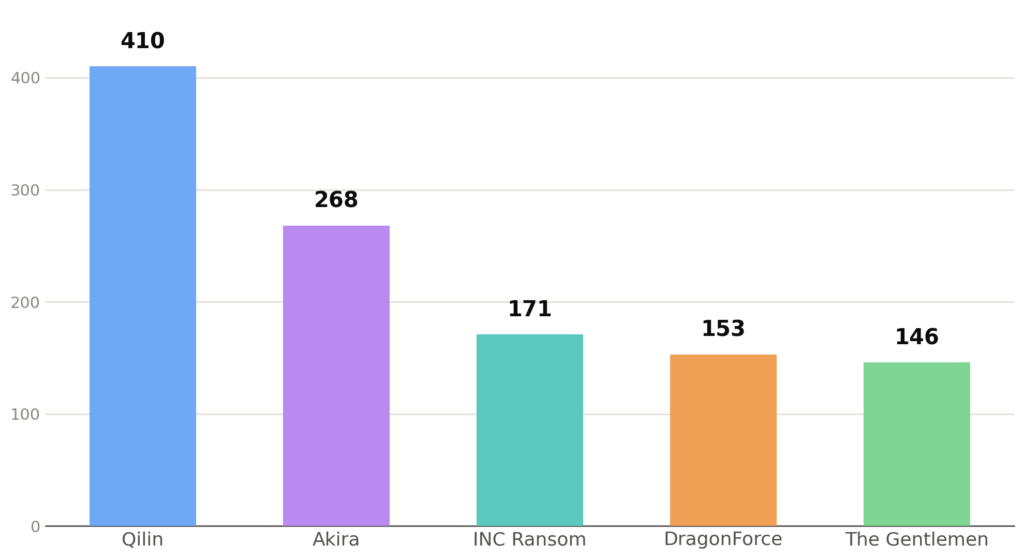
Across both sub-regions combined, five ransomware operators account for the overwhelming share of documented activity: Qilin, Akira, INC Ransom, Dragonforce, and The Gentlemen. Together, these five groups are linked to roughly 1,148 of the Americas' 2,188 attacks — approximately 52.5% of all regional ransomware activity.
Fig. Top five ransomware groups in Americas for H1 2026 (Source: CRIL)
1. Qilin: The Biggest Ransomware Threat in the Americas
Attack Volume: 410 documented incidents across the Americas (370 in North America, 40 in South America) — 18.7% of the regional total.
Qilin is the single most prolific ransomware actor operating in the hemisphere, and its dominance is not evenly spread — it is concentrated hardest in the United States.
Geographic Concentration:
United States: 323 attacks (the single largest country-level concentration of any group, anywhere)
Canada: 33 attacks
Argentina: 13 attacks
Broader South America: 40 attacks
Worldwide Sectoral Targeting: Qilin's targeting logic is deliberate rather than opportunistic:
Construction: 108 incidents (primary focus)
Professional Services: 90 incidents (legal, accounting, consulting firms)
Manufacturing: 67 incidents
Healthcare: 53 incidents
IT & ITES: 43 incidents
Operational Characteristics:
Qilin's affiliate model is built for scale. Initial access brokers handle reconnaissance and compromise, mid-tier operators manage lateral movement, and dedicated crews execute encryption and exfiltration. This compartmentalization lets Qilin run dozens of concurrent operations across the United States without any single point of failure. The group's near-total dominance of the American ransomware market (323 of 1,721 US attacks) suggests either an unusually large affiliate roster or a payout structure attractive enough to pull operators away from competing platforms.
Rapid Exploit Weaponization: Fast turnaround from vulnerability disclosure to active exploitation
Sector Fluency: Deep understanding of which industries face the highest downtime cost
Established Data Brokerage Ties: Exfiltrated data reliably reaches monetization channels
Americas Security Implications: Any organization in construction, professional services, manufacturing, or healthcare operating in the US or Canada should treat Qilin as a primary named threat, not a generic ransomware risk.
2. Akira: North America's Persistent Operator
Attack Volume: 268 documented incidents, almost entirely concentrated in North America — 12.2% of the regional total
Akira is the second most active group in the Americas, and unlike Qilin, its footprint is almost exclusively North American. CRIL's data shows Akira's South American presence is negligible to date.
Geographic Concentration:
United States: 247 attacks (92% of Akira's total Americas volume)
Canada: Remaining North American activity
South America: Minimal to no confirmed activity
Worldwide Sectoral Targeting:
Construction: 57 incidents
Manufacturing: 54 incidents
Professional Services: 47 incidents
Consumer Goods: 19 incidents
IT & ITES: 16 incidents
Operational Characteristics:
Akira has built a reliable playbook around compromising small-to-medium-sized businesses through unpatched public-facing network devices, then pivoting into construction and manufacturing environments where downtime tolerance is lowest. The group's consistency — rather than explosive growth — is its defining trait; it has neither the explosive scale of Qilin nor the geographic diversification of The Gentlemen, but it reliably executes against the same target profile month after month.
Americas Security Implications: North American SMBs in construction, manufacturing, and professional services should assume Akira is actively scanning for exposed remote access infrastructure. Its South American absence should not be mistaken for permanence — RaaS groups expand geographically once North American markets saturate.
3. INC Ransom: The Law-Firm Specialist
Attack Volume: 171 documented incidents (164 in North America, 7 in South America) — 7.8% of the regional total
INC Ransom distinguishes itself through sector specialization rather than volume. The group shows a clear, repeated preference for Professional Services organizations — particularly law firms — leveraging the sensitive, high-stakes nature of legal client data.
Geographic Concentration:
United States: 154 attacks
Canada: 6 attacks
Brazil: 4 attacks
Worldwide Sectoral Targeting:
Professional Services: 58 incidents (primary focus, with a documented preference for law firms)
Construction: 27 incidents
Manufacturing: 26 incidents
Healthcare: 21 incidents
Organisation/Non-profit: 12 incidents
Operational Characteristics:
INC Ransom's rapid operational pace and consistent targeting of law firms, healthcare providers, and transportation/energy operators reflects a strategy built entirely around double-extortion leverage. The sensitivity of the data matters more than the size of the victim. A regional law firm holding privileged client communications is, to INC Ransom, a more valuable target than a much larger manufacturer with less sensitive data.
Americas Security Implications: Law firms, accounting practices, and consulting shops across the US, Canada, and Brazil should assume INC Ransom is actively targeting client confidentiality as leverage — not just encrypting file servers for disruption.
4. Dragonforce: The Cross-Border Supply-Chain Operator
Attack Volume: 153 documented incidents (148 in North America, 5 in South America) — 7.0% of the regional total
Dragonforce maintains an aggressive operational tempo focused heavily on the United States, with a strategy that suggests supply-chain-aware targeting rather than random opportunism.
Geographic Concentration:
United States: 135 attacks
Canada: 11 attacks
South America: 5 attacks
Worldwide Sectoral Targeting:
Construction: 48 incidents
Manufacturing: 31 incidents
Professional Services: 28 incidents
IT & ITES: 18 incidents
BFSI: 17 incidents
Operational Characteristics:
Dragonforce's manufacturing and construction focus mirrors Qilin's and Akira's playbooks, but its concentration in the US combined with limited-but-present South American activity hints at interest in transnational manufacturing supply chains. North American organizations with manufacturing partners or subsidiaries in Latin America should treat this as a lateral-access risk, not just a direct-targeting one.
Americas Security Implications: Manufacturers and construction firms with cross-border operations — a common structure across USMCA supply chains — should extend Dragonforce-specific monitoring to subsidiaries and vendors, not just headquarters networks.
5. The Gentlemen: South America's Dominant Threat
Attack Volume: 146 documented incidents (100 in North America, 46 in South America) — 6.7% of the regional total, but the single most active ransomware group in South America specifically.
While The Gentlemen rank fifth across the combined Americas, they are the #1 threat actor in South America on their own — responsible for roughly 22% of every ransomware attack recorded in that sub-region.
Geographic Concentration:
United States: 77 attacks
North America: 100 attacks
Brazil: 15 attacks
South America: 46 attacks (largest single-group share in the sub-region)
Worldwide Sectoral Targeting:
Manufacturing: 56 incidents
Construction: 45 incidents
Healthcare: 37 incidents
IT & ITES: 36 incidents
Consumer Goods: 34 incidents
Operational Characteristics:
The Gentlemen are a relatively new operator that has achieved outsized scale in a short window, and their South American concentration is the most important regional signal in this dataset. Unlike Qilin or Akira — which built North American dominance first and are only beginning to diversify — The Gentlemen appear to have prioritized South America as a primary theatre from early in their operational life, an unusual strategic choice that may reflect lower defensive maturity, less aggressive law enforcement cooperation, or simply less competitive pressure from other RaaS operators in the sub-region.
Americas Security Implications: South American organizations — especially in healthcare, manufacturing, and IT services — should treat The Gentlemen as their single highest-priority named adversary. North American organizations should not discount them either; 100 US-focused attacks is a substantial footprint for a group still building its brand.
Other Notable Threats: Play, LockBit, and CL0P
Three additional groups warrant inclusion in any Americas threat model:
Play (144 attacks, North America only): Continues its "Big Game Hunting" approach layered with high-volume SMB attacks via unpatched public-facing network devices, concentrated almost entirely on US and Canadian construction, professional services, and manufacturing targets.
LockBit (80 attacks combined — 47 in North America, 33 in South America): Despite sustained international law enforcement pressure and repeated takedown attempts, LockBit remains operationally resilient across both sub-regions, notably compromising Chile's Clínica Dávila in South America.
CL0P (93 attacks combined — 91 in North America, 2 in South America): Operated differently from its peers, executing a large-scale campaign concentrated in January and February 2026 that exploited a single zero-day vulnerability across hundreds of organizations at once — reminiscent of the group's historical MOVEit campaign.
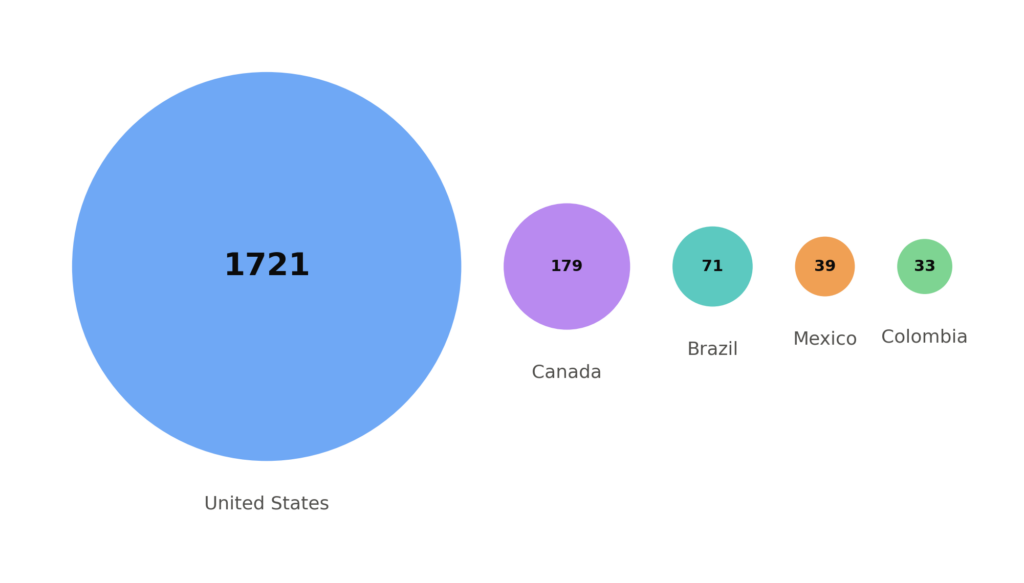
Fig. Most targeted countries in Americas for H1 2026 (Source: Cyble)
United States: The Global Ransomware Epicenter
Attack Volume: 1,721 ransomware attacks — 78.7% of all Americas ransomware activity, and roughly 45% of every ransomware attack recorded worldwide.
No other country on Earth comes close to the volume of ransomware activity absorbed by the United States in H1 2026. The country functions as the default target for nearly every major RaaS operator active today.
Threat Actor Concentration:
Qilin: 323 attacks
Akira: 247 attacks
INC Ransom: 154 attacks
Dragonforce: 135 attacks
Play: 134 attacks
Sectoral Breakdown: Manufacturing, Professional Services, Construction, and Healthcare bear the brunt, consistent with the broader North American pattern of operationally sensitive, low-downtime-tolerance industries.
Why the United States Faces Maximum Pressure
The scale of the US economy, its dense concentration of mid-market manufacturers, law firms, and healthcare providers, and its comparatively high ransom-payment history combine to make it the most economically rational target for every major ransomware operator. US organizations also frequently anchor cross-border supply chains stretching into Canada, Mexico, and South America — meaning a US compromise can cascade into lateral access against hemispheric partners.
Defensive Priority: US organizations across construction, manufacturing, professional services, and healthcare should assume Qilin, Akira, INC Ransom, Dragonforce, Play, and The Gentlemen are all actively scanning for exploitable entry points into their networks simultaneously — not sequentially.
Canada: The Cross-Border Extension
Attack Volume: 179 ransomware attacks — 8.2% of the regional total.
Canada's threat profile closely tracks the United States, reflecting deep economic integration and shared supply chains rather than a distinct targeting logic of its own.
Sectoral Breakdown: Manufacturing, professional services, and construction dominate, mirroring the US pattern almost directly.
Why Canada Faces Sustained Pressure
Canadian organizations are frequently subsidiaries, suppliers, or joint-venture partners of US enterprises, which means the same RaaS groups saturating the US market extend naturally northward. Cross-border manufacturing in particular creates lateral access opportunities that Dragonforce and Akira appear well-positioned to exploit.
Defensive Priority: Canadian organizations should not assume distance from US headquarters provides insulation — the same threat actors, exploiting the same vulnerability classes, are already active on both sides of the border.
Brazil: The Financial Malware and Ransomware Convergence Point
Attack Volume: 71 ransomware attacks — 3.2% of the regional total, but the largest single concentration in South America.
Brazil represents South America's most complex threat environment, combining traditional ransomware pressure with a maturing, sophisticated financial malware ecosystem.
Threat Actor Concentration: The Gentlemen (15 attacks), LockBit, and a fragmented tail of smaller operators.
Sectoral Breakdown: Government & Law Enforcement, BFSI, and Healthcare are the most consistently targeted sectors.
Why Brazil Faces a Dual Threat
Beyond ransomware, Brazil emerged in H1 2026 as a focal point for new Android banking trojan families — TCLBANKER and BTMOB RAT — which use self-propagation, evasion techniques, and Malware-as-a-Service (MaaS) distribution models to target banking and cryptocurrency users directly. Brazil also suffered an alleged 250-million-record breach of Serasa, one of the country's largest credit bureaus, alongside an access sale allegedly targeting the Central Bank of Brazil — a listing that, if genuine, represents one of the most significant initial-access offerings tracked anywhere in the report.
Defensive Priority: Brazilian financial institutions should treat mobile banking malware and ransomware as converging risks rather than separate problems — the same underground economy is monetizing both. Government and BFSI entities should assume access-broker listings referencing critical national infrastructure require immediate incident-response-level validation, not routine monitoring.
Mexico: The Emerging Nearshoring Risk
Attack Volume: 39 ransomware attacks — 1.8% of the regional total.
Mexico's attack volume is meaningfully lower than the US, Canada, or Brazil, but its position within North American manufacturing supply chains — accelerated by ongoing nearshoring trends — makes it a nation to watch closely rather than dismiss.
Why Mexico Warrants Increased Attention
As global manufacturers continue relocating production closer to the US market, Mexican facilities increasingly sit inside the same supply chains that Dragonforce, Akira, and Qilin already target aggressively north of the border. Lower current attack volume may reflect earlier-stage targeting rather than lower risk — a pattern security teams should not mistake for durable safety.
Defensive Priority: Manufacturers with Mexican operations should extend the same OT/IT segmentation and vulnerability management discipline applied to US and Canadian facilities to their Mexican sites, rather than treating them as lower priority.
Colombia: Where Hacktivism Meets Cybercrime
Attack Volume: 33 ransomware attacks — 1.5% of the regional total.
Colombia's ransomware volume is modest, but the country stands out for the density of ideologically motivated activity layered on top of financially driven attacks.
Why Colombia Faces a Blended Threat
Groups such as Anonymous Colombia (#OpColombia) ran active campaigns throughout H1 2026 blending website defacement, DDoS attacks, and data leak activity — consistent with the broader South American pattern in which hacktivist-branded channels frequently overlap with financially motivated cybercrime infrastructure.
Defensive Priority: Colombian government and law enforcement entities — the most frequently targeted sector across South America overall — should treat hacktivist claims as credible threat intelligence signals rather than dismissing them as purely ideological noise.
Where Americas Organizations Face Maximum Risk: A Sectoral Analysis
Professional Services: One of the Top Targets
Attack Volume: The second most heavily impacted sector in North America.
Professional services firms — law, accounting, and consulting practices — are one of the top jobs on North America's ransomware target list, driven overwhelmingly by INC Ransom and AiLock's aggressive targeting of client-confidential data.
Why Professional Services Are Targeted
Privileged Data Concentration: Legal privilege and client confidentiality create existential regulatory and reputational exposure that threat actors exploit for maximum ransom leverage.
Trust-Based Business Model: A single confirmed breach can permanently damage client relationships built entirely on confidentiality.
Documented Actor Preference: INC Ransom has shown a specific, repeated preference for law firms — this is not incidental targeting.
Notable Incident Pattern: AiLock's activity stood out for a coordinated wave of victim disclosures on a single day — March 3, 2026 — a pattern consistent with mass-exploitation of a shared vulnerability rather than individually researched targeting.
Defensive Recommendations:
Segregate client data on separate network segments with distinct, audited access controls
Deploy data loss prevention (DLP) with aggressive egress monitoring for client-data exfiltration
Maintain comprehensive access logs for all sensitive client-data touchpoints
Construction and Manufacturing: The Downtime Economy
Attack Volume: Construction and Manufacturing rank first and third in North America; combined, they represent the largest share of Qilin, Akira, Dragonforce, and The Gentlemen's worldwide targeting.
Constructions and manufacturing share a common vulnerability across the Americas: both operate on tight, contractually enforced timelines where downtime translates directly into cascading financial penalties.
Why Construction and Manufacturing Are Targeted
Time-Sensitive Financial Exposure: Missed construction deadlines trigger contractual penalties; halted production lines trigger lost revenue and breached delivery commitments.
OT/IT Convergence: Modern factories and job sites increasingly integrate operational technology with corporate IT, creating exploitation bridges unavailable in pure-IT industries.
Supply-Chain Complexity: Both industries depend on dense webs of subcontractors and suppliers — compromising one upstream partner can provide lateral access into prime contractors.
Cross-Border Exposure: US-Canada-Mexico manufacturing integration (and increasingly, US-Brazil trade relationships) means a single compromise can propagate across national borders.
Defensive Recommendations:
Implement airgapped network segmentation between OT and corporate IT environments
Prioritize vulnerability patching for network appliances and identity systems over blanket patch cycles
Maintain fully offline, immutable backups of critical project and production data
Extend third-party risk assessments to subcontractors, suppliers, and cross-border subsidiaries
Healthcare: South America's Critical Infrastructure Threat
Attack Volume: One of the top four most heavily impacted sectors in South America.
Healthcare organizations across the Americas — but particularly in South America — face a threat dynamic distinct from financial pressure alone: ransomware attacks against hospitals directly endanger patient safety.
Why Healthcare Is Targeted
Patient Safety Leverage: Downtime in diagnostic systems, pharmaceutical dispensing, and patient records directly threatens continuity of care, creating existential pressure to pay quickly.
Documented Regional Incidents: The Gentlemen's claimed attack on Primero Medicina Privada and LockBit's compromise of Chile's Clínica Dávila both illustrate ransomware groups' willingness to target hospital networks directly.
Data Value: Patient medical records and clinical data command premium prices on dark web marketplaces.
System Complexity: Healthcare IT environments blend legacy diagnostic equipment, electronic health records, and connected medical devices — each with distinct security postures.
Defensive Recommendations:
Implement complete network isolation between clinical systems and corporate IT
Deploy redundant diagnostic and pharmaceutical systems capable of manual fallback operation
Encrypt all patient medical records end-to-end
Build healthcare-specific incident response plans addressing patient notification and continuity of care
Agriculture & Livestock: The Americas' Emerging Supply-Chain Target
Attack Volume: 33% of all North American initial access listings — the second-most targeted sector in the region's access brokerage market.
A distinctive Americas finding: initial access brokers targeting the region show unusually strong interest in Agriculture & Livestock, second only to Technology.
Why Agriculture & Livestock Is an Emerging Target
North America's food supply chain increasingly depends on connected logistics, cold-chain monitoring, and precision agriculture technology — creating an attack surface that did not meaningfully exist a decade ago. Access brokers appear to be positioning themselves ahead of ransomware operators, selling footholds into agricultural operations before ransomware crews weaponize them. This mirrors a pattern seen elsewhere globally but is particularly pronounced in North America's access brokerage data.
Defensive Recommendations:
Treat agricultural technology platforms (precision ag, cold-chain IoT) with the same security rigor as manufacturing OT
Monitor initial access broker markets specifically for agriculture and food-sector listings
Build incident response plans accounting for food-supply-chain continuity, not just data confidentiality
Geopolitical and Ideological Dimensions: Hacktivism Across the Hemisphere
SOLDADOS DIGITALES – UNIÓN AMERICANA: A Hemispheric Hacktivist Collective
Unlike most hacktivist channels tracked in this report, SOLDADOS DIGITALES – UNIÓN AMERICANA operates across both North and South America, making it one of the few genuinely hemispheric threat actors identified in H1 2026 — a significant finding given how regionally siloed most hacktivist activity tends to be.
Combined Hacktivism Metrics (North + South America):
~140 confirmed data leak and dump posts across both sub-regions
At least 932 unique domains impacted (360 in North America, 572 in South America)
Primary targets: Government & LEA, Technology, BFSI, Telecommunication, Education
Notable Collectives by Sub-Region:
North America: SOLDADOS DIGITALES – UNIÓN AMERICANA, Anonymous #FreeTurtleIsland, KERALA HACKERS, LYSTIC TEAM #ID
South America: SOLDADOS DIGITALES – UNIÓN AMERICANA, Anonymous Colombia (#OpColombia) Y.A.N, BLAZER TEAM ATTACK
The Convergence Problem: As with hacktivist activity documented elsewhere in CRIL's global dataset, several Americas-based channels marketed as ideological collectives function as hybrid operations — logging DDoS attacks and defacement claims alongside stolen-data brokerage and DDoS-for-hire services. Security teams should treat these channels as credible threat intelligence sources rather than dismissing their claims as purely political theater.
Regional Threat Actor Summary: Who Targets Your Americas Organization
If You're in Professional Services:
Primary Threat: INC Ransom, Qilin
Secondary Threat: AiLock, The Gentlemen
Vulnerability: Client data exfiltration, regulatory breach-notification pressure
Inventory Network Appliances: Document every internet-facing firewall, VPN, and security gateway
Patch Critical CVEs: Prioritize Ivanti, Fortinet, Cisco, SolarWinds, and Palo Alto Networks appliances — the vendors repeatedly appearing in both the CISA KEV catalog and active exploitation campaigns
Harden Remote Access: Enforce phishing-resistant MFA on all administrative and remote access paths
Deploy Behavioral Monitoring: Watch for anomalous activity on network appliances specifically
DLP Implementation: Deploy data loss prevention with aggressive egress monitoring
Encryption Standards: Enforce encryption in transit and at rest across all sensitive data stores
Access Auditing: Maintain comprehensive logs for every access event touching sensitive data
Phase 3: Operational Resilience (90 days)
Immutable Backups: Establish offline, immutable backup infrastructure isolated from production networks
Sector-Specific Incident Response: Build playbooks addressing construction project continuity, manufacturing downtime, and healthcare patient-safety scenarios specifically
Cross-Border Continuity Planning: For organizations with US-Canada-Mexico or US-Brazil operations, extend continuity plans across all connected facilities
Recovery Testing: Conduct quarterly backup restoration drills to verify actual recovery capability
Phase 4: Threat Hunting and Detection (Ongoing)
Named-Actor Threat Intelligence: Subscribe to intelligence feeds tracking Qilin, Akira, INC Ransom, Dragonforce, and The Gentlemen specifically
Access-Broker Monitoring: Track listings for organizational exposure
Supply-Chain Monitoring: Continuously assess vendor and subsidiary security posture across borders
Mobile Malware Awareness (Brazil-specific): Financial institutions should monitor for TCLBANKER- and BTMOB RAT-style Android banking trojan activity targeting customers
Conclusion: The Americas Ransomware Reality
The Americas is not just the largest ransomware theatre in the world by volume — it is two distinct threat environments operating under a single regional label. North America hosts a saturated, competitive RaaS marketplace where no single group dominates outright. South America is consolidating around a smaller set of operators, led decisively by The Gentlemen.
Key Takeaways:
The Americas carries the global center of gravity: 2,188 of the world's 3,836 documented ransomware attacks (57%) struck North or South America in H1 2026.
Five groups anchor the threat: Qilin (410), Akira (268), INC Ransom (171), Dragonforce (153), and The Gentlemen (146) collectively account for over half of all Americas ransomware activity — but their dominance splits sharply by sub-region.
North America and South America require different playbooks: North America's threat model demands broad coverage against a long tail of competing operators; South America's demands deep, specific defense against The Gentlemen, Qilin, and LockBit.
The United States remains the world's single largest target: 1,721 attacks — nearly 45% of global ransomware volume — makes the US the default target for virtually every major RaaS operator active today.
Brazil's threat is compounding, not singular: ransomware, mass data breach, and mobile banking malware are converging in the same underground economy targeting the same financial institutions.
Sector risk follows economic logic, not chance: Professional Services, Manufacturing, Construction, Healthcare, and — distinctively for the Americas — Agriculture & Livestock face targeting because threat actors have identified specific, exploitable economic pressure points in each.
Access brokers are a leading indicator: a small number of sellers control the region's initial access market and routinely precede ransomware deployment by weeks.
For security leaders across North and South America, the strategic imperative is the same even where the tactical details diverge: know which named actors are active in your specific country and sector, prioritize risk-based patching over blanket cycles, treat data exfiltration as inevitable rather than optional, and build recovery infrastructure that assumes an attack will happen — not one that hopes it won't. The data confirms the Americas will remain the world's most heavily targeted ransomware region through the remainder of 2026. The only open question is how prepared each organization chooses to be.
Frequently Asked Questions (FAQs)
How many ransomware attacks hit the Americas in H1 2026?
2,188 documented ransomware attacks were observed across North and South America in H1 2026, according to Cyble Research and Intelligence Labs (CRIL) findings.
Which ransomware group is most active in the Americas in H1 2026?
Qilin is the most active group across the combined Americas, with 410 documented attacks (370 in North America, 40 in South America). Within South America specifically, however, The Gentlemen — not Qilin — is the dominant actor.
How many ransomware attacks hit North America in H1 2026?
CRIL recorded 1,981 ransomware attacks in North America during H1 2026, representing roughly 52% of all ransomware activity tracked worldwide.
How many ransomware attacks targeted the US in H1 2026? Is it the highest?
Yes. CRIL observed 1,721 ransomware attacks targeted at the US — which is 78.7% of the American continent (North and South, both), and nearly 45% of every ransomware attack recorded worldwide.
Which sector was the most targeted in South America?
IT & ITES remained the most targeted sector in South America for H1 2026.
Ransomware actors targeted which country the most in South America?
Brazil. With 71 attacks, it was the prime target of ransomware actors in H1 2026.
Is Brazil a significant ransomware target?
Yes. Brazil recorded 71 ransomware attacks — the highest total in South America — and additionally faced an alleged 250 million record breach at credit bureau Serasa, an access sale allegedly targeting the Central Bank of Brazil, and new Android banking trojan families (TCLBANKER, BTMOB RAT) targeting financial and cryptocurrency users.
What is the most targeted industry in the Americas?
Construction tops North America's target list, while IT & ITES, Healthcare, and Professional Services top South America's. Across the whole Americas, Construction and Manufacturing remain consistently high-risk due to their low tolerance for operational downtime.
Ransomware stopped being an isolated incident type in 2025. It became the dominant force behind the modern breach landscape, and the ransomware data breach statistics from Cyble's own tracking make the shift impossible to ignore. For organizations facing this growing threat, having a ransomware incident response plan in place is becoming just as important as preventing an attack in the first place.
Cyble's Global Cybersecurity Report 2025 documented 5,967 ransomware attacks for the year, a 50% year-over-year jump. Against the 6,046 data breaches and leaks recorded in the same period, ransomware accounted for nearly half — 49.7% — of the combined ransomware-and-breach total tracked by Cyble Research and Intelligence Labs (CRIL). That's the "nearly half" this blog's title refers to, and it isn't a projection. It's what Cyble observed.
The pace hasn't slowed into 2026:
Q4 2025 brought 2,018 claimed attacks (roughly 673 a month), and January 2026 held that pace at 679 victims, 30% above the 2025 monthly average.
Europe's Q1 2026 tally hit 462 incidents, 404 of them ransomware, with the UK as the region's most-attacked country and manufacturing/construction overtaking financial services as top targets.
Ransomware-as-a-service Threats Have Removed the Skill Barrier
CRIL identified 57 new ransomware groups and 27 new extortion groups in 2025, alongside more than 350 new ransomware strains built largely on the MedusaLocker, Chaos, and Makop families.
This is the mechanics of RaaS: affiliates rent pre-built toolkits, and operational capacity scales faster than any single group's headcount. Between January and April 2025, this dynamic drove an 86% spike in global incidents, with Cl0P alone responsible for 28% of that quarter's activity, per Cyble's Ransomware Threat Landscape report.
Double Extortion Ransomware is the Baseline, Not the Exception
Encrypt-and-leak is now standard operating procedure. CRIL's research into extortion technique evolution tracked groups layering in triple extortion (DDoS on top of encryption and data theft) and direct outreach to a victim's clients — a tactic CL0P has used to compound reputational damage beyond the initial breach. For a lean team, this means "we have backups" no longer neutralizes the threat; the data theft component still forces a decision.
Why Cost Pressure Hits Small Teams Hardest
Cyble's Europe Q1 2026 findings noted that attackers are deliberately targeting sectors with narrow downtime tolerance — manufacturing and construction firms face contract penalties and supply-chain breakage within days of an outage, which shortens the runway between intrusion and ransom decision. Lean security teams, by definition, have the least slack to absorb that pressure.
How to Prevent Ransomware Attacks in 2026: What the Data Points to
The October 2025 surge to 5,194 year-to-date attacks was fueled by a steady supply of critical vulnerabilities and unpatched internet-facing assets, per Cyble's analysis. For small teams, prevention priorities follow directly from that finding:
Patch internet-facing systems against CISA KEV entries first — over 86% carry CVSS scores of 7.0 or higher.
Treat remote-management tools (RMM, VPN, RDP) as high-risk attack surface; Qilin affiliates have abused WinSCP, AnyDesk, and ScreenConnect for lateral movement.
Monitor for BYOVD (Bring Your Own Vulnerable Driver) activity, a technique increasingly paired with credential-harvesting toolkits.
Zero Trust Security for Small Teams is Achievable Without Enterprise Budgets
Zero trust doesn't require a full architecture overhaul on day one. The practical entry points for a lean team:
Enforce MFA on every remote access path, especially RMM and VPN tools — the same tools driving initial access in Cyble's tracked campaigns.
Segment networks so a single compromised endpoint can't reach backup infrastructure.
Apply least-privilege access reviews quarterly, not annually.
Endpoint Detection and Response for Small Business is the Non-negotiable Layer
Given that Qilin and similar groups deploy Linux-based binaries on Windows hosts and harvest credentials via NirSoft and Mimikatz-style toolkits, EDR coverage across every endpoint — not just servers — is the difference between detection in hours versus discovery via a ransom note.
Building a Ransomware Incident Response Plan Before it's Needed
A working ransomware incident response plan and cybersecurity incident response checklist should cover, at minimum:
Pre-approved communication chain (legal, leadership, cyber insurance, law enforcement contact) that doesn't depend on compromised email.
Isolated, tested offline backups with a documented restoration time objective.
A decision framework for the ransom-payment question, made before an attack, not during one.
Log retention sufficient to reconstruct the intrusion timeline for post-incident analysis.
Ransomware Recovery Best Practices After the Encryption Hits
The ransomware incident response plan and recovery speed depend on preparation done months earlier: validated backup integrity, a pre-mapped list of critical systems in priority order, and a rehearsed communication plan for customers and regulators. Teams that treat recovery as an extension of the incident response plan — rather than an improvised scramble — cut both downtime and the pressure to pay.
How Cyble Can Help
Every ransomware statistic in this ransomware incident response plan playbook — the leak-site counts, the group rankings, the extortion techniques, the sector targeting — traces back to one thing: visibility into where attackers operate before they hit a victim's network. That's the gap Cyble Vision is built to close.
Cyble Vision is the threat intelligence platform behind CRIL's own research, continuously monitoring deep, dark, and surface web sources — ransomware leak sites, underground forums, and threat actor chatter — through its Blaze AI engine.
For a lean security team, that means the same early-warning signal CRIL uses to track Qilin, Akira, and every emerging RaaS affiliate becomes available as a live feed for their own organization: exposed credentials, brand mentions on cybercrime forums, ransomware group activity tied to their sector, and third-party breach exposure, all correlated and prioritized automatically instead of requiring a dedicated analyst to piece it together manually.
For a team that can't staff round-the-clock dark web monitoring or manually track which of the dozens of active ransomware groups is circling their industry, this is the difference between finding out from a leak site and finding out weeks earlier.
Lean teams can't out-staff ransomware operators, but they can out-see them. Request a Cyble Vision demo to get the same dark web and ransomware-tracking intelligence CRIL uses to build reports like this one — built for teams that need to know who's targeting them before the leak site does.
Conclusion
A ransomware incident response plan for small security teams isn't about matching enterprise headcount. It's about aligning limited resources against the specific mechanics CRIL has documented: patch the exploited CVEs first, lock down remote-access tools, deploy EDR broadly, and rehearse the incident response plan before the RaaS-fueled affiliate economy finds the gap.
Europe faced a ransomware onslaught in the first half of 2026 that sets a troubling precedent for the remainder of the year. According to Cyble Research and Intelligence Labs (CRIL), the region experienced 866 documented ransomware attacks, 51 confirmed data breach incidents, and 7 initial access sales between January and June 2026. These figures represent not just a volume problem, but a fundamental shift in how threat actors are organizing, targeting, and monetizing their operations within European territory.
What distinguishes the ransomware threats in Europe from other global regions is the concentration of power among a small number of highly sophisticated threat actors. While the threat ecosystem encompasses dozens of groups, five dominant ransomware operators account for approximately 55% of all documented activity. This concentration creates predictability—European security leaders can now identify, profile, and build specific defensive strategies against known adversaries.
The Five Dominant Ransomware Groups Targeting Europe
1. Qilin: The Biggest Ransomware Threat in Europe
Attack Volume: 158 documented incidents (18.2% of regional total)
Qilin stands as the dominant ransomware threat actor targeting Europe, commanding operational superiority through sophisticated affiliate management, rapid exploit weaponization, and industry-specific targeting intelligence.
Qilin's dominance stems from understanding European organizational economics. Construction projects operate under time-sensitive contracts with contractually-defined penalties for delay. A single day of downtime on a €50 million construction project can trigger cascading costs exceeding €100,000. This economic reality translates directly into ransom payment likelihood, making Qilin's targeting strategy rational and highly effective.
The group maintains an extensive affiliate network capable of concurrent operations across multiple European nations. Evidence suggests Qilin has compartmentalized its operations: initial access brokers handle reconnaissance and network compromise, mid-tier operators manage lateral movement and privilege escalation, and final-stage operators execute encryption and exfiltration. This division of labor enables rapid scaling and reduces attribution risk.
Why Qilin Dominates:
Industry Expertise: Deep understanding of construction project timelines and financial exposure
Exploit Library: Rapid weaponization of both known and zero-day vulnerabilities
Data Monetization: Established data brokerage partnerships ensure exfiltrated data reaches buyers
European Security Implications: Organizations in construction, professional services, and manufacturing should treat Qilin as their primary threat actor concern. Defensive strategies must prioritize data exfiltration prevention, network segmentation, and immutable backup infrastructure.
2. The Gentlemen: The Rising European Threat
Attack Volume: 144 documented incidents (16.6% of regional total)
The Gentlemen represent an emerging threat actor that has achieved remarkable scale in a relatively short operational window. Unlike established groups that evolved from other cybercriminal operations, The Gentlemen appear purpose-built for ransomware-as-a-service operations.
Geographic Concentration:
Europe: 144 attacks (primary focus)
United States: 100 attacks (secondary focus)
Thailand: 35 attacks (supply-chain targeting)
South Asia: 40 attacks
Worldwide Sectoral Targeting:
Construction: 45 incidents
Manufacturing: 56 incidents
Healthcare: 37 incidents
IT & ITES: 36 incidents
Professional Services: 29 incidents
Operational Characteristics:
The Gentlemen's rapid emergence and sustained growth suggest significant operational funding and technical sophistication. The group's geographic diversification—maintaining European dominance while aggressively expanding into Asia-Pacific—indicates either organizational scale or partnerships with regional threat actors.
Notably, The Gentlemen's Thailand targeting (35 incidents) suggests supply-chain attack sophistication. By compromising manufacturing and logistics operations in Thailand, the group can leverage these beachheads for downstream attacks against Western European organizations. This cross-continental supply-chain targeting represents a significant evolution in ransomware operational sophistication.
Key Distinction: While Qilin focuses on maximizing ransom payments from individual targets, The Gentlemen appear to prioritize operational scale and geographic expansion. This suggests the group may be building toward either:
A mega-RaaS platform rivaling LockBit's historical dominance
Preparation for potential acquisition or partnership with state-sponsored actors
Geographic arbitrage—leveraging lower prosecution risk in developing nations while maintaining European operations
European Security Implications: The Gentlemen's emergence signals market competition is intensifying. Organizations should monitor this group's operational evolution closely, as aggressive growth often precedes operational mistakes that create defensive opportunities.
3. LockBit: The Persistent Legacy Threat
Attack Volume: 61 documented incidents (7.0% of regional total)
LockBit's presence in European targeting represents a significant finding given sustained law enforcement pressure and multiple platform disruption attempts. Despite being targeted by coordinated international takedown operations, LockBit maintained operational capability throughout H1 2026.
Geographic Concentration:
Europe: 61 attacks (Primary operations)
North America: 47 attacks (Secondary operations)
Distributed: Global presence indicating resilient infrastructure
Worldwide Sectoral Targeting:
Construction: 22 incidents
Manufacturing: 22 incidents
Government & LEA: 12 incidents
Healthcare: 19 incidents
Professional Services: 13 incidents
Operational Resilience:
LockBit's continued operations despite international enforcement actions demonstrate several critical lessons:
Affiliate Compartmentalization: By maintaining separate operational cells, LockBit can continue operations even when core infrastructure is disrupted
Rapid Rebranding: The group has adopted multiple identities and platform variants, complicating attribution
Infrastructure Redundancy: Multiple command-and-control server locations across jurisdictions with varying law enforcement cooperation levels
Operator Recruitment: Continuous recruitment of new affiliates from emerging cybercriminal talent pools
The group's continued viability suggests that law enforcement actions, while disruptive, are insufficient to eliminate established RaaS operations. Organizations cannot rely on law enforcement intervention as a defensive strategy; they must assume LockBit and similar groups will remain operational threats indefinitely.
European Security Implications: LockBit should remain on European security teams' active threat monitoring lists. The group maintains technical sophistication, access to critical zero-day exploits, and demonstrated willingness to target European critical infrastructure.
4. Akira: The Opportunistic European Operator
Attack Volume: 59 documented incidents (6.8% of regional total)
Akira represents a secondary-tier ransomware group with focused European operations. The group demonstrates strong preference for Manufacturing and Construction sectors, suggesting industry-specific expertise or targeted affiliate recruitment.
Geographic Concentration:
Europe & UK: 59 attacks (Secondary focus)
North America: 268 attacks (Primary focus)
Secondary: Limited operations in other regions
Worldwide Sectoral Targeting:
Manufacturing: 54 incidents
Construction: 57 incidents
Professional Services: 47 incidents
Consumer Goods: 34 incidents
Healthcare: 13 incidents
Operational Profile:
Akira's disproportionate North American presence (268 attacks) with lower European activity (59 attacks) suggests the group may have established affiliate networks in North America with secondary capacity for European operations. The strong manufacturing and construction focus mirrors Qilin's strategy, indicating these sectors offer superior ransom payment likelihood across multiple geographic markets.
European Security Implications: While not as immediately threatening as Qilin or The Gentlemen, Akira's persistent operations warrant inclusion in threat modeling exercises. European manufacturing and construction organizations should monitor Akira's affiliate recruitment channels and tactical innovations.
5. Dragonforce: The Supply-Chain Specialist
Attack Volume: 54 documented incidents (6.2% of regional total)
Dragonforce rounds out the top-five European threat actors with apparent specialization in Manufacturing and Technology sectors, suggesting possible supply-chain attack capabilities.
Geographic Concentration:
North America: 135 attacks (Primary focus)
Europe & UK: 54 attacks (Secondary focus)
Secondary: Limited global operations
Worldwide Sectoral Targeting:
Manufacturing: 31 incidents
Construction: 48 incidents
Professional Services: 28 incidents
Food & Beverages: 9 incidents
Healthcare: 9 incidents
Operational Pattern:
Dragonforce's heavy US focus with secondary European operations suggests the group may be leveraging North American-based supply chains to gain access to European targets. Manufacturing supply chains are deeply interconnected across transatlantic partners; compromising US manufacturers could provide lateral access into European operations.
European Security Implications: European manufacturing organizations should implement aggressive third-party risk management programs, particularly for US-based suppliers. Dragonforce's supply-chain sophistication suggests the group may bypass direct targeting in favor of compromising upstream vendors.
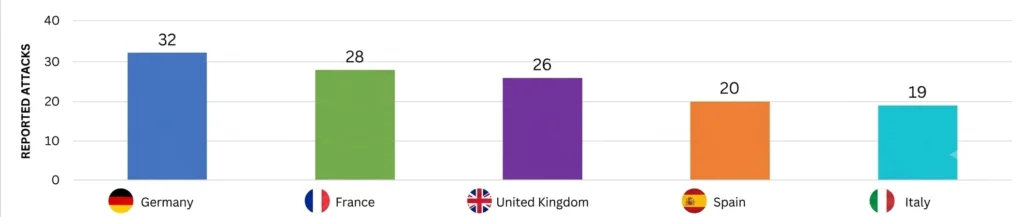
Top five European Nations Attacked by Ransomware Actors in 2026 H1 (Source: Cyble Research)
Germany: The Manufacturing Battleground
Attack Volume: 155 ransomware attacks (17.9% of regional total)
Germany's position as Europe's manufacturing powerhouse places it at the center of ransomware targeting campaigns. The nation's industrial sector—encompassing automotive, machinery, chemicals, and precision manufacturing—represents the most valuable ransomware target set in Europe.
German organizations represent an optimal target combination: high asset value, supply-chain criticality, strong operational technology integration, and proven willingness to pay ransoms to maintain production schedules. Additionally, Germany's federal structure creates jurisdictional complexity that may slow law enforcement response.
The nation's Mittelstand (mid-market manufacturing firms) are particularly vulnerable—large enough to justify ransom payments, but sometimes lacking enterprise-grade security infrastructure.
Defensive Priority: German manufacturing organizations should assume Qilin, The Gentlemen, Akira, and Dragonforce all maintain active operations targeting their sector. Network segmentation between IT and operational technology (OT) environments should be elevated to critical priority.
United Kingdom: The Financial Services Crosshairs
Attack Volume: 138 ransomware attacks (15.9% of regional total)
The UK faces a different threat profile than Germany, driven primarily by London's position as a global financial services hub. While manufacturing is targeted, Banking, Financial Services, and Insurance (BFSI) organizations command disproportionate attention.
Threat Actor Concentration:
Qilin: 26 attacks
The Gentlemen: 26 attacks
LockBit: 18 attacks
Akira: 13 attacks
Dragonforce: 11 attacks
Sectoral Breakdown:
BFSI: 38 incidents (concentrated targeting)
Technology: 32 incidents
Retail: 26 incidents
Professional Services: 24 incidents
Government & LEA: 16 incidents
Why the UK Is Targeted
London's financial services ecosystem manages trillions in assets, making it extraordinarily valuable to data-exfiltrating threat actors. BFSI organizations hold customer financial data, internal financial records, and strategic information that commands premium prices on dark web marketplaces.
Additionally, regulatory requirements (FCA, PRA, etc.) create pressure for rapid ransom payment to avoid breach notification delays that could trigger regulatory sanctions.
Data Exfiltration Risk: The UK's status as a financial services hub makes it particularly vulnerable to data-centric attack strategies. Organizations should assume that successful breach attempts will include aggressive data exfiltration alongside encryption deployment.
Defensive Priority: UK BFSI organizations must implement robust data loss prevention (DLP), encryption for data in transit and at rest, and aggressive monitoring for unauthorized data access or exfiltration attempts.
France: The Balanced Threat
Attack Volume: 119 ransomware attacks (13.7% of regional total)
France experiences balanced threat distribution across multiple sectors, reflecting both its manufacturing capacity and significant professional services sector.
Threat Actor Concentration:
Qilin: 28 attacks
The Gentlemen: 28 attacks
LockBit: 15 attacks
Akira: 14 attacks
Dragonforce: 8 attacks
Sectoral Breakdown:
Professional Services: 26 incidents
Manufacturing: 24 incidents
Construction: 19 incidents
Technology: 14 incidents
Healthcare: 10 incidents
Why France Faces Distributed Threat
As Europe's second-largest economy, France is attractive to ransomware operators across multiple sectors. The nation's professional services sector (legal, accounting, consulting) is particularly valuable for data exfiltration, while manufacturing remains a consistent target.
Defensive Priority: French organizations should implement sector-specific defensive strategies: professional services firms should prioritize client data protection and DLP, while manufacturing organizations should focus on OT segmentation and operational resilience.
Italy: The Construction and Manufacturing Hub
Attack Volume: 115 ransomware attacks (13.3% of regional total)
Italy faces concentrated targeting in construction and manufacturing sectors, with particular pressure on small-to-medium enterprises in industrial regions.
Threat Actor Concentration:
Qilin: 19 attacks
The Gentlemen: 18 attacks
LockBit: 12 attacks
Akira: 16 attacks
Dragonforce: 8 attacks
Sectoral Breakdown:
Construction: 48 incidents (concentrated)
Manufacturing: 38 incidents
Professional Services: 18 incidents
Retail: 14 incidents
Why Italy Faces Sector-Specific Pressure
Italy's construction industry is particularly vulnerable to ransom attacks due to tight project timelines and significant financial exposure. The nation's manufacturing sector, while sophisticated, sometimes operates with legacy infrastructure that creates exploitation opportunities.
Defensive Priority: Italian construction and manufacturing organizations should prioritize incident response readiness, backup infrastructure resilience, and supply-chain risk management.
Spain: The Emerging Risk
Attack Volume: 87 ransomware attacks (10.0% of regional total)
Spain experiences lower absolute attack volume than Germany, UK, France, or Italy, but faces concentrated pressure in manufacturing and professional services sectors.
Threat Actor Concentration:
Qilin: 20 attacks
The Gentlemen: 18 attacks
LockBit: 8 attacks
Akira: 12 attacks
Dragonforce: 7 attacks
Sectoral Breakdown:
Manufacturing: 28 incidents
Professional Services: 19 incidents
Construction: 16 incidents
Technology: 10 incidents
Regional Observation: Spain's lower attack volume may reflect either lower overall ransomware targeting or more effective defensive implementations. Spanish security teams should not interpret lower numbers as reduced threat but rather as a baseline for future comparison.
Where European Organizations Face Maximum Risk: A Sectoral Analysis
Construction: The Ransomware Goldmine
Attack Volume: 107 documented incidents (58% of all sector targeting across regions – not just in Europe – analyzed)
Construction organizations face disproportionate ransomware targeting across the entire European region. This concentration reflects understood economic vulnerabilities that threat actors exploit with precision.
Why Construction Is Targeted
Time-Sensitive Financial Exposure: Construction projects operate under contractually-defined timelines. Each day of delay triggers cascading costs, financial penalties, and potential contract termination. Organizations facing potential loss of €50-100 million contracts will prioritize rapid recovery over law enforcement involvement.
Operational Technology Integration: Modern construction increasingly relies on Building Information Modeling (BIM), cloud-based project management, and real-time equipment tracking. This IT/OT convergence creates exploitation pathways unavailable in purely IT-based industries.
Supply-Chain Complexity: Construction projects depend on dozens of subcontractors and suppliers. Compromising a single upstream supplier can provide lateral access into prime contractors.
Financial Pressure: Construction firms often operate with tight cash flow, making ransom negotiation essential to preserve solvency.
Accessibility: Many construction firms, particularly smaller regional players, operate with basic security infrastructure, creating easy exploitation opportunities.
European Construction Risk Mapping:
Germany (14 attacks): Heavy machinery and precision manufacturing integration
Supply-Chain Due Diligence: Implement security requirements for subcontractors and equipment suppliers
Professional Services: The Data Exfiltration Target
Attack Volume: 86 documented incidents
Professional services firms (law, accounting, consulting) face sophisticated targeting driven by data exfiltration opportunities rather than operational disruption pressure.
Why Professional Services Are Targeted
Client Confidentiality Risk: Legal privilege and client confidentiality create existential regulatory and reputational exposure. Threat actors leverage this to demand premium ransoms.
Sensitive Data Concentration: Professional services firms accumulate client financial records, litigation strategies, tax information, and corporate secrets—all commanding premium dark web prices.
Regulatory Exposure: GDPR breach notification requirements create pressure for rapid response and ransom payment to avoid regulatory sanctions.
Supply-Chain Position: Professional services firms advise major corporations; compromising advisors provides indirect access to clients.
Trust-Based Business Model: Client relationships depend on confidentiality. A single breach can destroy long-term client relationships and firm reputation.
European Professional Services Risk:
France (16 attacks): Concentrated targeting of Paris-based firms
Germany (16 attacks): Heavy focus on Frankfurt financial advisory firms
UK (17 attacks): London-based legal and accounting partnerships
Italy (6 attacks): Milan and Rome-based advisory firms
Spain (7 attacks): Barcelona and Madrid professional services sector
Key Finding: Professional services firms experience disproportionate data breach incidents (exfiltration with confirmed leak activity) compared to other sectors. Of the 51 total data breach incidents across Europe and UK, professional services represents a concentrated target.
Defensive Recommendations:
Client Data Segregation: Isolate client data on separate network segments with distinct access controls
Data Loss Prevention (DLP): Deploy DLP solutions with aggressive egress controls monitoring client data exfiltration
Encryption Standards: Implement client-facing encryption for all sensitive communications
Access Auditing: Maintain comprehensive logs of all access to sensitive client data
Ransomware-Specific Insurance: Consider cyber insurance with specific ransomware coverage addressing confidentiality exposure
Manufacturing: The Supply-Chain Critical Target
Attack Volume: 123 documented incidents
European manufacturing organizations face sophisticated, supply-chain-aware threat actors who understand production dependencies and downtime economics.
Why Manufacturing Is Targeted
Operational Technology Integration: Modern factories integrate IT and OT systems. Ransomware deployment can halt production lines, creating catastrophic financial exposure.
Supply-Chain Criticality: Manufacturing downtime cascades through dependent enterprises. A single organization's compromise can impact dozens of downstream customers.
Export Dependency: European manufacturers serve global markets. Production delays translate directly into lost revenue and market share.
Legacy Infrastructure: Many manufacturing facilities operate aging, unpatched systems integrated with newer IT infrastructure, creating exploitation bridges.
Financial Pressure: Manufacturing organizations face razor-thin margins; production downtime can drive solvency crises.
UK (14attacks): Aerospace, automotive, precision manufacturing
Critical Vulnerability Pattern: Manufacturing organizations are disproportionately targeting known, exploitable vulnerabilities in critical infrastructure appliances (network appliances, security tools, identity systems). Rather than deploying zero-days, threat actors exploit patched vulnerabilities that organizations have not implemented.
Defensive Recommendations:
OT/IT Segmentation: Implement airgapped network separation between operational technology and corporate IT
Vulnerability Management Prioritization: Focus patching efforts on network appliances, security tools, and identity systems
Industrial Control System (ICS) Monitoring: Deploy behavioral monitoring for unusual activity on manufacturing control systems
Healthcare organizations face a unique threat dynamic where ransomware directly endangers patient safety, creating existential operational pressure distinct from financial threats.
Why Healthcare Is Targeted
Patient Safety Risk: Ransomware disables critical medical systems (diagnostic equipment, pharmaceutical dispensing, patient records). Unlike other industries, downtime directly threatens life.
Regulatory Pressure: GDPR, HIPAA-equivalent regulations, and national privacy laws create breach notification requirements that incentivize ransom payment.
Data Value: Patient medical records, pharmaceutical research data, and clinical trial information command premium dark web prices.
Continuous Operation Requirement: Unlike manufacturing or services, healthcare cannot delay critical procedures. The operational pressure to pay ransoms is existential.
System Complexity: Healthcare IT environments integrate numerous legacy systems (PACS, EHR, medical devices) with varying security architectures.
European Healthcare Risk Distribution:
Germany (14 attacks): Concentrated in Berlin, Munich, and Frankfurt urban medical centers
Austria (2 attacks): private healthcare sector
France (5 attacks): Concentrated in Paris and Lyon region hospitals
Switzerland (3 attacks): medical centers
Spain (3 attacks): Barcelona and Madrid hospital networks
Critical Finding: Healthcare organizations experience disproportionately high data breach incident rates, suggesting organized threat actors specifically target health information exfiltration.
Defensive Recommendations:
Clinical System Isolation: Implement complete network separation between clinical systems and corporate IT
Redundant Critical Systems: Deploy redundant diagnostic and pharmaceutical systems capable of manual operation
Patient Data Encryption: Implement end-to-end encryption for all patient medical records
Breach Response Planning: Develop healthcare-specific incident response plans addressing patient notification and continuity of care
Medical Device Security: Implement inventory and monitoring for all connected medical devices
Supply-Chain Assessment: Assess security of medical device manufacturers and pharmaceutical distributors
The Data Exfiltration Reality: Beyond Encryption
Confirmed Data Breaches: 51 Incidents Across Europe and UK
While ransomware attacks total 866, only 51 incidents resulted in confirmed data breaches and leaks (5.9% confirmation rate). This apparent low percentage masks a critical operational truth: organizations cannot distinguish between encryption-only attacks and data exfiltration scenarios until exfiltration attempts or threats emerge.
Data Breach Distribution by Sector:
Sector
Confirmed Breaches
Percentage
BFSI
9
17.6%
Telecom
9
17.6%
Retail
8
15.7%
Government & LEA
6
11.8%
Media & Entertainment
5
9.8%
Technology
4
7.8%
Healthcare
4
7.8%
Automotive
3
5.9%
Construction
2
3.9%
Education
1
2.0%
Others
6
11.8%
Critical Observation: BFSI and Telecom sectors experience disproportionate data breach incidents, suggesting these industries are specifically targeted for data exfiltration rather than operational disruption. The strategic implication is clear: threat actors targeting financial and telecommunications organizations prioritize data monetization over ransom payment.
Most Active Threat Actors in Data Exfiltration: The Leak Economy
Primary Exfiltration Actors:
Actor
Confirmed Leak Posts
Targeting Pattern
tanaka
6
Industry-agnostic, global operations
kazutlg
4
BFSI and Professional Services focus
aslan1
2
Government and Technology sectors
darkcybervault
2
Retail and Professional Services
breach3d
2
Technology focus
frog
2
Diverse sector targeting
ken6k
2
BFSI concentration
max9898
2
Retail and Technology
worldrdp
2
Technology sector
zyad2drkwb
2
Government targeting
zoozkooz
2
Diverse sector
mr_x1
1
Retail focus
ventuuas
1
Professional Services
Others
18
Distributed diverse targeting
Strategic Finding: While Qilin, The Gentlemen, and LockBit dominate ransomware attack volume, data exfiltration is fragmented across numerous smaller actors, including tanaka (6 posts), kazutlg (4 posts), and dozens of single-incident operators. This suggests a mature data brokerage ecosystem where extracted data is resold to specialized exfiltration actors.
Dark Web Data Marketplace Activity:
916 unique domains impacted by data leaks
Approximately 86 distinct leak posts across dark web channels
Data types: Financial records, customer PII, medical records, intellectual property, trade secrets
Implication: Organizations can no longer assume encrypted data is "lost forever" if backups are restored. Exfiltrated data will be monetized regardless of whether organizations pay ransoms. Data loss prevention becomes as critical as ransomware detection.
Geopolitical and Ideological Dimensions: The Activism-Cybercrime Convergence
Pro-Russian Hacktivism: Blurred Lines Between Ideology and Profit
H1 2026 witnessed increasing overlap between geopolitically motivated hacktivism and financially motivated cybercrime, particularly among pro-Russian collectives targeting NATO-aligned European nations.
Key Threat Actors to Monitor
NoName057(16) - The Pro-Russian DDoS Coalition
Primary Activity: Large-scale DDoS attacks against NATO-aligned governments and Ukrainian supporters
Secondary Activity: Data exfiltration for monetization
Geographic Targets: Estonia, UK, Ukraine, Italy, Spain, France, Poland, Norway, Denmark, Lithuania, Latvia, Czech Republic, Germany, Moldova
Operational Pattern: Coordinated DDoS campaigns often accompanied by data theft and subsequent leak activity
Operational Evolution: NoName057(16) began as a purely activist collective claiming ideological motivation (anti-NATO, pro-Russia). By H1 2026, the group had evolved to include data exfiltration and monetization—suggesting either organizational evolution or infiltration by financially motivated threat actors.
Strategic Implication: European organizations cannot compartmentalize threat modeling. A geopolitically motivated attack that begins as a DDoS campaign can transition into ransomware deployment when exfiltration opportunities present themselves.
Strategic Defense Recommendations for European Organizations
Prioritized Defensive Roadmap
Based on CRIL's H1 2026 regional data, European security leaders should prioritize defensive investments in the following sequence:
Defensive Focus: Data encryption, DLP with aggressive egress controls, cyber insurance
If You're in Healthcare:
Primary Threat: Qilin, The Gentlemen, LockBit
Secondary Threat: Data exfiltration operators
Vulnerability: Patient safety risk, critical operational pressure, medical device security
Defensive Focus: Clinical system isolation, redundant critical systems, incident response for operational continuity
Conclusion: The European Ransomware Reality
Europe and the UK face a mature, organized ransomware ecosystem dominated by five sophisticated threat actors who have developed deep understanding of regional economic vulnerabilities. The threat is not random or opportunistic—it is strategic, targeted, and evolved.
Key Takeaways:
Five groups dominate: Qilin (158 attacks), The Gentlemen (144), LockBit (61), Akira (59), and Dragonforce (54) collectively account for 476 of 866 documented attacks (55%). European security leaders can build specific defensive strategies against known adversaries.
Geography matters: Germany, UK, France, Italy, and Spain face distinct threat profiles. Security strategies must be regionally and sector-specific, not generic.
Sectors are targeted deliberately: Construction, Professional Services, and Manufacturing are not randomly selected—they face extraordinary pressure due to economic vulnerabilities that threat actors systematically exploit.
Data exfiltration is the primary leverage: Of 866 attacks, only 51 resulted in confirmed breaches—but this understates the risk. Organizations must assume all breaches involve data exfiltration and cannot rely on backup restoration alone.
Patch management is the primary defense: Nearly 90% of exploited vulnerabilities had patches available. Disciplined patch management, particularly for network appliances, would prevent the vast majority of successful attacks.
Known vulnerabilities are the current threat: Despite awareness of zero-day sophistication, threat actors continue exploiting known vulnerabilities because patches lag adoption. This creates a predictable exploitation window that defensive teams can close.
For European security leaders, the path forward is to understand your regional threat actors, prioritize critical infrastructure protection, implement robust data protection measures, and establish resilient backup and recovery infrastructure. The threat is severe, but it is also understood and defensible. The question is not whether European organizations will face ransomware attacks in the remainder of 2026 and beyond—the data confirms they will. The question is whether they will be prepared.
The conversation around ANZ ransomware threats has shifted noticeably over the past year. What once looked like sporadic, high-profile incidents has evolved into a sustained and structured campaign against organizations across Australia and New Zealand. Signals emerging from underground forums and marketplaces reveal a sobering reality: ransomware is no longer just a technical problem; it is an economic strategy driven by efficiency, specialization, and scale.
At the center of this shift is ransomware dark web intelligence, which paints a clear picture of attacker intent. Threat actors are not simply increasing volume; they are refining their focus. The ANZ region, with its high-value economy and deeply digitized infrastructure, has become a preferred hunting ground.
Australia’s economic profile plays directly into the hands of ransomware operators. A strong GDP, combined with a relatively small population, creates a high-return environment. Attackers don’t need to cast a wide net; each successful breach can yield significant payouts.
By mid-2025, 71 ransomware incidents had been publicly claimed in Australia, compared to nine in New Zealand. On the surface, those figures may seem moderate. However, when adjusted for population, the rate of ransomware attacks in Australia and New Zealand stands out globally. Even larger economies have not experienced the same intensity relative to their size.
This imbalance reflects a fundamental principle driving ANZ organizations cybersecurity risks: attackers prioritize value over volume. In practical terms, fewer victims can still mean higher profits.
A Fragmented Threat Landscape with No Single Dominant Actor
Unlike regions where one ransomware group dominates headlines, the dark web ANZ cyber threats ecosystem is notably fragmented. Multiple groups, including Qilin, Akira, INC, Lynx, and Dragonforce, operate concurrently, each claiming a similar share of attacks.
This decentralization complicates defense strategies. Organizations are not facing a predictable adversary with a consistent playbook. Instead, they must prepare for a rotating cast of threat actors, each bringing different techniques, timelines, and negotiation tactics.
From a ransomware dark web intelligence perspective, this fragmentation signals a competitive market. Threat actors are actively testing sectors, probing defenses, and adapting quickly based on what works.
Industries Under Sustained Pressure
The distribution of ANZ ransomware threats is far from uniform. Certain sectors continue to absorb the majority of attacks due to the nature of their operations.
Healthcare and professional services sit at the top of the list. In healthcare, the urgency of patient care creates a near-zero tolerance for downtime, increasing the likelihood of ransom payments. Professional services firms, on the other hand, hold large volumes of sensitive client data, making them lucrative targets.
However, the scope is broader than these two sectors alone. Aviation software providers, pharmaceutical companies, engineering firms, and even steel manufacturers have all been affected. This pattern reinforces a key insight: ransomware attacks in Australia and New Zealand are opportunistic but calculated, targeting environments where disruption carries tangible consequences.
Notable Incidents Reveal Tactical Evolution
Several incidents in 2025 highlight how attackers are evolving their methods.
The Akira group compromised an Australian industrial technology provider, exfiltrating approximately 10GB of sensitive data, including financial records and employee identification documents. This case highlights the growing overlap between ransomware and critical infrastructure risk.
In another breach, a political organization suffered exposure to communications, identity records, and financial data, highlighting that ANZ organizations' cybersecurity risks extend beyond the private sector.
Meanwhile, Dragonforce leaked over 100GB of data from an engineering firm, including technical drawings and internal reports. The long-term implications of such intellectual property theft often exceed immediate financial damage.
These cases share a common thread: encryption is no longer the sole objective. Data exfiltration and double extortion have become standard practices.
The Rise of Initial Access Brokers
One of the most important developments in shaping dark web ANZ cyber threats is the growth of the initial access market. In 2025 alone, 92 instances of compromised access sales were observed across Australia and New Zealand.
Retail organizations accounted for roughly 34% of these cases, followed by BFSI and professional services. The implications are significant. Attackers no longer need to breach networks themselves; they can simply purchase access.
This shift has redefined how ANZ ransomware threats materialize. The most complex phase of an attack—initial intrusion—is now outsourced, accelerating timelines and increasing overall attack volume.
It also introduces indirect risk. Organizations may be compromised through vendors, partners, or shared platforms, expanding the attack surface beyond traditional boundaries.
Ransomware-as-a-Service and the Scaling Problem
The emergence of affiliate-driven models, particularly groups like INC Ransom, has further amplified ransomware attacks in Australia and New Zealand. Operating under a Ransomware-as-a-Service structure, these groups separate responsibilities: affiliates handle intrusions, while core operators manage ransom negotiations.
This model enables rapid scaling. Multiple attacks can be executed simultaneously, each leveraging shared infrastructure and tooling.
INC Ransom’s activity across healthcare and professional services highlights how effective this approach has become. Their operations often involve credential compromise, privilege escalation, lateral movement, and eventual deployment of ransomware—frequently paired with data exfiltration.
From a ransomware dark web intelligence standpoint, this reflects a mature ecosystem where roles are specialized, and efficiency is maximized.
A Regional Problem with Cross-Border Impact
Although Australia is the primary target, the broader region is not immune. A ransomware attack on Tonga’s Ministry of Health disrupted national healthcare services, while a major breach in New Zealand’s healthcare sector involved both data theft and system encryption.
These incidents reinforce the interconnected nature of ANZ organizations' cybersecurity risks. Threat actors operate without regard for national boundaries, shifting focus wherever defenses appear weakest.
Common Entry Points and Techniques
Despite the evolving ecosystem, many attack methods remain consistent. Spear-phishing campaigns, exploitation of unpatched systems, and the use of stolen credentials continue to dominate.
Once inside, attackers often rely on legitimate tools—file compression utilities, remote management software, and standard data transfer mechanisms—to blend into normal operations. This “living off the land” approach makes detection significantly more difficult.
From Defense to Resilience
The steady rise of ANZ ransomware threats signals a need for strategic change. Perimeter-based defenses are no longer sufficient in an environment where access can be purchased, and attacks can be outsourced.
As access is bought and attacks are outsourced, organizations must shift toward stronger identity controls, continuous monitoring, rapid patching, and tighter third-party risk management.
Cybersecurity is no longer just about prevention—it’s about resilience. Attacks are inevitable, but their impact doesn’t have to be. Cyble helps organizations stay ahead with AI-powered threat intelligence, dark web monitoring, and predictive defense through its AI-native platform, Cyble Blaze.
Stay ahead of ransomware threats—book a free demoand build a more resilient security posture.
As the cybersecurity community prepares for Black Hat Asia 2026 Singapore, the conversation is shifting from isolated incidents to systemic risk. The Black Hat Asia 2026 conference arrives at a moment when cyber threats are no longer sporadic disruptions. Instead, they are persistent, industrialized, and intertwined with global infrastructure.
The discussions expected in the Black Hat Asia 2026 schedule and among Black Hat Asia 2026 speakers will likely reflect a reality that defenders are already grappling with: scale has become the defining feature of modern cybercrime.
Ransomware Has Entered a High-Throughput Era
Ransomware activity since late 2025 has moved beyond periodic spikes into a sustained, high-frequency operating model. Over the last four months, threat actors have claimed roughly 700 victims per month on average. This marks a notable jump from the approximately 512 monthly victims observed in the first three quarters of 2025, an increase of more than 30 percent.
This is not just growth; it highlights maturation. Ransomware groups are no longer operating like loosely organized gangs. They resemble production systems, automated, repeatable, and optimized for throughput. Attack pipelines now rely heavily on credential theft, automated exploitation of known vulnerabilities, and scalable infrastructure that allows campaigns to run continuously.
Supply chain compromises have amplified this efficiency. Rather than targeting organizations individually, attackers breach IT providers or managed service vendors to access multiple downstream victims. One compromised vendor can cascade into dozens of affected organizations, dramatically increasing operational impact.
Key Players and Tactical Shifts
Among active groups, Qilin has demonstrated particularly aggressive activity, with over 100 claimed victims in a single month.
Meanwhile, CL0P has re-emerged with campaigns targeting enterprise software ecosystems, an approach that historically yields high-volume results when successful.
Other groups, such as Akira continue to operate at a steady pace, while newer entrants like Sinobi and The Gentlemen are quickly establishing themselves. This constant churn reflects a competitive underground economy where innovation is driven by survival.
Notably, the tactics themselves are evolving. Traditional ransomware encryption is no longer the centerpiece. Instead, attackers prioritize data exfiltration, public exposure threats, and rapid monetization. Negotiation cycles are shrinking, and pressure tactics are intensifying.
Where Attacks Are Landing
Geographically, ransomware activity continues to concentrate in highly digitized economies. The United States remains the primary target, accounting for nearly half of observed incidents in early 2026. However, the United Kingdom and Australia have also seen increased activity, partly linked to large-scale exploitation campaigns.
The logic is straightforward: attackers follow digital density. Regions with mature enterprise ecosystems, extensive outsourcing, and interconnected infrastructure offer higher payouts and more opportunities for lateral movement.
From a sector perspective, construction, manufacturing, and professional services remain frequent targets. These industries often operate with fragmented security controls and rely heavily on interconnected supplier networks, conditions that attackers exploit.
The IT services sector is also attractive. Compromising a service provider can unlock access to multiple client environments, effectively multiplying the impact of a single intrusion.
Real-World Incidents Reflect Broader Trends
Recent incidents highlight the diversity and scale of ransomware impact. CL0P-linked campaigns have affected organizations across the finance, healthcare, and hospitality sectors in multiple regions. Meanwhile, the Everest group has reportedly targeted a U.S.-based telecommunications manufacturer, exfiltrating sensitive engineering data such as circuit schematics and design files, assets that carry long-term intellectual property risks.
Critical infrastructure-adjacent organizations are also under pressure. A breach attributed to Qilin reportedly exposed sensitive data from a U.S. airport authority, including financial records and operational documents.
In Asia, attacks against IT service providers underscore the ongoing vulnerability of managed environments. When attackers access centralized infrastructure, they gain leverage over multiple organizations simultaneously.
The Constant Arrival of New Threat Actors
Even as established groups dominate headlines, new ransomware operations continue to emerge. Groups like Green Blood, DataKeeper, and MonoLock highlight how accessible the ransomware ecosystem has become. Many operate under ransomware-as-a-service models, lowering the barrier to entry for affiliates.
These newer groups often emphasize technical features such as in-memory execution, multithreaded encryption, and hybrid cryptographic techniques. But more importantly, they reflect a broader trend: ransomware is becoming a business model, complete with revenue-sharing schemes and affiliate programs.
Beyond Ransomware: Expanding Threat Vectors
While ransomware dominates, it is only part of the threat landscape leading into Black Hat Asia 2026. Hacktivist activity has expanded, with loosely aligned groups forming coordinated networks across geopolitical lines. These operations are often low in sophistication, focused on DDoS attacks and defacements, but high in volume and visibility.
At the same time, mobile-based threats and social engineering campaigns are accelerating. Attackers are leveraging real-world events to craft convincing phishing messages, malicious apps, and even voice-based scams. The use of AI tools has made these attacks more scalable and believable, reducing the skill required to execute them.
AI: A Double-Edged Sword
The rapid adoption of artificial intelligence, particularly in countries like India, is introducing both opportunity and risk. AI systems are no longer passive tools; they are active decision-makers embedded in critical workflows.
This shift expands the attack surface. Threats now include data poisoning, model manipulation, prompt injection, and unintended data leakage through AI outputs. At the same time, AI is enabling attackers to automate reconnaissance, personalize phishing, and accelerate vulnerability discovery.
The result is a more balanced battlefield; both attackers and defenders have access to powerful tools, but the speed of offense is increasing faster than defensive adaptation.
What This Means for Black Hat Asia 2026
The Black Hat Asia 2026 schedule is likely to reflect these converging trends: industrialized ransomware, supply chain fragility, AI-driven threats, and the growing complexity of global cyber operations. The Black Hat Asia 2026 speakers will not just be discussing vulnerabilities; they will be addressing systemic risk across interconnected ecosystems.
The current threat landscape suggests a fundamental shift in how organizations must approach security. Prevention alone is no longer sufficient. Resilience, through segmentation, strong identity controls, continuous monitoring, and robust backup strategies, has become essential.
Equally important is understanding external risk. Third-party exposure, supply chain dependencies, and shared infrastructure are now central to organizational security posture.
As Black Hat Asia 2026 Singapore approaches, one thing is cannot be overlooked: cybersecurity is no longer a technical function operating in the background. It is a discipline that must evolve continuously to keep pace with an organized, adaptive, and relentless adversary ecosystem.
Let's talk about the sector that keeps our lights on, water running, and industries humming—and why it's become ransomware's favorite target.
In 2025, the global energy and utilities sector faced 187 confirmed ransomware attacks. Not attempts. Confirmed, successful intrusions where attackers locked systems, stole data, and demanded payment. And that's just what we know about.
If you think that number sounds alarming, you're paying attention.
When Ransomware Hits Where It Hurts
Here's the thing about attacking energy infrastructure: the impact cascades. When ransomware paralyzed Halliburton's operations in August 2025, the company disclosed a $35 million loss. When hackers using FrostyGoop malware hit a Ukrainian municipal energy company, residents in Lviv lost heating during sub-zero temperatures.
These aren't abstract data breaches. They're disruptions that affect millions of people who depend on essential services. And attackers know this—which makes energy companies prime targets for extortion.
The ransomware groups leading this assault? RansomHub tops the list with 24 incidents (12.8% of the total), followed closely by Akira with 20 attacks (10.7%) and Play with 18 (9.6%). Throw in Qilin and Hunters/Lynx, and you've got five crews responsible for nearly half of all ransomware incidents against energy targets worldwide.
Figure 1. Most active ransomware actors in the energy sector (Source: Cyble Energy Sector Report)
That's not a diverse threat landscape—that's concentrated, organized, industrial-scale cybercrime targeting critical infrastructure.
Why Energy? Follow the Vulnerability
Energy companies face a perfect storm of attack vectors that most sectors don't deal with.
Legacy Infrastructure Many power plants, refineries, and water treatment facilities run on operational technology (OT) systems that are decades old. We're talking about industrial control systems running outdated protocols like Modbus and DNP3—designed in an era when "cybersecurity" wasn't even a concept. These systems were built for reliability and uptime, not network defense.
IT-OT Convergence As energy companies digitized operations for efficiency, they connected previously isolated industrial systems to corporate IT networks. That convergence created pathways for attackers to move from phishing an employee's laptop to accessing SCADA systems controlling physical infrastructure.
Distributed Attack Surface Unlike a bank with centralized data centers, energy infrastructure is geographically dispersed. Solar farms, wind installations, substations, pipeline monitoring stations—each represents a potential entry point. And managing security across hundreds or thousands of remote sites? That's a nightmare.
The Numbers Tell a Grim Story
Between July 2024 and June 2025, the energy sector didn't just face ransomware. It got hit from every angle:
37 incidents of compromised network access advertised for sale on criminal forums
57 data breach and leak events exposing sensitive operational data
187 ransomware attacks encrypting systems and exfiltrating files
Over 39,000 hacktivist posts targeting energy infrastructure
Figure 2. Cybercrime incidents related to the energy sector (Source: Cyble Energy Sector Report 2025)
To get the complete analysis on data breaches, ransomware attacks and attackers, hacktivists, and vulnerabilities plaguing the energy and utilities sector worldwide, download Cyble’s full report now!
North America bore the brunt of ransomware attacks, accounting for over one-third of incidents. But Asia and Europe weren't far behind, each absorbing significant portions of compromised access sales and data breaches.
Figure 3. Regional ransomware targeting distribution (Source: Cyble Energy Sector Report 2025)
This geographic distribution tells us something important: attackers aren't focused on one region. They're systematically targeting energy infrastructure globally, exploiting whichever networks offer the easiest access.
The Broker Economy Feeding the Fire
Here's a disturbing trend: initial access brokers are specializing in energy targets.
During the reporting period, Zerosevengroup, mommy, and miyako led sales of compromised energy sector credentials. Together, they posted about 27% of observed access offerings. That might not sound like much until you realize the remaining 73% was split among dozens of one-time sellers.
What this fragmentation means: barriers to entry for attacking energy infrastructure are low. You don't need to be an elite hacker anymore. Just buy credentials from a broker for a few thousand dollars, and you've got a foothold in a power company's network.
One particularly alarming listing? In March 2025, ZeroSevenGroup advertised admin-level access to a UAE water and power holding company, claiming reach over 5,000 network hosts. Another broker offered access to an Indonesian power plant operations subsidiary. A third claimed control-level access to a French wastewater treatment platform.
These aren't theoretical vulnerabilities. They're active criminal advertisements offering buyers the keys to critical infrastructure.
When Hacktivists Target the Grid
Geopolitical hacktivist groups added another dimension to the threat landscape in 2025—and some crossed lines that genuinely matter.
Pro-Russian groups like Sector 16 didn't just deface websites or leak stolen documents. They claimed—and provided video evidence of—actual manipulation of operational technology at US oil and gas facilities. We're talking about interfaces controlling shutdown systems, production monitoring, gas-lift controls, and valve actuation.
Whether they could have caused physical damage is debatable. That they had access to try? Undeniable.
Figure 4. Hacktivism targeting by region (Source: Cyble Energy Sector Report 2025)
Similarly, the Golden Falcon Team claimed breach of a French wastewater monitoring platform with access to pH controls, temperature settings, and water distribution parameters. Again, the claimed level of access would allow manipulation of real-world physical processes.
Most hacktivist activity in 2025 consisted of low-level DDoS attacks and propaganda—more noise than genuine threat. But when groups start demonstrating OT access? That's crossing from nuisance into dangerous territory.
The Colonial Pipeline Echo
Remember May 2021? The Colonial Pipeline ransomware attack that caused fuel shortages across the US East Coast?
That incident was supposed to be a wake-up call. Colonial supplies 45% of fuel for the East Coast. The attack forced them to pay $5 million in ransom just to resume operations. Panic buying. Gas station shortages. Economic disruption.
Four years later, we're seeing similar attacks globally but with faster execution. The median time from breach to encryption has collapsed. Modern ransomware groups move through networks in hours, not weeks. They know exactly which systems to target for maximum leverage.
And here's the kicker: many of these attacks succeed using known vulnerabilities that victims simply hadn't patched.
Vulnerabilities: The Same Old Story
Throughout 2025, attackers exploited critical flaws in systems that energy companies depend on daily:
ABB ASPECT systems used in substations
Siemens SENTRON PAC3200 power meters
Mass-deployed solar inverter platforms
Schneider Electric Jira instances
Various VMware, Ivanti, and Fortinet products
What's frustrating is that patches existed for most of these. The median remediation time across energy enterprises exceeded 21 days—while attackers were weaponizing exploits within 72 hours of public disclosure.
That 18-day gap? That's your exposure window. That's when you're vulnerable to attacks using publicly documented methods that everyone knows about.
What Defense Looks Like
So what actually works when you're defending energy infrastructure against this onslaught?
Segment Everything Your OT networks shouldn't be reachable from corporate IT. Period. Air-gap where possible. When connection is necessary, lock it down with rigorous access controls, monitoring, and authentication. Every pathway between IT and OT is a potential attack vector.
Hunt the Broker Market Continuous monitoring of criminal forums isn't just for intelligence agencies anymore. Organizations need visibility into whether their credentials or network access is being advertised for sale. Finding out after an attack that your access was sold three months earlier? That's too late.
Patch with Urgency I know, I know—patching OT systems is complex. Downtime is expensive. Testing is slow. But you know what's more expensive? Halliburton's $35 million ransomware loss. Or NovaScotia Power dealing with 280,000 customers' exposed data.
Create aggressive patch timelines. Test in parallel. Prioritize internet-facing systems and known exploited vulnerabilities. Move fast.
Prepare for the Worst Every energy company should have tested incident response playbooks that assume successful breach. Can you isolate compromised systems? Do you have offline backups they can't encrypt? Can you switch to manual operations if SCADA goes down? Have you drilled these scenarios?
Because when ransomware locks your systems at 3 AM on a Sunday, you won't have time to figure it out.
The Honest Truth
Here's what nobody wants to say out loud: perfect security for energy infrastructure is impossible.
The attack surface is too large. The systems are too old. The connectivity requirements are too complex. The attacker economics favor offense.
But perfect security isn't the goal. Resilience is.
Resilient organizations detect breaches quickly. They respond effectively. They recover without paying ransoms. They learn from incidents and improve their defenses.
The energy sector can't eliminate ransomware risk. But it can reduce the window of exposure, limit the blast radius, and ensure continuity of critical operations even under attack.
Because the next attack isn't coming someday. It's probably happening right now, somewhere in the supply chain, and the question is whether defenses will catch it before ransomware deploys.
For energy and utilities operators navigating the 2026 threat landscape, the challenge is clear: defend infrastructure designed for a pre-internet era against adversaries armed with industrialized attack tools. Resilience isn't optional anymore—it's survival.

 Entrar