Visualização de leitura

Why Cisco is redefining its CIO role

The CIO job description is being rewritten in real time. As AI agents take over the interface layer and connect directly to any data source, the skills that once defined great IT leadership — UX fluency, applications integration, build-versus-buy judgment — are giving way to an entirely different set of questions surrounding not how a process works, but whether it needs to exist at all.

Thimaya Subaiya is living that shift firsthand. At Cisco, he oversees IT and says the ideal CIO candidate today might not have a traditional IT background. Here, he explains why he split the company’s AI leadership out as its own function and why he’ll merge back in, what he’s really looking for in a CIO candidate, and why the Cisco CIO job is such a good one.

How would you describe your role at Cisco?

I lead operations for one of the world’s largest supply chains, as well as security and trust, including product security, internal systems, and data center security. I also lead the CIO organization and have revenue operations, partnership management, and accountability for our AI strategy. Two and a half years ago, I consolidated AI from throughout the company and named a CAIO. I then split out the role to give us a boost in the AI space, but eventually, the CAIO role will merge into IT.

How did you conceptualize the CAIO role?

At first, it was a leader who could pull use cases from all our operations and execute. The role also included the ethical use of AI systems, and prioritized what to guardrail and push out to employees.

But it’s evolved. To take a step back, Cisco pioneered enterprise networking, then built Compute with Cisco, Storage with Cisco, Networking with Cisco, Security with Cisco, and Observability with Cisco. Today, the CAIO is moving up the stack with an AI framework for MCP connectors, which has really moved us forward.

This CAIO group can tell the Cisco-on-Cisco story for AI, because we have a testbed for new ideas. If we continue to rely on multiple vendors, as in the past, we won’t be able to integrate at scale. This is why we isolated the CAIO role, to focus exclusively on AI governance and execution.

You’re in the middle of a CIO search. What are you observing about the CIO talent market?

With AI, the CIO role has completely changed. It’s no longer about UX and applications integration because with MCP, we can connect to any data source at any time, and agents have replaced the interface. The CIO role is now more about rethinking a process and then deploying an agent to execute, rather than reworking a process.

So the ideal CIO is a traditional one who’s learned to think differently, or even someone without a CIO background, but who’s led in product management, innovation, or transformation. The role today requires someone who’s been disruptive, and has had to rethink how a company operates, not just how its applications work.

Our top criteria are strategy, speed of execution, and the ability to scale because we’re not investing in science projects. For example, when the sales team requests a better forecasting tool, a CIO traditionally would make a build or buy decision. But in today’s world, the right question should be if you need a solution to forecast at all, or can an agent do it. Or better yet, do we even need this process?

So what’s the right background for today’s CIO?

Product managers have a relevant background because they manage multiple aspects of how a product comes together: user needs, business outcomes, fit in the market, and getting it built. This understanding of product strategy, marketing, and adoption is extremely important right now because we treat our AI initiatives like products. So a great path for our CIO is data scientist foundations, product management, and transformation.

What about enterprise security?

I treat enterprise security as a separate organization, which every company should do. Testing and evaluating new cyber solutions for frontier models requires a lot of work like scanning everything, taking a neutral view of what’s broken, deciding which tools become standard within development frameworks, which cryptography tools to use, and then maintenance. Abstracting that into its own organization creates focus. It also lets us move at the speed of AI.

When AI attacks, you need AI to defend you, and if security is embedded within the CIO organization, it’s not top of mind for the business. Security has become its own board-level conversation. For today’s CIO, I’d keep AI in but take security out.

A year after the CIO is in place, what will success look like?

Our applications footprint has been reduced, we’ve seen pure productivity gains from accelerating the back, and the speed of new releases is increased. The team is becoming more effective with the same resources, and we can say that our CIO drove us to leverage everything new technologies offer without blowing up on tokens. We’re looking for a new way to operate IT.

Why is the CIO job at Cisco a great opportunity for the CIO you’re describing?

It’s possibly the coolest job out there. We have an entire AI stack end-to-end that nobody else can claim because we bring networking and security together, complemented by observability and collaboration. That combination means we can create net-new solutions that define what technology looks like in the future.

On the security side, we’re one of the very few companies truly integrating AI into defense in a way that can be leveraged across a much broader market. That’s exciting, because it means free access to an entire stack that lets you innovate in ways the industry hasn’t seen before.

I call AI today’s generational technology. Every generation gets a technology that redefines how it operates, including the internet, iPhone, and now AI. Cisco is about to become the first company to launch a personalized AI agent for every employee, reachable through Webex. Think of it this way: the average person has an IQ of around 100. Now every employee is paired with an AI agent that can exponentially increase human capacity, built entirely on the technology available today.

Getting to build things like that, with no proven methodologies or limitations, and nothing but the question of how we get to the future, is the most exciting thing there is if you’re an innovative leader.

10 steps to implement an effective AI training program

It’s no surprise that reaping the rewards from AI requires careful guidance, especially in helping staff use tools safely and productively. Yet evidence suggests some CIOs and their executive peers aren’t providing the level of guidance employees require.

While three-quarters of IT staff have access to AI tools, one in five technologists are expected to self-learn, and 23% are waiting for formal training, according to the recent Harvey Nash Tech Talent Salary Report, which surveyed over 3,600 technology professionals globally.

The research suggests AI explorations are commonplace, but tailored learning and development initiatives are not. Digital leaders who want to turn AI into a value-generating opportunity, though, must educate their staff. But what elements should AI training schemes include? Here, industry experts offer 10 steps to implement an effective program.

1. Take a comprehensive approach

Michael Cole, chief technology officer at the DP World Tour, the men’s professional golf tour that oversees 42 tournaments in 25 countries, says AI training is an organization-wide effort.

“I’ve asked the training coordinators in our HR department to help me deliver what I believe is going to be a fit-for-purpose training and development program for not only my IT team here at the European Tour, but equally across the business,” he says.

Cole says the crucial element to emphasize is that AI and the range of capabilities it brings is about much more than learning how to use technology. “Using AI effectively is about process, mindset, and culture,” he says. “So, when we start to think about the training and development needed to bring an organization like ours into this AI-enabled era of transformation, it’s a comprehensive program that must extend across the business.”

2. Educate the boss

In an organization-wide program, everyone needs AI education, including the boss. That’s why Emmanuel Frenehard, chief digital officer at biopharmaceutical giant Sanofi, says his firm takes a multi-layer approach to AI training.

The executives there completed Drive Digital, a program that Sanofi designed with the ESSEC business school in Paris. The initiative focused on core considerations, such as use cases and value generation. After 150 managers passed through the program, it was extended to more than 1,000 other professionals across the organization.

“Don’t just look for the solution; don’t just think about Claude or ChatGPT,” says Frenehard, referring to best-practice lessons. “Think about the challenge you’re trying to solve. In our case, that approach means focusing on what we’re doing, the value we’re looking to create, and the dependencies the project will create.”

He says training also needs to help AI doubters overcome their fears. “You have to make it fun and as risk-free as possible,” he says. “People shouldn’t feel they need to be super-technical to use AI productively.”

3. Build clarity and agency

Jo Bishenden, chief learning officer at tech training and talent provider QA, says AI education is often treated as a one‑off awareness session, a compliance requirement, or something reserved for technical specialists. 

The best programs get three things right. They provide a baseline for everyone across the organization, the courses focus on role-specific applications to show how AI impacts everyday activities, and they provide continuous learning to encourage a behavior change as new AI tools are introduced.

“When done well, organizations see better return on AI investment, improved productivity, and more confident decision‑making,” says Bishenden. “Employees gain clarity and agency, understanding how AI augments their expertise rather than replaces it. Ultimately, AI success isn’t determined by the technology alone, but by the capability of the workforce using it.” 

4. Put the human in the loop

Ankur Anand, group CIO at recruiter Harvey Nash, says AI training is often a work in progress, with his firm’s research suggesting one in five technologists are expected to self-learn. “There’s a rush to deliver the tools, but then organizations aren’t investing enough in enabling the capability of the people,” he says.

While technological skills like prompt engineering are an important part of AI learning and development, Anand said the best programs go beyond IT expertise to ensure humans in the loop have thorough understanding of their responsibilities.

“There are so many softer elements that need to be handled as part of AI training,” says Anand. “Good training is about using the tool as well as the governance and risk frameworks that need to be changed accordingly.”

5. Showcase individual successes

Louise Newbury-Smith, head of UK&I at Zoom, says it has AI enablement teams at the local and global level. And while the company provides courses and self-learning opportunities, Newbury-Smith says the enablement element brings AI training to life.

“Our approach is about showcasing individual successes, making it real, and repeating best practices,” she says. “We have what we call a Cook Along session with our AI evangelists. We’ll do those sessions together a lot as a group, and that makes the process fun. If you’ve got champions who can share incredible successes, then that goes a long way.”

She says the key to success is sharing knowledge. “We’re very much focused on the human,” she adds. “All the services, content, and direction of AI is about how we can give humans time back so they can have more valuable interactions with other staff to empower them with the information they need.”

6. Focus on the finer details

Dan Cherowbrier, CTO at Formula E, the motorsport championship for electric cars, is another digital leader whose business focuses on enablement. The company has a dedicated AI engineer who helps employees exploit emerging technology.

“We’ve got an innovative culture and we weren’t short of ideas of what we could do with AI,” he says. “What we needed were the resources to get people going, get the technology tested, and get it out there.”

The AI enablement engineer works with other tech specialists in the company to ensure tools are deployed safely and securely. “We’re beefing up our data and AI team so we can help users across the business plug in and understand APIs, get access to data, run security checks, and then put AI into production,” he says.

7. Develop reusable skills

Murali Swaminathan, CTO at technology firm Freshworks, says there’s so much information about AI models that people can easily take the wrong direction without guidance.

“We’re trying to give our staff structured learning,” he says. “We understand they’re not all on the same page. Some are ahead of others so you need to provide knowledge that applies to their specific job roles.”

Swaminathan says senior managers discuss how to train people effectively, as AI experiences and capabilities vary considerably across business units. However, the chosen pathway to AI learning and deployment must suit the individual and the company.

“I had this challenge with my engineers,” he says. “Initially, we gave them four different tools. Everybody was using AI, but it was so inconsistent, and everyone was trying to do the same thing in different ways. So we’re now trying to build reusable skills. And that approach must be replicated for every job function.”

8. Learn by doing

Luke Gebb, head of global innovation at American Express, says the financial services firm has various training programs. Having seen AI education in different forms, he advocates for learning by doing, or as a second-best strategy, watching someone else use the technology.

“Hearing or reading about AI, or being presented with something where you’re not actually seeing it happen is not nearly as helpful,” he says. “The best thing is to get a homework assignment and try something.”

Gebb says this approach plays out regularly across the people working in his 120-strong innovation group. The team runs one-hour show-and-tell sessions where an employee demonstrates how they use AI tools in their everyday activities.

“Then they get a bunch of questions, they post their best-practice lessons, and then others try the same thing. It’s an approach that works really well.”

9. Use pioneering techniques

Stephen Wood, COO at Rathbones Asset Management, says AI training in his organization is mandatory. “We want everyone to be versed in different types of AI,” he says. “We’re not expecting everyone to be a coding genius and an expert in all this stuff, but everyone needs to understand it.”

The firm takes a proactive approach to training, using education sessions and spreading best practices via digital champions. The company also embraces pioneering techniques, including running a hackathon to help identify in-house capabilities.

“The hackathon showed that with some searching on Google and YouTube, you could start to create agents that could do basic functions,” he says. “That process taught us, with the right training, and repeated sessions and continuous development, we wouldn’t necessarily need to hire people to create big productivity gains. That was quite an exciting moment.”

10. Evaluate new possibilities

Emerging technology can’t exist in a vacuum. Bernhard Seiser, VP of digital, data, and IT at AOP Health, says anyone using AI must be aware of potential consequences. “It’s your responsibility to validate whether what you’ve created is correct,” he says.

Operating in a regulation-heavy industry means AI training is linked to data governance. “We leverage it in areas where compliance isn’t an issue,” he says. “For example, writing text, creating images, and so on. Certain things can be done.”

As new AI tools emerge, AOP Health will consider its options and develop a training program. “That approach could mean bringing in specialized tools for specific tasks,” says Seiser. “It’s part of my job, and part of my team’s job, to evaluate AI for each use case.”

How a new AI value framework and stakeholder focus keep Zoetis ahead of the pack

Most AI investment strategies fail not because the tool or platform underperforms, but because organizations didn’t clearly define what success looks like before they started building.

Through a new approach to measuring value, Zoetis chief digital and technology officer Keith Sarbaugh and his business partners have leveraged a value-driven framework to scale AI solutions across research, manufacturing, and customer experience. And they measure every investment against goals before, during, and after the deployment.

In addition, his team rolled out a model-agnostic gen AI platform now used by nearly 95% of employees, which turned early experimentation into enterprise-wide adoption. Sarbaugh’s current focus now is partnering with Zoetis’ CHRO to advance the $9 billion global company’s capabilities in managing organizational AI adoption.

How are you integrating AI into your growth plans at Zoetis?

We have an umbrella program we call AI@Zoetis, where we unify our AI work under an enterprise purview, which spans research and development, manufacturing, commercial operations, customer and colleague experience, and other business functions. We manage AI collectively to enable grassroots innovation.

For example, we made our generative AI platform available to everyone, so as many people as possible can experiment and innovate. Our colleagues have access to 10 different LLMs, and we’ve seen over 95% adoption rate among our user community, and more than 11,000 colleague-built agents.

One popular AI use case is helping colleagues build their own development plans. The agent guides a colleague through a conversational, coach-like experience to map out their career aspirations against Zoetis’ competency framework, which was key to its wide adoption. This idea came from people not in HR, illustrating the point that some of the best use cases come from our broader employee base.

What’s an AI use case that directly impacts customers?

We have millions of customer interactions across our channels. Our sales force is out talking to them, who are also in our digital platforms, and we receive thousands of calls through customer service. We’ve been using the industry standard Net Promoter Score (NPS) to measure customer loyalty and satisfaction, but NPS is a measure that can take longer to generate. Zoetis has accelerated our awareness of customer feedback into real-time listening, using AI to understand these customer interactions in a holistic way, and at a scale we couldn’t achieve before. NPS still matters for tracking long-term trends and maintaining a consistent industry benchmark. We simply use AI to listen, learn, and act quicker.

Our AI customer experience platform also lets us look across all our customer touchpoints like calls, emails, and websites in real time, immediately identify issues and insights, and then be smart about how we address them. We now have more than 10 times the feedback signals we had in the past. We see trends sooner and act faster, and as humans, we can’t do that without AI.

How are you deciding where to make your AI investments?

We use different lenses. One is AI for the masses, which is our generative AI platform for colleagues; second is our middle lens, where we drive value in a particular function; and the third is enterprise-wide transformation, the big bets that’ll fundamentally change our business. We don’t do many, but we do them in a smart way.

With the transformative investments, we focused on both our commercial business and R&D, which we knew had the highest probability of serious returns. We started with seven golden use cases and knew that if we hit on two or three, it would be a big deal. Of the original seven use cases, six of them exceeded their value target and went from PoC to scale.

Since those earlier days, we’ve broadened to include manufacturing and supply chain, and our enabling functions.

Overall, we didn’t go out of the gate looking for productivity gains. We thought about business transformation right from the start. Today, we’re scaling up those first-mover investments and continue to leverage our value-driven framework to identify more use cases.

Are you creating new value frameworks so you and the rest of the ELT are unified in your investment strategy?

We developed a business value realization framework, which isn’t as sophisticated as it sounds. Before we make a tech investment, we ask what category of benefit we expect to receive, whether it’s revenue uplift, cost reduction, productivity, or whatever. We predict what success will look like and how we’ll measure it. 

Because with AI, we’re trying to move fast. We put a value case together at this early stage and do a PoC, and if it hits its target, we update the value case and decide whether to scale. A key element of the framework is real-time measurement. Are we seeing what we wanted, and if not, how do we pivot for more value?

The speed of iteration and scaling decisions make AI investments unique, so we can’t use our traditional value frameworks for digital investments, generally. Measuring outcomes post-implementation has become even more important.

How is your CHRO partnership impacting AI value?

Our CHRO and I partner closely to ensure enterprise enablement. When driving new ways of working that impact your workforce, you need a comprehensive approach, clear communications, and genuine buy-in. Colleagues adopt faster when they help shape the change. We’re prioritizing our workforce strategy, understanding what AI means for jobs at Zoetis, identifying skills that matter most, and building a plan to upskill people.

Another focus area is organizational change management (OCM). We reviewed our first AI investments to learn from our mistakes, and one consistent theme was that we shortchanged OCM. We thought naively that what we build will be so compelling, adoption will just come. But we didn’t do the right communication and stakeholder management. We recognize our need to develop OCM as a core competency, so our CHRO and I are building an enterprise playbook for AI change.

What’s your pragmatic advice to other CIOs when it comes to OCM?

When you’re wrapped up in a change program, you know what’s coming, but no one else does. When you impact your entire workforce, you need a smart approach to stakeholder management and communications. Involving colleagues in the creation of something new will aid in adoption. Have a deliberate and intentional communications plan and cadence, and have the discipline and objectivity to measure and learn. Our first tries weren’t perfect, but we listened to feedback and pivoted, and those pivots drove further commitment.

Has your communication at the board level changed?

When I talk to my peers about their board conversations, half focus on risk and compliance, and the other half talk about transformation and revenue generation. I’m fortunate that our board cares about both and has great energy around generating revenue, and how AI will give us a competitive advantage. By managing risk and compliance, we can spend our time focusing on potential drug candidates and getting to market quicker. Our board conversation is both about enablement and compliance.

What advice would you give to tomorrow’s CIOs?

The role is now about orchestration, understanding the business, and realizing value from technology investments. If you want to work with the best technology and bleeding-edge innovation, you’ll get some of that as a CIO, but the focus is broader, centered much more on processes and complex business problems than ever.

My advice is if you love working with technology, you’ll get that as a CIO. If you love delivering meaningful outcomes for the business and the customers you serve, it’s a truly rewarding role, and you’ll be an even more successful CIO.

Ways CIOs can maintain control amid changes brought by AI

It took nine seconds for an AI agent to destroy PocketOS’s production database. At work on a routine task in April, the coding agent, a variant of Cursor running on Claude Opus 4.6, ran into a credential mismatch and decided to fix the problem by triggering an API token. Little did PocketOS founder Jer Crane know that its activation would also delete its production database. “Had we known,” Crane later wrote on X, “we would never have stored it.”

The consequences of the agent’s actions were immediately apparent. Not only were recent backups belonging to PocketOS’ infrastructure provider contained in the production database — the recoverable versions were at least three months old — but so were those belonging to its infrastructure provider, Railway, which at press time still couldn’t tell Crane whether full infrastructure-level recovery was possible. Crane couldn’t fathom why the agent did this. So he asked it.

What he got back was an apology, of sorts. “I guessed that deleting a staging volume via the API would be scoped to staging only,” the agent said. “I didn’t verify. I didn’t check if the volume ID was shared across environments. I didn’t read Railway’s documentation on how volumes work across environments before running a destructive command.”

Ignoring built-in safety guardrails is hardly unique to agents operating on Claude Opus 4.6. In July, a Brazilian software engineer claimed an agent powered by OpenAI’s GPT-5.6 Sol model also deleted his production database, while in February, a Meta AI security and safety researcher claimed she had to switch off her computer to prevent an experimental agent deleting her entire inbox.

It wasn’t meant to be like this. Agentic AI was intended to be the culmination of millions of hours of research and development in gen AI to perform hyper-qualified acts of pattern recognition in the real world, and truly live up to their labor-saving promise. Their apparent predilection for destruction, however, has revived multiple debates about exactly how they should be restrained, and who, ultimately, is responsible for doing so.

Ultimately, the answer is those who green-lit the offending system. But as the pace of AI development puts greater daylight between companies pressured to adopt it, and those very tools capable of wreaking havoc across their internal databases, are CIOs now out of their depth?

Setting the pace

There’s no question the emergence of gen AI has changed the CIO role. “A few years ago, most of my time went to infrastructure decisions, including what to build, what to buy, and how to sequence the roadmap,” says Mike Trkay, CIO at data analytics company FICO. “Now, a growing share goes to questions of trust, verifying that when AI writes code, makes recommendations, or acts on behalf of a system, those actions can be explained and traced back to someone accountable for them.”

So the CIO has become the enterprise’s technological organizer du jour. “AI is accelerating software development, decision automation, and organizational experimentation at a pace that can outstrip institutional coherence,” says Edosa Odaro, executive advisor for data and AI at consulting firm VDS Global. “As AI becomes embedded across every business function, CIOs are increasingly responsible for ensuring that technical capability, governance, data quality, cybersecurity, human capability, and business strategy continue to evolve together rather than fragment.”

Day to day, that’s led to an exponential change of pace. “Things have always been fast,” says Zach Lewis, CIO and CISO of the University of Health Sciences and Pharmacy in St. Louis. “But now that speed of change is quicker, and you have to adapt.” And the need to catch up is constant. There’s no other option because then any competitor or co-collaborator can jump ahead, adds Lewis.

The rapid pace of change in AI also threatens to diminish the authority of individual CIOs who fail to keep up or set effective guardrails on those individuals who like to experiment with the newest models with loose regard for corporate security. “There’s all these AI tools that employees can now just go out and adopt,” says Lewis. And at the moment, a paid subscription to Claude or ChatGPT isn’t required to capitalize on its abilities. Consequently, staff are just a click away from asking LLMs to perform various tasks and expose sensitive corporate information in the process. “Everyone wants to play with the new thing,” he says. “And when they find benefit there, they’re going to want to bring it to their work lives.”

Agentic AI poses an entirely new set of problems. For one thing, says Odaro, the next phase of application adoption will be defined less by the capabilities of individual models, and more on what you allow their agents to do. “As AI becomes increasingly capable of generating software, coordinating workflows, and making recommendations across functions,” he says, “the challenge shifts from building AI to continuously governing evolving AI systems.”

This, Odaro continues, means that the CIO’s current approach to governance isn’t sustainable. “Static policies, annual reviews, and isolated oversight will struggle to keep pace with dynamic AI environments,” he says. “CIOs will increasingly need continuous governance capabilities that provide ongoing visibility into AI performance, value creation, risk, trust, and organizational adoption.”

Falling over the guardrails

How, then, should CIOs approach writing these new guardrails? Traditionally, this would be perfect fodder for so-called alignment researchers investigating how to instil a sense of morality and propriety into agents. According to analysts at Google DeepMind, however, it’s best to assume the agent will always be a potentially chaotic force within the company, and set parameters on its conduct from there.

“We borrow a lot from security, which already deals with the threat of internal employees who might be malicious, and we can apply these to a new setting,” Rohin Shah, Google DeepMind’s AGI safety and alignment team lead, told Fortunein June. Even so, he added, “AI is systematically different from humans.”

That difference primarily pertains to authority and speed. For agentic AI to live up to its full potential, it requires the freedom to access multiple systems simultaneously — an uncomfortable fact for CIOs hoping to align agent responsibility across the enterprise. In a time when workflows are becoming ever-more automated, however, that aspiration may prove unrealistic. In that case, Google DeepMind theorises that yet another monitoring layer for agentic AI may be required to make sure these free-roaming agents don’t cause too much trouble.

If that sounds daunting, you’re not alone. According to recent research by Gartner, up to 40% of enterprises using agentic AI will either demote or decommission these applications because their guardrails have proven inadequate. Preventing this, the research organization advises companies will need to adopt a graded approach to access, with autonomy for AI agents governed by the level of authority actually determined by the task they’ve been assigned.

Trkay is doing something similar at FICO. “Rather than chase every new model or capability, I focus control on the decisioning layer beneath it,” he says. “That includes the rules for what data AI can access, what it can act on autonomously, and where a human must sign off.”

All this, he adds, is defined from the start by a cross-functional governance committee, clear RACI ownership across standards and monitoring for the application, and a platform approach that enforces responsible AI usage. “Built well, that layer doesn’t need to be rebuilt every time the technology shifts,” says Trkay. “New capabilities plug into an existing structure of accountability, which is the difference between reacting to AI and running it.”

For his part, Trkay is skeptical that rigid guardrails can effectively restrain agentic AI from its most destructive impulses. “They tend to get worked around, either because they slow teams down or they’re too inflexible for legitimate edge cases,” he says. Effective guardrails for agentic AI, he adds, have to be specific enough to be meaningful, and adaptable enough to hold up as use cases multiply, backed by strong architecture, testing, and ongoing monitoring. “The one non-negotiable is the audit trail,” he says. “Whatever autonomy a system has, we need a record of what it did, and why.”

Staying grounded

For CIOs who don’t relish the challenge of setting obstacles and passing points for AI agents scurrying through their maze of networks, there’s always the option of delaying the inevitable by not immediately deploying such applications. Some might not even have the choice, at least for now. “We’re seeing the cost of tokens go up with those new models, because they’re expensive to run,” says Lewis. “But as new models come out, we’re going to see that decrease for some of those older models that were good.”

There is time, then, for CIOs to learn how to keep their head above the torrent of ever more new and powerful agentic AI applications. Whether they’ll be capable of doing so when the next great innovation is sold by Silicon Valley is an open question. Colin Constable, CTO of software development firm Atsign, styles himself as an internet optimist. Even he, however, is dismayed by the decreasing number of junior developers succeeding their more senior counterparts as they retire. That’s a big problem when so many of the former are relying on AI to assist them at work.

“We hand over lots of these decisions to LLMs without making good architectural choices,” says Constable. “If you haven’t been burnt by these things in the past, how would you know the difference?”

For their part, Constable and his colleagues get around this problem with a combination of AI-on-AI oversight of code quality, maintenance of constant dialogue within the team about new coding quandaries, and letting senior developers teach junior counterparts about some of the more avoidable mistakes in their profession. It’s a way of adapting to AI acceleration that points, unequivocally, toward CIOs diffusing responsibility for deeply educating the business about the technology. And if they continue to get it wrong, at least the agent will apologize.

The IT leadership rules have changed: 3 things you need to architect now

Here is the statistic that should frame every IT leadership conversation this year. In CIO.com’s 2026 State of the CIO, fewer than one in five leaders say their AI initiatives have met or exceeded business goals. After three years of investment, that is not the number anyone expected. And the window to fix it is closing: The boards that once funded experimentation are now asking where the return is, and the agents arriving this year act on the business rather than merely advise it.

The easy explanation is that the technology isn’t ready. In the organizations I advise, that’s rarely what I see. The models work. What’s missing is the operating system they plug into, the way the enterprise decides, the way work gets done and supervised, and the way trust is engineered. AI amplifies the operating system you already have. Point it at a strong one and value compounds. Point it at a fragmented one, and you simply industrialize the fragmentation.

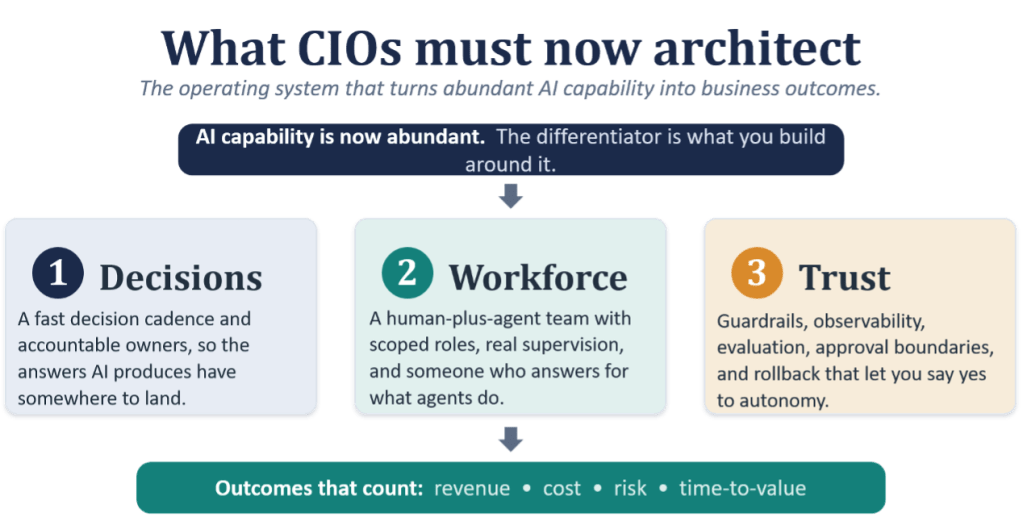
That reframes the job. The 2026 IT leader isn’t measured on how much AI they deployed. They’re measured on three things they now have to architect: How the organization decides, who does the work and what makes it safe to let go.

Figure: What CIOs must now architect

Vipin Jain

Does the output have anywhere to land?

Start with where AI programs actually stall. In the banks I advise, pilots rarely fail in the lab. They fail at the handoff — the moment a working capability meets an organization that has no place to put it. There is no owner accountable for the outcome, no decision forum that moves at the speed of the tool, and no scorecard that separates real value from visible activity. The model performs. The operating model doesn’t.

This is why CEOs have stopped being impressed by demos. As CIO.com’s reporting on CEO priorities makes plain, chief executives no longer want AI experiments; they want initiatives that move revenue, cost and risk, and they expect their CIOs to create those opportunities rather than merely collaborate on them. The money is available; nearly seven in ten organizations expect IT budgets to rise this year, according to Foundry’s State of the CIO. What’s scarce isn’t budget or technology. It’s an operating model that can convert either into outcomes. Analysts are converging on the same point: Info-Tech now urges CIOs to run IT by the numbers and tie AI to value streams rather than activity.

That shifts the center of gravity for the role. IT leadership used to be measured by how well you ran the technology. It is now measured by how well you architect the decisions the technology feeds. The State of the CIO captures the new job description bluntly: The CIO of 2026 is “half operating architect, half risk officer.” Running the platform is table stakes. Designing how the enterprise decides is the work.

The teams that struggle most here are not the ones with the weakest technology. They are the ones whose governance forums meet quarterly while their agents act by the hour. What I see most often is a review board built for a slower era,  one that approves projects but never revisits them, that funds pilots but never kills them. In a fast-moving portfolio, the cadence itself is the control. If the enterprise decides in quarters, an AI that decides in seconds will simply outrun its own oversight.

What that looks like in practice is unglamorous and decisive. Assign a single accountable owner to every AI use case on the business side, not in IT. Retire the vanity metrics (copilots deployed, pilots launched, dashboards built) that let activity masquerade as progress. And rebuild the executive decision cadence so that when an agentic workflow produces a recommendation, there is a forum ready to act on it in days, not quarters. In a Fortune 500 health insurer whose portfolio I helped rationalize, the pilots that had been circling for quarters shipped only once each had a named business owner and a standing forum with the authority to act — the fix was to the operating model, not the model.

Tie every initiative to the language the board already speaks: Revenue gained, cost removed, risk retired, time-to-value shortened. Say “we cut fraud losses by half a million dollars,” not “the model hit 94 percent precision.” A dashboard full of pilots isn’t a strategy. It’s a symptom of one you haven’t written yet.

Who’s doing the work now — and who answers for it?

The second shift is quieter and larger. Agentic AI is turning the CIO into the architect of a blended workforce: part human, part software that acts on its own. The vendor conversation has already moved from copilots that suggest to systems that act: Google’s Agentic Data Cloud and Gemini Enterprise Agent Platform, AWS’s Bedrock AgentCore and ServiceNow’s control tower are all built to let agents execute work across systems, not just describe it. In retail, I watch teams push agents into production faster than they build the controls to govern them.

Most organizations are still onboarding those agents the way they onboard licenses: provisioned, counted, forgotten. At one property-and-casualty insurer, I watched a team stand up a dozen agents with no more oversight than a new software seat. An agent that acts is not a license. It is closer to a new hire, and it needs what any hire needs: A scoped job, boundaries, supervision, an escalation path and a named human who answers for it.

This reshapes the team as much as the tooling. The value of a junior person who only produces work falls; the value of someone who can review, correct and supervise what an agent produces rises. The classic talent pyramid: Many juniors, a few seniors starts to look more like a diamond, thick with experienced people who can tell good output from output that merely looks plausible. Leaders who treat agents purely as a headcount lever miss the point. The scarce skill now is judgment: Knowing when the agent is wrong, and owning the call when it is.

It helps to be concrete about where that value shows up first. Across very different industries, it is the same kind of work: High-volume, rules-clear, with a clear definition of “good.” In a bank, that is fraud triage and reconciliation. In a health plan, it is first-pass claims and prior-authorization routing. In retail, it is service-case deflection and returns. In a federal agency, it is eligibility screening and case intake. None of these are moonshots. They are the unglamorous, high-friction workflows where an agent under supervision takes out cost and cycle time without betting the business and where the supervision muscle gets built for the harder, higher-stakes work that follows. Start where the value is obvious and the blast radius is small.

The cost of skipping that is now quantified. Gartner projects that more than 40 percent of agentic AI projects will be canceled by the end of 2027, not because the models fail, but because of escalating costs, unclear business value and inadequate risk controls. The market muddies the picture further through what Gartner calls “agent washing”: Of the thousands of vendors claiming agentic capability. CIO.com’s own reporting finds the same pattern inside enterprises — pilots that demo beautifully stall the moment they meet production, where documents vary, exceptions multiply and someone has to be accountable when an agent acts. What I see most often is that the teams that struggle aren’t the ones with the weakest platform. They’re the ones with the vaguest intent. AI amplifies ambiguity as efficiently as it amplifies capability.

The leadership response is not a bigger bake-off among platforms. Naming vendors tells you where the market is heading; it doesn’t tell you what to do. The work is to design the roles around the agents. People move up the value chain — from doing the task, to steering it, to supervising and handling the exceptions the agent can’t. Autonomy follows a ladder, not a switch: Assistant, then participant, then genuine team member, with human supervision tightening as the stakes rise. Start with a bounded use case, build the supervision muscle and only then widen the boundary. In a federal modernization program I advised, the teams that pulled ahead began with a single high-volume, rules-clear workflow, proved the audit trail and human sign-off, and widened autonomy only once the supervision held. The goal was never more agents. It is agents that belong to a team someone actually leads.

What makes it safe to let go?

The third shift is the one leaders most want to skip, and the one that now decides the other two. As agents begin to act, governance stops being paperwork and becomes the thing that lets you move. The current gap is telling: In the State of the CIO, 83 percent of leaders have or are planning cross-functional AI steering committees, but only 53 percent have any formal process for approving AI projects. Committees are easy. The boundary that lets you say “yes, act” is hard.

I recommend a reframe most leaders resist at first. Governance is not the office of “no.” Observability, evaluation, approval boundaries and rollback are precisely what let you grant more autonomy, sooner, with confidence. They are how you catch a failing agent before it becomes a headline — and, as one analysis of the Gartner forecast observes, agentic projects fail when companies grant systems access and authority before they define ownership and rollback controls. Used well, that discipline is what turns acceleration into advantage instead of avoidable damage.

This is not a distant concern. In a health plan I advise, an ungoverned action doesn’t just fail a demo: It can surface as a compliance finding, which is why governance gets attention there first. For the first time in over a decade, state CIOs have ranked AI as their number one priority, displacing the cybersecurity focus that held the top spot for twelve straight years, the very settings where autonomy is most consequential. The analyst community has reached the same conclusion: Gartner now lists evolving IT strategy, governance and operating models among the top priorities for CIOs this year, alongside operationalizing AI itself. Governance and operating-model design are no longer separate agenda items. They are the agenda.

And the pressure only builds. Gartner expects that by 2028, 15 percent of day-to-day work decisions will be made autonomously by agents, up from essentially none in 2024, with a third of enterprise applications shipping with agents inside them. Governance that feels optional today becomes load-bearing the moment agents are deciding at that scale. The leaders building the trust layer now — while the stakes are still small enough to learn on — are the ones who will be able to say yes when the stakes are not.

Guardrails aren’t what slow the car down. They’re what let you take the corner at speed.

The one shift, three ways

The three moves are facets of a single reframe. The center of gravity for IT leadership has shifted from running the technology to architecting the system around it. Decisions, workforce and trust are not three initiatives competing for budget; they are three faces of one job: Building the operating system that turns capability into results.

 Old center of gravityNew center of gravityWhat the leader must architect
DecisionsDelivering technology reliablyTurning capability into outcomesAccountable owners, a fast executive decision cadence, outcome-based metrics
WorkforceManaging tools and licensesLeading a human-plus-agent teamScoped agent roles, supervision that scales with stakes, staged autonomy
TrustControlling risk after the factEnabling speed through governanceObservability, evaluation, approval boundaries, rollback

Where should CIOs start?

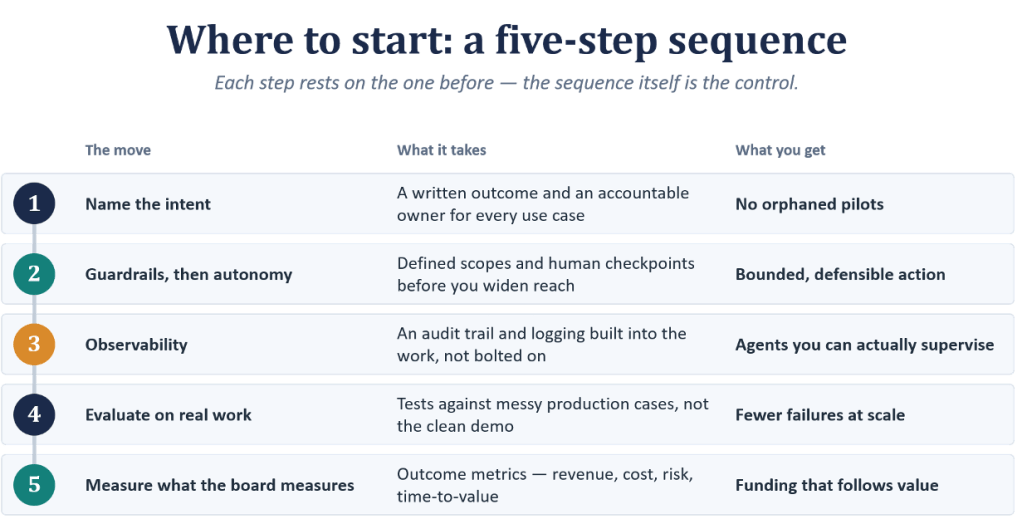
None of this requires a reorganization to begin. It requires a sequence. The leaders getting ahead aren’t doing more; they’re doing these five things in order, on the bounded use cases where they can afford to learn.

1.  Name the intent. For every AI use case, write the business outcome and the person accountable for it before a line of code ships. Vague intent is the most expensive input in the system.

2.  Set the guardrails, then the autonomy. Decide what an agent may touch and what still requires a human before you widen its reach. Boundaries first, freedom second, never the reverse.

3.  Instrument for observability. If you can’t see what an agent did and why, you can’t supervise it. Build the audit trail into the work, not after the incident.

4.  Evaluate against Tuesday, not the demo. Test agents on the messy production reality, the missing field, the duplicate record, the exception — not the clean pilot. What passes in the lab rarely survives first contact with real work.

5.  Measure what the board measures. Retire activity metrics; report revenue, cost, risk, time-to-value and release confidence. If a number wouldn’t move a board conversation, it doesn’t belong on the scorecard.

Figure: Where to start: A five-step sequence.

Vipin Jain

Do these in order and autonomy compounds. Skip a step and you join the 40 percent whose agentic projects get canceled before they ever earn their keep.

The takeaway

The most common strategic mistake I see in 2026 is subtle, because it doesn’t look like a mistake. Leaders are scaling powerful new technology on an operating model built for a slower, all-human enterprise, and then blaming the technology when the returns don’t come. The failures won’t come from the models. They’ll come, as they always have, from business strategy, IT and organizational culture not being architected to move together, a pattern I have watched hold across every industry I work in, from trading floors to healthcare programs.

The good news is that this is architectable, and it is the CIO’s to architect. The leaders who will look prescient a year from now aren’t the ones who bought the most capable AI. They’re the ones who rebuilt the operating system it runs on: How their organization decides, who does the work and what makes it safe to let go. The tools will keep getting better on their own; the operating system will not: It is built, on purpose, by someone in the room. The technology was never the hard part. The leadership is. That’s the job now.

This article was made possible by our partnership with the IASA Chief Architect Forum. The CAF’s purpose is to test, challenge and support the art and science of Business Technology Architecture and its evolution over time as well as grow the influence and leadership of chief architects both inside and outside the profession. The CAF is a leadership community of the IASA, the leading non-profit professional association for business technology architects. 

Why the CIO is becoming the most commercial role in the boardroom

My mum has asked me the same question for almost 30 years.

“So…what is it you actually do?”

I’ve explained it hundreds of times. I lead the team that look after the network, the servers, the applications and cyber security that help the business work. And more recently, AI. She’d smile politely, nod and then ask another question that made it painfully obvious she still thought I spent my day writing computer programs. My dad was a programmer, so in her mind I did the same thing, just in a nicer office. I never dared explain that it’s now called software engineering. Her head might explode.

The funny thing is, I don’t think she was the one struggling to understand the role. I think our industry is.

When I started my career, technology was largely a support function. We built systems, maintained infrastructure, kept the lights on and delivered projects. Success was measured by uptime, budgets and whether the latest implementation made it into production. Technology enabled the business, but it rarely shaped it. My job was largely about delivering technology successfully.

Today, every organization depends on technology to create value. Revenue growth relies on digital products and customer experience. Margin depends on automation, data and operational efficiency, while resilience depends on cyber security, recovery planning and the ability to respond when – not if – something goes wrong. Technology hasn’t simply become more important over the last thirty years; it has become part of the business itself. In many organizations it is impossible to separate commercial strategy from technology strategy because one simply cannot succeed without the other.

That is why I believe the role of the CIO has fundamentally changed. In fact, I’d argue it has quietly become one of the most commercial roles in the boardroom.

We all work in technology now

Over the past decade we’ve seen an explosion of technology leadership titles. CIOs, CTOs, Chief Digital Officers, Chief Data Officers, Chief AI Officers and Chief Transformation Officers have all emerged to solve different organizational challenges. Organizations have continued to reorganize their technology functions as digital, data and AI have become increasingly important, but I’ve gradually realized the titles themselves aren’t really the story.

Whether you’re responsible for technology, data, digital, cyber or AI, you’re ultimately trying to achieve the same outcome: helping the business deliver its strategy. Recent research from McKinsey’s Global Tech Agenda 2026 describes CIOs as becoming “strategy architects”, recognising that leading technology executives are increasingly shaping enterprise strategy rather than simply delivering it. The highest-performing organizations are no longer treating technology as a support function; they’re building business strategy around it.

That certainly reflects my own experience. The conversations I have with CEOs and boards rarely begin with technology. They begin with growth, profitability, customer experience, acquisitions, operational resilience and competitive advantage. Technology is simply one of the most powerful levers available to achieve those ambitions.

In fact, I genuinely believe we all work in technology now. The finance director relies on technology to improve forecasting and financial control. HR depends on it to attract and retain talent. Sales teams use it to understand customers and drive growth. Operations rely on automation and data to improve efficiency. Marketing depends on digital platforms to reach new audiences. Technology is no longer a department sitting alongside the business; it has become the operating system that underpins almost every commercial decision.

My job comes down to two questions

Over the years I’ve found myself simplifying my own role. Rather than thinking about the dozens of responsibilities that typically appear in a CIO job description, I’ve reduced everything to two questions.

  1. Is our technology strategy supporting the business strategy?
  2. Are we delivering it against the priorities that matter most?

Every major decision I make comes back to those two questions. Whether I’m reviewing investment, deciding whether to modernize a platform, introducing AI or discussing a major transformation programme with the board, the conversation always starts there. If the technology isn’t helping the organization achieve what it set out to achieve, then we’ve already lost sight of the objective.

I’ve also become increasingly ruthless about another simple test. If an initiative isn’t helping us grow revenue, improve margin or strengthen resilience, why are we doing it? That doesn’t mean every project needs an immediate financial return. Some investments reduce operational risk, others improve employee experience or prepare the organization for future growth, but every decision should ultimately contribute towards creating business value.

Somewhere along the way, I think many of us forgot that. We’ve become exceptionally good at discussing architectures, cloud platforms, AI models and technology roadmaps, yet the people sitting around the board table aren’t interested in technology for its own sake. They want better commercial outcomes. They want technology investments that help the organization grow, become more efficient or become more resilient. That’s what they should expect from us.

I sometimes hear people describe the CIO as the bridge between technology and the business. I understand the analogy, but I no longer think it’s true. There isn’t a bridge anymore because there aren’t two separate places to connect. Technology is woven into every part of the organization. As technology leaders, we’re no longer translating between IT and the business – we’re helping lead the business itself.

AI hasn’t changed the role. It’s exposed it

If there’s one topic dominating every boardroom conversation today, it’s AI. Every organization wants to understand how quickly it should adopt it, where it creates value and how to avoid falling behind competitors. Yet I don’t believe AI has fundamentally changed the role of the CIO. If anything, it has exposed what the role had already become.

The difficult part isn’t choosing the technology. It never has been. The difficult part is deciding where AI genuinely creates competitive advantage, where it introduces unnecessary risk and where it simply adds another layer of complexity. Cloud did the same thing. Mobile did. Digital transformation did. Every major technology wave promised transformation, and every one of them left organizations with technical debt, integration challenges, security risks and difficult investment decisions. AI is moving faster than anything we’ve seen before, but the leadership challenge remains remarkably familiar.

Gartner’s latest assessment of CIO priorities reflects this shift. The biggest challenges facing technology leaders today are scaling generative and agentic AI, optimising technology investment and defending organizations against increasingly sophisticated AI-driven cyber threats. Those aren’t purely technical challenges. They’re commercial decisions that require balancing opportunity, investment, risk and resilience.

The same message comes through in Microsoft’s 2026 Work Trend Index, which argues that every leader now has a responsibility to rethink how work is organized in an AI-enabled world. That isn’t simply about deploying another technology platform. It’s about redesigning operating models, helping people adapt and ensuring technology creates measurable business value rather than becoming another expensive experiment.

The future doesn’t belong to the most technical CIO. It belongs to the technology leader who understands how organizations create value, can influence commercial decisions, earn the confidence of the board and know when technology is the answer—and when it isn’t.

Which brings me back to my mum.

If she asked me today what I do, I think my answer would finally be much simpler.

I help organizations make better business decisions through technology.

Sometimes that means AI. Sometimes it means strengthening cyber resilience. Sometimes it’s simplifying an operating model, stopping a programme that no longer creates value or helping a leadership team make difficult investment decisions. The technology will continue to evolve, just as it always has, but the role itself has become remarkably consistent.

The best CIOs are no longer measured by the technology they deliver.

They’re measured by the commercial outcomes they create.

The modern CIO: From technology expert to business leader

The role of the CIO has changed more in the last five years than it did in the previous 20.

Cloud computing, cybersecurity, data, automation and artificial intelligence are reshaping organizations at a pace few leaders have experienced before. Today’s competitive advantage often becomes tomorrow’s baseline capability. In this environment, expecting a CIO to be the deepest technical expert in every domain is neither realistic nor necessary.

The organizations that succeed aren’t necessarily the ones with leaders who know the most technology. They are the ones that learn, adapt and execute faster than their competitors.

After more than two decades in IT and over a decade leading technology organizations across telecom, consumer goods, retail and healthcare, I’ve come to believe that the modern CIO’s role has fundamentally evolved — from leading technology to leading business transformation through technology.

The end of the expert CIO

Technology has become too broad, too specialized and too fast-moving for any individual to master. Today’s CIO is expected to navigate cloud, cybersecurity, enterprise platforms, data, AI, automation, digital commerce and regulatory compliance — often simultaneously.

The most effective CIOs don’t try to have every answer. They build teams that collectively do.

Leadership is no longer about being the smartest person in the room. It’s about creating an environment where the smartest ideas emerge, regardless of where they come from.

That requires humility — surrounding yourself with people whose expertise exceeds your own, encouraging healthy debate and being willing to have your own assumptions challenged.

In many ways, the CIO has evolved from chief technologist to chief orchestrator — aligning business strategy, technology, talent and execution to deliver meaningful business outcomes.

Why candor matters more than certainty

Leading this way also requires creating an environment where people feel comfortable raising concerns, questioning decisions, experimenting with new ideas and admitting when something isn’t working. Innovation rarely comes from agreement; it comes from constructive debate.

In my experience, the strongest technology organizations are built on constructive disagreement, not silent agreement.

Many of the costliest project failures and production incidents I’ve witnessed weren’t caused by a lack of technical expertise. They were caused by a lack of candor. Someone recognized the risk. Someone had concerns. The environment simply didn’t encourage them to speak up.

One of the CIO’s most important responsibilities is creating an environment where the best ideas surface early — regardless of where they come from. Innovation thrives when people are trusted to challenge assumptions, experiment responsibly and learn from setbacks rather than hide them.

Technology can be acquired.

Culture must be built.

Business leadership has become the real job

Perhaps the biggest shift in the CIO role isn’t technological — it’s organizational.

Today’s CIO is expected to spend as much time discussing business growth as technology. We are increasingly expected to understand customers, supply chains, finance, HR, marketing, manufacturing and operations — not because we are experts in every function, but because technology decisions only create value when they solve real business problems.

Business leaders no longer ask, “What technology are we implementing?” More often, they ask:

  • How will this help us grow?
  • How will it improve customer experience?
  • How will it increase productivity?
  • How will it reduce risk?
  • What measurable value will it create?

That shift changes the conversation.

The CIO is no longer simply a technology partner. We are expected to challenge thinking, bring external perspectives, identify opportunities the business may not yet see and help shape business strategy through technology.

Success is increasingly measured not by systems delivered, but by business outcomes achieved. The conversation has shifted from implementation to impact, from projects to value and from technology delivery to business transformation.

Why AI makes leadership even more important

Artificial intelligence is making technology more accessible than ever. Capabilities that once took months can now be delivered in days, dramatically lowering the barriers to innovation.

Paradoxically, as technology becomes more accessible, leadership becomes even more important.

The question is no longer simply, “Can we build this?” Increasingly, it is, “Should we build this?”

Many organizations pursue AI because they fear being left behind rather than because they have clearly defined the business problem they want to solve.

The most successful AI initiatives I’ve seen have always started with a business outcome—a customer experience to improve, a cycle time to reduce, a decision to strengthen or a risk to mitigate — not with a technology capability.

Technology creates possibilities. Business context creates value. The CIO’s role is to ensure the organization never confuses the two.

Looking ahead

Looking ahead, I believe the most successful CIOs of the next decade won’t be distinguished primarily by their technical expertise. They’ll be distinguished by their ability to build organizations that learn, adapt and innovate continuously.

Technology will continue to evolve. Platforms will change. AI will become more capable. New tools will replace old ones.

The ability to learn faster than competitors, embrace change and translate technology into business value will remain a lasting competitive advantage.

When I started my career, I believed great CIOs were defined by the answers they had.

Today, I believe they’re defined by the questions they ask, the cultures they build and the people they empower.

The modern CIO is no longer measured by how much technology they know. They are measured by how effectively they connect technology with business strategy, empower their teams and help their organizations adapt to constant change.

In an era where technology is becoming increasingly accessible, the CIO’s greatest contribution is no longer being the smartest technologist in the room.

It’s creating an organization where people, technology and business come together to continuously learn, innovate and create value.

There are two completely different roles called ‘FDE’

There’s something very attractive about saying “we embed very closely with our customers and just figure it out with them”, especially since the company that started “forward deploying engineers” is growing 84% with $5B+ revenue. But “forward deployed engineer” is a vague term and means different things depending on the business you’re running.

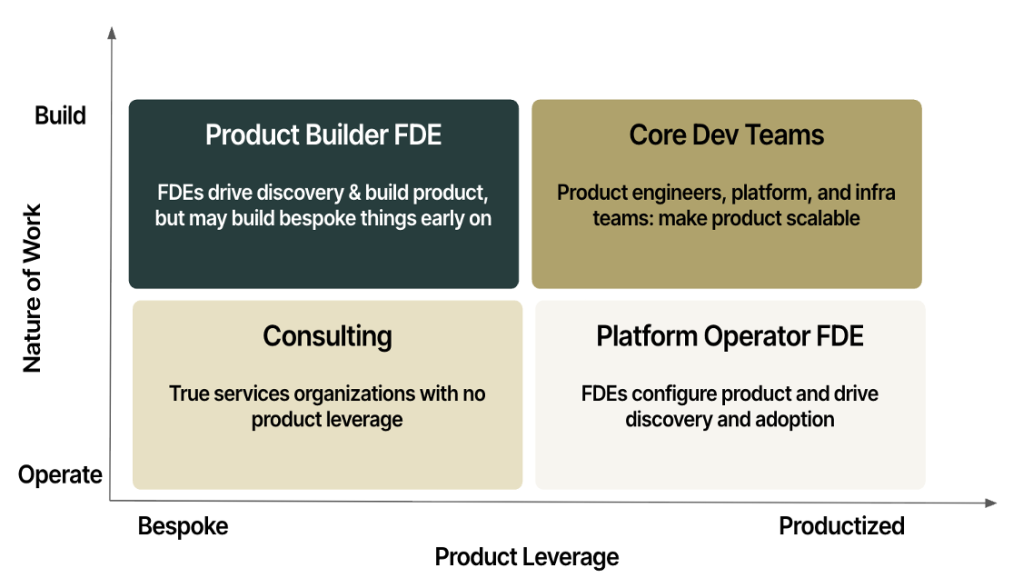
I spent almost 5 years at Palantir as a forward-deployed software engineer, and Palantir’s version of an “FDE” does not make sense for most companies I now meet as an early-stage VC. Depending on the type of business you’re building, this role could broadly mean one of two things: “the product builder” or “the platform operator.” Clearly defining which bucket you fall into will make it easier to hire for this role and run your FDE org.

Figure: Nature of work vs. product leverage.

Kabir Sial

The product builder: The OG Palantir version

The north star is: do whatever it takes to actually solve the user’s problem. FDEs are not just responsible for making the platform work, but also discovering what to build and building it (actually creating software) in service of the customer.

The platform operator: Solutions + technical customer success

The north star is: make the product work for the customer – deploy and operationalize it. This is what most startups today really mean when they want FDEs. FDEs here configure the core platform, manage account relationships and drive adoption. This is not new – companies have always had solutions engineers, sales engineers, customer success etc., although the work looks different as FDEs are increasingly building prototypes, configuring evals and building MCPs.

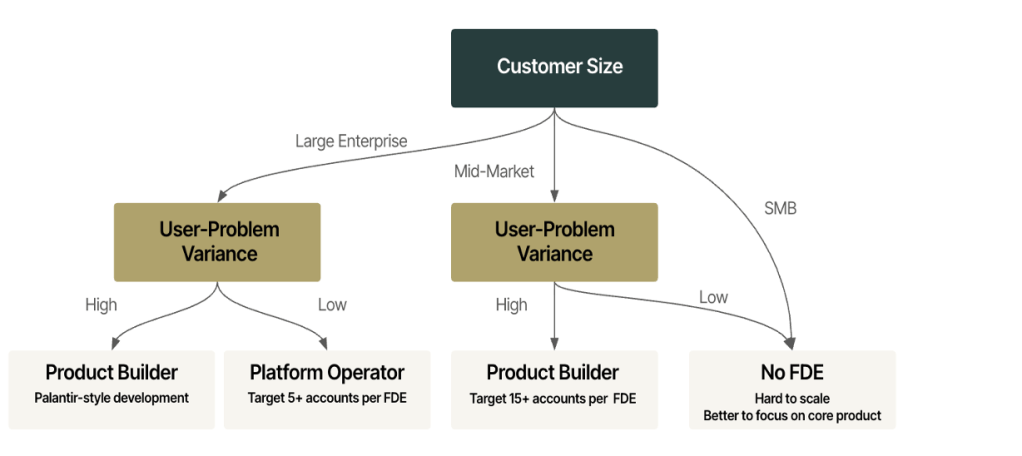
Which FDE is right for you

Figure: Customer size.

Kabir Sial

For most situations, hiring product builder FDEs is a mistake.

At scale, the FDEs should be the platform operator. It’s hard to have FDEs build and maintain highly custom product features, especially as the company scales. Over time, the custom product surface area distracts from building the core product, even though AI coding tools make it easy to ship new features quickly and maintain them.

Many fast-growing AI startups recognize these constraints and structure the FDE role more like the platform operator. This also allows them to have 5-10 accounts per FDE, which is a much higher ratio than Palantir had (at least in 2023). Even the Palantir FDE role has evolved to look more like the platform operator.

There are, however, situations when your FDEs should be the product builder archetype.

1. You have very large customers (F500 scale)

Technical complexity: Large customers have complex environments with legacy infrastructure that often requires “out-of-platform” engineering work. I often encountered bespoke data infrastructure, privacy requirements, etc. at various Palantir customers that required me to build “out-of-platform” connectors, UIs and backends.

Organizational inertia and trust: Serving large enterprises is about building trust. In short time periods, overfitting product to a specific user/workflow is often what delivers the most value, builds trust and helps organizations get over the inertia of moving away from Excel and legacy software tools that are part of their day-to-day workflow. For AI-native startups, it’s arguably even more important to invest in doing “unscalable” development with engineering boots on the ground, as it helps solidify your right to exist and eventually expand the customer relationship.

2. You have many ICPs and workflows

If you have a broad range of ICPs and workflows that you serve, your product probably is not walk-up usable on day 1 of deployment. The short-term hacky things that product builder FDEs build to make the product work for these heterogeneous users/workflows will help you shape the product long-term.

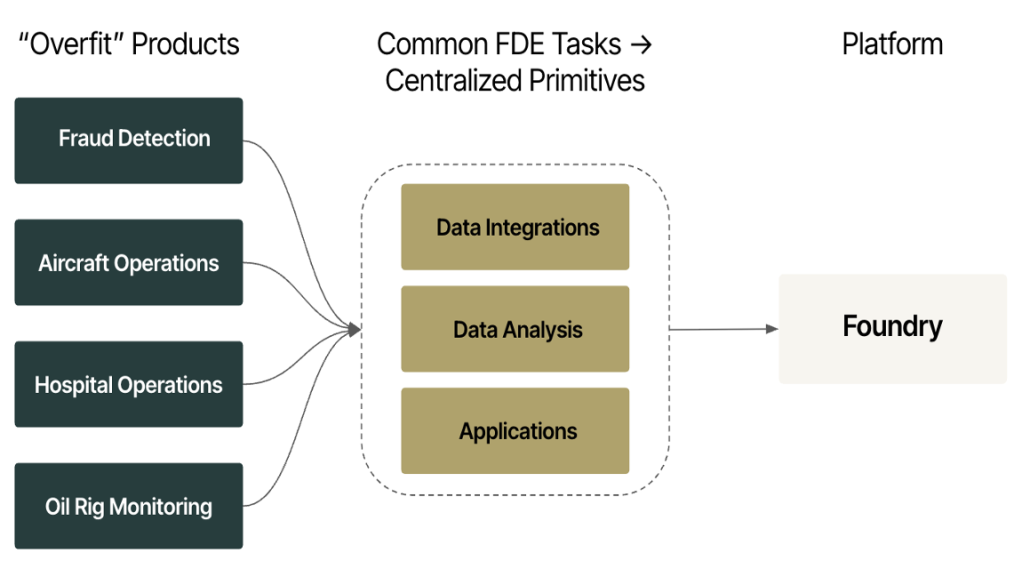
Figure: "Overfit" products.

Kabir Sial

Note: see Palantir Foundry’s architecture here.

This was a big reason why Palantir FDEs were more like product builders (and are still able to – see the Forward Deployed Software Engineer job profiles as an example). The vision for Foundry was to be the operating system for an enterprise’s critical decisions – inherently multiple industries, users and workflows. A lot of FDE-led development showed that solving many of these use cases required complex data integrations, which led to the early versions of Foundry being best-suited for complex data integrations and building a customer’s “Ontology”. Similarly, FDEs like myself built custom frontend applications for fraud analysis, pricing, etc. As certain patterns of what these applications required became more clear, they were centralized into an application-layer product.

Who you should hire

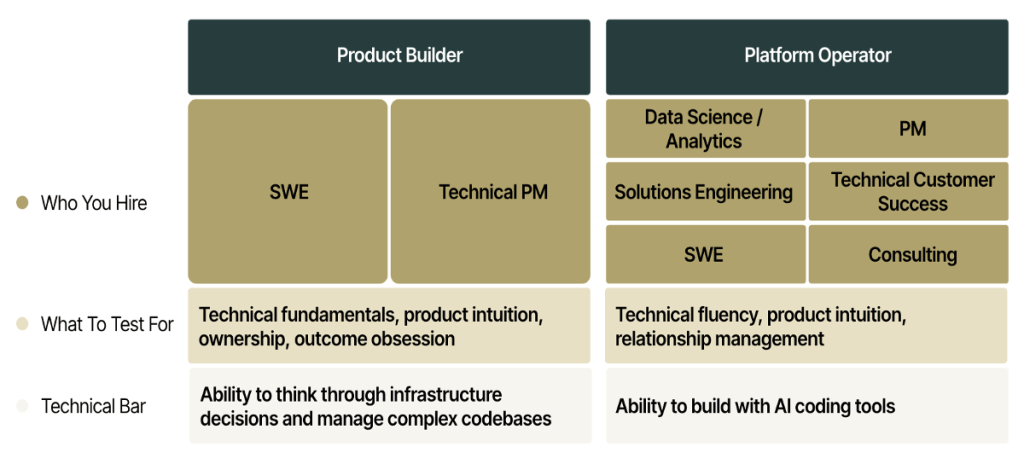
Figure: Who you hire.

Kabir Sial

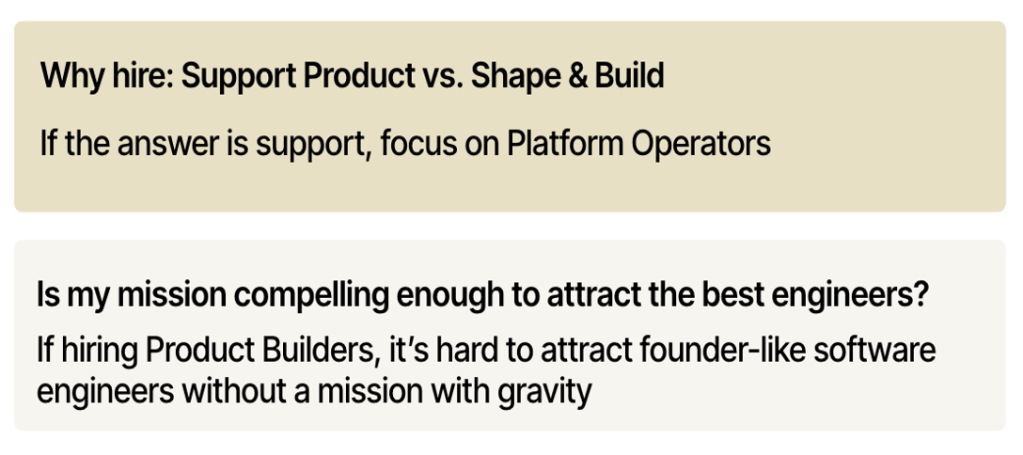
Figure: Why hire one vs. the other.

Kabir Sial

Platform operator: There is a much broader set of people you could hire, testing for technical fluency (e.g., being good at data analysis, complex Excel work, even SQL), product intuition and an inclination to build customer relationships. Backgrounds like technical customer success, solutions engineering, software engineering, product management and consulting are all strong fits.

Product builder: You want candidates that are high ownership and missionary software engineers, or technical PMs who want to ship products themselves.

Hiring for these profiles, especially product builders, is hard. It’s worth calling out two things that helped Palantir hire software engineers into what might be considered a less sexy role.

  1. Culture of building at the edge: Strong engineers are motivated to build things. Palantir gave FDEs a lot of ownership to build products, which is why much of the core product leadership was former FDEs.
  2. Cult built around mission: Internally, there was a cult-like devotion to the mission. Everyone always talked about why outcomes were far more important than software, and why most companies building tools had it wrong. I’ve never been at a company where people feel so closely bonded around a mission.

As founders building AI startups think about hiring FDEs, it’s worth being specific about your culture and asking: Am I just hiring people to support development teams, or am I hiring people to shape and build product? It’s hard to get software engineers (even today) to be excited about an FDE role that might just be technical customer success.

What FDEs should be doing (regardless of archetype)

You’ve hired the right people. How do you best leverage your team of FDEs?

FDEs were Palantir’s way of delivering outcomes rather than tools. AI-native startups can take this much further and FDEs can help in a few unique ways by leveraging their proximity to customers.

  1. Find the most critical workflows: As AI lowers the cost of producing software, companies will face a lot more competition. FDEs at AI startups should be constantly finding ways to serve the most critical workflows for a customer and paying attention to how customers do work across newer and legacy tools. For example, FDEs at Harvey should pay attention to which workflows are in Westlaw, which ones are moving to ChatGPT/Claude, and how the Harvey product can stay ahead.
  2. Build around nondeterminism: In more regulated environments, FDEs should be hyper-focused on making products reliable for specific use cases using evals and configs. Previously, product reliability lived with product and support. As companies provide outcomes instead of tools, configuring products appropriately and managing evals shifts towards FDE teams.

How AI is changing the business analyst role for the better

AI’s impact has been felt across nearly every industry, and its rise has already started to alter several roles in tech, including that of the business analyst. While the rise of agentic AI may have some questioning whether AI will replace business analyst jobs entirely, as we’ve seen with most roles impacted by AI, it’s more likely that AI will augment the role and fundamentally change how BA’s conduct daily business.

“As AI takes on more routine tasks, the human side of the role is becoming even more valuable. It’s becoming more of a hybrid role, where employers are often looking for candidates who can combine technical fluency with strong communication and problem-solving skills, along with sound business judgment,” says Megan Slabinski, district president of technology talent solutions at Robert Half.

AI can save business analysts time in the long run, automating many of the tasks that are time consuming and repetitive around data processing, note taking, and documentation. While automation will impact the daily tasks of the role, business analysts will still be necessary for properly interpreting outputs, collaborating across teams, and maintaining compliance and AI workflows.

AI-driven analysis and automated workflows

With AI-driven analysis, BA’s can use machine learning models for pattern detection, determining risk, and for forecasting demand, while natural language processing (NLP) can be used for text-heavy inputs. AI tools can also assist analysts with decision-making by transcribing meetings and automatically identifying any necessary business requirements, constraints, risks, or dependencies that will impact the project.

As a result, the role is undergoing a shift toward spending less time on monotonous, routine tasks, and instead “spending more time connecting the dots and providing strategic context earlier in the process,” says Slabinksi.

“We’re seeing that business analysts today aren’t spending as much time as they were a few years ago on some manual processes. AI is speeding up tasks like documenting requirements, summarizing stakeholder meetings, generating first drafts of user stories, and even helping create SQL queries or reports,” she adds.

AI can also assist business analysts with interviews and workshops for the discovery phase of a project and autonomously identify patterns in the data that might be overlooked or missed by the human eye. These tools can also enable BAs to create living models that can be adjusted and altered with feedback, as opposed to traditional static documents, and allow for an automated review process for data validation. In terms of maintenance and change management, AI can help with predictive recommendations to get ahead of risks, compliance, and future process updates.

That said, an increased reliance on AI tools while require business analysts to validate AI outputs and assure AI-generated content is accurate, relevant, and ultimately aligned with the overall business strategy. Still responsible for explaining the reasons behind business decisions, business analysts will also need to identifying bias and fairness concerns associated with AI use, and ensure decisions aren’t over-automated.

Ultimately, BA’s will see their responsibilities shift to focusing more on data interpretation, governance, and strategy, and identifying the most practical use cases for enterprise AI adoption.

New skills to focus on

Traditionally, business analysts are responsible for gathering the data as well as processing it for analysis. This comes with a lot of drudgery that can be eased by implementing AI tools into the workflow. Tasks such as routine documentation, formatting, and data crunching can be automated, while analysts provide the human context around that data, as well as a critical eye to the final output.

“Business analysts are often in the mix to make sure that data is accurate and that the requirements are in line with expected outcomes. They can also help ensure AI projects include the appropriate level of human oversight, comply with internal policies and industry regulations, and use data responsibly. While they aren’t solely responsible for AI governance, they often play an important role in raising questions about data sources, bias, whether the outputs make sense, and potential business risks early in a project,” says Slabinski.

BAs will need to develop AI literacy skills to better understand how models are trained and designed as well as data reasoning skills to interpret and validate AI outputs. Prompt-framing skills will also become valuable as analysts will need to know how to properly structure inputs for quality outputs. There will also be a growing emphasis on ethical analysis to identify compliance, bias, and overall fairness of algorithms, and qualified candidates will require strong change management skills to help oversee the adoption of AI-driven workflows.

“The skills becoming more important are the ones that help BAs evaluate AI-generated information and translate it into business recommendations. AI literacy is becoming a baseline expectation, and that includes knowing things like how to query the data and support requirements gathering. Critical thinking, communication, and business acumen are all part of that skill set because employers still need people who can explain what the findings mean and why they matter,” says Slabinski.

The missing role in every enterprise AI strategy: The analytics engineer

Every enterprise AI strategy these days has mostly the same core cast: Software engineers who log online events data, data engineers who move data from online to offline data warehouses, data scientists who build machine learning models, AI/ML engineers who deploy these models to production systems and data analysts who consume these data outputs and help create dashboards and self-serve agents for product and business leadership for informed decision making. Despite this systematic setup, the same mode of failure still keeps recurring across industries: AI outputs contradict the dashboard, executives eventually stop trusting the numbers and there seems to be no clear owner of the gap between them.

The missing role is not a brand-new role. It is a discipline that has existed for less than a decade, is still not clearly understood at the leadership level, and has no standardized hiring rubric at most organizations. It is the analytics engineer, and the absence of this role is why most enterprise AI deployments seem to stall before they scale.

What is analytics engineering ?

Analytics engineering sits right at the intersection between data engineering, data science and business intelligence — it is the discipline responsible for transforming raw data into a trusted, governed, reusable semantic layer with metrics and dimensions that both humans and AI systems can rely on. The role emerged from the dbt ecosystem as well as early data infrastructure work at Netflix around 2016-2018, but remains unclearly defined at the leadership level — most CIOs either conflate it with data engineering or product data science or business intelligence analysts, or don’t have a job family for it at all.

The role is growing but poorly understood at the top: dbt Labs’ 2024 survey found only 14% of data professionals strongly agree their organization sets clear goals for their data team which is a number that holds steady across individual contributors and managers alike. The core function includes being able to speak both the language of core data engineering and product analytics while having a solid understanding of the business events to track for downstream end-user reporting.

The analytics engineer plays a vital role in designing as well as reviewing data models to be used for reporting in conjunction with data engineers who are building these, often in SQL and Spark. This is not reporting work — it is infrastructure work and therefore analytics in production environments must be engineered as infrastructure, not assembled as reporting.

From these defined business events and key objectives for tracking the health of the product, the analytics engineers need to be able to derive key metrics and dimensional slicing, validating the logic while ensuring those definitions are consistent across all central teams and geographies, and embedding the validation checks that make outputs trustworthy. The practitioner in this role can answer the question no one else can: “Why is the AI giving a different number than the dashboard, and who owns fixing it?”

Why AI exposed the gap

The metric governance problem has existed even before AI, with different teams using different definitions, regional inconsistencies, manual reconciliation cycles — but it was still controllable when humans were entirely responsible for all final reconciliation and data interpretation, and often any data inconsistencies were caught at the analysis stage. Now, with AI in the picture, it removes the human interpreter stage altogether. When an AI system consumes an ungoverned metric, it inherits the ambiguity at the data layer and amplifies it at the output layer. Executives receive different answers to the same question depending on which system they ask.

Confidence in AI erodes independently of model quality — and the numbers bear this out: Foundry’s 2026 State of the CIO study found that fewer than half of  enterprise IT leaders have established formal AI success metrics, and only 19% say AI initiatives have met or exceeded ROI goals. McKinsey’s 2025 State of AI survey found that nearly two-thirds of organizations have not yet begun scaling AI across the enterprise — and explicitly named the absence of platforms and guardrails, not model capability, as the reason.

Popular semantic layer tools like dbt Metrics and LookML describe how metrics should be calculated but do not enforce correctness, which means there is no structural guarantee that the calculation is consistent across regions and can be traced to an authoritative source that is version-controlled on git or maintained by anyone accountable for its accuracy. With conversation and agentic AI systems embedded into the analytics workflow, the data inconsistency problem is further amplified where agents make sequential decisions, each one building on the previous output. A metric that drifts in a traditional pipeline generally produces one wrong number. The same drift in an agentic workflow can produce a chain of downstream decisions built on that wrong number, with no architectural checkpoint to catch it. This is not a model problem. It is a governance architecture problem — and it requires a specific type of data practitioner to detect and solve it.

Ownership and enforcement

The analytics engineer owns the semantic data layer: The governed, versioned, validated definitions of every metric that matters to the business. This includes standardizing metric definitions across teams and geographies, embedding validation logic directly into data pipelines, assigning ownership accountability for each metric, and ensuring AI systems consume only validated outputs. The technical signature of this role dives into the reconciliation controls that proactively detect and stall the data pipeline on failure rather than alerting after incomplete or incorrect data lands; This also includes financial reconciliation from upstream to downstream for all the data models trying all data values to financial statements and accounting ledgers, as well as jurisdiction-aware validation logic that treats regional regulatory differences as first-class properties supported by version-controlled metric definitions that create an audit trail.

While data engineers are responsible for moving and transforming data from online to offline data warehouses, analytics engineers govern what that data means and ensure the meaning is consistent everywhere it is consumed. Data scientists, on the other hand, build machine learning models to detect anomalies, fraud or product marketing opportunities, while analytics engineers build the trusted data foundation those models depend on, making sure whether that data is accessed via manual querying, imported via dashboard tableau extracts or consumed via large language model (LLM), the end user receives consistent answers based on trusted and governed metrics. Data analysts are responsible for surfacing these metrics and building actionable dashboards and reports for leadership, while analytics engineers make sure that the data surfaced is of the utmost quality. Therefore, in the absence of this role,  oftentimes the data engineer, the data scientist and the data analyst are working around a gap that none of them owns.  

What happens when the role is absent

In the absence of this dedicated analytics engineer role, enterprises most often encounter the issue of the “which number is right” question where finance has one revenue figure, product intelligence has another and the LLM model has a third value, and none of these seem to reconcile.

One of the common issues seen in AI projects that work in pilot and often break in production is that the pilot references clean, curated datasets and production data containing millions or even billions of records still reference the ungoverned data layer. The third and significant issue seen across enterprises is the analytics team burnout, where data engineers, scientists and analysts spend 60-70% of their time on reconciliation and firefighting rather than new pipeline creation and insight generation, because there is no governed layer to prevent these fires. The fourth issue is the hidden cost of delayed decisions, eroded executive trust and AI investments that deliver less than projected because the data foundation was never built. Most organizations recognize that they need this role only after something breaks in front of an executive, by which time the damage is already done.

How to identify and hire talent for this role

Analytics engineer, data governance engineer and metrics engineer are all applicable titles for this role. But what really matters technically is the experience with data modeling, semantic layer tooling (dbt, LookML, etc.), validation pipeline design, reconciliation architecture, data lineage and data governance. An ideal candidate is someone who thinks about data correctness as a structural constraint, not a quality preference,  where the first instinct is to stop the pipeline rather than alert and continue with bad data to land and affect stakeholder dashboards.

While interviewing, it’s critical to ask candidates to describe a time they caught a metric inconsistency before it reached a stakeholder. The answer will reveal whether they think in governance terms or reporting terms. This role belongs in the data platform engineering or analytics infrastructure team, not in BI or reporting — it is mostly infrastructure work, not data visualization work. If the role doesn’t exist in your org chart, it exists somehow informally, usually as the senior data engineer whom everyone asks when the numbers don’t reconcile.

Key takeaways

The enterprises that are scaling faster and winning with AI in 2026 are not the ones with the best models, best-in-class AI infrastructure or large budgets. They are the ones who invested the time and effort in successfully building the governed data foundation before deploying the LLMs, and they built it because someone in the organization understood that metric governance is the fundamental data foundation that defines the nervous system of data and insights. It is an architectural property, not a configuration setting in the model, and the data practitioner who helps embed this thinking as a design strategy is the analytics engineer.

The role is the need of the hour, the discipline is established, and the gap it fills is not going away as AI systems become more autonomous. The question for every CIO is not whether this role is needed, as the AI deployment failures already answer that. The question is whether you should hire for it before the next deployment hiccup.

This article is published as part of the Foundry Expert Contributor Network.
Want to join?

AI can do your tasks. That doesn’t mean it will do your job

Much of the conversation around AI and work has centered on a single question: Will AI take my job?

It’s an understandable concern. Every week AI becomes increasingly more capable. We see AI summarizing meetings, generating content, analyzing data, writing software and automating workflows that once required significant human effort. Agentic AI is also becoming more established in the workplace, with virtual agents that can reason, plan and act across workflows. As those capabilities continue to improve, many employees are looking at the tasks they perform every day and wondering how much longer they will belong to them.

I believe that question reveals a bigger issue that has little to do with the technology itself.

Too many people have become defined by the tasks they perform rather than the value they create. Over time, the administrative work surrounding a role can overshadow the purpose behind it. According to Asana’s Anatomy of Work Index, knowledge workers spend 60% of their time on “work about work” — coordinating, tracking and managing tasks rather than driving meaningful outcomes. As AI automates more of this work, it can feel less like a productivity breakthrough and more like a threat because many employees equate their value with the activities that consume most of their day.

But most people were not hired to perform a task. They were hired to fulfill a purpose.

Tasks are not the job

A customer service representative isn’t successful because they spend their day summarizing conversations, looking up account information or navigating multiple systems to find answers. Those activities may have become part of the job, but they aren’t the reason the role exists. Great service professionals build trust, solve problems and create moments that strengthen customer relationships. AI can, and should, take on this administrative work, but the human value has never been in completing those tasks. It has always been in helping customers through moments that matter.

The industry increasingly recognizes this distinction. In fact, 91% of CX leaders believe human agents will remain a critical part of delivering customer experience, according to my company’s State of Customer Experience 2026 report. As AI takes on more routine work, the role of the employee doesn’t disappear. It becomes even more focused on the judgment, empathy and relationship-building that customers value most.

The same principle applies across every profession. A marketer isn’t measured by the number of presentations they build or approvals they coordinate; they’re hired to shape customer perception and drive growth; an HR professional isn’t successful because they schedule interviews or process paperwork; they’re there to identify, develop and retain talent. The examples go on, but the principle remains the same: Organizations create roles because outcomes need to be achieved, not because tasks need to be completed.

I’ve helped lead four major AI transformations, spanning everything from machine learning and big data to conversational AI, generative AI and now agentic AI. While the technology has evolved dramatically, one pattern has remained remarkably consistent.

The employees who embrace AI tend to focus on outcomes, while those who fear it often focus on tasks. The more someone defines their contribution through a list of activities, the easier it becomes to imagine AI replacing them. The more someone understands the purpose they serve, the easier it becomes to see AI as a tool that helps them deliver greater value.

As part of AI transformations, CIO organizations are often responsible for mapping jobs and core workflows. Inevitably, employees think we’re mapping their jobs to figure out what AI can replace. But once we start identifying repetitive work they’d gladly hand off, perspectives change. Someone says, “If AI handled that, I’d finally have time to work directly with customers.” Another realizes they could spend more time creating. People start thinking less about what AI might replace and more about what they’d finally have time to do. They’re reconnecting with the reason they wanted the role in the first place.

I’ve seen this play out as AI adoption expands. Our team responsible for responding to customer RFPs began using AI to analyze requirements, surface relevant information and accelerate response development. Their purpose is to help the organization communicate our value to customers and win new business. By reducing the time spent on low-value activities, AI created more capacity for strategic thinking, collaboration and customer-focused work, which directly influences the revenue and growth of our company.

I’ve even had to confront this myself. I used to spend hours coaching leaders before operational reviews: reviewing KPIs, challenging assumptions and helping them prepare for difficult questions. I used to think this was part of what made me valuable as a CIO, but I realized that I didn’t need to spend my time repeating the same coaching session. That’s why I built a virtual coach that helps my team prepare for operational reviews using many of the frameworks and lessons I’ve accumulated throughout my career. Now I have more time to spend strategizing on how to lead through the breakneck speed of AI evolution and helping the business think differently.

Rediscovering purpose

What employees are really confronting is a different question: What was my purpose in being hired in the first place?

As organizations move from AI experimentation to AI-first operating models, this question becomes harder to avoid. The tension is already visible across the workforce. A recent EY survey found that 84% of employees are eager to embrace agentic AI because they expect it to improve productivity, efficiency and the overall work experience. Yet 56% also worry about their job security working alongside AI systems. Employees aren’t rejecting AI; they’re trying to understand which parts of their contributions remain uniquely theirs as technology takes on more of the tasks they perform today.

Success will depend greatly on helping employees reconnect with the value they were hired to create. For leaders looking for practical guidance on how organizations are actually approaching AI-first transformation, the World Economic Forum’s AI-First Operating System offers a useful framework. Rather than treating AI as another technological tool, this approach encourages organizations to redesign work around value creation. As AI increasingly takes on routine tasks, employees must become clearer about where human judgment, creativity and relationships can create the greatest impact. You cannot redesign work around value if people no longer understand the purpose behind the work that they do.

In my experience, the organizations seeing the strongest results are helping employees reconnect with the outcomes they were hired to create. The conversation shifts from “What tasks can AI do?” to “What is the purpose of this role?” Once people answer that question, it becomes much easier to decide what should remain human, what can be delegated to AI and where the combination creates the most value.

None of this means change won’t happen. Some responsibilities will disappear. Some jobs will evolve significantly. New roles will emerge that we cannot fully predict today. Every major technology shift creates that kind of change.

But I believe many people are looking at this transformation through the wrong lens.

The question is not whether AI can do your tasks. The question is whether you understand the purpose behind them. Because while AI may increasingly perform the work, humans will continue to provide the judgment, creativity, accountability and value that give that work meaning.

This article is published as part of the Foundry Expert Contributor Network.
Want to join?

❌