Visualização de leitura

McKesson confirms cyber incident after ShinyHunters claims patient-data theft

Healthcare and pharmaceutical-distribution giant McKesson has disclosed a cybersecurity incident involving unauthorized access to third-party applications and the theft of data.

McKesson Corporation is an American healthcare company that distributes pharmaceuticals and provides medical supplies, health information technology, and care management tools.

McKesson says it discovered the cybersecurity incident on August 25, 2026, and that its investigation is still in early stages.

“Based on our investigation thus far, including assessments by leading cybersecurity industry experts supporting our response, we’ve confirmed that the unauthorized access to certain third-party applications and the exfiltration of certain data was associated with a subset of customers within our Oncology & Multispecialty and Medical-Surgical business units.”

For now, McKesson provides no information about the amount or nature of the stolen data.

The attack has been claimed by ransomware/extortion group Shiny Hunters. On their leak site the group claims to have stolen hundreds of millions of records containing very sensitive information spanning from Personally Identifiable Information (PII) to Protected Health Information (PHI).
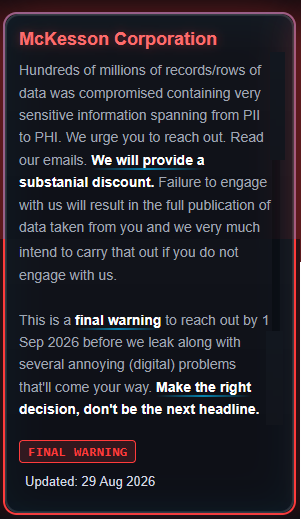
ShinyHunters listing McKesson Corporation
ShinyHunters listing for McKesson Corporation

The ShinyHunters extortion group told BleepingComputer that it was behind the attack, claiming it gained access after conducting voice phishing (or vishing) attacks—a form of social engineering—against multiple McKesson employees. Subsequently, the group said it used compromised Okta single-sign-on accounts to access Salesforce and Snowflake environments. It further claimed to have removed approximately 1 TB of data between August 21 and 25.

The group also said the data includes roughly 284 million records, which does not necessarily mean they belong to 284 million unique patients.

A combination of identity information and healthcare-related details could make affected people targets for convincing scams. Criminals could impersonate a pharmacy, insurer, medical provider, debt collector, or patient-support service and use personal details to make the approach appear legitimate.

Healthcare data is especially useful in social-engineering attacks because it can be used to create a sense of urgency: Criminals could scare a target by sending a supposed prescription problem, unpaid claim, delivery issue, appointment change, or request to “verify” insurance details. At this stage, however, McKesson has not confirmed that any particular category of patient data was accessed.

What to do if you’re affected

While waiting for more information about the nature of the breach and how you might be affected, there are a few things you can do:

  • Check the company’s advice. Every breach is different, so check with the company to find out what’s happened and follow any specific advice it offers.
  • Change your password. You can make a stolen password useless to thieves by changing it. Choose a strong password that you don’t use for anything else. Better yet, let a password manager choose one for you.
  • Enable two-factor authentication (2FA). If you can, use a FIDO2-compliant hardware key, laptop, or phone as your second factor. Some forms of 2FA can be phished just as easily as a password, but 2FA that relies on a FIDO2 device can’t be phished.
  • Watch out for impersonators. Cybercriminals may contact you posing as the breached company. Check its official website to see if it’s contacting victims, and verify the identity of anyone who contacts you using a different communication channel.
  • Take your time. Phishing attacks often impersonate people or brands you know and use themes that require urgent attention, such as missed deliveries, account suspensions, and security alerts.
  • Consider not storing your card details. It’s definitely more convenient to let sites remember your card details, but it increases the risk if a company suffers a breach.
  • Set up identity monitoring. This can alert you if your personal information is found being traded illegally online and help you recover afterward.

Let’s face it, an incognito window can only do so much. 
 
Breaches, dark web trading, credit fraud. Malwarebytes Identity Theft Protection monitors for all of it, alerts you fast, and comes with identity theft insurance. 
Ransom & Dark Web Issues Week 3, August 2026

ASEC Blog publishes Ransom & Dark Web Issues Week 3, August 2026         Customer and Operational Data of a South Korean Delivery Platform Offered for Sale Unauthorized Access Incident at a Japanese Cloud and Data Center Services Company ShinyHunters Threatens Data Disclosure Against a U.S. Live-Streaming Platform

Ransom & Dark Web Issues Week 2, August 2026

ASEC Blog publishes Ransom & Dark Web Issues Week 2, August 2026.           DragonForce Ransomware Attack on a South Korean Online Education Company Qilin Ransomware Attack on a South Korean Motor and Robotics Manufacturer ShinyHunters Claims Data Leak from a U.S. Digital Healthcare Company

July 2026 Dark Web Threat Actor Trend Report

Note The July 2026 Dark Web Threat Actor Trend Report focuses on trends among threat actors—including hacktivists—active on the deep web and dark web. It is explicitly noted that the factual accuracy of some content could not be verified. Major Issues Handala claimed to have compromised the core infrastructure of an Internet service provider in […]

ShinyHunters Claims Ernst & Young Data Breach, Threatens to Leak Stolen Data

ShinyHunters claimed the Ernst & Young data breach, threatening to leak stolen tax records unless the firm contacts the group by July 31.

The ShinyHunters cybercrime group has taken responsibility for the recently disclosed data breach involving professional services firm Ernst & Young (EY), adding the company to its Tor-based leak site and threatening to publish the stolen data unless negotiations begin by July 31.

Earlier this month, EY notified several U.S. state Attorneys General that attackers had gained unauthorized access to a third-party service management platform used to support tax-related operations. According to the company’s filings, the intrusion occurred between March 28 and April 12, during which threat actors downloaded documents attached to customer support tickets.

“EY uses a third-party information technology service management platform to help EY information technology personnel provide support to EY teams performing tax-related work for clients. Support tickets submitted through the platform may include documents containing client tax information. On April 23, 2026, EY identified anomalous activity within that platform.” reads the data breach notification. ” “EY’s Information Security team immediately initiated its incident response procedure to determine the nature and scope of the incident, contain it, and begin remediation and recovery efforts. EY has worked with an independent cybersecurity firm to investigate the incident and confirm that the unauthorized access has been stopped, and our systems are now secure. Based on EY’s investigation and available evidence, between March 28, 2026, and April 12, 2026, an unauthorized third party accessed the platform referenced above and downloaded documents pertaining to a number of EY clients.”

The exposed information includes highly sensitive personal and financial data used for tax preparation, such as names, addresses, Social Security numbers, bank account details, payment card information, and other tax-related records. EY said the incident affected data stored within the external support platform rather than its core internal systems.

While the company has not disclosed how many individuals were impacted or publicly attributed the attack, it is offering affected customers 24 months of complimentary credit monitoring, identity monitoring, and identity restoration services. EY has also remained silent on whether it has been in contact with the attackers.

The claim by ShinyHunters adds to a growing list of high-profile victims attributed to the group. In recent months, the extortion gang has claimed responsibility for breaches affecting organizations such as DentaQuest, 7-Eleven, Medtronic, and campaigns targeting Oracle PeopleSoft and Salesforce environments.

The group is known for stealing large volumes of sensitive data and using the threat of public disclosure to pressure victims into paying a ransom.

Follow me on Twitter: @securityaffairs and Facebook and Mastodon

Pierluigi Paganini

(SecurityAffairs – hacking, ShinyHunters)

Ransom & Dark Web Issues Week 5, July 2026

ASEC Blog publishes Ransom & Dark Web Issues Week 5, July 2026           Termite Ransomware Attack on a U.S. Nonprofit Healthcare Provider ShinyHunters Claims Data Leak Involving a Global Accounting and Consulting Firm The Gentlemen Ransomware Attack on a South Korean IT Software Distributor and Infrastructure Service Provider

Sextortion scammers are exploiting ShinyHunters data leaks

Sextortion scammers are using email addresses from data leaked by the ShinyHunters hacking group to add some credibility to their feeble attempts to convince people they have embarrassing information about them.

Sextortion emails are messages claiming that the scammer recorded you through your webcam while you watched pornography and now demand payment. They have been around for years and keep evolving with small changes in wording and fake technical detail.

In this campaign, the scammers pretend to be ShinyHunters. What hasn’t changed is the basic truth: there is no malware, no recording, and no credible evidence behind the threat. Despite seeing countless versions of these emails over the years, I’ve yet to encounter one that was backed up by the evidence the sender claimed to have.

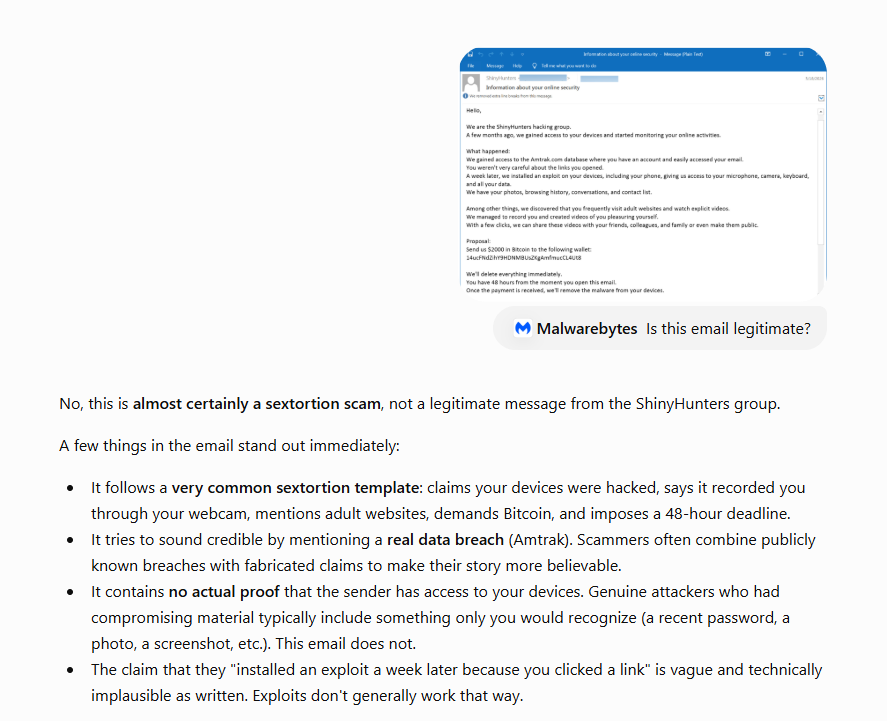
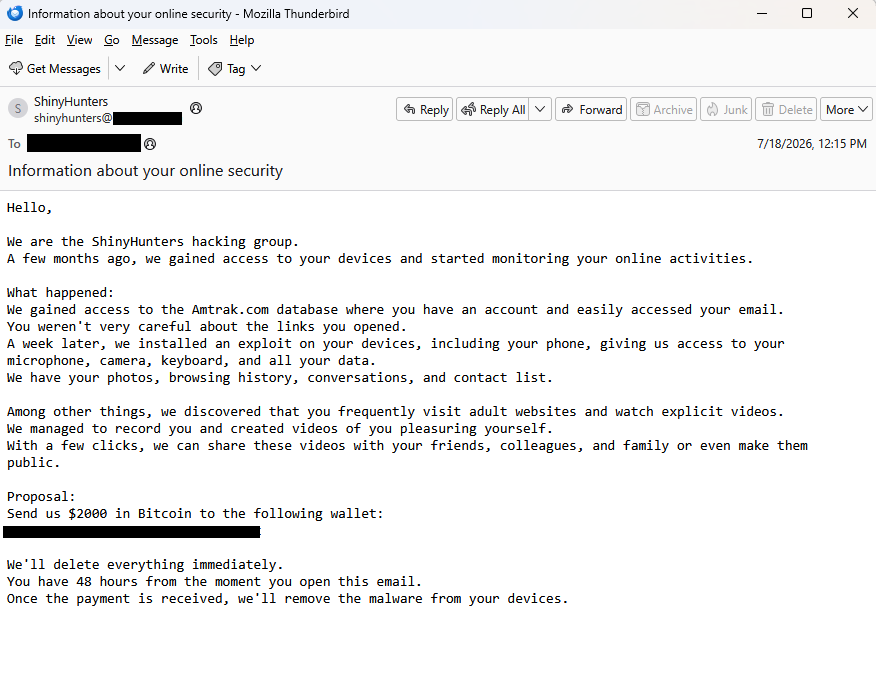
BleepingComputer reports that ShinyHunters data leaks are fueling a $2,000 sextortion email scam and shared the following example:

Example sextortion email from ShinyHunters

“Subject: Information about your online security

Hello,

We are the ShinyHunters hacking group.
A few months ago, we gained access to your devices and started monitoring your online activities.

What happened:
We gained access to the Amtrak.com database where you have an account and easily accessed your email.
You weren’t very careful about the links you opened.
A week later, we installed an exploit on your devices, including your phone, giving us access to your microphone,
camera, keyboard, and all your data.
We have your photos, browsing history, conversations, and contact list.

Among other things, we discovered that you frequently visit adult websites and watch explicit videos.
We managed to record you and created videos of you pleasuring yourself.
With a few clicks, we can share these videos with your friends,
colleagues, and family or even make them public.

Proposal:
Send us $2000 in Bitcoin to the following wallet:
xxxxxxxxxxxxxxxxxxxxxxxxxxxxxxxxx

We’ll delete everything immediately.
You have 48 hours from the moment you open this email.
Once the payment is received, we’ll remove the malware from your devices.”

BleepingComputer states it has seen data from the Amtrak, Hallmark, ADT, Substack, Betterment, CarGurus, Panera Bread, and McGraw Hill breaches used to target victims in this sextortion email campaign.

A California community college also issued a warning after seeing the campaign target people affected by the Canvas data breach.


Digital Footprint Scan

See if your personal data has been exposed.


They confirmed that the targeted email addresses had previously appeared in data leaked by ShinyHunters. They also contacted the group, which denied being behind the sextortion emails.

The increase to a $2,000 demand may suggest the scammers paid someone for the email lists. Although it’s more likely they simply downloaded the leaked data after ShinyHunters published it following failed extortion attempts.

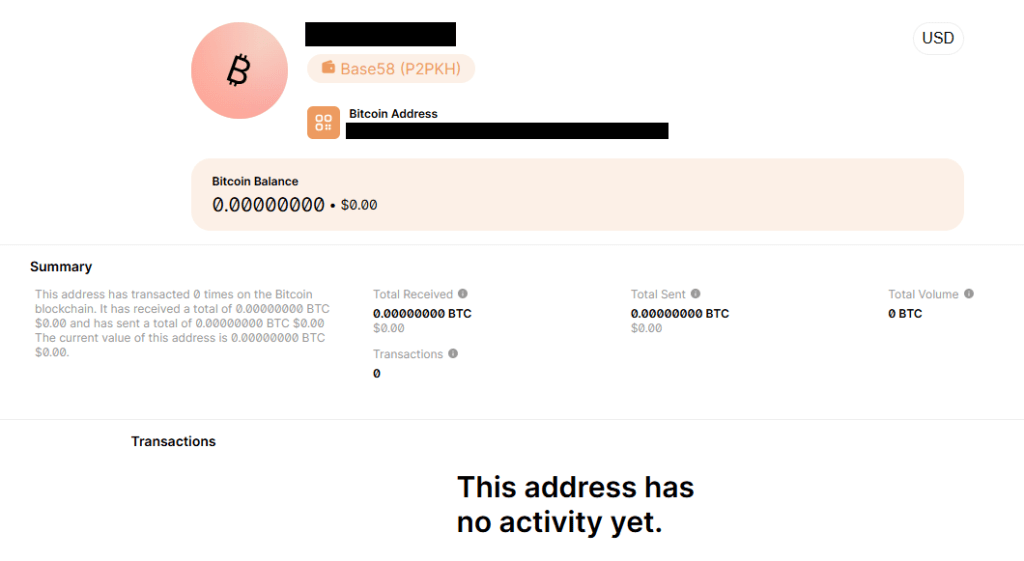
A quick check of the Bitcoin address used in the email shows no activity.

blockchain report of scammer's Bitcoin address
No activity on their Bitcoin address

Let’s keep it that way. With any luck, these dungeon dwellers will eventually give up trying to scare people out of their hard-earned money.

How to react to sextortion emails

Some sextortion emails are badly written, but many have been polished by AI and look convincing. Regardless of how professional they look, they should be treated the same way: as unsubstantiated threats designed to scare victims into paying.

  • First and foremost, never reply to emails of this kind. Responding confirms that someone is actively reading messages sent to that address and may encourage further scam attempts.
  • Don’t let yourself be rushed into action. Scammers rely on the fact that you will not take the time to think this through and subsequently make mistakes. Ask for advice if you’re not sure.
  • An attachment is not proof. Most sextortion emails contain no evidence at all, and attachments are often used to deliver malware or make the threats appear more convincing.
  • If the email includes a password you’ve used before, change it immediately anywhere it’s still in use. Then enable two-factor authentication (2FA) wherever possible. If you’re having trouble keeping track of your passwords, consider using a password manager.
  • Delete the message, report it as spam, and move on.

Pro tip: Malwarebytes Scam Guard recognized this email for what it is: sextortion. It can recognize scams and advise you how to proceed.

Scam Guard recognizes this email as a sextortion scam

While these sextortion emails are almost always bluffs, if you’re concerned about webcam spying, Malwarebytes Webcam Monitoring can alert you when applications attempt to access your camera.


Scam or legit? Scam Guard knows.


Healthcare giant Abbott probes two cyber incidents amid extortion claims

Abbott Laboratories, one of the world’s largest healthcare and medical device companies, is investigating two apparently unrelated cyber incidents after confirming unauthorized access to internal systems. While Abbott says there has been no impact on manufacturing, laboratory operations, or patient care, cybercriminal groups ShinyHunters and ShadowByt3$ claim the breaches were far more extensive. Those claims remain unverified at the time of writing and, so far, unsupported by publicly leaked data.

The incidents reportedly involve Abbott’s Cancer Diagnostics business and its LabCentral customer portal for core laboratory diagnostics.

According to a statement released by Abbott on July 16:

“Abbott is investigating a cyber incident in which there was unauthorized access to a limited number of internal systems in our Cancer Diagnostics business only. This does not impact any business operations, product or product availability, manufacturing or lab operations, or our ability to serve patients.”

Regarding LabCentral, Abbott told reporters that it is an externally hosted portal and that there has been “no known exposure of sensitive customer or business information.”

ShinyHunters told BleepingComputer it stole internal documents, contracts, customer information, more than 22 million doctor‑patient notes, over 20 million medical orders, and more than one million US Social Security numbers, along with personally identifiable information (PII) such as names, addresses, dates of birth, emails, and phone numbers.

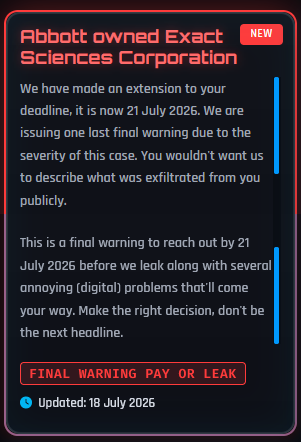
On July 18, ShinyHunters gave Abbott until July 21 to respond before leaking the alleged data:

Extended deadline
Extended deadline

“This is a final warning to reach out by 21 July 2026 before we leak along with several annoying (digital) problems that’ll come your way. Make the right decision, don’t be the next headline”

The threat of “digital problems” is a familiar one from ShinyHunters. During the Canvas attacks, the group defaced school login pages and the Canvas app with an on‑screen ransom message.

Separately, ShadowByt3$ claims it accessed the LabCentral portal on July 4, using compromised customer credentials plus a “weak point” in the environment, allegedly exfiltrating technical documentation, manufacturing certificates, operating manuals, technical specs, and regulatory docs for Abbott lab systems.

If the attackers’ claims prove accurate, the breach could affect healthcare providers that use Abbott’s diagnostic systems and potentially expose sensitive patient and healthcare data. Abbott, however, says it has found no evidence that sensitive customer or business information was exposed through the LabCentral incident and has not confirmed any patient data was compromised.

What we can reasonably assume to be true

  • There was a genuine compromise affecting Cancer Diagnostics systems. Abbott has publicly acknowledged unauthorized access and engaged incident response and law enforcement. This doesn’t appear to be a purely “fake” extortion attempt.
  • There was also a separate cyber incident involving the LabCentral portal. Abbott says the portal primarily hosts public reference material and that it has found no evidence that sensitive customer or business information was exposed.
  • Both ShinyHunters and ShadowByt3$ have listed Abbott on their extortion sites and have provided narrative details to media outlets, so this is not just generic name‑dropping.
  • As of the latest reporting, neither group has publicly released samples of the data they claim to have stolen.

What Abbott customers can do

There are some actions you can take if you are, or suspect you may have been, the victim of a data breach.

  • Check the vendor’s advice. Every breach is different, so check with the vendor to find out what’s happened and follow any specific advice they offer.
  • Change your password. You can make a stolen password useless to thieves by changing it. Choose a strong password that you don’t use for anything else. Better yet, let a password manager choose and store one for you.
  • Enable two-factor authentication (2FA). If you can, use a FIDO2-compliant hardware key, laptop, or phone as your second factor. Some forms of 2FA can be phished just as easily as a password. 2FA that relies on a FIDO2 device can’t be phished.
  • Watch out for impersonation scams. Criminals may contact you pretending to be the company. Check the company’s website to see how it is contacting affected customers, and verify anyone who contacts you using a different communication channel.
  • Take your time. Phishing attacks often impersonate people or brands you know, and create a false sense of urgency with messages about missed deliveries, suspended accounts, or security alerts.
  • Consider not storing your card details. It’s definitely more convenient to get sites to remember your card details for you, but we highly recommend not storing that information on websites.
  • Set up identity monitoring. Identity monitoring alerts you if your personal information is found being traded illegally online and helps you recover if your identity is stolen.

What do cybercriminals know about you?

Use Malwarebytes’ free Digital Footprint scan to see whether your personal information has been exposed online.

UK Cybercrime Journal: University of Nottingham Breached by ShinyHunters

What Happened

  • On 9 June 2026, the University of Nottingham was listed as a victim on the ShinyHunters Tor data leak site.
  • The attackers leaked over 40GB of billing and payment records, student finance data, and campus portal exports from the University of Nottingham and its Malaysia and China campuses.
  • The data stolen includes contact information, transaction amounts, IP addresses, full names, home addresses, postcodes, email addresses, phone numbers, dates of birth, and other internal campus data.
  • Further analysis of the leaked data by Have I Been Pwned revealed it also contained over 455,000 unique email addresses along with extensive personal information including ethnicities, disabilities, and passport numbers.
  • On 10 June 2026, security researcher @nahamike01 uncovered an exposed server belonging to ShinyHunters and found them targeting Oracle PeopleSoft servers using MeshCentral agents. Plus, analysis the bash_history logs on the server uncovered SSH connections to the IP address hosting the ShinyHunters Tor data leak site.
  • On 11 June 2026, Mandiant and Google Threat Intelligence Group (GTIG) disclosed they have observed active compromise and extortion campaign attributed to UNC6240 (ShinyHunters) targeting Oracle PeopleSoft application infrastructure via a zero-day now tracked as CVE-2026-35273, a critical remote code execution (RCE) vulnerability (CVSS 9.8).

Analyst Comment
ShinyHunters is a prolific feature of current threat landscape. This adversary appears to have a particular focus on the educational sector. Last month in May 2026, ShinyHunters targeted another provider of educational software: Instructure Canvas. A number of other UK universities were also impacted by the Instructure breach.

The education sector in the US and UK has suffered repeated, significant data breaches in recent years. In January 2025, BleepingComputer reported that PowerSchools, a cloud-based software provider, suffered a breach whereby the data of 62.4 million students and 9.5 million teachers was exfiltrated. Also in June 2026, the University of Oxford also disclosed a data breach impacting its CareerConnect platform. Separately, 13 schools in Powys county in Wales were impacted by a data breach in April 2026.

After the Oracle E-Business Suite zero-day campaign by CLOP in October 2025, this campaign by ShinyHunters against Oracle PeopleSoft is yet another blow for Oracle. Google identified over 100 exposed organisations, and noted that 68% are academic institutions, including universities and colleges worldwide. More are likely to have been victimised by ShinyHunters and listed on their Tor data leak site in the coming weeks.

Defensive Takeaways

  • Patch Oracle PeopleSoft: Internet-facing applications, such as file transfer servers or cloud-based software need to be prioritised for patches and updates. Checking the integrity of such systems while patching is also key to finding undetected compromises. Proactively ingesting event logs and threat hunting for suspicious activities involving these systems is also key to prevent breaches.
  • Prioritise Education Software Security: Education sector firms or cybersecurity companies with education sector clients must react to the elevated threat, by pen-testing, threat hunting, and threat intelligence sharing. Cybercriminal adversaries like ShinyHunters often exploit internet-facing applications or use stolen credentials for initial access. It is therefore critical to focus on these tactics, techniques, and procedures (TTPs) to prevent their attacks.
  • Follow the Data Breach Alert Playbook: Impacted victims must begin to rotate credentials, and start the laborious task of requesting new identity documents and codes like national insurance numbers or passports. It is also worth investing in some credit monitoring services as well to prevent loans being taken out in your name.

Relevant Sources

  1. https://x.com/politlcsuk/status/2064699766215164241
  2. https://www.dailymail.com/news/article-15889587/University-Nottingham-data-major-hack-cybercriminal.html
  3. https://www.bbc.co.uk/news/articles/ckg0lkp042zo
  4. https://www.bbc.co.uk/news/articles/cnv93j9pv78o
  5. https://www.theregister.com/cyber-crime/2026/06/11/shinyhunters-raids-nottingham-uni-for-student-alumni-data/5253961

Relevant CTI Resources

  1. https://www.ransomware.live/id/bm90dGluZ2hhbS5hYy51a0BzaGlueWh1bnRlcnM
  2. https://haveibeenpwned.com/Breach/UniversityOfNottingham
  3. https://x.com/nahamike01/status/2064559568018186745
  4. https://cloud.google.com/blog/topics/threat-intelligence/shinyhunters-targets-education-sector-oracle-exploit 

June 2026 Dark Web Breach Incident Trend Report

Note The June 2026 Dark Web Breach Incident Trend Report is based on major data breach cases posted on the deep web and dark web forums. Due to the nature of some sources, it was difficult to fully verify the accuracy of certain information, so the report includes content that requires further verification. Major Issue […]

June 2026 Dark Web Issue Trend Report

Note The June 2026 Dark Web Issue Trend Report summarizes major issues that occurred on the deep web and dark web. Due to the nature of the sources, it is sometimes difficult to fully verify the accuracy of certain information, and this is noted accordingly. Major Issue On Hasan’s BreachForums, there was a series of […]

Medtronic Notifies 3.8 Million After ShinyHunters Data Breach

Medtronic says a ShinyHunters attack exposed the personal and medical data of over 3.8 million people. Products and operations were unaffected.

Medtronic is notifying 3,834,294 individuals after a cyberattack by the ShinyHunters extortion group exposed personal and medical information.

In April 2026, Medtronic confirmed a cyberattack on its corporate IT systems after the hacker group ShinyHunters claimed to have stolen over 9 million records. The company did not share details on the security breach.

Medtronic is an international medical equipment giant with 90,000 employees and operations in 150 countries. It is the largest medical device maker in the world by revenue ($33.5 billion) and also develops healthcare technologies and therapies.

The company said an unauthorized party accessed data in some corporate IT systems. It found no impact on products, patient safety, operations, financial systems, or care delivery. The company noted its IT, product, and manufacturing networks are separate, and hospital networks remain independently managed and secure.

“Medtronic has determined that an unauthorized party accessed data in certain Medtronic corporate IT systems. We have not identified any impact to our products, patient safety, connections to our customers, our manufacturing and distribution operations, our financial reporting systems or our ability to meet patient needs.” reads the press release published by the company. “The networks that support our corporate IT systems, our products and our manufacturing and distribution operations are separate. Hospital customer networks remain separate from Medtronic IT networks and are secured and managed by customers’ IT teams.”

Medtronic states it had contained the breach and activated incident response with the help of external cybersecurity experts. It’s assessing if personal data was exposed and will notify affected individuals, offering them support.

On April 18, ShinyHunters added the firm to its Tor data leak site, claiming the theft of over 9 million records, including personal data and internal files. Initially, the group threatened to leak the data if the ransom was not paid by April 21, but the listing has since disappeared. The company is investigating and says it will notify and support affected individuals if data exposure is confirmed.

This week, the technology firm started sending notification letters to the impacted individuals. Medtronic said the breached data may include patients’ names, contact details, dates of birth, Social Security numbers, and health information. The company added that it has found no evidence the stolen information has been publicly released or exposed online.

“On April 15, 2026, Medtronic became aware of unusual activity on certain corporate IT systems. Medtronic launched an investigation with the assistance of leading third-party cybersecurity experts to determine the impact and scope of the incident. The investigation determined that from April 13 to April 19, 2026, an unauthorized actor accessed certain Medtronic corporate IT systems.” reads the data breach notification. “With the assistance of data review specialists, we have been working diligently to determine the types of information that may have been subject to unauthorized activity and to whom they relate. What Information Was Involved? As a patient with a Medtronic medical device, our company collects data related to you in order to provide important product-related updates and to meet our legal obligations. The investigation to date has determined that the following types of information may have been impacted: name, contact information, date of birth, Social Security number, and health-related information. We have no evidence that any of that information was posted publicly or exposed on the Internet.”

Medtronic is offering 24 months of free credit monitoring, dark web monitoring, and identity theft recovery services to those impacted.

“Medtronic is committed to and takes very seriously our responsibility to safeguard all data entrusted to us. As part of our ongoing commitment to the security of personal information in its care, Medtronic has implemented additional safeguards and continues to work with third-party cybersecurity experts to identify opportunities to further strengthen the security of its systems.” concludes the notification. “Medtronic has also worked with law enforcement and is notifying relevant regulatory authorities. In addition, we are offering you access to 24 months of complimentary credit monitoring, dark web monitoring (monitoring certain online sources for publication of personal information), and identity theft restoration services through Epiq. Details on the service and instructions for enrollment can be found in the enclosed Epiq – Privacy Solutions ID.”

Follow me on Twitter: @securityaffairs and Facebook and Mastodon

Pierluigi Paganini

(SecurityAffairs – hacking, data breach)

Madison Square Garden Hack Exposes 26 Million Visitor Records

Madison Square Garden faces a 26M-record hack tied to visitor data, facial recognition, and security records from its venue operations, with fallout from the leak.

The post Madison Square Garden Hack Exposes 26 Million Visitor Records appeared first on TechRepublic.

Kodak confirms breach as ShinyHunters’ leak threat reaches deadline

The Eastman Kodak Company (Kodak) confirmed to BleepingComputer that it is investigating a security breach after the ShinyHunters extortion group claimed responsibility for the incident.

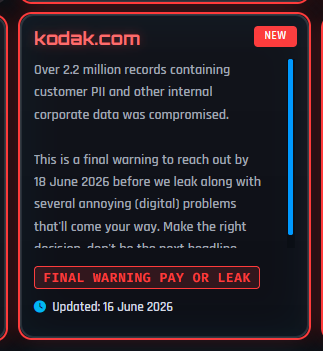
Kodak is the latest organization to land on the group’s leak site. ShinyHunters claims it stole more than 2.2 million records and threatened to publish the data unless the company responded by June 18.

Kodak listed on ShinyHunters leak site

“Over 2.2 million records containing customer PII and other internal corporate data was compromised. This is a final warning to reach out by 18 June 2026 before we leak along with several annoying (digital) problems that’ll come your way.”

Kodak has now confirmed a data breach, while also saying the incident was limited in scope, contained, and did not pose a threat to its systems or operations.

ShinyHunters has been busy making the same point across multiple victims: modern extortion is often less about ransomware (encryption) and more about access, stealing valuable data, and applying pressure.

ShinyHunters claims it stole customer information and internal corporate data, but has not publicly provided proof. That’s a common pattern for extortion groups. They make public claims, set a deadline, and use the threat of a data leak to pressure victims before the full facts are known.

Kodak told SecurityWeek that an unauthorized third party gained access to a limited amount of company data, and that the incident appears to have been contained. The company said it brought in external cybersecurity experts, notified law enforcement, and believes there is no threat to its systems or operations.

It’s not yet known how the attackers gained entry to Kodak’s systems, but the extortion group is well-known for social engineering, bribery, and utilizing zero-day vulnerabilities to perform supply-chain attacks. The investigation is ongoing.

How to stay safe

While Kodak works to determine who was affected and exactly what information was accessed, there’s no reason to panic. But there are a few things you can do:

  • Change the password on your Kodak account and make sure you haven’t reused the same password on other accounts.
  • Turn on multi-factor authentication (MFA) wherever possible, to ensure that a stolen password is not enough to take over your account.
  • If you’re in the US, consider placing a credit freeze with Equifax, Experian, and TransUnion. A credit freeze helps prevent identity thieves from opening new accounts in your name by blocking lenders from accessing your credit file.
  • Depending on the information involved, Kodak may offer affected customers free credit monitoring. Even if it doesn’t, you may want to consider identity monitoring services, which can alert you if your personal information appears in suspicious places or is used to open accounts, apply for credit, or commit fraud.
  • Check your Digital Footprint regularly to see if your personal details have been exposed.

Cybercriminals often exploit the confusion that follows a breach. They know victims will be expecting emails and updates from the affected company, making phishing messages more convincing.

Monitor Kodak’s official website for updates, and be skeptical of unsolicited emails, texts, or phone calls the reference the incident. Look for inconsistencies, unusual sender addresses, and strange links, and watch out for the two biggest warning signs: pressure to act immediately and requests for money, passwords, or personal information.


Let’s face it, an incognito window can only do so much. 
 
Breaches, dark web trading, credit fraud. Malwarebytes Identity Theft Protection monitors for all of it, alerts you fast, and comes with identity theft insurance. 

EdTech Faces a Cybersecurity Crisis: Data Breaches Surge

EdTech firms face rising cyberattacks as ShinyHunters and FulcrumSec target schools, exposing sensitive data and disrupting services.

Resecurity (USA) warns the education technology (EdTech) sector has become a prime target for cybercriminals, as attacks against educational institutions and related platforms continue to escalate. Recent high-profile incidents, including attacks by groups such as ShinyHunters and FulcrumSec, highlight the vulnerability of educational organizations and the increasing sophistication of cyber extortion tactics.

Today (June 16, 2026) — ShinyHunters announced new victims, including, but not limited to Glendale Community College, Moody Bible Institute, Illinois Central College, Houston City College. The gang also stole personal information from more than 137,000 school staff accounts in a Salesforce data theft attack that targeted the widely used Infinite Campus K-12 student information system in March. Infinite Campus is an education technology (EdTech) company that provides a student information system (SIS) to over 3,200 school districts across the United States, managing data for 11 million students in 46 states.

In another devastating incident, the group FulcrumSec has claimed responsibility for a massive ransomware attack targeting the Global Schools Foundation (GSF), an international network of educational institutions headquartered in Singapore. The attack, which occurred in early June 2026, resulted in large-scale data exfiltration from critical systems across GSF’s schools in multiple countries, disrupting operations, and leaving students and staff unable to access essential services.

Follow me on Twitter: @securityaffairs and Facebook and Mastodon

Pierluigi Paganini

(SecurityAffairs – hacking, EdTech Faces)

❌