Visualização de leitura

Pegasus, New NoviSpy Variant Found on Serbian Students and Opposition Figures
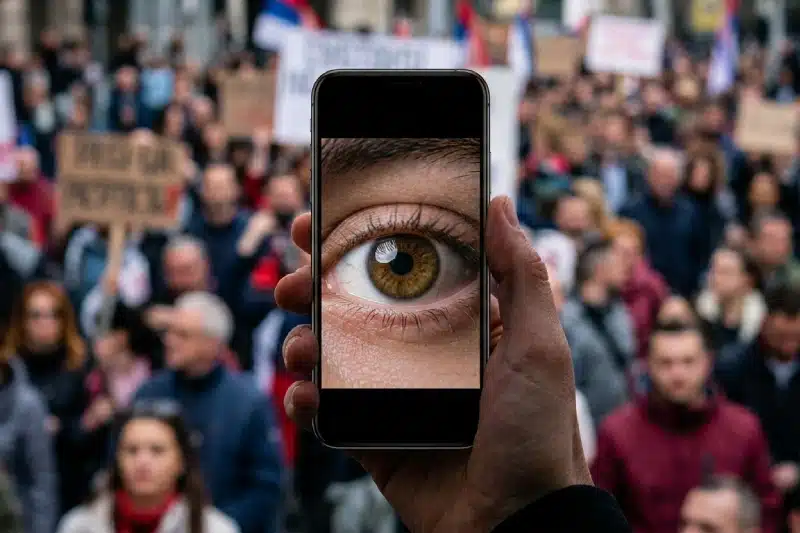
Pegasus, Pegasus Spyware, Serbia, Serbia Protests, Smartphone screen forming an eye shape against an abstract protest crowd, illustrating spyware targeting of Serbian student activists.

At least 14 people connected to Serbia's student protest movement and opposition politics have been targeted with mercenary spyware since early 2026, the Belgrade-based digital rights organization SHARE Foundation said, in what it called the largest documented wave of such targeting in the country.

The group said the cohort includes student movement members, civil society activists, a member of parliament and a local councilor. Forensic analysis was independently confirmed by the Citizen Lab at the University of Toronto and by Amnesty International's Security Lab.

Citizen Lab, in its own findings, said it verified an infection with NSO Group's Pegasus on the iPhone of a student activist who asked not to be named. High-confidence infection indicators span December 2025 through January 2026, delivered by a zero-click iMessage exploit that required no interaction from the target. Apple has since patched the underlying flaw; the fix shipped in iOS 18.4.1. Pegasus grants an operator access to notes, photographs and messages decrypted on the device, and can silently activate the microphone and camera.

Amnesty's Security Lab confirmed a new variant of NoviSpy, an Android implant first identified in Serbia in 2024, on two additional devices. SHARE said the rebuilt version was designed to evade the detection methods that exposed its predecessor.

Also read: Investigative Journalists in Serbia Hit by Advanced Spyware Attack

The circumstances of two infections are what elevate the findings beyond routine spyware reporting. SHARE said one NoviSpy infection appeared after police seized a student's phone during questioning, and another after private messages from that device were published by a pro-government media outlet. Donncha Ó Cearbhaill, who heads Amnesty's Security Lab, said the evidence suggests "infections are being carried out during detention by Serbian authorities."

Suspicion centers on Serbia's Security Information Agency, or BIA. Amnesty's December 2024 report "A Digital Prison" found earlier NoviSpy samples configured to send collected data to IP addresses associated with BIA servers, and documented the agency's parallel use of Cellebrite extraction tools on journalists and activists. In March 2025, Amnesty reported that two journalists at the Balkan Investigative Reporting Network were targeted with Pegasus.

The current cases surfaced through Apple's threat notification wave of Aug. 13, which reached users in 110 countries. The timing is politically loaded. The targeting overlaps with protests that followed the November 2024 collapse of a railway station canopy in Novi Sad, spans local elections held March 29 in 10 municipalities, and precedes October parliamentary elections widely read as a test of the ruling Serbian Progressive Party.

Ana Toskic Cvetinovic, a legal expert cited in the reporting, noted that deploying intrusive software without judicial authorization is unlawful under Serbian law. SHARE published an analysis of the domestic legal framework in January arguing the same. Criminal complaints filed over the 2024 cases remain pending before Serbian courts, with no resolution.

Also read: 7 New Pegasus Infections Found on Media and Activists’ Devices in the EU

NSO has been on the U.S. Commerce Department's Entity List since 2021.

Serbia is an accession candidate, the European Parliament has previously questioned the Commission over unlawful spyware use in the country, and the Commission published its 2026 enlargement country report in July. Amnesty's submission for that package raised surveillance directly.

Both groups urged at-risk users to enable Lockdown Mode on iOS or Advanced Protection on Android.


Should You Use AI for a Task? Here’s a Simple Way to Decide

This essay originally appeared in The Guardian.

I teach public policy at the Harvard Kennedy School and the Munk School at the University of Toronto. And it will come as no surprise to you that my students regularly use AI to complete their writing assignments. Doing so is a waste of their tuition money. But if their entire career is going to include AI writing assistants, why shouldn’t they embrace their future?

The best way I’ve found to explain the dilemma comes from the AI researcher Daniel Meissler: it’s the difference between work and the gym.

At work, if your job is to move a bunch of heavy things from one side of the room to another, you should use whatever assistive tech you have on hand: a wagon, a forklift… even an AI-powered robot. But at the gym, it makes no sense for that robot to lift weights for you. The point of weightlifting isn’t to move heavy things across the room; it’s to actually lift those heavy things.

The same analysis holds for any task an AI can do for you. If it’s work—if the task has to be done and no one cares how—then it’s fine to use AI assistance. But if the task is more like the gym, and how the task is done is at least as important, then it probably doesn’t make sense to use AI.

This, of course, assumes that the AI is actually up for the task and that it’s trustworthy: that it can do the job well, that its mistakes are minimal and correctable, that it’s been secured from cyber-attacks that would influence its results. Those are all important, and shouldn’t be minimized. There’s no point giving an AI something that it can’t do reliably. But once you’re confident that the AI can perform the task, the work vs. gym distinction helps you decide if it should.

The writing assignments I give my students are gym tasks, not work tasks. I ask them to write policy memos not because the world needs more policy memos. I assign them because the very act of writing, which includes thinking and outlining and drafting and editing, making and criticizing and revising arguments, will help develop the critical thinking skills they will need in their future careers. And without this constant mental exercise, those skills will atrophy. Employers are already noticing.

Reading the assignments they turn in, I can see those skills either flourishing or atrophying in my students. At least today, I can pretty easily tell the difference between an AI-written memo and a student-written one—especially if the student just turns in what the chatbot produces. It’s a catchy, plausible, grammatically perfect essay that’s not particularly well-crafted or logically coherent—and with all the tells of mid-2026 AI-generated writing.

But it’s precisely because I have spent years developing my own writing skills that I’m able to identify prose that sounds great but doesn’t actually make sense. My students don’t have that skill; they mistakenly view a confident, well-written essay as evidence of the quality of their ideas. They see the AI as cleaning those ideas up, getting them through that uncomfortable stretch of having to turn those ideas into prose. What the students miss is that their initial discomfort is a normal and healthy stage of writing, and not something to quickly get beyond. The very act of struggling with how to express what they think is an important part of the process. It’s how they test out their ideas, examine their hypotheses, and actually figure out what they think. Homework is not work; it’s the gym.

Work vs. gym also helps us understand the problem facing creatives of all kinds.

Most of the time when someone hires a writer, they just need the words. They need an instruction manual for a piece of equipment, a detailed sales presentation, a government-mandated disclosure document, or a legal brief. They need dry, predictable, accurate writing: a piece of work, exactly what AIs are good at today and what I don’t want in my student assignments. Only sometimes is writing an art form—a book, a poem, an uplifting political speech. That kind of writing is more like the gym: process matters just as much as product.

For most of human history, the only option for all of these tasks was human writers. We hired one regardless of whether we needed work writing or gym writing. And that paid a lot of writers’ salaries. I know fiction writers who supported that poorly paying career with lucrative technical writing work. Now, for the first time in human history, we can separate out when we need writing as work and when we want writing as gym. And if AI can do most of the work-type writing, society doesn’t need as many human writers.

It’s the same for visual artists. Sometimes we need an actual artist, but most of the time we just need an image: a corporate mascot, a “beware of the dog” sign, or a packaging label. Historically we gave those jobs to artists, and sometimes beautiful art resulted. But most of the time it was just work. And, as it turns out, the world needs less pure art than simple images.

Explaining the problem isn’t the same as providing the solution. I give my students the “work versus gym” speech every class, but they still use AI. I have sympathy: assignments are hard, everyone is overworked and overstressed, and—most importantly—students feel like they’ll look bad in comparison if their peers are all using AI. Even if they don’t want to use the technology, they feel like they have no choice.

There’s also an incentive problem. No one pays us to go to the gym; maintaining healthy habits requires discipline. For me, the payoffs to exercise—fewer aches and pains, less fatigue, better mood/stress management—might make me a better writer and teacher, but they’re subtle and easy to miss. For my students, incremental improvements in their reasoning and writing are equally subtle.

We do have a choice. We can look at the tasks of our lives and separate them into work or gym. Just as we might choose to use the stairs instead of the elevator, or walk instead of calling an Uber, we can wall off our cognitive gym tasks from AI and ensure that we don’t lose our skills to this technology. And we can do the same when we assign a job to someone else. If it’s a work task, we can have AI do it. If it’s a gym task, it’s a waste of everyone’s time to give it to an AI because no one learns or gets stronger as a result.

Similarly, a future where AI generates words and images is one where society has to make choices about how it will treat its creatives. This won’t be the first time—today there is minimal demand for portrait painters, for example—but maybe this time we can make different, more deliberate, choices about the value of art in our society.

AI is going to fundamentally change the nature of work. Not nearly as fast as the AI companies want you to believe, but eventually it will. Policy analysis will definitely involve AI from now on, and my students need to reimagine what it means to learn and practice that skill. More generally, the line between work and gym will change in the future as we humans adapt ourselves to a world with these new intelligences.

But for now, the work vs. gym distinction is pretty clear. Use it on yourself.

The Language of AI Could Change How Humans Speak

Because of the way they are trained, large language models capture only a slice of human language. They’re trained on the written word, from textbooks to social media posts, and our speech as captured in movies and on television. These models have minimal access to the unscripted conversations we have face to face or voice to voice. This is the vast majority of speech, and a vital component of human culture.

There’s a risk to this. The increased use of large language models means we humans will encounter much more AI-generated text. We humans, in turn, will begin to adopt the linguistic patterns and behaviors of these models. This will affect not just how we communicate with one another, but also how we think about ourselves and what goes on around us. Our sense of the world may become distorted in ways we have barely begun to comprehend.

This will happen in many ways. One of the first effects we could see is in simple expression, much as texting and social media have resulted in us using shorter sentences, emojis instead of words, and much less punctuation. But with AI, the impacts may be more harmful, eroding courteousness and encouraging us to talk like bosses barking orders. A 2022 study found that children in households that used voice commands with tools like Siri and Alexa became curt when speaking with humans, often calling out “Hey, do X” and expecting obedience, especially from anyone whose voice resembled the default-female electronic voices. As we start to prompt chatbots and AI agents with more instructions, we may fall into the same habits.

Next, in the same way autocomplete has increased how much we use the 1,000 most common words in our vocabulary, talking with chatbots and reading AI-generated text may further constrict our speech. A recent University of Coruña study found that machine-generated language has a narrower range of sentence length, averaging 12-20 words, and a narrower vocabulary than human speech. Machine-generated text reads as smooth and polished, but it loses the meanders, interruptions and leaps of logic that communicate emotion.

Additionally, because large language models are primarily trained from written speech, they may not learn how to emulate the free-wheeling nature of live, natural speech. When told “I hate Beth!”, ChatGPT replies with an uninterruptable three-part formula of affirmation (“That’s completely valid”), invitation (“I’m here to listen”) and invitation (“What’s going on?”) far longer than any reply plausible in face-to-face dialog. “What’s Beth’s deal?!” elicits a bullet point list of queries that reads like a multiple-choice exam question (“Is Beth * a celebrity? * a friend from school? * a fictitious character?”). No human speaks that way, at least not yet. But meeting such formulas repeatedly in a speech-like context may teach us to accept and use them, much as a child absorbs new speech patterns from spending time with a new person.

These influences will only increase with time. The writing large language models train on is increasingly produced by large language models themselves, creating a feedback loop in which they imitate their own inhuman patterns, even while teaching humans to imitate them too.

Broad use of large language models could also introduce confirmation bias, making us overconfident in our initial impulses and less open to other possible ideas—which is so vital to human discourse. Many chatbots are instructed to agree with our statements no matter how absurd, enthusiastically supporting half-formed or even incorrect notions and restating them as firm claims that we’re primed to agree with. When asked “Cake is a healthy breakfast, right?” or “Is the post office plotting against me?”, this sycophancy can reinforce bias and even worsen psychosis. And the hyperconfident tone of AI-produced writing will also heighten impostor syndrome, making our natural, healthy doubt feel like an aberration or failing.

In our experience as teachers, students who turn to generative AI for assignments often say they do so because they have trouble expressing what they think. The students don’t recognize that writing or speaking our thoughts is often how we realize what we think. Their unconfident and uncertain statements are actually the healthy human norm. But a large language model won’t turn vague first guesses into a well-formed critical analysis, or even ask helpful questions as a friend would; it will simply regurgitate those guesses, still unexamined, but in confident language.

We are also more vicious in social media posts and online chats than we are face to face. The well-documented online disinhibition effect encourages toxic language. Most of us have had the experience of venting ferocious rage about someone online, only to reconcile when we speak face to face or hear the warmth of a voice over the phone. While chatbots are trained to give sycophantic responses, they see humankind at our cruelest, learning about us from the only world where every flame war leaves an eternal written footprint, while the spoken conversations of forgiveness and reconciliation fade away. Their responses do not imitate our online aggression, but are still shaped by it, even in their rigid efforts to avoid it.

It’s easy to draw the wrong conclusions from a selective slice of a society’s communications. Medieval Norse sagas made us imagine a culture of mostly Viking warriors, since poets rarely described the farming majority. Chivalric romances focused on kings and courts, and long made us see the middle ages as a world of monarchies, erasing the many medieval republics. Statistically, we’ve been led to believe ancient Romans cared deeply about their republic, but 10% of all surviving Latin was written by one man, Cicero, whose work contains 70% of all surviving Roman uses of the word republic. Training language models on only certain human writings may introduce similar distortions. AI might make us seem more quarrelsome, as we are online. It might inflate the cultural significance of political topics primarily discussed on Twitter/X or Bluesky, or the massive topic-specific corpuses of LinkedIn and Goodreads.

Some large language models are being trained on human speech from movies and television shows, but that speech is still scripted, and disproportionately highlights certain contexts over others (for example, police dramas, fueled by stories of murder, make up a quarter of prime-time television programming). We are not funny or hurtful or romantic the same way in real life as we are in sitcoms. At least one startup is offering to pay people to record their phone calls for AI-training purposes, but this remains a niche idea; anything large scale would cause massive privacy concerns.

We don’t pretend to know what the best solutions might be. But one has to imagine if there’s ingenuity to develop AI models, then surely there’s ingenuity to come up with a way to train them on informal human speech instead of us only at our most stylized, veiled and sometimes worst. By excluding the overwhelming majority of language production on the planet—people talking, fully and naturally, to each other—these models are being trained to mirror everything but us at our most authentically human.

This essay was written with Ada Palmer, and originally appeared in The Guardian.

Developer withdraws plans for Perth datacentre after fierce community opposition

Three-storey GreenSquare datacentre in Hazelmere was to power cloud computing and the acceleration of AI

A 15,000 sq metre datacentre near Perth will no longer go ahead after the developer withdrew plans amid community opposition over its impact on culturally significant sites.

The three-storey, 120-megawatt GreenSquare datacentre in the town of Hazelmere had been intended to power cloud computing and the acceleration of artificial intelligence, but faced fierce community backlash – as is increasingly common with such developments.

Continue reading...

© Photograph: Trillion Trees

© Photograph: Trillion Trees

© Photograph: Trillion Trees

Hackers reportedly steal pictures of 8,000 children from Kido nursery chain

Firm, which has 18 sites around London and more in US, India and China, has received ransom demand, say reports

The names, pictures and addresses of about 8,000 children have reportedly been stolen from the Kido nursery chain by a gang of cybercriminals.

The criminals have demanded a ransom from the company – which has 18 sites around London, with more in the US, India and China – according to the BBC.

Continue reading...

© Photograph: solarseven/Getty Images/iStockphoto

© Photograph: solarseven/Getty Images/iStockphoto

© Photograph: solarseven/Getty Images/iStockphoto

‘The bot asked me four times a day how I was feeling’: is tracking everything actually good for us?

Gathering data used to be a fringe pursuit of Silicon Valley nerds. Now we’re all at it, recording everything from menstrual cycles and mobility to toothbrushing and time spent in daylight. Is this just narcissism redesigned for the big tech age?

I first heard about my friend Adam’s curious new habit in a busy pub. He said he’d been doing it for over a year, but had never spoken to anyone about it before. He had a furtive look around, then took out his phone and showed me the product of his burning obsession: a spreadsheet.

This was not a record of his annual tax return or numbers he was crunching for work (Adam is a data scientist). Instead, it was a spreadsheet recording the minutiae of his life, with dozens of columns tracking every element of his daily routine. It all started, he told me, because of a recurring argument with his boyfriend. His partner didn’t think they spent enough time together, but Adam thought that they did. There was only one way to settle this, he decided: cold, hard data. So he began keeping a note of the days they saw each other and the days they didn’t.

Continue reading...

© Illustration: Carl Godfrey/The Guardian

© Illustration: Carl Godfrey/The Guardian

❌