Meta won’t judge employees by how much they use AI when it comes to annual performance reviews, despite early efforts to drive AI adoption focusing on so-called token maxing.
The company has told employees that it “will not use AI adoption dashboards or token counts to evaluate impact,” according to a report by The Information.
The announcement came in an internal memo from executives Maher Saba and Santosh Janardhan, which said that instead of measuring AI usage, “managers should look at output quality, velocity, problem complexity and scope taken on.”
This marks a culture change for Meta, where engineers had previously competed to consume the most AI tokens, displaying their scores on a leaderboard. Meta then discovered that its employees were being diverted from regular work because they were using AI to carry out additional tasks to boost their scores.
Amazon had similar results when it implemented a leaderboard to track AI use; it also found that some employees were trying to game the system by using AI to complete unnecessary tasks, and it has now deleted it.
Meta had already started to look askance at the concept of using AI metrics as a tool to assess employees. Earlier this year, Chief Technology Officer Andrew Bosworth told employees in a memo that “nobody should be using AI tools just for the sake of using them,” adding that “token usage alone is not a measure of impact of any kind.”
Picture the meeting. A slide goes up, a number goes down and somewhere in the room, someone claps.
The line item is a renegotiated managed services contract, a hardware order trimmed to “just enough,” or a headcount freeze that quietly became a headcount decrease. Whatever it is, it looks great in the deck. The CFO nods. The COO nods harder. Everyone agrees this was smart.
Three months later, something breaks — an incident nobody can escalate fast enough, a part that doesn’t arrive in time, a senior engineer who finally takes that recruiter’s call. Nobody connects it back to the slide. The slide was right. The spreadsheet said so.
This is the part where I’d like to gently suggest that a lot of very smart people are managing to the cell instead of managing to the outcome — with total confidence, because the cell is the only thing anyone asked them to optimize.
To be clear, this isn’t a jab at the leaders doing it. I’ve done it. I have a Six Sigma certification and a well-worn habit of measuring things, and measuring things is good — right up until the measurement becomes the mission. The problem was never the spreadsheet. It’s mistaking it for a map.
Outsourcing: The invoice goes down, and so does everything you can’t put a price on
I’ve watched this failure mode play out more times than I can count. Across nearly three decades in infrastructure — as chief technology architect at GE Medical Systems (now GE Healthcare), integrating roughly 300 acquired companies into a 420-location footprint — the pattern held: The moment a relationship with the people who actually knew a system got treated as a line item instead of an asset, the organization lost something the spreadsheet never had a row for.
Vendor and MSP contracts are the cleanest modern example: Savings are easy to show, losses are easy to miss. You cut the line item. What doesn’t show up anywhere is the on-call engineer who used to just know — the environment, the history, the thing that broke in 2019 — replaced by a support queue and an SLA that’s met on paper while your business is down in practice.
None of this is the vendor’s fault — they’re delivering exactly what the contract asked for. CIO.com’s own reporting on the hidden costs of outsourcing makes the same point from the other side: Ineffective knowledge transfer and high vendor-side attrition can permanently erode institutional knowledge the client never gets back. The contract took away flexibility. The person who used to just fix it — the one who wore six hats and closed the gap on a Tuesday afternoon — gets replaced by a role with a scope of work. Scopes of work don’t wear hats. A five-minute favor becomes a change request, routed through a ticketing system, against a rate card. You didn’t just outsource a function. You outsourced your ability to handle it — and bought back a slower, costlier version of the same fix, one billable hour at a time.
JIT procurement: A factory formula applied to a business that isn’t a factory
Just-in-time assumes something that doesn’t exist: A crystal ball good enough to see today’s need and whatever shows up next. I learned that the hard way at GE Medical Systems, when a new customer opening a facility wanted several hundred patient-critical bedside monitors customized to match a color scheme from their marketing department. Our processes were built entirely around clinical function — the thing that keeps a patient alive — and nothing accounted for a hospital wanting its equipment to match its brand. It came in from left field. We had no SKU for “must match burgundy.”
We ended up standing up a new department — Specials — because the existing process had nowhere to put a request like that. Building the flexibility after the fact was expensive. But it became a real differentiator: As far as I know, we became the first and only medical device manufacturer with a dedicated specials department. It told customers something that mattered more than paint color: They came first, and we’d find a way to say yes.
The lesson wasn’t “predict better.” It was “build systems with teeth” — flexibility designed in, not bolted on after reality shows up sideways. Dell and HP figured this out decades ago: You can order a PC built to your exact spec and have it shipped in days, because their systems were engineered for change. Most IT organizations still build for demand they can already see, then treat every surprise as an exception instead of the job itself.
This wasn’t a one-off: Supply chain analysts at SupplyChainBrain noted that during the 2021 chip shortage, many manufacturers found their lean JIT models weren’t built to flex under real disruption. “Just in time” only works until the time arrives and the thing isn’t there.
Headroom is savings, too — paid out in advance instead of on the back end, which is why it never gets credit. Nobody puts “the department we didn’t need to build in a panic” on a savings slide, because avoided cost doesn’t announce itself the way cut cost does. The expense of headroom is visible and immediate; the expense of its absence is invisible until it isn’t. It’s an incident report.
The hour that reads as free
I lived a version of this at GE Medical Systems. We built life-critical patient care products in a market crowded with giants — Philips, Siemens, HP — where nothing shipped until it cleared FDA review. On one release, scope crept weekly because sales kept promising new capability to close deals, and no one above us would draw a line around what “done” meant. What we got instead of a defined scope was a war room: Catering, a fridge stocked with Mountain Dew, enough M&Ms to open a candy counter — everything money could buy to keep engineers at their desks around the clock, except the one thing that would have actually helped: Someone willing to tell sales no.
We hit the deadline. The product cleared FDA review. When it shipped, there was no “great work,” no pat on the back — just the quiet message that this was expected of us. We won on the software. We failed on the people. That’s sunk-cost thinking in its purest form: Once a team’s extraordinary effort becomes the baseline, the extraordinary disappears the same way the ordinary already had.
Salaried time reads the same way on every spreadsheet I’ve seen since: Already paid for, so effectively free. Nothing stops it from being spent — on the meeting that could’ve been an email, on the ticket queue treated as bottomless, on “just have IT handle it” as the default answer. Burnout doesn’t have a line item either, until it shows up as attrition, and attrition finally does, at which point everyone acts surprised. It’s not small: Gallup estimates disengaged employees cost the global economy trillions a year — roughly 9% of global GDP, sitting outside any single department’s budget. The spreadsheet didn’t lie to you. It just never had a cell for the thing that mattered most.
The ledger nobody built
Zoom out from these three stories and the pattern is the same: Reporting structure decides which questions get asked. When technology reports through a CFO or a COO, the question every quarter is “what did this cost us today?” Almost never “what did this cost us to keep?” An organization that only asks the first will keep hiring smart people to answer it well — in exactly the wrong direction, forever.
None of these leaders are bad at arithmetic. Most are excellent at it. The tragedy isn’t the math — it’s the ledger: Precise, defensible calculations against books never built to hold the costs that matter most, and calling it leadership. I’ve seen this enough times to give it a name: The leader who runs a technology organization strictly by the numbers handed to them, gets good at it and never gets fired for it — not because they succeeded, but because the failure never had a cell to live in. The spreadsheet balanced. The building didn’t burn down that quarter. They got promoted.
That’s the actual scandal, worth saying to the room and not just the page: A CIO who has never once been wrong on a savings initiative hasn’t been managing technology. They’ve been managing a spreadsheet, and calling the absence of visible damage “success.”
Before the next savings initiative gets a round of applause, three questions worth asking honestly, out loud, in front of people:
What does this cost that will never appear on an invoice — and am I certain, or just unbothered?
Who inherits that cost, and will I still be in this seat when the bill comes due?
If I can’t put a number on it, have I decided it’s zero — and whose job was it to notice first?
The savings will still show up in the deck. If nothing else shows up beside it, that isn’t restraint — it’s the tell.
The concept of digital transformation (DX) has been around for quite some time now. Many companies are adopting digital technologies such as AI, IoT and the cloud to transform their businesses, operations and organizational cultures, striving to improve productivity and create new value.
However, on the other hand,
They have introduced IT tools and systems, but their operations haven’t changed
They keep repeating proof-of-concept (PoC) projects, but these remain at the PoC stage and do not lead to full-scale deployment
Frontline staff and all employees do not view DX as something that directly concerns them
These are just a few of the many challenges frequently reported.
Why does this happen?
The fundamental cause lies in viewing DX merely as a project to introduce digital technology.
The essence of DX is not the D (digital), but the X (transformation).
And throughout history, it has always been people who carry out that transformation.
No matter how brilliant or well-crafted a strategy may be, or how advanced the AI introduced, without the talent capable of mastering it, executing it and turning it into results, the strategy will remain nothing more than a pipe dream, and DX will not move forward. I believe that in the coming era, one of the most important roles required of a CIO is to develop talent capable of executing DX.
DX talent is not simply ‘people who are knowledgeable about IT’
First, let’s clarify what DX talent actually means.
When we hear DX talent, we tend to imagine highly specialized professionals such as data scientists, digital consultants and AI engineers. Of course, such expertise is important. However, it is not enough on its own to truly drive DX forward.
What is truly important in DX is
Understanding management and operational challenges
Considering value from the customer’s perspective
Utilizing digital technology as a tool
Driving transformation while engaging others
In other words, DX talent is not merely IT talent.
They are individuals who can apply the equation and apply it to actual business operations, organizational structures and customer experiences.
The Kansai Electric Power Group has also set a goal to transform into an AI-first company by rebuilding operations on the premise that AI exists. However, to achieve this, we need talent who can treat AI not merely as a convenient tool to try out, but as a weapon to master and utilize to the fullest, and who can embed it into the organization’s DNA and operating system.
A DX talent strategy is a business strategy, not merely a training or HR initiative
First and foremost, it is crucial not to confine the DX talent strategy to training initiatives or HR measures.
DX talent development, by its very nature, asks the questions:
What kind of company do we aim to become?
What competitive advantages we want to build
What value do we want to provide to customers and society?
In other words, it is intrinsically linked to the business strategy itself.
For example,
We want to use AI to dramatically improve operational productivity
We want to use data-driven approaches to enhance the quality of management decision-making
We want to enhance the customer experience and improve customer satisfaction and NPS
If so, you must define a DX talent strategy that can make this a reality and strategically advance the development of such talent.
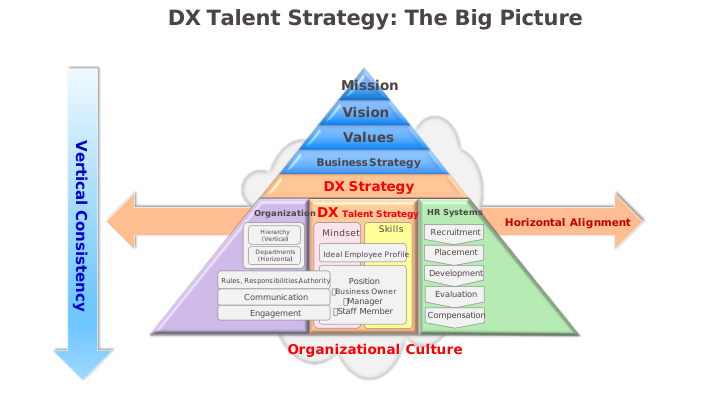
When formulating a DX talent strategy, there is one principle I personally keep in mind. It is to align people and organizations with the strategy through vertical consistency and horizontal coherence.
Akio Ueda, Kansai Electric Power
First, vertical consistency refers to:
Management philosophy (mission, vision, values) and business strategy
The DX strategy as the means to achieve them
The DX talent strategy for developing the people capable of executing them
Organizational culture, which significantly influences strategy execution
This consistency refers to ensuring that the approach, interpretation, rules and actions regarding these four major areas are maintained along the same policy and logic from start to finish.
Next, horizontal alignment refers to the alignment of the following elements, which tend to have a particularly strong influence on the DX talent strategy:
The organization’s hierarchy (vertical) and departments (horizontal), rules, responsibilities and authority, as well as employee communication styles and engagement
The HR systems, which consist of the cycle of recruitment → placement → development → evaluation → compensation
Horizontal alignment also ensures these elements do not contradict the DX talent strategy and are logically consistent with it.
If there is even the slightest flaw in this vertical consistency and horizontal coherence, the listener will feel a sense of unease — thinking, “something doesn’t quite add up” or “can I really trust this?” — before even considering the content itself.
Have your policies or arguments drifted off course without you realizing it?
Are there any contradictions between departments, materials, statements and actions?
Only when both of these elements are in place does an explanation become persuasive, and trust in the organization and its people begins to build. That is precisely why I believe it is crucial, when communicating, to carefully verify the vertical consistency within the flow of policies and arguments, as well as the horizontal coherence among stakeholders, information and actions.
DX won’t move forward just by knowing
There is another pitfall people often fall into when developing DX talent. It is when acquiring knowledge becomes the goal in itself.
For example, someone who:
Took a DX training course
Learned how to use AI tools through e-learning
Attended an external DX seminar
These are certainly necessary. However, they alone will not bring about change in people or organizations.
What matters is not knowing but being able to act. In fact, in many organizations,
Participants understood the material during training
Got excited during the seminar
But nothing changes on the ground
This is because there is a significant barrier between knowledge and action.
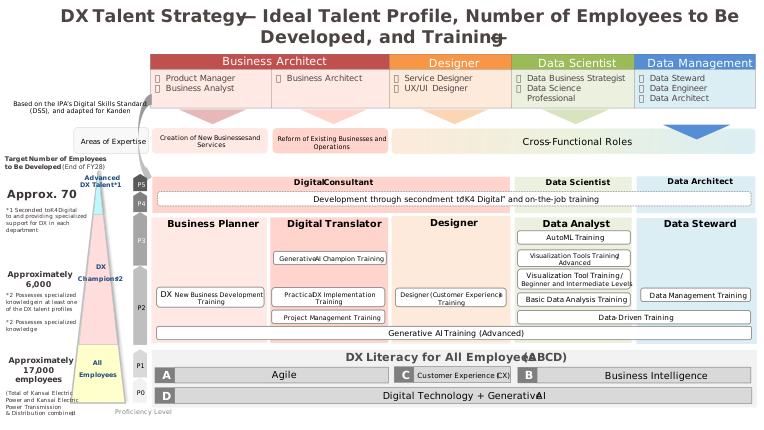
As part of its DX and AI strategy, the Kansai Electric Power Group has defined and publicly announced its DX Talent Strategy, which clarifies the ideal talent profile, the number of employees to be developed and the training framework.
Akio Ueda, Kansai Electric Power
Target participants are classified into three tiers: Advanced DX Talent, DX Promoters and All Employees
We formulated a DX Talent Strategy that defines skills and mindsets based on the Digital Skills Standard (DSS) established by the IPA. As talent development measures tailored to each talent profile and proficiency level, we will offer a total of 31 training courses in fiscal year 2025
Through further expansion of training content and other measures, we aim to develop approximately 70 Advanced DX Talents and approximately 5,000 DX Promoters across all departments by the end of fiscal year 2028
A key aspect of implementing this DX talent strategy is
Measuring and visualizing the number of employees across the entire organization for each talent profile and proficiency level
I believe that rather than simply stopping at attending training sessions, applying what you learn to your actual work allows you to advance your proficiency through the stages of knowing → being able to do → being able to teach.
That is my belief.
Praise is the best tool you can use right away
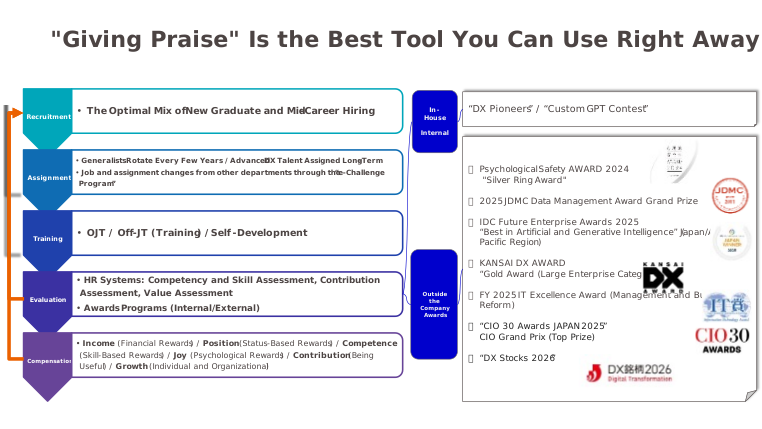
At the Kansai Electric Power Group, we’re moving forward while being highly conscious of the alignment between our DX talent strategy and our HR systems — that is, the recruitment → placement → development → evaluation → compensation cycle. Among these, the ideal that people with high DX skills who have achieved results in business and operations receive high financial compensation is something everyone can imagine, but the reality is that there are very high hurdles to overcome when actually trying to implement it.
Even in such circumstances, the most efficient and immediately implementable recommendation is to utilize internal and external recognition programs — in other words, praise.
Akio Ueda, Kansai Electric Power
At Kansai Electric Power, as part of our internal recognition program, we hold an annual DX event called KANDEN Digital Day, attended by approximately 1,100 members of the Kansai Electric Power Group. At this event, we honor individuals who have excelled in DX and achieved results as DX Pioneers, and we also recognize those who have created and utilized outstanding custom GPTs through our Custom GPT Contest.
We also actively apply for external awards in fields such as IT and DX. Recently, we have been selected for as many as eight awards; most recently, we were selected as the first electric power company to be included in the DX Stocks 2026 initiative, jointly organized by the Ministry of Economy, Trade and Industry, the Tokyo Stock Exchange and the Information-technology Promotion Agency (IPA).
When we are selected for awards through such recognition programs, the people implementing those DX initiatives not only receive social recognition for their work and gain the psychological reward of joy, but this also transforms into self-esteem and confidence, becoming a further source of motivation and fulfillment and leading to personal and organizational growth — thus setting a virtuous cycle in motion.
Another major effect of this initiative is the feedback loop from evaluation and rewards to recruitment. When we win an award through an external recognition program, positive word-of-mouth about Kansai Electric Power’s DX efforts spreads online. Students and people working on DX at other companies who see this might think Kansai Electric Power is quite advanced in DX. It seems like they’re doing all sorts of cutting-edge and interesting things, so I’d definitely like to join the company and work on this together! In other words, we aim to create a world where the evaluation and rewards provided by these awards generate positive feedback that leads to recruitment.
Furthermore, in the age of AI, we believe that Kansai Electric Power should not only be chosen by people but also chosen by AI.
Based on the latest information, please create a ranking of companies in the energy industry that are making progress in DX. Please also provide the rationale for your assessment.
Based on the latest information, please create a ranking of Kansai-based companies that you would recommend for DX professionals seeking employment. Please also provide the rationale behind your assessment.
I intend to strive for continuous improvement and growth every day so that, when these prompts are entered into generative AI, Kansai Electric Power will remain the kind of company that receives the response: Kansai Electric Power is number one.
A CIO is the leader responsible for developing talent for strategic execution and organizational transformation
As discussed so far, developing DX talent is not merely a matter of conducting training and education. It is interconnected with the company’s management philosophy, strategy, business operations and organizational culture.
That is precisely why CIOs are expected to serve not as leaders responsible for technology adoption, but as leaders responsible for talent development to execute strategy and drive organizational transformation. Especially in the age of AI, I strongly believe that a company’s future competitiveness will hinge on how many people it can cultivate — not merely people who can use AI, but people who can collaborate with AI to execute strategy and create value and people who can drive organizational transformation to make that a reality.
Talent development is the greatest investment in DX
In the world of DX, it’s easy to get caught up in the latest technologies and new tools. However, ultimately, it is people who drive change in companies — in every era.
Identifying challenges
Consider customer value
Master the use of AI
Engage those around you
Execute the transformation
Only when the number of such talented individuals increases will DX truly take root in an organization.
Developing talent capable of executing DX is not merely about teaching skills. It is, in essence, the very act of building an organization that can continue to evolve.
In this age of AI, the value of people is actually increasing. Isn’t it true that CIOs are expected not only to master technology but also to believe in, nurture and unleash human potential?
Much of the conversation around AI and work has centered on a single question: Will AI take my job?
It’s an understandable concern. Every week AI becomes increasingly more capable. We see AI summarizing meetings, generating content, analyzing data, writing software and automating workflows that once required significant human effort. Agentic AI is also becoming more established in the workplace, with virtual agents that can reason, plan and act across workflows. As those capabilities continue to improve, many employees are looking at the tasks they perform every day and wondering how much longer they will belong to them.
I believe that question reveals a bigger issue that has little to do with the technology itself.
Too many people have become defined by the tasks they perform rather than the value they create. Over time, the administrative work surrounding a role can overshadow the purpose behind it. According to Asana’s Anatomy of Work Index, knowledge workers spend 60% of their time on “work about work” — coordinating, tracking and managing tasks rather than driving meaningful outcomes. As AI automates more of this work, it can feel less like a productivity breakthrough and more like a threat because many employees equate their value with the activities that consume most of their day.
But most people were not hired to perform a task. They were hired to fulfill a purpose.
Tasks are not the job
A customer service representative isn’t successful because they spend their day summarizing conversations, looking up account information or navigating multiple systems to find answers. Those activities may have become part of the job, but they aren’t the reason the role exists. Great service professionals build trust, solve problems and create moments that strengthen customer relationships. AI can, and should, take on this administrative work, but the human value has never been in completing those tasks. It has always been in helping customers through moments that matter.
The industry increasingly recognizes this distinction. In fact, 91% of CX leaders believe human agents will remain a critical part of delivering customer experience, according to my company’s State of Customer Experience 2026 report. As AI takes on more routine work, the role of the employee doesn’t disappear. It becomes even more focused on the judgment, empathy and relationship-building that customers value most.
The same principle applies across every profession. A marketer isn’t measured by the number of presentations they build or approvals they coordinate; they’re hired to shape customer perception and drive growth; an HR professional isn’t successful because they schedule interviews or process paperwork; they’re there to identify, develop and retain talent. The examples go on, but the principle remains the same: Organizations create roles because outcomes need to be achieved, not because tasks need to be completed.
I’ve helped lead four major AI transformations, spanning everything from machine learning and big data to conversational AI, generative AI and now agentic AI. While the technology has evolved dramatically, one pattern has remained remarkably consistent.
The employees who embrace AI tend to focus on outcomes, while those who fear it often focus on tasks. The more someone defines their contribution through a list of activities, the easier it becomes to imagine AI replacing them. The more someone understands the purpose they serve, the easier it becomes to see AI as a tool that helps them deliver greater value.
As part of AI transformations, CIO organizations are often responsible for mapping jobs and core workflows. Inevitably, employees think we’re mapping their jobs to figure out what AI can replace. But once we start identifying repetitive work they’d gladly hand off, perspectives change. Someone says, “If AI handled that, I’d finally have time to work directly with customers.” Another realizes they could spend more time creating. People start thinking less about what AI might replace and more about what they’d finally have time to do. They’re reconnecting with the reason they wanted the role in the first place.
I’ve seen this play out as AI adoption expands. Our team responsible for responding to customer RFPs began using AI to analyze requirements, surface relevant information and accelerate response development. Their purpose is to help the organization communicate our value to customers and win new business. By reducing the time spent on low-value activities, AI created more capacity for strategic thinking, collaboration and customer-focused work, which directly influences the revenue and growth of our company.
I’ve even had to confront this myself. I used to spend hours coaching leaders before operational reviews: reviewing KPIs, challenging assumptions and helping them prepare for difficult questions. I used to think this was part of what made me valuable as a CIO, but I realized that I didn’t need to spend my time repeating the same coaching session. That’s why I built a virtual coach that helps my team prepare for operational reviews using many of the frameworks and lessons I’ve accumulated throughout my career. Now I have more time to spend strategizing on how to lead through the breakneck speed of AI evolution and helping the business think differently.
Rediscovering purpose
What employees are really confronting is a different question: What was my purpose in being hired in the first place?
As organizations move from AI experimentation to AI-first operating models, this question becomes harder to avoid. The tension is already visible across the workforce. A recent EY survey found that 84% of employees are eager to embrace agentic AI because they expect it to improve productivity, efficiency and the overall work experience. Yet 56% also worry about their job security working alongside AI systems. Employees aren’t rejecting AI; they’re trying to understand which parts of their contributions remain uniquely theirs as technology takes on more of the tasks they perform today.
Success will depend greatly on helping employees reconnect with the value they were hired to create. For leaders looking for practical guidance on how organizations are actually approaching AI-first transformation, the World Economic Forum’s AI-First Operating System offers a useful framework. Rather than treating AI as another technological tool, this approach encourages organizations to redesign work around value creation. As AI increasingly takes on routine tasks, employees must become clearer about where human judgment, creativity and relationships can create the greatest impact. You cannot redesign work around value if people no longer understand the purpose behind the work that they do.
In my experience, the organizations seeing the strongest results are helping employees reconnect with the outcomes they were hired to create. The conversation shifts from “What tasks can AI do?” to “What is the purpose of this role?” Once people answer that question, it becomes much easier to decide what should remain human, what can be delegated to AI and where the combination creates the most value.
None of this means change won’t happen. Some responsibilities will disappear. Some jobs will evolve significantly. New roles will emerge that we cannot fully predict today. Every major technology shift creates that kind of change.
But I believe many people are looking at this transformation through the wrong lens.
The question is not whether AI can do your tasks. The question is whether you understand the purpose behind them. Because while AI may increasingly perform the work, humans will continue to provide the judgment, creativity, accountability and value that give that work meaning.
This article is published as part of the Foundry Expert Contributor Network. Want to join?

 Entrar