In October 2026, the financially motivated threat actor Storm-3358 began targeting organizations in the financial sector using the agentic AI offensive framework ARTEX. The threat actor that Microsoft Threat Intelligence tracks as Storm-3358 is a Cambodia-based intrusion cluster that primarily targets financial organizations in Southeast Asia, in addition to a smaller number of large financial organizations globally.
Microsoft has observed Storm-3358 use ARTEX in combination with conventional automated tools to scan systems connected to the public internet, exploit security flaws including anonymous file upload and server-side request forgery (SSRF), and install open-source remote access trojans (RATs). Storm-3358 has used the WISP, vshell, and AdaptixC2 RATs for persistence and lateral movement. Microsoft has observed ARTEX agents using utilities like netcat and curl to download these RATs to compromised systems, as shown in Figure 1.
Figure 1. Example commands that ARTEX agents used to download RATs to compromised systems.
In recent ARTEX-related attacks, threat actors have used ARTEX agents to scan and exploit vulnerabilities in web applications, use web shells for persistence on compromised web servers, compromise credentials from public sources and compromised systems, and use compromised cloud identities for persistence and data exfiltration. ARTEX agents can also perform brute-force password attacks, password spraying, API enumeration and abuse, and database dumping. Agentic tools like ARTEX can leverage compromised credentials and systems at machine speed to move laterally, escalate privileges, and exfiltrate data.
This activity illustrates an ongoing trend of threat actors accelerating all stages of the attack chain with agentic AI penetration testing frameworks, including ARTEX. As these capabilities evolve, defenders must similarly use AI to investigate and respond across large environments.
While threat actors regularly use proxies and virtual private networks (VPNs) to change the source IP address of malicious traffic and bypass static detections, Microsoft is providing indicators of compromise (IOCs) to help defenders detect related activity.
Mitigation and protection guidance
Microsoft’s research into threats involving agentic frameworks informs security detections and investigative context across its products. The capabilities available to customers depend on the source of the activity and the products and protections deployed in their environment.
Several behavioral signals can help organizations determine that they are being targeted by threat actors using agentic AI. Agentic AI frameworks scanning a target send a wide variety of requests in a brief time and retry variations on the same technique or move on to next-stage actions at machine speed. Agentic AI frameworks use existing penetration testing tools. For example, ARTEX by default uses Nmap, curl, wget, Python HTTP clients, Norma SDK WebFetch, and headless Chromium through Playwright, among others. These tools may send network traffic with distinctive characteristics, such as default user agent strings. While blocking network traffic with these characteristics will not stop an attack by an AI agent, which will quickly change them, identifying them can alert defenders to the activity.
Defensive honeypots, decoys, tarpits, and fake wins can pull autonomous AI attacks away from legitimate targets. Honeypots and decoy surfaces such as Microsoft Sentinel Deception give the agent attractive but worthless targets to pursue. Tarpits consume the agent’s time and budget. Fake wins present convincing evidence that the agent’s objective is complete, which can cause it to stop on a false success. In Microsoft’s testing, these controls helped reduce the attack traffic reaching real assets and produced high-confidence, attribution-quality signal.
Microsoft’s continuous research into threat actors leveraging agentic frameworks integrates directly into the following products:
Identity and sign-in activity — Microsoft Entra ID Protection
Microsoft analyzes sign-in activity and other signals to identify potential identity risk. Customers can investigate risk detections and risky sign-ins, and configure Conditional Access policies that use sign-in or user risk to require multifactor authentication or block access when specified conditions are met. Identity and sign-in activity from known threat actor infrastructure, including from agentic frameworks like ARTEX, generate Verified threat actor IP risk detections delivered at high risk. See:
Endpoint activity — Microsoft Defender for Endpoint
Endpoint alerts help security teams identify and investigate suspicious activity on devices. Indicators of compromise can support detection and, when configured, blocking. Customers can review related alerts in the Microsoft Defender portal. See:
Activity across security domains — Microsoft Defender portal
The portal brings together alerts and incidents from Microsoft security solutions and provides relevant threat intelligence to support investigation, threat hunting, and response. This helps customers assess suspicious activity in the context of their own environment. See:
Threat actor misuse of AI accelerates risk across enterprise environments by amplifying existing threats such as exploitation of vulnerabilities, phishing, malware threats, and insider activity. To help organizations stay ahead of AI-enabled threat activity, Microsoft has introduced the Security Dashboard for AI. The dashboard provides users with a unified view of AI security posture by aggregating security, identity, and data risk across Microsoft Defender, Microsoft Entra, and Microsoft Purview. See:
Microsoft Defender customers can refer to the list of applicable detections below. Microsoft Defender coordinates detection, prevention, investigation, and response across endpoints, identities, email, apps to provide integrated protection against attacks like the threat discussed in this blog. These alerts may trigger on unrelated activity. Customers should investigate to determine if the alert is related to the activity outlined in this blog.
Tactic
Microsoft Defender coverage
Execution
Microsoft Defender for Endpoint – Process launched in the background – Suspicious file dropped and launched – Suspicious file or content ingress – Hidden file executed – Suspicious process executed by network service – Suspicious piped command launched – Suspicious process launched by service – Suspicious process launched from a world-writable directory – Suspicious script launched – Suspicious shell execution from PHP application – Suspicious shell command execution
Collection
Microsoft Defender for Endpoint – Enumeration of files with sensitive data – Suspicious file copy operations – Suspicious process collected data from local system
Credential access
Microsoft Defender for Endpoint – Suspicious access of sensitive files
Defense evasion
Microsoft Defender for Endpoint – Executable permission added to file or directory – Obfuscation or deobfuscation activity – Possible time based evasion – Suspicious decoding of encoded content into script – Suspicious file and directory permission modification – Suspicious file or information obfuscation detected – Suspicious path deletion
Discovery
Microsoft Defender for Endpoint – Suspicious port scan activity
Command and control (C2)
Microsoft Defender for Endpoint – Possible reverse shell – Suspicious connection to remote service – Suspicious curl behavior
Microsoft Defender for Cloud – Publicly accessible storage containers have been exposed – Azure Resource Manager operation from suspicious IP address
Lateral movement
Microsoft Defender for Endpoint – Remote Desktop session
Persistence
Microsoft Defender for Endpoint – Possible Web Server compromise activity – Suspicious cron job creation
Microsoft Security Copilot
Microsoft Security Copilot is embedded in Microsoft Defender and provides security teams with AI-powered capabilities to summarize incidents, analyze files and scripts, summarize identities, use guided responses, and generate device summaries, hunting queries, and incident reports.
Security Copilot is also available as a standalone experience where customers can perform specific security-related tasks, such as incident investigation, user analysis, and vulnerability impact assessment. In addition, Security Copilot offers developer scenarios that allow customers to build, test, publish, and integrate AI agents and plugins to meet unique security needs.
Threat intelligence reports
Microsoft Defender XDR customers can use the following threat analytics reports in the Defender portal (requires license for at least one Defender XDR product) to get the most up-to-date information about the activity and techniques discussed in this blog. These reports provide intelligence, protection information, and recommended actions to prevent, mitigate, or respond to associated threats found in customer environments.
Microsoft Security Copilot customers can also use the Microsoft Security Copilot integration in Microsoft Defender Threat Intelligence, either in the Security Copilot standalone portal or in the embedded experience in the Microsoft Defender portal to get more information about this threat.
Hunting queries
Microsoft Defender XDR
Microsoft Defender XDR customers can run the following advanced hunting query to find related activity in their networks:
Download of new files using curl
Threat actors might use tools such as curl to download additional files, communicate with C2 infrastructure, or exfiltrate data. This query looks for new files being downloaded using curl. curl also has legitimate uses, so files and hosts should be reviewed to identify potentially malicious activity.
let known_files = DeviceNetworkEvents
    | where TimeGenerated between (ago(7d)..ago(1d))
    | where InitiatingProcessFileName has "curl"
    | extend url = extract("http[s]?:\\/\\/(?:[a-zA-Z]|[0-9]|[$-_@.&+]|[!*\\(\\),]|(?:%[0-9a-fA-F][0-9a-fA-F]))+", 0,InitiatingProcessCommandLine)
    | extend ip = extract("(\\b25[0-5]|\\b2[0-4][0-9]|\\b[01]?[0-9][0-9]?)(\\.(25[0-5]|2[0-4][0-9]|[01]?[0-9][0-9]?)){3}[^ ]*", 0, InitiatingProcessCommandLine)
    | extend remote_file = iif(isnotempty(url), url, ip)
    | union (SecurityEvent
    | where TimeGenerated between (ago(7d)..ago(1d))
    | where EventID == 4688
    | where CommandLine has "curl"
    | extend url = extract("http[s]?:\\/\\/(?:[a-zA-Z]|[0-9]|[$-_@.&+]|[!*\\(\\),]|(?:%[0-9a-fA-F][0-9a-fA-F]))+", 0,CommandLine)
    | extend ip = extract("(\\b25[0-5]|\\b2[0-4][0-9]|\\b[01]?[0-9][0-9]?)(\\.(25[0-5]|2[0-4][0-9]|[01]?[0-9][0-9]?)){3}[^ ]*", 0, CommandLine)
    | extend remote_file = iif(isnotempty(url), url, ip))
    | summarize by remote_file;
    DeviceNetworkEvents
    | where TimeGenerated > ago(1d)
    | where InitiatingProcessFileName has "curl"
    | extend url = extract("http[s]?:\\/\\/(?:[a-zA-Z]|[0-9]|[$-_@.&+]|[!*\\(\\),]|(?:%[0-9a-fA-F][0-9a-fA-F]))+", 0,InitiatingProcessCommandLine)
    | extend ip = extract("(\\b25[0-5]|\\b2[0-4][0-9]|\\b[01]?[0-9][0-9]?)(\\.(25[0-5]|2[0-4][0-9]|[01]?[0-9][0-9]?)){3}[^ ]*", 0, InitiatingProcessCommandLine)
    | extend remote_file = iif(isnotempty(url), url, ip)
    | union (SecurityEvent
    | where EventID == 4688
    | where CommandLine has "curl"
    | extend url = extract("http[s]?:\\/\\/(?:[a-zA-Z]|[0-9]|[$-_@.&+]|[!*\\(\\),]|(?:%[0-9a-fA-F][0-9a-fA-F]))+", 0,CommandLine)
    | extend ip = extract("(\\b25[0-5]|\\b2[0-4][0-9]|\\b[01]?[0-9][0-9]?)(\\.(25[0-5]|2[0-4][0-9]|[01]?[0-9][0-9]?)){3}[^ ]*", 0, CommandLine)
    | extend remote_file = iif(isnotempty(url), url, ip))
    | where remote_file !in (known_files)
Microsoft Sentinel
Microsoft Sentinel customers can run the following advanced hunting query to find related activity in their networks:
Detect network IP indicators of compromise using ASIM
The following query checks IP address across data sources in the past 30 days supported by ASIM network session parser.
let lookback = 30d; let
ioc_ip_addr = dynamic(["199.19.95.66", "199.19.95.67", "199.19.95.68", "91.92.240.238", "85.11.168.45", "178.15.54.129", "31.77.229.35", "85.11.167.52"]);
_Im_NetworkSession(starttime=todatetime(ago(lookback)), endtime=now())
| where DstIpAddr in (ioc_ip_addr)
| summarize FirstSeen=min(TimeGenerated), LastSeen=max(TimeGenerated), EventCount=count() by SrcIpAddr, DstIpAddr, DstDomain, Dvc, EventProduct, EventVendor
Indicators of compromise
Note: Threat actors regularly use proxies and virtual private networks (VPNs) to change the source IP address of malicious traffic and bypass static detections. Microsoft is providing the following sample indicators of compromise (IOCs) to help defenders detect related activity.
To hear stories and insights from the Microsoft Threat Intelligence community about the ever-evolving threat landscape, listen to the Microsoft Threat Intelligence podcast.
Statistics on Malware Distributed to the Financial Sector In Attack Stage 1, phishing (attacks that trick users into revealing information) had the highest rate at 2.1, Up from 1.8 The previous month. In Attack Stage 2, “Dropper/Downloader” (a type that downloads additional malware) was the most common at 1.1, Though this was a decrease from […]
Purpose and Scope This report summarizes the quantity of new ransomware samples collected, the number of compromised systems, and statistics on targeted businesses during the month of September 2026, as well as major Korean & global ransomware issues. The analysis is based on data collected through ATIP (AhnLab Threat Intelligence Platform) and AhnLab Smart Defense, […]
Expect to see quite a few websites serving error pages today: Nearly 70 percent of websites need to update their core software to fix a pair of vulnerabilities that allow an attacker to seize full control over affected servers. Experts say there are working exploits for the flaws, and that these critical bugs are already being exploited in the wild.
Image: Shutterstock.com, Sashkin.
The flaws at issue are present in PHP, the programming language that powers sites running on a large number of web publishing systems, including Drupal, Magento, Joomla and WordPress. Earlier today, PHP released an emergency security update to fix two critical bugs that can allow an attacker to execute code of their choosing on a vulnerable server.
Reutersreports that government websites in Europe and elsewhere went offline today after the PHP vulnerabilities were disclosed. Cloudflare said it has already detected some exploitation of the flaw, and that at 3:02 am (UTC) it implemented web application firewall rules to protect websites from attack traffic seeking to exploit the bugs, which could cause a denial of service condition, remote code execution, and data exposure.
OpenAI, which was involved in the vulnerability research and outreach, said “given the severity of these flaws and PHP’s widespread use, we consider this one of the most impactful security issues in recent memory.”
Censys, a company that tracks the technology used by Internet hosts, said a recent scan identified approximately 2.58 million Internet facing hosts and 54.9 million web properties running PHP.
Security experts at Wiz said every PHP version released in the last decade is affected by at least one of these vulnerabilities [full disclosure: Wiz is an advertiser on this blog].
“These findings rank among the most severe vulnerabilities discovered in PHP, and arguably in software history,” reads a blog post published today by a team of researchers at Wiz, which was one of several organizations credited with discovering the vulnerabilities. “The underlying flaws had been present for decades, but demonstrating their exploitability required an exceptionally complex chain of steps, at the edge of what human researchers could practically achieve. Frontier AI models substantially reduced that barrier, turning a longstanding flaw into an exploit.”
The Wiz researchers say it is likely the PHP vulnerabilities will be mass-exploited to install web-based backdoors or “web shells,” which give attackers a web-based panel that allows them to remotely control infected sites. Wiz said that prior to the PHP bugs being publicly disclosed, the company worked with the PHP team, Calif and OpenAI to measure the size of the problem and coordinate patch verification and disclosure.
The PHP zero-day vulnerabilities are being tracked by their CVE numbers, CVE-2026-109618 and CVE-2026-109619, and they affect all web servers running PHP 5.4 or later. The bugs are fixed in PHP 8.5.12, 8.4.27, 8.3.36, and 8.2.35.
According to Wiz, PHP is so deeply embedded in many web applications that we are likely to see organizations struggling to patch these vulnerabilities for some time to come, comparing this PHP vulnerability pair with the Log4Shell weakness that emerged in 2021 — a widespread, severe-as-it-gets security flaw in Log4j, a popular Java logging framework.
“A vulnerability in core PHP reaches far beyond a single application,” the Wiz researchers wrote. “PHP runs across clouds, hosting providers, content-delivery networks and millions of independently managed servers. Reducing exposure before the technical details became public required coordinated work across that entire ecosystem.”
The SANS Internet Storm Center is keeping an eye on major software platforms that are shipping updates to deal with these PHP flaws. For example, Ubuntu just released updated PHP packages. For a technical deep-dive on these vulnerabilities that tells the timeline of the discovery of these bugs in a comic book style, check out this post from Calif, another technology company credited with finding the PHP flaws.
A snapshot of php2shell.censys.com, the website Censys set up to track the PHP vulnerabilities.
This is a fast-moving story. Updates will be noted here with timestamps.
Update, 2:30 pm ET: Add figures from Censys and a link to Calif’s writeup.
U.S. federal investigators pursuing the ShinyHunters hacking group that recently stole highly sensitive data from the FBI have identified executives at two different ransomware negotiation firms who maintained unusually close relations with the extortion group, KrebsOnSecurity has learned. Sources close to the investigation say one of the executives in the United States even helped ShinyHunters operate a website that pressured victims into paying a ransom.
Hackers aligned with ShinyHunters have claimed credit for dozens of major data breaches since 2019, when the group was primarily operated by cybercriminals living in France. As those original members were arrested or jailed one by one, control over the ShinyHunters brand eventually passed to “Rey,” identified last year as a teenage hacker from Amman, Jordan. According to the FBI, ShinyHunters has extorted more than $70 million from victims so far this year.
In late September, ShinyHunters hacked the FBI recruitment website fbijobs.gov and taunted the agency by threatening to publish the stolen files, which reportedly included medical and psychological records, Social Security numbers and home addresses, and information about each employee’s unit and specialization.
The FBI jobs site hack has prompted the agency to move with uncommon speed to arrest, detain and question people who had any communications with Rey or other ShinyHunters suspects. Reutersreported on October 3 that Rey had been detained by Jordanian authorities and was cooperating with the FBI.
Rey was able to assume control over the hacking group because one of its alleged senior members had just been nabbed. On the evening of September 15, 2026, authorities in the Netherlands arrested convicted hacker and ShinyHunters suspect Pepijn van der Stap. Dutch police reportedly used flash-bang grenades in an effort to stun and apprehend Van der Stap as he was logged in to various online accounts.
According to a source close to the investigation, the authorities arrested Van der Stap while he was using his Signal instant messaging account, which allowed them to read recent communications with frequent contacts — including ransomware negotiators based in Canada and the United States.
Multiple sources with knowledge of the matter told KrebsOnSecurity that Van der Stap’s messages were the key to unraveling a murder-for-hire plot that emerged immediately following his arrest. The Dutch news outlet RTL reported last month the two murders were allegedly to be committed abroad, and that there are indications Van der Stap gave the order for the attacks (there is no indication those orders were ever carried out).
On October 9, KrebsOnSecurity broke the news that the FBI arrested a 54-year-old Canadian cybersecurity executive named Edward Dubrovsky in connection with the ShinyHunters investigation. Dubrovsky, who recently published a book on handling cyber extortion that recommended always engaging with the hackers, was charged with threatening to disclose stolen or hacked data and interfering with interstate commerce through extortion, according to court records. Politicoreports prosecutors have asked that Dubrovsky remain in custody pending trial, and that records related to his case remain under seal.
A source close to the investigation told KrebsOnSecurity that Van der Stap’s Signal messages showed he had frequent conversations with Mr. Dubrovsky and with at least one executive at a large U.S.-based consulting firm, and that these executives often knew the details about new ShinyHunters victims before the victims themselves had even learned of the breach.
That source shared another potentially explosive finding by federal investigators: the Dutch hacker’s chats showed Mr. Dubrovsky knew ShinyHunters had stolen highly sensitive data from FBI servers, and that he never informed the bureau of the data breach prior to ShinyHunters threatening on Twitter/X to publish the agency’s deeply personal personnel files.
SHINYWIRE
KrebsOnSecurity has learned from two sources close to the ShinyHunters probe that FBI investigators believe at least one executive at a U.S.-based consulting firm played an active role in operating the now-defunct ShinyHunters victim extortion website “shinywire[.]com.” KrebsOnSecurity is not naming the U.S. company or the suspected executive(s) for now because they have not yet been charged with a crime, but it is a prestigious firm with more than 1,000 associates.
A section of the homepage for the now-defunct Shinywire website.
The Shinywire website was active from approximately May 3, 2026 until October 16 and had entries for nearly 100 organizations hacked by ShinyHunters. Each entry urged victims to engage with the cybercrime group and discuss terms for payment. The pages also included samples of stolen files and promised those files would be published online if the victim ignored their demands.
The following screenshot shows a cached portion of the Shinywire extortion page for Intuitive Surgical, an American medical technology company that was breached in March 2026 after an employee fell for a targeted phishing email.
The Shinywire website, as indexed by urlscan.io. This listing is an extortion demand targeting Intuitive Surgical, an American medical technology company breached in March 2026 by a targeted phishing email attack that compromised an employee’s credentials.
Victim organizations that refused to engage or negotiate after seven days would find all of their stolen data published on the ShinyHunters victim shaming blog (a website that is only reachable via the anonymity network Tor).
In a story published October 15, The Globe and Mailwrote that a few months before Edward Dubrovsky was arrested by the FBI, the Canadian cybersecurity executive alleged in court documents he had become collateral damage in a campaign by a former business partner to “destroy” another industry executive.
The story noted that Dubrovsky filed the lawsuit in Ontario this year against Daniel Tobok, the former chief executive of Cypfer, a cybersecurity firm founded in Toronto with offices in the U.S., Britain, the Netherlands, the United Arab Emirates, and Mexico. The two first became business partners in 2017 and later developed Cypfer together, where Mr. Dubrovsky was a managing partner and chief operating officer. But by 2024, the two had a falling out, with Dubrovsky accusing Tobok of gradually excluding him from business matters and making “increasingly capricious business decisions.”
Mr. Tobok reportedly denied the allegations and filed a counterclaim, accusing Mr. Dubrovsky of accessing confidential information and unfairly competing with Cypfer through work at another firm called CyberSteward Inc. He also said Mr. Dubrovsky has misrepresented himself as a Cypfer founder, and is not a shareholder.
GHOSTBYTE
According to interviews with several former colleagues of Mr. Tobok, as far back as eight years ago he was known to ransomware purveyors by a particular nickname: Ghostbyte. In 2018, a Canadian company was hacked by Dharma, a prolific Russian-language ransomware affiliate program that first surfaced in 2016. The victim company told the Dharma ransomware representative they were leaning toward paying because some of the files were unrecoverable after being locked, but that they needed a better guarantee that Dharma would keep their word if paid.
A redacted copy of the Dharma rep’s reply is pictured below, and it shows the ransomware group urged the victim to contact a person at a Canadian IT firm that helps companies seeking such guarantees. The Dharma rep recommended the victim contact the email address ghostbyte@tutanota.com.
“If you want guarantees, you can write to the IT company,” the Dharma reply advised. “Take the phone and negotiate with them. This IT company often solves such problems in Canada. You can contact them and sign a contract for services. You’ll still have to pay.”
An email reply from the Dharma ransomware group to a victim, recommending they contact an email address that is connected to Mr. Tobok.
It’s unclear if Mr. Tobok ever used that Ghostbyte address offered by the Dharma representative, and he has not responded to multiple requests for comment. However, the breach tracking service Constella Intelligence finds an email address Mr. Tobok has frequently used — dtobok@me.com — is associated with two online accounts where the chosen username was “ghostbyte,” including a Snapchat account.
Incidentally, Constella also finds the Dharma rep’s email address luckygoodlucky@tuta.io is associated with a cryptocurrency address that processed 38 transactions totaling 43 bitcoin, ~$3.5 million at today’s value (the most recent transaction for this wallet is dated February 2019).
In a statement shared on October 14, Cypfer said the company’s business does not include making or facilitating ransomware payments, and that Cypfer learned of Dubrovsky’s arrest when the news first broke in the media.
“We had no prior knowledge of Mr. Dubrovsky’s arrest,” a spokesperson told KrebsOnSecurity via email. “CYPFER has not received any outreach from law enforcement and, to our knowledge, is not the target of any law enforcement investigation.”
The statement said CyberSteward and Cypfer are separate companies with no officers, directors or employees in common, and that Cypfer was recently acquired by the Apros Group, a holding company led by Jason Hogg, a former FBI special agent and former CEO of Aon Cyber Solutions Group. In 2020, Aon aquired Cytelligence, a security consulting firm where Mr. Tobok was founder and CEO and Mr. Dubrovsky was a managing partner.
CONFLICTING INTERESTS
It is not illegal in the United States to pay hackers for an encryption key to unlock servers infected with ransomware, or in exchange for a promise to delete any stolen files and refrain from publishing them online. While victim organizations can land in legal hot water if they pay a ransom to a group that is sanctioned by the U.S. Treasury Department, ShinyHunters is not among the ransomware groups currently sanctioned by the United States or by any other government.
Experts say ransomware victims are typically directed by their insurance provider to work with a specific incident response firm. But not all cyber forensics and breach response companies will agree to facilitate payments to ransomware groups on behalf of their clients. As a result, once victim firms make a decision to pay, the firms that eschew rewarding extortionists are invariably replaced by companies that have no such qualms.
In December 2024, ShinyHunters began extorting the education technology company PowerSchool, stealing private information on 62 million students and 9.5 million teachers in the U.S. and Canada. PowerSchool reportedly paid a $2.85 million ransom demand, and a “frequently asked questions” statement (PDF) about the breach says PowerSchool was assisted in that effort by CyberSteward (ShinyHunters affiliate Matthew Lane, 20, of Sterling, Mass., was sentenced in November 2025 to four years in prison for his admitted role in the PowerSchool hack).
But that ransom payment did not stop future extortion attempts using the same stolen data. By May 2025, individual school districts were reportedly receiving separate ransom demands using samples of the same stolen files. While nobody has alleged ShinyHunters was behind the second wave of extortion against PowerSchool users, the incident drives home the reality that there is no technical way to verify the threat actors have deleted the stolen data as promised, or prevent others from abusing the same records.
A number of leading cyber incident response firms, including Coveware and Unit 221B, have consistently warned victims against paying ShinyHunters, noting that “destroyed” victim data is often kept, resold or used to extort the company’s clients directly later on.
The FBI echoed those sentiments in an alert on May 15, 2026 advising victims against paying the ShinyHunters group. Meanwhile, ShinyHunters members have been harassing and threatening employees at Coveware and Unit 221B for offering this advice.
The following screenshots show just how annoyed the ShinyHunters leaders were with Coveware’s relentless advice against paying the group. The first image is from a conversation on May 6, 2026 that took place between the group’s main account on Telegram and a co-conspirator. In that chat, snippets of which were shared with KrebsOnSecurity by a trusted source, ShinyHunters complained that Coveware was harming the group’s payment rates.
The operator of the ShinyHunters account on Telegram speaking privately with a co-conspirator and complaining that Coveware was harming their business.
“Go on my website, majority of those companies would’ve paid if it weren’t for Coveware giving them misinformation,” the ShinyHunters account wrote. “Someone (100% Coveware) is going out of their way to make sure i am not paid.”
In another conversation on April 11, 2026, the ShinyHunters Telegram account privately said they were trying to “eliminate the problem,” which they said was Coveware. Coveware declined to comment for this story.
“I’m sure the company will pay but in this specific case I am aware of Coveware and their involvement, and I’ve probably been not getting a lot of other negotiations mostly likely because Coveware keeps getting involved,” the ShinyHunters account bemoaned.
The operator of the ShinyHunters account on Telegram telling a co-conspirator they were “trying to eliminate the problem,” which they identified as Coveware advising victims not to pay the cybercrime group.
Mark Camillo is chief executive at CyberAcuView, an industry group founded in 2021 by a consortium of major cyber insurance carriers. Camillo said some firms charge a flat retainer fee, while those that specialize in helping companies negotiate a ransom payment tend to charge a percentage of the total ransom amount paid.
That latter dynamic, he said, is an inherent conflict of interest, as the negotiator has every incentive to make things more favorable to the attackers because they are financially incentivized to negotiate and pay out, and to not negotiate down on the price.
“It has come to the industry’s attention that many of the ransomware payers charge a percentage of the final payment which may or may not be disclosed,” Camillo said. “This makes no sense if they are also the negotiator. There needs to be more transparency in the process as no one in the ecosystem should be profiting purely on the size of the ransomware transaction or payment itself.”
Camillo said the firms doing this work would argue the fees are needed because there may be unexpectedly higher costs to secure larger quantities of cryptocurrency or more risk carrying the float, and because cryptocurrency exchanges may charge higher fees for high risk transactions.
“There definitely needs to be more visibility around the transaction and clarity on the increasing value of the crypto and the exchange’s percent in the transaction to get to the bottom of this and remove any misaligned incentives,” he said.
In recent months, the U.S. Department of Justice has prosecuted a number of ransomware negotiators alleged to have conspired with cybercriminals to defraud their clients. On October 7, the DOJ chargedMonsterCloud CEO Zohar Pinhasi, 50, with wire fraud and conspiracy for allegedly charging customers to remediate ransomware attacks without paying the hackers. According to charging documents, Pinhasi secretly went behind his customers’ backs and paid hackers anyway, paying ransomware groups $8 million while charging customers $19 million.
In July, Angelo Martino, a 41-year-old ransomware negotiator from Land O’Lakes, Florida, was sentenced to 70 months in prison for conspiring with the Blackcat/ALPHV ransomware group to extort multiple victims. According to the DOJ, Martino was paid by BlackCat attackers to provide confidential information about the negotiating position and strategy of his employer’s clients and enable the ransomware actors to maximize the ransoms paid by the victims.
Microsoft today issued updates to fix more than 1,400 security vulnerabilities in its Windows operating systems and other software. Today’s epic patch batch dwarfs September’s record of nearly 1,000 fixes, which was already about ten times the normal monthly patch load from Redmond.
Just one of the weaknesses patched this week is considered a “zero day,” or already exploited in the wild. CVE-2026-96951 is a security feature bypass in the Windows Shell that affects Windows 10 and 11 systems, as well as some Server versions.
Windows 10 users might be wondering if they can still expect security updates after this month. Microsoft had been slated to stop shipping updates for Windows 10 systems in October 2025, but ended up adding another year of free updates after considerable pushback. A few months ago, Microsoft quietly extended that support for another year (until October 2027).
At least 78 of the flaws fixed this month are rated “critical,” meaning they could be exploited with little or no action by the user, and most of those critical bugs allow an attacker to execute code of their choice on the vulnerable system.
While Microsoft said there are no signs anyone is exploiting it yet, a security feature bypass in the .NET Framework (CVE-2026-108398) was publicly disclosed prior to today, potentially giving attackers advance time to work out how to exploit the bug.
Satnam Narang at Tenable said the number of flaws fixed this month far surpasses the previous record-setting year 2020, when Microsoft patched 1,261 CVEs.
“We’ve now crossed the 4,000 CVE mark with two months left to go,” he said.
Microsoft credits large language models for the high volume of bug discovery, and presumably AI gets credit for many of the patches used to fix these flaw. Meanwhile, security experts have been warning that these unusually large patch volleys from Microsoft are placing extra strain on corporate security teams, which often have to test individual updates before deploying them across a network to ensure the fixes don’t cause problems for other software.
Tyler Reguly, associate director of security research and development at Fortra, notes that just 26 Microsoft vulnerabilities appeared in the “Known Exploited Vulnerabilities” (KEV) catalog maintained by the U.S. Cybersecurity & Infrastructure Security Agency (CISA) so far this year, and security teams would do well to prioritize patching those 26 vulnerabilities first.
“Security leaders should focus on exploitable risk, and ask whether their teams have the clarity, capacity and support to act,” Reguly said.
Which vulnerabilities deserve the most scrutiny in your organization? The folks at Cisco Talos have a useful roundup of the more noteworthy flaws that Microsoft fixed today, and of course the SANS Internet Storm Center has a reliable roundup that indexes vulnerabilities by severity, CVE number and affected software.
Agents with the Federal Bureau of Investigation (FBI) on Thursday arrested an executive at a Canadian cybersecurity firm in connection with an investigation into the ShinyHunters hacking group that recently relieved the FBI of sensitive data on thousands of agents, multiple sources tell KrebsOnSecurity.
The New York Times reported today that the FBI has arrested a Canadian man in Pennsylvania on suspicion of assisting ShinyHunters. The Times story did not identify the man, nor did a statement on Twitter/X about the arrest from FBI Director Kash Patel.
One source close to the investigation told KrebsOnSecurity the Canadian person arrested this week was visiting Pennsylvania for a cyber insurance conference, and that the suspect’s company specialized in handling ransomware negotiations with cybercrime groups. Another shared that control over the ShinyHunters investigation has been centralized at an FBI field office in Texas.
An online search reveals the Cyber Risk Summit was held at the Loews Philadelphia Hotel between Oct. 5 and Oct. 7. The conference had several sponsors, but according to the summit’s website its biggest sponsor was a Canadian security company called Cypfer.
According to LinkedIn, one of Cypfer’s “ex-founders” was Edward Dubrovsky, who is now associated with another Canadian security firm and sponsor called CyberSteward. In a post to LinkedIn approximately one month ago, Dubrovsky said he had plans to attend the Cyber Risk Summit with the rest of the CyberSteward team.
[Update: Oct. 10, 9:58 a.m. ET: A spokesperson for Cypfer said Dubrovsky was not a founder or co-founder as his LinkedIn profile claims, but instead served as a managing director before resigning in December 2025].
Edward Dubrovsky’s LinkedIn profile.
“Looking forward to continuing conversations around strategy & compliant driven coercive (ransomware, extortion) advisory, negotiations and settlement services that are global and truly agnostic,” Dubrovsky wrote.
Federal court records show that on October 8, an Edward Dobrovsky (note the slight misspelling of the last name) was arrested in Pennsylvania on cyber extortion and conspiracy charges. Several of those documents — including the core complaint — are now sealed. But a handful of them were indexed at Courtlistener.com, including a summary of the complaint, which charges the defendant with “conspiracy to threaten to impair the confidentiality of information with the intent to extort money,” and “interference with commerce by threats.”
Image: Courtlistener.com
The inmate locator at the U.S. Bureau of Prisons website reports that a 54-year-old Edward Dubrovsky is currently being held at a federal facility in Philadelphia. But the court records indexed by CourtListener include a notice filed on October 9 that moved the case to the Eastern District of Texas, which sources say is now the epicenter of the FBI’s ShinyHunters investigation. The FBI declined to comment for this story.
Dubrovsky’s LinkedIn profile states he is the author of Cyber Extortion Strategic Response, a 252-page book that promises to “take readers beyond the ransom note and into the decisions that determine how an organization responds, recovers, and protects what matters.”
Edward Dubrovsky’s book, which centers on the intricacies of ransomware negotiations.
“At the heart of the book is a critical distinction: communicating with a criminal is not the same as negotiating a payment, and negotiating is not a commitment to pay,” reads an excerpt from the book’s listing on Amazon. “Engagement can serve other objectives, including testing claims, gathering information, creating time, and preserving options while the organization evaluates its next move.”
Mr. Dubrovsky could not be immediately reached for comment. KrebsOnSecurity also sought comment from other executives at CyberSteward, and will update this post in the event they respond. The available court records in Dubrovsky’s case show that he does not currently have an attorney and has yet to be appointed a public defender by the courts.
ShinyHunters typically uses phishing and stolen credentials to siphon data from corporate accounts at software-as-a-service companies, and then threatens to publish the stolen data online unless a ransom demand is paid. According to the FBI, the group has extorted more than $70 million from victims so far this year.
Sources tell KrebsOnSecurity the FBI has been poring over devices that were seized last month when the Dutch police arrested the convicted cybercriminal Pepijn van der Stap in connection with the ShinyHunters investigation, and that charges against principals at other companies that specialize in ransomware negotiation may be forthcoming.
Immediately after Van der Stap’s arrest, another member of ShinyHunters named “Rey” assumed control over the group and began taunting the FBI over data the group stole from the agency’s online recruitment portal, which included each’s person’s unit and specialization, as well as medical and psychiatric records.
Last week, Reuters reported that Rey — identified as a teenager named Saif Al-din Khader — had been detained and was cooperating with FBI investigators. On October 7, we detailed how Rey was apprehended as the cybercrime group allegedly sought to extort a navigation and digital aviation unit that was divested by Boeing in late 2025.
This is likely to be a fast-moving story. Updates will be noted along with timestamps.
A teenager from Amman, Jordan suspected of leading the prolific data theft and extortion group ShinyHunters has been detained and is reportedly cooperating with the FBI to identify other members of the hacking gang. KrebsOnSecurity has learned that the suspect, who uses the hacker handle “Rey,” was detained as ShinyHunters was in the process of extorting a business unit recently divested by the global aerospace company Boeing, which manufactures the fleet of planes used by the employer of Rey’s father — Royal Jordanian Airlines.
The logo for Jeppesen ForeFlight, a business unit divested last year by the aerospace firm Boeing.
On October 3, Reuterscited three unnamed sources saying a suspected ShinyHunters member in Amman named Saif Al-din Khader was detained by Jordanian authorities and was cooperating with the FBI. KrebsOnSecurity identified Rey as Khader in a November 2025 profile, in which the young man admitted working with multiple ransomware groups.
Rey was featured again in a September 28 exclusive about the Dutch police arresting 24-year-old convicted cybercriminal Pepijn van der Stap on suspicion of aiding in data thefts and extortions by ShinyHunters. The story noted that immediately following the Dutchman’s arrest on the evening of September 15, Rey assumed control over the ShinyHunters brand and boasted publicly about stealing highly sensitive data from the FBI and extorting the ransomware group Cl0p.
Rey taunted both the FBI and Cl0p with memes posted to his longtime account on Twitter/X, while simultaneously including images of the avatar used by Van Der Stap’s former hacker alias “Umbreon” in an apparent attempt to frame the Dutchman for both hacks.
A taunting meme uploaded to Twitter/X by Rey on Sept. 22. A giant sized version of the Pokemon character Umbreon can be seen in the bottom left.
As noted in our September 28 report, ShinyHunters gained access to the FBI site and other victims by exploiting a vulnerability (CVE-2026-35273) in PeopleSoft, a software-as-a-service platform from the tech giant Oracle that is broadly used by companies to manage hiring and human resources, benefits and payroll. Oracle quickly issued a fix for CVE-2026-35273, which ShinyHunters first began exploiting as a zero-day in June, and at the time Mandiant released web application firewall rules intended for organizations that couldn’t apply the security update quickly enough.
ShinyHunters told BleepingComputer in June that the original goal behind exploiting the PeopleSoft vulnerability was to breach the FBI’s own PeopleSoft database, but the hackers said those attacks were unsuccessful for some reason. In recent weeks, however, ShinyHunters turned to a well-known URL-encoding trick to bypass Mandiant’s suggested web application firewall rules.
In a report released Sept. 25, security experts at Mandiant and the Google Threat Intelligence Group (GTIG) confirmed that ShinyHunters had mass-exploited the PeopleSoft vulnerability to steal data from dozens of systems across a range of industries, including higher education, technology, healthcare, agriculture, transportation and government.
Reuters reported October 5 that the FBI has removed a contractor at Accenture over their failure to patch the FBI recruitment website hacked by ShinyHunters, which exposed sensitive data on more than 5,000 FBI personnel, including each’s person’s unit and specialization, as well as medical and psychiatric records.
‘REY’ MEANS KING, AS IN ROYAL
According to two sources familiar with the ShinyHunters investigation, a navigation and digital aviation unit recently divested by the global aerospace company Boeing was among the victims that ShinyHunters was in the process of extorting when Rey was apprehended by Jordanian authorities.
Those sources said the FBI’s investigation into ShinyHunters gained renewed urgency with the group’s attempted extortion of the former Boeing unit, which allegedly included the theft of sensitive information that sources said could pose operational safety and security risks.
In a brief statement shared with KrebsOnSecurity, Boeing acknowledged the extortion attempts by ShinyHunters, and said the incident concerned data stolen from Jeppesen ForeFlight, a subsidiary that Boeing sold in November 2025 to the private equity firm Thoma Bravo for $10.55 billion.
“We are aware of claims by a threat actor regarding data allegedly associated with Boeing and our former subsidiary Jeppesen ForeFlight,” a Boeing spokesperson shared. “We are actively reviewing the matter with the Jeppesen ForeFlight team.”
A spokesperson for Jeppesen ForeFlight shared a written statement in response to questions, saying the company has seen no impact on their end. “Based on our investigation to date into this claim and proactive security posture, there was no impact to our operations or products.”
Rey’s alleged involvement in attempting to extort the former Boeing unit is noteworthy because there is strong evidence that his father works for Royal Jordanian Airlines, which is mostly controlled by the Jordanian government and operates its long-haul fleet on passenger planes built by Boeing. Rey claimed on Telegram in early 2025 that his father was an airline pilot, although that could not be independently confirmed.
However, as noted in our November 2025 profile of Rey, his family’s shared computer was at one point compromised by password-stealing malware, and the data collected by that malware clearly shows Rey’s father used the same credentials to log in at multiple online portals for Royal Jordanian Airlines employees.
Royal Jordanian Airlines has not yet responded to a request for comment. In advance of our September 28 story, KrebsOnSecurity once again emailed Rey’s father to seek comment and update him on his son’s alleged activities. Neither of the Khaders have responded. But just hours after that request was sent, Rey began deleting his various social media accounts, including the Twitter/X account he previously used to taunt the FBI, Cl0p, and other ShinyHunters victims.
Rey may have nixed many of his social media profiles, but his cybersecurity blog on GitHub somehow escaped the purge, and it shows that Rey was fixated on the leaders of the Cl0p ransomware group. In March 2026, Rey’s blog featured a lengthy post that identified two Russian men as the core developers and hackers behind Cl0p.
Rey’s blog on GitHub. This post doxes two Russian men as the core operators behind Cl0p, one of the oldest and most established ransomware groups still in operation today.
MURDER FOR HIRE?
Meanwhile, news outlets in the Netherlands reported explosive new allegations leveled at Van der Stap, whose supposed personal transformation from convicted to reformed hacker has been widely covered in the tech news media. The Dutch daily RTL reported on Sept. 29 that investigators suspect Van der Stap tried to orchestrate at least two murders. According to RTL, the murders were allegedly to be committed abroad, and there are indications Van der Stap gave the order for these attacks.
Van der Stap was released from prison after serving the better part of a four year sentence for data theft and extortion activity that prosecutors said netted between €1.5 million and €2.7 million. In an interview with KrebsOnSecurity on September 9, Van der Stap described his new role as “offensive security lead” at the Dutch cybersecurity company Neo Security, saying the job involved probing client networks for security vulnerabilities.
Neo Security’s owner Benjamin Korper told Reuters he has hired an outside firm to investigate whether Van der Stap had hacked Neo Security or its customers, but that so far investigators have found no evidence he acted against his employer or clients. Korper said Dutch forensic investigators visited his office on September 15, the night Van der Stap was arrested in a dramatic police raid that reportedly involved flash bang grenades.
A screenshot of a Sept 16 story by the Dutch news outlet at5.nl, describing a police raid on Van Der Stap’s residence that reportedly used flash-bang grenades.
Prior to his first arrest in 2023, Van der Stap was working as a software engineer at the Amsterdam-based cybersecurity startup Hadrian, while volunteering at the Dutch Institute for Vulnerability Disclosure (DIVD) — even as he was hacking into and extorting a number of large organizations.
When asked in a recent interview why anyone should believe the word of a self-described “reformed” cybercriminal who had so casually deceived countless friends, co-workers and journalists for years, Van der Stap replied that his work spoke for itself and there was nothing he could say that would convince his worst critics.
“You can throw a bunch of nice words at someone, but you can’t convince them if they don’t want to be convinced,” Van der Stap told KrebsOnSecurity on Sept. 9. “I’m doing what I can to repay victims, and that’s all I can do. If someone doesn’t want to believe me, then that’s on them.”
FRANCHISING AND BURNING A BRAND
Cybercriminals aligned with ShinyHunters have been responsible for dozens of data breaches involving billions of stolen records, and breaches claimed by the group stretch back to at least 2019. But experts say the people recently operating behind the ShinyHunters name are not the same core members that populated the group in its early days, most of whom are French citizens who have been arrested (if not also imprisoned) on at least one prior occasion for alleged cybercrime activity.
More to the point, ShinyHunters has become something of a franchise. Think the Dread Pirate Roberts character in the 1980s cult movie classic “The Princess Bride,” only succession by death is replaced with succession by arrest, and there can be multiple simultaneous Dread Pirate Robertses. Sources close to the investigation say the FBI is focusing on a remaining handful of cybercriminal freelancers or affiliates who have been feeding the group stolen credentials to various software-as-a-service (SaaS) platforms used by major companies in exchange for a cut of any data ransoms later paid by victims.
In the days after the news broke of Van der Stap’s arrest, a cybercrime-focused chat server on Telegram that was allegedly operated by Rey erupted with hot takes, with most participants heaping ridicule on the teenage hacker after he publicly backed down from threats against the FBI and Cl0p, and again when the ShinyHunters’s darknet website suddenly went offline. Several commentators accused Rey of resurrecting the ShinyHunters brand after its core members were rounded up in France, and making a mockery of the group’s name and reputation ever since.
“He bought the old forum PGP key and used it to make new Breachforum websites and Telegram channels larping as ShinyHunters to ransom companies and then sell the used data or resell his forum when he goes broke,” one member recounted.
A relatively new Telegram channel called “The Battle” has been doxing and needling Rey and other alleged ShinyHunters members for several weeks, and it has gained a considerable readership among the cybercrime communities operating on Telegram. One of the coordinators of that harassment campaign repeatedly portrayed Rey as clueless greenhorn who sought to ride the coattails of a cybercriminal brand that has long enjoyed a reputation for ruthlessly selling or publishing data stolen from victim companies who refuse to give in to extortion demands.
“Rey (Saif Al-Din Khader) made a serious mistake when he started pretending to be a member of ShinyHunters,” wrote the administrators of The Battle server on Telegram. “That group had already been dismantled, with many of its members either arrested or imprisoned, yet Rey still chose to use its name while carrying out his crimes. We’re aware of claims that [Rey] caused over $200 million in damages and helped around 5–6 friend groups in the community make money by using Shiny Hunters group aliases to negotiate deals for a 25–30% cut over the past few months.”
In an interview with The Register, ShinyHunters claimed they hacked the FBI to counter the agency’s narrative in a May 2026 alert that advised victims against paying a ransom to the group, which came off looking unprofessional and capricious in the FBI’s advisory.
A flash notice on ShinyHunters released by the FBI on May 15, 2026.
The public notice warned the group has been known to pursue a number of different victim harassment strategies, from sending threatening text messages and phone calls to victims and their family members to in some cases swatting victims. The FBI warned ShinyHunters members “may also falsely claim to have sensitive or compromising information, including embarrassing photographs or videos of victims, which frequently do not exist.”
The hackers told The Register their attack on the FBI “demonstrated our technical capabilities and directly refuted the misinformation disseminated by the FBI, journalists, and industry researchers.” At the same time, the group’s leaders seemed to acknowledge that the FBI’s warning materially harmed their prospects for convincing victims to pay, saying “this was fundamentally a public relations and marketing initiative for our business.”
Microsoft Threat Intelligence has identified NeedyMantis, a modular post-compromise malware family observed in a limited number of targeted operations affecting telecommunications organizations, universities, medical nonprofits, intergovernmental organizations, and government contractors. Based on observed activity, NeedyMantis is typically deployed after a threat actor has already established access to a target environment, indicating that the malware is used to maintain long-term access and support follow-on operations.
NeedyMantis activity dates back to at least October 2025. We discovered the malware family while analyzing and pivoting from research and indicators of compromise associated with the DAEMON Tools supply chain compromise, which Kaspersky previously reported on as part of its investigation into the campaign. Observed activity involving NeedyMantis has thus far aligned with activity that Microsoft associates with threat actors operating from China, although Microsoft has not determined whether all observed activity is attributable to the same operator.
While NeedyMantis employs techniques commonly used by modern malware, its architecture combines multiple loaders, custom encrypted file archives, a custom executable file format, and modular components that enable operators to evade analysis and extend functionality through additional modules. These characteristics, combined with its use in targeted intrusions, make NeedyMantis a useful case study for understanding how threat actors establish and maintain long-term access within victim environments.
In this blog, we analyze the NeedyMantis malware framework. We examine its packaging and deployment, custom archive format, loader architecture, command-and-control (C2) communications, and modular design. We also provide indicators of compromise (IOCs), Microsoft Defender detections, and mitigation guidance to help organizations defend against this threat and related activity.
Observed operators and targeting
At the time of writing, Microsoft has observed at least one threat actor using NeedyMantis malware: Storm-3069. Storm-3069 is Microsoft Threat Intelligence’s designator for activity associated with the DAEMON Tools supply chain compromise. While Microsoft assesses the activity originates from China, it has not attributed Storm-3069 to a Chinese nation-state actor. Microsoft identified NeedyMantis through follow-on analysis of indicators associated with Kaspersky’s investigation of the DAEMON Tools compromise.
Microsoft has observed additional NeedyMantis activity beyond Storm-3069’s activity in the DAEMON Tools campaign, indicating that the malware might be used by more than one operator. Observed activity involving NeedyMantis has thus far aligned with activity Microsoft associates with threat actors operating from China, such as targeting that aligns with Chinese interests and the use of selective deployment.
NeedyMantis has been observed in intrusions affecting telecommunications organizations, universities, intergovernmental organizations, medical nonprofits, and government contractors. Combined with the malware’s limited observed deployment and alignment with activity Microsoft associates with China-based threat actors, this victimology suggests NeedyMantis is deployed selectively rather than broadly. However, Microsoft has not determined whether all observed activity is attributable to the same threat actor or whether multiple actors have access to the malware.
Malware packaging and distribution
As previously mentioned, observed activity suggests that the malware is typically deployed after a threat actor has established access to a target environment. As a result, the methods used to gain access before NeedyMantis is deployed may vary across intrusions.
NeedyMantis is composed of multiple components written in C++ and x64 shellcode. The malware starts with a first-stage loader and a file archive. The loader and archive have been found packaged alongside legitimate software, with the first-stage loader–masquerading as a required DLL—being loaded through DLL sideloading.
Some of the open-source, software abused by the malware include: Poedit (translation), curl (data transfer), Vim (text editor), and TightVNC (remote access). Microsoft has also observed NeedyMantis masquerading as Microsoft Office, Broadcom, Intel, and NVIDIA DLL components. The following is a list of some of the DLL path names used by the malware:
%ProgramFiles%\Poedit\WinSparkle.dll
%ProgramData%\USOShared\libcurl.dll
%ProgramData%\VIM\vim64.dll
%ProgramData%\TightVNC\VIM\vim64.dll
%ProgramData%\office\dbghelp.dll
%ProgramData%\broadcom\dbghelp.dll
%ProgramData%\Intel\jli.dll
%ProgramFiles%\modifiable\nvml.dll
%ProgramData%\ics\nvml.dll
The malware’s file archive is named the same as the loader DLL without the extension, for example WinSparkle or libcurl.
In one observed incident, an operator used the Impacket toolkit during hands-on-keyboard activity to copy the legitimate software, malicious DLL, and file archive from a network share and execute it on a targeted device. This activity occurred after the actor had already obtained access to the environment and illustrates one method by which NeedyMantis can be introduced during an intrusion post-compromise.
NeedyMantis is observed during the post-compromise stage of an intrusion after an actor has established access to the target environment. While one known user of the malware, Storm-3069, has been associated with supply chain compromises, Microsoft has not observed NeedyMantis itself being distributed through a supply chain compromise. However, supply chain activity remains one possible means by which an actor could gain the access necessary to deploy the malware.
NeedyMantis architecture and capabilities
First-stage loader
NeedyMantis’ first-stage loader is DLL sideloaded and launched when the legitimate software it is packaged with is run. Its only task is to extract the second-stage loader from its file archive and continue execution there.
In the analyzed sample, the loader DLL was named WinSparkle.dll (SHA-256: e842dd7642c8e04b5ec20b6393848a9c904e4832930950c16664fe7800ba382e) and its file archive was named WinSparkle (SHA-256: 9cb68f986043a576e19d32184c583b7d8f571c7219d8dc0065dced1c13f077ef). NeedyMantis spoofed and replaced the WinSparkle software update component of the Poedit translation software.
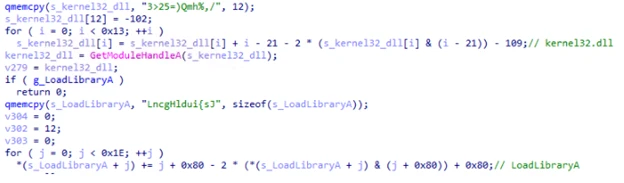
The loader employs common anti-analysis techniques to hinder analysis, like obfuscating most of its important strings.
Figure 1. Example obfuscated strings being deobfuscated
This technique is known as obfuscated stack strings because each piece of the string is built up one at a time on the function’s stack. Once built up, it is deobfuscated using various mathematical operations. Most of the obfuscated strings in this loader are Windows DLL and API names. These deobfuscated strings are used to resolve Windows APIs dynamically at runtime.
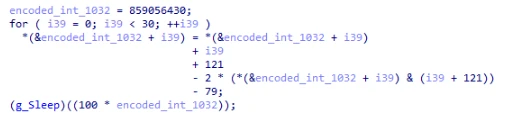
In addition to obfuscated strings, a lot of the code’s constant values are stored obfuscated as well.
Figure 2. Example obfuscated constant value “1032” being deobfuscated
Finally, the loader has two anti-debugger methods: one based on ProcessDebugFlags and the other using ThreadHideFromDebugger.
As noted above, the loader’s main objective is to extract the next stage from its file archive and launch it. In the analyzed sample, the next stage was named encryptbase64.ps1.
Custom file archives
NeedyMantis’ file archives are in an encrypted and compressed custom file format. To get access to the files, the outer layer of the archive is XOR-decoded and RtlDecompressBuffer decompressed. Once decompressed, there are individual file entries. In each file entry, the file’s name is XOR-decoded and its contents are RtlDecompressBuffer decompressed.
The file format’s offsets, XOR keys, and values change from sample to sample.
Figure 3. Example output of an archive unpacking tool displaying metadata of the WinSparkle file archive
dnsapi.dll – Not a dnsapi.dll, but contains the malware’s configuration
ws2_32.dll – Not a ws2_32.dll, but contains a WebSockets based communications DLL
msvcrt140.dll – Not a msvcrt140.dll, but contains shellcode to load module DLLs and resolve exports
While this archive contains several legitimate software components, the malware’s functionality is implemented by the remaining files, discussed below.
Other analyzed NeedyMantis file archives have contained different file names and components. An older version of the malware, for example, used a libcurl (SHA-256: c82520eb03c084226be4eafbff46f56dca0aa8804a2a7f23a085a96afe71ef77) file archive, and it contained only four files:
300.c – Malware’s configuration
300.s – WebSockets-based communications DLL
is – Persistence module using Windows Services
m.l – Main component
Second-stage loader
In the analyzed sample, encryptbase64.ps1 was the second-stage loader. Despite its .ps1 PowerShell extension, the file contains x64 shellcode. Its purpose is to decode and decompress an embedded binary which is NeedyMantis’ main component.
This loader also has some anti-analysis functionality that differs from stage one. For string decoding, it locates two encoded blocks of data and XOR keys at calculated offsets and then decodes them. The first block, most relevantly, contains a few Windows DLL and API names that are resolved dynamically. The second block, shown below, contains a list of Windows DLL names and Windows API hash values:
Figure 4. Decoded Windows API hash values
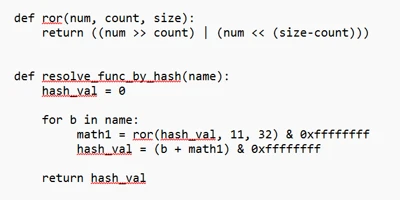
The component uses a rotate right (ROR) based algorithm with a configurable rotation value (the analyzed sample used value 11) to resolve these Windows API hashes. Figure 5 shows a snippet of Python code reproducing the algorithm:
Figure 5. Python snippet of Windows API hashing algorithm
This second-stage loader’s objective is to extract embedded data, XOR-decode it, and then RtlDecompressBuffer decompress it. The location of the encoded data and XOR key are at calculated offsets, which change from sample to sample.
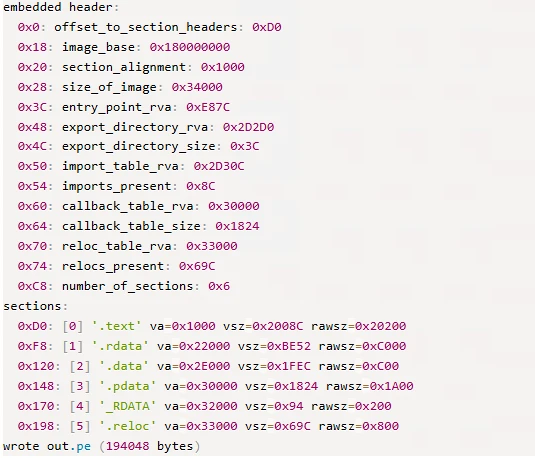
Once decoded the resulting data is a DLL that has been formatted using a custom executable file format. It is a minimized version of a PE file.
Figure 6. Example output of custom executable file format to PE file conversion tool
Main component
NeedyMantis’ main component orchestrates C2 communications and handles additional downloaded modules.
It creates a mutex named <username>-<process name>, such as Contoso-Poedit.exe. Like in the first-stage loader, most of the main component’s strings and constant values are stored as obfuscated stack strings.
Configuration
The malware’s configuration was stored in a dnsapi.dll file from the custom file archive. This file name spoofs a Windows networking library. In the sample analyzed, the file contains a 3448-byte binary structure. The structure includes the following fields:
0x00: Unknown (config contained “300”, but components also reference “400”)
0x1c: Communication component name (ws2_32.dll)
0x128: C2 port (443)
0x12c: C2 host (corp.tripswithengine[.]com)
0x334: C2 URI (/library/zip/)
0x53C: WinHttpOpen AccessType (0)
0x954: Proxy username (not set)
0xB5C: Proxy password (not set)
0xD64: Sleep time related (300)
0xD68: Sleep time related (300)
Communications DLL
As referenced in the configuration, NeedyMantis makes use of a communication component called ws2_32.dll. This component is also stored in the custom file archive. Like the config file, the file name spoofs a Windows networking library.
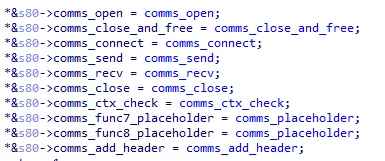
This communications DLL has one export named SystemInfo. As shown below in Figure 7, SystemInfo exposes 10 functions for the main component to initiate and maintain a WebSockets connection with the C2:
Figure 7. Communications DLL API functions
The library uses WinINet APIs for WebSockets. It also has a hard-coded user-agent of firefox/21.0.
We have also spotted a second version of the communications DLL in a file archive. It implements the same communications API but uses Libwebsockets (LWS) instead of WinINet.
Command and control
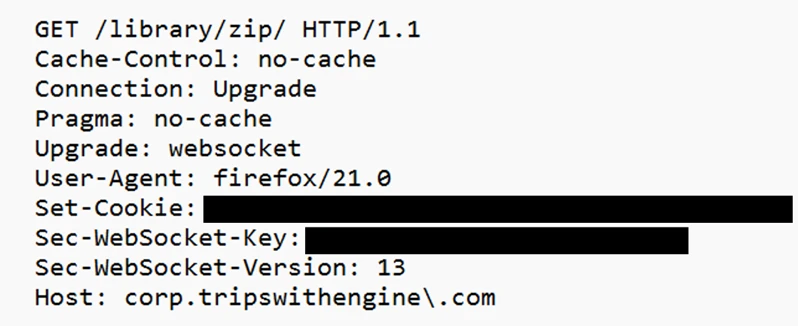
The initial C2 beacon is an HTTPS GET request, similar to Figure 8 below:
Figure 8. Initial C2 HTTPS GET request
The Set-Cookie header contains system information. The header value can be Base64-decoded and RtlDecompressBuffer decompressed. Once decompressed it contains a JSON object. The key values are:
c – Computer name
u – Username
o – Base64-encoded data, once decoded it contains line separated “: ” entries
p – Process name
pa – Parent process
f – Files in ProgramFiles directory
p – Process list
The connection is then converted to WebSockets and a binary C2 protocol is continued. The binary protocol is separated into a header and optional data components. The 44-byte header includes the following fields:
0x00: 16-byte XOR key
0x10: Uncompressed data length
0x14: Compressed data length
0x18: Command number
0x28: Data length
0x2c: Optional data
A 16-byte random XOR key is generated and the header is XOR-encoded, starting at offset 0x18. If there is any data, it is compressed with RtlCompressBuffer and optionally encrypted with RC4.
The initial messages of the binary protocol are a key exchange with the C2 server. The protocol is performed as such:
32-bytes are received from the C2 server, but then ignored
A 1024-byte random buffer is created
The first 32-bytes of this random buffer are used as the RC4 key for further communications
A 256-byte buffer is created that starts with google.com followed by random bytes
The 256-byte buffer is RC4 encrypted
A random length between 292 and 1282 is picked
The C2 protocol message data is structured as such:
0x00: The random length
0x04: RC4 encrypted google.com buffer
0x104: The random 1024-byte buffer used to create the RC4 key (at least 32 bytes of it)
This message data is compressed, but not RC4 encrypted
A random command number between 1 and 45 is chosen
The C2 server uses the buffer at offset 0x104 to recreate the RC4 key and presumably checks the RC4 encrypted google.com buffer
The server sends back the random command number as an acknowledgement
Commands
The main component only has a handful of commands. Commands sent to the C2 include:
1110 – Sends computer name and username
1112 – Sends a hard-coded identifier (like 20001)
1150 – Keep alive
Commands received from the C2 include:
1020 – Load module
1030 – Unload module
1050 / 1150 – Dispatch data to module
1070 – Turn off active flags
The main component’s load, unload, and data dispatch commands show that NeedyMantis can extend its functionality through additional modules, but the capabilities of those modules remain unconfirmed.
Mitigation and protection guidance
Microsoft recommends the following mitigations to reduce the impact of this threat.
Look for outbound connections in network egress traffic to corp.tripswithengine[.]com.
Run Endpoint Detection and Response (EDR) in block mode so that Microsoft Defender for Endpoint can block malicious artifacts, even when your non-Microsoft antivirus does not detect the threat or when Microsoft Defender Antivirus is running in passive mode. EDR in block mode works behind the scenes to remediate malicious artifacts that are detected post-breach.
Configure automatic attack disruption in Microsoft Defender XDR. Automatic attack disruption is designed to contain attacks in progress, limit the impact on an organization’s assets, and provide more time for security teams to remediate the attack fully.
Microsoft Defender XDR customers can turn on the following attack surface reduction rules to prevent common attack techniques used by threat actors.
You can assess how an attack surface reduction rule might impact your network by opening the security recommendation for that rule in threat and vulnerability management. In the recommendation details pane, check the user impact to determine what percentage of your devices can accept a new policy enabling the rule in blocking mode without adverse impact to user productivity.
Microsoft Defender detections
Microsoft Defender customers can refer to the list of applicable detections below. Microsoft Defender coordinates detection, prevention, investigation, and response across endpoints, identities, email, apps to provide integrated protection against attacks like the threat discussed in this blog.
Tactic
Observed activity
Microsoft Defender coverage
Execution
Shellcode loading, DLL sideloading, decryption, and decompression
Microsoft Defender for Endpoint – Suspicious DLL loaded – An executable file loaded an unexpected DLL file – Suspicious decode command
Microsoft Security Copilot is embedded in Microsoft Defender and provides security teams with AI-powered capabilities to summarize incidents, analyze files and scripts, summarize identities, use guided responses, and generate device summaries, hunting queries, and incident reports.
Security Copilot is also available as a standalone experience where customers can perform specific security-related tasks, such as incident investigation, user analysis, and vulnerability impact assessment. In addition, Security Copilot offers developer scenarios that allow customers to build, test, publish, and integrate AI agents and plugins to meet unique security needs.
Threat intelligence reports
Microsoft Defender XDR customers can use the following threat analytics reports in the Defender portal (requires license for at least one Defender XDR product) to get the most up-to-date information about the threat actor, malicious activity, and techniques discussed in this blog. These reports provide the intelligence, protection information, and recommended actions to prevent, mitigate, or respond to associated threats found in customer environments.
Microsoft Security Copilot customers can also use the Microsoft Security Copilot integration in Microsoft Defender Threat Intelligence, either in the Security Copilot standalone portal or in the embedded experience in the Microsoft Defender portal to get more information about this malware and associated activity.
Hunting queries
Microsoft Defender XDR
Microsoft Defender XDR customers can run the following advanced hunting queries to find related activity in their networks:
NeedyMantis masquerading as software
A listing of legitimate, unmodified application folders, along with malicious replacement DLL filenames sideloaded by NeedyMantis.
DeviceFileEvents
| where Timestamp > ago(7d)
| where (
    (FolderPath matches regex @"^[A-Za-z]:\\Program Files\\Poedit" and FileName == "WinSparkle.dll")
    or (FolderPath matches regex @"^[A-Za-z]:\\Program Files \(x86\)\\Poedit" and FileName == "WinSparkle.dll")
    or (FolderPath matches regex @"^[A-Za-z]:\\ProgramData\\USOShared" and FileName == "libcurl.dll")
    or (FolderPath matches regex @"^[A-Za-z]:\\ProgramData\\VIM" and FileName == "vim64.dll")
    or (FolderPath matches regex @"^[A-Za-z]:\\ProgramData\\TightVNC\\VIM" and FileName == "vim64.dll")
    or (FolderPath matches regex @"^[A-Za-z]:\\ProgramData\\office" and FileName == "dbghelp.dll")
    or (FolderPath matches regex @"^[A-Za-z]:\\ProgramData\\broadcom" and FileName == "dbghelp.dll")
    or (FolderPath matches regex @"^[A-Za-z]:\\ProgramData\\Intel" and FileName == "jli.dll")
    or (FolderPath matches regex @"^[A-Za-z]:\\Program Files\\modifiable" and FileName == "nvml.dll")
    or (FolderPath matches regex @"^[A-Za-z]:\\Program Files \(x86\)\\modifiable" and FileName == "nvml.dll")
    or (FolderPath matches regex @"^[A-Za-z]:\\ProgramData\\ics" and FileName == "nvml.dll")
)
| project Timestamp, DeviceId, DeviceName, ActionType, FolderPath, FileName,
          SHA1, SHA256, MD5,
          InitiatingProcessAccountDomain, InitiatingProcessAccountName, InitiatingProcessAccountSid,
          InitiatingProcessAccountUpn,
          InitiatingProcessMD5, InitiatingProcessSHA1, InitiatingProcessSHA256,
          InitiatingProcessFolderPath, InitiatingProcessFileName, InitiatingProcessCommandLine,
          InitiatingProcessCreationTime,
          ReportId, TenantId
NeedyMantis C2
This query identifies connectivity to the NeedyMantis command and control site for this activity.
Microsoft Sentinel customers can use the TI Mapping analytics (a series of analytics all prefixed with ‘TI map’) to automatically match the malicious domain indicators mentioned in this blog post with data in their workspace. If the TI Map analytics are not currently deployed, customers can install the Threat Intelligence solution from the Microsoft Sentinel Content Hub to have the analytics rule deployed in their Sentinel workspace.
NeedyMantis C2
This query identifies connectivity to the NeedyMantis command and control site for this activity.
To hear stories and insights from the Microsoft Threat Intelligence community about the ever-evolving threat landscape, listen to the Microsoft Threat Intelligence podcast.
Purpose and Scope This report summarizes statistics on new ransomware samples, affected systems, and statistics on targeted businesses collected during the month of August 2026, as well as major Korean & Global ransomware issues. Statistics on targeted businesses were compiled based on the time when publicly available information from ransomware groups’ DLS (Dedicated Leak Sites, […]
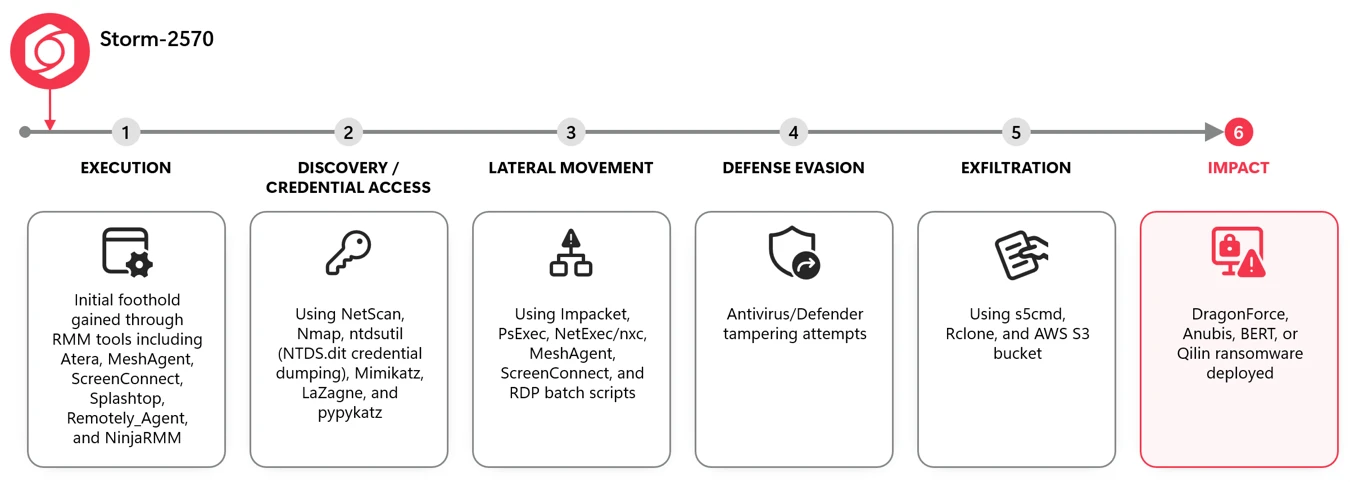
Activity associated with Storm-2570, a ransomware affiliate linked to multiple ransomware payloads, illustrates how tracking and responding to ransomware attacks by payload alone can obscure the affiliates carrying out intrusions and the recurring behaviors that defenders can use to detect and disrupt them. Microsoft Threat Intelligence has observed Storm-2570 using consistent post-compromise tools and techniques across deployments involving Qilin, DragonForce, Anubis, and BERT ransomware. Across multiple investigations, Storm-2570 has maintained largely uniform tradecraft, infrastructure overlaps, and repeated use of the same remote access and cloud exfiltration tooling despite operating across multiple ransomware ecosystems.
These findings reinforce the value of examining threat actor behavior across the attack chain rather than treating each ransomware payload as an isolated activity set. Recurring remote access, credential access, lateral movement, security tampering, and data exfiltration activity can help defenders connect related intrusions and respond before ransomware deployment, even when the final payload changes.
In this blog post, we delve into the attack techniques attributed to Storm-2570. While Storm-2570’s methodology aligns with the tactics, techniques, and procedures (TTPs) of many tracked ransomware actors, analysis of their post-compromise tactics provides essential insights into how organizations can harden and defend against ransomware threat actors, informing opportunities to disrupt attackers even if they have gained initial access to a network. At the end of this blog, we also provide a comprehensive recommendation section with detection details.
Who is Storm-2570?
Storm-2570 is a ransomware affiliate that Microsoft Threat Intelligence has tracked since April 2025. We assess that Storm-2570 has operated across multiple ransomware as a service (RaaS) ecosystems, including Qilin, DragonForce, Anubis, and BERT.
To date, Microsoft Threat Intelligence has observed Storm-2570 in multiple investigated intrusions affecting organizations in United States, Canada, United Kingdom, Spain, Netherlands, and Puerto Rico, including healthcare and public health, education, government agencies and services, financial services, energy, consumer retail, Information technology (IT), food and agriculture, consumer services, commercial facilities, non-government organization (NGO), chemicals, critical manufacturing, and transportation.
Unlike actors that consistently support a single ransomware operation, Storm-2570 appears to be a cross-ecosystem threat actor that works with multiple ransomware groups and shifts between operations as opportunities arise, giving the threat actor the flexibility to use and deploy multiple families and improve opportunities for payouts. As a result, organizations could encounter the same actor, tools, and intrusion methods despite different ransomware payloads being deployed.
Figure 1. Storm-2570’s RaaS deployment timeline
Storm-2570 attack chain: From initial foothold to impact
While the method through which Storm-2570 gains initial access remains unconfirmed, observed intrusion chains indicate subsequent use of remote management tooling and hands-on-keyboard activity to progress toward credential access, lateral movement, exfiltration, and ransomware deployment.
Across incidents, Microsoft has observed the use of commodity tools in the pre-ransom attack stage even when the ransomware payload changed. These tools include:
Remote monitoring and management (RMM) tools, including Atera, MeshAgent, ScreenConnect, Splashtop, Remotely_Agent, and NinjaRMM
Discovery and lateral movement tools, including NetScan, Nmap, PsExec, Impacket, NetExec, and Remote Desktop Protocol (RDP) batch scripts
Data collection and exfiltration tools, including s5cmd and Rclone
These tools enable remote administration, command execution, persistence, and tunneling or proxy access.
Figure 2. Storm-2570 attack chain
Frequent use of remote management tooling across the attack chain
MeshAgent, a remote device management software, stands out as one of Storm-2570’s most frequently observed remote access and execution tools across multiple intrusions. Rather than appearing as a one-off utility, MeshAgent repeatedly shows up at key points in Storm-2570 attack chains, often after the actor has gained access and is preparing to expand control, run commands, deploy additional tooling, or move toward ransomware impact. In several cases, Storm-2570 used MeshAgent along with MeshCentral as an operational bridge between initial hands-on-keyboard activity and later-stage actions, such as account manipulation, discovery, credential access, security tampering, and ransomware deployment.
Many intrusions tracked by Microsoft have shown Storm-2570 tailoring MeshAgent deployments to the compromised environment. The actor renames MeshAgent-related binaries or services with victim-themed names, likely to make the tool appear more legitimate in the environment. For example, Storm-2570 renames the variant of the meshagent64 RMM tool to include the name of the compromised organization, such as meshagent64-[organization name].exe and uses Base64-encoding to obfuscate the commands being executed. In one such intrusion, MeshAgent was used alongside NinjaRMM before the activity progressed to ntdsutil for credential dumping, network scanning, and Qilin deployment.
Storm-2570 uses a diverse set of remote access tools rather than relying on a single capability. The threat actor rotates among commercially available RMM platforms, remote desktop components, and tunneling utilities, often deploying multiple tools during the same intrusion. For example, Storm-2570 uses Atera to install agents and execute interactive commands, while ngrok and Cloudflared.exe expose RDP services or establish persistent outbound tunnels. Storm-2570 uses AteraAgent to issue commands and to further download and install Splashtop Streamer in compromised environments. Splashtop appears to be the interactive remote control component delivered through Atera, giving the threat actor hands-on keyboard access. The actor also uses tools such as ScreenConnect for command execution and account or domain reconnaissance and installs Remotely_Agent as a persistent remote management service.
Use of tunneling utilities for persistent remote access
Storm-2570 also pairs remote access tooling with tunneling utilities such as Cloudflared.exe to create resilient outbound access paths. In one intrusion, Storm-2570 installed MeshAgent and later created a persistent Cloudflare Tunnel service on the victim host. The tunnel was configured to run automatically as a service under LocalSystem, allowing the threat actor to maintain an encrypted outbound channel from inside the network. This type of tunnel can help bypass inbound firewall restrictions and provide covert remote access for follow-on activity.
Discovery and credential access
Post-compromise, Storm-2570 routinely conducts internal network discovery using tools such as NetScan, SoftPerfect Network Scanner Portable, and Nmap, alongside native discovery commands and file-searching activity. These activities are used to identify reachable hosts and services, map internal networks and remote systems, and locate systems, network shares, and files that may facilitate data collection, credential access, or encryption operations.
For credential access and harvesting, Storm-2570 uses tools like Mimikatz, LaZagne, and pypykatz. Storm-2570 also uses ntdsutil in intrusions for NTDS.dit credential dumping, a credential theft technique against Active Directory domain credentials. The ntdsutil command usage pattern is consistent with creating an Install From Media (IFM) copy of Active Directory database material. In an intrusion context, attackers can use this to obtain NTDS.dit and related registry hives for offline extraction of password hashes and credential material.
The command uses the legitimate Windows ntdsutil.exe to activate the NTDS Active Directory instance and create a full IFM backup in C:\Windows\Temp\<XXXXXXXXX>.
Storm-2570 uses this command to dump or stage Active Directory database NTDS.dit and supporting registry hive material, then copy it off-host and potentially extract domain credential hashes offline, indicating that the actor has high-privilege access to a victim’s domain controller:
Defense evasion
After acquiring privileged credentials, Storm-2570 uses defense evasion tactics preceding ransomware deployment, including antivirus tampering and the modification of Microsoft Defender settings and Defender exclusions. In multiple observed intrusions, Storm-2570 disabled real-time monitoring, added Defender exclusions for C:\PerfLogs to weaken endpoint detections, and modified registry values under Microsoft Defender service keys to further impair protections.
These tactics are consistent across Storm-2570 ransomware intrusions involving Qilin, DragonForce, and Anubis deployment, including cases where the actor used registry changes to alter DisableAntiSpyware, DisableRealtimeMonitoring, and WinDefend service behavior.
Lateral movement and deployment preparation
Storm-2570 moves into lateral movement and deployment preparation phase typically by using a mix of legitimate administrative tooling, offensive frameworks, and remote execution utilities.
Across multiple investigated intrusions, Storm-2570 was observed leveraging PsExec, Impacket, NetExec, RDP batch scripts, and admin shares to reach additional systems, execute commands remotely, and stage tooling across the environment. The actor uses these capabilities to facilitate data exfiltration and prepare victim networks for ransomware deployment. These tools frequently appear alongside earlier discovery activity, credential access, and remote access tooling such as MeshAgent, and often precede the use of s5cmd for exfiltration or ransomware payload execution.
PsExec is one of the most consistent lateral movement and deployment tools used by Storm-2570. The actor frequently uses PsExec, sometimes with host lists such as @ip.txt, to move laterally and install renamed MeshAgent binaries across compromised environments. Storm-2570 utilizes MeshAgent during the lateral movement phase in several intrusions as a remote access tool deployed onto newly compromised systems.
The following are examples of PsExec commands with host lists @ip.txt:
Storm-2570 also uses RDP and RDP-enabling scripts as part of this phase. If RDP is not allowed in the environment, Storm-2570 needs admin privileges to modify the policy and enable it. In several intrusions, rdp.bat script appeared with PsExec, including cases where PsExec ran rdp.bat across hosts using @ip.txt.
The RDP batch script (rdp.bat) enables inbound Remote Desktop access by modifying Terminal Server settings and adding a firewall rule to allow TCP port 3389, as observed in the command below:
Additionally, the threat actor uses ngrok to expose TCP 3389 (default port for RDP), after which PsExec-related activity and security tampering appears. These examples show Storm-2570 combining RDP access, tunneling, and remote execution to sustain hands-on-keyboard control and reach additional systems.
Storm-2570’s use of Impacket and NetExec over Server Message Block (SMB) further supports their lateral movement pattern. Impacket is a collection of open-source Python classes designed for working with network protocols, and is popular with adversaries due to its ease of use and wide range of capabilities. Microsoft Defender for Endpoint has a dedicated attack surface reduction rule to defend against lateral movement techniques used by Impacket; protecting lateral movement pathways can also mitigate Impacket.
The following NetExec SMB command is used to conduct credential theft and reconnaissance against internal Windows hosts:
Data collection and exfiltration
Storm-2570 frequently performs data theft using cloud and file-transfer utilities that are capable of moving large volumes of data quickly from compromised environments to a remote attacker-owned cloud resource. Microsoft has observed Storm-2570 using s5cmd or Rclone to stage and exfiltrate data, often after the actor has already completed discovery, credential access, lateral movement, and remote access setup. Tools like Rclone provide data synchronization capabilities, moving newly created or updated files to cloud resources in real-time to enable continuous exfiltration throughout all stages of the attack without needing attacker interaction.
Most commonly, Storm-2570 relies on s5cmd, a command-line utility designed for managing Amazon S3 and compatible object storage services, for S3-based exfiltration. In multiple intrusions, the actor staged s5cmd.exe alongside a credentials file and used it to copy documents, spreadsheets, images, databases, mail-related files, archives, and other business-relevant file types to S3 buckets. Storm-2570 identifies high-value drives and network shares, stages s5cmd.exe and a credentials file, and then executes run copy (cp) operations with extension filters to transfer selected data to attacker-controlled S3 buckets. To interact with the destination S3 bucket, s5cmd requires credentials for authentication and the credentials file stores the AWS access keys for authentication to the S3 bucket.
The following is an example of s5cmd data exfiltration command lines:
Overall, Storm-2570’s exfiltration tradecraft shows a strong preference for tools that blend into legitimate administrative or cloud-transfer workflows, allowing double-extortion operations: first collecting sensitive data through cloud-transfer tooling, then deploying ransomware.
What Storm-2570 activity means for defenders
Storm-2570 illustrates common human-operated ransomware attacks and how modern ransomware affiliates increasingly operate independently of a single ransomware brand. Ransomware affiliates’ use of common tools, intrusion methods, and operational patterns remain remarkably consistent. Although Storm-2570’s techniques are not novel, recognizing the patterns used by ransomware affiliates can be important for defenders to know to improve prevention, detection, and incident response.
Mitigation and protection guidance
To defend against Storm-2570 TTPs and similar activity, Microsoft recommends the following mitigation measures:
Follow the defending against ransomware guidance in Microsoft’s ransomware as a service blog post which details how to build credential hygiene as well as how to limit lateral movement using the principle of least privilege.
Turn on tenant-wide tamper protection features to prevent attackers from stopping security services or using antivirus exclusions. Without tamper protection, attackers could simply turn off Microsoft Defender Antivirus without the need to acquire higher privileges.
If there is an issue with a device during roll out of various antivirus features, the device can be placed in Troubleshooting mode to turn off Tamper Protection temporarily without impacting the wider organizational security policy.
For approved RMM systems used in your environment, enforce security settings where possible to implement MFA. If an unapproved RMM installation is discovered in your network, reset passwords for accounts used to install the RMM services. If a System-level account was used to install the software, further investigation may be warranted.
Configure automatic attack disruption in Microsoft Defender XDR. Automatic attack disruption is designed to contain attacks in progress, limit the impact on an organization’s assets, and provide more time for security teams to remediate the attack fully.
Microsoft Defender XDR customers can turn on attack surface reduction rules to prevent common attack techniques used in ransomware attacks:
Block process creations originating from PSExec and WMI commands (Some organizations might experience compatibility issues with this rule on certain server systems but should deploy it to other systems to prevent lateral movement originating from PsExec and WMI.)
Microsoft Defender customers can refer to the list of applicable detections below. Microsoft Defender coordinates detection, prevention, investigation, and response across endpoints, identities, email, apps to provide integrated protection against attacks like the threat discussed in this blog.
Tactic
Observed activity
Microsoft Defender coverage
Execution
Storm-2570 delivers tools such as PsExec, Impacket, NetExec, and RDP batch scripts, to carry out post-compromise activity
Storm-2570 has used tools like Mimikatz, LaZagne, and pypykatz for credential access and harvesting and NTDS.dit for credential dumping
Microsoft Defender Antivirus – HackTool:Win32/Mimikatz – HackTool:Win64/Mimikatz – HackTool:Linux/LaZagne – HackTool:Win32/LaZagne – HackTool:Win64/LaZagne Microsoft Defender for Endpoint – Exposed credentials at risk of compromise – Compromised account credentials – Process memory dump
Exfiltration
Storm-2570 uses Rclone and s5cmd for data theft
Microsoft Defender for Endpoint – Potential human-operated malicious activity – Renaming of legitimate tools for possible data exfiltration – Possible data exfiltration – Hidden dual-use tool launch attempt
Impact
Storm-2570 deploys Anubis, DragonForce, Qilin, and BERT ransomware
Microsoft Defender for Endpoint – Possible ransomware activity based on a known malicious extension – Possible compromised user account delivering ransomware-related files – Potentially compromised assets exhibiting ransomware-like behavior – Ransomware behavior detected in the file system – File dropped and launched from remote location
Microsoft Security Copilot
Microsoft Security Copilot is embedded in Microsoft Defender and provides security teams with AI-powered capabilities to summarize incidents, analyze files and scripts, summarize identities, use guided responses, and generate device summaries, hunting queries, and incident reports.
Security Copilot is also available as a standalone experience where customers can perform specific security-related tasks, such as incident investigation, user analysis, and vulnerability impact assessment. In addition, Security Copilot offers developer scenarios that allow customers to build, test, publish, and integrate AI agents and plugins to meet unique security needs.
Threat intelligence reports
Microsoft Defender XDR customers can use the following threat analytics reports in the Defender portal (requires license for at least one Defender XDR product) to get the most up-to-date information about the threat actor, malicious activity, and techniques discussed in this blog. These reports provide the intelligence, protection information, and recommended actions to prevent, mitigate, or respond to associated threats found in customer environments.
Microsoft Security Copilot customers can also use the Microsoft Security Copilot integration in Microsoft Defender Threat Intelligence, either in the Security Copilot standalone portal or in the embedded experience in the Microsoft Defender portal to get more information about this threat actor.
Hunting queries
Microsoft Sentinel
Microsoft Sentinel customers can run the following advanced hunting queries to find related activity in their networks:
Hunt for PsExec-based remote execution and deployment
DeviceProcessEvents
| where Timestamp > ago(30d)
| where FileName in~ ("psexec.exe", "psexec64.exe")
    or ProcessCommandLine has_any ("psexec.exe", "psexec64.exe")
| where ProcessCommandLine has_any ("@ip.txt", "-accepteula", "\\")
| project Timestamp, DeviceName, AccountName, FileName, ProcessCommandLine,
          InitiatingProcessFileName, InitiatingProcessCommandLine,
          SHA256, DeviceId, ReportId
| order by Timestamp desc
Hunt for renamed MeshAgent binaries and services
let MeshAgentTerms = dynamic(["meshagent", "meshagent64", "meshcentral"]);
union isfuzzy=true
(
    DeviceProcessEvents
    | where Timestamp > ago(30d)
    | where FileName has_any (MeshAgentTerms)
        or ProcessCommandLine has_any (MeshAgentTerms)
        or InitiatingProcessCommandLine has_any (MeshAgentTerms)
    | project Timestamp, DeviceName, ActionType, FileName, FolderPath,
              ProcessCommandLine, InitiatingProcessFileName,
              InitiatingProcessCommandLine, SHA256,
              RegistryKey="", RegistryValueName="", SourceTable="DeviceProcessEvents"
),
(
    DeviceFileEvents
    | where Timestamp > ago(30d)
    | where FileName has_any (MeshAgentTerms)
        or FolderPath has_any (MeshAgentTerms)
        or InitiatingProcessCommandLine has_any (MeshAgentTerms)
    | project Timestamp, DeviceName, ActionType, FileName, FolderPath,
              ProcessCommandLine="", InitiatingProcessFileName,
              InitiatingProcessCommandLine, SHA256,
              RegistryKey="", RegistryValueName="", SourceTable="DeviceFileEvents"
),
(
    DeviceRegistryEvents
    | where Timestamp > ago(30d)
    | where RegistryKey has_any (MeshAgentTerms)
        or RegistryValueName has_any (MeshAgentTerms)
        or RegistryValueData has_any (MeshAgentTerms)
        or InitiatingProcessCommandLine has_any (MeshAgentTerms)
    | project Timestamp, DeviceName, ActionType, FileName="", FolderPath="",
              ProcessCommandLine="", InitiatingProcessFileName,
              InitiatingProcessCommandLine, SHA256="",
              RegistryKey, RegistryValueName, SourceTable="DeviceRegistryEvents"
)
| order by Timestamp desc
To hear stories and insights from the Microsoft Threat Intelligence community about the ever-evolving threat landscape, listen to the Microsoft Threat Intelligence podcast.
Note The August 2026 Dark Web Threat Actor Trend Report focuses on trends among threat actors—including hacktivists—active on the deep web and dark web. It is noted that the accuracy of some information could not be verified. Major Issues NoName057(16), BD Anonymous, and Dark Storm Team claimed responsibility for repeated DDoS attacks targeting websites of […]
A new identity theft service launched on the dark web this week is selling digital scans of more than 153 million drivers licenses from people in the United States and Canada. Based on interviews with individuals whose licenses are available for purchase on this service, it appears to be siphoning images collected by a widely-used identity verification company based in Louisiana. KrebsOnSecurity also has learned that the New Orleans field office of the Federal Bureau of Investigation (FBI) today launched an official inquiry into the source of the images.
A record available at this identity theft service that includes the drivers license for U.S. Defense Secretary Pete Hegseth, one of several high-ranking U.S. government officials whose drivers licenses can be found for sale.
On Monday, Aug. 31, a source alerted KrebsOnSecurity to a service advertised by a new user on the Russian cybercrime forum Exploit, offering access to digital scans of identity documents on more than 170 million people in North America. The source brought it to my attention because the proprietor of this identity theft service offered my Virginia drivers license as a free sample in their initial sales thread on Exploit.
The service, dubbed Nexus, claims to have more than 153 million drivers licenses for people in the United States and Canada, as well as more than 10 million identification cards; more than three million travel documents and/or international IDs; and at least 579,000 medical cards.
A quick look around Nexus finds they are likely not exaggerating about that 153 million number: Running a blank search in Nexus (with no search parameters entered) returns approximately 11.5 million pages of results, with roughly 15 results displayed per page. It includes documents from people in both Canada and the United States, but the bulk of these records are on Americans: searching for just Canadian drivers licenses returns approximately 1.1 million results, with the largest concentration from Ontario (473,673 records).
Curiously, the identity records include not only drivers licenses but also marijuana dispensary cards. Some of the records list their “source” as “CDL,” presumably short for “commercial drivers license.” Other records carry the source notation of “CAC,” which may refer to Common Access Cards, government issued identity cards that grant physical access to government buildings and secure rooms.
The people behind Nexus claim the license images are coming from an active breach at “a major identity verification company” whose customers include multiple Fortune 500 companies.
The record totals listed by the Nexus identity theft service. The number of drivers license records increased by nearly 400,000 in the span of just 24 hours.
“We have been continuously exfiltrating new data for over a year into our private database,” the service enthused in its introductory post on Exploit. “Records are available to preview before purchase with pertinent information redacted. Customer photos are displayed if available.”
Indeed, over the past 24 hours, the number of drivers license records listed as available in Nexus has increased by nearly 400,000, suggesting that freshly stolen license data is being harvested and uploaded to this service on a semi-regular basis.
The record featuring my drivers license includes six image files: three pairs of photos of the license’s front and back, a basic image scan, as well as infrared and ultraviolet versions of the same images. A date and timestamp is appended to each image file, and the timestamp on my license scan corresponds to a date in June 2025 when I took a flight to the midwest United States to attend a family funeral.
Some of the 153 million+ license scans — including mine — feature six image files with date and timestamps appended to the filenames. Not all records include photos, and some that do feature photos do not display the associated filenames.
Intent on discovering the source of this data, KrebsOnSecurity asked more than a dozen friends and family members for permission to search for their licenses in this service. Each person whose license could be found (nine of them) confirmed having traveled on or very close to the dates in the timestamps attached to their images. It is unclear what timezone these timestamps are in, but from reviewing car rental records shared by several people who helped with this research, it appears the timezone is set to Greenwich Mean Time (GMT).
At first, I thought the source of the data might have something to do with airports. However, that theory went out the window when it became apparent there were no passports in this data set. Also, only some of those who helped with this research said they showed their drivers license at the airport on the day of their travel. One person whose license was in Nexus hadn’t flown at all recently, but was renting a car from Hertz for several months around the date of their timestamp.
Two of those who agreed to help are federal employees who said they shared other forms of government identification when passing through airport security. However, those individuals each said they shared their state-issued drivers licenses later that day when renting vehicles at their respective destinations, and that both rented their cars from Hertz.
After finding a note in my calendar for the day of my June 2025 flight reminding me to bring my passport, I remembered that I also never actually shared my drivers license when I went through security at Reagan National Airport on that day because I did not yet have a Real ID, a security-enhanced drivers license that is now required by the Transportation Security Administration (TSA) for all domestic travel. Instead, I showed the TSA agent my government-issued U.S. passport.
Here’s where it gets interesting: I was able to find my mother’s drivers license in this service as well, and the timestamps for her images are just a few seconds apart from mine. That’s notable because we both handed our licenses to the Hertz rental car representative at the same time.
According to my mom, the only place she gave her drivers license to that day was the rental car company, and if memory serves that is also true for me. I don’t recall if the rental car representative inserted our licenses into any kind of machine, but I remember they held onto them for several minutes behind the counter while we were signing various forms. KrebsOnSecurity sought comment from Hertz and will update this story in the event they reply.
Zach Edwards is a well-known security and privacy researcher who recently launched a service called DecryptAds to help people better understand how online advertisers are tracking them. A scan of Edwards’s drivers license is available for purchase on this identity theft service, and Edwards said the timestamp on his record corresponds to the middle of a trip last month to Las Vegas for the annual DEFCON security conference.
Edwards told KrebsOnSecurity that although he did not rent a car in Vegas, he did hand over his license at the TSA checkpoint, at a marijuana dispensary in Vegas, and at his hotel (the Aria). But he said the only one of those three that for sure scanned his ID in some kind of device was the dispensary.
To enter Planet13’s weed dispensary in Las Vegas, one must pass through a red telephone booth. Image: Zach Edwards.
Edwards said the dispensary he visited that day was Planet13, a multi-state chain with stores in California, Florida, Illinois and Nevada. In 2022, the New Orleans-based identity provider idscan.net published a press release announcing an exclusive identity verification agreement with Planet13’s dispensaries nationally. IDScan says it processes ID verification for more than 1,000 marijuana dispensaries in 19 U.S. states.
The “trust” page of idscan.net states that the company provides identity verification services for numerous big brands, including Hertz, Target, Fedex, Motorola Solutions, the financial services giant Jack Henry, and Caesars Entertainment. And as idscan.net’s own documentation states, the technology scans IDs with both infrared and ultraviolet light. Idscan.net says the company’s systems and technology perform more than 21 million verifications monthly, at more than 20,000 locations around the world.
Image: idscan.net.
Contacted by KrebsOnSecurity, idscan.net said it was investigating the matter, but the company has not yet shared an official statement or a substantive reply to specific questions sent via email.
“At this point I’m not able to share any additional information, but the updates you have provided have been welcome, and helpful to our team’s investigation,” wrote Jillian Kossman, a marketing and operations leader at idscan.net.
During the course of my research for this story, word got around to the FBI that I was poking at the apparent source of this new identity theft service’s data. Probably they were tipped off when I shared with a trusted source that Nexus also is selling the drivers license information for the assistant director of the FBI (I did not find FBI Director Kash Patel’s license in Nexus).
Earlier this afternoon, I was added to a conference call with a half-dozen FBI agents, including senior leaders from the agency’s cyber division. During that call, the FBI shared that earlier today their New Orleans field office opened an official investigation into an apparent breach involving idscan.net.
Edwards said that as more in-person and online experiences require sharing drivers licenses, vendors who collect this sensitive data need to be held to a higher standard.
“This episode should further strengthen the resolve for people who are fighting back against online ID schemes which are requiring countless providers to ask for drivers licenses in order to access services under the guise of protecting kids,” Edwards told KrebsOnSecurity. “These systems are putting sensitive data into more and more 3rd party vendors, and we don’t have nearly the oversight to ensure they are safe.”
Larry Baldwin is principal intelligence researcher at the cybersecurity firm Cybera. Baldwin said a front and back scan of his drivers license available at Nexus contains timestamps that correspond to the date of a car rental from Hertz on a recent vacation.
Baldwin said the Nexus identity theft service presents multiple serious security and privacy threats, noting that state-issued drivers licenses are commonly used as proof of one’s identity when opening new lines of credit. Baldwin said the service could also dangerously expose many people who do not wish to be found but who cannot meaningfully change their appearance (or at least not enough to fool today’s AI-based image matching tools).
This category of people, he said, includes those fleeing domestic violence, and even people who have been assigned a whole new life and identity as part of the federal government’s witness protection program, which is generally reserved for criminal defendants in racketeering and conspiracy investigations who agree to cooperate with federal authorities.
“Just when it seems like we’re making some headway in improving authentication controls through drivers license verification systems, this happens and the very thing those improvements are dependent on are compromised,” Baldwin said.
Update, Sept. 8: IDscan.net published a brief notice saying it has “determined that an unauthorized third party may have accessed and/or copied certain customer information, including full names and drivers license or other government-issued identification numbers.” The statement said IDscan.net is notifying affected individuals and offering credit protection services.
Update, Sept. 2, 6:05 p.m. ET: A spokesperson for Caesars Entertainment said Caesars has not been a client of IDScan.net and has not used VeriScan since February 2025, despite IDScan.net listing them as a client on their website. That person said Caesars had no active VeriScan accounts at the time of the incident and did not authorize IDScan.net to retain data from its accounts, and that IDScan.net said the incident should have no impact on Caesars Entertainment.
Update, 8:56 p.m. ET: Shortly after this story was published, the Nexus identity theft service website vanished from the darkweb, replacing its login page with a plain text message that reads, “This service is no longer available.”
This is a potentially fast-moving story. Any changes or updates will be noted here along with a timestamp.
Since early May 2026, Microsoft Threat Intelligence has observed Storm-2945, a sub-cluster of Midnight Blizzard, conducting widespread but targeted traffic manipulation attacks involving hospitality sector networks served by captive portals worldwide. Despite some tactic, technique, and procedure (TTP) similarities to the Forest Blizzard DNS hijacking operation that we publicly disclosed in April 2026, we attribute this campaign, which we call CaptiveCrunch, to Storm-2945. As reported by ReliaQuest on July 23, a portion of this activity leverages doppelganger domains mimicking Microsoft online services to conduct follow-on adversary-in-the-middle (AitM) phishing operations that abuse the device code authentication flow in Microsoft Entra ID. Microsoft Threat Intelligence has also identified active traffic manipulation attacks leading to the delivery of malware on impacted systems. Microsoft has observed Storm-2945 leveraging AI to support a significant portion of these operations.
Today, we are sharing our findings on these ongoing intrusions to raise awareness of this threat and enable customers to protect their devices, especially while traveling. We provide our assessment of Storm-2945’s relationship to Midnight Blizzard and analysis of the CaptiveCrunch campaign, detailing the malware and tradecraft used in these operations. We also provide mitigation, detection, and hunting guidance to help organizations identify and defend against Storm-2945 and related activity.
Microsoft Threat Intelligence would like to thank our partners at Anthropic and OpenAI for their collaboration and support during this investigation.
The CaptiveCrunch campaign
Since February 2026, Storm-2945 has conducted AI-augmented operations including targeted device code and OAuth code phishing campaigns leading to Entra device registration and subsequent data collection from Microsoft 365. Since early May 2026, Microsoft Threat Intelligence has observed Storm-2945 manipulating DNS and HTTP traffic from networks served by captive portals to redirect user traffic through actor-controlled infrastructure. Although our investigation into the initial compromise vector for the captive portal networks is ongoing, we have observed notable commonalities in the equipment and management systems used across multiple affected networks. These similarities suggest that the activity might not be limited to isolated compromises of individual venues and could reflect access to shared services within portions of the captive portal ecosystem.
Figure 1. Overview of the CaptiveCrunch attack flow
As part of the CaptiveCrunch campaign, Storm-2945 has leveraged their AitM position to redirect users through actor-controlled phishing infrastructure and has also delivered malware purporting to be browser or operating system updates in response to automated connectivity checks issued by users’ browsers. Multiple variants have been delivered, including fully-featured Windows remote access trojans (RAT) in compiled Golang, with functionality to conduct system enumeration, collect files and keystrokes, steal credentials and session tokens, conduct audio and video surveillance, monitor for removable media, and provide the threat actor a remote shell on infected systems.
The threat actor infrastructure leverages a variety of ClickFix techniques to elicit the user into downloading and executing the malware:
Figure 2. ClickFix prompt with manual user instructionsFigure 3. ClickFix prompt with additional user instructions after verification failure
In addition to variants of malware targeting Windows systems, Microsoft Threat Intelligence is also aware of indications that the threat actor might be targeting Android devices with similar techniques as the ClickFix landings also include instructions for Android devices to download and install an APK file.
To date, Microsoft has identified widespread compromise of Wi-Fi networks at hospitality-related organizations and other networks serviced by captive portal equipment in several countries. ReliaQuest has identified this activity not only at hotels, but also conference centers and other shared venues, and assesses that the goal of this activity is to access the accounts of corporate travelers.
Storm-2945 and Midnight Blizzard
Microsoft Threat Intelligence assesses that Storm-2945 is an operational sub-cluster of Midnight Blizzard based on distinctive technical and operational overlaps. These include technical similarities to Storm-2372, a Midnight Blizzard initial access operations sub-cluster, also notable for their device code and OAuth code phishing operations tracked throughout 2025, Microsoft Graph-based email exfiltration, social engineering delivered via commercial messaging apps, and significant similarities in victimology.
Midnight Blizzard is a Russia-based threat actor attributed by the US and UK governments to the Foreign Intelligence Service of the Russian Federation, also known as the SVR. This threat actor is known to primarily target governments, diplomatic entities, non-governmental organizations (NGOs), and information technology (IT) service providers, primarily in the US and Europe. Midnight Blizzard is consistent and persistent in their operational targeting, and their objectives rarely change. Their focus is to collect intelligence through longstanding and dedicated espionage in support of Russian foreign policy interests.
Midnight Blizzard operations often involve compromise of valid accounts and, in some highly targeted cases, advanced techniques to compromise authentication mechanisms within an organization to expand access and evade detection. They utilize diverse initial access methods, and Midnight Blizzard is also adept at identifying and abusing OAuth applications to move laterally across cloud environments and for post-compromise activity, such as email collection.
CaptiveCrunch tradecraft and tooling
CornFlake: Remote access and infostealer implant
CornFlake is a full-featured Windows RAT written in Go that serves as Storm-2945’s primary persistent implant. Microsoft has observed the threat actor rapidly iterating on this malware layer, which features customizable capabilities from the social engineering user interface and data collection capabilities to anti-detection and evasion techniques.
On initial execution, CornFlake operates in dropper mode: it displays a convincing fake progress window designed to occupy the victim’s attention while the binary copies itself to %APPDATA%\svchost32\svchost32.exe and establishes persistence.
Fake window options configurable by the threat actor at build time:
winupdate — A Windows Update screen displaying “Working on updates… Don’t turn off your computer”
defender — A Windows Security virus scan
directx — A DirectX End-User Runtime Web Installer
vcredist — A Microsoft Visual C++ 2015-2022 Redistributable installer
sysopt — A disk optimization utility
netfix — A Windows Network Diagnostics tool
browser — A browser update prompt
pdfview — A document viewer installer
Figure 4. False update window
CornFlake registers as a Windows service named svchost32 with the display name “Cloud Sync Service” and description “Synchronizes files with the cloud storage provider”, deliberately mimicking the legitimate svchost.exe process. It establishes redundant persistence mechanisms: Windows service registrations, Registry Run keys, named scheduled tasks, and a persistence watchdog routine that runs continuously to restore any persistence mechanism that is removed by defenders or endpoint protection.
For command and control (C2), CornFlake performs an Elliptic Curve Diffie-Hellman (ECDH) P-256 ephemeral key exchange with the C2 server, derives a session key via SHA-256, and communicates over a custom JSON protocol framed within the encrypted channel. This provides an encrypted channel to the C2 server, with each C2 session using a unique ephemeral key, making decryption of captured traffic impossible without the session-specific private key. The runtime configuration file sync.dat supports hot reconfiguration of C2 servers, watched directories, file targeting patterns, and Transport Layer Security (TLS) settings without requiring redeployment.
Once established on a victim system, CornFlake provides the operator with a comprehensive collection toolkit, gated by configuration flags that allow selective activation post-deployment:
Capability
Description
Keylogging
Raw input API-based keylogger capturing all keystrokes, including password fields
Clipboard monitoring
Captures clipboard changes with SHA-256 deduplication and records the active window title at time of capture
Screenshot capture
Idle-triggered and on-demand screenshots with configurable idle threshold
Audio surveillance
Windows Audio Session API (WASAPI)-based microphone capture, encoded as WAV files
Video surveillance
Media Foundation-based webcam capture, encoded as JPEG
Browser credential theft
ChromeKatz-derived module supporting live cookie extraction from process memory (Chromium browsers) and stored password extraction from on-disk databases, including Chrome App-Bound Encryption (ABE) bypass and Firefox NSS/SDR decryption
File exfiltration
Targets files based on file extensions with real-time file system monitoring and an upload throttle (1,000 files or 500 MB per cycle). File extensions are categorized as Documents, Archives, Images, Code, Data, Emails, and Keys
USB drive monitoring
Detects and scans removable media when inserted
Security posture sweep
Collects 18 categories of host intelligence including installed software, antivirus (AV)/endpoint detection and response (EDR) products, Defender exclusions, User Account Control (UAC) level, Remote Desktop Protocol (RDP) history, Office most recently used (MRU) files, and credential hints
Remote shell
Arbitrary command execution via cmd.exe or PowerShell (with -NoP flag to suppress profile-based detection)
CornFlake also exposes a localhost HTTP API server (/upload, /reload, /status) that transforms the RAT into a modular platform: companion or next-stage payloads such as ChocoShell could task file exfiltration, trigger configuration hot reloads or check C2 connectivity using the pre-established secure C2 channel for communication.
ChocoShell: PowerShell infostealer
ChocoShell is the campaign’s Powershell-based infostealer, delivered and executed entirely in-memory. Its primary objective is the high-volume theft of browser session cookies, saved passwords, Microsoft 365 Single Sign-On (SSO) tokens, and Wi-Fi credentials from compromised systems. Where CornFlake provides the operator with a persistent, long-running foothold on the device, ChocoShell is designed to extract the most operationally valuable credentials, giving the operator access to victim cloud environments.
The ChocoShell script was authored with full developer comments that reveal the operator’s intent behind each code decision, including explicit references to Microsoft detection signatures and the reasoning behind specific evasion choices. The consistent coding standard and descriptive commentary suggest the author might have leveraged AI-assisted code generation.
Defense evasion. Upon execution, ChocoShell beacons to a hardcoded C2 server at 213.145.86[.]112 and implements several evasion techniques in sequence. It disables the Antimalware Scan Interface (AMSI) via .NET reflection to prevent ScriptBlock scanning and evades Microsoft behavioral detection that triggers on suspicious PowerShell web request cmdlets. A timing-based sandbox detection check is also employed as a virtual machine (VM) detection mechanism, silently exiting without performing any collection if detected.
C2 communication. ChocoShell communicates with its C2 server using HTTPS with URI paths designed to blend in with legitimate web traffic. Beacons use /t/pixel.gif?m=<status>, mimicking an image tracking pixel. Additional tooling is fetched from /cdn/chunks/polyfill-7e2b.min.js, disguised as a JavaScript polyfill file. This downloaded module is Base64-decoded and executed in memory via [ScriptBlock]::Create(), providing browser encryption key extraction capabilities, SYSTEM token impersonation, and Defender signature locking. Exfiltrated data is sent by POST to /t/event as GZip-compressed, Base64-wrapped JSON.
Privilege escalation. ChocoShell requires administrative privileges for its most impactful capabilities: SYSTEM token impersonation for Chrome ABE decryption, Volume Shadow Copy Service (VSS) shadow copy creation, Defender signature locking. It implements three silent UAC bypass techniques with ordered fallback:
SilentCleanup task hijack: Writes a malicious command to HKCU\Environment\windir, then triggers the built-in SilentCleanup scheduled task, which resolves %windir% from the user’s environment, executing the threat actor’s command at elevated privilege. The registry value is cleaned up after two seconds to avoid cloud detection.
wsreset.exe COM hijack: Creates a COM handler key in HKCU\Software\Classes and launches the auto-elevating Windows Store reset tool.
sdclt.exe folder hijack: Hijacks HKCU\Software\Classes\Folder\shell\open\command and launches the Windows Backup utility with the /KickOffElev flag.
If none of the silent bypasses succeed (for example, the user is not a local administrator), ChocoShell falls back to a visible UAC prompt via Start-Process -Verb RunAs. Notably, the script also contains a variant designed to execute within the WinGet Desired State Configuration (DSC) host process (ConfigurationRemotingServer), suggesting an attack vector through malicious WinGet DSC configuration used in Windows machine provisioning.
Credential and session theft. Once running with elevated permissions, ChocoShell locks Defender signature updates and systematically harvests data from multiple sources. For Chromium-based browsers (Chrome, Edge, Brave, Opera, Opera GX, Vivaldi), it extracts the master encryption key from the browser’s Local State file, handling both the modern ABE scheme (Chrome v127+) and the legacy data protection API (DPAPI)-only scheme. ABE decryption requires SYSTEM-level DPAPI access, which the malware obtains by impersonating a SYSTEM process token borrowed from winlogon.exe, wininit.exe, or services.exe. Locked browser SQLite databases are accessed through three strategies: shared file access, Volume Shadow Service snapshots, and direct copy as a fallback.
As a parallel collection path, ChocoShell launches Chrome, Edge, and Brave with the –remote-debugging-port flag and issues Network.getAllCookies through the Chrome DevTools Protocol (CDP). This completely bypasses ABE, enabling the browser to perform its own internal decryption and returns plaintext cookie values. To handle privilege issues (SYSTEM-launched browsers inherit the wrong token), the malware creates transient scheduled tasks with TASK_LOGON_INTERACTIVE_TOKEN to launch the browser under the signed-in user’s session. After extraction, the browser is stopped and relaunched with –restore-last-session to avoid alerting the user.
For Firefox family browsers (Firefox, Waterfox, LibreWolf, Floorp, Zen), the malware copies unencrypted cookies.sqlite databases from each profile. Additionally, ChocoShell collects Microsoft 365 and Azure Active Directory (AD) access tokens, refresh tokens, and Web Account Manager (WAM) tokens from .tbres files in the Token Broker cache. Collection of these tokens represents a significant threat to enterprise environments, as threat actors could replay SSO sessions without browser cookies. Additionally, Wi-Fi credentials are harvested via netsh wlan show profile with key=clear.
Exfiltration and cleanup. All collected data is aggregated into a JSON structure, GZip-compressed, Base64-encoded, and sent by POST to the C2’s /t/event endpoint. After exfiltration, all collected data variables are nulled, garbage collection is forced, VSS shadow copies are deleted via Windows Management Instrumentation (WMI), temporary elevation scripts are removed, and all UAC bypass registry keys (already cleaned during escalation) are verified removed.
FruitStone: Operator C2 panel
FruitStone is the web-based C2 panel that Storm-2945 operators use to manage the entire CaptiveCrunch campaign infrastructure. Implemented as a single-page application (HTML and JavaScript) serving as the front-end of the C2 server with all functionality exposed without authentication, FruitStone provides a centralized dashboard for managing compromised endpoints, building and deploying new campaign payloads, and reviewing all collected data (such as screenshots, keystrokes, browser credentials).
Operational cover. The panel is branded as “CloudSync Console” with a footer reading “Acuity Systems, Inc. — Cloud Infrastructure Portal v3.2.1,” designed to appear as legitimate enterprise cloud management software if the panel URL is discovered by defenders or hosting providers. This masquerading extends to the CornFlake agent’s service name (Cloud Sync Service) and description (“Synchronizes files with the cloud storage provider”), creating a consistent cover story across the toolchain.
Figure 5. CloudSync Console panel masquerade
Session management and multi-operator support. FruitStone uses JSON Web Token (JWT)-based authentication, session revocation, and rate limiting with IP blocking to prevent brute force attacks against the panel sign in. Multiple operators could be provisioned with individual accounts, and all active sessions are visible with IP address, user-agent, and creation time to enable operational security awareness across the operators.
Agent management. The panel displays all registered CornFlake agents in a dashboard with real-time status updates via Server-Sent Events (SSE). Each agent card shows comprehensive system information including hostname, username, OS version, CPU, RAM, disk usage, screen resolution, timezone, domain membership, and camera/microphone presence, all collected during the CornFlake posture sweep. Agents are grouped by country and subnet, with geographic distribution visualized on a map.
Operators could interact with individual agents through:
Remote shell — Interactive cmd.exe or PowerShell command execution with command history
File system browser — Live directory traversal and arbitrary file download from compromised hosts
Collection tasking — On-demand screenshot, process list, keylog buffer flush, clipboard dump, security posture survey, ChromeKatz cookie/password extraction, camera capture, and audio recording
Configuration push — Live runtime reconfiguration of C2 servers, watch paths, and C2 beacon timing
Agent update — In-place implant update by pushing a new CornFlake build to a running agent
Agent kill — Remote termination of the CornFlake implant
Campaign builder. A step-by-step wizard enables operators to configure and build new CornFlake payloads directly from the panel:
Identity — Campaign ID, C2 host and port, HTTP base URL, executable file name (svchost32.exe by default), and dropper type (C dropper at ~19 KB, Go stub at ~8 MB, or standalone self-installer)
File Paths — Configure targeted directories and file extensions by category (documents, archives, images, code, data, emails, encryption keys)
Figure 8. File paths tab
Evasion — Enable garble symbol randomization (for GoLang payloads), XOR string encoding, GZip upload compression, and debug mode
Figure 9. Evasion tab
Infrastructure management. FruitStone provides management interfaces for three layers of supporting infrastructure:
Proxy relays — Multi-proxy C2 relay architecture with TLS certificate tracking (fingerprint, expiry), health checks, connection counts, bytes forwarded, and rotation capabilities that push updated server lists to all online agents
Beacon profiles — Configurable timing profiles controlling agent sleep intervals, reconnection delays, TLS Server Name Indication (SNI) spoofing (like teams.microsoft.com), and DNS fallback domains
Staging servers — External payload hosting infrastructure with push-to-deploy, file listing, and health monitoring
Figure 10. View of the CloudSync staging servers interface
Device code abuse for cloud access
Since July 16, Microsoft has observed a portion of CaptiveCrunch landing pages redirecting users to device code authentication flow experiences. In these cases, users served these landings might be instructed to enter a device code into a legitimate Microsoft sign-in page, a technique commonly referred to as device code phishing.
Device code authentication is a legitimate OAuth workflow designed for devices that cannot support a traditional sign-in experience. However, threat actors could abuse this flow by initiating an authentication request on behalf of a user then convincing the user to enter an actor-controlled device code into a legitimate Microsoft authentication page. When successful, the victim authenticates the threat actor’s session rather than their own.
This activity is consistent with previously reported device code phishing operations conducted by Midnight Blizzard since August 2024. The observed technique does not appear fundamentally novel; however, integrating device code phishing into captive portal and traffic manipulation operations might increase the likelihood that users perceive the authentication request as legitimate. For additional details on Midnight Blizzard-related device code phishing techniques, see: Storm-2372 conducts device code phishing campaign. To understand other threat actors’ use of device code phishing and associated mitigations, see Inside an AI‑enabled device code phishing campaign.
How to protect against CaptiveCrunch activity
Minimize trust in hospitality and guest networks
When traveling, users should treat hotel, conference, airport, and other guest wireless networks as untrustworthy.
Prefer private connectivity (including mobile hotspots, satellite, and eSIM-based cellular data connections) over public Wi‑Fi whenever practical.
Consider using enterprise-managed travel routers or hotspot devices that establish encrypted tunnels back to trusted corporate infrastructure before accessing sensitive resources.
Avoid downloading software updates, certificates, browser updates, network troubleshooting tools, or security utilities presented through captive portals or other unexpected web prompts.
Verify update requests through trusted operating system mechanisms rather than pop-up messages or website prompts.
Strengthen identity and access controls
Organizations should assume that public and hospitality network infrastructure might not be trustworthy and should adopt controls that limit exposure to traffic manipulation, credential theft, and device code phishing.
Educate users to recognize ClickFix-style prompts, fake verification checks, and paste-and-run instructions as malicious, especially when they invoke command interpreters or script hosts such as cmd.exe, PowerShell, rundll32.exe, or mshta.exe.
Use passwordless solutions like passkeys and implement multifactor authentication (MFA).
Only allow device code flow where necessary. Microsoft recommends blocking device code flow wherever possible. Where necessary, configure Microsoft Entra ID’s device code flow in your Conditional Access policies.
Implement a sign-in risk policy to automate response to risky sign-ins. A sign-in risk represents the probability that a given authentication request is not authorized by the identity owner. A sign-in risk-based policy can be implemented by adding a sign-in risk condition to Conditional Access policies that evaluates the risk level of a specific user or group. Based on the risk level (high/medium/low), a policy can be configured to block access or force MFA.
When a user is a high risk and Conditional access evaluation is enabled, the user’s access is revoked, and they are forced to re-authenticate.
For regular activity monitoring, use Risky sign-in reports, which surface attempted and successful user access activities where the legitimate owner might not have performed the sign-in.
Use a Security Service Edge (SSE) solution like Global Secure Access to secure access to any app or resource using network, identity, and endpoint access controls.
Reduce exposure during captive portal registration
Organizations should review what information employees provide to hospitality providers when connecting to guest networks.
Do not reuse corporate credentials on hotel, conference, or guest-network registration pages.
Where possible, organizations should evaluate whether venue-provided wireless is required for corporate events and conferences.
Organizations should minimize unnecessary disclosure of employee identities, organizational affiliations, and travel details when booking accommodations or registering for guest network access, consistent with corporate policy and applicable local requirements.
Microsoft Defender detections and hunting guidance
Microsoft Defender customers can refer to the list of applicable detections below. Microsoft Defender coordinates detection, prevention, investigation, and response across endpoints, identities, email, apps to provide integrated protection against attacks like the threat discussed in this blog.
Microsoft Defender for Endpoint detects Storm-2945 activity under the detection Suspicious activity linked to a Russian state-sponsored threat actor has been detected. However, these alerts might be triggered by unrelated threat actor activity. The following chart lists Microsoft Defender detections specific to the TTPs utilized by Storm-2945 in this attack.
CornFlake registers a Windows service, a Registry Run key, a scheduled task
Microsoft Defender for Endpoint – Suspicious Scheduled Task Process Launched – Suspicious scheduled task – Suspicious file added to run key – Suspicious service registration
Microsoft Defender XDR – User account compromise via OAuth device code phishing – Malicious sign in from an IP address associated with recognized attacker infrastructure – Suspicious Azure authentication through possible device code phishing
Microsoft Security Copilot is embedded in Microsoft Defender and provides security teams with AI-powered capabilities to summarize incidents, analyze files and scripts, summarize identities, use guided responses, and generate device summaries, hunting queries, and incident reports.
Security Copilot is also available as a standalone experience where customers can perform specific security-related tasks, such as incident investigation, user analysis, and vulnerability impact assessment. In addition, Security Copilot offers developer scenarios that allow customers to build, test, publish, and integrate AI agents and plugins to meet unique security needs.
Threat intelligence reports
Microsoft Defender XDR customers can use the following threat analytics reports in the Defender portal (requires license for at least one Defender XDR product) to get the most up-to-date information about the threat actor, malicious activity, and techniques discussed in this blog. These reports provide the intelligence, protection information, and recommended actions to prevent, mitigate, or respond to associated threats found in customer environments.
Microsoft Security Copilot customers can also use the Microsoft Security Copilot integration in Microsoft Defender Threat Intelligence, either in the Security Copilot standalone portal or in the embedded experience in the Microsoft Defender portal to get more information about this threat actor.
Hunting queries
Microsoft Defender XDR
Microsoft Defender XDR customers can run the following advanced hunting queries to find related activity in their networks:
Detect file creation after Wi-Fi connectivity test on devices
The following query checks for a file creation on a device within two minutes of the device performing built‑in Network Connectivity Status Indicator (NCSI) test, which occurs when network connectivity is established to a Wi-Fi network with a captive portal. This activity might indicate an attacker’s initial access file presence on a device.
Please note that not all files discovered through this query might be malicious or related to this threat activity.
The following query checks for the CornFlake RAT Windows service registration.
DeviceRegistryEvents
| where RegistryKey has @"\SYSTEM\CurrentControlSet\Services\svchost32"
| where ActionType == "RegistryValueSet"
| where (RegistryValueName == "DisplayName" and RegistryValueData == "Cloud Sync Service")
    or (RegistryValueName == "Description" and RegistryValueData == "Synchronizes files with the cloud storage provider")
| project
    Timestamp,
    DeviceName,
    DeviceId,
    RegistryKey,
    RegistryValueName,
    RegistryValueData,
    ActionType,
    InitiatingProcessFileName,
    InitiatingProcessCommandLine,
    InitiatingProcessAccountName,
    ReportId
Microsoft Sentinel
Microsoft Sentinel customers can use the TI Mapping analytics (a series of analytics all prefixed with ‘TI map’) to automatically match the malicious domain indicators mentioned in this blog post with data in their workspace. If the TI Map analytics are not currently deployed, customers can install the Threat Intelligence solution from the Microsoft Sentinel Content Hub to have the analytics rule deployed in their Sentinel workspace.
Detect network IP and domain indicators of compromise using ASIM
The following query checks IP addresses and domain IOCs across data sources supported by ASIM network session parser:
//IP list and domain list- _Im_NetworkSession
let lookback = 30d;
let ioc_ip_addr = dynamic(["213.145.86.112"]);
let ioc_domains = dynamic(["213.145.86.112/t/pixel.gif", "213.145.86.112/cdn/chunks/polyfill-7e2b.min.js", "213.145.86.112/t/event"]);
_Im_NetworkSession(starttime=todatetime(ago(lookback)), endtime=now())
| where DstIpAddr in (ioc_ip_addr) or DstDomain has_any (ioc_domains)
| summarize imNWS_mintime=min(TimeGenerated), imNWS_maxtime=max(TimeGenerated),
  EventCount=count() by SrcIpAddr, DstIpAddr, DstDomain, Dvc, EventProduct, EventVendor
Detect web sessions IP and file hash indicators of compromise using ASIM
The following query checks IP addresses, domains, and file hash IOCs across data sources supported by ASIM web session parser:
//IP list - _Im_WebSession
let lookback = 30d;
let ioc_ip_addr = dynamic(["213.145.86.112"]);
let ioc_sha_hashes =dynamic([“918fa52ae45ed60ba7cc8bdc99c3cbe9ab92e0375ec31fc05d0d4513be11c593”, “be99857449d2856dd5a84e21c8a3d5e0e01456adb44062ddec5a6b4970d8d42c”]);
_Im_WebSession(starttime=todatetime(ago(lookback)), endtime=now())
| where DstIpAddr in (ioc_ip_addr) or FileSHA256 in (ioc_sha_hashes)
| summarize imWS_mintime=min(TimeGenerated), imWS_maxtime=max(TimeGenerated),
  EventCount=count() by SrcIpAddr, DstIpAddr, Url, Dvc, EventProduct, EventVendor
Detect domain and URL indicators of compromise using ASIM
The following query checks domain and URL IOCs across data sources supported by ASIM web session parser:
// file hash list - imFileEvent
// Domain list - _Im_WebSession
let ioc_domains = dynamic(["https://213.145.86.112/t/pixel.gif", "https://213.145.86.112/cdn/chunks/polyfill-7e2b.min.js", "https://213.145.86.112/t/event"]);
_Im_WebSession (url_has_any = ioc_domains)
ChocoShell C2 communications
The following query detects ChocoShell communications with its C2 server using HTTPS with URI paths designed to blend in with legitimate web traffic. Beacons use /t/pixel.gif?m=<status>, mimicking an image tracking pixel.
let lookback = 30d;
let ioc_url_artifacts = dynamic(["/t/pixel.gif?m="]);
_Im_WebSession(starttime=todatetime(ago(lookback)), endtime=now())
| where DstDomain  in (ioc_url_artifacts)
| summarize imWS_mintime=min(TimeGenerated), imWS_maxtime=max(TimeGenerated),
  EventCount=count() by SrcIpAddr, DstIpAddr, Url, Dvc, EventProduct, EventVendor
To hear stories and insights from the Microsoft Threat Intelligence community about the ever-evolving threat landscape, listen to the Microsoft Threat Intelligence podcast.
The home appliance giant LG Electronics USA said this week it plans to suspend any apps built for its smart TVs that turn one’s television into an always-on residential proxy node. The move comes less than a month after researchers found that more than 42 percent of games and other apps available for download on LG’s webOS store allow unknown third-parties to route their Internet traffic through a user’s TV.
Proxy SDK prevalence among smart TV apps for LG (webOS) and Samsung (Tizen OS) televisions. Image: Spur.us.
On July 2, we featured research by the security firm Spur that examined the prevalence of residential proxy software development kits (SDKs) in smart TV apps. Spur found more than 42 percent of apps available for download on LG smart TVs include SDKs that turn one’s television in a proxy node indefinitely, and that more than a quarter of the apps made for Samsung’s Tizen operating system had similar residential proxy components.
Responding to questions about Spur’s research, LG Senior Vice President John Taylor told KrebsOnSecurity the company was working with app developers to remove the residential proxy option from their apps on the webOS platform. Developers that fail to comply, he said, will find their apps suspended.
“A residential proxy network is not an intended use for LG smart TVs, and LG Electronics is working with developers to remove the residential proxy option from their apps on the webOS platform,” Taylor said. “If this option is not removed, these apps will be suspended.”
Taylor said LG is committed to keeping residential proxy networks out of its smart TV apps going forward, and that the company’s review of those apps is “well underway now.”
“As part of our ongoing efforts to enhance platform quality and the user experience, LG will continue to strengthen our evaluation process for developer-submitted apps, including those that incorporate residential proxy SDKs,” Taylor wrote in an emailed statement.
App makers looking for ways to monetize their creations can turn to residential proxy providers, which pay developers to include SDKs that turn the user’s device into a residential proxy node that is rented to paying customers. In the case of LG and Samsung smart TVs, Spur found residential proxy SDKs bundled with everything from simple games like Pac-Man to screensavers and file utilities.
A Pac-Man smart TV app from Bright Data offers users the choice between viewing ads in the game or agreeing to allow their TV to serve as a residential proxy node. Image: Spur.us.
Spur’s report found the residential proxy network Bright Data accounted for a majority of proxy SDKs across both Samsung and LG smart TVs. In a statement shared with KrebsOnSecurity, Bright Data said its network is built on consent and responsibility and operates by LG and Samsung terms.
“Every peer opts in through a dedicated screen and receives value in return; every customer is vetted, and our practices have now undergone a second independent audit by PwC,” the statement reads. “We remain committed to an open, transparent internet where legitimate businesses, researchers, and institutions can responsibly access data that lives in the public domain.”
Bright Data and other proxy providers named in Spur’s report all say they follow rigorous know-your-customer processes to validate legitimate uses of their services, which is often heavily tied to content-scraping activities by said customers. The proxy companies also say they incorporate technological countermeasures to prevent proxy service customers from being able to interact with and control other devices on the proxy user’s local network.
Spur argues the problem is not that residential proxy networks exist, but rather that they are being embedded at scale in devices that most consumers do not think of as computers and are not equipped to audit.
“A one-time consent prompt buried in a TV app is not a substitute for meaningful transparency, ongoing control, and platform oversight,” Spur’s Trevor Sutter wrote. “The risk is amplified when consent comes from individuals within the household who use the device but shouldn’t give consent, such as minors.”
LG’s announcement that it is culling residential proxy SDKs from its app store is welcome news, but the company recently came under fire for another questionable partnership: Pimping McAfee security products via software drivers included in its high-end LCD monitors.
Earlier this week, the Youtube channel Gamers Nexus showed that certain LG LCD monitors will automatically install an app that promotes paid McAfee antivirus subscriptions, and that the app arrives through Windows Update without an approval prompt.
Update, July 22, 1:06 p.m. ET: Added statement from Bright Data.
Microsoft Corp. today released software updates to plug at least 570 security holes in its Windows operating systems and other software, almost triple the number of vulnerabilities the software giant fixed in its record-smashing Patch Tuesday release last month. Microsoft attributed the burgeoning patch counts to vulnerability discoveries aided by artificial intelligence.
Nearly 60 of the bugs quashed in July’s Patch Tuesday earned a “critical” severity rating, meaning miscreants or malware could use them to seize remote control over a Windows device with little or no help from the user. Microsoft also addressed three zero-day flaws, including two that are already being exploited in the wild.
Two of the zero-day weaknesses allow an attacker to elevate their user rights on a Windows system, as do approximately 250 other elevation of privilege flaws fixed this month; they include CVE-2026-56155 — an Active Directory Federation Services bug — and CVE-2026-56164, a Microsoft Sharepoint vulnerability.
CVE-2026-50661 is a security feature bypass in Windows BitLocker that could allow attackers to gain access to encrypted data if they have physical access to the device. Microsoft said this bug has been detailed publicly, but that it is not aware of any active exploitation.
In a blog post on July 9, Microsoft Executive Vice President Pavan Davuluri wrote that Windows users will notice “a higher volume of security updates included in each security release” as a result of AI aiding in the discovery of vulnerabilities.
“The pace of vulnerability discovery is changing with advances in AI making it possible to find more issues, faster, across more code, with new mechanisms that can accelerate both discovery and analysis,” Davuluri wrote.
Jack Bicer, director of vulnerability research at Action1, called attention to CVE-2026-48561, a remote code execution flaw in Microsoft Copilot (with a 9.6 CVSS threat score) that allows an unauthorized attacker to execute code over the network. Microsoft says an attacker could exploit this bug by hosting a malicious website that causes Microsoft Edge for Android to automatically send crafted prompts to Copilot when a user visits the site.
As AI advances the state of vulnerability discovery and remediation, it is also making it easier for attackers to quickly devise working exploits for known software flaws. Microsoft has long labeled security bugs using its “exploitability index,” which is Redmond’s best guess as to how likely it is that attackers will be able to figure out a reliable way to exploit a given vulnerability.
But Satnam Narang, senior staff research engineer at Tenable, argues that Microsoft’s exploitability index needs to do a better job of shifting with the machine speed of discovery. For example, Microsoft originally gave this month’s SharePoint zero-day an exploitability rating of “less likely,” although the flaw was added to CISA’s Known Exploited Vulnerabilities list on July 1.
“Anthropic’s Red Team’s own findings for known vulnerabilities (n-days) revealed how fragile this system has become, with its Mythos Preview model being able to produce proof-of-concept exploits for 13 of 14 vulnerabilities that were rated ‘Exploitation Less Likely’ or ‘Exploitation Unlikely,'” Narang said. “What this means is that our way of looking at Patch Tuesday has changed, because the exploitability index is centered around humans, not AI tools, and as these tools continue to improve, defense needs to improve alongside it.”
Chris Goettl at Ivanti observed that the record patch numbers from Microsoft come as a number of other major software makers are increasing their patch cadence, including Adobe which announced today it is moving to twice-monthly security bulletins published on the 2nd and 4th Tuesday of each month (Adobe also cited AI for accelerating their patch cycles). Cisco, Mozilla and Oracle also are shipping updates more frequently, while Google’s patch batches in June 2026 totaled more than 900 security fixes, Goettl noted.
Backing up your Windows system and/or data is always a good idea before applying operating system updates. Given the volume of patches addressed this month it may be wise for end users to wait a few days before applying these fixes. It’s not uncommon for security patches to introduce system stability issues, and those chances probably increase quite a bit with the gigantic patch count released today.
For the past four years, a sprawling Android-based botnet called Popa has forced millions of consumer TV boxes to relay Internet traffic linked to advertising fraud, account takeovers, and mass data-scraping efforts. This week, researchers from multiple security firms concluded that the Popa botnet is linked to NetNut, a “residential proxy” provider operated by the publicly-traded Israeli firm Alarum Technologies Ltd [NASDAQ: ALAR].
Malicious streaming devices sold online that enroll the user’s home Internet address in a residential proxy service. Image: HUMAN Security.
Popa is a massive botnet, but by all accounts it is unlike traditional botnets that enlist compromised systems in destructive activities, such as coordinating huge distributed denial-of-service attacks. Rather, Popa appears designed with a singular purpose: Implementing a persistent communications layer capable of registering a device, maintaining long-lived encrypted connections, and opening communication tunnels on demand.
Experts say Popa is a plugin component associated with the Vo1d botnet, a large-scale malware campaign targeting unofficial Android-based TV boxes. These devices, which are marketed under thousands of brand names and model numbers and broadly available for purchase at top e-commerce destinations, all advertise the ability to stream hundreds of subscription video services for an up front one-time fee.
But as the FBI and security industry experts have warned repeatedly, these streaming boxes typically bundle or come pre-installed with software that turns the user’s TV into a “residential proxy” — allowing anyone to route their Internet traffic through that device for as long as it remains plugged into a wall socket and connected to a local network. More concerning, some of these proxy networks do little to stop malicious customers from communicating with and even compromising systems on the local network of the unsuspecting device owner.
The first clues about Popa’s origins came in a 2025 report from the Chinese security company XLAB, which flagged at least nine domain names that were used to register and direct the activities of compromised devices. In a report released today, the security firm Qurium described how it stumbled on some of those same domains while investigating a series of disruptive and expensive data scraping events targeting the company’s hosted organizations in May 2026, in which the scraping activity was scattered evenly across more than 1.4 million Internet addresses.
Qurium said it found several dozen domains used to control Popa that were all hosted in lockstep across multiple Internet addresses over time, including gmslb[.]net, safernetwork[.]io, tera-home[.]com, and ninjatech[.]io. Digging deeper, Qurium discovered gmslb[.]net was referenced in dozens of pirated or modded video content streaming apps, such as CRICFy, DooFlix, Sprozfy, RTS Tv, Flixoid, CyberFlix, Rapid Streamz, TvMob and HD/OceanStreams.
Qurium’s report notes that most of the domains long used to control the Popa botnet were seized or dismantled in July 2025, after Google, HUMAN Security and Trend Micro teamed up to disrupt Badbox 2.0, a botnet that is closely associated with Vo1d. Qurium said that immediately after that disruption, several dozen new domains were registered to serve as controllers for the Popa botnet, but that one of those control domains was not new: ninjatech[.]io.
Ninjatech is a company founded by Moishi Kramer, whose LinkedIn profile says he is vice president of research and development at NetNut. That resume credits Kramer for helping NetNut to build from the “ground up,” “designing the architecture,” and “scaling the NetNut” before the company was acquired by Alarum Technologies. A self-created listing at the job board F6Sreferences Kramer as the sole owner of the Ninjatech domain (a screen capture of it is pictured below).
Image: F6S.com.
Responding via email, Mr. Kramer said Ninjatech ceased operations approximately five years ago, when the company sold a software development kit (SDK) called Popa that was designed to use a small portion of a device’s bandwidth and to run only after the host application obtained user consent.
“That code was sold and licensed to third parties including resellers years ago,” Kramer said. “Once software is distributed that way, the original developer has no control over how others later modify, rebrand, or deploy it.”
Kramer said neither he nor NetNut builds, operates or maintains the infrastructure being described as Popa, nor does he control the Ninjatech domain.
“I didn’t register the June 2025 domains you mention, and I don’t know who did,” he continued. “I have no control over, or visibility into, that infrastructure. I can only tell you it isn’t operated by me or by NetNut.”
But in a separate Popa research report released today, the proxy-tracking company Synthient said a recent analysis of the Popa SDK revealed outbound traffic clearly associated with NetNut.
“The research team assesses with high confidence that devices running Popa forward traffic from Netnut clients,” Synthient wrote. “This proves without a shadow of a doubt that Popa actively continues to be used by NetNut as part of their proxy pool.”
Synthient’s platform receiving outbound traffic from Popa. Image: Synthient.com.
Alarum Technologies, NetNut’s Tel Aviv-based parent company, said the reports by Synthient and Qurium contained “demonstrably inaccurate assertions and flawed deductions rather than verified facts.” Alarum shared a statement saying they reject the basic characterization of the SDKs and technologies discussed in the reports as a “botnet.”
“The SDKs at issue are designed to facilitate bandwidth-sharing functionality and do not transform user devices into malware-controlled systems or otherwise compromise the devices on which they operate,” the statement reads. “Netnut operates a commercial proxy network and maintains policies, procedures, and technological measures designed to promote lawful and responsible use of its services.”
Alarum said NetNut places “significant emphasis on appropriate notice and consent mechanisms, conducts customer due diligence, monitors for potential misuse, and takes steps intended to detect and mitigate suspicious or unauthorized activity.”
“This method of operation is supported both by internal procedures and policies, including performing KYC checks and additional due diligence of NetNut’s customers, as well as employing various technological measures, designed to assist in identifying and addressing suspected misuse of the network,” their statement continued.
However, in a report released on June 8, the proxy tracking service Spur asserted that NetNut does not require corporate verification or meaningful “know your customer” procedures before allowing customers to purchase proxy access.
“An individual can sign up, pay, and route traffic through partner address space, including space belonging to institutions whose users never opted in,” Spur wrote. “The ‘verified corporations only’ claim is simply marketing for bandwidth sellers, not an access control on who actually uses the proxies.”
“Nor is NetNut the only front door,” Spur continued. “A number of downstream white labelers and resellers repackage the same ISP proxy pool under their own brands. These outlets typically perform no KYC at all, less scrutiny than NetNut itself, who at the very least might assign an account manager to potential users. Anyone who knows where to look can buy access through a reseller with nothing more than a burner email address and $5 in crypto.”
Synthient found that although the most recent builds of Popa (as of three months ago) have added the ability to ask the user for consent before installing proxy components, not all variants or previous versions of Popa contain this functionality.
“Of the over 20 genuine Popa publishers analyzed, none of them were observed asking for user consent,” Sythient wrote.
THE PREVALENCE OF POPA
Chris Formosa is senior lead information security engineer for Black Lotus Labs, a division of the Internet backbone carrier Lumen Technologies.
“What especially makes Popa dangerous is just how widely used NetNut is for reselling and sharing,” Formosa said, explaining that many other proxy services simply resell NetNut proxies rather than building out their own far-flung proxy networks. “So these Popa IPs appear in tons of different services all over the ecosystem, which makes it one of the most problematic and dangerous proxy botnets on the market currently.”
Formosa said the Popa botnet averages between 1.5 million to 2.5 million distinct IP addresses each day, relying on between 250 and 300 Internet addresses that are used to direct its activities.
“That’s why Popa is so dangerous,” Formosa said. “It may not be the largest botnet we have seen, but it is spread all over the industry, making its power very amplified.”
Formosa said while that makes Popa one of the larger botnets out there today, its numbers pale in comparison to those previously boasted by IPIDEA, a China-based proxy provider that until recently operated a daily pool of nearly 10 million devices that they resold as proxies to anyone. In January 2026, Synthient published research showing that multiple new large DDoS botnets had grown rapidly by tunneling through IPIDEA proxies into the local networks of unsuspecting TV box owners and infecting other Android-based devices behind the user’s firewall.
IPIDEA is based largely on SDKs used to view pirated streaming content on a vast number of TV box devices, but the service’s numbers have dwindled since January, when Google and industry partners took legal action to seize domain names that IPIDEA used to control devices and proxy traffic through them.
Jérôme Meyer, a security researcher at Nokia Deepfield, said the total population of devices participating in the Popa botnet may be far higher than Lumen’s estimates. Meyer told KrebsOnSecurity that Nokia is monitoring 26 of at least 359 known relay nodes for the botnet, and estimates that each relay node handles between 35,000 and 60,000 clients simultaneously.
“On the relay node subset I am looking at (26 of them), 750,000 unique sources in 24 hours,” Meyer wrote in response to questions.
Nokia Deepfield released its own report today on RoboVPN, a VPN app tied to the Vo1d botnet’s Popa plugin that Qurium attributes to NetNut/Alarum Technologies.
THE SYMBIOSIS OF PROXIES AND DATA SCRAPING
Experts say many of the world’s largest proxy providers have updated their public-facing branding to highlight their utility for training AI platforms, implying it is a primary use case for their residential proxies. That’s because AI services tend to rely on constantly mass-scraping the Internet for new text, images and video content that can be used to train large language models (LLMs).
NetNut and other proxy services have recast themselves as critical infrastructure for the AI scraping economy. Image: Synthient.com.
“AI companies depend on web-scraped content: for pre-training, for retrieval, for agent grounding, for search,” reads a report this month from Include Security that examines the prevalence of proxy SDKs in smart TV apps. “But the modern web isn’t scrapeable from a datacenter. Cloudflare, DataDome, HUMAN, among others throttle or block requests from known cloud IPs. The workaround is residential proxies. A scraping job routed through a Comcast or T-Mobile subscriber’s connection arrives at the target site from an IP that belongs to a paying residential customer.”
This non-stop content scraping has spawned more than 70 copyright infringement lawsuits against major tech companies that have acknowledged large-scale data scraping as a major source of the “brains” behind their commercial AI offerings. Ironically, much of that scraping is being aided by proxy services that are intimately tied to unofficial Android TV boxes and associated SDKs whose stated purpose is streaming pirated content.
The scraping activity has become so aggressive that it often overwhelms the targeted websites, preventing them from being reachable by legitimate visitors. In many reported cases, nonprofit organizations, libraries and universities have complained of constantly battling to keep their services online in the face of relentless data-scraping firms hiding behind residential proxy services.
A survey conducted last year by the Confederation of Open Access Repositories (COAR) found while some content scraping bots are rather innocuous, “others are sufficiently aggressive that they are increasingly causing service disruptions in repositories and other scholarly communications infrastructures.” More than 90 percent of survey respondents indicated their repository is encountering aggressive bots, usually more than once a week, and often leading to slow downs and service outages.
“Automated web scraping is nothing new, and has been the key technology underlying search engines such as Google for over 30 years,” wroteBrendan O’Connell, platform manager at the Directory of Open Access Journals (DOAJ), a free, community-curated index of peer-reviewed academic journals. “However, the current investor-fueled AI startup craze means there are now thousands of well-funded companies developing and deploying their own scraping tools to train AI models, alongside existing major players like OpenAI and Google.”
DON’T TOUCH THAT DIAL!
Across the United States, local communities are pushing back against the proliferation of new data centers aimed primarily at improving the capabilities of AI. But security experts say the general public remains largely unaware that using one of these unsanctioned Android TV boxes means their “smart TV” is almost certainly using a significant amount of bandwidth each month to help train modern AI models.
Even households without these sketchy TV boxes can still have their smart TVs turned into residential proxy nodes, just by downloading one of thousands of apps made available on Samsung and LG smart TVs. Spur said it recently scraped the LG and Samsung app stores and found that each had approximately 3,000 apps available for download. Many of these apps are simple games or utilities that state in the fine print that the user’s Internet connection will be used to download data and that they can opt out at any time.
Spur said it found that more than 42 percent of apps available for download via the webOS operating system on LG smart TVs include SDKs that turn one’s television into an always-on residential proxy node. More than a quarter of the apps made for Samsung’s Tizen operating system had similar residential proxy components, Spur found.
Image: Spur.us.
Experts say it’s questionable whether TV apps with proxy SDKs can obtain meaningful consent from users for installing an always-on proxy connection, particularly when anyone in a household — including children — can effectively opt the family TV into a residential proxy network just by installing a simple game or app.
“Privacy-policy disclosure is the wrong control surface for a TV,” Include Security wrote. “It is hard to scroll through a legal document navigated by arrow keys on a remote, and the in-app consent dialog doesn’t convey that a paying customer is about to route their scraping traffic through the user’s home internet.”
Spur’s head of research Sean Simmons told KrebsOnSecurity that most people do not have a working mental model for what it means to sell access to their residential IP address, no matter what device they are using.
“And on a TV, the gap is even wider,” Simmons said. “A one-time prompt navigated with a remote can disappear into the setup flow, while the app keeps monetizing the connection long after anyone remembers what they accepted.”
Simmons said LG and Samsung should follow the lead of other TV platforms that have already drawn a line against residential proxy providers, pointing to policies by Amazon that prohibit apps facilitating proxy services for third parties. Likewise the TV streaming device maker Roku reportedly now bars developers from using proxy SDKs and has removed apps that bundled them.
Apps that turn one’s device into a residential proxy node are not limited to smart TVs and no-name streaming boxes, of course. As noted by the security firm Infoblox, mobile app developers can embed SDKs provided by the residential proxy networks into their products to monetize their software, allowing them to receive a small amount of money on each installation.
The result, Infoblox said, is that devices are frequently enrolled without the owner’s knowledge, typically through free applications such as VPNs, streaming apps, screensavers and “productivity” apps such as PDF viewers and break reminders.
All too often, these proxy services are beaconing out from employee devices brought into the workplace, Infoblox found. In a blog post earlier this month, Infoblox said it discovered that fully 65% of its customer base was querying one or more residential proxy related domains.
“We saw steady growth in these queries in 2025, with a 25% increase over the year to over 500 billion per month,” Infoblox wrote. “Over 90% of our pharmaceutical and food & beverage customers have queried residential proxy indicators. Perhaps even more concerning is that over 60% of government and banking customers have as well.”
Infoblox researchers Nick Sundvall and David Brunsdon warned that with residential proxies in the corporate environment, external access is granted to an organization’s IP space.
“If threat actors were to abuse the residential proxy to attack a third party, the third party’s incident response would, correctly, identify your residential proxy as the source,” they wrote. “Untangling that, by proving that you were the conduit and not the threat actor, costs time, creates legal exposure, and can damage your reputation. The stunning prevalence of these services within customer environments warrants attention from both network defenders and policy makers who should consider how the risks posed by residential proxies could be impacting their security posture.”
Microsoft today released software updates to plug nearly 200 security holes across its Windows operating systems and supported software, a record number of fixes for the company’s monthly Patch Tuesday cycle. Nearly three dozen of those bugs earned Microsoft’s most dire “critical” rating, and exploit code for at least three of the weaknesses is now publicly available.
The software giant said in a blog post last month that both its engineers and the security community are increasing using artificial intelligence tools to find bugs, meaning this month’s heavy Patch Tuesday may start to become the norm, said Satnam Narang, senior staff research engineer at Tenable.
“Some surveys put AI usage among security professionals generally at 90%, so it’s unsurprising that this volume of patches may be the norm,” Narang said. “Pandora’s proverbial box has been opened, and as more advanced AI models become available, we expect the norm to continue upward across the board, not just for Patch Tuesday.”
June’s zero-day bugs include CVE-2026-49160, a denial of service vulnerability affecting a range of web servers, including Microsoft Internet Information Services (IIS). Microsoft says the flaw was reported by OpenAI’s Codex.
Two of the zero-days addressed this month appear to stem from recent vulnerability disclosures by Nightmare Eclipse, the nickname chosen by a security researcher who has been dropping exploits for various Windows flaws. One of those, dubbed “GreenPlasma,” leverages an elevation of privilege weakness in the Windows Collaborative Translation Framework, the same framework patched today in CVE-2026-45586.
Nightmare Eclipse also last month released “YellowKey,” an exploit for a Windows BitLocker vulnerability that allows an attacker with physical access to view encrypted data, and CVE-2026-50507 is a patch for an elevation of privilege bug in BitLocker.
Microsoft received heavy blowback on social media last month after it said in a blog post that it was considering taking legal action against the security researcher. The company later clarified on Twitter/X that while it has no intention of pursuing legal actions against researchers, it would report them to authorities if they break the law. The advisories for CVE-2026-49160 and CVE-2026-50507 do not credit any researchers in the acknowledgement section, saying only that “Microsoft recognizes the efforts of those in the security community who help us protect customers through coordinated vulnerability disclosure.”
Nightmare Eclipse claims to be a former employee of Microsoft, although Microsoft has not responded to questions about this claim. Rapid7 notes that a recent blog post by Nightmare Eclipse included an image of Albert Wesker, a character from the Resident Evil video game series who formerly worked as a researcher for a technology company before going rogue.
Nightmare Eclipse has pledged to release even more zero-day exploits for Windows in what they called a “bone shattering” drop planned for July 14 (the same day as next month’s Patch Tuesday). Immediately following the release of Microsoft patches today, the researcher published an exploit for what they claimed was a zero-day bug in Windows Defender.
While 200 vulnerabilities may be a record for Patch Tuesday, the actual number of security flaws Microsoft addressed this month is far higher, said Rapid7’s Adam Barnett.
“So far this month, Microsoft has provided patches to address 360 browser vulnerabilities, which is an order of magnitude more than has been typical in any given month over the past few years,” Barnett wrote. “As usual, browser [flaws] are not included in the Patch Tuesday count above. Indeed, the vast, and presumably sustained, uptick in the number of browser vulnerabilities has led to Microsoft no longer enumerating Chromium CVEs in the Security Update Guide.”
Microsoft also patched a zero-day vulnerability in Visual Studio Code that allows attackers to steal GitHub tokens with a single click. The company was forced to push a stopgap fix for the flaw on June 3, after a researcher published instructions showing how to exploit it. The researcher said they opted not to work with Microsoft because of a recent experience wherein Redmond silently patched a flaw they reported without offering credit or recognition.
Microsoft battled its own internal zero-day emergencies last week, after at least 72 of the company’s public code repositories were infected with a variant of the Shai-Hulud worm. Researchers found that all of the affected packages were connected to Microsoft official Azure Durable Task SDK, which got hit by the same Shai-Hulud worm in May.
Other major software makers are also shipping outsized update bundles this month. Adobe has released updates to fix a massive number of critical vulnerabilities across a range of products, including Adobe Experience Manager, Acrobat Reader and Cold Fusion. On June 3, Google resolved a whopping 429 vulnerabilities in its latest Chrome browser update (Chrome automatically downloads updates but installing them usually requires a complete restart of the browser).
As ever, please consider backing up your data before applying operating system updates, and drop a note in the comments if you run into any problems with this month’s patches.
The Instagram accounts for the Obama White House and the Chief Master Sergeant of the U.S. Space Force were briefly defaced with pro-Iranian images and messages over the weekend, after instructions began circulating on Telegram showing how to trick Meta’s “AI support assistant” bot into resetting account passwords.
A screenshot from a video released on Telegram claiming to show how Meta’s AI customer support bot could be tricked into resetting a target’s password.
On May 31, word began to spread on several Telegram instant message channels that Meta’s AI bot would happily add an email address to an existing account as part of the bot’s standard password reset flow.
A video released on Telegram by pro-Iran hackers claimed to document a remarkably simple exploit that appears to have involved using a VPN connection with an IP address that is in or near the target’s usual hometown, requesting a password reset for the account, and then choosing to chat with Meta’s AI support assistant. From there, the video shows the attacker told the bot to link the account in question to a new email address, after which the bot dutifully sent that address a one-time code that allowed a password reset.
The Telegram account that posted the video also linked to screenshots of pro-Iran images, videos and messages that defaced the hacked Instagram accounts, saying hackers had used the exploit to hijack a number of valuable (read: short) Instagram account names that allegedly have a resale value of more than a half million dollars.
Meta has not responded to requests for comment on the video’s claims, but Meta’s Andy Stone said on Twitter/X that the issue had been resolved and that they were securing impacted accounts. The security blog thecybersecguru.com reports that Meta pushed an emergency patch over the weekend, and clarified that no back end database was breached.
“Instagram has notoriously poor human support infrastructure,” Cybersecguru wrote. “Recovering a locked account – especially a high-value one can take weeks of back-and-forth with an automated ticketing system. Meta’s solution was to deploy a conversational AI layer to handle common recovery workflows: relinking a lost email address, triggering a password reset, verifying account ownership. The assistant, presumably, was supposed to reduce friction for legitimate users stuck in account-access hell.”
Ian Goldin, a threat researcher at Lumen’s Black Lotus Labs, said we’re entering unchartered security territory as more large online platforms start allowing AI chatbots to handle sensitive account recovery requests. Just like human customer support employees can be social engineered into providing unauthorized access to someone’s account, AI bots are equally eager to help and vulnerable to persuasion and trickery, he said.
“AI chatbots create interesting new attack surface, and we’re likely going to see a lot more of these kinds of attacks,” Goldin said.
Securing your various online accounts means taking full advantage of the most secure form of multi-factor authentication (MFA) offered (such as a passkey or security key). In this case, even using the least robust form of MFA that Instagram offers — a one-time code sent via SMS — likely would have blocked the exploit: The hackers who released the video on Telegram said their exploit failed to work against any accounts that had MFA enabled.

 Entrar